Biodiversity Heritage Library - Program news and collection highlights from BHL
  • Home
  • News
  • Featured Books
    • All Featured Books
    • Book of the Month Series
    • BHL at 20
  • User Stories
  • Campaigns
    • Fossil Stories
    • Garden Stories
    • Monsters Are Real
    • Page Frights
    • Her Natural History
    • Earth Optimism 2020
  • Tech Blog
  • Visit BHL
Home
News
Featured Books
    All Featured Books
    Book of the Month Series
    BHL at 20
User Stories
Campaigns
    Fossil Stories
    Garden Stories
    Monsters Are Real
    Page Frights
    Her Natural History
    Earth Optimism 2020
Tech Blog
Visit BHL
  • Home
  • News
  • Featured Books
    • All Featured Books
    • Book of the Month Series
    • BHL at 20
  • User Stories
  • Campaigns
    • Fossil Stories
    • Garden Stories
    • Monsters Are Real
    • Page Frights
    • Her Natural History
    • Earth Optimism 2020
  • Tech Blog
  • Visit BHL
Biodiversity Heritage Library - Program news and collection highlights from BHL

Search results for "label"

Blog Reel, Featured Books

MUDPIE — Online at BHL! Documenting the History of Computers in Museums

Read the full blog post

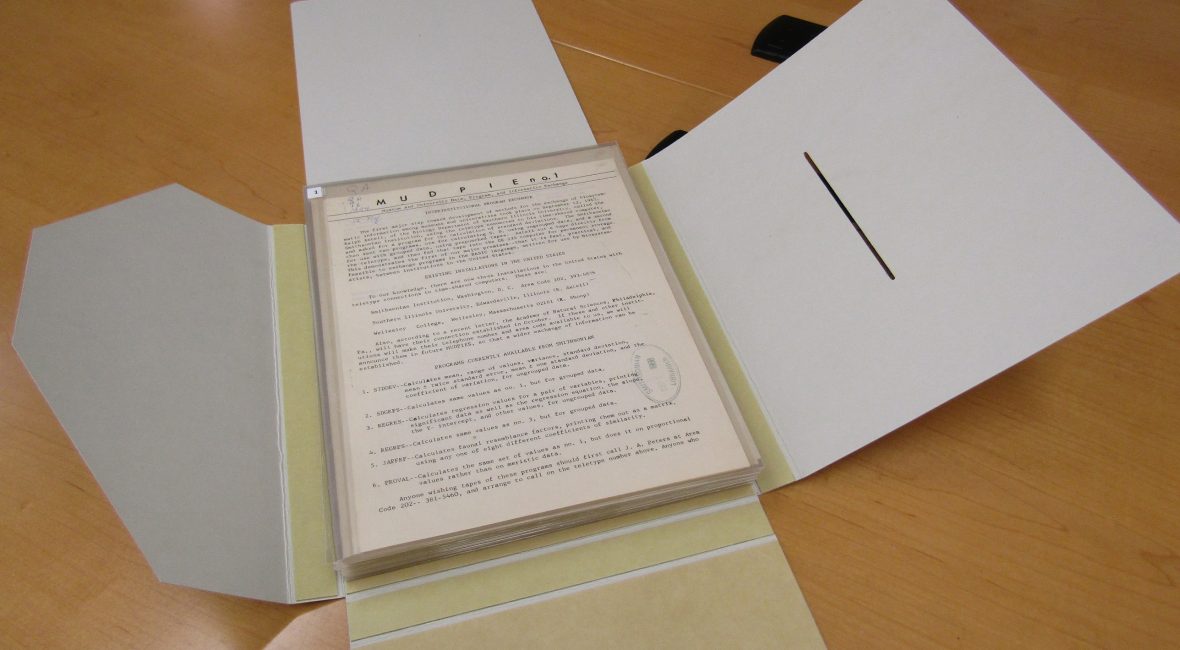
On September 12, 1967 Ralph Axtell, of the Biology Department of Southern Illinois University, called the Smithsonian Institution using the teletype connected to his time-shared computer and asked for a [computer] program for the calculation of standard deviations. The Smithsonian then sent him two computer programs. This demonstrated that, using data communications equipment and telephone lines, “it is fast, practical, and feasible to exchange programs in the BASIC language, written for use by biosystematists, between institutions in the United States.” A revolution had begun that would transform museums, research, systematics and science.

The following day Dr. James A. Peters produced the inaugural issue of the MUDPIE (Museum and University Data Program and Information Exchange) Newsletter.

MUDPIE newsletter documents many early events in the adoption of computers and timesharing computing in museums and universities, and was founded and produced by Dr. Peters, the only editor in the newsletter’s publication history. Twenty-six issues of MUDPIE were produced and distributed over a five-year period, between September 1967 and September 1972. All issues are now digitally available at the Biodiversity Heritage Library thanks to the Smithsonian Libraries.
Continue reading
November 15, 2018byDavid Bridge
Blog Reel, Featured Books

Unearthing Scientific History through Art: New Insights from the Archives of Lewis David von Schweinitz, the “Father of North American Mycology”

Read the full blog post

In 1805, the “Father of North American mycology”, Lewis David von Schweinitz (1780-1834), published an account of the fungi in Niesky, Germany with his friend and mentor, Johannes Baptista von Albertini (1769-1831). Documenting over 1,000 species, including 100 published as new-to-science, Conspectus fungorum in Lusatiae Superioris agro Niskiensi crescentium, e methodo Persooniana is still referenced to this day as a classic mycological text and ecological record.

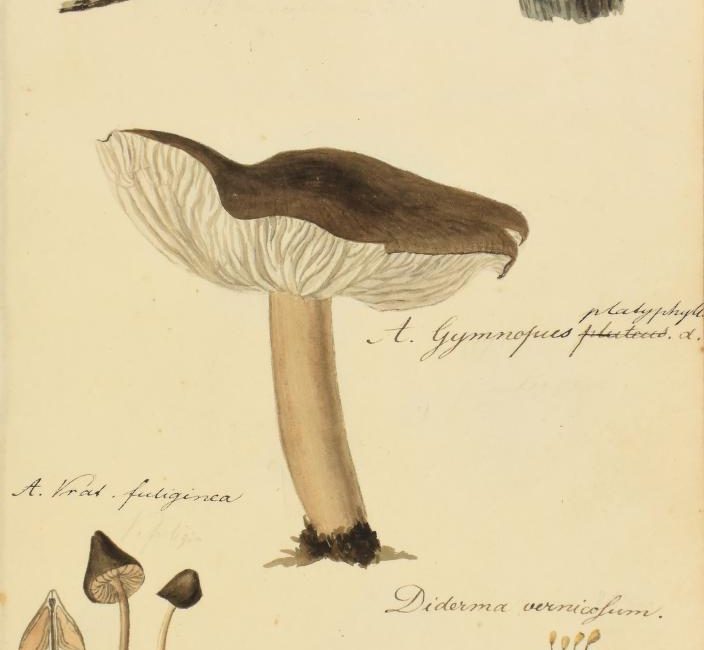
The Conspectus is illustrated with 12 hand-colored plates based on drawings by Schweinitz, each featuring 6-10 figures of new species described. Whenever possible, Schweinitz based his drawings on fresh specimens, but when this was not an option, he referred to fungarium specimens or to a collection of earlier watercolors he’d created of representative specimens.

Today, these watercolor volumes are dispersed between several American institutions and offer a wealth of insight into the history and development of the Conspectus. The earliest volume of original watercolors related to the Conspectus is the Icones Fungorum Niskiensium, created (ca.) 1798-1802 and held in the archives of the Farlow Reference Library of Cryptogamic Botany at Harvard University. This volume served Schweinitz as a sketchbook of sorts, which he used to inform the final paintings in the Conspectus itself.

Continue reading
November 1, 2018byGrace Costantino
Blog Reel

North American Mycological Association Shares Work on Fungi

Read the full blog post

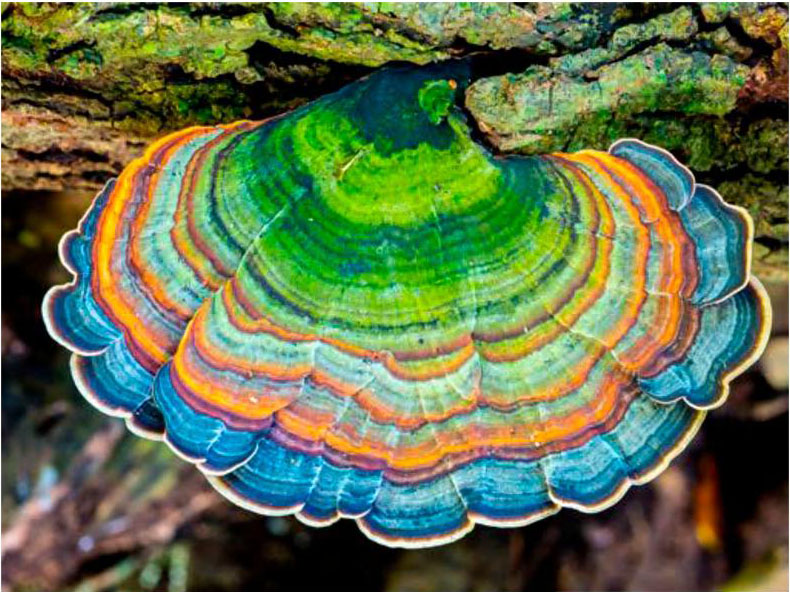
The North American Mycological Association (NAMA) could be described as a mutualism between citizen scientists and academics who share dedication to the study of fungi. Founded in 1967, the organization of volunteers collaborates with professional mycologists from academic centers. With over 80 affiliated clubs and 1,700 members in the United States, Canada and Mexico, NAMA’s initiatives cover a lot of ground.

In that spirit of collaboration and open access, NAMA licensed its journal McIlvainea (named for mycologist Charles McIlvaine of the epigraph) and newsletter The Mycophile to BHL as a part of the Expanding Access to Biodiversity Literature project, funded by the Institute of Museum and Library Services.

Continue reading
June 20, 2018byElizabeth Meyer
Blog Reel, User Stories

For the Love of Cider: Phenotyping Apples with Modern Techniques and Historic Texts

Read the full blog post

Dr. Gregory Peck, an Assistant Professor in the Horticulture Section of the School of Integrative Plant Science at Cornell University, has been assessing a large number of apple genotypes for their potential use in hard cider production. Through this work, he has discovered inconsistencies between many U.S. varieties and their original counterparts. He recently teamed up with Dr. Gayle Volk at the United States Department of Agriculture to uncover the truth behind these enigmatic cultivars.

“We employed DNA fingerprinting tools to confirm our suspicions that these were misnamed cultivars,” explains Peck. “But now we’re left with a mystery. What are the misidentified cultivars?”

As it turns out, it’s a mystery that the Biodiversity Heritage Library can help solve.

Continue reading
June 5, 2018byGrace Costantino
Blog Reel, User Stories

On Fish, Color, and Social Behavior: Connecting Current Research to Historical Scientific Studies through Open Access Archives

Read the full blog post

Social orders exist throughout the animal kingdom. Comprised of dominant and subordinate individuals, these orders dictate how members of a group interact, influencing everything from food access to mating privileges.

Sometimes, the behavior of the dominant individual is more extreme, and the “alpha” actively inhibits interactions between other members of the group. This sort of “monarchistic dominance” has been reported in male laboratory mice and African lions. The behavior is not restricted to mammals, however.

Continue reading
April 12, 2018byGrace Costantino
BHL News, Blog Reel

A Look at the 2018 BHL Annual Meeting in Los Angeles

Read the full blog post

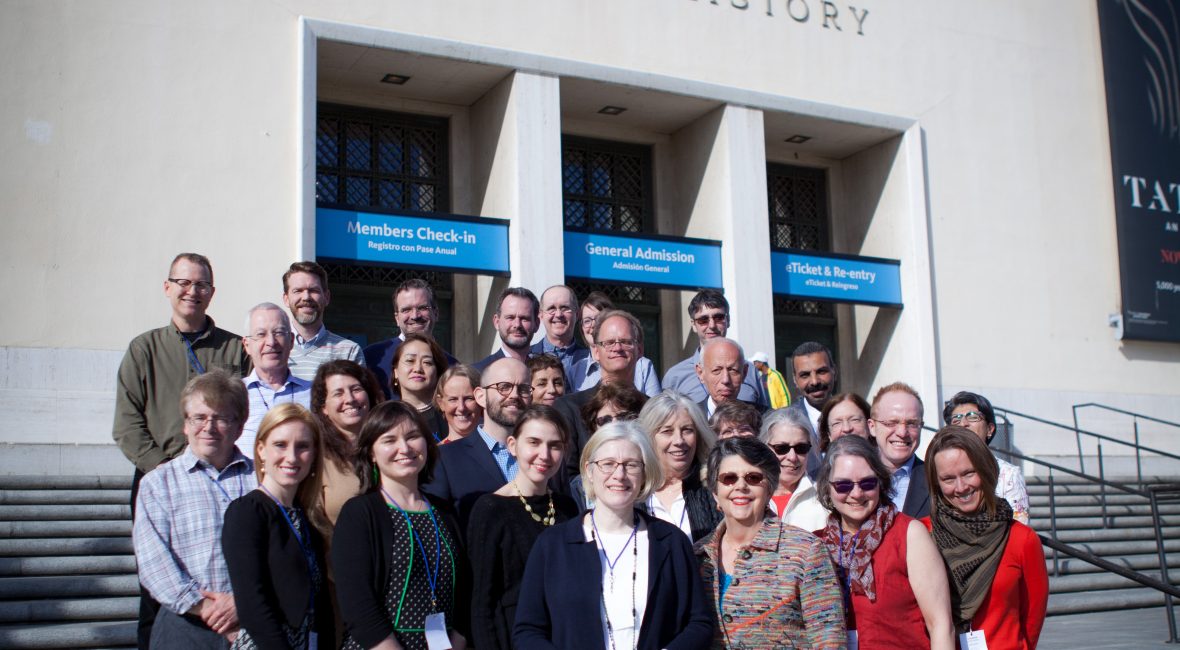
The 2018 BHL Annual Meeting was held in Los Angeles at the Natural History Museum of Los Angeles County and Los Angeles County Arboretum and Botanic Garden. The meeting was attended by 35 representatives of BHL partners from 11 countries.

Continue reading
April 9, 2018byMartin R. Kalfatovic
Blog Reel, Featured Books

Dr. Arthur Cronquist and his Botanical Field Notes

Read the full blog post

The LuEsther T. Mertz Library at the New York Botanical Garden is one of many partners on the Biodiversity Heritage Library Field Notes Project which was generously funded by the Council of Library and Information Resources (CLIR). As its contribution to the project, NYBG selected 91 field notebooks for digitization. Nine different collectors are represented in the selected volumes. The bulk of the selected volumes — a total of 61 — document the botanical collecting of Dr. Arthur Cronquist (1919-1992), a pre-eminent twentieth-century American botanist who spent most of his career at NYBG.

Continue reading
February 8, 2018bySusan Lynch
Page 4 of 13« First...«3456»10...Last »

Help Support BHL

BHL's existence depends on the financial support of its patrons. Help us keep this free resource alive!

search

About BHL

The Biodiversity Heritage Library (BHL) is the world’s largest open access digital library for biodiversity literature and archives. BHL operates as a worldwide consortium of natural history, botanical, research, and national libraries working together to digitize the natural history literature held in their collections and make it freely available for open access as part of a global “biodiversity community.”

Follow BHL

  • Bluesky logo
  • Instagram logo
  • Facebook logo
  • Flickr logo
  • Twitter logo

Join Our Mailing List

Sign up to receive the latest news, content highlights, and promotions.

Subscribe Now

Subscribe to Blog via Email

Enter your email address to subscribe to this blog and receive notifications of new posts by email.

Join 318 other subscribers

Subscribe to Blog Via RSS

Subscribe to the blog RSS feed to stay up-to-date on all the latest BHL posts.

Access RSS Feed

Inspiring Discovery through Free Access to Biodiversity Knowledge.

The Biodiversity Heritage Library makes it easier than ever for you to access the information you need to study and explore life on Earth…for free, anytime, anywhere.

64+ Million Pages of
Biodiversity Literature Online.

EXPLORE

Tools and Services
to Transform Research.

EXPLORE

300,000+
Illustrations on Flickr.

EXPLORE


ABOUT | BLOG AUTHORS | HARMFUL CONTENT | PRIVACY | SITE MAP | TERMS OF USE