Biodiversity Heritage Library - Program news and collection highlights from BHL
  • Home
  • News
  • Featured Books
    • All Featured Books
    • Book of the Month Series
    • BHL at 20
  • User Stories
  • Campaigns
    • Fossil Stories
    • Garden Stories
    • Monsters Are Real
    • Page Frights
    • Her Natural History
    • Earth Optimism 2020
  • Tech Blog
  • Visit BHL
Home
News
Featured Books
    All Featured Books
    Book of the Month Series
    BHL at 20
User Stories
Campaigns
    Fossil Stories
    Garden Stories
    Monsters Are Real
    Page Frights
    Her Natural History
    Earth Optimism 2020
Tech Blog
Visit BHL
  • Home
  • News
  • Featured Books
    • All Featured Books
    • Book of the Month Series
    • BHL at 20
  • User Stories
  • Campaigns
    • Fossil Stories
    • Garden Stories
    • Monsters Are Real
    • Page Frights
    • Her Natural History
    • Earth Optimism 2020
  • Tech Blog
  • Visit BHL
Biodiversity Heritage Library - Program news and collection highlights from BHL
Blog Reel, Campaigns, Featured Books, Garden Stories

“’Tis A Gift To Be Simple” But to Have a Splendid Garden Buy Shaker Seeds

View Full Size Image
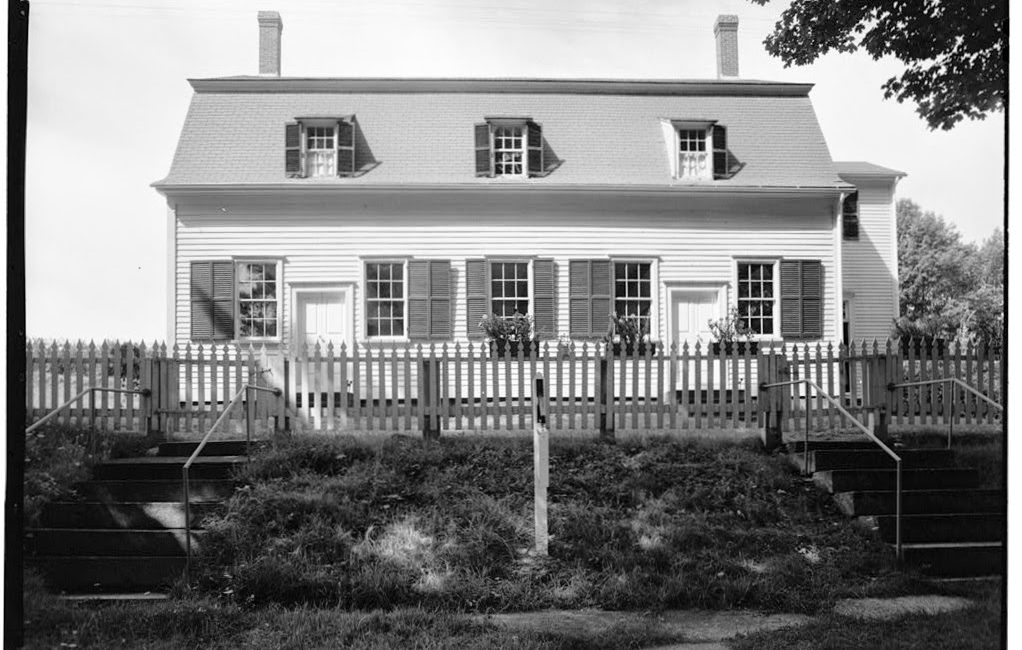
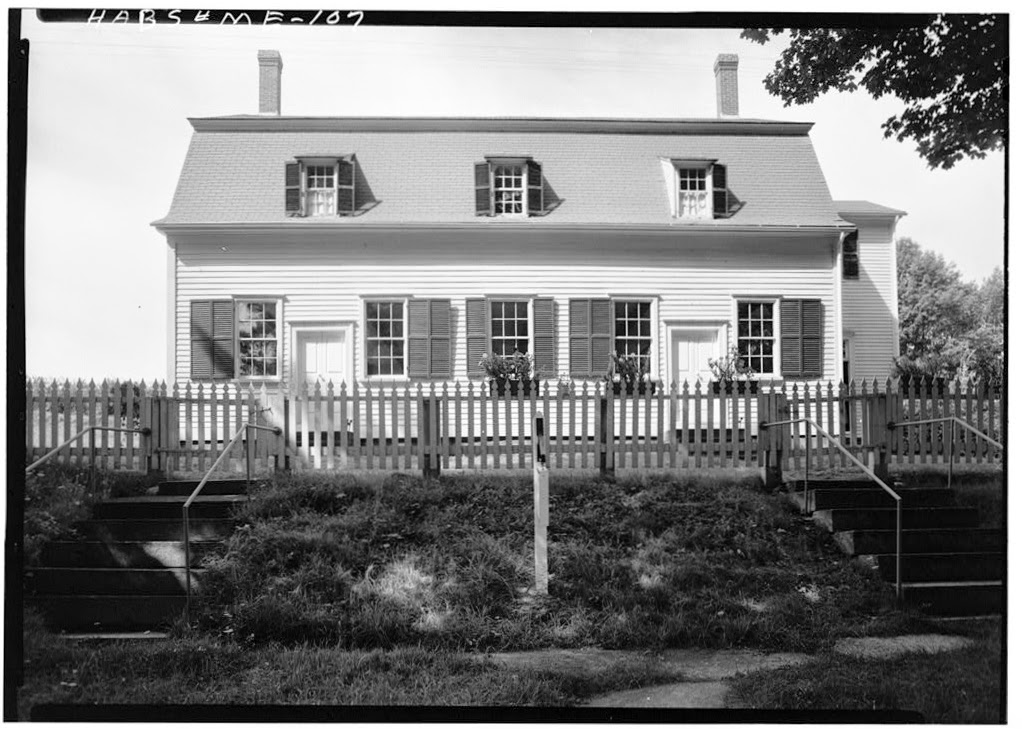
Sabbathday Lake Shaker Community Meetinghouse  (photo by Gerda Peterich for the Historic American Buildings Survey, Library of Congress Prints and Photographs Division; HAB SME,3-SAB,1—1)

The United Society of Believers in Christ’s Second Appearing, a religious sect commonly referred to as the Shakers, was founded in 18th-century England from a branch of the Quakers. Along with other newly formed devotional groups, they soon immigrated to colonial America. There they established as their economic foundation a variety of cottage industries that thrived throughout the 19th and into the early 20th centuries. Now known mostly for wonderfully simple architecture, austere but beautifully designed furniture and such functional objects as nesting oval boxes and baskets, members of the Shaker communities also once had booming garden and seed businesses. Their labor-intensive methods of working inevitably came to be overwhelmed by competition from industrial manufacturing as well as the problem of ever-shrinking membership, celibacy being one of their central tenets.
View Full Size Image
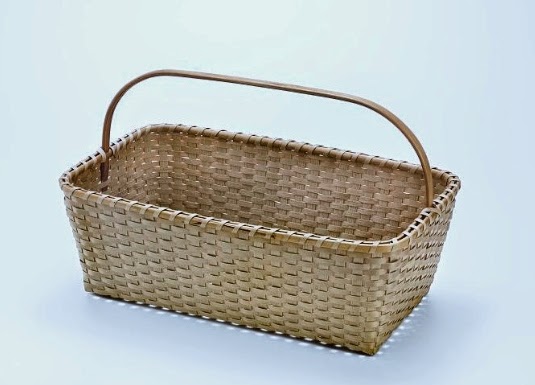
Shaker Carrier (by Sharon Dugan; Smithsonian American Art Museum, Gift of Martha G. Ware and Steven R. Cole; no. 2011.47.11)
The first fully organized Shaker community was New Lebanon in New York; by 1789, two years after its formation, the members cultivated seeds as a cash crop. This was the second earliest “company” to sell seeds in America. David Landreth & Son of Philadelphia was the first, in 1784, and that business traded back and forth with the Shakers. Another early dealer was Grant Thorburn in Philadelphia who wrote about the difficulty of obtaining seeds of good quality.
Other Shaker settlements, or “families,” soon followed in the seed-production business, including Watervvliet, New York; Hancock, Massachusetts; Enfield, Connecticut; Canterbury, New Hampshire; Alfred, Maine; and South Union, Kentucky, among several others. All were known for the excellence of their products and integrity of their business dealings. Devotion to God was expressed through their work ethic, hand labor and craftsmanship. The selling of goods was meant to raise funds only for needs the Shakers could not supply for themselves.

It is uncertain whether the Shakers were the first to put their seed products in small paper envelopes or packets, but they were the first to popularize their use. The Shaker Brothers printed millions of them on their presses, while the Sisters performed the labor of cutting, folding and pasting the papers. While believing in partnership in work and equality of the sexes, occupations tended to fall along traditional gender lines. The Brothers tilled the fields while the Sisters picked, sorted and packaged the seeds and herbs.
View Full Size Image
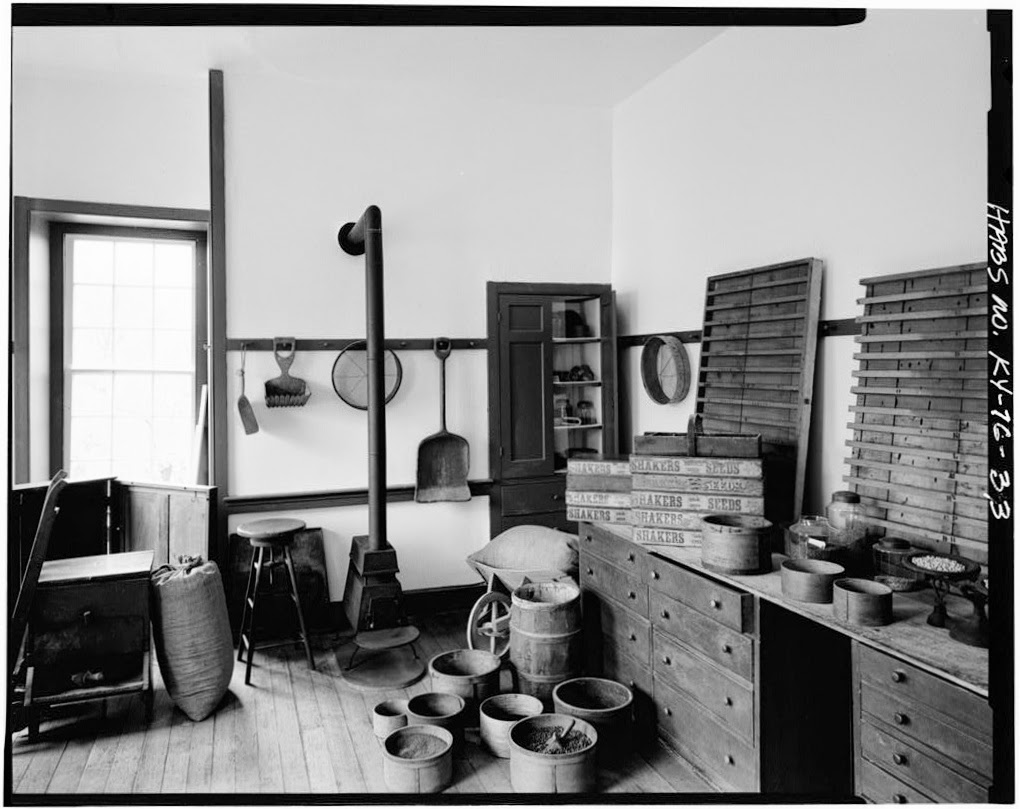
Seed Room, Shakertown, Kentucky (LC Prints & Photographs Division; HABS,84-SHAKT,2-33)

The Shakers were also early adopters of incorporating gardening manuals in their catalogs. Charles Crossman wrote ones in 1835 and 1836 for Mount Lebanon, Pittsfield and Watervilet, directing the wholesaler or the individual purchaser how best to plant the offered seeds. Instructions for storing and cooking bounties from the gardens were also sometimes given. Vegetables dominated the products but herbs and flowers as well as grass also appear in the lists. Crossman later left the Shakers and established his own company in Rochester, New York, which was just beginning to become the thriving horticultural center in the country.
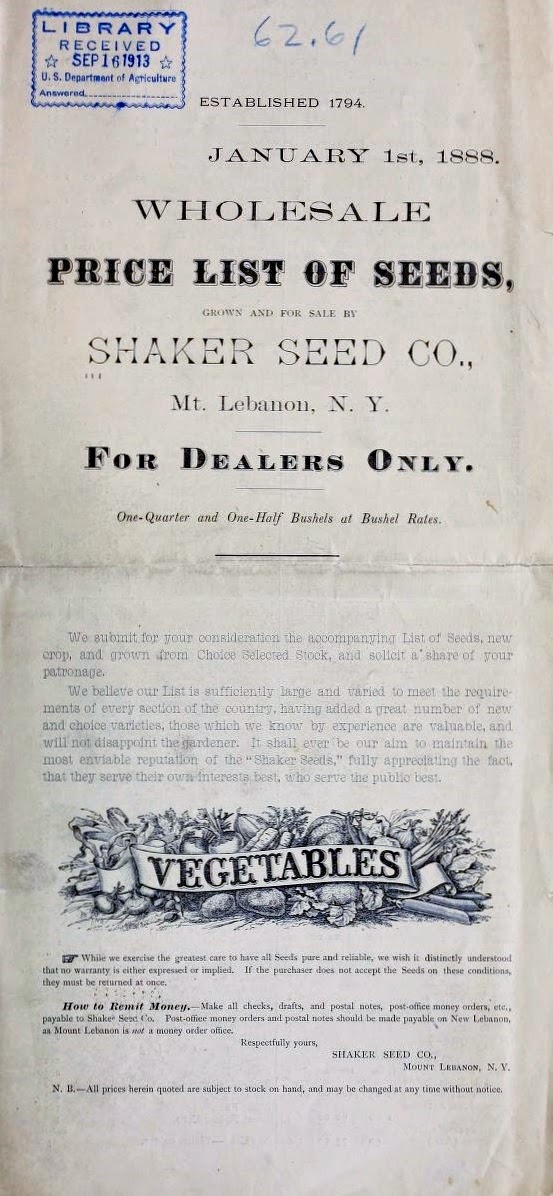
View Full Size Image
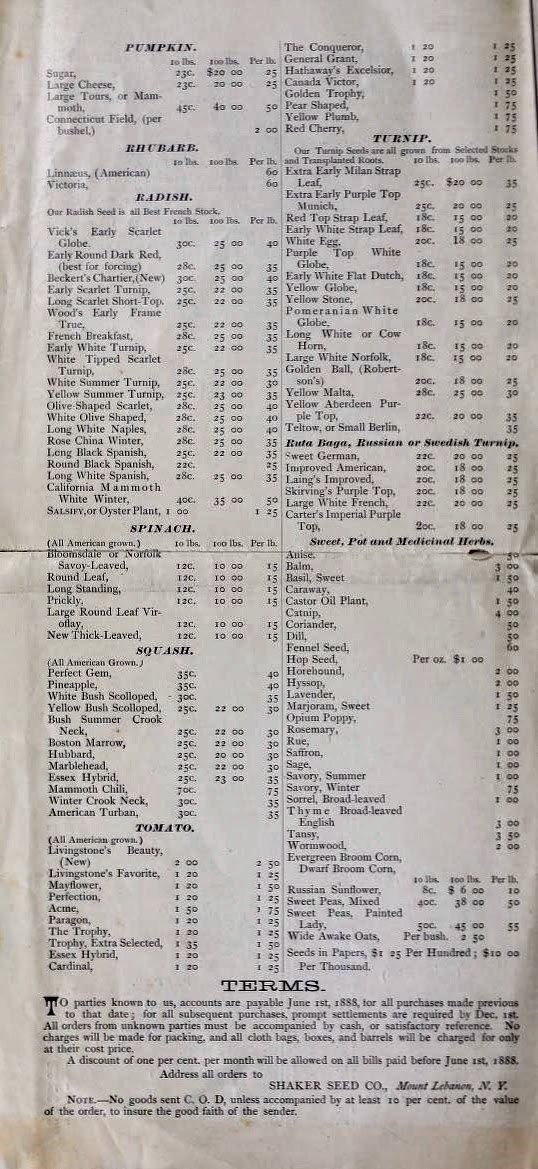
Wholesale price list of seeds by the Shaker Seed Company. New Lebanon, New York, 1888 (Henry G. Gilbert Nursery and Seed Trade Catalog Collection, National Agriculture Library; image from the Biodiversity Heritage Library)

As the Shaker seed business in the United States grew from 1840, printing firms outside of the communities were employed to keep up with demand. Correspondingly, advertisements and the design of the packets, begun first plain with simple chunky block type, were transformed to include the use of color papers and borders and eventually vivid chromolithography.

Following the Civil War, increased competition resulted in the Shakers’ using the word “genuine” in their advertising, as products from the communities were considered to be of the highest quality, their best selling point. They also used various and effective marketing techniques, including seed boxes meant to be displayed on the counters of country stores. The containers had compartments for assorted Shaker vegetable and flower seed packages, with a hinged lid to be propped open to display a broadside detailing the contents within, and a chromolithographic image of a bountiful harvest, promising the purchaser a similar reward.
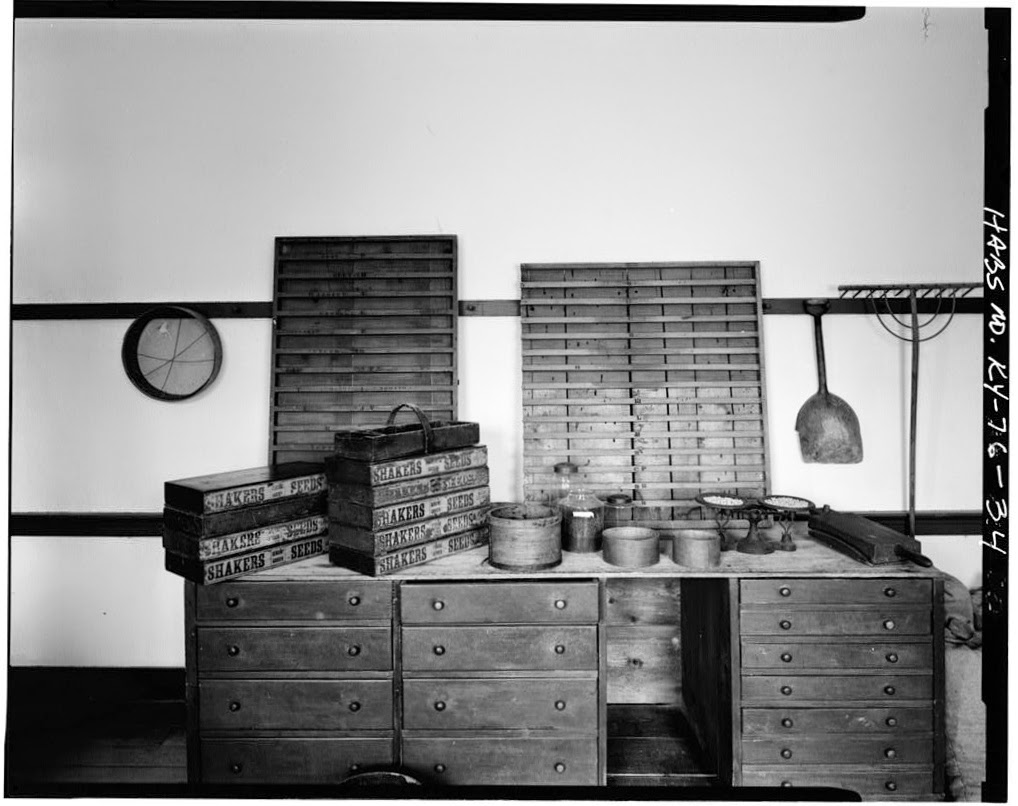
View Full Size Image
Seed Room with display containers, Shaker Centre Family Dwelling House, Shakertown, Mercer County, Kentucky (Library of Congress Prints and Photographs Division; HABS KY,84-SHAKT,2—34)

Other surviving ephemera record the once-thriving industry of seed, herbal, food, and medicinal products from the Shakers. Along with seed catalogs and the packets, mailing tags and envelopes, broadsides, receipts, invoices, billheads, and labels, give testament to their industry. Product labels include currant, grape, wild cherry, and blackberry wines. Far from being abstinent (except in the matter of sex), the Shakers made at least fourteen varieties of wine as well as distilled spirits. The religious group in their various communities was also at the forefront of selling medicinal herbs in the United States.

View Full Size Image
Shaker Digestive Cordial (A.J. White, New York, New York; National Museum of American History, no. 246707)

The changing world and market forces caused the Shaker seed industry to gradually peter out at the beginning of the 20th century. Increasing industrialization, growth of urban centers with ease of shipping and mailing to formally isolated villages, and overwhelming production from big companies, particularly in Philadelphia and Rochester, eliminated the communities’ wagon and sleigh seed routes for trading. With their firm spiritual beliefs and practices, the Shakers were not very competitive against aggressive business tactics.
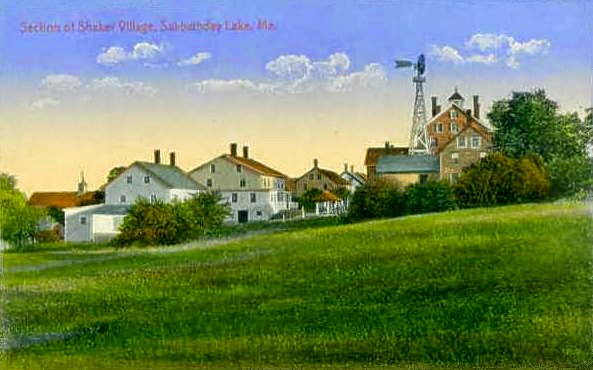
View Full Size Image
Postcard of the Shaker Village of Sabbathday Lake, Maine (ca. 1920; Wikimedia Commons)

At their peak in the mid-19th century there were about 6,000 “Shaking Quakers” so named because of their ecstatic behavior during worship services. Today, Sabbathday Lake Shaker Community, founded in 1783 in Maine, is the sole active survivor of the religion. A tree farm, an apple orchard and vegetable gardens are maintained, and hand-set printing is still practiced. The library there holds ephemera such as account records, recipes, catalogs and 1,380 labels printed by Shakers for their own products. They are living testament to the Shakers’ influence on the American seed and nursery industry and their permanent place in horticultural history—the early development of the new business, innovative techniques in marketing and education as well as the propagation and introduction of new varieties. The Sabbathday Shakers still sell herbs, and their catalog is online.
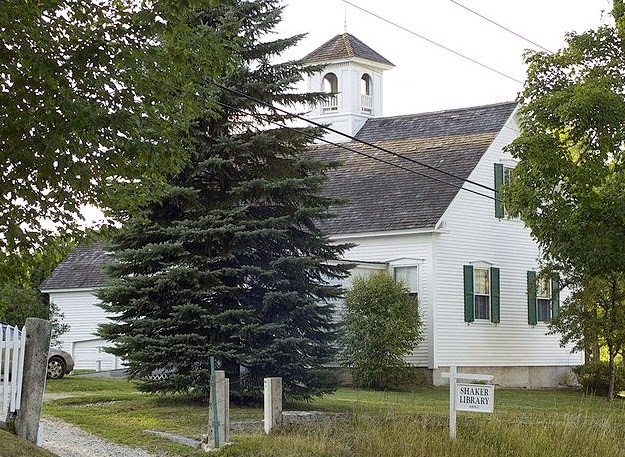
View Full Size Image
The Library of Sabbathday Village in New Gloucester, Maine (Wikimedia Commons, August 2010)
View Full Size Image
Wholesale price list of seeds by the Shaker Seed Company, Mount Lebanon, New York, 1888 (Henry G. Gilbert Nursery and Seed Trade Catalog Collection, National Agriculture Library)

More Garden Stories Fun

  • Follow our blog and #BHLinbloom on Twitter and Facebook (or go directly to BHL’s Twitter and Facebook) this week as we explore the fascinating world of gardening, from its history to plant factoids and practical gardening tips.
  • Browse over 14,000 seed and nursery catalogs in our collection.
  • Browse over 2,500 seed and nursery catalog images in our Flickr collection.
  • Explore select seed catalog art, and stunning bookmarks and postcards developed by Cornell Library, on Pinterest.
  • See historic gardening come to life on the Smithsonian Libraries’ Tumblr.
  • Purchase your very own Garden Stories T-Shirt through T-Fund. All proceeds will go to help us digitize more pages for BHL. Our goal is to sell enough shirts to digitized 5,000 pages. Can you help us get there?
  • Help us improve access to seed and nursery catalogs by transcribing some today as part of our the Institute of Museum and Library Services (IMLS)-funded Purposeful Gaming project!
  • Find great online gardening resources, tips, and help on the BHL Gardening Resources Page.
March 27, 2015by mckenzie.87
Blog Reel, Featured Books

Celebrating Oceans and Marine Biodiversity

50 Fish from American Waters (1870-1900). Allen and Ginter.

The Seafood Picture

View Full Size Image
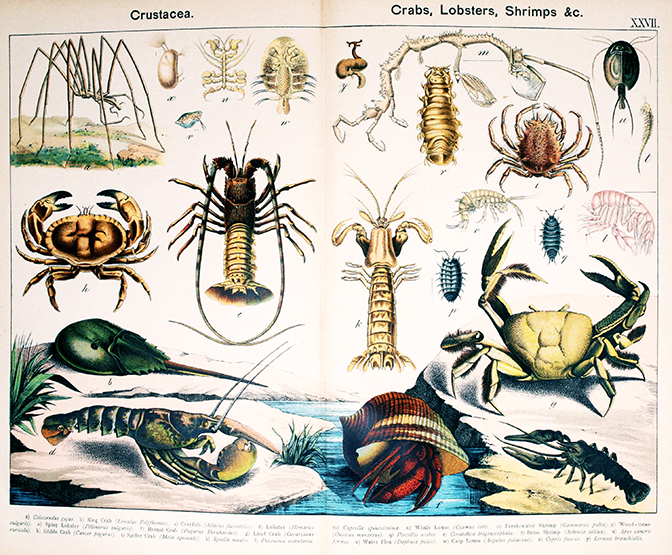
Shrimp (the most-consumed seafood in America) and other Crustaceans. Natural History of the Animal Kingdom for the Use of Young People.

This Saturday, June 8, is World Oceans Day, the UN-designated day for the global community to celebrate and take action to protect Earth’s oceans. 71% of the Earth’s surface is covered with water, and every living thing depends on water to survive. Sadly, according to the United Nations, with the world eating more seafood than ever before, approximately 2/3 of the ocean’s species are overfished.

According to NOAA, in 2009, Americans consumed 4.833 billion pounds of seafood – translating to 15.8 pounds of fish and shellfish per person. Approximately 50% of that seafood was wild-caught, and 50% was farm-raised.  The top ten most-consumed seafood in the U.S. in 2010 was:

  1. Shrimp (4.10 lbs)
  2. Canned Tuna (2.8 lbs)
  3. Salmon (1.84 lbs)
  4. Tilapia (1.34 lbs)
  5. Pollock (1.19)
  6. Catfish (0.92 lbs)
  7. Crab (0.61 lbs)
  8. Cod (0.44 lbs)
  9. Pangasius (0.43 lbs)
  10. Clams (0.341 lbs)
*lbs average per person

50 Fish from American Waters

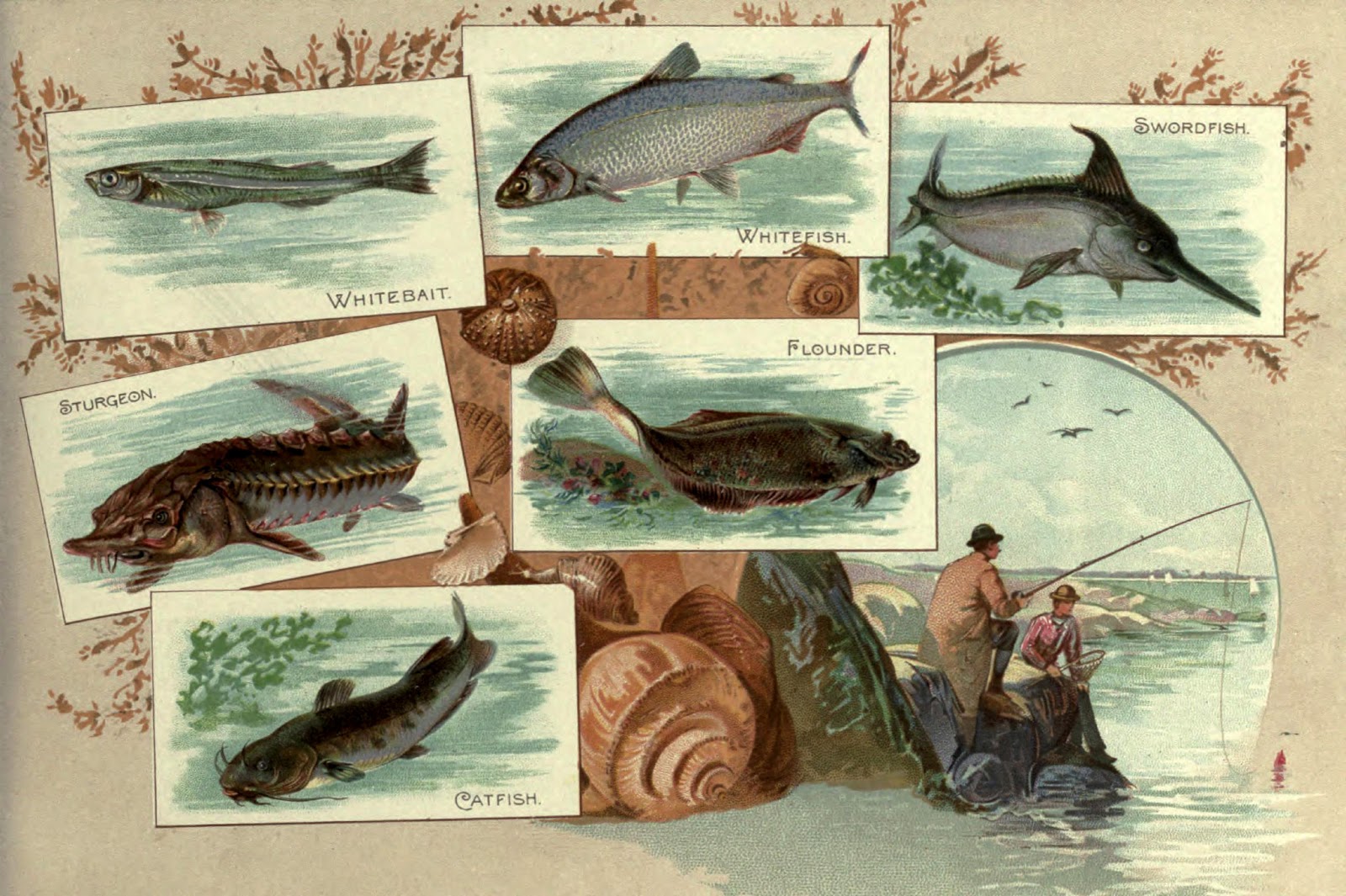
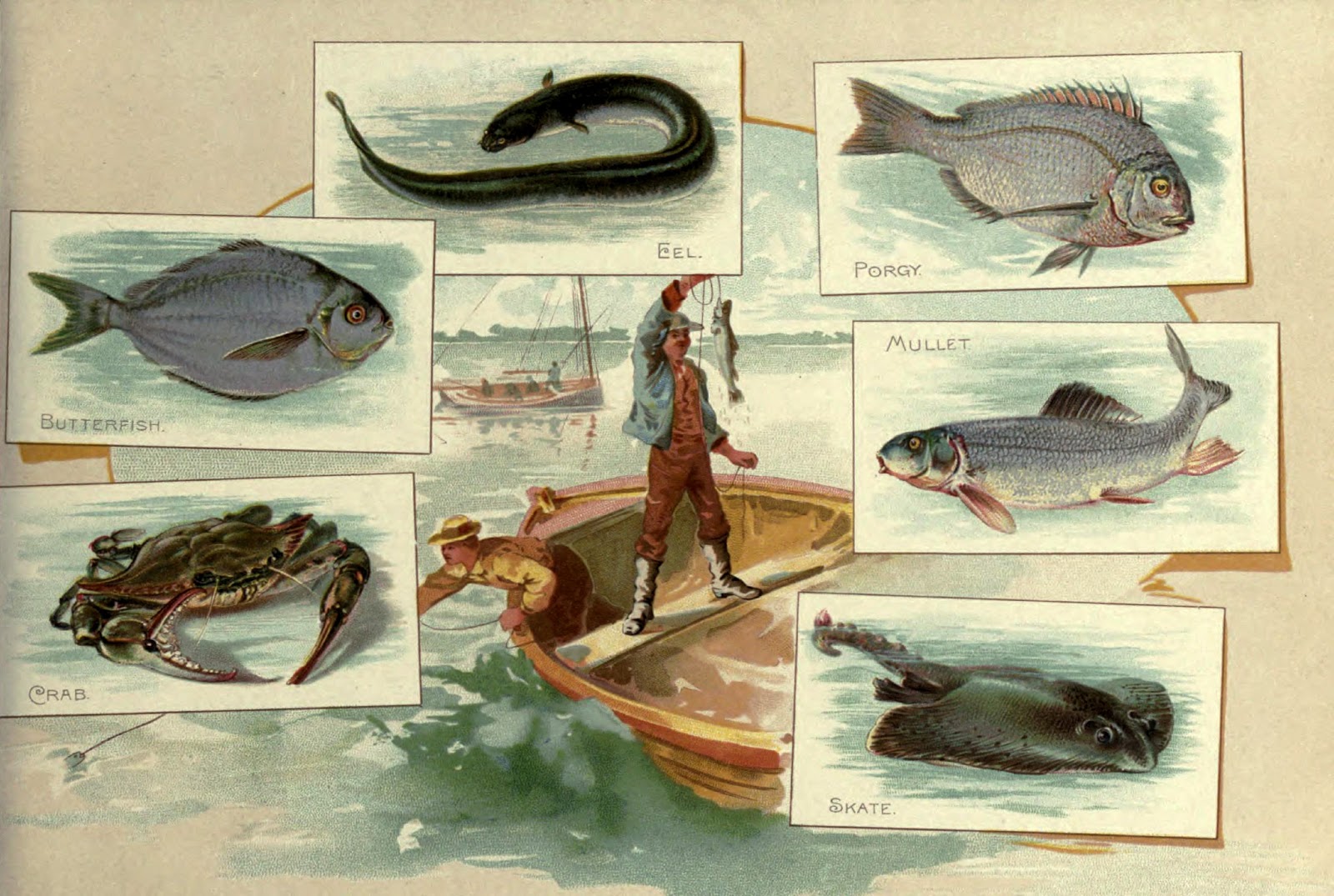
Have you ever wondered what marine species can be found in American waters? While not exhaustive, 50 Fish from American Waters is a pictorial work that presents a delightful collection of such species through illustrations.

Curiously, the fish illustrations in this book were originally published as individual cigarette cards for collecting and trading. The tobacco firm, Allen and Ginter of Richmond, Virginia, was the first firm to use tobacco trading cards as a means of advertisement in cigarette packages, and, between 1870-1900, select packages of Allen and Ginter Virginia Bright cigarettes contained one of the 50 varieties of American fish trading cards (see the poster advertising the cards from Library of Congress). All of the cards were later published in the book 50 Fish from American Waters.

View Full Size Image
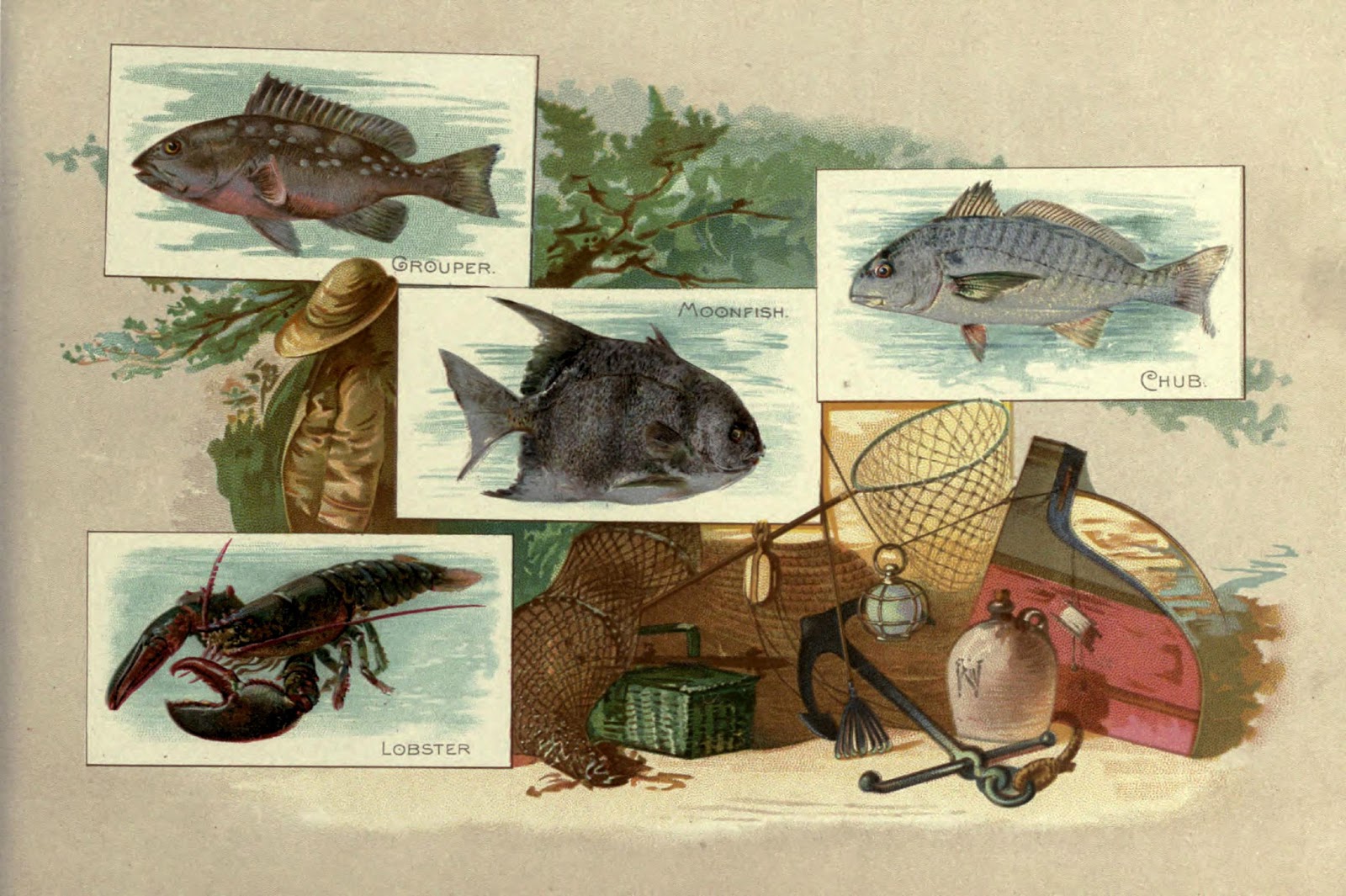
Lobster, Grouper, Moonfish, and Chub. 50 Fish from American Waters.
View Full Size Image
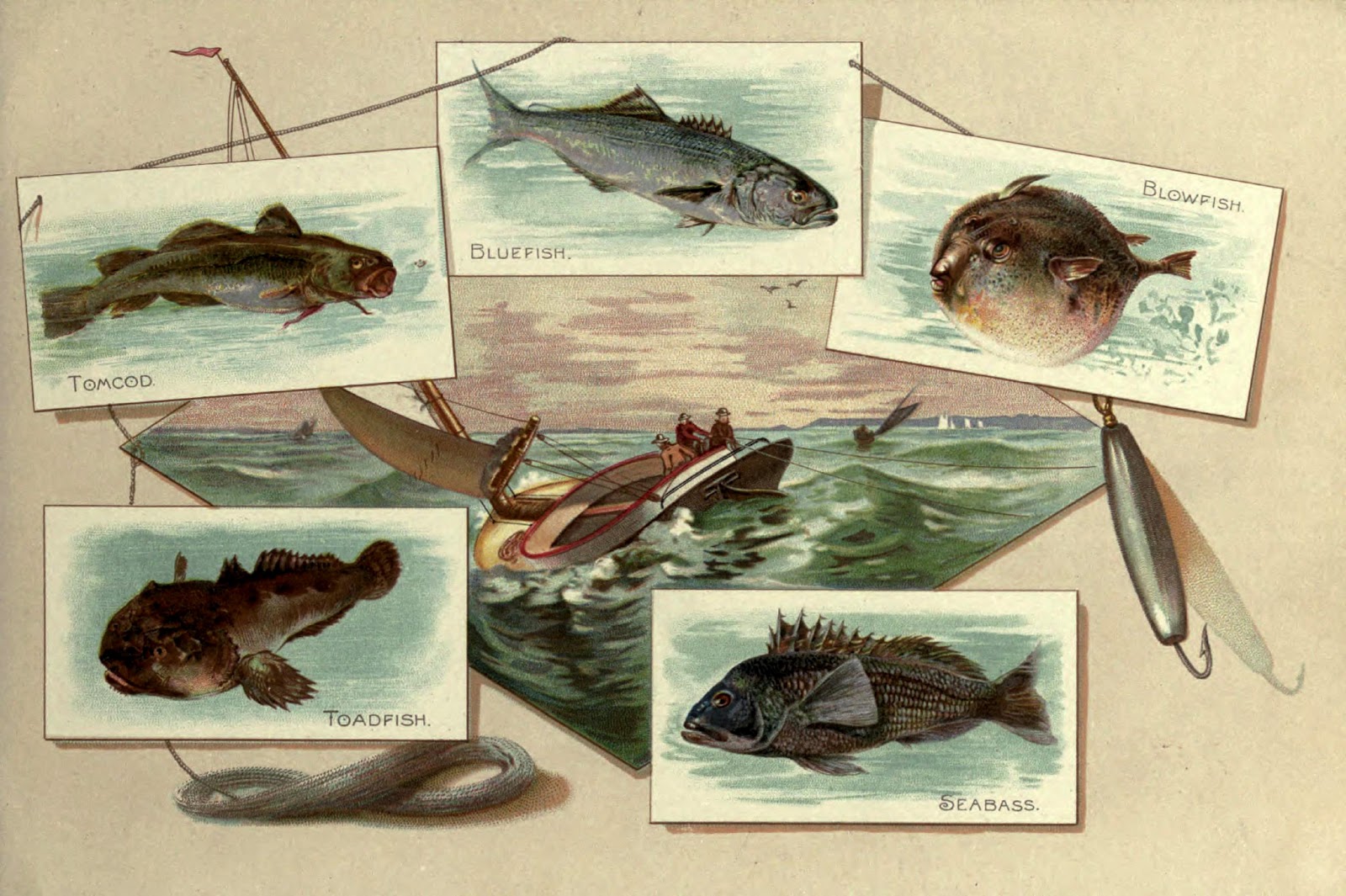
Tomcod, Bluefish, Blowfish, Toadfish, and Seabass. 50 Fish from American Waters.
View Full Size Image
Whitebait, Whitefish, Swordfish, Sturgeon, Flounder, Catfish. 50 Fish from American Waters.
View Full Size Image
Butterfish, Eel, Porgy, Mullet, Skate, Crab. 50 Fish from American Waters.

View all images from 50 Fish from American Waters in Flickr.

What can you do to help?

According to the ongoing The Ocean’s Project survey, most Americans care about the ocean and want to protect it, but many feel that they themselves can make little impact on the ocean’s health and, interestingly, that American waters are less imperiled that foreign waters. While these may be somewhat troubling responses, on the bright side, 22% of the 30,000+ people surveyed said that they are active in the environmental movement and 57% expressed sympathy but not active involvement. Most indicated a high willingness to alter their seafood consumption habits to help protect the oceans.

So, what can you do to help? Worldoceansday.org provides some great examples of small actions you can take to help protect our oceans, including reducing seafood consumption in general, using re-usable grocery bags and water bottles, choosing abundant, farmed, and locally-caught species, reducing meat consumption (which reduces the demand for forage fish), and choosing sustainable seafood buyers and sellers.

Marine Biodiversity and BHL

View Full Size Image
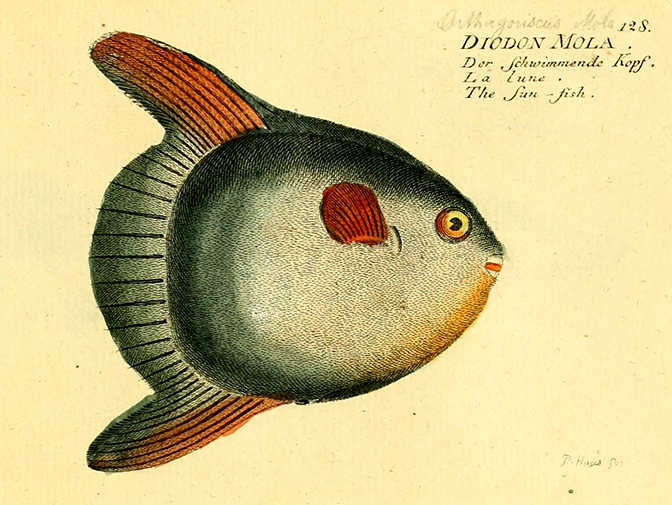
Ocean Sunfish. Ichthyologie.

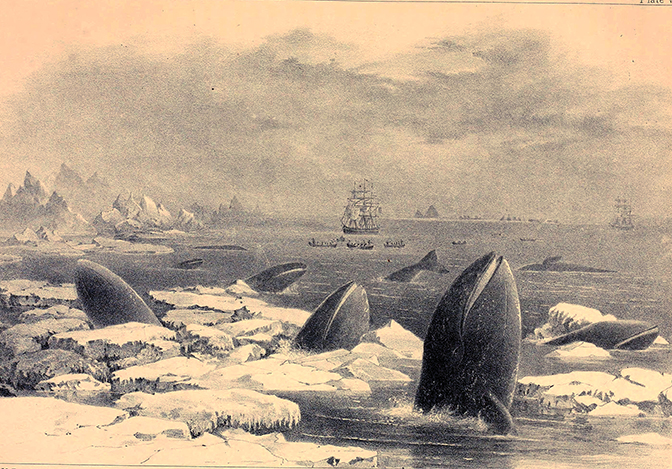
BHL is celebrating World Oceans Day by highlighting marine biodiversity on Facebook, Twitter, and Flickr.  For instance, did you know that the Gray Whale is more heavily infested with a greater variety of parasites than any other cetacean? Or that the Ocean Sunfish, the heaviest known bony fish, can grow up to 2300 kilograms, and that the Giant Oarfish, at up to 11 confirmed meters (and possibly 17 meters), is the world’s longest bony fish? Or that the adorable Common Blanket Octopus has been known to carry around tentacles of the Portuguese-Man-of-War as a defensive measure and means of capturing prey? Learn more about these species and get other watery factoids on Twitter and Facebook.

Be sure to check out our Marine Biodiversity Flickr collection with free images that you can download and reuse for your own World Oceans Day celebrations!

View Full Size Image
Gray Whales. The Marine Mammals of the North-west Coast of North America.

Are you a whale-lover? Then Smithsonian Libraries, one of BHL’s founding members, has an exhibit for you! Learn about whale research at the Smithsonian, and how research and fossils are translated into publications, in the new Whales: From Bone to Book exhibit at the National Museum of Natural History in Washington, D.C. Check out the books that support the exhibit in the BHL Collection and get fabulous whale illustrations in Flickr.

Remember, every living species requires water to survive, and our oceans play a huge part in our communal ecosystem. No matter where you live, your local water will eventually make its way to the ocean. We each have a responsibility to protect our oceans. Together, we can make a difference!

  • Find some World Oceans Day events near you.
  • Get some great promotional materials for World Oceans Day.
  • You can even get free Dr. Seuss-themed World Oceans Day materials!
June 6, 2013by ulib-libraryjobs

Help Support BHL

BHL's existence depends on the financial support of its patrons. Help us keep this free resource alive!

search

About BHL

The Biodiversity Heritage Library (BHL) is the world’s largest open access digital library for biodiversity literature and archives. BHL operates as a worldwide consortium of natural history, botanical, research, and national libraries working together to digitize the natural history literature held in their collections and make it freely available for open access as part of a global “biodiversity community.”

Join Our Mailing List

Sign up to receive the latest news, content highlights, and promotions.

Subscribe Now

Subscribe to Blog via Email

Enter your email address to subscribe to this blog and receive notifications of new posts by email.

Join 319 other subscribers

Subscribe to Blog Via RSS

Subscribe to the blog RSS feed to stay up-to-date on all the latest BHL posts.

Access RSS Feed

Inspiring Discovery through Free Access to Biodiversity Knowledge.

The Biodiversity Heritage Library makes it easier than ever for you to access the information you need to study and explore life on Earth…for free, anytime, anywhere.


64+ Million Pages of
Biodiversity Literature Online.

EXPLORE

Tools and Services
to Transform Research.

EXPLORE

300,000+
Illustrations on Flickr.

EXPLORE

ABOUT | HARMFUL CONTENT | PRIVACY | SITE MAP | TERMS OF USE