Biodiversity Heritage Library - Program news and collection highlights from BHL
  • Home
  • News
  • Featured Books
    • All Featured Books
    • Book of the Month Series
    • BHL at 20
  • User Stories
  • Campaigns
    • Fossil Stories
    • Garden Stories
    • Monsters Are Real
    • Page Frights
    • Her Natural History
    • Earth Optimism 2020
  • Tech Blog
  • Visit BHL
Home
News
Featured Books
    All Featured Books
    Book of the Month Series
    BHL at 20
User Stories
Campaigns
    Fossil Stories
    Garden Stories
    Monsters Are Real
    Page Frights
    Her Natural History
    Earth Optimism 2020
Tech Blog
Visit BHL
  • Home
  • News
  • Featured Books
    • All Featured Books
    • Book of the Month Series
    • BHL at 20
  • User Stories
  • Campaigns
    • Fossil Stories
    • Garden Stories
    • Monsters Are Real
    • Page Frights
    • Her Natural History
    • Earth Optimism 2020
  • Tech Blog
  • Visit BHL
Biodiversity Heritage Library - Program news and collection highlights from BHL
Blog Reel, User Stories

Basionyms, Synonyms, Authorities: Tracking the Names of Macro- and Micro Algae Through Time

Portrait version of the Biodiversity Heritage Library logo.

As part of our BHL & Our Users series, we recently caught up with Dr. Roberta Cowan, a specialist in Phycology (taxonomy) and information management. Over the last 19 years, Dr. Cowan has been actively involved in nomenclatural work, notably for Australian algal species.  Dr. Cowan was kind enough to provide some background on her work and the role BHL has played in making that work both quicker and easier over the years.

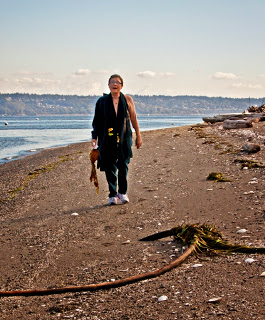
Roberta Cowan, PhD 
View Full Size Image
Dr. Cowan collecting on Whidbey Island,
Washington State 

In the 1980s a number of countries had nomenclatural plant databases. There was the famous Index Kewensis from Royal Botanic Gardens, Kew  and the Gray Cards from the Harvard University Herbaria. In Australia the Australian Plant Name Index (APNI) was being prepared. In the early 1990s proposals were put forward to the Australian Government to create a database for the marine macroalgae (Australian Marine Algal Name Index, AMANI) and the freshwater algae. Later the marine microalgae were included in AMANI. All of this information is now being updated and transferred to the Atlas of Living Australia (ALA).

I began work on AMANI in 1994. At that time, in order to check the accuracy of information regarding binomials cited in literature about Australian algae the original literature had to be sourced via the inter-library loan system. By definition much of the literature was contained in monographs and journal runs that were considered rare by the lending library. This invariably meant that the item was not available for photo-copying. Often the full bibliographic details for original literature was not entirely clear and so a ‘catch 22’ situation occurred in that an item may well be sourced to a particular library but could not be copied until the full bibliographic detail was supplied. The detail could only be supplied by accessing the item. Access to the item therefore had to wait until I could travel to the lending library. This meant waiting until travel to the libraries on the other side of Australia–or the other side of the planet–could be afforded.

In 2007, with the founding of the Biodiversity Heritage Library the problems of access and the problems of confirming bibliographic details became increasingly rare. My work changed from submitting inter-library loan forms and waiting for weeks for a requested item to arrive to searching BHL, selecting the item for download, filling in the information: title, author, keywords and waiting a very short time for the pdf to appear via a link in an email.

I am presently editing the algal data relevant to the nomenclature of all names cited in Australian taxonomic literature and all taxonomic literature citing Australian algal names for the Atlas of Living Australia. BHL is one of my most important tools.
December 17, 2013by sayeedmd
Blog Reel, Featured Books

Book of the Week: Stop and Smell the…Algae?

Take a deep breath. Ahhhhhh. Now take another.

View Full Size Image
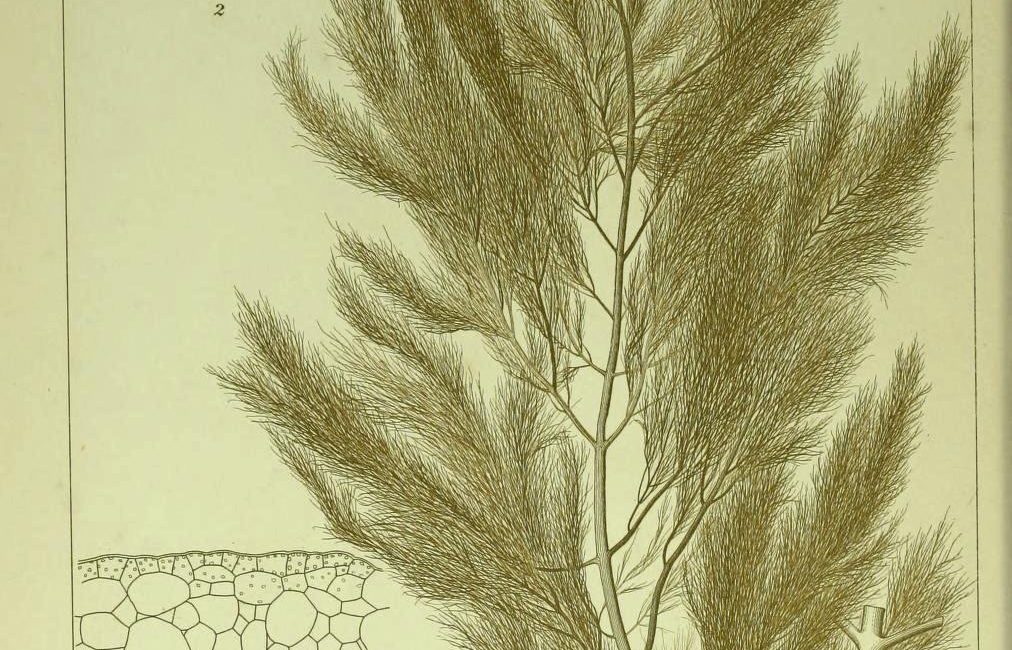
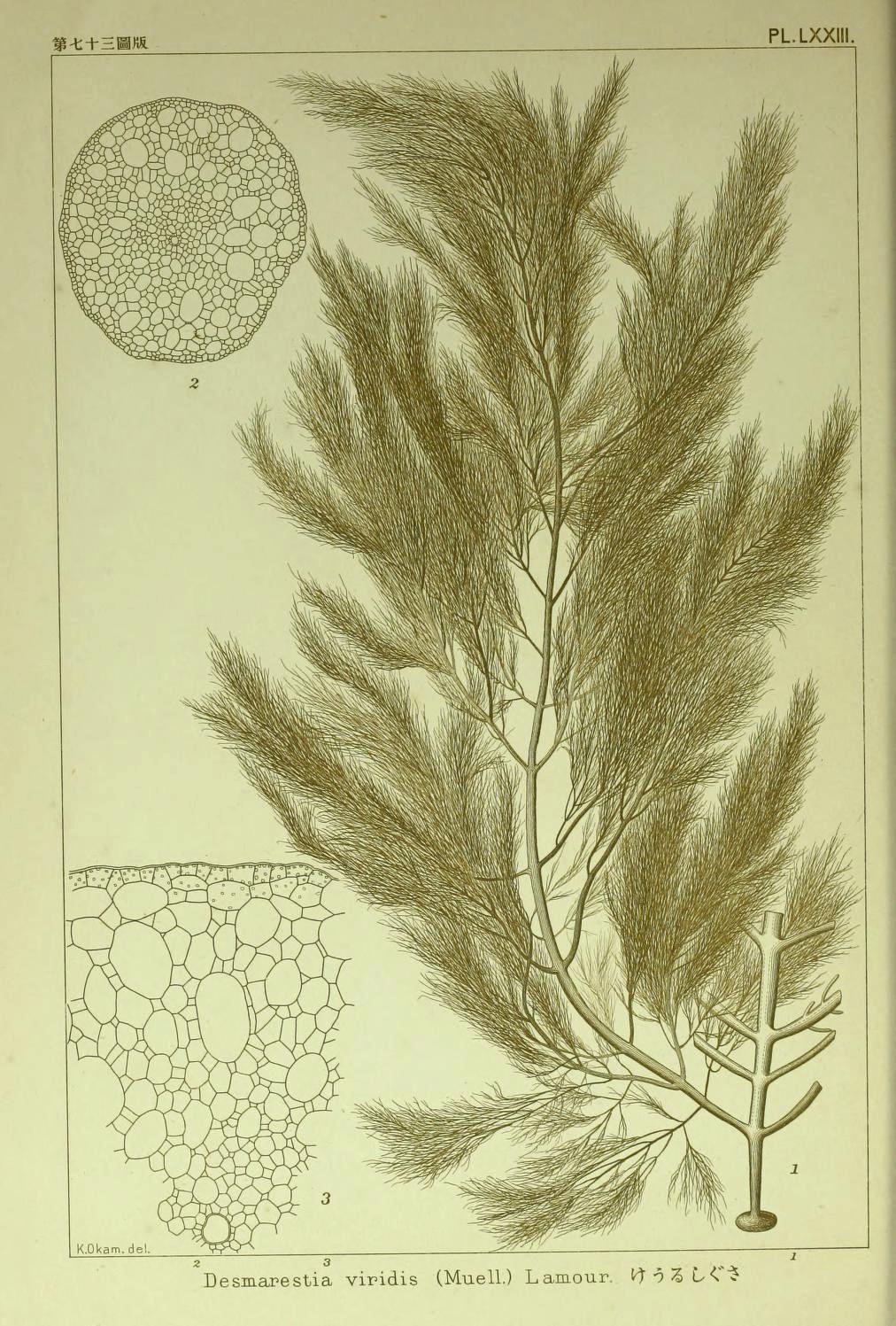
Desmarestia viridis

Did you know that every second breath you take, you owe to the ocean? Yes, it’s true: the ocean produces more than half of the planet’s oxygen supply which accounts for one out of every two human breaths. More specifically, we owe gratitude to microscopic phytoplankton. These varieties of algae are atrophic organisms, able to produce their own food via photosynthesis. Oxygen is a major by-product of this fascinating process that transforms sunlight into food therefore, algae underpins ALL earth’s ecosystems and life on earth.

Algae may be one of the most altruistic lifeforms I’ve ever heard of. Can you imagine being able to create your own food just by absorbing the sun’s rays and on top of that creating the very oxygen that sustains life? Algae why are you so good to us?

So this week, let’s pay homage to this unassuming and oft overlooked life-form and give it the proper credit it deserves. After all, without algae we wouldn’t be here today.  We are pretty sure that Kintaro Okamura (1867-1935), a famous Japanese algologist from the Meiji Era knew how critical algae organisms are to our continued existence. He was so beloved in Japan for his work on algae that the Japanese Emperor and government conferred on him the Decoration of the Third Class of the Order of the Sacred Treasure. Quite the honor.

It is clear that this man had an intense love affair with algae! Over the course of his career, he self-published a series titled Nihon sorui zufu; english translation: Icones of Japanese Algae, which is this week’s book of the week. You can thank our partner institution the MBLWHOI Library at Woods Hole, Mass. for this wonderful contribution to our beloved, ever growing digital library.

And fret not, if you don’t speak Japanese because Okamura includes all of the taxonomic names and important details in Japanese as well as English. What a champ!

You can also view the illustrations from Icones of Japanese Algae v. 2 in Flickr.

If you are ravenous for more Japanese algae, check out Okamura’s seminal work, Nihon kaisozusets or Illustrations of the marinealgae of Japan, digitized by Smithsonian Libraries.

5 Fun Algae Facts

We’re pretty sure Okamura would want you to know as much about algae as possible so, that you too might come to appreciate and value its complexity, diversity, and role as a foundational building block in the planet’s food chain, i.e., its status as a Primary Producer.

View Full Size Image
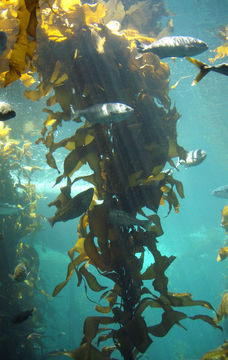
Macrocystis pyrifera*

Algae produces about 330 billion tons of oxygen each year.

2.4 billion years ago marks the Great Oxidation Event — the beginning of photosynthesis.  It took another couple hundred million years for enough oxygen to build-up in the atmosphere to support complex life.

The earth’s tallest forests are not on land but, in the ocean. Giant kelp forests, Macrocystis pyrifera, can reach 100 meters (328 feet) in height.

In the future, algae may become a major source of food and fuel. In fact the Navy is already purchasing algae biofuels.

Various types of algae are being studied and used to create anti-cancer drugs.

Why should we take care of the ocean, home of our algae friends?

If you aren’t already convinced of algae’s vital importance to humankind, last May, in the wake of thedevastation caused by the Deep Water Horizon oil spill in the Gulf of Mexico, Barack Obama decreedthat the upcoming month of June will be National Oceans Month. Obama wasn’t the first president to understand the vital role that the ocean plays for all Americans:

Among President John F. Kennedy’s many famous quotes were these:

View Full Size Image
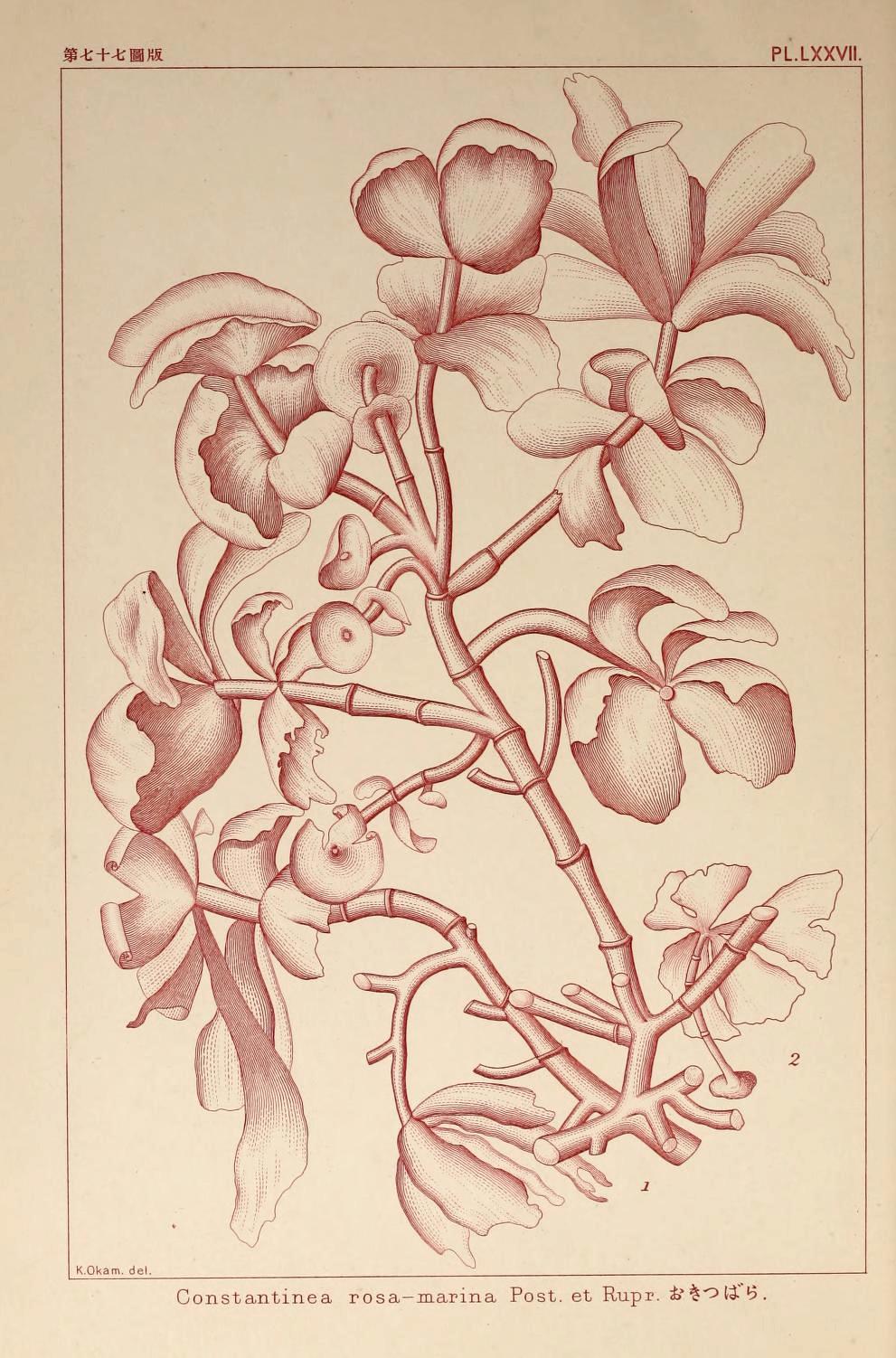
Constantinea rosa-marina

“Knowledge of the oceans is more than a matter of curiosity. Our very survival may hinge upon it.” – John F. Kennedy, Jr., March 1961 message to Congress.

And a year later he said this…

 “All of us have in our veins the exact same percentage of salt in our blood that exists in the ocean, and, therefore, we have salt in our blood, in our sweat, in our tears. We are tied to the ocean. And when we go back to the sea — whether it is to sail or to watch it — we are going back from whence we came.”– John F. Kennedy, Jr., September 1962, Speech given at Newport

So in the spirit of JFK, ask not what the ocean can do for you – ask what you can do for the ocean and its algae citizens.

In June, look for more posts about the ocean and the wondrous life contained therein!

May 17, 2012by [email protected]

Help Support BHL

BHL's existence depends on the financial support of its patrons. Help us keep this free resource alive!

search

About BHL

The Biodiversity Heritage Library (BHL) is the world’s largest open access digital library for biodiversity literature and archives. BHL operates as a worldwide consortium of natural history, botanical, research, and national libraries working together to digitize the natural history literature held in their collections and make it freely available for open access as part of a global “biodiversity community.”

Join Our Mailing List

Sign up to receive the latest news, content highlights, and promotions.

Subscribe Now

Subscribe to Blog via Email

Enter your email address to subscribe to this blog and receive notifications of new posts by email.

Join 319 other subscribers

Subscribe to Blog Via RSS

Subscribe to the blog RSS feed to stay up-to-date on all the latest BHL posts.

Access RSS Feed

Inspiring Discovery through Free Access to Biodiversity Knowledge.

The Biodiversity Heritage Library makes it easier than ever for you to access the information you need to study and explore life on Earth…for free, anytime, anywhere.


64+ Million Pages of
Biodiversity Literature Online.

EXPLORE

Tools and Services
to Transform Research.

EXPLORE

300,000+
Illustrations on Flickr.

EXPLORE

ABOUT | HARMFUL CONTENT | PRIVACY | SITE MAP | TERMS OF USE