Biodiversity Heritage Library - Program news and collection highlights from BHL
  • Home
  • News
  • Featured Books
    • All Featured Books
    • Book of the Month Series
    • BHL at 20
  • User Stories
  • Campaigns
    • Fossil Stories
    • Garden Stories
    • Monsters Are Real
    • Page Frights
    • Her Natural History
    • Earth Optimism 2020
  • Tech Blog
  • Visit BHL
Home
News
Featured Books
    All Featured Books
    Book of the Month Series
    BHL at 20
User Stories
Campaigns
    Fossil Stories
    Garden Stories
    Monsters Are Real
    Page Frights
    Her Natural History
    Earth Optimism 2020
Tech Blog
Visit BHL
  • Home
  • News
  • Featured Books
    • All Featured Books
    • Book of the Month Series
    • BHL at 20
  • User Stories
  • Campaigns
    • Fossil Stories
    • Garden Stories
    • Monsters Are Real
    • Page Frights
    • Her Natural History
    • Earth Optimism 2020
  • Tech Blog
  • Visit BHL
Biodiversity Heritage Library - Program news and collection highlights from BHL
Blog Reel, User Stories

Understanding BHL Through Metadata: Patterns of Bio-Diverse Knowledge Production

Global map showing places of publication in LAC dataset

During my time as an intern for the Biodiversity Heritage Library (July-August 2021), I worked on a project, I hope, will help engender important and critical conversations around the Library’s work and responsibilities vis-á-vis the sometimes harmful and problematic origins of its materials, as well as around the possibilities for the decolonization of its collection and archival practices. By focusing on the case of Latin America and her biodiversity, the main goal of this project was to identify patterns in the metadata of BHL’s collection that can inform decolonial policies and strategies for the diversification of the Library’s catalogue.

To identify such patterns, I extracted and analyzed the metadata of materials that include a subject related to Latin America in their subject lists. These analyses shed important light on diversification issues, specifically in the case of this region. The first part of this project was to perform subject-based extractions from BHL’s collection. Following a similar methodology to that of Chris Freeland (Freeland, steps 1–3), I extracted all records from BHL’s online datasets[i] (as of July 1st, 2021[ii]) that included specific subjects[iii] to build five subsets:

  1. Greater Regions (GR) subset. This subset incorporates all BHL records (4465 total[iv]) that include one of the following subjects—all of which refer to Latin America as a whole or in subcontinental terms—in their subject list: Latin America, Central America, South America, West Indies.
  2. Latin American Countries (LAC) subset. This subset incorporates all BHL records (6801 total) that include the name of at least one Latin American country—except Mexico—in their subject list: Argentina, Belize, Bolivia, Brazil,[v]British Guiana, Chile, Colombia, CostaRica/Costa-Rica, Ecuador, El Salvador, French Guiana, Guatemala, Guiana/Guyana, Honduras, Nicaragua, Panama, Paraguay, Peru, Surinam/e, Uruguay, Venezuela.
  3. Mexico (MEX) subset. This subset incorporates all BHL records (2995 total) that include the subjects Mexico; Mexico, North; and/or Mexico, Northern in their subject lists. Mexico was treated as a separate subset given that a large portion of materials about Mexican biodiversity in BHL comes from the BHL México project. Thus, considering these materials as a separate subset can illuminate the impact of global collaboration in the diversification of the Library’s collection.
  4. Indigenous Peoples – General (IP-G) subset. This subset incorporates all BHL records (1052 total) that include one of the following subjects—all of which refer to Latin American Indigenous peoples in generalizing/homogenizing terms—in their subject list: Indians of Central America, Indians of Mexico, Indians of South America, Indians of the West Indies. Although of a different nature, the subjects Aztecs and Incas are also included in this subset, as they refer to the Indigenous empires that existed at the arrival of European colonizers in the Americas but that no longer exist and were conglomerates of several Indigenous groups of these regions.
  5. Indigenous Peoples – Specific (IP-S) subset. This subset incorporates all BHL records (135 total) that include one of the following subjects—all of which refer to specific Latin American Indigenous peoples—in their subject list: Carib Indians, Choco Indians, Cuna Indians, Diaquita Indians, Goajiro Indians, Huichol Indians, Kickapoo Indians, Mapuche Indians, Mayas, Mayoruna Indians, Mojo Indians, Shipibo-Conibo Indians, Taino Indians, Tairona Indians, Tarahumara Indians, Yahgan Indians.

Once the subsets were created, from the different BHL datasets available online and using Microsoft Access, I extracted specific information for each of the records included in these subsets:[vi] title ID (used as primary key), full title, author, holding institution, year of publication (including start and end year of publication for periodicals), publication details, language, title URL, and the subject they include to be part of the subset.

The next step of this project was to prepare the data, especially for geolocation. In this regard, it is important to mention that BHL’s metadata do not have separate categories for place of publication and publisher. On the contrary, these two are included under the category Publication details, which sometimes includes the year of publication as well. Therefore, to understand the geopolitical affiliations of the records included in each subset, I cleaned the data[vii] to have a separate category for place of publication. In some cases, this required the modernization and/or translation of place names, given that BHL’s metadata often include publication information in the original language and format of the material. For example, the publication details of a volume of José de Acosta’s Historia natural y moral de las Indias (included in the LAC subset) read “Impresso en Seuilla :en casa de Iuan de Leon.,Año de 1590.” This record, then, required the isolation of the place of publication (Seuilla), its modernization from 16th-century Spanish to its modern form Sevilla, and its translation into English, Seville, for software readability. After the cleaning phase and running Microsoft Excel’s geographical data identification, I obtained coordinates (longitude and latitude) for each place of publication included in the subsets.[viii]

After preparing the datasets, the next step was to generate statistics and visualizations, mostly done in Tableau. For geographical data, I also employed Google Maps, which makes it easier to map the locations of holding institutions, as they are already recorded in Google. For Google Maps, given its restrictions in the number of nodes that can be mapped at a time, only unique IDs were included:[ix]GR, LAC, MEX, IP-G, IP-S.[x] In Tableau, however, I generated separate maps and graphs for two groups per subset, one for all title IDs and one for unique IDs only. For most subsets, the generated data visualizations[xi] include a density map for places of publication, graphs for number of titles (unique and non-unique) per place of publication, graphs for number of titles (unique and non-unique) per language of publication, graphs for number of titles (unique and non-unique) per year of publication, graphs for frequency of subject based on number of titles (unique and non-unique), graphs for frequency of holding institution based on number of titles (unique and non-unique), a graph for language versus year of publication, a graph for included subject versus place of publication, and a graph for included subject versus holding institution.[xii]

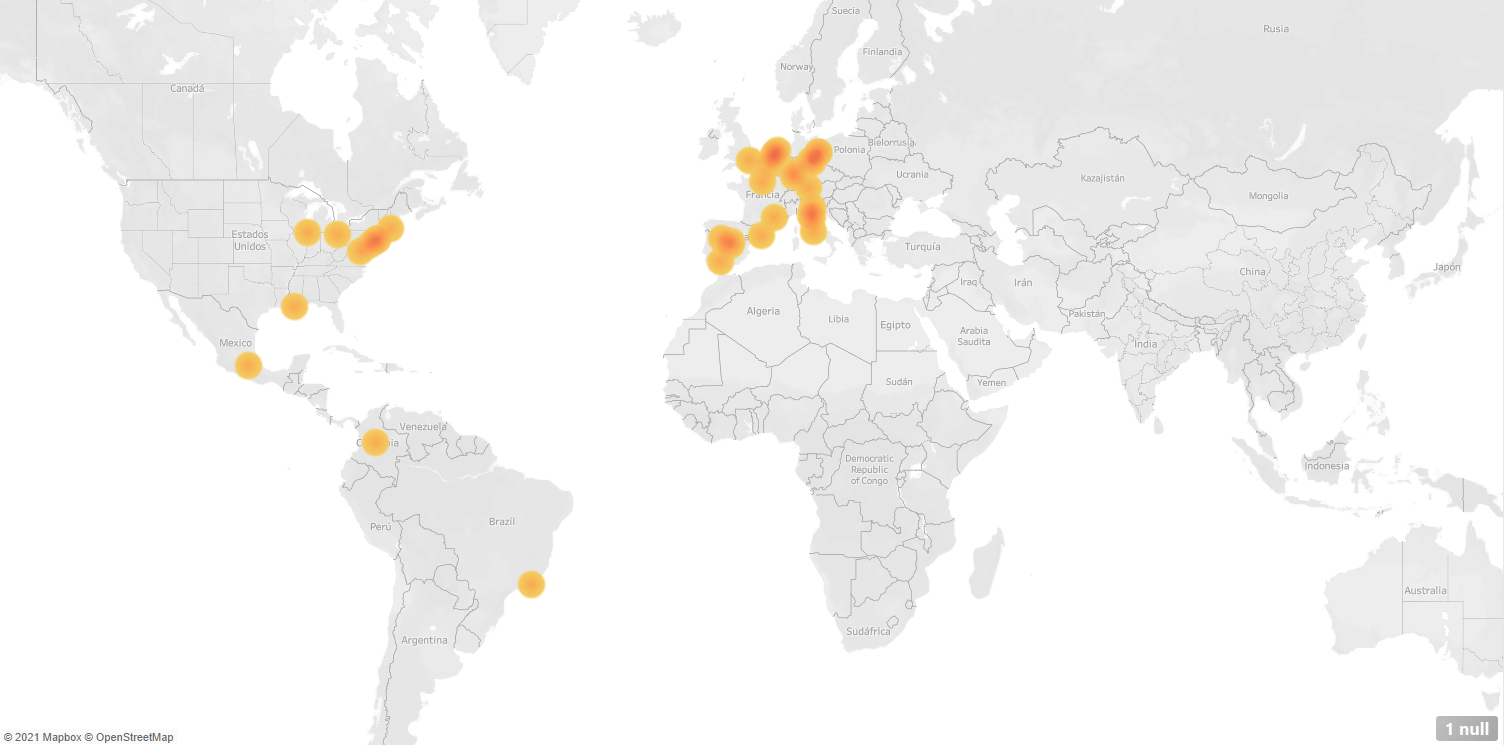
In almost all subsets,[xiii] mapping metadata categories evidences a discrepancy between the object of study, in this case, the biodiversity and peoples of Latin America, and the networks of knowledge production about said object. These colonial epistemic dynamics are particularly important for the IP-G and IP-S subsets, which not only include Indigenous peoples as objects of study but also show—arguably more than any other subsets—a clear distinction of the Global North as producer of knowledge about Indigenous peoples in Latin America (Figure 1).
Global map showing places of publication in IP-G dataset

Figure 1 Map showing places of publication (density per number of records) in the IP-G subset. Generated on Tableau in August 2021. Data from https://www.biodiversitylibrary.org/data as of July 1st, 2021.

Moreover, the IP-G subset is anchored in homogenizing terms such as “Indians of…” The very fact that the word Indians is being employed to refer to Indigenous peoples in Latin America perpetuates colonial homogenizing discourses that began with the first arrival of Europeans to the Americas (and not India) in the late 15th Century, thus flattening the cultural diversity of the Global South. Additionally, employing this formula alongside general geographical areas further blurs the cultural diversity of Indigenous peoples in the region. For instance, there are 70 identified Indigenous peoples in Mexico (Sistema de Información Cultural SIC México), at least four in Belize, 24 in Guatemala, seven in Honduras, three in El Salvador, nine in Nicaragua, eight in Costa Rica, eight in Panama, 30 in Argentina, 36 in Bolivia, 241 in Brazil, 83 in Colombia, nine in Chile, 12 in Ecuador, nine in Guyana, six in French Guiana, 20 in Paraguay, 43 in Peru, five in Suriname, and 37 in Venezuela (UNICEF España). However, these more than 660 Indigenous cultures are homogenized in the generalizing terms Indians of Mexico, Indians of Central America, and Indians of South America. In sum, the use of the formula Indians of… in subject lists requires a critical reformation that allows for a better representation of Indigenous peoples and topics in metadata practices.

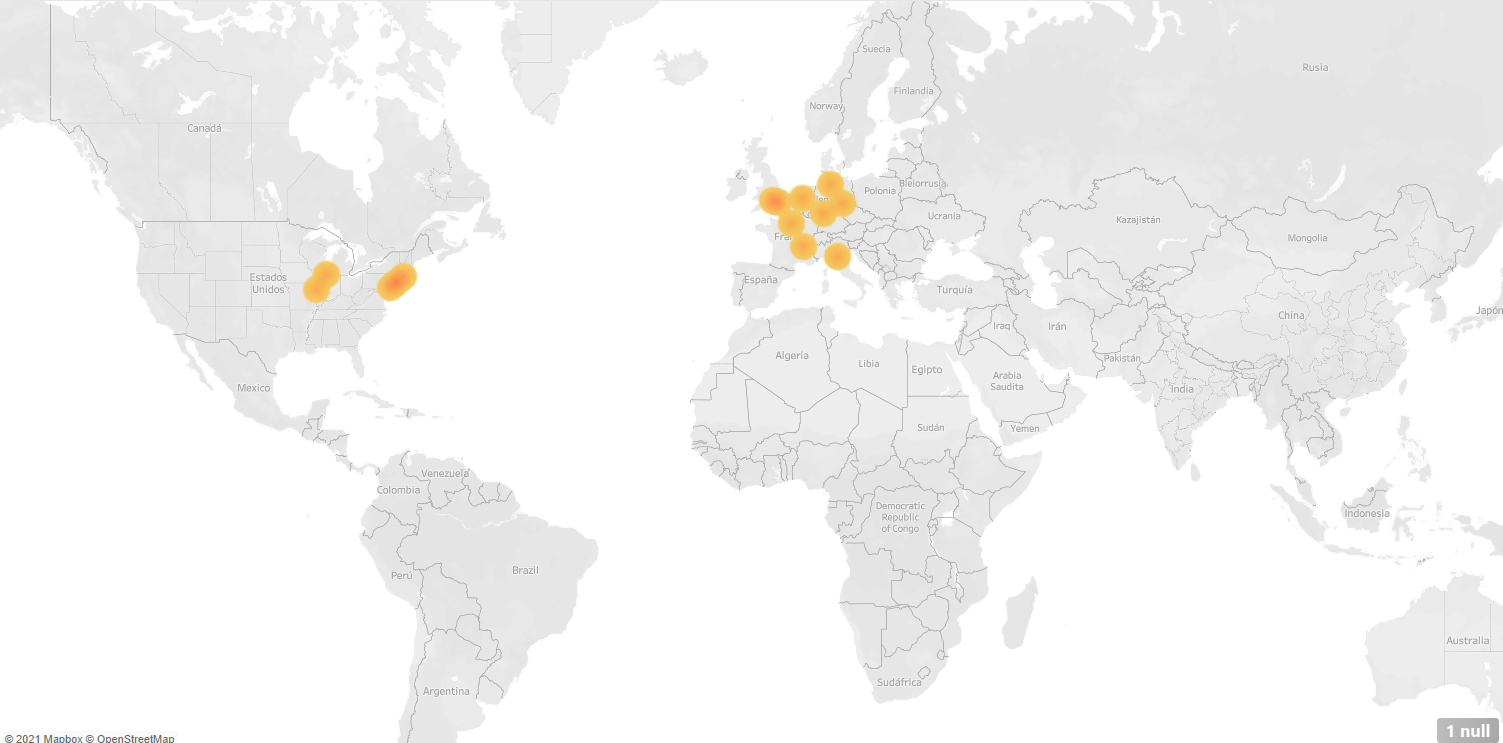
In contrast to the IP-G subset, the IP-S subset is built around subjects that specify the Indigenous group they are referring to, which could potentially mean that the cultural specificity of these communities is being more accurately represented. Nevertheless, the IP-S subset is the only subset where all materials were published and are held in the Global North (Figure 2). Therefore, despite its apparent cultural diversity and specificity, this subset reveals that the Library’s materials about Indigenous peoples continue to be anchored in a stark contrast between the North as epistemic subject—those who know—and the South as a passive object—that to be known. Furthermore, the dichotomy subject-object perpetuates the historical colonial association between nonhuman animals and Indigenous peoples. The animal-human dichotomy is the primeval binary on which other power-based categories are constructed and that characterizes the relationship between colonizers and colonized (Wolfe xx; Rajamannar 5). In this sense, several critics have identified a profound connection between colonization in the Americas and the establishment of a racial system for the classification of human groups (Greer et al.). Therefore, a link between species and race is constructed in the world-making process of colonization, a link that is still palpable in the use of subjects such as Indians of… in BHL’s metadata. These colonial dynamics can only be counteracted by an acknowledgement of the colonial roots of such materials as well as a stronger diversification of the Library’s collection that increases the presence of Indigenous peoples as agents of knowledge production.
Global map showing places of publication in IP-S dataset

Figure 2 Map showing places of publication (density per number of records) in the IP-S subset. Generated on Tableau in August 2021. Data from https://www.biodiversitylibrary.org/data as of July 1st, 2021.

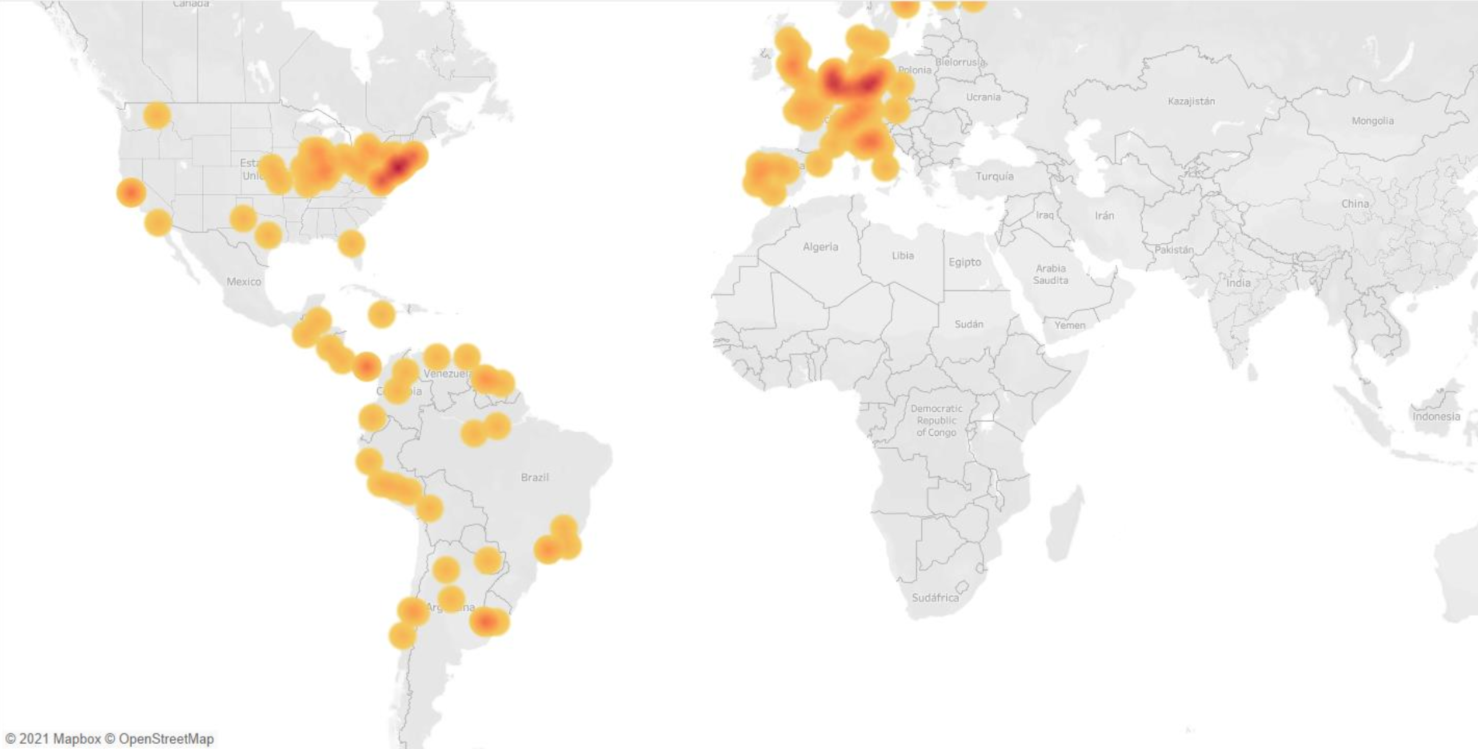
Even in subsets such as LAC, where there is a considerable diversity of places of publication,[xiv] the holding institutions of the materials are almost exclusively located in the Global North (Figure 3). In fact, there are only three works—out of 1982 unique IDs in this subset (LAC)—that are held in institutions outside of Europe and Anglo North America: Jean Baptiste Boussingalt and Francois Desire Raulin’s Viajes científicos a los Andes Ecuatoriales ó Colección de memorias sobre física, química e historia natural de la Nueva Granada, Ecuador y Venezuela (1849) translated by Joaquín Acosta and held in the Universidad Autónoma de Nuevo León in Mexico; the Anales del Museo de Historia Natural de Valparaíso, authored and held by the Museo de Historia Natural de Valparaíso in Chile; and Evangelina Schwindt, Nicolás Battini, Clara Giachetti, Karen Castro, and Alejandro Bortolus’s Especies exóticas marino-costeras: Argentina (2018), edited and contributed to BHL by authors Schwindt and Bortolus.
Global map showing places of publication in LAC dataset

Figure 3 Map showing places of publication (density per number of records) in the LAC subset. Generated on Tableau in August 2021. Data from https://www.biodiversitylibrary.org/data as of July 1st, 2021.

Boussingalt and Raulin’s work and, especially, Acosta’s translation is, in fact, a considerable example of historical efforts to decentralize biodiversity-related knowledge. Acosta himself, in his prologue, highlights the goal of his translation as being that of the sharing of the knowledge produced by Boussingalt and Raulin in French, especially so that it can be accessed by “Granadinos, Venezolanos y Ecuatorianos” (Acosta 10) that is, the people from the places established as the object of study of this work, Colombia, Venezuela, and Ecuador. As the translator mentions, the people from these countries had, during that time, little to no access to these volumes due to their limited distribution and high costs. Furthermore, Acosta emphasizes that his translation is the product of a strong collaboration between him and the authors and that the edition was sponsored by a French editor (10-11). Thus, already in 1844, Acosta’s translation of this work was an example of collaboration between the Global South and North. Moreover, his goals echo in the access provided to these volumes by BHL, even more so given that they are contributed by a Mexican institution, meaning that a fundamental part of the collaborative network of bio-diverse knowledge production of this text, from the 19th century to today, is notably located across the Global South.

In turn, both the volumes of the Anales of the Museo de Historia Natural de Valparaíso in Chile and Schwindt et al’s book are powerful examples of local biodiversity-related knowledge production. The latter is also a more recent example of global collaboration and the role of BHL in promoting it, and it exemplifies the fruitful outcomes of a truly diverse and trans-geopolitical network of bio-diverse knowledge production. The result of an extensive local project to understand marine species in Argentina, Especies exóticas marino-costeras is also bilingual (English and Spanish) and includes the voices of researchers in different parts of the world. It incorporates, for instance, three prologues by researchers from the US, South Africa, and Argentina respectively. Similarly, this book includes a remarkably diverse list of acknowledgements, with individuals from Canada, Argentina, Uruguay, Brazil, France, Sweden, South Africa, the US, the UK, Spain, the Netherlands, Colombia, and Chile, who the authors thank for “provid[ing] valuable assistance and help during the entire creative process … by supplying administrative assistance, photographs and specimens, as well as commenting and improving the text” (Schwindt et al. 15–16). Finally, this work was also featured in a BHL blog post published in October 2020 and written by former Outreach and Communication Manager for BHL, Grace Costantino. At the moment of publication, the blog post was also shared on the Library’s accounts on Twitter and Facebook, thus promoting this bio-diverse trans-geopolitical collaborative work through other important online avenues, a decolonial and truly global representation of Latin America for which I myself have argued elsewhere.

Despite, however, the richness and diverse geopolitical affiliations of these materials, their small numbers blur their presence and continue to evidence an overwhelming predominance of the Global North as the housing site of biodiversity-related knowledge production, thus positing it as a sort of legitimizing epistemic centre for such production. While local and collaborative knowledge production is present in it, BHL still has a long way ahead to achieve a more equitable and diversified collection. In sum, what the statistics and maps of these subsets show is a colonial object-subject relationship between the Global South and North that requires a profound diversification of the networks of knowledge production that constitute BHL’s catalogue.

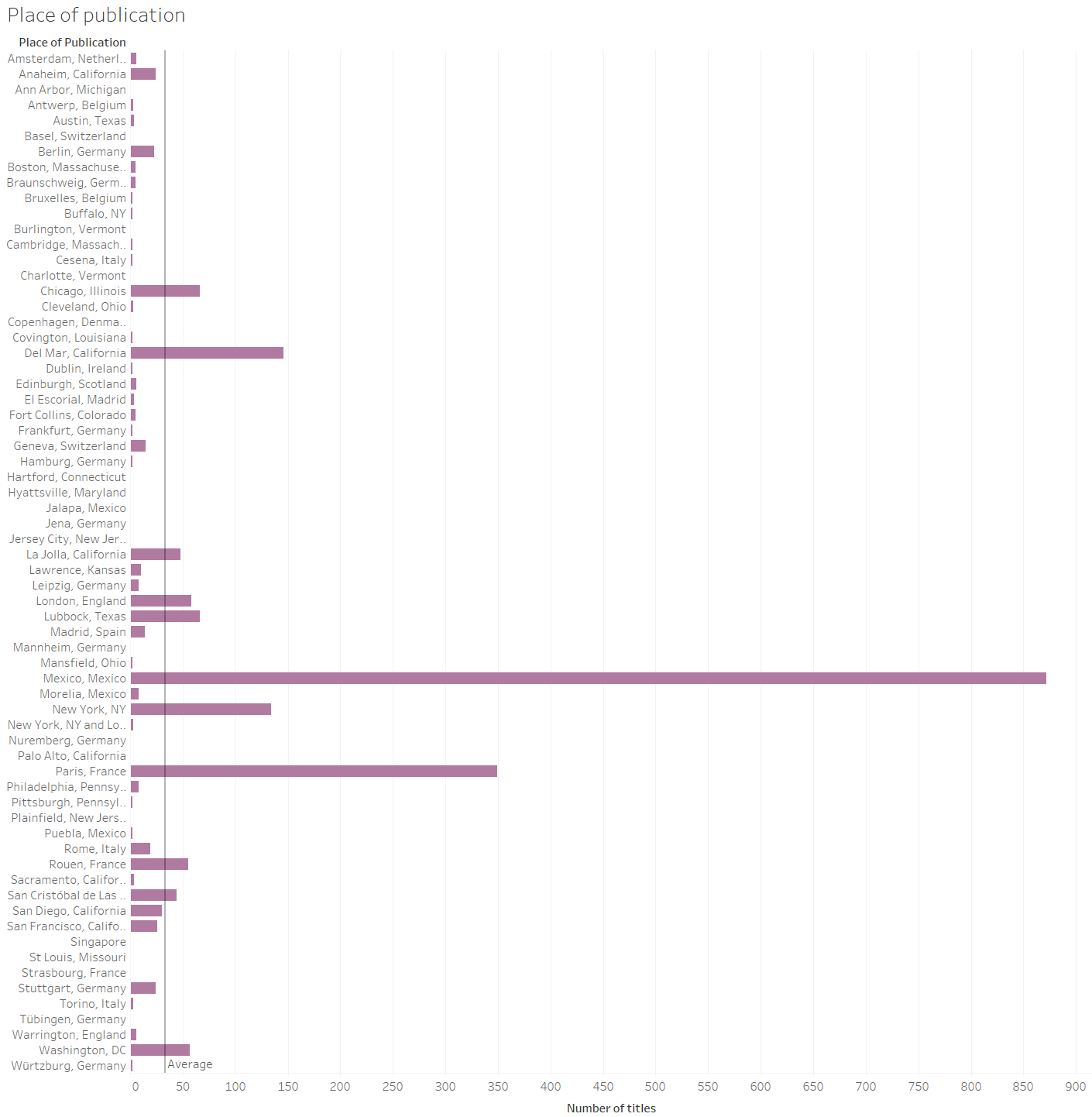
In the case of BHL, global partnerships are a strong strategy to achieve such diversification, both in terms of its collection and of access to materials. A notable example of this is the MEX subset. A significant portion of the materials about Mexico in BHL is contributed to its collection through the BHL México project, which is the result of a partnership between the Library and several Mexican institutions led by Mexico’s Comisión Nacional para el Conocimiento y Uso de la Biodiversidad (CONABIO). As a result, the MEX subset shows significant diversification in comparison to other subsets, especially regarding places of publication and language distribution. For instance, Mexico City is, by far, the most frequent place of publication in this subset, meaning that the MEX subset is the only one where the most frequent place of publication is not in the Global North and is located in the same country that is included as subject (Figure 4).
Bar chart listing the frequencies of places of publication in MEX dataset

Figure 4 Frequencies of places of publication (non-unique IDs) in the MEX subset. Generated on Tableau in August 2021. Data from https://www.biodiversitylibrary.org/data as of July 1st, 2021.

Such a strong presence of Mexico in the geographical affiliations of these texts thus posits the country not only as an object of study but, especially, as an agent of knowledge production, particularly of local knowledge production. Furthermore, although in most[xv] subsets—including the MEX subset—English continues to be the most frequent language of publication, the MEX subset shows a considerable number of materials in Spanish, with the difference between the two languages being significantly smaller than in other subsets (Figure 5). Therefore, at least to a certain extent, the meaningful presence of Spanish in materials about Mexico—which are part of both the BHL México project and the collection Publicaciones en español—counteracts the English dominance found throughout BHL’s collections, as I have also shown before.
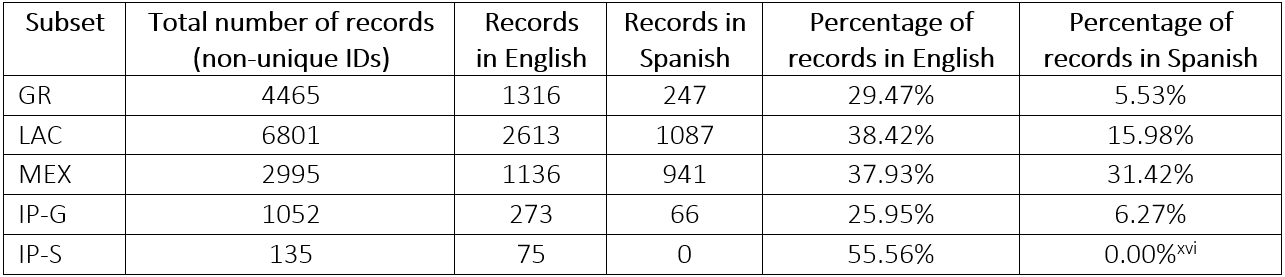
Table listing frequency of English and Spanish publications in all datasets

Figure 5 Frequency of English and Spanish in all subsets. Data from https://www.biodiversitylibrary.org/data as of July 1st, 2021.

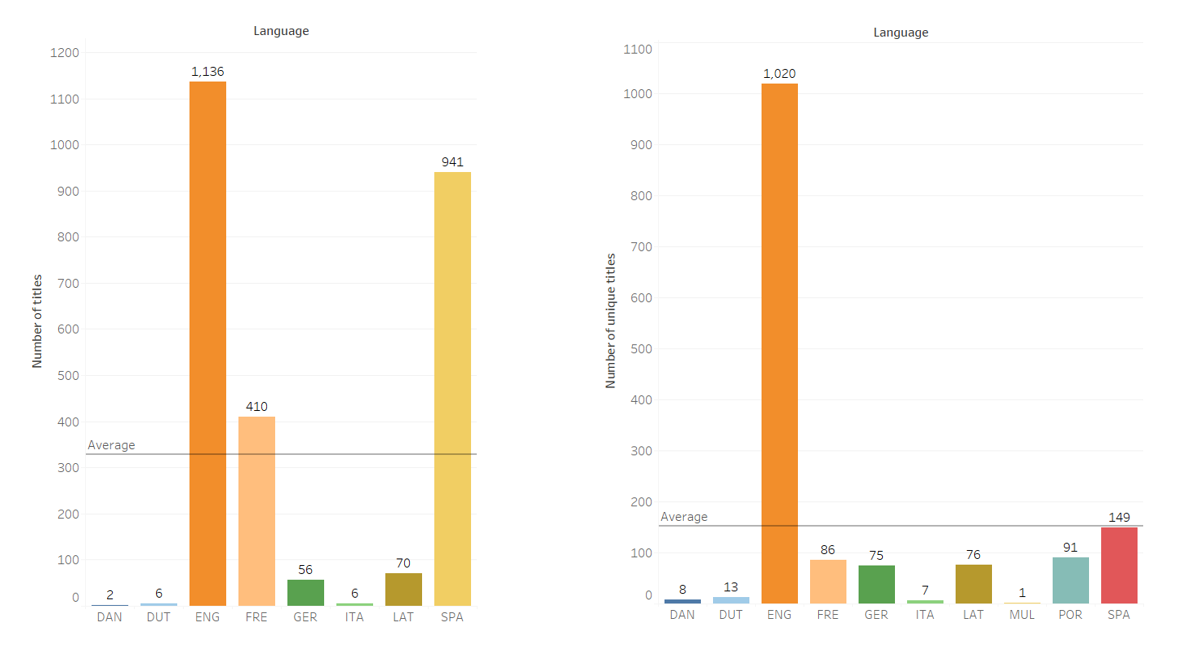
Moreover, it is important to note that the substantial presence of Spanish as a fundamental language of publication in the MEX subset is only true for non-unique IDs. On the contrary, when considering only unique IDs in this subset, the gap between English and Spanish increases dramatically, showing, once more, an overwhelming predominance of the former (Figure 6). Given that many of the materials contributed through BHL México and CONABIO are also periodicals, the difference of distribution when considering unique and non-unique IDs further strengthens the hypothesis that linguistic diversification in the MEX subset is strongly related to this partnership. Thus, the diversification of BHL’s collection proves to be deeply related to the diversification of its global partnerships, the BHL México project being a case in point.
Two bar charts comparing the language distribution for non-unique and unique ID titles in MEX dataset

Figure 6 Language distribution for non-unique (left) and unique (right) ID titles in the MEX subset. Graph generated on Tableau in August 2021. Data from https://www.biodiversitylibrary.org/data as of July 1st, 2021.

The Biodiversity Heritage Library is a rich and invaluable resource for researchers across the world. Nevertheless, to maximize access to its collection and an equitable and decolonial representation of diverse human and nonhuman subjects, the Library must continue its efforts regarding decoloniality, diversity, multiculturalism, and multilingualism. Diversification must be a primary goal of BHL’s outreach strategies. As I argued in a previous post on BHL’s blog, increasing multicultural representation can lead to diversified and equitable access that can increase the participation of audiences from the Global South including, at the very least in the case of Latin America, Indigenous communities. Therefore, a critical understanding of metadata, representational paradigms, and collection practices can highlight the dimensions of the Library where more work needs to be done as well as the benefits of previous strategies undertaken towards diversification. For instance, in the case of the subsets I analyzed during my internship with BHL, a stronger collaboration between the Library and institutions in the Global South seems to have a positive impact on the diversification and multicultural representation of topics related to these regions of the world. Thus, the establishment of more and stronger BHL nodes in the Global South can potentially lead to a more decolonial, equitable, and truly global collection anchored in bio-diverse networks of knowledge production, so that the Library can continue to honour its mission of providing global and open access to biodiversity-related content in collaborative and ethical ways.


[i] The files used for the extraction and building of the subsets were creator.txt, item.txt, subject.txt, and title.txt.

[ii] As of this date, the total number of BHL records was 146,806.

[iii] All subjects are presented here and used in the analyses exactly as they appear in BHL’s subject dataset (as of July 1st, 2021).

[iv] Total numbers for these subsets include non-unique ID records, meaning that some title IDs are repeated when the work includes several numbers, volumes, or issues.

[v] Includes the subjects Brazil 0 and Brazil 7 as they appear in BHL’s subject dataset.

[vi] Tables for these subsets (including cleaned geographical data as explained later in this text) can be found in BHL’s GitHub repository.

[vii] Data were cleaned directly on Microsoft Excel, separating values by punctuation and replacing terms that needed modernization and/or translation.

[viii] See note vi.

[ix] This means that works in volumes, issues, and/or numbers were treated as a single record and comprised in their shared title ID.

[x] Additional details can be found in the description of each map on Google. For the IP-G and IP-S subsets, additional information about Indigenous groups is included in each node on the map.

[xi] All visualizations for all subsets can be found in BHL’s GitHub repository.

[xii] Given the one-subject nature of the subset, all subject-based visualizations are not included in the MEX subset.

[xiii] The exception is the MEX subset, which is discussed later in this text.

[xiv] Meaning that they include several places of publication throughout Latin America. It is important to note, however, that there is almost no knowledge production about Latin America from other regions in the Global South.

[xv] The most frequent language in the IP-G subset is French, followed by English. In the GR, LAC, and IP-S subsets, French is the second most frequent language, after English.

[xvi] It is notable that the IP-S subset, along with its dichotomy between the Global South and North in terms of places of publication, is also the only subset with no materials in Spanish.


Works Cited

Acosta, Joaquín, translator. ‘Advertencia Preliminar’. Viajes Cietíficos a Los Andes Ecuatoriales ó Colección de Memorias Sobre Física, Química e Historia Natural de La Nueva Granada, Ecuador y Venezuela Presentada a La Academia de Ciencias de Francia, by Jean Baptiste Boussingault and Francois Desire Raulin, Librería Castellana, 1849, pp. 10–11, https://www.biodiversitylibrary.org/item/235575#page/6/mode/1up.

Freeland, Chris. ‘BHL Poster for AETFAT2010’. ChrisFreeland, 19 Apr. 2010, http://blog.chrisfreeland.com/2010/04/.

Greer, Margaret, et al., editors. Rereading the Black Legend: The Discourses of Religious and Racial Difference in the Renaissance Empires. 2008.

Rajamannar, Shefail. Reading the Animal in the Literature of the British Raj. Palgrave Macmillan, 2012.

Schwindt, Evangelina, et al. Especies Exóticas Marino-Costeras: Argentina. Marine-Coastal Exotic Species: Argentina. Edited by Evangelina Schwindt and Alejandro Bortolus, Vázquez Mazzini Editores, 2018, https://www.biodiversitylibrary.org/bibliography/169323.

Sistema de Información Cultural SIC México. ‘Pueblos Indígenas’. Gobierno de México, 2021, https://sic.cultura.gob.mx/lista.php?table=grupo_etnico&disciplina=&estado_id=.

UNICEF España. UNICEF Presenta El Atlas Sociolingüístico de Pueblos Indígenas En América Latina | UNICEF. https://www.unicef.es/prensa/unicef-presenta-el-atlas-sociolinguistico-de-pueblos-indigenas-en-america-latina. Accessed 29 June 2020.

Wolfe, Cary. ‘Introduction’. Zoontologies: The Question of the Animal, edited by Cary Wolfe, University of Minnesota Press, 2003, pp. ix–xxiii.
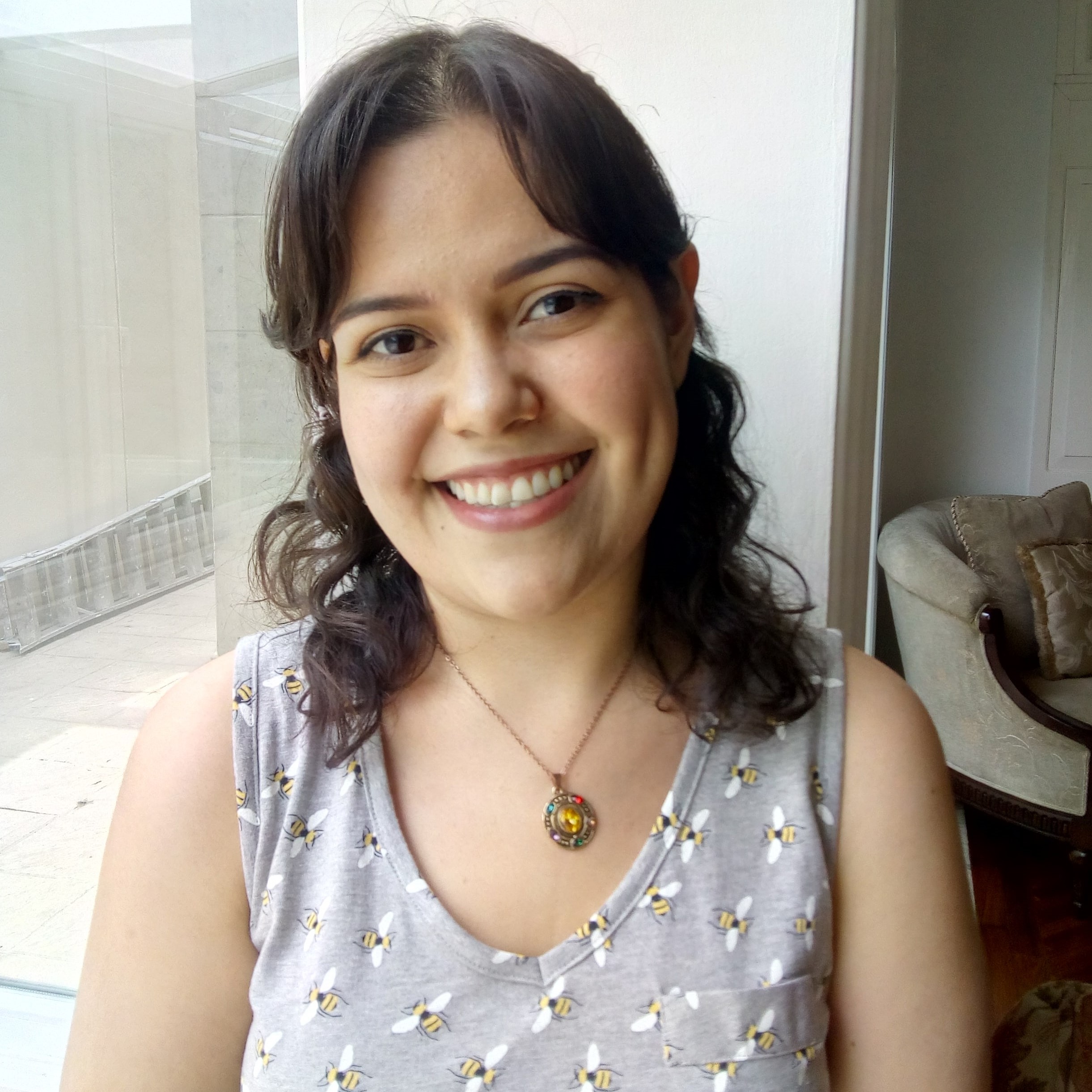
November 16, 2021by [email protected]
Blog Reel, User Stories

Towards Online Decoloniality: Globality and Locality in and Through the BHL

graphic with quote from Lidia Ponce de la Vega

Leer en español

This post is written by Lidia Ponce de la Vega, a Ph.D. Candidate in Hispanic Studies at McGill University. As part of her dissertation, she is analyzing the BHL collection from the perspective of Latin America to understand how the region produces and engages with biodiversity knowledge and how knowledge of Latin American biodiversity produced elsewhere represents the region and its nature. As part of this process, she has conducted a critical study of the BHL México program to understand how users in Latin America engage with BHL’s collections as well as how the program can help decolonise biodiversity knowledge and help inform best practices for decolonising digital archives more broadly.

photo of a woman in a pale purple shirt with dark hair

Lidia Ponce de la Vega is a Ph.D. Candidate in Hispanic Studies at McGill University. Photo courtesy of Lidia Ponce de la Vega.

As our collective interest in digital archives increases, our knowledge of biodiversity is now accessed and disseminated through digital means, a practice exemplified by the Biodiversity Heritage Library. As a repository of digital texts that compile human knowledges on biodiversity and retell human experiences with, in, and within biodiversity, the BHL has the responsibility not only of sharing and providing access to those (hi)stories but also of reflecting on its archival practices and the possibilities of decolonising the knowledges contained in and communicated through these materials. Because the BHL is part of an effort to concentrate global knowledges of biodiversity and make them globally accessible, it is key to understand who the Library’s audiences are and how they interact with biodiversity epistemologies in the BHL, as well as to acknowledge and explore the biases and colonial dynamics that underlie the construction of biodiversity knowledges. With this in mind, in my doctoral research, I perform a critical study of the BHL to understand the epistemic constructions of biodiversity, more specifically, of biodiversity in Latin America.

Part of my dissertation focuses on the relationship between the BHL and institutions and users in Latin America. I examine analytics data of the BHL website using SimilarWeb to understand how countries and communities in this region engage with biodiversity content in the library and the importance of its epistemic and archival practices in relation to its Latin American audiences.

For example, in 2015, the BHL established an important partnership with Mexico’s Comisión Nacional Para el Conocimiento y Uso de la Biodiversidad (CONABIO) to create BHL México. Prior to this partnership, the BHL included 600 texts about Mexico, of which only 44 were written in Spanish (Tapia Tinajero and Guzmán Vera 56). The rest of these texts, written in other languages, were produced outside of Mexico, that is, they were texts in which Mexican biodiversity was the object of study, but Mexico was not the site of production of that knowledge. Additionally, a limited availability of texts in Spanish meant limited access for Spanish speakers, which includes the great majority of the Mexican population. This, in turn, was an obstacle to the further development of local Mexican knowledges anchored in the knowledges included in the BHL.

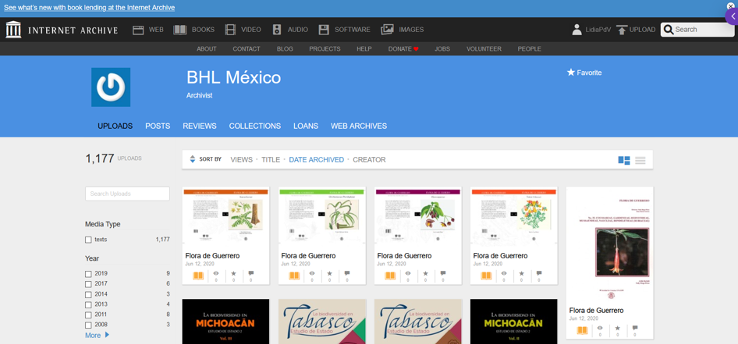
To remedy this situation, one of BHL México’s objectives was precisely to increase the number of materials in Spanish available in the BHL (ibid.). Texts that are part of BHL México are currently grouped in the BHL’s collection Publicaciones en español, to date, the only listed collection on the BHL that is built around a specific language and not presented in English. As of July 2020, BHL México’s collection housed in the Internet Archive is almost completely in Spanish, with 1,172 materials listed in this language and only one in English and one in French (Fig. 1). Furthermore, the vast majority of these texts were written and published in Mexico, which means that, with this collection, the BHL has opened up spaces for the incorporation of plural knowledges and, most importantly, plural sites of knowledge production, taking a step beyond the traditionally colonial epistemic relationship between the Global South and North.

BHL México in the Internet Archive

Figure 1: BHL México in the Internet Archive. Screenshot taken on June 17, 2020.

It is important to note, however, that Spanish is an imperial/European language and that there are almost no materials in the BHL in non-hegemonic languages, such as Indigenous languages. Nevertheless, including, promoting, and growing the selection of texts in Spanish in the BHL is a step forward in providing access to Indigenous communities in Latin America. In this region, according to UNICEF, out of 522 identified Indigenous peoples, 99 have lost their language and speak either Spanish or Portuguese (UNICEF España). Furthermore, the majority of Latin American Indigenous peoples are bilingual (speakers of an Indigenous language plus Spanish or Portuguese), with the numbers of monolinguals of Spanish and Portuguese growing every year (López 90). In this sense, increasing the online presence of materials in these two languages, albeit imperial languages, could potentially mean increased access to these materials for certain Indigenous communities.

Ideally, a site of knowledge production and dissemination such as the BHL, includes all languages, starting with those that have historically been most oppressed, such as Indigenous languages. This is a task that should also be shared and encouraged amongst partners in their local practices. Nonetheless, as shown by the case of Spanish, making space for materials in languages other than English—the Internet’s lingua franca—is a decolonising move that can contribute to the deconstruction of epistemic hierarchies in digital archives.

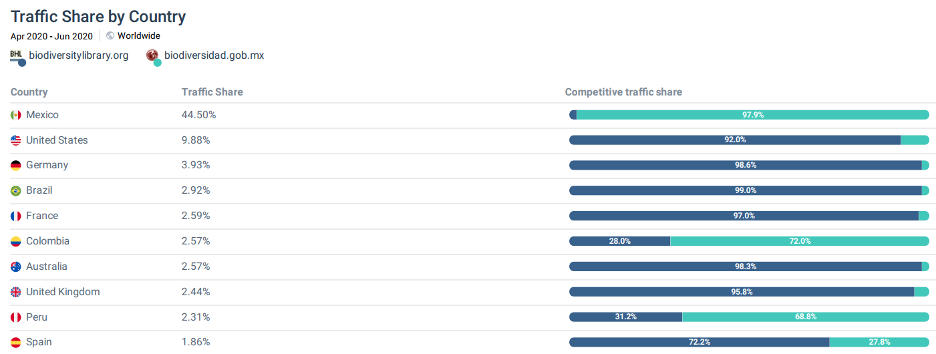
For the BHL, multilingualism is also tied to the participation of plural audiences, as evidenced by comparing data from SimilarWeb on traffic to the BHL (www.biodiversitylibrary.org) to data on traffic to CONABIO’s website (www.biodiversidad.gob.mx) (Custom Monthly Competitive Analysis (BHL and CONABIO)). Traffic shares by country to these sites from April to June 2020 (Fig. 2) show Mexico at the top of the list, not surprisingly with the highest number of visits to CONABIO. What is interesting, though, is that BHL has a considerably low traffic share from Mexico compared to CONABIO (2.1% between April and June). In turn, the BHL has significantly higher numbers in most of the other countries on the list, especially those outside of Latin America. The United States, Germany, France, Australia, and the United Kingdom show percentages of traffic share to the BHL of between 92% and 99%.

On the other hand, Latin American countries show an opposite pattern of access. For instance, CONABIO has a traffic share of 72% from Colombia and 68.8% from Peru. In contrast, Brazil is the only Latin American country on the list where almost all traffic goes to the BHL, and, in fact, has the highest share of traffic to the BHL of all countries in the top-10 (99%). Given the fact that Brazil is also the only listed Latin American country where Spanish is not the most spoken language, traffic shares by country could be perceived as influenced by the websites’ main languages and the availability of materials in Spanish.

Traffic share by country to the BHL and CONABIO's websites

Figure 2: Traffic share by country to the BHL and CONABIO’s websites. Data and visualization from SimilarWeb.

Interestingly, according to 2019 data from the Instituto Cervantes in Spain, four of the five countries with the largest number of native speakers of Spanish in the world made the top-10 list of access to the BHL and CONABIO, Mexico being first with approximately 121.9 million native speakers of Spanish, followed by Colombia with 49.4 million, Spain with 42.9 million, and the US with 41 million (Instituto Cervantes 7-9). Considering that Spanish is also the third most used language on the Internet (50), these numbers continue to evidence the importance of this language for digital archives such as the BHL, emphasizing the relevance of projects such as BHL México.

Despite the importance of Spanish in these countries, both Spain and the US show considerably greater traffic shares for the BHL, at 72.2% and 92% respectively. This is meaningful because it moves beyond language and into the sphere of knowledge production. As the data shows, CONABIO has less penetration in the US and European countries. In this regard, the BHL-CONABIO partnership could potentially both help highlight local Mexican systems of knowledge in the global context and promote access to global knowledges in Latin America.

For instance, since the availability of texts in Spanish is a great asset for Mexican websites such as CONABIO’s, including them in the BHL can make room for the participation of more Latin American communities in the Library. In turn, audiences from Europe and the US can access local Mexican knowledges through the BHL, thus helping decentralize epistemic production and move towards more global audiences for Mexican epistemologies.

Overall, the collaboration between the BHL and CONABIO can mean a greater access to knowledges of Mexican biodiversity, both from Spanish and non-Spanish speaking communities, and Latin American and non-Latin American publics. Furthermore, these circuits of biodiversity knowledges can engender new knowledges that stem from those made available online through the BHL. In the end, this can hopefully aid in the creation of more equitable relations between the Global South and North as sites of knowledge production, in this case, of knowledge production on biodiversity.

There are several specific actions that BHL can take to help further diversify and decolonise its collections and program:

  1. Expand multi-lingual interfaces and collections in BHL.
  2. Diversify global partnerships, particularly in the Global South.
  3. Include more materials representing Indigenous knowledge.
  4. Promote the participation of diverse communities in contextualizing and providing new perspectives about the Library’s collections.
  5. Diversify metadata through diverse communities’ involvement.

Decolonisation of online knowledge, in its pursuit of multiplicity and plurality, requires that globality intertwines with locality, creating a global community that nonetheless recognizes and emphasizes the value of the local. Multilingualism and global partnerships are valuable first steps which can, and should, be followed by other practices such as adjusting curatorial and annotating practices of both data and metadata, especially to address the often colonial nature of materials, as well as opening spaces for different communities to participate in such practices.

In my estimation, the BHL has a unique opportunity to reach this goal, particularly concerning interspecies relationships, that is, our existence, knowledges, and experiences with, in, and within biodiversity. Acknowledging and understanding colonial biases in knowledges of biodiversity are fundamental steps towards equitable, sustainable, and fair bio-diverse coexistence. By analysing the epistemologies of Latin American biodiversities in the BHL, I seek to contribute to such decolonisation, especially regarding the further (hopefully decolonial) development of this valuable digital library.

References

Custom Monthly Competitive Analysis (BHL and CONABIO). Obtained and created on 7 July 2020, pro.similarweb.com.

Instituto Cervantes. El español: Una lengua viva. Informe 2019. 2019, https://www.cervantes.es/imagenes/File/espanol_lengua_viva_2019.pdf.

López, Luis Enrique. “Pueblos, Culturas y Lenguas Indígenas En América Latina.” Atlas Sociolingüístico de Pueblos Indígenas En América Latina, by UNICEF and FUNPROEIB Andes, pp. 19–99.

Tapia Tinajero, María del Socorro, and Rosa María Guzmán Vera. “La Biodiversity Heritage Library (BHL), Un Proyecto Colaborativo Con El Instituto de Biología Para La Preservaciónn Digital Del Acervo Histórico.” Conectando Los Saberes de Bibliotecas, Archivos y Museos (BAM) En Torno a La Preservación de Documentos Analógicos y de Origen Digital., edited by Perla Olivia Rodríguez Reséndiz and María Teresa Fernández Bajón, pp. 47–61.

UNICEF España. UNICEF Presenta El Atlas Sociolingüístico de Pueblos Indígenas En América Latina | UNICEF. https://www.unicef.es/prensa/unicef-presenta-el-atlas-sociolinguistico-de-pueblos-indigenas-en-america-latina. Accessed 29 June 2020.

———————

Hacia la descolonización en línea: Globalidad y localidad en y a través de la BHL

Este texto fue escrito por Lidia Ponce de la Vega, candidata al doctorado en Estudios Hispánicos en la Universidad McGill. Como parte de su investigación, Lidia analiza la colección de la BHL desde la perspectiva de Latinoamérica para comprender las formas en las que la región produce y se relaciona con conocimientos sobre biodiversidad y cómo el conocimiento sobre la biodiversidad latinoamericana producido fuera de la región representa a Latinoamérica y su naturaleza. Como parte de este proceso, Lidia lleva a cabo un estudio crítico del programa BHL México con el objetivo de entender la manera en que los usuarios en Latinoamérica interactúan con las colecciones de la BHL, así como las posibilidades que tiene este programa para ayudar a descolonizar el conocimiento sobre la biodiversidad y promover, en un panorama más general, prácticas óptimas para la descolonización de archivos digitales.

photo of a woman in a pale purple shirt with dark hair

Lidia Ponce de la Vega es Ph.D. Candidato en Estudios Hispánicos en la Universidad McGill. Foto cortesía de Lidia Ponce de la Vega.

A medida que incrementa nuestro interés en los archivos digitales, nuestro conocimiento sobre la biodiversidad se accede y se disemina a través de medios digitales, una práctica ejemplificada por la Biblioteca de la Herencia de la Biodiversidad, la Biodiversity Heritage Library (BHL). Por tratarse de un repositorio de textos digitales que compilan conocimientos humanos sobre biodiversidad y cuentan experiencias humanas con, en, y dentro de la biodiversidad, la BHL tiene la responsabilidad no solamente de compartir y proveer acceso a dichas historias (en tanto historia y en tanto literatura, es decir, como experiencias históricas y narrativas), sino también de reflexionar sobre sus prácticas archivísticas y las posibilidades para descolonizar los conocimientos contenidos en y comunicados mediante estos materiales. Dado que la BHL es parte de un esfuerzo por concentrar conocimientos globales sobre biodiversidad y hacerlos accesibles de forma global, es esencial entender quiénes son las audiencias de esta biblioteca y cómo interactúan con epistemologías de biodiversidad en la BHL, así como reconocer y explorar los prejuicios y dinámicas coloniales que subyacen la construcción de los conocimientos sobre biodiversidad. Con esto en mente, en mi investigación doctoral, llevo a cabo un estudio crítico de la BHL para comprender las construcciones epistémicas de la biodiversidad, más específicamente, de la biodiversidad en Latinoamérica.

Así, parte de mi investigación se concentra en la relación entre la BHL y algunas instituciones y usuarios en Latinoamérica. Mediante el uso de herramientas en SimilarWeb, examino datos analíticos del sitio web de la BHL para comprender cómo es que los países y comunidades en esta región se involucran con contenido sobre biodiversidad en esta biblioteca y la importancia de sus prácticas epistémica y archivísticas en relación con las audiencias latinoamericanas.

Por ejemplo, en 2015, la BHL estableció un importante acuerdo de colaboración con la Comisión Nacional Para el Conocimiento y Uso de la Biodiversidad (CONABIO) en México para la creación de BHL México. Antes de este acuerdo, la BHL incluía 600 textos sobre México, de los cuales solamente 44 estaban escritos en español (Tapia Tinajero and Guzmán Vera 56). El resto de los textos, escritos en otras lenguas, fueron desarrollados fuera de México, es decir, se trataba de textos en los que la biodiversidad mexicana era el objeto de estudio, pero México no era el sitio de producción de ese conocimiento. Asimismo, una disponibilidad limitada de textos en español se traducía también en un acceso limitado para las personas hispanohablantes, grupo que comprende a la gran mayoría de la población mexicana. Esto, a su vez, era un obstáculo para el posible desarrollo de conocimientos locales mexicanos enraizados en los conocimientos incluidos en la BHL.

Para remediar esta situación, uno de los objetivos de BHL México fue precisamente incrementar el número de materiales en español disponibles en la BHL (ibid.). Los textos que forman parte de BHL México se encuentran actualmente agrupados en la colección Publicaciones en español de la BHL, hasta la fecha la única colección listada en la BHL que ha sido construida con base en una lengua específica y que no se presenta en inglés. Hasta julio de 2020, la colección BHL México contenida en el Archivo de Internet (Internet Archive) está casi completamente en español, con 1,172 materiales listados en esta lengua y solamente un material listado en inglés y uno en francés (Ilustración 1). Más aún, la gran mayoría de estos textos fueron escritos y publicados en México, lo cual indica que, con esta colección, la BHL está abriendo espacios para la incorporación de conocimientos plurales y, principalmente, sitios plurales de producción de conocimiento, tomando así un paso más allá de la relación epistémica colonial tradicional entre el Sur y el Norte globales.

BHL México in the Internet Archive

Ilustración 1 BHL México en el Archivo de Internet. Captura de pantalla tomada el 17 de junio de 2020.

Es importante notar, sin embargo, que el español no deja de ser una lengua imperial/europea y que prácticamente no existen materiales en la BHL en lenguas no hegemónicas, tales como las lenguas indígenas. A pesar de ello, incluir, promover, e incrementar la selección de textos en español en la BHL es un paso en la dirección correcta para proveer acceso a las comunidades indígenas en Latinoamérica. En esta región, de acuerdo con la UNICEF, de las 522 naciones indígenas identificadas, 99 han perdido su lengua y hablan ya sea español o portugués (UNICEF España). Además, la mayoría de las comunidades indígenas latinoamericanas son bilingües (hablantes de una lengua indígena más español o portugués), con el número de monolingües de español y portugués aumentando cada año (López 90). En este sentido, aumentar la presencia en línea de materiales en estas dos lenguas, a pesar de tratarse de lenguas imperiales, podría posibilitar un mayor acceso a estos materiales para algunas comunidades indígenas.

Idealmente, un sitio de producción y diseminación de conocimiento, como lo es la BHL, incluiría todas las lenguas, comenzando con aquellas que han sido históricamente más oprimidas, como es el caso de las lenguas indígenas. Esta es una tarea que debe ser también compartida y fomentada entre los colaboradores de la biblioteca en sus prácticas locales. A pesar de esto, como muestra el caso del español, abrir espacios para lenguas distintas del inglés –la lengua franca del Internet—es ya en sí mismo un movimiento descolonizador que puede contribuir a la deconstrucción de jerarquías epistémicas en los archivos digitales.

Para la BHL, el multilingüismo está igualmente vinculado con la participación de audiencias plurales, como se evidencia en datos de SimilarWeb sobre el tráfico hacia el sitio web de la BHL (www.biodiversitylibrary.org) y en datos sobre tráfico hacia el sitio web de biodiversidad de CONABIO (www.biodiversidad.gob.mx) (Custom Monthly Competitive Analysis (BHL and CONABIO)). Los porcentajes de tráfico por país hacia estos sitios web entre abril y junio de 2020 (Ilustración 2) muestran a México en primer lugar de la lista, como es de esperar, con el mayor número de visitas a CONABIO. Lo interesante es, sin embargo, que la BHL tiene un porcentaje de tráfico desde México considerablemente bajo en comparación con CONABIO (2.1% entre abril y junio). Por su parte, la BHL tiene números significativamente más altos en la mayoría de los otros países de la lista, especialmente fuera de Latinoamérica. Estados Unidos, Alemania, Francia, Australia, y el Reino Unido muestran porcentajes de tráfico hacia la BHL de entre 92% y 99%.

Por otro lado, los países latinoamericanos muestran un patrón de acceso contrario. Por ejemplo, CONABIO tiene un porcentaje de tráfico de 72% desde Colombia y 68.8% desde Perú. En contraste, Brasil es el único país latinoamericano en la lista en el que prácticamente la totalidad del tráfico en línea va a la BHL y, de hecho, tiene el porcentaje más alto de tráfico a la BHL de todos los países en el top-10 (99%). Dado el hecho de que Brasil es también el único país latinoamericano listado en el que el español no es la lengua más hablada, puede percibirse en los porcentajes de tráfico por país una influencia de la lengua principal de cada sitio web, así como de la disponibilidad de materiales en español.

Traffic share by country to the BHL and CONABIO's websites

Ilustración 2 Porcentajes de tráfico por país hacia los sitios web de la BHL y de CONABIO. Datos y visualización generados en SimilarWeb.

Es de notar que, de acuerdo con información del Instituto Cervantes en España, cuatro de los cinco países con el mayor número de hispanohablantes nativos en el mundo se encuentran en la lista del top-10 de acceso a la BHL y CONABIO, México siendo primero con aproximadamente 121.9 millones de hablantes nativos de español, seguido por Colombia con 49.4 millones, España con 42.9 millones, y Estados Unidos con 41 millones (Instituto Cervantes 7–9). Considerando que el español es también la tercera lengua más utilizada en el Internet (50), estas cifras continúan evidenciando la importancia de esta lengua para los archivos digitales como la BHL, enfatizando a su vez la relevancia de proyectos como BHL México.

A pesar de la importancia del español en estos países, tanto España como Estados Unidos muestran porcentajes de tráfico considerablemente mayores hacia la BHL, con 72.2% y 92% respectivamente. Este dato es significativo puesto que conduce más allá de la lengua y hacia la esfera de la producción de conocimiento. Como muestran los datos, CONABIO tiene menor penetración en Estados Unidos y en los países europeos. En este sentido, la colaboración entre la BHL y CONABIO podría ayudar tanto a promover sistemas mexicanos de conocimiento en el contexto global como a promover el acceso a conocimientos globales desde Latinoamérica.

Al respecto, dado que la disponibilidad de textos en español es un gran atractivo de sitios web mexicanos como el de CONABIO, su inclusión en la BHL puede abrir el camino para la participación de más comunidades latinoamericanas en esta biblioteca. Por su lado, las audiencias de Europa y Estados Unidos pueden acceder a conocimientos locales mexicanos a través de la BHL, contribuyendo así a la descentralización de la producción epistémica y moviéndose hacia audiencias más globales para las epistemologías mexicanas.

En términos generales, la colaboración entre la BHL y CONABIO puede significar un mayor acceso a conocimientos de biodiversidad mexicana, para comunidades hispanohablantes y no hispanohablantes, y para públicos dentro y fuera de Latinoamérica. Asimismo, estos circuitos de conocimientos sobre biodiversidad pueden engendrar nuevos conocimientos que surjan de aquellos disponibles en línea a través de la BHL. Al final, esto podría ayudar en el establecimiento de relaciones más equitativas entre el Sur y el Norte globales como sitios de producción de conocimiento, en este caso, de conocimiento sobre biodiversidad.

En este caso, existen algunas acciones específicas que la BHL puede tomar para ayudar a diversificar y descolonizar sus colecciones y su programa:

  1. Expandir las interfaces y las colecciones multilingües en la BHL.
  2. Diversificar los proyectos de colaboración globales, especialmente en el Sur global.
  3. Incluir más materiales que representen conocimientos indígenas.
  4. Promover la participación de comunidades diversas en la contextualización de sus materiales y que provean nuevas perspectivas sobre sus colecciones.
  5. Diversificar sus metadatos a través de la participación de comunidades diversas.

La descolonización del conocimiento en línea, en su búsqueda de multiplicidad y pluralidad, requiere que la globalidad se entrelace con la localidad, creando una comunidad global que, sin embargo, reconozca y enfatice el valor de lo local. El multilingüismo y la colaboración global son pasos invaluables que pueden, y deben, continuar en otras prácticas, tales como adaptaciones a las prácticas de curación y anotación de datos y metadatos, especialmente para abordar la naturaleza frecuentemente colonial de los materiales, así como para abrir espacios de participación en dichas prácticas para distintas comunidades.

Desde mi perspectiva, la BHL tiene una oportunidad excepcional para conseguir este objetivo, en particular en lo que concierne a las relaciones interespecie, es decir, nuestra existencia, conocimientos, y experiencias con, en, y dentro de la biodiversidad. Reconocer y comprender los prejuicios coloniales en los conocimientos de biodiversidad son pasos fundamentales hacia una coexistencia bio-diversa equitativa, sustentable, y justa. Mediante el análisis de las epistemologías sobre las biodiversidades latinoamericanas en la BHL, busco contribuir, precisamente, a dicha descolonización, especialmente en relación con el desarrollo futuro (con suerte descolonizador) de esta valiosa biblioteca digital.

Fuentes

Custom Monthly Competitive Analysis (BHL and CONABIO). 7 de julio de 2020, pro.similarweb.com.

Instituto Cervantes. El español: Una lengua viva. Informe 2019. 2019, https://www.cervantes.es/imagenes/File/espanol_lengua_viva_2019.pdf.

López, Luis Enrique. “Pueblos, Culturas y Lenguas Indígenas En América Latina.” Atlas Sociolingüístico de Pueblos Indígenas En América Latina, por UNICEF y FUNPROEIB Andes, pp. 19–99.

Tapia Tinajero, María del Socorro, and Rosa María Guzmán Vera. “La Biodiversity Heritage Library (BHL), un proyecto colaborativo con el Instituto de Biología para la preservación digital del Acervo Histórico.” Conectando los saberes de Bibliotecas, Archivos y Museos (BAM) en torno a la preservación de documentos analógicos y de origen digital, editado por Perla Olivia Rodríguez Reséndiz and María Teresa Fernández Bajón, pp. 47–61.

UNICEF España. UNICEF presenta el Atlas Sociolingüístico de Pueblos Indígenas en América Latina | UNICEF. https://www.unicef.es/prensa/unicef-presenta-el-atlas-sociolinguistico-de-pueblos-indigenas-en-america-latina. Consultado el 29 de junio de 2020.

September 1, 2020by michelle.underhill
Blog Reel, Campaigns, Her Natural History

A lifetime among Cacti: Helia Bravo-Hollis

Four days before becoming a centenarian, Dr. Helia Bravo Hollis passed away, on September 26th, 2001. Her biography is the history of the inclusion of women in the scientific research community and the slow but productive development of academic calling.

Teacher Bravo, as she liked to be called, never bothered or worried about being a pioneer in a discipline at a complicated stage in Mexican history. Although she always had a genuine concern for social inequalities, she believed that only through education this could be changed. To do so, she was a very dedicated researcher and teacher.

Her work is defined by the word vocation, as she describes it in her own words, full of humility:

“I did my job with a sense of responsibility before the National Autonomous University of Mexico UNAM, with love, passion, and courage; It was enjoyable research rather than a job. In spite of everything, I think that my work is still far from being satisfactory because the knowledge of the cacti is not finished, it is always being done”.

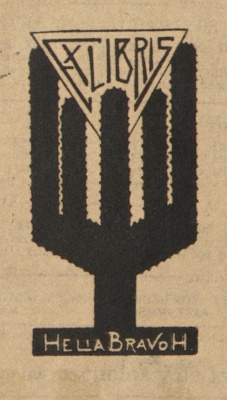
Dr. Bravo Hollis’ bookplate. Historic Archive of Biology Institute of UNAM.

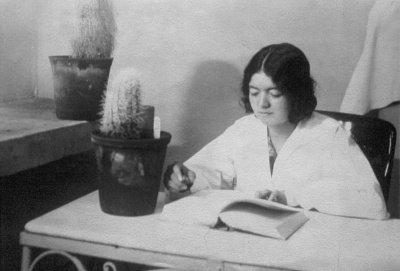
Since her childhood, Dr. Bravo Hollis stood out for her hard work. When she was 10 years old, she received a diploma of achievement from President Porfirio Díaz. In high school, she shared the classroom with distinguished personalities such as Octavio Paz, Salvador Novo, Carlos Pellicer, and even Frida Kahlo, among many other brilliant personalities of Mexican culture. As a teenager, she presented her works in the Antonio de Alzate Society and published them in Revista Mexicana de Biología (Mexican Biology Journal). Those tasks motivated her first trip abroad: a summer course at Pomona College, California. All of this gives us an idea of her striving at academic matters.

Helia during her studies with Dr. Ochoterena. Ca. 1930. Historic Archive of Biology Institute of UNAM.

The First Certified Biologist

Bravo Hollis was meant to study Medicine, however, she decided to study Biology against her family’s wishes. The career did not exist formally yet, and the studies were set in combination at the National School of Medicine and at the High Studies School, both part of UNAM.

In 1927, Bravo Hollis became the first certified biologist of Mexico and, in 1929 when the University reached its autonomy and her mentor Dr. Isaac Ochoterena was appointed in charge of the future Institute of Biology, she was chosen to create the Herbarium and was also commissioned with the study of the Cactaceae, one of the most identifiable, diverse plant families in Mexico: cactus, cholla, nopales, … and thus more than 700 species that, for the most part, do not exist anywhere else.

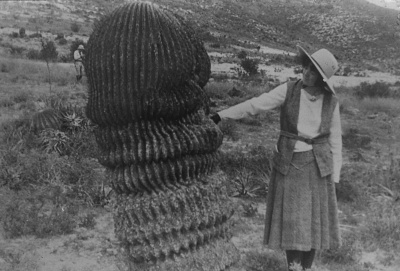
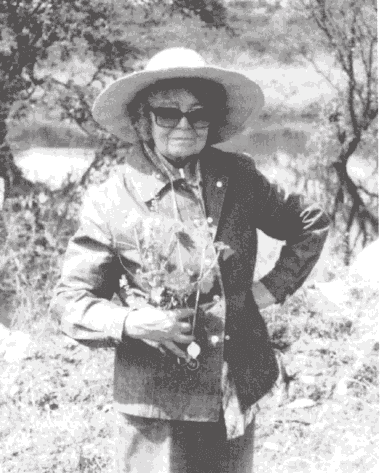
Therefore, Bravo Hollis began a stage in her career where she travelled around Mexico to collect information and samples and photograph different types of cacti. This culminated in 1931 when she graduated as a Master in Biological Sciences at the Faculty of Philosophy and Letters of UNAM, with the thesis entitled Contribuciones al conocimiento de las cacatáceas de Tehuacán (Contribution to knowledge of the Cacti of Tehuacán). This would set the beginning of her subject of study for the years to come.

Dr. Bravo Hollis in one of her many trips of specimen recollections. Ca. 1940. Historic Archive of Biology Institute of UNAM.

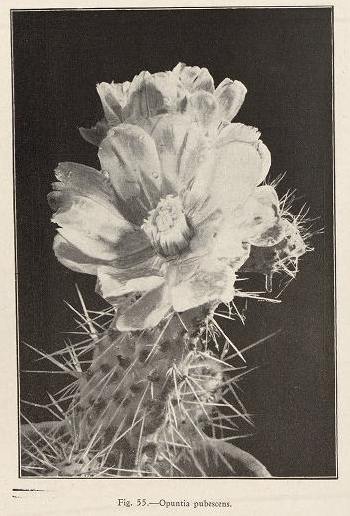
From this moment forward, her research career was unstoppable, focused on systematics of cacti in Mexico and part of North America. In 1937, she published her book Las cactáceas de México (Mexican Cacti), which placed her at the forefront of this field of research around the world. In the autumn of 1951, the Mexican Society of Cactology was founded with Dr. Bravo Hollis as president of Cactaceae and Suculentas Mexicanas, which published its first issue in June 1955. Its members carried out intense field work and with all the collected material contributed to the foundation of what became the Botanical Garden of UNAM. Throughout the 1960s, Dr. Bravo Hollis managed the gardens with passion and was highly respected, to the point that she even says she paid the workers out of her own pocket when a strike left them without a salary. Sorrowfully as she expressed:

“I am retired from working at the Biology Institute at 90 years old, handicapped by painful arthritis that prevents me from walking”.

Bravo Hollis, Helia. Las Cactáceas de México. 1937. Contributed in BHL by Instituto de Biología UNAM as part of BHL México. CC-BY-NC-SA.

In total, Bravo Hollis published almost 170 articles and three books, described 60 scientific classifications and made 59 nomenclature reviews. She received numerous awards and recognitions, including the Cactus d’Or from the International Organization of Succulents, an honorary doctorate and an Emeritus Research Prize at UNAM. Her works received worldwide acclaim from fellow biologists and botanists, and today six species and one subspecies of cacti are named after her. Additionally, the Botanical Garden in Tehuacán pays tribute to her through its name: the Helia Bravo Hollis Botanical Garden.

Dr. Bravo Hollis on fieldwork. Ca. 1980. Historic Archive of Biology Institute of UNAM.

References

Bravo-Hollis, Helia. (2004). Memorias de una vida y una profesión. México: Universidad Nacional Autónoma de México, Instituto de Biología, Dirección General de Divulgación de la Ciencia.

Granados Chapa, Miguel Ángel. (2001). La reina de las cactáceas. La Jornada. Recuperado de: https://www.proceso.com.mx/302201/la-reina-de-las-cactaceas

Salcedo Meza, Concepción. (2001). La pasión por la ciencia de una mujer centenaria. ¿Cómo ves? (34). pp. 29-30. Recuperado de: http://www.comoves.unam.mx/assets/revista/34/quienes_34.pdf

Photographs: Historic Archive of Biology Institute of Universidad Nacional Autónoma de México, UNAM.

March 22, 2019by Joel Richard
Blog Reel, Featured Books

Jesús Sánchez’s Mexican Medical Zoology

Sánchez, Jesús. Datos para la zoología médica mexicana: arácnidos é insectos. México: Oficina Tipográfica de la Secretaría de Fomento, 1893. viii, 189, iv pages, 9 leaves of plates : illustrations ; 23 cm.

View Full Size Image
Parra, Alfonso. Atlas histórico de la Escuela Nacional Preparatoria: desde su fundación hasta los momentos de celebrarse el centenario de la proclamación de la Independencia, septiembre 15 de 1910 / México : [Escuela Nacional Preparatoria], 1910. 1 vol.

With the single purpose of serving the country and with the belief that scientific study should be used with practical ends, Doctor Jesús Sánchez elaborated his essay on Mexican Medical Zoology (Datos para la zoología médica mexicana), where he acknowledges “the value of studying the animal kingdom, within which exists a vast variety that can offer both benefits and diseases”.

Equally, he states that it “is not only important to study the organisms living inside our own bodies, it is also necessary to know those whose venoms, when inoculated in the human body, can cause, from very light inconveniences, to very serious symptoms and even death”. That is why the author developed an essay about this topic, identifying, describing and studying arachnids and insects from several parts of Mexico that cause damage to the human health.

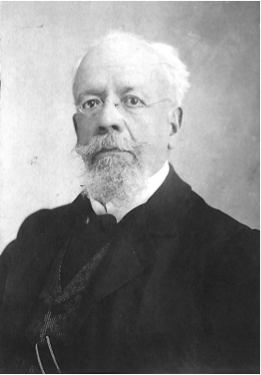
Doctor Jesús Sánchez was a physician by profession, a member of the Academy of Medicine, and responsible of the professorships in Zoology and Biology at the National High School and the National School of Agriculture, where he has dedicated several years to the compilation of insects; these where included in his work of Mexican Medical Zoology, published in 1893. A second edition or reprint of this work has never been published.

View Full Size Image
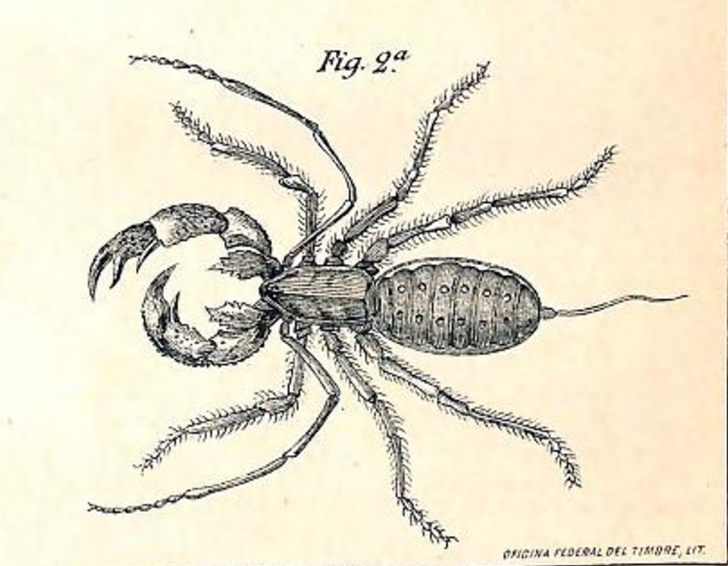
Thelyphonus giganteus. Vinagrillo. (Seg. Lucas). http://biodiversitylibrary.org/page/51139808.

During the development of this work, Doctor Sánchez exchanged knowledge, talks and experiences with the doctors and brothers Alfredo and Eugenio Dugés. Alfredo Dugés was a great illustrator who made a perfect descriptive work of the Aquatic Spider, or hydroarachnid, native of Guanajuato. Dugés directed Sánchez and recommended the research of other zoology scholars, like Fernando Altamirano, Lauro Jimenez, Antonio Peñafiel, Alfonso Herrera and Gumersindo Mendoza, among others, as well as other prominent publications from the naturalists Francisco J. Clavijero and Jose Alzate Ramirez.

Datos para la zoología médica mexicana describes, in a detailed manner, nine orders of arachnids and scorpions, as well as five orders of insects, ants and bees, using a mixture of a colloquial and technical language, explaining symptoms, cures and medicines that can be used to fight against symptoms caused by the bites or contact with insects. Within his work we can find a remarkably detailed index of every order and term, as well as illustrations for context.

View Full Size Image
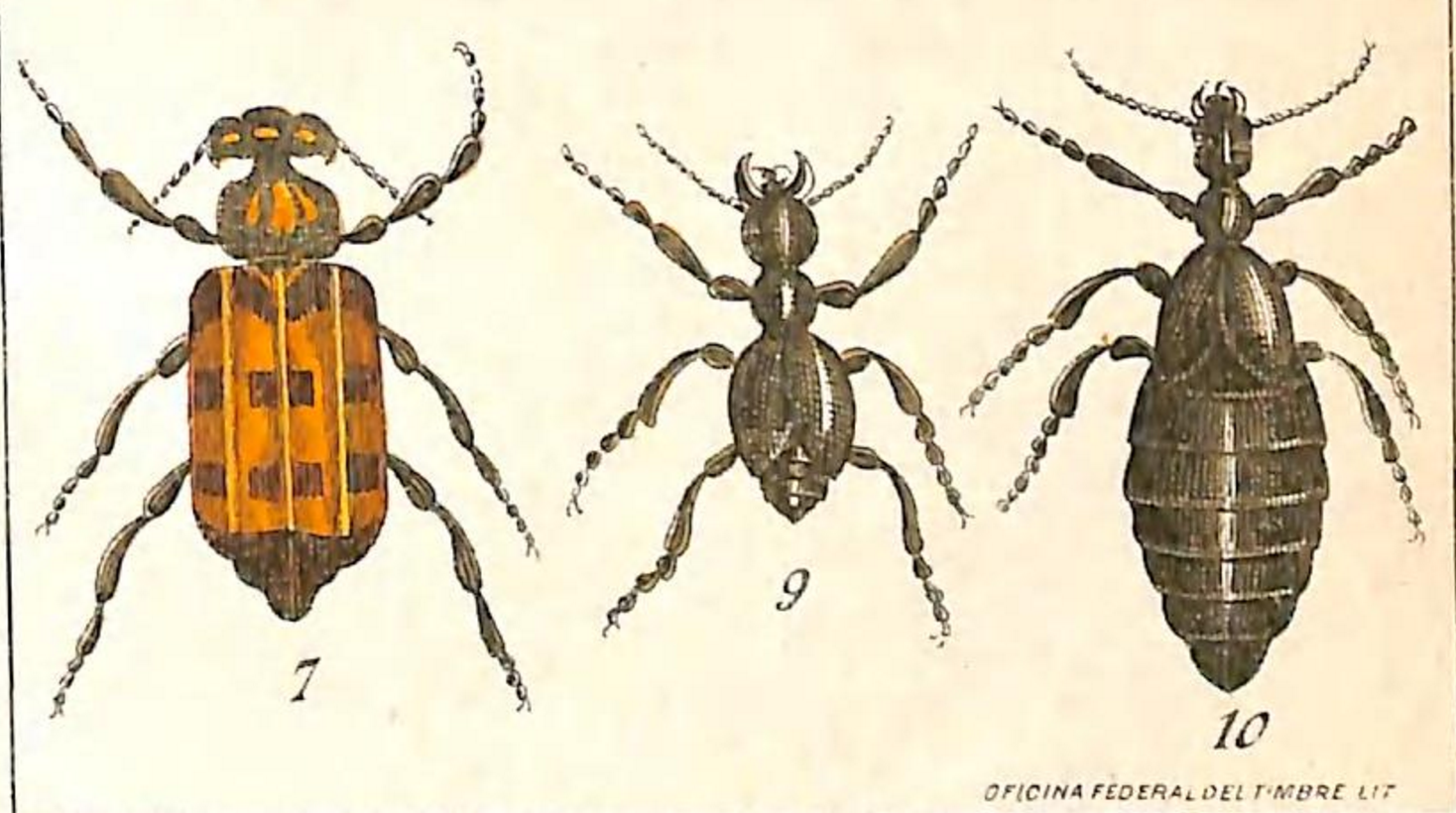
7. Horia maculata. 9. Treiodous barranci (macho). 10. Treiodous barranci (hembra). http://biodiversitylibrary.org/page/51139812.

One can appreciate nine pages that contain the illustrations of arachnids, scorpions, several insects, ants and bees, elaborated by hand with colours identical to those of the studied animals.

Being a professor of the National High School, Sánchez’s published works supported the students with knowledge and practical applications; he offered his expertise during his lectures and turned new students towards the development of science and knowledge.

View Full Size Image
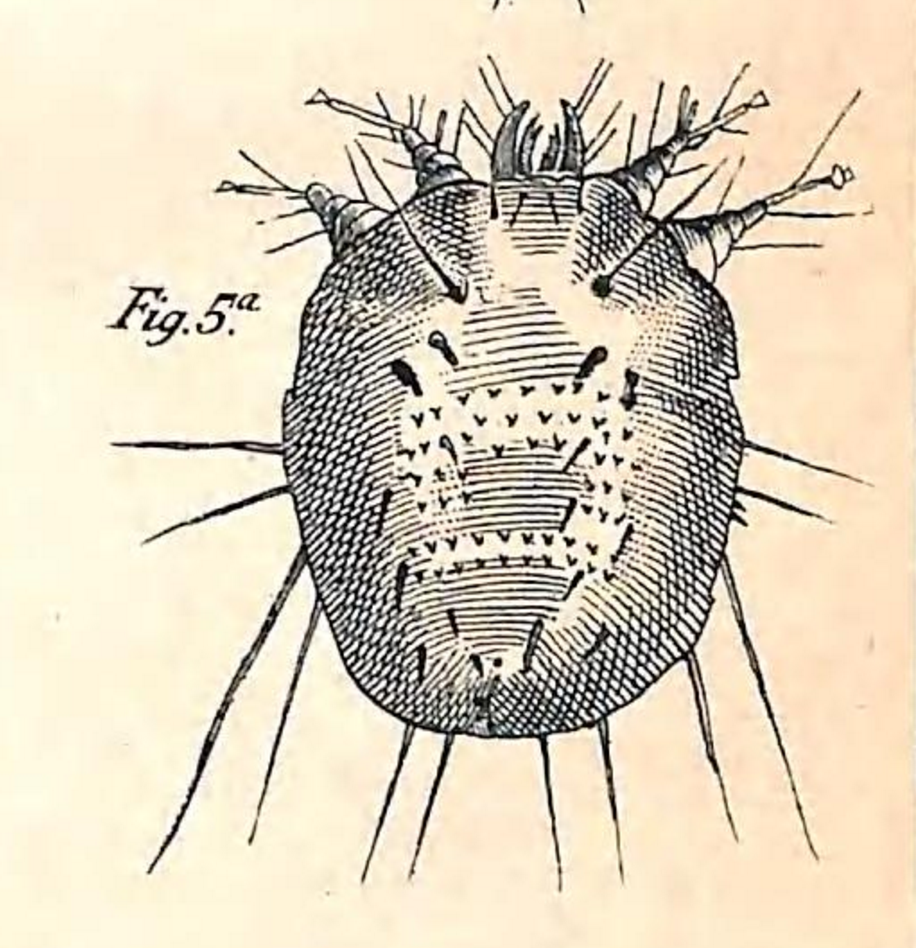
Sarcoptes scabiei (hembra). Visto por el dorso. (seg. Gudden). http://biodiversitylibrary.org/page/51139802.

Doctor Jesús Sánchez is also the author of other works related to the Mexican Medical Zoology of arachnids and insects, such as: Elementos de historia natural en forma de lecciones de cosas: Obra escrita expresamente para uso de las escuelas primarias de la nación, published in the year 1895 and available in BHL thanks to the Joint Library of Earth Sciences (Biblioteca Conjunta de Ciencias de la Tierra, Instituto de Ciencias del Mar y Limnología, UNAM), and the introduction of the work: Breve noticia de los establecimientos de instrucción dependientes de la Secretaría de Estado y del Despacho de Justicia e Instrucción Pública, edited in the year 1900.

View Full Size Image
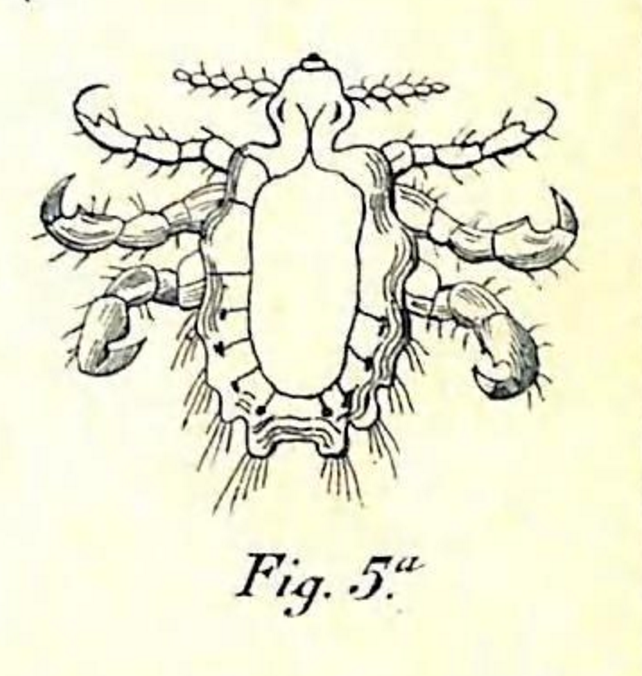
Ladilla o piojo del pubis. http://biodiversitylibrary.org/page/51139818.


September 22, 2016by ulib-libraryjobs

Help Support BHL

BHL's existence depends on the financial support of its patrons. Help us keep this free resource alive!

search

About BHL

The Biodiversity Heritage Library (BHL) is the world’s largest open access digital library for biodiversity literature and archives. BHL operates as a worldwide consortium of natural history, botanical, research, and national libraries working together to digitize the natural history literature held in their collections and make it freely available for open access as part of a global “biodiversity community.”

Join Our Mailing List

Sign up to receive the latest news, content highlights, and promotions.

Subscribe Now

Subscribe to Blog via Email

Enter your email address to subscribe to this blog and receive notifications of new posts by email.

Join 319 other subscribers

Subscribe to Blog Via RSS

Subscribe to the blog RSS feed to stay up-to-date on all the latest BHL posts.

Access RSS Feed

Inspiring Discovery through Free Access to Biodiversity Knowledge.

The Biodiversity Heritage Library makes it easier than ever for you to access the information you need to study and explore life on Earth…for free, anytime, anywhere.


64+ Million Pages of
Biodiversity Literature Online.

EXPLORE

Tools and Services
to Transform Research.

EXPLORE

300,000+
Illustrations on Flickr.

EXPLORE

ABOUT | HARMFUL CONTENT | PRIVACY | SITE MAP | TERMS OF USE