Biodiversity Heritage Library - Program news and collection highlights from BHL
  • Home
  • News
  • Featured Books
    • All Featured Books
    • Book of the Month Series
    • BHL at 20
  • User Stories
  • Campaigns
    • Fossil Stories
    • Garden Stories
    • Monsters Are Real
    • Page Frights
    • Her Natural History
    • Earth Optimism 2020
  • Tech Blog
  • Visit BHL
Home
News
Featured Books
    All Featured Books
    Book of the Month Series
    BHL at 20
User Stories
Campaigns
    Fossil Stories
    Garden Stories
    Monsters Are Real
    Page Frights
    Her Natural History
    Earth Optimism 2020
Tech Blog
Visit BHL
  • Home
  • News
  • Featured Books
    • All Featured Books
    • Book of the Month Series
    • BHL at 20
  • User Stories
  • Campaigns
    • Fossil Stories
    • Garden Stories
    • Monsters Are Real
    • Page Frights
    • Her Natural History
    • Earth Optimism 2020
  • Tech Blog
  • Visit BHL
Biodiversity Heritage Library - Program news and collection highlights from BHL
Blog Reel, Featured Books

Using the materials at hand: Richard Archbold and the 2nd Archbold Expedition to New Guinea

The American Museum of Natural History selected two unique sets of material to digitize for the CLIR BHL Field Notes Project: field books from the Whitney South Sea Expedition and the Archbold Expeditions. These were two long-running undertakings to systematically explore and collect the flora and fauna of Oceania. Both contributed invaluable specimens to the scientific research and exhibition collections at AMNH. We recently completed digitization of the Whitney South Sea Expedition field notes and are thrilled to have commenced work on the Archbold material. Arguably, the most rewarding aspect of participating in this project is raising awareness of some rather remarkable individuals and expeditions. One example is the 2nd Archbold Expedition to New Guinea. We recently digitized leader Richard Archbold’s journal from that journey, which helps shine a light on this particularly fascinating story.

Archbold Expeditions is a corporation originally founded and led by Richard Archbold. It funded a research collection and staff at the AMNH Department of Mammalogy and sponsored a series of scientific collecting journeys to New Guinea and northern Australia. Heir to a substantial fortune, Archbold was a collector, explorer, ecologist, photographer, mountaineer, and pilot. As a youth he developed a love of nature and technology which carried over into all his future endeavors. He was a Research Associate at AMNH since his participation as photographer and mammalogist in the Mission zoologique franco-anglo-américaine à Madagascar, an experience which would directly inspire him to continue exploration work. He led the first three of the Archbold New Guinea Expeditions himself, and in 1940 founded the Archbold Biological Station in Florida. This research station and Archbold Expeditions were associated with AMNH until the 1980s. The Archbold Biological Station is still vitally active today.

Archbold excelled at organization and planning, recognizing needs and filling them. He regularly made use of and adapted the most current technology and also sought after the best scientists and personnel for his expeditions.
View Full Size Image
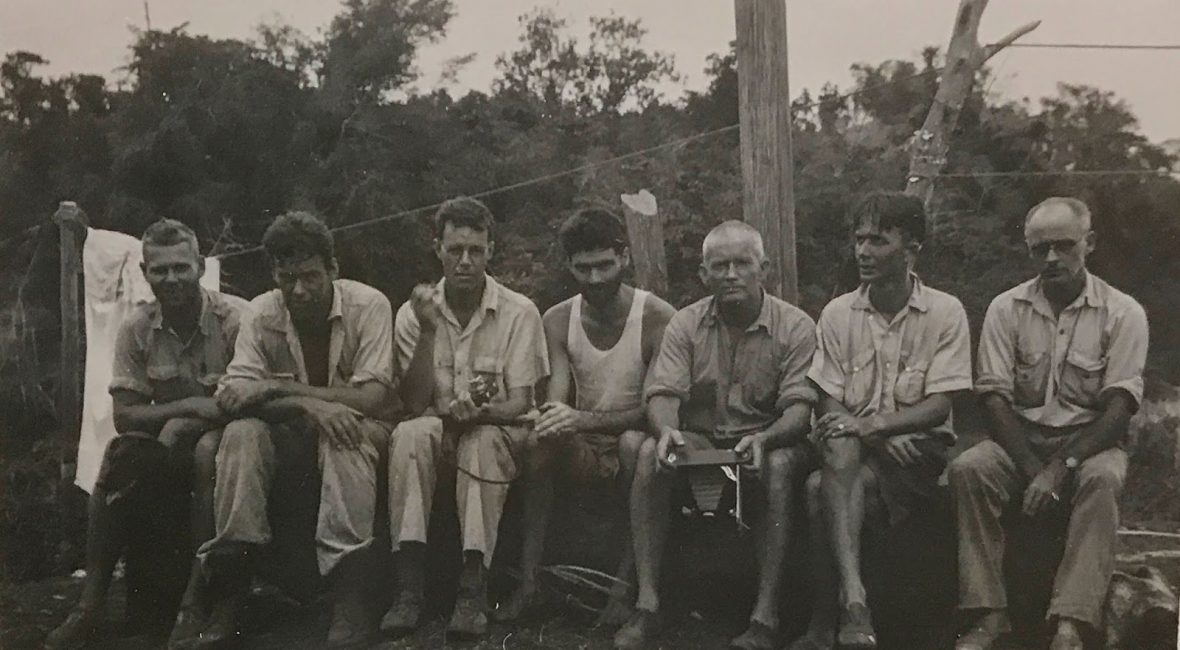
Some of the 2nd Archbold Expedition participants, including scientific party Austin Rand, G. H. H. Tate and Leonard Brass. All three participated in multiple Archbold Expeditions.
“WH2; Papua, Oroville Camp; Juhlstedt, Rand, Tate, Archbold, Burke, Healy, Brass.” Archbold Expeditions Collection, Department of Mammalogy, AMNH.

This ability to recognize needs and adapt is never more evident than in the 2nd Archbold Expedition, which took place between 1936 and 1937. There were seven ‘numbered’ Archbold Expeditions to New Guinea, reaching all areas of the region. The focus for this journey was the largely uncharted area of the Western Province of Papua New Guinea from Daru up the Fly River. After the success of the first expedition to New Guinea between 1933 and 1934, Richard Archbold hoped to continue the systematic exploration of Papua New Guinea, but he recognized that one of the main challenges to exploration in this region was in the effective provision and transportation of supplies overland in this mountainous terrain. Describing it as “the biggest bugbear of former travel in New Guinea,” (1) the lack of local food availability resulted in a need for a continuously moving food relay transport system manned with native assistants.

Demonstrating the above-mentioned practical planning and technological skills, Archbold and crew proposed and designed an innovative system of communication, transportation and delivery using aircraft, radio, and parachutes to utilize in the next trek. In addition to Archbold, the scientific party included ornithologist and assistant leader Austin Rand, botanist Leonard Brass, and mammalogist G. H. H. Tate.
View Full Size Image
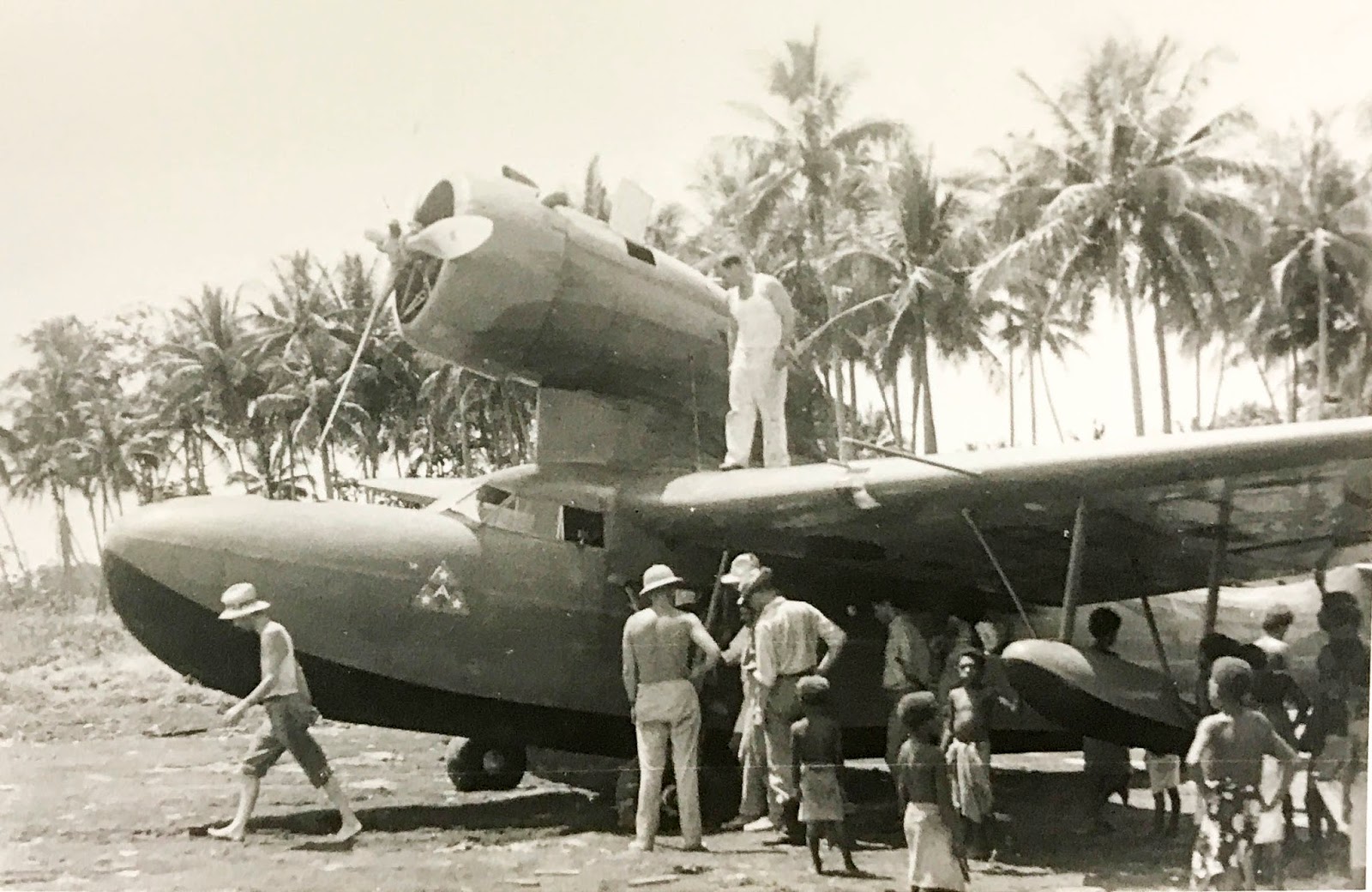
Archbold is walking toward the front of the craft. Note the triangular Archbold Expeditions insignia on the plane.
“90-43; Papua, W.D., Daru: Kono on ramp after return from Lake Marguerita.” Archbold Expeditions Collection, Department of Mammalogy, AMNH.

Archbold purchased a Fairchild Amphibian seaplane which he named the Kono, to be used to deliver supplies to the remote areas by parachute. The combination of air transport, along with a system of radio communications proved to be highly successful in practice. The use of the radios allowed the various divisions of the expedition (advance land party, collecting group and plane) to keep in contact and coordinate supply drops and pickups from remote areas, communication on which they were dependent.
View Full Size Image
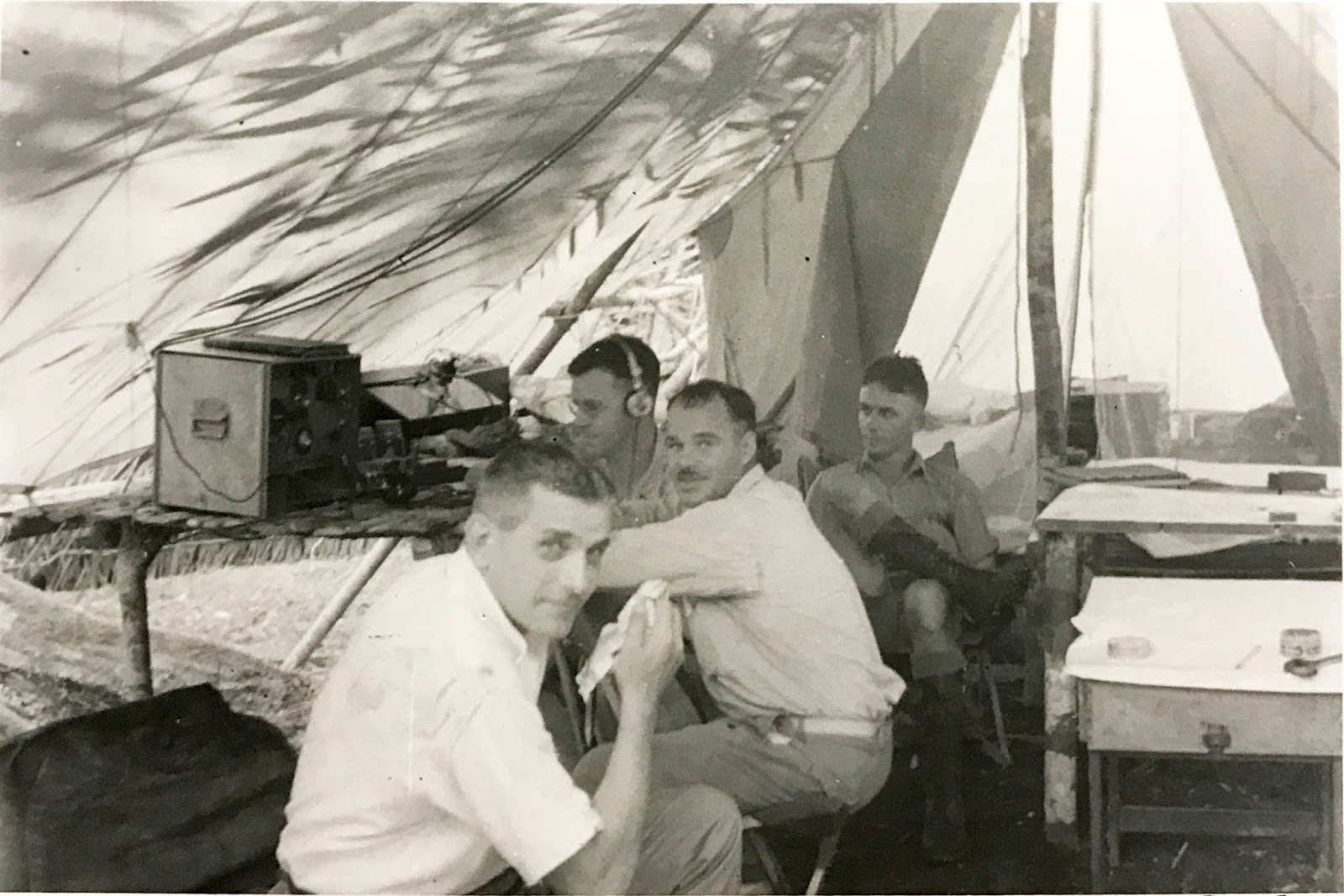
Besides collecting mammals, Tate acted as a radio operator.
“210-18; Papua, Western Division, Fly River, 528 mi. camp: Willis, Rogers, Tate & Healy” Archbold Expeditions Collection, Department of Mammalogy, AMNH.

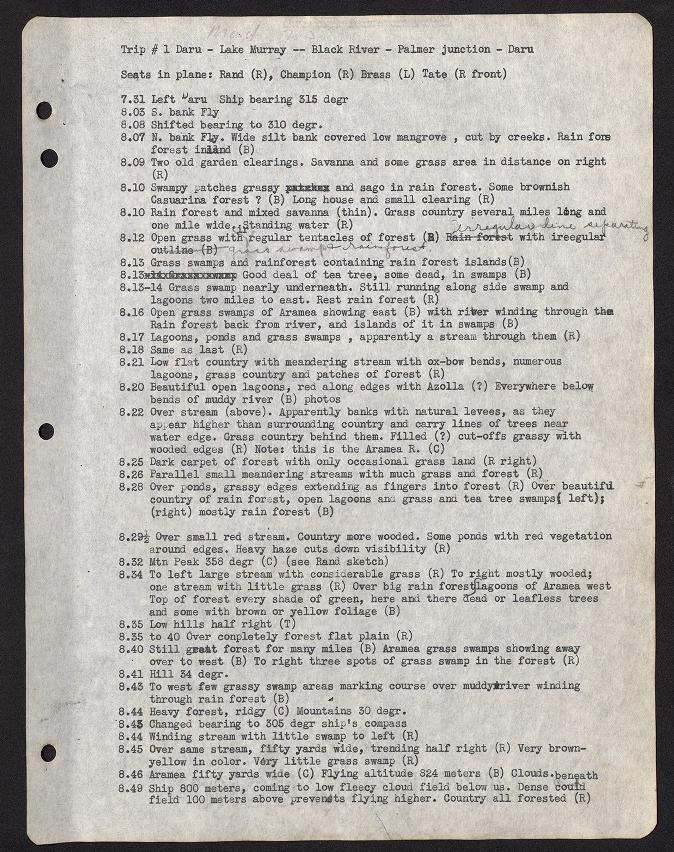
Besides transportation, the aircraft was also used for a series of reconnaissance flights to determine mountain camp sites and possible landing areas. In Archbold’s journal we see multiple lists of observations from these flights. They note the time, the participant making the observation, and even where they were seated, an evident effort to fully survey the viewed areas.
View Full Size Image
Reconnaissance flight observations.
Richard Archbold’s journal : Second Archbold Expedition to New Guinea, p. [19]; http://biodiversitylibrary.org/page/53611788

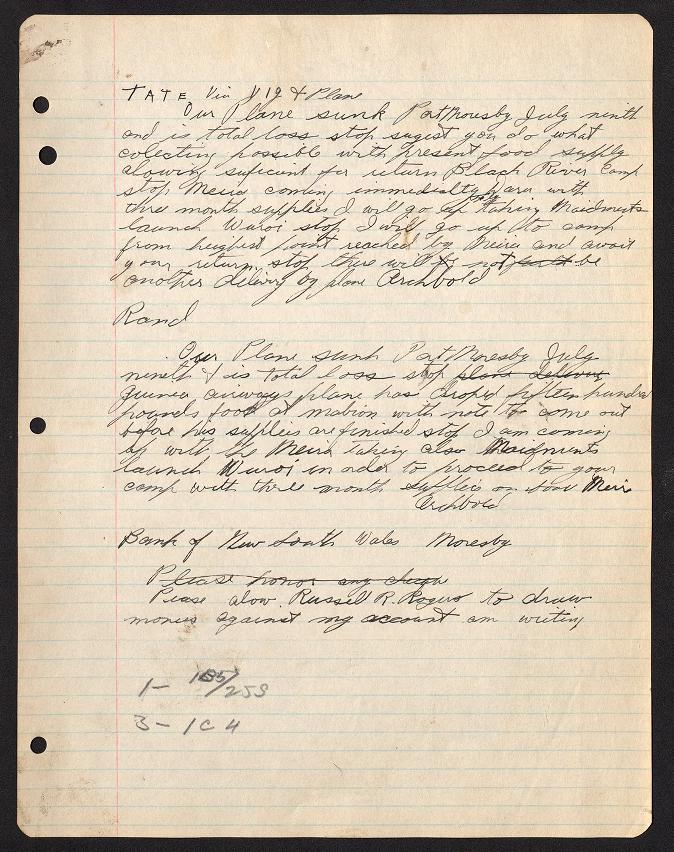
Initial plans called for the group to travel up to high elevations in the mountains but in July of 1936, only a few months into their endeavor, the Kono was tragically capsized in a sudden storm. Although no one was harmed, the devastation of this loss is clearly conveyed in a series of radio messages: “Our plane sunk.” In Tate’s expedition journal, which will soon be digitized for this project, he relates receiving the message, stating “What a calamity for Archbold!”(2)
View Full Size Image
Messages to Tate and Rand announcing the wreck of the Kono.
Richard Archbold’s journal : Second Archbold Expedition to New Guinea, p. [101]; http://biodiversitylibrary.org/page/53611844

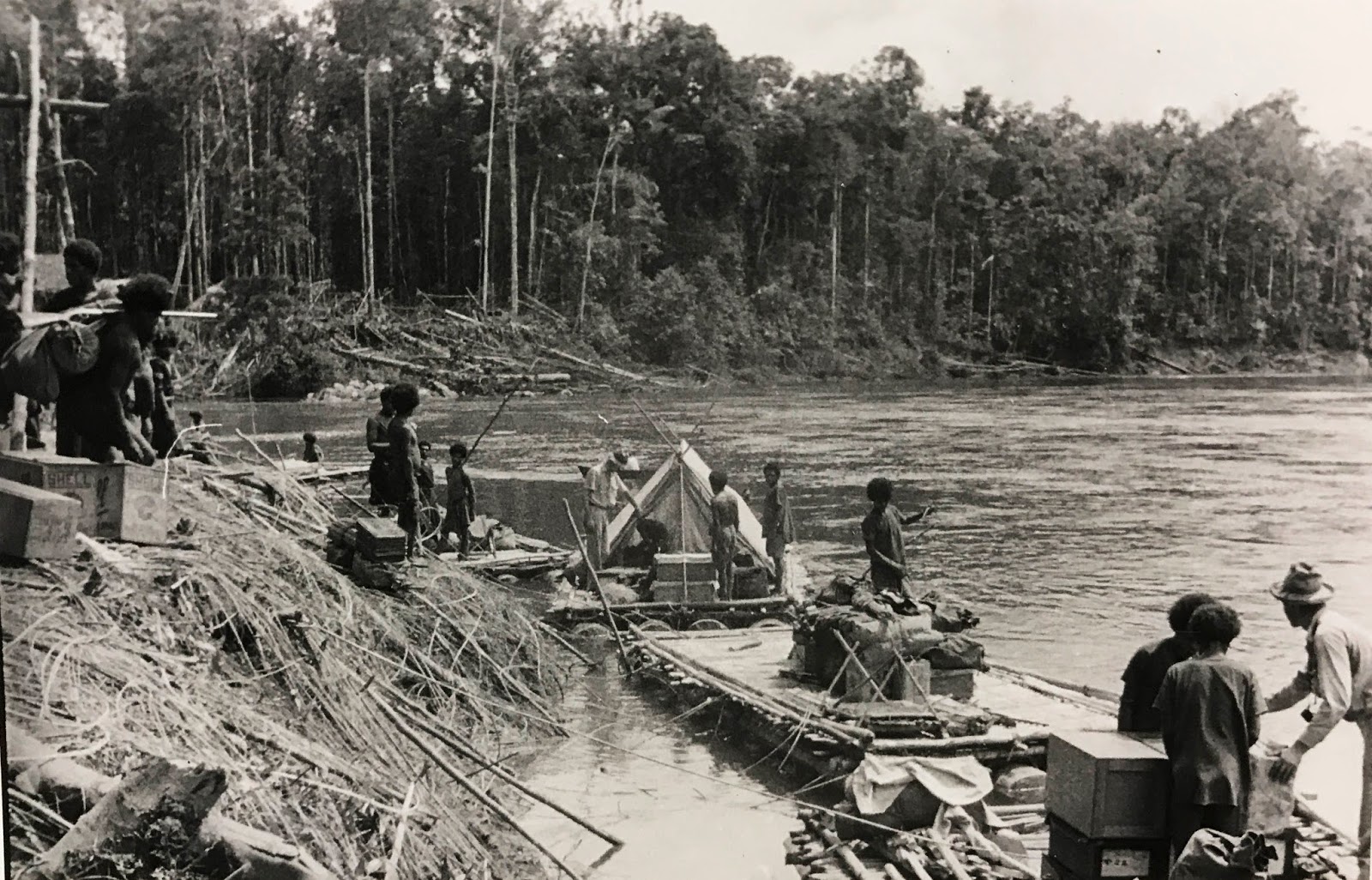
Besides the obvious financial setback of this loss, the team was forced to quickly adapt their plans, arranging for alternate means to transport the collections. The scientific staff and the carriers built a flotilla of rafts to move the specimens and supplies down the Fly River. According to Rand, “Tate had his rats on his rafts, Brass his plants on his, and I had my birds on mine.” (3) Not to be deterred, they simply moved forward and continued collecting in the lowlands, a resilience I find enviable. This is not to say that the irony of the situation was lost on the participants. In an article for Natural History magazine, Rand and Archbold noted that during the expedition both the most current and the most primitive methods of transportation were used: planes, ships, homemade rafts, and foot. (4)
View Full Size Image
After having to abandon plans to continue to higher altitudes, the team crafted a series of rafts to float material down the Fly River.
“258-20; Papua, W.D., Fly R., No. 2 base: Rafts being loaded—close up. Photo by Brass” Archbold Expeditions Collection, Department of Mammalogy, AMNH.

It is important to note the very practical advantage and benefit of their radio system at this juncture. It not only allowed easy communication, remote organization and project direction across the region, but also contact with New York. A copy of a radiogram received at AMNH on July 16, 1936 from Archbold at Daru reassures the safety of all parties. “Absolutely no cause for alarm stop Rogers dropped more food advance party in Guinea Airways plane stop in constant radio communication advance party stop they advise absolutely no danger.” (5)

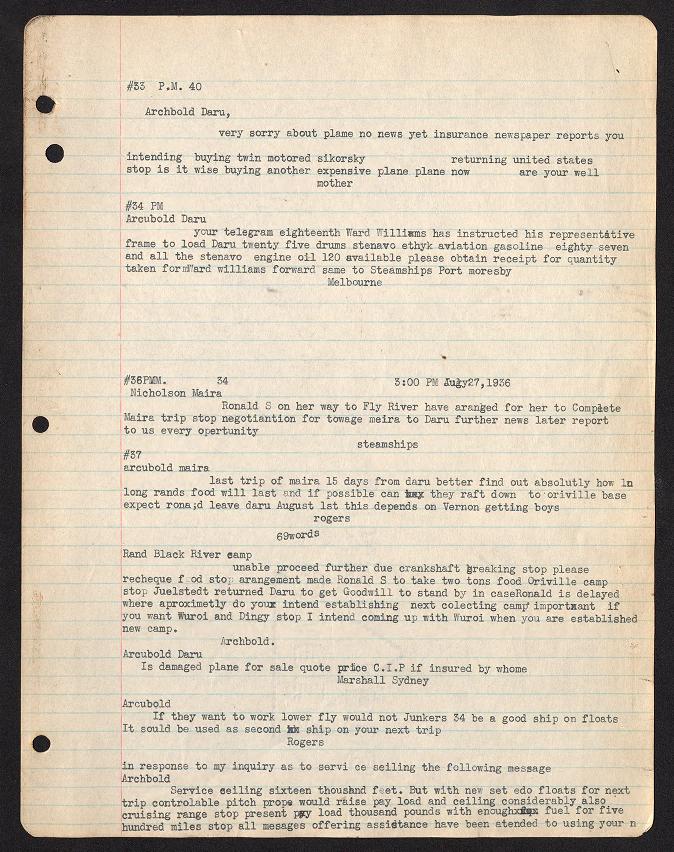
Archbold immediately began planning for the next expedition, even looking to purchase a replacement plane. A copy of a radio message from his mother shows her practical opposition to such an expense so soon. Archbold remained single-minded, however. “Though we had failed to reach the mountains our large collections from the Upper Fly were extremely valuable and our new methods of transport had proved so feasible that we plan to use the same system in collecting at the highest altitudes in the little known Snow Mountains of Dutch New Guinea early next year.” (6) That expedition also used the combination of seaplane delivery and radio with great success, incidentally also managing to set world aeronautic records! Amusingly, Archbold named this next plane the ‘Guba,’ which is the local dialectic term for the type of storm that downed the Kono.
View Full Size Image
A page from Archbold’s journal. Note the message from his mother.
Richard Archbold’s journal : Second Archbold Expedition to New Guinea, p. [113]; 

For context, it is interesting to place these expeditions in the overarching history of biodiversity exploration and collection in the region. In 2015, AMNH scientists participated in a collaborative Explore21 expedition to Papua New Guinea. Department of Ornithology Collections Manager Paul Sweet noted their place in the legacy of exploration in New Guinea, notably with the use of now modern technology: “Papua New Guinea is well known as a biodiversity hotspot, but it’s still not fully explored. The Museum has a long history of making expeditions to the island of New Guinea [the eastern half is part of the nation of Papua New Guinea; the western half is governed by Indonesia], so we were following in the tradition of naturalist explorers like Ernst Mayr, Richard Archbold, and E. Thomas Gilliard. And that’s really the thrust of these Explore21 expeditions. It’s a great way to continue the tradition of scientific collecting expeditions alongside cutting edge 21-century methods like genomics.” (7)

Hmm, cutting-edge technology and expeditions…sound familiar?

References:

(1) Archbold, Richard and Rand, A.L., “With plane and radio in stone age New Guinea,” Natural History 40, no. 3 (1937): 568.
(2) Tate, G. H. H., Field journal : Archbold 1936 New Guinea Exp. February 27, 1936 to July 8, 1937. AMNH Department of Mammalogy Archive.
(3) Morse, Roger A., Richard Archbold and the Archbold Biological Station. (Gainesville, FL: University Press of Florida, 2000), 18.
(4) Archbold, Richard and Rand, A.L., “With plane and radio in stone age New Guinea,” Natural History 40, no. 3 (1937)
(5) Radiogram transcript, 1936, Archbold Expeditions Collection, AMNH Department of Mammalogy Archive.
(6) Archbold and Rand, 576.
(7) AMNH, “SciCafe Goes to Papua New Guinea [blog post], (2/27/15), accessed at http://www.amnh.org/explore/news-blogs/q-as/scicafe-goes-to-papua-new-guinea

The BHL Field Notes Project is funded by the Council on Library and Information Resources (CLIR).

July 6, 2017by lmyrick
Blog Reel, Featured Books

George Engelmann’s Botanical Notes Can Now Be Seen!

The Missouri Botanical Garden (MBG), a partner in the Biodiversity Heritage Library Field Notes Project, has spent the last year digitizing the notebooks of George Engelmann.

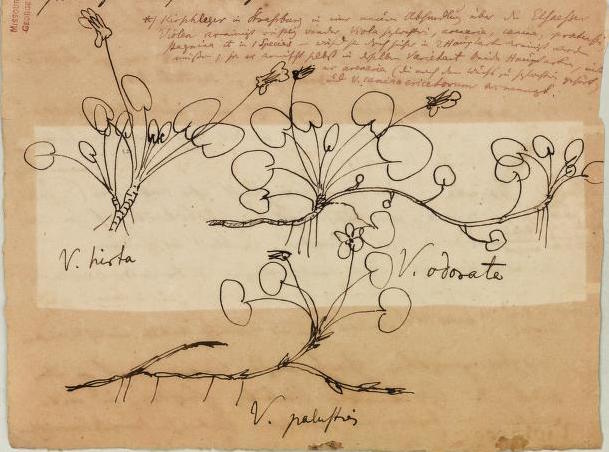
George Engelmann assisted Henry Shaw, MBG’s founder, in establishing the Garden’s research arm and corresponding library. He arrived in Belleville, Illinois, sometime in the 1830s but soon moved to St. Louis where he set up practice as a physician. In the 1840s, Engelmann began corresponding with—and became a close friend and colleague of—Asa Gray at Harvard University, one of the best known botanists in the United States. This relationship, combined with his passion for plants of the newly opened American west, would lead to Engelmann becoming the principle coordinator for botanical collecting west of the Mississippi River.

View Full Size Image
Figure 1 from notebook 1, folder 1. George Engelmann : botanical notebook 1. Cistaceae, Violaceae. [Undated].

Setting up a trifecta of American botanical exploration with Gray at Harvard and John Torrey at the Smithsonian, Engelmann became an avid and knowledgeable botanist as he corresponded with Gray and Torrey to direct various westward explorers. He collected over 98,000 botanical specimens which were donated to MBG upon his death. Combined with 62,000 botanical specimens purchased in 1857 for Shaw from the Bernhardi Herbarium, originally in Germany, these two collections formed the foundation of the MBG herbarium. Engelmann also helped establish the St. Louis Academy of Sciences.

The BHL Field Notes Project is the third time George Engelmann’s collection has been accessed for scanning. In 2010, MBG received a grant to complete a project called Digitizing Engelmann’s Legacy, and another in 2013 to digitize Engelmann’s correspondence. With this latest project, MBG is able to provide access to much of Engelmann’s botanical notebooks.

View Full Size Image
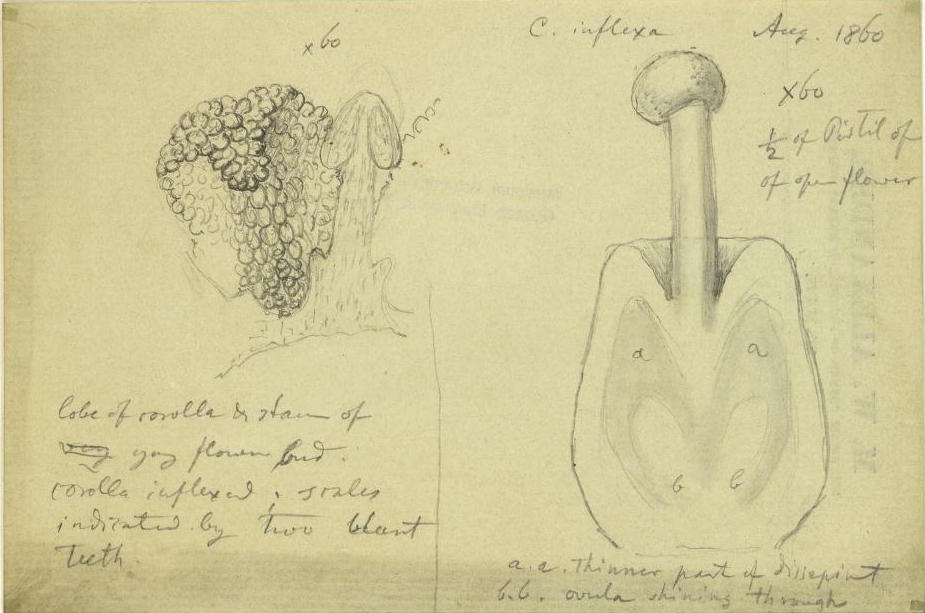
Figure 2 from notebook 25, folder 9. George Engelmann : botanical notebook 25 : Cuscuta. Box 11: Folder 9: Cuscuta. (1860-1875).

The notebooks were dismantled sometime in the past and housed within folders placed in boxes. His 58 notebooks are spread out over 27 boxes and comprise over 14,000 individual items. Not wanting to waste paper, Engelmann often wrote his notes on the back of correspondences, prescription slips, official documents, etc. Among his copious note taking are many botanical drawings likely depicting the specimens as he saw them.

Please feel free to browse Engelmann’s notebooks as they continue to be digitized and uploaded to the Biodiversity Heritage Library and Botanicus.

The BHL Field Notes Project is funded by the Council on Library and Information Resources (CLIR).
May 4, 2017by lmyrick
Blog Reel, Featured Books

Notes from William Brewster: The Evolving Field of Zoology

As a part of the Field Notes Project, the Ernst Mayr Library is digitizing the journals, correspondences and photographs of William Brewster (1851-1919), a self-trained ornithologist and specimen curator at Harvard’s Museum of Comparative Zoology (MCZ), the first president of the Massachusetts Audubon Society, and a co-founder and president of the American Ornithologists’ Union.

Brewster recorded a lifetime of observations on wildlife and plants, changing landscapes, and daily weather, making his notes a valuable resource for modern scientists studying ecological change. After working as an animal specimen curator for the MCZ for many years, he also bequeathed his personal collection of birds and other animals to the museum.

As I’ve worked to digitize and transcribe the Brewster collection, I’ve been periodically sharing interesting finds in a blog post series on the Mayr Library website. These posts highlight entertaining animal encounters, beautiful descriptions, letters, and more.

View Full Size Image
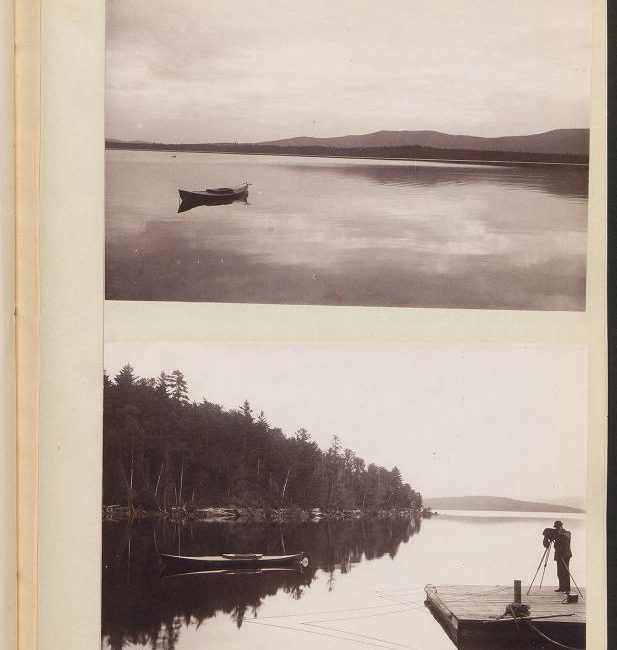
Lower image: Portrait of Brewster with his camera at
Lake Umbagog, Maine, likely captured by his assistant, Gilbert.
Journals of William Brewster, 1871-1919 (inclusive). (1898). http://biodiversitylibrary.org/page/45105729

I’ve been especially fascinated to track the development of Brewster’s thoughts on scientific collecting. I touched on this subject in a post on the Biodiversity Heritage Library blog, “Digging into the writings of a 19th century ornithologist”. As I’ve continued to scan and transcribe the Brewster collection, an interesting story has emerged. It was a complex job to juggle the hats of museum curator, scientific collector, and bird-lover.

In an 1886 letter, Brewster scoffed at the assertion that “the best was to study bird was with an opera glass!”[1] This was one decade before the Massachusetts Audubon Society for the Protection of Birds was founded, with Brewster as its first president. Despite his earlier reservations, journals from the 1890s show Brewster embracing new methods of data collection using binoculars and cameras, and reflecting critically on the future methods and goals in zoology.

While he continued to advocate for the importance of collecting wildlife specimens, Brewster increasingly felt that humans had an ethical responsibility to carefully mitigate human impact on wildlife – and this responsibility belonged to scientists, too.

View Full Size Image
Brewster returned for many years to make observations at Lake Umbagog, Maine, sometimes staying in his specially built house-boat.
The person standing on deck is probably his assistant, Gilbert. Journals of William Brewster, 1871-1919 (inclusive). (1898). http://biodiversitylibrary.org/page/45105746

In the 1890s Brewster began to consistently document a deep conflict between his desire to study nature and his desire to leave wildlife untouched. Because his field notes are typically more focused on data than on personal details, these comments really do stand out and signal that this became a matter of great concern to him. In 1892, he observes:

As on several former occasions when I have seen a Hawk catch a smaller bird and have listened to its expiring cries I was moved by deep pity and fierce wrath to an extent surprising on the part of one who, like myself, has killed thousands of birds without suffering more than an occasional slight qualm. But there is something peculiarly moving and piteous in the voice of a bird in the clutches of a Hawk – a quality of mingled pain and apprehension which the grasp of the human hand seldom or never elicits. [2]

Over the next few years, we find that he has gone from those aforementioned “occasional slight qualm[s]” to a daily struggle to complete his work. In 1896 he refers to collecting birds as “a most painful task”[3], and writes that he is sometimes “quite unable to bring [himself] to the point of doing it.” [4]

View Full Size Image
Close-up of a female moose Brewster sketched at Lake Umbagog, Maine. Journals of William Brewster, 1871-1919 (inclusive). (1896). http://biodiversitylibrary.org/page/44924677

It’s clear that Brewster saw a need for some change in the current scientific practices. Birds were generally being over-harvested, for fashion but also for science. And not only was nature conservation on his mind, but it seems that he felt personally dissatisfied by the limited scope of zoology. Brewster saw the need to legitimize observational studies of animal behavior in a scientific community that was focused primarily on taxonomy and building large collections. While he wrote many letters to colleagues debating the species and subspecies designation of specimens, his journals are brimming with descriptions and speculations about animal behaviors.

From his correspondences, we can see that his thinking was encouraged by Frank Michler Chapman, a younger friend and colleague working at the American Museum of Natural History. In 1890, Chapman had written to Brewster to express his concern that specimen collecting was destructively out of control:

This miserable collecting. It is the cause of all higher failing, it lowers a true love of nature through a desire for gain. I don’t mean a specimen here and there, but this shooting right and left, this boasting of how many skins have been made in a day or season. We are becoming pot-hunters. We proclaim how little we know of the habits of birds and then kill them at sight. Sometimes I am completely disgusted with our ways and myself in particular… I long for an outing where the gun will be secondary, recorded observations primary, where I shall be entirely alone or with a companion whose object is my object. 

We expect too much, that’s the trouble. Collecting, we have at the end of each day some tangible result to show for the day’s work. But it is useless to expect some novel or interesting incident for every day[‘]s observation. But listen to this final result: If I had gone down the Suwanee [River] to record what I saw, I could now have written a more or less interesting paper, as it is I have nothing to say, but I have a hundred or so skins. The question with me is, how am I going to change this? …We have degenerated to ‘gunners’; our success in the field is estimated by the size of our collections. 

… Will you embark with me on a novel ornithological expedition, whose aim shall be to really observe birds to learn something of them. Where the gun shall be a servant, not a master, where days may pass without a skin being made, where there will be time to speculate and discuss the habits of birds observed, where systematic observation of certain phaenomena may be attempted… Returning we could write a paper. How do you suppose this paper would compare with the ones we have to-day, where after a trip[‘]s experience all we can say concerning a given species is: Common, arrived ___.

Such a paper with your name attached to it would start a new epoch in the study of American birds. Imagine any one now-a-days making an extended trip for the sole purpose of observing birds. I know, I have several papers in mind which approach this – yours are nearest. Do you suppose we can reach that condition of mind where one good observation will be considered worth fifty skins, – as it really is. [Line breaks and emphasis added.] [5]

View Full Size Image
A page from William Brewster’s journal. Illustration reads “Made by Mr. Chapman from the feather of the ivory-bill shot March 24 and sent to me as a Christmas mount Dec. 25 1890.”
Journals of William Brewster, 1871-1919 (inclusive). (1890). http://biodiversitylibrary.org/page/44690675

Brewster was too busy with travel and fieldwork to respond directly (in writing, at least) to Chapman’s proposition, but he did reply a few weeks later, “I have been off in my canoe along the ‘South Shore’ of Mass for the past month & have made a good many valuable notes… I left the gun at home for the first time in my life and did not once regret it, either!” [6]

How amazing it was to find, in writing, a proposal to launch “a new epoch in the study of American birds”! While specimen collections are an important part of modern scientific work, it’s true that the study of zoology does look very different today than it did in the 19th century, and here we see the seeds of that change.

It would be easiest to paint Brewster as simply a taxidermist, or as an environmentalist, but as usual we find that the scientist was about as complex as the subjects he studied. Just as Brewster’s careful notes on species abundance and daily temperature are an invaluable resource for researchers, it’s enriching from a humanities perspective to uncover the personal stories that drove a major paradigm shift in the study and stewardship of natural world. While nothing quite compares to studying old documents in a quiet room, it’s exciting to be widening accessibility to these data and historical insights.

The BHL Field Notes Project is funded by the Council on Library and Information Resources (CLIR).
Images used in this post were previously digitized with funds from IMLS.

Citations:
[1] Correspondences, Letter to George Sennet, March 7, 1886. Soon to be available in BHL
[2] July 28. Journals of William Brewster, 1871-1919 (inclusive). (1892). http://biodiversitylibrary.org/page/44790847
[3] July 3. Journals of William Brewster, 1871-1919 (inclusive). (1896). http://biodiversitylibrary.org/page/44924596
[4] July 9. Journals of William Brewster, 1871-1919 (inclusive). (1896). http://biodiversitylibrary.org/page/44924608
[5] Correspondences, Frank Michler Chapman to William Brewster, June 15, 1890. Soon to be available in BHL
[6] Correspondences, William Brewster to Frank Michler Chapman, August 8, 1890. Soon to be available in BHL

Additional Resources:
To read more about Brewster’s encounter with the moose, read ‘Notes from William Brewster: Moose!‘
To learn more about how scientists use specimen collections today read ‘Natural history collections – why are they relevant?’ on The Guardian, or visit the page ‘Why Collections Matter’ on the Society for the Preservation of Natural History Collections’ website.

To learn more about the origins of the Massachusetts Audubon Society, read ‘Hats off to Audubon’ in Audubon Magazine, and the ‘History of Mass Audubon’ page on the society’s website.

April 6, 2017by lmyrick
BHL News, Blog Reel

Building Digital Field Notes Collections Together

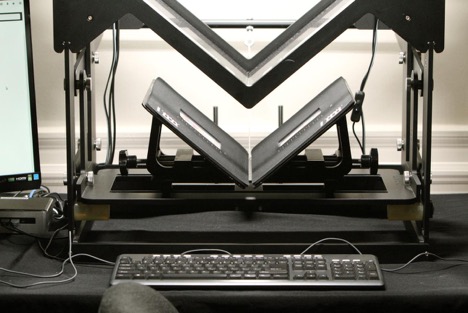
At Internet Archive, we are excited to provide digitization services for BHL Field Notes Project contributors from coast to coast. We will be digitizing our partners’ selected field notebooks at two of our eight North American regional digitization centers: San Francisco, CA and Princeton, NJ and providing remote services for the American Museum of Natural History.

View Full Size Image
A page scanned by AMNH staff on a Table Top Scribe. Whitney South Sea Expedition. Journal and letters of William F. Coultas. Volume 3. (1932). http://biodiversitylibrary.org/page/52311554

At regional centers, Internet Archive operators upload metadata from contributing partners, capture high-quality digital images using our Scribe system, then review each image for completeness and add structural metadata as appropriate. We use the term “republish” to refer to this post-capture process in which the operator de-skews pages, asserts page types, and ensures all data is captured. Once complete, operators upload the files and the automated derive process typically completes within 24 hours. The newly digitized books appear in their pre-designated collections and are then accessible to the public via our online book reader and/or downloadable access formats.

View Full Size Image

We are also participating in the Field Notes project through our Table Top Scribe system, which allows partners to capture images onsite within their libraries. Many of the field notebooks seen here were captured by American Museum of Natural History Table Top Scribe operators, and were then republished and uploaded by remotely located Internet Archive operators.

We have enjoyed working with the Field Notes librarians and project coordinators and look forward to adding more works like this to our shared collections.

The BHL Field Notes Project is funded by the Council on Library and Information Resources (CLIR).

March 2, 2017by lmyrick
Blog Reel, Featured Books

Interconnected Naturalist : Edmund Heller and the Field Notes Project

One of the great aspects of the BHL Field Notes Project is how the field notes we are digitizing – and the naturalists who created them – have connections to multiple project partners. Edmund Heller is one of these interconnected naturalists.

Heller was a naturalist active in the early twentieth century who participated in several expeditions sponsored by different institutions across the nation, including a number of BHL Field Notes Project partners. He traveled with Theodore Roosevelt for the Smithsonian African Expedition, traveled to Asia with Roy Chapman Andrews of the American Museum of Natural History (AMNH), served as a collector for the Field Museum, joined Hiram Bingham on Yale University and National Geographic Society’s Expedition in the Andes of Peru, and collected in Alaska with noted collector Annie Alexander, who proposed and helped establish the Museum of Vertebrate Zoology at the University of California, Berkeley.

View Full Size Image
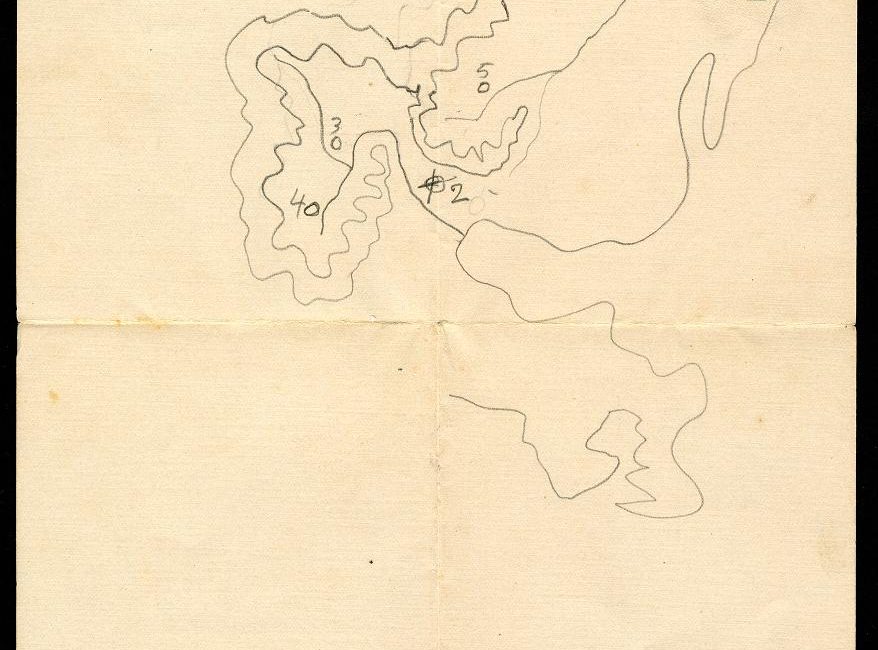
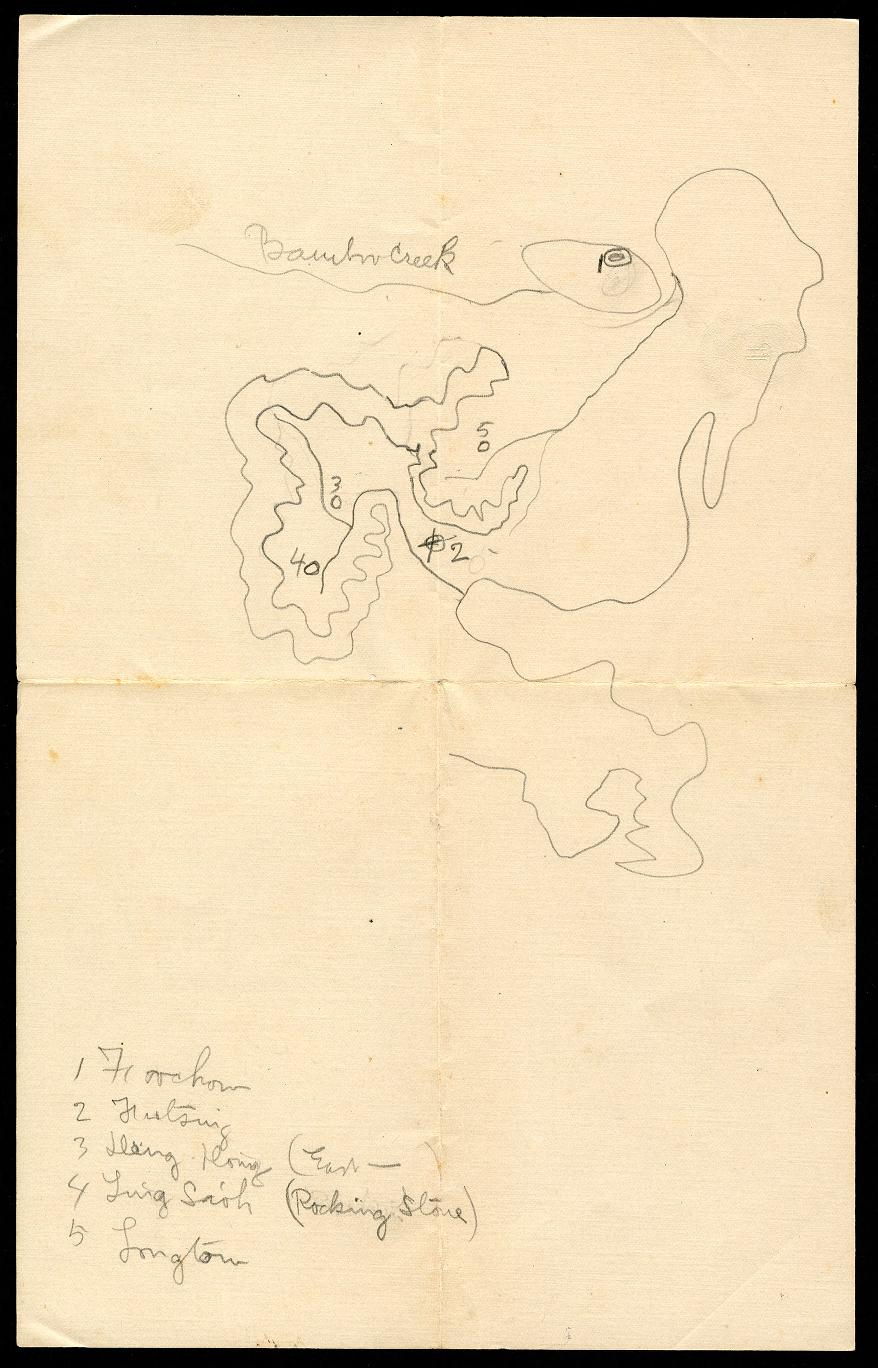
A map Heller drew while on Roy Chapman Andrews’ expedition to the Chinese province of Yunnan, Tibet, and Burma. Handwritten China journal of Edmund Heller (1 of 5). (1916). http://biodiversitylibrary.org/page/52109645.
View Full Size Image
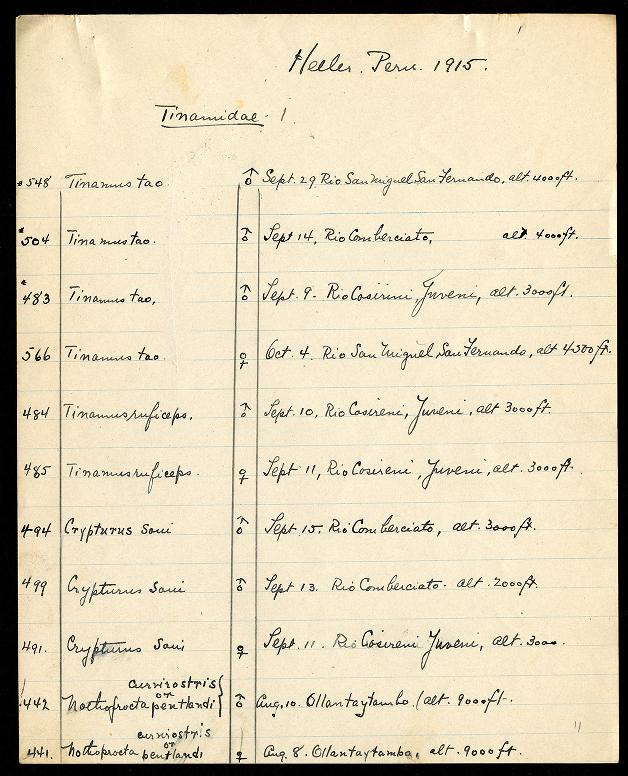
Field notes from Heller’s time as part of Yale University and National Geographic Society’s Expedition in the Andes of Peru. List of birds collected by Heller in Peru. (1915). http://biodiversitylibrary.org/page/52088223.

Since Heller moved around from institution to institution, participating in what he referred to as an “unequaled record of expeditions,” he is a classic example of a naturalist with field notebooks all over the map. Through the Field Notes Project, we have the opportunity to bring together parts of his collection. Nine of Heller’s notebooks are currently available in the BHL, contributed by Smithsonian Institution Archives (SIA). More of his notebooks will be digitized by SIA and AMNH by project end.

In the meantime, why not explore Heller’s work in the BHL?
The BHL Field Notes Project is funded by the Council on Library and Information Resources (CLIR).

Further Reading:

Where are Heller’s Field Books? – Field Book Project Blog

Expedition Connection: National Geographic Society Yale University Peruvian Expedition, 1915 – Biodiversity Heritage Library Blog

February 2, 2017by lmyrick
BHL News, Blog Reel

Introducing the BHL Field Notes Project

In 2015, the Council on Library and Information Resources awarded the Biodiversity Heritage Library a grant to fund the BHL Field Notes Project. Part of CLIR’s Digitizing Hidden Special Collections and Archives initiative, this project is a collaborative undertaking which will provide open access to field notes from several different institutions. By project end, BHL users will have access to over 450,000 pages of natural history field research material. This rich source of field notes includes diaries, journals, correspondence, and photographs.

View Full Size Image
p.p1 {margin: 0.0px 0.0px 0.0px 0.0px; text-align: center; font: 9.0px ‘Times New Roman’; color: #55677d} span.s1 {text-decoration: underline ; color: #0079cd}

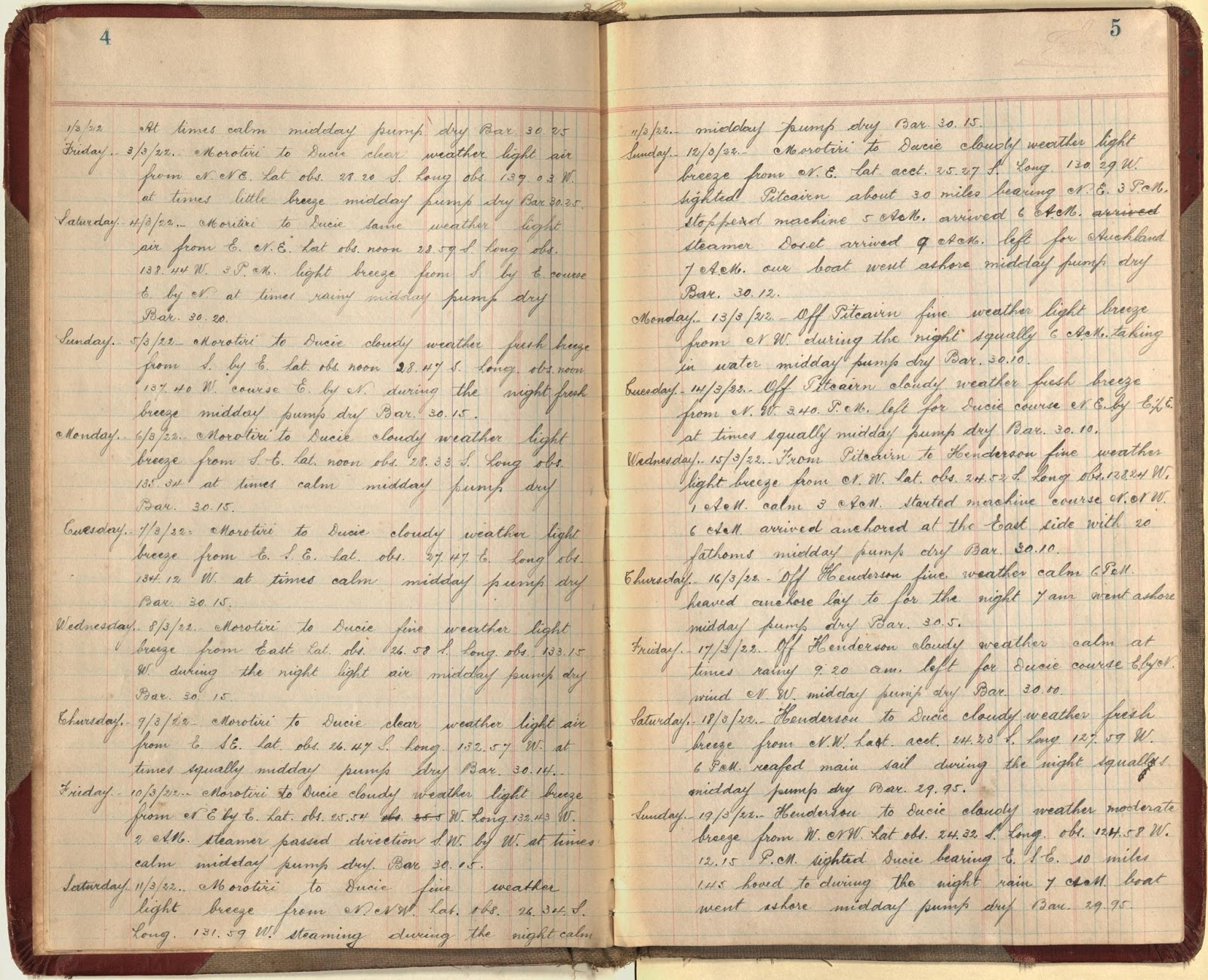
[Logbook of the yacht “France”]. v. 1 (1922-1926). Digitized by the American Museum of Natural History. http://www.biodiversitylibrary.org/page/51514493

The importance of field notes is well known to researchers. To natural scientists, field notes offer records of the flora and fauna of a location at a certain point in time. These records serve as reference points when observing how a certain habitat has changed over time. They can also offer information on expeditions, or the source of museum collection items. Field notes also present narratives that give insight into the scientists as people and their relationship with the locations and cultures they studied, making them an important resource for science historians.

View Full Size Image
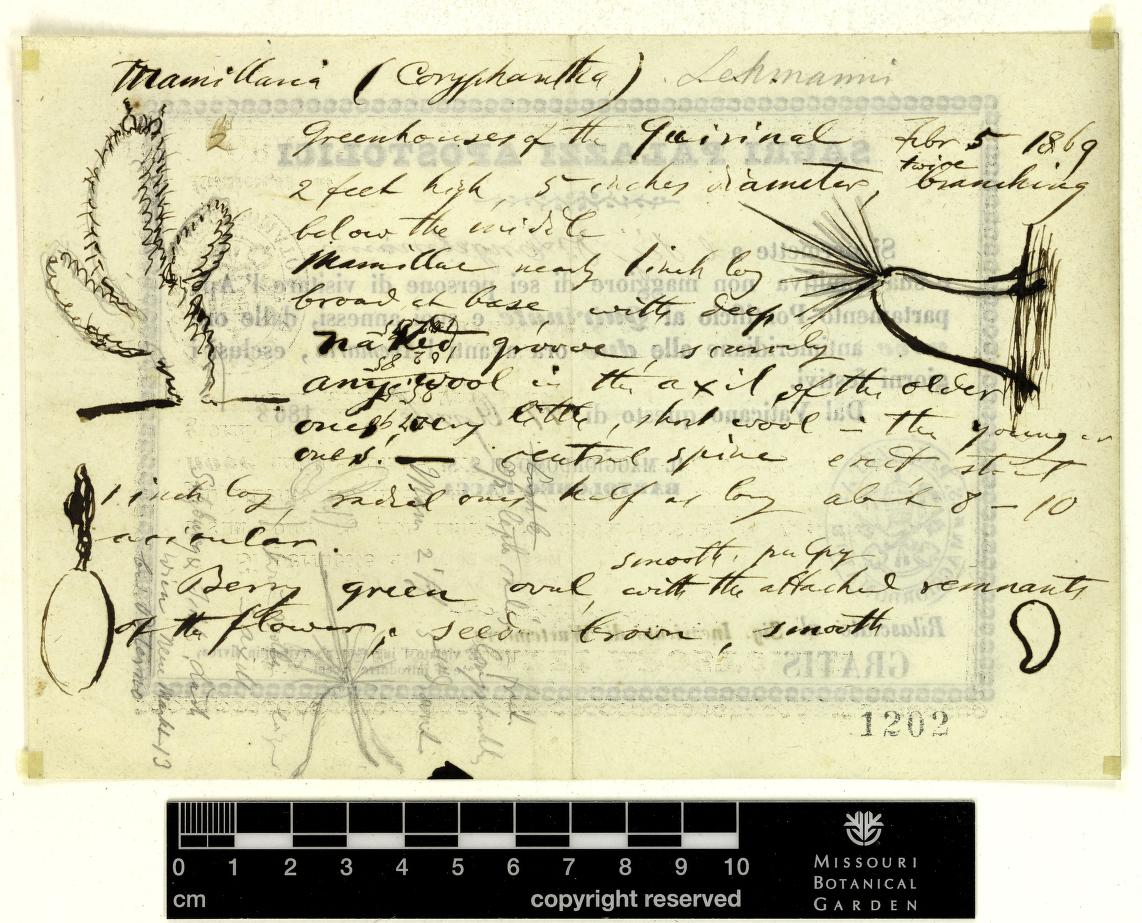
George Engelmann : botanical notebook 5 : Mammilaria, Leuchtenbergia, Discocactus, and Melocactus. Box 3: Folder 13: Cactaceae: Mammillaria: 1857-1883 (1856). http://biodiversitylibrary.org/page/52030722

The BHL has already started adding field notes to its collection, and the Field Notes Project hopes to add great value to the field notes already available. This project brings together the efforts of eleven institutions:

  • American Museum of Natural History
  • Field Museum of Natural History Library
  • Harvard University Botany Libraries
  • Harvard University, Museum of Comparative Zoology, Ernst Mayr Library
  • Internet Archive
  • LuEsther T. Mertz Library, The New York Botanical Garden
  • Missouri Botanical Garden, Peter H. Raven Library & Center for Biodiversity Informatics
  • Museum of Vertebrate Zoology, University of California, Berkeley
  • Smithsonian Institution Archives
  • Smithsonian Libraries
  • Yale Peabody Museum Archives

We are excited to be part of the effort to add more archival material to the BHL. Stay tuned for upcoming features which will highlight contributions from—and go behind-the-scenes at—some of our partners. In the meantime, explore some of the great field notes already digitized in the BHL Field Notes Project collection.

January 5, 2017by mkahn
Page 3 of 3«123

Help Support BHL

BHL's existence depends on the financial support of its patrons. Help us keep this free resource alive!

search

About BHL

The Biodiversity Heritage Library (BHL) is the world’s largest open access digital library for biodiversity literature and archives. BHL operates as a worldwide consortium of natural history, botanical, research, and national libraries working together to digitize the natural history literature held in their collections and make it freely available for open access as part of a global “biodiversity community.”

Join Our Mailing List

Sign up to receive the latest news, content highlights, and promotions.

Subscribe Now

Subscribe to Blog via Email

Enter your email address to subscribe to this blog and receive notifications of new posts by email.

Join 319 other subscribers

Subscribe to Blog Via RSS

Subscribe to the blog RSS feed to stay up-to-date on all the latest BHL posts.

Access RSS Feed

Inspiring Discovery through Free Access to Biodiversity Knowledge.

The Biodiversity Heritage Library makes it easier than ever for you to access the information you need to study and explore life on Earth…for free, anytime, anywhere.


64+ Million Pages of
Biodiversity Literature Online.

EXPLORE

Tools and Services
to Transform Research.

EXPLORE

300,000+
Illustrations on Flickr.

EXPLORE

ABOUT | HARMFUL CONTENT | PRIVACY | SITE MAP | TERMS OF USE