Biodiversity Heritage Library - Program news and collection highlights from BHL
  • Home
  • News
  • Featured Books
    • All Featured Books
    • Book of the Month Series
    • BHL at 20
  • User Stories
  • Campaigns
    • Fossil Stories
    • Garden Stories
    • Monsters Are Real
    • Page Frights
    • Her Natural History
    • Earth Optimism 2020
  • Tech Blog
  • Visit BHL
Home
News
Featured Books
    All Featured Books
    Book of the Month Series
    BHL at 20
User Stories
Campaigns
    Fossil Stories
    Garden Stories
    Monsters Are Real
    Page Frights
    Her Natural History
    Earth Optimism 2020
Tech Blog
Visit BHL
  • Home
  • News
  • Featured Books
    • All Featured Books
    • Book of the Month Series
    • BHL at 20
  • User Stories
  • Campaigns
    • Fossil Stories
    • Garden Stories
    • Monsters Are Real
    • Page Frights
    • Her Natural History
    • Earth Optimism 2020
  • Tech Blog
  • Visit BHL
Biodiversity Heritage Library - Program news and collection highlights from BHL
Blog Reel, Featured Books

Farewell to Brood X (2021) — See You in 2038!

A cicada attached to the underpart of a branch with green leaves in the background.

By the time this post publishes, the vast majority of Brood X (2021) will have completed their above ground lifecycle. The vast numbers of adult Magicicada who first emerged in late April and early May will have disappeared, leaving behind their adult bodies as well as still massive numbers of exuviae (cast-off outer skins) from when they emerged as nymphs.

Preparing for the Next Generation

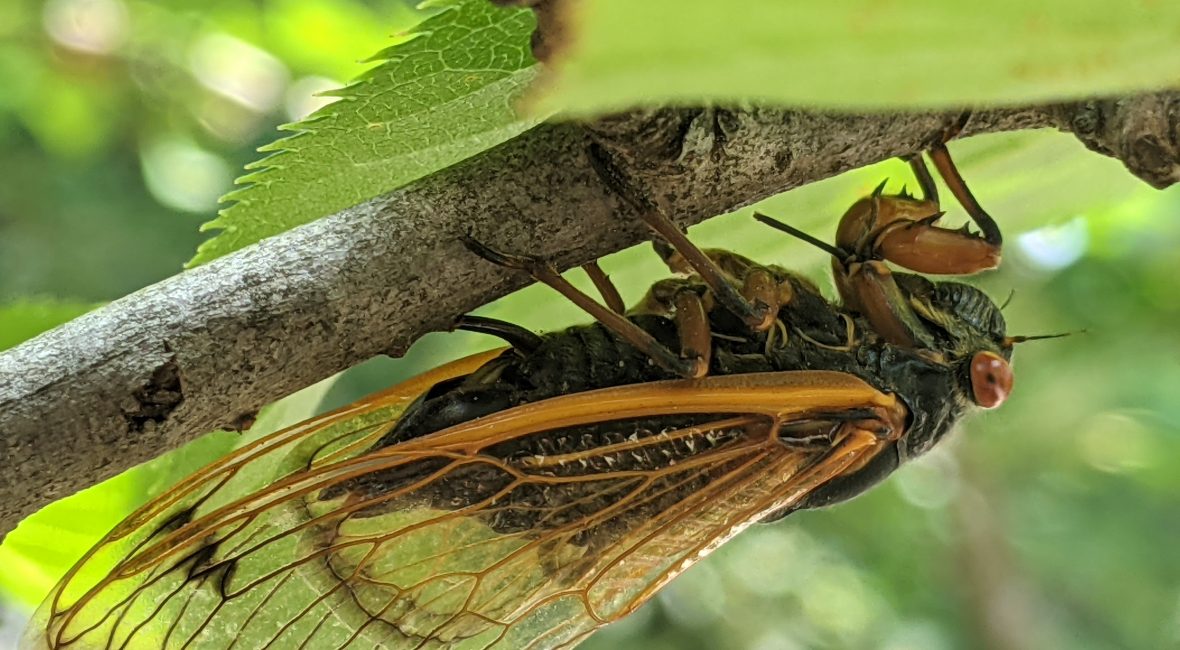
As the weather warmed up in the Brood X range, males began to sing and chorus, attracting females. After mating, the females could be found clinging to young branches, carefully digging into the branch and depositing eggs which will hatch in 4-6 weeks, the larvae then dropping to the ground where they will dig down, attaching themselves to the tree roots for the next 17 years.
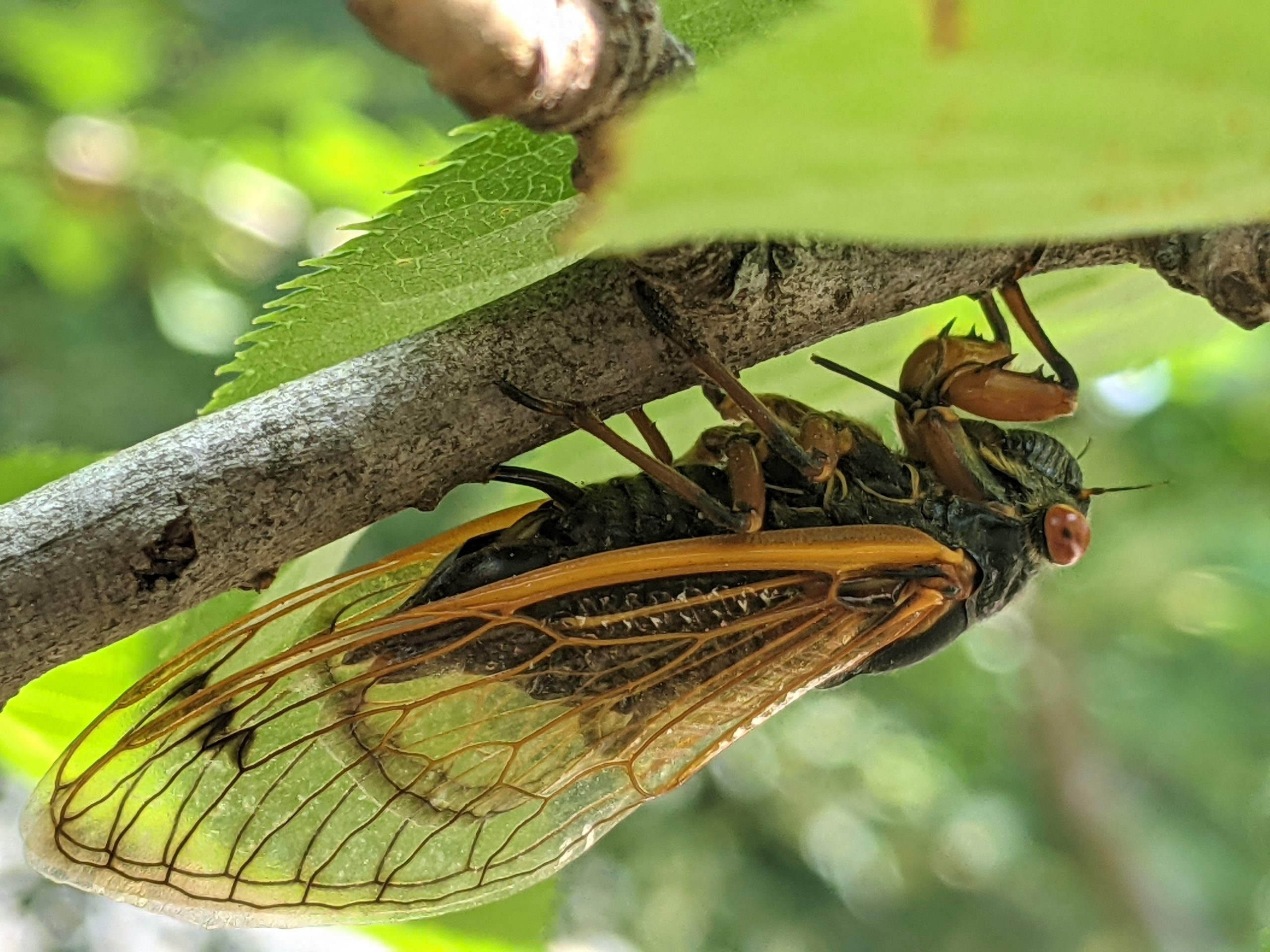
A cicada attached to the underpart of a branch with green leaves in the background.

Egg Laying Female (M. cassinii). 5 June 2021, Arlington Virginia. Photo credit: Martin Kalfatovic.

C.L Marlatt describes the process of the female’s ovipositing:

The work of the female Cicada in inserting her eggs is an interesting subject for study, and so little does she mind the presence of an observer that the operation can be closely watched without her exhibiting any alarm. (Marlatt 1898, 78)

The grooves or channels dug by the female can clearly be seen in this illustration by L.H. Joutel from Charles Pack’s Trees as Good Citizens:
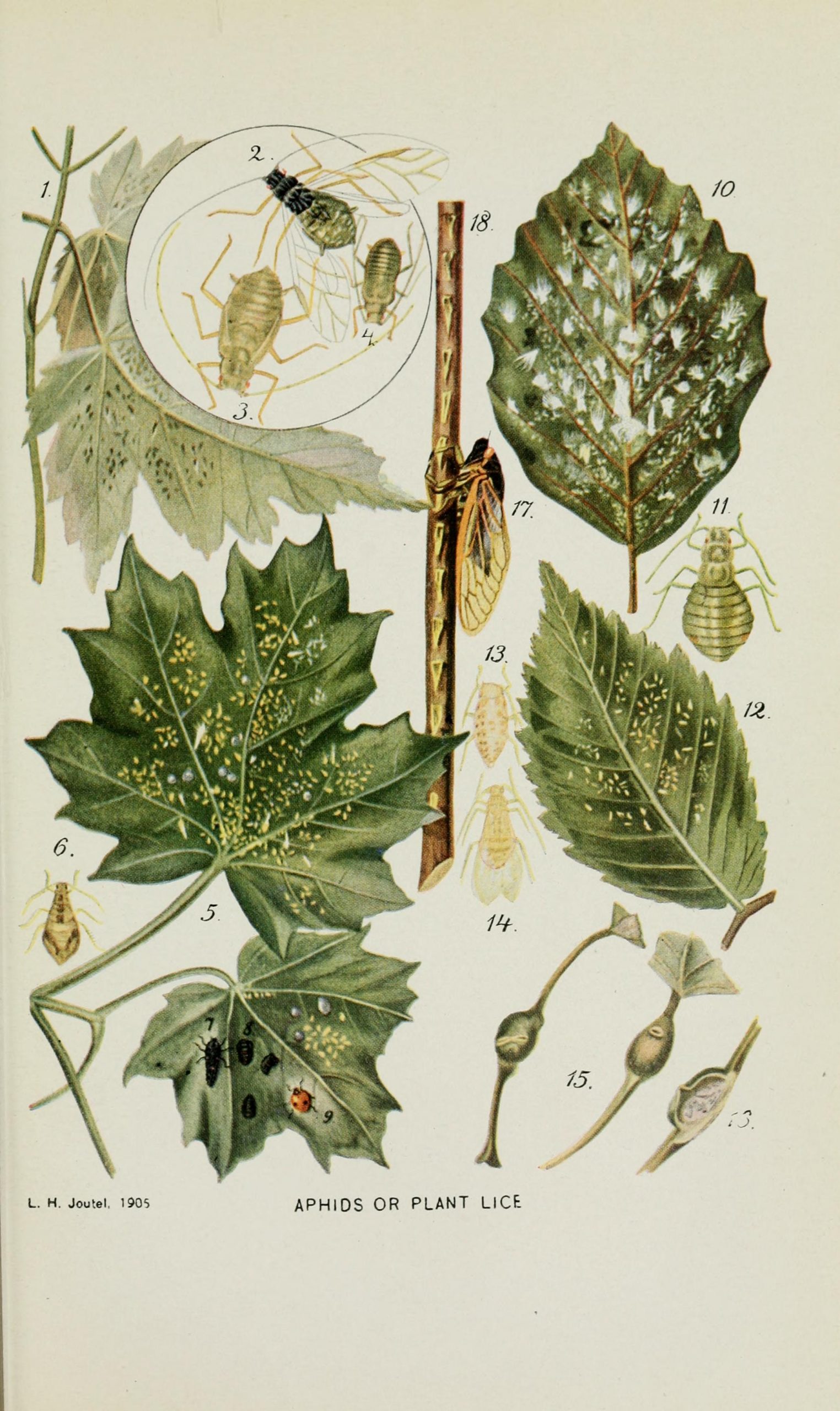
Branch with a cicada perched on it, showing Grooves cut by ovideposting female cicada. Branch is surrounded by green leaves.

Grooves cut by ovideposting female (Magicicada). Pack, Charles L. Trees as Good Citizens. 1922. Art by L.H. Joutel (1905). Contributed in BHL from the University of Toronto – Earth Sciences Library (Noranda).

Though the egg laying is generally harmless to most trees, very young trees can be damaged. “Flagging” (where portions of the twigs die off leaving brown leaves to droop down) as well as the oviposition scars are positive signs of a future new generation of Brood X. The female’s ovipositor is spear-shaped, as described by Marlatt:

The ovipositor, or twig-piercing and egg-laying organ, of the female Cicada is also a very complex instrument. It issues from a groove, or fissure, on the underside of the abdomen, and at rest is nearly concealed except at the tip by the broad overlapping sides of the eighth dorsal segment … The inclosed ovipositor is a very tough, horny instrument, spear-shaped, and serrated at the extremity, and consists of three pieces …. (Marlatt 1898, 54)
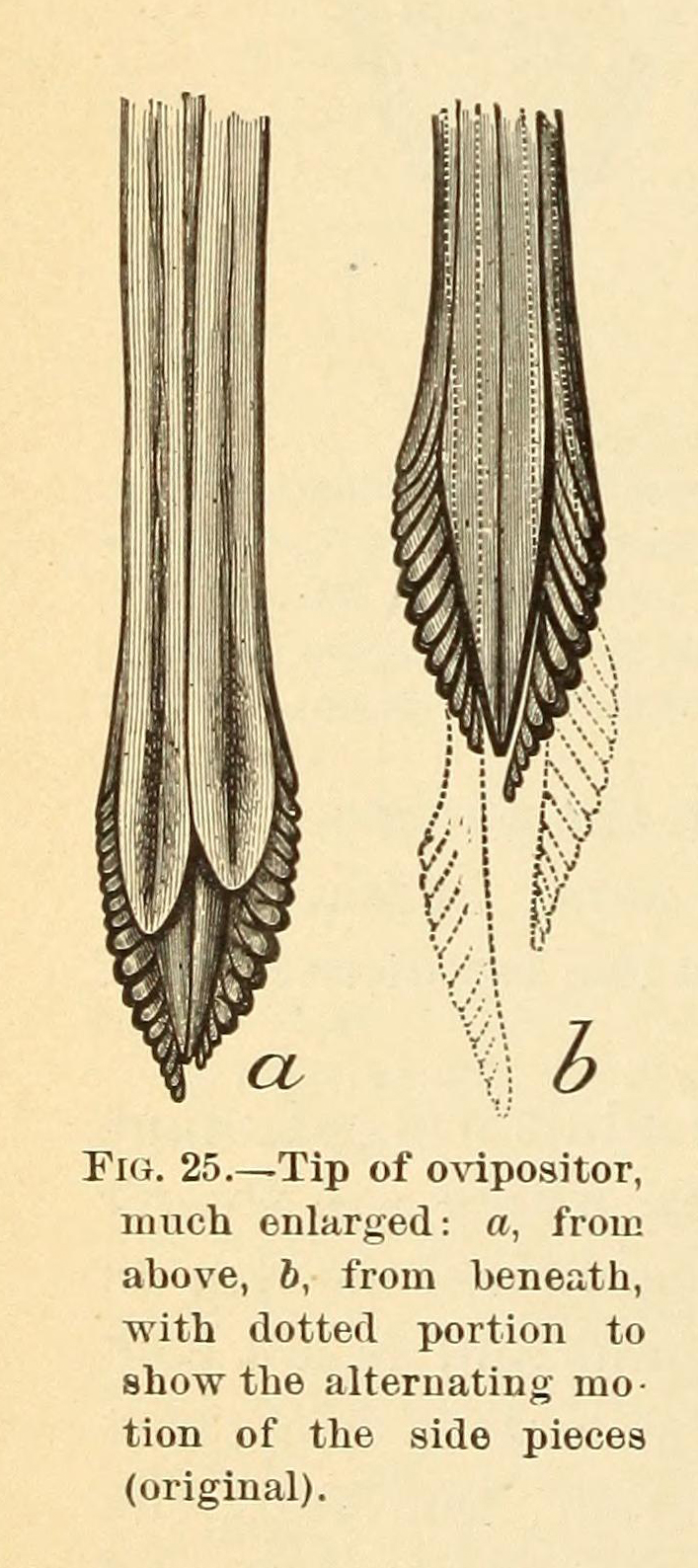
Black and white drawing of a close-up of the ovipositor of a female cicada.

Figure 25: The Ovipositor. Marlatt, C.L. The periodical cicada: an account of Cicada septendecim, its natural enemies and the means of preventing its injury: together with a summary of the distribution of the different broods. U.S. Department of Agriculture—Bulletin no. 14. 1898. Contributed in BHL from the U.S. Department of Agriculture, National Agricultural Library.
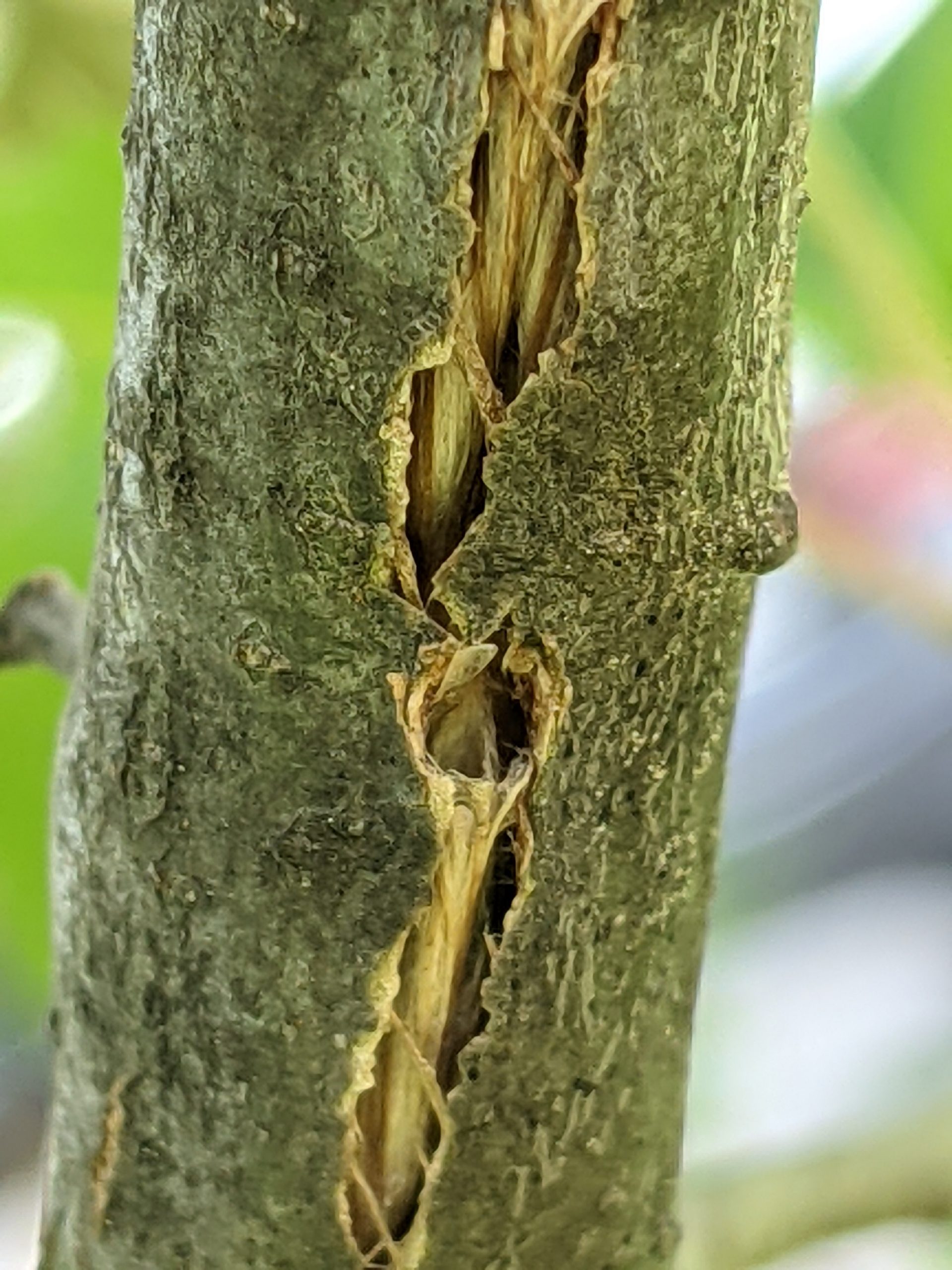
Oviposition scars in a tree trunk, made by a cicada.

Oviposition scars (Magicicada). 12 June 2021, Arlington Virginia. Photo credit: Martin Kalfatovic.

Cicada Songs and Chorusing

A continual singing or scream was kept up by the males, from sunrise till evening, and so loud that in a calm morning the sound was heard a full mile. (Hildreth 1830, 48)

As the 2021 Brood X emergence ends, those living in the range will find their world strangely quiet. The loud singing and chorusing of the male cicada, which can be as loud as 90-100 decibels, will stay for a lifetime with those who have heard it.

… the true sound apparatus consists of two small ear-like or shell-like inflated drums situated on the sides of the basal segment of the abdomen. These drums are caused to vibrate by the action of powerful muscles, and the sound is variously modified by adjacent smaller disks — the so-called “mirrors” or sounding boards — and issues as the peculiar note of the species, which once heard is never likely to be forgotten, or if heard again, mistaken for that of some other insect. (Marlatt 1898, 55-56)
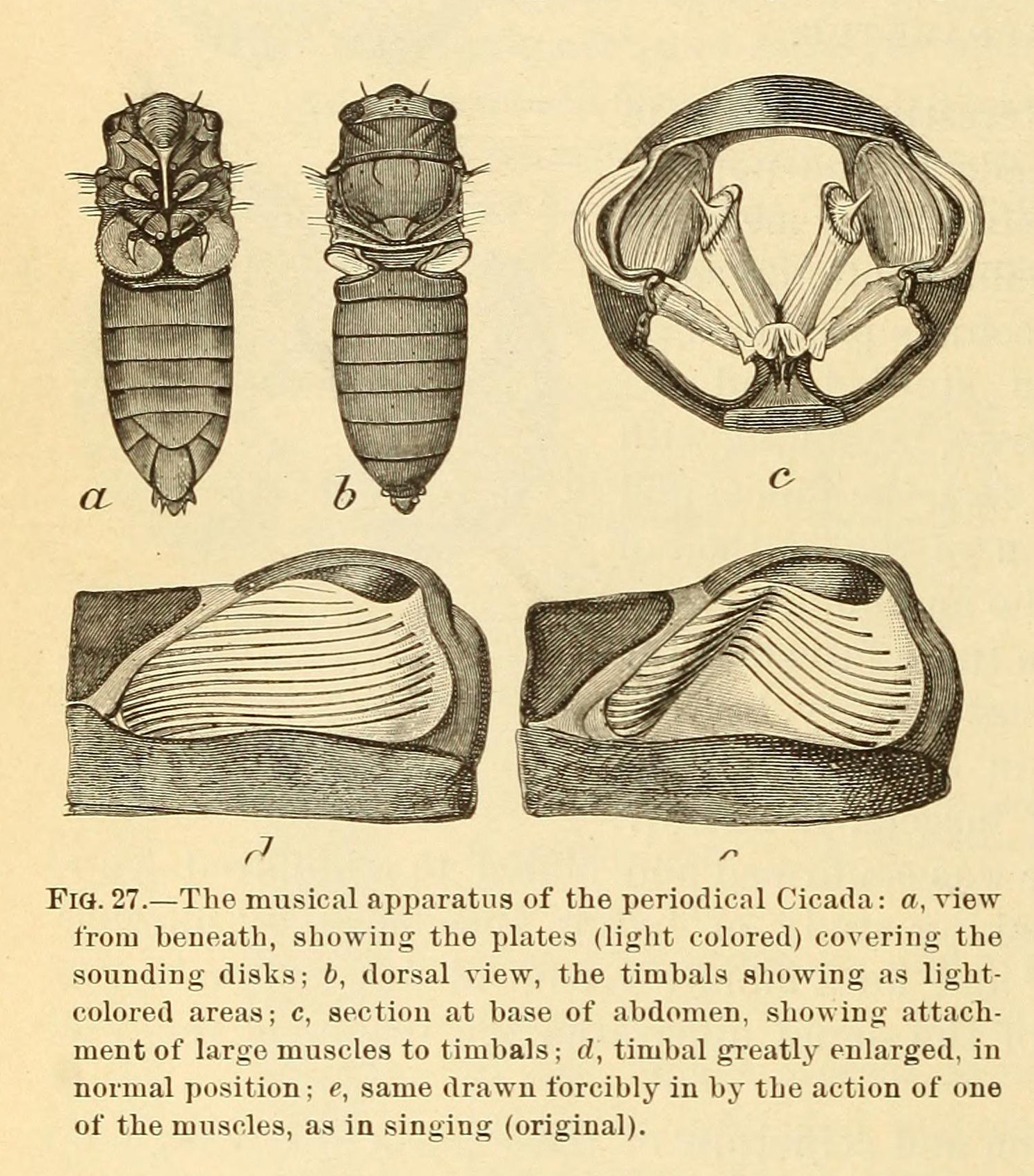
Black and white drawing of the musical apparatus of a cicada.

Fig. 27: The Musical Apparatus. Marlatt, C.L. The periodical cicada: an account of Cicada septendecim, its natural enemies and the means of preventing its injury: together with a summary of the distribution of the different broods. U.S. Department of Agriculture—Bulletin no. 14. 1898. Contributed in BHL from the U.S. Department of Agriculture, National Agricultural Library.

The songs of each of the species are distinctive. In my call with Dr. Gene Kritsky, he described the M. septendecim as a high note falling in descending pitch that sounds like “phaaaaa-raoh” (hence the common name of the species, Pharaoh Cicada). Kritsky details the cicada songs in his book: A chorus of M. septendecim has been compared to the sound of 1950s sci-fi movies. M. cassinii’s song is a series of clicks followed by a buzzing sound. M. septendecula’s call is isolated buzz-clicks and then staccato buzz-clicks (Kritsky 2021, 38).

You can find recordings of the various Magicicada species on iNaturalist: M. septendecim, M. cassinii, and M. septendecula.
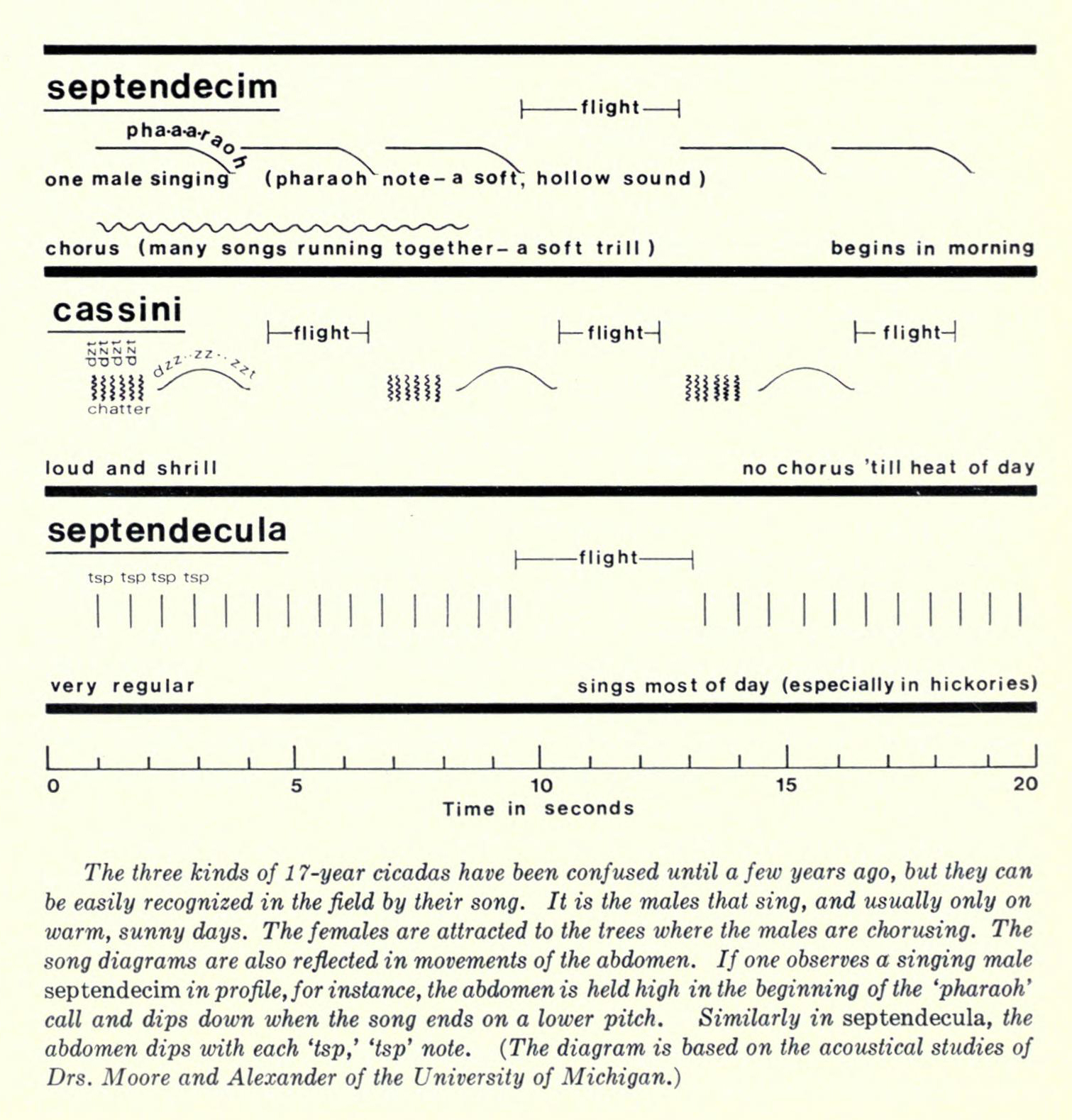
Figure showing Magicicada sounds.

Figure showing Magicicada sounds. Dybas, Henry. “Population explosion — 17-year locust style.” Bulletin. Field Museum of Natural History. 41.2 (February 1970). Contributed in BHL from the University Library, University of Illinois, Urbana-Champaign. CC-BY-NC-SA. Rights Holder: Chicago Field Museum.

Of course, for many, the songs and chorusing of the male cicadas is a rare treat. In 1970, during an emergence of Brood X in Princeton, NJ, Nobel-laureate Bob Dylan wrote of the cicada’s “sweet melody”:

And the locusts sang off in the distance
Yeah, the locusts sang such a sweet melody
Oh, the locusts sang off in the distance
Yeah, the locusts sang and they were singing for me (Bob Dylan, “Day of the Locusts”)

Near Threatened?

For those living in the areas where Brood X has appeared, it may seem perplexing that the three species of 17 Year Magicicada are listed as “near threatened” on the International Union for Conservation of Nature’s (IUCN) Red List of Threatened Species (see the IUCN Red List for Magicicada cassini, Magicicada septendecim, and Magicicada septendecula). The IUCN’s designation of “near threatened” is actually an improvement from its previous designation of “vulnerable.”

With multiple billions to trillions of individuals spread across a large geographic area, one may ask how these species could be at risk. However, we know from examples such as the Passenger Pigeon (Ectopistes migratorius) that species that seem vast in numbers and beyond threat can face numerous challenges from habitat loss and other human actions (see the BHL blog post, “From Billions to None: The Story of the Passenger Pigeon”).

A large patch of dirt in front of a brick building.

A former tree filled lot. June 2021, Arlington Virginia. Photo credit: Martin Kalfatovic.

Even if the majority of Brood X (or other Magicicada broods) does not disappear anytime soon, there are areas where previous emergences are not happening, or not happening in large numbers. The best example of this is on Long Island where Brood X has had, practically speaking, no Magicicada sightings. Habitat loss is a major driver (both recently and historically) in Magicicada loss. The 13 and 17 year life cycle of the species, while perhaps beneficial in reducing predation, proves fatal when trees are cut down or the locations where nymphs would appear have been paved over.

Massospora cicadina

Though the 13 and 17 year cycles of Periodical Cicadas serves to keep them safe from opportunistic predators, there is one species of fungus that infects only Periodical Cicadas: Massospora cicadina.
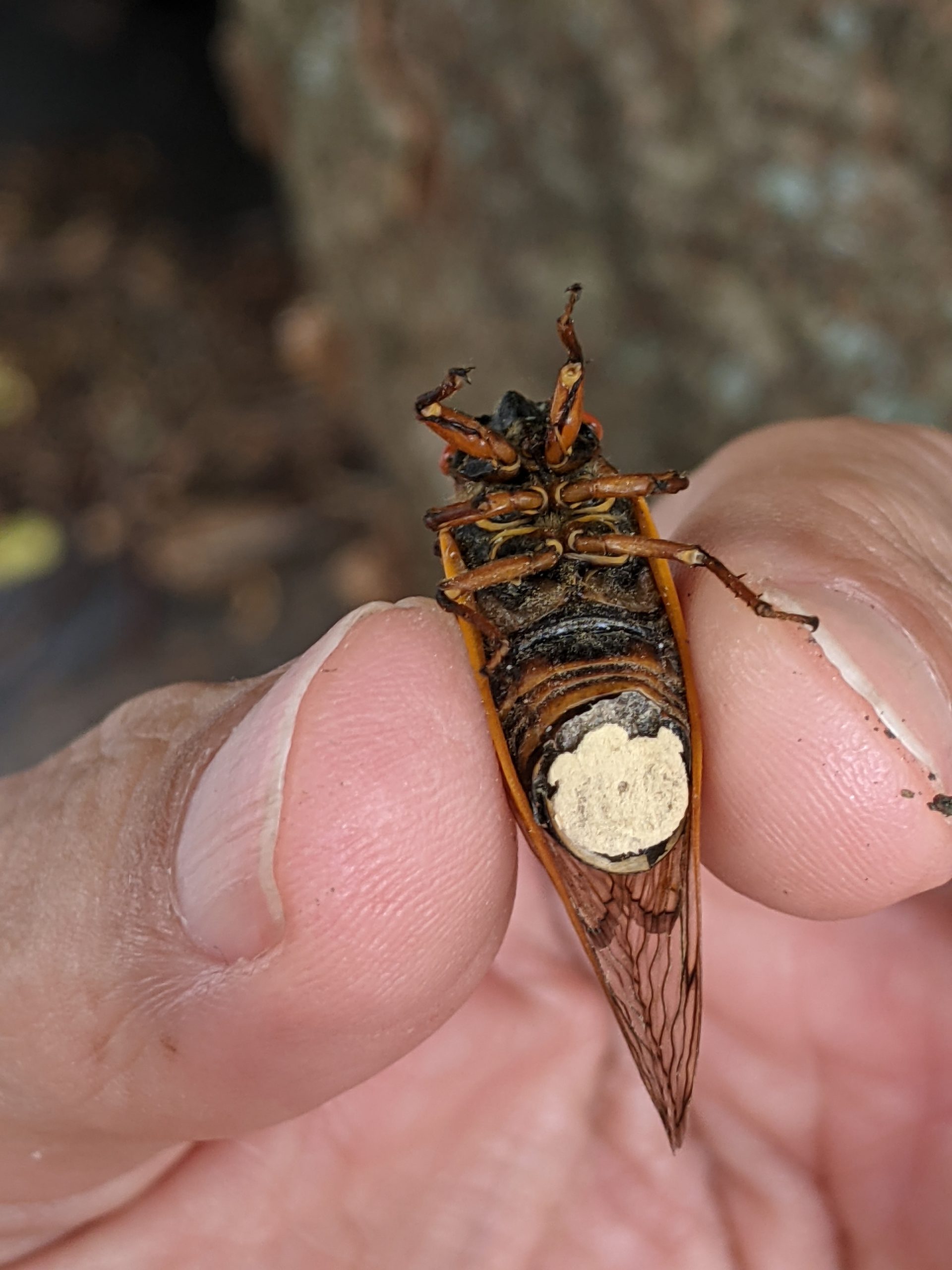
The underside of a cicada with white fungus.

M. septendecim infected with Massospora cicadina. 24 June 2021, Arlington Virginia. Photo credit: Martin Kalfatovic.

The M. cicadina fungus infection was first documented by Joseph Leidy in 1851:

In the spring of 1851, during the imago appearance of the seventeen-year locust, among myriads of the insect, several friends and myself found between 12 and 20 specimens, which, though living, had the posterior third of the abdominal contents converted into a dry, powdery, ochreous-yellow, compact mass of sporuloid bodies. The caudal appendages and posterior two or three abdominal rings covering the mass, were loose and easily detached, leaving the fungoid matter in the form of a cone, affixed by its base to the unaffected part of the abdomen of the insect. (Leidy 1853, 53)

In 1878, Charles Peck fully described and named the fungus, naming both the genus (Massospora) and species (Massospora cicadina):

Spore mass occupying the abdominal cavity, whitish or pale cream-color, at length exposed by the falling away of the terminal rings of the abdomen; spores subglobose or broadly elliptical, granular within, sometimes containing one to three unequal nucleoli or oil globules, .00065′ — .00085′ in diameter. (Peck 1879, 44)
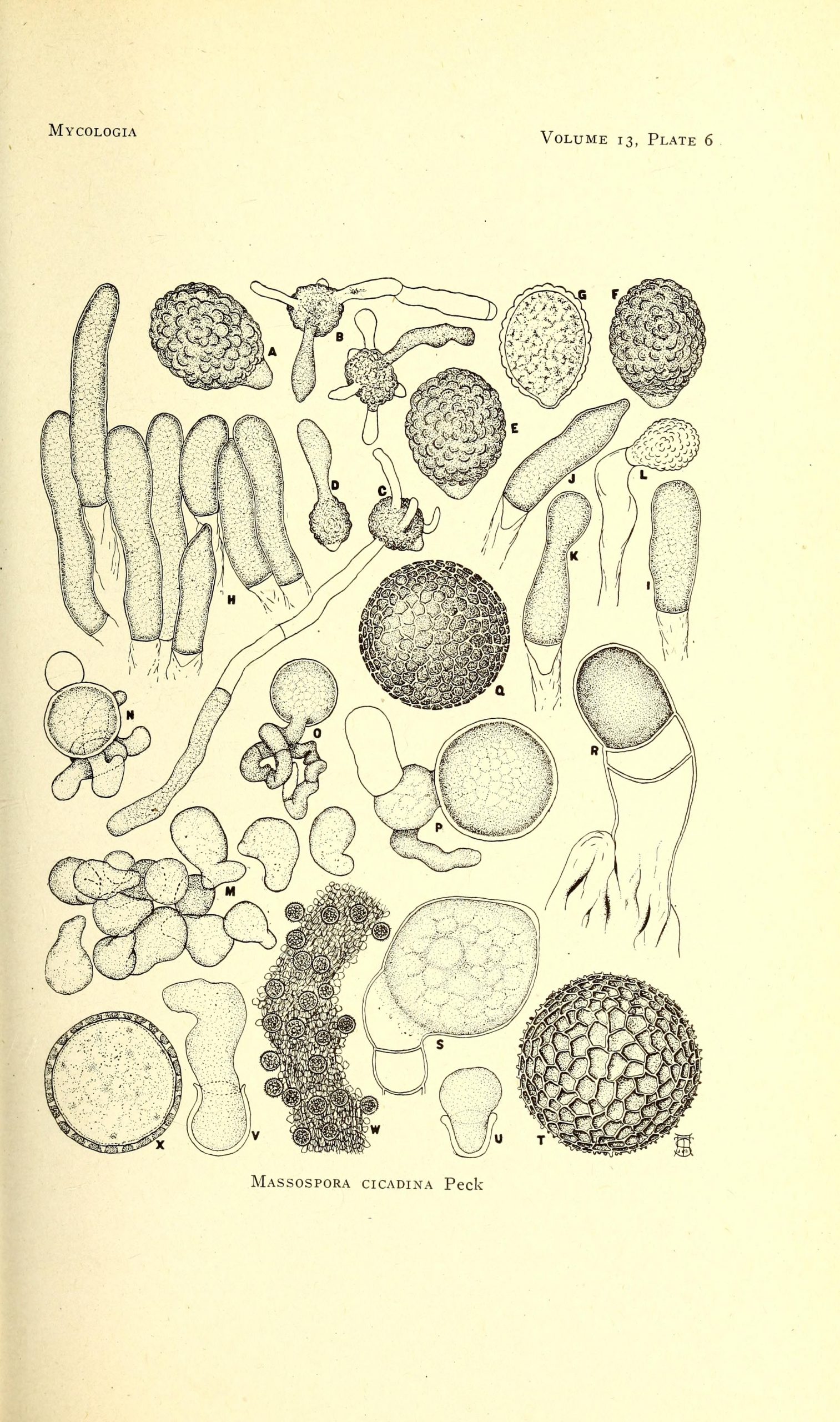
Black and white drawings of Massospora cicadina fungus.

Massospora cicadina Peck. Speare, A. T. 1921. “Massospora cicadina Peck: A Fungous Parasite of the Periodical Cicada.” Mycologia. 13 (2): 72–82. Contributed in BHL from Smithsonian Libraries and Archives.

Recent research by Boyce, et al. provides an extended genetic analysis for M. cicadina and explores the chemical basis for behavioral changes caused by M. cicadina:

Several studies have reported hypersexual behaviors in Massospora-infected cicadas, where male cicadas, in addition to typical mating behavior, also attract copulation attempts from conspecific males (5,7; table S1). This “extended phenotype” of Massospora hijacks cicadas, turning them into efficient vectors for conidial transmission. (Boyce, et al., 2018, 3)

Brood X: Cicada Safari and iNaturalist

Brood X is appearing at a time of great interest by people all around the world in helping create research quality data for scientists. The Cicada Safari app logged nearly 20,000 images a day during peak observations. In a conversation with Dr. Kritsky of Mount St. Joseph University, he noted that Cicada Safari is on track to document nearly 500,000 observations of Magicida this year. As I discussed with Kritsky, the sheer bulk of this data will be invaluable to researchers for years to come.

A man with white hair and a brown shirt overlaid on a photo of cicadas on green leaves.

Dr. Gene Kritsky. Image credit: Martin Kalfatovic.

Another important citizen science project is iNaturalist. Contributors to iNaturalist are also providing invaluate data on Brood X. Contributors are asked to provide additional species information (when known) and other iNaturalist participants verify or confirm both species as well as other data points on the observations. In a conversation with Carrie Seltzer (Stakeholder Engagement Strategist for iNaturalist), she noted:

More than 4,400 people across the Eastern United States submitted over 19,000 Magicicada observations this year to iNaturalist. We look forward to learning what insights emerge from these records, and how they complement data from more targeted apps like Cicada Safari.

I spoke with a few of the top iNaturalist observers/identifiers of Magicicada for their experiences with Brood X this year.
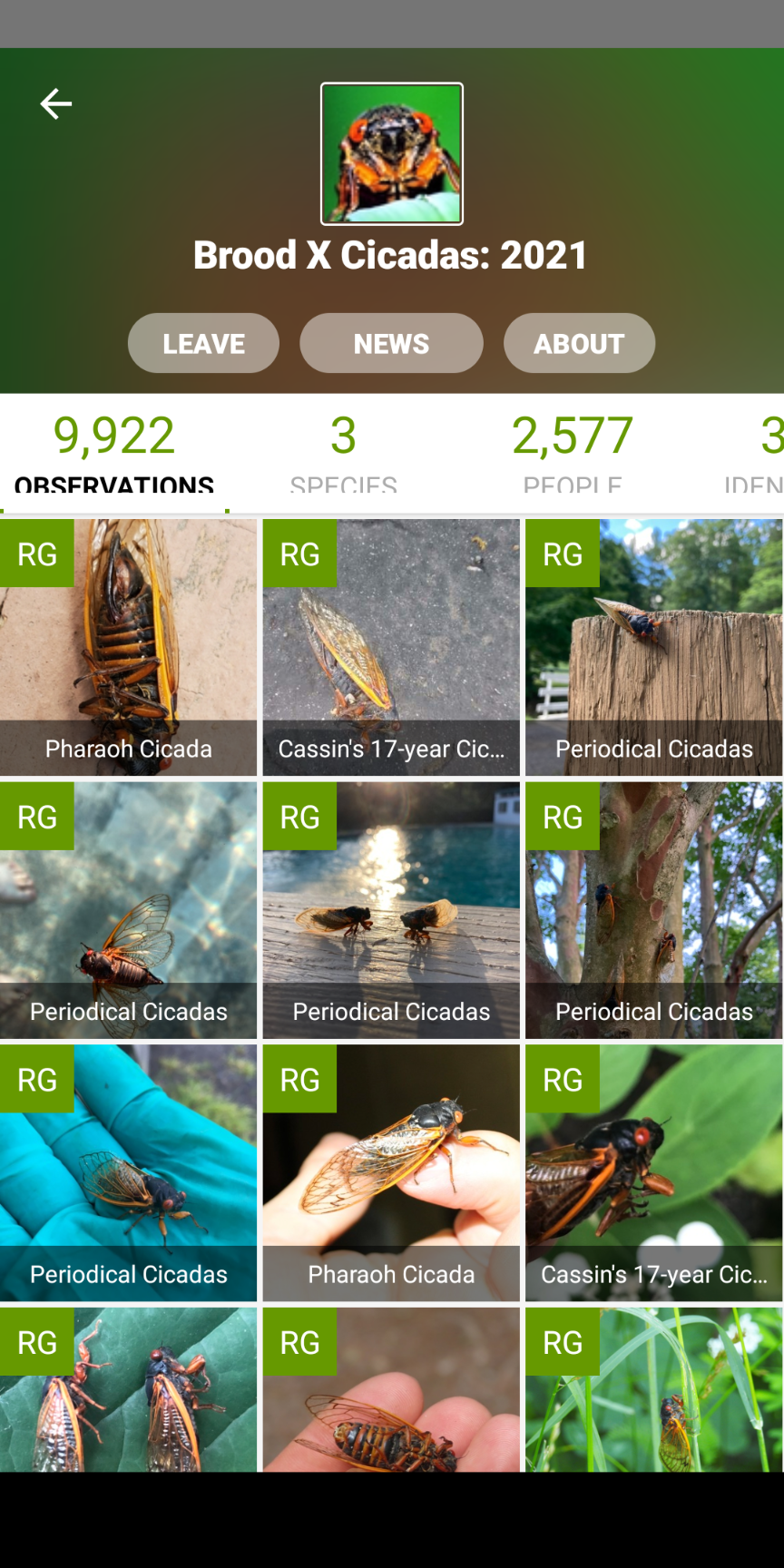
Collage of photos of cicadas from iNaturalist.

iNaturalist Screenshot.

Roshan Vignarajah (roshan2010) is one of the top observers/identifiers in iNaturalist. This is Roshan’s first Magicicada emergence. He shared with me:

I have been interested in insects for most of my life, and I have been waiting for the emergence since the Brood X stragglers emerged in 2017. Once I learned about the 3 species, I was hooked. I love observing larger insects which makes cicadas (specifically Magicicada) the perfect subject. I also have an interest in Lepidoptera (especially moths).

Vignarajah has also spotted four of the blue-eyed Magicicada (see examples of M. cassinii and M. septendecim). He will miss many things when Brood X’s emergence fades, “especially the constant drone of the choruses and having a constant stream of cicadas to enjoy and photograph.”

Adrienne van den Beemt (mmmmbugs) is a science teacher and naturalist in the Washington, DC area. This is her third Magicicada emergence. She noted:

I have loved watching this emergence. It has been hard sometimes to teach classes outside when the cicadas are so loud, and some students have a genuine fear which makes it difficult for them. As a science teacher and naturalist, I am always interested in what’s going on in the natural world. One thing I appreciate about iNaturalist is that it provides a way for the public to interact with scientists and naturalists. I love being able to help people identify a plant or a bug- and then to be able to continue the conversation if they have further questions, or if another user suggests a different identification.

Zachary Dankowicz (zdanko) is the top observer/identifier of M. septendecula. They commented:

This is my first experience, I’d only ever heard of the emergences from older family members, and it got me quite excited! I started just photographing them and trying to get all of the species, and as I got more involved in observing them, I learned a lot through other people and outside resources like cicadamania.com about how to identify them. One thing led to another, and now I’m the top observer and identifier for Magicicada septendecula, my favorite, and the most elusive, species of the 17-year cicadas! I’ve observed over 400 M. septendecim, so that’s definitely my top observed species, but it’s somewhat of a phase. My primarily observed taxon is a mix of Dipterans and Cicadellids, as they tend to be the ones that catch my eye most often.

I’ll miss going to my favorite septendecula spot and picking up cicadas one by one to check the abdomen. One thing I found quite interesting was that in the very beginning of the emergence, there were barely any septendecula in the places that I checked. All of the sudden, one day I found 5, and the next day 4, and the day after that 4, etc.

Jessee J. Smith (weecorbie) is another top observer/identifier and manages the Brood X Cicadas: 2021 iNaturalist project page. She told me:

My first experience with Magicicada in 1987 made a deep impression. I took entomology in college in spite of the fact that I was an English/art major at the time, and it made me swap my English major for one in natural science. I began working with Magicicada in a research capacity with Brood III in 1997, and I’ve helped out with field surveys and publications ever since. It’s a good thing that I’m very fond of cicadas, because I’m married to Gene Kritsky, and it would be impossible to avoid them for that reason alone. We’ve had a lot of adventures together in the course of our cicada surveys.

Among the highlights for Smith this year were “how many cicadas I saw with aberrant coloration; I found quite a few cassini with piebald orange patches, or with entirely orange abdomens.”

When the 2021 emergence ends, Smith won’t just miss the sight of all those Magicicada:

I’ll miss the chorusing, which peaked around our house at 90 dB (and that’s really loud), but which I especially enjoy in the evening when the cicadas are winding down for the night. There’s something restful about the occasional muttering rasps of cassinii in the gloaming, combining with the steady ticking of a few septendecula here and there.

At the time of writing (1 July 2021), iNaturalist had tallied the following:

  • 21,694: Magicicada (genus)
  • 8,710: M. septendecim
  • 3,104: M. cassinii
  • 509: M. septendecula

As a final note, Seltzer commented, “There are interesting opportunities to infer absence of cicadas from areas that had other iNaturalist observations during the Brood X emergence, but no cicada observations. Although imperfect, it may help control for (or at least highlight) areas with less observer effort.”

Magicicada 2038

Over the last weeks of June and into July, the last of the adult Magicicada will complete their breeding cycle and egg laying. The eggs deposited in tree branches will hatch and the larvae will drop to the ground, burrowing down to attach themselves to the tree roots and settle down for another 17 years.

The world that Brood X (2021) emerged into changed significantly from 2004 when they dug into the ground. The information gathered this year will inform the study for when they next emerge. What our shared world will look like in 2038 is something both humans and Magicicada will find out together.
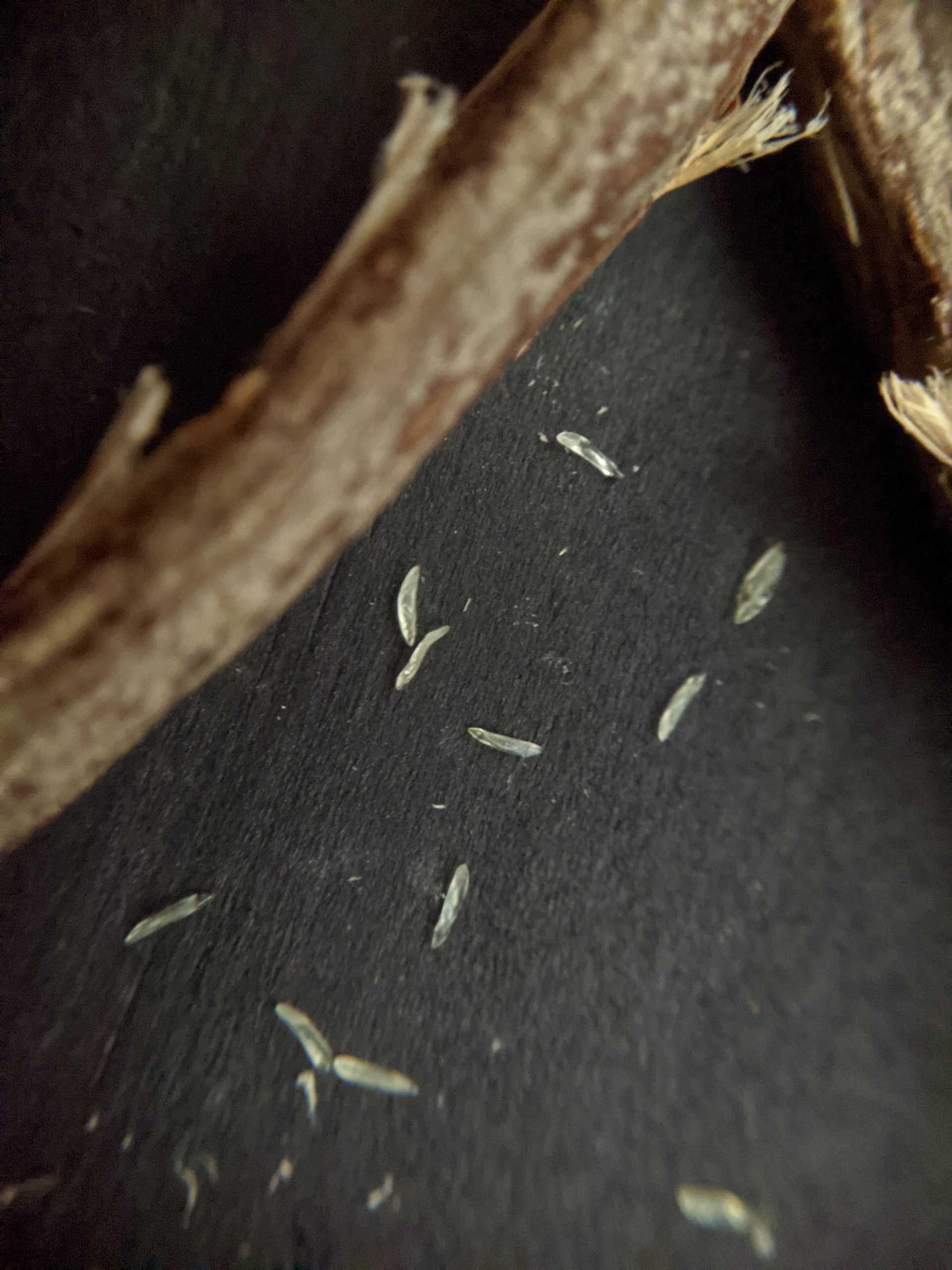
Cicada eggs on a black backdrop next to a branch.

Magicicada eggs. 28 June 2021, Arlington Virginia. Photo credit: Martin Kalfatovic.

My Observation Highlights of Brood X

  • First adult observation (likely Magicicada septendecim): 10 May 2021
  • First confirmed observation (Magicicada septendecim): 14 May 2021
  • First observation of teneral stage (Magicicada, likely M. septendecim): 15 May 2021
  • First Observation (Magicicada cassinii): 20 May 2021
  • First Observation (Massospora cicadina): 24 May 2021
  • First Observation, mating (Magicicada septendecim): 26 May 2021
  • First Observation (Magicicada septendecula): 27 May 2021
  • First Observation, ovipositing (Magicicada septendecim & Magicicada cassinii): 5 June 2021
  • Last Observation of living Magicicada (M. cassinii): 16 June 2021
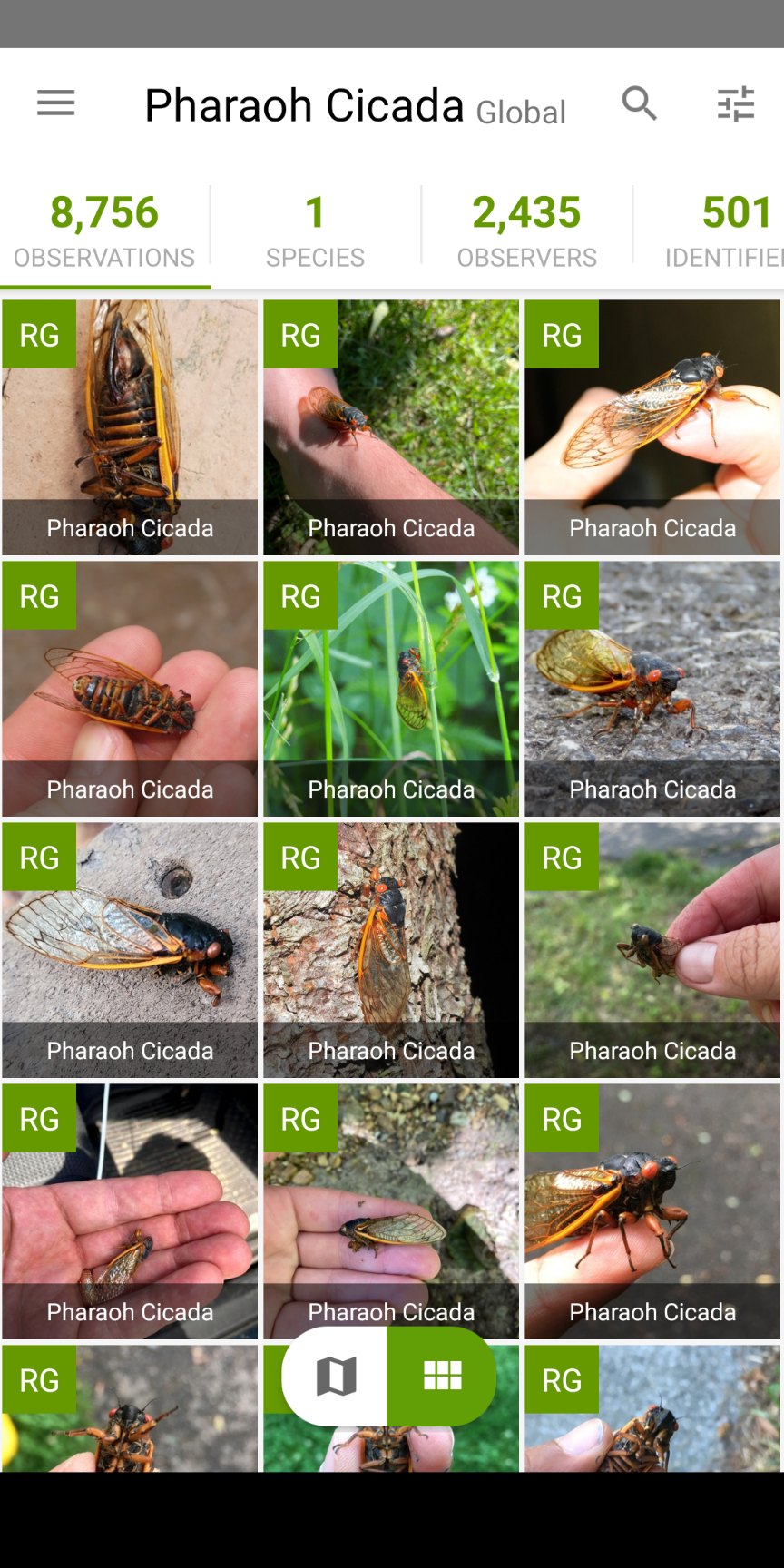
Screenshot of the iNaturalist app with photos of cicadas.

Screenshot: iNaturalist.

References and Additional Suggested Reading

Boyce, Greg, et al. 24 July 2018. Discovery of psychoactive plant and mushroom alkaloids in ancient fungal cicada pathogens. bioRxiv. Preprint doi: https://doi.org/10.1101/375105

Dybas, Henry. 1970. Population explosion — 17-year locust style. Bulletin (Field Museum of Natural History) 41(1): 11-13. https://www.biodiversitylibrary.org/page/2890663

Hildreth, S.P. 1830. Notices and Observations on the American Cidada, or Locust. The American Journal of Science and Arts. 18: 47-50. https://www.biodiversitylibrary.org/page/30953560

Kritsky, Gene. 2021. Periodical Cicadas: The Brood X Edition. Ohio Biological Survey. http://www.worldcat.org/oclc/1246784386

Leidy, Joseph. 1853. Upon Pseudo-Entophyta, etc. In: Flora and Fauna within Living Animals. Smithsonian Contributions to Knowledge. 5: 50-54. https://www.biodiversitylibrary.org/page/9049946

Peck, Charles H. 1879. Report of the Botanist. Massopora, gen. nov. 31st Annual report on the New York State Museum of Natural History. 31:44. https://www.biodiversitylibrary.org/page/35614048

Speare, A. T. 1921. “Massospora cicadina Peck: A Fungous Parasite of the Periodical Cicada”. Mycologia. 13(2): 72–82. https://www.biodiversitylibrary.org/page/46097338
July 13, 2021by
Blog Reel, Featured Books

The Magic of the Magicicada: Exploring Brood X Through Books in BHL

The periodical cicada in various life stages.

On 10 May, I had my first sighting of this year’s periodical cicada in Northern Virginia. For seventeen years, three species of Magicicada, the periodical cicada (M. septendecim, M. cassinii, M. septendecula)[1], have been living about 61 cm (2 feet) underground beneath trees across portions of eastern North America. In May 2021, individuals in Brood X (sometimes known as the Great Eastern Brood) began to emerge in the trillions from their long sojourn when soil temperature reached a consistent temperature of 18 degrees C (64 degrees F) or higher.

The last time Brood X emerged was in 2004. For those who witnessed that appearance, or previous ones, Brood X at times feels like a science fiction movie with the creatures swarming and the loud (up to 90 decibel) mating song of the males drowning out conversations (I wonder how the rest of the world will react to our Zoom call being joined by singing cicadas!).

Magicicada are mostly harmless, neither biting nor stinging. Members of the order Hemiptera, the nymphs spend their underground life harmlessly consuming xylem fluids from the roots of deciduous forest trees; the adult female, which deposits its eggs in small slits cut into the ends of branches, rarely causes damage to mature trees and there is speculation that the cicada pruning leads to more abundant leafing and fruiting the following year.

Nymph of a periodical cicada on a green leaf.

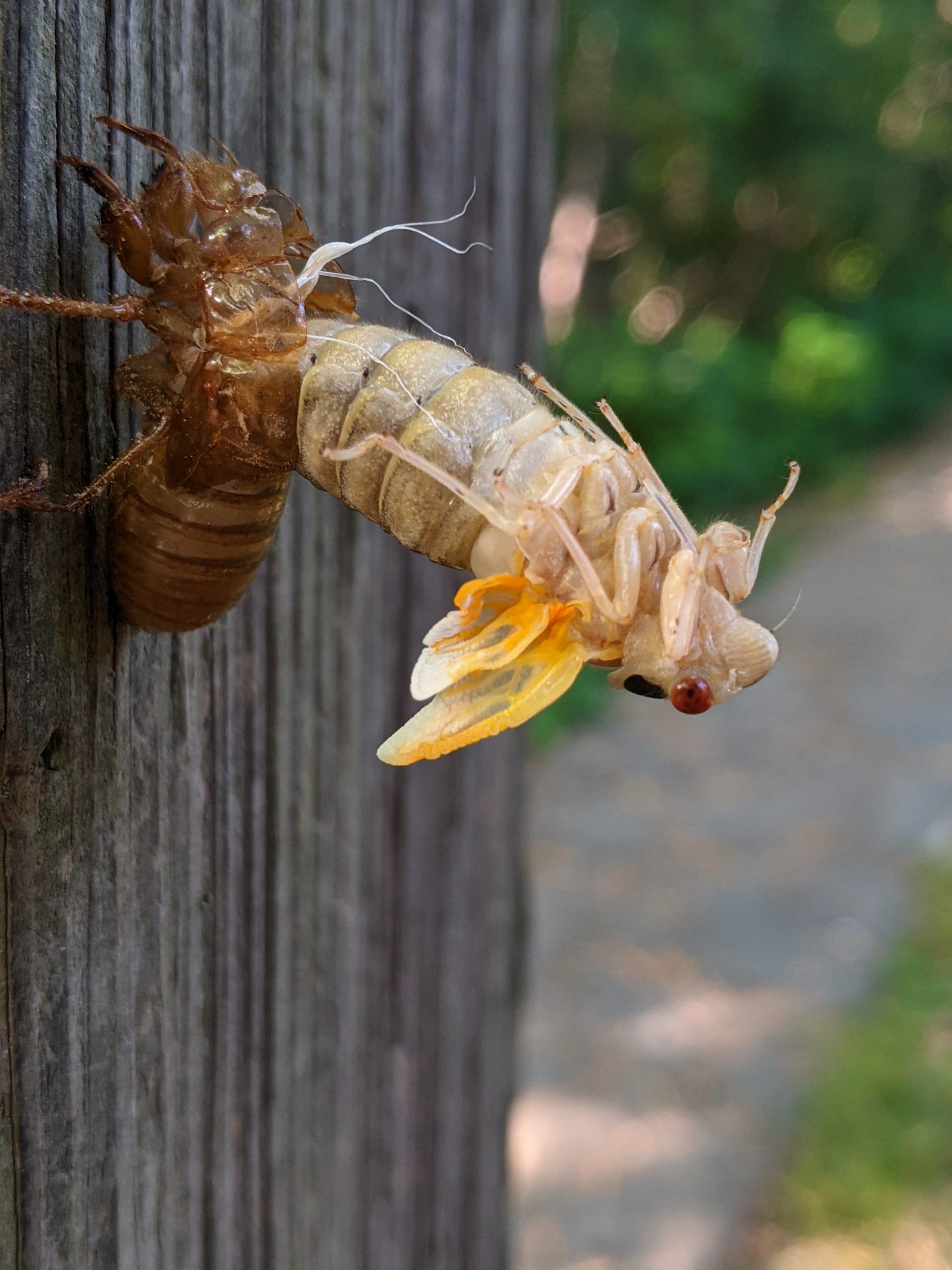
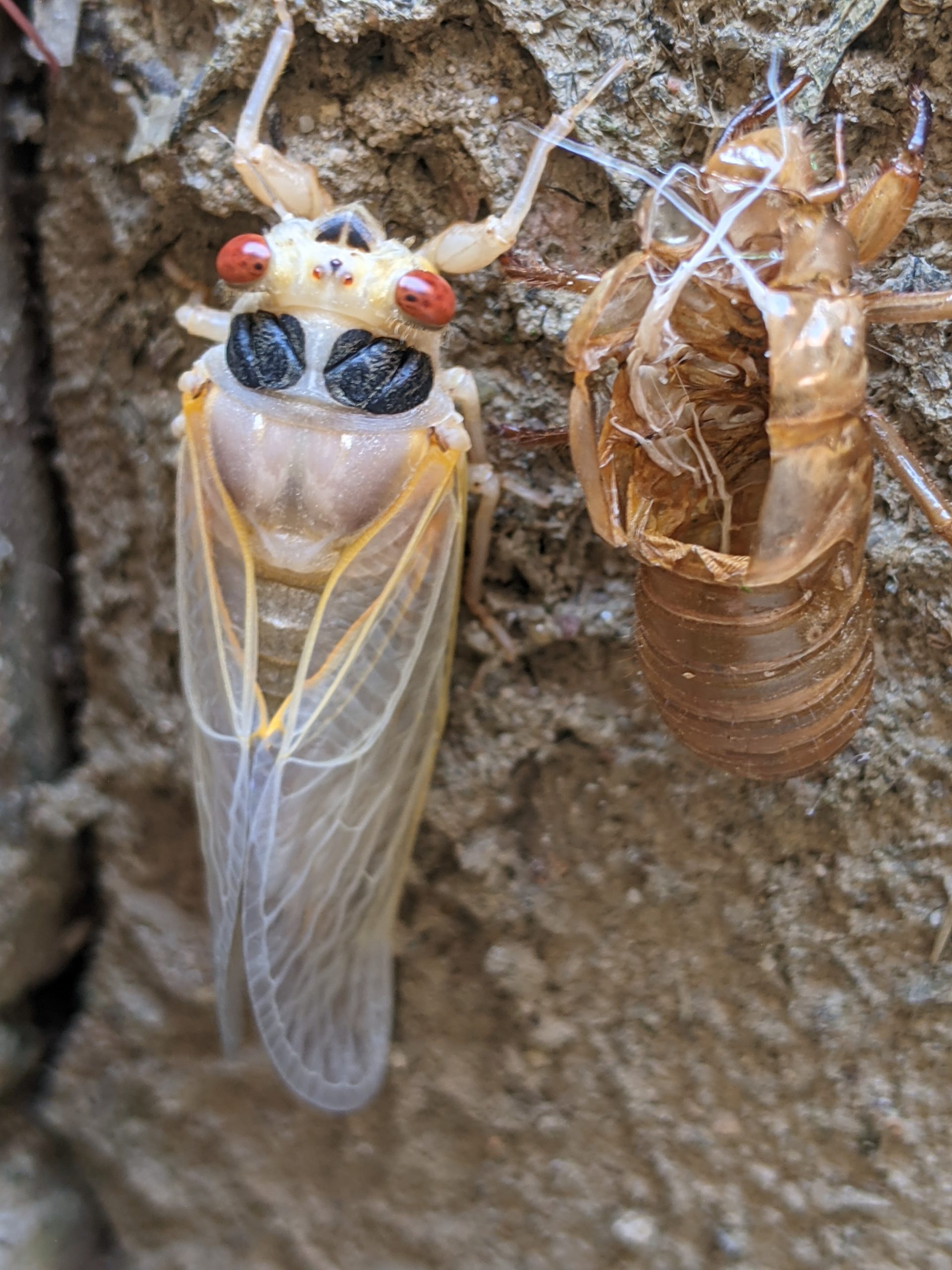
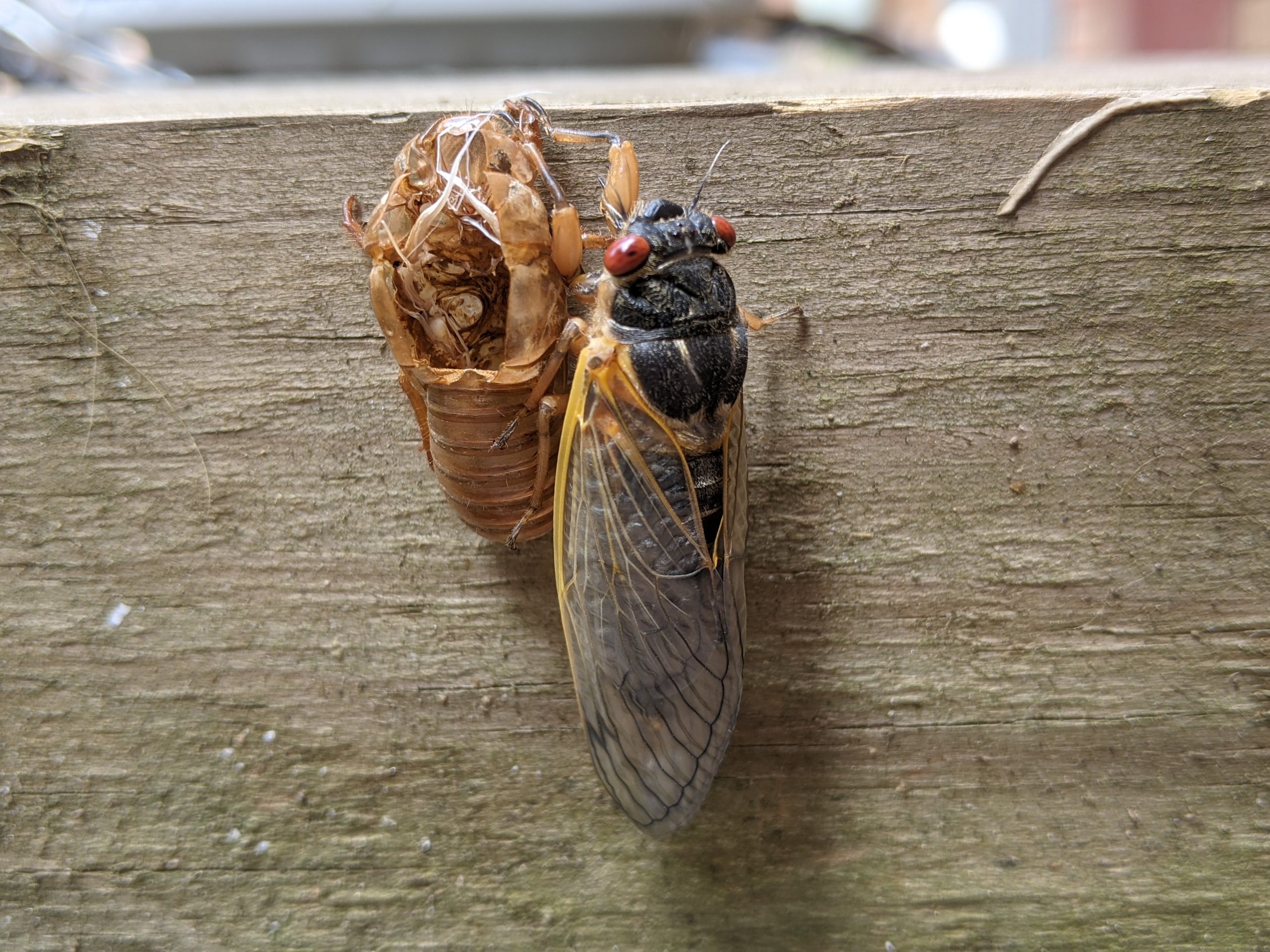
Photos capturing the author’s first observations of the Brood X emergence. Photos show the life cycle of the periodical cicada from nymph to adult. Shown here: Periodical cicada nymph. Photo credit: Martin Kalfatovic.

Immature adult periodical cicada emerging from nymph skin.

Photos capturing the author’s first observations of the Brood X emergence. Photos show the life cycle of the periodical cicada from nymph to adult. Shown here: Periodical cicada shedding its nymph exoskeleton. Photo credit: Martin Kalfatovic.

Immature periodical cicada next to exuviae.

Photos capturing the author’s first observations of the Brood X emergence. Photos show the life cycle of the periodical cicada from nymph to adult. Shown here: An adult periodical cicada that has not yet completed its transformation. Photo credit: Martin Kalfatovic.

Mature adult periodical cicada next to exuviae.

Photos capturing the author’s first observations of the Brood X emergence. Photos show the life cycle of the periodical cicada from nymph to adult. Shown here: An adult periodical cicada next to its nymph exoskeleton (exuviae). Photo credit: Martin Kalfatovic.

Early Accounts

Known to Native Americans for generations, the first known mention of periodical cicada literature is by William Bradford, governor of Plymouth Colony in 1633 (Kritsky 2001, 1). A more detailed (and somewhat inaccurate) account was printed thirty-three years later in the Philosophical Transactions (London) in 1666 by Henry Oldenburgh:

A great Observer, who hath lived long in New England, did upon occasion, relate to a Friend of his in London, where he lately was, That some few Years since there was such a swarm of a certain sort of Insects in that English Colony, that for the space of 200 Miles they poson’d and destroyed all the Trees of that Country; there being found innumerable little holes in the ground, out of which those Insects broke forth in the form of Maggots, which turned into Flyes that had a kind of taile or sting, which they struck into the Tree, and thereby envenomed and killed it. (Oldenburgh 1666, 137)

The first significant documentation by Europeans of what came to be known as Brood X occurred in Philadelphia in 1715 when they were reported by Reverend Andreas Sandel (Kritsky 2021, p.53). In 1748, the Swedish naturalist, Pehr Kalm, travelled to North America to observe the 1749 emergence of Brood X. Kalm comments:

You could hardly find one tree, not in gardens or in the forest, where the trunks were not covered with them. Some had just come out of their shells, while others were still in the process of emerging, so they were half in and half out. Some had started to try their wings. It was remarkable that on the previous day, May 21st there were none to be found. (Kalm 1756, 107; Translation by E.L. Lewis [Davis, J.J 1953])

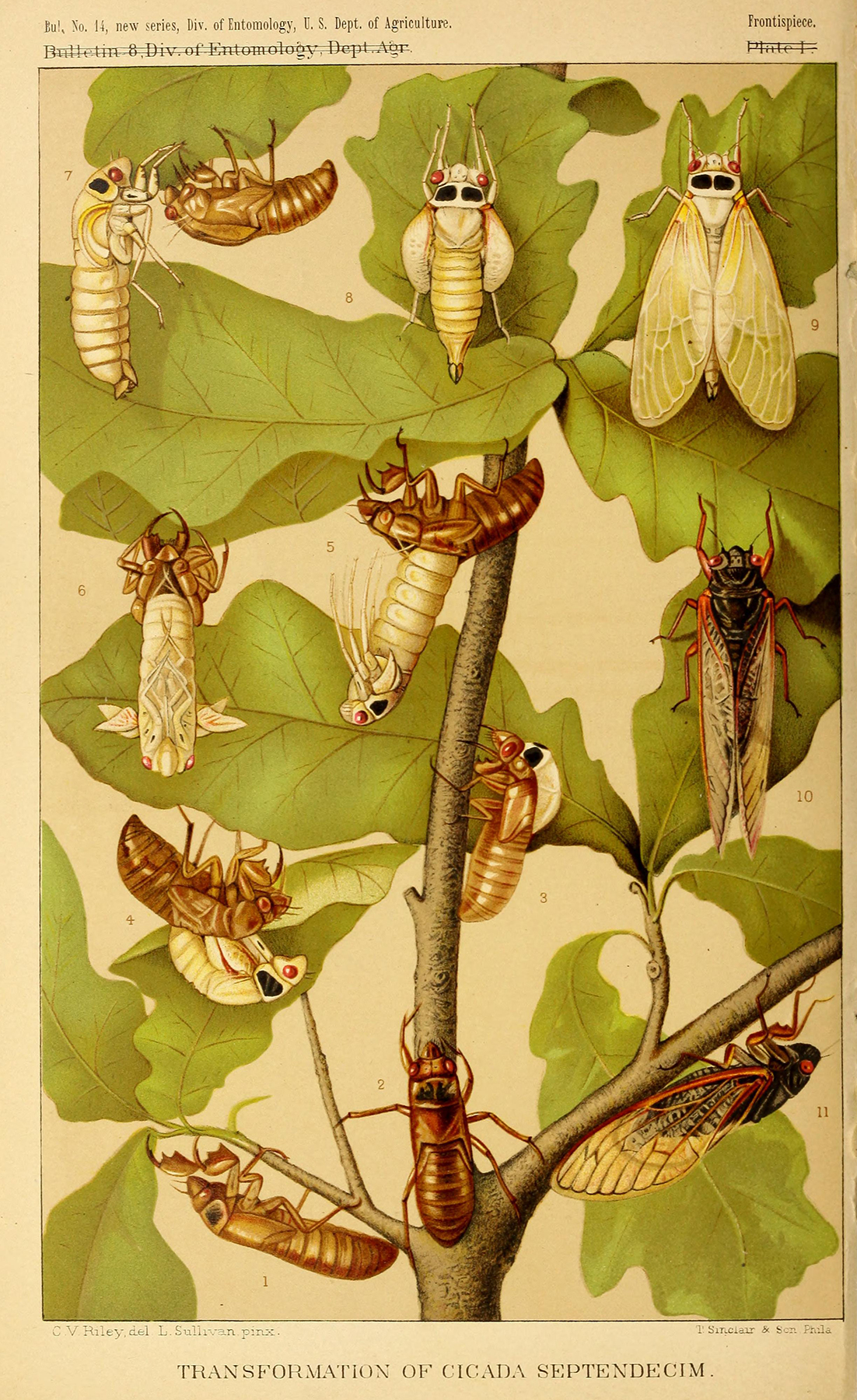
The periodical cicada in various life stages.

The various life stages of the periodical cidada (Magicicada septendecim). Marlatt, C.L. The periodical cicada: an account of Cicada septendecim, its natural enemies and the means of preventing its injury: together with a summary of the distribution of the different broods. U.S. Department of Agriculture—Bulletin no. 14. 1898. Art by C.V. Riley and L. Sullivan. Contributed in BHL from the U.S. Department of Agriculture, National Agricultural Library.

Kalm’s account, published in 1756, became the basis for Linné’s first scientific description and classification of the periodicical cicada in the 1758 edition of Systema Naturae (10th ed.). Linné’s classification of the periodical cicada placed it in the genus Cicada.

Magicicada

Additional investigations in the early 20th century led entomologist William T. Davis to look more closely at the taxonomy of the 13- and 17- year cicadas and propose a new genus, Magicicada, for the (then) two species of 17-year cicada and the four species of 13-year cicada. Davis noted in his paper with this revision that:

It is evident from the foregoing that our well known red-eyed Seventeen-Year Cicada does not belong where it has been placed, in fact Distant states in his 1905 paper, already cited, in describing his Division Tibicinaria, that Tibicina septendecim “possesses several aberrant characters.” The writer therefore proposes that this important and interesting species be the type of a new genus and be called Magicicada septendecim (Linn.). (Davis 1925, 44)

The term “Brood X” evolved from naturalists trying to make sense of the different emergences across the cicada range. C.L. Marlatt in his important work on cicadas notes:

Of the upward of twenty broods which have been differentiated, most of them have been carefully studied, chronological records collected, and the limits of distribution fairly well determined. For convenience of reference, these broods have been designated by Roman numerals, as Brood VI, Brood XXVI, etc. (Marlatt 1898, 19)

Black and white illustrations of the life cycles of the periodical cicada.

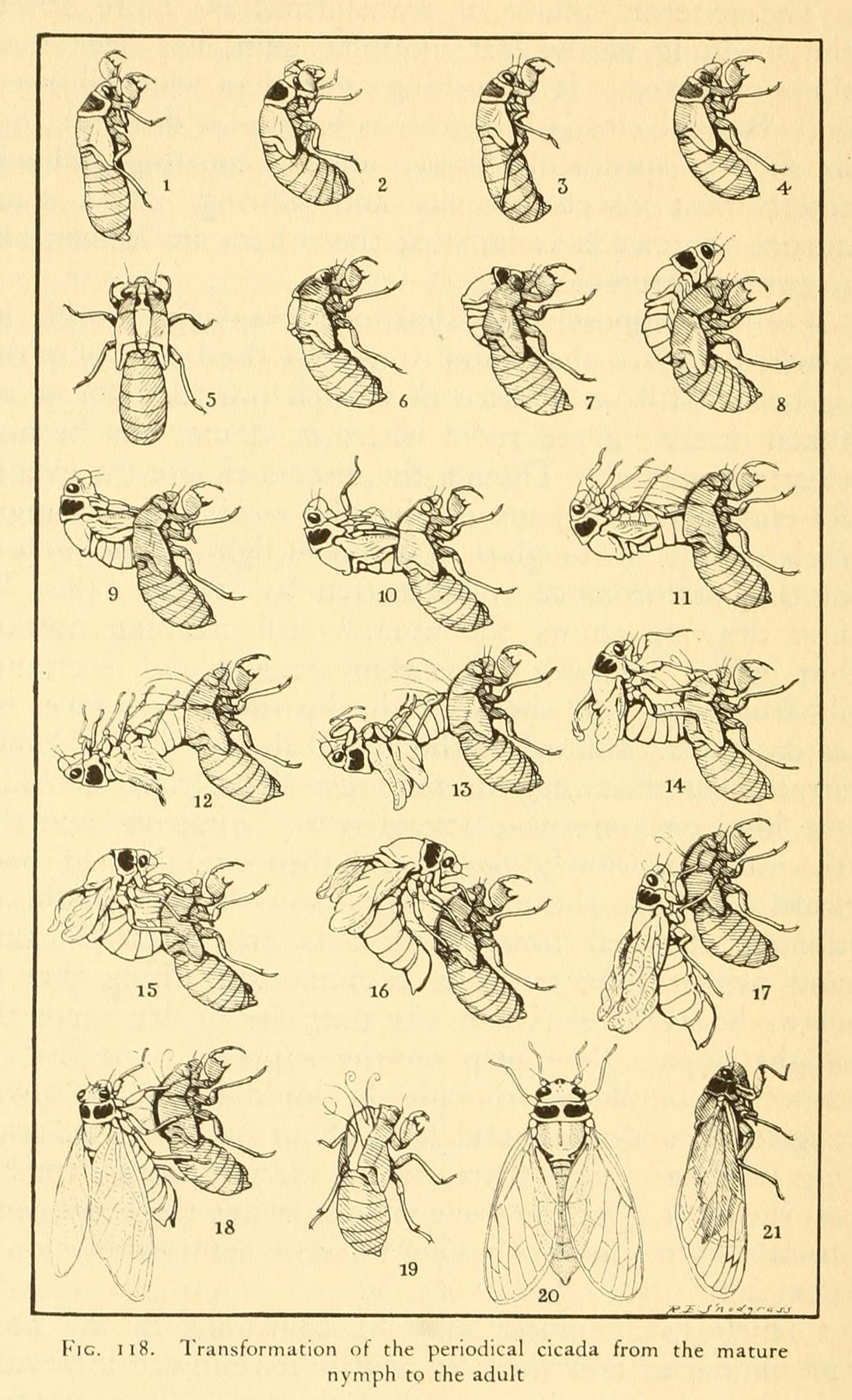
Transformation of the periodical cicada (Magicicada septendecim) from the mature nymph to the adult. Snodgrass, R.E. The Periodical Cicada. Insects, their ways and means of living. Smithsonian Scientific Series, v.5 (1930). Art by R.E. Snodgrass. Contributed in BHL from Smithsonian Libraries and Archives.

Magicicada cassinii

Cicada septendecim was the single species of periodical cicada described by Linné in 1758. A second species in the genus, M. cassinii, was described and published by J.C. Fisher in 1852 and named after his friend and fellow observer, the ornithologist, John Cassin. But, should Fischer and Cassin really get full credit for this discovery? In the 9 May 2021 issue of Scientific American, Catherine McNeur argues that Pennsylvania entomologist Margaretta Hare Morris’ contribution has been erased and that she deserves the credit for identifying the species that Fisher named, C. cassinii (McNeur 2021).

Black and white portrait of a woman in a gold frame.

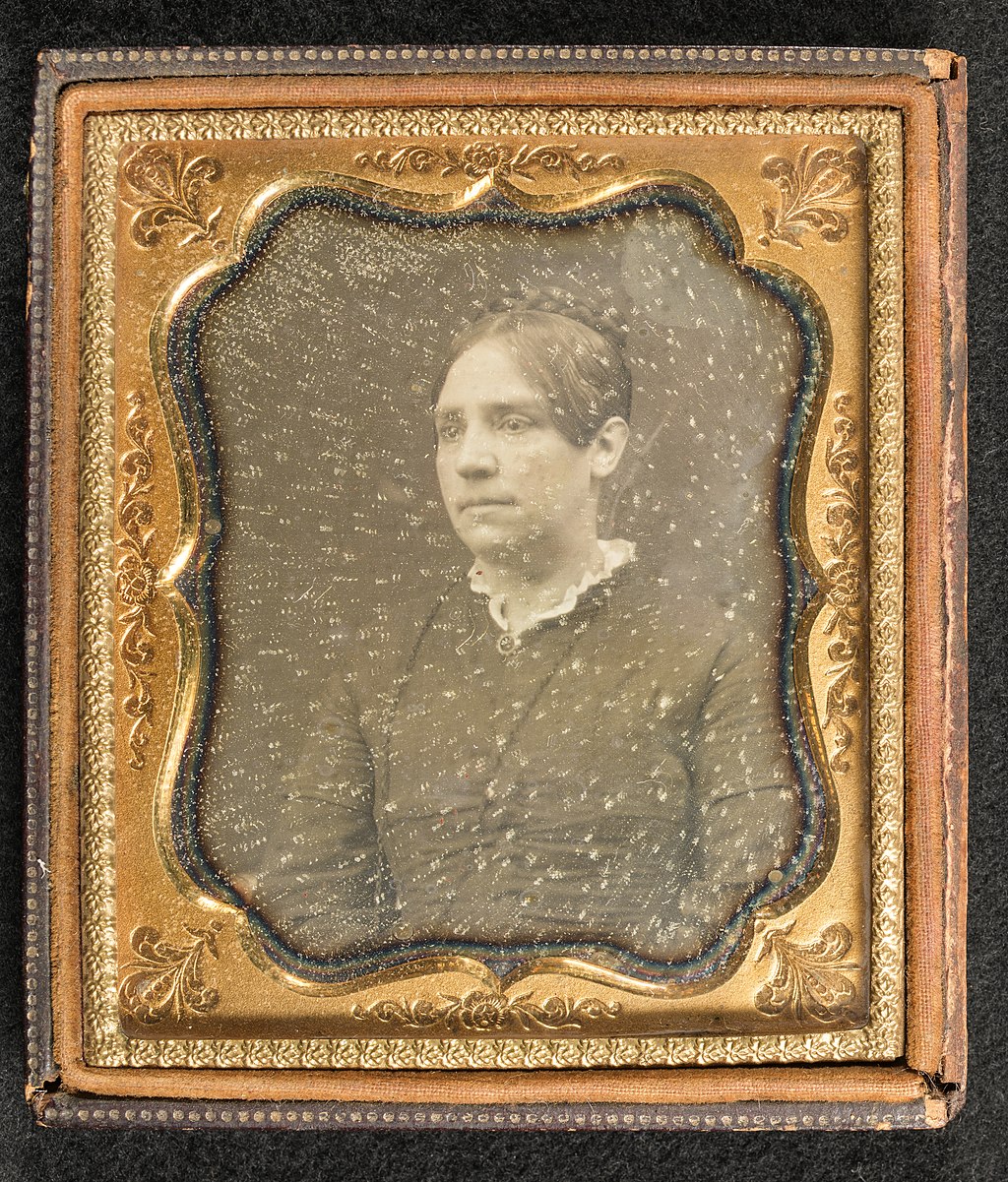
Portrait of entomologist Margaretta Hare Morris. Source: Public Domain via Wikimedia Commons. Caption from Wikimedia Commons: “19th-century cased photograph from the University of Delaware Library’s Special Collections.” Image taken by Evan Krape for the University of Delaware.

As women could not be members of the Academy of Natural Sciences (Philadelphia) at the time, Morris’ paper describing her findings was read by Professor Johnson during the 15 December 1846 meeting of the Academy. She was later admitted to the Academy in 1859 (having previously been admitted to the Association for the Advancement of Science in 1850 along with astronomer Maria Mitchell as the two first women members) (Academy of Natural Sciences 1859, 354). Morris’ 1846 paper is important not just for potentially identifying a new species, but for noting the way the cicada larvae attach themselves to the roots of trees for the extended period of time they are underground. Morris clearly describes, though without an explicit description, what she posits is a new species:

The larvae were enclosed in a compact cell of earth, with no outlet except that in immediate contact with the root, and as there were no galleries or holes leading from these cells, I infer that the grubs never leave the roots they first fasten on; which may account for the great difference of size; the small ones being starved specimens of the same brood: though I am inclined to believe that there are two species, differing sufficiently in size to account for the discrepancy in size of the larvae found. I noticed this difference in 1817, and again in 1834: the note of the smaller variety, or species, is much shriller than that of the larger, and will never be mistaken when noticed. (Morris 1846, 133) [emphasis added]

Fisher’s description, published six years later in the Proceedings of the Academy of Natural Sciences, is a more typical species description:

… the attention of its members was directed by Mr. John Cassin to the fact that two species had been confounded, and that the insect regarded as the smaller variety was in fact a distinct species, a conclusion at which he had arrived during their previous appearance in 1834 … I propose on these grounds to characterize the smaller species as follows: — Cicada Cassinii, nobis. ♂ total length of body, 9-10ths of an inch of the wings, 1 2-10ths inches; ♀ frequently smaller. (Fischer 1852, 272)

Comparison of two periodical cicada species.

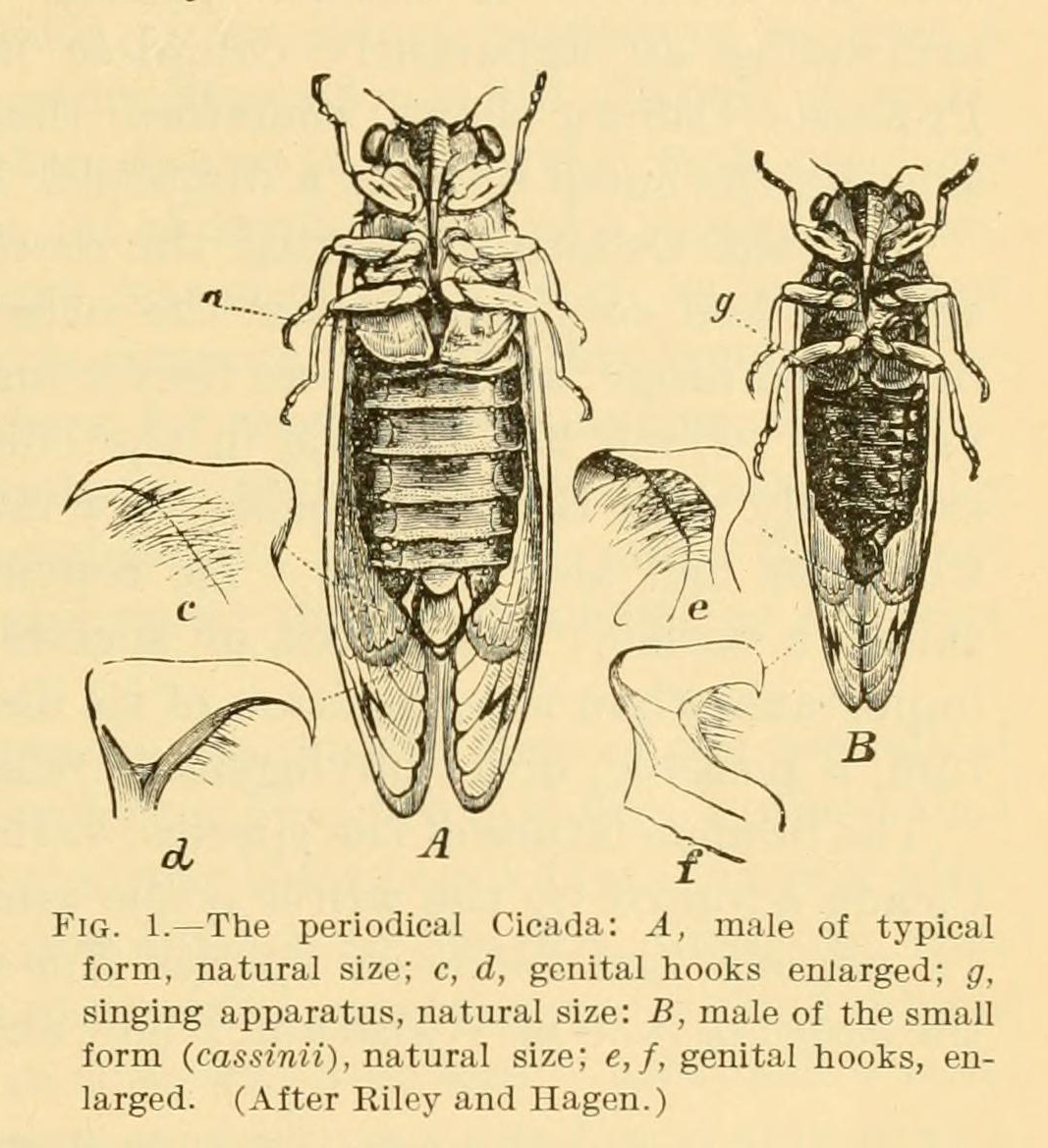
Comparison of two 17-year periodical cicada species: Magicicada septendecim (left, A) and Magicicada cassinii (right, B). Marlatt, C.L. The periodical cicada: an account of Cicada septendecim, its natural enemies and the means of preventing its injury: together with a summary of the distribution of the different broods. Bureau of Entomology—Bulletin no. 71. 1907. Contributed in BHL from Smithsonian Libraries and Archives.

Following Fisher’s description, Cassin adds his own note, focusing, like Morris, on the differing calls of the species:

It was therefore highly gratifying to me to have an opportunity of calling the attention of gentlemen of this Academy to the smaller species which Professor Fisher has done me the honor of naming as above, and particularly to its note. This is quite different from the prolonged and loud scream of the larger species, (which is C. septendecim, Linn.) and begins with an introductory clip, clip, quite peculiar. No disposition to associate with each other exists between the two species, and although I have seen both on the same tree, yet most frequently they were entirely separated, and occupied different parts of the woods. (Cassin 1852, 273)

Interestingly, Cassin cites an earlier observation by S.P. Hildreth (published in 1830) that delineates two varieties of periodical cicadas differing by size and song:

There appeared to be two varieties of the cicada, one much smaller than the other: there was also a striking difference in their notes. The smaller variety were more common in the bottom lands, and the larger in the hills. A continual scream was kept up by the males during the day, but they were silent through the night. (Hildreth 1830, 48)

Clearly, observers had noted that the apparent single species, M. septendecim, showed evidence that there were perhaps two varieties (as per Hildreth) or, more significantly, species (as per Morris). Fischer and Cassin clearly knew of and cited Hildreth’s observation, but were either unaware of, or consciously ignoring, Morris’ relatively recent paper (ironically presented just a few years earlier at the very Academy of Natural Sciences where their description was published).

Though Morris’ contributions to entomology (including additional publications on cicadas, e.g. Morris 1851) were recognized in her admission to prestigious scientific organizations, her important observations on what would become M. cassinii were lost for many years and her work deprecated. As late as 1947, in a short note on “Early Feminine Entomologists in America”, it is commented that “Her entomological conclusions were not always correct.” (New York Entomological Society 1947, 280)

As a final note, rounding out the three species of periodical cicadas was the description of the third species, Magicicada septendecula, described in 1962 (Alexander and Moore 1962, 9).

Magicicada 2021

The 2021 Brood X appearance provides a great citizen science opportunity. Cicada Safari has been developed by Dr. Gene Kritsky working with the Center for IT Engagement at Mount St. Joseph University in Cincinnati specifically to enable those in the range of Brood X to help naturalists document the appearance this year.

The periodical cicada as an immature adult next to its shed nymphal skin.

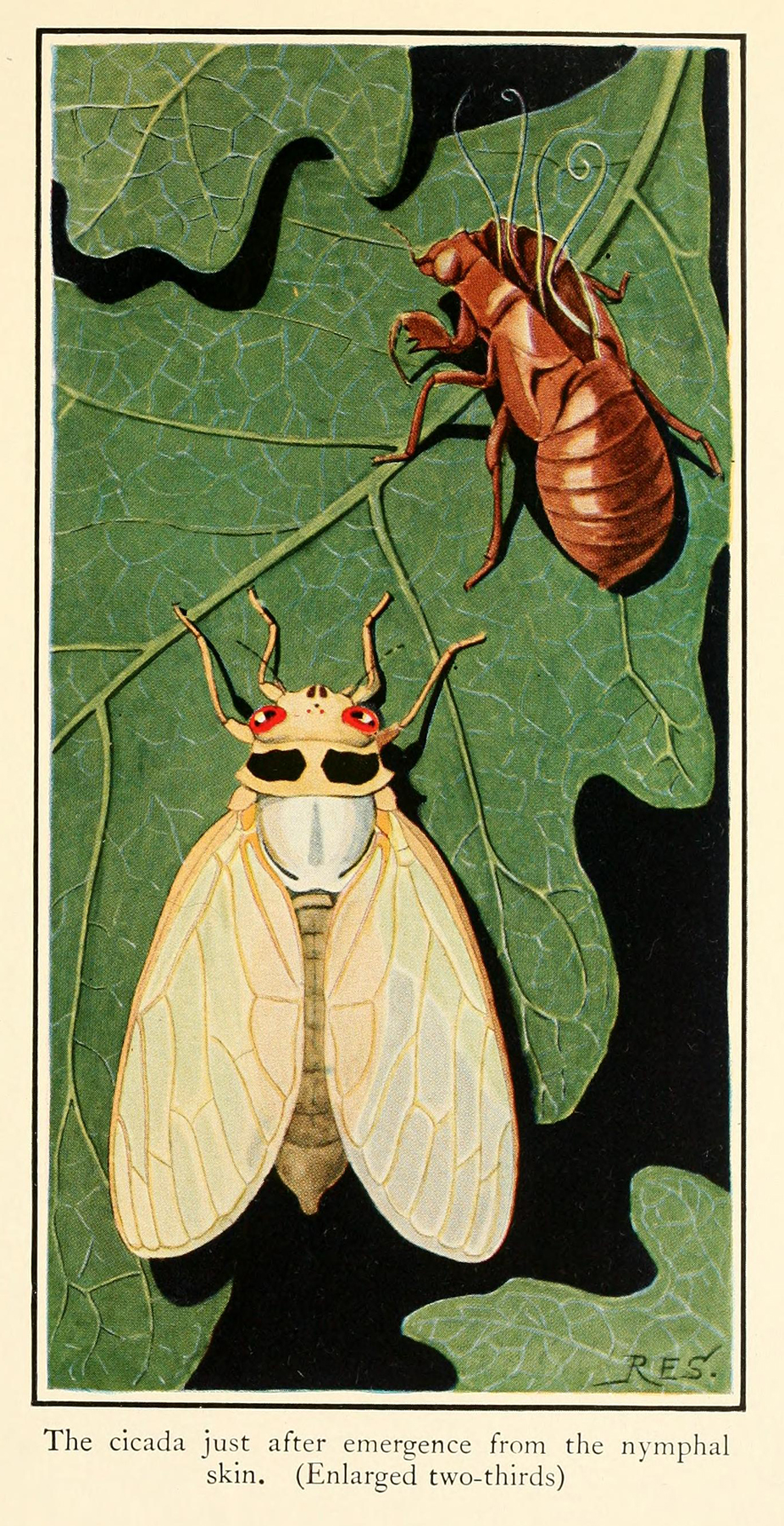
The periodical cicada (Magicicada septendecim) just after emergence from its nymphal skin. Snodgrass, R.E. The Periodical Cicada. Insects, their ways and means of living. Smithsonian Scientific Series, v.5 (1930). Art by R.E. Snodgrass. Contributed in BHL from Smithsonian Libraries and Archives.

Dr. Kritsky told me that he was drawn to the study of periodical cicadas early in his career:

It started the second week of my general entomology course at Indiana University. It was taught by Frank N. Young, Jr. who was the periodical cicada researcher in Indiana. As Frank started to describe these insects, I had the idea that mining the literature for historical records might prove fruitful in understanding the broods and their relationships to each other. So while in Grad School at Illinois, working under Lewis J. Stannard, Jr., the periodical cicada specialist in Illinois, I started searching. When I left in 1977, I had amassed nearly 7,000 historical records of cicadas! have been very gratified that so many of my colleagues and people around the country have embraced my app, CicadaSafari, to help map out this year’s emergence of Brood X. Here it is May 14, the cicadas have not started their major emergence in parts of their range and over 111,000 people are using the app and contributing 5,000+ -photos per day.

Additionally, for our BHL readers who already use iNaturalist for their observations, be sure to keep track of your Magicicada sightings there also.

Being based at the Smithsonian, I also checked in with Floyd Shockley, the collections manager for the Department of Entomology at the Smithsonian’s National Museum of Natural History, and asked what drew him to study the periodical cicada:

As Collections Manager, I am a broadly trained entomologist rather than a specialist on cicadas (my research focus is actually on beetles). However, I grew up on a small farm in rural Missouri and spent a lot of my childhood outside and exploring nature. I was a naturalist and a scientist even then. Cicadas were always a quintessential sign of summer back home, and given their size they were larger than most other insects so it was easy to find them and “study” them. We also have several broods of periodical cicadas that emerge in Missouri so I got to see them more than most. In fact, I’ve personally experienced 9 of the 15 extant broods of periodical cicadas during my life.

In Conclusion

The regular appearance of periodical cicadas over, for most species, what is a significant amount of time means that individual researchers will not have an opportunity to study them over multiple generations. The accumulation of observations and data over decades and even centuries makes the study of periodical cicadas possible.

The importance to researchers of repositories, such as the Biodiversity Heritage Library, that aggregate vast amounts of data gathered over long periods of time is inestimable. BHL allows researchers around the world to access literature that may be difficult or impossible to find locally or easily. Access, whether through metadata or full-text searching, uncover data that might otherwise be lost. As we saw with M. cassinii, it can also help with providing a richer story to the documenting of life on our planet.

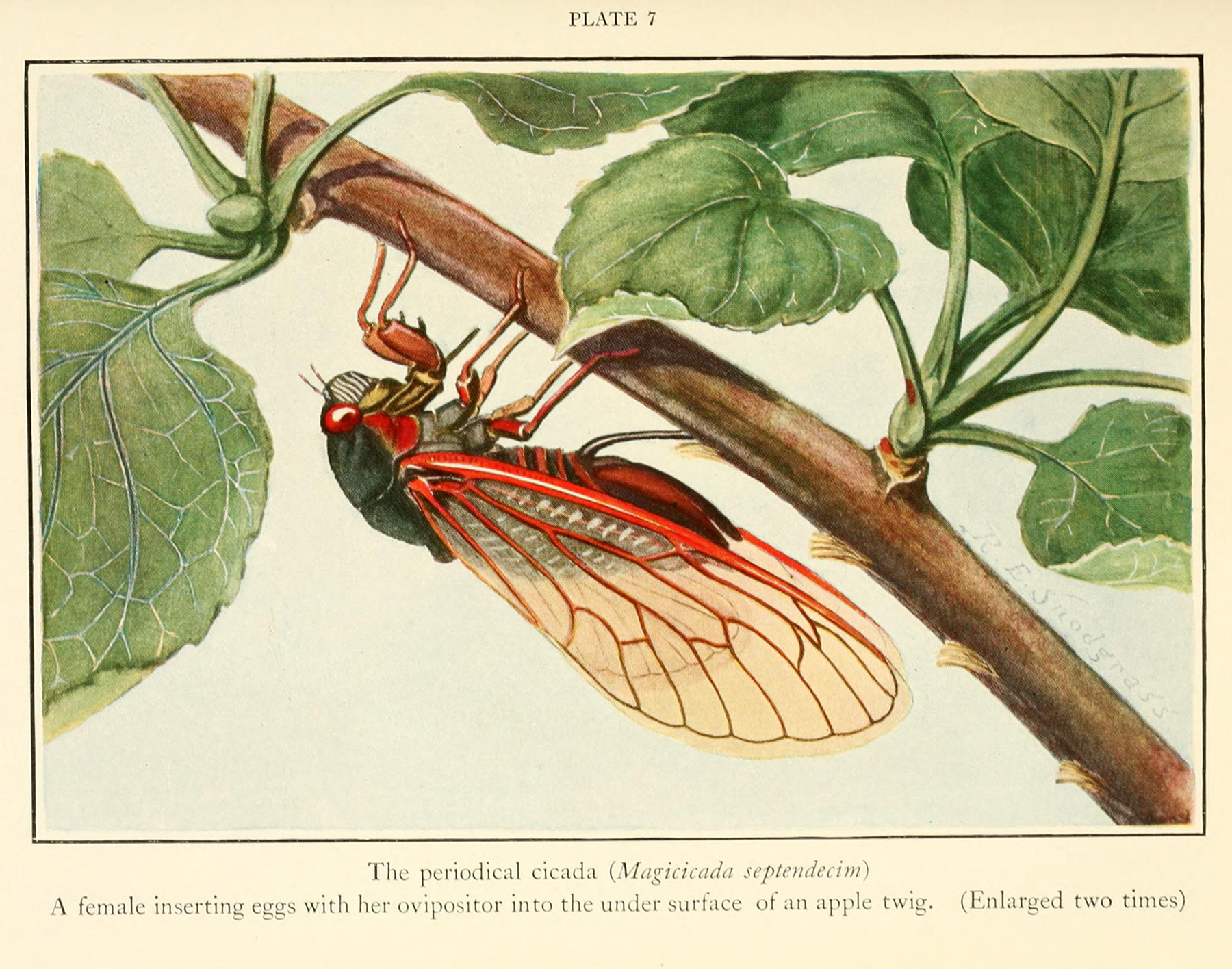
A female periodical cicada inserting eggs with her ovipositor into the under surface of an apple twig.

A female periodical cicada (Magicicada septendecim) inserting eggs with her ovipositor into the under surface of an apple twig. Snodgrass, R.E. The Periodical Cicada. Insects, their ways and means of living. Smithsonian Scientific Series, v.5 (1930). Art by R.E. Snodgrass. Contributed in BHL from Smithsonian Libraries and Archives.

References and Additional Suggested Readings

Academy of Natural Sciences (Philadelphia). 1859. Elections in 1859. 1: 354. https://www.biodiversitylibrary.org/page/1653313

Alexander, R.D., Moore, T.E. 1962. The evolutionary relationships of 17-year and 13-year cicadas, and three new species (Homoptera, Cicadidae, Magicicada). Misc. Publs Mus. Zool. Univ. Mich. 121: 1-59. https://deepblue.lib.umich.edu/bitstream/handle/2027.42/56365/MP121.pdf?sequence=4

Cassin, John. 1852. Note on the above species of Cicada, and on the Cicada septendecim, Linn. Proceedings of the Academy of Natural Sciences of Philadelphia. 5: 273-275. https://www.biodiversitylibrary.org/page/26301508

Davis, J.J. May 1953. Pehr Kalm’s Description of the Periodical Cicada, Magicicada septendecim L., from Kongl. Svenska Vetenskap Academiens Handlinger, 17:101-116, 1756, translated by Larson, Esther Louise (Mrs. K.E. Doak). The Ohio Journal of Science. 53: 139–140. https://kb.osu.edu/handle/1811/4028

Davis, W.T., 1925. Cicada tibicen, a South American species, with records and descriptions of North American cicadas. Journal of the New York Entomological Society. 33: 35-51. https://www.biodiversitylibrary.org/page/50783180

Dybas, Henry. (1970). Population explosion — 17-year locust style. Bulletin (Field Museum of Natural History) 41.1: 11-13. https://www.biodiversitylibrary.org/page/2890663

Fisher, J.C. 1852. On a new species of cicada. Proceedings of the Academy of Natural Sciences of Philadelphia. 5: 272-273. https://www.biodiversitylibrary.org/page/26301507

Hildreth, S.P. 1830. Notices and Observations on the American Cidada, or Locust. The American Journal of Science and Arts. 18: 47-50. https://www.biodiversitylibrary.org/page/30953560

Kalm, Pehr. 1756. Beskrifning På et slags Grås-hoppor uti Norra America. Kungl. Svenska vetenskapsakademiens handlingar. 17:101-116. https://www.biodiversitylibrary.org/page/46677076

Kritsky, Gene. 2001. Periodical Revolutions and the Early History of the “Locust” in American Cicada Terminology. American Entomologist, pp. 1-4. https://doi.org/10.1093/ae/47.3.186

Kritsky, Gene. 2021. Periodical Cicadas: The Brood X Edition. Ohio Biological Survey. http://www.worldcat.org/oclc/1246784386.

Linnaei, Caroli. 1758. Insecta. Hemiptera. Cicada. Mannifera. septendecim. Systema Naturae Per Regna Tria Naturae, Secundum Classes, Ordines, Genera, Species, Cum Characteribus, Differentiis, Synonymis, Locis. 1 (10 ed.). Stockholm, Sweden: Laurentii Salvii. pp. 436–437. https://www.biodiversitylibrary.org/page/727347

McNeur, Catherine. May 9, 2021. The Woman Who Solved a Cicada Mystery—but Got No Recognition. Scientific American. https://www.scientificamerican.com/article/the-woman-who-solved-a-cicada-mystery-but-got-no-recognition/

Marlatt, C.L. 1898. The periodical cicada: an account of Cicada septendecim, its natural enemies and the means of preventing its injury: together with a summary of the distribution of the different broods. Publication info: Washington, D.C. :U.S. Dept. of Agriculture, Division of Entomology,1898. https://www.biodiversitylibrary.org/page/48892673

Morris, Margaretta Hare. 1846. Stated Meeting, Dec. 15, 1846. Mr. Vaux in the Chair. Proceedings of the Academy of Natural Sciences of Philadelphia. 3: 131-34. https://www.biodiversitylibrary.org/page/1659400

Morris, Margaretta Hare. 1851. On the Seventeen Year Locusts. Proc. Bos. Soc. Nat. Hist. 4: 110. https://www.biodiversitylibrary.org/page/8870820

New York Entomological Society. 1947. Early Feminine Entomologists in America. Journal of the New York Entomological Society. LV: 280. https://www.biodiversitylibrary.org/page/50768578

Oldenburgh, Henry. 1666. Some Observations of swarms of strange Insects, and the Mischiefs done by them. Philosoph. Trans. London, l(8): 137-38. https://www.biodiversitylibrary.org/page/47594106

Snodgrass, R.E. 1930. The Periodical Cicada. Insects, their ways and means of living. (Smithsonian scientific series, v.5). https://www.biodiversitylibrary.org/page/41170136

Recommended Sites

BugGuide. Genus Magicicada – Periodical Cicadas. https://bugguide.net/node/view/6970

Catalogue of Life. Magicicada. https://www.catalogueoflife.org/data/browse?taxonKey=5K4G

CicadaMania. A commercial site that has good information about cicadas in general as well as the 2021 Brood X appearance. https://www.cicadamania.com/

Cicada Safari. Companion site to the Cicada Safari app, there’s lots of good information here as well. https://cicadasafari.org/

General Periodical Cicada Information (University of Connecticut). https://cicadas.uconn.edu/

And Brood X map https://cicadas.uconn.edu/brood_10/

iNaturalist Periodic Cicadas. The website for the citizen science app for Magicicada. https://www.inaturalist.org/taxa/83854-Magicicada

Smithsonian National Museum of Natural History. Good information from the Smithsonian on cicadas. https://www.smithsonianmag.com/blogs/national-museum-of-natural-history/2021/04/15/what-expect-when-cicadas-emerge-spring/

Wikipedia. Magicicada | M. septendecim (Linnaeus, 1758), M. cassinii (Fisher, 1852), M. septendecula (Alexander & Moore, 1962)

Notes

[1] More information on each of the Magicicada species from GBIF can be found here: M. septendecim (Linnaeus, 1758), M. cassinii (Fisher, 1852), M. septendecula (Alexander & Moore, 1962).

May 20, 2021by

Help Support BHL

BHL's existence depends on the financial support of its patrons. Help us keep this free resource alive!

search

About BHL

The Biodiversity Heritage Library (BHL) is the world’s largest open access digital library for biodiversity literature and archives. BHL operates as a worldwide consortium of natural history, botanical, research, and national libraries working together to digitize the natural history literature held in their collections and make it freely available for open access as part of a global “biodiversity community.”

Join Our Mailing List

Sign up to receive the latest news, content highlights, and promotions.

Subscribe Now

Subscribe to Blog via Email

Enter your email address to subscribe to this blog and receive notifications of new posts by email.

Join 319 other subscribers

Subscribe to Blog Via RSS

Subscribe to the blog RSS feed to stay up-to-date on all the latest BHL posts.

Access RSS Feed

Inspiring Discovery through Free Access to Biodiversity Knowledge.

The Biodiversity Heritage Library makes it easier than ever for you to access the information you need to study and explore life on Earth…for free, anytime, anywhere.


64+ Million Pages of
Biodiversity Literature Online.

EXPLORE

Tools and Services
to Transform Research.

EXPLORE

300,000+
Illustrations on Flickr.

EXPLORE

ABOUT | HARMFUL CONTENT | PRIVACY | SITE MAP | TERMS OF USE