Biodiversity Heritage Library - Program news and collection highlights from BHL
  • Home
  • News
  • Featured Books
    • All Featured Books
    • Book of the Month Series
    • BHL at 20
  • User Stories
  • Campaigns
    • Fossil Stories
    • Garden Stories
    • Monsters Are Real
    • Page Frights
    • Her Natural History
    • Earth Optimism 2020
  • Tech Blog
  • Visit BHL
Home
News
Featured Books
    All Featured Books
    Book of the Month Series
    BHL at 20
User Stories
Campaigns
    Fossil Stories
    Garden Stories
    Monsters Are Real
    Page Frights
    Her Natural History
    Earth Optimism 2020
Tech Blog
Visit BHL
  • Home
  • News
  • Featured Books
    • All Featured Books
    • Book of the Month Series
    • BHL at 20
  • User Stories
  • Campaigns
    • Fossil Stories
    • Garden Stories
    • Monsters Are Real
    • Page Frights
    • Her Natural History
    • Earth Optimism 2020
  • Tech Blog
  • Visit BHL
Biodiversity Heritage Library - Program news and collection highlights from BHL
Blog Reel, User Stories

Old Literature, New Discoveries: BHL Supports Cutting Edge Whale Research

In the early 20th century, the British Colonial Office and the Discovery Committee of the British Government undertook a series of major investigations into the biology of whales in the Southern Hemisphere. Using ship- and shore-based equipment (including whaling stations on South Georgia Island operated by the UK and other nations), these Discovery Investigations, as they were called, significantly advanced human knowledge of whale morphology and ecology.

The results of the Investigations were presented within the 37 volume series entitled the Discovery Reports. Groundbreaking for their time, these Reports are still important for cetacean research today.

“The data collected and published in the Reports were unique because they represented, in every case, a one-time, time-stamped opportunity to record the precise dimensions, weights, gut contents and many other details gathered as part of whaling activities,” explains Dr. Nicholas Pyenson, Curator of Fossil Marine Mammals at the Smithsonian’s National Museum of Natural History (NMNH).
View Full Size Image
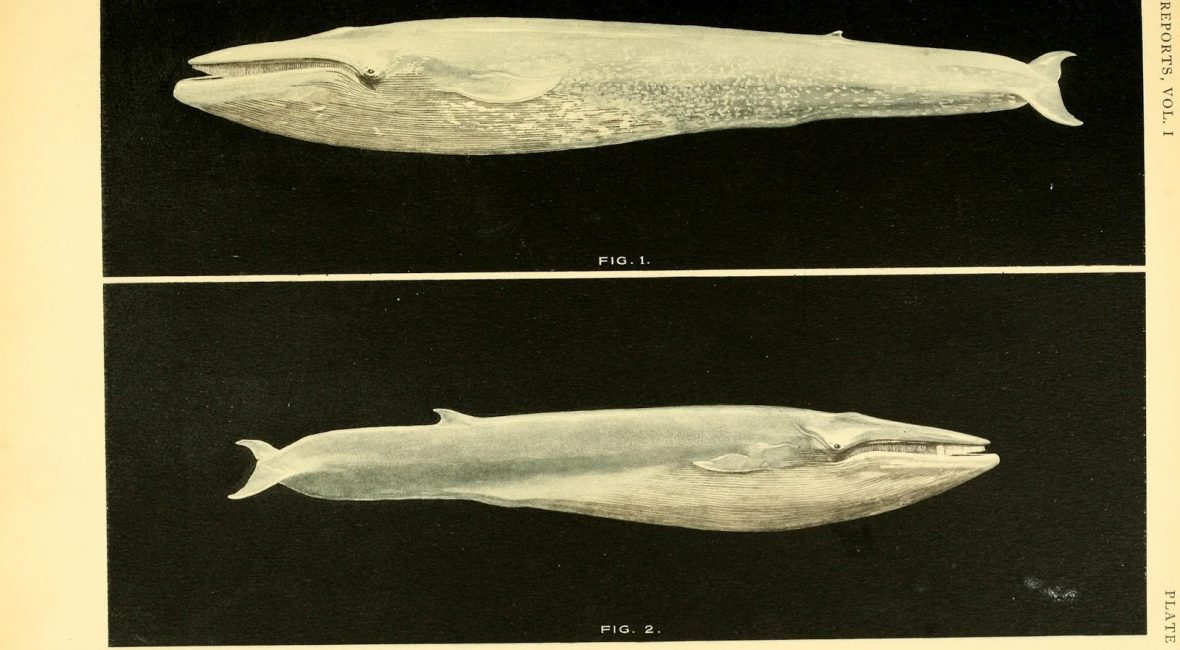
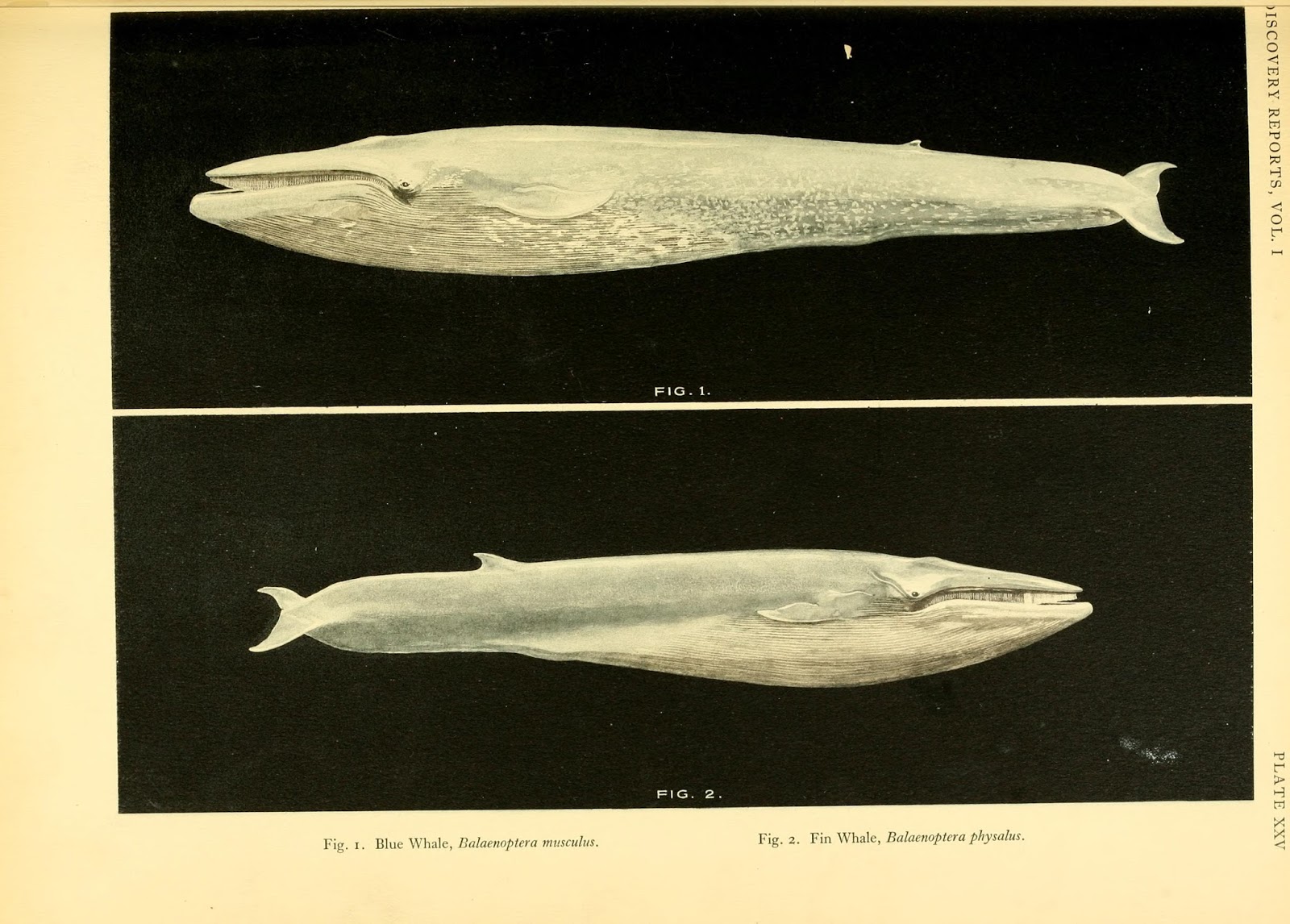
Mackintosh NA, Wheeler JFG (1929) Southern blue and fin whales. Discovery Reports 1:257—510. http://www.biodiversitylibrary.org/page/15917732. Digitized by Smithsonian Libraries.

Pyenson has used the data in the Reports to inform several recent studies. For example, he and colleague Simon Sponberg used data on total length and adult body mass for Southern blue and fin whales, published in 1929 as part of the Discovery Reports, to help develop and test regression methods for reconstructing the body size of extinct whales. Their findings, published in 2011 in the Journal of Mammalian Evolution, provided major insight into studying the evolution of cetacean body size.
View Full Size Image
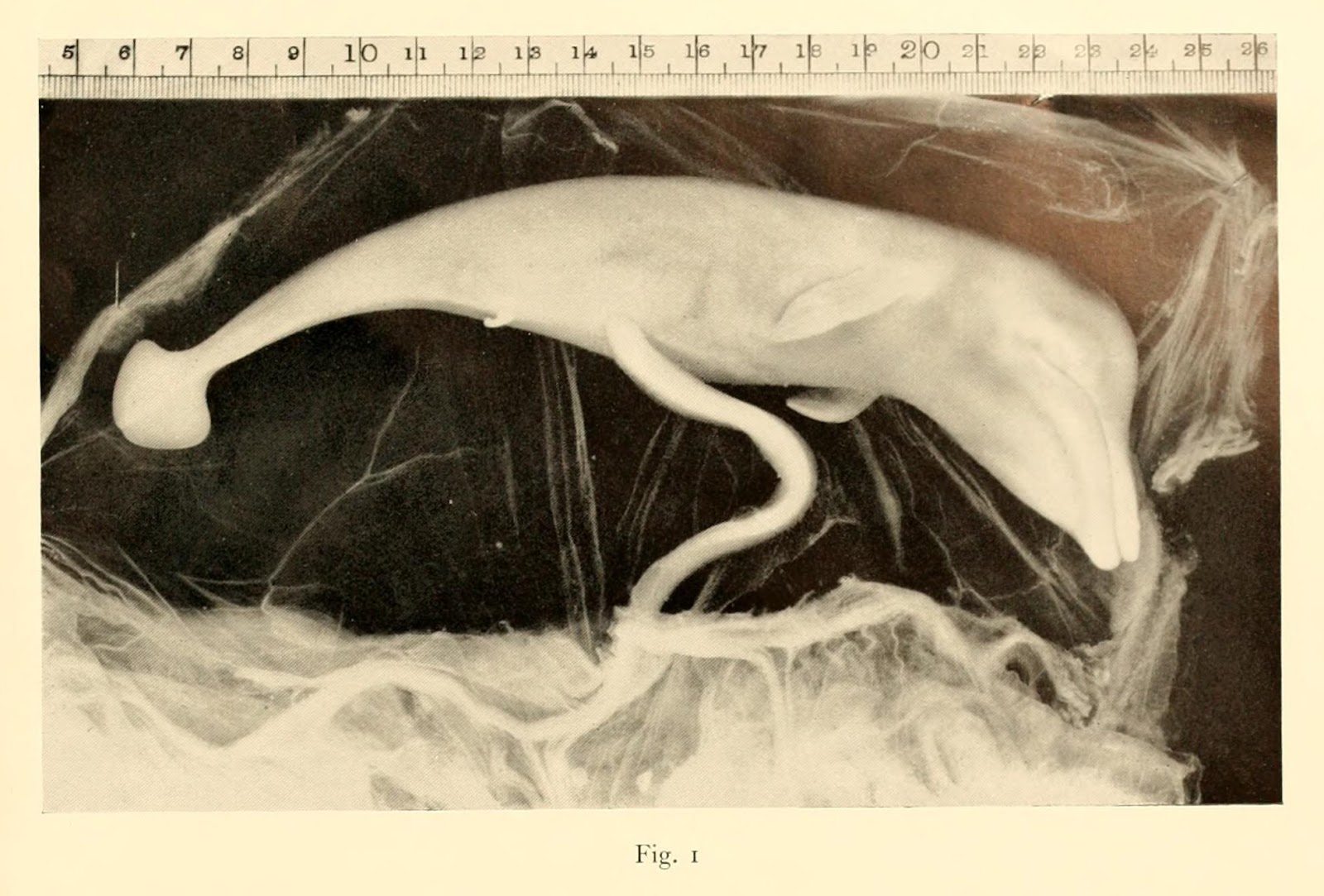
Fin whale fetus. Laws RM (1959) The foetal growth rates of whales with special reference to the fin whale Balaenoptera physalus Linn. Discovery Reports 29: 281–308. http://www.biodiversitylibrary.org/page/5569026. Digitized by MBLWHOI Library.

More recently, while researching the evolution of whale hearing, Maya Yamato and Pyenson used data on the fetal growth rates of whales, published in 1959 as part of the Discovery Reports, to gain insight into the maturation of the ear in baleen and toothed whales. Their research, published in 2015 in PLOS ONE, traces the development of an evolutionarily novel feature in cetaceans – the use of an acoustic funnel, rather than an ear canal, for hearing.

“The historic information in the Reports is so valuable for a variety of questions about the evolution, anatomy, and ecology of large whales,” asserts Pyenson.

View Full Size Image
Dr. Nicholas Pyenson. Selfie from a seakayak in Sitka Sound, Alaska.

Pyenson has been studying marine mammals and other marine vertebrates for over 15 years. He’s published pioneering research on the evolution and diversification of marine mammalian lineages and has used revolutionary techniques like 3D modeling to uncover new insights into the anatomy and transformation of this group. He’s even shared some of his research during past BHL-related events, including live webcasts for the #FWTrueLove and #FossilStories campaigns.

Pyenson’s scientific achievements, including the use of emerging digital tools to expand public access to fossils, earned him the coveted Presidential Early Career Award for Scientists and Engineers (PECASE). He is the first NMNH scientist to receive this award, which is the “highest honor bestowed by the United States Government on science and engineering professionals in the early stages of their independent research careers.”

While Pyenson has embraced many novel research techniques, the historic data found in publications like the Discovery Reports underpins much of his work. Thanks to the digital open access provided by the Biodiversity Heritage Library (BHL), it’s easier than ever to integrate these resources into modern research processes.

“As a free, mobile archive for natural history literature, BHL is ideal for 21st century research, which can happen on the field, in a museum, or at a coffee shop, as long as there’s internet connectivity,” lauds Pyenson.

Pyenson began using BHL nearly ten years ago, and over the past decade, it has had a major impact on his – and his colleagues’ – research.

“BHL supercharges the speed and efficiency of scholarly research, especially in the natural sciences where old literature sometimes contains the only information on a topic, taxon, geographic locality or collector,” says Pyenson. “And because BHL is open-access, I know firsthand that many of my international colleagues have dramatically better access to the literature covered in its database than more recent journals locked behind pay-walls.”

Pyenson uses BHL at least once a week, obtaining descriptions, measurements, and detailed views of morphology on fossil or modern specimens. The usability of the website, and the fidelity and quality of the scans, allow him to access and download information that is critical to his work.

“I think BHL’s interface is really wonderful. The links are crisp and easy to find and share. I especially enjoy the selectivity of being able to download just a few pages or only a specific article from an issue.”
View Full Size Image
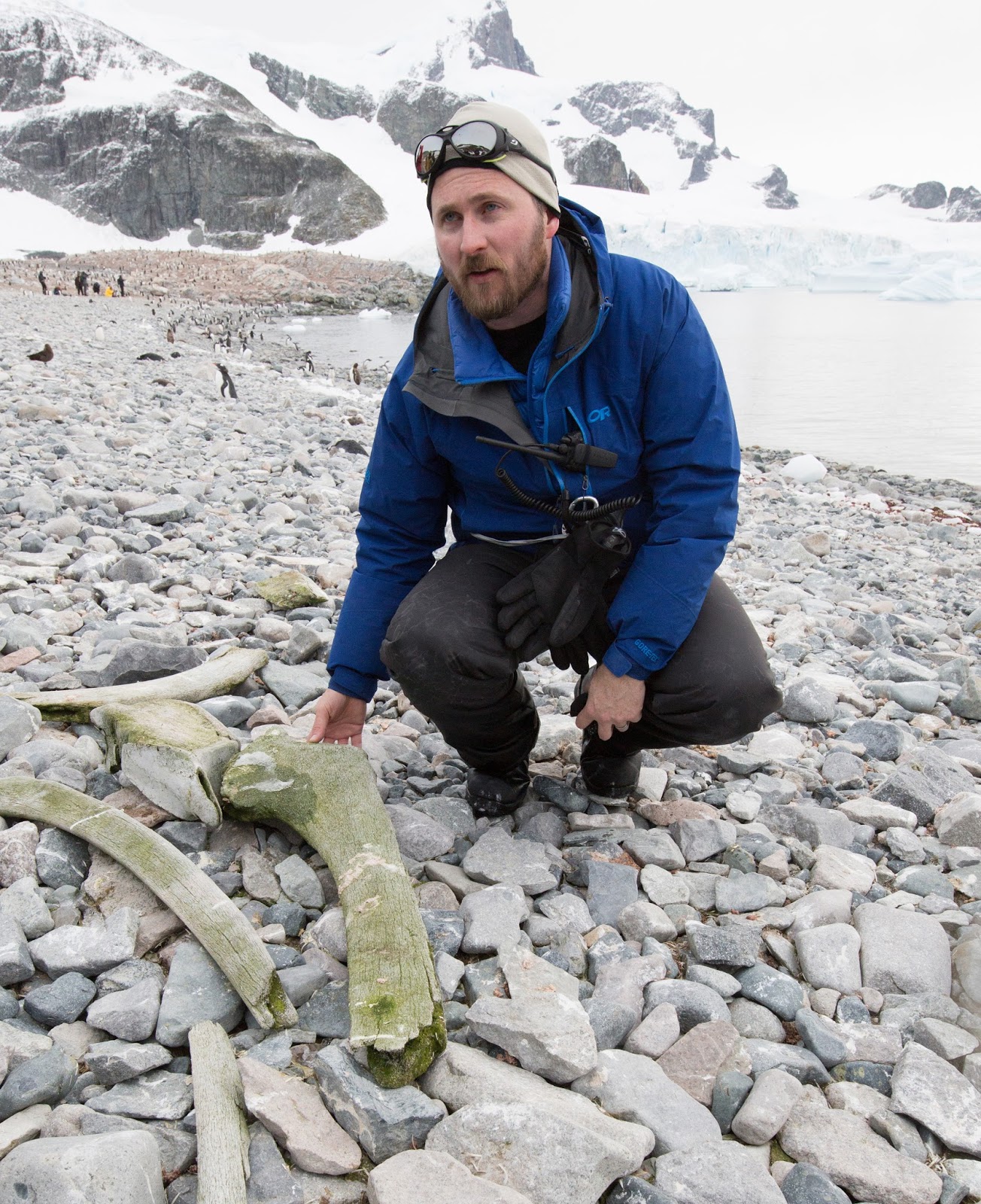
Dr. Nicholas Pyenson at Cuverville Island, Antarctica. Photo credit: Martha Stewart.

Given the significant impact that BHL has had on Pyenson’s work, he is anxious that more people be made aware of the vast abundance – and importance – of this free and open access collection.

“We need to get the word out. Old literature matters,” asserts Pyenson.

And matter it does. As Dr. Pyenson’s experience demonstrates, by providing a wealth of data on species morphology, phylogeny, and ecology, historic literature forms the foundation for the investigation of modern and ancient biodiversity. By making this content globally accessible to anyone with an Internet connection, BHL is helping to advance scientific research and inspire discovery of the natural world.

You can help support global research through a tax-deductible donation to BHL. With your help, we can continue to democratize access to information about biodiversity and empower scientific research on a global scale.

______________________________________

This post may contain the personal opinions of BHL users or affiliated staff and does not necessarily represent the official Biodiversity Heritage Library (BHL) position on these matters.
May 11, 2017by ulib-libraryjobs
Blog Reel, User Stories

Cetaceans and Cephalopods: Supporting the Work of Collections Managers One Specimen at a Time

Have you ever been to a museum and wondered about the history of the specimens on display?

If you have, then you’d probably be interested in talking to the museum’s collections managers, as their jobs include not only caring for and improving accessibility to the collections, but also serving as a living knowledge repository for information about the history of the collections.

View Full Size Image
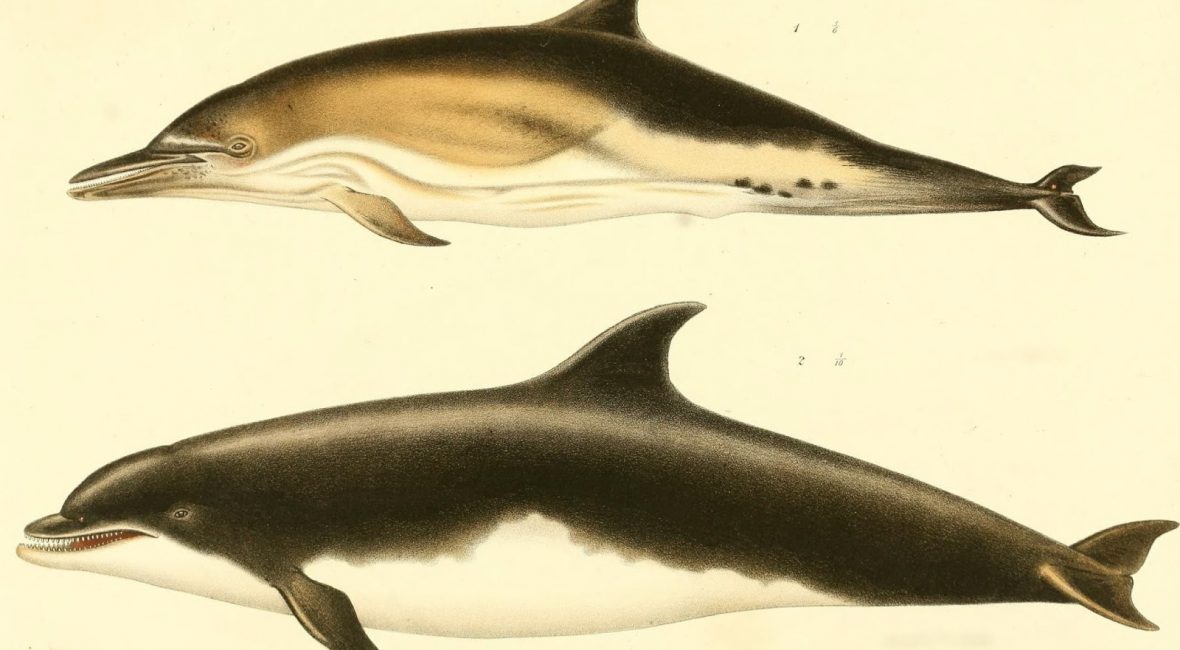
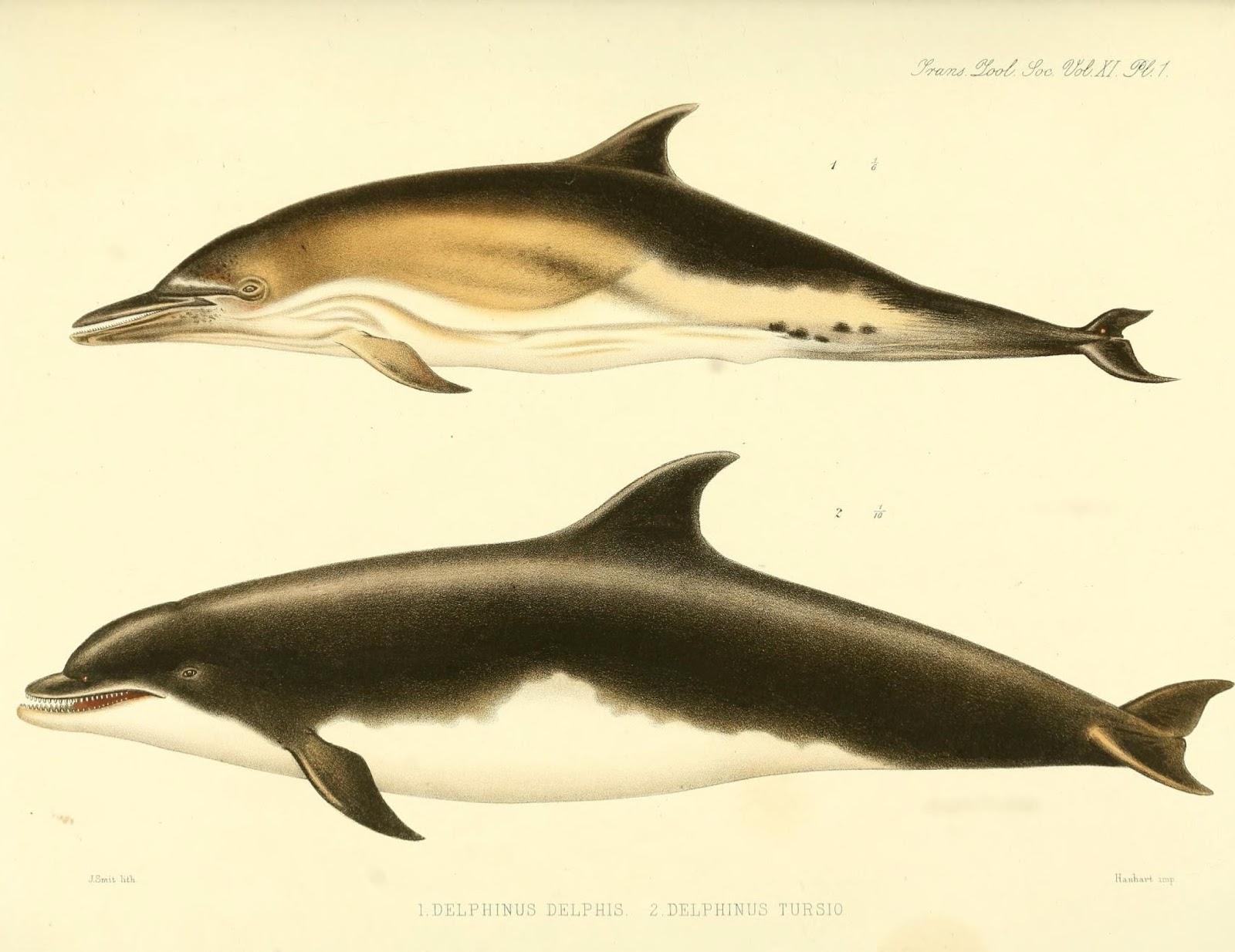
William Flower’s drawing of the bottlenose dolphin (lower). The skeleton from this individual is on display in the Oxford University Museum of Natural History. Flower, W. H. (1880), I. On the External Characters of two Species of British Dolphins (Delphinus delphis, Linn., and Delphinus tursio, Fabr.). The Transactions of the Zoological Society of London, 11: no 1. Digitized by the Natural History Museum, London. http://www.biodiversitylibrary.org/page/28725656.

Take the Oxford University Museum of Natural History, for example. Amongst the many treasures on display in that museum are five whale skeletons suspended from the roof. Where did those specimens come from? Mark Carnall, Collections Manager for the Life Collections at the museum, knows that these specimens are linked to some very prestigious individuals in the world of ‘whaleologists’, including Daniel Frederick Eschricht and William Henry Flower. Curious? Learn more in Mark’s blog post for More than a Dodo.

View Full Size Image
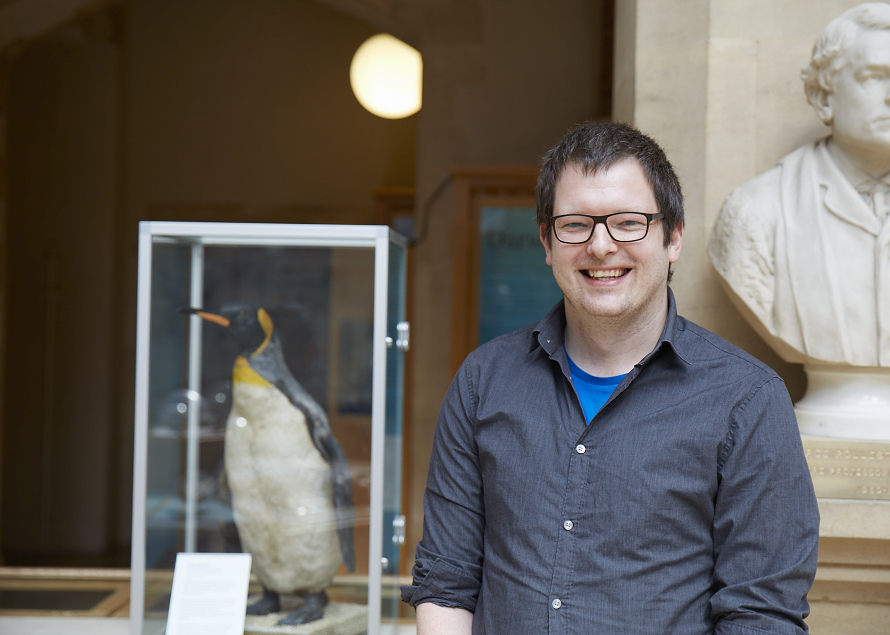
Mark Carnall. Image by John Cardwell courtesy Oxford University Museum of Natural History.

As a collections manager for the Oxford University Museum of Natural History, and during his tenure at other major UK museums, Mark has spent a great deal of time researching the history of the specimens in his care. BHL plays an important role in this research.

“Having worked at some of the older UK natural history museums, including the Grant Museum of Zoology at University College London, the Natural History Museum London and currently the Oxford University Museum of Natural History, I’ve been very fortunate in that some of the early references to the specimens that I curate are ‘THE’ original works when it comes to unravelling the physiology, taxonomy and ecology of major groups of animals, and it is rare that these aren’t already on BHL,” says Mark.


View Full Size Image
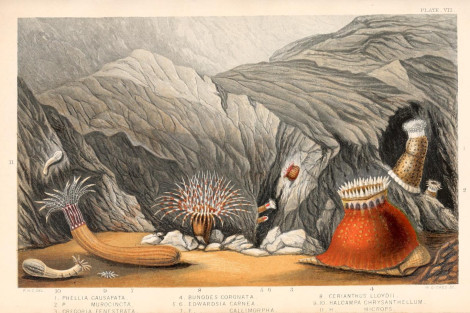
British Sea-Anemones, showing many of the species in the Oxford University Museum of Natural History series. Gosse, Philip Henry. Actinologia britannica (1860). Digitized by Smithsonian Libraries. http://biodiversitylibrary.org/page/12042290.

Mark first discovered BHL when looking for references and citations for specimens during his time at University College London. Today, he uses BHL about once a week as part of his research to answer inquiries about the museum’s collections. This research can be very time-intensive, and thus having online access to relevant publications is very important.

“As a collections manager, my role is dictated by priorities in improving accessibility to the collections, so often there isn’t much time for going in to depth with the history of specimens,” explains Mark. “Some specimens could be researched for weeks or months; however, with easy access to biodiversity heritage publications through BHL, it means that I can do some of this research on the fly rather than earmark it to return to later.”

In addition to discovering publications as part of his research process, Mark also discovers additional content of personal interest through BHL’s social media activities.

“One of my favourite features of BHL is the ‘curated content’ such as the blog posts that BHL users and staff write about discoveries or fascinatingly esoteric publications,” says Mark. “I am also a huge fan of the Flickr sets. As a collections manager, I’m always thinking about how people can access our specimens and content. A dry item by item database is fine for people who know what they are specifically looking for, but it doesn’t facilitate browsing such a vast amount of content or expose people to new knowledge or information. I’ve spent more than a few evenings starting by browsing a Flickr album I’ve been directed to by a BHL blog and ending up reading papers completely unrelated because making those fluid connections is so easy. The BHL social media team is also fantastic at raising awareness about the latest content on BHL. Additionally, I really appreciate that it’s clear how to reuse and credit resources, be it from reusing an image on Twitter to a bibliographic reference.”

When it comes to favorite content, Mark has a soft spot for the cephalopod material.

“I’m a huge cephalopod nerd,” admits Mark. “For such an interesting group there’s actually a paucity of published material. Browsing through BHL images, however, I’ve gone from sea monsters to beautifully illustrated plates (see for yourself), which I would have otherwise not stumbled upon or overlooked in the hunt for a taxon description.”


View Full Size Image
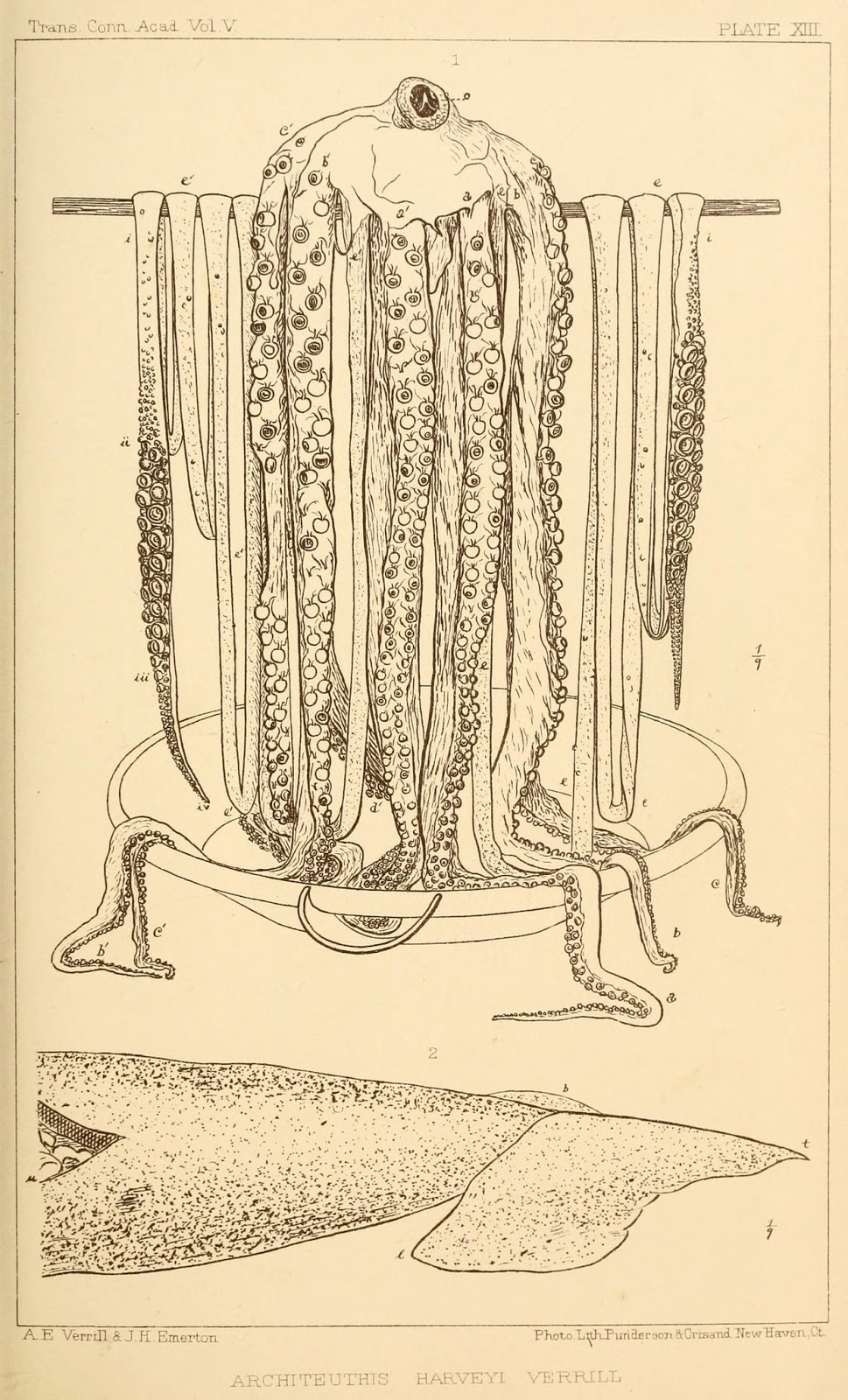
The rather sad-looking but earliest bona fide remains of a giant squid. Verrill, A.E. The cephalopods of the north-eastern coast of America. (1879-1881). Digitized by MBLWHOI Library. http://www.biodiversitylibrary.org/page/11826545.

Currently, his favorite item on BHL is the poem Spirula spirula by C. W. Johnson in the Nautilus (1926). According to Mark, “It’s a quirky (but accurate at the time) poem about the ram’s horn squid and formally captures a geekery and whimsy that you just don’t see as much in modern formal science publishing.”

While the historic collections and curated content on BHL are extremely valuable to Mark, he would love to see the amount of content from the mid-twentieth century expanded. This content, especially that from the 1930s-1970s, can be extremely difficult to access but can contain very valuable information for research.

You can help us obtain permission to include this content in BHL! If you or an organization you work with owns the copyright to a biodiversity-related publication, you can help us broker permission to digitize the work. Learn more on our website.

So, the next time you’re at a museum, take a moment to think about the history of the specimens on display and the people who work so hard to care for and preserve knowledge about those pieces. And just maybe, indulge your curiosity by searching for some related publications or browsing related images in BHL. You never know what kind of history you might dig up.

______________________________________

This post may contain the personal opinions of BHL users or affiliated staff and does not necessarily represent the official Biodiversity Heritage Library (BHL) position on these matters.
November 10, 2016by ulib-libraryjobs
Blog Reel, User Stories

No Flippant Matter: The Re-Invention of the Flipper and Why Ceatacean Flippers Are Unique

Cetaceans are not closely related to other aquatic vertebrates and represent a unique lineage derived from hoofed land mammals that returned to an aquatic lifestyle about 50 million years ago (Thewissen, 1998). The transition from land to water, i.e. the development from weight-bearing forelimb with five hoofed toes to tissue-encased flipper not capable to support locomotion on land, is well documented by fossils (Thewissen et al., 2001, 2009) and very different from other aquatic vertebrates. Consequently many morphological characteristics that cannot be detected in fossils have remained little documented or speculative. Freed from the constraints of gravity and the developmental links to the hind legs, there is also a persistent anatomical plasticity in the flipper of modern cetaceans, showing substantial skeletal disparities sometimes even within the same population or pod (Cooper et al., 2007). Although there are a small number of morphological studies investigating the flipper in extant cetaceans, the understanding of functional morphology in this group has so far remained largely unresolved.

There are less than two dozend studies that include odontocete (toothed whales and dophins) forelimb myology (soft tissue studies). About half are classical works (Howell, 1927, 1930; Murie, 1870, 1873; Schulte and Smith, 1918; Stannius, 1849; Struthers, 1873), most of them available at BHL, and a few are more modern (Benke, 1993; Klima et al., 1980; Pilleri, 1976; Pilleri et al., 1976; Smith et al., 1976; Sokalov and Rodionov, 1974; Strickler, 1978).

View Full Size Image
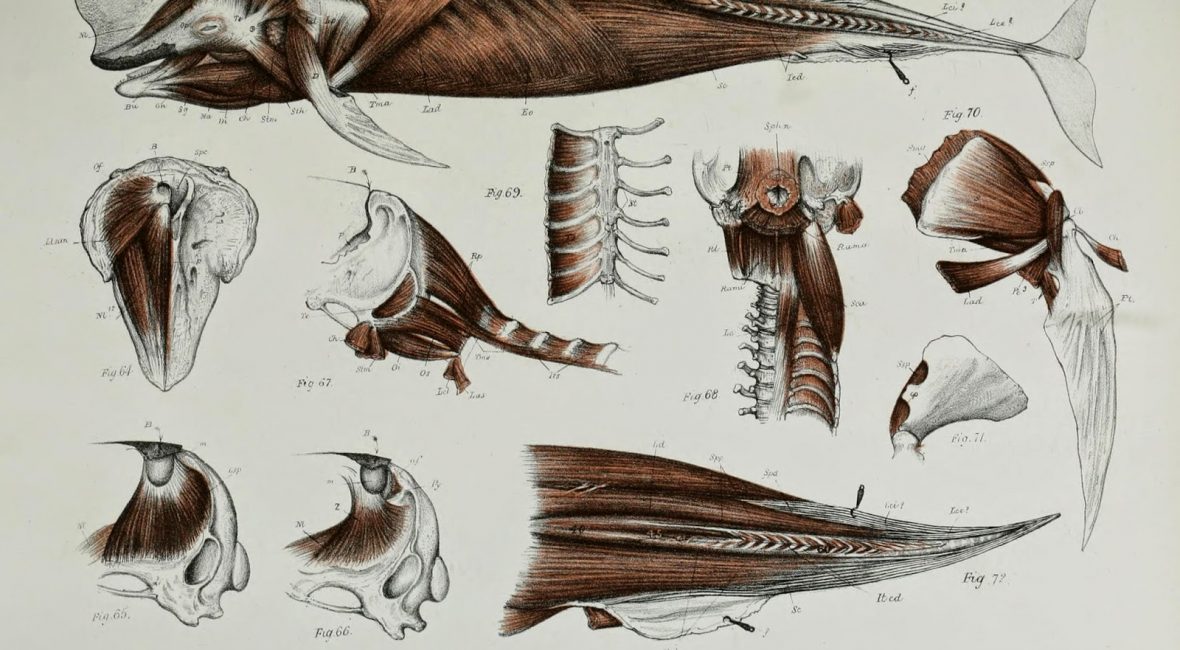
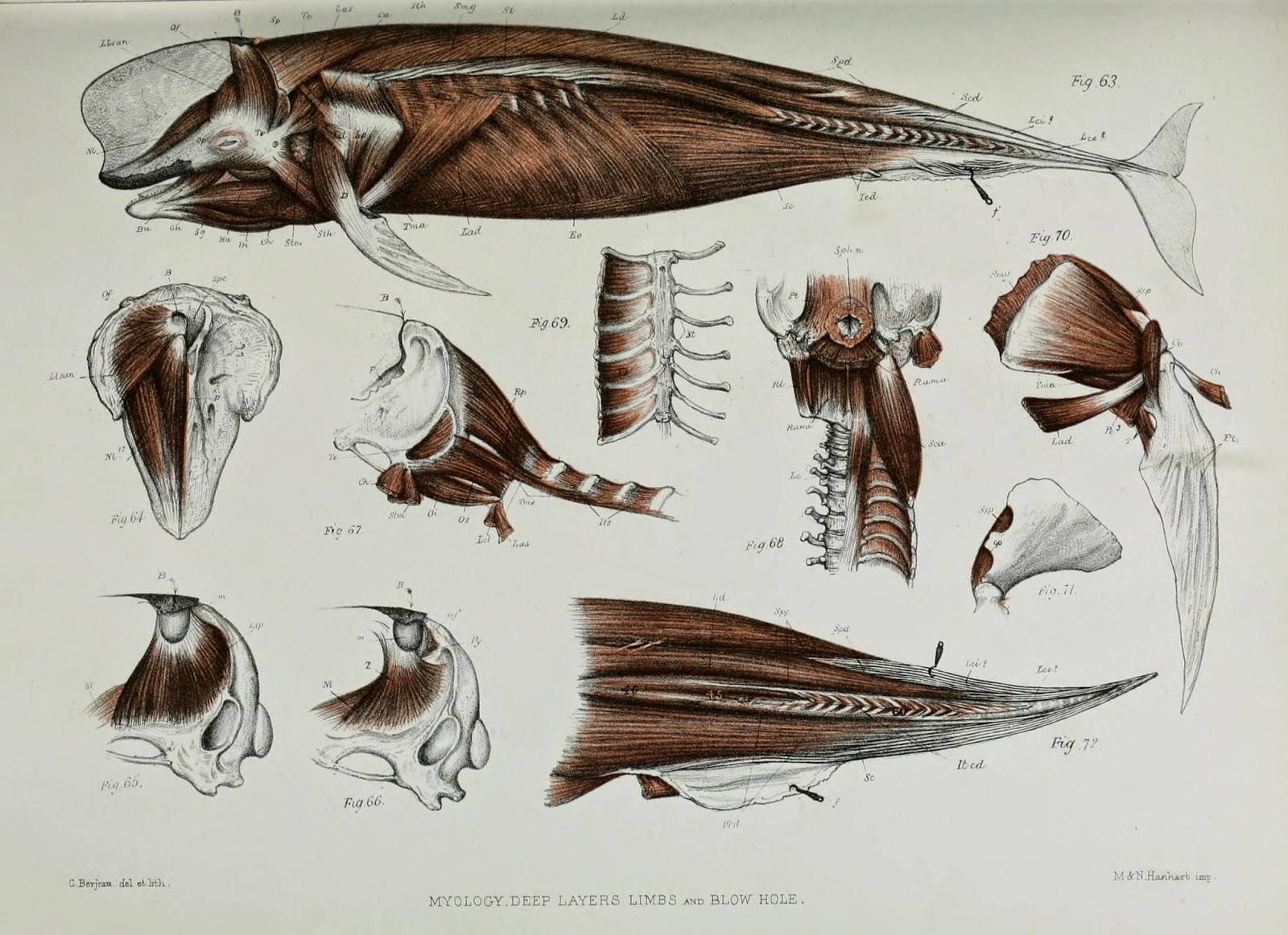
Myology, deep layers, of limbs and blow hole in the long-finned pilot whale (Globicephala melas). Murie, James. “On the Organization of the Caaing Whale, Globiocephalus melas.” Transactions of the Zoological Society of London. v. 8 (1872). http://biodiversitylibrary.org/page/28778656.

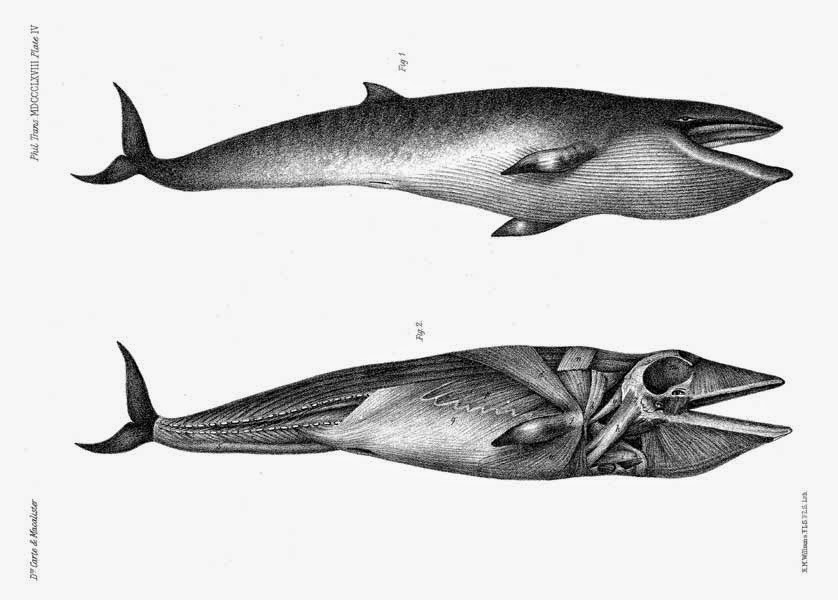
Among mysticetes (balaeen whales) the lack of data is particularly apparent. The few accounts that include soft tissue are limited to rorquals (Benke, 1993; Carte and Macalister, 1868; Kükenthal, 1921; Perrin, 1870; Schulte, 1916; Struthers, 1888, 1889) and right whales (Kükenthal, 1922; Struthers, 1878) – except Benke all are nearly or over a century old.

View Full Size Image
Drawing of and lateral view of myology of Balaenoptera rostrata. Alexander Carte and Alexander Macalister. On the Anatomy of Balaenoptera rostrata. Phil. Trans. R. Soc. Lond. January 1, 1868(158). 201-261. http://rstl.royalsocietypublishing.org/content/158/201.full.pdf+html.

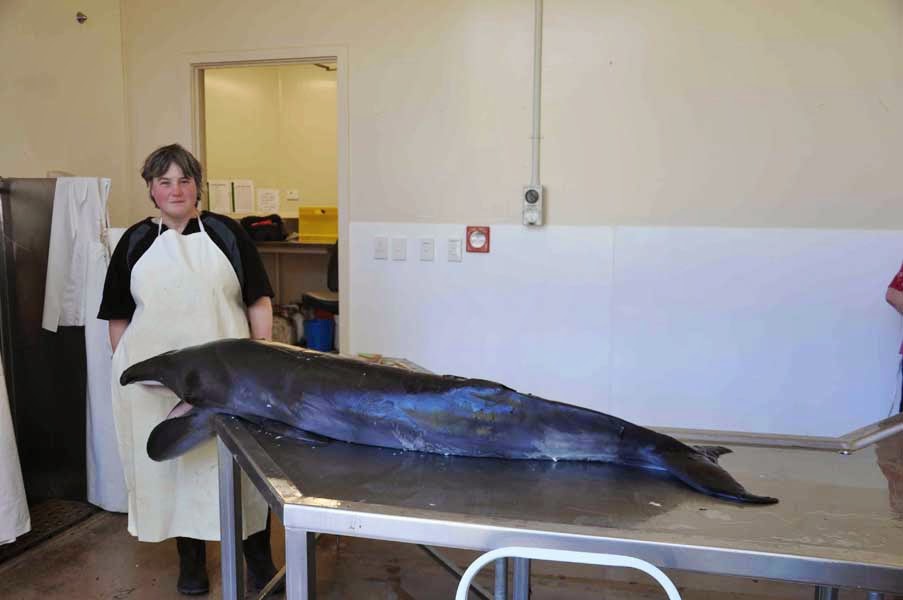
The question of how cetaceans transitioned from a weight-bearing leg to a flipper is one of considerable interest to Moyna K. Müller, a PhD student at the Geology Department, University of Otago, New Zealand.

Müller has been studying cetaceans for the past four years, with particular interest not only in the transition of the weight bearing leg to flipper (evo-devo), but also comparative muscoskeletal arrangement of the shoulder and forelimb and functional analysis of the flipper. Her research requires access to historic literature that forms the basis of her comparative analysis and provides access to data from morphological studies done in the past. Gaining access to this literature used to present a challenge for Müller, until she discovered the Biodiversity Heritage Library.

View Full Size Image
Moyna K. Müller, a PhD student at the Geology Department, Otago University, New Zealand at the Ag research centre Invermay, Mosgiel, with a neonate pygmy right whale. Photo by Cheng-Hsiu Tsai.

“[I discovered BHL] at the beginning of my studies when I couldn’t get an article and in desperation told a fellow student in our group, who then put me onto your website. Since then I felt like a kid in a lolly shop,” praises Müller. “[There are] way too many things to look at distracting me from my studies.”

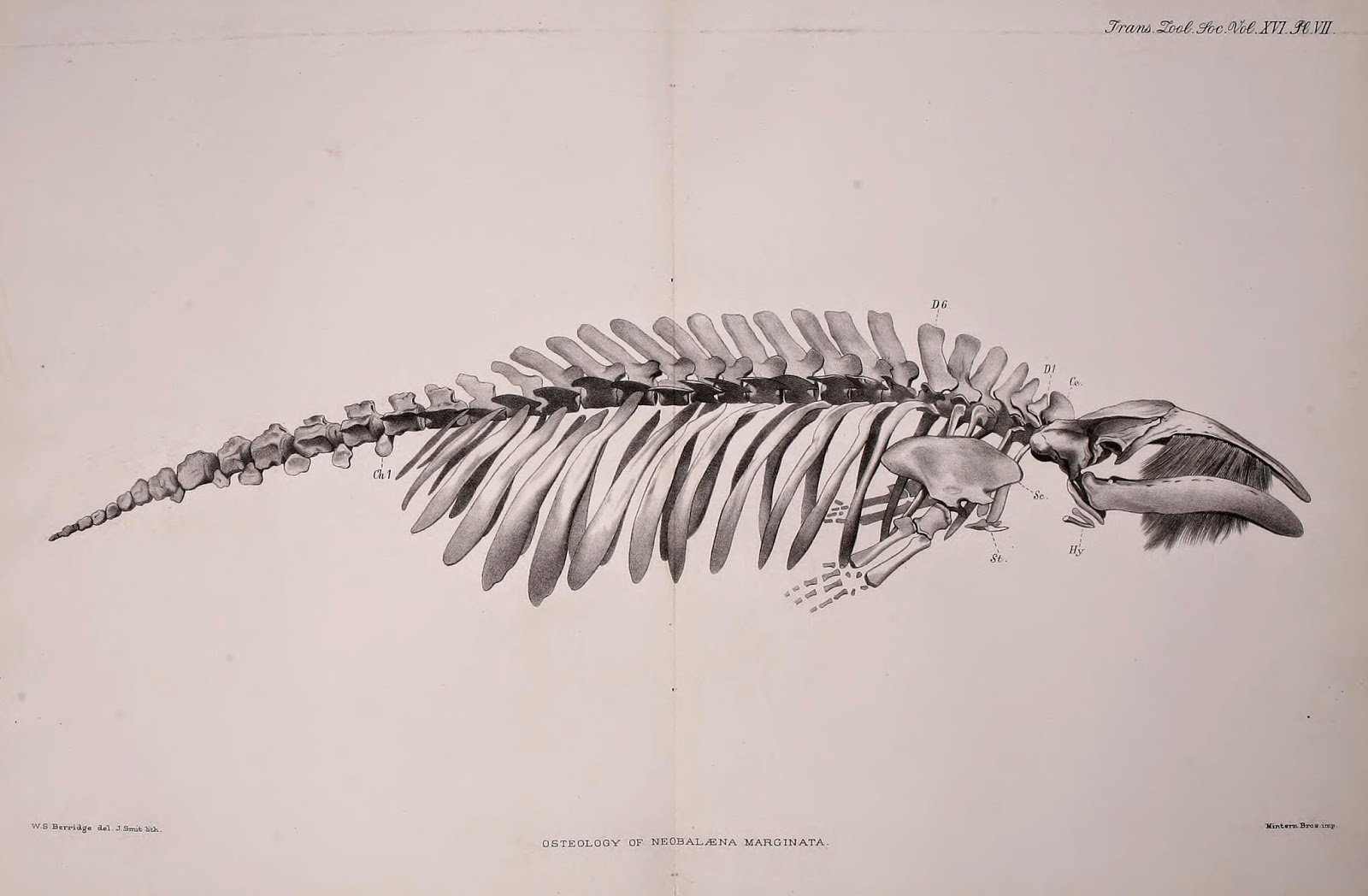
Recently those studies have included work on the pygmy right whale, Caperea marginata, the least known and most elusive of all baleen whales. This species is only known from isolated remains, infrequent solitary strandings, and few sightings, thus sharply contrast with all other baleen whales that are known from a multitude of live observations, captures and strandings (Baker, 1985). The earliest descriptions of this cryptic whale were based on beach-cast fragments associated with a convoluted taxonomy and nomenclature only applied correctly as Caperea marginata from 1930s onwards (Beddard, 1901; Gray, 1873; Rice, 1998). The divergent external appearance and skeletal disparity of the pygmy right whale warrant hereby separation from the true right whales (Balanidae) into a discrete family (Neobalaenidae Gray 1873), separating C. marginata from all other living mysticete families (Balaenidae, Eschrichtiidae and Balaenopteridae). However, only recently has C. marginata also been associated with an otherwise extinct fossil family (Cetotheriidae) (Fordyce and Marx, 2013). It is with this family that the pygmy right whale also shares some of the most striking fatures of the postcranial skeleton, namely the shoulde blade and the ribs (Bouetel and de Muizon, 2006; Gol’din et al., 2013).

View Full Size Image
Osteology of the Pygmy Right Whale Caperea marginata. Beddard, FE. “Contribution towards a knowledge of the osteology of the pigmy whale (Neobalaena marginata).” Transactions of the Zoological Society of London. v. 16 (1901). http://biodiversitylibrary.org/page/32663067.

Müller confides that, to support her work, she uses BHL “too often to count,” downloading PDFs of papers, whole articles, and high resolution images from our collection. The material is invaluable to her research.

“A lot of older literature I cannot get anywhere else, and without it I would sometimes have no basis for comparative analysis or I would not be able to confirm the validity of citations by other authors,” explains Müller. “This was particularly the case when working on the pygmy right whale (Caperea marginata). Apart from the pygmy right whale’s convoluted taxonomy, there are only three detailed descriptions of the shoulder musculature of any baleen whale – two of them (also the most detailed ones) are about a hundred years old (Carte and Macalister 1868 and Schulte 1916).”

When asked to describe her favorite BHL feature, Müller could not narrow it down to a single service (something we love to hear!). She not only finds it easy to locate the journals she needs but also, once she has found a title of interest, quickly determines what volumes are available. She also likes the visually-attractive images displayed throughout the website (even the “stunning fish” displayed on our “item not found” page), as well as the ‘news’, ‘today’s picks’ and ‘featured collections’ components. Finally, she was particularly complimentary of our feedback service (shout-out to Jackie Chapman, our BHL Collections Librarian who triages all of our feedback), describing it as “fast, friendly and very competent.”

View Full Size Image
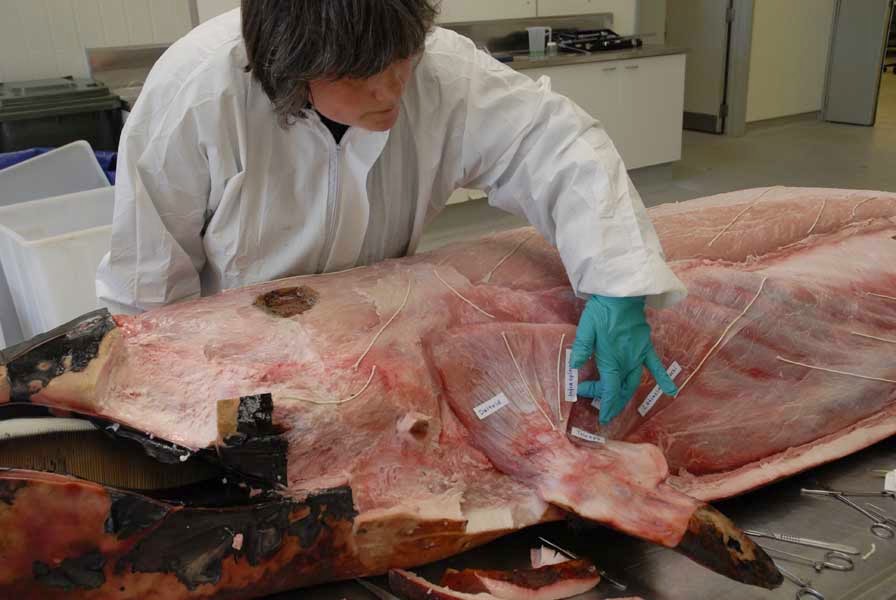
Moyna K. Müller labelling shoulder muscles of a juvenile pygmy right whale at the Museum of New Zealand (Te Papa). Photo by R. Ewan Fordyce.

Likewise, Müller could not name a single-favorite item in BHL. As she describes:

“The problem in my field is that there is no complete work I could use as the fundament for my own work, but rather a host of different articles that cover some aspects, e.g. osteology (van Beneden, 1880, Ostéographie des Cétacés vivant et fossils), or myology (Carte, A. and A. Macalister, 1868, On the anatomy of Balaenoptera acutorostrata or Schulte, H. v. W., 1916, Anatomy of a foetus of Balaenoptera borealis), and equally important the description of little described whales and dolphins (many articles by e.g. W. H. Flower, F. J. Knox, J. Hector, J. E. Gray in various volumes of Transactions and Proceedings of the New Zealand Institute or The Annals and Magazine of Natural History).”

Thus, the ability to retrieve all of these works and more is critical to Müller’s research success. BHL makes that possible.

Finally, Müller did offer a wonderful suggestion for a way to improve BHL, particularly in relation to the many foreign works available.

“You have quite a bit of foreign literature. [It’s] no problem for me to translate e.g. German or French, but it might be worth considering creating an option to upload translations, or a summary created by researchers in that field who do speak that particular language and are familiar with the terminology in their field, since a crude translation or summary is still better than none for somebody who doesn’t speak that language at all.”

As we continue to explore more and more crowdsourcing opportunities within our BHL community, and investigate ways to allow our users to help us improve our collections and services, the ability to add translations, transcriptions, and annotations are just some of the features we’re considering for our next interation of BHL. You can stay up to date with all of our website and service changes and improvements by following us on this blog, Twitter, and Facebook or subscribing to our newsletter. If you have suggestions for ways to improve our website or collections, please send us feedback!

Thank you, Moyna, for taking the time to explain how BHL is useful to you in your daily work! Do you use BHL to support your work? Want to tell us about it? Send us a message at [email protected].

Click here to see cetacean sources cited, used, or otherwise useful, outlined by Moyna K. Müller. 

With Contributions From:
Grace Costantino
Outreach and Communication Manager, Biodiversity Heritage Library

April 9, 2015by ulib-libraryjobs
Blog Reel, Featured Books

True Detective: Frederick W. True’s lifelong dedication to uncovering the natural history of marine mammals

This post is a guest post by John Ososky and Nick Pyenson, originally published on the Pyenson Lab blog.

The Smithsonian Field Book Project is showcasing Frederick William True in February! This post is follows in a series of blogs and social media content from the Biodiversity Heritage Library, Pyenson Lab, Smithsonian Transcription Center, Smithsonian Archives, and Smithsonian Libraries celebrating #FWTrueLove. Click on these links to the first and second posts; the third one, below, is based on a seminar recently presented by John Ososky (OsteoPrep Lab, Department of Vertebrate Zoology, NMNH) and co-written with N. D. Pyenson.

View Full Size Image
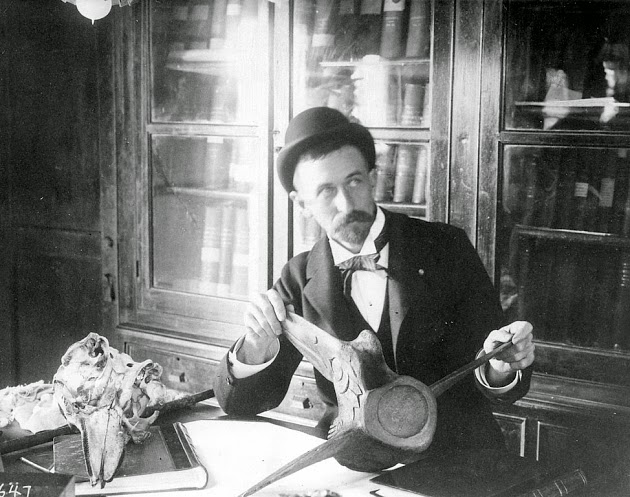
Frederick William True. c. 1880s. Smithsonian Institution Archive. Negative Number 2002-32245.
http://siarchives.si.edu/collections/siris_sic_10688.

In 1858, the inland port of Middletown, Connecticut, was the largest manufacturer of marine hardware in the United States, at a time when the shipping industry shifted from sails to steam. Frederick W. True was born that year, and unsurprisingly developed a lifelong interest in ships and fisheries, especially as he witnessed the decline of the Yankee whaling industry. After earning a Bachelor of Science degree in 1878, he took a job as clerk with the U.S. Fish Commission, which at the time was headed by the Smithsonian’s second Secretary, Spencer Fullerton Baird.

View Full Size Image
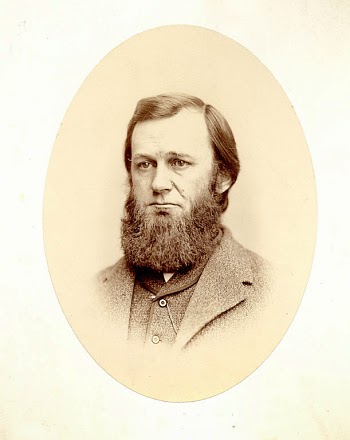
Spencer Fullerton Baird. Smithsonian Archives – History Div, 46853/oval or 2004-60740.
http://siarchives.si.edu/history/spencer-fullerton-baird.

While Secretary of the Smithsonian, Baird also decided to serve as the first Commissioner of the U.S. Fish Commission (a precursor to NOAA’s National Marine Fisheries Service). Under Baird’s guidance, the Commission became a robust scientific enterprise, undertaking extensive surveys of fisheries along all U.S. coastlines, censuses of fishery laborers, and also collecting data on target species and fisheries infrastructure. Baird was strategic about his influence, and he used the expansion of the Commission as an opportunity to hire promising young naturalists — such as True — and get their foot in the door at the Smithsonian.

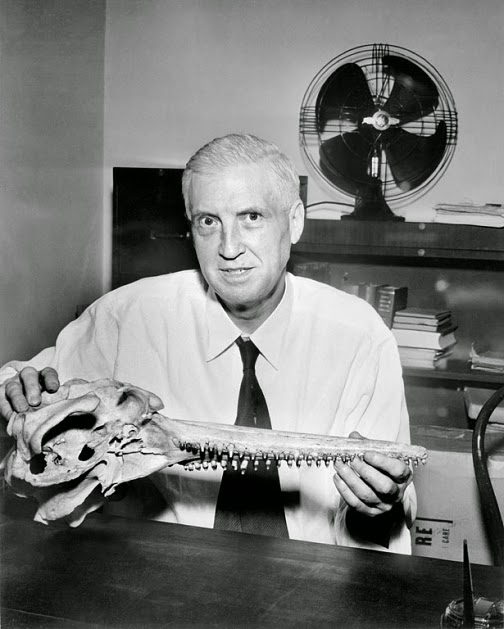
Recruited by Baird, True was initially a special agent for the U.S. Fish Commission, but eventually Baird put him in charge of the joint Smithsonian-U.S. Fish Commission display at the Berlin Fisheries Exhibition of 1880, where many of the specimens collected by special agents for the Commission were put on display. At the time, the Smithsonian lacked an official library (for various historical reasons), and Baird rectified this situation in 1881 by donating his own personal library to form the core of a new research library at the Smithsonian. Baird recognized True’s diligence and acumen as a reseacher, and hired him to lead it. True seized on the opportunity, and improved on the idea immediately, forming divisional libraries to meet the specialized needs of individual curators, which still continue to this day (such as the Kellogg Library of marine mammalogy, named in honor of Remington Kellogg, who never met True but succeeded him as a Smithsonian marine mammalogist).

View Full Size Image
Remington Kellogg. Smithsonian Institution Archives. Image Number 78-3701.
http://siarchives.si.edu/collections/siris_sic_11289.

True sometimes diverged from his role as a librarian to fill a void as acting curator of mammals; Baird, who noted True’s ambition and drive, soon appointed him curator of mammals in 1883. While microscopic descriptions were the rage in natural history at the time, True’s poor eyesight made this type of work difficult. True instead recognized the wealth of marine mammals specimens at the Smithsonian that had been generated in part by Baird’s collections from the Commission, as well as collections made by Captain Charles M. Scammon in the North Pacific Ocean in the 1870s and the prolific Edward Drinker Cope, who had been hired by Baird to write a monograph on cetaceans, which only came to partial fruition. Thus, True had the opportunity and motivation to expand his interest in marine fisheries and take on the study of cetaceans.

At the same time, True recognized the need to expand and grow the collections for the U.S. National Museum (USNM, the forerunner of what today is called the National Museum of Natural History, or NMNH). In a shrewd and practical move, True encouraged keepers of lighthouses and life-saving stations along the U.S. coasts to collect stranded specimens and data on marine mammals. True’s 1884 guide on the topic effectively presaged the logic of the modern marine mammal stranding network, which only formally took effect with the U.S. Marine Mammal Act of 1972.

View Full Size Image
Suggestions to the keepers of the U.S. life-saving stations, light-houses, and light-ships; and to other observers, relative to the best means of collecting and preserving specimens of whales and porpoises. True, F.W.  (1884).
http://biodiversitylibrary.org/page/16177227.

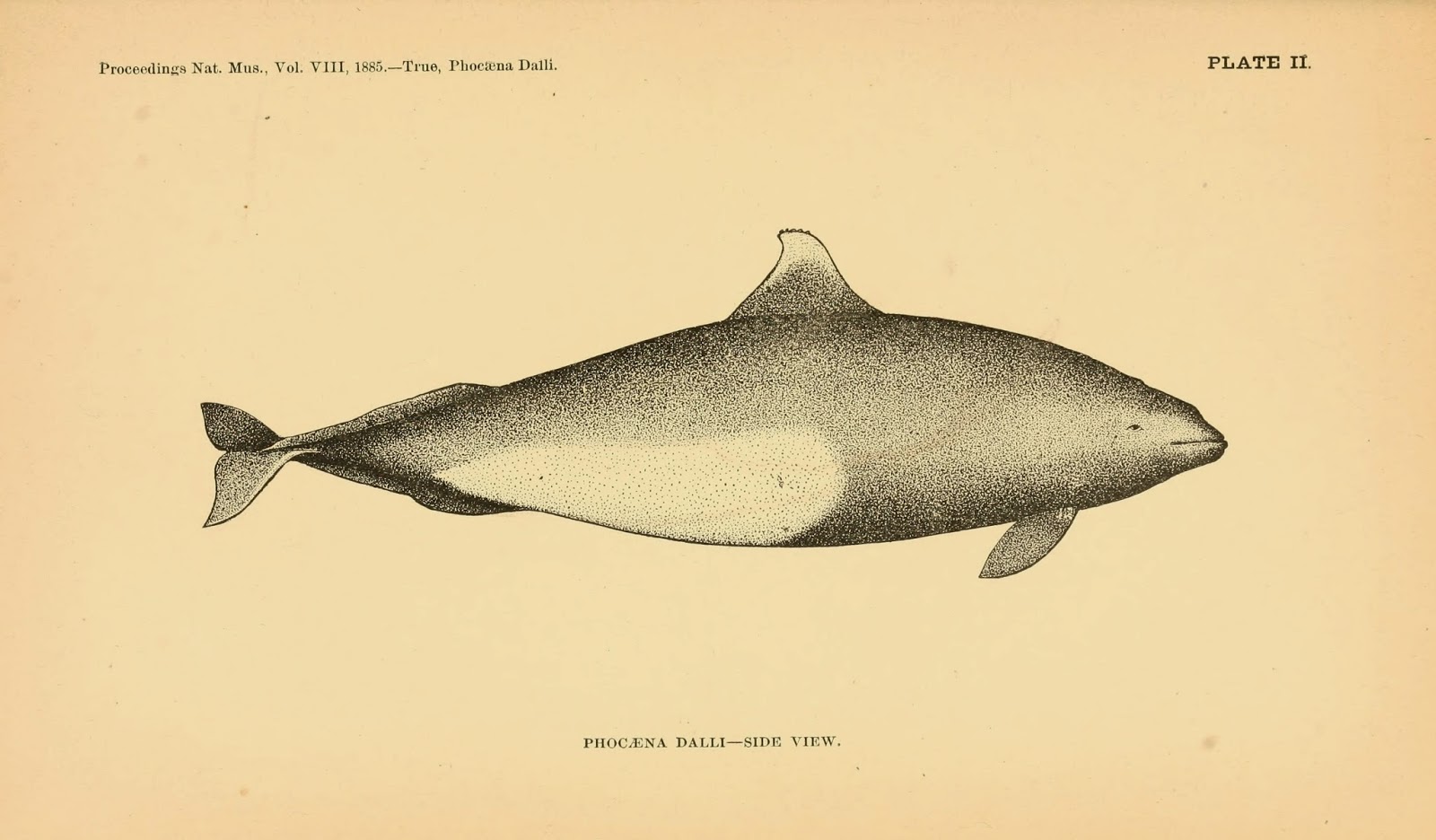
True capitalized on Baird’s support by expanding collecting efforts, both opportunistically as part of industries and fisheries, and with more dedicated expeditions with specific curators at USNM. For example, the Smithsonian’s involvement with the Western Union Telegraph Expedition to Alaska in 1865 brought William H. Dall, a paleontologist who later would work for both the U.S. Geological Survey and the Smithsonian, into the collaborative fold. As a tribute to Dall’s impact, True named Dall’s porpoise, Phocaena dalli (now Phocoenoides dalli) in 1885 based on a description, drawings and specimen collected by Dall in Alaska. Unfortunately, this specimen was initially shipped to the Army Medical Museum by mistake, where rats chewed up the postcranial elements. (The skull is now all that is now left of the holotype specimen).

View Full Size Image
Dall’s porpoise (Phocoenoides dalli). Proceedings of the United States National Museum. v. 8 (1885). http://biodiversitylibrary.org/page/15383677.

In 1895, the U.S. Fish Commission called True back into service for a study on the Northern fur seal industry in the Pribilof Islands, off Alaska. The Commission, lacking confidence in the local Russian naturalist’s conclusion about sustainable yield of fur seal skins from the islands’ rookeries, launched their own investigations. True, as he would in other field expeditions, brought along his father-in-law, D. W. Prentiss, as well as one of his chief preparators, William H. Palmer, who collected specimens while there. (Palmer would also later collect Miocene fossil marine mammals for True in Calvert County, Maryland). En route to the Pribilofs, the team dropped off another Smithsonian curator, Leonhard Stejneger, at the Commander Islands, near the Kamchatka Peninsula of modern-day Russia. Stejneger, who slightly preceded True, collected many marine mammals as well, including a beaked whale specimen that True named for him, Mesoplodon stejnegeri. True’s report on their work at the Pribilofs offered novel conservation strategies for the population, although he viewed a ban on pelagic sealing as the only effective strategy.

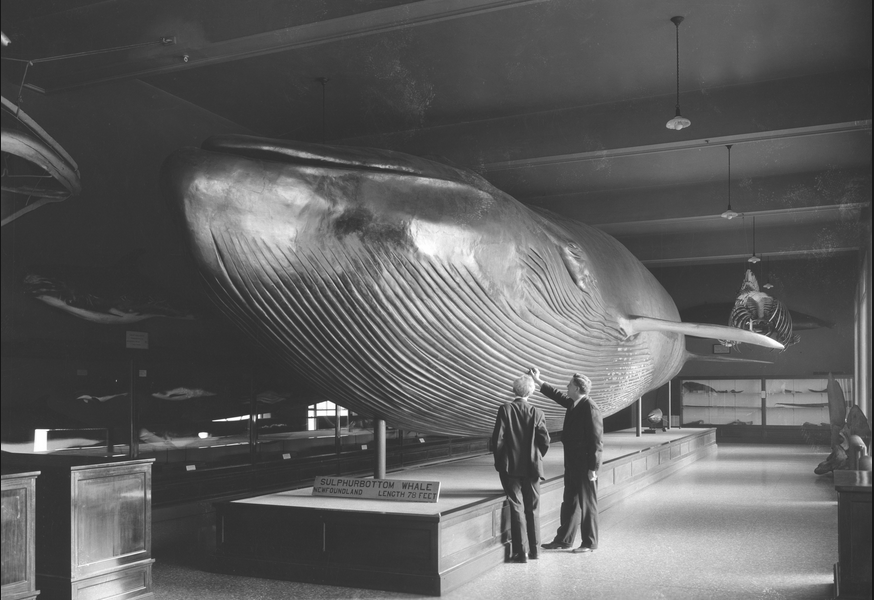
In 1899, True travelled to Newfoundland where a shore based whaling operation had been started by the Cabot Whaling Company at Snooks Arm in Notre Dame Bay. True joined the crew on the steam powered ships as they harpooned and returned to the station fin whales, as well as a smaller number of humpbacks. True observed and photographed the whaling operation, but also participated in crew activities, even including manning the harpoon on a successful fin whale hunt. As whales were flensed and processed, True availed himself of an opportunity to study the whale’s anatomy, especially at a second station that was opened at Balaena Station in Hermitage Bay, Newfoundland, in 1901. There, the primary target species were blue whales, which were too fast and too large for earlier fisheries to tackle. This operation offered an exciting new opportunity to study them, and generated important collections for the USNM, including a full plaster cast of one individual for the St. Louis Exposition of 1903.

View Full Size Image
Remington Kellogg and Leonhard Stejneger with the 1903 blue, or sulphur-bottom, whale, on exhibit in the Natural History Museum, c. 1930s. Image from Smithsonian Institution Archives.

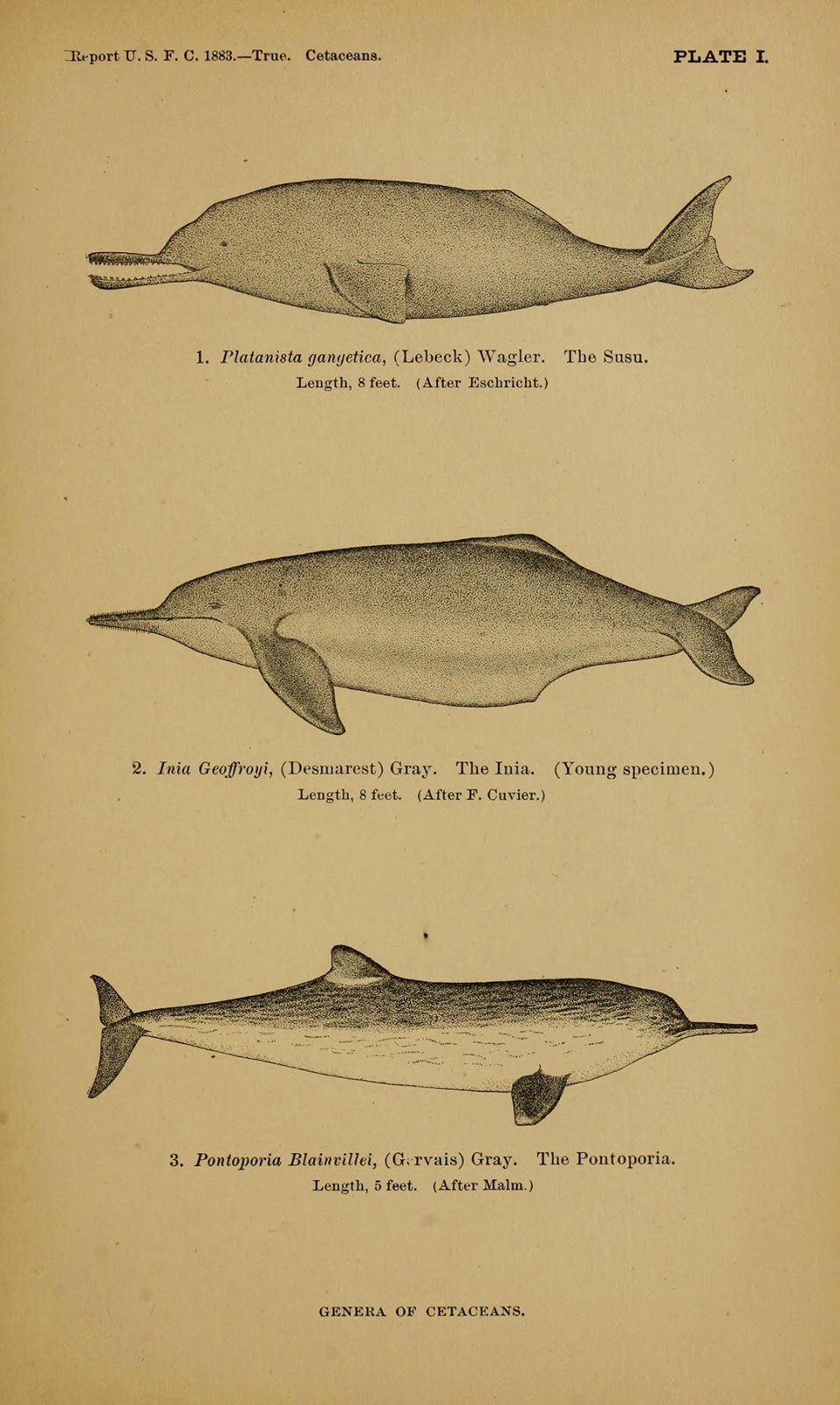
True’s ultimate contributions to marine mammal science were three profound monographs on Cetaceans. Grace Costantino provided a nice summary of his 1899 monograph on oceanic dolphins (A Review of the Family Delphinidae) at BHL’s blog last week. True’s lengthy Whalebone Whales of the Western North Atlantic in 1904 marked the first affirmative answer to whether baleen whales on opposite sides of the Atlantic constituted the same species and populations. To arrive at that conclusion, True provided the first extensive review of the validity of earlier descriptions of American whales by Scammon and Cope, an effort which relied on his own travels to other museum collections, and the rapidly growing one at his home institution (USNM). His 1910 work on beaked whales (An Account of the Beaked Whales of the Family Ziphiidae) similarly cleared up a mess of older taxonomic names for this enigmatic group of toothed whales, which have been a special strength of the Smithsonian since the time of Baird. In the past 100 years, many beaked whale species have been named after Smithsonian curators and other research associates, including: Baird’s beaked whale (Berardius bairdii), Stejneger’s beaked whale (Mesoplodon stejnegeri), True’s beaked whale (Mesoplodon mirus) and Perrin’s beaked whale (Mesoplodon perrini by emeritus curator of marine mammals James G. Mead). For his own contributions, True’s name is bestowed on the common names of two rodent species that he described and published on from Asia.

View Full Size Image
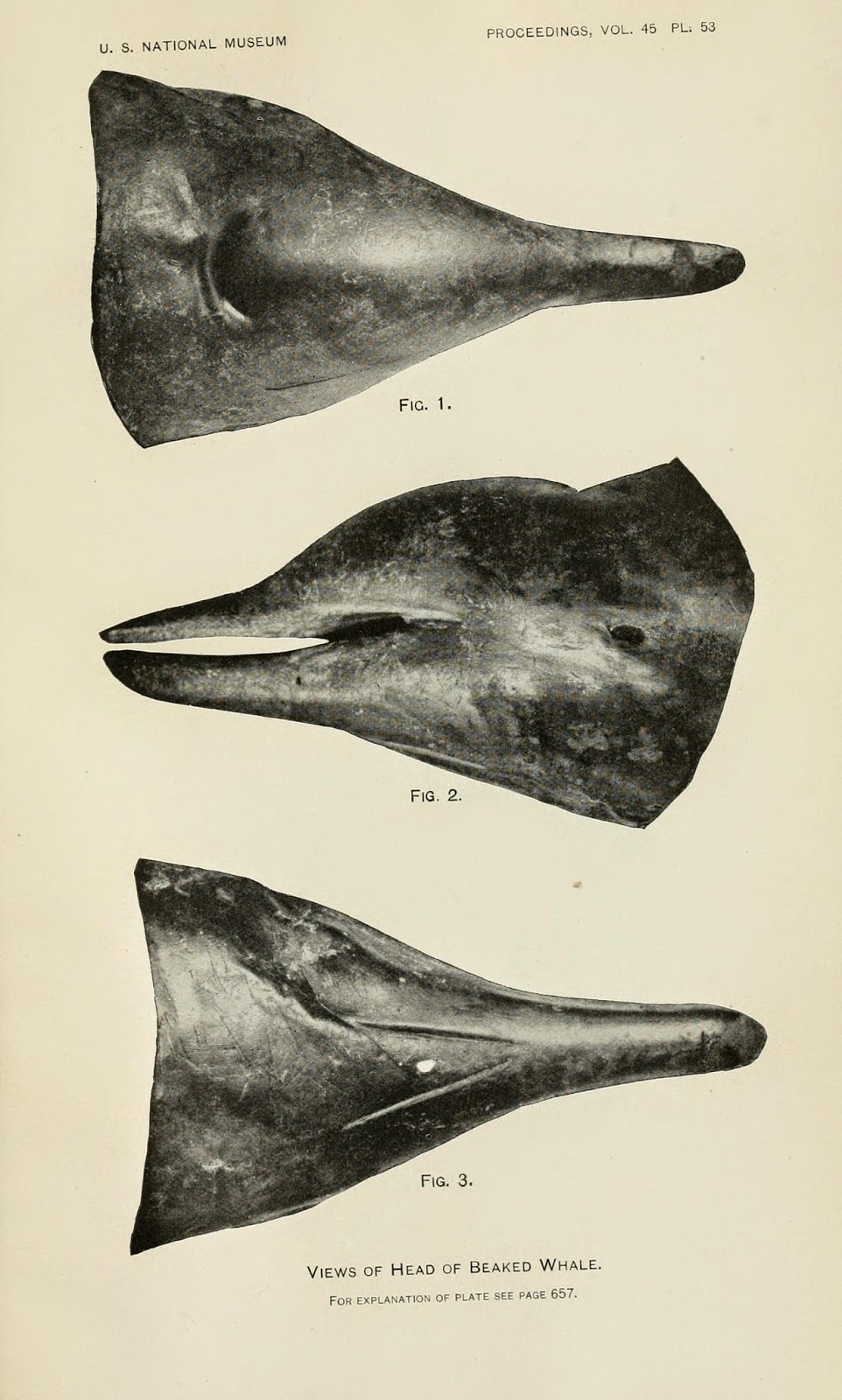
Head of True’s Beaked Whale (Mesoplodon mirus). Proceedings of the United States National Museum. v. 45 (1913). http://biodiversitylibrary.org/page/7307255.

In True’s entry for the Dictionary of American Biography, Alexander Wetmore (an ornithologist, Smithsonian curator, and the sixth Secretary of the Smithsonian) reflected that True was “profound as a student, and exact and punctilious as an administrative officer,” traits that no doubt served him well in his major capacities at USNM. By 1897, True was appointed head curator of the Department of Biology, with broad administrative direction over all biological work at USNM, and served as acting secretary of the entire institution for a short period of time that year. When the natural history collections of USNM moved across the National Mall to the newly built natural history building in 1910 (today, the main museum for NMNH), True became assistant secretary of the Smithsonian in charge of the library and of the international exchange service, a position that he occupied until his death in 1914.

February 13, 2015by ulib-libraryjobs

Help Support BHL

BHL's existence depends on the financial support of its patrons. Help us keep this free resource alive!

search

About BHL

The Biodiversity Heritage Library (BHL) is the world’s largest open access digital library for biodiversity literature and archives. BHL operates as a worldwide consortium of natural history, botanical, research, and national libraries working together to digitize the natural history literature held in their collections and make it freely available for open access as part of a global “biodiversity community.”

Join Our Mailing List

Sign up to receive the latest news, content highlights, and promotions.

Subscribe Now

Subscribe to Blog via Email

Enter your email address to subscribe to this blog and receive notifications of new posts by email.

Join 319 other subscribers

Subscribe to Blog Via RSS

Subscribe to the blog RSS feed to stay up-to-date on all the latest BHL posts.

Access RSS Feed

Inspiring Discovery through Free Access to Biodiversity Knowledge.

The Biodiversity Heritage Library makes it easier than ever for you to access the information you need to study and explore life on Earth…for free, anytime, anywhere.


64+ Million Pages of
Biodiversity Literature Online.

EXPLORE

Tools and Services
to Transform Research.

EXPLORE

300,000+
Illustrations on Flickr.

EXPLORE

ABOUT | HARMFUL CONTENT | PRIVACY | SITE MAP | TERMS OF USE