
Biodiversity Heritage Library - Program news and collection highlights from BHL
  • Home
  • News
  • Featured Books
    • All Featured Books
    • Book of the Month Series
    • BHL at 20
  • User Stories
  • Campaigns
    • Fossil Stories
    • Garden Stories
    • Monsters Are Real
    • Page Frights
    • Her Natural History
    • Earth Optimism 2020
  • Tech Blog
  • Visit BHL
Home
News
Featured Books
    All Featured Books
    Book of the Month Series
    BHL at 20
User Stories
Campaigns
    Fossil Stories
    Garden Stories
    Monsters Are Real
    Page Frights
    Her Natural History
    Earth Optimism 2020
Tech Blog
Visit BHL
  • Home
  • News
  • Featured Books
    • All Featured Books
    • Book of the Month Series
    • BHL at 20
  • User Stories
  • Campaigns
    • Fossil Stories
    • Garden Stories
    • Monsters Are Real
    • Page Frights
    • Her Natural History
    • Earth Optimism 2020
  • Tech Blog
  • Visit BHL
Biodiversity Heritage Library - Program news and collection highlights from BHL
Blog Reel, User Stories

Hidden Biodiversity: Exploring Neotropical Fungus Weevils With the Help of BHL

Leer en español

Photo of a lush tropical rainforest.

A view of the Panamanian tropical rainforest in Colón Province. Photo by Samanta Orellana.

In the last decades of the 19th century, a monumental publication on the biodiversity of Mexico and Central America began publication—Biologia Centrali-Americana. Published in 215 parts from 1879 to 1915 by the editors Frederick DuCane Godman and Osbert Salvin, the work describes over 50,000 species and is illustrated with over 1,600 lithographic plates depicting over 18,000 species. Remarkable for its time, the title is still vitally important for the study of Neotropical biodiversity today, as it contained virtually all known information at the time about Mexican and Central American flora and fauna.

Biologia Centrali-Americana is a particularly important resource for entomologist Samanta Orellana, a PhD student in evolutionary biology at the Dr. Nico Franz Lab of Arizona State University (ASU) and a research assistant in the ASU Biocollections of the Biodiversity Knowledge Integration Center. Orellana began studying insects and working with entomological collections more than a decade ago, during her undergraduate studies in her home country of Guatemala.

“For many insect groups in Guatemala and the rest of Central America, Biologia Centrali-Americana still represents the only source of information available for the region,” states Orellana.
A person with dark hair in a red vest and gray shirt standing in front of collection specimen drawers.

Samanta Orellana in the Arizona State University Biocollections. Photo by Kevin Cortés.

Biologia Centrali-Americana is also meaningful to Orellana because it led her to the Biodiversity Heritage Library (BHL). In 2010, whilst identifying Guatemalan insects as part of her undergraduate studies, Orellana started using the “Electronic Biologia Centrali-Americana,” available from the Smithsonian Libraries and Archives, which directed her to BHL. She hasn’t stopped using BHL since.

“BHL is simply wonderful,” lauds Orellana. “I think it is an amazing tool for entomologists all around the world, especially for those of us who work or have worked in collections in developing countries, usually without access to specialized libraries or journals, but with a lot of material to identify.”

A variety of weevils illustrated on a page.

One of the plates of Central American anthribids, included in the chapter written by Karl Jordan in the Biologia Centrali-Americana (Insecta. Coleoptera. v.4, pt.6, 1895-1907). Contributed in BHL from Smithsonian Libraries and Archives.

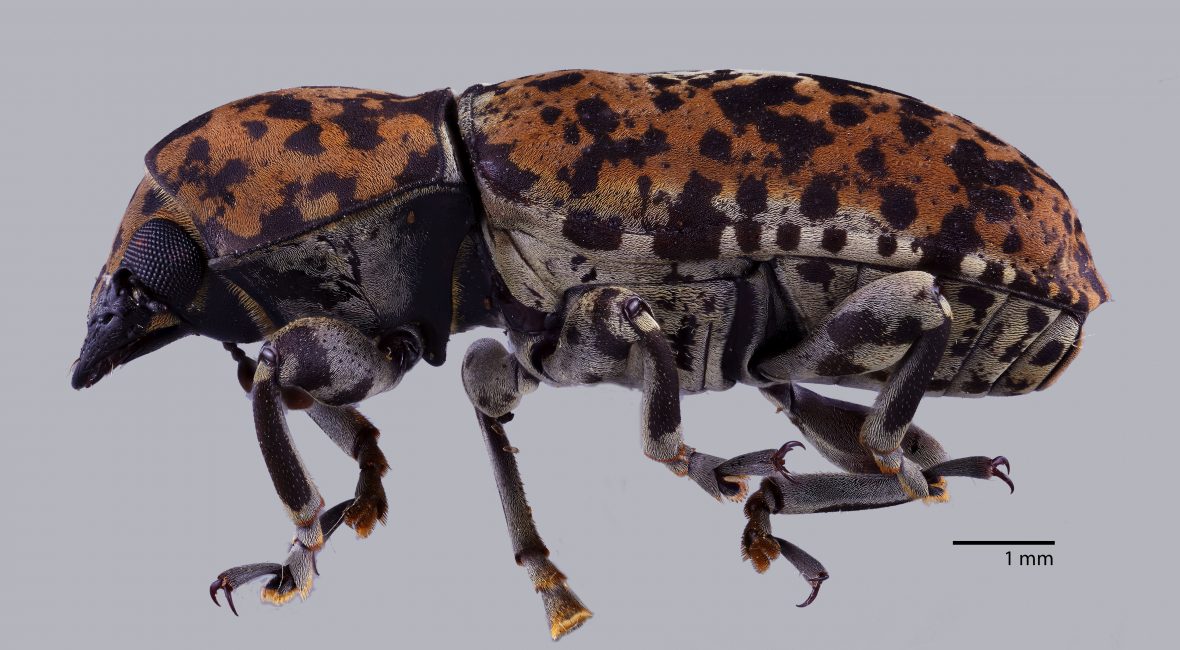
Orellana specializes in the family Anthribidae (Coleoptera), commonly known as fungus weevils. Her research on these insects began during her studies at the Universidad de Panamá, where she completed an M.Sc. in entomology, and continues through her PhD work, with her dissertation focused on the family’s diversity and evolution. As part of this research, Orellana recently published a catalogue of the Anthribidae species from Panama.

BHL’s collections have been instrumental in enabling Orellana to pursue her work on the family.

“BHL was essential to complete my first published work on Anthribidae, a catalogue of the species from Panama,” shares Orellana. “This group of weevils has been poorly studied in the Neotropics, so identifying specimens is always challenging due to the lack of taxonomic keys. I had to rely mostly on original descriptions available through BHL to identify the specimens I examined, both in Panamanian and American collections. The catalogue ended up with 44 new records for the country, most of them identified thanks to the literature available in BHL.”

A weevil with orange body and black spots.

Eugonus robustus Jordan, 1904 (Coleoptera: Anthribidae), from Panama. Photo by Samanta Orellana.

BHL has now become a core part of Orellana’s research process. She uses the Library at least several times a week, reading content online or downloading material via BHL’s custom PDF generator to build her own local collection of Anthribidae literature. Her favorite feature is BHL’s full text search service, which allows her to easily find scientific names or specific localities within sources.

“I use BHL all the time,” affirms Orellana. “I continue using it for my PhD studies to identify collection specimens, as taxonomy is an important component of my research with this group of weevils. I also maintain a website in Spanish about insects of Guatemala and constantly consult BHL to obtain and share information about the diversity of this group in my country.”

When asked what improvements she would like to see in BHL, Orellana replies, “This is a difficult question, because I love BHL so much. There is nothing I can think of that I would change. I can always find what I am looking for with the features already included on the website.”

Orellana’s experience testifies to the importance of open access for scientific research, whether you are a researcher working with limited resources or even if you have the benefit of a large, institutional library. For researchers everywhere, BHL’s collections offer free, easy access to centuries of scientific literature and sources that may otherwise have been inaccessible.

“Even now that I am working at a larger collection, and I have access to specialized literature, there are older works that can only be obtained through BHL,” confirms Orellana.

We are proud to know that BHL is empowering biodiversity research globally. As we face unprecedented biodiversity declines—with more than a million species threatened with extinction—immediate, online access to essential literature is ever-more important, allowing scientists to conduct research more quickly and efficiently and improving our ability to respond to today’s biodiversity crisis. We look forward to continuing to work with our global community of partners to ensure that researchers like Samanta Orellana have the resources they need to study and conserve biodiversity, from the smallest weevil to the largest sequoia and everything in between.

———————

Biodiversidad Oculta: Explorando los Gorgojos Neotropicales con la ayuda de BHL

Foto de una exuberante selva tropical.

Una vista del bosque tropical de Panamá en la Provincia de Colón. Fotografía por Samanta Orellana.

En las últimas décadas del siglo XIX, una publicación monumental acerca de la biodiversidad de México y Centroamérica inició su difusión –la Biología Centrali-Americana. Publicada en 215 partes de 1879 a 1915, por los editores Frederick DuCane Godman y Osbert Salvin, el trabajo describe más de 50,000 especies y está ilustrada con más de 1,600 láminas litográficas que contienen más de 18,000 especies. Muy notoria en su tiempo, la obra aún es sumamente importante para el estudio de la biodiversidad neotropical en la actualidad, ya que contiene prácticamente toda la información conocida, hasta el momento, acerca de la flora y fauna de México y Centroamérica.

La Biologia Centrali-Americana es un recurso particularmente importante para la entomóloga Samanta Orellana, estudiante de Doctorado en Biología Evolutiva, en el laboratorio del Dr. Nico Franz, en Arizona State University (ASU) y asistente de investigación en las Colecciones Biológicas del Centro de Integración para el Conocimiento de la Biodiversidad en ASU. Orellana empezó a estudiar insectos y a trabajar en colecciones entomológicas hace más de una década, durante sus estudios de pregrado en su país natal, Guatemala.

“Para muchos grupos de insectos de Guatemala y el resto de Centroamérica, la Biología Centrali-Americana aún representa la única fuente de información disponible en la región”, asegura Orellana.

Una persona de cabello oscuro con un chaleco rojo y una camisa gris de pie frente a los cajones de muestras de la colección.

Samanta Orellana en las Colecciones Biológicas de Arizona State University. Fotografía por Kevin Cortés.

La Biologia Centrali-Americana también es importante para Orellana, ya que la llevó a descubrirBiodiversity Heritage Library (BHL), que en español podría denominarse como “Biblioteca del Patrimonio de Biodiversidad”. En 2010, mientras identificaba insectos de Guatemala, como parte de sus estudios de pregrado, Orellana empezó a utilizar la versión electrónica de la Biología Centrali-Americana,disponible en el sitio de las Bibliotecas y Archivos del Instituto Smithsonian, lo cual la dirigió hacia BHL, y no ha dejado de usarla desde entonces.

“BHL es simplemente maravillosa”, asegura Orellana. “Pienso que es una herramienta increíble para los entomólogos alrededor del mundo, especialmente para aquellos que trabajamos en colecciones de países en vías de desarrollo, usualmente sin acceso a bibliotecas o revistas especializadas, pero con mucho material por identificar”.

Una variedad de gorgojos ilustrados en una página.

Una de las láminas de antríbidos de Centroamérica, incluidas en el capítulo escrito por Karl Jordan en la Biología Centrali-Americana (Insecta. Coleoptera. v.4, pt.6, 1895-1907). Compartido en BHL por las Bibliotecas y Archivos del Instituto Smithsonian.

Orellana se especializa en la familia Anthribidae (Coleoptera), comúnmente conocidos como “gorgojos de los hongos”. Sus investigaciones con estos insectos iniciaron durante sus estudios en la Universidad de Panamá, donde completó su maestría en entomología, y continúan durante su doctorado, con su tesis enfocada en la diversidad y evolución de la familia. Como parte de su investigación, Orellana recientemente publicó un catálogo de las especies de Anthribidae de Panamá.

Las colecciones de literatura de BHL han sido indispensables para permitir que Orellana trabaje con esta familia.

“BHL fue esencial para completar mi primer trabajo publicado acerca de Anthribidae, un catálogo de especies de Panamá”, comparte Orellana. “Este grupo de gorgojos ha sido pobremente estudiado en la región Neotropical, por lo que identificar las especies siempre es un reto debido a la falta de claves taxonómicas. Yo tuve que basarme mayormente en descripciones originales, disponibles en BHL, para identificar las especies que estudié, tanto en colecciones panameñas como norteamericanas. El catálogo finalizó 44 nuevos registros para el país, muchos de los cuales fue posible identificar gracias a la literatura disponible en BHL.”

Gorgojo de cuerpo anaranjado y manchas negras.

Eugonus robustus Jordan, 1904 (Coleoptera: Anthribidae), de Panamá. Fotografía por Samanta Orellana.

BHL se ha vuelto una parte esencial en el proceso de investigación de Orellana, ya que utiliza este recurso al menos varias veces por semana, leyendo el contenido en línea o descargando material, por medio del generador de archivos PDF de BHL, para construir su propia colección de literatura de Anthribidae. Su característica favorita de BHL es el servicio de búsqueda de texto, que le permite encontrar nombres científicos y localidades de una manera fácil dentro de los archivos disponibles.

“Uso BHL todo el tiempo”, afirma Orellana. “Durante mis estudios de doctorado, uso BHL constantemente para identificar especímenes de colecciones, ya que la taxonomía es un componente importante de mi investigación con este grupo de gorgojos. Como una actividad adicional, administro un sitio web enfocado en insectos de Guatemala, y consulto BHL constantemente para obtener y compartir información acerca de la diversidad de este grupo en mi país.”

Al consultarle acerca de las mejoras que le gustaría ver en BHL, Orellana responde, “Esta es una pregunta difícil, porque BHL me gusta demasiado. No puedo pensar en nada que me gustaría cambiar. Siempre puedo encontrar lo que estoy buscando con las características ya incluidas en el sitio web”.

Las experiencias de Orellana son un testimonio de la importancia de libre acceso a las investigaciones científicas, así sea para científicos trabajando con recursos limitados, o para aquellos que cuentan con acceso a bibliotecas institucionales. Para investigadores de todas partes, la colección de BHL ofrece acceso gratuito y fácil, a siglos de literatura y recursos científicos que, de otra manera, serían inaccesibles.

“Aún ahora, que me encuentro trabajando en una colección grande y tengo acceso a literatura especializada, existen trabajos muy antiguos a los que puedo acceder únicamente a través de BHL,” confirma Orellana.

Estamos orgullosos de saber que BHL empodera la investigación de biodiversidad a nivel global. Mientras nos enfrentamos a la desaparición sin precedentes de la biodiversidad —con más de un millón de especies amenazadas con la extinción— el acceso inmediato a literatura en línea es más importante que nunca, permitiendo que los científicos conduzcan sus investigaciones de una manera más rápida y eficiente, mejorando la habilidad de responder a la crisis de biodiversidad actual. Esperamos continuar trabajando con nuestra comunidad de socios para asegurar que los investigadores como Samanta Orellana tengan a la mano los recursos que necesitan para estudiar y conservar la biodiversidad, desde el gorgojo más pequeño a la secoya más grande.

April 6, 2021by michelle.underhill
Blog Reel, Featured Books

Two Hand-Painted Volumes of Coleoptera Illustrated by Francis du Boulay

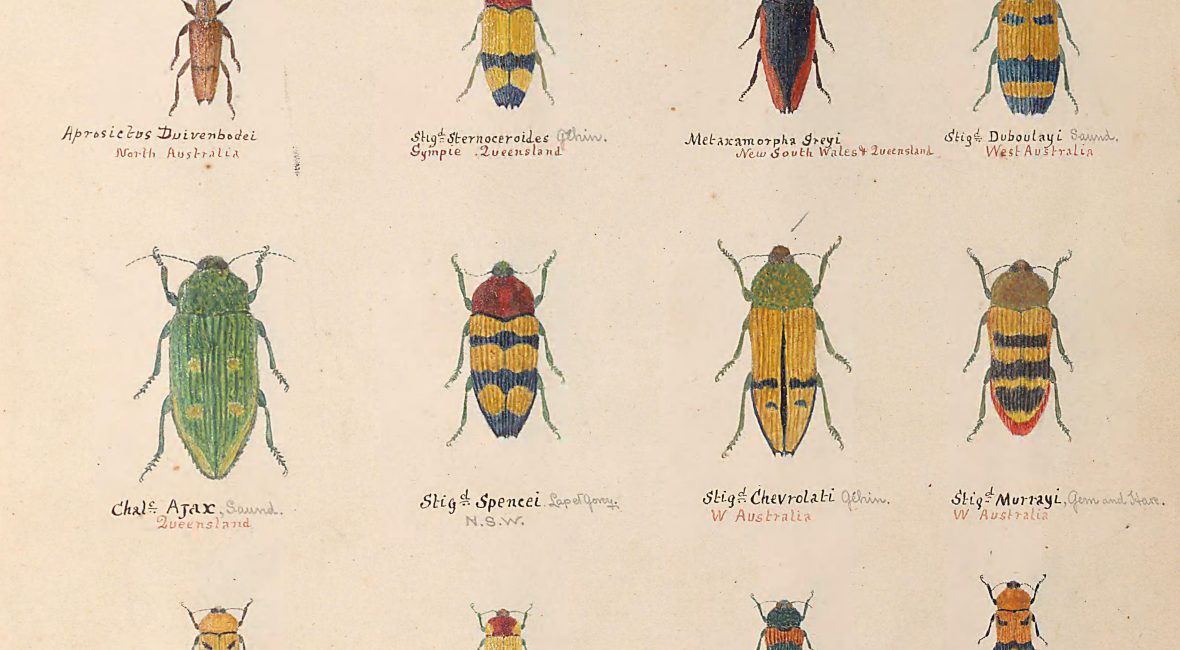
twelve colorful hand-drawn beetles

Seventh page of illustrations in volume one of a hand-painted volume of Coleoptera illustrated by Francis du Boulay, c.1880 – 1890 / Collection: OLDERSYSTEM~03048, Museums Victoria Archives / Source: Biodiversity Heritage Library.

Earlier this year Dr. Simon Leslie, Francis Houssemayne du Boulay’s great-grandson, contacted Melbourne Museum about accessing du Boulay’s hand-painted Coleoptera volumes, held in the Museums Victoria Archives. Dr. Leslie and family accessed the physical volumes in February 2020. While I carefully supervised flipping through the pages of these volumes, I was intrigued by their aesthetic, and scientific and historic, value. Since then, the volumes have been digitised by Biodiversity Heritage Library (BHL) Australia.

black and white portrait of a person with a short beard.

Portrait of Francis Houssemayne du Boulay, n.d. / Photographer: J. Fisher / Source: Accession number 2009.75, National Portrait Gallery, Australia.

Francis Houssemayne du Boulay was born in Sandgate, Kent, on 24 January 1837. As a young man in his early 20s, he migrated to Perth (c.1858). A scientist, entomologist, natural history artist, and Coleoptera (beetle) collector, du Boulay began to collect specimens in locations around Western Australia, Queensland, New South Wales, Victoria, and other parts of Australia. He settled in Beechworth, Victoria, where he lived out the rest of his life; du Boulay passed away on 12 January 1914.

In volume one of du Boulay’s hand-painted Coleoptera volumes, inside the front cover, is a handwritten inscription in ink, “F. H. Du Boulay 1880”. Du Boulay commenced work on the volume in 1880; however, it is likely that the work continued for several years. The cover also features a note handwritten in pencil, “Names in lead pencil inserted by H. M. Giles W. Australia (Du Boulay)”. Annotations inscribed in pencil are corrections by Henry Murray Giles, who assisted du Boulay in identifying scientific names of specimens. Giles worked as a Resident Keeper (1898) and later Head Keeper (1909 – 1910) at the Zoological Gardens, South Perth, Western Australia. Giles wrote an article in the Western Australian Year-Book for 1900-01 entitled “A Glimpse of Western Australian Entomology” (see pp. 285-297).

A total of 179 Coleoptera specimens are illustrated in volume one. Locations are noted where the specimens occur; however, the locations often only indicate the state where they were collected, for example New South Wales, Victoria, Queensland, Western Australia, South Australia; or a town or city, for example Cape York, Cardwell, Rockhampton, Brisbane. Some specimens identify the sex. It would be interesting to note if the colours used are scientifically accurate. Are the specimens drawn to scale? This would require the physical volume and specimens for comparison.

On the back of the volume is a sketch, in pencil, of a childlike illustration of a man, which is accompanied by an inscription, “W. Du Boulay”. This is an illustration of Francis du Boulay’s brother William, who was a fellow naturalist and collector. The yellow cover of the volume inscribed “DRAWING BOOK E. R. COLE BOOKSELLER AND STATIONER, SYDNEY” is well used, worn and has many inkblots. It has evidence of accompanying du Boulay in the field on his collecting trips around Australia.

Volume two is also well worn with inkblots on the cover. It has a leather-bound spine and leather corners protect the cover; otherwise the volume has no distinguishing features or title page. As in volume one, the specimen illustrations are printed, then hand coloured. Not all of the specimens are identified with their scientific names. The illustrations appear to be to scale. Specimens are illustrated from a dorsal perspective. Locations of where the specimens were collected are sometimes documented. Again as in volume one, the location is only noted from which state, for example, Queensland, Western Australia, Northern Territory, South Australia, New South Wales; or towns, cities, waterways or mountain ranges, for example Blue Mountains, Richmond River, Ropes Creek, Thompson River, Cairns, Coopers Creek, Cape York, Cooktown, Princess Charlotte Bay, Cleveland Bay, Port Mackay. The sex of the specimen is also sometimes identified.

six hand-drawn butterfly illustrations

Twelfth page of illustrations in volume two of a hand-painted volume of Coleoptera illustrated by Francis du Boulay, c.1880 – 1890 / Collection: OLDERSYSTEM~03048, Museums Victoria Archives / Source: Biodiversity Heritage Library.

While carefully presenting these volumes to Dr. Leslie, we were both surprised to come across several pages in the second volume containing beautiful Lepidoptera illustrations. Twenty-one Lepidoptera specimens are beautifully illustrated, but unfortunately do not include their scientific names or the locations where they were collected. Simon Hinkley, Collection Manager in Entomology at Museums Victoria, noted that the “Lepidoptera illustrated are detailed enough for identification purposes, for instance, the bottom left corner [see above] is a Caper White and the bottom middle specimen is a Spotted Jezebel.”

rough black ink line drawing of beetles

Fifteenth page, loose rough sketch and inscription by Professor Frederick McCoy, first director of the National Museum of Victoria, interleafed in volume two of a hand-painted volume of Coleoptera illustrated by Francis du Boulay, c.1880 – 1890 / Collection: OLDERSYSTEM~03048, Museums Victoria Archives / Source: Biodiversity Heritage Library.

Dr. Thomas Darragh, Curator Emeritus at Museums Victoria, identified the loose sheet of paper interleafed in volume two, see above, as Professor Frederick McCoy’s handwriting. McCoy was the first director of the National Museum of Victoria, predecessor of Museums Victoria (1854 – 1899). While not an entomologist, he was a paleontologist, geologist, zoologist, academic and keen collector for the National Museum of Victoria, and he was clearly interested in this volume, enough to incorporate a rough sketch of a “Phaneroptera (Serv)”. Simon Hinkley noted the Phaneroptera is an old genus name of katydids in the subfamily Phaneropterinae and was described by Jean Guillaume Audinet-Serville in 1831.

Volume two includes a loose letter with illustrations of beetles from “Mr. Span, Rooke’s Farm, West Drayton, Middlesex”. The letter includes illustrations of two specimens from North Queensland—one from New South Wales and one from the “Interior of Continent.” An inscription below the address on the letter, written in pencil, “Compared with British Mus. Specimens by Mr Span for Mr Du Boulay”, notes that specimens held by the British Museum have been compared with specimens collected by du Boulay. A few pages following the loose letter is a specimen that has been hand-drawn from the dorsal and cross section with inscription “Schizorhina Mnizechii Larry” (an unpublished name), and beside this is an inscription, “Drawings by Mr Span from originals in Brit. Museum”.

Some of the specimen illustrations in volume two include cross-sections of the heads and magnified studies of the legs. Volume two has a total of 220 Coleoptera and 21 Lepidoptera illustrations, compared to a total of 179 Coleoptera specimens illustrated in volume one.

The National Museum of Victoria purchased several Coleoptera specimens from Francis du Boulay and his brother William (1880-1912), such as the beautiful Castiarina erasma (Carter, 1935), Dilochrosis atripennis (Macleay, 1863), and Castiarina balteata (Saunders, 1869).

Du Boulay’s Coleoptera volumes are significant documents of historical collecting with important scientific information for contemporary scientists. Now that the volumes are available on the BHL website, scientists can benefit from the historical and scientific data on Coleoptera collected by Francis du Boulay from locations across Australia in the late nineteenth century.

September 24, 2020by Joel Richard

Help Support BHL

BHL's existence depends on the financial support of its patrons. Help us keep this free resource alive!

search

About BHL

The Biodiversity Heritage Library (BHL) is the world’s largest open access digital library for biodiversity literature and archives. BHL operates as a worldwide consortium of natural history, botanical, research, and national libraries working together to digitize the natural history literature held in their collections and make it freely available for open access as part of a global “biodiversity community.”

Follow BHL

  • Bluesky logo
  • Instagram logo
  • Facebook logo
  • Flickr logo
  • Twitter logo

Join Our Mailing List

Sign up to receive the latest news, content highlights, and promotions.

Subscribe Now

Subscribe to Blog via Email

Enter your email address to subscribe to this blog and receive notifications of new posts by email.

Join 319 other subscribers

Subscribe to Blog Via RSS

Subscribe to the blog RSS feed to stay up-to-date on all the latest BHL posts.

Access RSS Feed


64+ Million Pages of
Biodiversity Literature Online.

EXPLORE

Tools and Services
to Transform Research.

EXPLORE

300,000+
Illustrations on Flickr.

EXPLORE

ABOUT | HARMFUL CONTENT | PRIVACY | SITE MAP | TERMS OF USE