Biodiversity Heritage Library - Program news and collection highlights from BHL
  • Home
  • News
  • Featured Books
    • All Featured Books
    • Book of the Month Series
    • BHL at 20
  • User Stories
  • Campaigns
    • Fossil Stories
    • Garden Stories
    • Monsters Are Real
    • Page Frights
    • Her Natural History
    • Earth Optimism 2020
  • Tech Blog
  • Visit BHL
Home
News
Featured Books
    All Featured Books
    Book of the Month Series
    BHL at 20
User Stories
Campaigns
    Fossil Stories
    Garden Stories
    Monsters Are Real
    Page Frights
    Her Natural History
    Earth Optimism 2020
Tech Blog
Visit BHL
  • Home
  • News
  • Featured Books
    • All Featured Books
    • Book of the Month Series
    • BHL at 20
  • User Stories
  • Campaigns
    • Fossil Stories
    • Garden Stories
    • Monsters Are Real
    • Page Frights
    • Her Natural History
    • Earth Optimism 2020
  • Tech Blog
  • Visit BHL
Biodiversity Heritage Library - Program news and collection highlights from BHL
Blog Reel, Featured Books

Beyond Shells: The Birth of Malacology

Until the late 18th century, the study of mollusks was based largely on shells. Very little research or published information existed about molluscan anatomy and soft tissues. Giuseppe Saverio Poli, recognized by many as the father of malacology, changed this with his monumental publication, Testacea utriusque Siciliae eorumque historia et anatome (1791-1827).

Poli, born in 1746 in Molfetta, Italy, studied classics, theology, and natural sciences at the University of Padua. In 1774, he traveled to London during an appointment at the Royal Military Academy, where he met physician and collector William Hunter, who suggested that he study the mollusks of the Mediterranean.

View Full Size Image
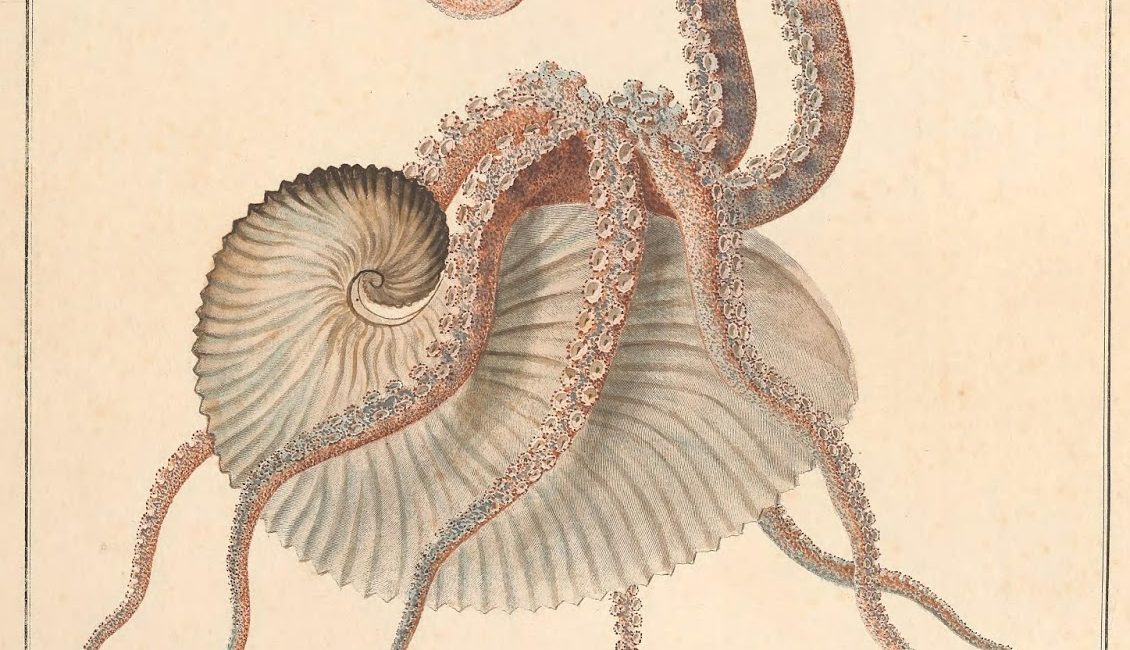
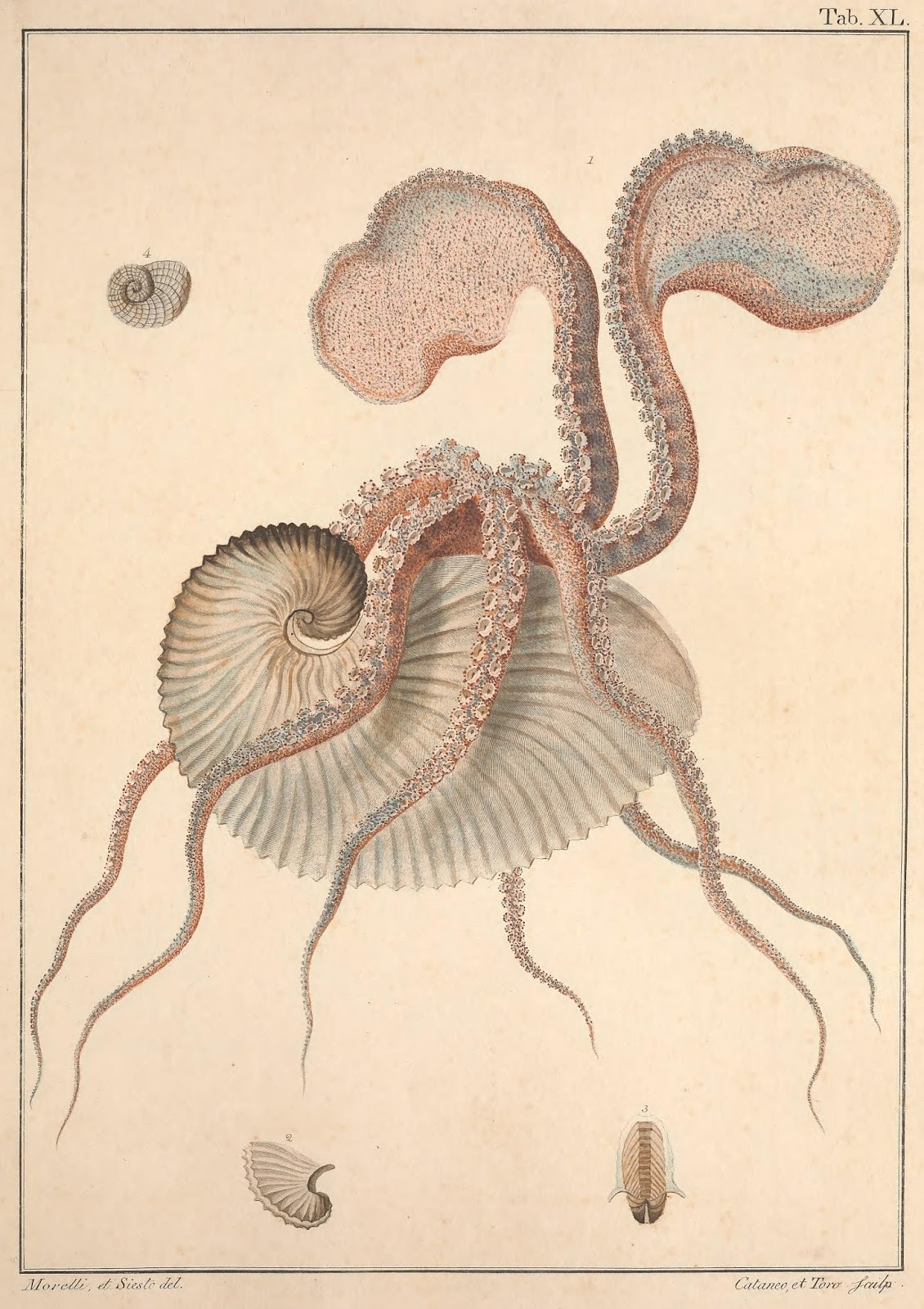
External morphology of a female paper nautilus (Argonauta argo) with egg case. Poli, Giuseppe Saverio. Testacea utriusque Siciliae. (1791-1827). http://biodiversitylibrary.org/page/44020354.

In the midst of a turbulent time in European history, with the outbreak of the Napoleonic wars at the beginning of the nineteenth century, Poli published his groundbreaking treatises on the comparative anatomy and classification of mollusks of Naples and Sicily, complete in three volumes under the title Testacea utriusque Siciliae eorumque historia et anatome. The first two volumes were published under Poli’s supervision in 1791 and 1795, but the outbreak of civil war in 1799 delayed the publication of the third, which was eventually published posthumously in two parts from 1826-27. The first part of volume three lists Poli as the author but provides annotations by Stefano Delle Chiaje, while the second part was authored by Delle Chiaje and describes the remaining species illustrated by Poli.

View Full Size Image
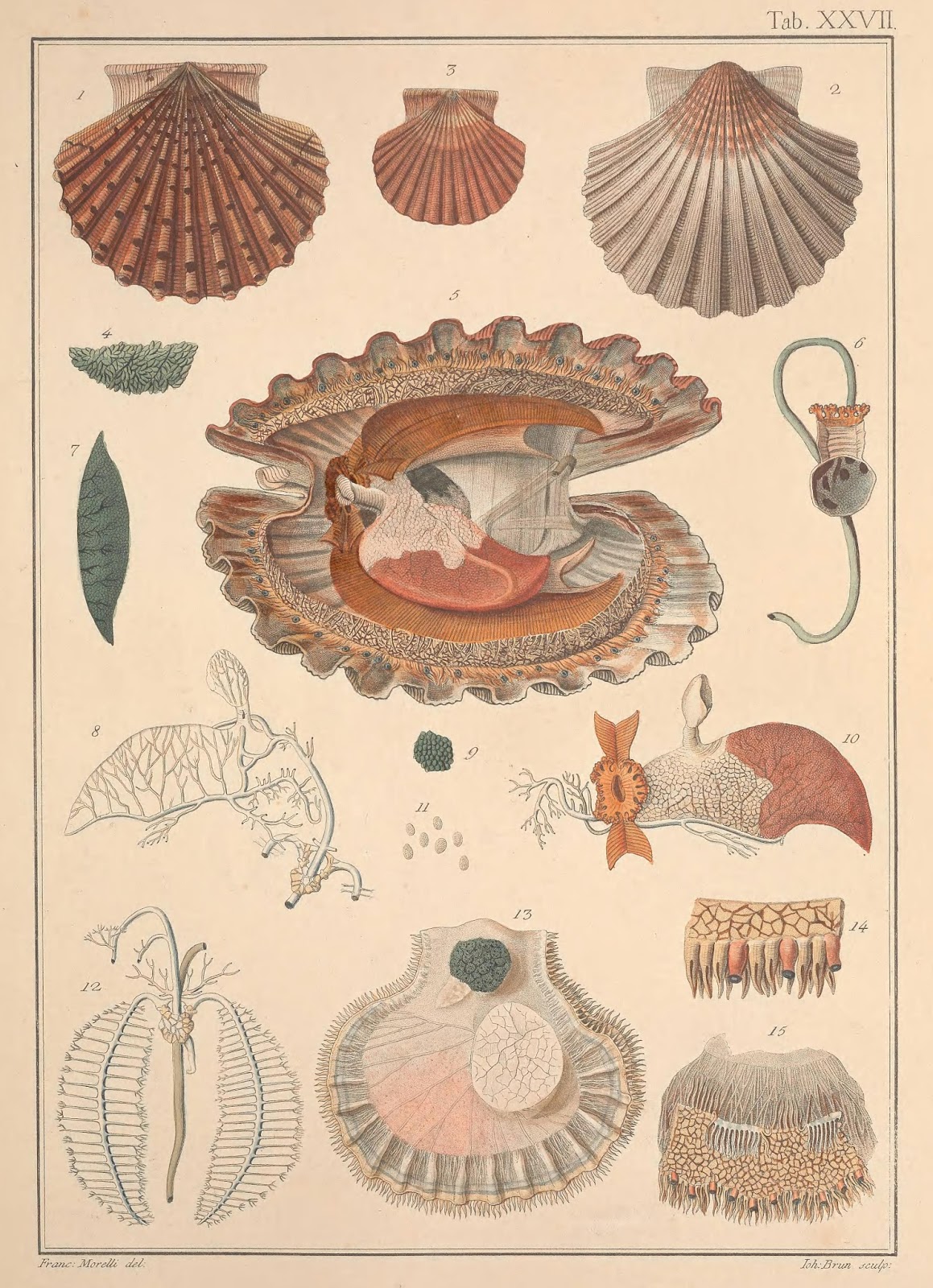
Shell morphology and internal and external anatomy of Mediterranean scallop (Pecten jacobaeus). Poli, Giuseppe Saverio. Testacea utriusque Siciliae. (1791-1827). http://biodiversitylibrary.org/page/44020302.

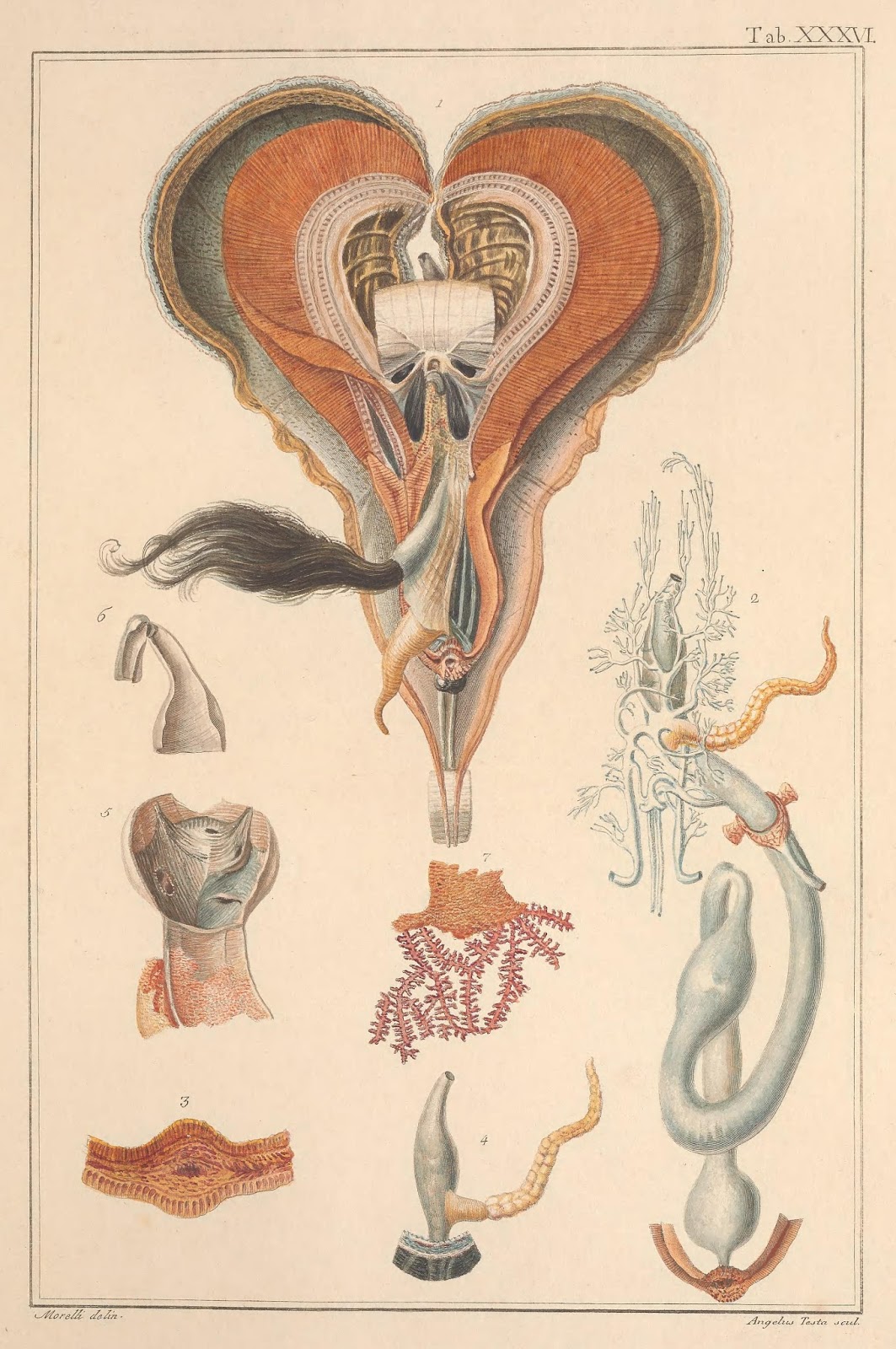
Testacea utriusque Siciliae is not only exquisitely illustrated with engraved colored plates featuring matching line-drawing versions with labels, but it also provided significant and novel insights about mollusks. While most of his contemporaries studied mollusks only through the lens of their shells, Poli recognized the importance of the information available in the soft tissues and documented molluscan morphology in great detail. Many of his observations were new to science; Poli was the first author to identify structures on the mantle edge of some bivalve mollusks as eyes.

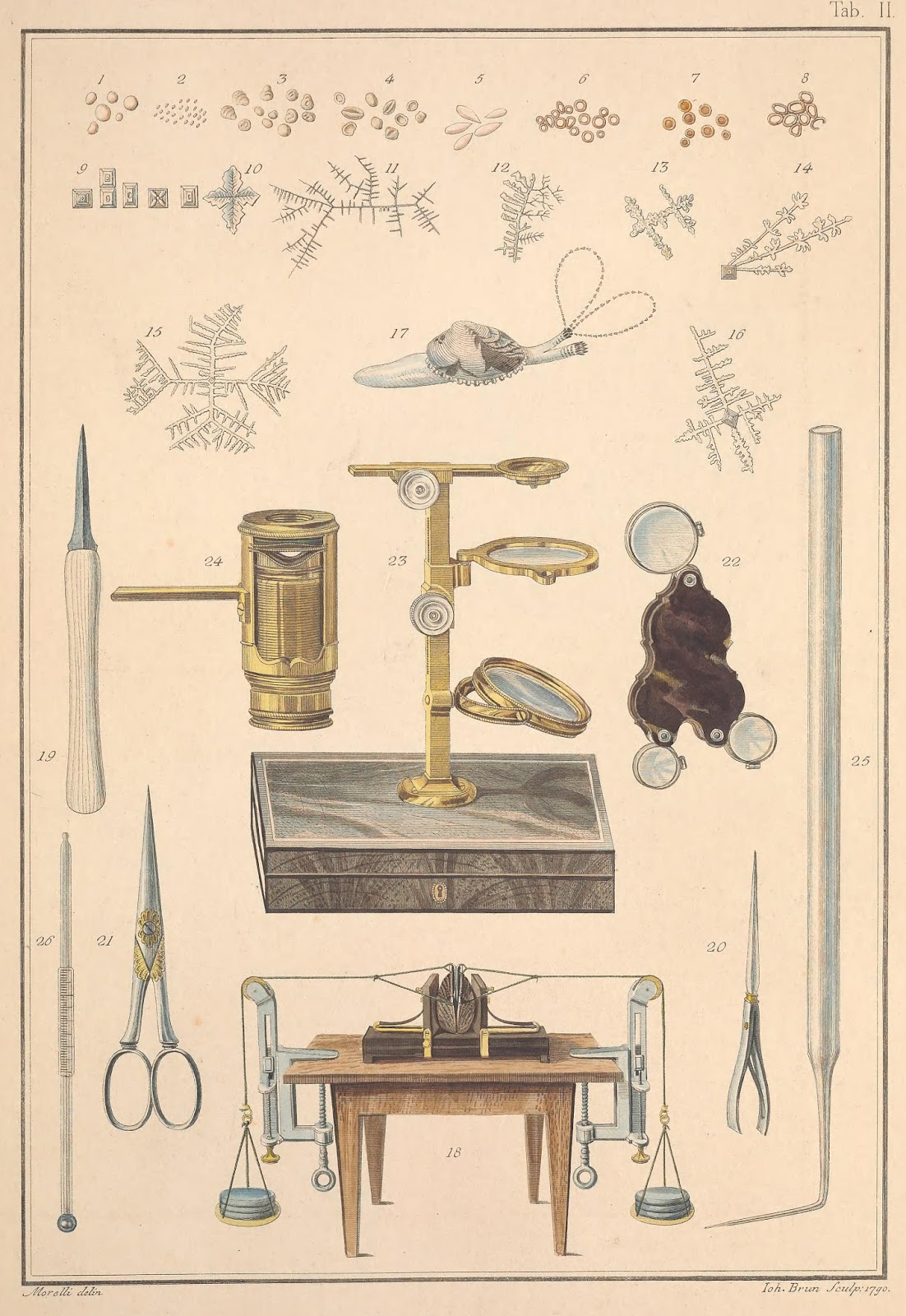
Testacea utriusque Siciliae was also the first treatise on molluscan biochemistry and physiology. A variety of tools, developed by Poli himself, were used to study reproduction and digestion, measure the contractile force of adductor muscles, trace blood flow and study blood composition, and describe the crystalline structure and chemical composition of shells in mollusks.

View Full Size Image
Instruments used by Poli, including dissecting tools, microscopes, and tools to measure the contractile force of adductor muscles in clams. Poli, Giuseppe Saverio. Testacea utriusque Siciliae. (1791-1827). http://biodiversitylibrary.org/page/44020202.

Finally, Testacea utriusque Siciliae was the first work to propose a classification system for mollusks based on soft anatomical characteristics. The predominant classification system of the day was based on the structure of the shells.

View Full Size Image
External morphology and dissections of the Mediterranean pen shell (Pinna nobilis). Poli, Giuseppe Saverio. Testacea utriusque Siciliae. (1791-1827). http://biodiversitylibrary.org/page/44020338.

In short, Testacea utriusque Siciliae established molluscan comparative anatomy as a distinct discipline, secured Poli’s position as the father of malacology, and provided an essential foundation for the work of future malacologists.

You can view this monumental publication for free in BHL, digitized by Smithsonian Libraries.

Information for this post based on the essay “At the Dawn of Malacology: The Salient and Silent Oeuvre of Giuseppe Saverio Poli” by Ilya Tëmkin from Natural Histories (2012).

August 20, 2015by michelle.underhill
Blog Reel, Featured Books

Death by Corset: A Nineteenth-Century Book about Fatal Women’s Fashions (and Animal Physiology)

Normally at the BHL we examine zoology-related books in our Book of the Week posts, but this week we’re entering new territory and taking a look at a comparative physiology book that examines the only species to mutilate its own body: Homo sapiens.

If you go by what J. L. Comstock, M.D., had to say in 1848 about what it was like to be a lady, times were difficult.  In this week’s book of the week, Outlines of Physiology, both Comparative and Human; in which are Described the Mechanical, Animal, Vital, and Sensorial Organs and Functions; Also, The Application of These Principles to Muscular Exercise, and Female Fashions and Deformities, Comstock explains that young women were under enormous pressure to be aesthetically pleasing to men (not a bad goal, he points out), and this pressure to look good by wearing a corset or stays was causing rampant deformities, illness, and even death: “. . .I have no doubt that the ladies themselves, to a considerable extent, will agree with me in believing, that hundreds, nay thousands, of females literally kill themselves every year by this fashion in our own country: and if suicide is a crime, how will such escape in the day of final account!” (311).

While he may have thought that women who died of tight-laced corsets were going to hell, he did sympathize with their goal to look beautiful for men: “what possible motive could have induced the females of the present age, and especially those of these United States (where ultraism in respect to this deformity [by corset] is carried to a much greater extent than in any other country). . .Can it be for the purpose of making themselves more agreeable, and more acceptable to the lords of creation?  Then certainly their motives ought to meet with the law of kindness, and the tortures through which they are willing to pass in order to arrive at perfection—the sympathy and commiseration of those for whom such perils are encountered” (321).
View Full Size Image

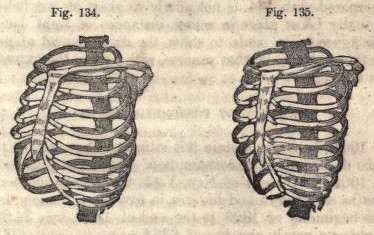
Comstock explains: “We have represented by figures 134 [normal skeleton] and 135 [deformed skeleton] the difference between a natural human skeleton, and one in which the pressure of stays has pushed the front ends of the ribs inward, bending the soft cartilages, so as to make them form acute angles outward” (311-312).  This results in the ribs pressing inward upon the lungs.
View Full Size Image

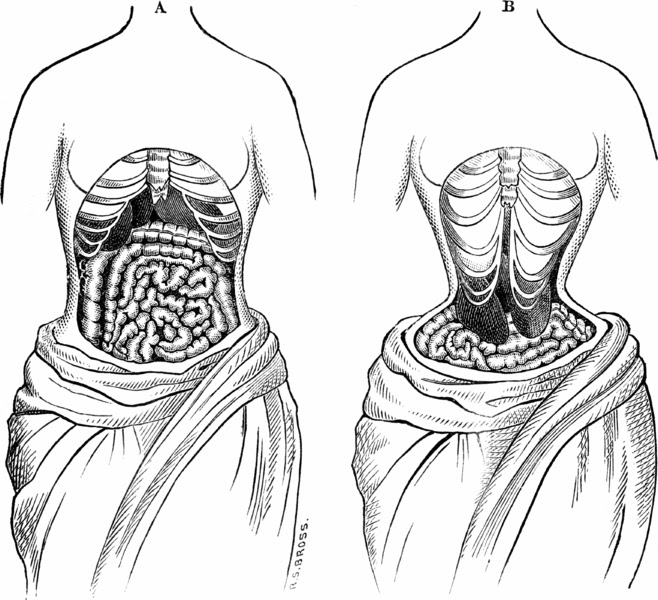
The force of a tight-laced corset upon the ribs caused them to create pressure not only upon the lungs, but also the other internal organs which undergo a shifting in position to accommodate for the new skeletal shape.  This illustration from 1884 represents the contemporary medical opinion about organ displacement due to corset wearing.

Ann Buermann Wass and Michelle Webb Fandrich, two fashion historians, describe what corsets looked like during Comstock’s period:

“By the 1840s, the line of women’s corsets extended to well below the waist. The corset of the 1840s and 1850s was boned throughout with whalebone and, as it had been in decades prior, outfitted with a metal, wood or whalebone busk at the center front. Commenting on the gradual lengthening of the corset in 1841, the Handbook of the Toilet noted that “[t]he modern stay extends not only over the bosom but also all over the abdomen and back down to the hips…they have been growing in length by degrees”. . .By this time, corsets had lost their shoulder straps and were most commonly fastened up the front with busk outfitted with clips and laced up the back to achieve a more precise fit.” (306)
View Full Size Image

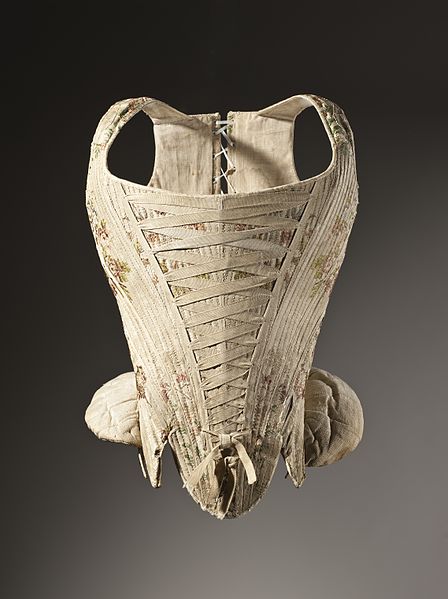
An early example of a stay, a type of corset with shoulder straps made of thick material.  This particular example is a woman’s corset from France, c. 1730-1740, made in a silk plain weave with supplementary weft-float patterning.  From the Los Angeles County Museum of Art.
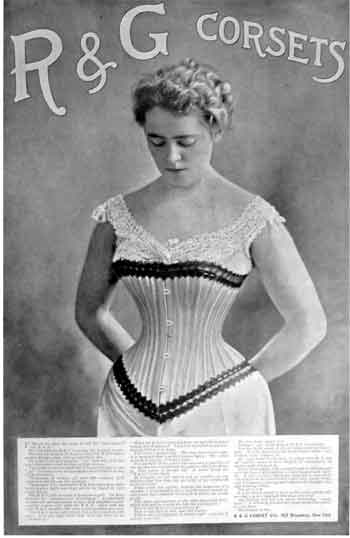
View Full Size Image

A corset ad from 1898 developed by Earnest Elmo Calkins for R & G Corset Company.  This corset represents the longer shape described by Wass and Fandrich.

The deformities caused by stays and corsets were a serious problem for Comstock, not only because they could result in death but because he believed that children born of corset-wearers were weak, small and sickly; this is owing to Comstock’s belief that corsets deplete the mother’s milk supply: “[the breasts of a corset- or stay-wearer] present a mere pretence, a nullity, a source of starvation, rather than one of sustenance, to the nascent beings, who are so unfortunate as to be thrown upon such cotton and wool resources of existence” (320-321).
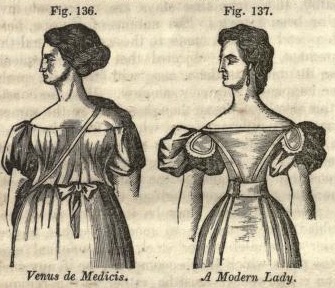
View Full Size Image

Figure 136 represents an ideal woman who does not wear a corset or stays and can thus produce breast milk and strong children.  Figure 137 represents the typical woman contemporary to Comstock who wears stays and thus cannot produce breast milk or healthy children, according to the M.D. (320).

And shoulder-baring dresses?  Ladies, forget about it!  Comstock notes that:

“the] cause of distorted shoulders. . .is the recent fashion of dressing so wide across the neck as to leave one, or perhaps both the acromion processes, or shoulder tips, in a state of entire nudity. . .The consequence of this fashion was, that, judging from the perpetual motion of [the shoulders], the wearer constantly felt as though her dress was in danger of slipping down, and which she made as constant efforts to prevent, or to ascertain by feeling with the shoulder whether this was the case, or not, until these motions became habitual, and therefore insensible. . .until [one shoulder] became permanently higher than the latter.” (296-7)

Comstock’s only hope to ending the serious deformities and risk for death caused by stays, corsets and fashionable clothing was that the country simpletons who didn’t know that corsets were fashionable would move to the city and literally create a new race of revitalized humans: “It is true that there are parts of our country where the practice of excessive lacing, and therefore its degenerating consequences do not exist; and whence we are happy to know that many of the daughters of unsophisticated nature are transplanted into our cities, there to become the fostering angels of a renovated species” (321).

While Comstock also explores similarities between human and animal physiologies in his book, a large part of his focus is on remedies for men and women to avoid illness.  Among Comstock’s recommendations for different forms of “exciting exercise” for adults and children to prevent illness are “field-sports,” angling, riding, calisthenics and archery—but also “cheerfulness” and “laughing” (239-266).
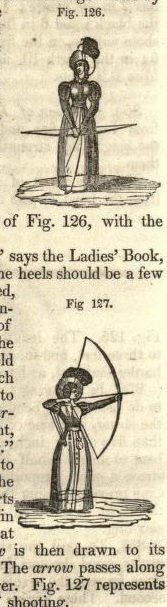
View Full Size Image

And ladies, while he doesn’t want you to wear a corset during your archery practice, don’t forget to wear your long-sleeve, floor-length gown with giant feathered hat (270).

If you are sitting at a desk right now while you read this, beware that you don’t become the lazy, deformed, lolling, school-girl type described by Comstock in his section on the evils of the seated posture:

“One posture which school-girls are exceedingly apt to take, is that of leaning forward, and placing the elbow on the desk for support; and this they often do, even when their seats are provided with backs.  This posture, if continued so as to form a habit, will often show its effects on all occasions, the young lady having such a disposition to lean, as to indulge it when any support happens to be near where she sits, let the place or company be what it may.  Such a one will lean, with the hand supporting the head, when at home, on a table, or window-stool, or any other convenient lolling-place, for hours together.” (294)
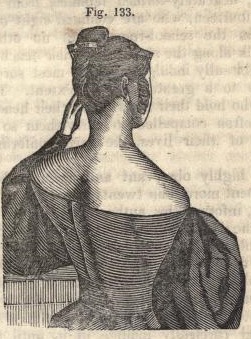
View Full Size Image

If you spend your time leaning with your head in your hand while sitting, you can look forward to deformed shoulder blades, according to Comstock, “one of which is sometimes thrown so far out of place as to give it the appearance of absolute dislocation” as in Figure 133 (294-295).

While Comstock’s pronouncements and prescriptions may seem amusing, corsets and stays presented a very real danger in the minds of many of his contemporaries.  Comstock’s descriptions of the physiological changes caused by corsets were sometimes accurate, such as his description of compressed lungs and organs, which resulted in difficulty breathing and could make recovery from any underlying illness harder.  Valerie Steele, a fashion historian, explains 19th-century beliefs about the dangers of corsets:

“The corset has been blamed for causing dozens of diseases, from cancer to curvature of the spine, deformities of the ribs and displacements of the internal organs, respiratory and circulatory diseases, birth defects, miscarriages, and “female complaints,” as well as medical traumas such as broken ribs and puncture wounds.  The Lancet, Britain’s most important medical journal, published more than an article a year from the late 1860s to the early 1890s on the medical dangers of tight-lacing.  Deaths from tight-lacing were also mentioned.  In one case, for example, the “heart was found to be so impeded in its action as to render life impracticable.” (67)

Today, corsets are still in fashion among people interested in recreating historical costume, and also among various different types of lingerie enthusiasts.  Regardless of one’s beliefs about the safety or practicality of corsets, they present a fascinating reflection of human beliefs about beauty and the ability to manipulate the human body.

References:

Comstock, J.L. Outlines of Physiology, both Comparative and Human; in which are Described the Mechanical, Animal, Vital, and Sensorial Organs and Functions; Also, The Application of These Principles to Muscular Exercise, and Female Fashions and Deformities.  New York: Pratt, Woodford & Company, 1898.

Steele, Valerie.  The Corset: A Cultural History.  New Haven, CT: Yale University Press, 2003.  p. 67.

Wass, Ann Buermann and Michelle Webb Fandrich.  Clothing through American History: The Federal Era through Antebellum, 1786-1860.  Santa Barbara, CA: Greenwood, 2010.  p. 306.

June 27, 2013by jjones
Blog Reel, Featured Books

Book of the Week: Shark Week Celebrates its 25th year!

This week, throngs of people who are amping up for Discovery Channel’s 25th annual Shark Week. This week long commemoration of all things sharks is aired in 72 countries watched by ~ 30 million viewers and is the longest running program event on cable. Every year schools of shark fans around the world countdown the days in anticipation for this late summer shark line-up and when it arrives they organize home-screening parties, play games, trivia, award prizes, shave their hair, get manicures and generally remain glued to their televisions marveling in the jawsome mystery and power of sharks.

What we here at the BHL love about this week of shark finaticism, is the remarkable thing that the Discovery Channel has done for shark conservation efforts. Over the course of 25 years, Discovery has significantly raised public awareness about declining shark populations by partnering with conservation organizations such as Oceana, Ocean Conservancy and The Pew Charitable Trust whose public service announcements are aired during prime-time commercial breaks, informing viewers about plummeting shark populations. Shark inspired mohawks and manicures aside, what the Discovery Network has really done is move public sentiment about sharks from a place of fear to a place of compassion. Moreover, they have successfully built a conservation army of shark lovers and enthusiasts. If every animal and organism on the planet had the same following that sharks have it would be a wonderful thing. We would all be a lot more knowledgeable about the earth’s biodiversity and the steep challenges that we face. Most importantly, we would know that there is still much work to be done.

Book of the Week: BHL’s selected homage to cartilaginous fishes aka Sharks

One hundred and fifty years ago, before twitter, television, and home-screening parties attended by folks in full shark regalia, there was a famous comparative anatomist cum ichythyologist named Johannes Müller who was also really into sharks. He may have expressed his fascination with sharks in a more traditional way by today’s standards, opting instead to publish one of the first comprehensive anatomical studies of sharks but, we think he would be tweeting it up if he was around today.

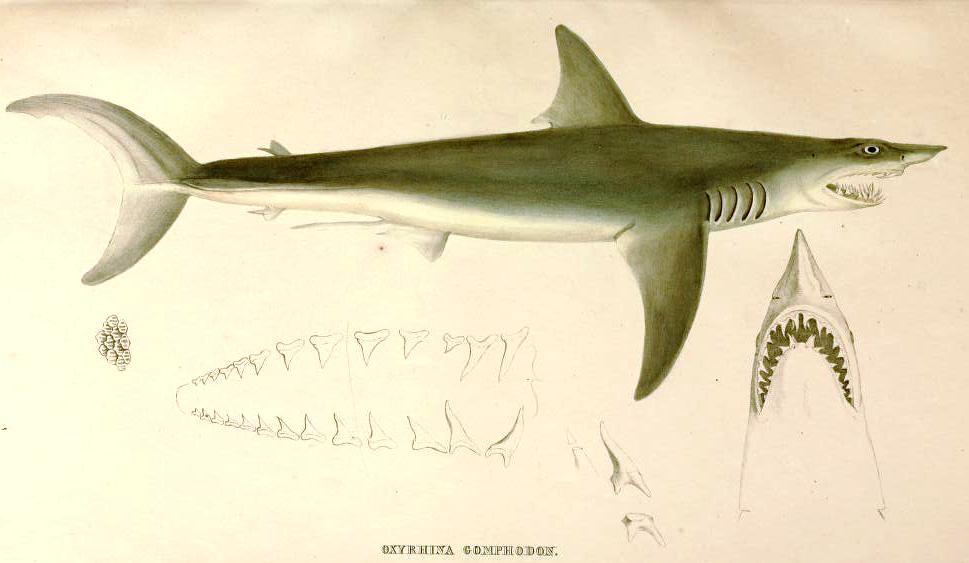
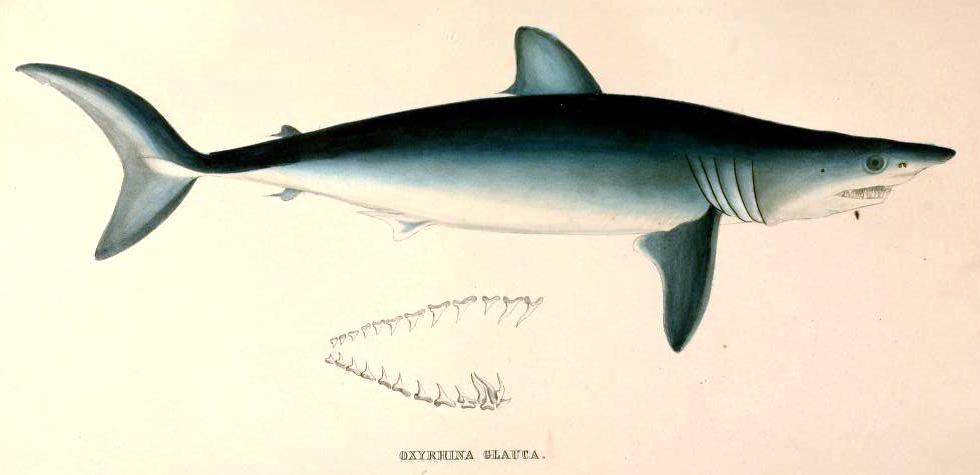
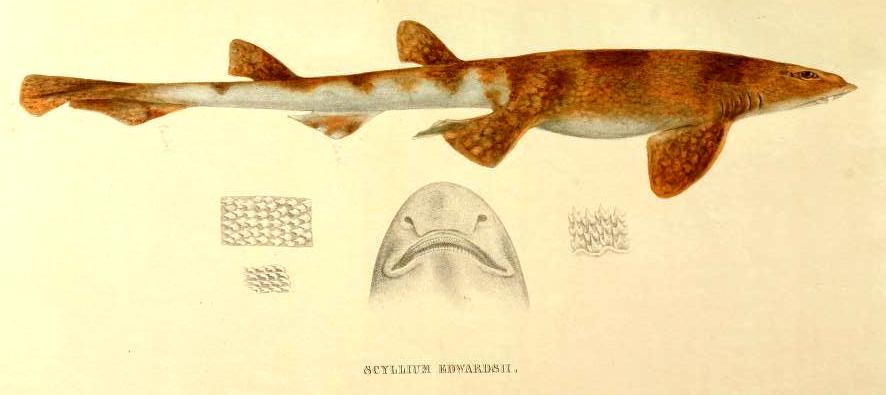
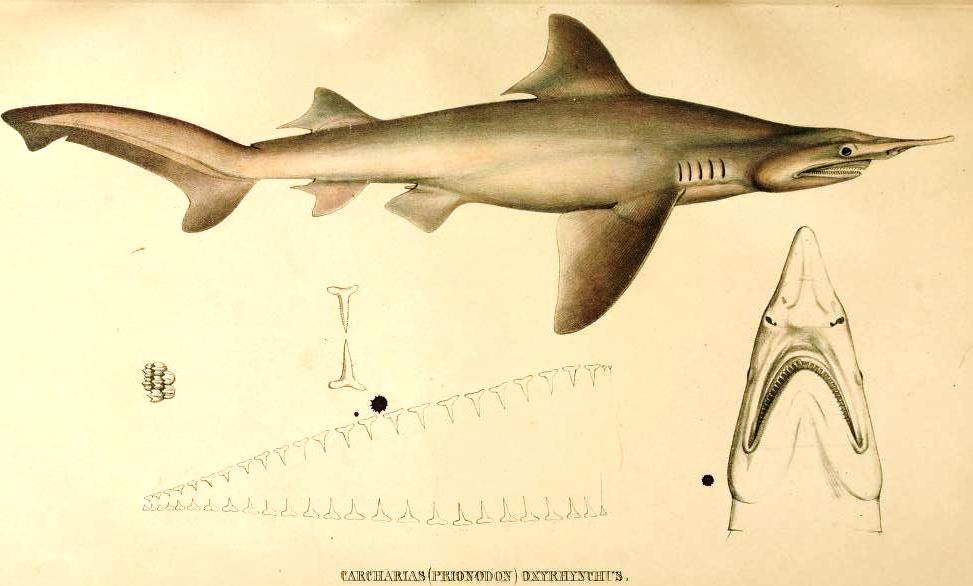
In his tome, Systematische Beschreibung der Plagiostomenor Systematic Description of Cartilaginous Fishes, Müller and his co-author Jakob Henle, provide anatomical descriptions of 214 Chondrichthyes (sharks, rays and skates). Their medical background in comparative anatomy helped to settle some taxonomic disputes about how certain species should be classified. For taxonomists, Müller asks that special attention be paid to the supplements and the detailed index of his book which guides you through his classificatory scheme. And naturally, one of the best parts of this week’s book of the week are the lovely plates provided in the text of some seriously jawsome sharks!

View Full Size Image

Want more sweet shark images? Check out the Biodivlibrary’s Flickr Stream and Pinterest Board!

We are unsure what the public perception of sharks was like in Müller’s day. Were people afraid of sharks? Did these creatures evoke blood-curdling fright and haunt them in their worst nightmares? Probably not. It was more likely that the average person never even saw a shark nor gave them much of a thought at all.Unfortunately for us, we have been subliminally programmed to be veryafraid of sharks. Movies like Jawsand over-sensationalized news stories about shark attacks have had the effect of damaging shark conservation efforts.The proof? According to a survey conducted in 2003 by the National Aquarium in Baltimore, Maryland “seventy percent of Americans surveyed […] believe that sharks are dangerous. 72 percent also believe that shark populations are just adequate or too high.”

Basically, more than half of the population seems to think that we don’t need to do anything to save sharks.This is a very dangerous sentiment indeed because the populations of these apex predators are on an alarming decline. Without sharks who will regulate the health of the ocean, chiefly coral reefs?  Sharks eat sick and diseased organisms, opening-up ocean habitats for healthy fish – in particular algae-grazing fish which act like coral vacuum cleaners.This video simulation created by the Nereus Program explains in detail how vital sharks are to reef eco-systems.

Seven Swell Facts about Sharks!

You are 15 times more likely to be struck by lightning than to be bit by a shark, and 89 times more likely to die of being struck by lightning than dying from a shark bite.  2/3 of a shark’s brain is dedicated to its sense of smell.In the 10 years between 1999 and 2009, there were 51 fatal shark attacks throughout the world. Annually, humans kill 79 million sharks. Now multiply that number by 10 years. And who’s afraid of whom again?

Sharks have seven senses compared to mammals that have five. What are the two extra that we don’t have: An electrical senseand pressure sensitive cells beneath the skin.

Of the millions of sharks killed annually, most of these deaths are a result of the high price for their fins to make shark fin soup. Fins go for $300 dollars a pound. The good news? States like California are banning the soup.

Some species of shark must keep swimming forward in order to breathe and therefore, are never stationary; they even swim while sleeping.
Some mother sharks can have parthenogenic births meaning that they can produce asexually. They are the Virgin Maries of the ocean.

Become a Shark Advocate

Convinced that sharks need your help? Here are some tangible things you can do to help shark conservation efforts:

  • Sign the “Save Sharks to Protect the Ocean” petition sponsored by the Pew Group
  • Stop eating Shark Fin soup with Yao Ming.
  • Adopt a shark
  • Eat sustainable seafood. Save sharks? Yeah, there’s an app for that. Download the Sustainable Seafood Guide on itunes.
  • Write in Scholarly Journals about declining shark populations. Get out there and collect that data!

Lastly, please educate yourself. Check out the iTunesU Shark collection that we put together that honors the power and mystery of these amazing creatures.

August 13, 2012by [email protected]

Help Support BHL

BHL's existence depends on the financial support of its patrons. Help us keep this free resource alive!

search

About BHL

The Biodiversity Heritage Library (BHL) is the world’s largest open access digital library for biodiversity literature and archives. BHL operates as a worldwide consortium of natural history, botanical, research, and national libraries working together to digitize the natural history literature held in their collections and make it freely available for open access as part of a global “biodiversity community.”

Join Our Mailing List

Sign up to receive the latest news, content highlights, and promotions.

Subscribe Now

Subscribe to Blog via Email

Enter your email address to subscribe to this blog and receive notifications of new posts by email.

Join 319 other subscribers

Subscribe to Blog Via RSS

Subscribe to the blog RSS feed to stay up-to-date on all the latest BHL posts.

Access RSS Feed

Inspiring Discovery through Free Access to Biodiversity Knowledge.

The Biodiversity Heritage Library makes it easier than ever for you to access the information you need to study and explore life on Earth…for free, anytime, anywhere.


64+ Million Pages of
Biodiversity Literature Online.

EXPLORE

Tools and Services
to Transform Research.

EXPLORE

300,000+
Illustrations on Flickr.

EXPLORE

ABOUT | HARMFUL CONTENT | PRIVACY | SITE MAP | TERMS OF USE