Biodiversity Heritage Library - Program news and collection highlights from BHL
  • Home
  • News
  • Featured Books
    • All Featured Books
    • Book of the Month Series
    • BHL at 20
  • User Stories
  • Campaigns
    • Fossil Stories
    • Garden Stories
    • Monsters Are Real
    • Page Frights
    • Her Natural History
    • Earth Optimism 2020
  • Tech Blog
  • Visit BHL
Home
News
Featured Books
    All Featured Books
    Book of the Month Series
    BHL at 20
User Stories
Campaigns
    Fossil Stories
    Garden Stories
    Monsters Are Real
    Page Frights
    Her Natural History
    Earth Optimism 2020
Tech Blog
Visit BHL
  • Home
  • News
  • Featured Books
    • All Featured Books
    • Book of the Month Series
    • BHL at 20
  • User Stories
  • Campaigns
    • Fossil Stories
    • Garden Stories
    • Monsters Are Real
    • Page Frights
    • Her Natural History
    • Earth Optimism 2020
  • Tech Blog
  • Visit BHL
Biodiversity Heritage Library - Program news and collection highlights from BHL
Blog Reel, Featured Books

Making the Best of Difficult Times: Accelerating the Transcription of William Brewster’s Writings During the COVID-19 Pandemic

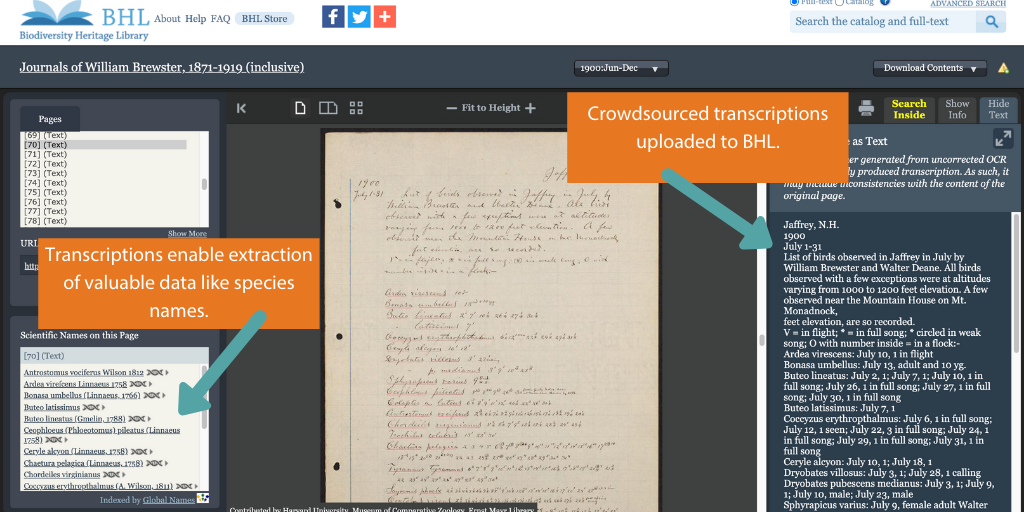
Screenshot of the BHL book viewer with crowdsourced transcriptions available for a handwritten journal.

This post is part of a series from the Ernst Mayr Library exploring the digitization and transcription of ornithologist William Brewster’s archival materials and the insights and scholarship made possible thanks to this work.

Many of us have searched for silver linings during the COVID-19 pandemic of 2020-2021. For many in the library and museum profession, one positive outcome of the mandatory transition to remote work has been the resurrection of some long-postponed projects. These are activities put on hold during normal times in deference to ever-proliferating, higher-priority onsite tasks. One such project in the Ernst Mayr Library and Archives (EMLA) of the Museum of Comparative Zoology (MCZ) at Harvard University is transcription of the digitized journals and diaries of William Brewster.

As discussed in Part One of this series, EMLA began digitization of its Brewster collection in 2012. In 2014, Library staff began transcription of Brewster’s digitized journals and diaries to produce a corpus of text files for the Purposeful Gaming and BHL project. As part of this project, EMLA was charged with leading an effort to select an appropriate open source transcription tool. At this time (early 2014), manuscript materials such as field notes and correspondence were beginning to appear in the Biodiversity Heritage Library (BHL) thanks to other grant-funded efforts among BHL members. Tools under consideration for Purposeful Gaming were thus also viewed as potential long-term transcription solutions for libraries contributing such materials to BHL.

After four months of research and testing, the grant partners selected DigiVol, a crowdsourcing transcription platform developed by the Australian Museum in collaboration with the Atlas of Living Australia, and EMLA staff set up a project space for the Library. One significant advantage of DigiVol is that it was developed specifically for the transcription of natural history materials such as specimen labels and field notes. Thus, there was the advantage of a pre-existing community of volunteers both interested in and adept at transcribing such items.

At the end of the Purposeful Gaming project (November 2015), volunteers and library staff had transcribed 12 volumes of Brewster’s journals and diaries, totaling 3,470 pages. That left 37,000 pages of Brewster’s writings in our collection awaiting transcription. Over the next four years, progress in the transcription work at EMLA was relatively slow at an average of 1,262 pages transcribed per year. During this time, EMLA had only a single, albeit enthusiastic, part-time library assistant who was able to dedicate one-third of her time or less to the project due to other higher-priority tasks.

On March 16, 2020, Harvard University staff began working remotely. Expecting a large influx of volunteers due to the quarantine in Australia, and anticipating an increase in staff availability at participating institutions, DigiVol administrators sent out a call for more materials to be uploaded for transcription. Working remotely, the author had the time available to regularly upload new volumes of Brewster’s diaries for transcription, respond to questions posted by volunteer transcribers, and validate completed transcriptions. Another EMLA staff member was able to offer several hours per week of her time as well. This was fortuitous as the volunteers were, indeed, ramping up their transcription activity, completing each diary volume in about two weeks time.

As the pandemic wore on, greater numbers of staff across the Harvard University library system were in need of work that could be done remotely. In response to this need, Harvard Library established a work share program whereby libraries in need of help could offer temporary assignments or projects to those in need of some additional work. By this time (September 2020), the volunteer transcribers were making so much progress that we were falling behind in the work of validating transcriptions. EMLA thus posted its project via the work share program, and we were fortunate to obtain the assistance of two library colleagues able to devote several hours each week to the work of transcription and validation.

With a total of 4 staff members and an average of 11 DigiVol volunteers (up from a previous average of 7) working on the project, more pages of Brewster’s writings were transcribed in 2020 than in any of the previous four years, as shown in the graphic below. There was a 242% increase in the number of pages transcribed over 2019, and a 165% increase over the average yearly number of pages transcribed from 2016 through 2019.
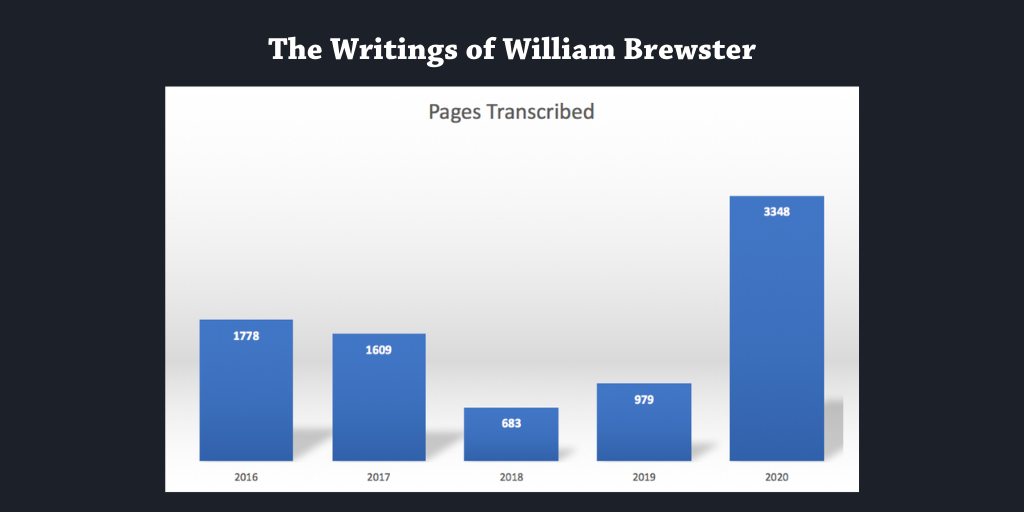
Bar graph showing number of pages transcribed per year, 2016-2020.

Number of pages transcribed per year, 2016-2020.

Transcriptions in the Biodiversity Heritage Library

The fruit of our transcribers’ labors began to materialize in 2018 when BHL developers introduced transcription import functionality to BHL. When member libraries began uploading transcribed pages of field notebooks and correspondence, the potential for access and discovery became readily apparent. Full-text indexing and searching of transcribed manuscript materials was now possible. For example, in researching the previous blog post about Robert Gilbert, the author was able to search for the name Gilbert in several transcribed volumes of Brewster’s journals. The result of such a search in Brewster’s 1898 journal is shown below.
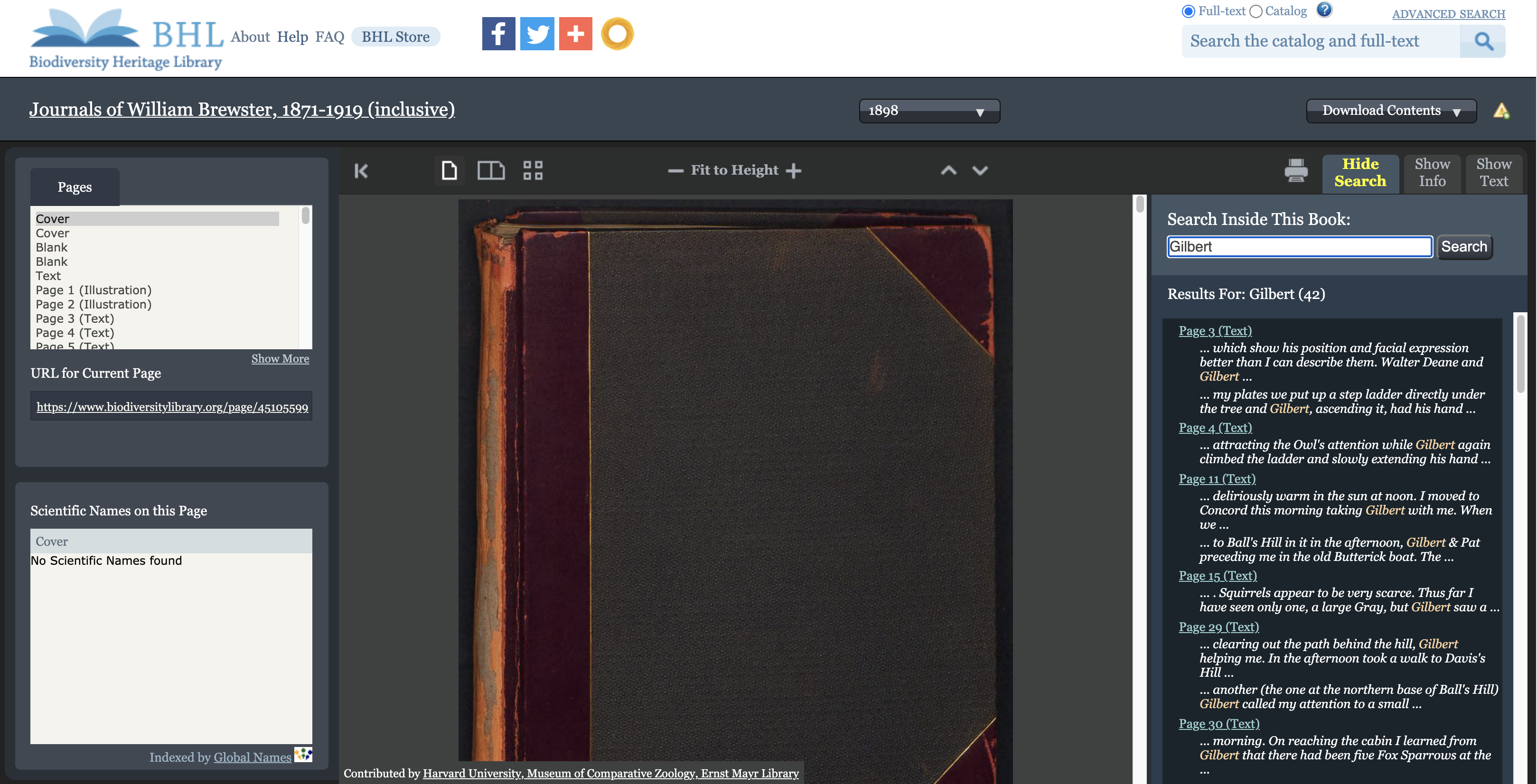
Screenshot of the BHL book viewer with full text search results for "Gilbert" displayed.

Searching for the name Gilbert in the 1898 volume of Brewster’s Journals retrieves 42 references to Robert Gilbert in this volume. The search results are shown in the right-hand panel of the BHL book viewer.

Like most field notebooks, Brewster’s diaries and journals are replete with scientific names. In order for these to be recognized by BHL’s name-finding utility, Global Names Architecture (GNA), they must be carefully transcribed. Transcription tutorials for the Brewster project in DigiVol ask that scientific names be given extra care, expanding abbreviations and correcting misspellings where possible. Our team of volunteers and staff have done an exquisite job of accurately transcribing scientific names, sometimes even doing research when unsure of the correct spelling of a name. Some of the transcribers so enjoy delving into Brewster’s world that they frequently research people, localities, or unfamiliar terms used in his writings as well.
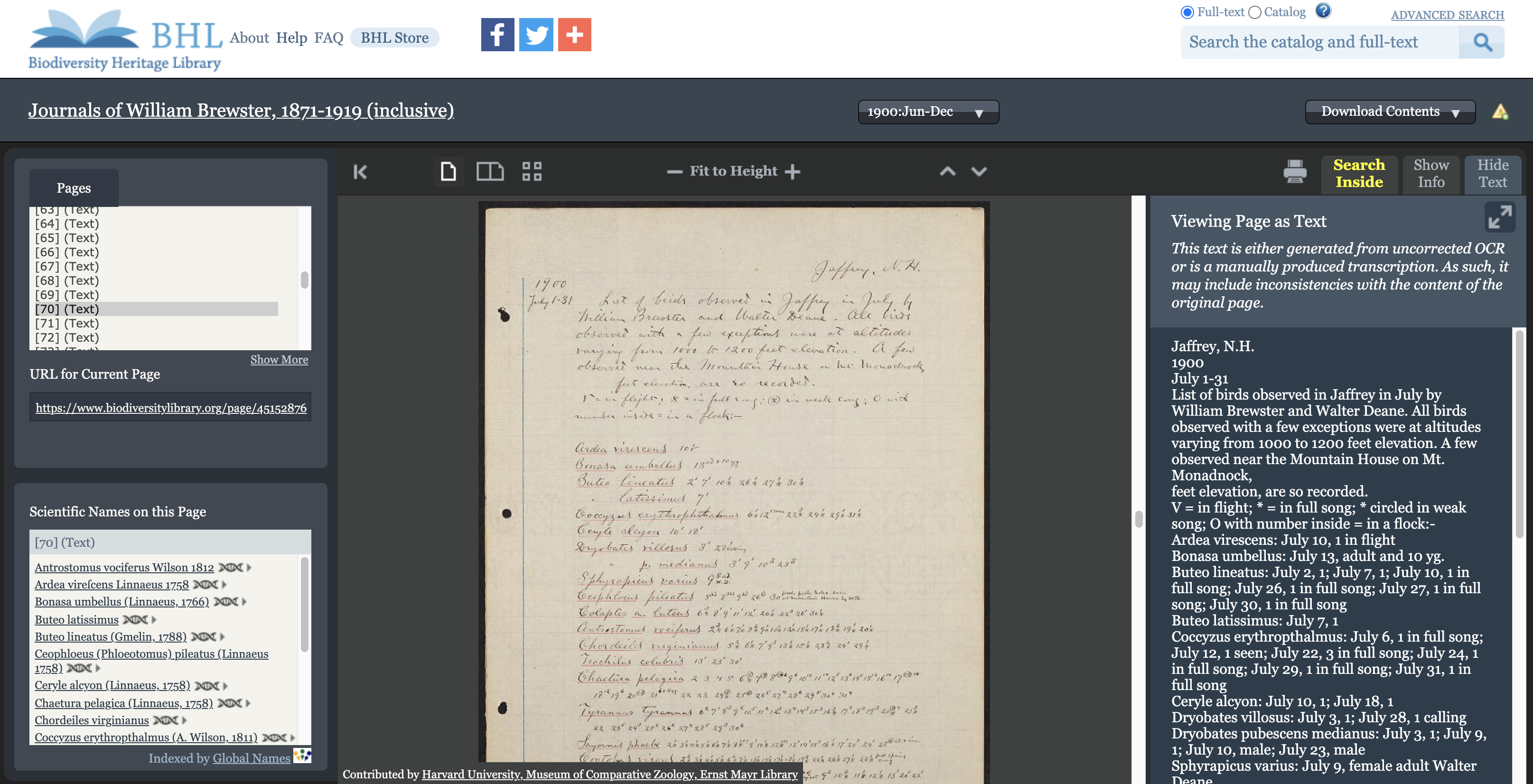
Screenshot of the BHL book viewer with scientific names found on the page.

A species observation list from Brewster’s 1900 Journal with transcription of species names and observations in the text panel on the right. Note the scientific names on the lower left, extracted from the transcription text by Global Names Architecture (GNA). Prior to addition of the transcription text, no names were found by GNA.

The end result is that the myriad of ornithological taxa mentioned in Brewster’s writings are being indexed in BHL. Thus a search across the full BHL repository for a specific taxon retrieves results from field notes and correspondence as well as the published literature. The resulting species bibliography will thus lead researchers to field observations, specimen collecting accounts, habitat and weather descriptions, and other content that may not be included in secondary sources.
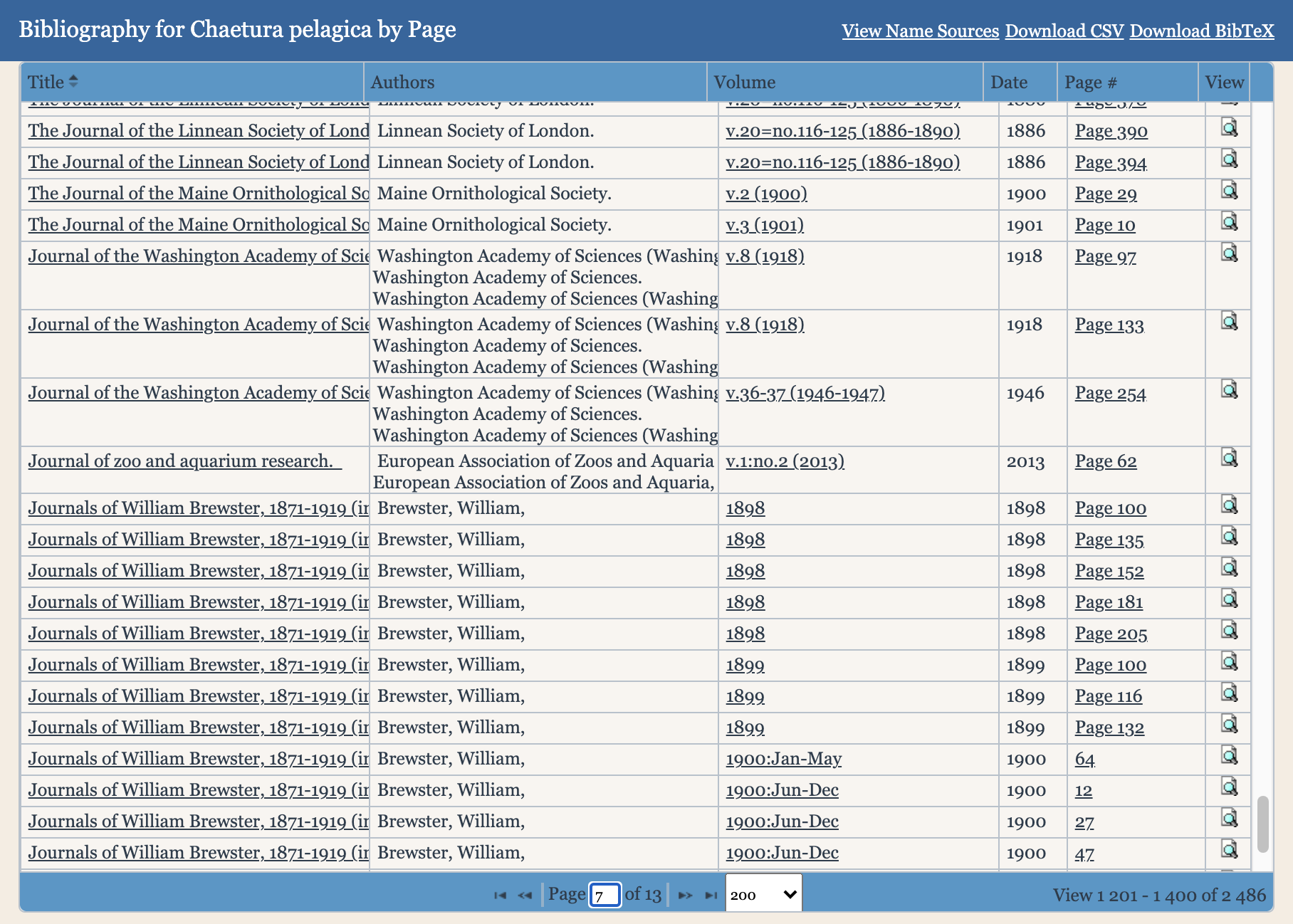
Screenshot of a species bibliography in BHL for Chaetura pelagica.

A search for Chaetura pelagica (Chimney Swift) across the full BHL repository retrieves instances of this taxon in Brewster’s transcribed Journals as well as the published literature.

Because of the hard work of our volunteer transcribers, full transcriptions of thousands of pages of Brewster’s diaries, journals, and correspondence are now being added to BHL, making this content available for text analysis, data mining, digital scholarship, and the creation of new information. Connections with similar collections in other institutions will likely be discovered as more primary source material is digitized and transcribed. Brewster’s meticulous record of species occurrences, habitat, landscape ecology, and weather can help in addressing the current climate and biodiversity crises. His record of historical events and his account of the work of Robert Gilbert might be used in social justice or other humanitarian research efforts. The staff of the EMLA are deeply indebted to the team of volunteers and our two Harvard Library colleagues who have given so much of their time and energy to help unlock the riches of the Brewster collection for the benefit of all.

If you would like to help transcribe Brewster’s writings, there is still plenty of work to do. We will soon complete his diaries and journals after which we will begin transcribing his extensive collection of correspondence. If you are interested, please visit our project page.
February 24, 2021by michelle.underhill
BHL News, Blog Reel

More than 250,000 Free Nature Images Now Available in the BHL Flickr

illustration of red flowers with green stems and leaves.

The most-viewed image in the BHL Flickr as of February 2021. Vincent, Henriette Antoinette. Études de fleurs et de fruits. c1820. Art by Vincent. Contributed in BHL from Chicago Botanic Garden, Lenhardt Library. Link in Flickr. Link in BHL.

Over a quarter of a million nature images are now freely available through the BHL Flickr!

Since 2011, we’ve been making many of the illustrations from BHL’s collection available via Flickr. While it has long been a community favorite amongst our audiences, in 2020 our Flickr’s popularity increased significantly when it received considerable media attention in outlets including Colossal, Laughing Squid, Český rozhlas, ZME Science, Cultura Inquieta, Hyperallergic, Graffica, Smithsonian Magazine, Open Culture, la Repubblica, Genbeta, My Modern Met (en Español), eCulture Greece, Daily Geek Show, Вокруг Света, Atlas Obscura, Shifter, Lifehacker, Indiehoy, Microsiervos, and Vice. As a result of this publicity in February 2020, we saw a 518% increase in daily views on Flickr images (2.5 million daily views compared to an average of 400,000) and an over 100% increase in visits and unique visitors to BHL. This popularity continued throughout the year, culminating in over 343 million views on images in 2020 alone—a 123% increase over 2019, bringing our all-time views to over 902 million!

Last year also offered a unique opportunity to substantially build our Flickr collection. With many of our partners working virtually in 2020 due to the COVID-19 pandemic, we focused on projects to improve our digital collections remotely. This work included uploading images to Flickr. In 2020, over 40 BHL partner staff and volunteers contributed to the upload of over 90,000 new images to Flickr—a nearly 200% increase in images uploaded compared to 2019.

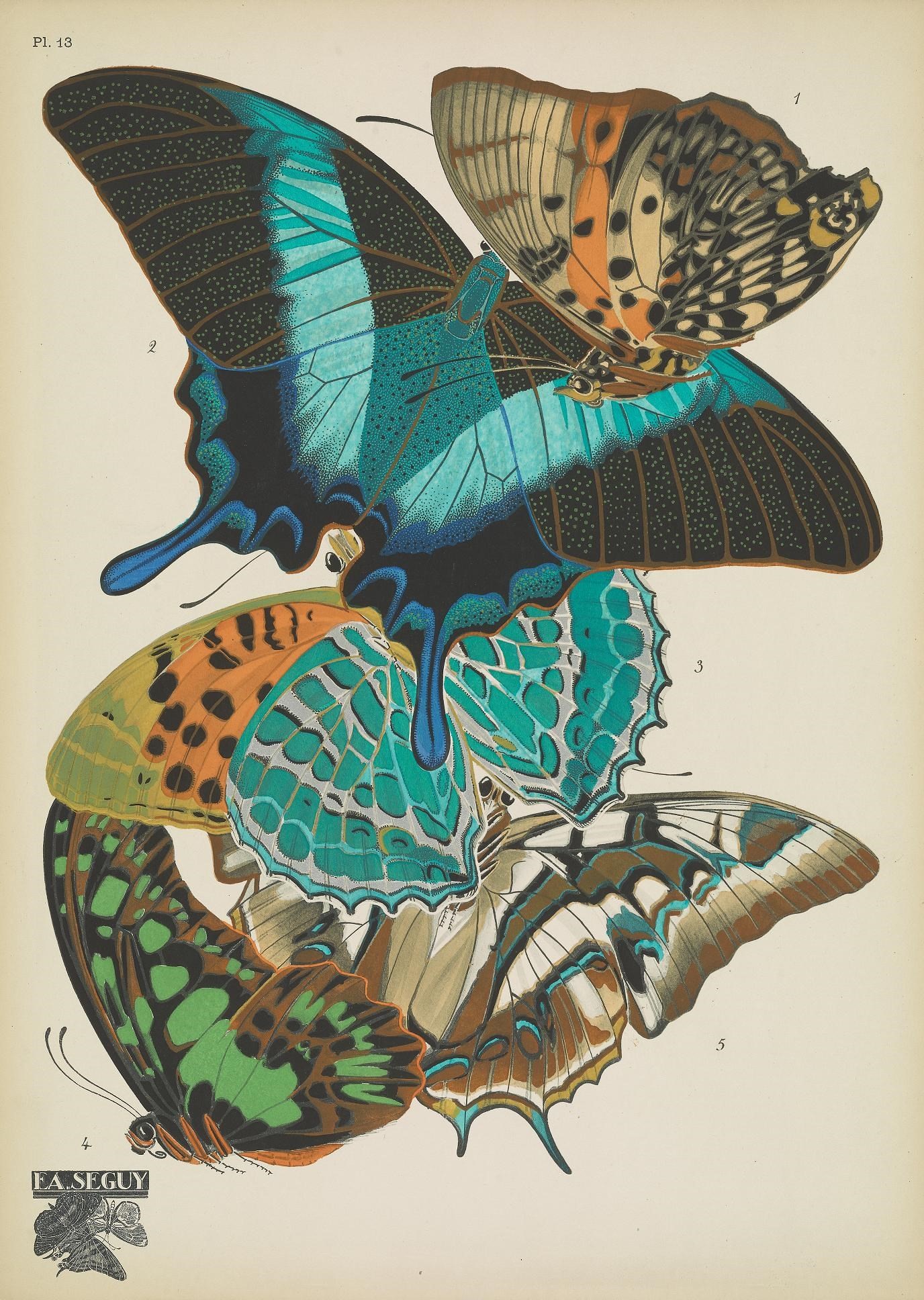
illustration of multiple butterflies positioned on top of one another.

The second most-viewed image in the BHL Flickr as of February 2021. Séguy, Emile-Allain. Papillons. 1925. Art by Séguy. Contributed in BHL from Smithsonian Libraries and Archives. Link in Flickr. Link in BHL.

Thanks to this impressive work, our Flickr collection now includes over 250,000 free images dating from the 16th-20th centuries and representing a range of biodiversity subjects, from plants and animals to fungi, microscopic organisms, and even artifacts like tools made from shells. All images in the BHL Flickr are free to browse, download, and reuse. You can learn more about reusing images from Flickr on the BHL About site.

This post features some of the most popular (by views) images in the BHL Flickr.

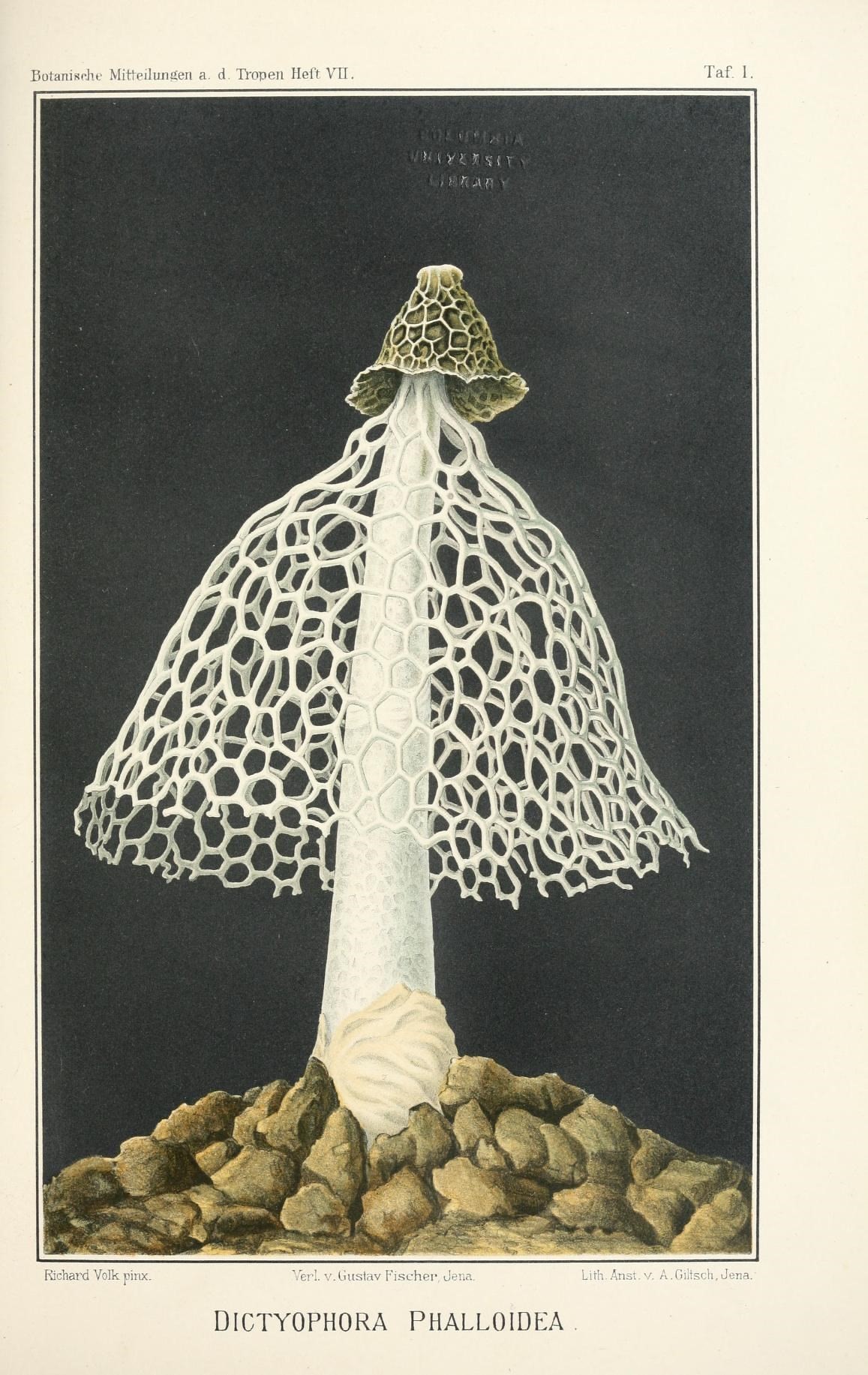
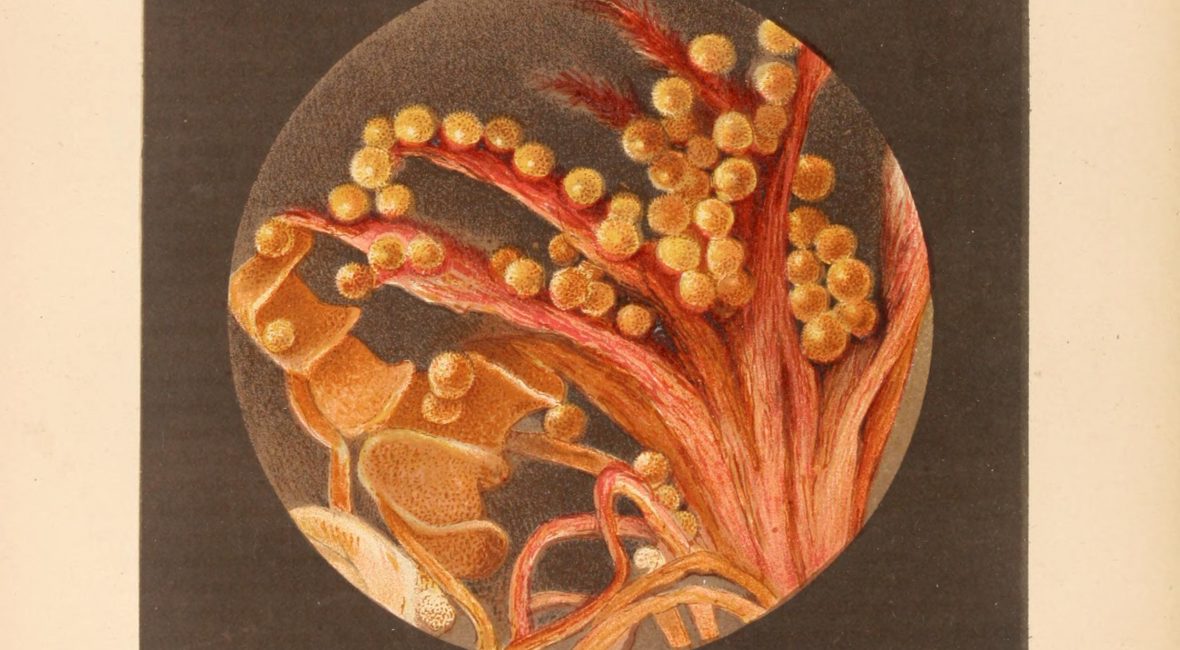
illustration of fungi with an indusium.

The third most-viewed image in the BHL Flickr as of February 2021. Möller, Alfred. Brasilische Pilzblumen. 1895. Art by Richard Volk. Contributed in BHL from The LuEsther T Mertz Library, the New York Botanical Garden. Link in Flickr. Link in BHL.

Images in Flickr are curated by album and collection. Each album corresponds to a particular volume in BHL and contains all of the full page images from that volume. Images and albums are further curated into collections on particular subjects, from botanical art to marine species, gardening, endangered species, and more. We also have collections associated with BHL’s various social media campaigns, including Her Natural History (featuring a collection of illustrations by women artists, each tagged with the name of the artist), Monsters Are Real (featuring images of mythical creatures like hydra, sea serpents, and kraken), Color Our Collections (featuring black and white illustrations perfect for printing and coloring), and Fossil Stories (featuring a wealth of historic paleontological art).

Flickr helps improve image discoverability for BHL, not only by making it easier to browse images from BHL’s collection of over 59 million pages, but also by providing an opportunity for the public to help enhance the metadata for these images through crowdsourcing, making it easier to search the images by species, artist, geographic location, and more! Visit our About site to learn more about how to search images in the BHL Flickr.

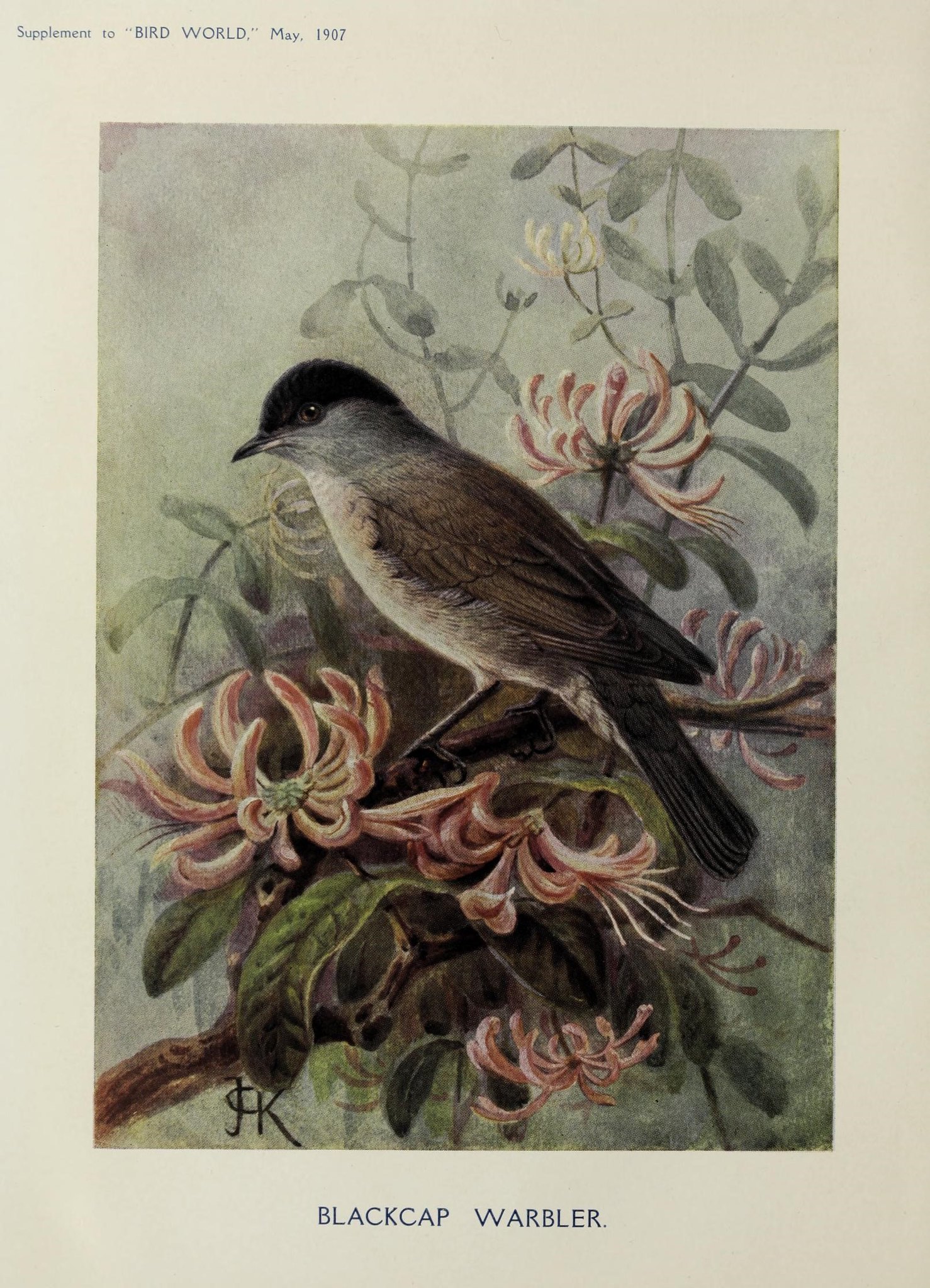
illustration of a bird sitting amongst pink flowers.

The fourth most-viewed image in the BHL Flickr as of February 2021. Bird World Magazine, v.1 (1906-1907). Art by John Gerrard Keulemans. Contributed in BHL from the University Library at the University of Illinois at Urbana-Champaign. Link in Flickr. Link in BHL.

Through our Flickr Tagging Crowdsourcing Project, we invite anyone to help add tags to Flickr images that describe the species depicted, identify the artist of the image, or indicate the geographic location in which the depicted species lives. To date, over 46,000 images, or about 18% of our Flickr collection, has been tagged by the public. This is an incredible accomplishment, but don’t worry—there’s still plenty of images in need of tags. And the best part? This is an educational activity that you can do from home!

We are so grateful to all of our volunteers who have helped tag our images. Thanks to you, these images are more accessible and discoverable for others to support their research and educational activities.

We welcome anyone to join us in tagging images in our Flickr. Learn how to get started with these detailed tagging instructions.

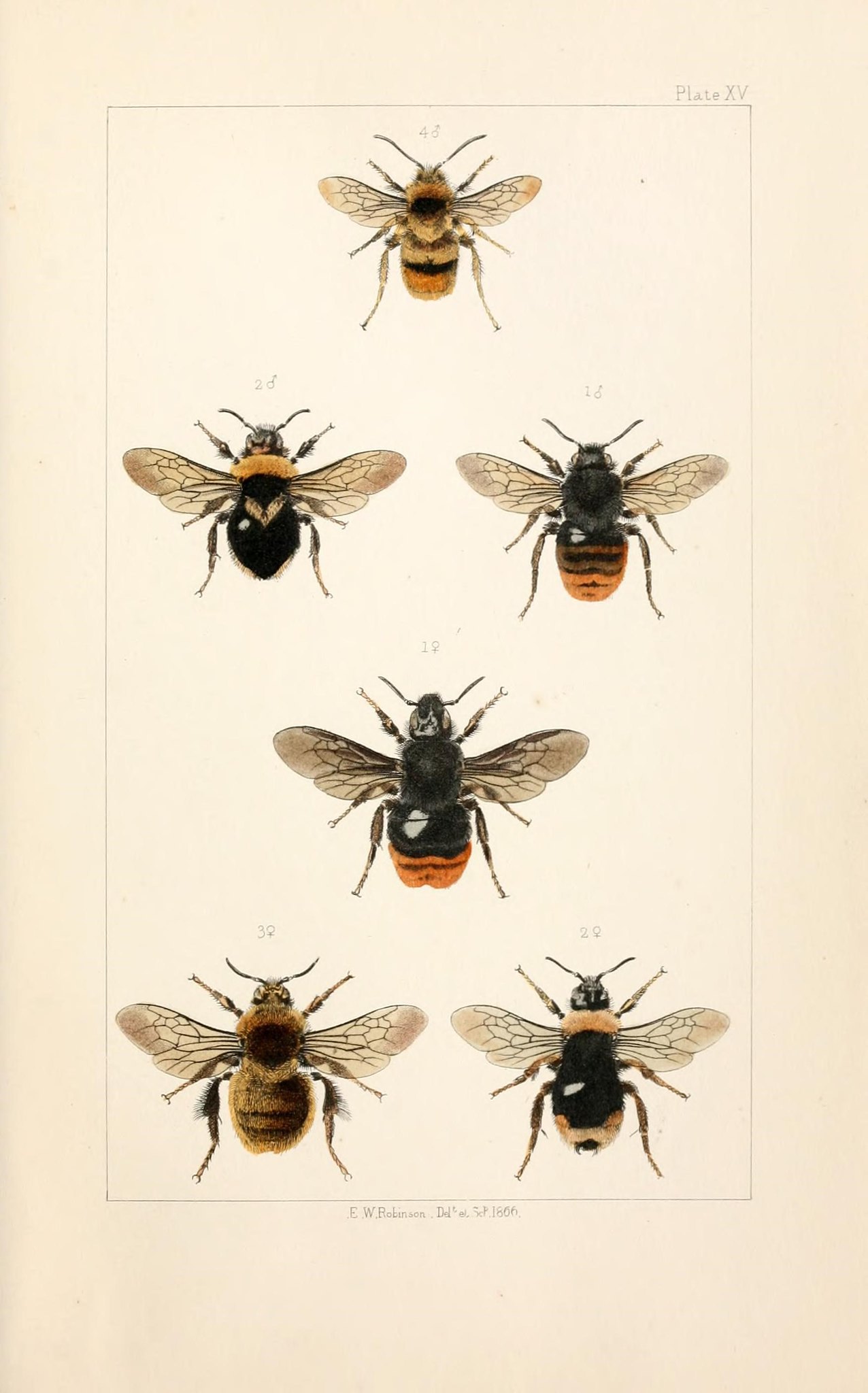
Illustration of bees.

The fifth most-viewed image in the BHL Flickr as of February 2021. Shuckard, William Edward. British Bees. 1866. Art by Edward William Robinson. Contributed in BHL from MBLWHOI Library. Link in Flickr. Link in BHL.

We invite you to explore our image collections on Flickr today. Thank you to all of our incredible partners who have helped build this amazing resource, and to all of our volunteers who have helped improve it through image tagging. We encourage you to download and reuse the images for your own educational, artistic, personal, and professional uses, and to help us improve the collections by participating in our tagging project.

Enjoy immersing yourself in the beauty of nature through art!

February 18, 2021by michelle.underhill
BHL News, Blog Reel, Featured Books

The John Torrey Papers: Increasing Accessibility with Full Text Transcriptions in BHL

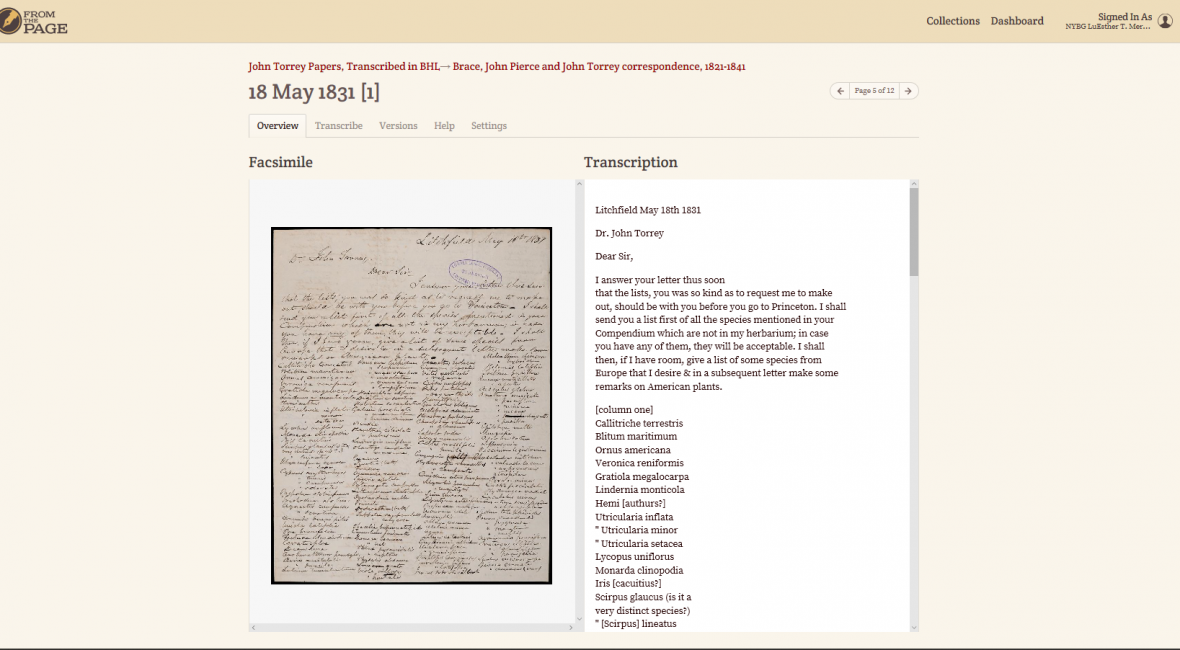
screenshot of a transcription in the from the page platform
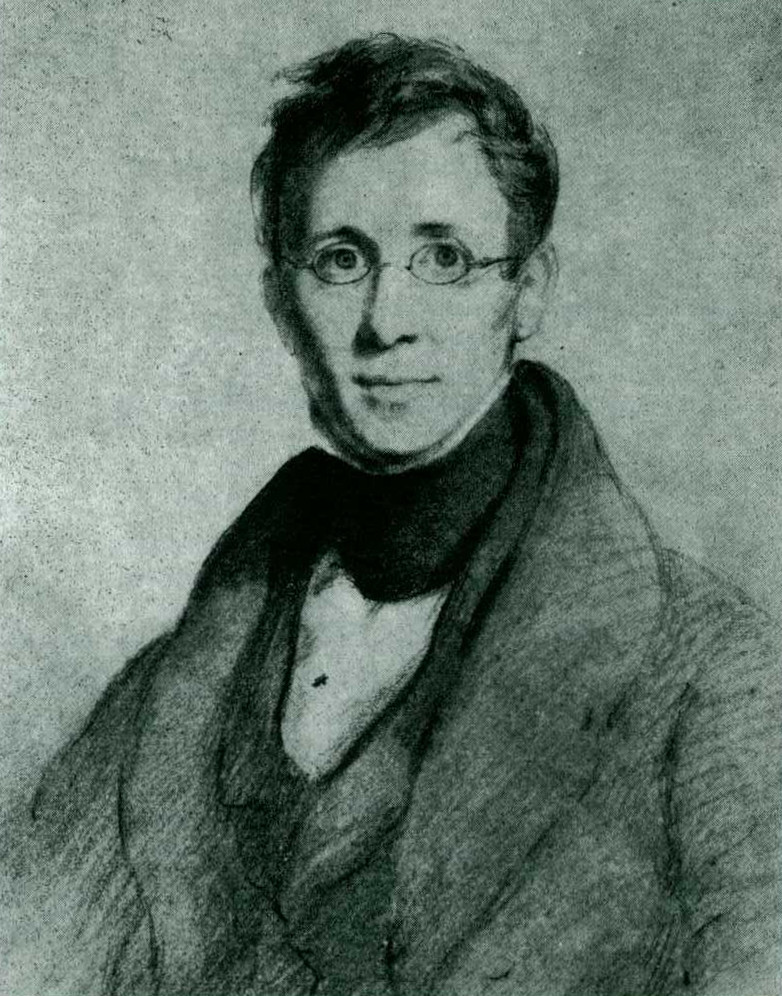
black and white portrait of a young man, john torrey

Drawing of John Torrey by Sir Daniel MacNee. From the collection of Sir William Hooker, The Royal Botanic Gardens at Kew, England.

Since July 2016, the papers of taxonomic botanist John Torrey (1796-1873) have been the focus of a digitization and crowdsourced transcription project at the New York Botanical Garden (NYBG). Digitizing and Transcribing the John Torrey Papers, organized in coordination with the Biodiversity Heritage Library (BHL) and funded by the National Endowment for the Humanities and the Carnegie Corporation of New York, was created in an effort to digitize and make virtually accessible the correspondence of John Torrey and his colleagues, specifically letters received by Dr. Torrey.

Access to the correspondence of Dr. Torrey is particularly useful to natural scientists and natural historians alike as these letters provide a glimpse into the thought process and workflow for many of the 19th century’s greatest botanical minds. These letters are filled with a variety of different content, including commentary on plant taxonomy, personal biographical details, and anecdotal information on the daily lives of these natural scientists. The content within these letters aid in our understanding of the realities faced by these pioneering botanists, including the shift from the Linnaean system to the natural system and the systemic challenges faced by individuals in an emerging profession..

The John Torrey Papers collection contains over 9,500 pages from more than 350 correspondents, including Asa Gray, Amos Eaton, and Joseph Henry. The collection is organized alphabetically by correspondent then chronologically by the date each letter was written. Each page of each letter is scanned as a .tif file and uploaded to Macaw, BHL’s metadata management system, which aggregates the .tif file with a New York Botanical Garden MARC XML record. Once appropriate metadata has been applied in Macaw, the correspondence are uploaded to the Biodiversity Heritage Library Collection in the Internet Archive. The correspondence’s placement in the BHL Collection then allows for BHL to harvest new material from the Internet Archive on a weekly basis.

Digital content management is a crucial aspect of the project, but the heart of the process lies in the crowdsourced transcriptions done by volunteers from the New York Botanical Garden. These volunteers, recruited through citizen science outreach events, workshops, and tabling opportunities at various locations, work on the transcription platform From the Page, which is one of three transcription platforms whose exports are currently accepted by the Biodiversity Heritage Library, allowing the automatically-generated OCR for these items to be replaced with crowdsourced transcriptions, enabling full text search.

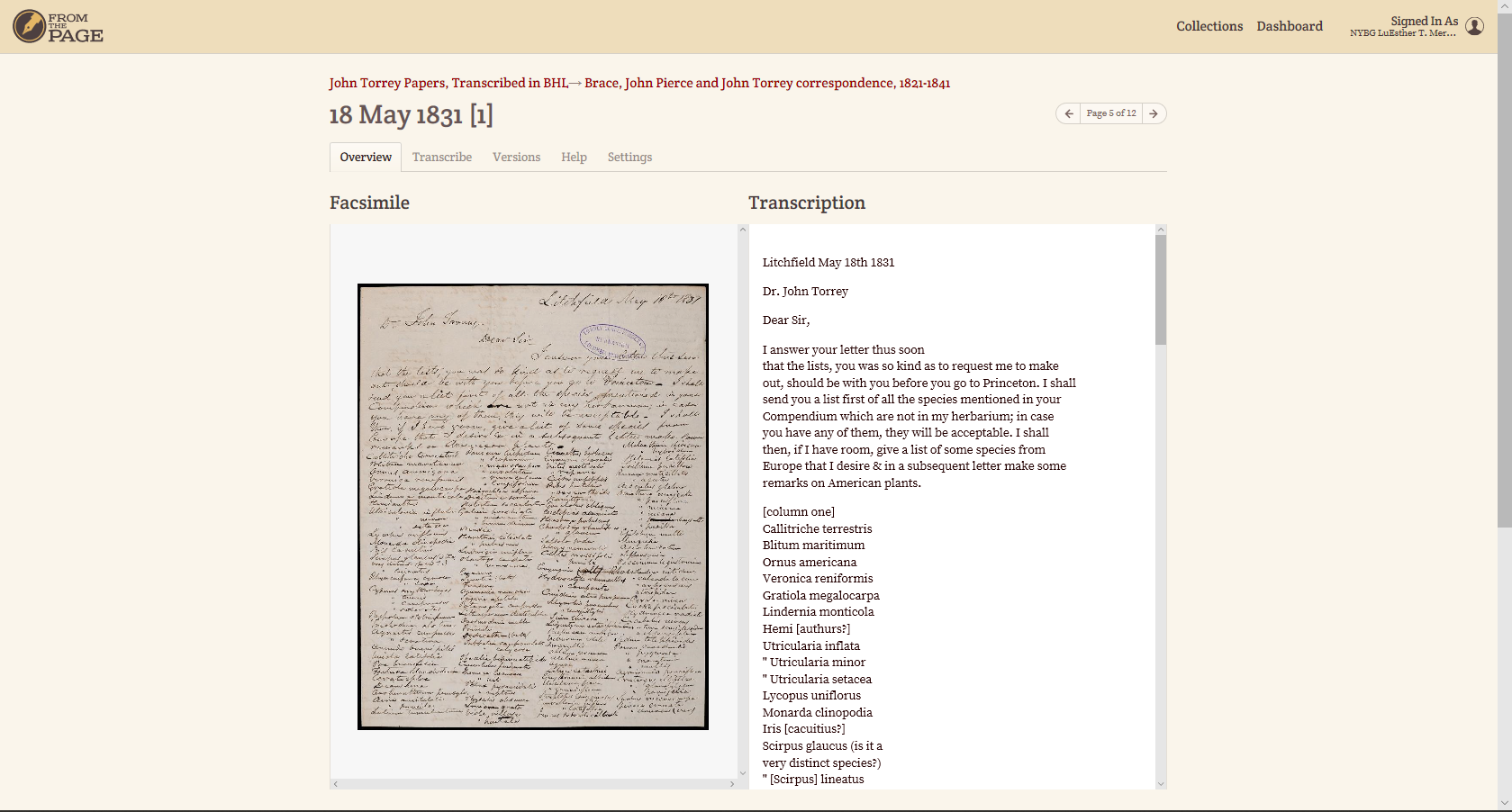
FTP Example Screenshot.PNG

A screenshot of a completed transcription from John Pierce Brace to John Torrey (May 1831) in From the Page.

The work done by these volunteers is a contribution to the project for two reasons. First, the handwriting, colloquialisms, and personal shorthand of many of Dr. Torrey’s correspondents are exceptionally difficult to read or interpret. With the correspondence of many correspondents containing several hundred pages, it takes a considerable amount of time for our volunteers to develop a proficiency capable of not only accurately deciphering poor handwriting but also of uncovering the intention or context of particular writings.

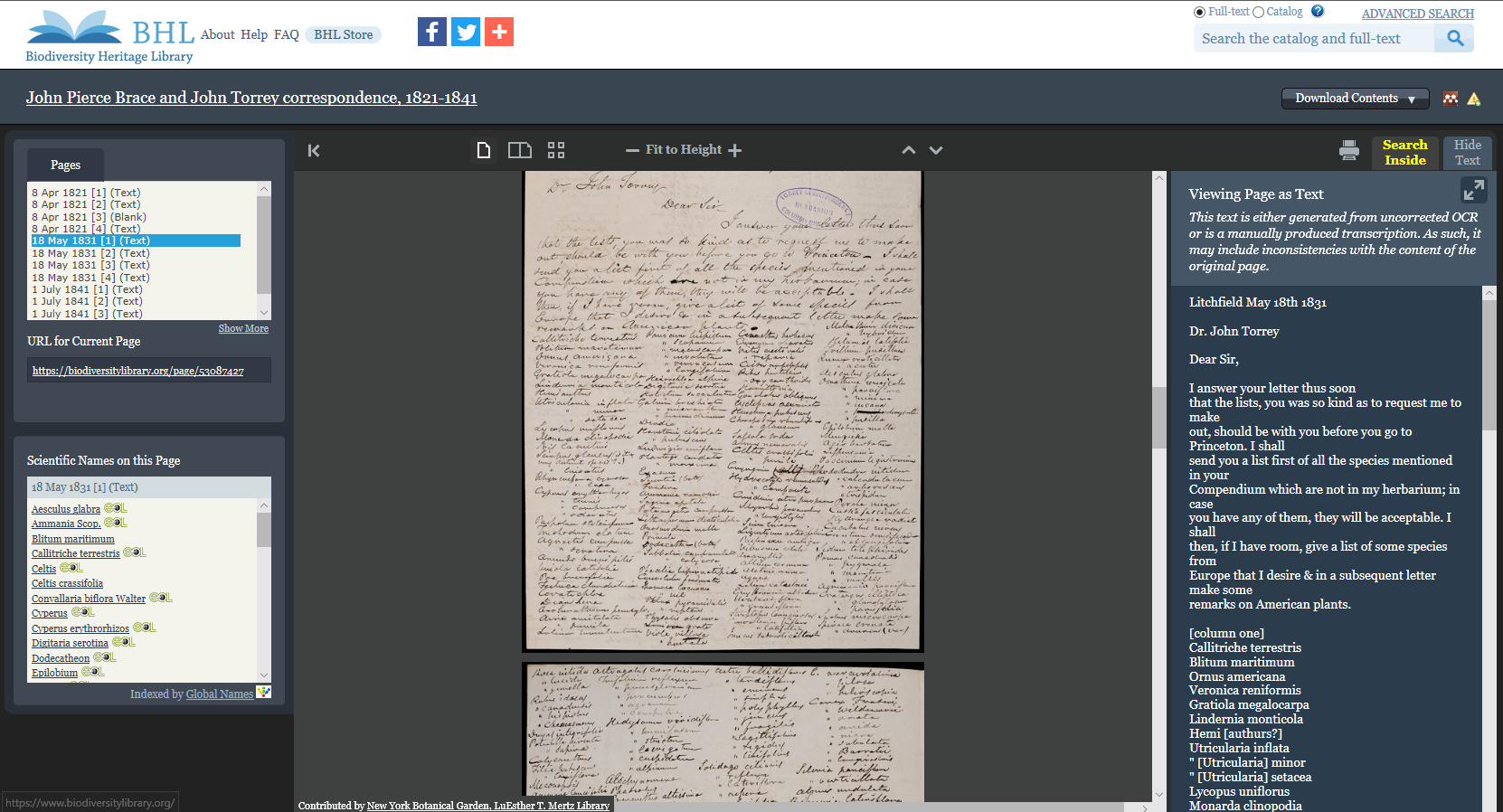
Second, the transcriptions produced by the Garden’s volunteers coupled with BHL’s new support for transcriptions facilitates full text searching of materials that would otherwise be unavailable. The introduction of full text searching to the world of transcriptions is extremely impactful as it allows researchers to execute a more thorough examination of resources available to them at a faster pace and with higher levels of productivity. A prime example of this is the Biodiversity Heritage Library’s page index of scientific names, as seen in the lower left hand corner of the figure below.

In effect, the Digitizing and Transcribing the John Torrey Paper’s volunteers are the bridge between the content we are looking for and how we look for it.

BHL Blog Screenshot.PNG

Screenshot of the completed John Pierce Brace page once the transcription and image files have been matched in BHL.

To date, more than 7,000 pages have been transcribed and more than 6,000 transcribed pages are available for view in BHL, but the goals of the Digitizing and Transcribing the John Torrey Papers project still have not been met.

With less than 1,500 pages remaining, the New York Botanical Garden is in search of new volunteers to help reach our goal and transcribe some of our most interesting correspondents remaining to be done such as William Jackson Hooker, the former Director of the Royal Botanic Gardens, Kew, and New England natural scientist Dewey Chester. While many of our volunteers are drawn to the project due to their interest in botany, many more are captivated by narratives not typically associated with botany, such as Carl Bogenhard’s struggles as an immigrant in the United States or Jacob Whitman Bailey’s experimentation with photography.

If you would like to become a volunteer transcriber for the Digitizing and Transcribing the John Torrey papers project, you can sign up online here or email [email protected] for more information or assistance with the sign up process.

If you would like to learn more about the life of John Torrey, works he published, or plants named after him, please visit out digital exhibit “John Torrey: American Botanist.”

September 24, 2019by Joel Richard
BHL News, Blog Reel, Tech Updates

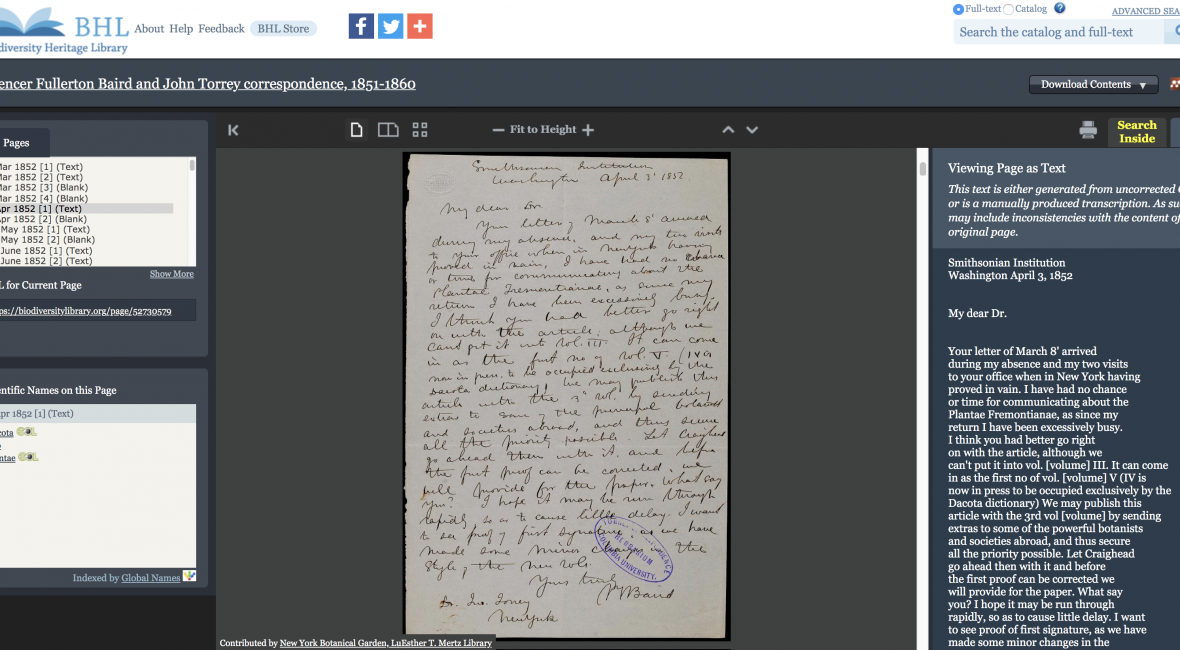
BHL Adds Functionality Allowing Partners to Upload Crowdsourced Transcriptions of Digitized Archival Materials

Screenshot of a digital library book viewer with readable OCR.

The Biodiversity Heritage Library (BHL) has added functionality to allow BHL Partners to upload transcriptions in place of the automatically-generated OCR (Optical Character Recognition) for archival materials digitized in BHL. This functionality supports transcriptions generated as part of Partner crowdsourcing projects on Smithsonian Transcription Center, DigiVol, and From the Page.

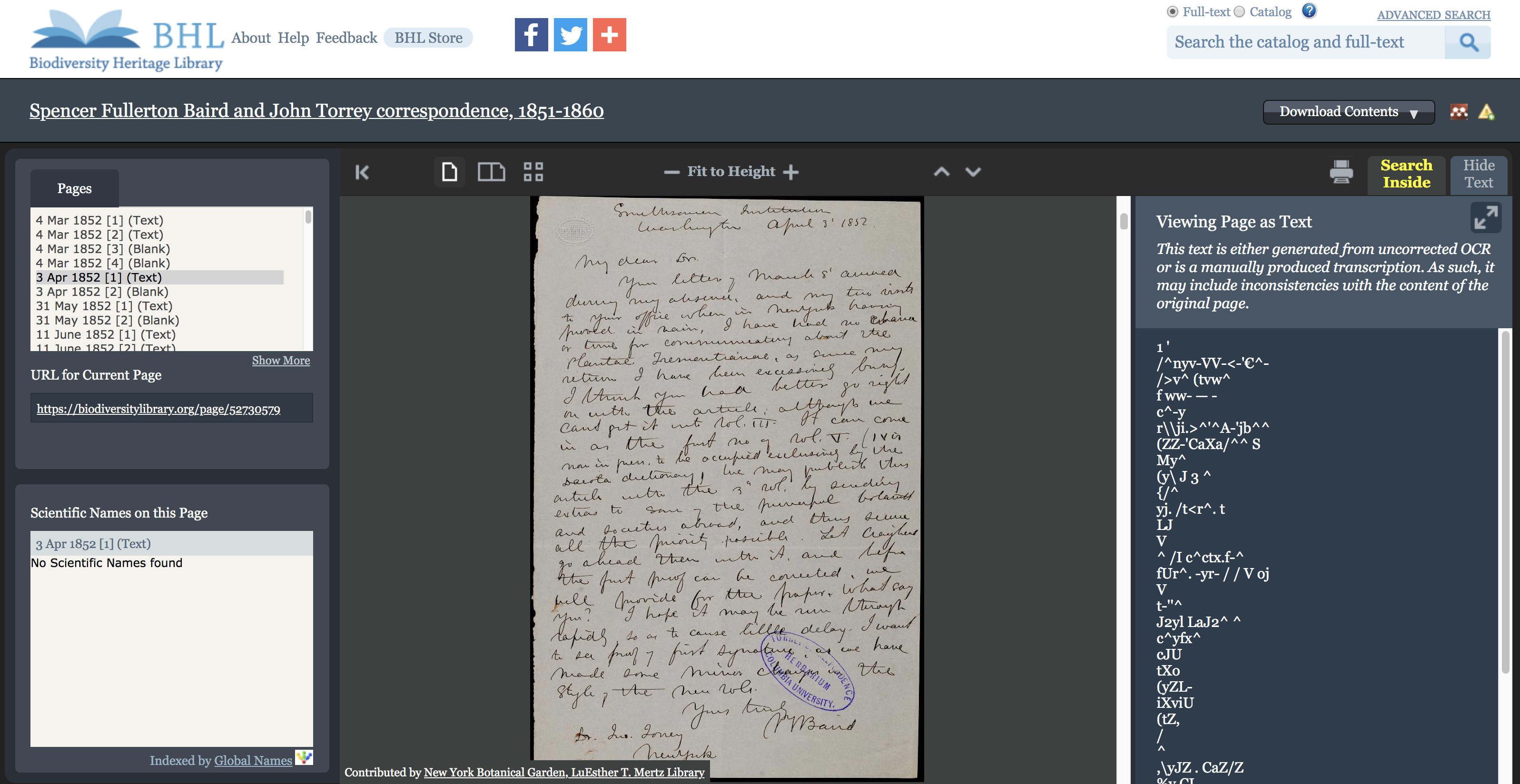
Optical Character Recognition (OCR), also called text recognition, translates text characters in scanned documents into code that can be used for data processing and enables searching of document text. Handwritten archival materials like correspondence and field notes are notoriously problematic for OCR software. Full-text searching of these materials is significantly hampered by poor OCR output.

Screenshot of a digital library book viewer with gibberish for OCR.

Example of the poor automatically-generated OCR output for handwritten correspondence. Spencer Fullerton Baird and John Torrey correspondence, 1851-1860. Contributed in BHL from the LuEsther T. Mertz Library of The New York Botanical Garden.

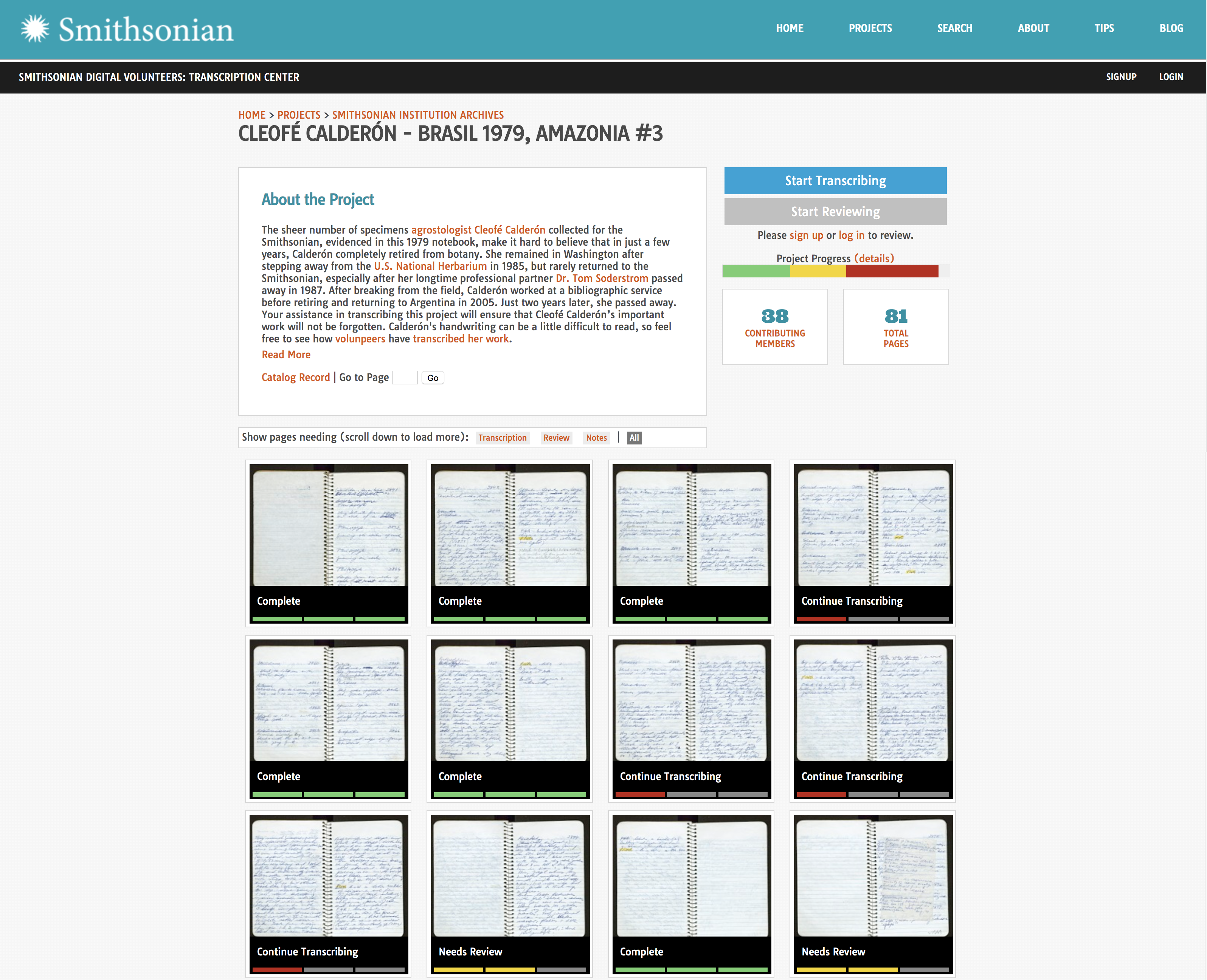
Crowdsourcing the transcription of archival materials has become a popular way to generate machine-readable text that enables searching and discoverability. Several BHL Partners are using crowdsourcing platforms (e.g. Smithsonian Transcription Center, DigiVol, and From the Page) to transcribe field notes, correspondence, and other archival materials that they have digitized in BHL.

Screenshot of a project in the Smithsonian Transcription Center.

Example of a field notebook being transcribed in the Smithsonian Transcription Center. This notebook, Brasil 1979, Amazonia #3, from Cleofé Calderón is also available in BHL from the Smithsonian Institution Archives.

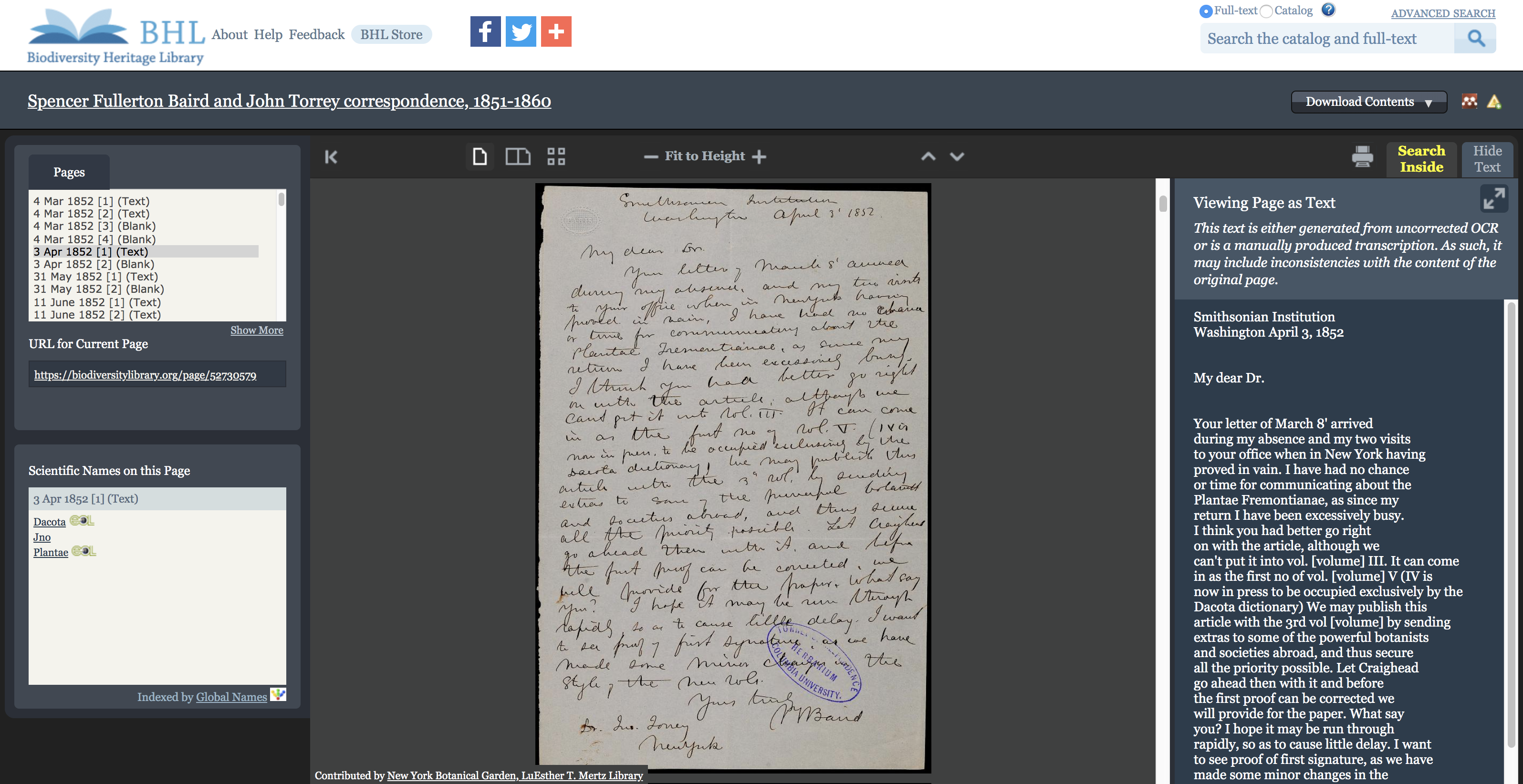
With this new functionality, these transcriptions can now be uploaded in place of the automatically-generated OCR for these items, allowing them to be full-text searchable and enabling our taxonomic name recognition software to index scientific names within their pages. Since the transcribed text can be viewed alongside the digitized page image, users can also more easily read materials with difficult-to-decipher handwriting. Thus, this new functionality makes it easier for researchers and the public to explore these valuable primary source materials and access specific information from their pages.

Screenshot of a digital library book viewer with readable OCR.

Above example with the OCR replaced with a crowdsourced transcription generated as part of The John Torrey Papers project from The New York Botanical Garden on From the Page. Spencer Fullerton Baird and John Torrey correspondence, 1851-1860. Contributed in BHL from the LuEsther T. Mertz Library of The New York Botanical Garden.

Screenshot of the BHL book viewer with a digitized field book and the transcribed text shown alongside the page in place of the OCR.

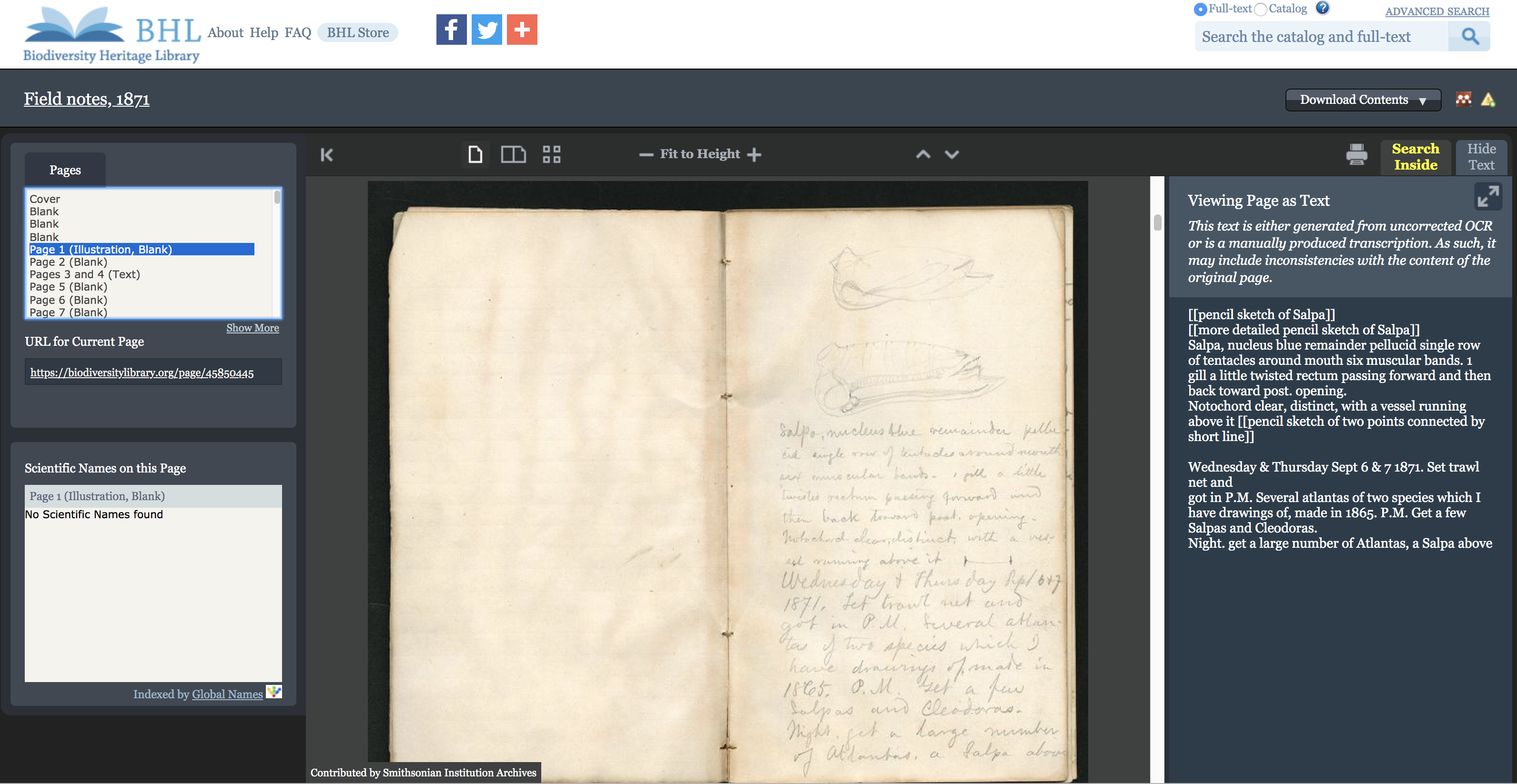
Since the transcribed text can be viewed alongside the digitized page image in the BHL book viewer, users can also more easily read archival materials. William Healey Dall’s Field Notes, 1871. Transcription generated on the Smithsonian Transcription Center. Contributed in BHL from the Smithsonian Institution Archives.

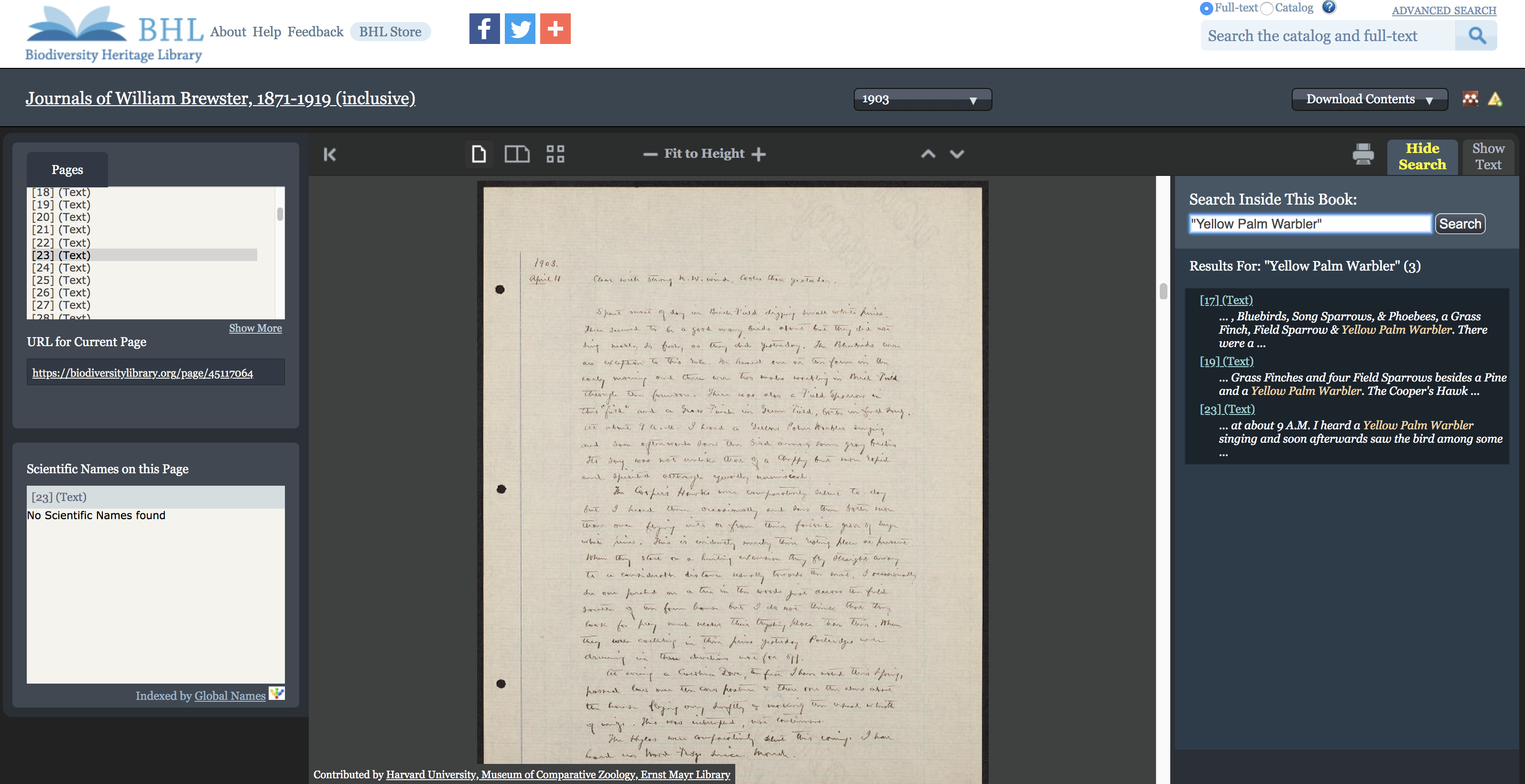
Screenshot of a book viewer with digitized archival materials and full-text search for "Yellow Palm Warbler".

Crowdsourced transcriptions allow digitized archival materials in BHL to be full-text searchable, as shown in this example searching for “Yellow Palm Warbler” within William Brewster’s 1903 journal. Transcription generated as part of the Ernst Mayr Library of Harvard University project on DigiVol. Contributed in BHL from the Ernst Mayr Library of the Museum of Comparative Zoology at Harvard University.

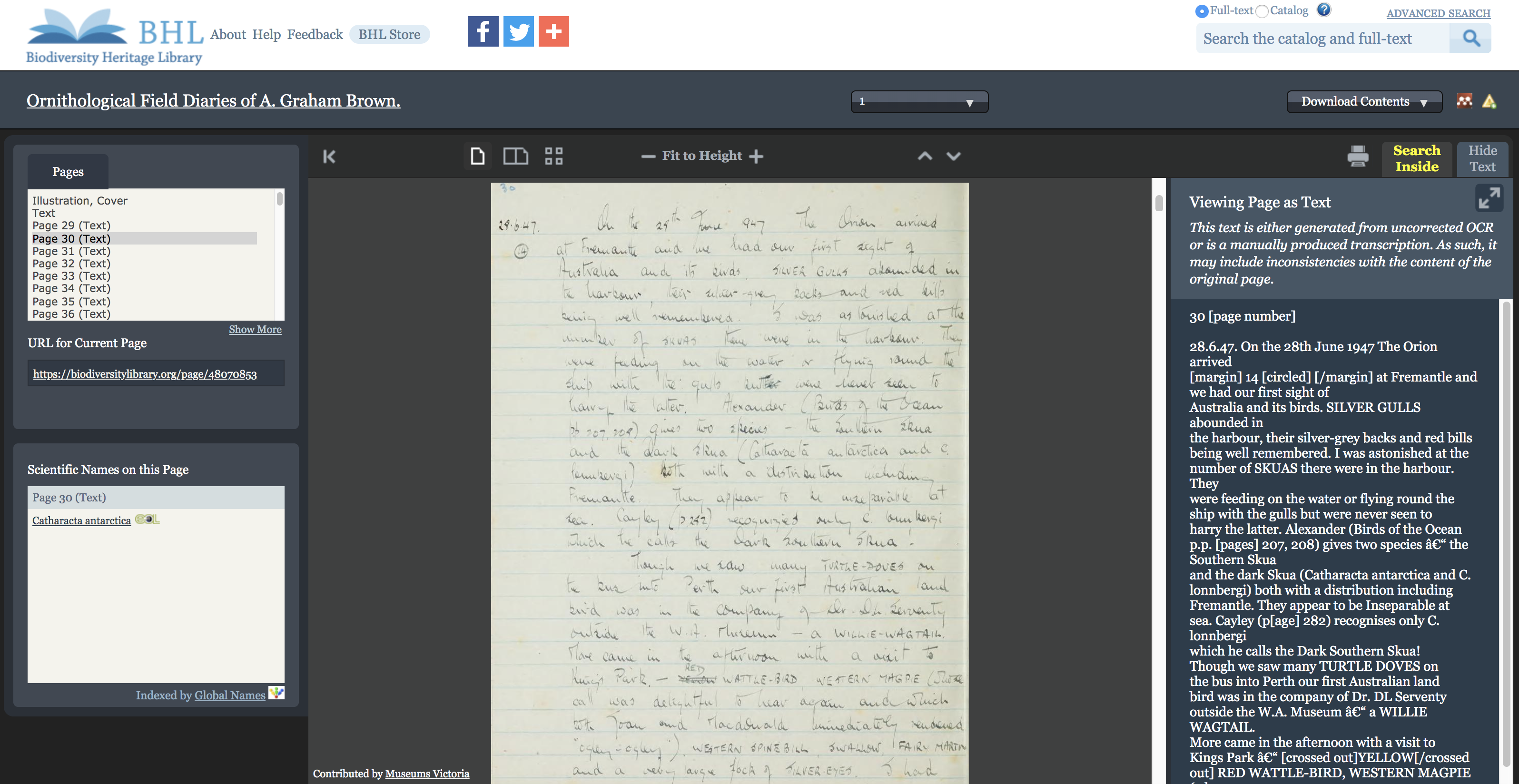
Screenshot of a book viewer with scientific name indexed on the page of an archival notebook.

Crowdsourced transcriptions allow BHL’s taxonomic name recognition software to index scientific names within the pages of digitized archival materials, as seen in this example in which Catharacta antarctica is indexed on a page within the first volume of the Ornithological Field Diaries of A. Graham Brown. Transcription generated as part of a project from BHL Australia and Museums Victoria on DigiVol. Contributed in BHL from Museums Victoria.

Participating Partners have begun uploading transcriptions to BHL. To date, transcriptions have been uploaded from Partner crowdsourcing projects with BHL Australia, Ernst Mayr Library of Harvard University, The New York Botanical Garden, and Smithsonian Institution Archives. This is an ongoing process, and more transcriptions will be uploaded to the Library over time.

Interested in transcribing archival materials? Several BHL Partners have active transcription projects on various crowdsourcing platforms. Follow the links below to explore the opportunities and get involved:

  • Ernst Mayr Library of Harvard University on DigiVol
  • The John Torrey Papers from The New York Botanical Garden on From the Page
  • Smithsonian Institution Archives on the Smithsonian Transcription Center
July 17, 2019by michelle.underhill
BHL News, Blog Reel, User Stories

Worlds of Wonder: Tracing Microscopy Illustrations on Zooniverse

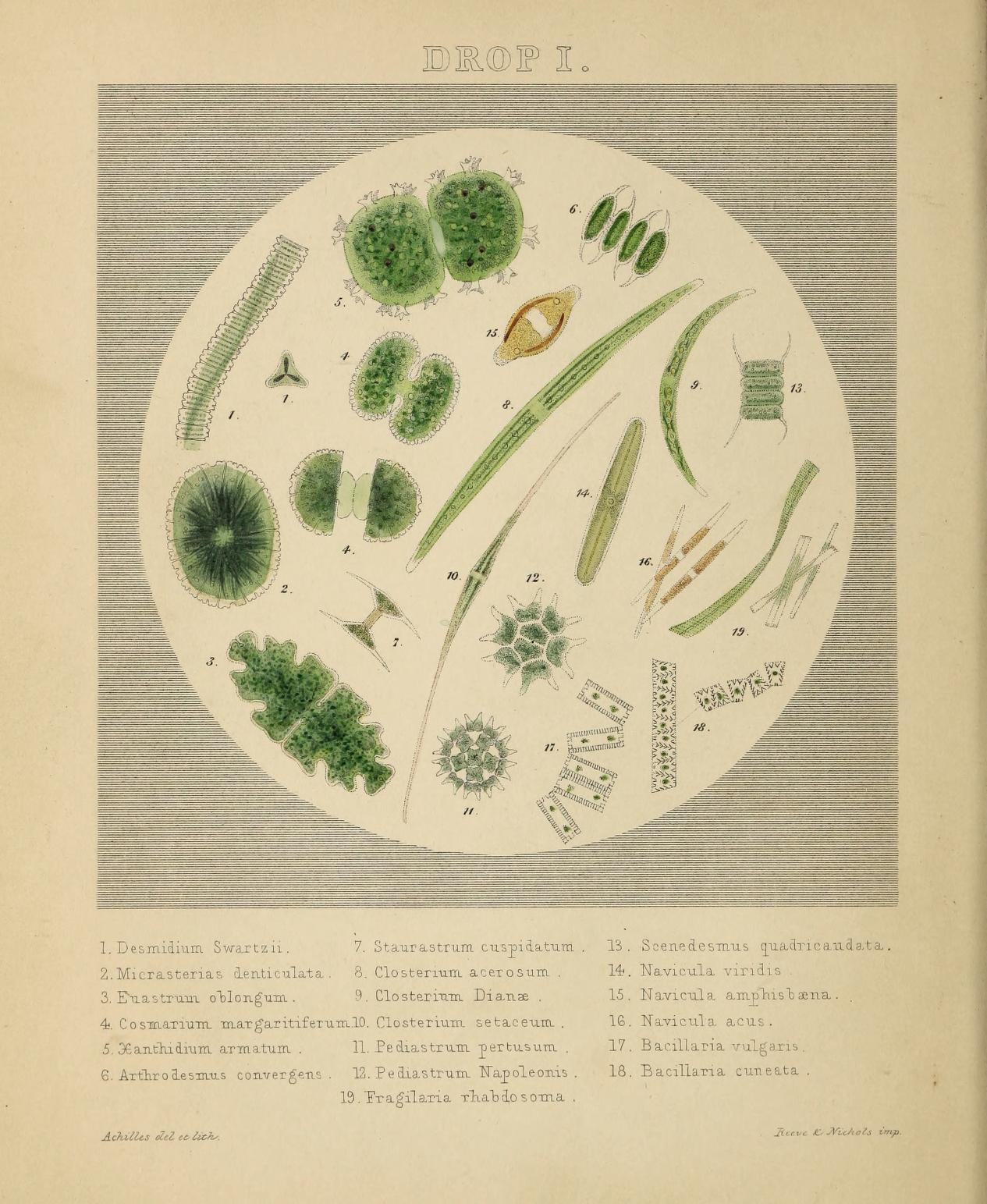
dropsofwaterthei00catl_0_0026.jpg

Catlow, Agnes. Drops of Water; their Marvellous and Beautiful Inhabitants Displayed by the Microscope. 1851. Contributed in BHL by University of Toronto – Thomas Fisher Rare Book Library.

In the mid-nineteenth century, microscopy became immensely popular with European and American naturalists. As microscopes became more affordable, microscopy societies were established, and numerous microscopy journals were launched and widely distributed. Many microscopy publications were richly illustrated, trying to recreate the “world of wonder and beauty” seen through the microscope (Gosse, 1860, p. v). In his widely read Evenings at the Microscope (1859), the English naturalist Philip Henry Gosse showed his readers “the path to the myriad wonders of creation” displayed by the microscope (p. 3). Moreover, microscopy journals, inviting their readers to contribute inquiries and observations, often made it possible for geographically dispersed microscopists to work together.

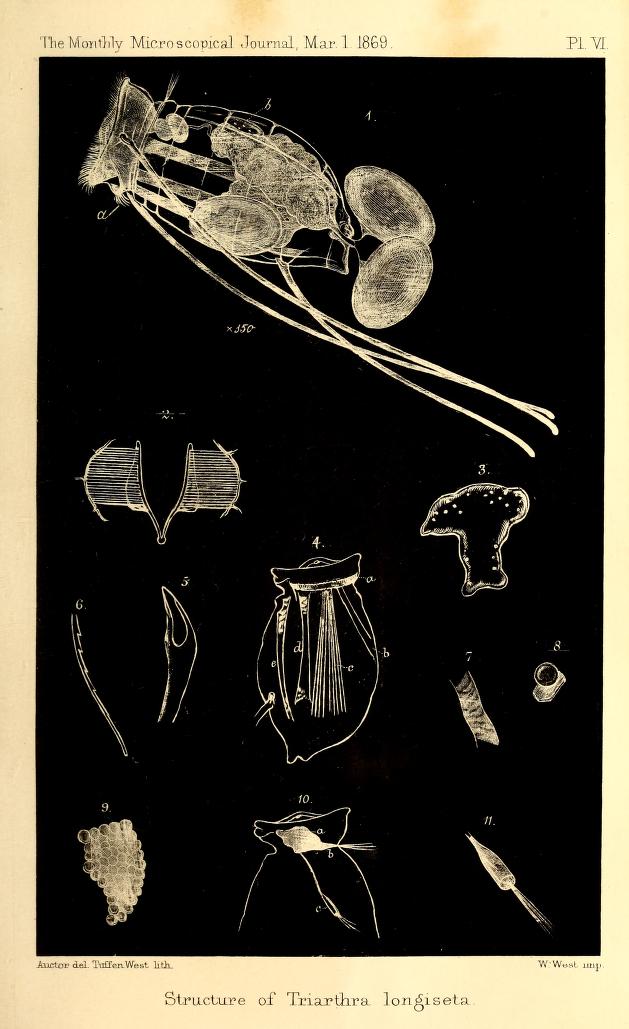
monthlymicroscop11869roya_0197.jpg

Hudson, Charles Thomas. “On Triarthra longiseta” in The Monthly Microscopical Journal. Vol. 1. 1869. Contributed in BHL by Smithsonian Libraries.

Since international copyright laws were only enforced after the signing of the Berne Convention in 1886 and the passing of the American Chace Act in 1891, mid-nineteenth-century publications frequently reused material published elsewhere. Illustrations and texts would be copied and reprinted, thus targeting several readerships at different places at the same time. Edward Pennock, editor of the Philadelphian Microscopical Bulletin and Science News, claimed that he could “write much better articles with the scissors than with the pen” (Pennock, 1890, p. 7). Pennock not only copied but also recombined articles to better accommodate the interests of his readers.

Citizen Scientists Invited to Explore the History of Microscopy

To this day, so many nineteenth-century publications on microscopy remain that they can hardly be analyzed by just a handful of historians. Therefore, the MUSTS research group at Maastricht University launched Worlds of Wonder, an online crowdsourcing project, on the Zooniverse citizen science platform. Worlds of Wonder is part of a PhD project funded by the Netherlands Organisation for Scientific Research, and it was inspired by Science Gossip, another crowdsourcing initiative asking citizen scientists to classify illustrations. The MUSTS researchers behind Worlds of Wonder, Lea Beiermann, Cyrus Mody and Raf De Bont, ask citizen scientists to help them classify nineteenth-century microscopy illustrations, assign keywords to the illustrations to make them searchable, and identify the people who made them.

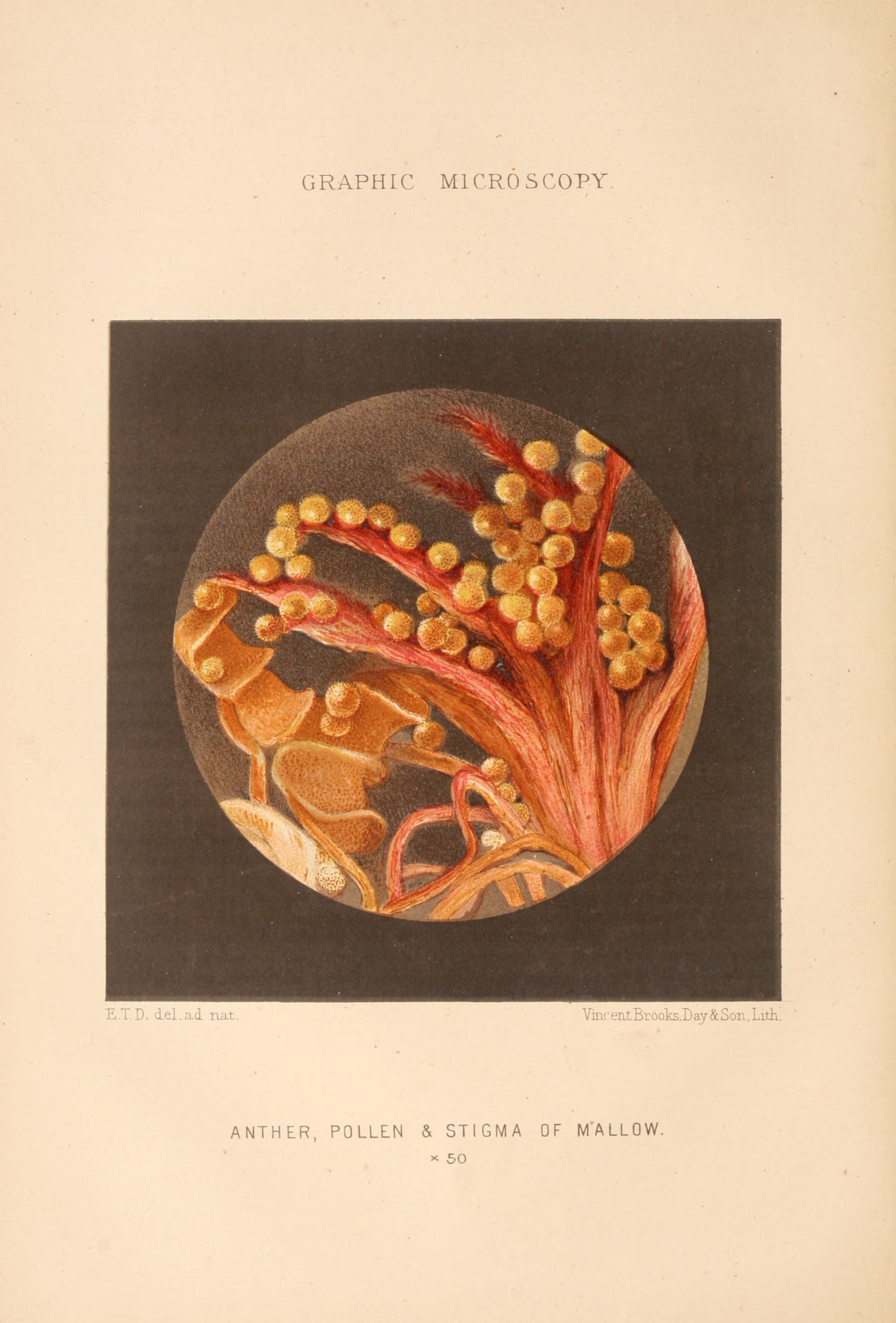
hardwickesscienc20cook_0092.jpg

E. T. D. “Graphic Microscopy” in Hardwicke’s Science Gossip. Vol. 20. 1884. Contributed in BHL by MBLWHOI Library.

Worlds of Wonder aims to better understand the formation of a community of European and American microscopists by investigating the publications that connected them. How did microscopists and illustrators collaborate to produce illustrations? Who could contribute illustrations to microscopy publications? Where did microscopy illustrations travel and how did they change along the way? It seems that the circulation and reproduction of illustrations was a crucial factor in connecting nineteenth-century microscopists, who formed a strikingly diverse scientific community including physicians, biologists, engineers, natural historians, school teachers and zoologists with a shared interest in microscopy. Adapting and recombining published texts and illustrations may have made it easier for editors to tailor their publications to different groups of microscopists. In order to trace reproductions of microscopy illustrations, Worlds of Wonder draws on a wealth of digitized microscopy publications hosted by the BHL.

Although copyright laws were not strictly enforced in the mid-nineteenth century, issues of ownership and the authenticity of reproduced materials were strongly debated. Considering that today many online platforms continue to recombine and distribute texts and illustrations published elsewhere, Worlds of Wonder may also help us get a better idea of the effects of using these platforms in science communication.

You can join the crowdsourcing project on Zooniverse or learn more about the history of microscopy on the Worlds of Wonder blog.

References

Gosse, Philip Henry. 1860. Evenings at the Microscope; or Researches Among the Minuter Organs and Forms of Animal Life. New York: D. Appleton.

Pennock, Edward. 1890. Minutiae. The Microscopical Bulletin and Science Ne, 7(1), 7.

April 25, 2019by Joel Richard
BHL News, Blog Reel

Update: Smorball and Beanstalk Access Restored

Portrait version of the Biodiversity Heritage Library logo.

The Purposeful Gaming project has now ended and BHL is no longer utilizing outputs from the games created as part of this project: Smorball and Beanstalk. However, both games will remain live for your continued enjoyment. Learn more.

UPDATE: Access to BHL’s two online games, Smorball and Beanstalk, has now been restored. Thank you for your patience. Start playing today and improve access to BHL’s books and journals by helping to correct our OCR (optical character recognition). Learn more.


Below Posted 2 June, 2016:

BHL’s two online games, Smorball and Beanstalk, are temporarily unavailable while we transfer the domains to a new registrar. We apologize for the inconvenience and thank you for your patience. We will provide notification via this blog, Twitter, and Facebook once access to the games is restored.

You can learn more about our games, and how they help improve the discoverability of BHL books, in this past blog post. To date, over 5,000 people have played the games and over 140,000 words have been typed. Thank you so much to all of our players and for your contributions to help improve access to biodiversity literature!

June 2, 2016by michelle.underhill
Blog Reel, Featured Books

An Artist Steps Out of the Shadows: Using Social Media to Solve a Question of Identity

Over the years, we’ve discovered that social media is a pretty awesome way to learn more about our collections. Recently, a Twitter conversation helped us unravel the true identity of an incredible natural history artist.

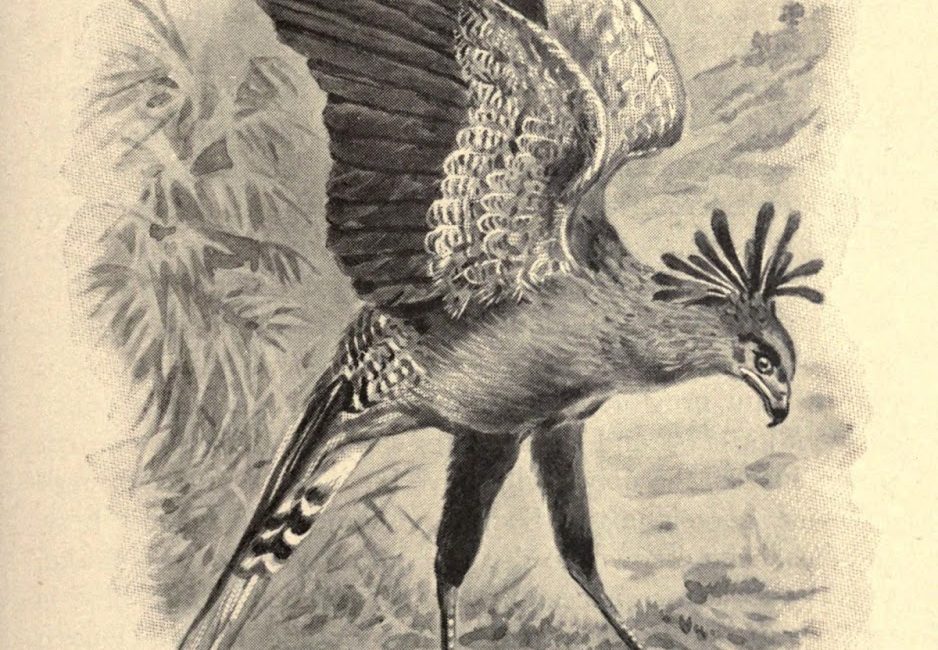
In November, one of our star citizen scientists Siobhan Leachman was working on adding artist machine tags to images in the BHL Flickr (want to learn more about how to do that? See this guide!). She was working on Wonders of the Bird World (1921), which was digitized for BHL by Cornell University Library. The title page stated that it was illustrated by A.T. Elwes. But who exactly was this Elwes?

View Full Size Image
Wonders of the bird world. By Bowdler Sharpe. Illustrations by A. T. Elwes. (1921) http://biodiversitylibrary.org/page/16742946.

There was lots of information online about an Alfred Elwes (1819-1888), a prolific 19th century British author who wrote many books related to animals. What was unclear was whether this Alfred Elwes was the same person as A.T. Elwes, which, after some research, was found to be an abbreviation for Alfred Thomas Elwes. Siobhan reached out to BHL and many other libraries on social media to uncover the truth.

.@BioDivLibrary @Cornell_Library Can u confirm A. T. Elwes = Alfred Thomas Elwes 1819-1888 Want 2 artist machine tag https://t.co/Fw5hAKawQJ

— Siobhan (@SiobhanLeachman) November 16, 2015

Thanks to leads from a variety of people, including @silmaril11 and Mann Library at Cornell University, the mystery was finally solved.

@SiobhanLeachman strange. This of any help https://t.co/5NAyKxyjCm ?

— Steve Em (@silmaril11) November 17, 2015

@SiobhanLeachman @BioDivLibrary @Cornell_Library LOC name authority dbase (https://t.co/KMrnoDec8Q) shows this: pic.twitter.com/X3CLgK0sok

— Mann Library (@Mann_Library) November 19, 2015

A.T. Elwes was NOT Alfred Elwes. They were distinct individuals that shared nearly identical names and were active during many of the same years. Alfred Thomas Elwes (A.T. Elwes), however, was born in 1841 and died in 1917 (compared to Alfred Elwes’ 1819 birth and 1888 death).

Through the leads she discovered via social media, Siobhan was able to learn much more about A.T. Elwes. She consolidated this information into a new Wikipedia article about him.

Alfred Thomas Elwes (A.T. Elwes) was a British natural history illustrator of mammals and birds. Though born in Leghorn, Italy around 1841, he lived and worked for most of his life in England. From 1872 to 1877, he was employed by the Illustrated London News as the chief draftsman of natural history subjects.

View Full Size Image
The birds of our rambles : with a companion for the country. By Charles Dixon. Illustrations by A. T. Elwes. (1891) http://biodiversitylibrary.org/page/22695638.

A.T. Elwes was an extremely productive artist, illustrating many natural history books over his lifetime. Many of these titles are in BHL, and, thanks to Siobhan, the Wikipedia article includes a list of a good many of them, as well as links to them in BHL where available. Some of the titles include The birds of our rambles : with a companion for the country (1891), The game birds and wild fowl of the British Islands; being a handbook for the naturalist and sportsman (1893), Birds’ Nests (1902), and Wonders of the Bird World (1921).

View Full Size Image
Birds’ nests; an introduction to the science of caliology. By Charles Dixon I.lustrations by A. T. Elwes. (1902). http://biodiversitylibrary.org/page/23036298.
View Full Size Image
The game birds and wild fowl of the British Islands; being a handbook for the naturalist and sportsman. By Charles Dixon. Illustrations by A.T. Elwes. (1893). http://biodiversitylibrary.org/page/37686026.

Social media is a powerful tool. It’s not just a way to share what you ate for lunch or even just a tool for chatting with friends. It’s also a networking and information goldmine, allowing you to draw on the expertise of disparate individuals and organizations in a variety of disciplines to get answers to questions that might otherwise be nearly impossible to solve on your own. For us at BHL, it’s an amazing tool for not only sharing BHL and our collections with the world, but also for learning more about the incredible books we hold and the remarkable individuals that produced them. Thanks, Siobhan, for all of your incredible dedication and passion. We love our collections even more because of you!

Want to share your own expertise about our collections with us or learn more about the books we hold? Engage with us on Twitter and Facebook, follow our blog, and leave comments on books in BHL.

December 31, 2015by michelle.underhill
Page 1 of 41234»

Help Support BHL

BHL's existence depends on the financial support of its patrons. Help us keep this free resource alive!

search

About BHL

The Biodiversity Heritage Library (BHL) is the world’s largest open access digital library for biodiversity literature and archives. BHL operates as a worldwide consortium of natural history, botanical, research, and national libraries working together to digitize the natural history literature held in their collections and make it freely available for open access as part of a global “biodiversity community.”

Join Our Mailing List

Sign up to receive the latest news, content highlights, and promotions.

Subscribe Now

Subscribe to Blog via Email

Enter your email address to subscribe to this blog and receive notifications of new posts by email.

Join 319 other subscribers

Subscribe to Blog Via RSS

Subscribe to the blog RSS feed to stay up-to-date on all the latest BHL posts.

Access RSS Feed

Inspiring Discovery through Free Access to Biodiversity Knowledge.

The Biodiversity Heritage Library makes it easier than ever for you to access the information you need to study and explore life on Earth…for free, anytime, anywhere.


64+ Million Pages of
Biodiversity Literature Online.

EXPLORE

Tools and Services
to Transform Research.

EXPLORE

300,000+
Illustrations on Flickr.

EXPLORE

ABOUT | HARMFUL CONTENT | PRIVACY | SITE MAP | TERMS OF USE