Biodiversity Heritage Library - Program news and collection highlights from BHL
  • Home
  • News
  • Featured Books
    • All Featured Books
    • Book of the Month Series
    • BHL at 20
  • User Stories
  • Campaigns
    • Fossil Stories
    • Garden Stories
    • Monsters Are Real
    • Page Frights
    • Her Natural History
    • Earth Optimism 2020
  • Tech Blog
  • Visit BHL
Home
News
Featured Books
    All Featured Books
    Book of the Month Series
    BHL at 20
User Stories
Campaigns
    Fossil Stories
    Garden Stories
    Monsters Are Real
    Page Frights
    Her Natural History
    Earth Optimism 2020
Tech Blog
Visit BHL
  • Home
  • News
  • Featured Books
    • All Featured Books
    • Book of the Month Series
    • BHL at 20
  • User Stories
  • Campaigns
    • Fossil Stories
    • Garden Stories
    • Monsters Are Real
    • Page Frights
    • Her Natural History
    • Earth Optimism 2020
  • Tech Blog
  • Visit BHL
Biodiversity Heritage Library - Program news and collection highlights from BHL
Blog Reel, Featured Books

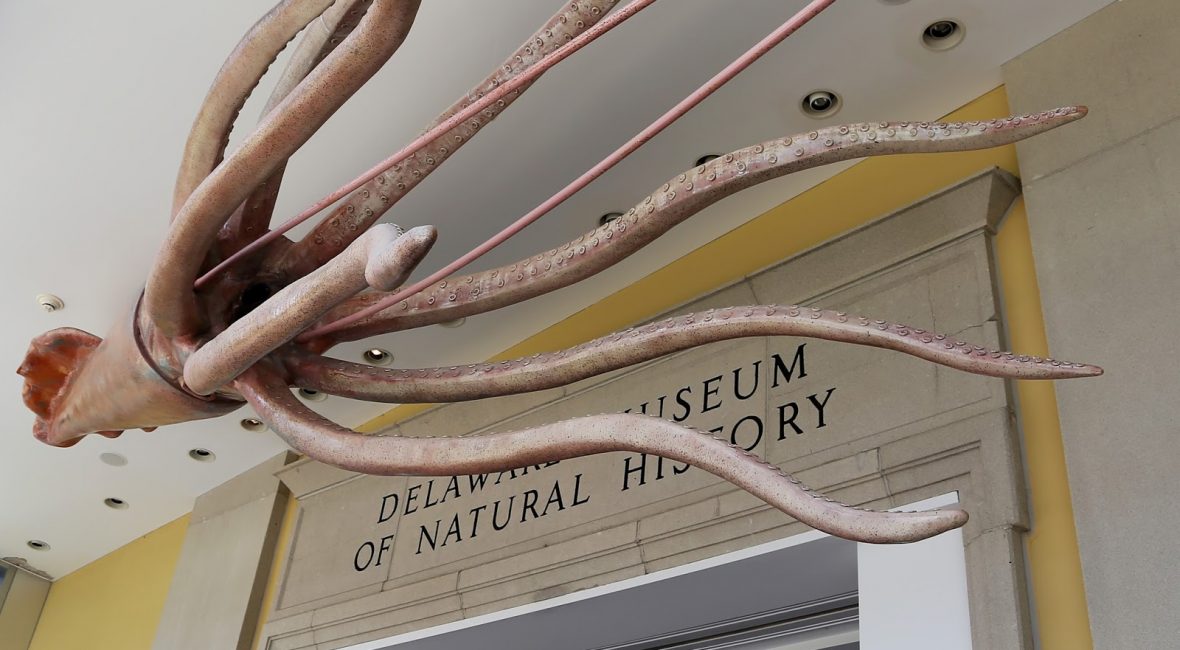
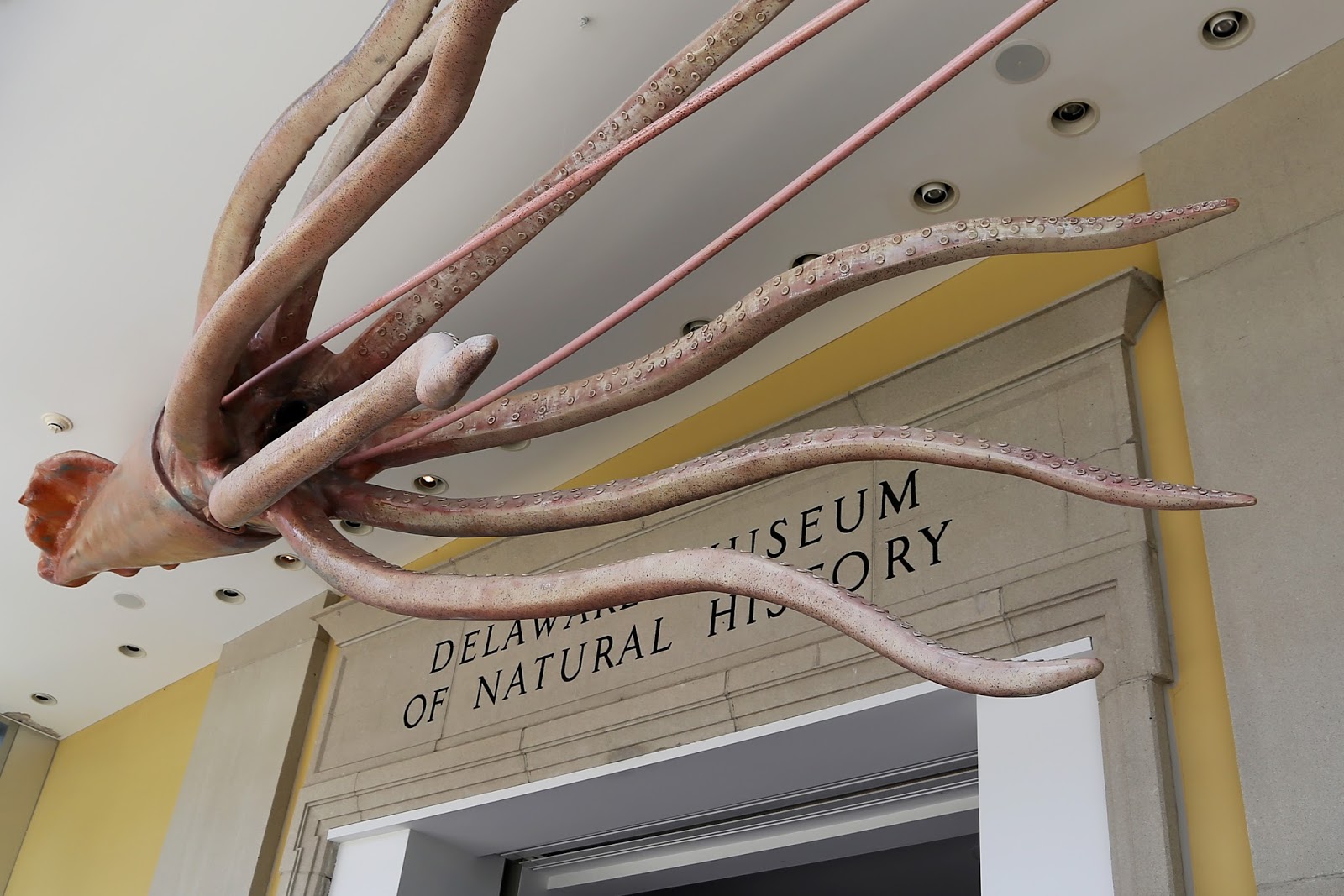
The Delaware Museum of Natural History

View Full Size Image
Image adapted from a photo by Jim, the Photographer. Original on Flickr.
(CC BY 2.0)

History
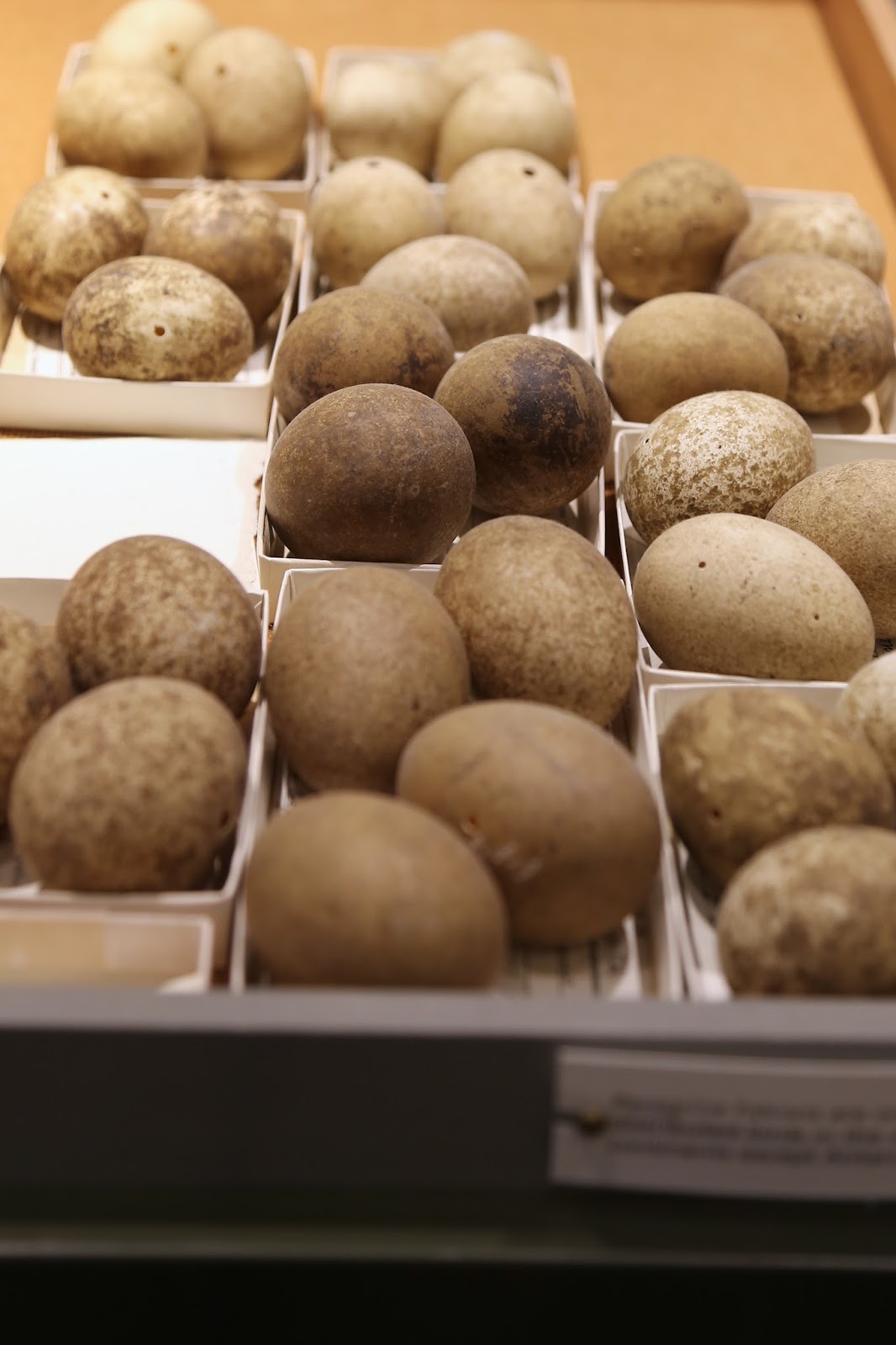
For over 40 years, the Delaware Museum of Natural History (DMNH) has promoted the study of nature, investigated the planet’s flora and fauna, and educated the public with its world-class collections, which are particularly rich in mollusks and birds (DMNH’s collection of bird eggs is the second-largest in North America).
View Full Size Image
“The Egg Collection”
Photo by Jim, the Photographer
on Flickr (CC BY 2.0)

Founded in 1957, the museum began as an idea in the mind of John duPont, heir to the DuPont Chemical fortune. An avid naturalist, duPont travelled the world and amassed a collection of 113,000 birds and 2 million seashells. He used a portion of land from his family’s estate to found the museum that houses his collections. It opened to the public in 1972.

Long after his involvement with DMNH had ended, duPont moved his attention to athletics. He used some of his fortune to open a training center for Olympic athletes on his sprawling estate in Pennsylvania. The athletes, trainers, and coaches who worked for him were known as Team Foxcatcher and enjoyed considerable success. As years went on, however, duPont’s behavior became increasingly erratic. His deterioration came to a head in January of 1996, when, for reasons unknown, he shot and killed his star wrestling coach, Olympic gold medalist Dave Schultz. This tragic story was (loosely) told in the 2014 film Foxcatcher.

Publications and Rare Books

Birds, shells, and mammals aren’t the only things that John duPont put in the DMNH; he also contributed a library with an excellent collection of rare books. DMNH recently contributed some of these books to BHL through the Expanding Access to Biodiversity Literature (EABL) project, which works with organizations across the U.S. to digitize unique and valuable material. The DMNH-contributed books include rare works from the 18th century and publications by the museum, including several works by duPont himself. Below are some highlights; the complete list can be found here and here.

1. Index testarvm conchyliorvm quae adservantvr in mvseo Nicolai Gvaltieri (1742)

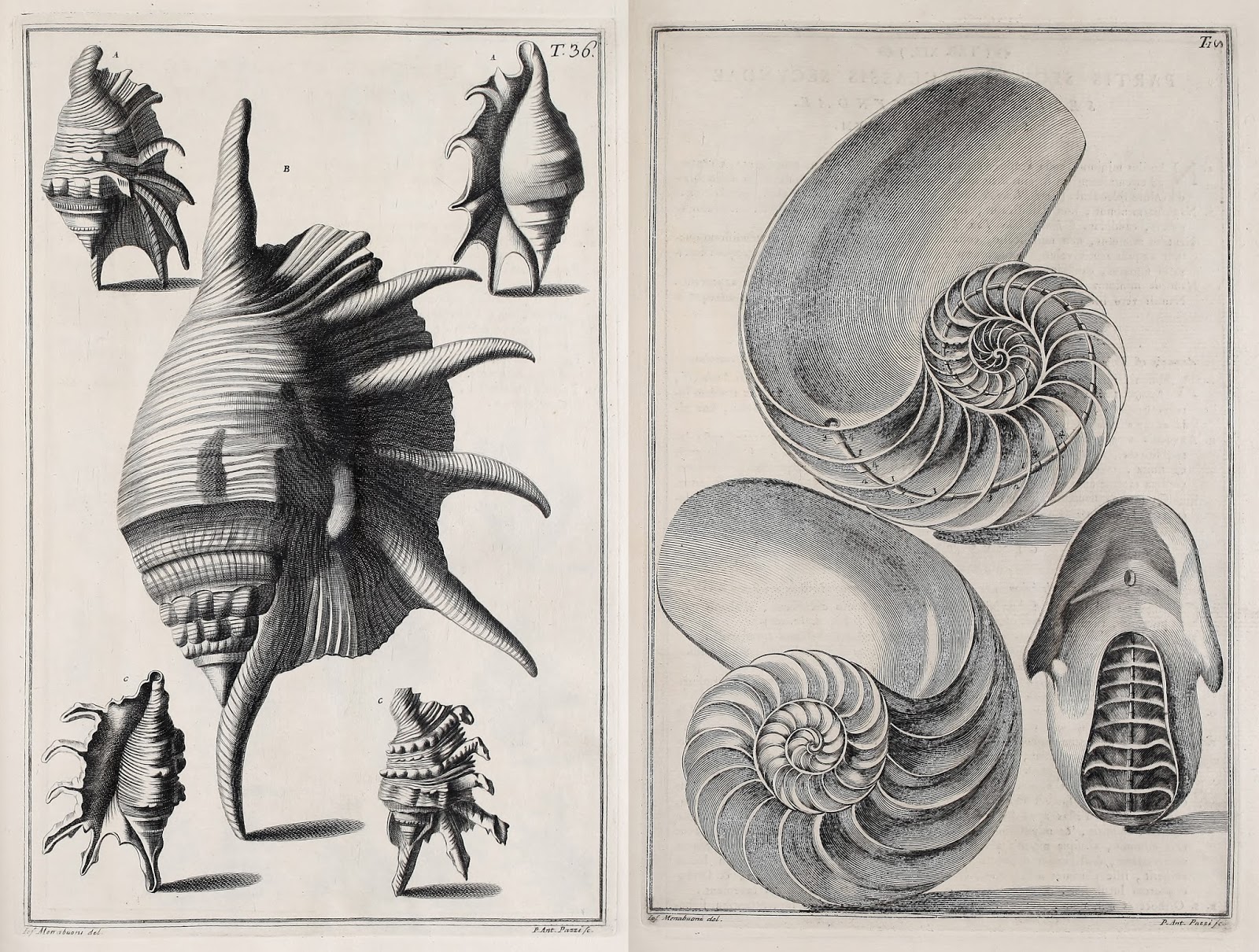
Niccolò Gualtieri was an Italian doctor, malacologist, and professor at the University of Pisa, whose collection of shells is the oldest in the university’s natural history museum. Particularly noteworthy in his Index testarvm conchyliorvm are his descriptions of argonauts, also called paper nautiluses.
View Full Size Image
Plates from Gualtieri’s Index: L: T.36, Conch shells (Strombidae);
R: T.18, Nautilus.

2. Woodpeckers of the World (Monograph Series No. 4, 1982)

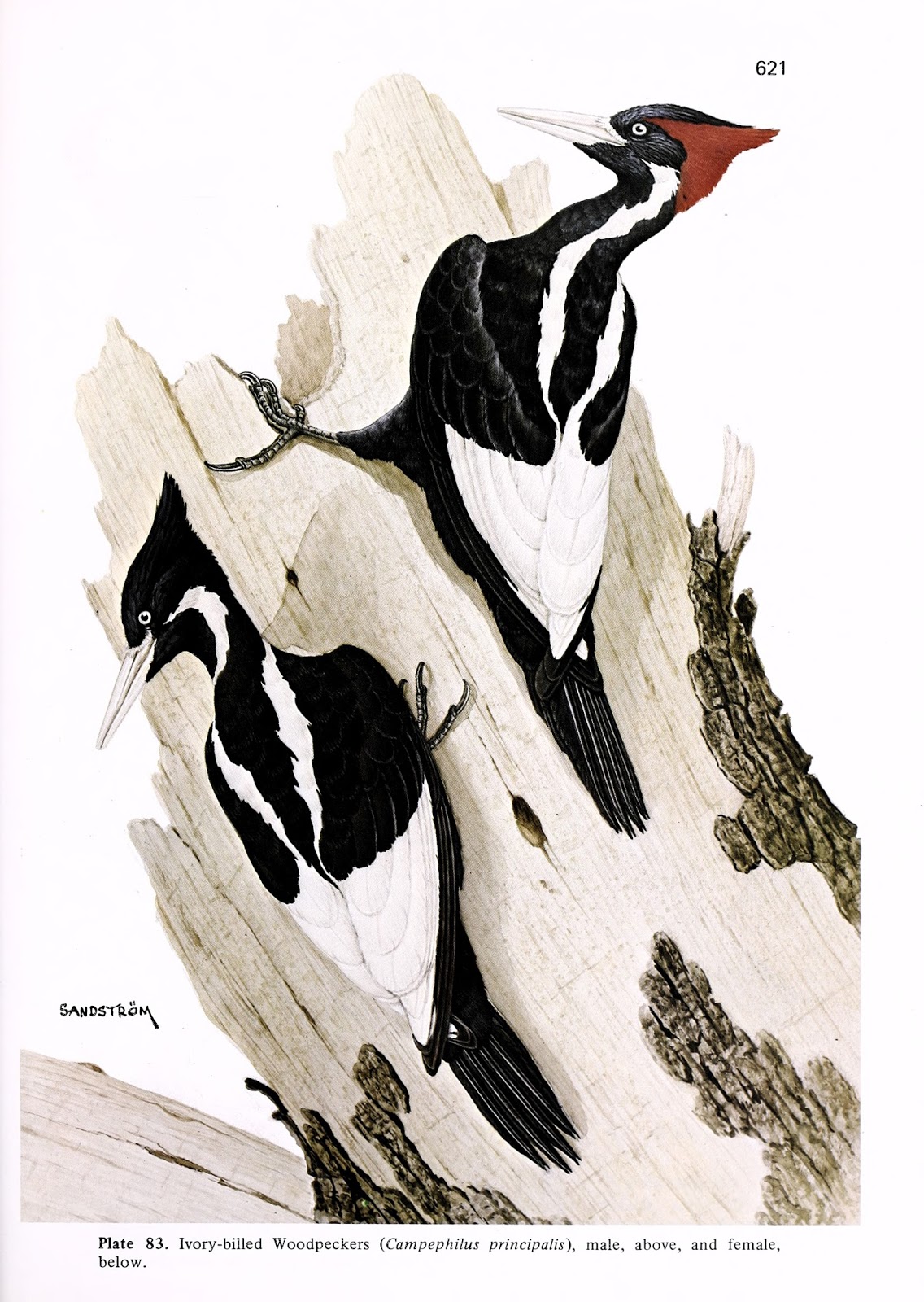
Lester L. Short, born in 1933, is one of the world’s foremost experts on woodpeckers (family Picidae). A former curator of birds at the American Museum of Natural History, Short travelled to over 60 countries documenting woodpeckers and in 1986 was one of the last people to see a Cuban Ivory-billed Woodpecker, Campephilus principalis bairdii, in the wild. The bird is now believed to be extinct.

Short’s Woodpeckers of the World was written with the encouragement and support of John duPont; in fact, duPont arranged for his illustrator, George Sandström, to work with Short to produce the 101 color plates in the book.
View Full Size Image
Ivory-billed Woodpeckers, illustrated by George Sandström.
From Woodpeckers of the World (1982), p. 621:
http://biodiversitylibrary.org/page/53631011

3. Philippine Birds (Monograph Series No. 2, 1971)

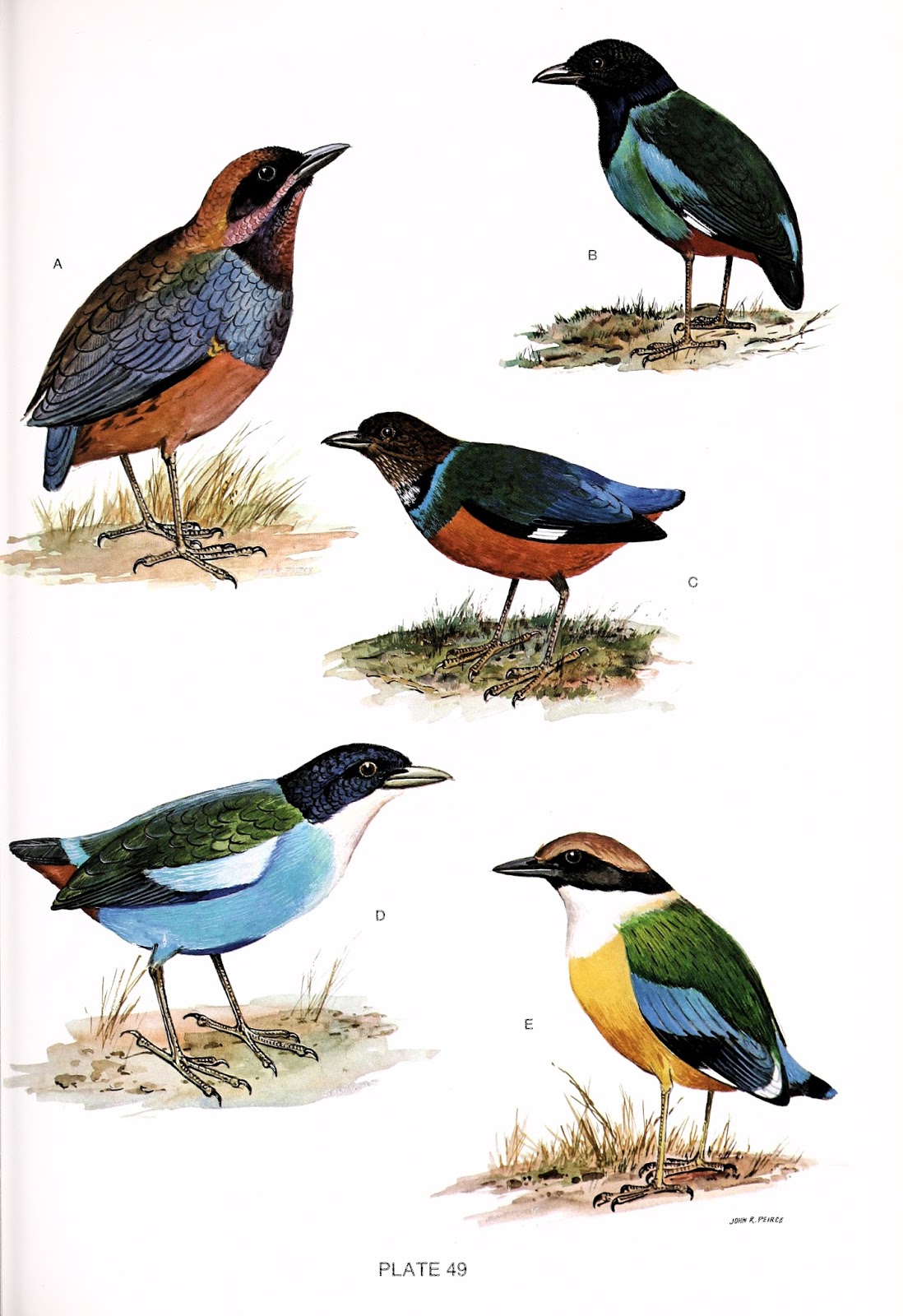
John duPont wrote this book based on his own expeditions to the Philippines, beginning in 1958. In the foreword to the book, ornithologist Dean Amadon writes that “anyone who knows John duPont will realize that, once in the islands, he heads for the nearest mountains and jungles: he is not one to dawdle about in the gardens of local officials.” Philippine Birds was written as an identification guide rather than a comprehensive work, with brief descriptions accompanying color illustrations by George Sandström.
View Full Size Image
Pittas (family Pittidae), illustrated by George Sandström.
From Philippine Birds (1971), plate 49:
http://biodiversitylibrary.org/page/53630110

Jean Woods, Curator of Birds at DMNH, worked with the EABL team to digitize these titles and get them into the BHL collection. Discussing the importance of putting them online, she said, “We’re excited to have the museum’s publications and rare books available through the Biodiversity Heritage Library to be used by researchers that have not previously had access to them.” She added that some of the titles, like Philippine Birds, have been out of print for years and that “many of the rare mollusk books contain original species descriptions which continue to be essential for taxonomic work.”

We are grateful to Jean and to the Delaware Museum of Natural History for so generously sharing their wealth of publications and rare books with the BHL community.

References
About us. (n.d.). Retrieved from http://www.delmnh.org/about-us-2/
Eckholm, E. (1986, May 5). Woodpecker, believed extinct, seen in Cuba. The New York Times. Retrieved from http://www.nytimes.com/1986/05/05/us/woodpecker-believed-extinct-seen-in-cuba.html
Longman, J. (2010, December 9). John E. du Pont, heir who killed an Olympian, dies at 72. The New York Times. Retrieved from http://www.nytimes.com/2010/12/10/sports/olympics/10dupont.html?_r=0
Niccolò Gualtieri’s splendid seashells. (2016, August 26). Retrieved from http://www.italianways.com/niccolo-gualtieris-splendid-seashells/
August 17, 2017by [email protected]
Blog Reel, Featured Books

Documenting Scientific Knowledge One Handwritten Note at a Time

Connecting Content: The Wonderful World of Field Books

The California Academy of Sciences and our partners (all of whom are also BHL member institutions) are in the midst of a 3 year IMLS National Leadership Grant titled “Connecting Content: A Collaboration to Link Field Notes to Specimens and Published Literature.” This project aims to digitize published scientific findings, their related field books and specimens, and metadata for these items, link all of these resources, and make them available for harvesting, reuse, and repurposing without cost. At this point, the bulk of the field books selected for this project have been digitized and made available through the Biodiversity Heritage Library. (*You can see the sixty-one titles digitized for this project by searching for “Connecting Content” in the BHL search box.) You can download a selection of these field book for free via the latest BHL iTunes U Collection: Connecting Content through Archival Field Notes.

Field books (or field notes) are the original documents which chronicle specimen collection and the events and observations that led to scientific discovery.  Field books are unique unto the creator and vary greatly from book to book. Here are a selection of highlights from the collection which demonstrate the wealth of information and styles found throughout the selection of field books:

William Whitman Bailey and the USGS Exploration of the 40th Parallel

View Full Size Image
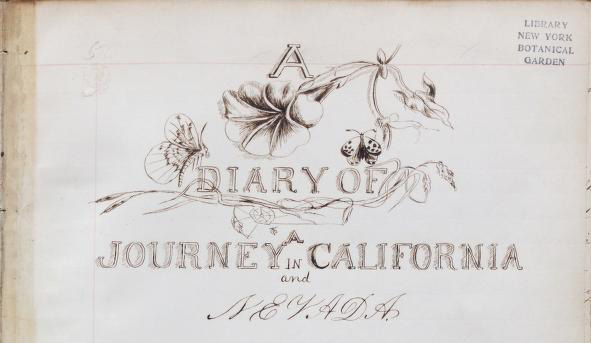
Page One. A diary of a journey in California and Nevada. William Whitman Bailey.


View Full Size Image
Portuguese Man of War. Bailey.
View Full Size Image
Riccinus communis. Bailey.

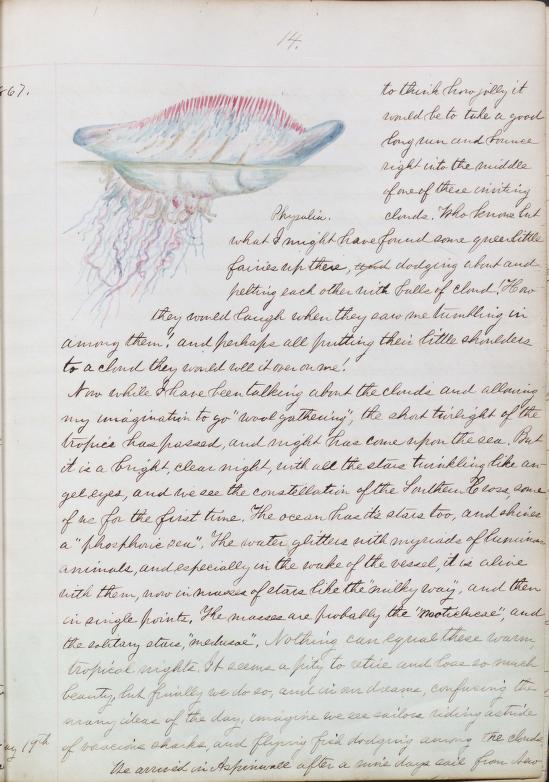
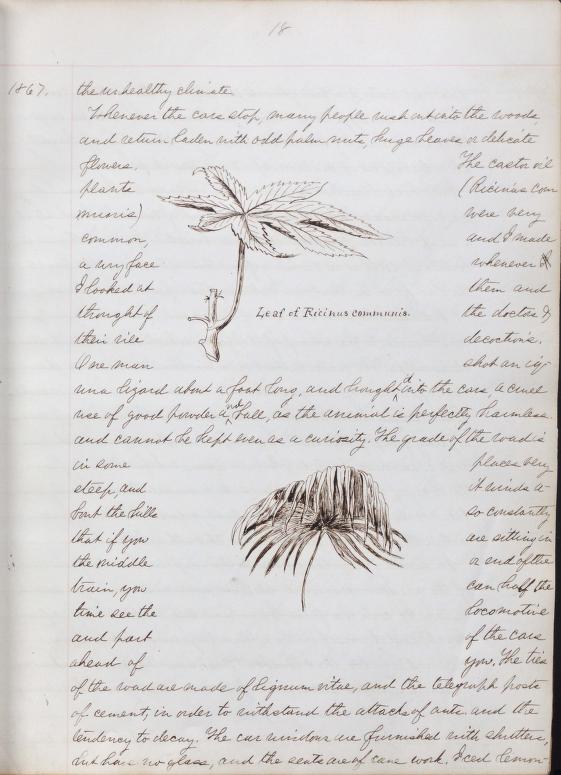
William Whitman Bailey’s life story reads like a blockbuster movie plot. When young William was just nine years old, he and his family took an ill fated boat trip aboard the 198 foot side-wheeler, the Henry Clay. On this fateful day, the Henry Clay was involved in a minor collision with another vessel, but pressed onwards as it seemed that the ship has sustained little damage. However, about an hour outside of its final New York destination, the ship beached itself on shore near Yonkers as a result of a fire that had been burning unnoticed since the collision. The lucky passengers on the bow of the ship were either thrown or able to jump onto land, but the Baileys were not so fortunate. Separated from land by 140 feet of water and a wall of fire, the Baileys had no choice but to jump into the water as the fire approached. William’s mother and sister succumbed to the depths and his father barely survived. William managed to grab hold of a floating wicker chair and was eventually picked up by a passing ship, but the experience would leave him with permanent health problems.

However, this tragic setback did not lessen Bailey’s enthusiasm for adventure and curiosity about the natural world. Bailey would eventually study under Dr. Asa Gray at Harvard University and at 24 years old, he became the botanist for the United States Geological Exploration of the 40th Parallel. The field book for this expedition chronicles Bailey’s journey through California and Nevada in a flowing prosaic style with beautiful illustrations and photographs of Bailey’s observations. The very first page of Bailey’s journal opens with a beautiful demonstration of his illustrative pen and ink style. Bailey’s rich descriptions are paired with exquisite drawings that seem to jump off the page whether he is waxing poetic about the Portuguese Man of War or closely observing the leaf of the Riccinus communis. Bailey’s flowing narrative style and gorgeous illustrations make this field book a charming and informative look at the exploration of the 40th parallel that will surely captivate readers.

Washington H. Ochsner and the Galapagos Islands


View Full Size Image
Charles Island. Ochsner.

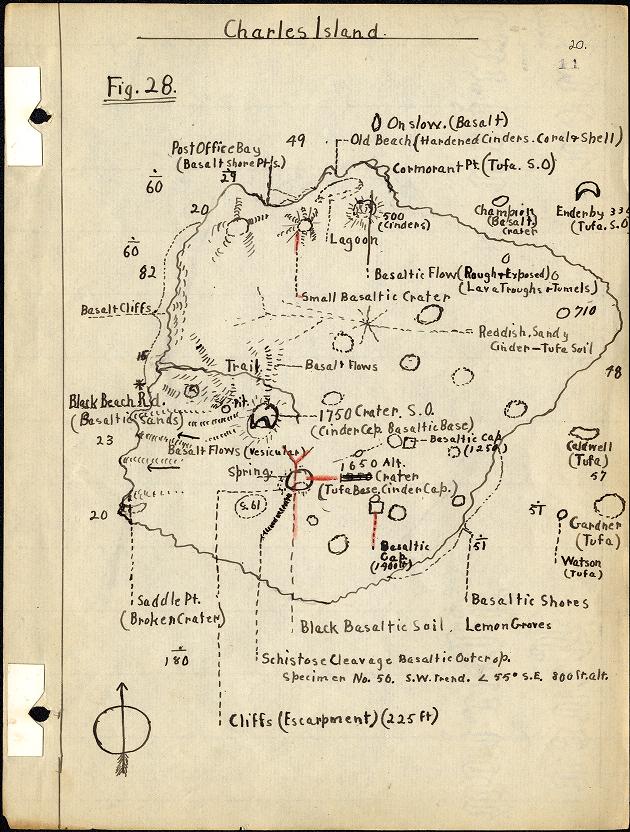
In 1905, the California Academy of Sciences sent 11 men off for a year and a day on an eighty-five foot schooner destined for the Galapagos Islands. While the expedition was underway, the California Academy of Sciences would fall into ruin during the great San Francisco earthquake of 1906. The specimens gathered during the Galapagos expedition would come to form the crux of the new California Academy of Sciences’ collections. Of the young men on that voyage, 26 year-old Washington Henry Ochsner travelled as the expedition’s geologist. His journals are more technical than Bailey’s in what they intended to capture and often included geological survey information, as well as inferences about how the geological features were formed. Ochsner also drew detailed surveys of the island terrains like this map of Charles Island. Ochsner’s field books have a scientifically focused structure and tend to be not-so-much a diary but a close and careful record of his scientific observations.

The Diaries of William Brewster, 1865- 1919

View Full Size Image
Eggs and Nests. Brewster.

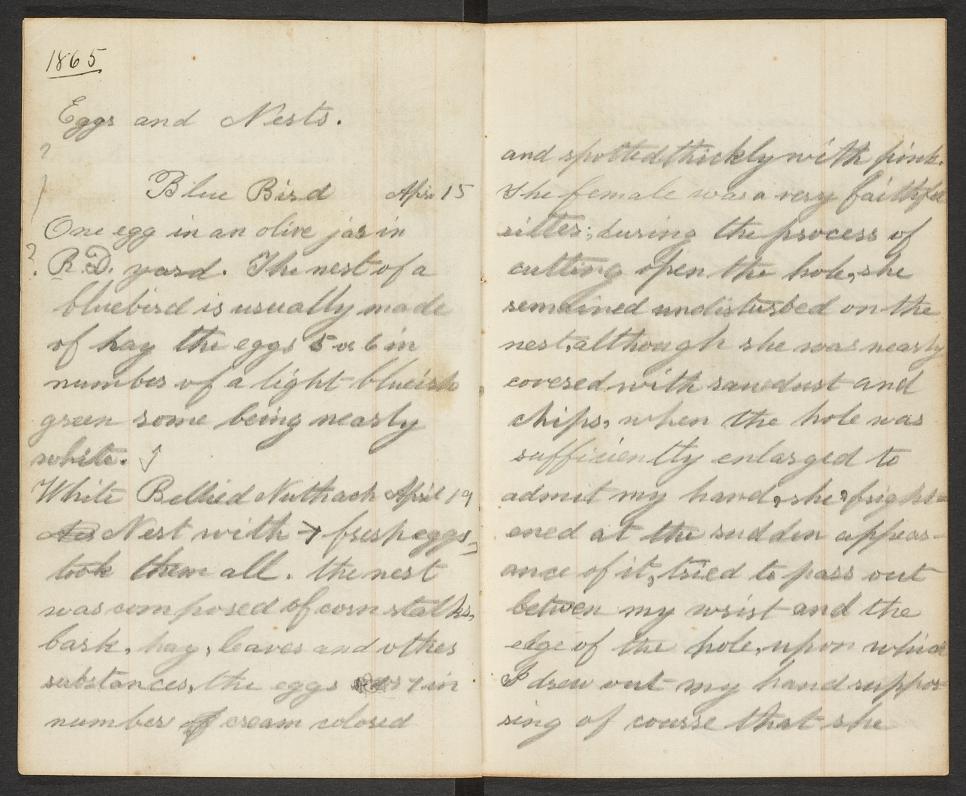
Renowned ornithologist William Brewster mused over his daily observations in a personal and often humorous way. William Brewster’s love of ornithology blossomed early, and he kept careful records of the birds he observed throughout his life. These journals begin when Brewster was 14 years old, and it is interesting to see how his hand, knowledge, and confidence all develop over time.  In his later journals, Brewster takes care to write in a colloquial manner, and these notes provide unique insight into the daily life of a researcher over a 54 year span. This collection of journals also provide an enticing perspective on the detrimental changes to the environment and bird populations as a result of industrialization and the growth of urban centers.

All of the field books digitized for the Connecting Content project offer inimitable insight into how scientific data is gathered, synthesized, and extrapolated. It is the hope that by sharing these unique resources, researchers can better understand scientific findings and that the insights gained from this will promote further inquiry and the spirit of discovery.

Want more Field Book Content?

View 61 field books digitized by the Connecting Content grant in BHL

Download a selection of these books for free on iTunes U

Find out more about the link between expeditions, field books, and publications in our previous blog posts with Smithsonian’s Field Book Project: Post One | Post Two | Post Three

May 9, 2013by Kathryn Stine
Blog Reel, Featured Books

Our Little Town

View Full Size Image
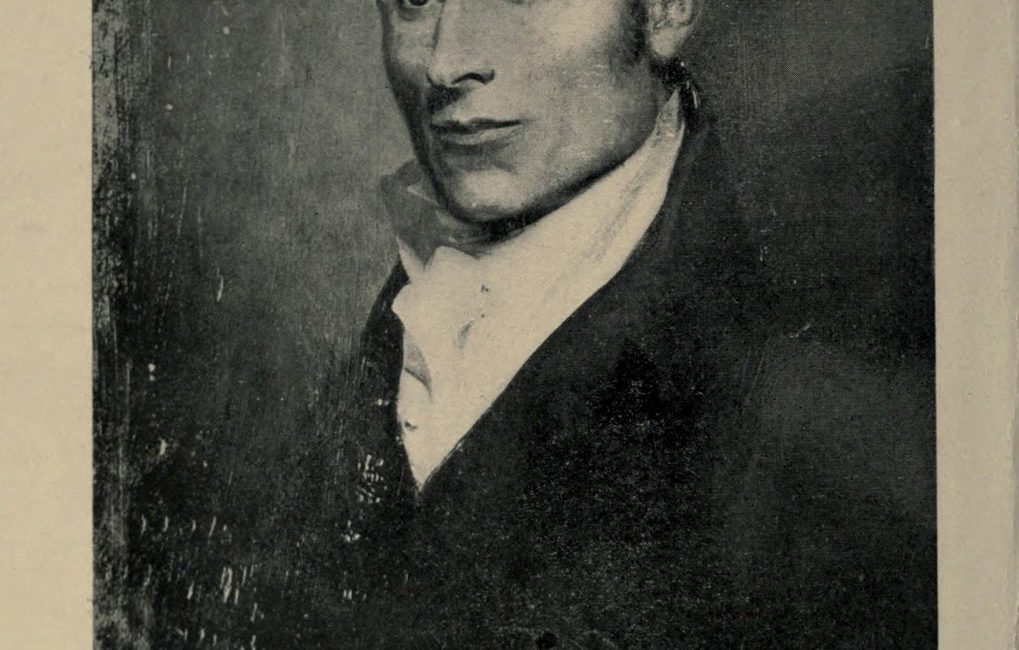
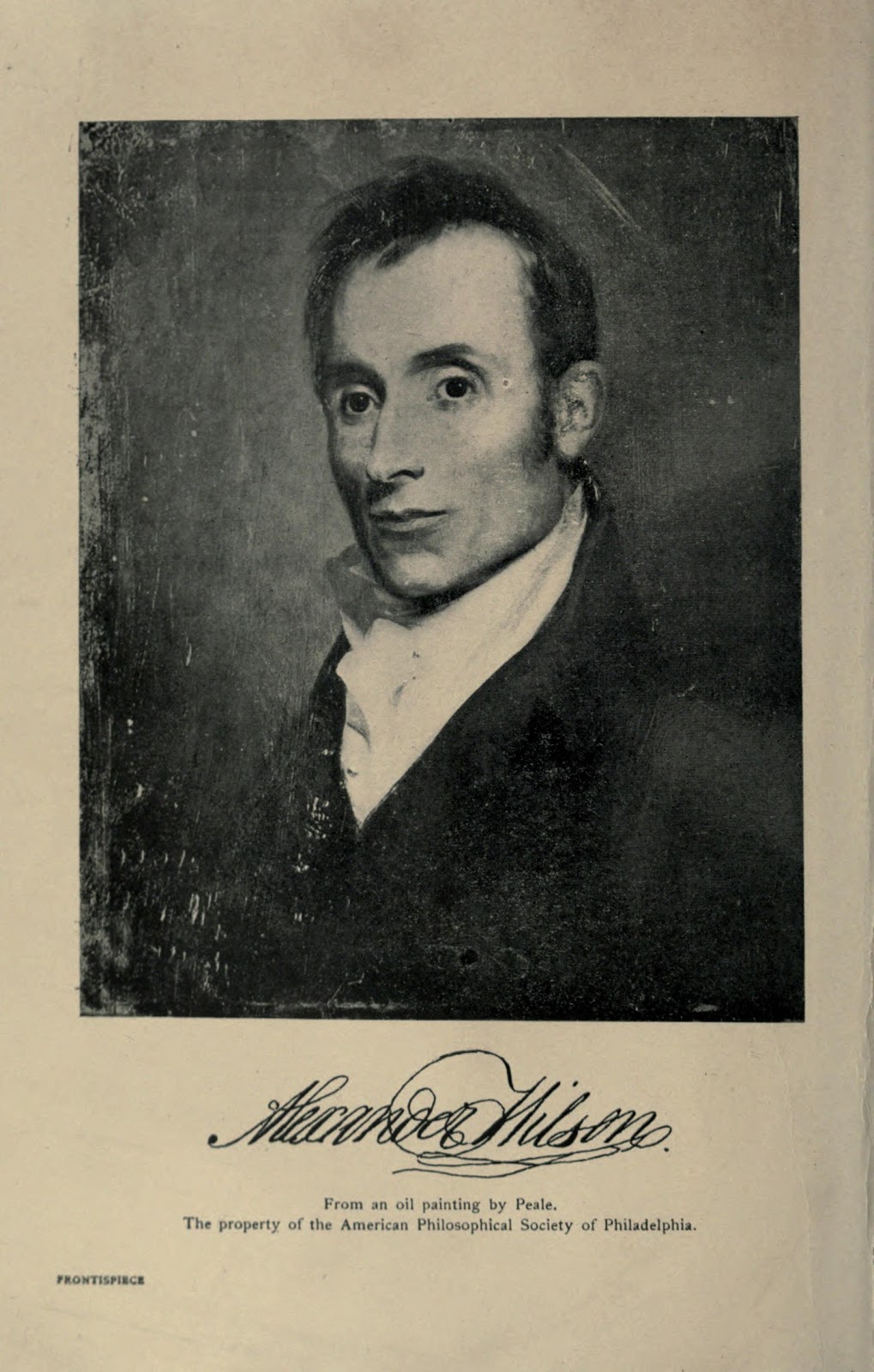
Alexander Wilson

It’s almost a year now since we moved to Bloomfield, and I’m still not over my disappointment at our new New Jersey home’s failure to honor its most distinguished citizen. Not a statue, not a plaque to be found anywhere; and that short boulevard leading to the cemetery turns out, alas, to be named for Woodrow.

Alexander Wilson, the Father of American Ornithology, served as schoolmaster in our little town for a few months in 1801. Wilson’s teaching in Bloomfield was “spirit-sinking, laborious work,” and he doesn’t seem to have found much intellectual stimulus outside the classroom either, complaining in a poem dated August 7 that:

Here bull-headed Ignorance gapes and is courted,
And pale Superstition with visage distorted.
Sweet Science and Truth, while these monsters they cherish,
Like the Babes of the Wood are abandoned to perish.

Wilson got out as soon as he could, and by February 1802 he was back among the sophisticates of Philadelphia.

-*-*-*-

If only he’d managed to stick around.

View Full Size Image

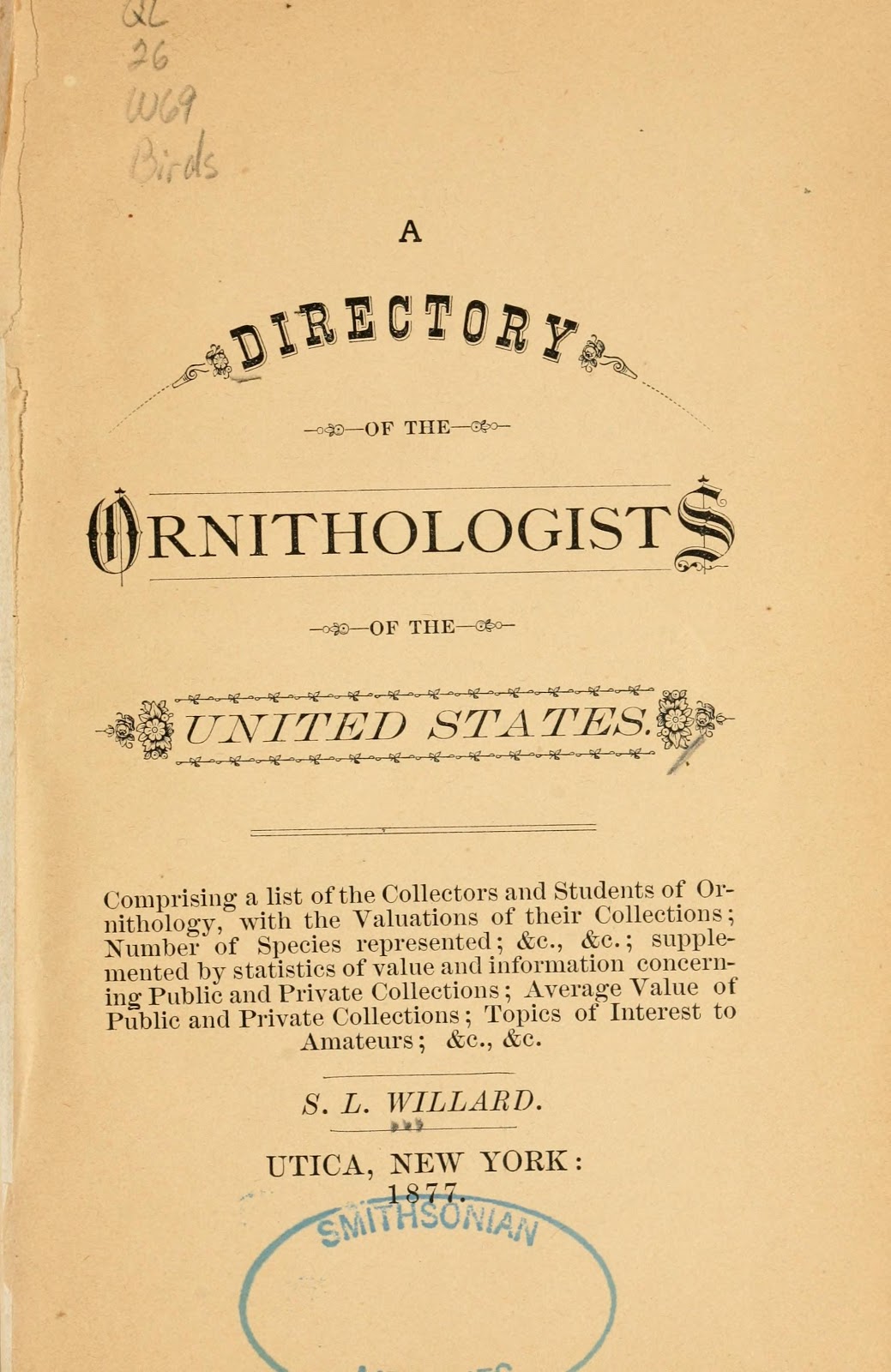
By 1877—sixty-four years after Wilson’s untimely death 200 years ago this August—Bloomfield was a veritable hotbed of ornithological activity. Of the 21 New Jersey amateurs listed in Willard’s Directory of the Ornithologists of the United States, no fewer than four give Bloomfield as their mailing address.

View Full Size Image
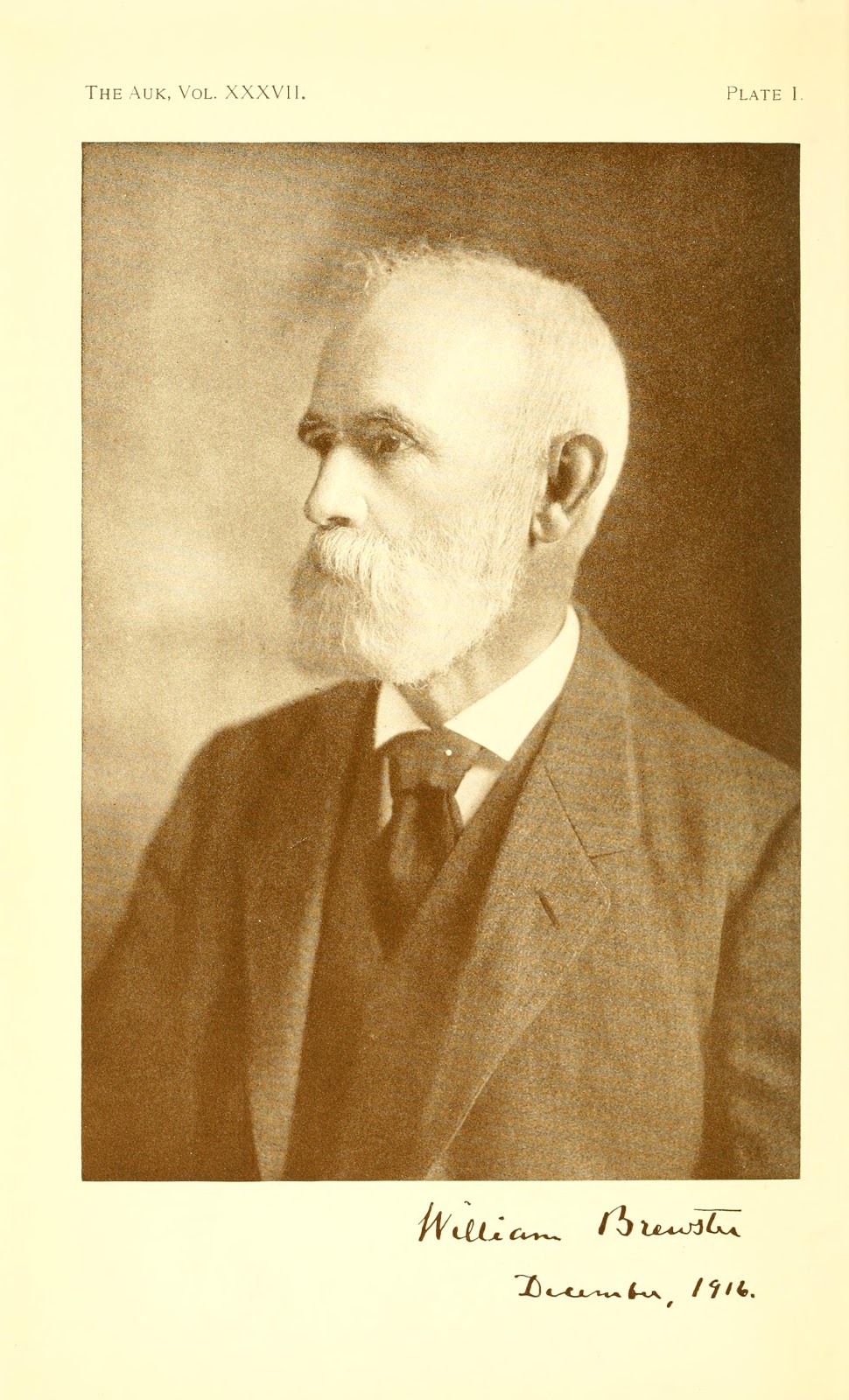
William Brewster

All four, admittedly, were small-time collectors.

Up in Cambridge, William Brewster’s personal holdings that year comprised 6500 specimens, valued at the enormous sum of $5000. Here in Bloomfield, our colleagues had much smaller collections, each of them containing just a few dozen eggs and none of them worth more than $20.

The largest collection in our little town, that belonging to J.L. Adams, held 75 eggs; that makes the average specimen worth a little more than a quarter, the going price a few years later for the shell of a Black Skimmer or a Loggerhead Shrike. The smaller cabinets of Henry D. Davenport, Wm. F. Day, and E.C. Farrand were just as modest, with the average value per egg between twenty and twenty-five cents.

View Full Size Image
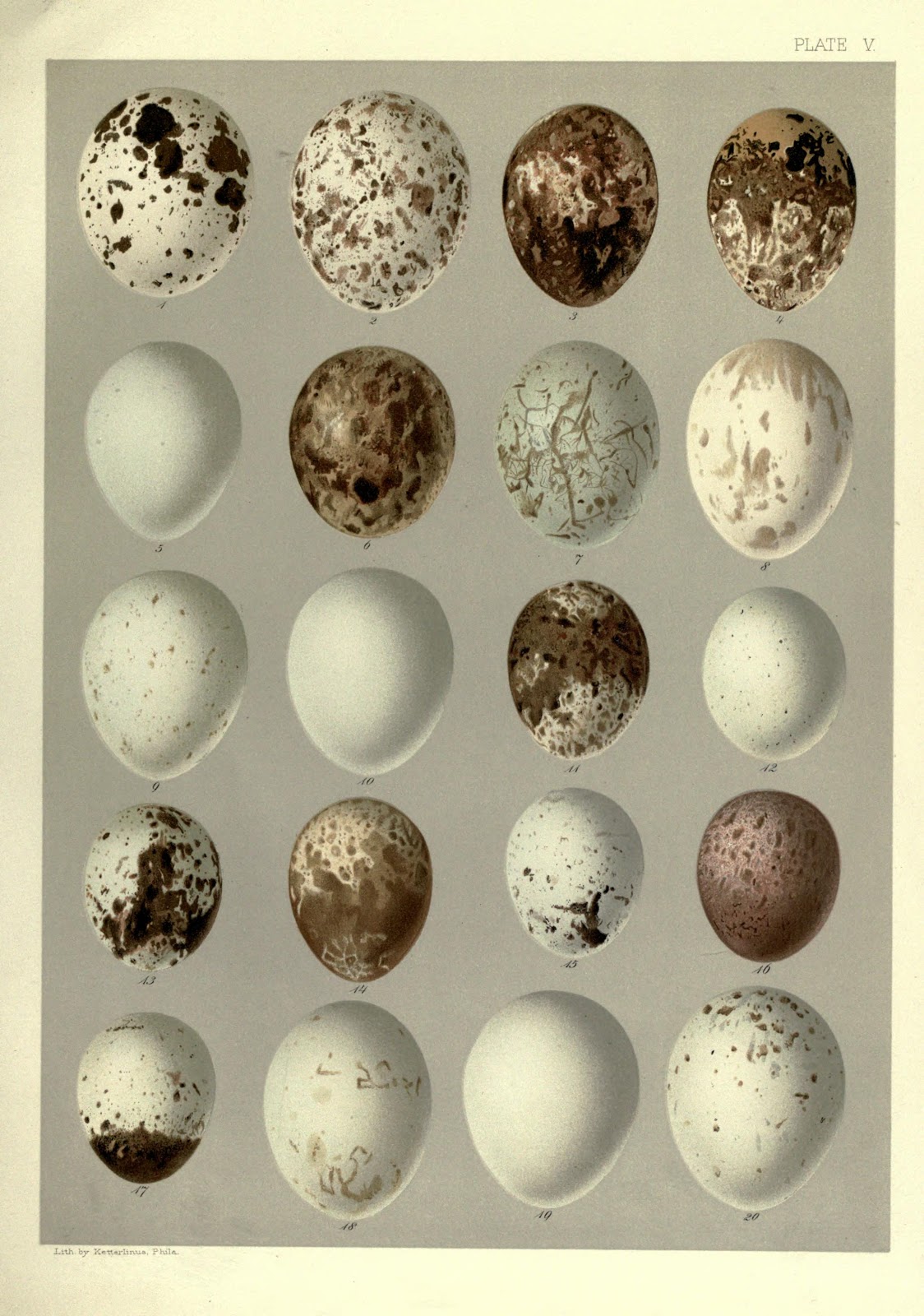
Egg plate by John Ridgway from Bendire’s Life Histories

-*-*-*-

None of these Bloomfield Four seems to have left more than a trace in the written record of American birding and ornithology. Their reticence was more than made up for by Bloomfield’s leading ornithologist a generation later, Louis Slidell Kohler.

Kohler’s family was living in Bloomfield by the early 1890s; he seems to have divided his final years—starting around 1919—between Hawthorne and a farm near Paterson, where he died sometime after 1926.

Kohler began his bird studies in Bloomfield, exploring a twenty-acre farm near his house that he called “The Haunt.” He applied for membership in the Cooper Ornithological Club in 1909, and was elected an associate member of the American Ornithologists’ Union in 1910. His notes, lists, and essays appeared over the years in the Auk, the Wilson Bulletin, and the Oologist. Unlike the earlier Bloomfieldians, and refreshing for his generation, Kohler does not seem to have been much of a collector; his published articles report on the birds observed—not shot and stuffed—on his “jaunts” and “tramps” through what was still the countryside of northern New Jersey.

View Full Size Image
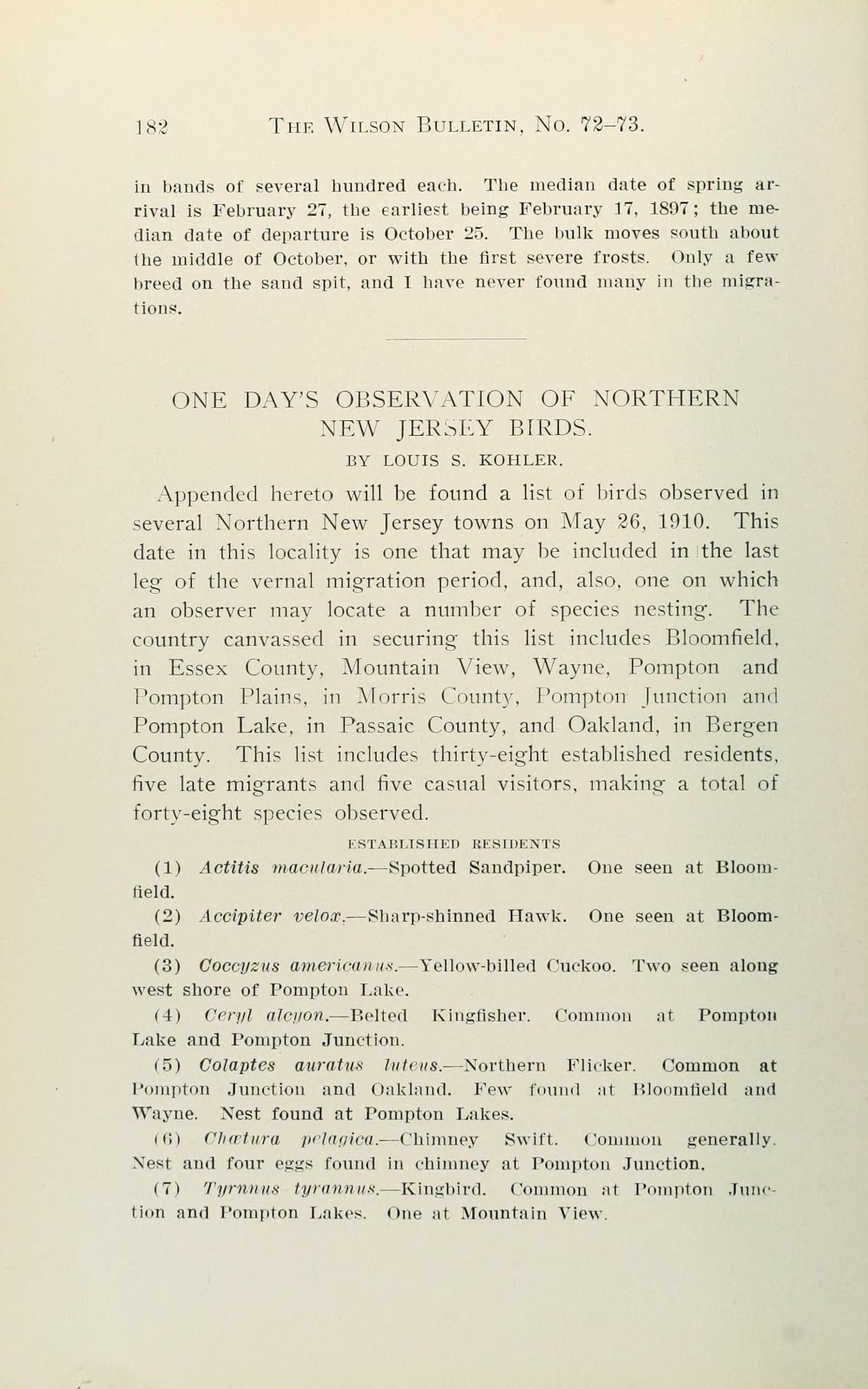
Kohler’s observations in The Wilson Bulletin

Kohler’s publications include documentation of range expansions, winter irruptions, and notable migration events. Like most of us, he made the occasional error, as when he reported the nest of a Wilson’s Warbler in New Jersey—dismissed, almost certainly correctly, by the editor of the Auk as “a case of mistaken identity.”

-*-*-*-

View Full Size Image
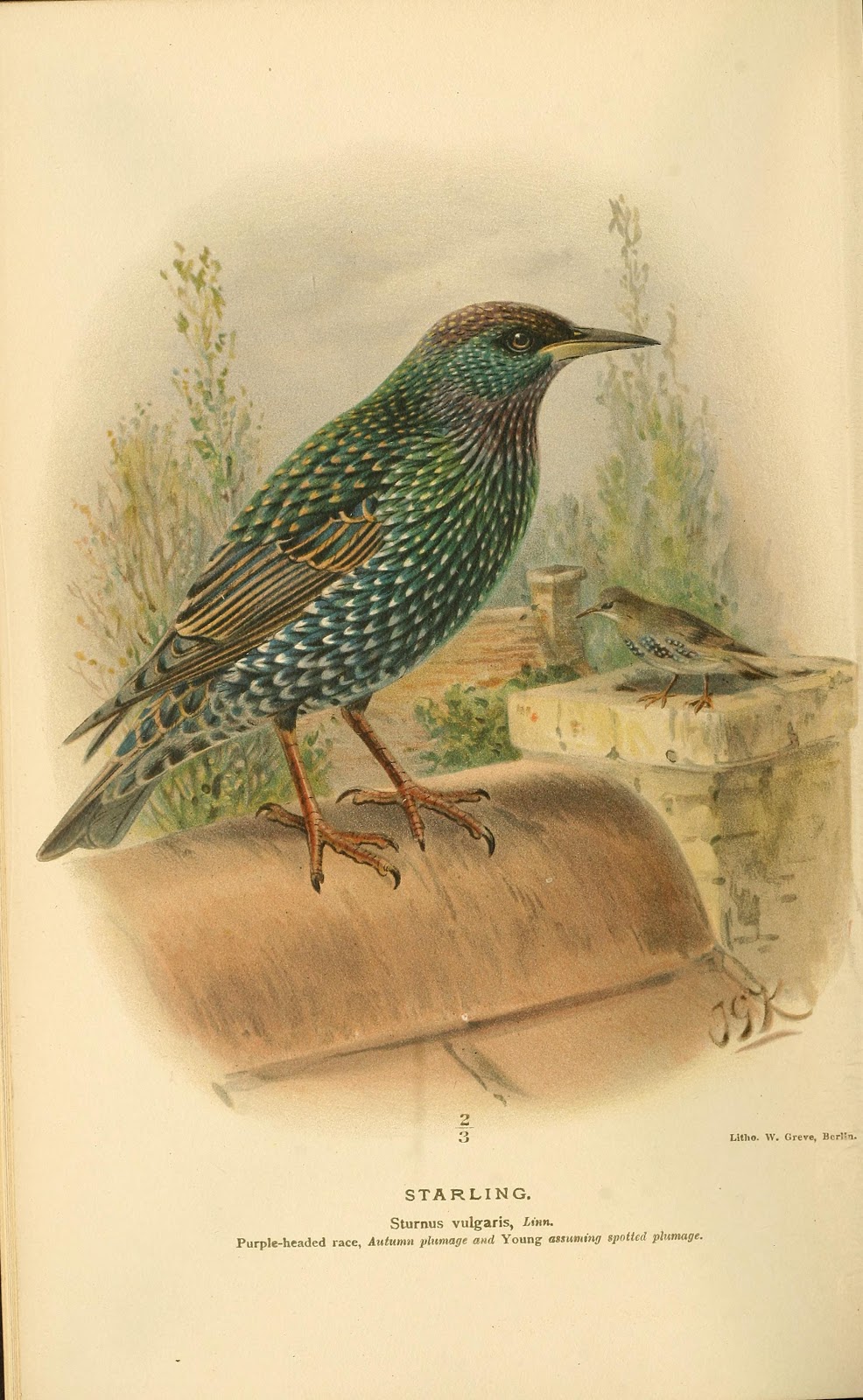
Starling

In the spring of 1903, Louis Kohler put Bloomfield firmly on the ornithological map with his sighting of a flock of fifteen European Starlings “in the neighborhood of a refuse pile on a farm”—probably “The Haunt.” The birds lingered until July, conspicuous for “their odd gyrations while in the air and methods of alighting on the ground.” When the flock returned the following March, it had grown to 200 birds, which soon “broke up into pairs and began seeing nesting places…. in cupolas, on station poles of the telephone companies and in deserted woodpecker nest holes.” Soon enough, starlings were ejecting Northern Flickers, Eastern Bluebirds, and other birds from their nests, and Kohler was “almost convinced that the time is not far off when they will become as obnoxious as the omnipresent [House Sparrow] is to us now.”

He was right.

In August 1911, Robert Barbour—himself a member of the Cooper Club and of the AOU—described in the pages of the New York Times a flock of 60,000 starlings, House Sparrows, Common Grackles, and American Robins roosting on Bloomfield Avenue just across the Montclair line.

What with the excrement of the birds, the feathers that they shed, and the leaves that they dislodged, sidewalks and piazza steps would be like a poultry yard or worse. The odor, I am told, at times made it unpleasant to use the piazzas in the evening, and those going out in the evening found it desirable to walk in the middle of the street in the interest of personal cleanliness.

Violence was inevitable. On August 30, Peter Stevens, “was arraigned before Justice of the Peace Cadmus of Bloomfield, [for] shooting five starlings” two weeks earlier. The charges had been brought by State Game Warden Frederick J. Hall of Bloomfield, and the City of Montclair wasted no time in issuing a formal denial that it had in any way authorized the shootings. Stevens, “a colored man in the employ of the Montclair Street Department,” was fined the exorbitant sum of $100—$20 a bird. Stevens could not pay, and was jailed for two days.

To its great credit, Montclair stepped up at the end of those two days and filed an appeal on Stevens’s behalf, arguing that the confession he signed had been obtained in an “irregular” fashion. How the case was concluded, and how the dynamics of race, social standing, and urban rivalry were finally played out, I do not know. Montclair swore to take its defense of Stevens to the Supreme Court if necessary, though public opinion was clearly against him, as shown by the scores of letters from all parts of New Jersey asking that the persons responsible for the killing of the birds be prosecuted to the full extent of the law.

View Full Size Image
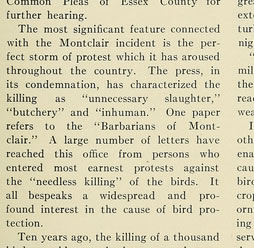
Pearson on Peter Stevens’s Starlings

Gilbert Pearson, reviewing the matter in Bird Lore, took satisfaction in the affair as evidence of the rapidly increasing refinement of sentiment that comes with advancing civilization. It is a most positive fact that, the more cultured the community, the greater the esteem in which the wild bird is held.

Even starlings.

-*-*-*-

It’s easy to feel like a pioneer in a new place, as if everything new to us is, simply, new. How much richer the experience of novelty, though, when we realize that there is a past behind us, a past inhabited by the rightly famous, the nearly unknown, and the unjustly notorious. That is just the sort of knowledge that can help make any little town into our little town.

We hope you enjoyed this post. Interested in guest-blogging for BHL? We’d love that! Natural history, biodiversity and conservation topics are especially welcomed. Email us your ideas at [email protected].

February 7, 2013by ulib-libraryjobs
Blog Reel, User Stories

Honoring the Man Who Revolutionized Bird Identification

Portrait version of the Biodiversity Heritage Library logo.
A Celebration of Chester A. Reed on the 100th Anniversary of his Death


View Full Size Image
Michel Chevalier

In the early 1930s, the name of Chester A. Reed was known to all amateur and professional ornithologists in the United States and Canada. Today, there are few who remember him. And yet, he was the first to develop the concept of the “Field Guide ” by publishing his Bird Guide Part 2, Land Birds East of the Rockies (1905)*, which presented for  the  first time colored illustrations of birds in a small format book convenient for use in the field (3 X 5 ½ inches).

Reed’s most prominent publication, Bird Guide Part 2 revolutionized the art of bird identification in the field and directly contributed to public education about identification practices. Following the success of this publication, several other identification guides were published, including the first color “Field Guide” to wild plants in 1907 and, in 1911, with the collaboration of S. Bowdish Beecher, the first color “Field Guide” of the Audubon Society of New Jersey – Guide to the Birds of New Jersey.

View Full Size Image
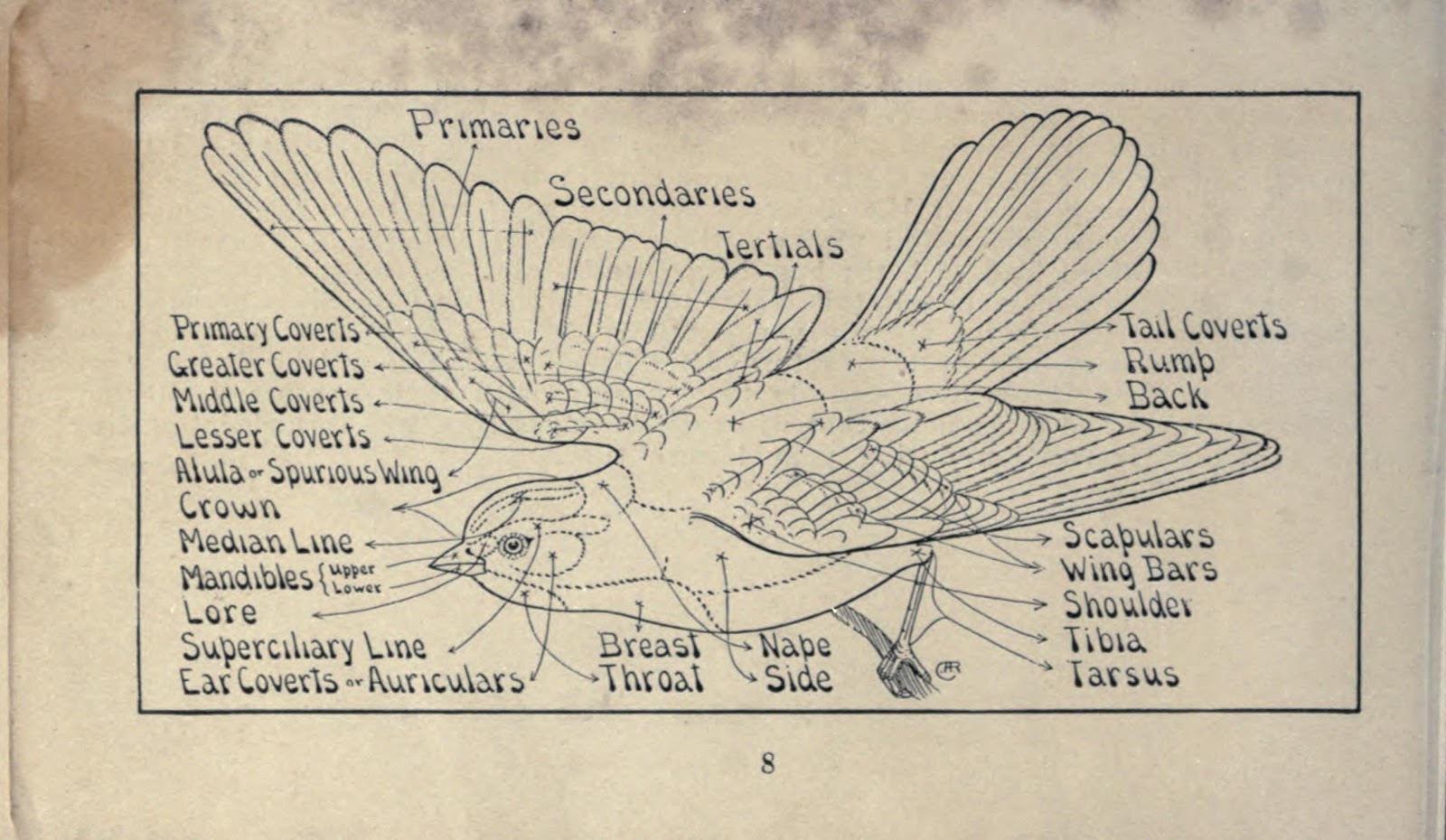
Diagram of a bird, from Bird Guide Part 2

Reed’s publication history extends significantly beyond his renowned field guides. Between 1901 and 1906, Chester published 67 issues of the magazine American Ornithology, for Home and School. This journal was dedicated to the education and conservation of birds. Between 1903 and 1912, he published 24 books mainly on the topic of ornithology.

View Full Size Image
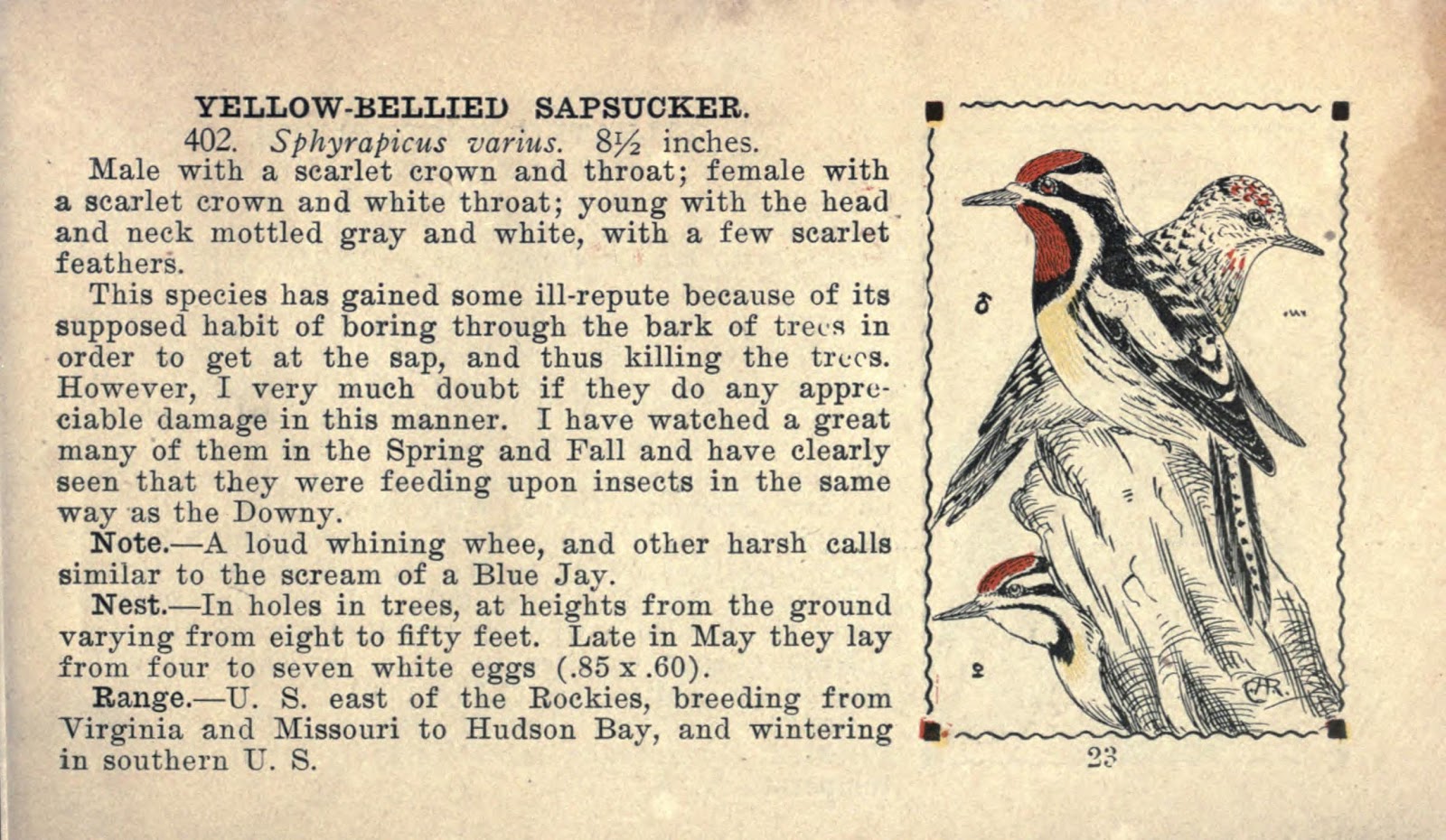
The Yellow-Bellied Sapsucker, in Bird Guide Part 2

One hundred years ago today (on December 16, 1912), at the age of 36 and five days after contracting pneumonia, Chester died. At that time, he was planning the trip of his dreams in Amazonia. Fate decided otherwise.

It was not until 22 years after his death that another talented illustrator adopted his format and improved on it, thus enabling a new generation of fans to indulge their favorite hobby. Roger T. Peterson was introduced to birding through Chester’s books and the publication of his Field Guide to the Bird in 1934 became a new source of inspiration for future authors of ornithology.

View Full Size Image
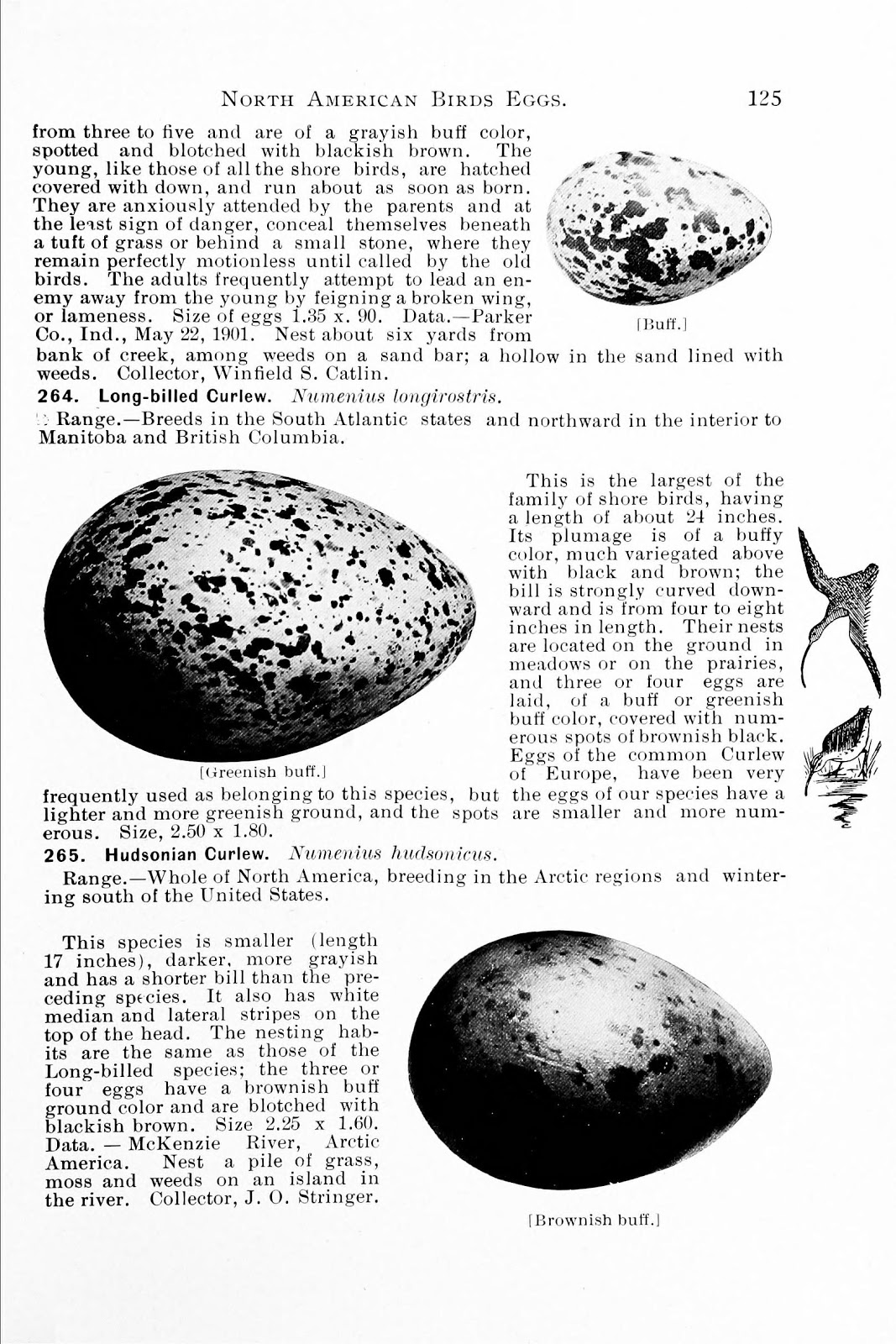
Sandpiper and Curlew Eggs

My interest in Chester A. Reed began in 2009. I wanted to pay tribute via a web project to the publication of his book North American Birds Eggs in 1904. I soon realized that there was no information on his life history and even institutions and historians were at an impasse on his personal life.

My research on Reed lasted 2 ½ years. I enlisted the help of many individuals, notably Mrs. Jean Mayo (specialist in genealogy) who enabled me to discover what history had forgotten. She helped me track down one of the last descendants of the Reed family. Mrs. Gail Berkshire had preserved the family history, and she allowed me access to his archives.

The generosity of Mrs. Berkshire has allowed me to trace a large part of the personal life of Chester, including a better understanding of the close relationship between Chester and his father Charles K. Reed, who was the publisher of all his books. This relationship earned him a great reputation amongst the birders of his time.

I could not keep this information to myself. I had to share this history and was motivated to create a website devoted to his biography and that of his father and mother. I wanted to make the experience others have of his life similar to a visit to a museum. Thus, at the end of each webpage, I present a little slideshow that allows visitors to view some of the archival material which I used in this research (see an example here-must have a Swiff player on your desktop to view).

View Full Size Image
First ad for Bird Guide pt. 2

The website also includes a Gallery section, which presents several of Reed’s illustrations which have never been published before. For instance, there you will find the first advertisement for the “Bird Guide” published in 1905.  All this valuable information has been preserved for over 100 years by the Reed family.

For the first time, all of the 34 books published by Chester and his father have been documented via this website. Each book has its own story and allows us to follow the evolution of this great pioneer of ornithological literature from the early 20th century.

The Biodiversity Heritage Library (BHL) has many of the books published by Chester A. Reed and his father Charles K. Reed. This is the only collection in digital format available on the Web. It will allow many people to become familiar with his work and discover a teacher whose passion for his research is as obvious today as it was 100 years ago.

The life of Chester A. Reed has long been a mystery to historians. Thanks to the research now presented on the Chester Reed website, this is no longer the case. His work played an important role in the history of recreational ornithology in America. He should not be forgotten.


December 16, 2012by ulib-libraryjobs
Blog Reel, Featured Books

Book of the Week: Birds and Their Nests

View Full Size Image

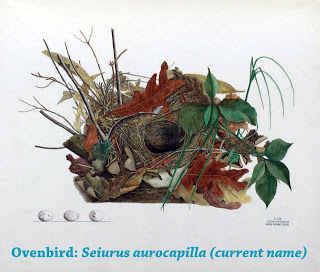
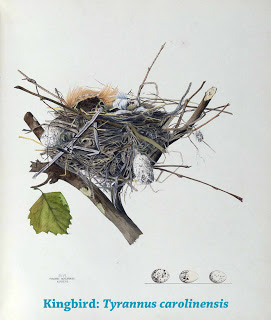
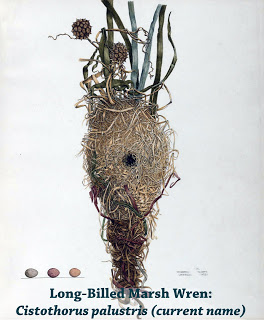
Have you ever been out and about, enjoying the beauty of nature, looked up in a tree, noticed a bird’s nest, and wondered what species of bird made the nest? If so, and if you happen to live in Ohio, or somewhere close to it, we’ve got the book for you: Illustrations of the Nests and Eggs of Birds of Ohio (1886), v.1–2, text by Howard Jones and illustrations by a variety of artists, including Miss Genevieve Estelle Jones, Miss Eliza J. Schulze, Mrs. N. E. Jones, Miss Nellie D. Jacob, Miss Josephine Klippart and Miss Kate Gephart. What really struck us about this book was the charming nature of the illustrations. And after reading the preface, it became quite clear that obtaining these illustrations for the work was no easy task.

View Full Size Image

In 1877, Genevieve Jones decided to create a series of plates for a publication depicting the nests and eggs of Ohio birds. She enlisted the help of close friend Eliza Schulze, and together the two women, amateur artists but having no formal training, embarked on the

venture. To make matters more complicated, the plates themselves needed to be completed as lithographs so that they could be printed for mass production – a method that neither lady was familiar with. However, after many months of practice, Miss Jones and Miss Schulze produced plates 1-3, and these, along with the accompanying text by Howard Jones, were sent to publication in 1879. Favorably received, the ladies continued their partnership.

Unfortunately, on August 17th, 1879, Genevieve Jones died of typhoid fever. Desiring to continue the work, Miss Schulze enlisted the help of Genevieve’s mother, Mrs. N. E. Jones. Eventually, Miss Schulze relinquished all of her interests in the title to Mrs. Jones. Determined to move forward, Mrs. Jones undertook the responsibility for all of the illustrations herself, eventually employing three additional artists, Miss Nellie D. Jacob, Miss Josephine Klippart, and Miss Kate Gephart. Despite all the hardships encountered over the life of this publication, the authors and artists were thankful and proud of the work, remarking,

View Full Size Image

“Aside from the entertainment and instruction accompanying the study of birds in their homes, and the delineation of their various styles of architecture, it has been a great pleasure to us to continue to completion an undertaking so unfortunately interrupted at almost its very beginning. It has also been a satisfaction to us to know that, however poor our efforts, we were breaking new ground in a field, which, with the cultivation of time, will yield a rich and beautiful harvest.”

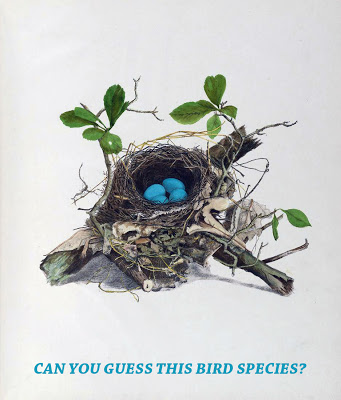
For our post, we’re featuring a few of the nest illustrations found in this title, identifying them for the bird species to which they correlate. However, we’ll leave the last picture unidentified. Can you tell which bird species made the nest below (of course, you could always just check in the book, but where’s the fun in that)? Let us know what species you think it is via Twitter (@BioDivLibrary), Facebook, or by leaving a comment on this blog. To see all of the images from this title, visit the set in Flickr: v. 1 and v. 2.

View Full Size Image

September 22, 2011by michelle.underhill

Help Support BHL

BHL's existence depends on the financial support of its patrons. Help us keep this free resource alive!

search

About BHL

The Biodiversity Heritage Library (BHL) is the world’s largest open access digital library for biodiversity literature and archives. BHL operates as a worldwide consortium of natural history, botanical, research, and national libraries working together to digitize the natural history literature held in their collections and make it freely available for open access as part of a global “biodiversity community.”

Join Our Mailing List

Sign up to receive the latest news, content highlights, and promotions.

Subscribe Now

Subscribe to Blog via Email

Enter your email address to subscribe to this blog and receive notifications of new posts by email.

Join 319 other subscribers

Subscribe to Blog Via RSS

Subscribe to the blog RSS feed to stay up-to-date on all the latest BHL posts.

Access RSS Feed

Inspiring Discovery through Free Access to Biodiversity Knowledge.

The Biodiversity Heritage Library makes it easier than ever for you to access the information you need to study and explore life on Earth…for free, anytime, anywhere.


64+ Million Pages of
Biodiversity Literature Online.

EXPLORE

Tools and Services
to Transform Research.

EXPLORE

300,000+
Illustrations on Flickr.

EXPLORE

ABOUT | HARMFUL CONTENT | PRIVACY | SITE MAP | TERMS OF USE