Biodiversity Heritage Library - Program news and collection highlights from BHL
  • Home
  • News
  • Featured Books
    • All Featured Books
    • Book of the Month Series
    • BHL at 20
  • User Stories
  • Campaigns
    • Fossil Stories
    • Garden Stories
    • Monsters Are Real
    • Page Frights
    • Her Natural History
    • Earth Optimism 2020
  • Tech Blog
  • Visit BHL
Home
News
Featured Books
    All Featured Books
    Book of the Month Series
    BHL at 20
User Stories
Campaigns
    Fossil Stories
    Garden Stories
    Monsters Are Real
    Page Frights
    Her Natural History
    Earth Optimism 2020
Tech Blog
Visit BHL
  • Home
  • News
  • Featured Books
    • All Featured Books
    • Book of the Month Series
    • BHL at 20
  • User Stories
  • Campaigns
    • Fossil Stories
    • Garden Stories
    • Monsters Are Real
    • Page Frights
    • Her Natural History
    • Earth Optimism 2020
  • Tech Blog
  • Visit BHL
Biodiversity Heritage Library - Program news and collection highlights from BHL
Blog Reel, Featured Books

Book of the Week: Fish Aren’t all About Sharks

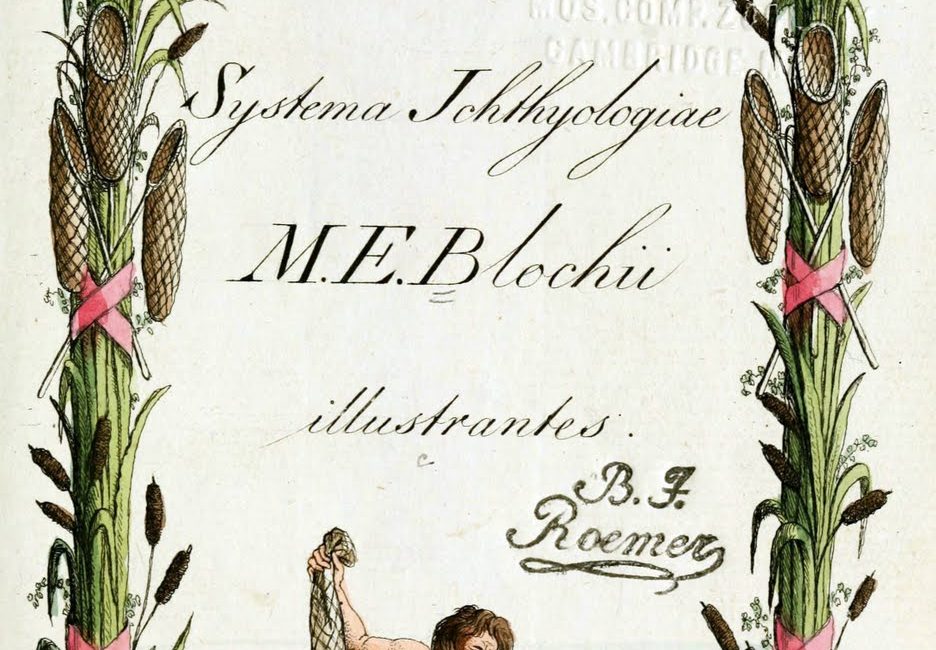
View Full Size ImageLast week we were all about sharks, seeing as it was Shark Week and all. That meant that we were combing through our collections looking for anything that was marked with Shark or even just fish tags. We found a wonderful variety of books and images about sharks (you can peruse them, and lots of other kinds of species, yourself on our Flickr account), but what we also found were a lot of great books about the many other species of fish besides sharks. One of our favorites was Systema Ichthyologiae Iconibus CX Illustratum, volumes 1-2 (1801), by M.E. Bloch & Schneider. While it did contain a few illustrations of sharks, the plethora of other fish species depicted in beautifully vivid colors made us stop and stare. And anything that makes us stop and stare in BHL is worthy of being highlighted somewhere. And today, that somewhere is our blog.

Marcus Elieser Bloch was a German medical doctor and naturalist. He was born into an extremely poor family in Ansbach in 1723 and received very little education growing up. By the time he reached adulthood, he could not even read German, his native language. However, thanks to some knowledge of Hebrew and rabbinical literature, he was able to secure a teaching position with a Jewish surgeon in Hamburg. After learning German and some Latin thoroughly, he began to study anatomy, which in turn sparked his enthusiasm for the natural sciences. He went to Berlin and began to study all branches of science and medicine. Today, he is considered one of the most important ichthyologists of the 18th century, and his encyclopedic work on fishes, captured in a 12-volume series entitled Allgemeine Naturgeschichte der Fische, is still today considered extremely important. Though Bloch didn’t live to see our book of the week published, as he died in 1799, it serves as a beautiful legacy of the incredible career of this dedicated naturalist.

For the post, we thought we’d showcase some of our favorite illustrations from the book. However, we’d be remiss in our duty if we didn’t admit that it was very difficult to choose just a few, and you should spend some time looking through all of the illustrations. They really are worth a few minutes, or even hours, or your time! But, for now, here are our favorites!

View Full Size Image

1) Callionymus orientalis, today known as Synchiropus orientalis

View Full Size Image

2) Chaetodon nicobariensi, today known as Pomacanthus imperator

View Full Size Image

3) Synanceia verrucosa

View Full Size Image

4) Rhina ancylostoma

View Full Size Image

5) Muraena myrus, today known as Echelus myrus

View Full Size Image

6) Syngnathus biaculeatus and Pegasus draconis, today known as Eurypegasus draconis

See all of the illustrations from this book in our Flickr account! This week’s book of the week, Systema Ichthyologiae Iconibus CX Illustratum, volumes 1-2 (1801), by M.E. Bloch, was contributed by Harvard University, MCZ, Ernst Mayr Library.

August 11, 2011by michelle.underhill
Blog Reel, User Stories

BHL and Our Users: Dr. Joshua Drew

View Full Size ImageThis week we feature Dr. Joshua Drew, a former a researcher at the Biodiversity Synthesis Center at the Field Museum of Natural History in Chicago. The Biodiversity Synthesis Group is a component of EOL “dedicated to advancing biodiversity science and the core EOL mission through…diverse meetings, workshops, research programs, and outreach.” Our featured user’s research focuses on coral reefs and the challenges of both protecting these reefs and discovering new species of coral reef fish. With this brief introduction, meet Dr. Joshua Drew.

Q: What is your title, institutional affiliation, and area of interest?

A: Postdoctoral Researcher, Biodiversity Synthesis Center, Field Museum of Natural History.

Q: How long have you been in your field of study?

A: I’ve worked as a marine conservation biologist since 2000.

Q: When did you first discover BHL?

A: During my Ph.D. at Boston University in 2008.

Q: What is your opinion of BHL and how has it impacted your research?

A: BHL is a very important part of my research for two reasons. First, as a researcher who is interested in discovering new species of coral reef fish, BHL provides me with easy access to taxonomic literature. This allows me to see the whole history of a species laid out before me. Secondly, much of my work is trying to understand how ecosystems used to look, and using those baselines to evaluate how current conservation measures are succeeding. Having access to historical literature is essential to characterizing what ecosystems used to look like, what species were present and what peoples’ opinions of the health of the ecosystem were like throughout time. Since we don’t often have old photographic evidence of reef ecosystems, I rely on the historical literature to get a glimpse of how these wonderfully diverse ecosystems used to look.

Q: How often do you use BHL?

A: It depends. When I’m working on a project, I’ll use it intensively (two or three times a day); when I’m not actively working on a project, I still find myself accessing it once or twice a week.

Q: How do you usually use BHL (read the titles online/download whole PDFs/Select pages to download/etc.)?

A: For my taxonomic research, I will typically search for a specific name and see how our construction of that species has changed over time. For the historical ecology research I will often search for information about a specific place or places within a region. If I’m lucky, there will be multiple reports on that area throughout time and I can see how species assemblages have changed.

Q: What are your favorite features/services on BHL?

A: I like the ease of having access to the literature anywhere I have access to the Internet. For example, I was teaching a class last semester and it was great to be able to introduce my students to the primary literature with a few clicks on my iPad right in the middle of class.

Q: If you could change one thing about BHL, what would it be, or what developmental aspect would you like the BHL team to focus on next?

A: I think what you are doing is great; I simply would hope that you can further your collaborations with publishers to get more modern content into the BHL.

Q: If you had to choose one title/item in BHL that has most impacted your research, or one item that you prefer above any other in BHL, what would it be and why?

A: The Fishes of Samoa. Description of the Species found in the Archipelago, with a Provisional Check-List of the Fishes of Oceania (1906), by David Starr Jordan and Alvin Seale.

This book was one of the first comprehensive records in the Southwest Pacific, the area where I do most of my work. In it, Jordan and Seale give a great look into what these reefs were like before widespread development. Reading their words is like going through a time machine, and allows us a glimpse into a world that will probably never be again. Additionally, these authors describe for perhaps the first time, a biogeographic pattern of species distributions that still perplexes people to this day – that the islands of the Coral Triangle (PNG, Indonesia, and the Philippines) are much more diverse than those in the Southwest Pacific. People have tried to explain why this pattern exists for over a century, and addressing this question is one of the major challenges I am addressing using molecular systematics.

Thank you, Dr. Drew, for giving us a glimpse into your world and the important oceanic conservation work that you do. These “rainforests of the sea” support twenty-five percent of all marine species, and it is imperative that we work to protect these ecosystems and ensure that they are around for generations, and indeed, millennia, to come.

Learn more about Dr. Drew on his website: www.halichoeres.org.

If you would like to be featured on our blog, let us know by sending us feedback, posting on our Facebook page, or sending us a Tweet to @BioDivLibrary. 🙂

June 21, 2011by michelle.underhill
Page 3 of 3«123

Help Support BHL

BHL's existence depends on the financial support of its patrons. Help us keep this free resource alive!

search

About BHL

The Biodiversity Heritage Library (BHL) is the world’s largest open access digital library for biodiversity literature and archives. BHL operates as a worldwide consortium of natural history, botanical, research, and national libraries working together to digitize the natural history literature held in their collections and make it freely available for open access as part of a global “biodiversity community.”

Follow BHL

  • Bluesky logo
  • Instagram logo
  • Facebook logo
  • Flickr logo
  • Twitter logo

Join Our Mailing List

Sign up to receive the latest news, content highlights, and promotions.

Subscribe Now

Subscribe to Blog via Email

Enter your email address to subscribe to this blog and receive notifications of new posts by email.

Join 319 other subscribers

Subscribe to Blog Via RSS

Subscribe to the blog RSS feed to stay up-to-date on all the latest BHL posts.

Access RSS Feed


64+ Million Pages of
Biodiversity Literature Online.

EXPLORE

Tools and Services
to Transform Research.

EXPLORE

300,000+
Illustrations on Flickr.

EXPLORE

ABOUT | HARMFUL CONTENT | PRIVACY | SITE MAP | TERMS OF USE