Biodiversity Heritage Library - Program news and collection highlights from BHL
  • Home
  • News
  • Featured Books
    • All Featured Books
    • Book of the Month Series
    • BHL at 20
  • User Stories
  • Campaigns
    • Fossil Stories
    • Garden Stories
    • Monsters Are Real
    • Page Frights
    • Her Natural History
    • Earth Optimism 2020
  • Tech Blog
  • Visit BHL
Home
News
Featured Books
    All Featured Books
    Book of the Month Series
    BHL at 20
User Stories
Campaigns
    Fossil Stories
    Garden Stories
    Monsters Are Real
    Page Frights
    Her Natural History
    Earth Optimism 2020
Tech Blog
Visit BHL
  • Home
  • News
  • Featured Books
    • All Featured Books
    • Book of the Month Series
    • BHL at 20
  • User Stories
  • Campaigns
    • Fossil Stories
    • Garden Stories
    • Monsters Are Real
    • Page Frights
    • Her Natural History
    • Earth Optimism 2020
  • Tech Blog
  • Visit BHL
Biodiversity Heritage Library - Program news and collection highlights from BHL
Blog Reel, Campaigns, Featured Books

World Oceans Day through Books: The Roots of Modern Ichthyology

This post is the first in our week-long celebration leading up to World Oceans Day on June 8. Tune in all week for awesome marine biodiversity fun!

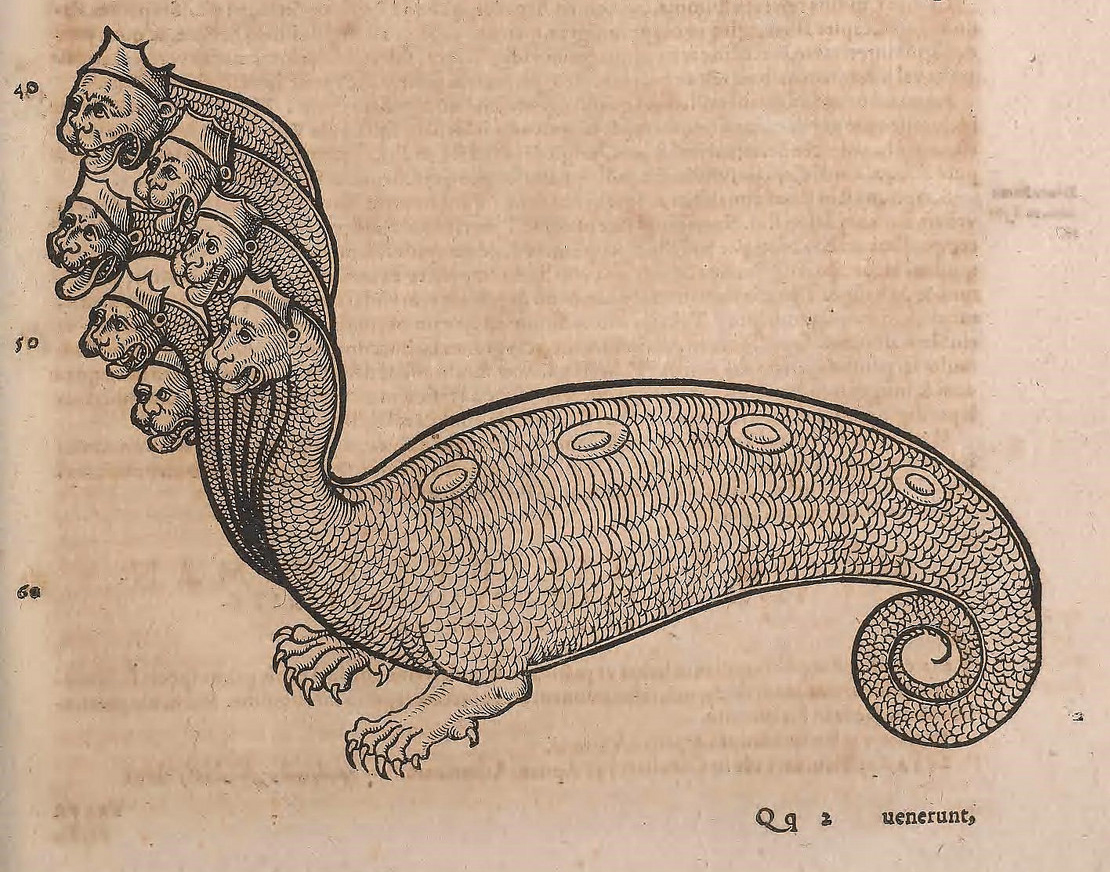
In the context of human history, ocean exploration is a relatively recent occurrence. Even by the 19th century, human knowledge of the oceans was still limited, and the flora and fauna that called the sea home, particularly within the depths, remained virtually unknown. Publications by individuals such as Olaus Magnus and Conrad Gessner in the mid-16th century represent some of our first attempts to systematically aggregate and describe biodiversity and many marine species. Much of this published information, however, was based on accounts from antiquity or spotty, second-hand narratives from sailors, hence the representation of many mythical creatures, such as the Kraken, hydra, or sea serpent, as real species.
View Full Size Image
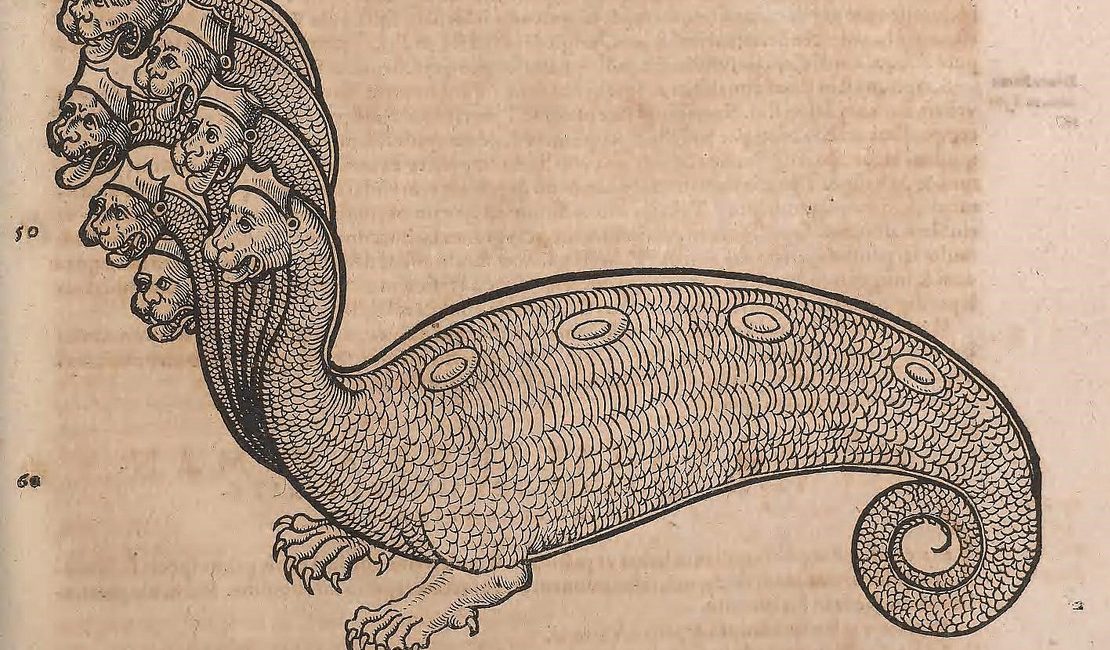
The hydra, as depicted by Conrad Gessner in Historia Animalium. 1551-58. http://biodiversitylibrary.org/page/42166090.

But over the centuries, human exploration increased, and with it, our knowledge of the oceans and marine biodiversity. This knowledge and a record of our scientific discoveries are captured within the pages of natural history literature.

In honor of World Oceans Day on June 8, we’ve compiled a collection of publications that represent important milestones in the progress of marine bioscience research and ocean exploration. These publications will be presented in a three-part series. But while we know significantly more today than we did in the 16th century (few today, for example, would argue that the Hydra is a real species), we still have a great deal to learn about an environment that covers almost 71% of the Earth’s surface. Oceans may in fact be our true final frontier.

The Start of Modern Ichthyology: De Aquatilibus

By the mid-1500s, the birth of modern zoology, with attempts to bring together all available knowledge about Earth’s biodiversity in a systematic way, was underway. Conrad Gessner’s Historia Animalium, published in 1551-58, is in fact considered the beginning of modern zoology. This work, however, like many others of its time, is not based solely on personal observation and analysis but instead includes much inherited knowledge from ancient naturalists like Aristotle and Pliny. The result is the depiction of both mythical and authentic species.
View Full Size Image
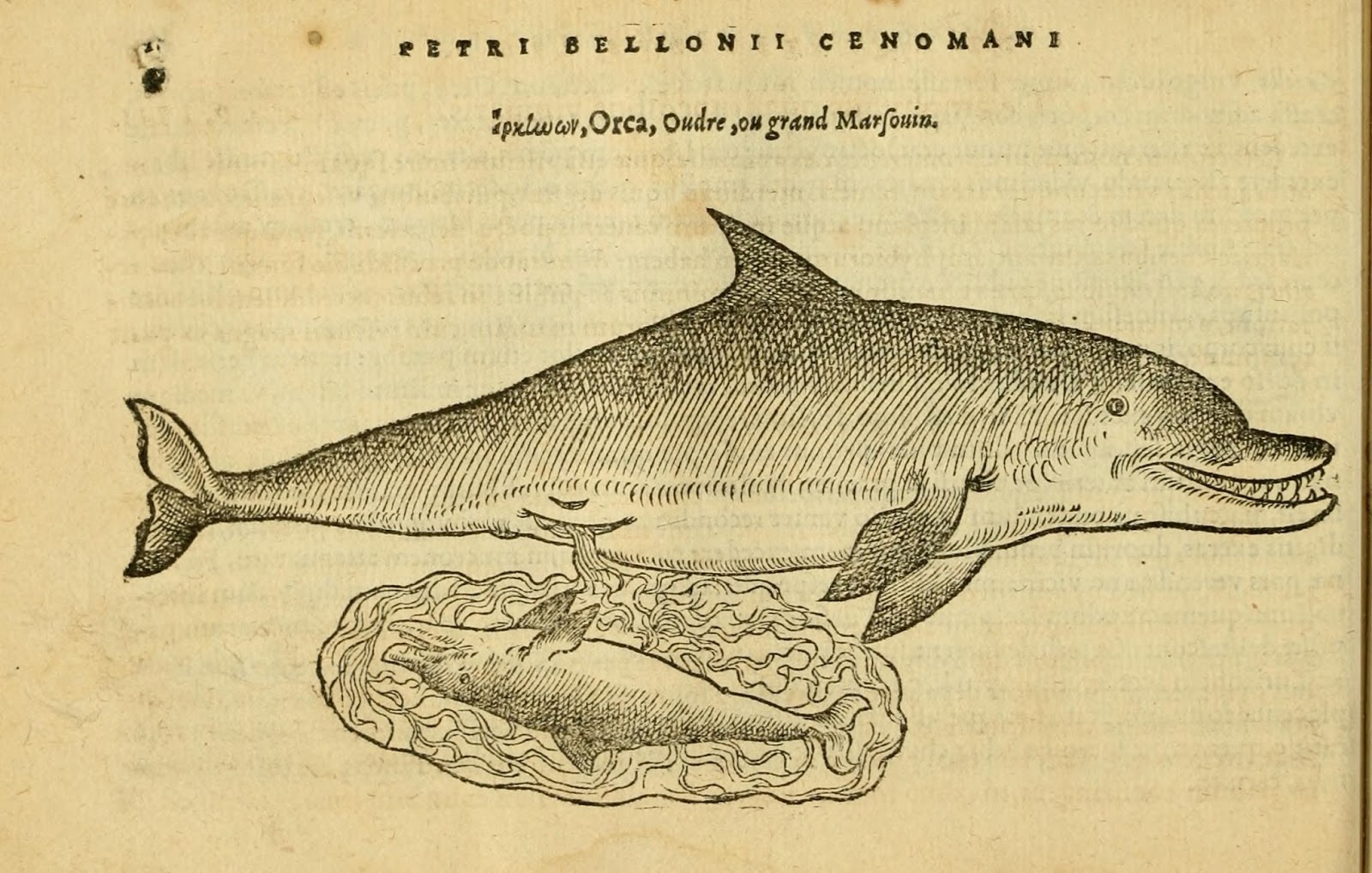
Belon portrayed many dolphins, their embryos, and reproductive anatomy within De aquatilibus, marking the beginning of modern embryology. Belon, Pierre. De aquatilibus. 1553. http://biodiversitylibrary.org/page/4770162.

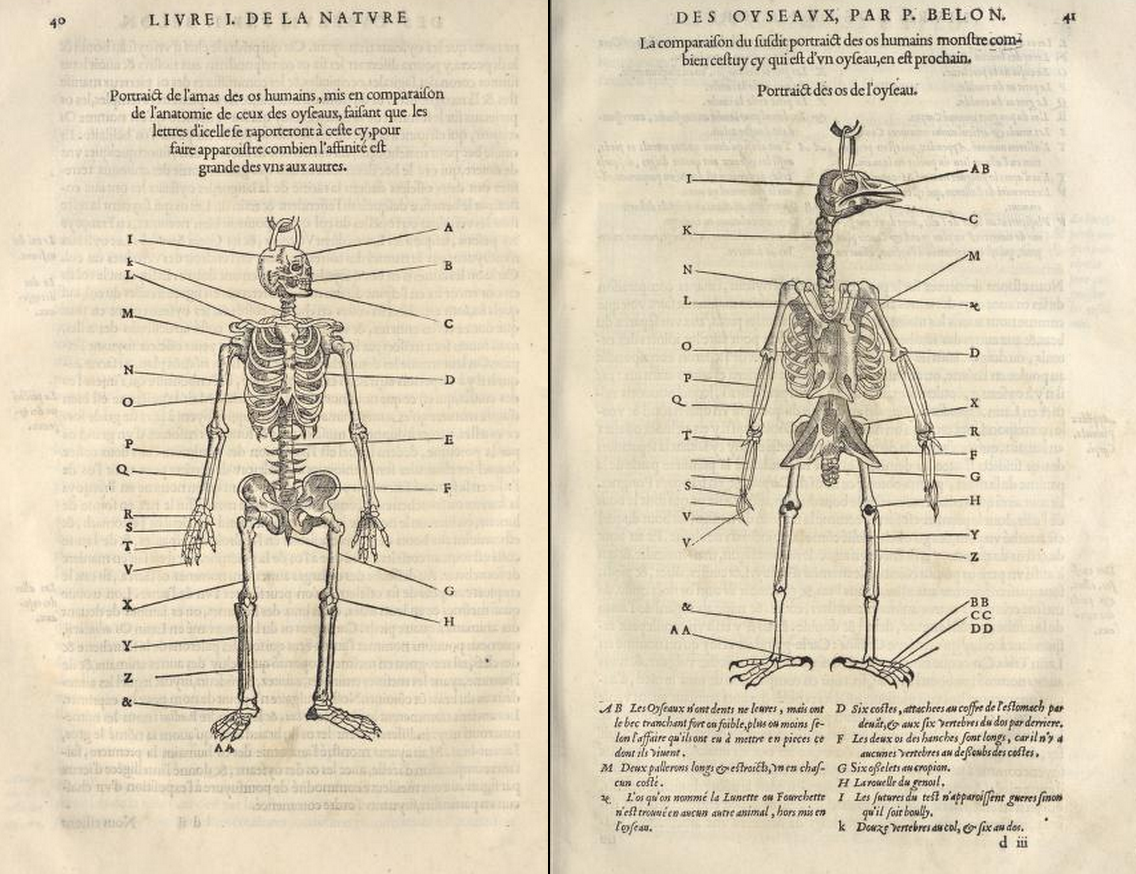
Around the time of Gessner’s publication, Pierre Belon, a French naturalist who started practice as an apothecary, studied medicine, and later undertook many travels that fueled his interest in natural history, published De aquatilibus (1553), describing and illustrating over 100 fish, sharks, and rays, as well as many marine mammals. Belon details the outward characteristics of the species he depicts and classifies his divisions of aquatic animals by size, skeletal structure, mode of propagation, number of limbs, form of the body, and habitat. As such, De aquatilibus is considered by many to be the beginning of modern ichthyology. The work also includes detailed descriptions of dolphins, their embryos, and reproductive anatomy, and thus is also considered the start of modern embryology. In a later work, Belon also illustrated comparisons between human and bird skeletons, a pioneering advancement in comparative anatomy.
View Full Size Image
Skeleton of a bird and human side-by-side, a pioneering advancement in comparative anatomy. Belon, Pierre. L’histoire de la natvre des oyseavx. (1555). http://biodiversitylibrary.org/page/43989554.

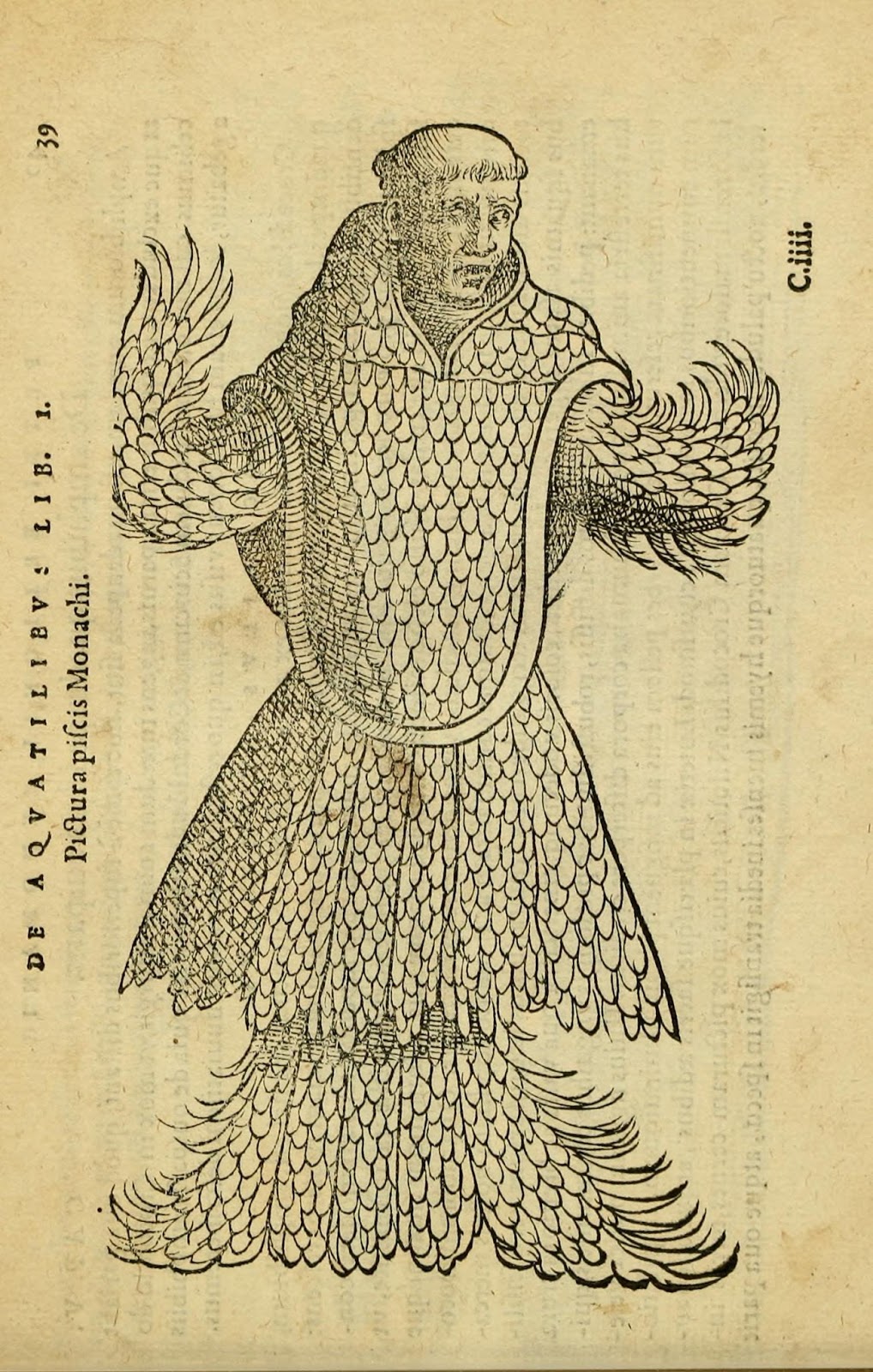
Belon stressed the importance of observation in scientific study and communication, chastising those who simply relied on and proliferated historic accounts stemming from the titans of antiquity. However, despite this charge, Belon does include some fantastical creatures within his book, including the “sea monk” and “web-footed horse of Neptune.”
View Full Size Image
Mythical “sea-monk,” possibly based on a stranded squid. Belon, Pierre. De aquatilibus. 1553.  http://biodiversitylibrary.org/page/4770183.

Sadly, Belon’s life was cut tragically short. He was murdered by unknown assailants in the Bois de Boulogne in 1564 at the age of 47.

Observation over Authority: Aquatilium Animalium 

Belon was not alone in his directive to base scientific study on observation rather than the authority of antiquity. Italian physician Hippolito Salviani, whom Belon met during his travels in Rome, took a marked interest in natural history, particularly ichthyology. Salviani, in fact, proclaimed that he would not publish anything that he himself had not observed and ascertained to be true.
View Full Size Image
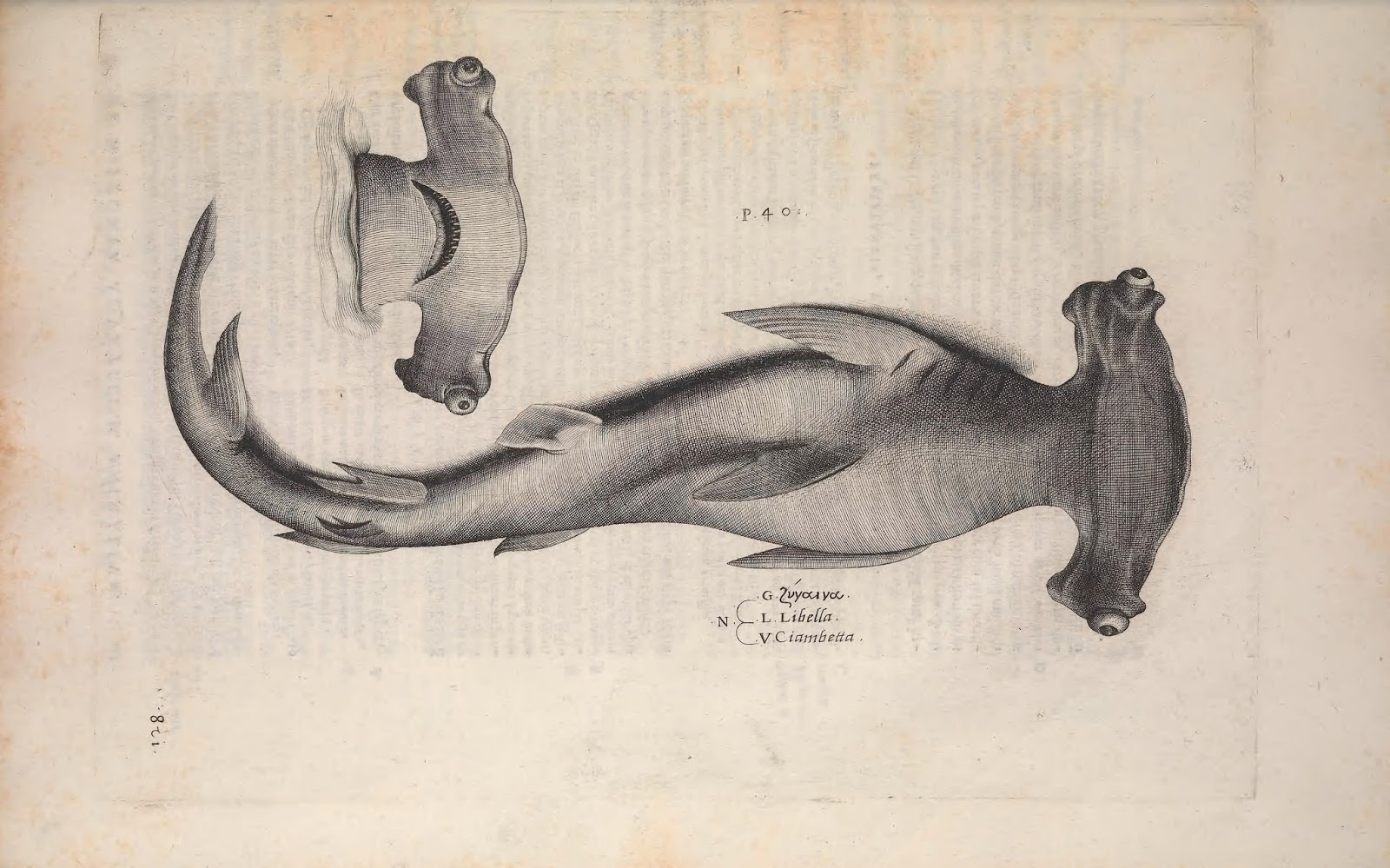
Smooth hammerhead shark (Sphyma zygaena). Salviani, Hippolito. Aquatilium Animalium Historiae. 1554-58. http://biodiversitylibrary.org/page/44715878.

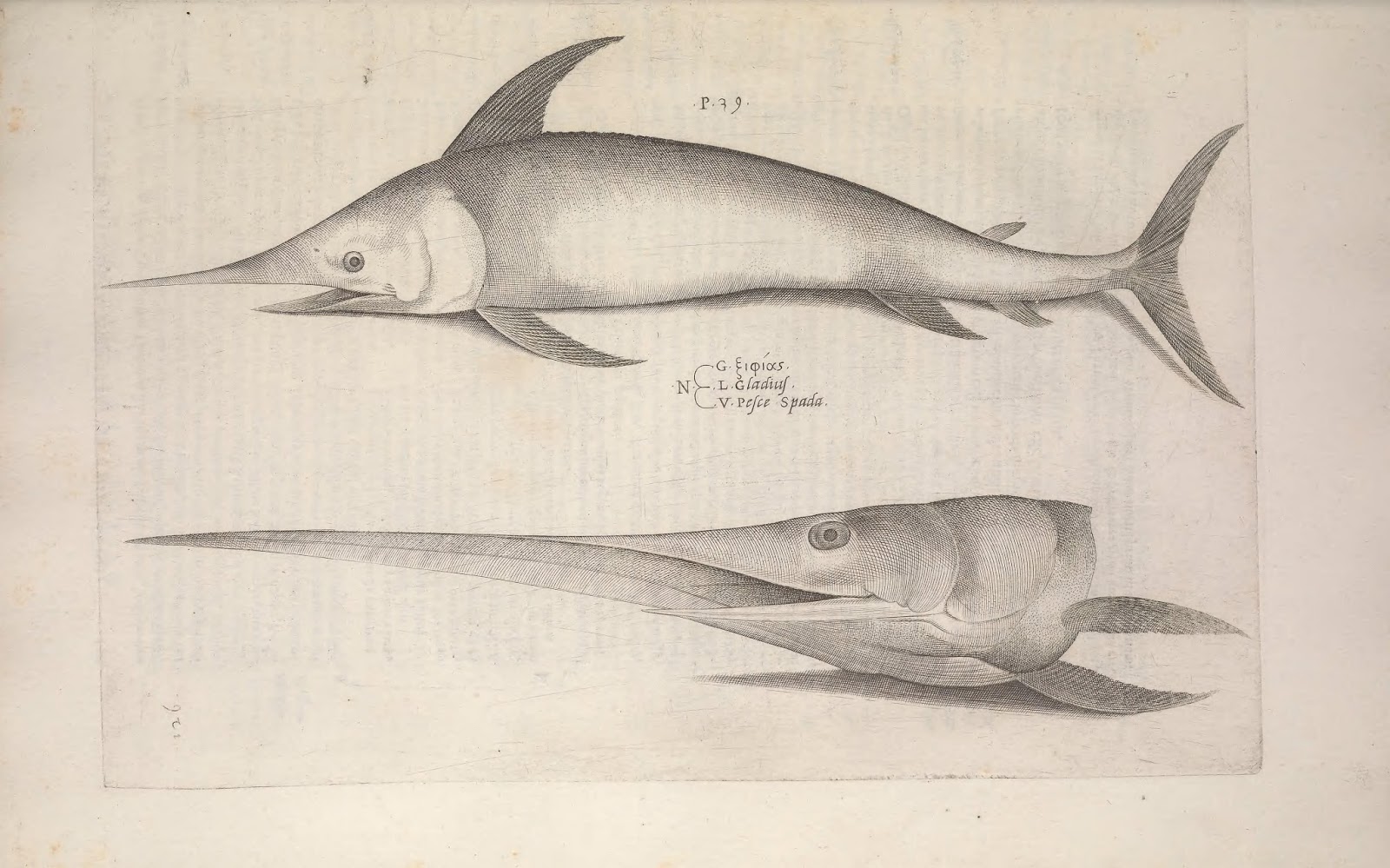
In the mid-1500s, Salviani worked to produce his own masterpiece on fishes. His 1554-58 Aquatilium Animalium Historiae includes two folio volumes and eighty-eight full-page copper engravings and describes only those fish species that he personally observed and studied. He gathered many of his specimens from local fishermen and markets. His descriptions not only include external characteristics but many additional aspects such as “habitat, behaviors and reproduction, methods of capture, nutritional and medicinal usages, and often even cooking techniques” (Stiassny, 5). Salviani’s employment of detailed copper engravings resulted in illustrations with a much more life-like appearance than the woodcuts utilized by his peers, including Belon. Salviani was also the “first to narrow the concept of ‘fish’ from a broad notion embracing all marine animals [as was the custom of the time] to instead include only the bony and cartilaginous fishes” (Stiassny, 5). As such, Salviani and Belon are often considered the two founding fathers of ichthyology.
View Full Size Image
Swordfish (Xiphias gladius). Salviani, Hippolito. Aquatilium Animalium Historiae. 1554-58. http://biodiversitylibrary.org/page/44715874.

More World Oceans Day Resources

  • Follow us on Twitter, Facebook, and this blog all this week as we explore marine biodiversity and awesome related publications in BHL.
  • Check out some monumental publications in historic and present-day marine bioscience research in our BHL collection.
  • Browse a selection of marine biodiversity illustrations in Flickr and Pinterst

Reference

  • Stiassny, Melanie. Natural Histories: Opulent Oceans. New York: Sterling Publishing, 2014. Print.
June 1, 2015by michelle.underhill
Blog Reel, Featured Books

Celebrating Oceans and Marine Biodiversity

50 Fish from American Waters (1870-1900). Allen and Ginter.

The Seafood Picture

View Full Size Image
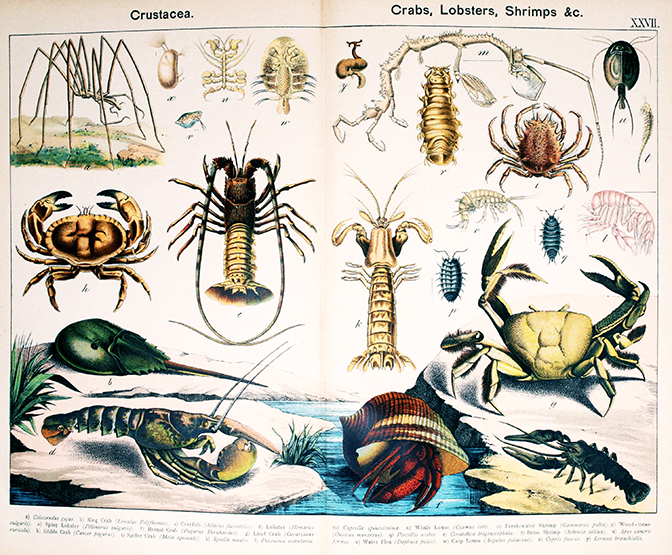
Shrimp (the most-consumed seafood in America) and other Crustaceans. Natural History of the Animal Kingdom for the Use of Young People.

This Saturday, June 8, is World Oceans Day, the UN-designated day for the global community to celebrate and take action to protect Earth’s oceans. 71% of the Earth’s surface is covered with water, and every living thing depends on water to survive. Sadly, according to the United Nations, with the world eating more seafood than ever before, approximately 2/3 of the ocean’s species are overfished.

According to NOAA, in 2009, Americans consumed 4.833 billion pounds of seafood – translating to 15.8 pounds of fish and shellfish per person. Approximately 50% of that seafood was wild-caught, and 50% was farm-raised.  The top ten most-consumed seafood in the U.S. in 2010 was:

  1. Shrimp (4.10 lbs)
  2. Canned Tuna (2.8 lbs)
  3. Salmon (1.84 lbs)
  4. Tilapia (1.34 lbs)
  5. Pollock (1.19)
  6. Catfish (0.92 lbs)
  7. Crab (0.61 lbs)
  8. Cod (0.44 lbs)
  9. Pangasius (0.43 lbs)
  10. Clams (0.341 lbs)
*lbs average per person

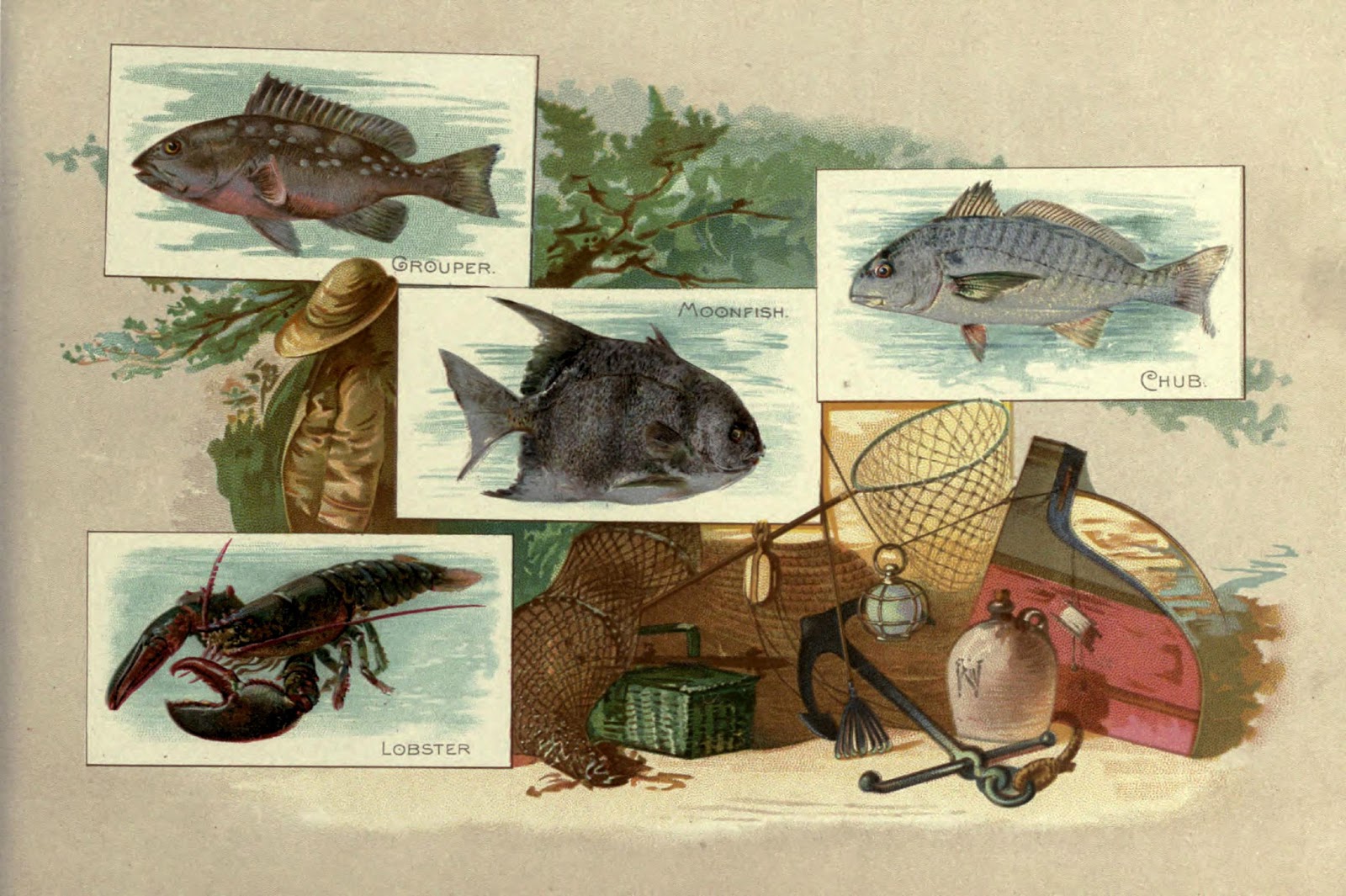
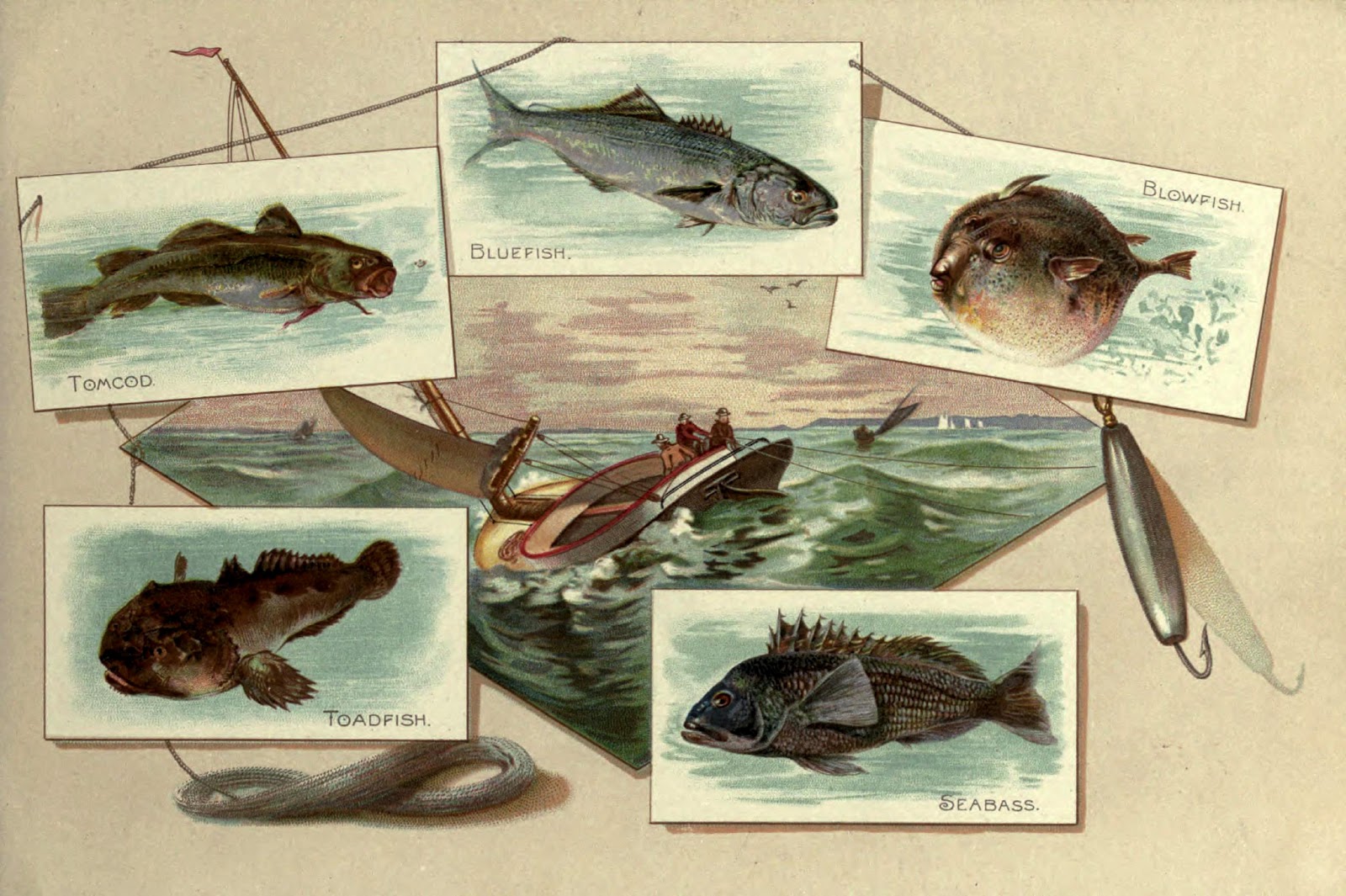
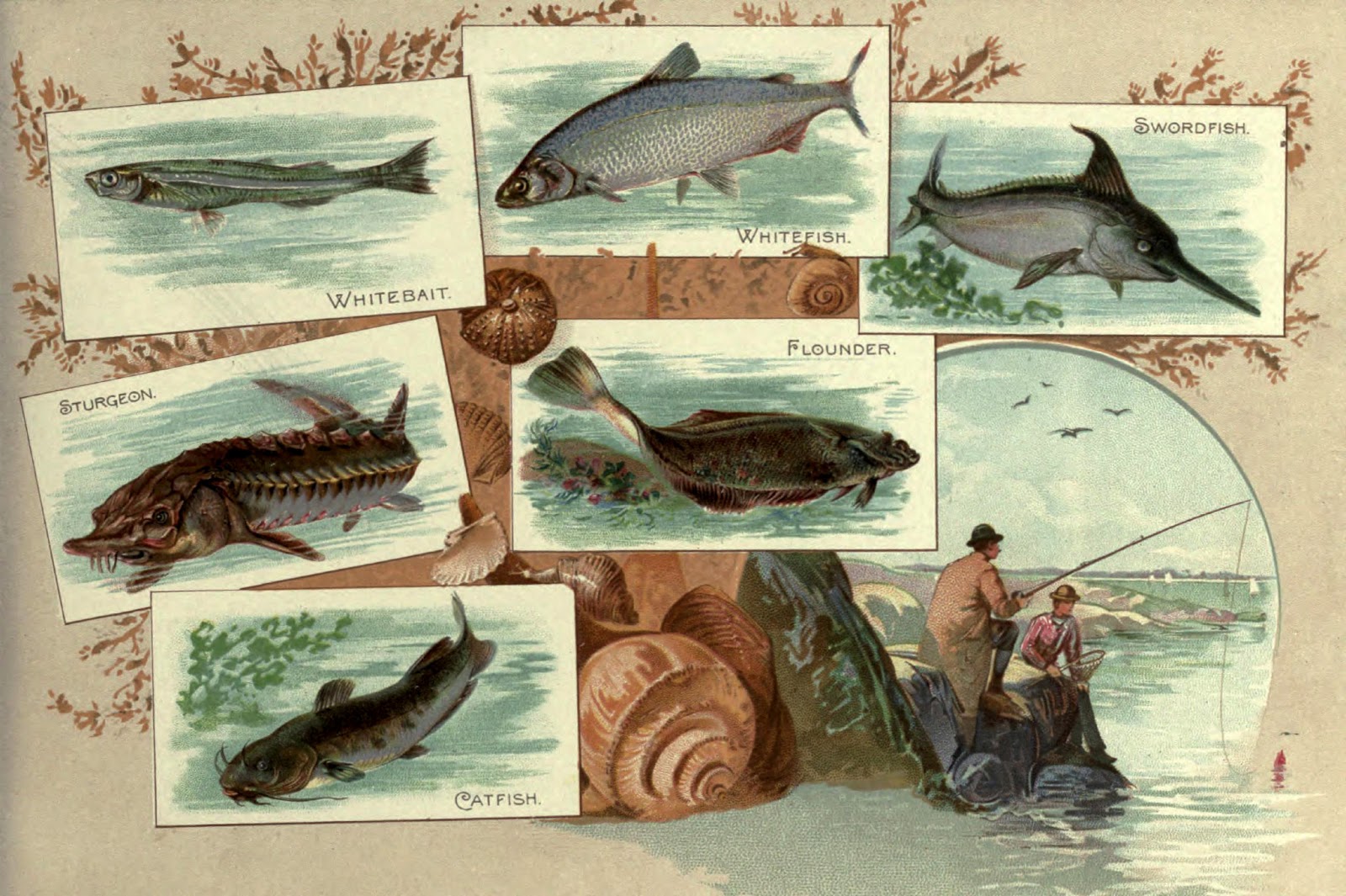
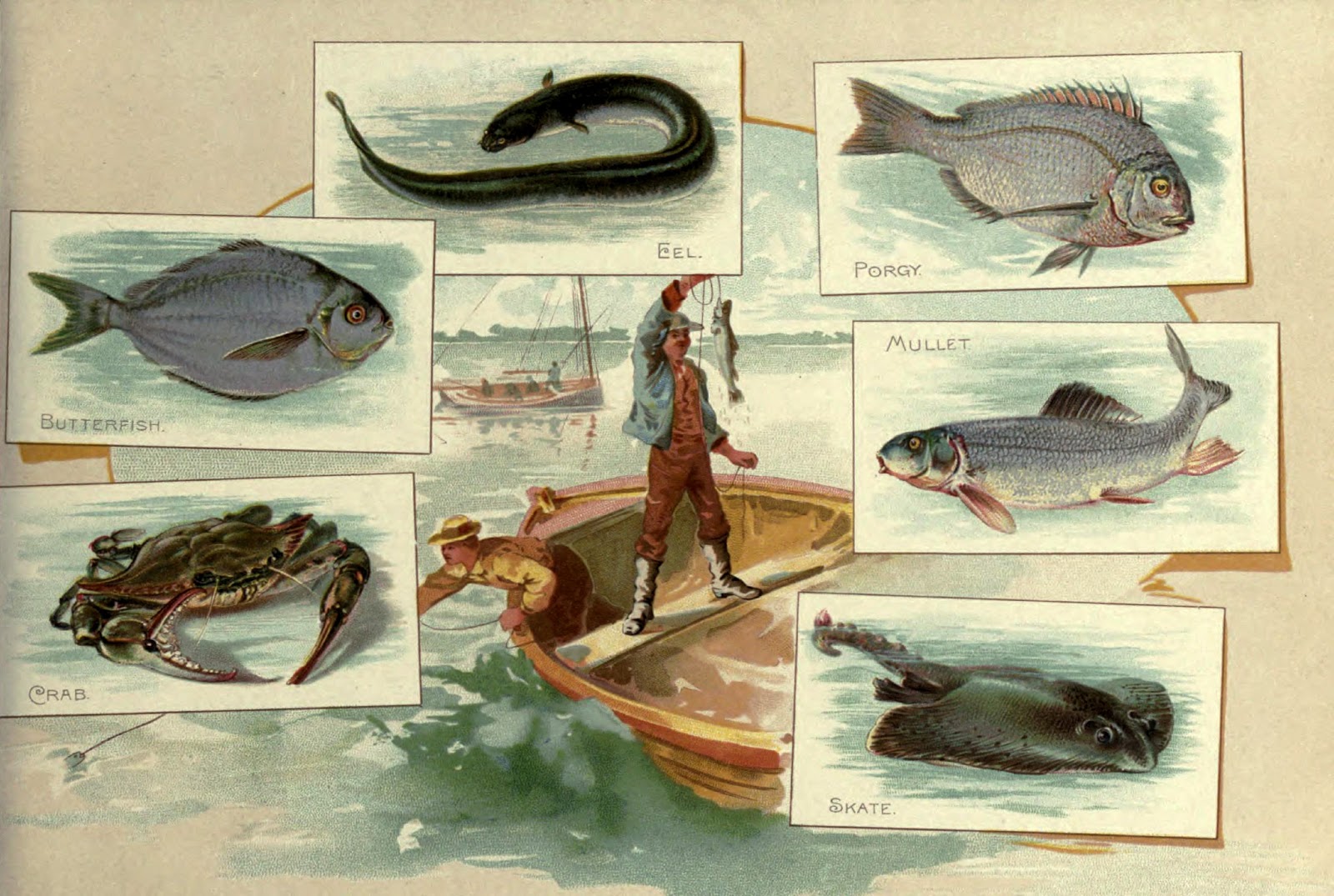
50 Fish from American Waters

Have you ever wondered what marine species can be found in American waters? While not exhaustive, 50 Fish from American Waters is a pictorial work that presents a delightful collection of such species through illustrations.

Curiously, the fish illustrations in this book were originally published as individual cigarette cards for collecting and trading. The tobacco firm, Allen and Ginter of Richmond, Virginia, was the first firm to use tobacco trading cards as a means of advertisement in cigarette packages, and, between 1870-1900, select packages of Allen and Ginter Virginia Bright cigarettes contained one of the 50 varieties of American fish trading cards (see the poster advertising the cards from Library of Congress). All of the cards were later published in the book 50 Fish from American Waters.

View Full Size Image
Lobster, Grouper, Moonfish, and Chub. 50 Fish from American Waters.
View Full Size Image
Tomcod, Bluefish, Blowfish, Toadfish, and Seabass. 50 Fish from American Waters.
View Full Size Image
Whitebait, Whitefish, Swordfish, Sturgeon, Flounder, Catfish. 50 Fish from American Waters.
View Full Size Image
Butterfish, Eel, Porgy, Mullet, Skate, Crab. 50 Fish from American Waters.

View all images from 50 Fish from American Waters in Flickr.

What can you do to help?

According to the ongoing The Ocean’s Project survey, most Americans care about the ocean and want to protect it, but many feel that they themselves can make little impact on the ocean’s health and, interestingly, that American waters are less imperiled that foreign waters. While these may be somewhat troubling responses, on the bright side, 22% of the 30,000+ people surveyed said that they are active in the environmental movement and 57% expressed sympathy but not active involvement. Most indicated a high willingness to alter their seafood consumption habits to help protect the oceans.
So, what can you do to help? Worldoceansday.org provides some great examples of small actions you can take to help protect our oceans, including reducing seafood consumption in general, using re-usable grocery bags and water bottles, choosing abundant, farmed, and locally-caught species, reducing meat consumption (which reduces the demand for forage fish), and choosing sustainable seafood buyers and sellers.

Marine Biodiversity and BHL

View Full Size Image
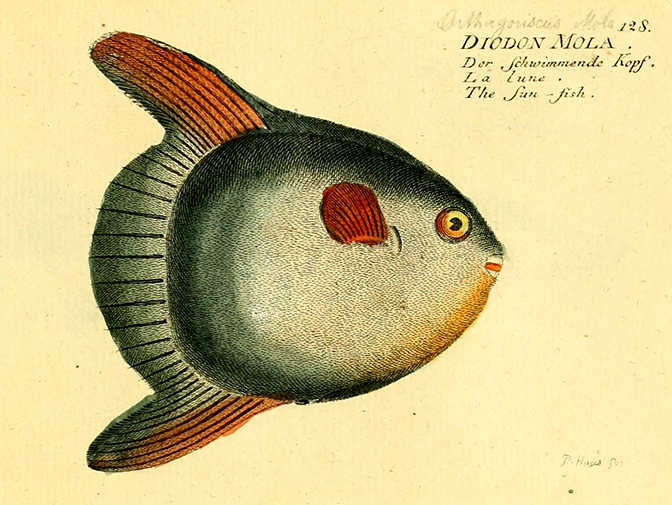
Ocean Sunfish. Ichthyologie.

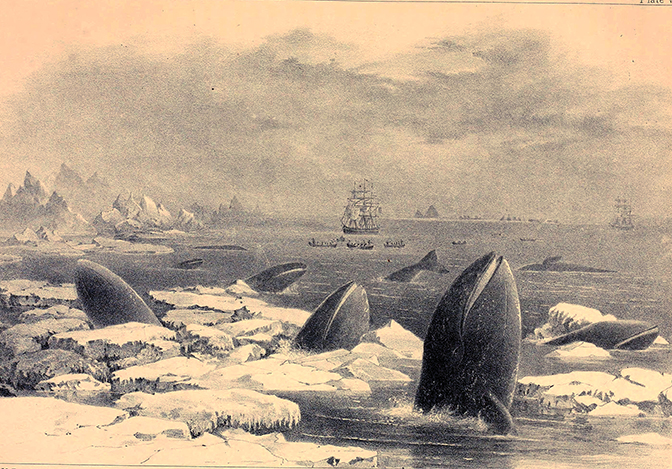
BHL is celebrating World Oceans Day by highlighting marine biodiversity on Facebook, Twitter, and Flickr.  For instance, did you know that the Gray Whale is more heavily infested with a greater variety of parasites than any other cetacean? Or that the Ocean Sunfish, the heaviest known bony fish, can grow up to 2300 kilograms, and that the Giant Oarfish, at up to 11 confirmed meters (and possibly 17 meters), is the world’s longest bony fish? Or that the adorable Common Blanket Octopus has been known to carry around tentacles of the Portuguese-Man-of-War as a defensive measure and means of capturing prey? Learn more about these species and get other watery factoids on Twitter and Facebook.

Be sure to check out our Marine Biodiversity Flickr collection with free images that you can download and reuse for your own World Oceans Day celebrations!

View Full Size Image
Gray Whales. The Marine Mammals of the North-west Coast of North America.

Are you a whale-lover? Then Smithsonian Libraries, one of BHL’s founding members, has an exhibit for you! Learn about whale research at the Smithsonian, and how research and fossils are translated into publications, in the new Whales: From Bone to Book exhibit at the National Museum of Natural History in Washington, D.C. Check out the books that support the exhibit in the BHL Collection and get fabulous whale illustrations in Flickr.

Remember, every living species requires water to survive, and our oceans play a huge part in our communal ecosystem. No matter where you live, your local water will eventually make its way to the ocean. We each have a responsibility to protect our oceans. Together, we can make a difference!

  • Find some World Oceans Day events near you.
  • Get some great promotional materials for World Oceans Day.
  • You can even get free Dr. Seuss-themed World Oceans Day materials!
June 6, 2013by ulib-libraryjobs
Blog Reel, Featured Books

Book of the Week: Beebe, Barton and the Bathysphere

 View Full Size Image“There is one joy of reading, another of painting, and another of writing, but none to compare with the thrill which comes to one who, loving Nature in all her moods, is about to start on a voyage of discovery to a land familiar in dreams alone.”  ~William Beebe

In 1934, William Beebe and Otis Barton made the first historic deep-sea submersible descent off the coast of Nosuch, Bermuda. At the time, they had reached a world record depth of 3,028 feet (923 meters). Beebe and Barton would later inspire ever deeper submersible dive records by many more explorers to come.

In fact, just over a month ago, China set the world record for deepest manned dive: The Jiaolong submersible reached depths of 22,600 ft (6,908 meters) in the Marianas Trench. The water pressure at that depth is equivalent to 1,600+ elephants standing on the roof of a small car! It’s important to remember that all submersible dives, including the Jiaolong are built on the initial explorations of two very brave men — William Beebe and Otis Barton.

Today, researchers have the security of new technological advances, exhaustive testing, and deep-sea robots that allow us to observe life in these extremely pressurized ecosystems with relative safety. In contrast during the 1930’s, Beebe and Barton did not have this luxury, being the first to dare such a dangerous feat. These were men whose curiosity overcame their fear, taking no refuge in the certainty that they would come back to the surface alive.

Unsophisticated by today’s standards, the original Bathysphere designed by Otis Barton, was essentially a 2.25 ton ball of casted steel, 4.75 ft. in diameter, with two windows made of three inch-thick fused quartz. Barton approached Beebe with the design after Beebe publicly made available his own preliminary design for a cylindrical deep-sea vehicle in the New York Times Barton saw Beebe’s plans and knew that his alternative spherical shape submersible would be a superior design, able to better withstand the pressure of the deep-sea.  Beebe met with Barton and approved his designs. The rest is history. 

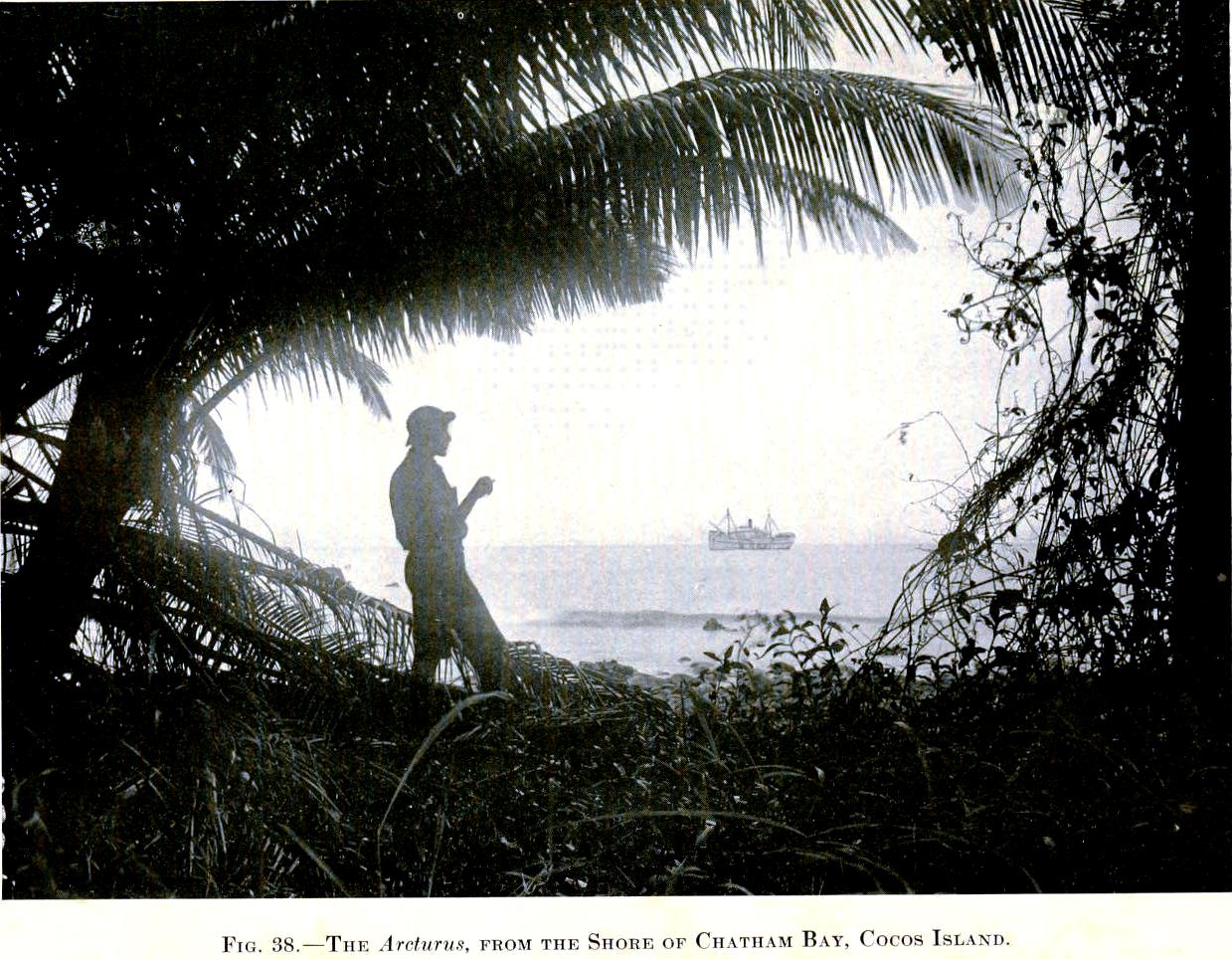
The origins of Beebe’s quest: The Arcturus Adventure

Many scientists at the time questioned Beebe’s motives, seeing the Bathysphere as a publicity stunt by a media hungry scientist cum celebrity. Beebe’s bitter public divorce, late nights dancing in jazz clubs and stints on game shows made him an easy target for drama-driven gossip columns. In Beebe’s defense, we believe his intentions were honorable since he was so often lamenting over the fact that his deep-sea dredges off the coast of Bermuda brought back only lifeless bodies of the creatures whose behaviors and tendencies he wished to study in their own habitat.

In this week’s book of the week, The Arcturus Adventure, Beebe writes, after another round of deep-sea dredging, that the eels brought back to the surface from a half-mile down only raise more questions:

“If tentacles were needed by this eel why in the name of holy natural selection must the jaws be thus sacrificed! These eels were always quite dead when I found them in the heart of the salpa mass, and how they live and move and satisfy their appetites in the icy blackness half a mile beneath our keel I shall perhaps never know. “ (p.382)

Beebe’s need to know pushed him ever further to take new risks and thus, his search for a deep-sea submersible design began, ending with Barton in 1930. Four years later on August 15, 1934 they would make headlines with the world’s first, only and deepest submersible dive. The results of these dives produced Beebe’s account of his many journeys in the Bathysphere, Half Mile Down along with a 1938 film titled, Titans of the Deep.

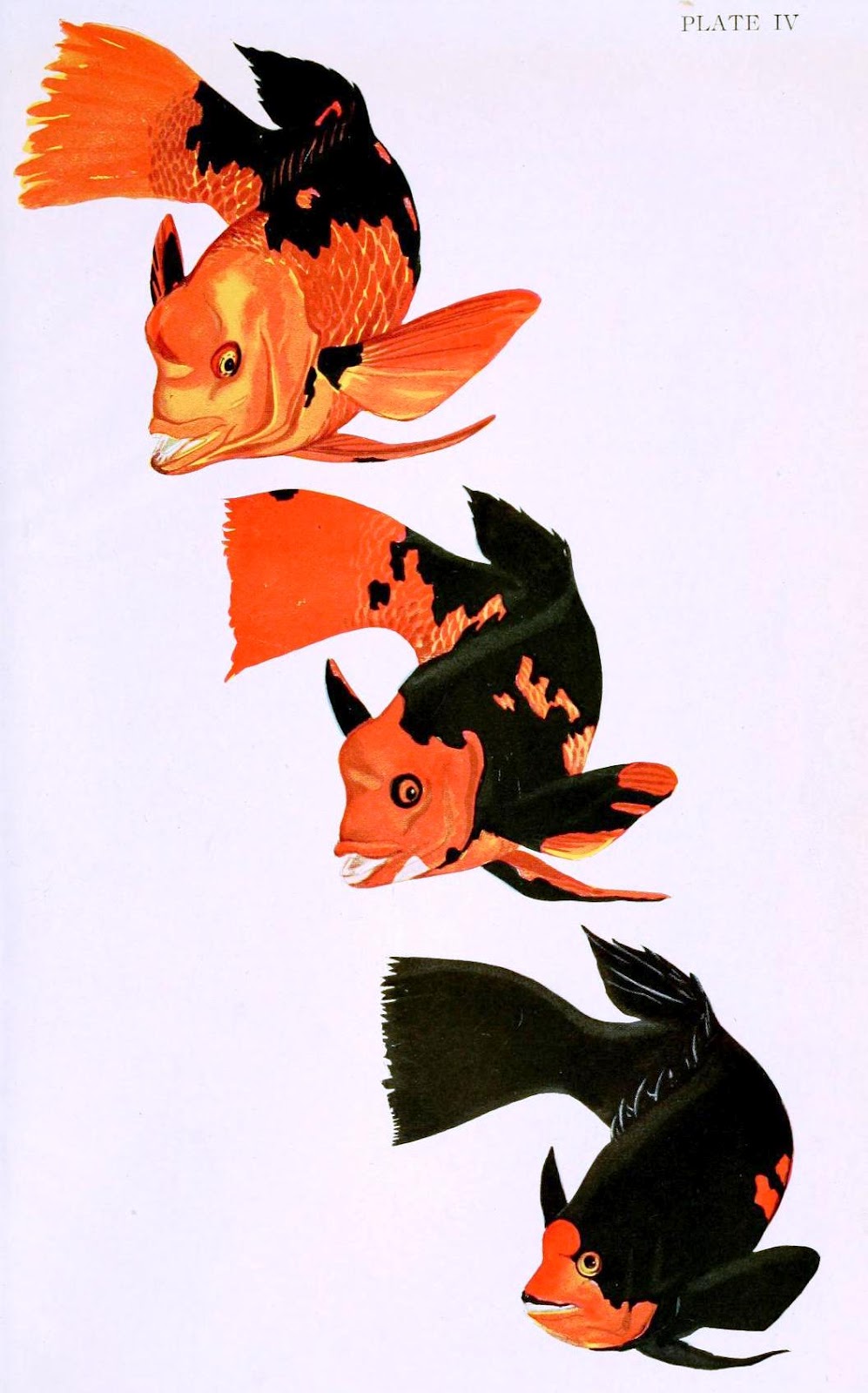
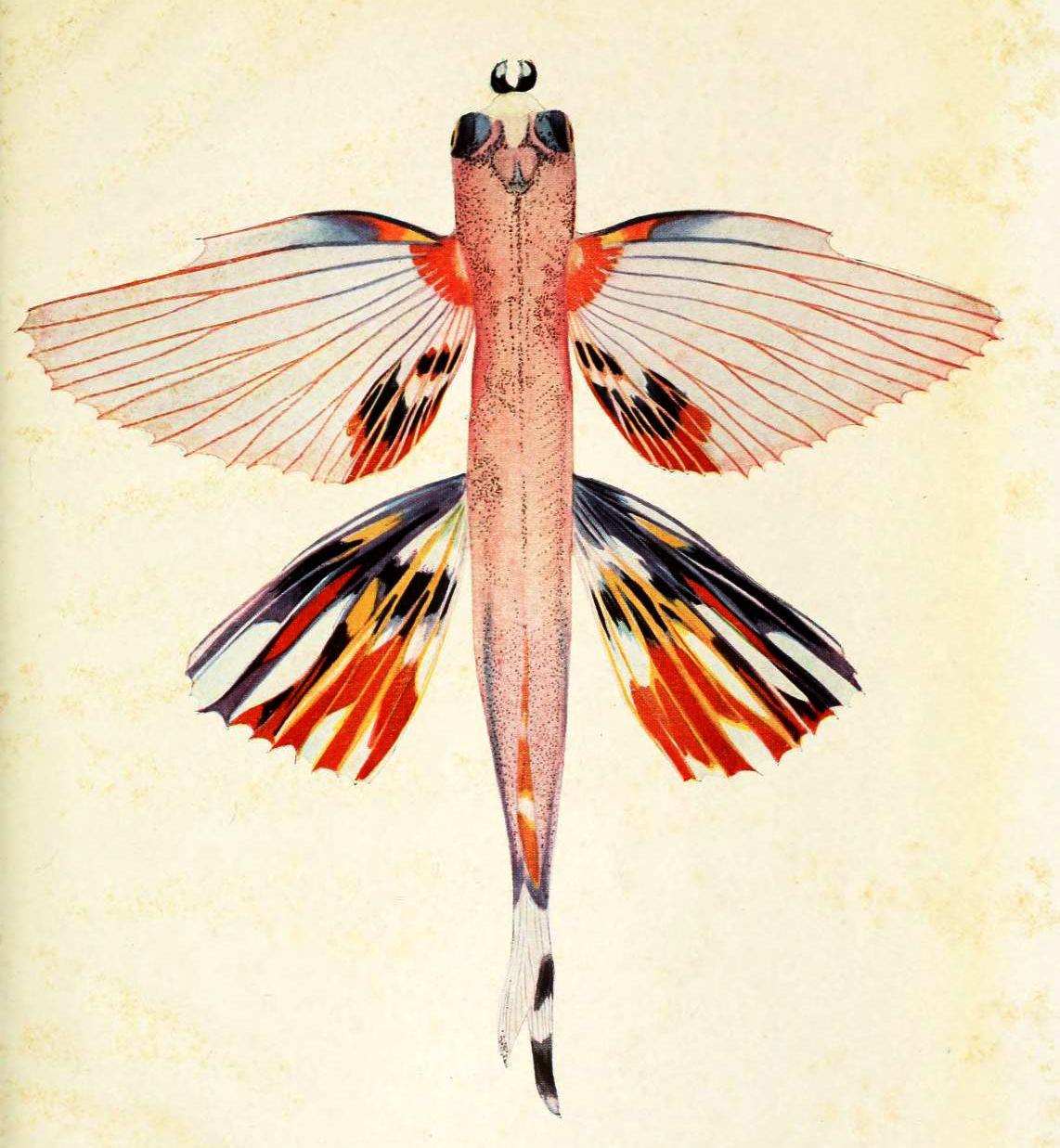
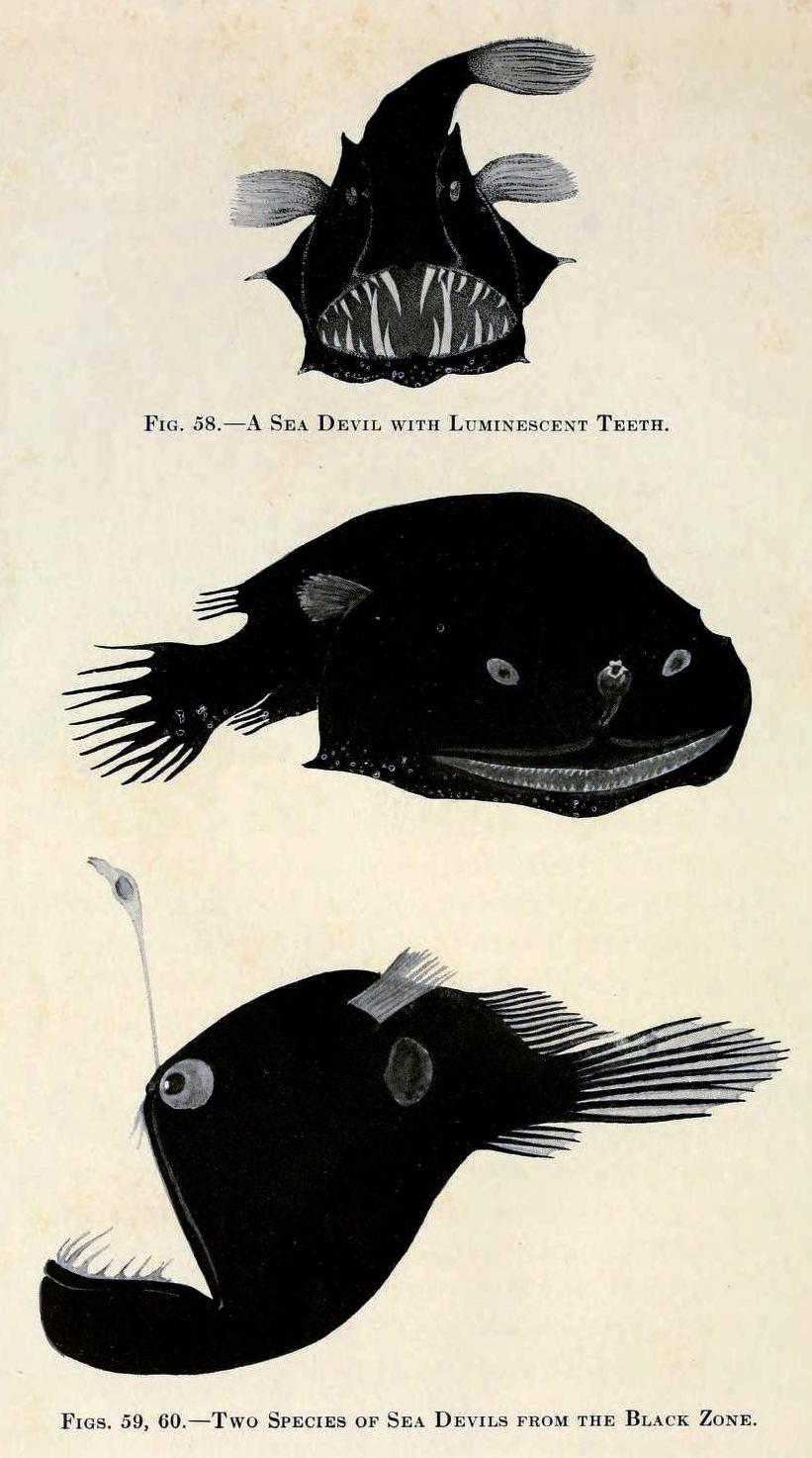
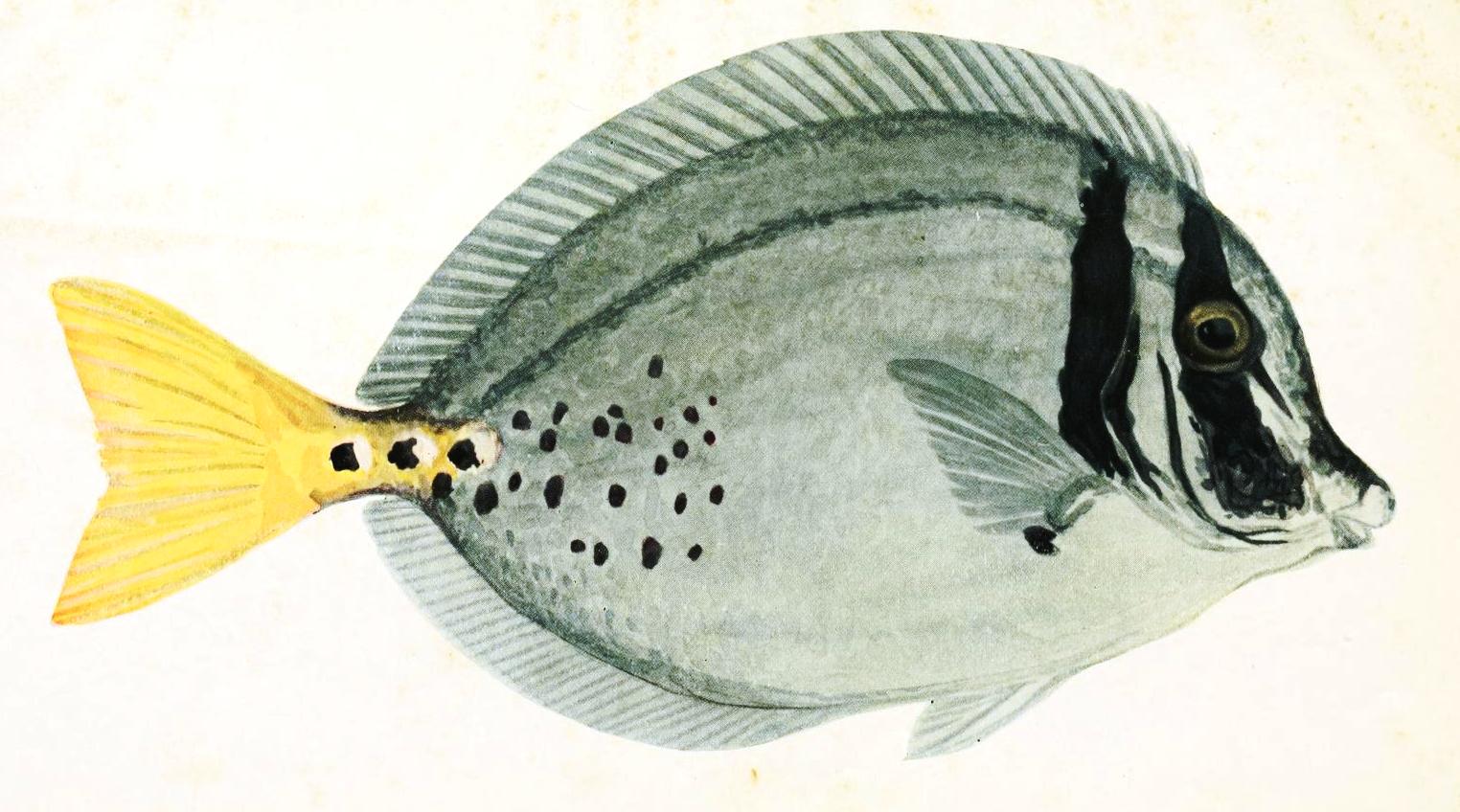
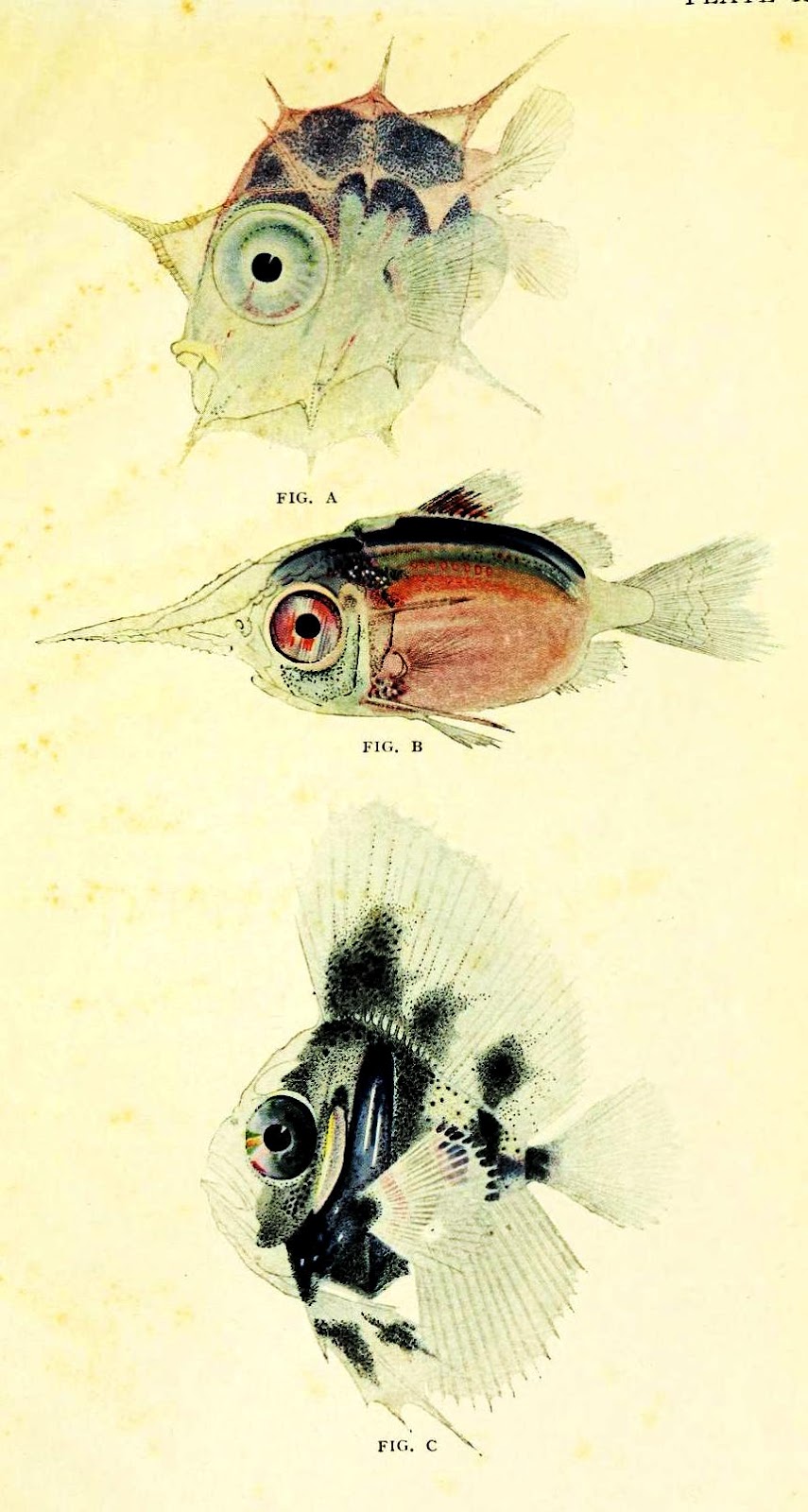
Lucky for Beebe and his insatiable curiosity, it would be only a few years later that we would have the answers to once unknowable questions about deep-sea creatures and Beebe would share his conclusions with us in his rivetingly written and richly illustrated books. The Arcturus Adventure gifts us with some fabulous images from the New York Zoological Society expedition that acted as the catalyst to the Bathysphere dives. For your viewing pleasure, please check-out some of Beebe’s dredged-up fish

View Full Size Image
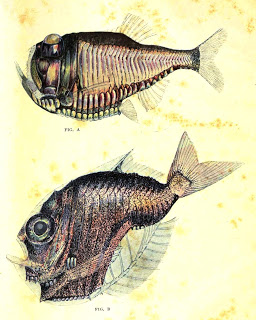
Fig. A, Argyopelecus ; Fig. B: Sternoptyx
View Full Size Image
Bodianus eclancheri
View Full Size Image
Cypselurus furcatus
View Full Size Image
Melanocetus johnsonii
 
View Full Size Image
Xanthichthys Ringens
View Full Size Image
Fig A: Young Mola mola ; Fig. B: Holocentrus; Fig C: Taractes

The full-set is available for download on Flickr. This week we thank MBHLWHOI for digitizing Arcturus.

Happy Birthday Beebe

And why do we highlight Charles William Beebe today? Besides the fact that he was no ordinary scientist, this past Sunday marked Beebe’s 135th birthday. Happy belated Beebe and thank you for your contributions to the body of knowledge about life on Earth with such infectious flare! Even though Beebe was often accused by critics of “spicing” things up in popular accounts of his scientific adventures, we think he was just a man on a mission with some serious curiosity, courage and commitment to knowledge. He lived like a man who was running out of time, indefatigable to the last: on his expeditions he was noted to rise at 5AM and end the day around 10PM; the fact that a volcano was erupting did not deter him from hiking into it — almost being killed by toxic gasses. It would take a man like this to place himself into a 2+ ton steel ball called a “Bathysphere” and head down into the unexplored deep. We know Beebe was not interested in notoriety, Beebe was interested in Life.

“…the supreme joy of learning, of discovering, of adding our tiny facts to the foundation of the everlasting why of the universe; all this makes life [..] one never-ending delight.”~ William Beebe


View Full Size Image

Notes

Beebe Bibliogpraphy on the BHL
William Beebe’s Official Website
Beebe, Barton, Cameron

Beebe Media
Welcome to Bermuda (recommended)
William Beebe’s Galapagos Expeditions (recommended)
Sounding the Deep, a 2012 Hull Philharmonic Orchestra production inspired by Beebe.
Titans of the Deep (1938)
Information Please, Beebe airing as a guest on the popular quiz show.

August 2, 2012by [email protected]
Blog Reel, Featured Books

Book of the Week: The Valdivia Expedition

Deep sea dredging in the twilight zone with Teuthologist Carl Chun

View Full Size Image
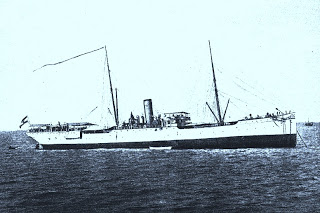
The Valdivia

Deep sea dredging, as a means of scientific discovery, was popularized after the Challenger Expedition (1872-1876) came back to port in Spithead, Hampshire in the United Kingdom. In four years, the scientifically outfitted steamboat had circumnavigated the globe, traveled a total distance of 68,890 nautical miles, and along the way had picked-up 4,700+ previously unobserved and unnamed species.

The study of these biological treasures produced about 50 tomes of scientific publications penned by the scientists on the voyage. The Challenger Expedition was the foundation of modern Oceanography. It prompted many other nationally and privately funded expeditions to begin dredging the deep-sea in the pursuit of describing new and exotic species.

The intense fascination with deep sea organisms during this time period was not very surprising, considering the fact that it controverted the widely accepted mid-19th century, Abyssal Theory which, held that life could not exist at more than 300 fathoms under the sea. (~1800 ft.) Carl Chun, famed marine biologist specializing in cephalopods, was among a growing faction of scientists who had a deep conviction that there must be life, a prolific amount of it, deep in the unexplored nether regions of the ocean.

It was this belief along with the desire to further delve into areas previously neglected by the Challenger Expedition that led him to propose the first German Deep Sea expedition, nationally funded with the good graces of Germany’s last Kaiser, Wilhelm II.

The Valdivia Expedition

With plans in place, Chun and his scientific team were granted 300,000 marks that would fund the Valdivia Expedition. The steamboat was outfitted with dredging gear, specimen jars, deep sea traps and oceanographic equipment. The Valdivia set sail on July 31, 1898; it would be a journey that would take its crew to 268 stations around the West Coast of South Africa, the Gulf of Guinea, the Antarctic Sea, and a large portion of the Indian Ocean.

They would cover over 32,000 nautical miles and come back with so many new specimens that they would continually publish their findings over the span of 4 decades. The resulting 24 volumes comprises this week’s lengthy Book of the Week:Wissenschaftliche Ergebnisse der Deutschen Tiefsee-Expedition auf dem Dampfer “Valdivia” 1898-1899″ (Scientific results of the German deep-sea expedition on the steamer “Valdivia” 1898-1899). This multi-volumed set includes Chun’s visually stunning Die Cephalopoden; the English translated version is also available on BHL.

It was on this voyage that Chun first observed and described the “Vampire Squid” or Vampyroteuthis infernalis, which means “vampire squid from hell.” (This is one of the most favorited images on Flickr, so be sure to have a look)

The main goals for the expedition were to collect as many biological samples as possible and focus on the adaptation of organisms to the extreme conditions of their environment. This resulted in many anatomical studies of light organs. One stand-out publication comes from Dr. August Brauer, a german zoologist who was among the many scientists on the Valdivia.

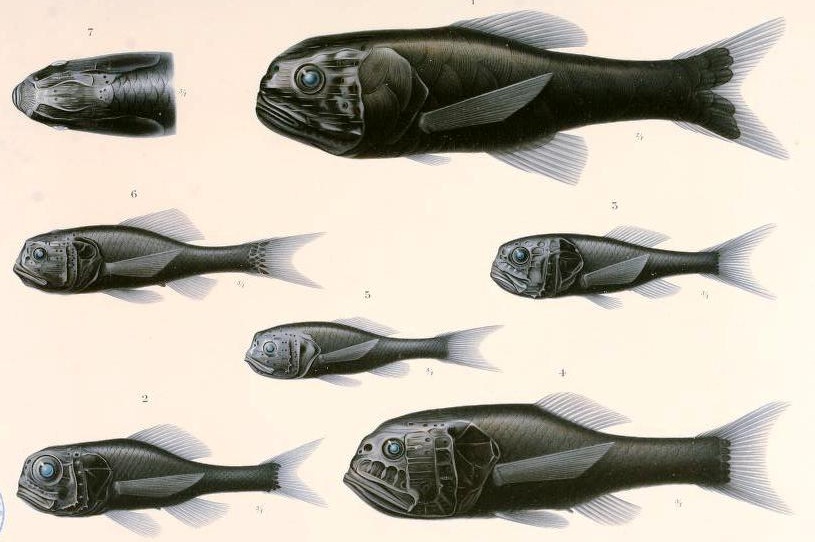
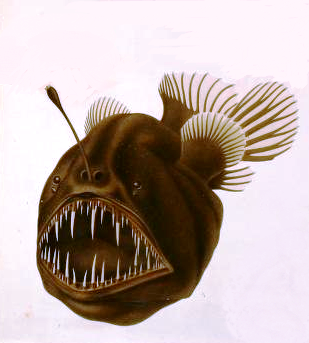
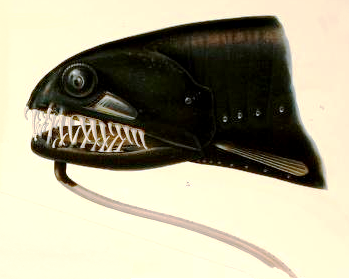
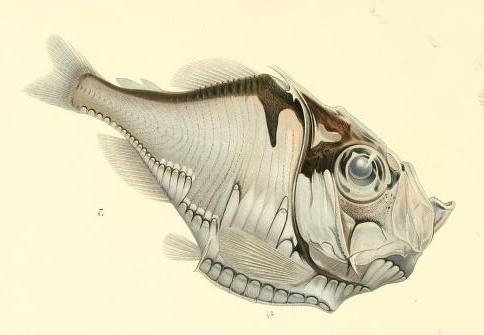
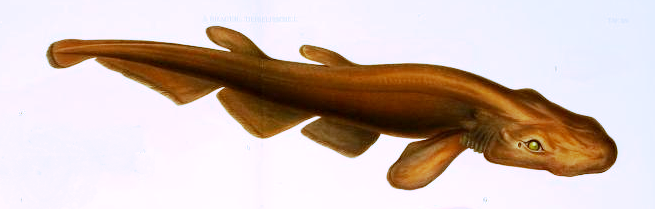
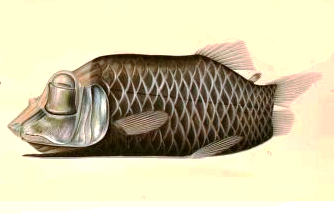
With the editorial review of Chun, Brauer producedVolume 15: Die Tiefsee-Fische which is a systematic and anatomical study of the deep sea fish specimens brought back from their journey. The illustrations were done by zoologist and expedition artist Fritz Winter. It is clear from Fritz’s drawings that deep sea fish rely heavily on senses other than vision. Many produce their own light, which has the effect of making the deep sea look like a starry night, filled with bioluminescent organisms — thus the bathypelagic (1000-4000m) and (700-1000m) abyssopelagic zones in the ocean have aptly been nicknamed the “twilight zone.”

Dr. August Brauer’s Deep Sea Fish, Illustrated by Fritz Winter
Winter was an incredibly talented man: 100+ years later these deep sea fish are still jumping off of the page.

View Full Size Image
Various (Melaphaes Genus)
View Full Size Image
Humpback anglerfish (Melanocetus johnsonii)
View Full Size Image
Valdivia Black Dragon Fish (Melanostomias valdiviae)
View Full Size Image
Spicy Hatchet Fish (Polyipnus spinosus)
View Full Size Image
Smallbelly Catshark (Apristurus indicus)
View Full Size Image
Barrel-eye (Opisthoproctus soleatus)

Fritz Winter on Flickr

Two sets of illustrations by Fritz Winter from the Valdivia Expedition are now on Flickr: Brauer’s Deep Sea Fish and Chun’s Cephalopoda. These should simply not be missed. Look out for more images from this expedition in the future!

And don’t forget that it is still National Oceans month. We should remember the spirit of these men who ventured forth in to the unknown as some of the world’s first oceanographers. They taught us that we shouldn’t overlook the deep sea. It may be invisible, inhospitable and completely foreign to humans yet, it is home to the largest habitat on the planet and still remains largely undiscovered.

Dive in to the Deep Sea: Resources for the Interested

  • The Deep: The Extraordinary Creatures of the Abyss by Claire Nouvian
  • The Silent Deep: The Discovery, Ecology and Conservation of the Deep Sea by Tony Koslow
  • BBC Nature: Deep Ocean
  • Planet Earth: Deep Ocean
  • NOAA: Ocean Explorer
  • World Ocean Census: A Global Survey of Ocean Life
June 21, 2012by [email protected]
Blog Reel, Featured Books

Happy Birthday, Louis Agassiz!

View Full Size Image

Monday, May 28, marked Jean Louis Rodolphe Agassiz’s 205th birthday. Louis Agassiz was a famous Swiss paleontologist, glaciologist, and geologist who made critical advances in the fields of ichthyology and glaciology. During his lifetime, he received the Wollaston medal, was named a member of the Royal Society, the Royal Swedish Academy of Sciences, and the American Academy of Arts and Sciences, and served as the head of the Lawrence Scientific School at Harvard University. And last, but certainly not least, Agassiz founded the Museum of Comparative Zoology at Harvard University.

Born in Môtier, Switzerland, in 1807, Agassiz’s original interests laid in medicine, but he developed an affinity for zoology, particularly ichthyology, after meeting Georges Cuvier, renowned French naturalist and zoologist. In 1826, Carl Friedrich Philipp von Martius asked Agassiz to study a collection of fish brought back from an 1819-20 expedition to Brazil. The endeavor marked the launch of Agassiz’s work in ichthyology. The project was completed in 1829, and by 1830, Agassiz, fully engrossed in the subject, issued a prospectus of a History of the Freshwater Fish of Central Europe, which was finally published from 1839-42.

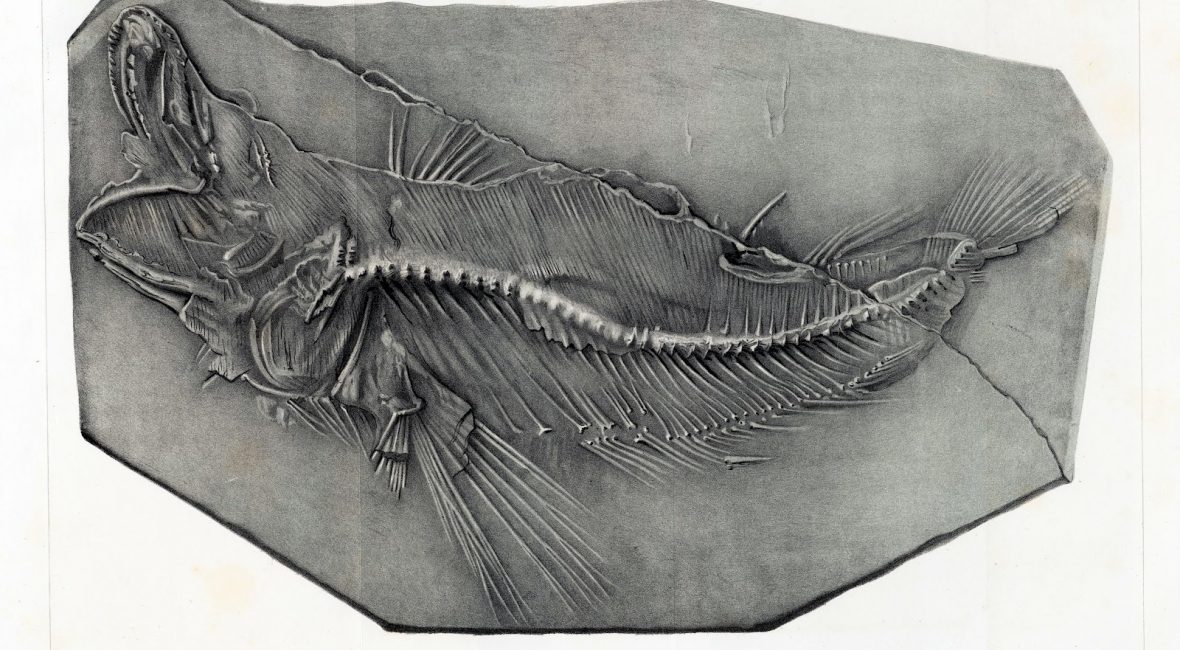
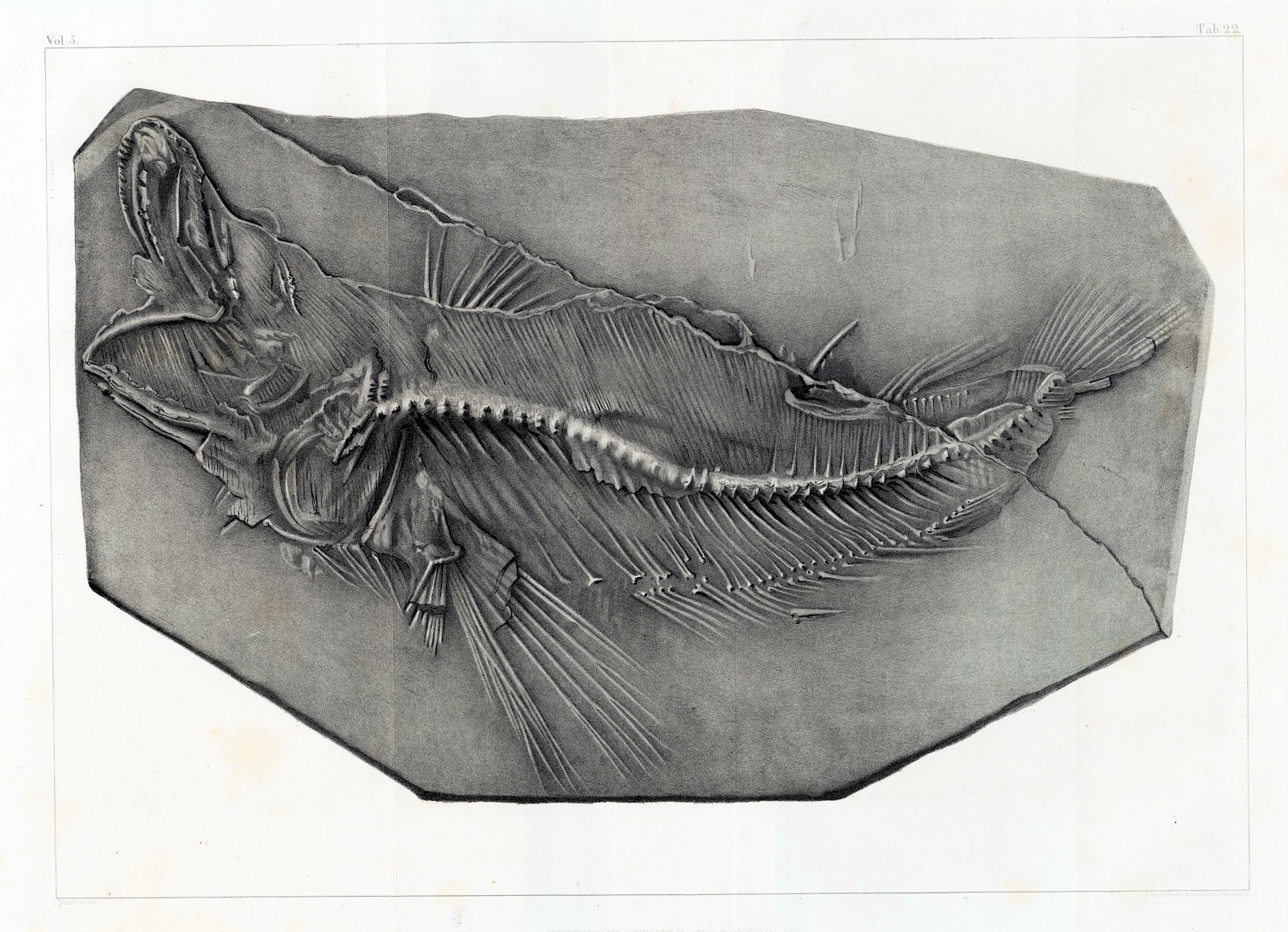
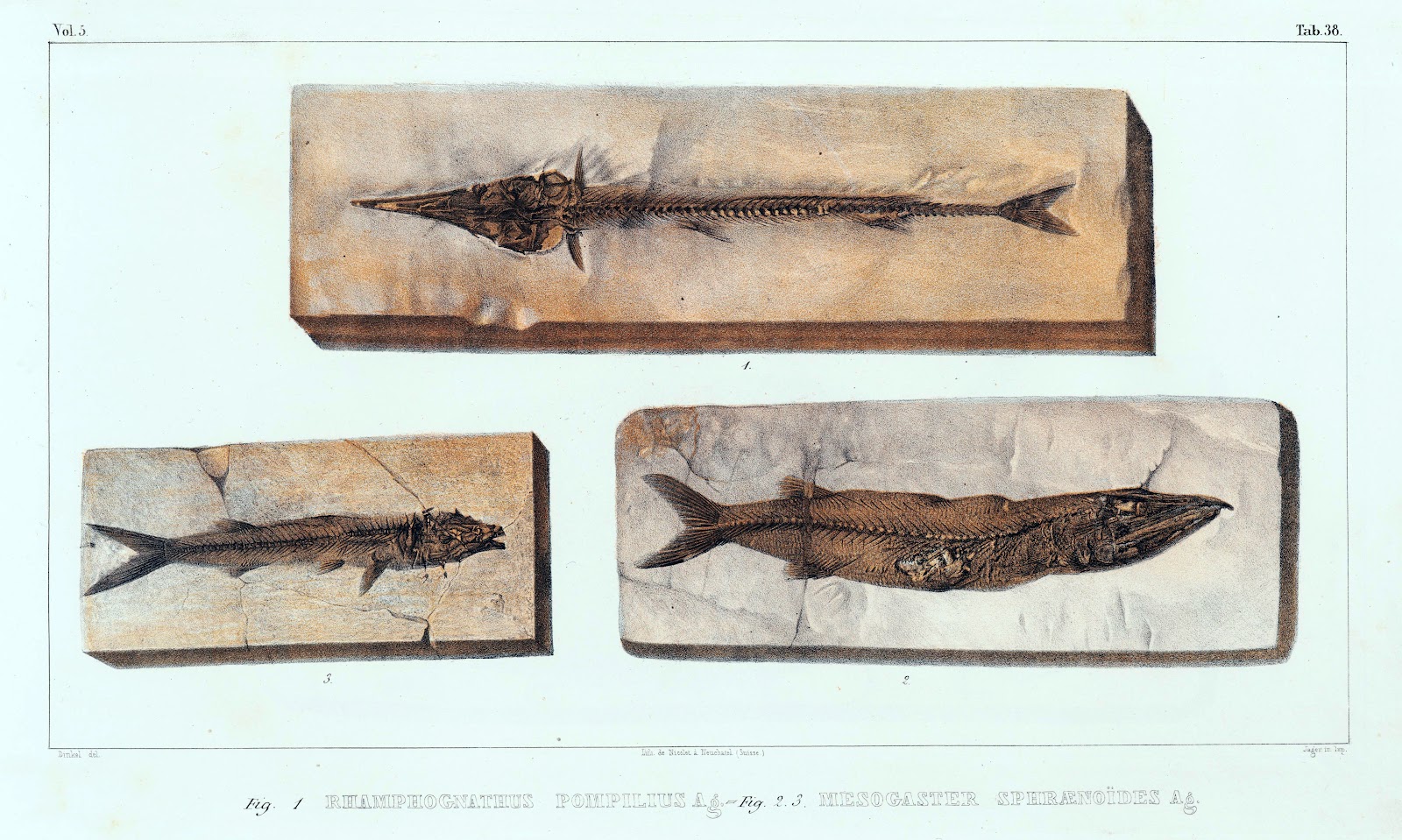
Agassiz achieved worldwide fame with the publication of Recherches sur les poissons fossiles, a five volume, gorgeously-illustrated set, published from 1833-43. The work described the fossil fish housed at the University of Neuchâtel, where Agassiz taught as a professor. The stones containing the fossils came from the slates of Glarus and the limestones of Monte Bolca.

View Full Size Image

Agassiz’s research for Recherches prompted him to develop a new classification system for fish, dividing them into the four groups Ganoids, Placoids, Cycloids and Ctenoids. The division was based on the scales and dermal appendages exhibited by each specimen, as these characteristics were often the only traits preserved in fossils. Though no longer in use, Agassiz’s system served as an important advancement in the study of fossil fish.

Recherches contains 402 lithographic plates, 318 of which are hand-colored. It describes more than 1,700 ancient fish species. To support the continued development of the project, the Earl of Ellesmere purchased Agassiz’s 1,290 original drawings for the work, which were ultimately presented to the Geological Society of London. A complete copy of the work sold at Christie’s Auction House in 2003 for $8,537.

During his lifetime, Agassiz published material about echinoderms, fossil mollusks, embryology, and glaciers. He was the first to advocate scientifically for the advent of an ice age in earth’s history, which resulted in his two-volume work Etudes sur les Glaciers. Agassiz ultimately settled in the United States, and, perhaps most importantly for BHL, founded the Museum of Comparative Zoology at Harvard University in 1859. The museum’s library is one of the founding members of BHL and the contributor of our copy of Recherches sur les poissons fossiles. By the time of his death, Agassiz was one of the best-known scientists in the world.

You can see a selection of the illustrations from volumes 2 and 3 in Flickr and browse the entire work in BHL. We’re proud to have our own history so intricately interwoven with this great man and send a heartfelt birthday wish his way. Happy birthday, Louis Agassiz!

May 31, 2012by ulib-libraryjobs
Blog Reel, User Stories

BHL and Our Users: EOL Rubenstein Fellow, Dr. John Sullivan

Portrait version of the Biodiversity Heritage Library logo.

View Full Size Image

Today, we continue with our mini-series featuring EOL Rubenstein Fellows and their research activities. For this installment, meet Dr. John Sullivan, a passionate ichthyologist dedicated to discovering and describing fish species all over the world, but particularly in Africa.

What are your research interests, where you do the bulk of your work (country), and what is your institutional affiliation?

I am an evolutionary biologist who studies the phylogenetic interrelationships and evolution of freshwater fishes. I focus on two groups in particular: weakly electric fishes (Mormyridae and Gymnotiformes) which are found in Africa and South America, respectively, and catfishes (Siluriformes), which are distributed pretty much all over the world. In addition to using molecular techniques to work out phylogenies for these fishes, I describe species and work on the taxonomy of all three groups. My most recent collecting field trips have been to Ethiopia, the Democratic Republic of Congo, and Gabon. I am affiliated with two institutions, the Academy of Natural Sciences in Philadelphia, where I am a Research Associate, and the Cornell University Museum of Vertebrates in Ithaca, New York, where I am a Curatorial Affiliate. I live with my wife in Ithaca.

In the program, Fellowships are expected to serve as a complementary funding source to existing funding you have that supports your primary research activities. Please describe what you primary research activities are.

I used the Rubenstein Fellowship to supplement a nine-month Fulbright Research Fellowship in the Democratic Republic of the Congo. My Fulbright work was to make an inventory of fish species found in the vicinity of Kisangani, a city on the Congo River at the base of the Upper Congo rapids and to help build capacity at the University of Kisangani in ichthyology. As a Rubenstein Fellow, I made creation of EOL species pages for Congo River freshwater fishes a key activity of my time there. And since my return from Congo, I’ve been continuing to add many of the hundreds of photographs of fish specimens I took as we identify the specimens. We’ve already found several undescribed species from our collections, and I and my colleagues are beginning work on their descriptions.

Please describe how you use EOL to disseminate or support your primary research activities, or what your primary duties related to EOL are.

Eventually, I’d like to see great photos, descriptions and keys available online through EOL for all African freshwater fishes. We still have a lot of work to do to get there, but one can now see that this is the future. It still takes a lot of time to do careful taxonomic work, but now as soon as it’s published, we can get the name into a classification and a picture and description up online. For instance, we got the new mormyrid species Petrocephalus similis into EOL the week it was published in July. Taxonomy is a dynamic discipline: names and classifications frequently change to reflect our improving knowledge of the organisms (a sometime annoyance to end-users of taxonomies, but unavoidable). So static books are in some ways poor repositories of this information. Taxonomy and the Web are really made for each other and in hindsight something like EOL was inevitable.

How has the EOL Fellows program made a difference in your career/research?

The Rubenstein EOL Fellows program gave me an easy way to help make knowledge about African fishes available to everyone, including Africans who often have internet access but nothing in the way of libraries. The more informed my African colleagues are about their own fish fauna, the more effective our collaborations can be. While it doesn’t take the place of getting published in the primary literature, contributing to EOL tells your colleagues that you’re committed to the “broader impacts” of what we taxonomists do and that you’re at the forefront of where the field of taxonomy is headed. I am looking forward to the day when publishing a new species description and publishing content on EOL are one and the same thing. In fact, that future is already here with the journal ZooKeys that automatically exports to EOL. We plan to use that journal for our next mormyrid description.

Who is your Mentor, what is their area of interest (research activities), and how have they supported you throughout your Fellowship?

My mentor is Dr. Melanie Stiassny, curator of fishes at the American Museum of Natural History in New York. Melanie has really reinvigorated the study of fish diversity of the Congo River over the past few years and has made a number of stunning discoveries in the rapids area of the Lower Congo. She was great at providing me the logistical and moral support I needed for my project in Kisangani.

How does BHL support your Fellows activities, as well as those research activities that fall outside of your duties as an EOL Fellow?

I tend to think of BHL as my personal ichthyology library (although I know there’s a bit more archived in it than that). I have retrieved dozens and dozens of species descriptions from it that are now on my personal computer for instant reference and also appended to species pages in one of my two EOL Lifedesks: http://mormyrids.lifedesks.org/ and http://congofishes.lifedesks.org/.

I’ll give you a concrete example of how BHL supports my work. In systematics, the old literature is often just as important as the new. For instance, the systematics of a genus of mormyrid fish we work on was really blocked by our inability to establish the identity of Mormyrus sphekodes (now Paramormyrops sphekodes), described in 1879 by French ichthyologist H.E. Sauvage. The type specimen still exists, but is in bad condition in the Paris Museum collection. If we were to describe new species without knowing what P. sphekodes really was, we risked redescribing it under a different name and creating a synonym.

So this past May I arranged to go back to the type locality mentioned by Sauvage, the “Chutes de Doumé” on the Ogooué River in Gabon to make a new collection of it. I’m happy to report I succeeded! Before going there, I had downloaded Sauvage’s description of this fish from BHL, published in the Bulletin de la Société Philomatique de Paris. It had taken me just a few minutes to locate this paper and customize the pdf. I had it on my Kindle as I stood at the site, a place I don’t think ichthyologists had revisited since the 1870s.

When did you first discover BHL?

Some time before I started my Fellowship, probably in 2008.

What are your favorite features/services on BHL?

I love how it takes me no time at all to find a species description in some old serial like the Annals and Magazine of Natural History and, using the web interface, generate a pdf of just those pages that I want. Even if I lived in a library that had these volumes on the shelf, it would take me longer to locate what I was looking for. I can then take those pdfs BHL generates for me and attach them to the species pages I create on my Lifedesks. Now anybody in the world has instant access to the original species description in a couple of clicks!

If you could change one thing about BHL, or suggest one thing to be the next developmental priority for BHL, what would it be?

It seems like you are doing the right thing: continue to expand and add content. It is great to see a number of biodiversity journals allowing BHL to digitize their back catalog, including material still under copyright, and very encouraging to see BHL go international with BHL-Europe and other initiatives. Now that much of the really old stuff is available, it’s the material from the 1930’s – 1970’s that is notably hard to obtain if you don’t have a world-class library, so I hope more of it finds its way onto BHL in the near future.

Please describe why you think services like EOL and BHL are important for today’s scientific community.

Science is all about disseminating knowledge and building upon what has come before, yet so much of our knowledge of plants and animals has remained inaccessible to those who could make use of it. This has been a big part of the “taxonomic impediment.” BHL is radically changing the status quo and democratizing access to knowledge about biodiversity. Now that access to the works of so many great 18th and 19th Century biologists is an easy affair, I expect we’ll see them cited a lot more in the modern literature. In this way, BHL is contributing to the continuity of biodiversity science.

Do you have a favorite book in BHL, or a book that has most supported your research activities or EOL responsibilities?

My favorite book in BHL would have to be the four volumes of George Albert Boulenger’s Catalogue of the Fresh-Water Fishes of Africa, published from 1909 to 1916. This work remains the single-most important publication on African ichthyology. While many more species have been described in the subsequent century and generic names have undergone changes, it is still a remarkably useful resource for identifying African fishes. Until BHL made pdfs of all four volumes freely available, you had to pay dearly even for a reprinted version. Now all my African colleagues who never had these advantages have the pdfs on their laptops.

Thank you, Dr. Sullivan, for taking the time to give us a glimpse into your world and research, and for articulating how important BHL has been to your endeavors. As we continue to grow our collection, we hope to be able to establish more and more relationships with publishers and provide access to a plethora of in-copyright materials, freeing, as you so eloquently describe, this information from the static written page to the future of dynamic electronic access for the world.

Information on the photo from Dr. Sullivan: “The photo is of me on the Ogooué River in Gabon, Africa in May of this year. The site is a famous one for African ichthyology: it is the “Chutes de Doumé” from which H.-E. Sauvage described the catfish Doumea typica and the mormyrid electric fish Mormyrus sphekodes – now Paramormyrops sphekodes – (among others) in an 1879 publication published in the Bulletin de la Société philomathique de Paris, a pdf of which I downloaded from BHL!”

September 13, 2011by michelle.underhill
Blog Reel, Featured Books

Book of the Week: Illustrations in Zoology

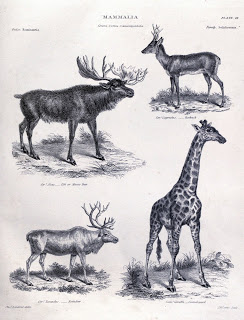
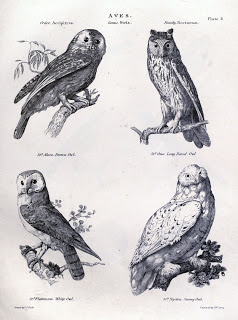
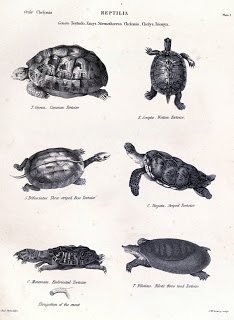
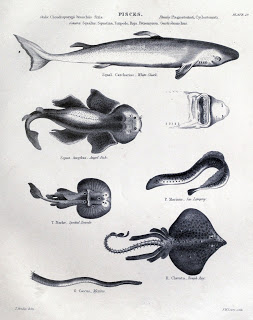
Ever wanted to get a systematic view of the animal kingdom in picture-book style? Well, this week you’re in luck, because we’re featuring Illustrations of Zoology (1851), with engravings by F.W. Lowry and Thomas Landseer, after the original drawings by Sowerby, Varley, Holmes, Bone, Pyne, Lowry and Charles Landseer. It contains no less than 87 illustrations of animals from all walks of life!

The book is arranged first according to vertebrates and invertebrates, and within each of those divisions, it is further divided into the various classes, i.e. Mammals, Birds, Reptiles, and Fish for vertebrates and Mollusks, Insects, Crustaceans, Arachnids, Myriapods, Echinoderms, Entozoa, Acalepha, Infusoria, and Polyps for invertebrates. The further you delve into the classes, the more the categories are broken down into orders and families. While 156 pages of our book of the week give some fairly detailed text descriptions of the classes, orders and families contained within, the really juicy stuff comes after that, when the dozens of breath-taking engravings begin. For our post, we’ve chosen a few of our favorite engravings, and, for each featured, we’ve chosen our favorite animal on the page and included an interesting fact about it. Enjoy!

View Full Size Image

Mammals: Featured animal, the Giraffe. Interesting fact: Giraffes can grow up to 18 feet tall, but they have the same number of vertebrae in their necks as humans do: 7!

View Full Size Image

Birds: Featured Animal, the Snowy Owl. Interesting fact: The Snowy Owl’s diet consists mostly of lemmings, and they can eat up to 1,600 a year each!

View Full Size Image

Reptiles: Featured Animal, the Matamata. Interesting fact: The Matamata has been renamed 14 different times in 2 centuries.

View Full Size Image

Fish: Featured Animal, the Whale Shark. Interesting fact: The Whale Shark is the largest fish in the sea, reaching lengths of 40 feet!

View Full Size Image

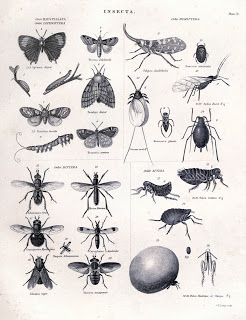
Insects: Featured Animal, Lanternfly (shown as Fulgora candellaria). Interesting fact: Though named Lanternflies due to the assertion that the large “snout” of this insect becomes illuminated at night (an assertion that even Linnaeus accepted without question), centuries of observations have failed to support this claim.

View Full Size Image

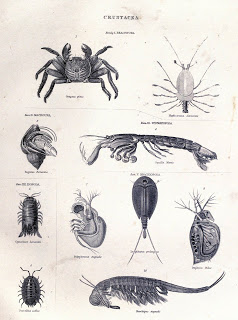
Crustaceans: Featured Animal, the Mantis Shrimp (shown as Squilla mantis). Interesting fact: This shrimp is of the “spearer” type, having long spiny appendages topped with barbed tips that are used to stab and snag prey.

View Full Size Image

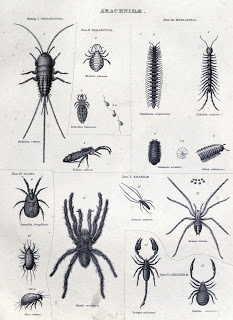
Arachnids: Featured Animal, Argiope lobata (shown as Aranea lobata). Interesting fact: Argiope lobata decorate their webs with intricate crisscross patterns, of which the purpose is still in hot debate. Some believe the patterns serve as camouflage, others that they make the spider appear larger and more threatening, and still others that they make the web more visible and thus less likely to incur accidental damage from large bodies like humans. Still others believe that the patterns more distinctly reflect ultraviolet light, which many insects are attracted to, thus increasing the number of prey that the spider traps.

We hope you’ve enjoyed our brief excursion into the world of zoology, but remember, we’ve only highlighted a few of the many gorgeous plates in this book. Be sure to check out all of the images from Illustrations of Zoology (1851) in our Flickr account!

August 18, 2011by michelle.underhill
Page 2 of 3«123»

Help Support BHL

BHL's existence depends on the financial support of its patrons. Help us keep this free resource alive!

search

About BHL

The Biodiversity Heritage Library (BHL) is the world’s largest open access digital library for biodiversity literature and archives. BHL operates as a worldwide consortium of natural history, botanical, research, and national libraries working together to digitize the natural history literature held in their collections and make it freely available for open access as part of a global “biodiversity community.”

Follow BHL

  • Bluesky logo
  • Instagram logo
  • Facebook logo
  • Flickr logo
  • Twitter logo

Join Our Mailing List

Sign up to receive the latest news, content highlights, and promotions.

Subscribe Now

Subscribe to Blog via Email

Enter your email address to subscribe to this blog and receive notifications of new posts by email.

Join 319 other subscribers

Subscribe to Blog Via RSS

Subscribe to the blog RSS feed to stay up-to-date on all the latest BHL posts.

Access RSS Feed


64+ Million Pages of
Biodiversity Literature Online.

EXPLORE

Tools and Services
to Transform Research.

EXPLORE

300,000+
Illustrations on Flickr.

EXPLORE

ABOUT | HARMFUL CONTENT | PRIVACY | SITE MAP | TERMS OF USE