Biodiversity Heritage Library - Program news and collection highlights from BHL
  • Home
  • News
  • Featured Books
    • All Featured Books
    • Book of the Month Series
    • BHL at 20
  • User Stories
  • Campaigns
    • Fossil Stories
    • Garden Stories
    • Monsters Are Real
    • Page Frights
    • Her Natural History
    • Earth Optimism 2020
  • Tech Blog
  • Visit BHL
Home
News
Featured Books
    All Featured Books
    Book of the Month Series
    BHL at 20
User Stories
Campaigns
    Fossil Stories
    Garden Stories
    Monsters Are Real
    Page Frights
    Her Natural History
    Earth Optimism 2020
Tech Blog
Visit BHL
  • Home
  • News
  • Featured Books
    • All Featured Books
    • Book of the Month Series
    • BHL at 20
  • User Stories
  • Campaigns
    • Fossil Stories
    • Garden Stories
    • Monsters Are Real
    • Page Frights
    • Her Natural History
    • Earth Optimism 2020
  • Tech Blog
  • Visit BHL
Biodiversity Heritage Library - Program news and collection highlights from BHL
Blog Reel, Campaigns, Her Natural History

Discovering Emma J. Cole (1845-1910), Author of the “Remarkably Fine” Grand Rapids Flora

This post is the first in a two-part series about the life and legacy of botanist Emma Jane Cole. View the second part by Drs. Garrett E. Crow and David P. Warners.

In the early years of the 21st century, I was delving into the archives of the Grand Rapids Public Museum researching a book to celebrate their 150th anniversary in 2004. Among the lists of men involved in the lyceums and institutes that shaped the beginnings of the western Michigan museum in the 1850s, there finally appears, at the very end of the 19th century, the name of Emma J. Cole, emerging like the first blossom of hepatica on a spring afternoon.
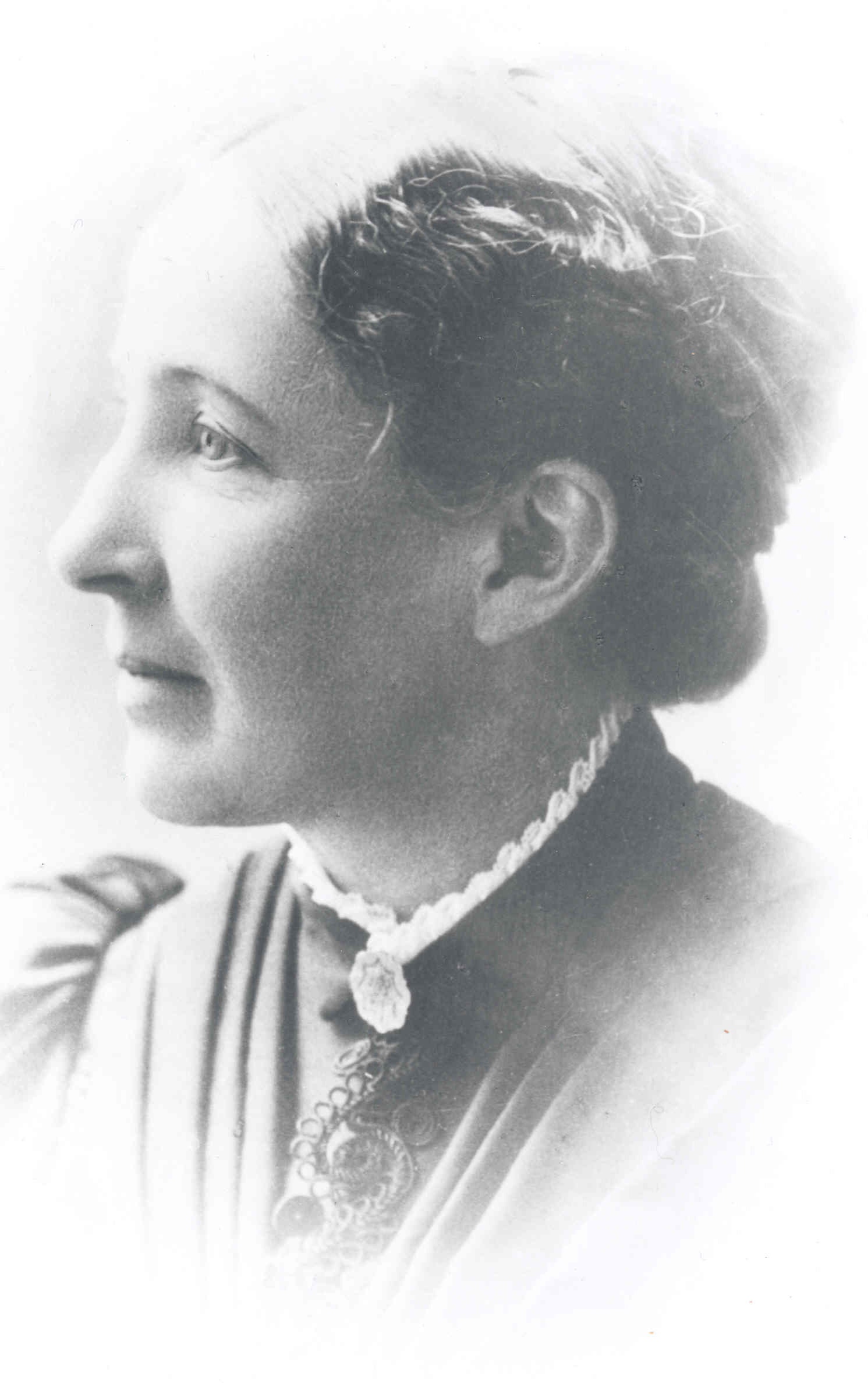
Emma J. Cole as she appeared in the 1895 Yearbook, Central High School, Grand Rapids, Michigan. Date of photo uncertain, as the same photo was used in all yearbooks from the beginning of her tenure, 1881. Photo courtesy Grand Rapids History & Special Collections, Grand Rapids Public Library.

Emma was elected a Vice President of the Kent Scientific Institute, precursor to the public museum, in 1900, but in 1891 the trustees had voted to pay her expenses while she collected plants to create an extensive herbarium for the institute (the completed sheets numbered nearly 4,000). As far as I have been able to glean, everyone involved with the KSI served without compensation for an organization whose annual budget seems to have been around $100. Emma’s reimbursements amounted to little more than $10 each summer, but as many women in science even today will attest, receiving 10% of an annual budget for a project is a significant vote of confidence at any institution.

Emma recruited students from the local high school, where she had been a teacher since 1881, to help in her field work, eventually resulting in the publication in 1901 of Grand Rapids Flora: A Catalogue of the Flowering Plants and Ferns Growing Without Cultivation in the Vicinity of Grand Rapids Michigan. It remains the only comprehensive survey of wildflowers in this area.

I was intrigued. Who was this woman and how did she undertake what seemed to me to be a truly ambitious project, on her own and in the face of a social structure less than amenable to professional work by women?

I had heard of Emma Cole before. For the past ten years I had been the editor of the Museum’s newsletter, and in 1994 the local Women’s History Council had commissioned a play about significant women in Grand Rapids history, including Emma. After a little scouring of abandoned file cabinets, I found a dusty file of research for the project containing census records about Emma’s early life, as well as copies of her Cornell University transcripts from 1876-79.

Cornell! How did this young woman from Lowell, a small town 15 miles east of Grand Rapids, leave her safe and secure family life to attend an elite eastern institution that had only begun to admit women six years earlier? I was hooked.

I started my search beyond the archives at the museum in the History and Special Collections division at the local library. I quickly stumbled onto the work of Dr. Edward Voss at the University of Michigan. What a treasure trove!

As I’m sure almost every reader of this blog will know, Dr. Voss was a professor of botany at the University of Michigan and curator of the herbarium there for decades, continuing as professor and curator emeritus until his death in 2012 at age 82. He was an internationally renowned expert on plant nomenclature, a fellow of the Linnean Society and author of the highly acclaimed three-volume Michigan Flora. He was the editor of The Michigan Botanist from 1962-1976. In the second issue he edited, September 1962, he published a 1907 manuscript by Emma Cole about her experiments with Green Dragon (Arisaema dracontium) that he found in some archives, and described her as “author of the remarkably fine Grand Rapids Flora.” He added, “She evidently influenced a large number of people in the study of botany, and she will surely be worthy of a biographical treatment one day in The Michigan Botanist.” I wish he had lived to see the July-December 2018 volume of that journal, now called The Great Lakes Botanist, in which Professor Garrett E. Crow and I published just that.

I began corresponding with Ed Voss in October of 2005, and he responded to my first e-mail with characteristic delight and enthusiasm: “I have hoped that someone with Grand Rapids connections would undertake a thorough treatment of Emma Cole!” It turned out that not only had he published her article, he included her in several surveys of historical Michigan botany and referenced her in his Flora.
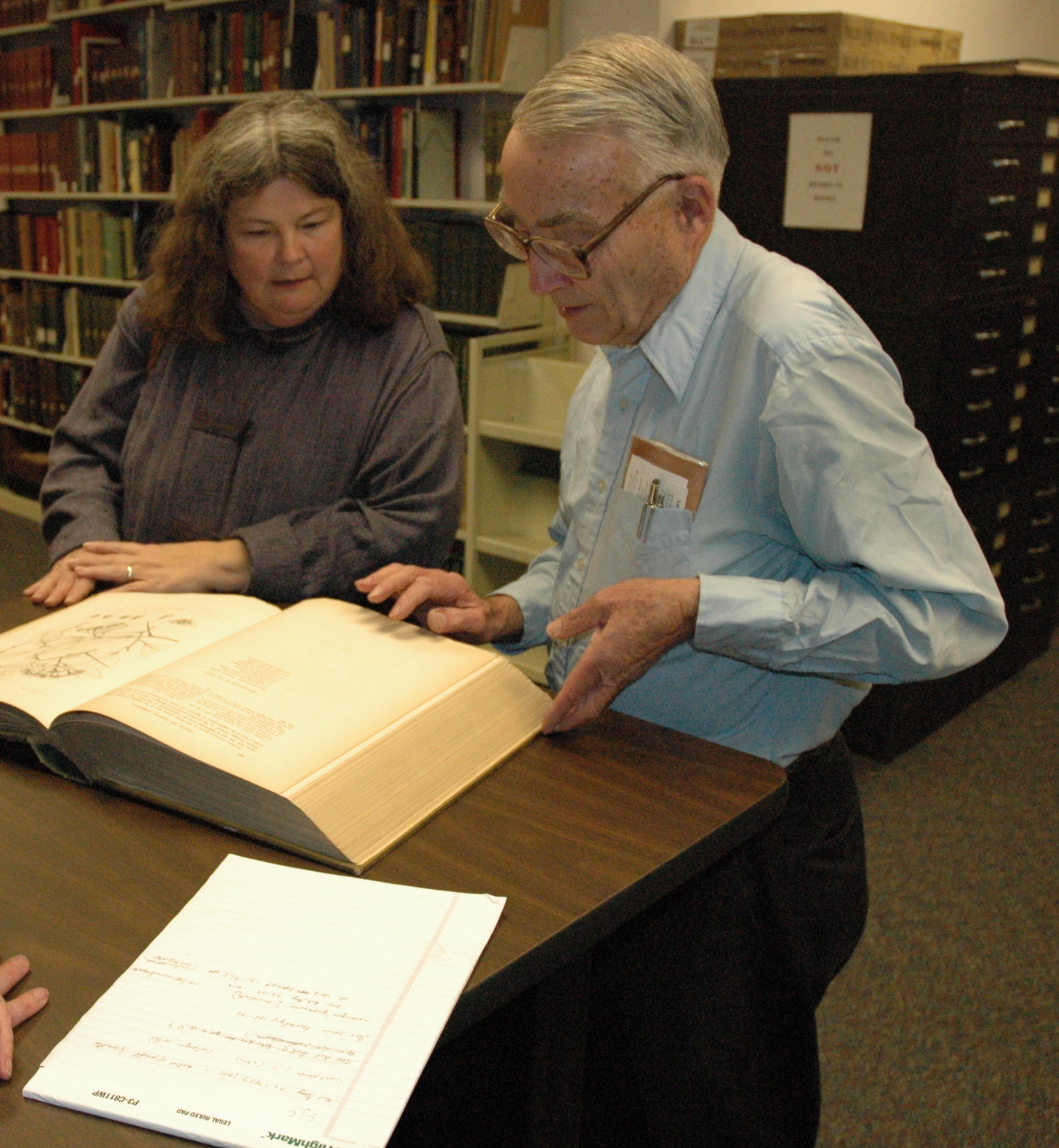
Dr. Edward G. Voss and author Julie Stivers, at the University of Michigan Herbarium, 2005. Photo by John Stivers.

When Emma Cole died in 1910, she left a very substantial estate that included a bequest to the University of Michigan to establish a scholarship in botany. (I still have not determined how she was able to accumulate an estate that included many property holdings on the salary of a high school teacher.) In the 1953-54 academic year, Edward Voss was an Emma Cole Scholar, and he retained a lifelong interest in “Miss Cole,” as he persisted in addressing her. Not only did he provide me with a wealth of materials he had collected, he spent hours with me pulling Emma’s herbarium sheets from the University of Michigan collection so they could be photographed for various programs about her I was presenting, including tracing her botanical travels through Europe, Cuba, Mexico and all over the U.S. Her herbarium, after serving as the basis of the natural history exhibitions at the Kent Scientific Institute until the 1930s, was put on permanent loan at the University of Michigan in the 1970s. Dr. Voss also became my gentle coach in the labyrinths of botanical terminology, historical and contemporary.

Emma had substantial contact with renowned botanists during her lifetime. As I proceeded in my pursuit of information about her, the Internet became a much more significant source. In those early years, before resources such as the Biodiversity Heritage Library were readily available, most of the online listings were finding aids for archival holdings. I found an intriguing reference to “50 letters of E. Cole” in the archives of the Harvard University Herbarium, and mentions of Emma Cole in the correspondence record of Charles Sprague Sargent at the Arnold Arboretum.

Again, a treasure trove. In 2008 I traveled to Cambridge to read and copy those letter. During the time she was compiling her data for Grand Rapids Flora, Emma corresponded extensively with Dr. Benjamin Lincoln Robinson, Director of the Gray Herbarium at Harvard, and his young assistant, Merritt Lyndon Fernald (who were in the midst of writing the 7th edition of Gray’s Manual of Botany). The correspondence, which we have reproduced in the Great Lakes Botanist article, is one-sided, as only her letters survived. But from her repeated gratitude expressed for their assistance, it is clear that they provided interested and detailed advice on nomenclature and species identification.

The archive of correspondence with Charles Sprague Sargent, Director of the Arnold Arboretum at Harvard, was equally one-sided, consisting of copies only of his letters to her. She evidently had sent him numerous specimens from one of his many plant passions, the genus Crataegus (Rosaceae), and he made several visits to Grand Rapids to explore what she had found. He credited her help in describing twenty new species, and even named one Crataegus coleae, a recognition that has persisted despite the taxonomic debate surrounding this genus.

At this point in my research, after giving several public programs about Emma Cole and working with the Women’s History Council to nominate her to the Michigan Women’s Hall of Fame (she was inducted in 2007), I was at a loss as to what to do next. I had come to the opinion that the most useful next step would be to visit some of her collecting areas in the 585 square miles covered in Grand Rapids Flora, find out what might still be growing there, and publish some kind of guide that could be used by contemporary plant enthusiasts. I went as far as determining the most likely spots that would still be accessible, and found myself hopelessly in over my head with the botanical work. I stored my Emma Cole boxes away in our attic, and thought that someday I might pick up that idea again.

Eight years later — I had a call from the president of the Women’s History Council. Students from Calvin College in Grand Rapids had tracked down an article I had written about Emma for the Council’s newsletter. They were involved in a project to — revisit the collecting areas outlined in Grand Rapids Flora, assess what was growing there now and publish their results! In January of 2016 I met with Dr. Garrett Crow and Dr. David Warners, visiting scholar and professor of botany, respectively, who were directing the student project (Dr. Warners also had been an Emma Cole scholar at the University of Michigan). The three of us have given public programs about Emma and the project, and Garrett published an article updating Emma’s nomenclature in the July 2017 issue of The Great Lakes Botanist. Learn more about the student project in this post by Drs. Crow and Warners.

Me? Someday I’m going to work out how this remarkable woman left an estate totaling nearly a half-million dollars in today’s money, a curiosity sparked over two long afternoons in Kent County Probate Court records, poring over her 60-page will. Some day.
March 20, 2019by Joel Richard
Blog Reel, Featured Books

Michał Piotr Boym’s Flora sinensis, fructus floresque humillime [Flora of China, fruits and flowers].

View Full Size Image
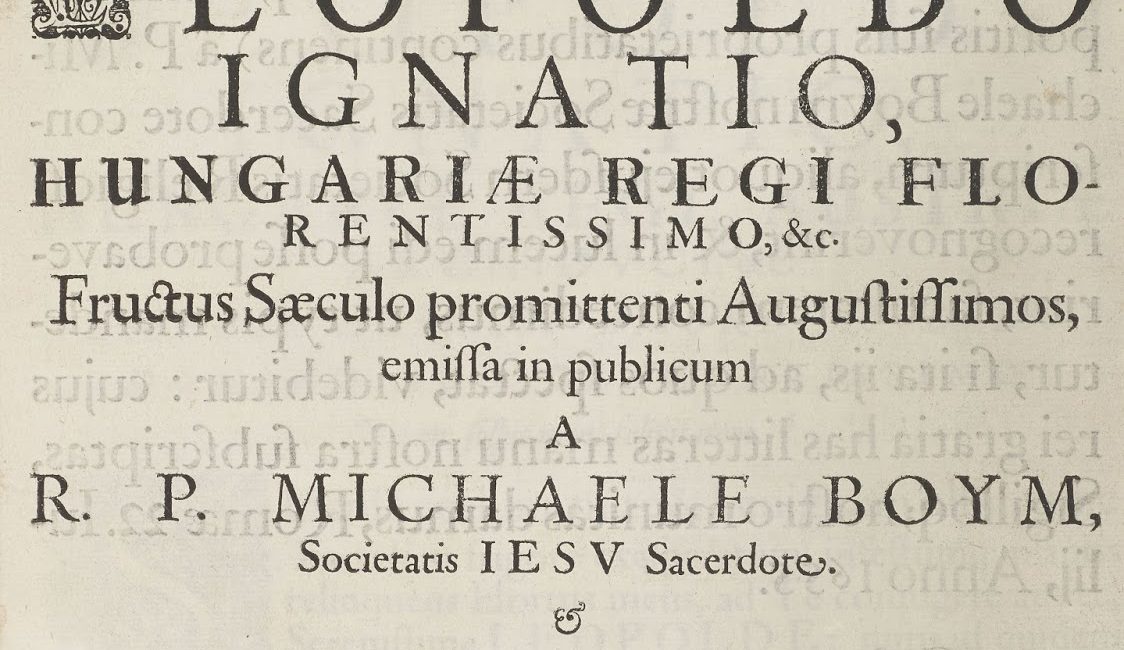
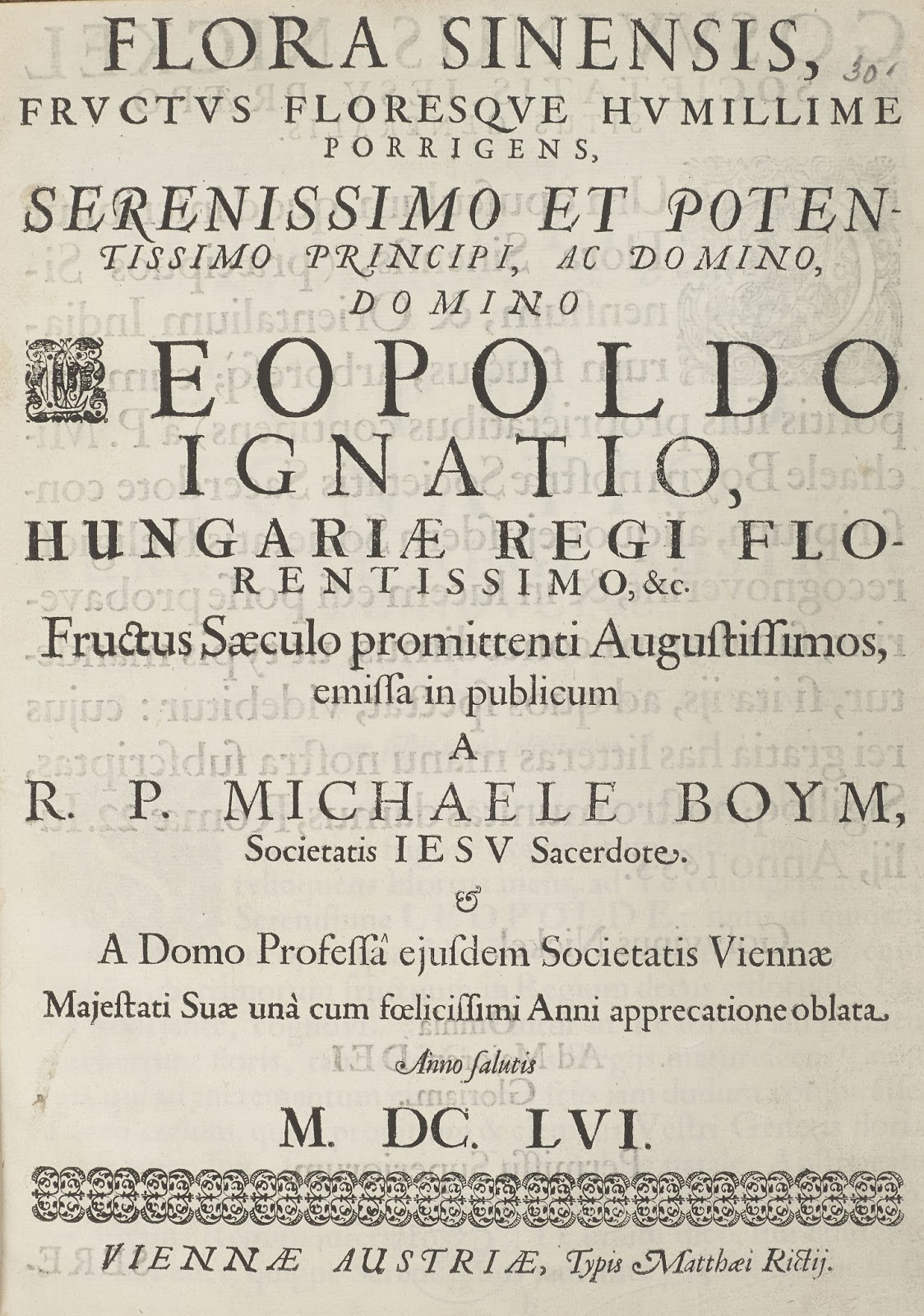
Fig. 1. Title Page. Boym, Michał Piotr. Flora sinensis. 1656. Digitized by Royal Botanic Gardens Kew, Library, Art & Archives. http://www.biodiversitylibrary.org/page/52239363.

Flora sinensis is one of the first natural history books on China by a European. Authored by Michał Piotr Boym, it was published in 1656 by Matthæi Rictii in Vienna. Boym dedicated it to Leopold I (1640-1705), Holy Roman Emperor, King of Hungary and Croatia, King of Bohemia and King of Serbia, and included a poem incorporating chronograms alluding to his coronation date, 1655.

View Full Size Image
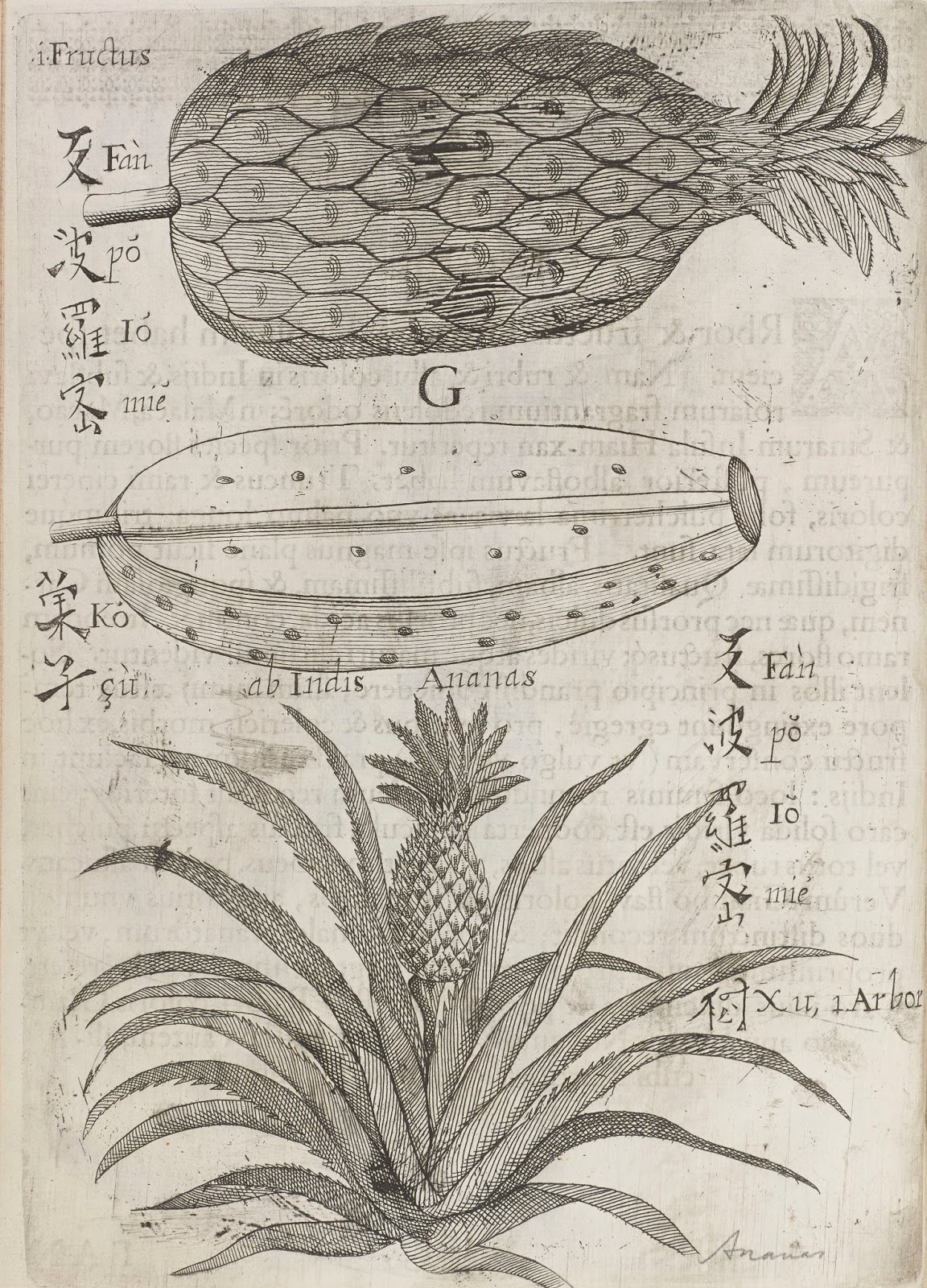
Fig. 2 Ananas (pineapple). Boym, Michał Piotr. Flora sinensis. 1656. Digitized by Royal Botanic Gardens Kew, Library, Art & Archives. http://www.biodiversitylibrary.org/page/52239334.

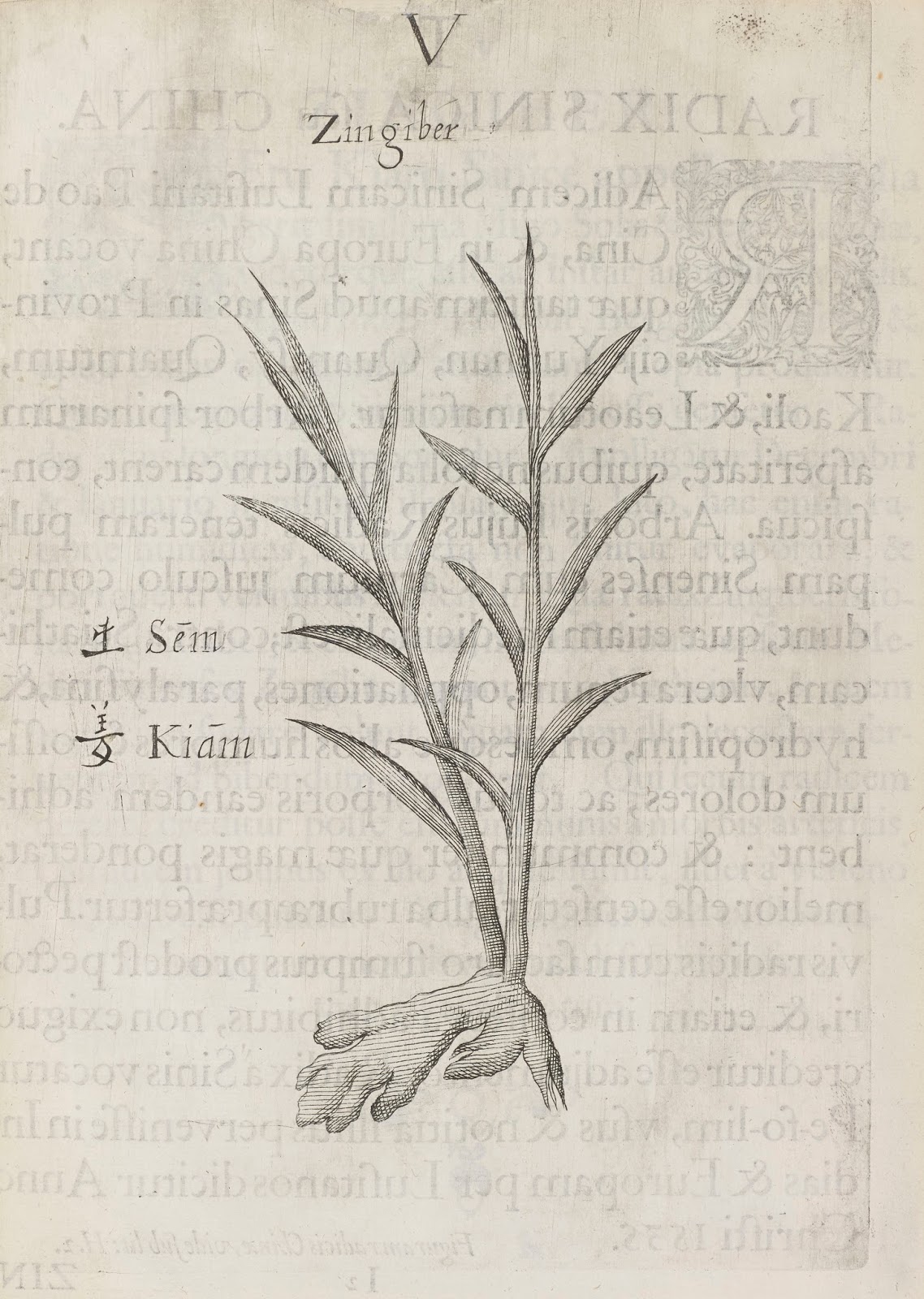
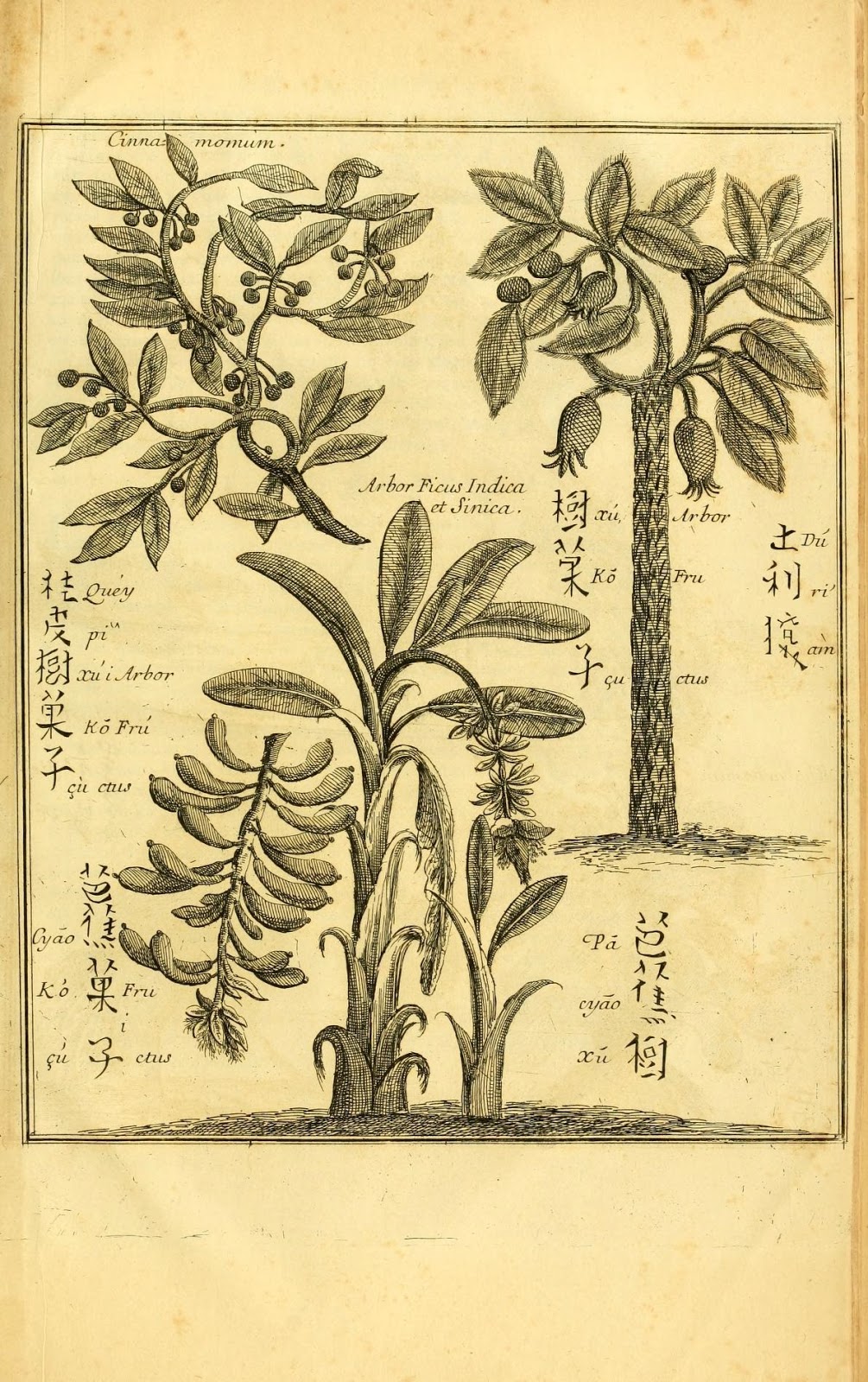
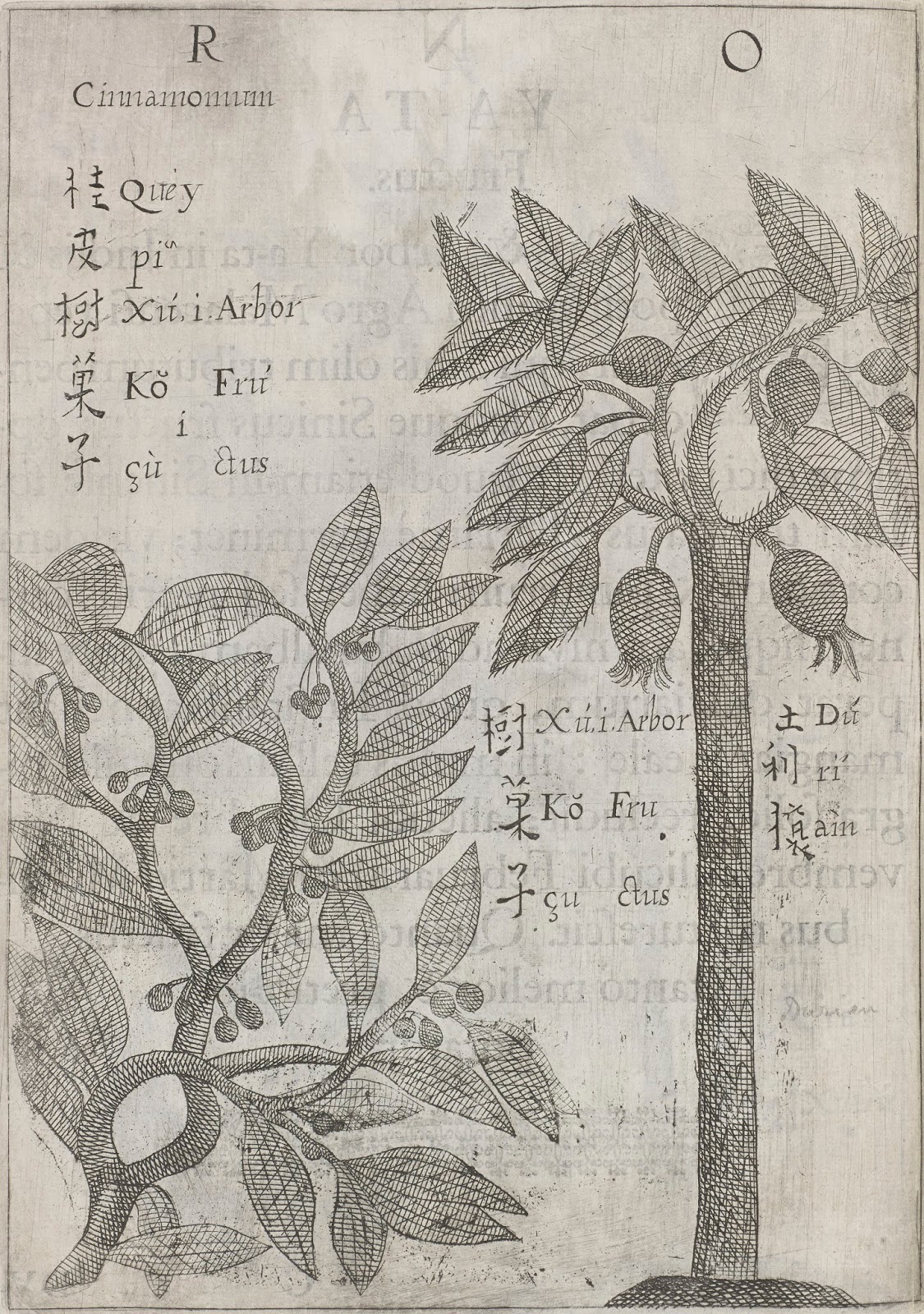
Augustin Pyramus, a Swiss Botanist, identified Boym as the first person to use ‘flora’ to define the plants of a particular region, habitat or geological period. Despite the title, it contains some animals, as well as a selection of choice plants, some of which are non-Chinese natives introduced from the Americas in the previous century, including guava (Psidium), papaya (Carica) and pineapple (Ananas) (fig. 2). Others, including cinnamon (Cinnamomum) (fig. 9), ginger (Zingiber) (fig. 3) and pepper (Piper), were important commodities of the spice trade.

View Full Size Image
Fig. 3. Zingiber (ginger). Boym, Michał Piotr. Flora sinensis. 1656. Digitized by Royal Botanic Gardens Kew, Library, Art & Archives. http://www.biodiversitylibrary.org/page/52239318.

Flora sinensis contains 48 pages of text and 23 black and white woodcut illustrations, 17 of plants, five of animals and one of a Nestorian Stele. Boym describes each species, its physical characteristics, common names, geographical distribution and medicinal virtues. The plates have titles in Chinese, transliterated into Latin, and in the Kew Gardens copy most of the Latin plant names have also been added to genus level.

Whilst the book was originally published uncoloured, some rare hand-coloured copies exist, notably at the Natural History Museum in London, Université de Namur, and SLUB Dresden.

View Full Size Image
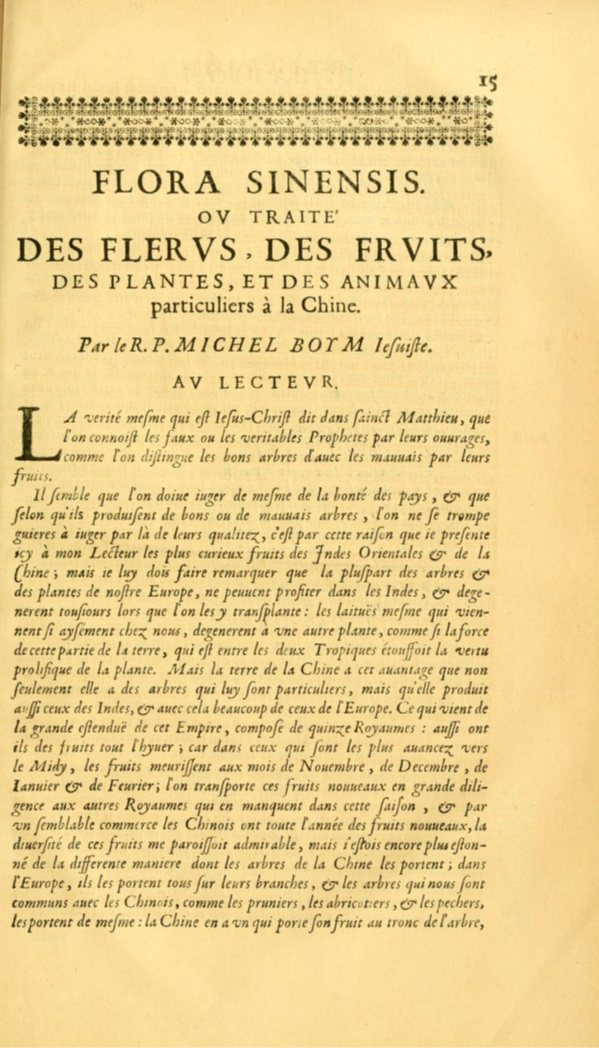
Fig. 4. Flora sinensis 1696, French edition title page. Digitized by Boston Public Library. http://www.biodiversitylibrary.org/page/25193368.

In 1664, Melchisédech Thévenot published a 15 page French translation, Flora Sinensis, ou traité des fleurs, des fruits, des plantes et des animaux particuliers à la Chine In: Relations de divers voyages curieux : qui n’ont point esté publiées, est qu’on a traduit or tiré des originaux des voyageurs françois, espagnols, allemands, portugais, anglois, hollandois, persans, arabes & autres orientaux, the 1696 edition of which is available on BHL.

View Full Size Image
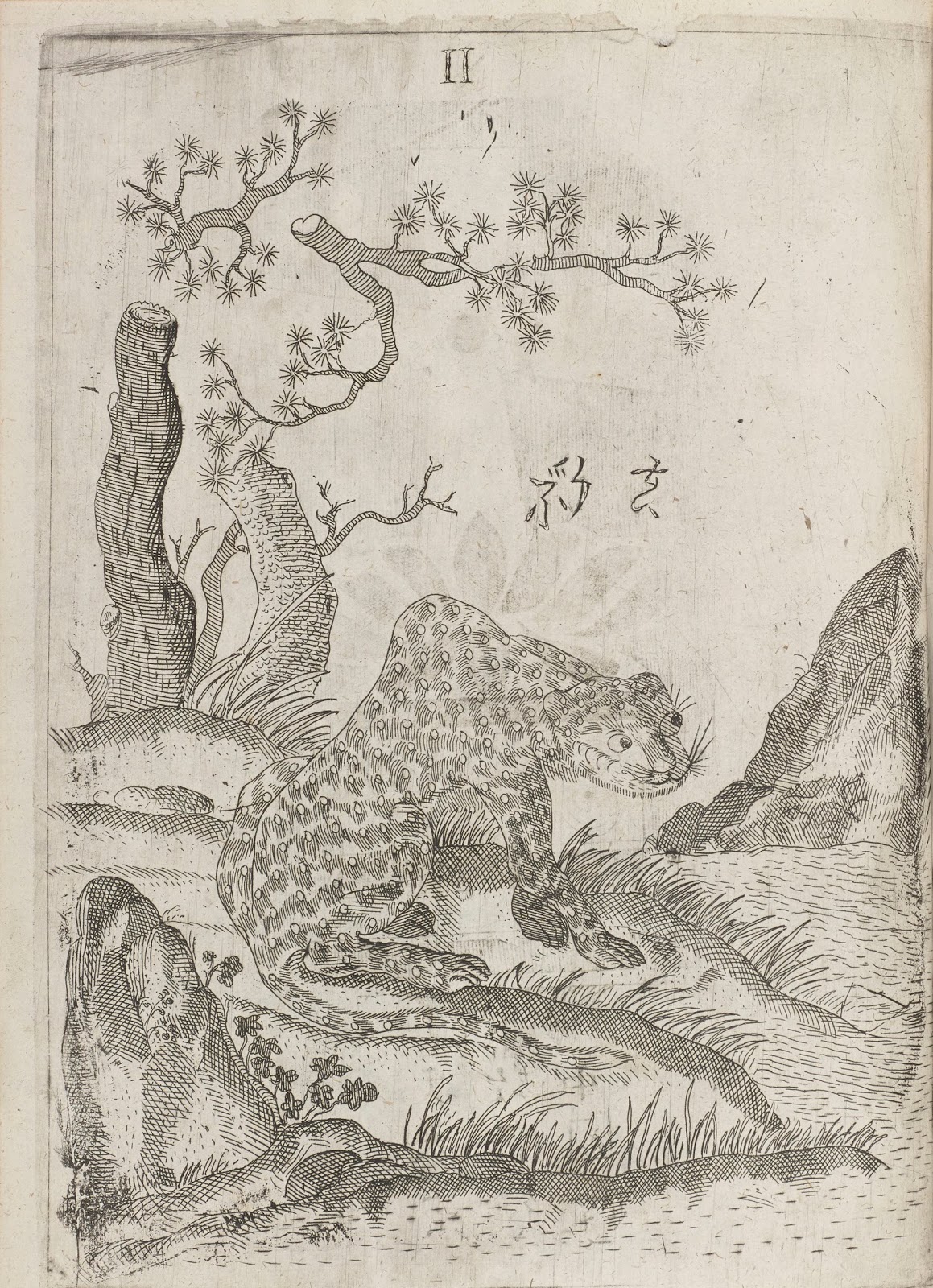
Fig. 5. Chinese leopard missing from the 1664 French edition. Boym, Michał Piotr. Flora sinensis. 1656. Digitized by Royal Botanic Gardens Kew, Library, Art & Archives. http://www.biodiversitylibrary.org/page/52239371.

Unfortunately the illustrations in this edition appear to be composites derived from the originals and some, notably the Chinese leopard (fig. 5), are not included. Flora sinensis was also the source for much of the natural history content of Athanasius Kircher’s China illustrata (1667).

View Full Size Image
Fig. 6. Composite plate of Cinnamomum, Musa (bananas) and an un-named plant. Flora sinensis, 1696 French edition. Digitized by Boston Public Library. http://www.biodiversitylibrary.org/page/25193501.

Michał Piotr Boym was born the son of a wealthy merchant in Lwów, Poland in 1612. He joined the Jesuits in 1629 and was ordained in 1641. He sailed from Lisbon in 1643, reaching Macao, via Madeira, the Cape Verde Islands, Mozambique, the Bay of Bengal, Siam, and Goa, in 1647.

View Full Size Image
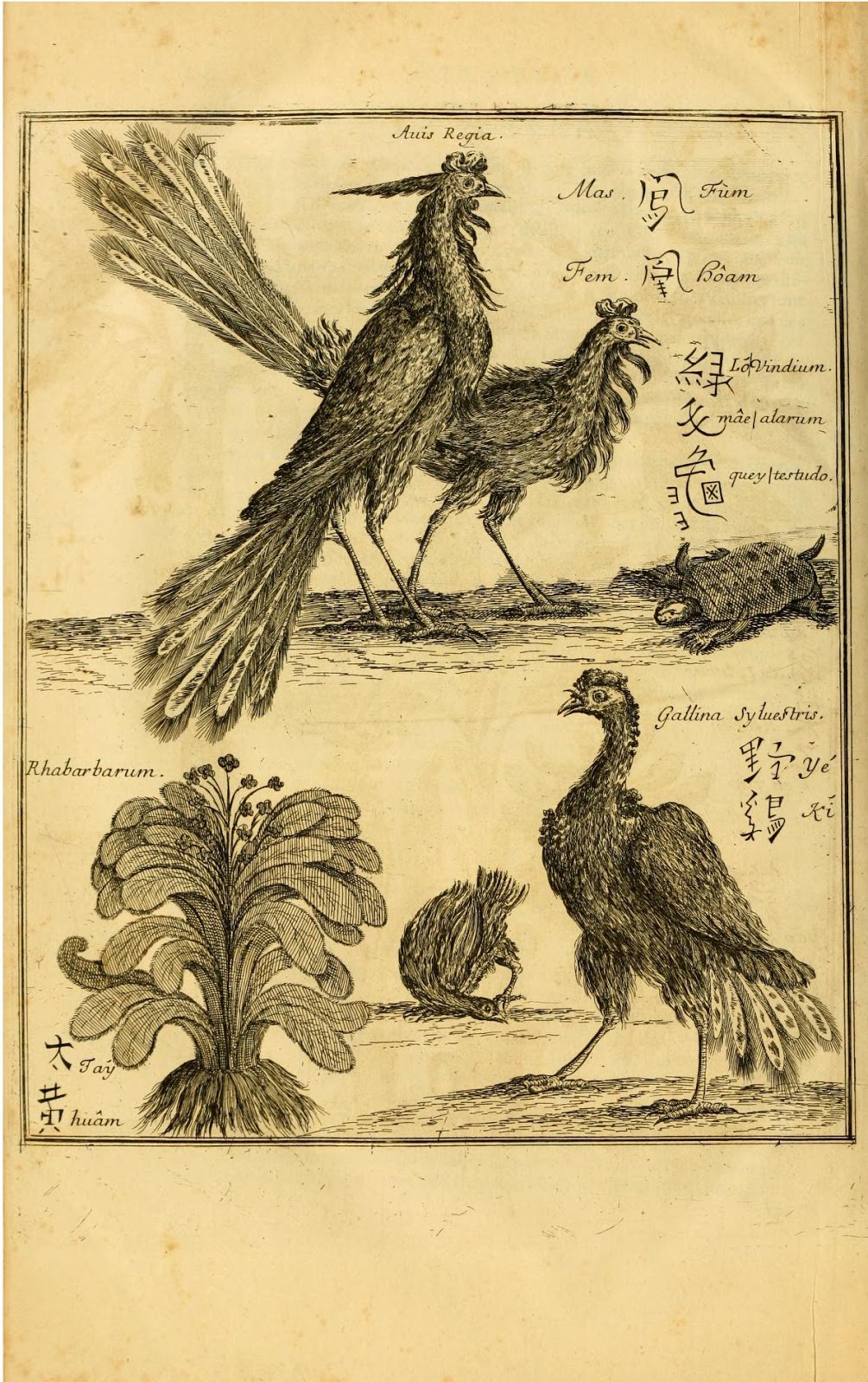
Fig. 7. Avis regia, Rhabarbarum (possibly rhubarb) and Gallina sylvestris. Flora sinensis, 1696 French edition. Digitized by Boston Public Library. http://www.biodiversitylibrary.org/page/25193697.

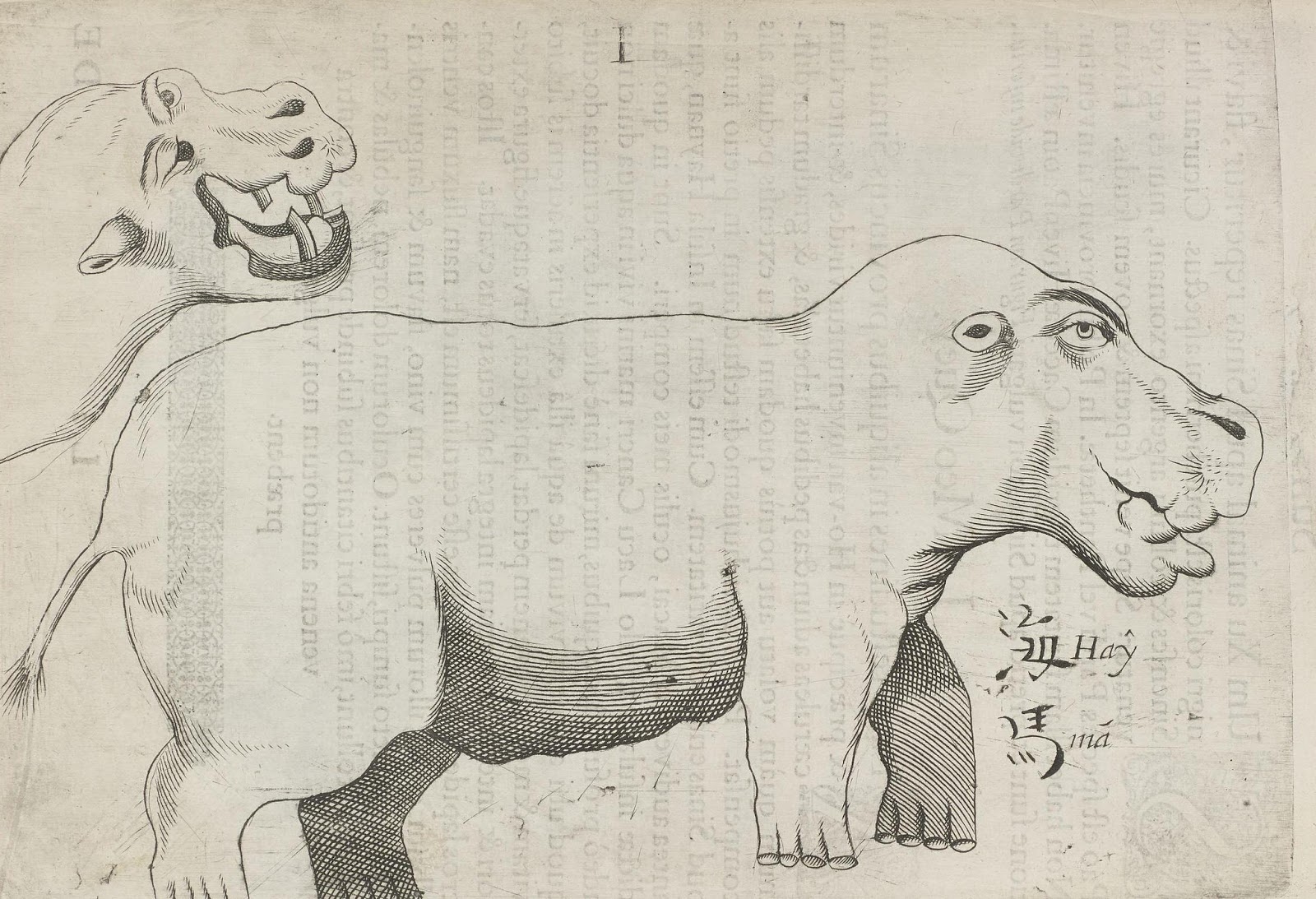
It was probably in Mozambique that he observed the hippopotamus, illustrated in Flora Sinensis (fig. 8), and wrote an account of the natural history of Mozambique, one of the oldest works on Africa in Polish (Cafraria: a P.M. Boym Polono Missa Mozambique 1644 Januario 11).

View Full Size Image
Fig. 8. Hippopotamus from the original 1656 edition. Boym, Michał Piotr. Flora sinensis. 1656. Digitized by Royal Botanic Gardens Kew, Library, Art & Archives. http://biodiversitylibrary.org/page/52239327.

Boym taught and studied Chinese in Macao and started to write on medicine, natural history and Chinese society after he moved to Hainan. It was there that he founded a mission, but had to flee to Tonkin when the Manchus invaded the island. He was then sent on a diplomatic mission to the court of the last Ming dynasty ruler, the Emperor Yongli, in Guangxi.

In 1650, Boym left Zhaoqing carrying letters from the court to Pope Innocent X, requesting support against the Manchus. He arrived in Venice in 1652, where he began work on various publications, including Flora sinensis and Fondo Borgia Cinese 531. (The latter unpublished collection of 18 maps is still in the Vatican Library, and includes the first European map to include Korea as a peninsula, not an island. It also features Chinese topography and Chinese and transliterated place names). He finally reached Rome in 1653, but it was not until 1655 that he was granted an audience with Pope Alexander VII.

In 1656, Boym set out again from Lisbon to China, but only four of the eight priests accompanying him survived as far as Goa and the news from the Chinese court was ominous. He persevered, arriving in Siam in 1658, but died on 22 June 1659 somewhere in the province of Guangxi before reaching the emperor’s court. He has no known grave.

View Full Size Image
Fig. 9. Cinnamomum (cinnamon) on left. Boym, Michał Piotr. Flora sinensis. 1656. Digitized by Royal Botanic Gardens Kew, Library, Art & Archives. http://www.biodiversitylibrary.org/page/52239309.

One of the plants described by Boym is a favourite Christmas spice. The rich spicy flavour of cinnamon (fig. 9) is a Christmas ingredient in recipes such as cakes, puddings, mince pies, Zimtsterne (Christmas stars), lebkuchen, mulled wine and glühwein. It was also used in medicine and as an ingredient of oils and perfumes.

Early trade in cinnamon to the Roman and Greek empires was controlled by Arab traders, who kept the source secret. It was thought, by both Herodotus and Theophrastus (4th and 5th century BC) to have come from Arabia, and locating the source was an ambition of 15th and 16th century European explorers.

In the 13th and 14th centuries, Venetian traders controlled the cinnamon trade in Europe until the Portuguese broke their monopoly when they arrived in Sri Lanka (then Ceylon) in the early 1500s, when cinnamon was one of the most highly prized and valuable spices in Europe. The Dutch expelled the Portuguese from the island in the mid 17th century, monopolising the trade and maintaining cinnamon’s rarity by refusing to allow commercial farming until the 1770s. The East India Company obtained control in 1796, when the Dutch were ousted, and retained it until 1833, when the cinnamon trade was opened to all.

Cinnamon is the prepared bark of Cinnamomum verum (synonym C. zeylanicum Bl., Laurus cinnamomum) in the family Lauraceae. It is indigenous to Sri Lanka and south India and widely cultivated in Sri Lanka (approximately 80% of total output), Indonesia, Java, Seychelles, Madagascar, South West Indies, Brazil, Martinique, and Jamaica.

Other items written by Boym include:

  • The first Chinese-Latin and Chinese-French dictionaries (1667).
  • Clavis medica ad Chinarum doctrinam de pulsibus. Nuremberg: Wolfgang Moritz Endter, 1686.
  • Specimen Medicinæ Sinicæ sive Opuscula Medica ad Mentem Sinensium Continens. A. Cleyer, ed. Francofvrti: Sumptibus Joannis Petri Zubrodt, 1682.

Bibliography:

  • Lehner, M. & Lehner, G. (2016) M.Boym: Flora Sinesis [online]. Bibliotheca Sinica 2.0. [Accessed 12 December 2016].
  • Davidson, A. (2006). The Oxford companion to food. 2nd ed. Oxford: Oxford University Press, p.186-187.
  • Hart, A. (2015). Michał Piotr Boym: Flora Sinensis In: J. Magee, ed., Rare treasures from the Library of the Natural History Museum. 1st ed. London: NHM, p. 38-45.
  • Jeong, S. (2016). The Silk Road Encyclopedia. Irvine, California: Seoul Selection. [Accessed 12 December 2016].
  • Rema, J. &. (2008). Cinnamon and cassia. In: V. P. Parthasarathy ed., Spice crops, Volume 2, tree spices. New Delhi: Today & Tomorrow’s, p. 29-75.
  • Van Wyk, B. E. (2013). Culinary herbs and spices of the world. Kew: Royal Botanic Gardens, Kew, p. 104.
December 22, 2016by ulib-libraryjobs
Blog Reel, Featured Books

When New England was New

Portrait version of the Biodiversity Heritage Library logo.
View Full Size Image
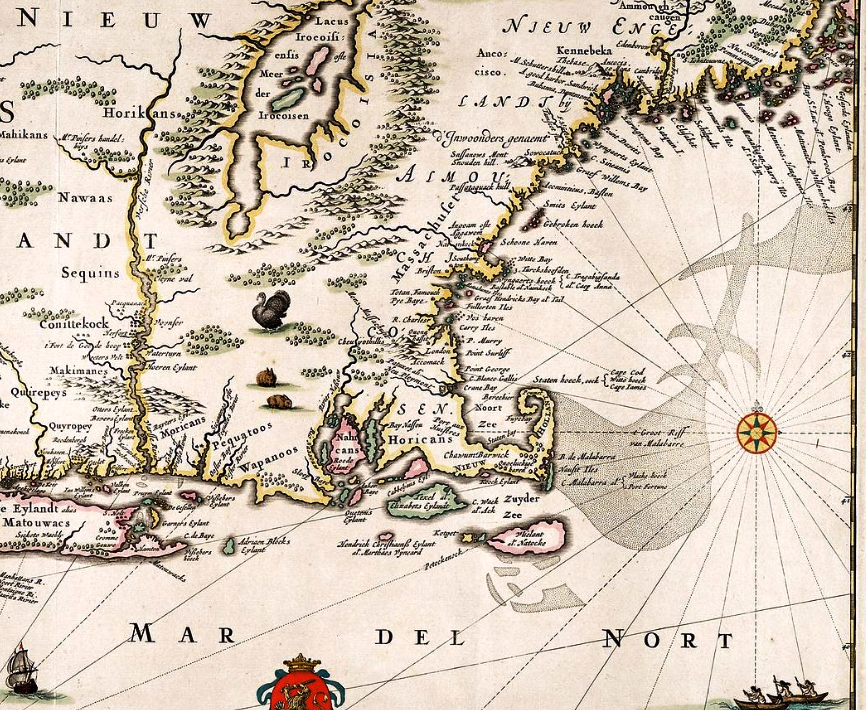
Map of eastern North America. Detail of engraved map by Nicolaes Jansz Visscher, made about 1655, not long after Josselyn’s first journey to the New World. Note the prominent, plump turkey. Gift of Mrs. Francis P. Garvan, National Museum of American History, Smithsonian Institution

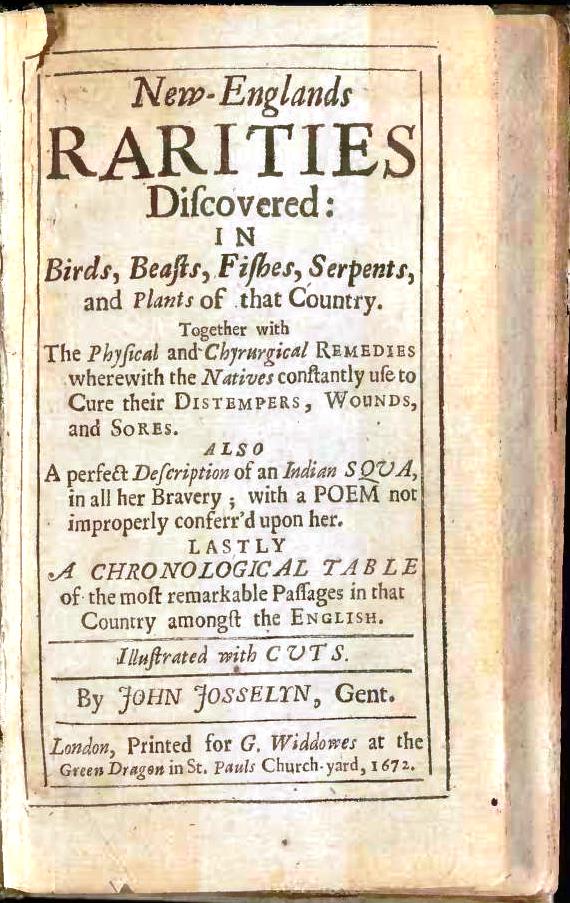
It is a small book, palm-size, with pages of less-than-fine paper, the well-worn letters of the type sometimes carelessly inked. The sparse woodcut illustrations are child-like in their simplicity and straight-forwardness. Yet John Josselyn’s New-Englands rarities discovered, printed in London in 1672, drew me in as I went about cataloging the work. Intrigued by the title and the early date of publication, I found myself reading an account of the landscape of my past, from Boston, “down east” (that is, up the coast as represented in the above illustration) to my place of birth, and points all around. That great bibliography, The Hunt Botanical Catalogue, notes that this book is “particularly interesting to people who are fond of Maine.” Indeed. The text provides a sense of place from the 17th century.

Having refreshed my self here [Boston] for some time, and opportunely lighting upon a passage in a Bark belonging to a Friend of my Brothers, and bound to the Eastward, I put to sea again, and on the Fifteenth of August I arrived at Black-point, otherwise called Scarborow, the habitation of my beloved Brother, being about an hundred leagues to the Eastward of Boston; here I resided eight years, and made it my business to discover all along the Natural, Physical, and Chyrurgical Rarities of the New-found World.

View Full Size Image
BHL digitized copy, supplied by the U.S. Department of Agriculture, National Agricultural Library.

New-Englands rarities is an account of the author’s two journeys to America, the first in 1638 for several months and again in 1663 for a stay of eight years. Despite the autobiographical nature of the work, not much is known of Josselyn, “active” in cataloging parlance, from 1630 to 1675, and born around 1608 in Essex County. The author comes across as a learned, if not terribly discerning, gentleman with possibly a medical background. He describes the topography, customs and the natural history of the country, with great interest in the healing properties of organic materials from recipes used by both native Americans and colonists, leading to speculation that the Englishman was a physician. It may be Josselyn was simply well-read and the curious type. The era of European plant exploration in the New World, for both therapeutic, consumption and ornamental purposes, was underway by the time of Josselyn’s travels. There would be a ready audience for such information, particularly in a relatively accessible and inexpensive publication.

View Full Size Image
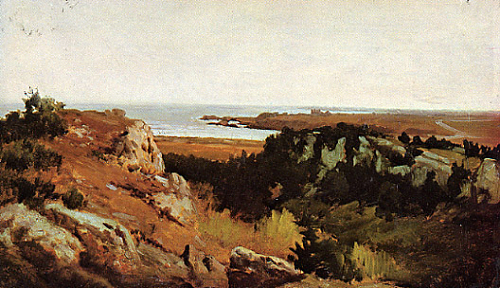
Prouts Neck. Painting by Winslow Homer (1836-1910), Smithsonian American Art Museums

“Scarborow” is the coastal area of Scarborough, incorporated as a town in 1658 in the present state of Maine. One of the area settlements was “Black-point” (originally a patent of 1500 acres) that included the rocky shoreline of present-day Prouts Neck, of artist Winslow Homer-fame (a place now known for exclusiveness). It was here that John Josselyn’s brother Henry lived and worked along the sea, rivers, stretches of salt marshes and sandy beaches. Henry Josselyn was representing the Royal grant of land, Council of Gorges’ Province of Maine, by 1636, and later served as Deputy-Governor.

There is some evidence that Henry Josselyn may have ascended the highest mountain in the Northeast, the 6,288-foot (1,917-meter) Mount Washington. His brother John, as did Giovanni da Verrazano in 1524, observed and recorded the peak (known by various names before European settlement) from shipboard in the Atlantic Ocean as “one stately mountain…surmounting the rest”:

“Fourscore miles (upon a direct line) to the Northwest of Scarborow, a Ridge of Mountains run Northwest and Northeast an hundred Leagues, known by the name of the White Mountains, upon which lieth Snow all year, and is a Land-mark twenty miles off at Sea.”

View Full Size Image
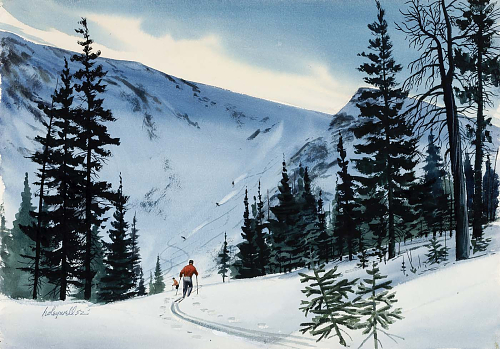
Skiing at Tuckerman’s Ravine, Mt. Washington, N. H. Watercolor by Arnold Holeywell (1923-2010). Smithsonian American Art Museum, gift of the Ford Motor Company

John Josselyn’s further writings indicate that he probably also summited the mountain (as I did one June, when there was still snow on the slopes). Now a not-particularly arduous but long day’s hike in good weather along groomed trails, it was not a casual undertaking in the 1660’s. It is a volatile place with fierce, sometimes unpredictable, weather. The Josselyns probably journeyed along the magnificent Saco River, south of Scarborough, to reach the range. There John Josselyn made meteorological observations (The Mount Washington Observatory on April 12, 1934, recorded the wind at 231 miles per hour, a record that held through the 20th century).

Josselyn liked to compose catalogs and there is humor sprinkled about his lists. In the one on fishes, he prefaced: “Pliny and Isadore write there are not above 144 Kinds of Fishes, but to my knowledge there are nearer 300: I suppose Americawas not known to Pliny and Isadore.” The account of his unfortunate encounter with a wasp nest begins with his belief he was coming across an exotic fruit. And, amusing for readers today, Josselyn was none too fond of the Puritans of the Bay Colony. The Native Americans, on the other hand, were regarded with admiration.

View Full Size Image
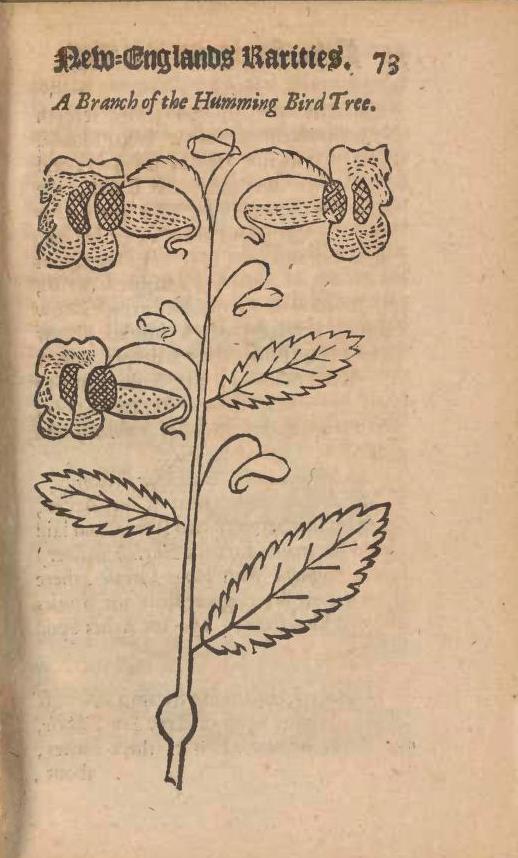
Touch-me-not or Hummingbird tree – a favorite of the bird to feed upon. Josselyn, John. New-Englands rarities. (1672). Digitized by the U.S. Department of Agriculture, National Agricultural Library. http://biodiversitylibrary.org/page/47579388.

For botany researchers there is much information to decipher from New-Englands rarities. Twenty-two invasive species or weeds are listed under a section “Of such Plants as have sprung up since the English Planted and kept Cattle in New-England” (the reference to cows is of their manure). In Josselyn’s identifications, sow thistle, night shade, mallowes, wormwood, bloodwort, and cheek weed are recorded; some are identifiable today, others not. According to noted botanist, ecologist and conservationist Paul Sears, Josselyn provides the first mention of the now-ubiquitous dandelion in America. From the many references, it is evident that the author had with him the hefty 1633 Thomas Johnson’s edition of Herball by John Gerard, “our famous Herbalist.” Josselyn notes the New World plants described by Gerard as well as Parkinson and points out his own discoveries, such as skunk cabbage and the pitcher-plant.

View Full Size Image
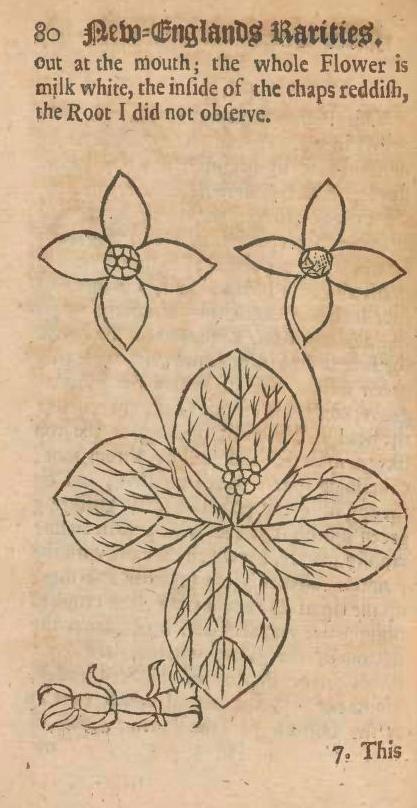
Herb True Love: “the leaves are good to be laid upon hot tumors.” Josselyn, John. New-Englands rarities. (1672). Digitized by the U.S. Department of Agriculture, National Agricultural Library. http://biodiversitylibrary.org/page/47579357.

Recipes, whether for medical purposes or nourishment, are sprinkled throughout the text. The wild turkey is fully described for the first time and what must be one of the earliest records of meat being eaten with cranberries as “it is a delicate Sauce.” Josselyn also mentions “pompions” (pumpkin) pie. The colonists of course learned about the cultivation of pumpkins, squash and corn from the native inhabitants. “Billberries” (blueberries), are reported to be “very good to allay the burning heat of Feavers and hot Agues, either in Syrup or Conserve. A most excellent Summer Dish.” Peas, grown in New England, “are the best in the world.”

View Full Size Image
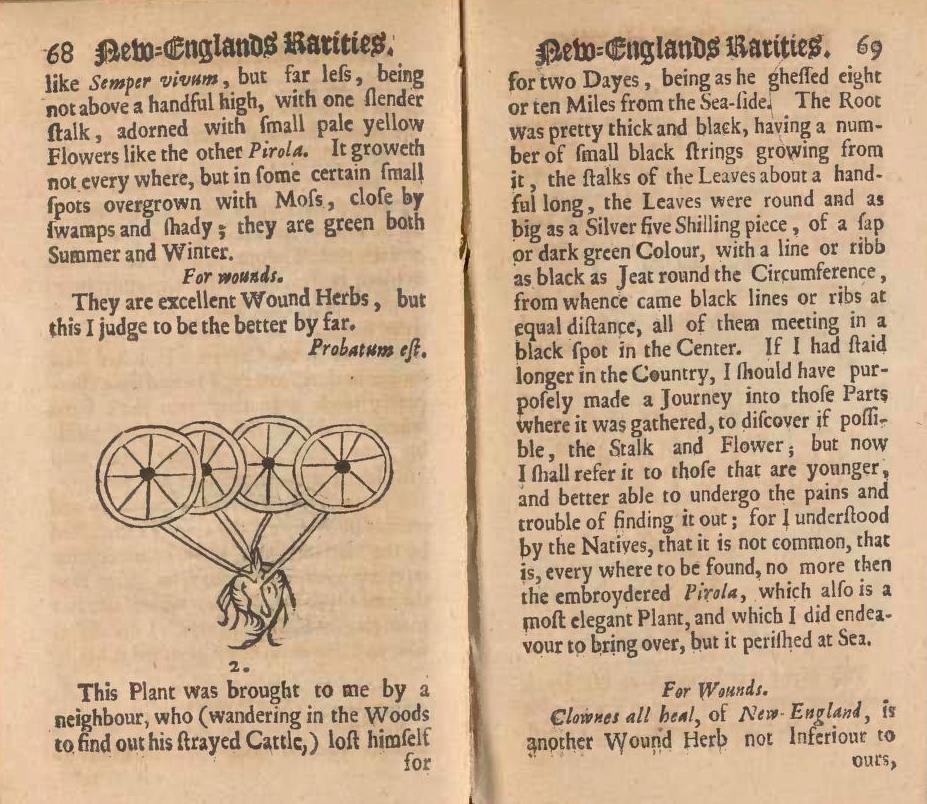
Josselyn, John. New-Englands rarities. (1672). Digitized by the U.S. Department of Agriculture, National Agricultural Library. http://biodiversitylibrary.org/page/47579390.

Josselyn soon expanded New-Englands rarities with An account of two voyages to New England in 1674 (BHL copy digitized from the Smithsonian Libraries). The dedication in this edition is loftier and more ambitious: to the President and Fellows of the Royal Society. A relative of Josseyln’s, Samuel Fortrey, had helped pay for the printing of the earlier work. There is far more detail on the provisioning and crossings of the ships and attendant illnesses and deaths. There is also a disturbing story of the rape of a slave on Noodles Island in Boston Harbor, a horrifying but important testament in the history of slavery in New England.

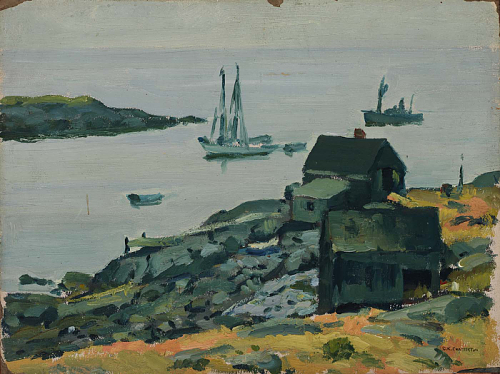
Two voyages to New England provides more scenes of the coast. Monhegan Island, a favorite place of mine, is a speck about ten miles from the nearest mainland. Following European explorers Martin Pring, Samuel de Champlain, George Weymouth, John Smith (and before these sailors, possibly the Vikings), Josselyn reported that Monhegan was filled with fisherman’s houses and shacks, long a staging area for drying fish and post for fur traders to send their goods across the Atlantic. Cod was the great commodity, harvested from the abundant fishing grounds of the Gulf of Maine and along the coast. Since the mid-19th century, Monhegan, spectacularly ruggedly beautiful, has been better known as an artist colony and draw for tourists, at least in the summer.

View Full Size Image
Monhegan Harbor, oil painting by C. K. Chatterton (1880-1973). Smithsonian American Art Museum, bequest of Olin Dows

New-Englands rarities was cited by the great Swedish zoologist and botanist Carl Linnaeus in 1753, attesting to its completeness and authority on flora and fauna for about a century. It also inspired a certain type of travel literature. Henry David Thoreau was an admirer and in A week on the Concord and Merrimack Rivers (1849) wrote of Josselyn’s speaking of “the strong new soil.” Soon after I encountered the book in the Cullman Library of Natural History, I came across a reprinted edition while in Salem, Massachusetts in the gift shop of the House of the Seven Gables. Most valued today for its accounting of plants, the book and its successor, An account of two voyages, have much to offer historians of indigenous cultures about the impact of European settlements, cookery, gardens, religion, folklore, meteorology, geology, and maritime and social norms of the early colonial period in America. Its sense of wonder about the landscape of the New World provides the modern reader with a sense of the place.

Josselyn’s last printed words:

“Now by the merciful providence of the Almighty, having performed Two voyages to the North-east parts of the Western-world, I am safely arrived in my Native Countrey; having in part made good the French proverb, Traveul where thou canst, but dye where thou oughtest, that is, in thine own Countrey.”

Notes
New-Englands rarities has frequently been reprinted. Many of those editions, as well as the National Agricultural Library’s copy of the first, have been digitized by the Biodiversity Heritage Library. The Cullman Library’s copy had been rebound too tightly for it to be safely scanned. It also lacks the last leaf containing the printer’s device.

View Full Size Image
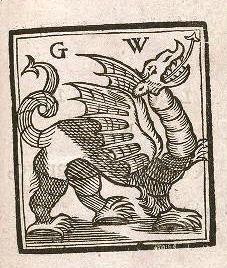
The printer Giles Widdows’ woodcut mark, with his initials and winged dragon. Josselyn, John. New-Englands rarities. (1672). Digitized by the U.S. Department of Agriculture, National Agricultural Library. http://biodiversitylibrary.org/page/47579382.
The BHL digitized copy in Smithsonian Libraries (the Dibner Library) of Josselyn’s later work: An account of two voyages to New-England : wherein you have the settingout of a ship, with the charges; the prices of all necessaries for furnishing aplanter and his family at his first coming; a description of the countrey,natives and creatures, with their merchantil and physical use : the governmentof the countrey as it is now possessed by the English, &c.; : A largechronological table of the most remarkable passages, from the first discoveringof the continent of America, to the year 1673. London : Printed for Giles Widdows, at the Green-Dragon in St. Paul’s-Church-yard, 1674.

Bulletin of the Josselyn Botanical Society of Maine.

Leighton, Ann. Early American gardens “for meate or medicine.” Amherst: The University of Massachusetts Press, 1986.
View Full Size Image
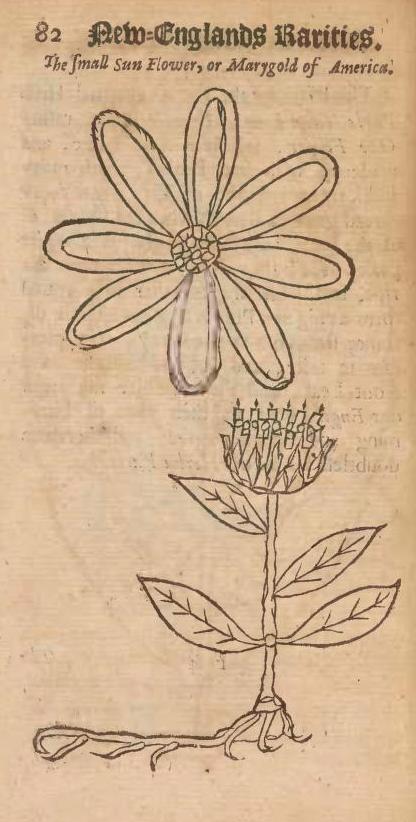
‘The American Sunflower” Josselyn wrote: “The plants in New-England for the variety, number, beauty, and vertues, many stand in Competition with the plants of any Countrey in Europe.” Josselyn, John. New-Englands rarities. (1672). Digitized by the U.S. Department of Agriculture, National Agricultural Library. http://biodiversitylibrary.org/page/47579359.

The Scarborough Land Conservation Trust.

View Full Size Image
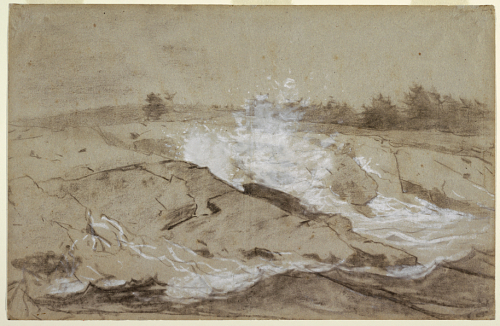
Black Point, Scarborough. Charcoal and chalk drawing of approximately 1884, by Winslow Homer. Cooper Hewitt, Smithsonian Design Museum Collection. Josselyn reported of a spring at Black Point that was “purgative and cures scabs and Itch.” Along with the springs, the Englishman was taken with the curative properties of the waters in the New World.
March 31, 2016by khage
Blog Reel, Featured Books

Book of the Week: Floral Masterpiece from Biodiversity Heritage Library on iTunes U

View Full Size Image
In case you missed our post earlier this week, the Biodiversity Heritage Library is now on iTunes U. From our provider page, you can now download select BHL content through iTunes to your desktop or mobile device, i.e. iPad, iPod touch, and iPhone. And, all for free, of course! We currently have 8 collections available, including:

  • Fungus Among Us
  • Floral Mania
  • Charles Darwin’s Library: Selections*
  • Extinct Species
  • Rarest of the Rare
  • Pillars of Biodiversity
  • Biota of Cape Cod
  • The Curious and the Bizarre

You can learn more about iTunes U through Apple’s website.

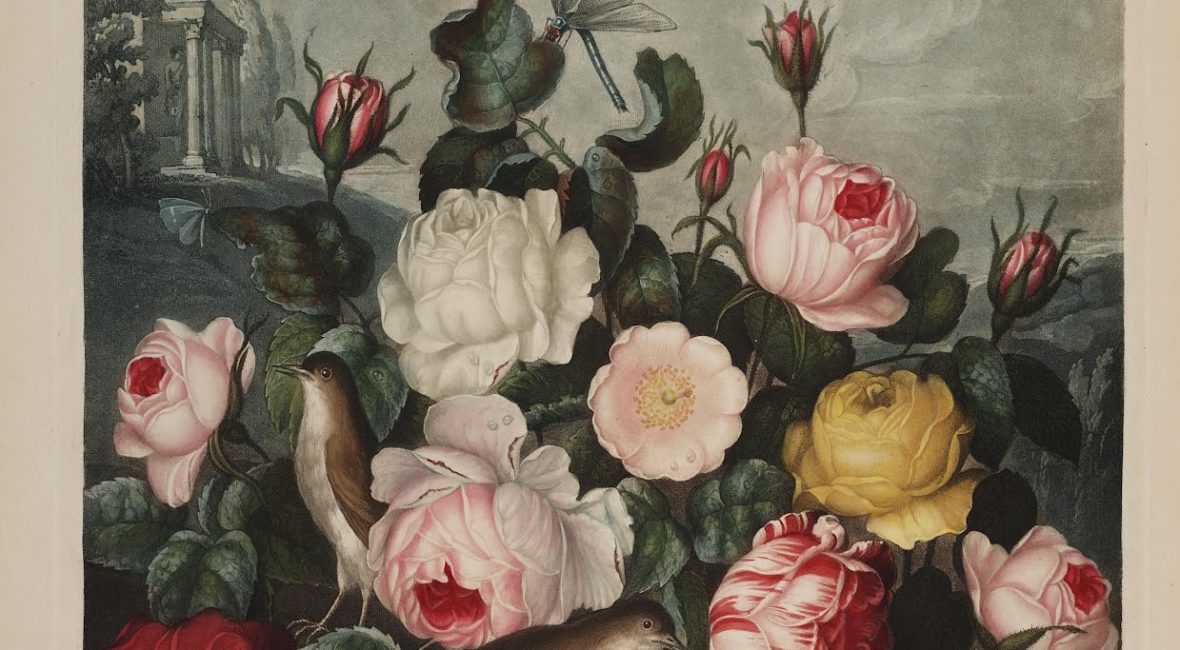
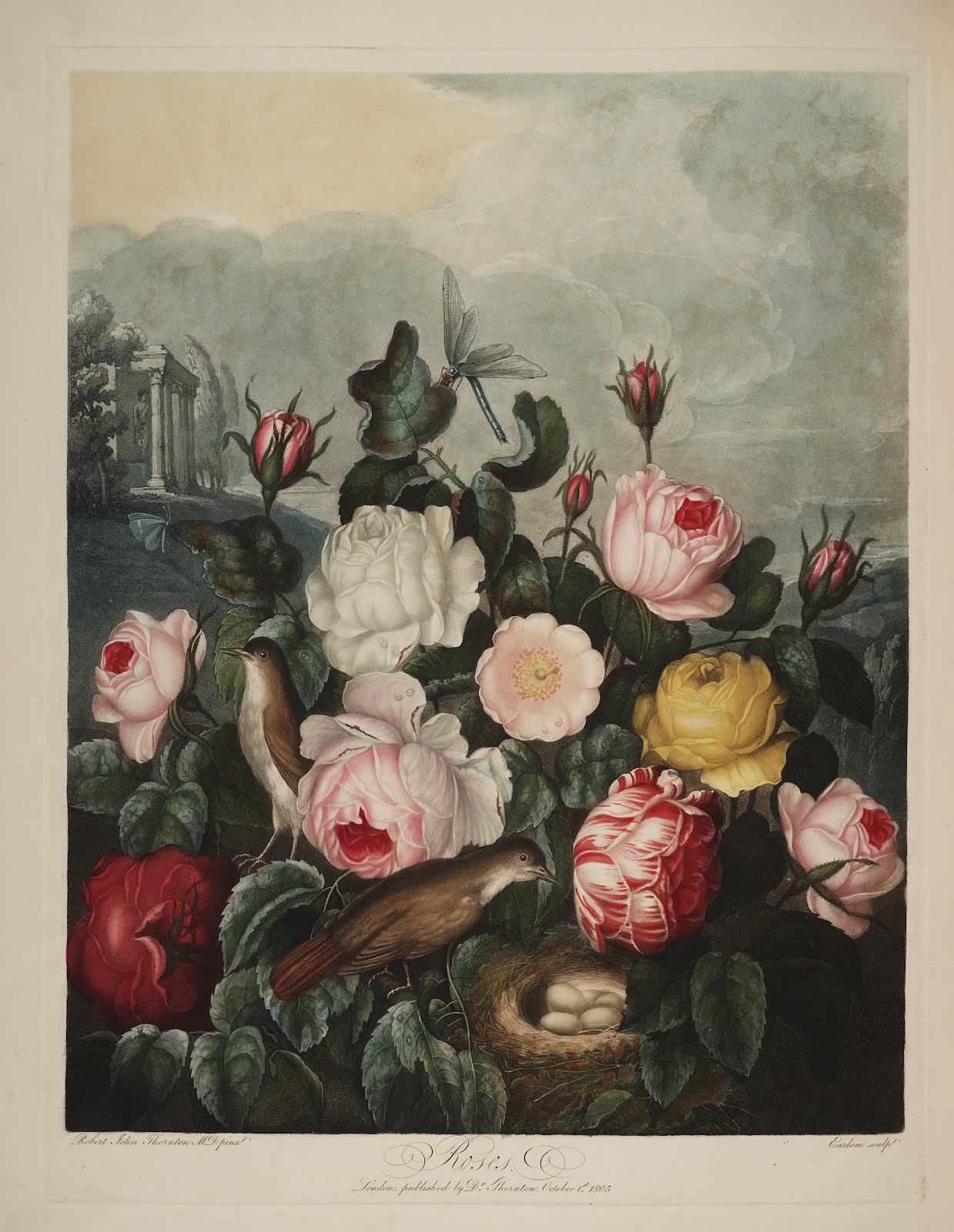
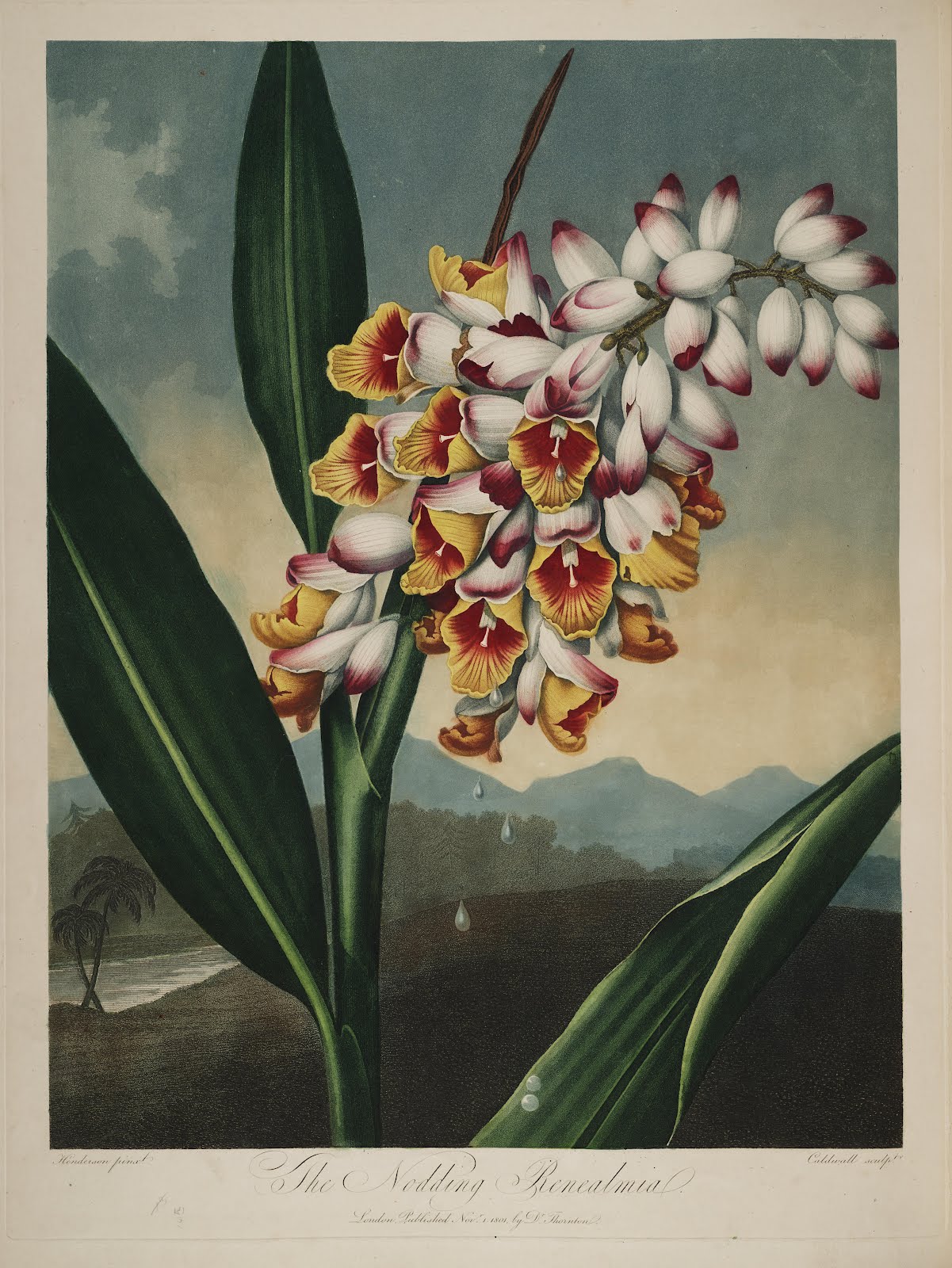
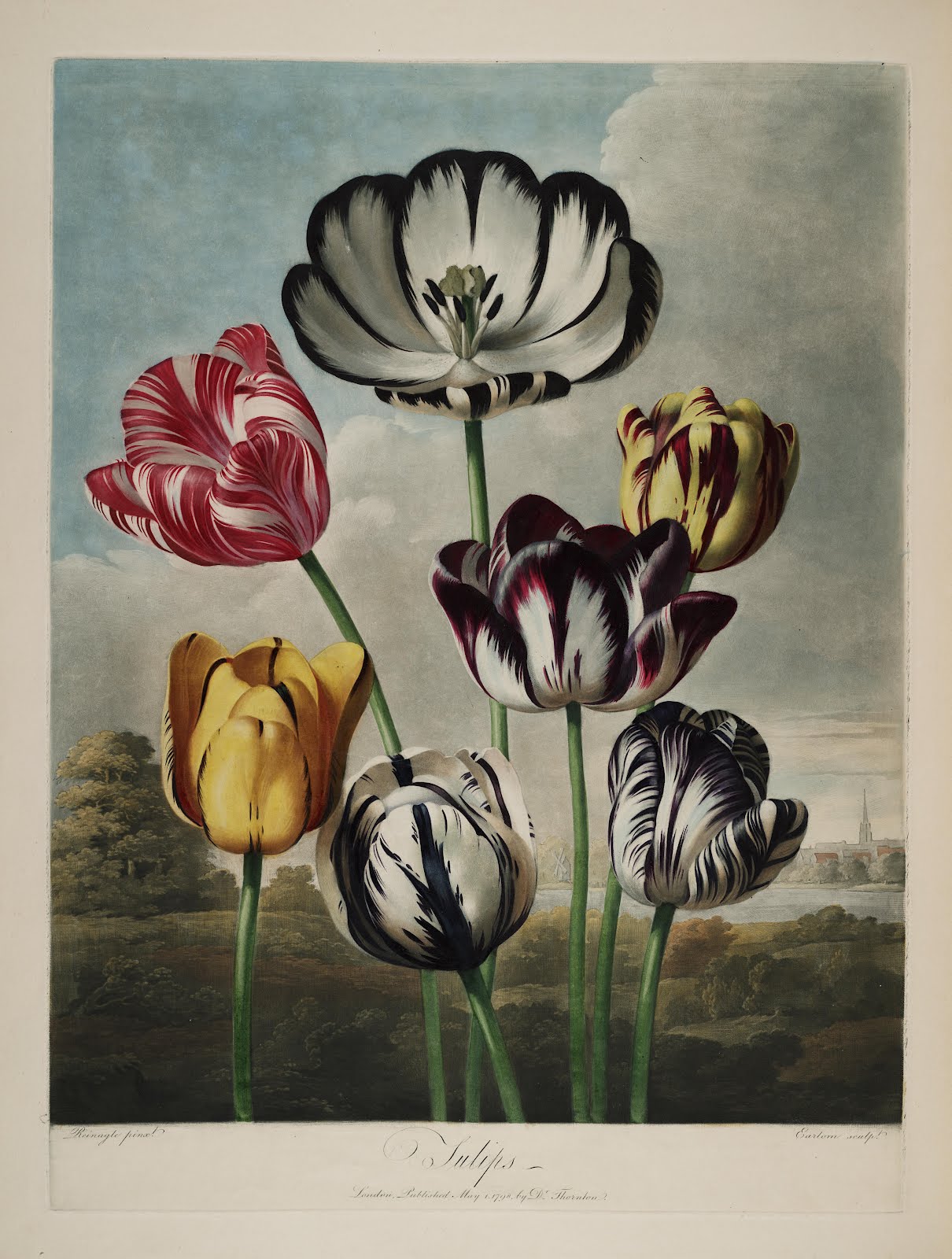
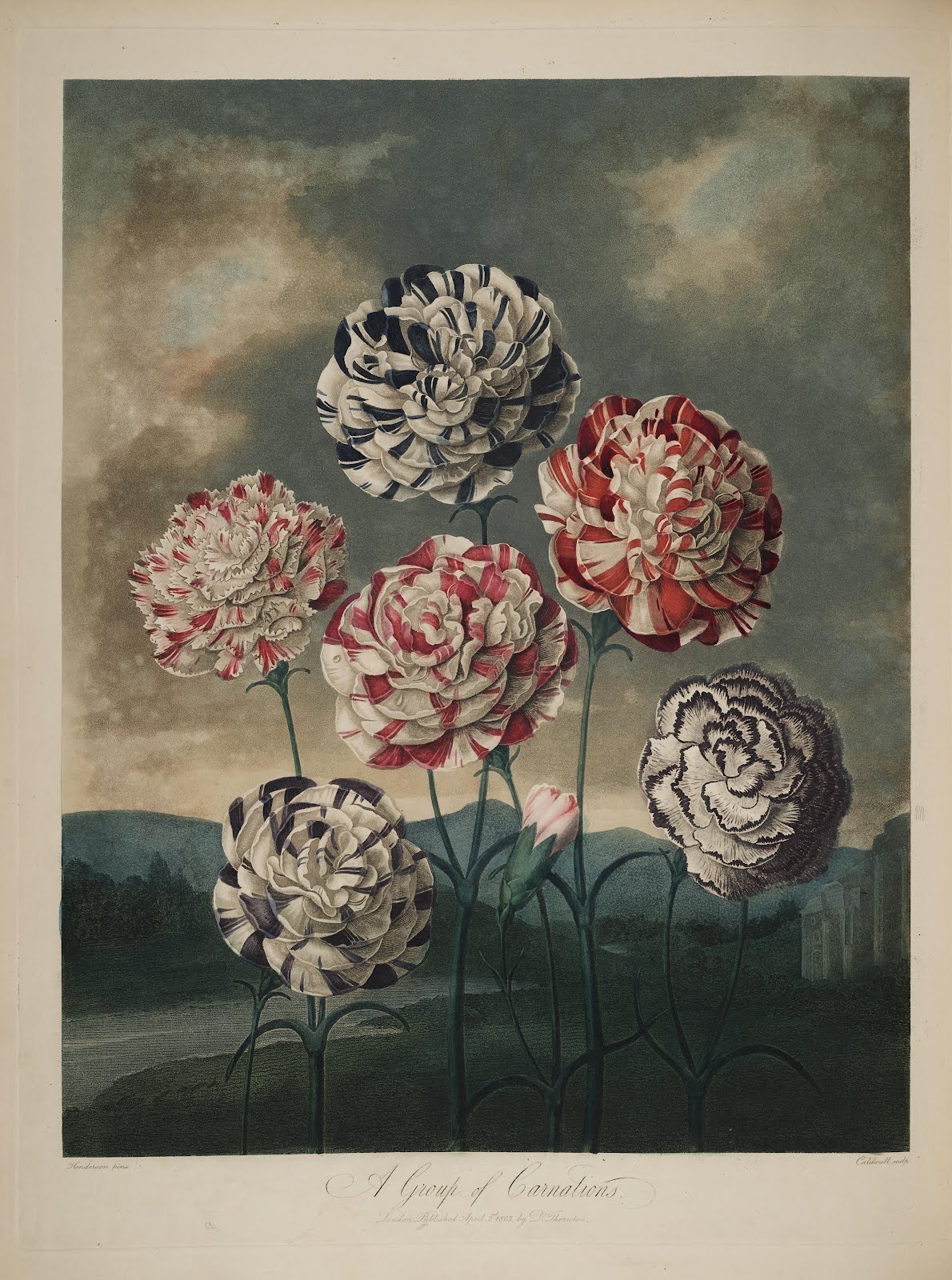
For our Book of the Week this week, we’re featuring one of the classics from our iTunes U collection Floral Mania, which consists of some of the most beautiful and unusual illustrations of flowering plants in BHL. Today, we present New Illustration of the Sexual System of Carolus von Linnaeus: and the Temple of Flora, or Garden of Nature (1807), by Robert John Thornton.

View Full Size Image

Robert John Thornton was an English physician and botanical writer. After hearing Thomas Martyn’s lectures on botany and Linnaeus, he decided to practice medicine rather than his previously-chosen profession in the church. He worked and lectured in medical botany at Guy’s Hospital in London, and at the end of the eighteenth century began working on his ambitious project New Illustration of the Sexual System of Carolus von Linnaeus.

New Illustration of the Sexual System of Carolus von Linnaeus is a three-part work, the third part (Temple of Flora) of which was intended to have seventy folio-sized plates. Work on the plates began in May 1798, and the first plates were engraved by Thomas Medland after paintings by Philip Reinagle. The plates were engraved in aquatint, stipple and line.

View Full Size Image
The work, unfortunately, proved to be Thornton’s demise. The expense of the project drained his financial assets, and Thornton was unable to generate significant public interest in the work. To save the project and ensure its completion, a public lottery and a dedication within the work to Queen Charlotte, patroness of botany and fine arts, were ventured, but without success. Only thirty-three colored plates were completed between 1798-1807, and Thornton died in destitution.

It is a tragedy that Thornton’s life ended so sadly when his work is now deemed a remarkable masterpiece. We pay him tribute for the incredible achievements of his life and are proud to feature just a few of the stunning illustrations from his creation in this post. You can access New Illustration of the Sexual System of Carolus von Linnaeus: and the Temple of Flora, or Garden of Nature (1807) on BHL and within the Floral Mania collection of iTunes U, both for free of course! See all of the illustrations from this masterpiece on our Flickr account and tell us which is your favorite.

View Full Size Image

February 9, 2012by michelle.underhill
Blog Reel, Featured Books

Book of the Week: A BHL Superstar

View Full Size Image

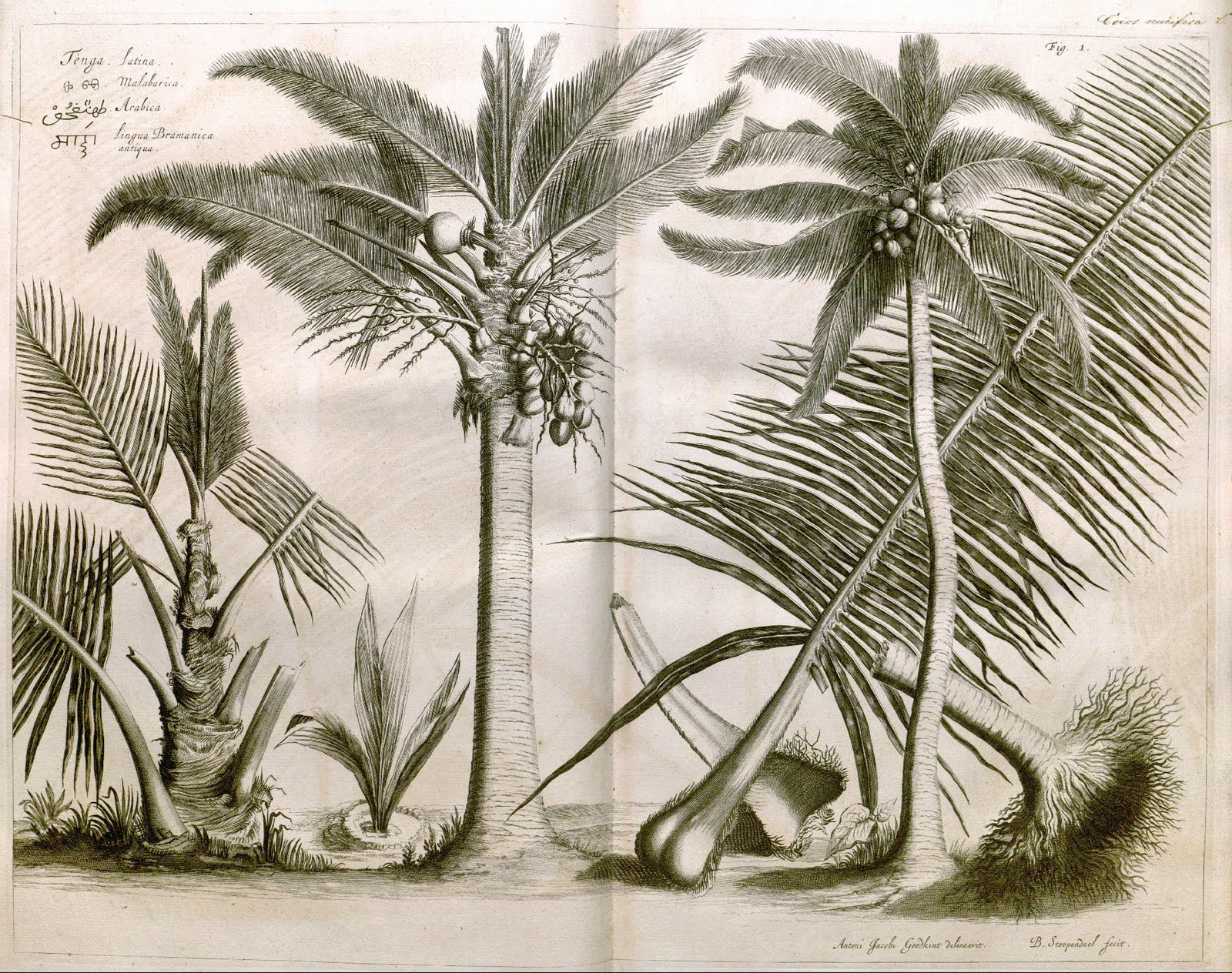
It’s one of the most frequently downloaded books from BHL. It was compiled over thirty years, in twelve volumes, and contains 794 copper plate engravings. It depicts and describes the flora of Asia and the tropics, focusing on the medicinal properties of the flora in the Indian state of Kerala. Species names are recorded in such languages as Konkani, Arabic, Malayalam, and Latin. It contains the type illustrations of many species, and was first published in Amsterdam in 1678-1693. Edited by nearly a hundred physicians, professors of medicine and botany, amateur botanists, technicians, illustrators, engravers, officials and clergymen, the work was conceived of by the then-governor of the Dutch administration in Kochi, Hendrik van Rheede.

Enough talk! What is it, you ask?

Answer: Hortus Indicus Malabaricus, one of the most important early works on the medicinal properties of various flora.

Hortus Indicus Malabaricus has also been the recent focus of a special publication of Samagra, a journal published by the Centre for Research in Indigenous Knowledge, Science and Culture. This special issue discusses the recent discovery of the previously unidentified creator of the first volume’s Frontispiece (now identified as the Dutch Golden Age artist Gerard de Lairesse), a discussion of the contributions of the Hungarian Theologians involved with the work, as well as an analysis on the medicinal plants described within the work.

Spend some time exploring one of the most popular works in BHL, and read what modern-day researchers are still discovering about the work in the special issue of Samagra, entitled, appropriately, “Hortus Malabaricus: Special Issue.” The exotic East and its flora await you!

February 24, 2011by michelle.underhill

Help Support BHL

BHL's existence depends on the financial support of its patrons. Help us keep this free resource alive!

search

About BHL

The Biodiversity Heritage Library (BHL) is the world’s largest open access digital library for biodiversity literature and archives. BHL operates as a worldwide consortium of natural history, botanical, research, and national libraries working together to digitize the natural history literature held in their collections and make it freely available for open access as part of a global “biodiversity community.”

Join Our Mailing List

Sign up to receive the latest news, content highlights, and promotions.

Subscribe Now

Subscribe to Blog via Email

Enter your email address to subscribe to this blog and receive notifications of new posts by email.

Join 319 other subscribers

Subscribe to Blog Via RSS

Subscribe to the blog RSS feed to stay up-to-date on all the latest BHL posts.

Access RSS Feed

Inspiring Discovery through Free Access to Biodiversity Knowledge.

The Biodiversity Heritage Library makes it easier than ever for you to access the information you need to study and explore life on Earth…for free, anytime, anywhere.


ABOUT | HARMFUL CONTENT | PRIVACY | SITE MAP | TERMS OF USE