Biodiversity Heritage Library - Program news and collection highlights from BHL
  • Home
  • News
  • Featured Books
    • All Featured Books
    • Book of the Month Series
    • BHL at 20
  • User Stories
  • Campaigns
    • Fossil Stories
    • Garden Stories
    • Monsters Are Real
    • Page Frights
    • Her Natural History
    • Earth Optimism 2020
  • Tech Blog
  • Visit BHL
Home
News
Featured Books
    All Featured Books
    Book of the Month Series
    BHL at 20
User Stories
Campaigns
    Fossil Stories
    Garden Stories
    Monsters Are Real
    Page Frights
    Her Natural History
    Earth Optimism 2020
Tech Blog
Visit BHL
  • Home
  • News
  • Featured Books
    • All Featured Books
    • Book of the Month Series
    • BHL at 20
  • User Stories
  • Campaigns
    • Fossil Stories
    • Garden Stories
    • Monsters Are Real
    • Page Frights
    • Her Natural History
    • Earth Optimism 2020
  • Tech Blog
  • Visit BHL
Biodiversity Heritage Library - Program news and collection highlights from BHL
Blog Reel, Featured Books

Ancient Myths Inspired by Fossils

The study of mythology associated with fossils is a relatively new field, which Adrienne Mayor (2005) terms “the folklore of paleontology”; she continues by saying that “[c]ombining oral traditions and paleontology, and drawing on history, archaeology, anthropology, and mythology, the investigation of fossil legends offers a new way of thinking about pre-Darwinian encounters with prehistoric remains” (Preface, p. xxiv). Drawing from several resources, one can create a dynamic picture of what a large variety of cultures around the world and throughout time have thought were the myths associated with dinosaur, bird, and other prehistoric fossils.

Due to extensive travel, Greeks and Romans discovered fossils throughout the Mediterranean and into India (Mayor, 2000b, p. 8). The fossils of dinosaurs, mastodons, mammoths and other creatures were pervasive parts of the natural landscape in the Greek and Roman periods, helping to account for why Greeks and Romans developed mythologies about giant creatures as they sought to understand the presence of these remains (Mayor, 2000b, p. 8). Some highlights from Greek and Roman mythology include the following accounts.

View Full Size Image
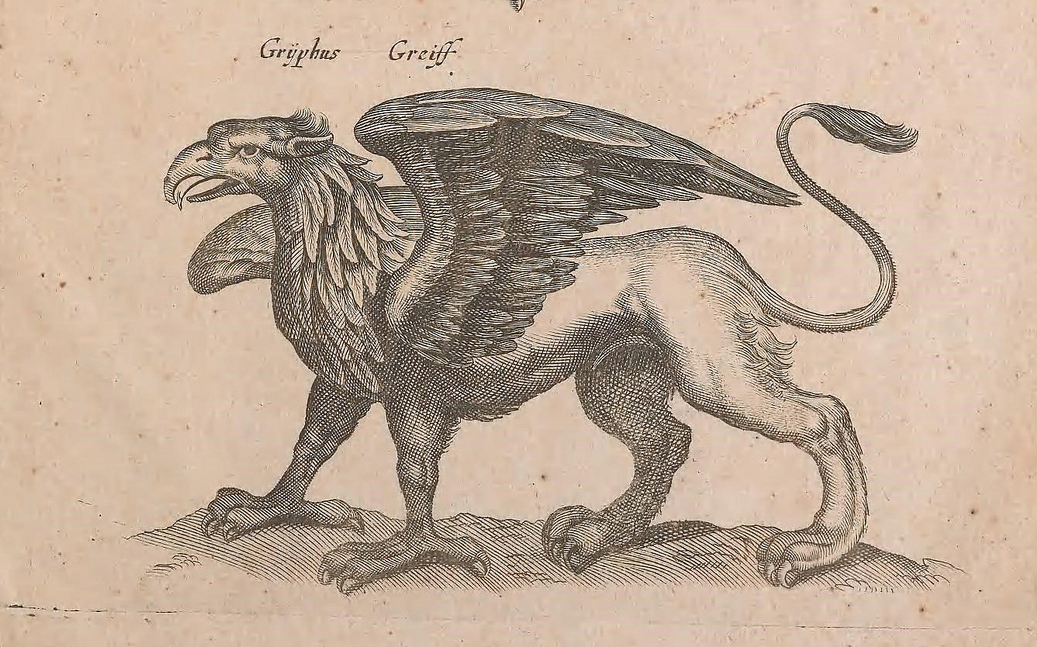
Griffin, likely inspired by encounters with fossils. Jonstonus, Joannes. Historiae naturalis de quadrupedibus libri. pt. 6 (1657). http://biodiversitylibrary.org/page/40913115. Digitized by Smithsonian Libraries.

In 675 B.C. when the Greek traveler, Aristeas, visited Scythian nomads in the Gobi deserts, the nomads told him about an area beyond Issedonia where griffins defended gold from the nomads (Mayor, 2000b, pp. 22-3). Aristeas wrote that the nomads would battle the griffins and that Issedonian accounts portrayed these creatures as lion-sized, with curved beaks like eagles (Mayor, 2000b, p. 23). Near Eastern cultures have been depicting such creatures since 3000 B.C. (Mayor, 2000b, p. 23). In the thirteenth century, the Chinese in Turfan and Lop Nur feared the surrounding deserts—which used to be Issedonian lands that were thought to be haunted by demons and dragons. In particular, the people feared the large bones in these deserts, calling them “dragon bones” (Mayor, 2000b, p. 38). In 1922, American adventurer Roy Chapman Andrews followed caravan trails through China to the Gobi desert and found the fossilized remains of Protoceratops (the size of a lion) and Psittacosaurus (which has a prominent beak); these fossil bones combine to form the image of the griffin, as described by the Scythian nomads and later the Greeks, Romans and other cultures (Mayor, 2000b, pp. 39-40).

View Full Size Image
Various dragon forms. Dragon myths may have been inspired in part by encounters with fossils. Jonstonus, Joannes. Historiae naturalis de quadrupedibus libri. pts. 2-5 (1657). http://biodiversitylibrary.org/page/40918325. Digitized by Smithsonian Libraries.

In North Africa during the third to second century B.C., Carthaginians were digging trenches when they came upon two fossilized skeletons, each about 34 feet long (Mayor, 2000b, p. 153). The skeletons were assumed to be those of mythic giants, and Phlegon of Tralles, who served Hadrian (reigned between A.D. 117-38) at the time, claimed that the skeletons were proof that all life forms were becoming smaller (Mayor, 2000b, p. 149). This area, Ancient Carthage on the Gulf of Tunis, is rich with mastodon fossils, deinotheres, and mammoths (Mayor, 2000b, pp. 153-4), which paleontologists believe to be the source of the giant myths. Mayor provides evidence of the similarity between prehistoric fossils and Greek and Roman mythical creatures by citing contemporary Greek and Roman oral (transcribed) and written histories, as well as artwork produced during these periods.

View Full Size Image
Mammoths may have inspired many Native American myths. Westell, William Percival. The book of the animal kingdom. (1910). http://biodiversitylibrary.org/page/10102652.

Not to be ignored are Native American fossil mythologies from the Americas, also treated by Mayor (2005) in another work. She addresses tribes from North and South America and those mythologies believed to be based on prehistorical fossils by analyzing oral, Native American fossil lore preserved by various people during the colonial period, the sixteenth to eighteenth century, and the nineteenth and twentieth centuries (Preface, pp. xxxvi-xxxviii). Additionally, she interviewed scholars and Native Americans willing to discuss important myths concerning large creatures and monsters that she—and they—associate with fossilized creatures. Included in her findings are myths about monster bison, giants that were neither man nor animal (but were probably based on mastodon bones), a giant monster that promised its own extinction (thought to be a mammoth), giants in Tlaxcala, Mexico believed to have killed all the ancestors of the Tlaxcalteca people (presumed to be inspired by Colombian mammoth fossils), bird monsters (that were probably fossilized prehistoric birds of prey), giant lizards (assumed to be Triceratops) and sea creatures that battled flying creatures (assumed to be the marine fossils of mosasaurs and the fossils of the flying Pteradons, respectively). Each of these mythological creatures, and many more, addressed by Mayor, come from different Native American cultures throughout the Americas, though there are some overlaps occasionally in mythological themes, and the connection between myth and creature is largely supported by the actual presence of fossils in the region of the myth that reflect the appearance of the mythological creature being addressed.

Want to learn more about the connection between ancient myths and fossils? Then check out these resources (also cited above):

  • Greer, A., Dermitzakis, M. and Vos, J. (2008). Fossil folklore from India: The Siwalik Hills and the Mahâbhârata. Folklore, 119(1), 71-92.
  • Lyons, S. L. (2009). Species, serpents, spirits, and skulls: Science at the margins in the Victorian age. Albany, N.Y.: State University of New York.
  • Mayor, A. (2000a). A time of giants and monsters. Archaeology, 53(2), 58-61.
  • Mayor, A. (2005). Fossil legends of the first Americans. Princeton, N.J.: Princeton University Press.
  • Mayor, A. (2000b). The first fossil hunters: Dinosaurs, mammoths, and myth in Greek and Roman times. Princeton, N.J.: Princeton University Press.

Tune in all week for more great fossil fun with our Fossil Stories event, including:

  • Tweets and Facebook Posts
  • Blog Posts highlighting milestones and key publications in the history of fossil research
  • A Flickr Collection with hundreds of historic fossil illustrations
  • A Pinterest Collection featuring a selection of our favorite fossil illustrations
  • A BHL Collection containing seminal publications in the history of paleontology
  • A series of live webcasts at BHL partner institutions
  • A citizen science challenge in collaboration with The Field Book Project, the Smithsonian Transcription Center, and Smithsonian Institution Archives
Follow #FossilStories on Twitter and Facebook to learn more.
October 13, 2015by micahv
BHL News, Blog Reel, Campaigns, Fossil Stories

Webcast! Exploring Antarctic Dinosaurs with The Field Museum

During the 1990-91 austral summer, geologist David Elliot came across fossil bones on Mount Kirkpatrick in the Beardmore Glacier region of the Transantarctic Mountains in Antarctica at an altitude of ~4,000 m (13,000 ft) high and about 640 km (400 mi) from the South Pole. The team notified paleontologist Bill Hammer, who then excavated the fossil-bearing rock over a three week period. The excavated skeleton was eventually given the name Cryolophosaurus ellioti in an 1994 article in Science by Hammer and paleontologist William J. Hickerson. Two subsequent expeditions to Mount Kirkpatrick in 2003 and 2010-11 recovered yet more remains of Cryolophopsaurus, as well parts of three herbivorous dinosaurs.

Cryolophosaurus ellioti was a significant find. It was the first carnivorous dinosaur to be discovered in Antarctica and the first non-avian dinosaur from the continent to be officially named. It dates from the Early Jurassic Period, and is ~194 million years old.

At this point, at least a few of you are probably saying, “I didn’t know there used to be dinosaurs in Antarctica!” Anxious to learn more about the previous inhabitants of Earth’s southern-most continent? Well, you’re in luck.

View Full Size Image

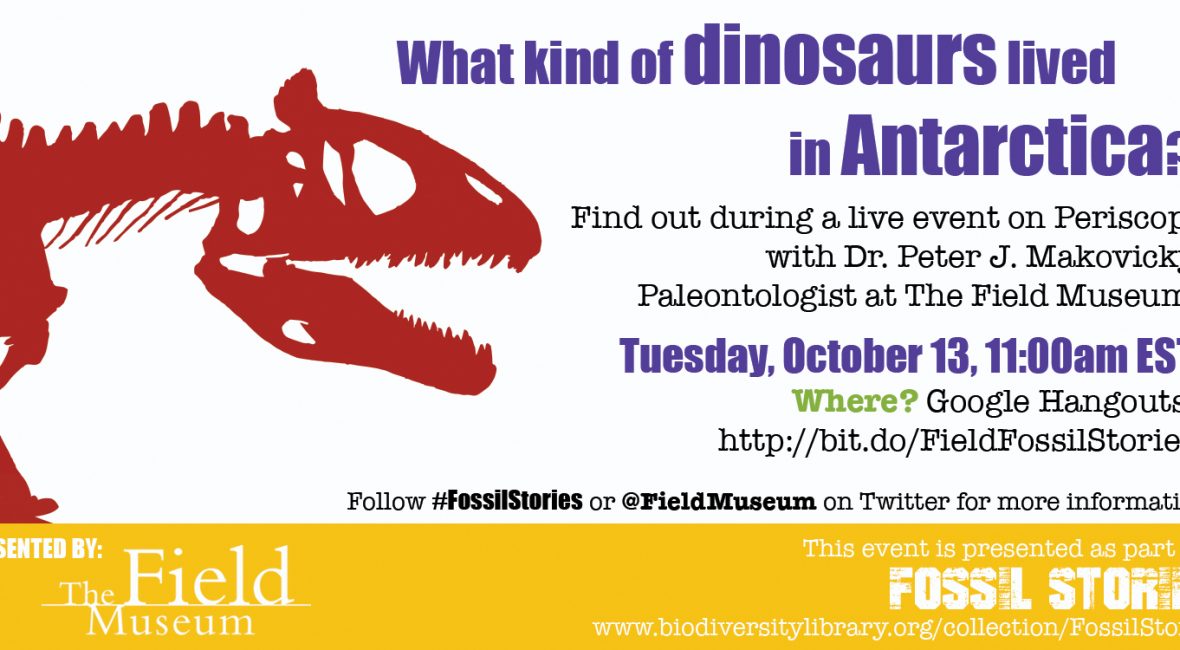
On October 13, at 11am EST, The Field Museum hosted a live webcast with Dr. Peter J. Makovicky, Associate Curator of Dinosaurs at The Field Museum. Dr. Makovicky was interviewed by none other than Field’s Chief Curiosity Correspondent, Emily Graslie, whom you may recognize from her show The Brain Scoop.

Did you miss the live event? You can see the recording of it here: http://sml.fieldmuseum.org/sml/play/DigitalStudio/48-recording

Dr. Makovicky studies dinosaurian evolutionary history, and he has led expeditions to the western US, China, Argentina and Antarctica. Some of his recent work has focused on Antarctic dinosaurs. In 2007, he co-authored a paper with Dr. Hammer and Drs. Nathan Smith and Diego Pol, as well as lengthy treatment on Cryolophosaurus in the Zoological Journal of the Linnean Society. Smith and Pol named the only other known early Jurassic dinosaur from Antarctica, Glacialisaurus hammer, in 2007.

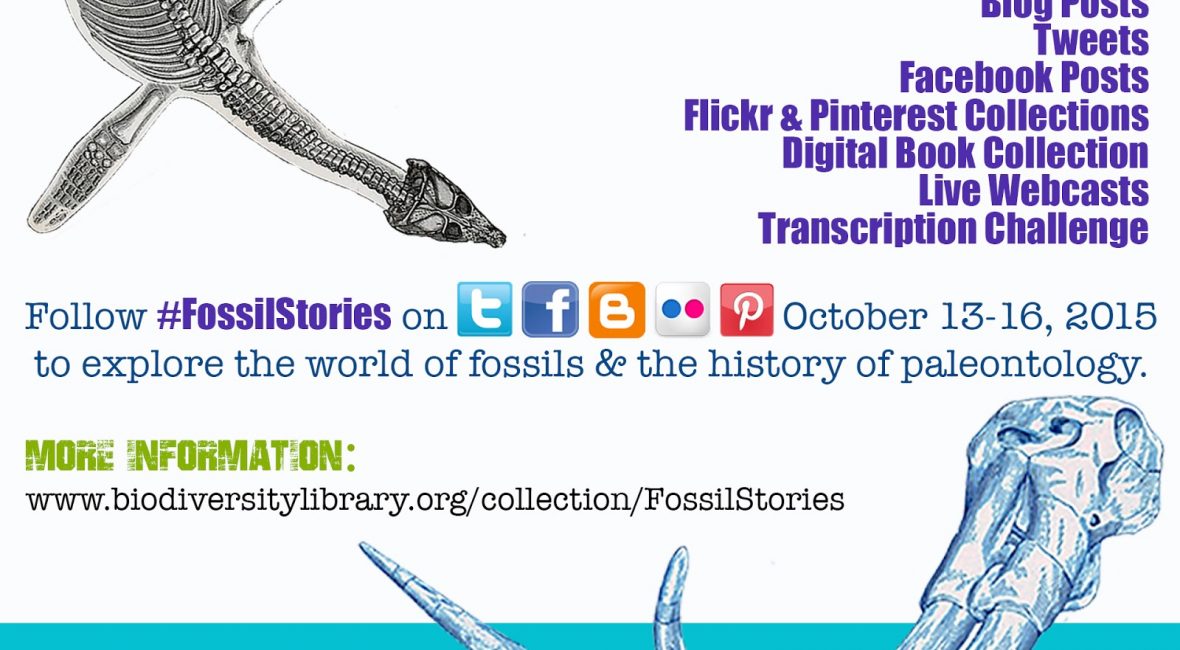
Follow our blog and #FossilStories on Twitter and Facebook all week for more great fossil fun and live webcasts. Check out the full webcast schedule below:

View Full Size Image
October 13, 2015by michelle.underhill
BHL News, Blog Reel, Campaigns, Fossil Stories

Welcome to Fossil Stories!

Welcome to Fossil Stories, a week-long social media event (presented by the Biodiversity Heritage Library in collaboration with several of our partner institutions) celebrating fossils!

View Full Size Image

Today, we recognize fossils as representing the preserved remains or traces of life from the ancient past. The scientific study of these fossils, how they formed, and their evolutionary relationship with each other and living species is known as paleontology.

Humans have been uncovering fossils for millennia, but we have not always understood what they were. Many of these fossils have inspired myths and legends over the centuries, including griffins, dragons, giants, and monsters.

Myths aside, the term “fossil” originally referred to anything that was dug up from the ground, including inorganic materials such as minerals. Even those specimens that were of organic origin were not widely understood as such, and it was not until the 16th century that books recognizing the similarity between some fossil objects and living creatures began to be published. And while some breakthroughs did occur during the Renaissance, it was not until the early 1800s that the reality of extinction was widely established or that the field of paleontology as we know it today was born.

And those dinosaurs that everyone loves? The first dinosaur genus was not described and validly named until the 19th century, and the term dinosaur (from the scientific clade “Dinosauria”) did not appear until 1842.

The study of fossils not only reveals Earth’s past, helping us delve into the origin of life itself, but it also informs research about our planet’s future through, for example, records of ancient climate change that can inform models regarding future change.

All week (October 13-16, 2015), we’ll be celebrating the world of fossils, the history of paleontology, and the men, women, and publications that shaped our knowledge about life preserved in stones with  social media content, including:

  • Tweets and Facebook Posts
  • Blog Posts highlighting milestones and key publications in the history of fossil research
  • A Flickr Collection with hundreds of historic fossil illustrations
  • A Pinterest Collection featuring a selection of our favorite fossil illustrations
  • A BHL Collection containing seminal publications in the history of paleontology
  • A series of live webcasts at BHL partner institutions
  • A citizen science challenge in collaboration with The Field Book Project, the Smithsonian Transcription Center, and Smithsonian Institution Archives (which, we’re excited to announce, was successfully completed on October 12! Learn more below)
All content will be tagged with the event hashtag, #FossilStories, to make it easy for you to follow along and catch all of our great posts. You can find more information about the webcasts and the citizen science challenge below. We hope you’ll join us in our fossil-mania this week! We’re sure you’ll dig it!

Webcasts
The Fossil Stories webcasts will feature paleontologists, fossil research, and fossil exhibits at some of America’s most prestigious natural history institutions. You’ll also have the opportunity to ask these experts your fossil questions!

The webcast schedule is:

  • “Antarctic Dinosaurs with Dr. Peter J. Makovicky.” Presented by The Field Museum.
    • When? Tuesday, October 13, 2015, 11:00am EST
    • Where? Google Hangouts: http://bit.do/FieldFossilStories
  • “Exploring The FossiLab with Advait Jukar.” Presented by the Smithsonian National Museum of Natural History.
    • When? Wednesday, October 14, 2015, 9:00am EST
    • Where? The BHL Periscope Account. (Twitter and Periscope Handle: @BioDivLibrary)*
  • “Behind the Scenes at the NHMLA Dino Lab.” Presented by the Natural History Museum, Los Angeles County
    • When? Friday, October 16, 3:00pm EST
    • Where? The Natural History Museum, Los Angeles County Periscope Account (Twitter and Periscope Handle: @NHMLA)

*For events on Periscope, follow the indicated account on Periscope (Periscope will then alert you when the webcast is live) OR follow @BioDivLibrary or the presenting institution on Twitter to get the link to the event. When the event is live, the link to access the webcast will be tweeted out on the host institution’s Twitter account and BHL’s Twitter account.

Citizen Science Challenge

View Full Size Image


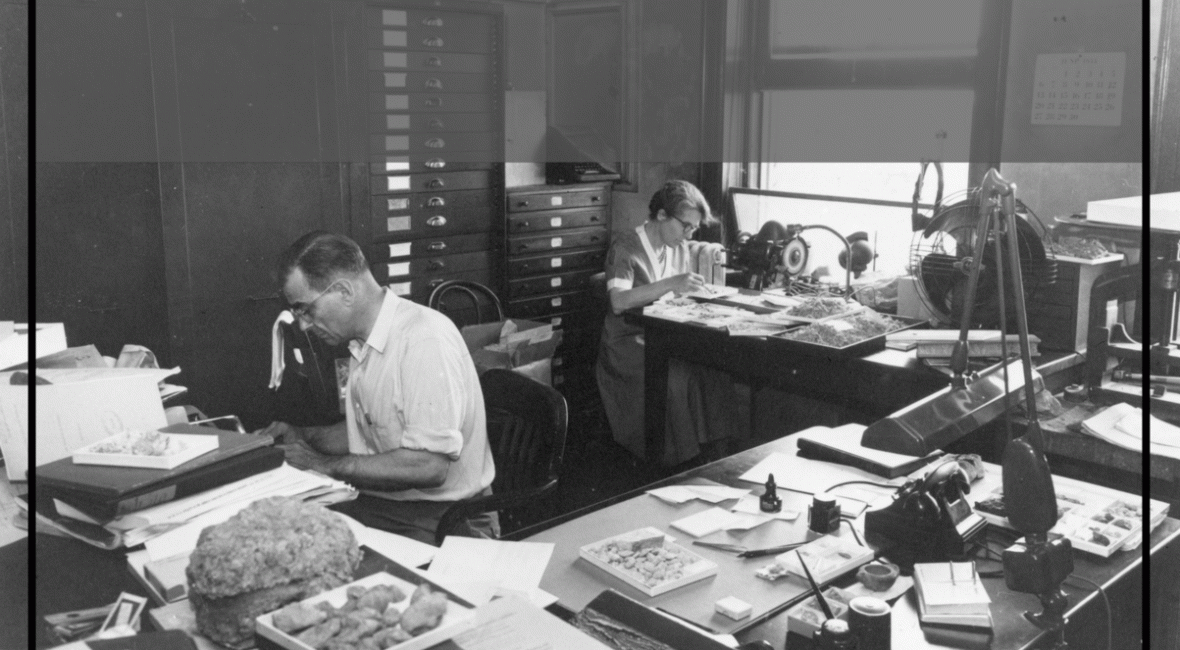
For Fossil Stories, we’ve teamed up with The Field Book Project, the Smithsonian Transcription Center, and Smithsonian Institution Archives to issue you a #FossilFossick citizen science challenge! Last Friday, October 9, we released a set of paleontology field notes from the Smithsonian’s collection into the Transcription Center. We’re excited to announce that all 252 pages of field notes that we released for the challenge have been successfully transcribed and reviewed as of Oct. 12! Thanks to all of our great volunteers for their hard work and dedication! We’ll be sharing more information about the paleontologists featured in the challenge, and highlights from the challenge, all week, so be sure to follow #FossilStories to catch all this great information.

As a reward for successfully completing the challenge, we’ll be featuring a live webcast with Dr. Nicholas D. Pyenson, Curator of Fossil Marine Mammals at the Smithsonian’s National Museum of Natural History, on October 26 via the BHL Periscope account (@BioDivLibrary). He’ll show off some of his favorite specimens in the collection and you’ll have the opportunity to ask him your most pressing fossil questions, so be sure to tune in! More information to come later.

We hope to see you on social media this week! Let the #FossilStories begin!

October 13, 2015by ulib-libraryjobs
BHL News, Blog Reel, Campaigns, Fossil Stories

A Fossil-Focused Citizen Science Challenge!

UPDATE: We are proud to announce that after 3.5 days, volunteers successfully transcribed and reviewed all 252 pages of field notes that we uploaded as part of this challenge! Thanks to all of our great volunteers, and tune in all week (Oct. 13-16, 2015) for more great fossil fun and highlights from the challenge!

October 14 is National Fossil Day! What do you think you might learn if we unleashed notes on the mighty and micro fossilized specimens in the Smithsonian Institution’s collections? Let’s time travel together with Smithsonian scientists – to their field sites, their discoveries, and the mysteries they uncover.

We’re celebrating fossils during the BHL Fossil Stories social media event, running October 13-16, 2015. Follow #FossilStories on Twitter and Facebook or read this article to learn more.

As part of Fossil Stories, we’re teaming up with The Field Book Project, the Smithsonian Transcription Center, the Smithsonian Institution Archives, and the National Museum of Natural History to issue a transcription challenge to you!

View Full Size Image

To Fossick is to “rummage or search,” often for gold nuggets or gems, though you’ll be gathering pearls of wisdom this week. And since knowledge is golden, we know we’ll all be enriched by our #FossilFossick challenge!

Here’s how the challenge works:

  1. We’ll launch several paleontology-related field notes on the Smithsonian Transcription Center
  2. You successfully transcribe and review the pages of those field notes with many of your transcribing friends
  3. Follow and share your findings on Twitter with the #FossilFossick hashtag
  4. We connect you with behind-the-scenes access to fossil specimens and scientists who will tell you more about the real ways fossil records make a difference in our world today

The set of field notes we’ve selected for the challenge not only provides a glimpse into the worlds of three paleobiologists (Lester F. Ward, Harry S. Ladd, and G. Arthur Cooper) over nearly a hundred-year period (from 1893 to 1965), but also highlights the fact that paleontology is a discipline that is frequently transformed by technology, whether that is the technology to travel to previously inaccessible places, technology to find and excavate items too hidden or too fragile to unearth before, or technology to inspect, record, and preserve findings in new ways.

As you transcribe the field notes for this challenge, you’ll discover some of these changes in technology, from sailing ships to “electric cars” and airplanes, and from the naked eye to new scanning microscopes and 3-D scanning. You’ll also uncover the names of other scientists, researchers, and collectors that our paleobiologists corresponded with, the specimens that they collected, and the locations they collected in. We hope you’ll share these findings with us by tweeting with the challenge hashtag #FossilFossick and/or adding them to our Google spreadsheet.

View Full Size Image
Local field note-book no. 2 of Lester F. Ward, October 16, 1892 to May 7, 1893. http://biodiversitylibrary.org/bibliography/107244. Smithsonian Institution Archives.

If you successfully transcribe all of the field notes in the challenge, we’ll celebrate with a live webcast with Dr. Nicholas D. Pyenson, Curator of Fossil Marine Mammals at the Smithsonian’s National Museum of Natural History, on October 26 via the BHL Periscope account (@BioDivLibrary). He’ll show off some of his favorite specimens in the collection and you’ll have the opportunity to ask him your most pressing fossil questions.

So, do you accept our challenge? If so, dig into the field notes here:


  • Harry S. Ladd: 
    • https://transcription.si.edu/project/7811
    • https://transcription.si.edu/project/7812
  • Lester F. Ward:
    • https://transcription.si.edu/project/7810
  • G. Arthur Cooper:
    • https://transcription.si.edu/project/7804
    • https://transcription.si.edu/project/7805
    • https://transcription.si.edu/project/7806
    • https://transcription.si.edu/project/7807
    • https://transcription.si.edu/project/7808
    • https://transcription.si.edu/project/7809

Be sure to share your discoveries using our challenge hashtag, #FossilFossick. Learn more about the collectors who created these field notes and get updates on challenge progress by following #FossilStories all next week.

Welcome to the #FossilFossick Challenge!

October 9, 2015by ulib-libraryjobs
BHL News, Blog Reel, Campaigns, Fossil Stories

A Celebration of Fossils: Fossil Stories

October 14, 2015, is National Fossil Day, a day to celebrate all things fossils! Museums around the country are celebrating with fossil-related events the entire month of October, especially during the week of Fossil Day. BHL will be joining the fossil-mania next week with our social media campaign, Fossil Stories, running October 13-16, 2015.

Rocks hold the key to the history of life on Earth. Buried within the earth are millions of years’ worth of fossils, each of which tells a unique story about the life and ecosystems that once dominated our planet. These fossils not only reveal Earth’s past, but also provide insight into our future. Yet, the scientific study of these fossils began just a few hundred years ago.

View Full Size Image


Fossil Stories, presented by the Biodiversity Heritage Library in collaboration with several of our partner institutions, explores the world of fossils, the history of paleontology, and the men, women, and publications that shaped our knowledge about life preserved in rocks. October 13-16, BHL and our participating partner institutions will be producing a plethora of fossil content, which will publish on our blog, Twitter, and Facebook. All content will be tagged with the hashtag #FossilStories. We’ll also have hundreds of fabulous historic fossil illustrations available in Flickr and Pinterest, as well as a collection of seminal books in the history of paleontology in our BHL Fossil Stories collection.

The highlights of our campaign will be a series of three live webcasts at several of our participating partner institutions, as well as a citizen science challenge in partnership with The Field Book Project, the Smithsonian Transcription Center, and the Smithsonian Institution Archives.

Webcasts
The Fossil Stories webcasts will feature paleontologists, fossil research, and fossil exhibits at some of America’s most prestigious natural history institutions. For the webcasts featuring paleontologists at the respective institutions, you’ll have the opportunity to ask these experts your fossil questions!

The webcast schedule is:

  • “Antarctic Dinosaurs with Dr. Peter J. Makovicky.” Presented by The Field Museum.
    • When? Tuesday, October 13, 2015, 11:00am EST
    • Where? Google Hangouts: http://bit.do/FieldFossilStories 
  • “Exploring The FossiLab with Advait Jukar.” Presented by the Smithsonian National Museum of Natural History.
    • When? Wednesday, October 14, 2015, 9:00am EST
    • Where? The BHL Periscope Account. (Twitter and Periscope Handle: @BioDivLibrary)*
  • “Behind the Scenes at the NHMLA Dino Lab.” Presented by the Natural History Museum, Los Angeles County.
    • When? Friday, October 16, 2015, 3:00pm EST
    • Where? NHMLA Periscope Account (Twitter and Periscope Handle: @NHMLA)

*For events on Periscope, follow the indicated account on Periscope (Periscope will then alert you when the webcast is live) OR follow @BioDivLibrary or the presenting institution on Twitter to get the link to the event. When the event is live, the link to access the webcast will be tweeted out on the host institution’s Twitter account and BHL’s Twitter account.

Citizen Science Challenge
For Fossil Stories, we’re teaming up with The Field Book Project, the Smithsonian Transcription Center, and Smithsonian Institution Archives to issue you a citizen science challenge! Today, we’re releasing a set of paleontology field notes from the Smithsonian’s collection into the Transcription Center. Can you help transcribe all of them by the end of the campaign, October 16? There’s a reward if all of the field notes are successfully transcribed by the end of the challenge. Stay tuned to our blog later today to learn more about the challenge!

So be sure to follow #FossilStories all next week to explore fossils and the history of paleontology, and tune in later today to get more details on our transcription challenge. We know you’ll dig the event!

October 9, 2015by ulib-libraryjobs
Page 4 of 4«1234

Help Support BHL

BHL's existence depends on the financial support of its patrons. Help us keep this free resource alive!

search

About BHL

The Biodiversity Heritage Library (BHL) is the world’s largest open access digital library for biodiversity literature and archives. BHL operates as a worldwide consortium of natural history, botanical, research, and national libraries working together to digitize the natural history literature held in their collections and make it freely available for open access as part of a global “biodiversity community.”

Join Our Mailing List

Sign up to receive the latest news, content highlights, and promotions.

Subscribe Now

Subscribe to Blog via Email

Enter your email address to subscribe to this blog and receive notifications of new posts by email.

Join 319 other subscribers

Subscribe to Blog Via RSS

Subscribe to the blog RSS feed to stay up-to-date on all the latest BHL posts.

Access RSS Feed

Inspiring Discovery through Free Access to Biodiversity Knowledge.

The Biodiversity Heritage Library makes it easier than ever for you to access the information you need to study and explore life on Earth…for free, anytime, anywhere.


64+ Million Pages of
Biodiversity Literature Online.

EXPLORE

Tools and Services
to Transform Research.

EXPLORE

300,000+
Illustrations on Flickr.

EXPLORE

ABOUT | HARMFUL CONTENT | PRIVACY | SITE MAP | TERMS OF USE