Biodiversity Heritage Library - Program news and collection highlights from BHL
  • Home
  • News
  • Featured Books
    • All Featured Books
    • Book of the Month Series
    • BHL at 20
  • User Stories
  • Campaigns
    • Fossil Stories
    • Garden Stories
    • Monsters Are Real
    • Page Frights
    • Her Natural History
    • Earth Optimism 2020
  • Tech Blog
  • Visit BHL
Home
News
Featured Books
    All Featured Books
    Book of the Month Series
    BHL at 20
User Stories
Campaigns
    Fossil Stories
    Garden Stories
    Monsters Are Real
    Page Frights
    Her Natural History
    Earth Optimism 2020
Tech Blog
Visit BHL
  • Home
  • News
  • Featured Books
    • All Featured Books
    • Book of the Month Series
    • BHL at 20
  • User Stories
  • Campaigns
    • Fossil Stories
    • Garden Stories
    • Monsters Are Real
    • Page Frights
    • Her Natural History
    • Earth Optimism 2020
  • Tech Blog
  • Visit BHL
Biodiversity Heritage Library - Program news and collection highlights from BHL
Blog Reel, Campaigns, Featured Books, Fossil Stories

A Sinner Killed During the Great Flood or a Fossil Reptile? Discovering the Plesiosaur

Most people today are at least somewhat familiar with the order of extinct marine reptiles known as Plesiosauria, thanks to the legend of the Loch Ness monster, which is often described as resembling a plesiosaur. Indeed, some argue that Nessie may in fact be a surviving member of this order. Scientists, however, reject this suggestion, if for no other reason that the Loch Ness lake formed a mere 10,000 years ago, while the fossil record indicates that plesiosaurs went extinct over 66 million years ago. And yet, even if plesiosaurs can’t account for the Loch Ness legend, the story of their discovery is still captivating.

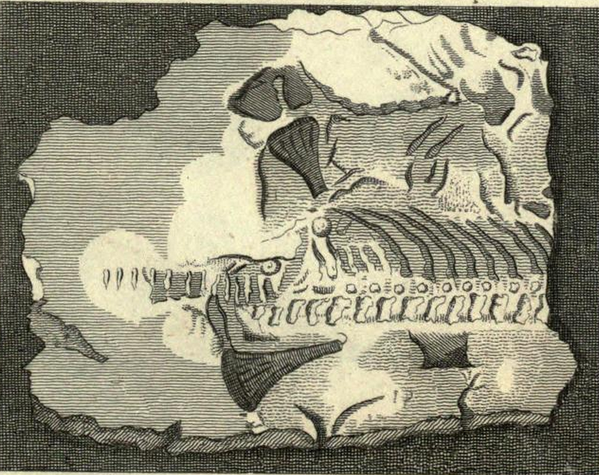
Plesiosaurs are among the first extinct fossil reptiles to be recognized as such. Plesiosaur fossils were described as early as 1605, though in the seventeenth century they were not recognized as extinct reptiles. In 1719, Anglican clergyman William Stukeley, who pioneered archaeological studies at Stonehenge and Avebury, described a partial plesiosaur skeleton that had been brought to his attention by Robert Darwin of Elston, Charles Darwin’s great-grandfather. The skeleton had been found at a quarry at Fulbeck, England. It had been used to reinforce the slope of a watering-hole until the fossils were discovered within it, after which it was displayed in the local vicarage as the remains of a sinner killed during the Biblical flood. Stukeley’s description in “An Account of the Skeleton of a Large Animal Impressed on Stone,” which describes the fossils as belonging to a sea creature such as a crocodile or porpoise, is the first published description of an articulated fossil reptile skeleton.

View Full Size Image
Stukeley’s plesiosaur. Original Publication: Philosophical Transactions of the Royal Society of London. 1719. Reprint, 1809: http://biodiversitylibrary.org/page/23269260. Digitized by University of California Libraries.

Further descriptions of plesiosaurs through the early nineteenth century were still based on incomplete specimens. In 1821, William Conybeare and Henry Thomas De la Beche gave the genus its name, Plesiosaurus, when they described a partial skeleton from the collection of Colonel Thomas James Birch.

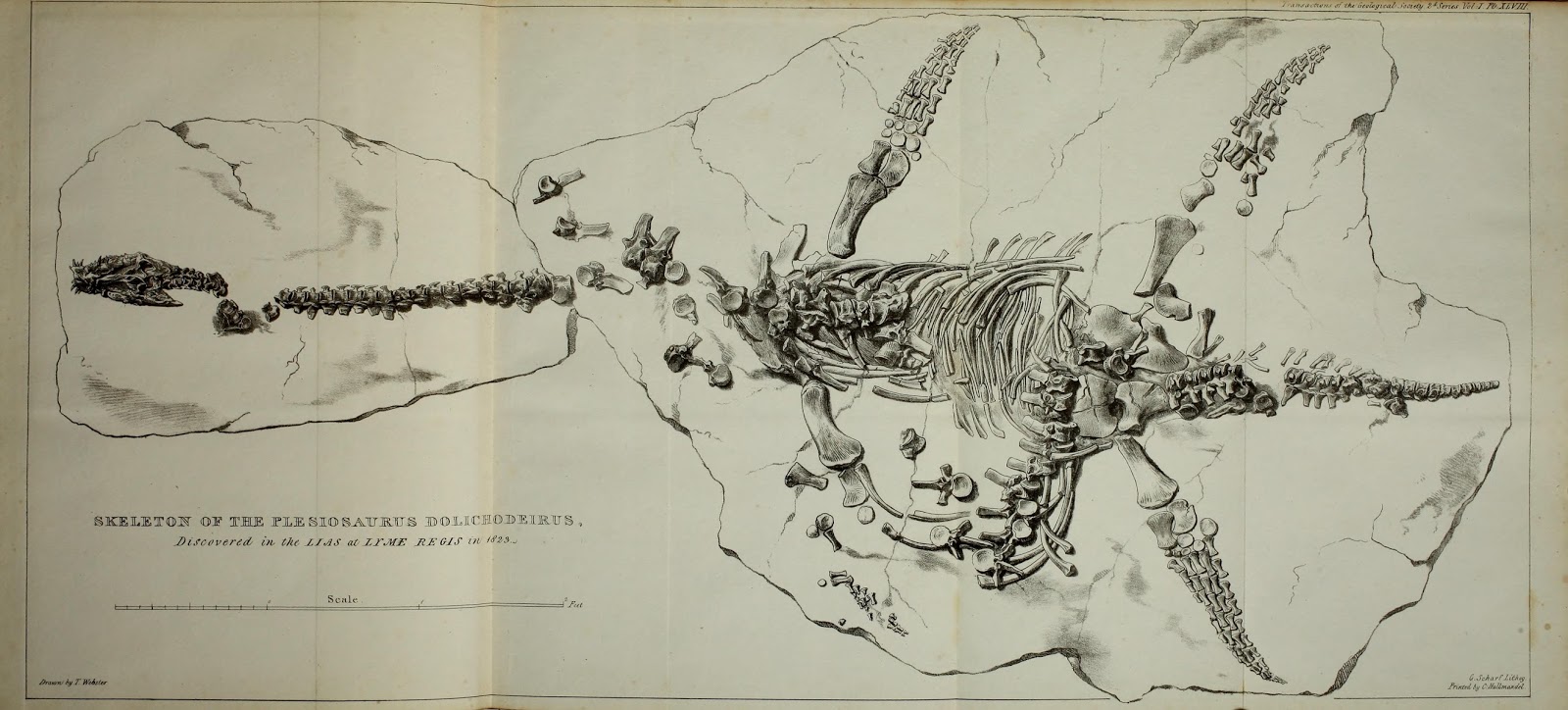
It was 1823 when the next great milestone in the plesiosaur story occurred. Famous “fossil-hunter” Mary Anning discovered a nearly complete skeleton at Lyme Regis in Dorset, England. The fossil was acquired by the Duke of Buckingham, who lent it to geologist William Buckland, who himself made it available to William Conybeare. Conybeare described the find, and asserted the full species name, Plesiosaurus dolichodeirus, during the same lecture at which Megalosaurus, the first dinosaur genus to be validly named, was described.
View Full Size Image
Anning’s plesiosaur. Transactions of the Geological Society. ser. 2, v.1. 1824. http://biodiversitylibrary.org/page/36238986. Digitized by California Academy of Sciences.

Sadly, despite Mary Anning’s significant contribution to the history of plesiosaur discovery, she is not named in Conybeare’s paper.

Fossil Stories

Stay tuned all week for more great fossil fun with our #FossilStories campaign, including:

  • Tweets and Facebook Posts
  • Blog Posts highlighting milestones and key publications in the history of fossil research
  • A Flickr Collection with hundreds of historic fossil illustrations
  • A Pinterest Collection featuring a selection of our favorite fossil illustrations
  • A BHL Collection containing seminal publications in the history of paleontology
  • A series of live webcasts at BHL partner institutions
  • A citizen science challenge in collaboration with The Field Book Project, the Smithsonian Transcription Center, and Smithsonian Institution Archives
Follow #FossilStories on Twitter and Facebook to learn more.
October 14, 2015by michelle.underhill
Blog Reel, Campaigns, Featured Books, Fossil Stories

Challenge Focus: Harry S. Ladd

We’re so excited that our #FossilStories Citizen Science Challenge was successfully completed on October 12, with 252 pages from 9 field books fully transcribed and reviewed in just 3.5 days! Be sure to tune into the behind-the-scenes tour of Smithsonian fossil collections with Dr. Nicholas Pyenson, Curator of Fossil Marine Mammals at the Smithsonian’s National Museum of Natural History, via the BHL Periscope on October 26 as a reward for the successful completion of the challenge. More details to come on Twitter and Facebook.

View Full Size Image
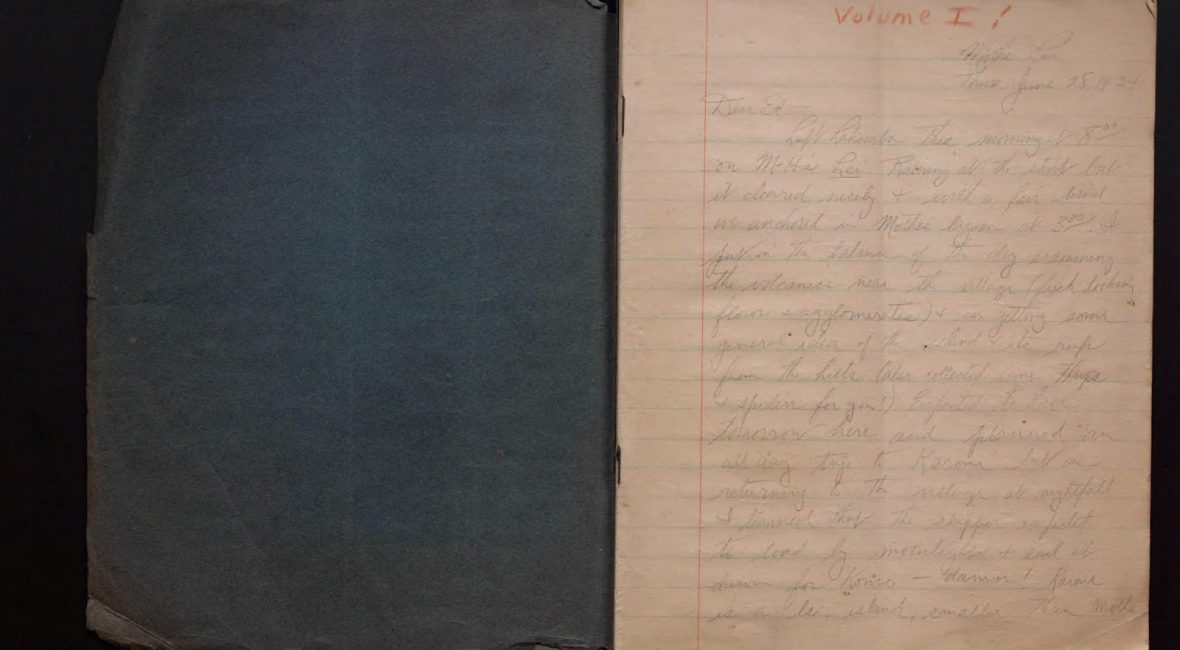
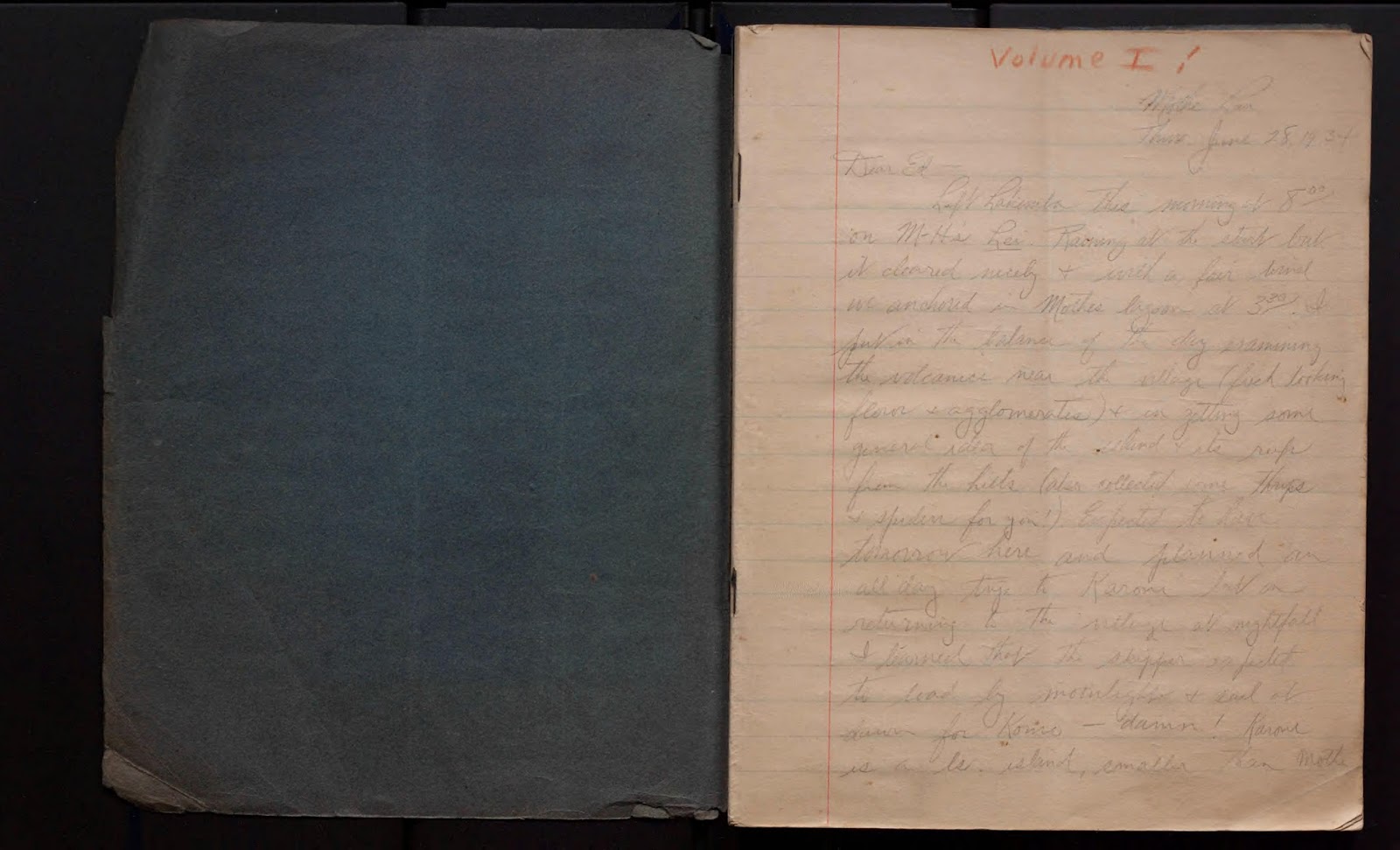
First page of Harry S. Ladd’s first field diary, 1915-72. http://biodiversitylibrary.org/page/48485440. Smithsonian Institution Archives.

One of the journals in the challenge is from Harry Stephen Ladd (1899-1982), a geologist and paleontologist who worked much of his career with the US Geological Survey. Many of his fossil specimens can be found in the Stratigraphic collections and Mollusca Cenozoic Marine Type collection at the Department of Paleobiology, National Museum of Natural History. He began working in the field in the 1920’s and eventually became a leading authority in the geology of the islands in the Pacific Ocean. His two volume diary documents some of his earliest work in the Pacific region. In 1934, he went into the field for the second time with J. Edward Hoffmeister of the University of Rochester to study the coral formations in Fiji (in the 1960s he even used aerial observations made from a helicopter the document the shape and character of Fiji reefs). This work would go on to stimulate the debate about “the coral problem” of how did islands and atolls form. There were two competing theories in the early twentieth century — Darwin’s and Reginald Daly’s.

In the midst of this work, Ladd writes about his experiences in the field, with local communities, and getting married. All of this is shared as a series of letters to his colleague “Edward.”

View Full Size Image
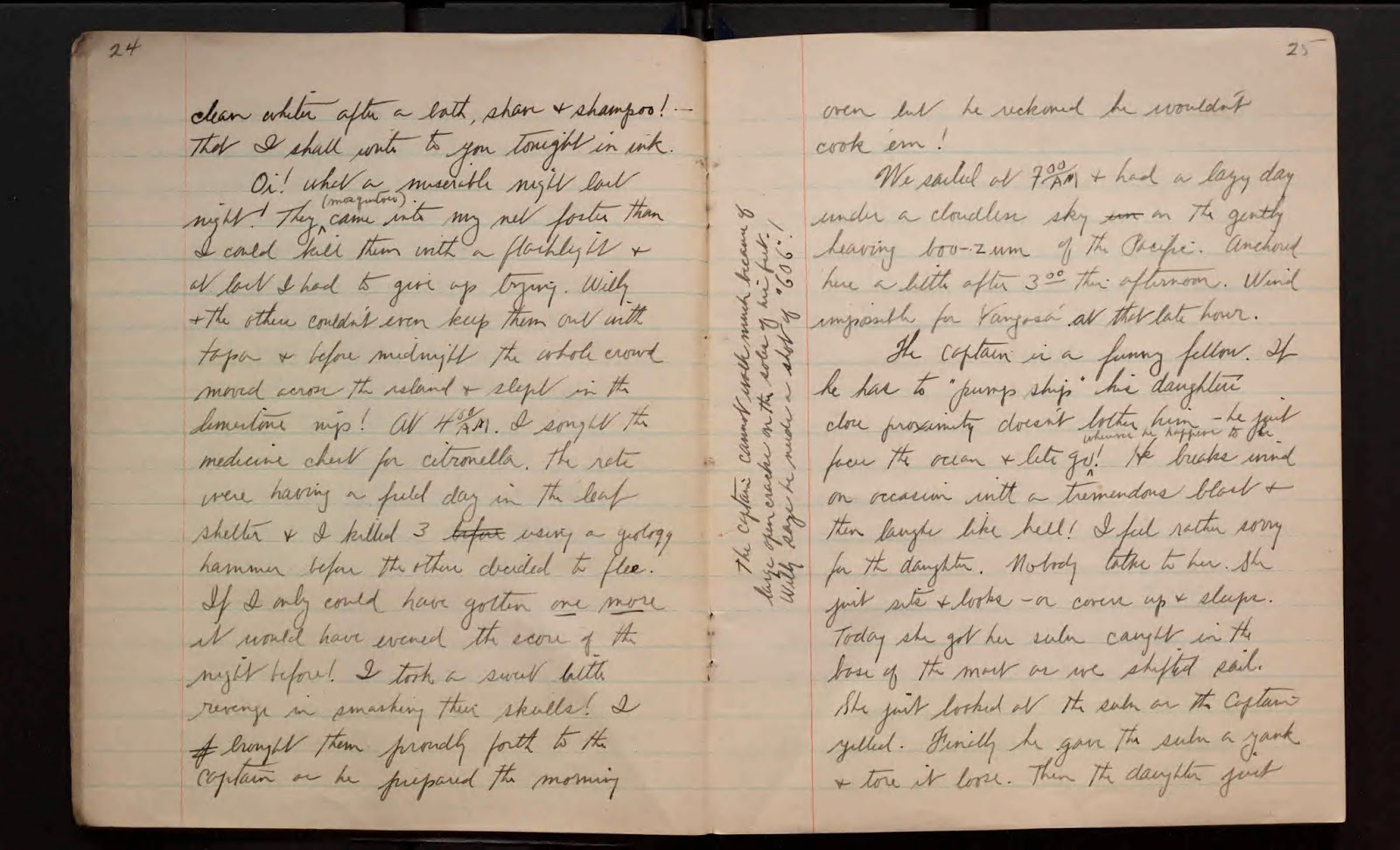
Page from Harry S. Ladd’s second field diary, 1915-72. http://biodiversitylibrary.org/page/48485425. Smithsonian Institution Archives.

Volunteers working on the #FossilFossick challenge uncovered some awesome quotes from Ladd within his field book. For instance:

@SiobhanLeachman @TranscribeSI “The things I’ve done for palaeontology!” HA! That’s gotta be Ladd’s motto!

— Witchy Meg (@meg_shuler) October 10, 2015


oh, Harry, you dog! @TranscribeSI #fossilfossick https://t.co/bsdZ7bC1hW pic.twitter.com/yfOMhg7i7F

— Witchy Meg (@meg_shuler) October 11, 2015

Thanks to our awesome volunteers for the incredible information that they pulled out of Ladd’s field books. Stay tuned to our blog on Friday for more highlights from the challenge!

If you would like to know more about Harry Ladd and E. J. Hoffmeister, we encourage you to check out Ladd’s field books and specimen records on Smithsonian’s Collections Search Center, his publications and field books in BHL, and Hoffmeister’s personal papers at UC San Diego.

Be sure to follow #FossilStories on Twitter and Facebook all week for more great fossil fun and more highlights from our #FossilFossick Challenge!

October 14, 2015by ulib-libraryjobs
BHL News, Blog Reel, Campaigns, Fossil Stories

Webcast! Exploring the Smithsonian’s FossiLab

The Smithsonian National Museum of Natural History’s FossiLab is a busy place, responsible for preparing newly-collected fossils for Smithsonian’s scientists and maintaining the fossils in the Smithsonian’s collection. Visitors to the museum can actually watch staff and volunteers at work in the FossiLab, which is located within the Last American Dinosaurs Exhibition.

One of the projects in the FossiLab is the conservation and rehousing of specimens from the Museum’s fossil marine mammal collection. The specimens range from individual teeth to skulls, jaws and more-or-less complete skeletons comprised of both intact and fragmentary bones. Some of the most important specimens were described by Smithsonian scientists in articles now available online through the Biodiversity Heritage Library. The BHL collection gives FossiLab staff easy access to early photographs and drawings of these fossils, aiding their conservation work greatly. How is that? Fossils tend to break over time (gravity, vibration, and even the most careful handling may cause old repairs to fail or new fractures to form). Most such breaks are easy to repair, but in a large collection of fragmentary bones it’s not always easy to distinguish breaks that occurred during storage from those that predate a fossil’s discovery. When staff compare the bones to the original illustrations, the distinction becomes clear. Not only can they see if fragments have gone missing, but they also learn the approximate shapes of any missing pieces. If you’ve ever put a jigsaw puzzle together, you know how much easier it is to find a missing piece if you know what it looks like!

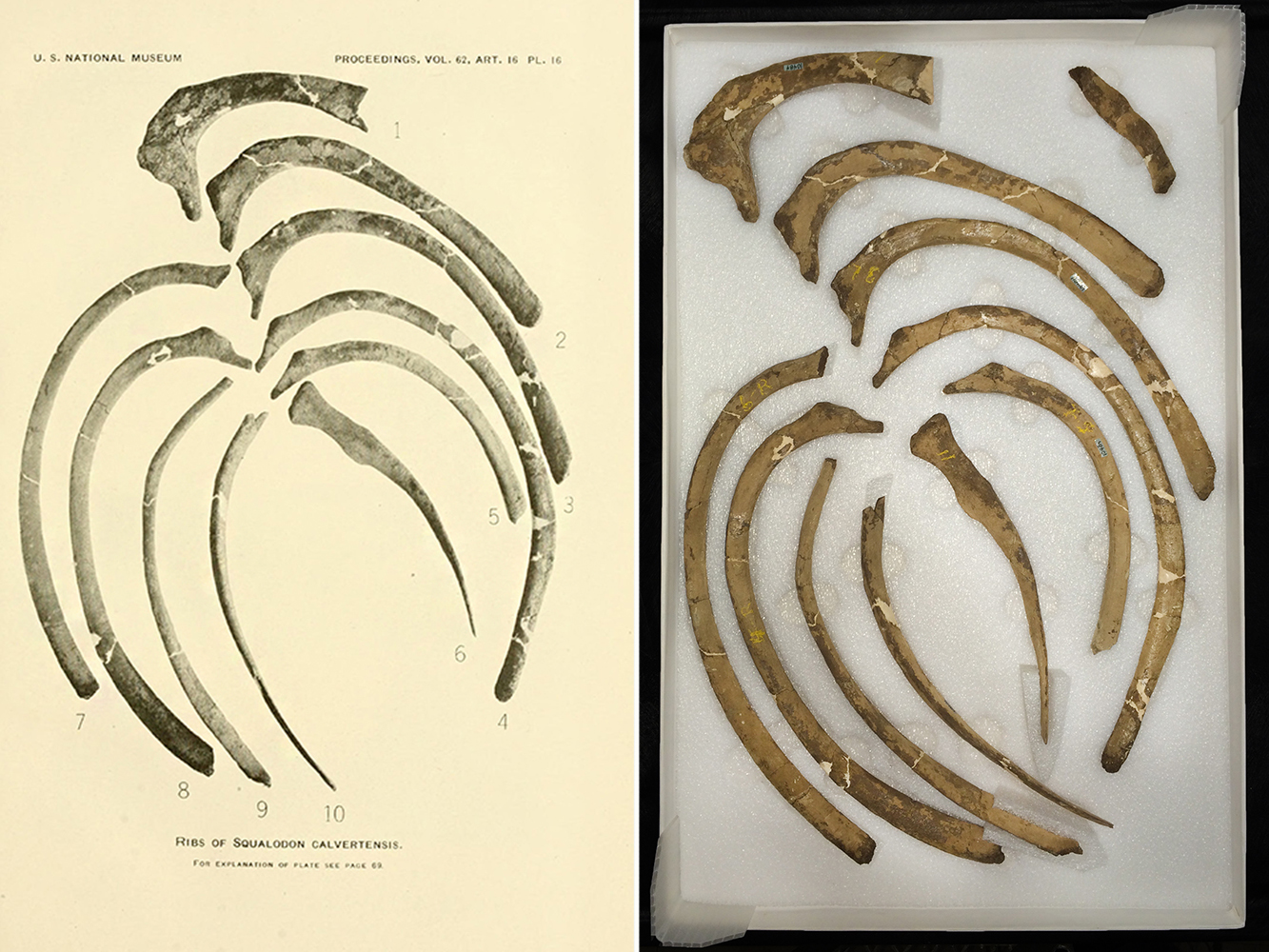
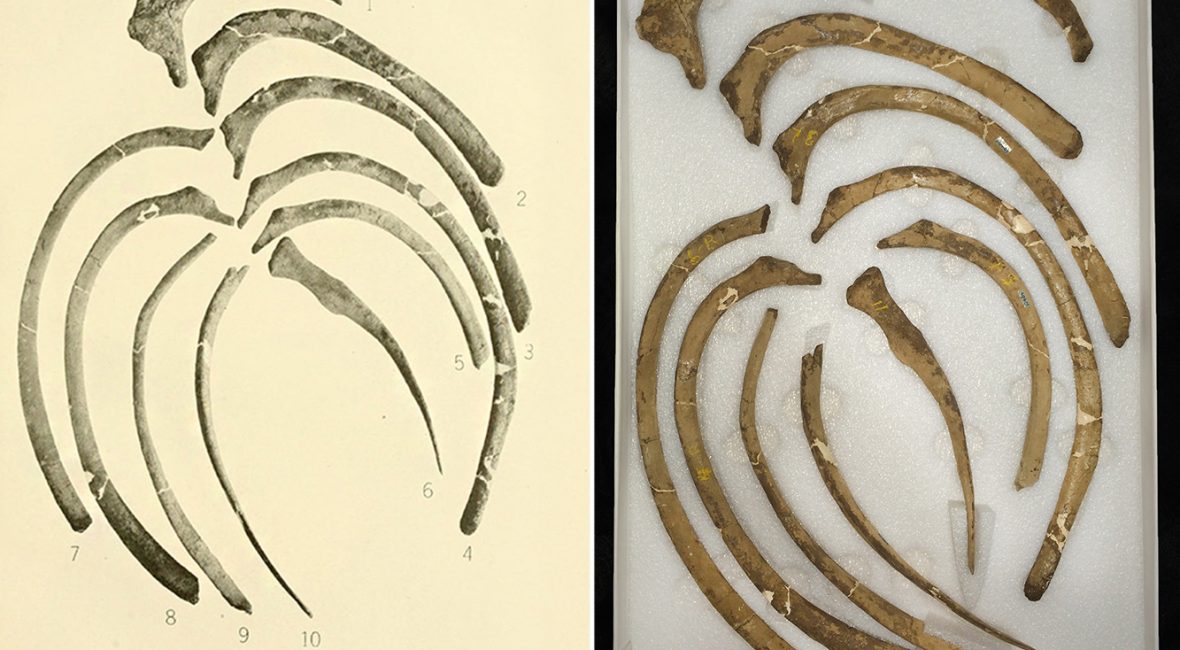
The photos below show an example of the FossiLab’s work. This past summer, the fossil of an extinct shark-toothed dolphin, Squalodon calvertensis (USNM 10484), was brought to FossiLab for rehousing. It had been described in 1923 by Remington Kellogg in the Proceedings of the United States National Museum. When staff compared the ribs with the photo in the publication (left), they realized that some had broken during their 92 years in storage. A careful search among all the bones in the storage drawer turned up the missing pieces. FossiLab staff reattached them using an archival adhesive before rehousing the entire specimen and returning it to storage. The repaired and rehoused ribs are shown in the photo on the right.

View Full Size Image
Ribs from Squalodon calvertensis. Left: Photo from “Description of two squalodonts recently discovered in the Calvert Cliffs, Maryland; and notes on the shark-toothed cetaceans.” Kellogg, Remington. Proceedings of the United States National Museum. 62(2462). pg. 1-69. http://biodiversitylibrary.org/page/16118643. Right: Same ribs, recently rehoused at the Smithsonian’s FossiLab.

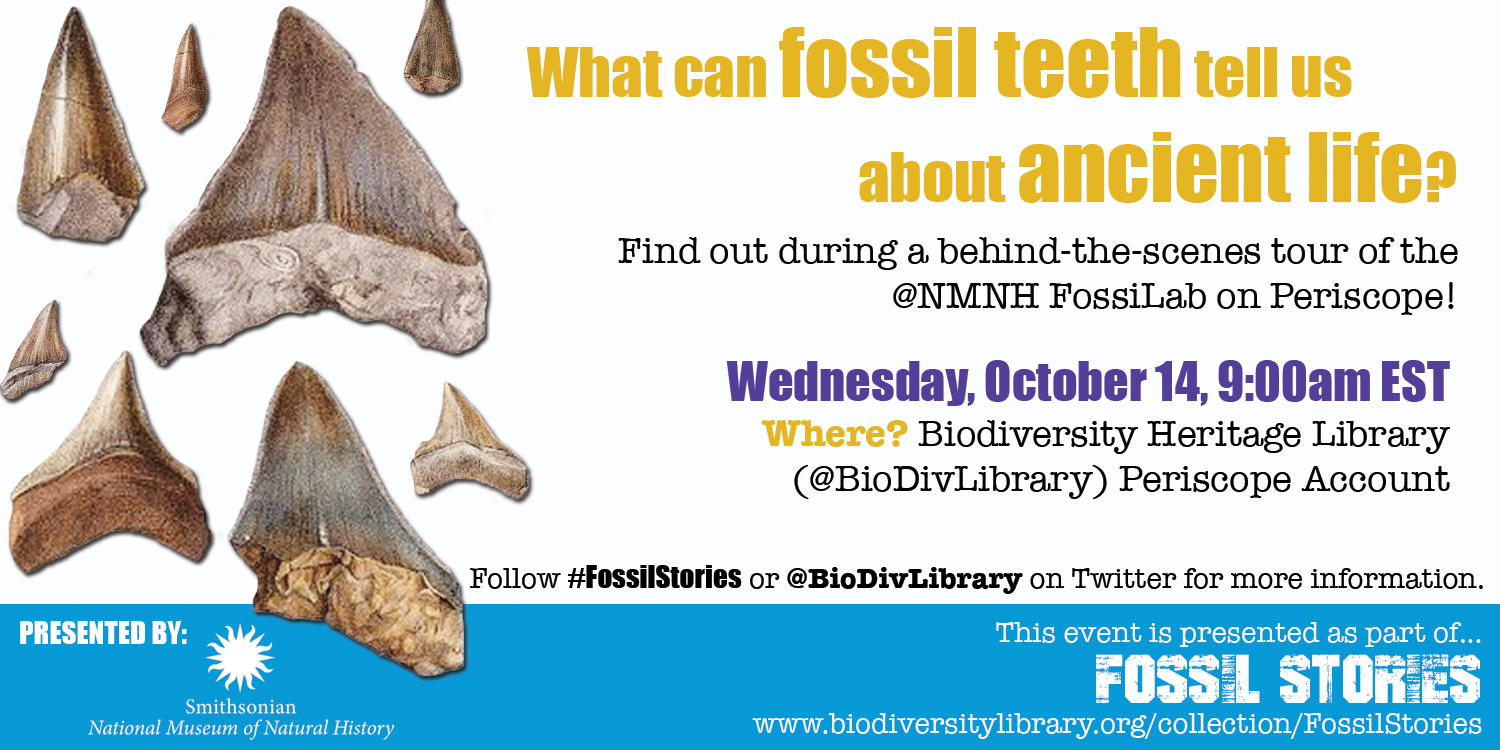
The FossiLab is also very interested in fossil teeth. Why? According to FossiLab volunteer Advait Jukar, a PhD student at George Mason University, these teeth can help us determine, for example, the number and types of dinosaur species in a region.

Curious to know more about the fascinating things that fossil teeth can tell us about ancient life and to further explore the work going on at the Smithsonian’s FossiLab? You’re in luck!

View Full Size Image

Tune in today, October 14, at 9am EST for a live tour of the FossiLab with Advait Jukar! The event will take place on the BHL Periscope account. To participate, simply follow BHL (@BioDivLibrary) on Periscope (you’ll then receive a notification via Periscope once the event is live) or follow @NMNH or @BioDivLibrary on Twitter. We’ll tweet out the link to the Periscope event on those accounts once it’s live.

If you missed the live event, you’re in luck. You can see the recording on YouTube!

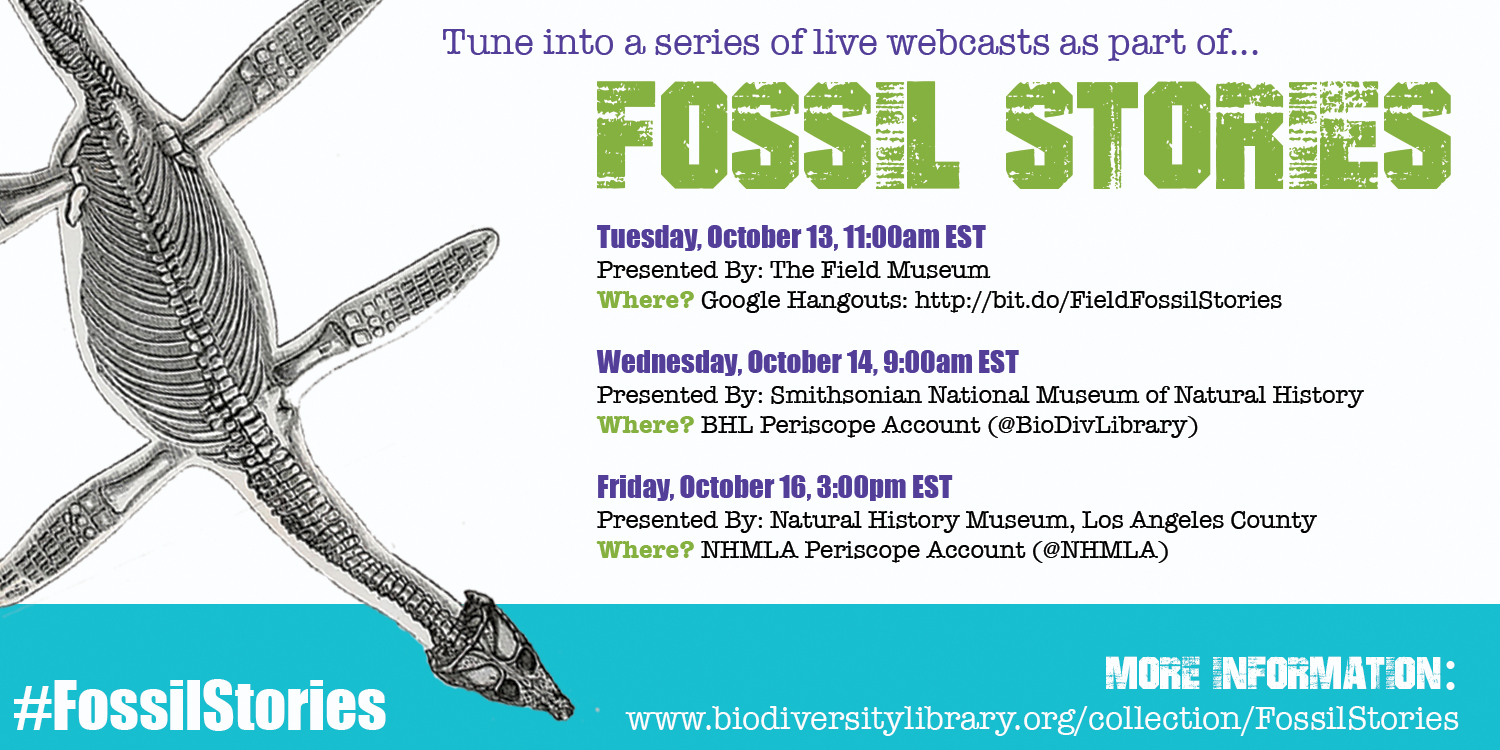
We hope to see you today on Periscope, and remember to follow our blog and #FossilStories on Twitter and Facebook all week for more great fossil fun and live webcasts. Check out the full webcast schedule below:

View Full Size Image
October 14, 2015by michelle.underhill
Blog Reel, Campaigns, Featured Books, Fossil Stories

Proving Extinction: Cuvier and the Elephantimorpha

At the end of the eighteenth century, Jean Léopold Nicolas Frédéric Cuvier, also known as Georges Cuvier and widely remembered as the Father of Paleontology, helped establish extinction as a fact and laid the foundation for vertebrate paleontology.

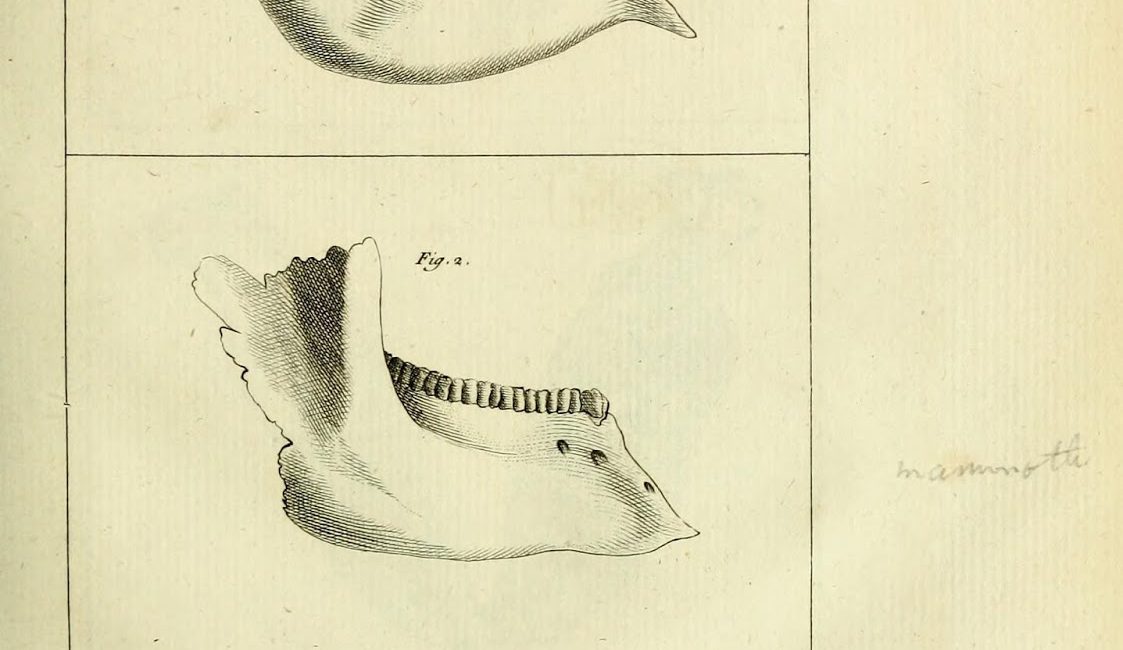
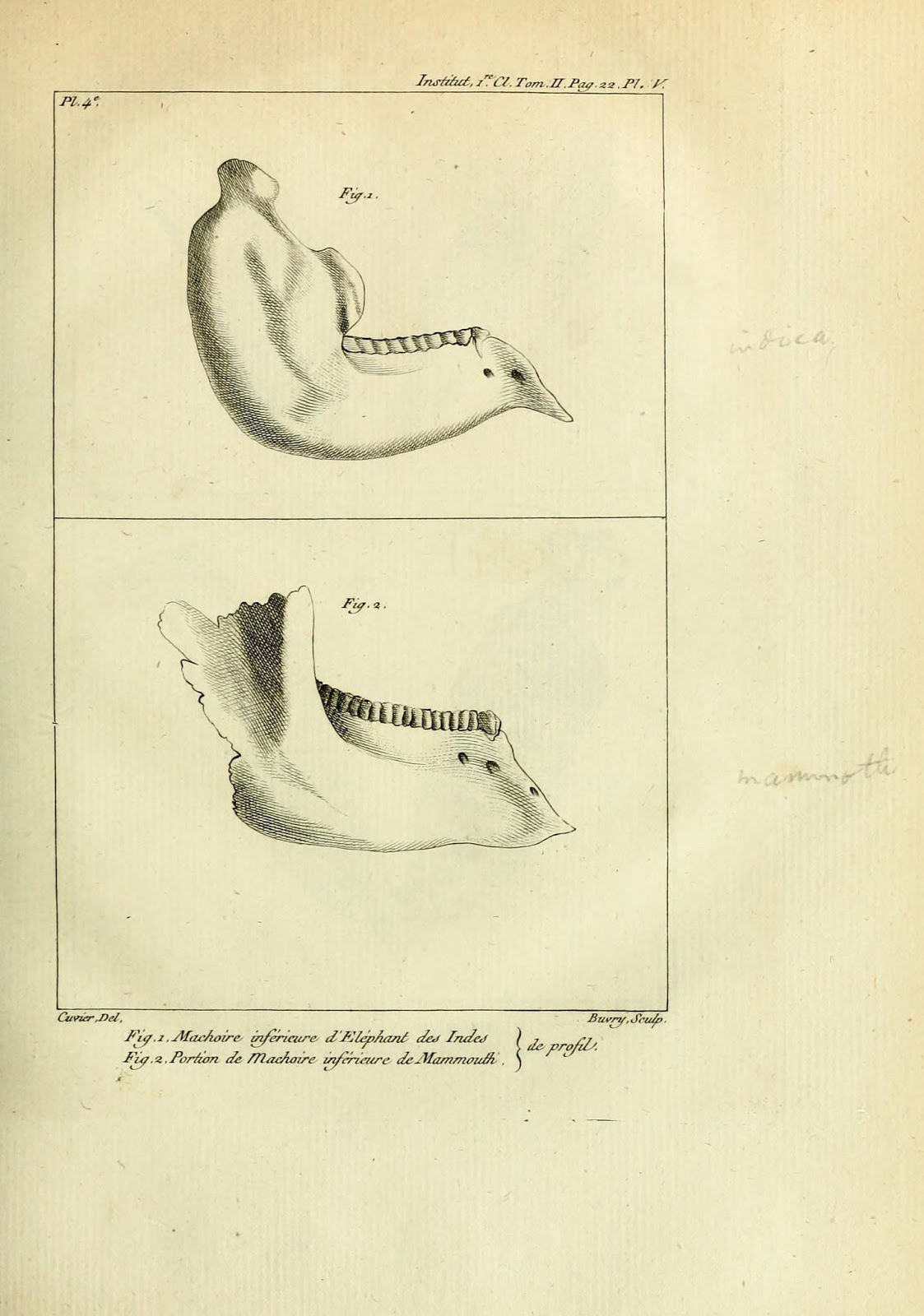
Born in Montbéliard, France, in 1769, Cuvier formed an interest in natural history at a young age, and by the time he was 26 (in 1795), he became the assistant of Jean-Claude Mertrud, the chair of comparative anatomy at the Jardin des Plantes. Also in 1795, Cuvier was elected a member of the Institut de France’s Academy of Sciences, and in 1796, at the opening of the National Institute, he read his first paleontological paper, which was published in 1800 as “Mémoires sur les espèces d’éléphants vivants et fossiles.”

View Full Size Image
Comparing the jaws of the Indian elephant and the mammoth. Cuvier, Georges. “Mémoires sur les espèces d’éléphants vivants et fossiles.” 1800. http://biodiversitylibrary.org/page/16303001. Digitized by Natural History Museum, London.

The paper presents Cuvier’s findings from his analysis of Indian and African elephant skeletons as well as mammoth fossils and a fossil skeleton known as the “Ohio animal,” which would later be named “mastodon” by Cuvier. Using comparative anatomy, Cuvier showed for the first time that the Indian and African elephants were distinct species, and that the mammoth and mastodon fossils were distinct from living elephants, thus representing extinct species. This work represents a major milestone in the history of paleontology by establishing the use of comparative anatomy within the field and confirming the reality of extinction.

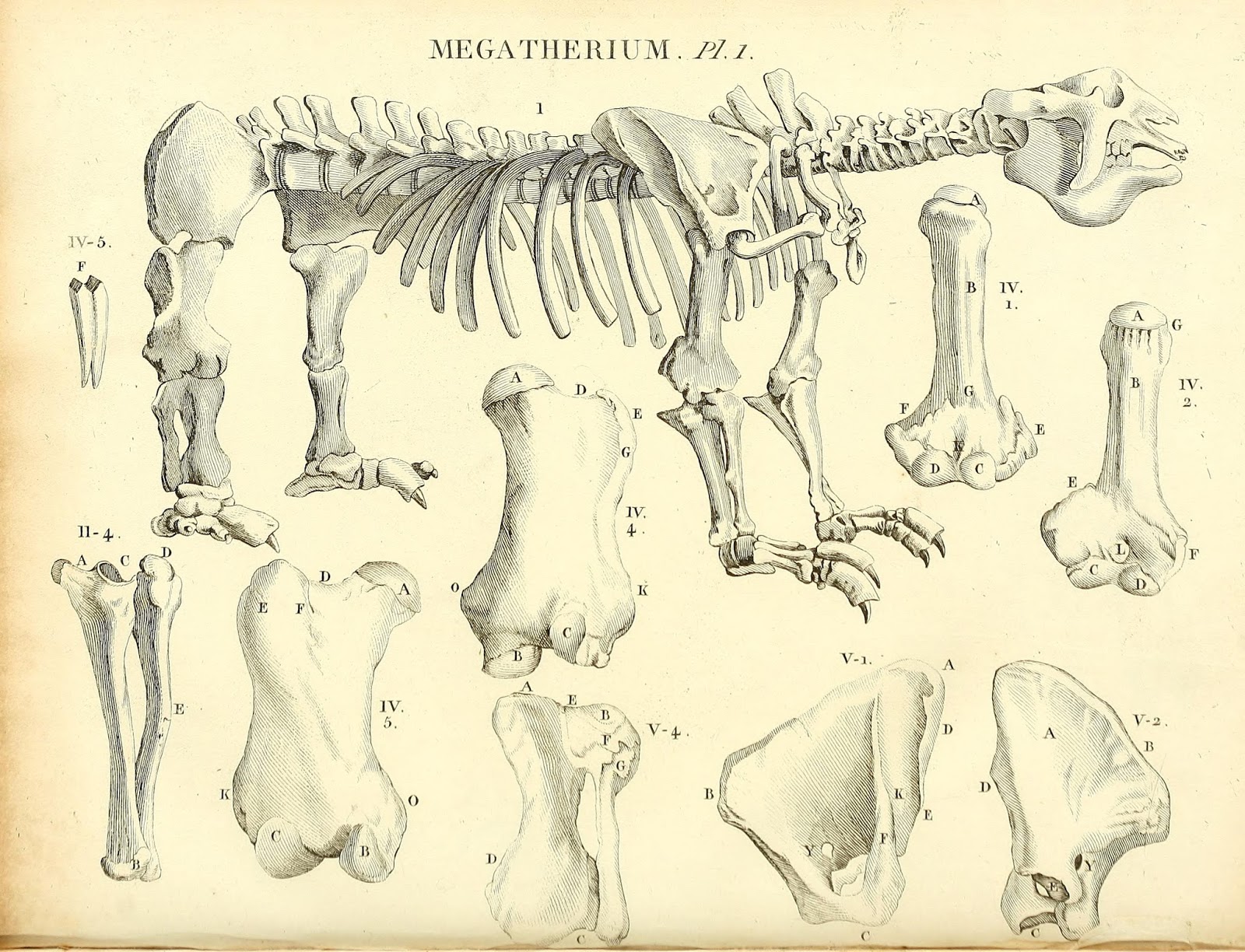
While Cuvier’s work established extinction as a fact, he believed that these extinctions were the result of catastrophism. Catastrophism is the theory that several global catastrophes have occurred throughout Earth’s history, resulting in the extinction of many species that were then replaced by new species in successive eras. Cuvier discussed these ideas in great detail in the preliminary discourse of his Recherches sur les ossements fossiles de quadrupèdes (“Researches on quadruped fossil bones”), published in 1812. This work also summarizes Cuvier’s principal palaeontological and geological investigations.

View Full Size Image
Megatherium, a genus of elephant-sized ground sloths endemic to South America. Cuvier, Georges. Recherches sur les ossemens fossiles de quadrupèdes. t. 4 (1812). http://biodiversitylibrary.org/page/40031828. Digitized by Smithsonian Libraries.

Cuvier staunchly objected to the evolutionary theories being proposed by naturalists such as Jean-Baptiste Lamarck and Geoffroy Saint-Hilaire, which argued for the gradual transmutation of species over time. These early evolutionary theories held that species were transitory (the concept of a defined species was “unreal”), constantly shifting from one form to another rather than dying off to be replaced by new species. Thus, this theory excluded the possibility of extinction. Cuvier maintained that his extensive experience with fossils indicated that species did not change over time, but instead that the fossil record showed abrupt appearances of new forms and the extinction of old ones. This fueled his support of Catastrophism.

Later that century, Darwin would propose a new theory of evolution that combined both the idea of extinction and the transmutation of species over time with his publication of On the Origin of Species. While Cuvier (or Lamarck, for that matter) may not have gotten all of the details right regarding the emergence of new species, his contributions to the field of paleontology are extensive, and indeed he is sometimes referred to as the Father of Paleontology. Establishing the reality of extinction, and the use of comparative anatomy within the field, were critical to the progress of paleontology as a science.

Fossil Stories

Stay tuned all week for more great fossil fun with our #FossilStories campaign, including:
  • Tweets and Facebook Posts
  • Blog Posts highlighting milestones and key publications in the history of fossil research
  • A Flickr Collection with hundreds of historic fossil illustrations
  • A Pinterest Collection featuring a selection of our favorite fossil illustrations
  • A BHL Collection containing seminal publications in the history of paleontology
  • A series of live webcasts at BHL partner institutions
  • A citizen science challenge in collaboration with The Field Book Project, the Smithsonian Transcription Center, and Smithsonian Institution Archives
Follow #FossilStories on Twitter and Facebook to learn more.
October 13, 2015by ulib-libraryjobs
Blog Reel, Campaigns, Featured Books, Fossil Stories

Fossils Under the Microscope: Hooke and Micrographia

By the seventeenth century, it was still widely believed that species could not become extinct, and there were still many hypotheses about the origin of fossils. One widely-held belief, extending back to Aristotle’s time, was that fossils were formed by the Earth itself, and that some “extraordinary Plastick virtue” could create stones that resembled, but were not, living organisms.

But also during the seventeenth century, some critical advances in the world of science were having an impact on fossil research.

Robert Hooke was born at Freshwater, on the Isle of Wight, in 1635. Though of humble origins, he eventually studied at Oxford and impressed many of England’s leading scientists with his ability to design experiments and build equipment. In 1662, Hooke was named Curator of Experiments of the newly formed Royal Society of London, where he demonstrated new equipment and experiments during the Society’s weekly meetings.

View Full Size Image
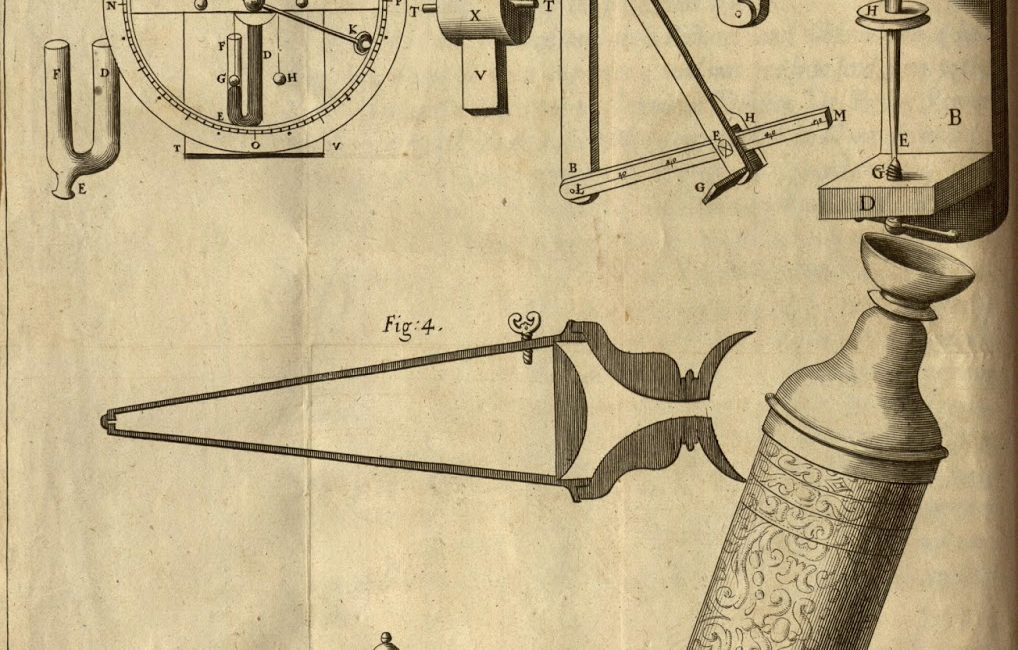
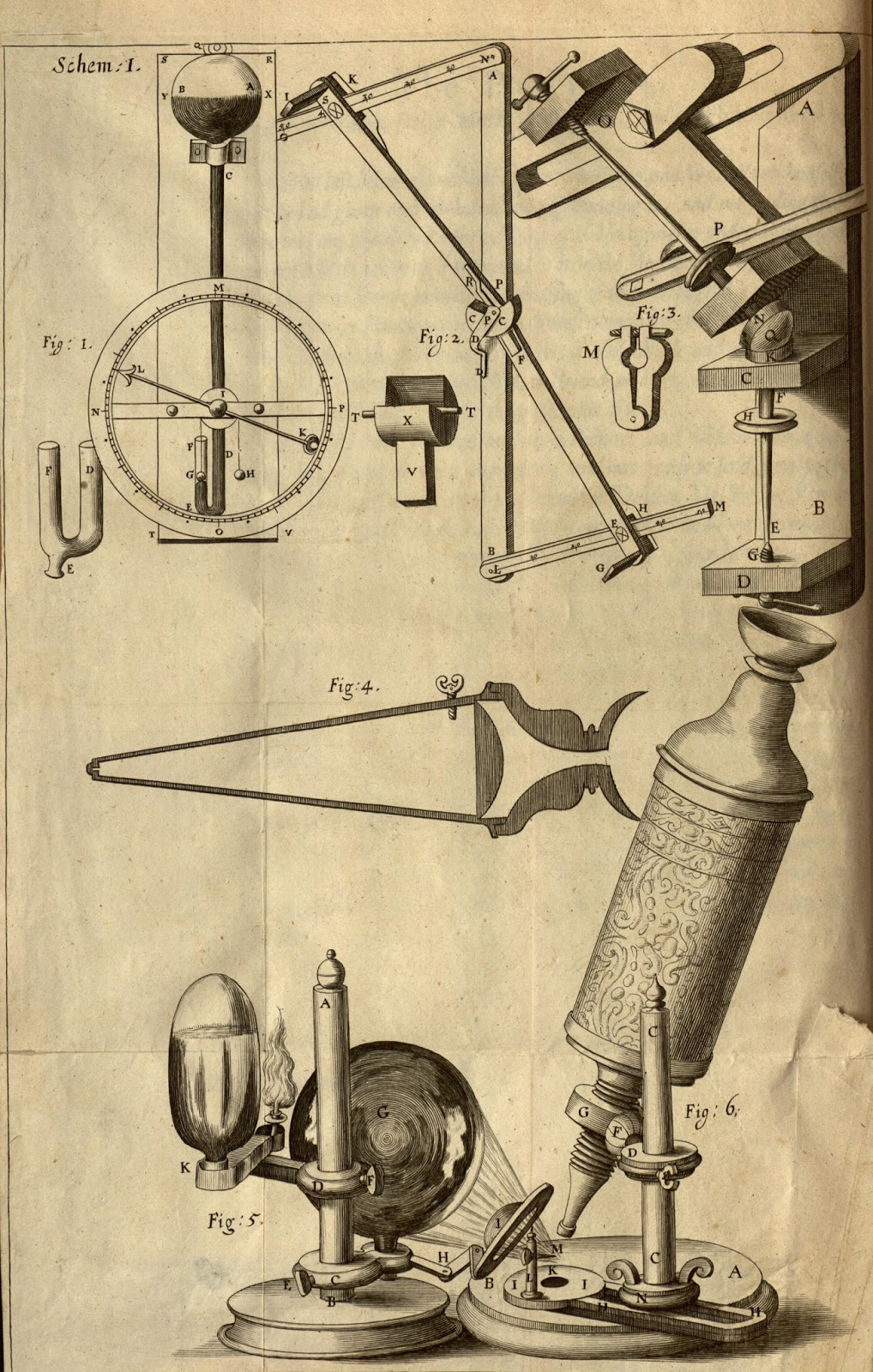
Robert Hooke’s microscope. Micrographia, 1665. http://biodiversitylibrary.org/page/786364. Digitized by: Missouri Botanical Garden.

One of his inventions was a novel compound microscope and illumination system, one of the best microscopes of the time. In 1665, Hooke published Micrographia, his masterpiece detailing his microscopic observations. It is the first book to illustrate plants and animals as seen through the microscope, and the stunning illustrations capture minute details such as the intricacies of a flea or the cells in cork tissue. In fact, Hooke coined the term “cells,” as the structures he saw in his microscope reminded him of the cells of a monastery.

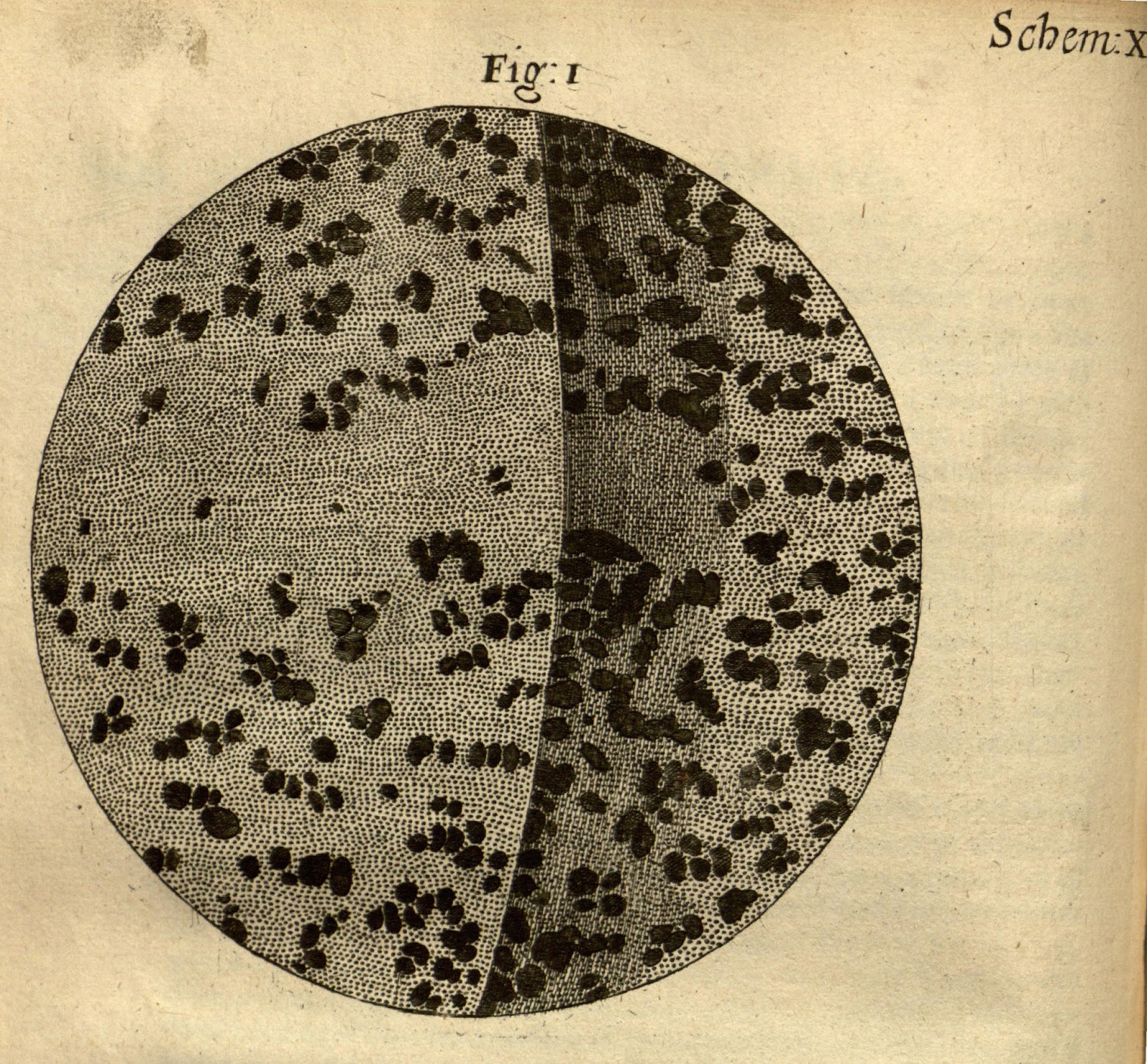
Hooke also examined fossils with his microscope, thus becoming the first recorded person to do so. Through his observations, he noticed striking similarities between petrified and living wood and fossil shells and living mollusk shells. Comparing petrified wood to a piece of rotten oak wood, Hooke realized that wood could be turned to stone when water deposited minerals throughout the wood. Similarly, his observations on shell-like fossils led him to conclude that shells could also be turned into fossils when they were “fill’d with some kind of Mud or Clay, or petrifying Water, or some other substance.”

View Full Size Image
A section of petrified wood. Micrographia, 1665. http://biodiversitylibrary.org/page/786478. Digitized by: Missouri Botanical Garden.

Throughout his life, Hooke continued to study fossils and compare them to living organisms. Recognizing that many fossils did not have living equivalents, he concluded that some represented species that no longer exist. If this was true, he deduced, it was likely that there are species alive today that did not exist in past ages.

Thus, nearly 200 years before Darwin, Hooke’s observations of fossils led him to assert that they are not only the remains of past-living organisms, but that they also document the history and changes of life on Earth.

Fossil Stories

Stay tuned all week for more great fossil fun with our #FossilStories campaign, including:
  • Tweets and Facebook Posts
  • Blog Posts highlighting milestones and key publications in the history of fossil research
  • A Flickr Collection with hundreds of historic fossil illustrations
  • A Pinterest Collection featuring a selection of our favorite fossil illustrations
  • A BHL Collection containing seminal publications in the history of paleontology
  • A series of live webcasts at BHL partner institutions
  • A citizen science challenge in collaboration with The Field Book Project, the Smithsonian Transcription Center, and Smithsonian Institution Archives
Follow #FossilStories on Twitter and Facebook to learn more.

Reference
UC Berkeley: Robert Hooke

October 13, 2015by michelle.underhill
Blog Reel, Campaigns, Featured Books, Fossil Stories

Challenge Focus: Lester F. Ward

Our Fossil Stories citizen science challenge – a challenge to fully transcribe three paleontologists’ field books from the Smithsonian collection – is complete! Volunteers have successfully transcribed and reviewed 252 pages from 9 field books in just 3.5 days! Thanks to all of our awesome volunteers for their monumental efforts! As a reward, we’ll be hosting a behind-the-scenes tour of Smithsonian fossil collections with Dr. Nicholas Pyenson, Curator of Fossil Marine Mammals at the Smithsonian’s National Museum of Natural History, on the BHL Periscope Account on October 26. Stay tuned on Twitter and Facebook to learn more. Follow #FossilStories all week to learn more about the paleontologists featured in the challenge and to get highlights from our #FossilFossick Challenge.

Or just read below to learn more about Lester F. Ward!

One of the field books in the challenge is from Lester Frank Ward. Ward (1841-1913) is probably best known as the “Father of American Sociology,” publishing pioneering works in the field. But before he was a sociologist, he was a geologist and paleontologist with the United States Geological Survey (USGS) from 1882 to 1905. Some of his field notes now reside at the Smithsonian Institution Archives as part of the Field Notebooks, 1881-1915 and undated collection (SIA Acc. 07-041).

View Full Size Image
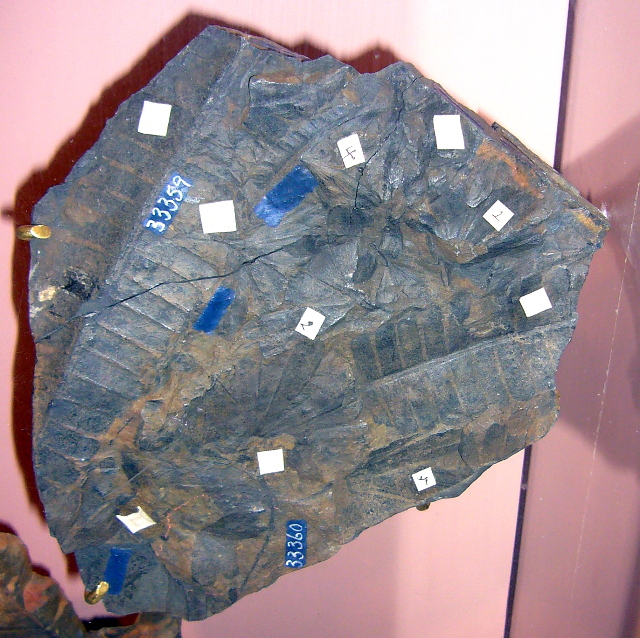
Pterophyllum and Ginkgo (USNM 33359 and 33360) on same slab, from Douglas county, Oregon. Collected by Lester Ward and James Storrs, in 1899. Courtesy of Department of Paleobiology, National Museum of Natural History.

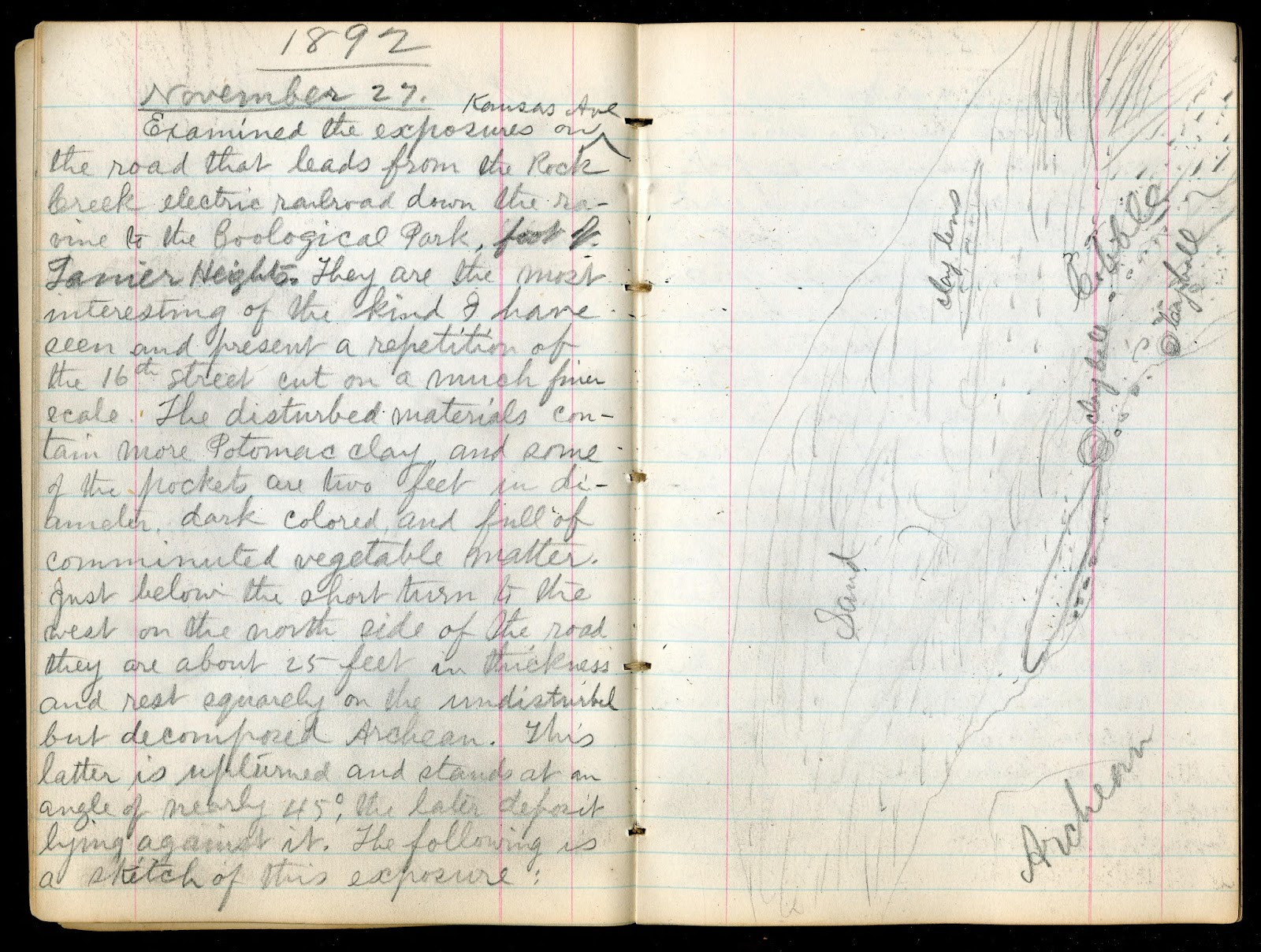
While working for the USGS, he collected living and fossilized examples of plants in the vicinity of the District of Columbia, even publishing a guide to the area’s flora. Examples of his botanical and paleobiological collecting can be seen on Smithsonian’s Collections Search Center. His field books tend to offer wonderfully detailed information about his time in the field. This is especially true in his DC field books, in which he describes conversations with individuals offering specimens as well as locality information that specifies street intersections or neighborhoods.

View Full Size Image
Page from Lester F. Ward field book. Local field note-book no. 2 of Lester F. Ward, October 16, 1892 to May 7, 1893. http://biodiversitylibrary.org/page/48485371. Smithsonian Institution Archives.

If you would like to know more about Lester F. Ward, we encourage you to check out his other field books on Collections Search Center, his publications and field book on BHL, and his personal papers at George Washington University.

Be sure to follow #FossilStories on Twitter and Facebook all week for more great fossil fun and more highlights from our #FossilFossick Challenge!

October 13, 2015by ulib-libraryjobs
Blog Reel, Campaigns, Featured Books, Fossil Stories

Early Innovations in Paleontology: Gessner and Fossils

Until the end of the 18th century, it was generally believed that species could not become extinct, and despite important scientific advances in the 16th and 17th centuries, it was widely held that since the dawn of life, no new animal or plant species had been created or lost.

Furthermore, until the 19th century, the word “fossil” referred to any object that had been dug up from the ground, including not only what we recognize today as organic remains, but also gemstones, minerals, and other inorganic materials.

View Full Size Image
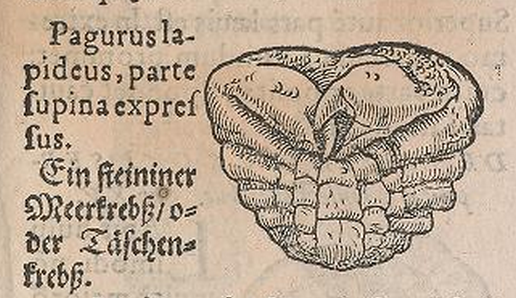
Fossil crab. Gessner, Conrad. De rerum fossilium, lapidum et gemmarum maximè, figuris & similitudinibus liber. 1565.  http://biodiversitylibrary.org/page/48518847. Digitized by: Smithsonian Libraries.

Finally, at the time of the 16th and 17th centuries, when the first books on “fossils” were being published, the living equivalent of many “fossil” species had not yet been discovered, making it extremely difficult to draw connections between fossil specimens and living organisms.

These three scenarios together created a daunting challenge for early naturalists trying to classify and understand fossils, and advances in each were required before true fossils could be widely identified as the remains of past life.

Conrad Gessner is one of the most influential naturalists in scientific history. Born in Zürich, Switzerland in 1516, his five-volume masterpiece Historiae animalium (1551–1558) is considered the beginning of modern zoology.

View Full Size Image
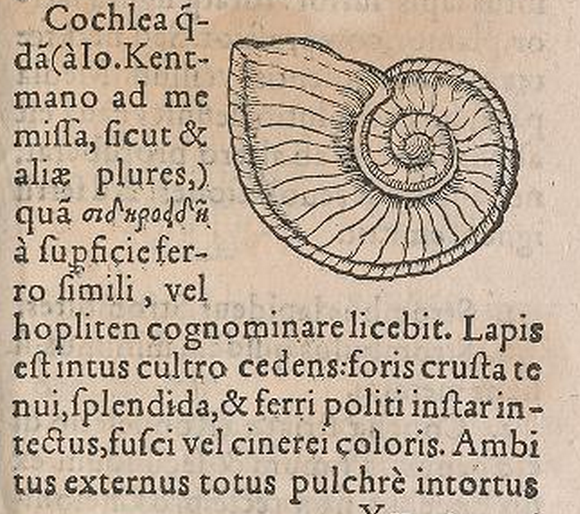
Woodcut illustration of an ammonite, which he placed in the same class as fossil shells.  Gessner, Conrad. De rerum fossilium, lapidum et gemmarum maximè, figuris & similitudinibus liber. 1565. http://biodiversitylibrary.org/page/48518841. Digitized by: Smithsonian Libraries.

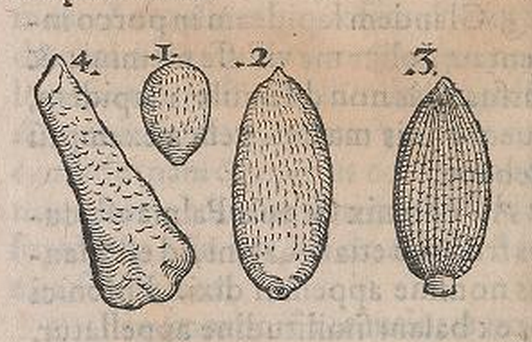
In 1565, Gessner published a short but incredibly important work entitled De rerum fossilium, lapidum et gemmarum maximè, figuris & similitudinibus liber or “A Book on Fossil Objects, Chiefly Stones and Gems, their Shapes and Appearances.” While he, like others of his time, included both organic remains and inorganic objects within his definition of fossils, he correctly recognized the resemblance of some fossils to living organisms. For instance, he recognized the similarity between several fossil echinoids and living sea-urchins, as well as a fossil and living crab. Other specimens, however, were more difficult to relate to living species. For instance, Gessner placed various fossil ammonites alongside gastropods and serpents, and the fossilized spines of cidariods he placed within his chapter on fossil wood.

View Full Size Image
Detached spines of cidaroids, which Gessner mistakenly placed in his fossil wood chapter, as he thought they resembled the fruit or acorn of a tree. Gessner, Conrad. De rerum fossilium, lapidum et gemmarum maximè, figuris & similitudinibus liber. 1565. http://biodiversitylibrary.org/page/48518770. Digitized by: Smithsonian Libraries.

In addition to correctly drawing correlations between several fossil objects and living species, On Fossil Objects represented three important innovations in the history of paleontology. First, it was the first publication in which illustrations were used systematically to supplement a text on fossils.

On Fossil Objects was also the first work on fossils that clearly refers to a distinct collection of fossil objects. The precursors to museum collections were beginning to be aggregated in university and private collections in the 15th and 16th centuries, and these collections were an important step towards ensuring that naturalists were referring to the same species as they could reference a distinct type specimen. On Fossil Objects references the “fossil objects” collection of physician Johann Kentmann of Torgau as the source of many of the objects described within the book, providing a concrete, verifiable point of reference for other naturalists.

View Full Size Image
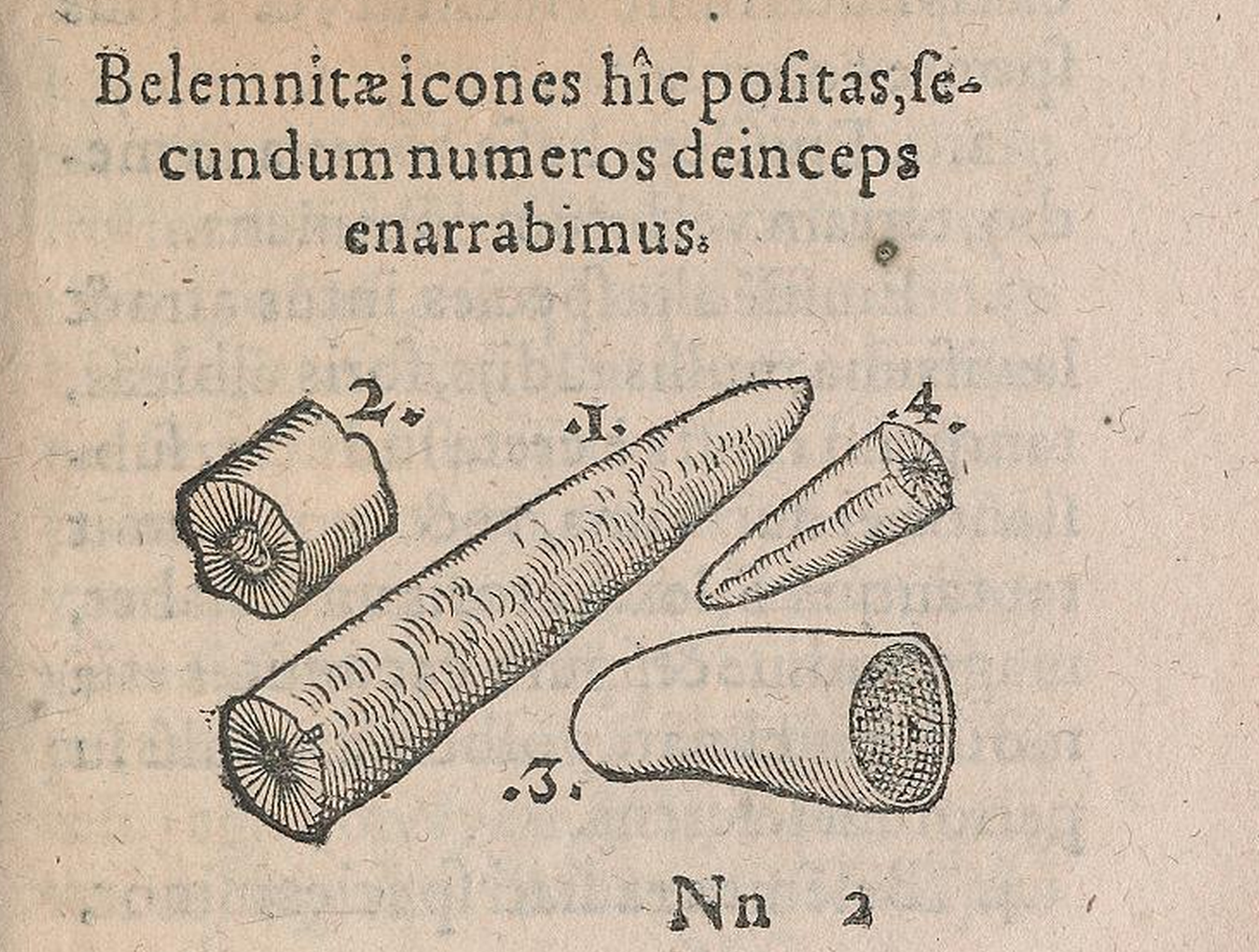
Fossil belemnites. Gessner knew of no comparable living animal. Gessner, Conrad. De rerum fossilium, lapidum et gemmarum maximè, figuris & similitudinibus liber. 1565. http://biodiversitylibrary.org/page/48518695. Digitized by: Smithsonian Libraries.

Finally, to support research for his book, Gessner corresponded with naturalists across Europe, and thus On Fossil Objects is also the first work on fossils to employ the use of a cooperative research community. This not only helped form the first scholarly paleontological community, but also ensured that a greater breadth of fossil objects could be represented within the book.

Gessner intended for On Fossil Objects to be merely a prelude to a much larger work on fossil objects akin to his Historiae animalium. Unfortunately, Gessner never had the opportunity to write his next masterpiece. He died of the plague in 1565, shortly after the publication of On Fossil Objects.

This innovative work on fossils, which helped shape the future of paleontology, was the last publication from one of history’s most influential naturalists.

Fossil Stories

Stay tuned all week for more great fossil fun with our #FossilStories campaign, including:
  • Tweets and Facebook Posts
  • Blog Posts highlighting milestones and key publications in the history of fossil research
  • A Flickr Collection with hundreds of historic fossil illustrations
  • A Pinterest Collection featuring a selection of our favorite fossil illustrations
  • A BHL Collection containing seminal publications in the history of paleontology
  • A series of live webcasts at BHL partner institutions
  • A citizen science challenge in collaboration with The Field Book Project, the Smithsonian Transcription Center, and Smithsonian Institution Archives
Follow #FossilStories on Twitter and Facebook to learn more.
October 13, 2015by ulib-libraryjobs
Page 3 of 4«1234»

Help Support BHL

BHL's existence depends on the financial support of its patrons. Help us keep this free resource alive!

search

About BHL

The Biodiversity Heritage Library (BHL) is the world’s largest open access digital library for biodiversity literature and archives. BHL operates as a worldwide consortium of natural history, botanical, research, and national libraries working together to digitize the natural history literature held in their collections and make it freely available for open access as part of a global “biodiversity community.”

Join Our Mailing List

Sign up to receive the latest news, content highlights, and promotions.

Subscribe Now

Subscribe to Blog via Email

Enter your email address to subscribe to this blog and receive notifications of new posts by email.

Join 319 other subscribers

Subscribe to Blog Via RSS

Subscribe to the blog RSS feed to stay up-to-date on all the latest BHL posts.

Access RSS Feed

Inspiring Discovery through Free Access to Biodiversity Knowledge.

The Biodiversity Heritage Library makes it easier than ever for you to access the information you need to study and explore life on Earth…for free, anytime, anywhere.


64+ Million Pages of
Biodiversity Literature Online.

EXPLORE

Tools and Services
to Transform Research.

EXPLORE

300,000+
Illustrations on Flickr.

EXPLORE

ABOUT | HARMFUL CONTENT | PRIVACY | SITE MAP | TERMS OF USE