Biodiversity Heritage Library - Program news and collection highlights from BHL
  • Home
  • News
  • Featured Books
    • All Featured Books
    • Book of the Month Series
    • BHL at 20
  • User Stories
  • Campaigns
    • Fossil Stories
    • Garden Stories
    • Monsters Are Real
    • Page Frights
    • Her Natural History
    • Earth Optimism 2020
  • Tech Blog
  • Visit BHL
Home
News
Featured Books
    All Featured Books
    Book of the Month Series
    BHL at 20
User Stories
Campaigns
    Fossil Stories
    Garden Stories
    Monsters Are Real
    Page Frights
    Her Natural History
    Earth Optimism 2020
Tech Blog
Visit BHL
  • Home
  • News
  • Featured Books
    • All Featured Books
    • Book of the Month Series
    • BHL at 20
  • User Stories
  • Campaigns
    • Fossil Stories
    • Garden Stories
    • Monsters Are Real
    • Page Frights
    • Her Natural History
    • Earth Optimism 2020
  • Tech Blog
  • Visit BHL
Biodiversity Heritage Library - Program news and collection highlights from BHL
Blog Reel, Featured Books

A Pot of Basil in Every Household

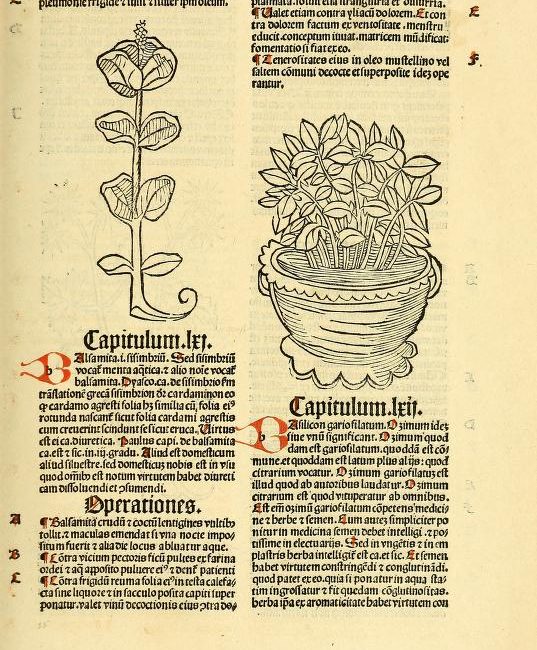
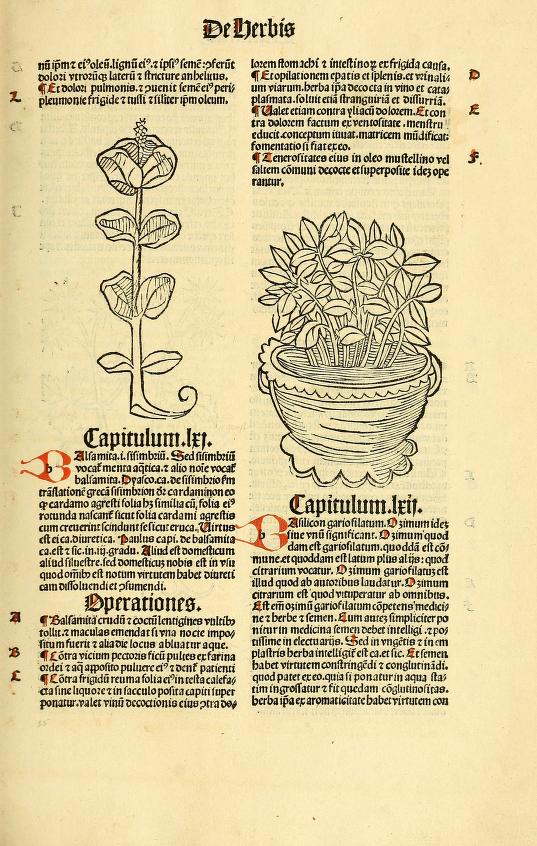
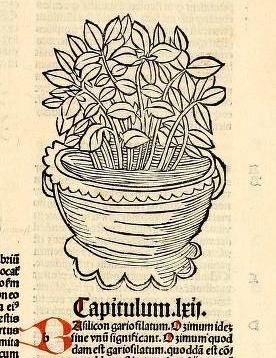
In Johann Prüss’ late 15th-century herbal, Ortus Sanitatis (Garden of Health), a bushy basil plant is portrayed growing in a decorative container. The book, a popular pharmacopoeia of various remedies drawn from ancient and medieval authors, was intended to be practical. The woodcuts are somewhat stylized and simple, meant to be easily identifiable to readers such as a doctor, apothecary, spice merchant, monk, or household member.

This was a manual for ready reference at a time when literacy was not common and earlier written descriptions alone were found to be inadequate. For instance, the all-important roots of the peony, used for infantile epileptic seizure, jaundice, stomach-aches, and kidney and bladder problems, are emphasized rather than its beautiful, fragrant blossoms.

At the time, basil was applied to a number of ailments, including convulsion, deafness, diarrhea and constipation, gout, impotency, colic, and nausea. So is it significant that basil was illustrated in a pot? Medieval and Renaissance art is full of plant symbolism. Or is this portrayal simply a charmingly unexpected domestic detail?
View Full Size Image
Ortus Sanitatis. 1497. Digitized by Smithsonian Libraries. http://www.biodiversitylibrary.org/page/40535862.
Medieval herbals ascribed healing or poisonous ‘virtues,’ the natural properties of plants. Basil is one plant of the garden full of associations, both good and bad, sometimes contradictory. And a pot of basil has a long and colorful history.

Sweet basil (Ocimum basilicum) is an herb of the mint family Lamiaceae. It is native to parts of Asia and Africa. The name may be derived from the Greek βασιλικόν φυτόν (basilikón phutón)—royal or kingly plant. While many culinary authors and cooks consider basil the “king of herbs” for its versatility and dominance in the kitchen (particularly in Italian, Thai, Vietnamese and Laotian cuisines), it long has had royal and religious associations. Ocimum sanctum(holy basil or tulasi) is sacred in the Hindu religion, though not used much in Indian dishes. In Christianity, the herb came to be associated with the Feast of the Cross, celebrating the finding by St. Helena, mother of Emperor Constantine, of the True Cross in a patch of basil.

Ancient Greeks believed basil must be sowed with words of abuse in order to thrive. In both Eastern and Western societies the herb has been associated with death. In ancient Egypt it was applied in embalming rituals. It is also an herb much connected with love and fertility rites, and has been seen as a source of erotic powers. Or, conversely, a sprig of basil would whither in the hands of the impure.

In late Medieval and Renaissance Italy, basil in a pot was a sexy thing: on a windowsill alerts a lover that the lady of the house is available to be entertained. Or, in some accounts, such as in the early 15th-century risqué tales of Sienese Gentile Sermini, its sudden removal was the signal it was safe to come on in. Apparently in some parts of present-day Southern Italy, a family notes the presence of an eligible, virginal daughter by a basil pot in the window.
View Full Size Image
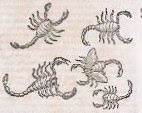
Scorpions. Woodcut from Conrad Gessner, Historia animalium. Liber 2, 1586 (BHL link here)
View Full Size Image
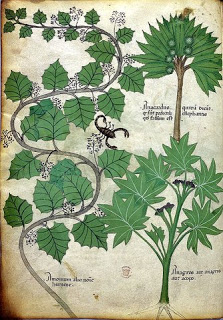
Plants and a Scorpion, in “Herbal” Manuscript folio 3v (Lombardy, Italy, around 1440). British Library Sloane 4016. This illustration indicates that a sting from a scorpion may be soothed by plants.

The Latin basiliskmeans dragon, mythical deadly reptile or serpent, sprouting legends of basil with scorpions. The arachnid with the venomous stinger was said to be bred out of mishandling the cultivated species of Ocimum. Scorpions were believed to favor hiding under a pot of basil, or that a spring of basil under a pot would turn into a scorpion. The Smithsonian’s Floyd W. Shockley, Collections Manager (and scorpion expert) in the Department of Entomology of the National Museum of Natural History, points out that the cool dark underside of the pot is a natural place for scorpions to rest, accounting for their presence and not a particular attraction to the basil.

In the pharmacopoeia on herbal medicine from the surviving writings of the ancient Greek physician and botanist Dioscorides, De Materia Medica, basil is prescribed for application to bites of the sea dragon or stings of the scorpion. Dr. Shockley notes there is some evidence that basil is effective in soothing scorpion stings and that the essential oil in the plant is anti-inflammatory and has pain-relieving enzymes. The plant would work to soothe the bites and stings of many arthropods, but ancient medicinal practitioners really focused on the scorpion relief aspect. Dioscorides observed that Africans would ingest the herb as a preventive measure against the pain of a sting. John Gerard in his famous 16th-century herbal repeated this belief but reported that, as did the 2nd-century physician Galen, basil should not be eaten.

Gerard in the Herball, or Generall Historie of Plantes of 1597, declared “The smell of Basil is good for the heart … it taketh away sorrowfulnesse which commeth of melancholy and maketh a man merry and glad.” Nicholas Culpeper in the 17th century wrote: “And away to Dr. Reason went I, who told me it was an herb of Mars, and under the scorpion, and, perhaps therefore called basilican, and it is no marvel if it carry a kind of virulent quality with it.” And, noting the differing portrayals of the plant: “This is the herb which all authors are together by the ears about and rail at one another (like lawyers).”
View Full Size Image
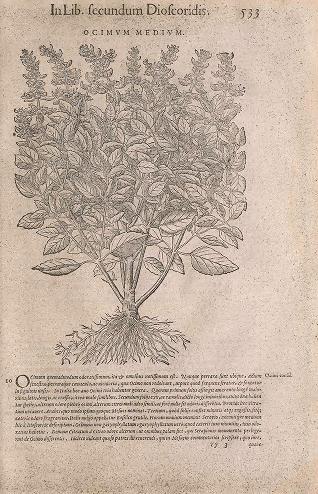
Illustration of one type of basil in the Smithsonian Libraries’ 1565 edition of Mattioli (BHL scan here)

Much of ancient plant folklore was dismissed by Pier Andrea Mattioli (1501-1577) in his commentaries on Dioscorides, Di Pedacio Dioscoride Anazarbeo Libri cinque Della historia, et materia medicinale. The work first appeared in 1544, with illustrations in the 1554 edition, and became the most influential Italian herbal of the 16th century.

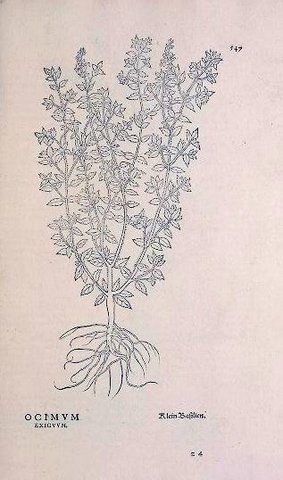
A medical doctor and botanist, born in Siena, the perennially grumpy Mattioli provides the delightful contemporary observation that basil was found to be growing in every Italian household, often in a pot placed by a window or in the garden. However, the finely cut illustrations in his herbal are without any whimsy such as a container. Likewise, Leonhart Fuchs’ splendid De Historia Stirpium (1542) notes this domestic element and illustrates different types of basil, including the roots, leaves, stems, and flowers. These publications are products of the Renaissance, knowledge drawn from direct observation and not legend, although much of the texts still rely on Dioscorides.
View Full Size Image
Fuchs: “Women everywhere raise Ocimun in clay pots on windowsills of their homes, also in gardens.” Smithsonian Libraries’ copy scanned by BHL (link here)
Fuchs wrote that ozimumis Greek for fragrant. Basil has highly aromatic leaves and placed in a pot would serve to sweeten the air. Royal apothecary and botanist John Parkinson in Paradisi is Sole Paradisus Terrestris(1629) wrote that basil was sometimes used in nosegays and made “sweet or washing waters.” (Boston Public Library copy). In the home, the herb acted to keep flies out. Basil is, of course, sensitive to cold temperatures and planted (in Northern Europe) in a container would allow for easy moving to a warm shelter.

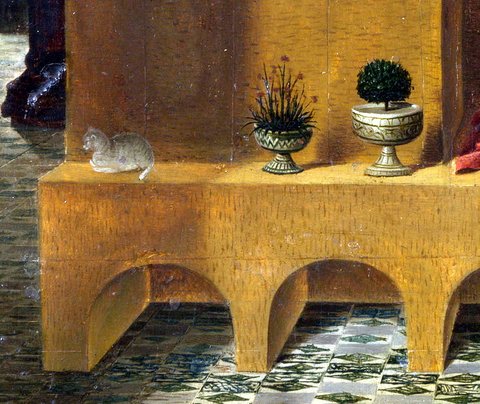
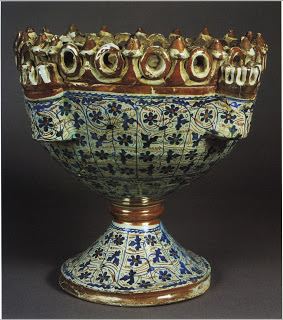
There are surviving examples of actual 15th-century basil pots, known as alfabeguer (derived from the Arabic word for sweet basil). These decorative containers were imported from Valencia, supplying a demand for this luxury item throughout Europe. In the Rothschild collection at Waddesdon Manor is a beautiful one, decorated in lustre and blue, dating from 1440 to 1470.
 

View Full Size Image
The Rothschild Alfabeguer (this and other illustrations of basil pots here).


View Full Size Image
Detail of Antonello da Messina’s “St. Jerome in his Study,” of alfabeguers (and kitten) approximately 1475 (National Gallery, London)
There is an earlier recording of basil pots used as decoration or furnishing in a home, and readers of Prüss’ herbals may have picked up on the allusion. In Giovanni Boccaccio’s The Decameron (Day IV, Novella 5) of approximately 1353, is the story of Lisabetta and Lorenzo. The lady’s three brothers murdered the lowly born Lorenzo to thwart the forbidden love between the servant and their sister. They buried the corpse in a location that came to her in a dream. Lisabetta dug up the grave, decapitated the head, and, returning home:
There she shut herself up in her room with the head, and kissed it a thousand times in every part, and wept long and bitterly over it, till she had bathed it in her tears. She then wrapped it in a piece of fine cloth, and set it in a large and beautiful pot of the sort in which marjoram or basil is planted, and covered it with earth, and therein planted some roots of the goodliest basil of Salerno, and drenched them only with her tears, or water perfumed with roses or orange-blossoms. And ‘twas her wont ever to sit beside this pot, and, all her soul one yearning, to pore upon it, as that which enshrined her Lorenzo, and when long time she had so done, she would bend over it, and weep a great while, until the basil was quite bathed in her tears.”

The basil thrived with this fertilization and watering, but the distraught Lisabetta did not: the evil brothers discovered poor Lorenzo’s head in the flowerpot and stole it away. She died from further grief.
View Full Size Image
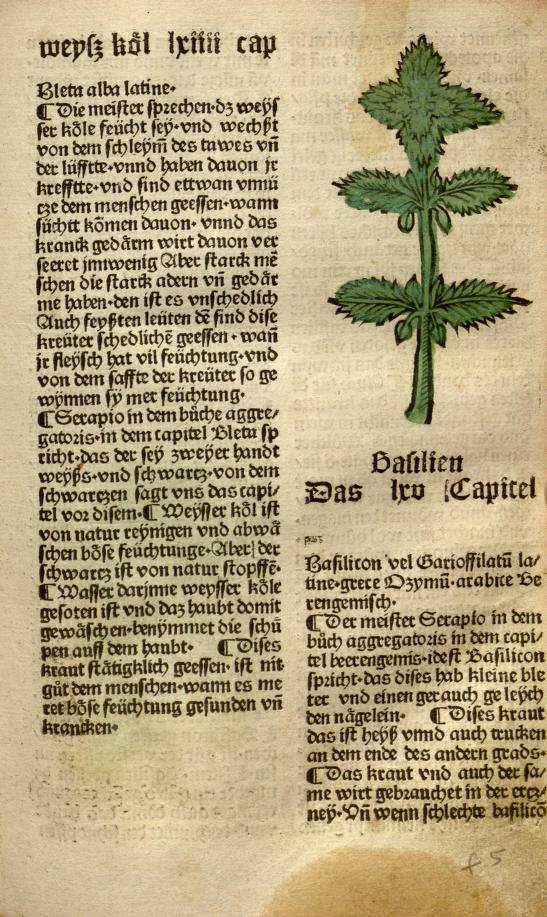
A more typical illustration of basil from an earlier period, showing the plant truncated. The Smithsonian Libraries‘ Gart der Gesundheit [Ulm?: Konrad Dinckmut?, 1487?], often attributed to Johannes von Cuba. The Missouri Botanical Garden’s copy has been scanned by BHL (link here).


A version of Peter Schöffer’s Ortus ([H]ortus) Sanitatis(1485) was published in 1491 by Jacob Meydenbach of Mainz. Some of the more than a thousand small illustrations were copied rather crudely from Der Gart der Gesundheit (also of 1485), which itself was based on the Latin Herbariusof 1484 (Missouri Botanical Garden copy in BHL). Although there is an occasional genre scene (such as laborers) and landscape setting sprinkled throughout these early printed herbals, most of the plants are simply shown cut off at the stem. The first of Prüss’ editions of Meydenbach’s Ortus Sanitatis, printed in Strasbourg in 1497, is the Smithsonian Libraries’ copy which has been scanned for the Biodiversity Heritage Library.
View Full Size Image

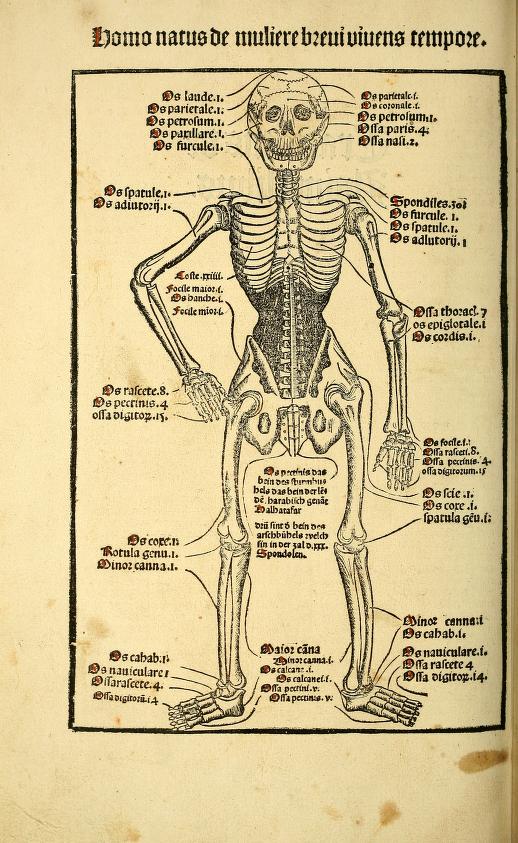
A pot of basil: may this be symbolic or practical, whether signifying divine or earthly love, used as a culinary ingredient or insect repellent, to soothe a sad soul, or just a convenient place to store a lover’s severed head. The iconography of the image in printed books, manuscripts and paintings is yet to be fully explored. The bibliography of early printed herbals—endless editions, translations, fragments, versions, and reuse and copying of woodcuts—is a complex and difficult task to sort out. But the increasing number of scanned early herbals in the Biodiversity Heritage Library allows for easy exploration of these extremely rare works. Perhaps Prüss’ Ortus Sanitatis has a unique basil pot because of an inventive author/illustrator. The book does contain a woodcut of the human skeleton, the first appearance of one in an herbal.

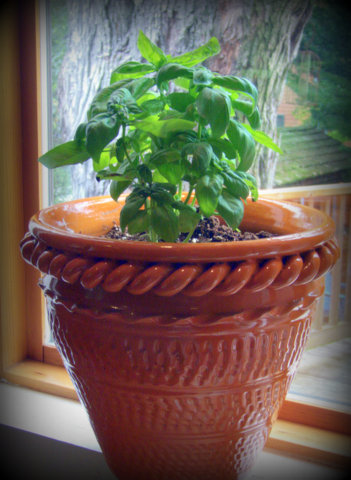
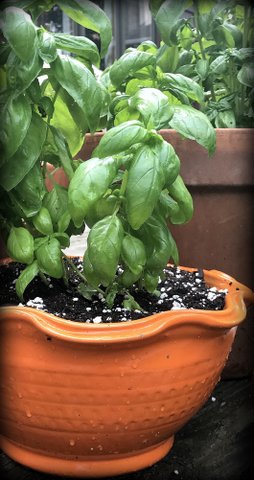
Should you happen upon any, please send me your finds of illustrations of basil in a pot. Or, a picture of the herb growing in a container on your windowsill.

View Full Size ImageView Full Size Image


View Full Size Image

Notes

View Full Size Image
What is old is new again: basil oil from the local grocery store.
The first printed herbal to have illustrations is Macer Floridus’ De Viribus Herbarum (Milan, 1482).
Di Pedacio Dioscoride Anazarbeo Libri cinque Della historia, et materia medicinale first appeared in 1544. It was soon reprinted many times in a variety of languages; there are several of these editions in the Smithsonian Libraries and many digitized versions in the Biodiversity Heritage Library (link to one here).
Blunt, Wilfrid and Sandra Raphael. The Illustrated Herbal. New York: Thames and Hudson, 1994.

Ray, Anthony. “The Rothschild ‘Alfabeguer’ and Other Fifteenth-Century Spanish Lustred ‘Basil-Pots’,” The Burlington Magazine, vol. 142, no. 1167 (June 2000), pages 371-375 (link here).

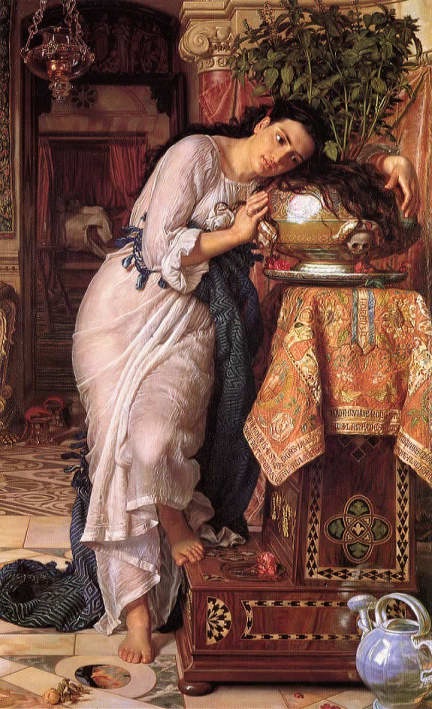
Poet John Keats picked up the narrative in “Isabella or, the Pot of Basil” (1818). In turn, British painters of the 19th century, most notably by the Pre-Raphaelite William Holman Hunt, were greatly inspired by the story.
View Full Size Image
Painting of 1867, by William Holman Hunt. Laing Art Gallery, Newcastle upon Tyne, England (image from Wikimedia Commons)


She wrapp’d it up; and for its tomb did choose
A garden-pot, wherein she laid it by,
And cover’d it with mould, and o’er it set
Sweet Basil, which her tears kept ever wet.
…
And so she ever fed it with thin tears,
Whence thick, and green, and beautiful it grew,
So that it smelt more balmy than its peers
Of Basil-tufts in Florence; for it drew
Nurture besides, and life, from human fears,
From the fast mouldering head there shut from view:
So that the jewel, safely casketed,
Came forth, and in perfumed leafits spread.
View Full Size Image
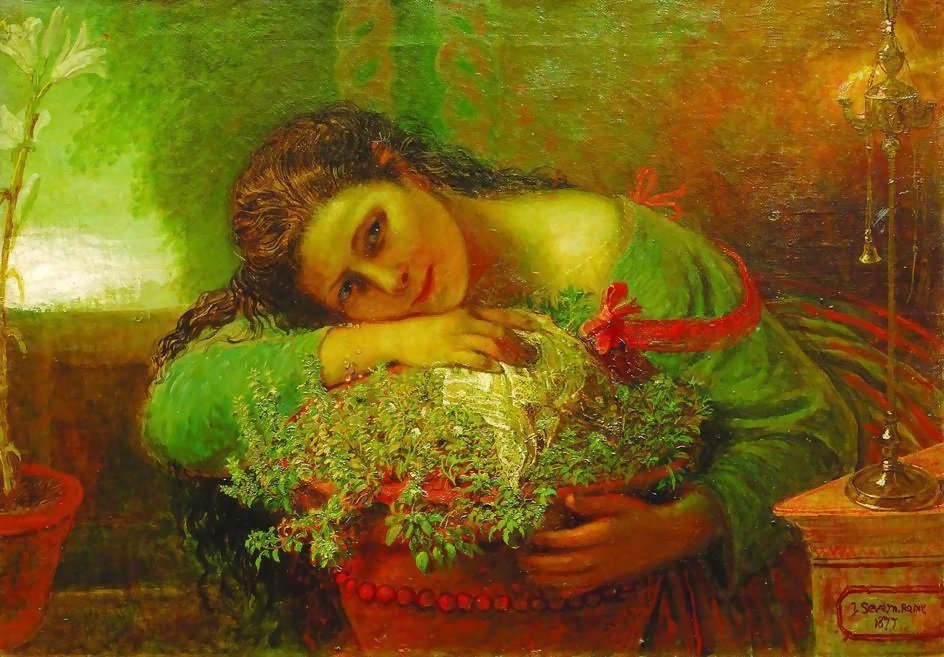
“Isabella, or the Pot of Basil,” painting by Joseph Severn (1793-1879), a close friend of Keats (image from Wikimedia Commons). Guildhall Art Gallery, London.
View Full Size Image
Ocimum basilicum ‘Genovese Verde Migliorato’. The only variety for proper pesto.


June 27, 2017by khage
BHL News, Blog Reel, Campaigns, Featured Books, Garden Stories

Garden Stories: A Celebration of Gardening

Friday, March 20, 2015, we celebrated the March equinox (and, incidentally, a total solar eclipse!), when the sun appears to cross the celestial equator heading northward. In the northern hemisphere, this is also known as the vernal equinox. For those in the southern hemisphere, it means that autumn is upon them, and cold days are ahead. But for those of us in the northern hemisphere, it means that Spring is officially here!

The coming of spring is therapeutic for many – a time for new life, a break from the grayness of winter, and a signal to get the trowels, shovels, and gardening gloves out. Many hopeful gardeners have poured over their fall and winter seed catalogs for months, fantasizing about the colorful Edens they will nurture come springtime.

But did you ever wonder about the history of the home garden, or even agriculture for that matter, and just when and how those beloved seed catalogs came about? What did gardens 100 years ago look like? What tools, fertilizer, and seed and plant varieties were available in the nineteenth, eighteenth, or even seventeenth centuries? When did recreational gardening come into its own, and who were the men and women who helped make it happen?

A Walk Down the Gardening Memory Lane

Though speculative due to lack of written records, many researchers believe that Neolithic agriculture began several thousand years ago with attempts by hunter-gatherers to manage nature for their benefit, eventually resulting in the “Domestication Revolution” with the emergence of propagation, whereby ancient civilizations began distributing, dividing, and planting seeds and tubers [1].

For many millennia, most agriculture was undertaken strictly as a means to produce food to feed families and local populations or grow herbs for medicinal purposes. The flames of change began to ignite in Europe in the seventeenth century, however, with the Enlightenment and the Scientific Revolution, which resulted in an increased desire to understand the natural world and apply scientific methods to study it. Scientific advances in turn nurtured an agricultural revolution in the eighteenth and nineteenth centuries, whereby farmers applied new techniques to produce more crops across increased land areas, resulting in more food security and leisure time[1].

View Full Size Image
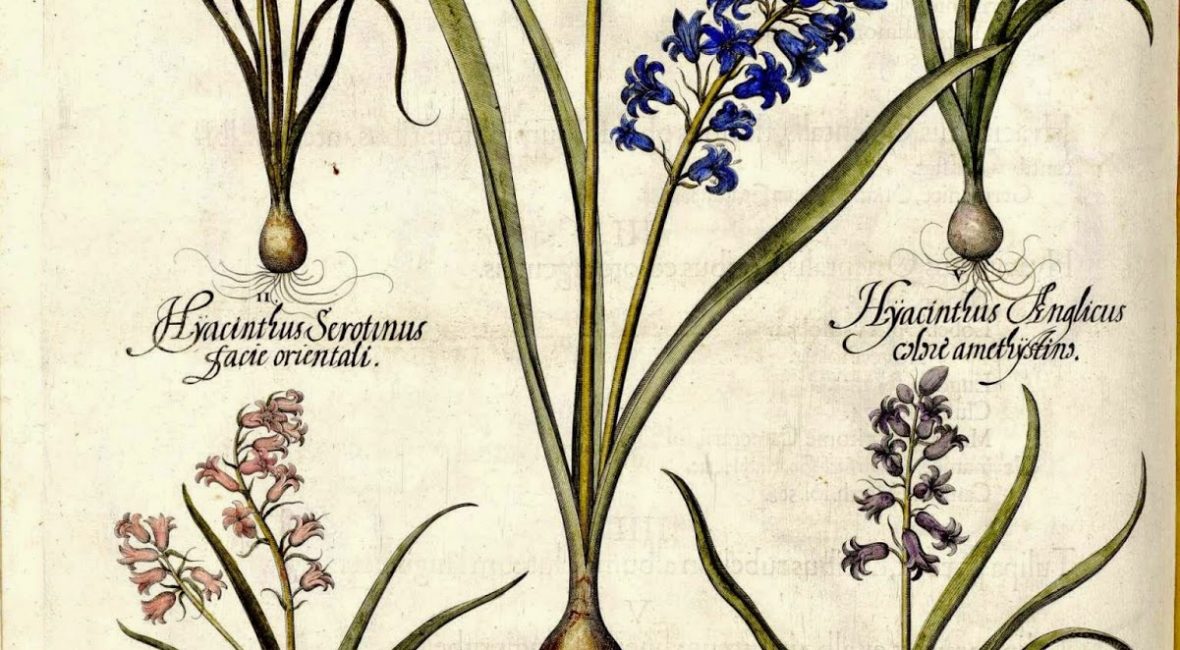
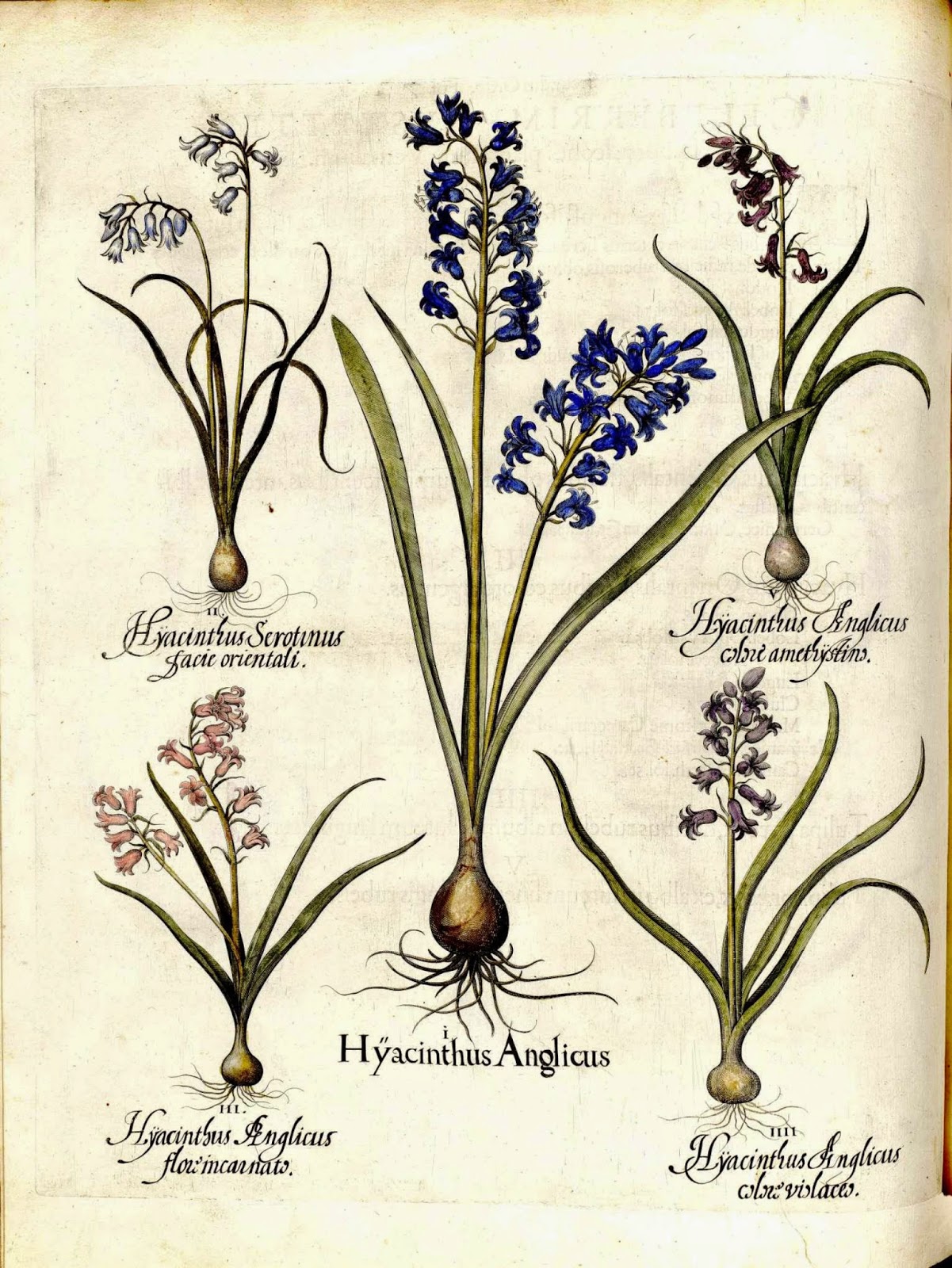
Flowers in the Willibaldsburg fortress castle garden in Eichstatt, Germany. The book Hortus Eystettensis, commissioned by Prince-Bishop Johann Conrad von Gemmingen, illustrates the plants gathered together in the castle gardens. The garden and this book represent the first time in Western history that plants were being collected and celebrated not for their use but for their beauty and inherent interest. Hortus Eystettensis (1613). Volume One and Volume Two digitized by Biblioteca Digital del Real Jardin Botanico de Madrid.

The rise of capitalism and growing populations fueled the development of commercial agriculture, and farmers (especially gentry farmers) started sharing and publishing their knowledge and botanical gardens began cataloging their seeds and producing seed lists (which included many plant species new to science), articulating the seeds housed at the garden available for international exchange with other institutions. As a result, agriculture not only became more prominent, but citizens (particularly those in urban environments) began nurturing home gardens as leisure activities.

As commercialism increased and imperial expansion enabled the introduction of new plant species from expanded locales, a bustling seed trade developed, first in Europe and Western Asia in the seventeenth and eighteenth centuries but quickly strengthening in America following the Revolution. American nurseries emerged as early as the seventeenth century, and David Landreth founded the first seed house in America in 1784 in Philadelphia.

View Full Size Image
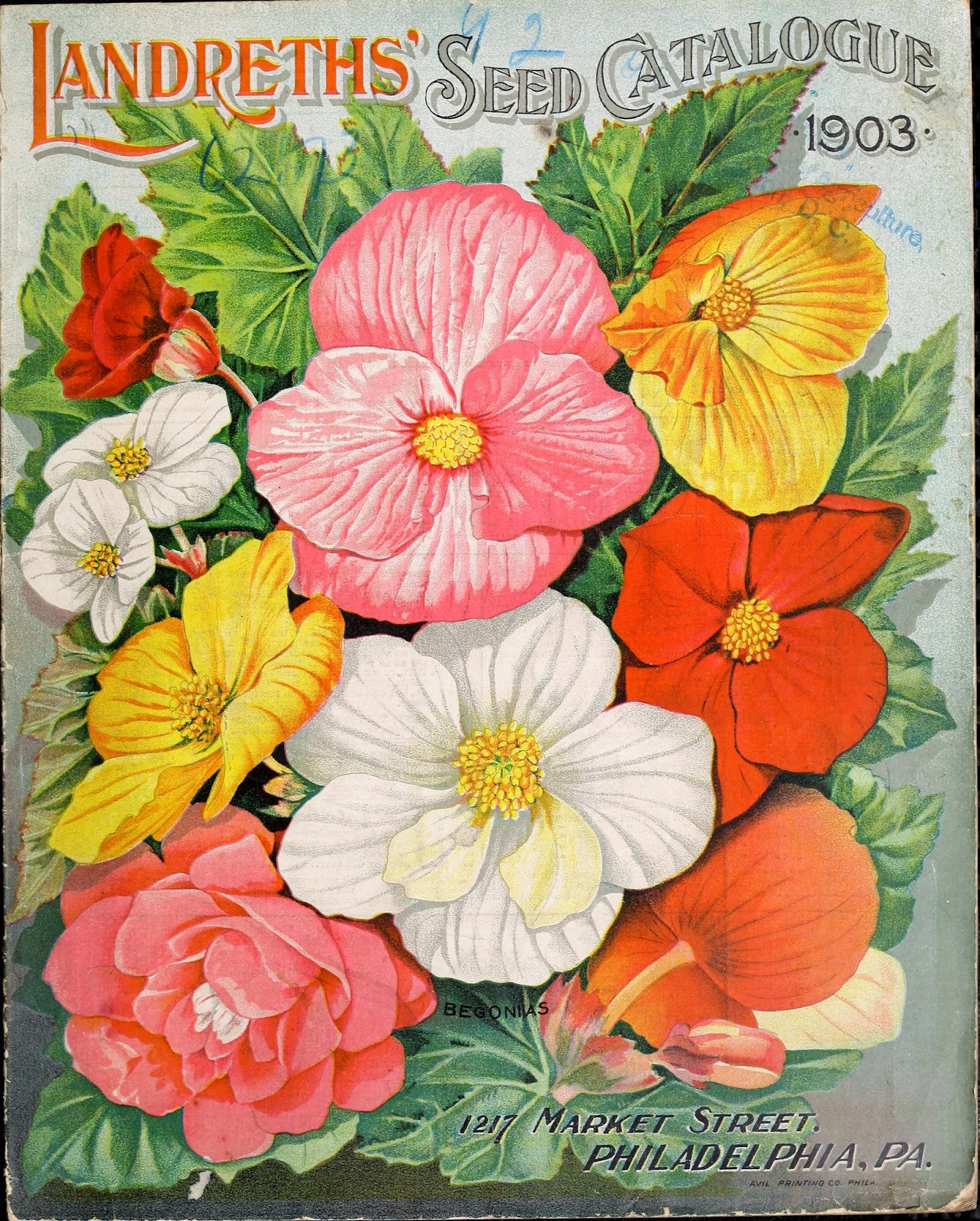
David Landreth founded the oldest seed house in the U.S. in 1784 in Philadelphia. Landreth’s Seed Catalog: 1903. http://biodiversitylibrary.org/page/46368234. Digitized by the USDA National Agricultural Library.

Rise of the Seed and Nursery Catalog

One of the most important innovations in the seed industry was the seed catalog, which offered a list of seeds and bulbs, and later garden tools and supplies like fertilizer and insecticides, for sale from the issuing company.

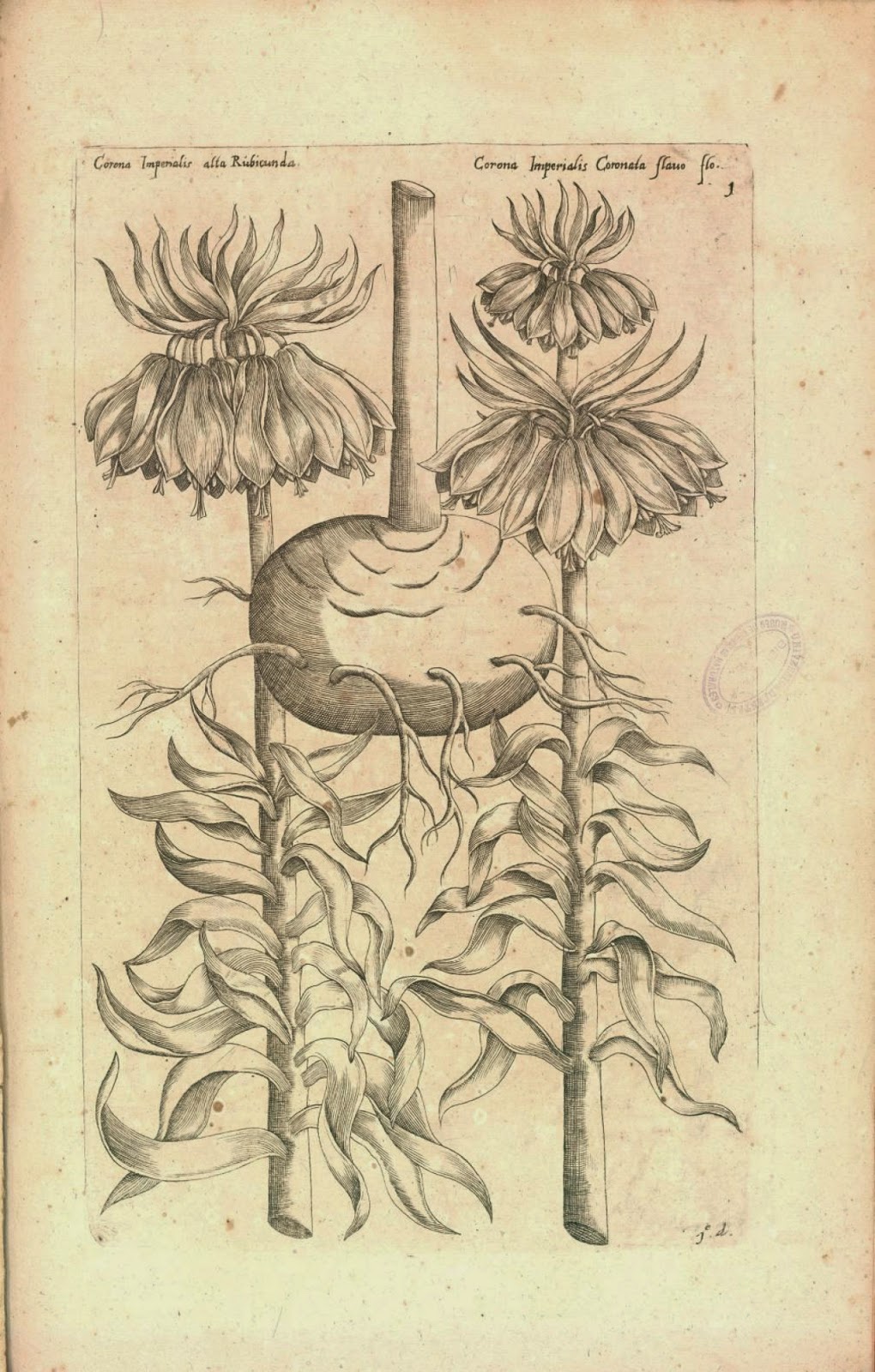
In the late 1500s, kings and wealthy aristocrats began having their exotic plant collections cataloged within elaborately-illustrated books called florilegia. Emanuel Sweerts‘ 1612 Florilegium, rather than being simply a catalog of his collection, presented a list of plants he could offer for sale, making it the oldest-surviving European plant catalog [2].

View Full Size Image
Fritillaria imperialis in Sweerts’ 1647 Florilegium amplissimum et selectissimum. http://biodiversitylibrary.org/bibliography/75687. Digitized by Biblioteca Digital del Real Jardin Botanico de Madrid.

In 1688, the first nursery catalog was published in Europe [3]. Early catalogs were simply listings of seeds or plants for sale, often articulated by Latin names and frequently in broadside form, lacking ornamentation, illustrations, or even prices. One of America’s first nursery catalogs was a broadside published in 1783 by John Bartram Jr [4]. Early nineteenth century seed advertising also consisted of short notices of seeds and tools for sale in gardening publications, very much in the newspaper “classifieds” style [5].

View Full Size Image
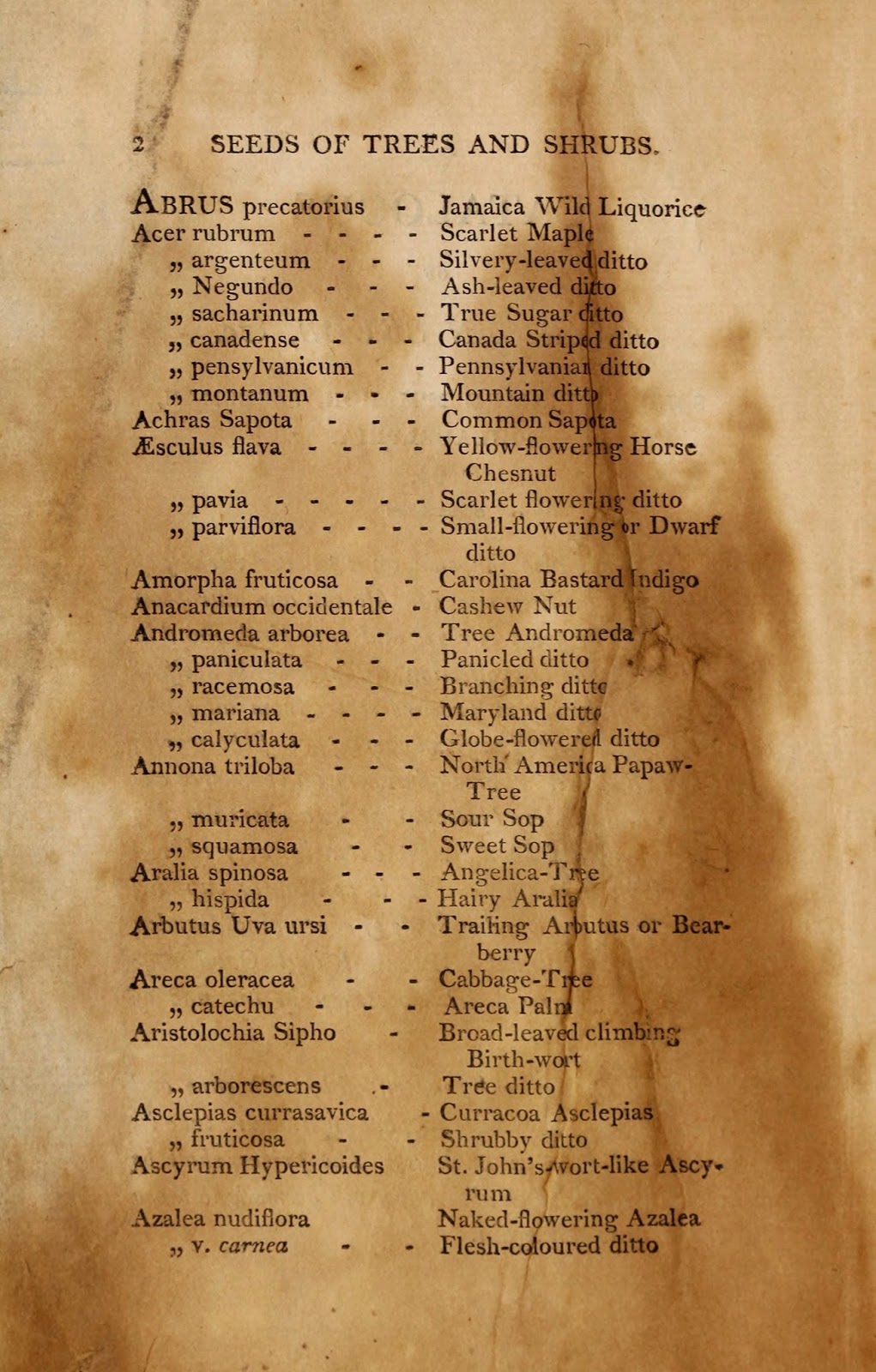
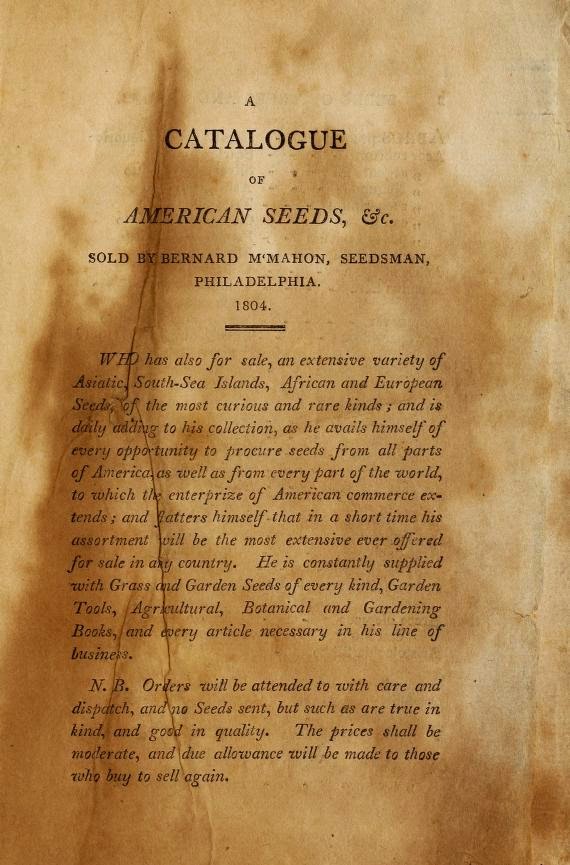
Tree and shrubs seeds offered for sale in the first American seed catalog in booklet form. M’Mahon, Bernard. A Catalog of American Seeds. 1804. http://biodiversitylibrary.org/page/44425432. Digitized by the USDA National Agricultural Library.

In 1804, the first American seed catalog in booklet form was published by Bernard M’Mahon, and by the 1820s in America, simple illustrations appeared in select catalogs [6]. Throughout the nineteenth century, horticultural manuals became increasingly popular, with growing instructions expanding to inclusion in catalogs as the industry bloomed, with the Shakers being early adopters of such practices  (incidentally, the Shakers were also the first to popularize the use of seed packets) [7]. The seed catalog became an increasingly important component of the seed business in the middle of the nineteenth century. Nurseries began publishing regular annual catalogs in the 1840s, which were mailed, often at great expense, to various segments of a merchant’s customer base. Expanding transportation networks, the growth of the US Postal Service, and a new Post Office classification system in 1863 assigning low rates to instructive periodicals and seeds, allowed the seed industry to flourish at an unprecedented scale through the mail order phenomenon. The mail order gardening business first centered on fruits and vegetables but grew to include flowers and especially ornamentals towards the last quarter of the nineteenth century [8].

View Full Size Image
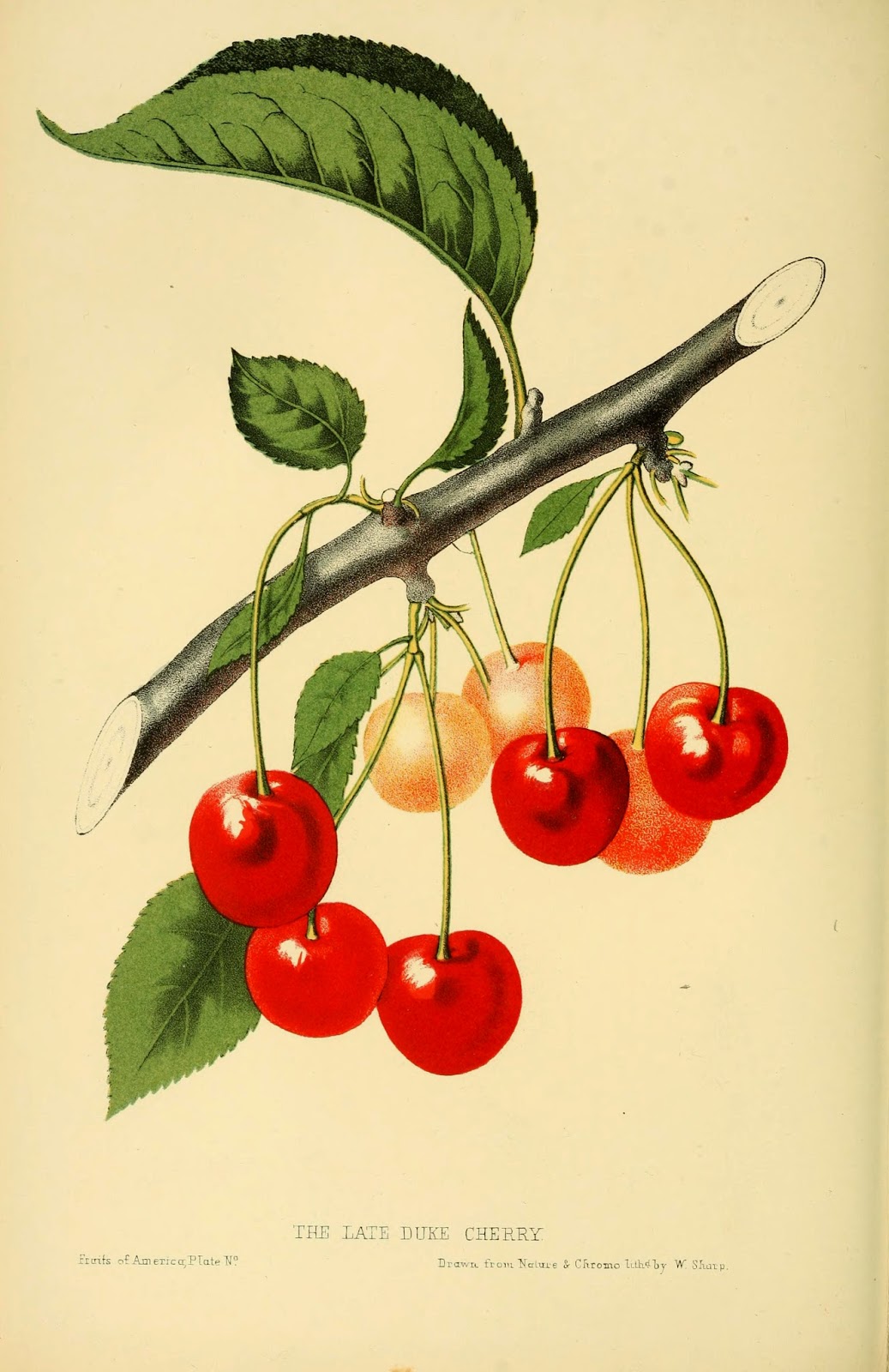
The Fruits of America (1848-56) by Charles Hovey is the first major American book with exclusively chromolithographed plates. http://biodiversitylibrary.org/page/20359525.

Printing innovations in the mid-nineteenth century transformed seed catalogs into beautiful marketing tools that stimulated customer appetites with visual representations of an advertised-seed’s potential. The multi-colored printing process of chromolithography was patented by Franco-German lithographer Gottfried Engelmann in 1837 [9] and introduced to the U.S. by William Sharp in 1841. By 1851, the first major American book with exclusively chromolithographed plates, The Fruits of America by nurseryman Charles Hovey, was published [10]. By the 1860s, chromolithography appeared in seed catalogs, thanks in large part to innovative nurseryman James Vick. Benjamin K. Bliss, however, is credited by horticultural historian Ulysses P. Hedrick as the first to introduce color to the catalog in the US in 1853. According to Elizabeth S. Eustis in “The Horticultural Enterprise: Markets, Mail, and Media in Nineteenth Century America,” Bliss’ 1867 “autumn catalog featured the earliest example so far discovered of chromolithography as the color process in a horticultural catalog” [11]. By 1890, commercial use of photographs in magazines and newspapers began, with, according to Ernest Morrison in J. Horace McFarland: A Thorn for Beauty, J. Horace McFarland being the first to use halftone images in horticultural publications [12].

View Full Size Image
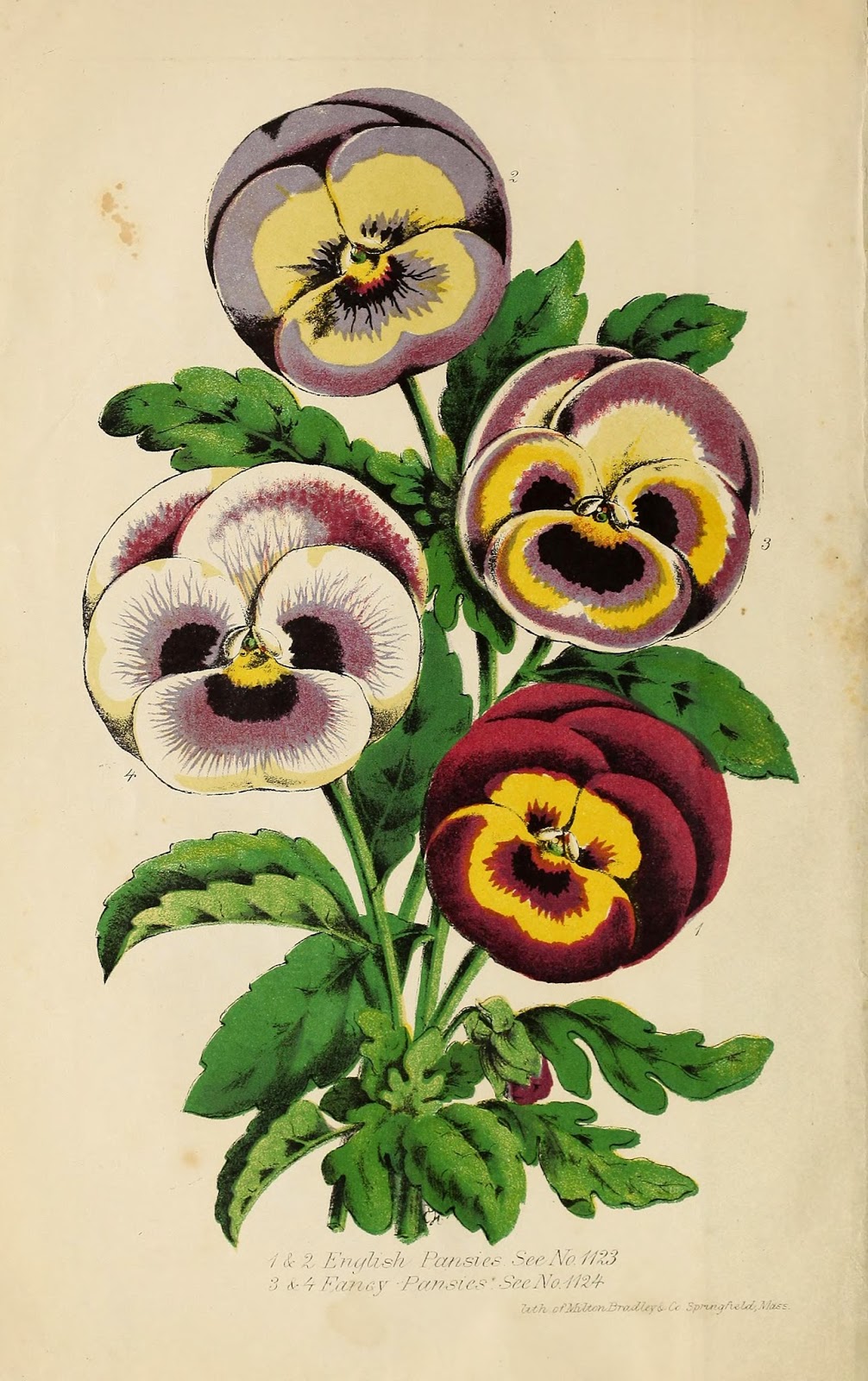
B.K.Bliss is credited as the first to introduce color to the seed catalog in 1853. B.K. Bliss and Son’s illustrated spring catalogue and amateur’s guide to the flower and kitchen garden. 1870. http://biodiversitylibrary.org/page/44492905. Digitized by the USDA National Agricultural Library.

Increased competition and growing costumer demands for novelties led to the popularity of hybrids (offspring produced by breeding two genetically distinct plants) in the nineteenth century, with certain varieties offered only through certain companies and beautifully portrayed in seed catalogs [13]. By the end of the nineteenth century, women had also entered the seed and flower business, including Carrie H. Lippincott, who established the first seed company in the U.S. to be founded and managed by a woman [14].

View Full Size Image
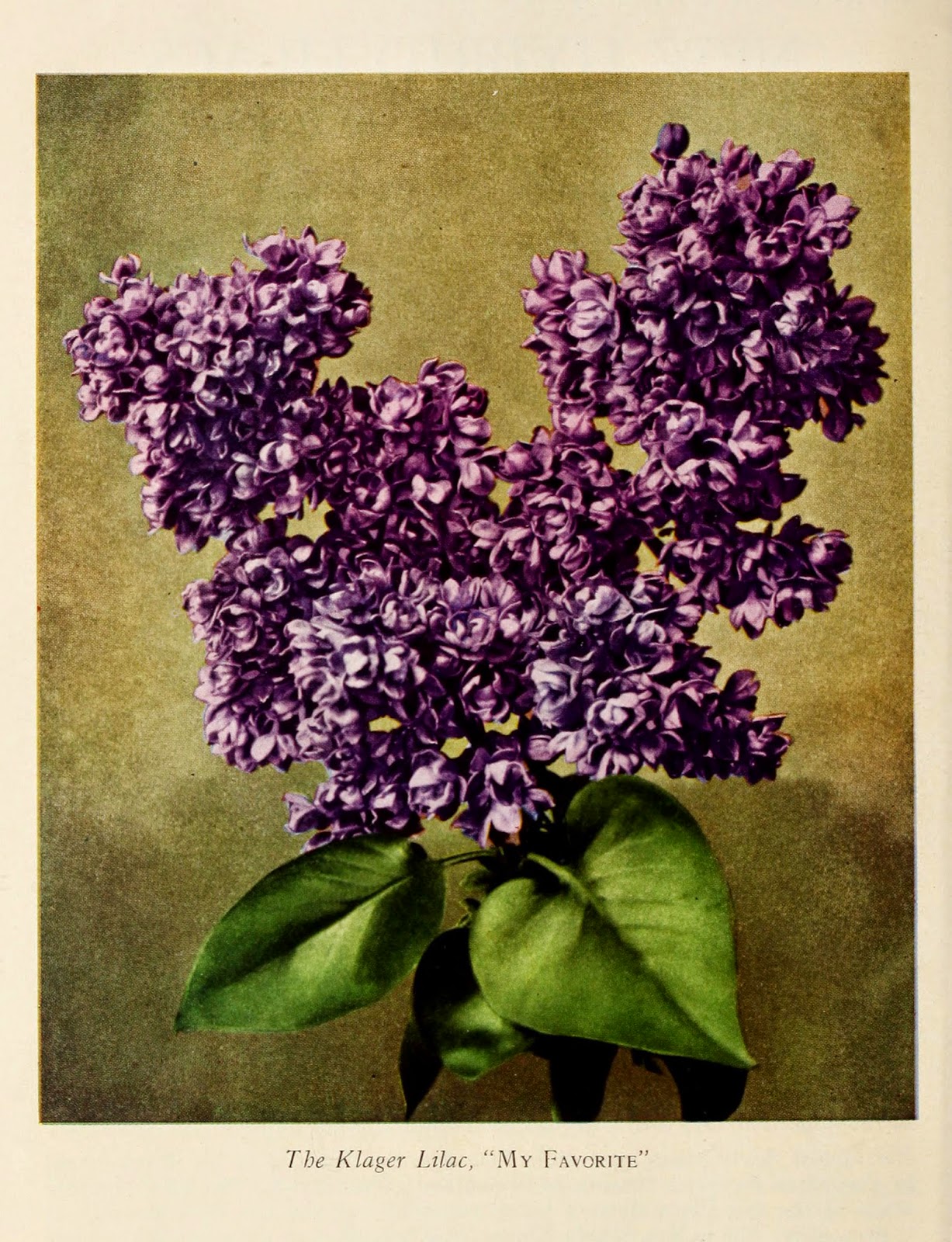
Hybrid Lilac, The Klager Lilac. Cooley’s Gardens. 1931 fall catalogue of new hybrid lilacs and Japanese irises. http://biodiversitylibrary.org/page/44394461. Digitized by the USDA National Agricultural Library.

Seed Catalogs: More than Horticultural Novelties

While they stimulate our gardening imagination, help us trace the development of the seed industry, and offer insight into the plant varieties offered to consumers throughout the centuries, seed catalogs are also important reflections of social and cultural values over time, changing agricultural and printing technologies, evolution of garden fashion and landscape design, and the development of botanical science. For instance:

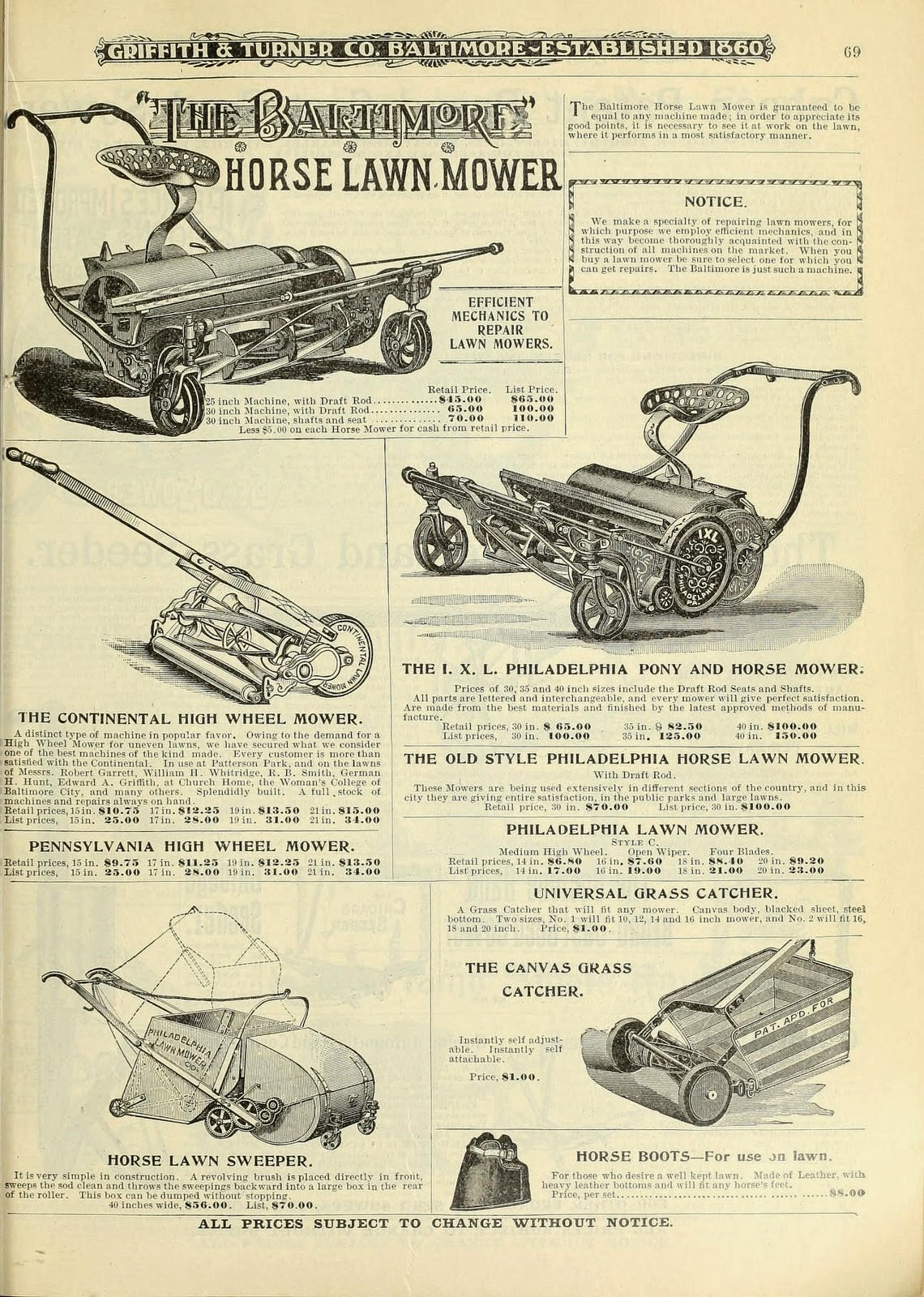
  • Seed catalogs show changes in gardening technology and tools over time. This 1906 catalog lists 29 tools for sale. By the 1860s, catalogs listed dozens of specialty tools for specific tasks, like grass shears, wooding shears, ladies shears, and hedge shears. This 1900 catalog proudly displays “Iron Age” garden and farm implements. The lawnmower, first invented by Edwin Budding in England in 1830, began being popularly manufactured starting in the 1860s, and in 1902 Ransomes produced the first gasoline-powered lawnmower. By 1900 various models were selling for between $6-$100 retail.
View Full Size Image
Various lawnmower models for sale in 1900. Farm and garden supplies : Griffith and Turner Co. http://biodiversitylibrary.org/page/43837949. Digitized by the USDA National Agricultural Library.
  • Pest control is a major business today. Seed catalogs help us trace the development and introduction of pesticides and fungicides. Compare the offerings from 1881, 1893, 1907, and 1934, for example.
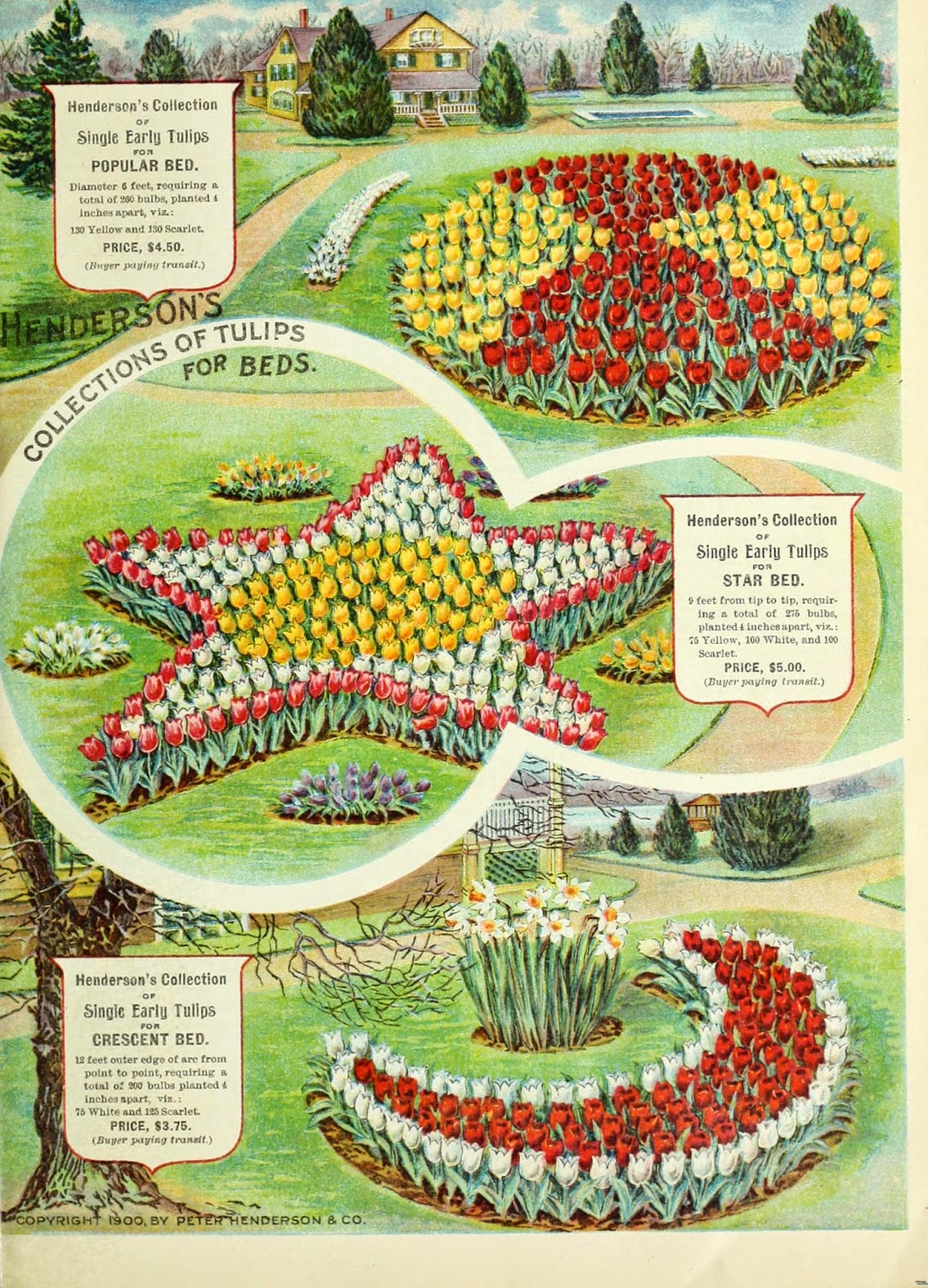
  • Seed catalogs help us trace changes in garden plant popularity and landscape design over time. For instance, from 1865-1900, “bedding out,” which involved laying out patterns on the ground and filling them in with colorful plants, was all the rage. After the turn of the 20th century, bedding out was replaced by cottage gardening, which uses informal design and traditional materials. Check out the awesome tulip bed patterns in this 1900 catalog.
View Full Size Image
“Bedding Out” Garden Style. Peter Henderson and Co. Autumn bulbs catalogue : 1900. http://biodiversitylibrary.org/page/43899723. Digitized by the USDA National Agricultural Library.

Garden Stories: A Week Long Event for Garden Lovers

All this week, we’ll be exploring the fascinating world of gardening, including garden history topics such as the development of hybrids, heirloom gardening, women in the seed industry, revolutions in garden marketing through art, and the vital role the Shakers played in the American seed industry. Follow our blog for more great stories! We’ll also be sharing great gardening tips and plant factoids with help from our BHL members and affiliates. And we’ll be using the over 14,000 seed and nursery catalogs in BHL to help tell these stories. Join in all the gardening fun by:

  • Following our blog and #BHLinbloom on Twitter and Facebook (or go directly to BHL’s Twitter and Facebook) this week.
  • Browsing over 2,500 seed and nursery catalog images in our Flickr collection.
  • Exploring select seed catalog art, and stunning bookmarks and postcards developed by Cornell Library, on Pinterest.
  • Seeing garden history come to life on the Smithsonian Libraries’ Tumblr.
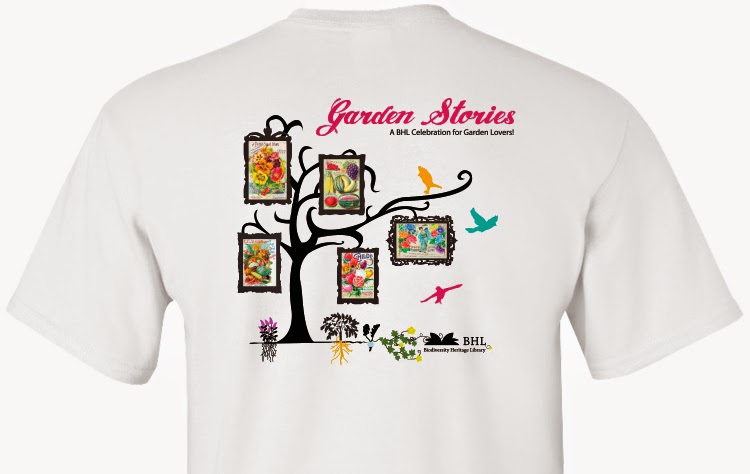
  • Purchasing your very own Garden Stories T-Shirt through T-Fund. All proceeds will go to help us digitize more pages for BHL. Our goal is to sell enough shirts to digitized 5,000 pages. Can you help us get there?
View Full Size Image
Garden Stories T-Shirt available through TFund.

More Great Gardening Resources from our Partners

Can’t get enough gardening fun? Explore these great resources from our partners:

  • Cornell University Library Mail Order Gardens Exhibit
  • Cornell University Gardening Guide
  • Missouri Botanical Garden Help for the Home Gardener
  • Natural History Museum, Los Angeles County Nature Garden
  • The New York Botanical Garden Seed Catalog LibGuides 
  • The New York Botanical Garden Plant Information and Gardening Guide
  • Royal Botanic Gardens, Kew, Nursery Catalogs and Seed Lists
  • Smithsonian Libraries Seed and Nursery Catalogs Exhibit
  • Spring Gardening Checklist via Smithsonian Gardens
  • USDA National Agricultural Library Seed and Nursery Catalog Collection
  • USDA The People’s Garden Video and Webinar Gardening Resources
  • Find more online gardening resources, tips, and help on the BHL Gardening Resources Page.


References

  1. Kingsbury, Noel. Hybrid. Chicago: University of Chicago Press, 2009, 1-36. Print.
  2. The Seed and Nursery Catalog in Europe and the U.S. “Earliest European Seed and Nurseru Catalogs.” Oregon State University Libraries. Web. February 2015. http://scarc.library.oregonstate.edu/omeka/exhibits/show/seed/earliest/earliest-european/.
  3. Kingsbury, Noel. Hybrid. Chicago: University of Chicago Press, 2009, 75. Print.
  4. Christopher, Thomas. “Heirloom Seed Catalogs.” Horticulture. Dec.(1985): 25. Print.
  5. Kraft, Ken and Pat Kraft. “Seeds for Sale.” Country Living Gardener. 1.1(1993): 30. Print.
  6. Fraser, Susan M. and Vanessa Bezemer Sellers. Flora Illustrata. New York: New York Botanical Garden, 2014, 235. Print.
  7. Ibid., 236
  8. Ibid., 249
  9. Ferry, Kathryn. “Printing the Alhambra: Owen Jones and Chromolithography.” Architectural History. 46(2003): 175–188.
  10. Fraser, Susan M. and Vanessa Bezemer Sellers. Flora Illustrata. New York: New York Botanical Garden, 2014, 239. Print.
  11. Ibid., 251
  12. Morrison, Ernest. J. Horace McFarland: A Thorn for Beauty. Harrisburg, PA: Pennsylvania Historical and Museum Commission, 1995. Print.
  13. Kingsbury, Noel. Hybrid. Chicago: University of Chicago Press, 2009, 139. Print.
  14. American Garden History. “Who was the mysterious feminist seed dealer and marketing genius Miss Carrie H. Lippincott?” Barbara Wells Sarudy, 2010-13. Web. February 2015. http://americangardenhistory.blogspot.com/2014/07/who-was-mysterious-feminist-seed-dealer.html.
March 23, 2015by michelle.underhill
Blog Reel, Campaigns, Featured Books, Garden Stories

Shaping Early American Gardening: Bernard M’Mahon

Our Garden Stories campaign is just under a week away! We’re excited to share fantastic gardening information, history, art, and tips with you March 23-27, 2015. And don’t forget our TwitterChat this Friday, March 20, from 1-2pm EST! If you have gardening questions, send them our way with the hashtag #BHLinbloom. Don’t miss out!

View Full Size Image

We thought we’d give you a taste of the fascinating history and stories you can expect next week by featuring a post on one of the individuals that helped shape the gardening industry in America: Bernard M’Mahon. It is written by Robin Everly, Botany and Horticultural Librarian at the Smithsonian Libraries and one of the experts that will be on hand to answer your gardening questions during our TwitterChat this Friday!

Bernard M’Mahon (spelled M’Mahon or McMahon) shaped American gardening during its formative years in early 19th century. Although M’Mahon left his mark by creating a successful seed and nursery business and writing an early popular horticultural book specific to American plants, accurate biographical information on him is sketchy. Born in Ireland, he came to America between 1796-1798 for political reasons. Like many immigrant stories, Ireland’s loss was the United States’ gain. Botanist William Darlington recalled meeting him in Dilworthtown, Chester County, “In autumn, I think, of 1799”, where many Philadelphians went to escape an outbreak of yellow fever. Although it is speculated he had extensive training in gardening while in Ireland, M’Mahon first worked in the printing business for William Duane and the newspaper, the Aurora, beginning in 1800. However, a few years later, he began working in the seed and nursery business, collecting and exporting seeds of America’s wild plants to Europe. At the time, native plants from America were all the rage for European gardeners.

View Full Size Image
M’Mahon, Bernard. A Catalogue of American Seeds. 1804. http://biodiversitylibrary.org/page/44425433.

He is credited with publishing the first American seed catalog in booklet form in 1804. It is actually more a seed list than what we think of as a seed catalog today. It simply lists plants in alphabetical order under major categories such as “trees and shrubs” and “herbaceous plants.” For each plant the scientific and common name is given. No illustrations were included. Printing and publishing in the United States was still very new at this time. Many publishers still sent their works to England to be published and shipped back to the states. Philadelphia, with sixty paper mills located nearby, was a popular area for papermaking and printing during this period of time.

View Full Size Image
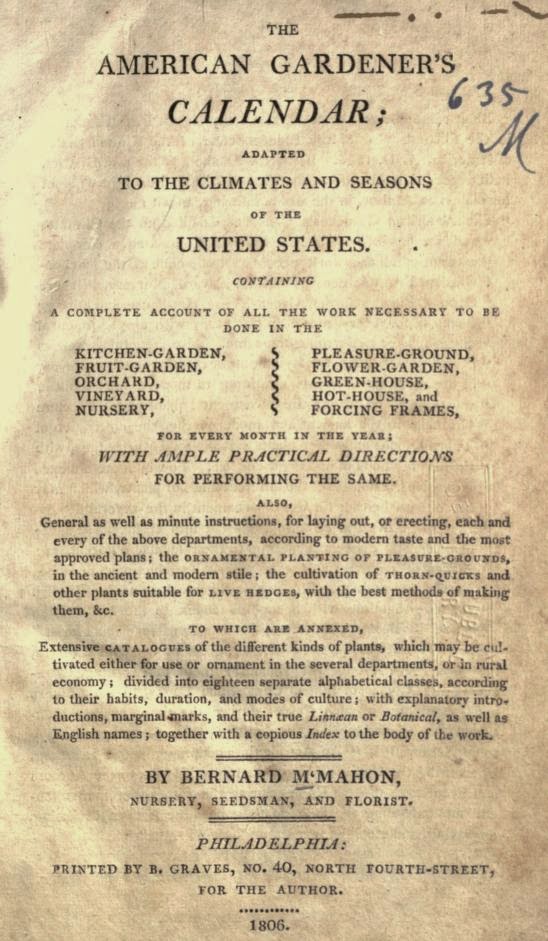
M’Mahon, Bernard. The American Gardener’s Calendar. 1806.  http://biodiversitylibrary.org/page/20142803.


In 1806, while operating his business, he published The American gardener’s calendar; adapted to the climates and seasons of the United States. Liberty Hyde Bailey, in his Cyclopedia of American Horticulture referenced it with: “He gave America its first great horticultural book.” In a sense, it became what we would call a bestseller. The book was popular for 50 years and went through 11 editions, the last published in 1857, long after M’Mahon’s death in 1818.

View Full Size Image
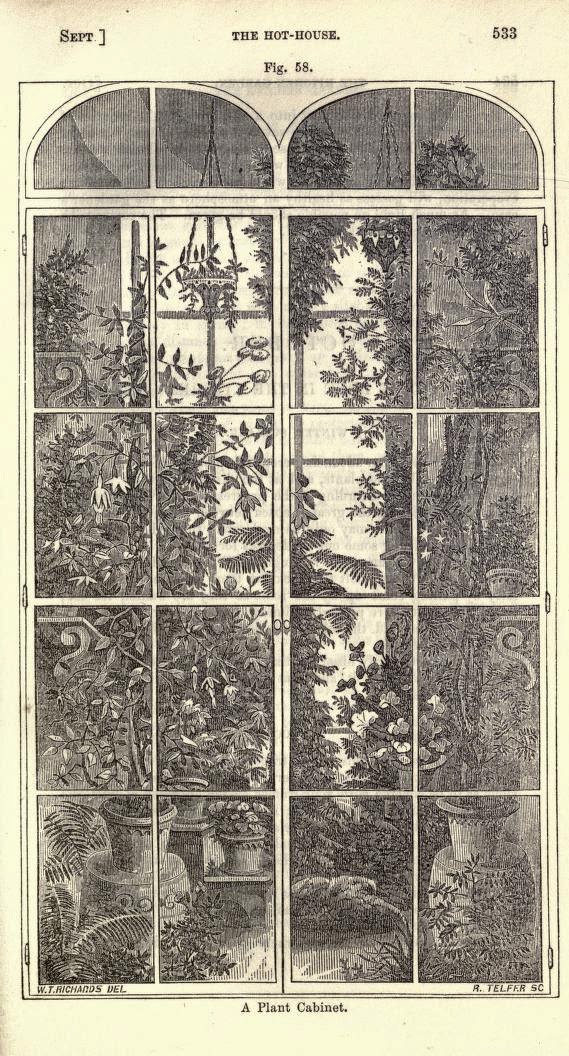
A Plant Cabinet, or Hot-House. M’Mahon, Bernard. The American Gardener’s Calendar. 11th Ed. 1857. http://biodiversitylibrary.org/page/20141911.

It was through The American gardener’s calendar that President Thomas Jefferson became acquainted and befriended M’Mahon. Jefferson found the book useful for his gardening and growing food at Monticello. M’Mahon and Jefferson began an exchange of books and seeds that went on for several years. Jefferson asked M’Mahon, along with fellow Philadelphia gardener, William Hamilton, to receive and propagate seeds and roots from plants collected on the Lewis and Clark Expedition, also known as the Corps of Discovery, in 1804 to 1806.

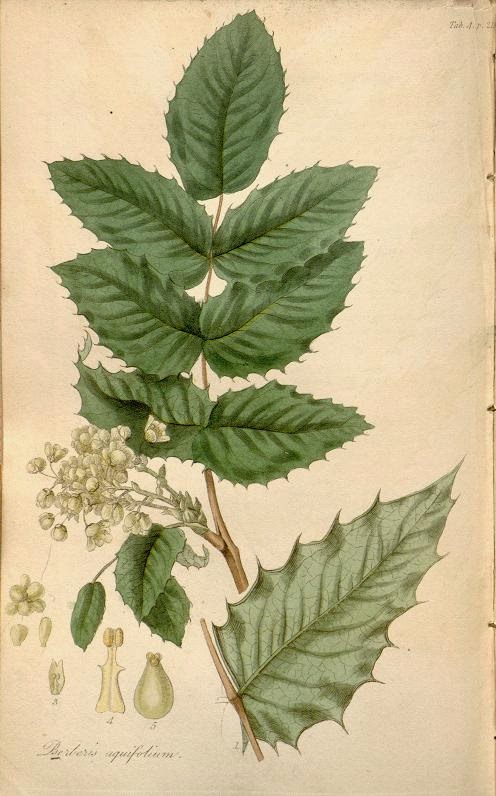
M’Mahon was a friend to many botanists; for example, Thomas Nuttall named a genus of evergreen shrubs discovered in the western U.S. during the Lewis and Clark expedition to honor him. While the name Mahonia is still used frequently in horticulture to identify these shrubs; scientifically, the Oregon grape holly or mountain holly (Berberis aquifolium) is now in the genus Berberis.

View Full Size Image
Berberis aquifolium. Pursh, Frederick. Flora Americae Septentrionalis. v. 1 (1814). http://biodiversitylibrary.org/page/396637.

In the 11th edition of The American gardener’s calendar, Jay J. Smith, who handled the revision, wrote a very personal memoir dedicated to M’Mahon which includes a tribute letter by Darlington. It is one of the few personal recollections I came across for such an important person in American gardening. M’Mahon’s publications can be found online through the BHL website.

Be sure to check out our Garden Stories event next week, March 23-27, and our TwitterChat this Friday, March 20, at 1-2pm EST. Happy gardening!

March 17, 2015by Grace Costantino
BHL News, Blog Reel, Campaigns, Garden Stories

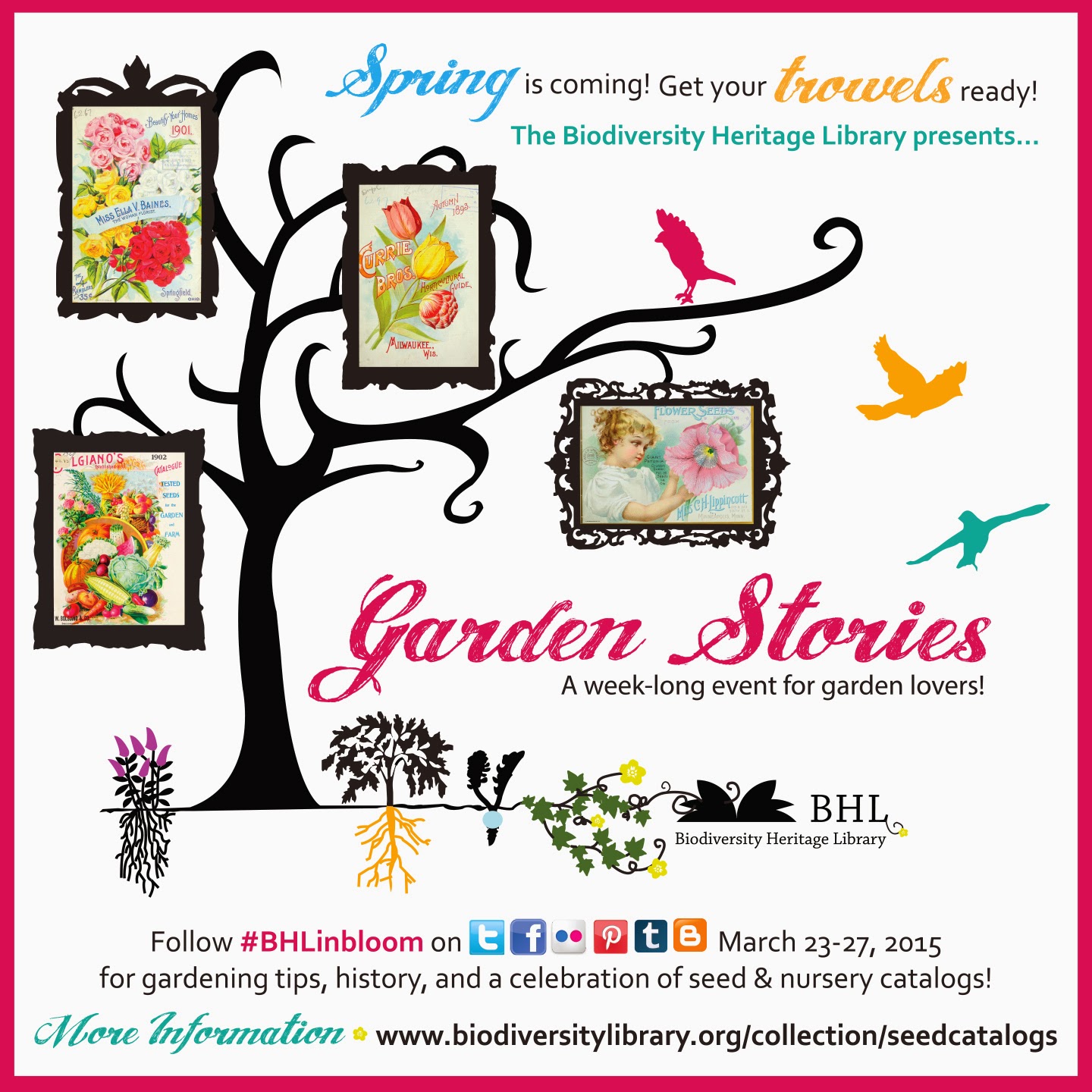
Announcing Garden Stories: A Week Long Event for Garden Lovers

Spring is coming! Get your trowels ready!

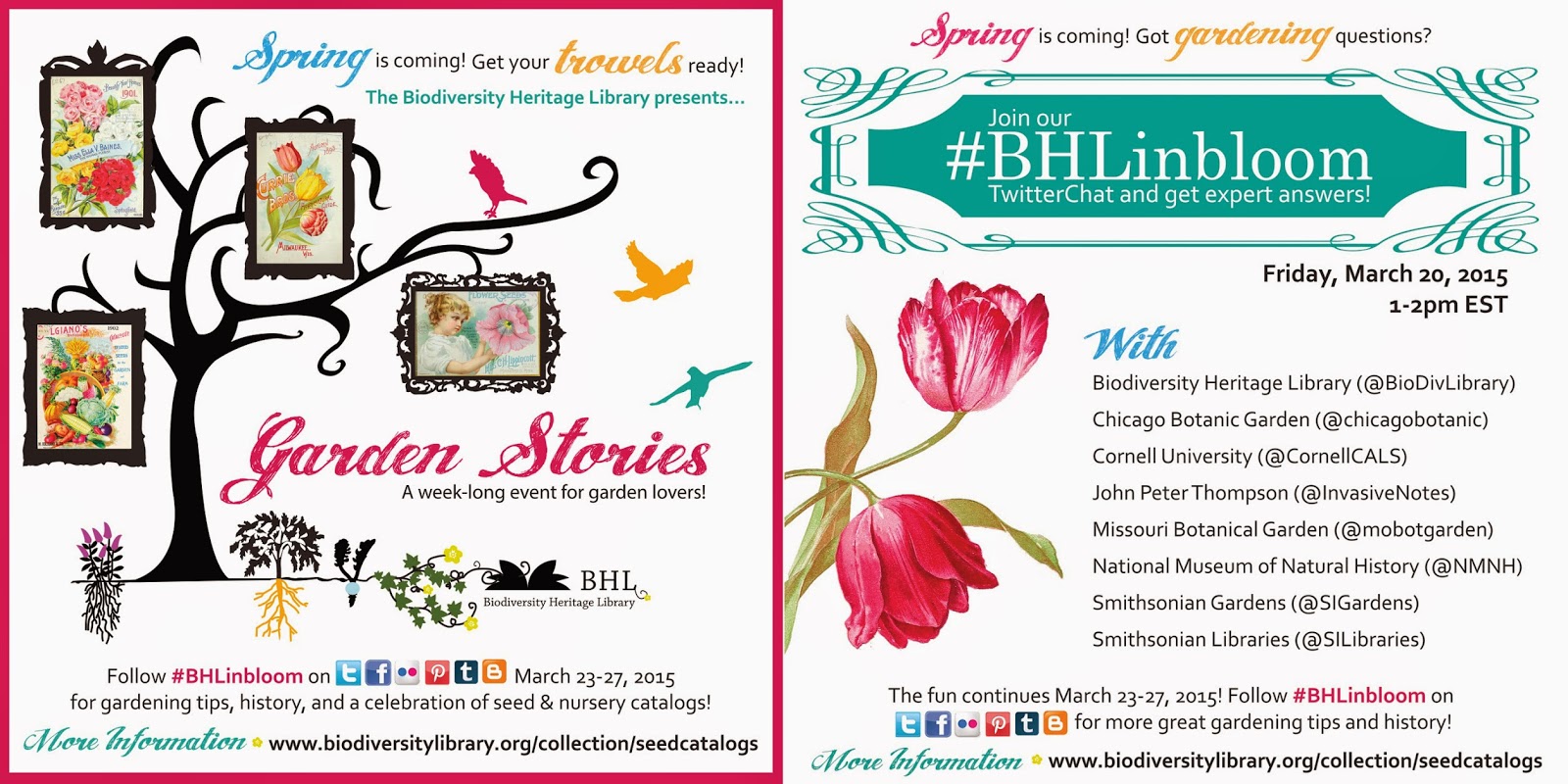
We’re excited to announce BHL’s spring event, “Garden Stories,” which will occur March 23-27, 2015.

View Full Size Image

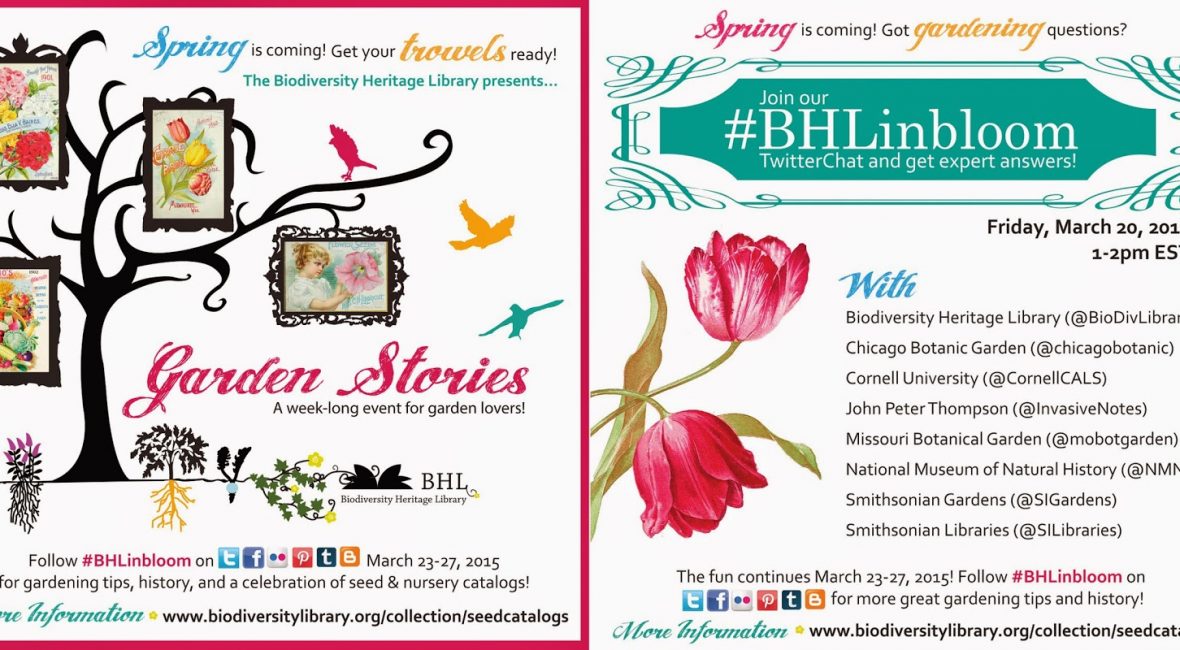
“Garden Stories” is a week long social media event for garden lovers. The campaign will explore the fascinating world of gardening, from the rise of agriculture to the home garden and the mail order gardening phenomenon.

Celebrating the history, science, and art of gardening, content will be published via the BHL Blog, Twitter, Facebook, Flickr, and Pinterest, with additional posts through the Smithsonian Libraries’ Tumblr. Posts will include gardening tips, history, and plant factoids, including daily blog posts highlighting topics such as the role of women in the American horticultural industry; the importance of seed lists and catalogs in the development of new cultivars; heirloom gardening; marketing and artistic revolutions in the gardening industry; and technological and garden fashion and design changes over time, using the over 13,000 seed and nursery catalogs in BHL to help tell these stories and provide this information. All content will be tagged with #BHLinbloom.

See this page for more information: http://www.biodiversitylibrary.org/collection/seedcatalogs

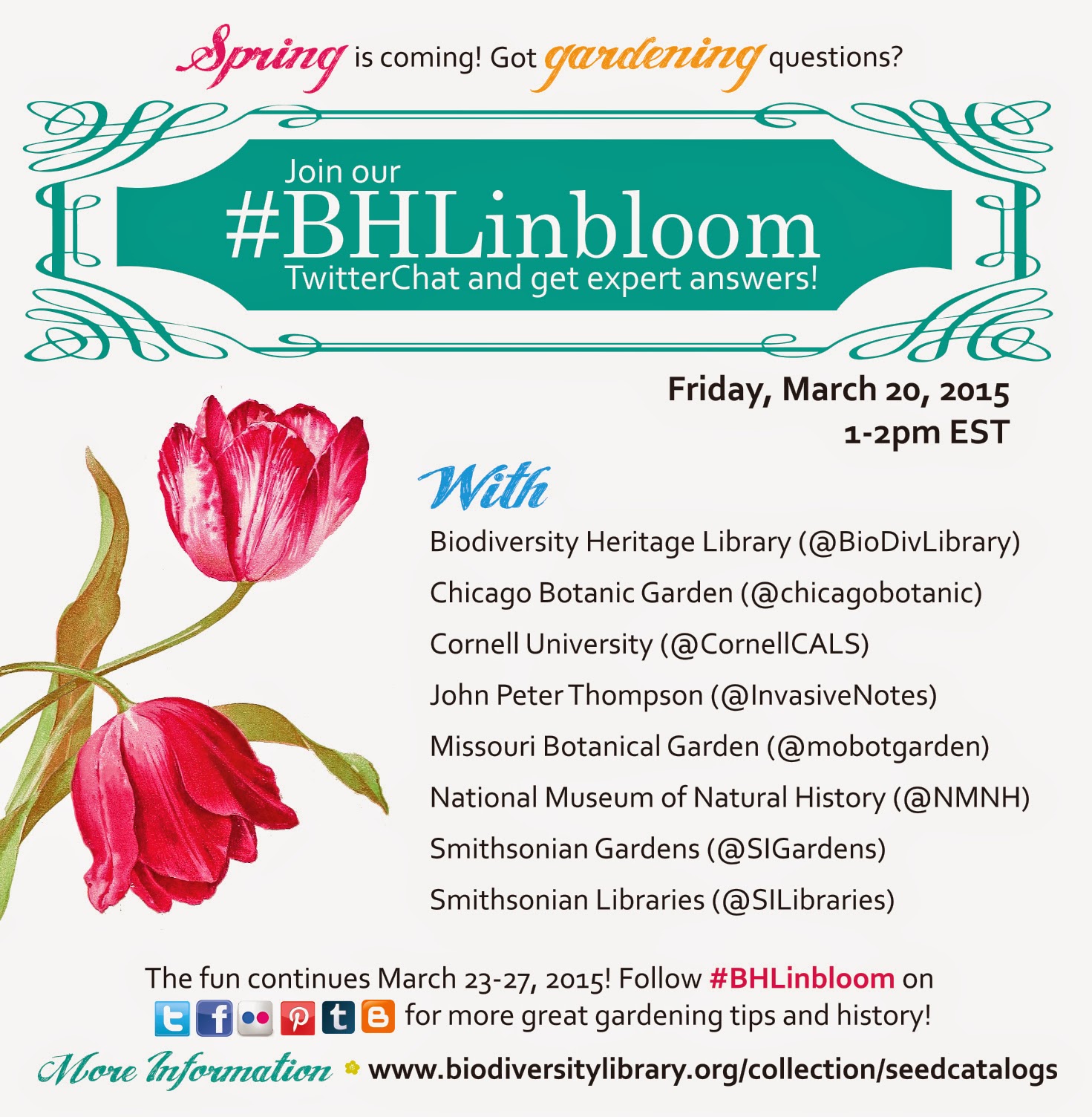
We will kick off the campaign with a TwitterChat on Friday, March 20, from 1-2pm EST. During the chat, we invite you to submit your gardening questions for experts to answer. Botanists and horticulturalists at BHL partner institutions, including Smithsonian Gardens, Smithsonian Libraries, National Museum of Natural History, Missouri Botanical Garden, Chicago Botanic Garden, and Cornell University’s College of Agriculture and Life Sciences are participating to answer questions and provide gardening tips and resources. Follow along and join in using #BHLinbloom.

View Full Size Image

We’re also featuring a Garden Stories t-shirt offered through T-Fund during the campaign. Proceeds will be used to digitize more books for BHL. Our goal is to sell enough shirts to digitize 5,000 pages. The shirt will be available starting on March 20th. Stay tuned on our blog and follow the campaign hashtag for more information.

Finally, during the campaign we’ll also be inviting you to help us improve access to seed and nursery catalogs by transcribing select catalogs as part of our Purposeful Gaming project. Stay tuned for more information and get your citizen science hats ready!

We hope you will join in the fun and help us spread the word about the campaign and TwitterChat. If you have gardening resources, historical information, or seed catalog collections, share them with the hashtag #BHLinbloom during the campaign and we’ll retweet and repost.

So, if you want to have some gardening fun this spring, get your garden gloves out and follow #BHLinbloom on our blog, Twitter, Facebook, Flickr, Pinterest and Tumblr, March 23-27, 2015, and join our TwitterChat on March 20 at 1pm EST!

See stunning art from seed and nursery catalogs in the BHL Flickr!

March 11, 2015by michelle.underhill

Help Support BHL

BHL's existence depends on the financial support of its patrons. Help us keep this free resource alive!

search

About BHL

The Biodiversity Heritage Library (BHL) is the world’s largest open access digital library for biodiversity literature and archives. BHL operates as a worldwide consortium of natural history, botanical, research, and national libraries working together to digitize the natural history literature held in their collections and make it freely available for open access as part of a global “biodiversity community.”

Join Our Mailing List

Sign up to receive the latest news, content highlights, and promotions.

Subscribe Now

Subscribe to Blog via Email

Enter your email address to subscribe to this blog and receive notifications of new posts by email.

Join 319 other subscribers

Subscribe to Blog Via RSS

Subscribe to the blog RSS feed to stay up-to-date on all the latest BHL posts.

Access RSS Feed

Inspiring Discovery through Free Access to Biodiversity Knowledge.

The Biodiversity Heritage Library makes it easier than ever for you to access the information you need to study and explore life on Earth…for free, anytime, anywhere.


64+ Million Pages of
Biodiversity Literature Online.

EXPLORE

Tools and Services
to Transform Research.

EXPLORE

300,000+
Illustrations on Flickr.

EXPLORE

ABOUT | HARMFUL CONTENT | PRIVACY | SITE MAP | TERMS OF USE