
Biodiversity Heritage Library - Program news and collection highlights from BHL
  • Home
  • News
  • Featured Books
    • All Featured Books
    • Book of the Month Series
    • BHL at 20
  • User Stories
  • Campaigns
    • Fossil Stories
    • Garden Stories
    • Monsters Are Real
    • Page Frights
    • Her Natural History
    • Earth Optimism 2020
  • Tech Blog
  • Visit BHL
Home
News
Featured Books
    All Featured Books
    Book of the Month Series
    BHL at 20
User Stories
Campaigns
    Fossil Stories
    Garden Stories
    Monsters Are Real
    Page Frights
    Her Natural History
    Earth Optimism 2020
Tech Blog
Visit BHL
  • Home
  • News
  • Featured Books
    • All Featured Books
    • Book of the Month Series
    • BHL at 20
  • User Stories
  • Campaigns
    • Fossil Stories
    • Garden Stories
    • Monsters Are Real
    • Page Frights
    • Her Natural History
    • Earth Optimism 2020
  • Tech Blog
  • Visit BHL
Biodiversity Heritage Library - Program news and collection highlights from BHL
Blog Reel

Reflecting back on my incredible summer at Smithsonian Libraries

View Full Size Image

As the weather in Central New York is getting colder, and the winter is inevitably approaching, I can’t help but recall the humid summer of Washington, DC. Over the summer of 2016, I interned at Smithsonian Libraries. As a summer intern, I worked at the Department of Digital Programs and Initiatives on the “Cataloging across collections” project. The project was focused on metadata and cataloging. During my internship I worked on digital curation of the records in Biodiversity Heritage Library as well as cataloging field notes for the Field Book Project. Both aspects of my internship were coordinated by mentors assigned by the Smithsonian Libraries – Bianca Crowley, Digital Collections Manager of Biodiversity Heritage Library, and Lesley Parilla, Cataloging Coordinator of the Field Book Project. During my internship I met with Smithsonian Institution staff members, toured different departments, attended the staff picnic, and, most importantly, improved my understanding of the technical services in libraries.

Although working on metadata projects was quite challenging, it helped me to gain confidence as an information professional. As a librarian, I’ve always known that the information organization is important, but I didn’t realize how much properly maintained bibliographic descriptions can improve the user experience. Especially, when the audience can only interact with online assets. Biodiversity Heritage Library is a unique digital collection of the resources in Natural Sciences. My work focused on editing metadata for existing records, which included author merging, editing of volume information, title merging, and linking of the serial records. I received training in 2 internal systems, the Gemini Issue Tracker and BHL Administrative Dashboard to work on these tasks.

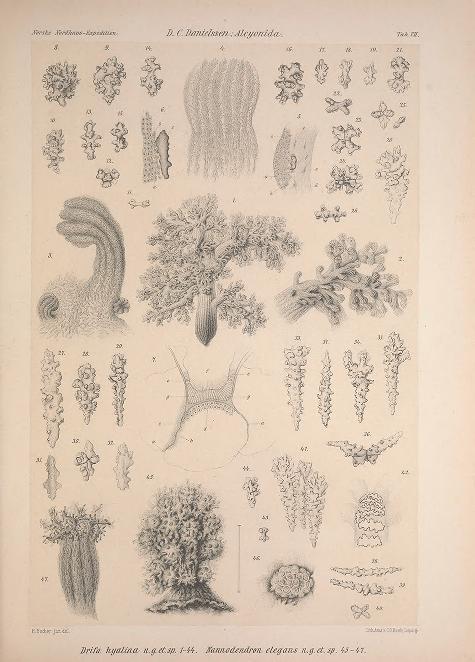
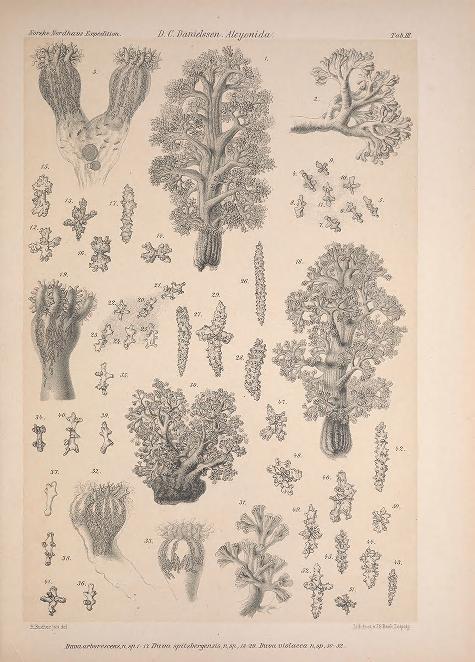
On the first week of my internship, I needed to link several volumes together. “Den Norske Nordhavs-expedition, 1876-1878” gives an account of the Norwegian North-Atlantic expedition in the 19th century, commanded by Carl Fredrik Wille, Captain of the Royal Navy. Since I have interest in Scandinavian languages, I enjoyed interacting with this resource. This and many other assignments throughout my internship taught me the importance of metadata standards. Seeing both librarian and user perspectives on the information-retrieval systems became an eye-opening experience for me.
 

View Full Size Image

“Den Norske Nordhavs-expedition, 1876-1878”, bd. 5, pt. 17 [Alcyonida], tab. I

View Full Size Image
“Den Norske Nordhavs-expedition, 1876-1878”, bd. 5, pt. 17 [Alcyonida], tab.

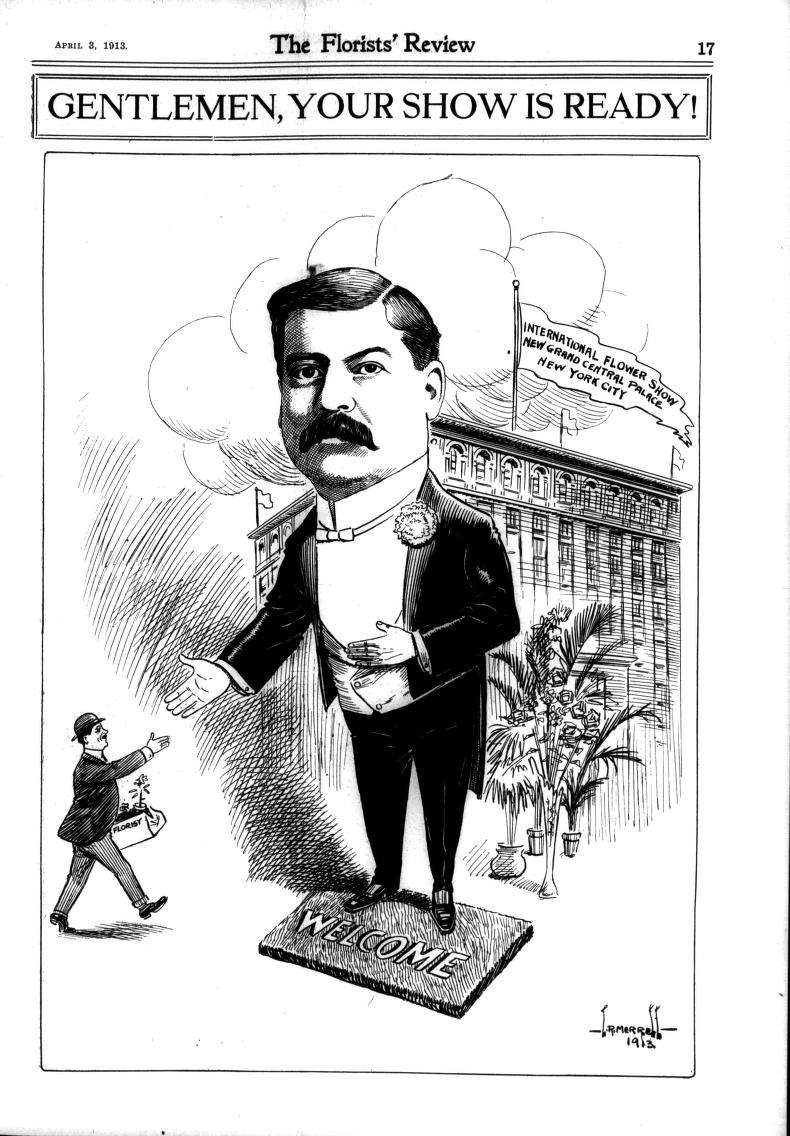
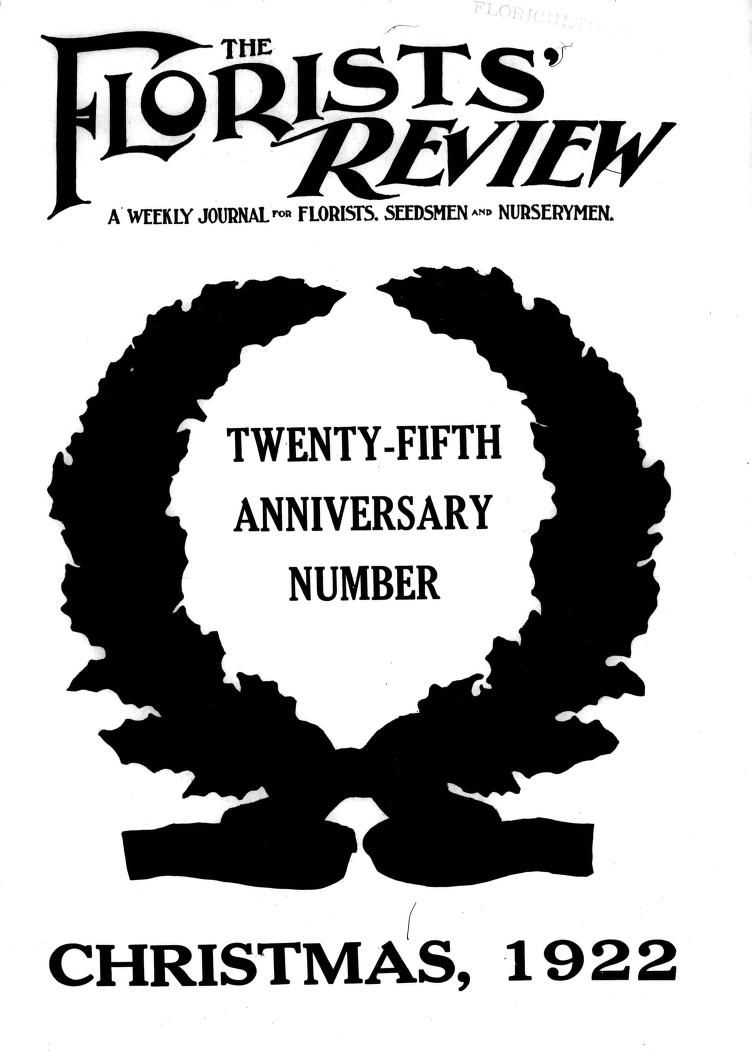
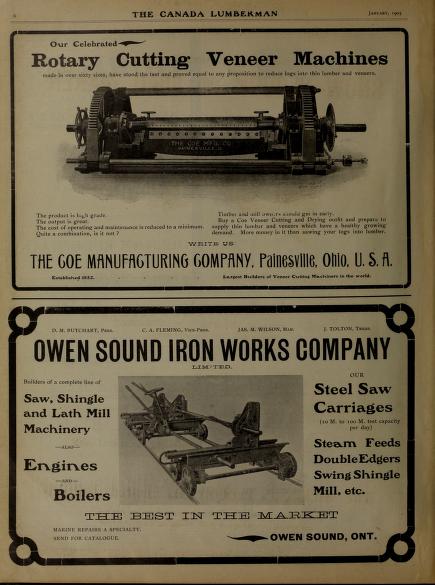
Further into my internship, I was trained to upload the scanned images into the Internet Archive, the platform that hosts the BHL assets. I used another internal system, Macaw, for this purpose. As I was uploading the new images, I assigned page-level metadata. One of the publications I was working with was Bonn Zoological Bulletin. I had so much fun working on the metadata-level description of William Mann’s scrapbook from his trip to South East Asia for the Field Book Project. One of my favorite serials was Canadian Forest Industries, a magazine that was renamed at least 6 times before its current title. While I was adding volume information and page level metadata, I encountered amazing illustrations and advertisement campaigns from Florists’ Review, that is a wonderful compilation of the marketing tools of the past.
 

View Full Size Image
Canadian Forest Industries, formerly known as Canadian Lumberman, Jan 1903.


View Full Size Image
Drawing from the Florists’ Review April 1913 v.31 no.797 (801) p.17


View Full Size Image
Front page of from the Florists’ Review December 1922, Christmas edition v. 51 no.1306

In addition to learning many essential skills for technical services in libraries, during my internship I worked with Camtasia software. Screen-casting was used to develop tutorials for BHL Staff about working in the BHL “Admin Dash.” I recorded one video that focused on merging author records together. During the internship I also presented at a Brown Bag presentation in front of Smithsonian Libraries staff, my mentors, and other interns.

I would like to express gratitude to my mentors – Bianca Crowley, Digital Collections Manager at Biodiversity Heritage Library, and Lesley Parilla, Cataloging Coordinator of the Field Book Project, and the entire Department of Digital Programs and Initiatives for their guidance and support. I would also like to thank LIS Program Director at Syracuse University – Jill Hurst-Wahl, and my Academic Advisor – Barbara Stripling, for their invaluable insights on the US library system. My boundless gratitude goes to Cultural Vistas and the Edmund S. Muskie Internship Program that made it possible for me to intern in Washington, D.C. during the summer of 2016. Being a part of the Smithsonian Institution was an unforgettable life experience, which I will proudly carry with me throughout my library career!
December 28, 2016by [email protected]
BHL News, Blog Reel

Kam Wies helps BHL “Moving Walls” Move On

Portrait version of the Biodiversity Heritage Library logo.

When I learned of the amazing opportunity to intern at the Smithsonian Libraries, I instantly knew I wanted to be a part of it. I was lucky enough to be chosen to be the Biodiversity Heritage Library In-Copyright Collection Management Intern. I knew the BHL was a digital library but, having no previous experience with a purely digital collection, I couldn’t begin to start making a guess. What I ended up doing was so much cooler than anything I could have anticipated. I got to spend the whole week pushing my attention to detail and love of consistency to the limits. Now that may sound boring to some but this is the kind of thing I do at home for fun.

View Full Size Image
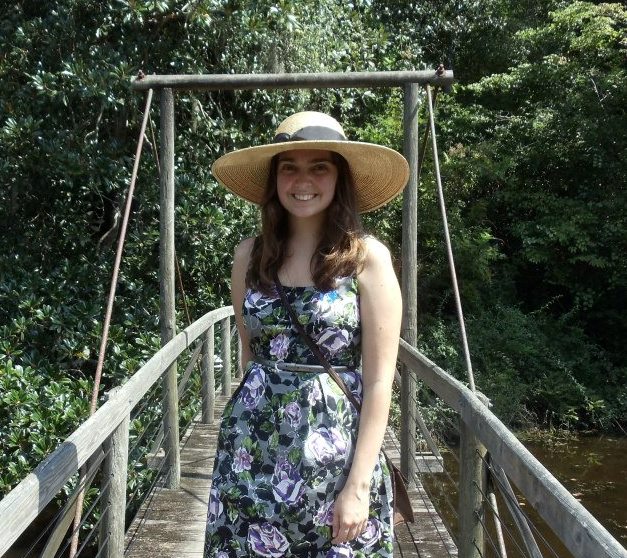
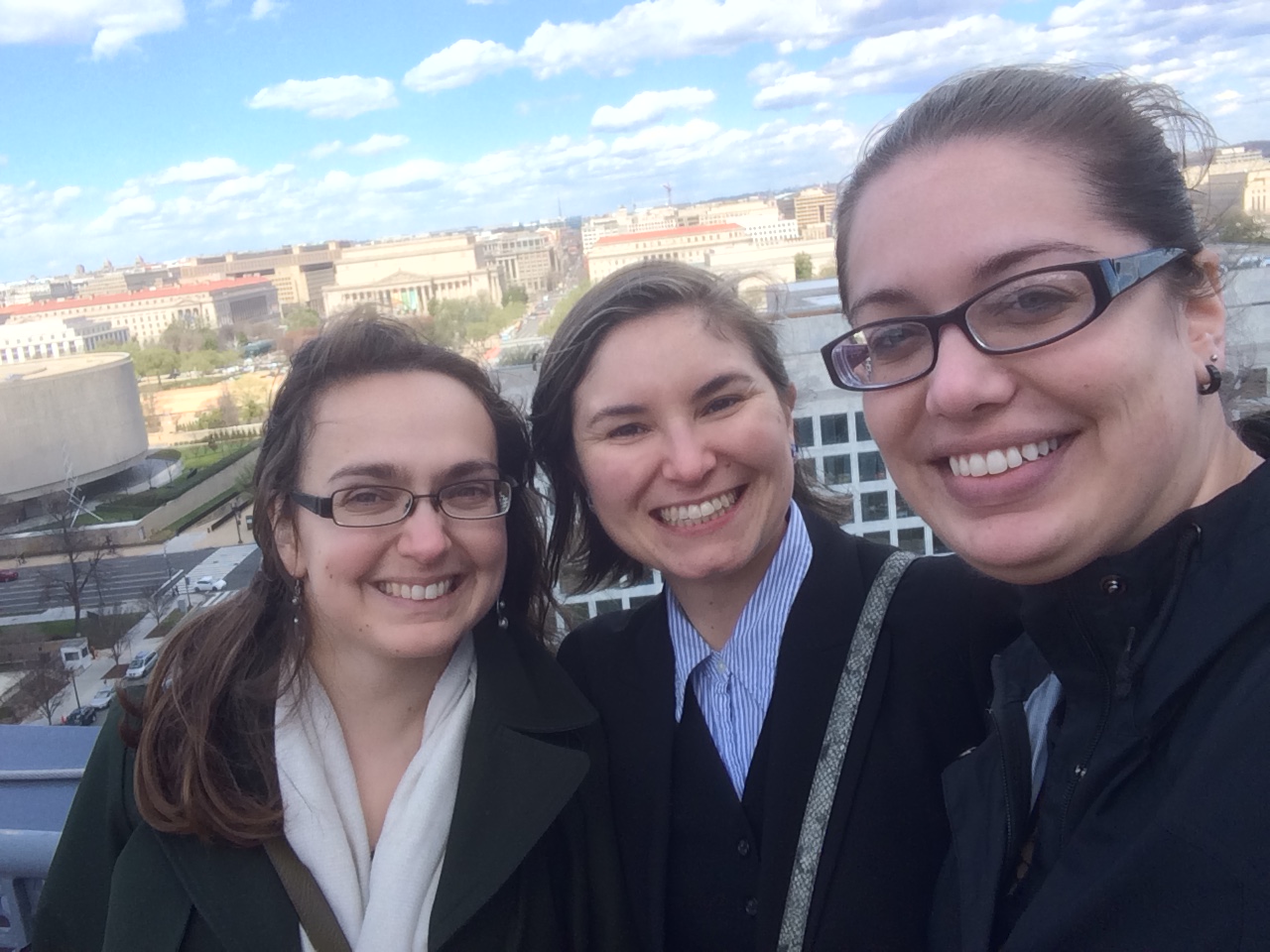
From left: Jacqueline Chapman, Bianca Crowley, Kam Wies

Because BHL is a digital library, copyright plays a huge role in their work. Some of the materials being digitized are still under copyright, which means that the BHL has to get permission, in writing, for the materials to be added to their collection.

Getting permission is just step one. Some copyright holders ask that there be what’s called a “moving wall” (or embargo). In academic publishing, access is sometimes only allowed to paid subscribers so publishers may not want their most current materials to be made accessible for free (see Wikipedia for more information). This can be a one year moving wall or even a fourteen year moving wall. It all depends on the wishes of the publisher.

BHL wants to make sure they can provide as much access as possible and having the option for a moving wall available to a publisher allows for that. The issue with having a bunch of publications that all have different moving walls is you then have to keep track of and keep up with them every year.

BHL manages this process by using an issue tracking system (again, see Wikipedia for more information). They create ‘issues’ for each publication title that has a moving wall in order to make sure it is being updated every year as appropriate. My first task was to make sure all of the permissions titles that had moving walls (about 60 of them), had open and up to date issues in the tracking system. I also had to make sure that there was an issue for each title because some publications had multiple titles and each title needed an issue created for it. I really loved this. Making sure information is accurate across multiple platforms (issue tracker, BHL website, permissions titles spreadsheet) and consistently formatted means that work can run easier, no matter who in the world is using the system.

Once I completed that introductory task, I moved on to the process of ‘reconciling moving walls’. I had to review each moving wall issue in the tracking system to make sure they were up to date. For example, if a title had a 3 year moving wall, 2013 should now be in BHL. I checked BHL to make sure the title was in the collection. Then reviewed the title for any gaps in the journal run or if we were missing the new year allowed due to the moving wall. If there were any missing materials, I had to find out which of the Contributor libraries had the missing materials and ask them to digitize it. There were so many little steps and details to pay attention to and I had fun delving into each issue.

This was a project that may have been created to help the BHL keep on point with their digitization of new materials but it was built with me in mind: someone who can easily work across multiple platforms and screens, has an acute attention to detail and strong desire to achieve consistency. This week was so interesting and informative. I had so much fun not only doing the project for the BHL but meeting all the different people who make the Smithsonian Libraries run smoothly. We did tours of multiple libraries and learned so much about the collections and how the librarians help the researchers. I can only hope that when I graduate I find a job that is as much as fun as this internship has been.

May 3, 2016by Kathryn Stine
BHL News, Blog Reel

On the Case: An Internship in Detective Work, Library Style

View Full Size Image
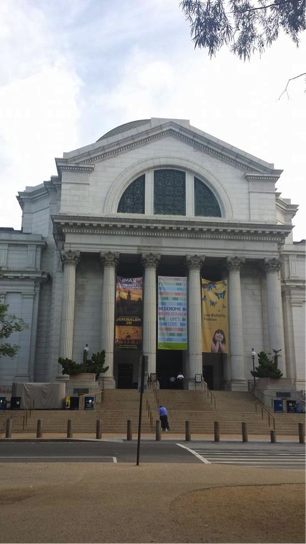
Facade, Smithsonian’s National Museum of Natural History

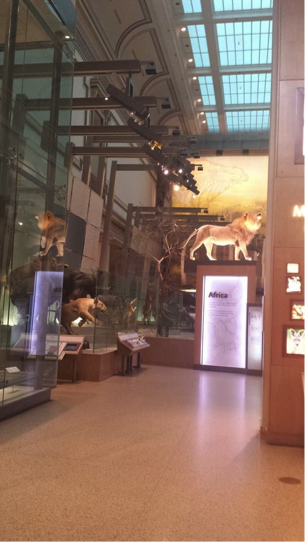
My earliest memory of the Natural History Museum is climbing the steps to see the “stuffed animal zoo.” It was a very rainy day and our plans of visiting the National Zoo were put on hold. However, my mom had an idea so that I- only about four or five at the time- could still see animals. I had no idea at the time what exactly she meant by “stuffed animal,” but I had a blast and returned frequently during our yearly trips up from Florida. The stairs seemed so much taller back then. Now they’re just a quick jaunt up to something much more than a place to escape the rain. As the years and visits went by, I found that I did not get bored by the many visits. Instead, I started looking at different aspects of the museum- beyond the educational tags and videos. I started seeing the museum as an entity and watching how much it meant to the different people visiting.

View Full Size Image
Mammal Hall, Smithsonian’s National Museum of Natural History

I completed my undergraduate degree at Florida State University, majoring in Interdisciplinary Social Sciences with a focus on Anthropology and History. I also completed a minor and certificate program in Museum Studies. I am currently working on completing my graduate degree at Catholic University of America in Library Information Science with a focus on Cultural Heritage Information Management.

Being able to work with the Smithsonian Libraries was an amazing experience. I was able to spend the last six weeks working with the Biodiversity Heritage Library as part of the Professional Development Internship Program. Those weeks flew by as I worked on a number of different projects. One of the main projects I worked on had to do with BHL’s issue tracking system, called Gemini. With digital libraries comes an even bigger audience which can lead to even more input. BHL users are able to note problems, questions, or requests that they have with items in the library which are then sent through to the issue tracking system. I was able to help unravel some of the difficult bibliographic questions which were anchored in the age old “what were the publishers thinking?” Bibliographic leg work made me feel as though my librarian skills were taking me down the path of a detective. Except instead of a dark alley I was making my way through the cyber-shelves of OCLC, wandering through different countries’ books to add to my collective knowledge about a title.

View Full Size Image
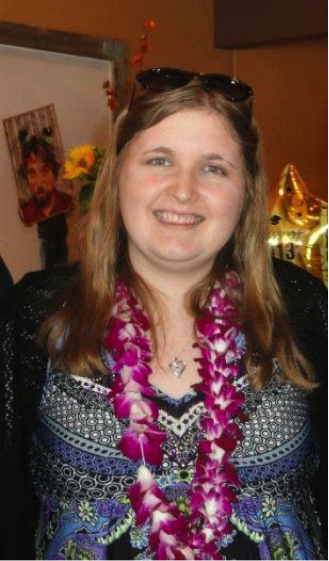
Mariah Lewis, BHL Professional Development Intern

While working on different issues in the issue tracking system I was able to make edits to the records in the BHL. After doing cataloging and metadata work in previous internships I found it very interesting to see how that data was stored and edited in a digital library setting. The collaborative effort that went into editing BHL records and answering questions in the Gemini system was incredible. With participating institutions all over the world, communication and team work was indispensable.

Working with BHL was a big change from my previous library work. It was my first time in a library setting not working with books. The transition from working with books and documents in a digitization setting to never seeing a book was not as difficult as I was expecting. I was given first-hand experience working with digital surrogates or- as some would say- totally new digital objects. Beyond this, it was really interesting to see how you can work with people all over the country and world with technology. While that seems obvious, BHL takes this to a different level and really works at having clear communication lines. The collaborative effort was probably the most inspiring part of the internship. I saw how BHL’s work can be used in other aspects of librarianship which complements my library and information science education and gives me hope and ideas for the future of librarianship.

Mariah Lewis
BHL Professional Development Intern

August 28, 2014by ntay
Blog Reel

My Life as a BHL Staffer: Jacqueline Chapman

Have you ever spotted an error in the BHL? Have you ever experienced technical difficulties with downloading digital files from our website? Have you ever looked for an article, journal, or title in our collections and been disappointed to find that it wasn’t in BHL’s collections? Have you ever wanted to thank BHL staff for a particular article, feature, or service? Have you ever had an idea for how the BHL could improve?
If you have, I hope you have taken advantage of our Feedback system and sent your corrections, suggestions, and questions on to us!  And if you have done so recently, you may have heard from me.
View Full Size Image
My name is Jacqueline Chapman, and I have had the pleasure of responding to hundreds of messages from BHL users over the past few months as I’ve taken on the role of BHL’s virtual reference librarian. I work on the BHL as part of my duties as a Digital Collections Librarian at the Smithsonian Institution, where I participate in digital initiatives and coordinate with various staff members to digitize the collections of Smithsonian Libraries.
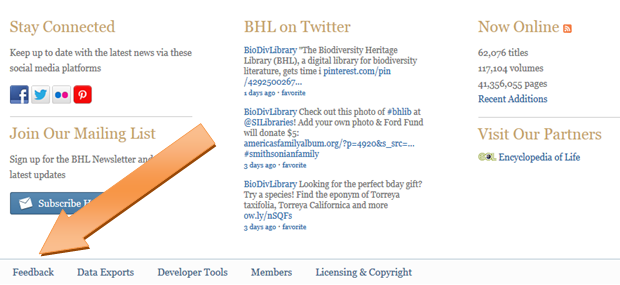
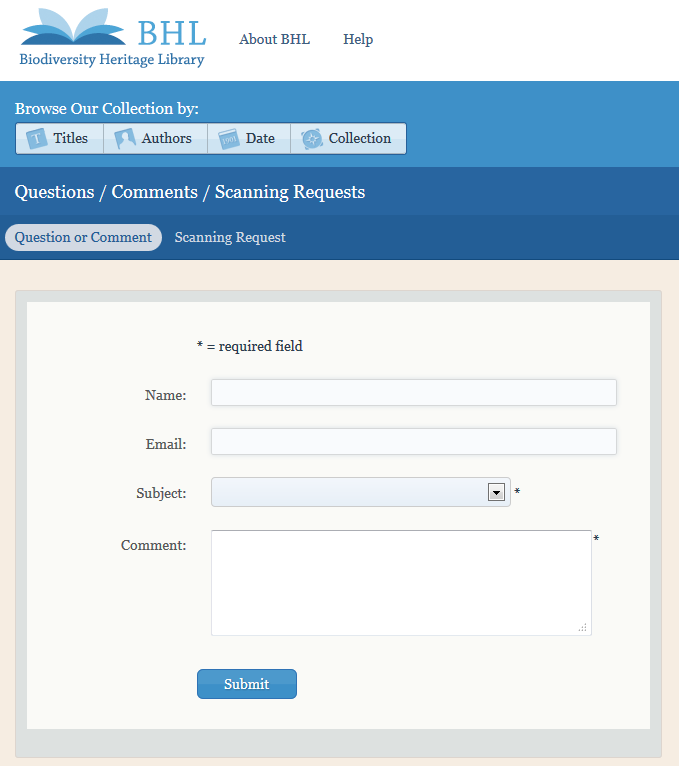
To submit feedback to the Biodiversity Heritage Library, simply scroll down to the bottom of our home page and click on Feedback.
View Full Size Image
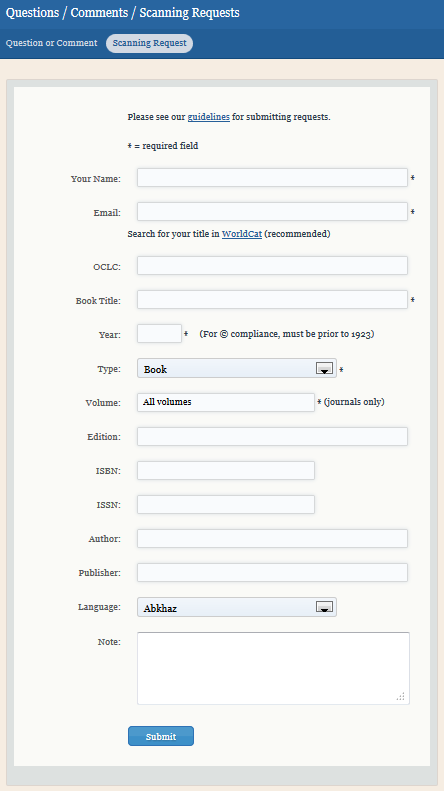
You will have the option to provide general feedback or to place a scanning request.  All submissions enter the same queue, in our back-end user feedback management system.  That’s where my work begins!
 
Questions and Comments
This section is a catch-all for user feedback that does not contain a scan request.  These may include image reuse requests, suggestions, error reporting, or technical questions.  Part of my job is to sort these submissions and determine what action is needed.
View Full Size Image
Through such user queries, I help with technical questions, investigate and fix quality issues, and answer more traditional reference questions.  I get to indulge in my enjoyment of detail-oriented intellectual tasks by merging rogue scans into their main entries, correcting metadata errors, re-sequencing volumes, merging duplicate author names, and delving into complex bibliographic mysteries. I especially enjoy sharing praise with the rest of the BHL staff!
 
Scan Requests
Members of the BHL user community are constantly helping our staff improve the quality of the BHL by requesting titles for inclusion and pointing out gaps in serials. A large portion of my duties consists of investigating these user submitted scan requests.
View Full Size Image
I begin by confirming that the requested item isn’t in BHL already.  Sometimes scan requests lead to the discovery of a mislabeled scan or to duplicate entries containing different volumes of the same title.  It’s great when I can satisfy a user request immediately by locating a difficult-to-find item in the BHL, and then make some changes so that it is more easily discovered by the next person.
If an item isn’t in the BHL, I check our queue to see if the item is already in progress.  We have over 1,000 issues open at any given moment, so it is not unusual for me to find that we are already hard at work on a particular scan request.
If the item is not already in progress, I will check to see if any of BHL’s member libraries holds the requested material and assign the scan accordingly.  An issue may be reassigned a number of times as institutions discover that their items are unable to be scanned, or that they lack specific volumes.  It is wonderful to see BHL collaboration in action as many partner libraries bring their collections together, digitally, in order to complete a series.
 
Submit Feedback!
I encourage you to take advantage of our feedback system. Our users make it possible for the Biodiversity Heritage Library to continually improve its offerings.  Our partners’ scanning priorities, our website’s design, the data export options that we offer, the goals we set for our project, and the social media platforms we embrace are all influenced though input from our users. We love to hear about how the BHL has aided the research of people around the world, and enjoy sharing some of the stories we hear in our BHL and Our Users feature.
Be part of the conversation!
August 21, 2013by Kathryn Stine
BHL News, Blog Reel

New Grant Helps The Field Museum Digitize Rare and Interesting Books!

View Full Size Image
Title Page Image, v. 3, Onze vogels in huis en tuin

One of the BHL partner institutions, The Field Museum Library, was recently awarded a small grant from the Consortium of Academic and Research Libraries in Illinois (CARLI) to contribute titles to the growing BHL corpus. The proposal entitled “Empowering Biodiversity Research,” allowed The Field Museum Library to contribute 34 new titles to the BHL.

Several titles chosen for digitization came from the Library’s impressive Edward E. Ayer Ornithological Library, housed in the collections of the Mary W. Runnells Rare Book Room.

The titles were chosen for digitization via several means:

View Full Size Image
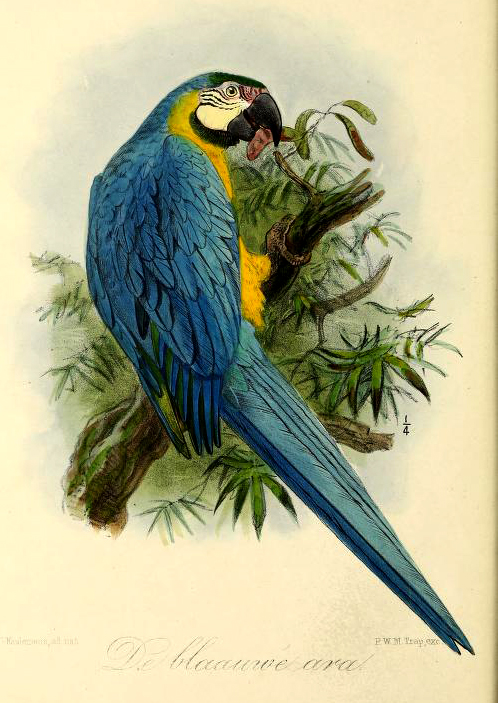
Blue Macaw. v. 3,

Onze vogels in huis en tuin

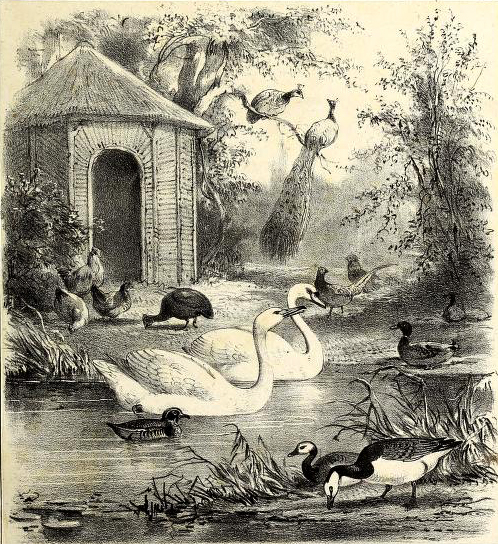
Requests received from users, which are processed via BHL’s issue tracking system, Gemini, allows us to fulfill user requests, complete series fill-in’s, and keep us organized! One item specifically requested was the famous work of Dutch illustrator John Gerard Keulemans (1842-1912), Onze vogels in huis en tuin (‘Our Birds in House and Garden’). Published in 3 volumes between 1869-1876, this collection of 200 lithographed plates were hand colored by the author. Noted for his beautiful and scientifically accurate work, Keulemans also provided illustrations for both Proceedings of the Zoological Society of London, The Ibis as well as numerous other monographs throughout the late 19th and early 20th centuries. With only 4 copies held in U.S. libraries, The Field Museum Library is the only BHL partner to own Onze vogels.


View Full Size Image
Neue Alpina, v. 1

In-demand titles were also identified via the Library’s active Interlibrary Loan (ILL) program. This service allows institutions from all over the world to request loans of books or scans of articles from The Field Museum Library. Items that are out of copyright and related to biodiversity are flagged for potential digitization. The title, Neue Alpina, has been requested via ILL twice in the last six months. This periodical, complete in two volumes, was published 1821-1827 and is focused on the natural history of Switzerland. Also part of the Ayer Collection, The Field Museum Library is the only holder of this title in the U.S.

View Full Size Image
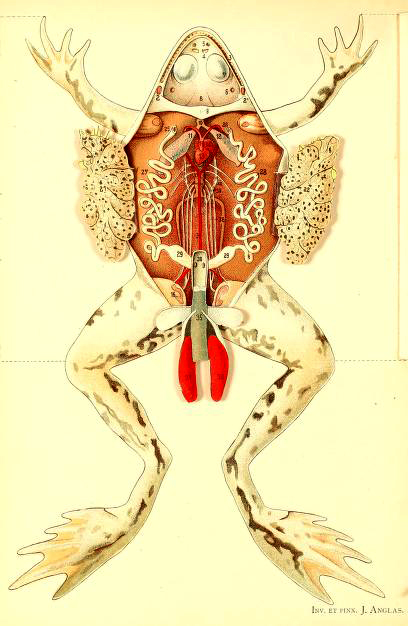
Dissected Frog. Les animaux de laboratoire

And finally, we often find pretty amazing items just by browsing the shelves! We came across an interesting item in our Herpetology Library from the collection of renowned herpetologist, Karl P. Schmidt. Les animaux de laboratoire: La grenouille (Anatomie et Dissection) is a short monograph about frog anatomy and a guide to dissection techniques. The amazing (and honestly, pretty fun) part of the book is the illustrations. The frog’s anatomy is dissected via multi-part anatomical flaps. The staff of the Internet Archive scanning center in Ft. Wayne, Indiana did a great job of capturing all of these flap elements during digitization.

Explore all items in the BHL contributed by The Field Museum Library here!

April 30, 2013by Kathryn Stine

Help Support BHL

BHL's existence depends on the financial support of its patrons. Help us keep this free resource alive!

search

About BHL

The Biodiversity Heritage Library (BHL) is the world’s largest open access digital library for biodiversity literature and archives. BHL operates as a worldwide consortium of natural history, botanical, research, and national libraries working together to digitize the natural history literature held in their collections and make it freely available for open access as part of a global “biodiversity community.”

Join Our Mailing List

Sign up to receive the latest news, content highlights, and promotions.

Subscribe Now

Subscribe to Blog via Email

Enter your email address to subscribe to this blog and receive notifications of new posts by email.

Join 319 other subscribers

Subscribe to Blog Via RSS

Subscribe to the blog RSS feed to stay up-to-date on all the latest BHL posts.

Access RSS Feed

Inspiring Discovery through Free Access to Biodiversity Knowledge.

The Biodiversity Heritage Library makes it easier than ever for you to access the information you need to study and explore life on Earth…for free, anytime, anywhere.


64+ Million Pages of
Biodiversity Literature Online.

EXPLORE

Tools and Services
to Transform Research.

EXPLORE

300,000+
Illustrations on Flickr.

EXPLORE

ABOUT | HARMFUL CONTENT | PRIVACY | SITE MAP | TERMS OF USE