Biodiversity Heritage Library - Program news and collection highlights from BHL
  • Home
  • News
  • Featured Books
    • All Featured Books
    • Book of the Month Series
    • BHL at 20
  • User Stories
  • Campaigns
    • Fossil Stories
    • Garden Stories
    • Monsters Are Real
    • Page Frights
    • Her Natural History
    • Earth Optimism 2020
  • Tech Blog
  • Visit BHL
Home
News
Featured Books
    All Featured Books
    Book of the Month Series
    BHL at 20
User Stories
Campaigns
    Fossil Stories
    Garden Stories
    Monsters Are Real
    Page Frights
    Her Natural History
    Earth Optimism 2020
Tech Blog
Visit BHL
  • Home
  • News
  • Featured Books
    • All Featured Books
    • Book of the Month Series
    • BHL at 20
  • User Stories
  • Campaigns
    • Fossil Stories
    • Garden Stories
    • Monsters Are Real
    • Page Frights
    • Her Natural History
    • Earth Optimism 2020
  • Tech Blog
  • Visit BHL
Biodiversity Heritage Library - Program news and collection highlights from BHL
BHL News, Blog Reel, Tech Updates

Announcing Altmetric and MyTweeps on BHL!

Have you ever wanted to learn more about the books in BHL? Or maybe find out what people are saying on social media about our collections? Or perhaps you’d like to connect with other BHL-enthusiasts?

We’re excited to announce that today, as part of our Mining Biodiversity project, we’ve launched two new features on BHL that will allow you to do all of the above! These features are Altmetric and MyTweeps.

Altmetric

Altmetric is a UK-based company that offers tools to help track online mentions of a library, publisher, or other entities’ content. Sites such as Twitter, Facebook, Wikipedia, Reddit, Google+, and Mendeley, as well as other online sources like blogs and news outlets, are indexed.

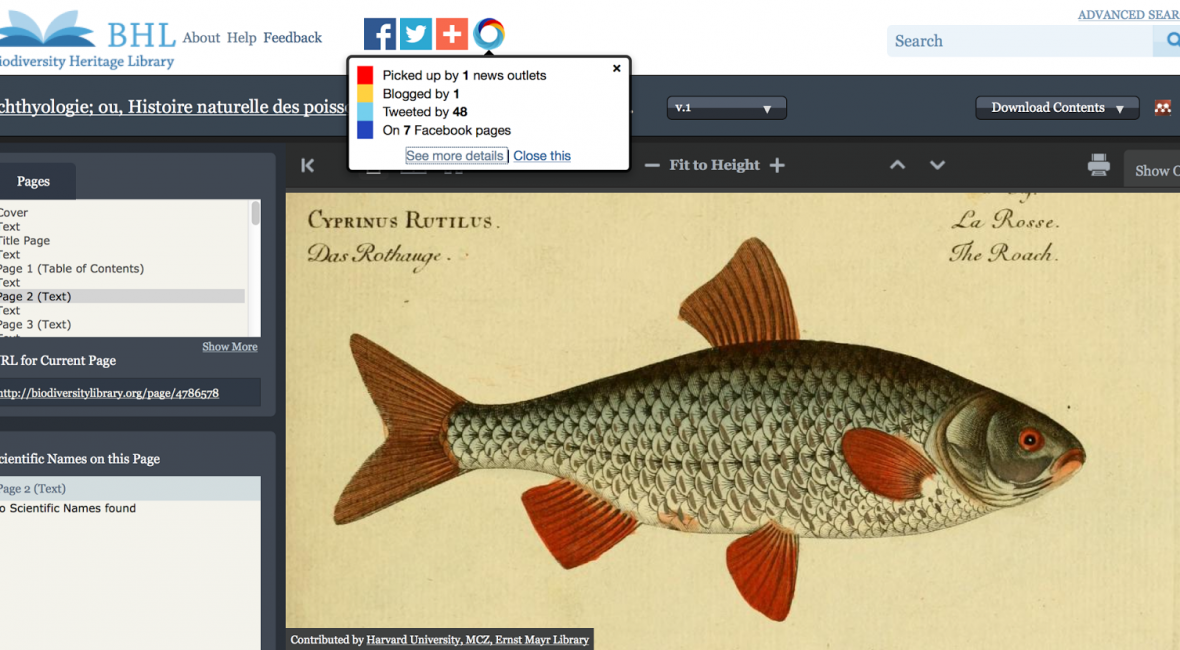
We worked with Altmetric* to track online conversations that include links to BHL books and articles. All mentions** of an individual book (which include a link to the book itself or a link to a page within that book***) are aggregated together into a single dashboard that allows you to explore all of the conversations happening about that item in one place. Each book’s individual dashboard is accessible by clicking on the Altmetric badge (a colorful, donut-shaped icon) in the book viewer header or the “see more details” link in the information box that pop-ups when you hover over the Altmetric badge (see below) in BHL.

View Full Size Image
The Altmetric badge in the BHL book viewer. Click on the badge itself, or the “See More Details” link in the pop-up box that appears when you hover over the badge, to see the Altmetric dashboard aggregating conversations about this item.


Within the dashboard, you can explore the specific tweets, Facebook posts, news articles, Wikipedia articles, or blogs that talk about that particular book. Each indexed site is represented by a different color (i.e. Twitter is teal; Facebook is navy blue; etc.), so a simple glance at the Altmetric donut will tell you which sites people have mentioned that item on.

View Full Size Image
Example of the Altmetric dashboard, accessed by clicking on the donut-shaped icon or information box illustrated above, for a book in BHL.

The Altmetric icon will appear in the book viewer header for any book that has been mentioned (and where that mention includes an actual link to that book or a page within that book) on one of the indexed online sites. If there is no Altmetric icon in the book viewer header, then there have not yet been any online conversations (with a link) about that book (but you can change that!).

Altmetric dynamically tracks new online mentions of BHL books. That means that if you tweet or post about a book in BHL (and include the link to it), Altmetric will subsequently index that post and make it available in BHL via the described Altmetric icon. Thanks to the social sharing buttons we’ve added to BHL (see below), it’s easier than ever to share your thoughts, expertise, or comments about a BHL book on social media. And thanks to our Altmetric implementation, it’s also now easier than ever for others to find those comments in BHL and benefit from your knowledge!

View Full Size Image
The social media sharing buttons on the BHL website. Simply click on the desired social site to share a link to the page you are viewing in BHL.

Altmetric picks up new mentions on Twitter, news outlets, and blogs on a daily basis. Mentions on Wikipedia, Google+, and Facebook are picked up and indexed via the described dashboards every 2-3 days.

Here are links to just a couple of BHL books that have been indexed by Altmetric. Click on the donut icon in the book viewer header to explore the fascinating conversations about each item. You can contribute directly to the online conversations using our social sharing buttons in BHL (see above), or by clicking on the appropriate links in the Altmetric dashboard (see below). Or start your own conversations about BHL books and see them appear (note the time lag for indexing on various sites above) in BHL!


  • Ichthyologie; ou, Histoire naturelle des poissons : En six parties avec 216 planches dessinées et enluminées d’après nature.
  • Caroli Linnaei…Systema naturae per regna tria naturae :secundum classes, ordines, genera, species, cum characteribus, differentiis, synonymis, locis.
  • The marine mammals of the north-western coast of North America, described and illustrated; together with an account of the American whale-fishery.
  • Conradi Gesneri medici Tigurini Historiae animalium liber IV : qui est De piscium & aquatilium animantium natura : cum iconibus singulorum ad viuum expressis ferè omnibus DCCXII.


View Full Size Image
Contribute to a Twitter conversation you discover in Altmetric simply by hovering over the tweet in the Altmetric dashboard and then choosing “Reply,” “Retweet,” or “Favorite.”


View Full Size Image
Clicking on any one of the Facebook posts you discover in the Altmetric dashboard will take you directly to that post in Facebook. From there you can comment, like, or share the post within Facebook itself.


MyTweeps

Love biodiversity, books, or natural history? Want to find others who like it too? Or perhaps you’d like to find an easy way to connect with other BHL fans? Are you on Twitter?

Then look no further than MyTweeps on BHL.

MyTweeps is a tool developed by the Social Media Lab at Ryerson University, one of our Mining Biodiversity grant partners. The tool allows you to explore an individual Twitter network (those who follow a certain account on Twitter).

We’ve included a link to the BHL MyTweeps dashboard on the homepage of BHL. Simply click on the “BHL Twitter Community” button at the bottom of the homepage, beneath the BHL Twitter feed, to access the dashboard.

View Full Size Image
The link to the BHL MyTweeps dashboard on the BHL homepage.

The BHL MyTweeps dashboard displays the latest tweets from the Twitter accounts that follow BHL, trending hashtags and trends over time from those followers, geographic location of BHL’s tweeps (i.e. followers), and the connectivity of the BHL network (i.e. who mentions whom among the BHL community of followers). We’ve also included an Altmetric dashboard in the lower left-hand corner of the MyTweeps page that shows the most popular BHL books on social media that week.

View Full Size Image
The BHL MyTweeps Dashboard, accessed by clicking on “BHL Twitter Community” at the bottom of the BHL homepage.

Take a look and discover a whole new network of biodiversity and BHL enthusiasts to connect, converse, and collaborate with. Or simply use MyTweeps as a way to stay informed about the topics and issues that are important to our community.

We hope you’ll explore and enjoy our new social media tools and take the opportunity to learn more awesome information about our collections. If you have any questions or comments about the tools, please don’t hesitate to send us feedback!

Happy socializing!

View Full Size Image


This project is made possible by a grant from the Institute for Museum and Library Services [Grant number LG-00-14-0032-14].

*Traditionally, Altmetric tracks only DOI (Digital Object Identifiers) mentions, but for this project our team worked with Altmetric to pioneer the tracking of URIs (Unique Resource Identifiers) via Altmetric. In exchange, Altmetric has granted us free access to their license and services.
**Mentions of BHL content on social media sites (i.e. Twitter, Facebook, Google+, Reddit, and Mendeley) are captured from June 2014-onwards. Mentions of BHL content on blogs and news articles are captured since the launch of BHL onwards.
***Indexed conversations are those that include links that start with “http://biodiversitylibrary.org/item/” or “http://biodiversitylibrary.org/page/” or “http://biodiversitylibrary.org/part/.” We are not tracking mentions with links that start with “http://biodiversitylibrary.org/bibliography/” due to Google Scholar tag guidelines, which form the basis of Altmetric’s tracking ability.

July 20, 2015by ulib-libraryjobs
Blog Reel, Featured Books

Documenting the Flora of the Nation’s First Urban Park System

Did you know that the city of Boston is blessed with one of the largest and the oldest urban forest reservations in America?

View Full Size Image
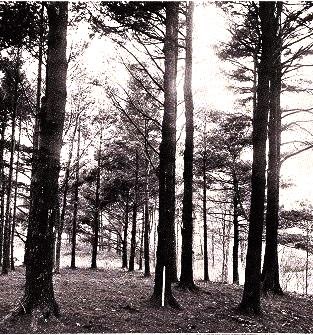
Photo: Charles Eliot, 1897

At the turn of the 20th century, Boston saw a rapid increase in human settlement and industrialization which quickly transformed the once pristine Commonwealth into a highly developed, unsightly, and unhealthy metropolis. The movement to preserve what was left of Greater Boston’s natural wonders was inspired by the writings by transcendental thinkers like Ralph Waldo Emerson and Henry David Thoreau, who were advocates of the idea to “keep the New World new.” Local activists for the cause included Wilson Flagg, Elizur Wright, Sylvester Baxter, and Charles Eliot. They envisioned a place where the citizens of Boston could escape the “noisy ugliness” of the overcrowded city and revitalize their spirits in the requiem of nature’s untamed beauty.

A Dream Comes to Pass 

Boston’s budding conservation movement had the foresight to identify large tracts of Massachusetts wilderness for preservation in perpetuity. A four decade campaign ensued and resulted in the passage of the Acts of 1893, Chapter 407 which established the Metropolitan Park Commission. This legal entity was charged with restoring, preserving, and increasing the beauty of the undeveloped woodlands surrounding Boston and this landmark legislation would serve as a model for other American cities. The Metropolitan Park Commission’s first order of business was to hire the noted landscape architecture firm, Olmsted, Olmsted and Eliot, to survey the vegetation in the recently acquired woodland reservations, the Middlesex Fells, Beaver Brook, Stony Brook, and the Blue Hills.

View Full Size Image
Map of the original Metropolitan Park Reservations
Click here for an interactive version.

The firm appointed landscape designer Warren H. Manning who led a team of twenty volunteers to complete the fieldwork. Local botanist Walter Deane was hired to compile and edit the survey’s findings and in 1896, he published the results in this month’s book of the month, Flora of the Blue Hills, Middlesex Fells, Stony Brook and Beaver Brook Reservations, of the Metropolitan Park Commission, Massachusetts. While Deane is credited with the organization of the specimens and botanical observations for publication, the project would not have been possible without collaboration among many amateur and professional botanists. This collaboration was so successful that it led to the formation of the New England Botanical Club (NEBC), which still meets regularly and has amassed a collection of 250,000 specimens housed in the Harvard University Herbaria (HUH).

Announcing a New BHL Collection

This example of an early successful citizen-science project is highlighted in the launch of a new collection in the BHL: The Archives from the Boston Metropolitan Park. This collection is composed of approximately 8,000 pages of manuscript material documenting the progress of the survey. Readers can peruse Walter Deane’s field notes, diaries, datebooks, and correspondence. His diaries reveal fascinating insights into his work on compiling the Flora and the details of its publication, as well as how the formation of the NEBC resulted from the Metropolitan Flora survey. His diaries also give rich pictures of the botanists of his time and are highly useful to anyone writing about the history of the NEBC and its members. The collection is now freely available and opens up this fascinating slice of history to the public for the first time. As part of the Connecting Content project, the digitization of the archives and original specimens from the Metropolitan Park Reservation was made possible by an Institute of Museum and Library Services (IMLS) National Leadership Grant.

Collection Highlights

One of the most compelling aspects of the correspondence related to the Metropolitan Flora survey is learning about people and information not evident from Deane’s Flora or from the botanical specimens. One example is a letter from the tree expert Loren Dame to Manning in which he encloses a list of trees compiled by a “non-botanist”, George Perry. Perry states that “I have made it a point to crawl through the densest tangle of greenbrier and thicket… to become familiar with every rod of the section.” As a result of his efforts, his list of trees is very thorough. He also found some very rare plants not seen by other surveyors, including maidenhair fern. Unfortunately, because he wasn’t considered a reliable source, his data wasn’t included. In another letter to Manning, Dame reported three rare tree species found only in an area adjacent to the Fells, which was added to the reservation after Flora was published. All of these omissions are significant, and the knowledge revealed in these letters is highly valuable for understanding the full extent of the past flora of the area.

Surveying the Flora of Middlesex Fells: Yesterday and Today

Between 2003 and 2011 a new survey  very much like the original survey of the Fells flora was undertaken by a team of NEBC and HUH botanists. Using Deane’s Flora as a basis for comparison, the team found that most of the native species from the original survey persist, despite substantial increases in the number and frequency of non-native plants. These native species face several threats, including habitat disturbance, and loss due to construction and recreational use of the Fells, herbivory from increases in deer and insect populations, as well as environmental changes effected by climate change and afforestation. Sustaining populations of native species, some of which are rare and endangered, will require a more active management of the Fells.[1]

Urban forests purify the air that we breathe, provide a habitat for local flora and fauna, help reduce energy demands, provide recreational opportunities, reduce stress and crime rates—the list goes on. Since eighty percent of us live in urban areas most of us owe quite a bit of thanks to the astute conservationists who fought to keep the untamed wilderness close by. Now it’s our turn to preserve their legacy.

View Full Size Image

Spot Pond named by Governor John Winthrop in 1631.

Photo by Mike Ryan, Friends of the Fells

“Something like five miles northerly from Boston lies a great tract of country, all stony hills and table-lands, almost uninhabited, and of wonderful picturesqueness, and wild rugged beauty… and at its heart is that most beautiful of Boston’s suburban lakes, Spot Pond, which lies high up among the hills.” Sylvester Baxter, 1886.

Notes

[1] 2012. Hamlin, Bryan T., W. T. Kittredge, D. P. Lubin & E. B. Wright. Changes in the vascular flora of the Middlesex Fells Reservation, Middlesex County, Massachesetts, from 1895 to 2011. Rhodora 114(959): 229-308.

Learn More!

IMLS Grant Project Page
Walter Deane (1848-1930) Papers
NPS: Metropolitan Parks Commision
Friends of the Fells
Found in the Fells
The Middlesex Fells, a Flourishing Urban Forest by W. Kittredge
BHL Collection: Archives and Specimens from the Boston Metropolitan Park Flora 

February 26, 2015by [email protected]
BHL News, Blog Reel

Empowering Access to Biodiversity Information in Africa

View Full Size Image

Almost two years ago, BHL Africa officially launched during a three-day workshop hosted by the South African National Biodiversity Institute (SANBI) at the Pretoria National Botanical Garden in Pretoria, South Africa. In the subsequent two years, BHLA has begun digitization at some participating institutions and has drafted a governance framework for the node. Recent developments, including a grant from the JRS Biodiversity Foundation and a new status within the global BHL community, have brought our colleagues significantly closer to achieving their vision of global access to biodiversity resources in sub-Saharan African institutions.

On January 30, 2015, the JRS Biodiversity Foundation, which is committed to enhancing the understanding of biological diversity for the benefit and sustainability of life on earth, announced an award of $150,000 to facilitate the growth of BHL Africa. JRS’ support of BHL Africa began in 2011 with a sponsorship for African attendance at the BHL Life and Literature Conference in Chicago, IL, followed by additional support for the launch ceremony and corresponding workshop in April, 2013.

View Full Size Image
Group photo at the BHL Africa launch ceremony. Pretoria, South Africa. April, 2013.

Awarded to SANBI, this new grant will grow BHLA through assessment, collaboration, and digitization, resulting in a wealth of collections unique to African institutions being added to BHL. This new JRS support will allow BHLA to:

  • Conduct outreach to expand active BHLA participation through engagement with current members and recruitment of new participants
  • Improve communications and host workshops and trainings for 13 BHLA member institutions
  • Analyze the existing capacity for participation and content aggregation
  • Stabilize the governance of the organization and infrastructure through sustainability planning

In order to accomplish these objectives, Anne-Lise Fourie, Assistant Director of SANBI Libraries, Chair of BHLA and PI on the JRS Africa project, plans to survey current members and potential partners and conduct site visits to Kenya and Uganda to establish capacities and collection profiles. This information will help inform future trainings regarding identification of unique content for inclusion in BHL and the selection of digitization service providers.

Learn more about the project, planned outputs, and project staff on the BHL Africa web page on the JRS website.

We are also pleased to announce that BHL Africa has joined BHL as an Affiliate, following the example of BHL Singapore and BHL Mexico, which participate in BHL both as autonomous regional nodes and Members of the BHL. As an Affiliate, BHLA may participate in BHL committees, task forces, and working groups and will collaborate more extensively within the global BHL community. See a list of current BHL Members and Affiliates here.

We are thrilled at BHL Africa’s progress and look forward to witnessing the continued growth of the project.

Contributions from BHL Africa


View Full Size Image
Important Birds Areas in Kenya. Contributed by Nature Kenya, East Africa Natural History Society for BHL Africa. http://biodiversitylibrary.org/bibliography/87589.

Current BHL Africa partner contributions to the BHL Collection include:

  • Publications from the South African National Biodiversity Institute
  • Articles and Publications from Nature Kenya, East Africa Natural History Society
  • The South African Institute for Aquatic Biodiversity’s “Ichthyological Papers of J.L.B. Smith 1931-1943”
February 11, 2015by ulib-libraryjobs
Blog Reel

Welcoming Grace Costantino, BHL Outreach and Communication Manager

View Full Size Image
Grace Costantino, BHL Program Manager. Image Credit: MYH Photography.

We are pleased to announce that Grace Costantino has joined BHL as our new Outreach and Communication Manager!

Grace is no stranger to BHL. She started with the project back in 2008 as a BHL Librarian at the Smithsonian Libraries, after which she served as the BHL Program Manager from 2012-2013. Over her years on BHL, she has helped shape the program’s digitization workflow, assisted in the implementation and administration of the user feedback system, facilitated strategic planning efforts, organized evaluation and reporting policies, spearheaded marketing and promotional activities, performed financial administration, and developed and managed BHL’s outreach and communication strategy.

In her new capacity, Grace will further refine BHL’s outreach strategy, expand social media initiatives, supervise marketing and promotional activities, and engage with the public to excite audiences about the wealth of biodiversity heritage and knowledge available in BHL while also educating them about its critical importance to modern scientific, conservation, and informatics efforts.

View Full Size Image
Grace with her husband, Justin, and their dog, Jack.
Image Credit: MYH Photography.

Grace received her BA in Studio Art, Graphic Design, and Art History, as well as her Master’s degree in Information Systems and Management, from the University of Maryland, College Park. She currently resides in Crofton, Maryland, with her husband, Justin (a middle school art teacher), and their dog, Jack. Her hobbies include drawing, painting, reading, writing fiction, watching fantasy and sci-fi movies, and traveling. She hopes to one day travel to every US state and continent. She has 21 states and 4 continents to go…Come on BHL-Antarctica!

View Full Size Image The BHL Outreach and Communication Manager position is part of the BHL Secretariat, housed at the Smithsonian Libraries. The position is made possible in part through funding from the Institute of Museum and Library Services (Grant number LG-00-14-0032-14).
June 26, 2014by ulib-libraryjobs
BHL News, Blog Reel

Digging into Data Challenge Winners Announced

Mining Biodiversity (MiBIO): innovative computational techniques to mine BHL texts

On January 15, 2014, ten international research funders from four countries jointly announced the winners of the third Digging into Data Challenge, a competition to develop new insights, tools and skills in innovative humanities and social science research using large-scale data analysis.

Fourteen international teams representing Canada, the Netherlands, the United Kingdom, and the United States will receive grants totaling approximately $5.1 million to investigate how computational techniques can be applied to “Big Data”.  Their work will address the evolving nature of humanities and social sciences research, which often relies on massive multisource datasets.  Each team represents collaborations among scholars, scientists, and information professionals from leading universities and libraries in Europe and North America.

The first round of the Digging into Data Challenge was held in 2009 and the second in 2011. Previous Digging into Data research projects have received international attention.  The 2013 winners were selected from among 69 applications and address a wide variety of topics.  Among the sponsoring bodies, the Institute of Museum and Library Services (IMLS) announced, on January 15, 2014, the winners of the third Digging into Data Challenge that they will fund.  IMLS’s contribution of $424,591 supports the American researchers from three of the mentioned fourteen international teams: the Missouri Botanical Garden, the University of Wisconsin-Madison, and the University of South Carolina.

As part of an international team involving partners in UK, Canada and the USA, Missouri Botanical Garden was awarded $175,000 by the IMLS to lead the USA members of the Mining Biodiversity Project team in applying innovative computational techniques to biodiversity texts and help improve the way we view, access and share the knowledge contained with in the Biodiversity Heritage Library.

The Mining Biodiversity (MiBIO) Project
Principal Investigators:

  • (United Kingdom) Sophia Ananiadou, Director of the National Centre for Text Mining and Professor in the School of Computer Science at the University of Manchester;
  • (Canada) Anatoliy Gruzd, Director of the SocialMedia Lab and Associate Professor at Dalhousie University;
  • (USA) William Ulate Rodríguez, Global Coordinator & Technical Director for US/UK of the Biodiversity Heritage Library and Senior Project Manager of the Center for Biodiversity Informatics at the Missouri Botanical Garden.

View Full Size Image

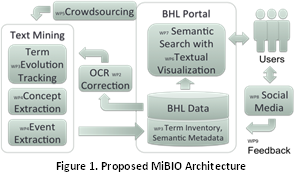
The MiBIO project is an international collaboration (UK, Canada, USA), leveraging large-scale data resources collected and curated by BHL members in US and worldwide, a digital portal developed and maintained by the BHL Technical staff at Missouri Botanical Garden and managed by the BHL Secretariat at the Smithsonian Institution Libraries, text mining resources developed by the UK partner (NaCTeM), and social media, visualization and text cleaning methodologies developed by the Canadian partner (Dalhousie).

The project’s prime objective is to promote the efficient access to and sharing of large-scale biodiversity legacy literature by the worldwide community of science libraries, museums and the interested public The project will integrate novel text mining methods, visualization, crowdsourcing and social media into the BHL to provide a semantic search system aimed to transform BHL into a next-generation social digital library resource that facilitates the study and discussion (via social media integration) of legacy science documents on biodiversity by a worldwide community.

By promoting the development of capabilities that will foster collaboration among researchers from the fields of History of Science, Environmental History, Environmental Studies, Library and Information Science and Social Media, the project hopes to make a significant impact on the above disciplines by (1) enriching a large-scale library, i.e., the BHL, via innovative application of Text Mining techniques to produce semantic metadata and a term inventory, (2) providing improved access to biodiversity-related digital artifacts via an enhanced search engine and visualization of results and (3) stimulating increased collaboration, interaction and sharing of information among BHL users via the social media environment.

View Full Size Image

The Institute of Museum and Library Services (IMLS)is the primary source of federal support for the nation’s 123,000 libraries and 17,500 museums. Our mission is to inspire libraries and museums to advance innovation, lifelong learning, and cultural and civic engagement. Our grant making, policy development, and research help libraries and museums deliver valuable services that make it possible for communities and individuals to thrive. To learn more, visit www.imls.gov and follow us on Facebook and Twitter.

In addition to the U.S. Institute of Museum and Library Services, the sponsoring funding bodies include:

  • Arts & Humanities Research Council (United Kingdom),
  • Economic & Social Research Council (United Kingdom),
  • Canada Foundation for Innovation (Canada),
  • National Endowment for the Humanities (United States),
  • Natural Sciences and Engineering Research Council (Canada),
  • National Science Foundation (United States),
  • Netherlands Organisation for Scientific Research in collaboration with The Netherlands eScience Center (NLeSC) (Netherlands),
  • Social Sciences and Humanities Research Council (Canada).

The U.K. charity Jisc will be providing professional program management in the progression of the United Kingdom projects.

The Biodiversity Heritage Library (BHL) is a consortium of natural history and botanical libraries that cooperate to digitize and make accessible the legacy literature of biodiversity held in their collections and to make that literature available for open access and responsible use as a part of a global “biodiversity commons.” The BHL consortium works with the international taxonomic community, rights holders, and other interested parties to ensure that this biodiversity heritage is made available to a global audience through open access principles. In partnership with the Internet Archive and through local digitization efforts, the BHL has digitized millions of pages of taxonomic literature, representing tens of thousands of titles and over 100,000 volumes.

The Missouri Botanical Garden’s mission is “to discover and share knowledge about plants and their environment in order to preserve and enrich life.” Today, 153 years after opening, the Missouri Botanical Garden is a National Historic Landmark and a center for science, conservation, education and horticultural display.

The Center for Biodiversity Informatics (CBI) at the Missouri Botanical Garden seeks to provide innovative technology solutions to the global community of life science scholars in order to mobilize, integrate, and repatriate data about the world’s biodiversity.

Find more information at:

MiBIO Project Website: www.nactem.ac.uk/DID-MIBIO/

Official Winners Announcement: http://www.diggingintodata.org/Home/AwardRecipientsRound32013/tabid/201/Default.aspx

IMLS Press Release: http://www.imls.gov/5.1_million_awarded_for_delving_into_big_humanities_and_social_science_data.aspx
Dalhousie University Press Release: http://www.dal.ca/news/2014/01/22/natural-history-for-the-digital-age.html

View Full Size Image

This project is made possible by a grant from the Institute for Museum and Library Services [Grant number LG-00-14-0032-14].

January 28, 2014by suzanne.chase
BHL News, Blog Reel

Art of Life Team Holds 2nd Face to Face Meeting in St. Louis, Missouri

Portrait version of the Biodiversity Heritage Library logo.
View Full Size Image
Pictured left to right:  Rob Guralnick, Mike Lichtenberg, Kyle Jaebker, Trish Rose-Sandler, Guarav Vaidya, Joel Richard, Doug Holland, William Ulate.  Not pictured:  Chris Freeland, Mike Blomberg, Chuck Miller.

The NEH-funded Art of Life project recently held its second face to face meeting November 2013 in St. Louis, Missouri.  Institutions represented were from the Missouri Botanical Garden (MOBOT), Indianapolis Museum of Art (IMA), the University of Colorado Boulder (CU-Boulder); Washington University, St Louis (WUSTL), and Smithsonian Institution Libraries (SIL).

The team focused primarily on how to bring the algorithm work to a close.  The IMA developed four algorithms for identifying which pages in the BHL corpus contain images.  Those algorithms were run across a gold standard set of 40k pages to determine their accuracy and performance.  Two of the four algorithms were deemed to be useful (accuracy ratings were above 80%).  Currently, an environment is being established to enable efficient processing of those two algorithms across the entire corpus of 40+ million pages.  There was also discussion on how to refine the functionality of the Macaw tool which will be used to broadly classify the page images into groups such as illustrations, photographs, diagrams/tables, and maps.  Further work on the schema included efforts to create an application profile based on VRA Core and Darwin Core element sets.   Finally, the team wrapped up the meeting by investigating bulk uploads of large numbers of images to Flickr and Wikimedia Commons as well as how to then extract the resulting crowdsourced metadata back into the BHL portal.

Notes and action items from the meeting can be found on the Art of Life site  http://biodivlib.wikispaces.com/Art+of+Life.

View Full Size Image
Pictured left to right:  Kyle Jaebker, Joel Richard, Mike Lichtenberg,
Mike Blomberg, William Ulate, Doug Holland, Guarav Vaidya, Chris Freeland.
Not pictured:  Chuck Miller, Rob Guralnick

Questions about the project’s goals, progress, and technology can be directed to Principal Investigator, Trish Rose-Sandler at trish.rose-sandler [at] mobot.org.  The Art of Life project runs from May 1, 2012 through April 30, 2014 and is generously funded by the National Endowment for the Humanities.

View Full Size Image

Any views, findings, conclusions, or recommendations expressed in this blog post do not necessarily represent those of the National Endowment for the Humanities.

December 10, 2013by sayeedmd
BHL News, Blog Reel

BHL’s Latest News!

View Full Size Image
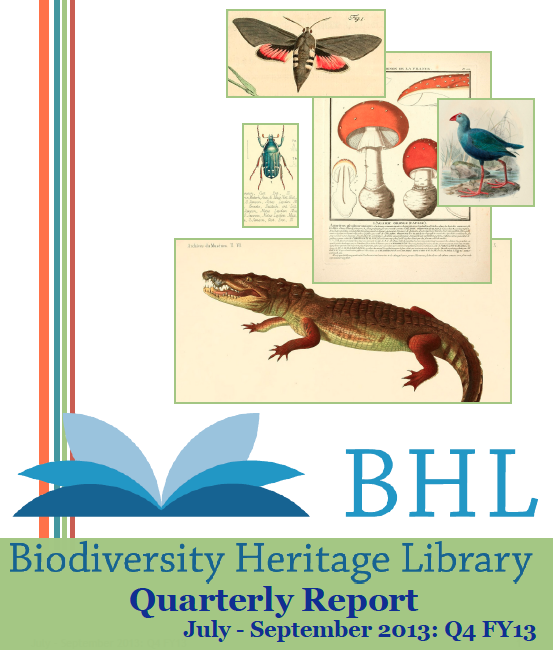
BHL Quarterly Report, Q4 FY13

If you’re reading this blog, you probably already know that BHL provides free and open access to millions of pages of biodiversity literature.  But did you also know that BHL is working to change the nature of biodiversity research through digitization?

In addition to the over 2 million pages scanned by BHL participating libraries in the past twelve months, BHL also co-launched the NESCent-EOL-BHL research sprint which will support research projects seeking answers to important biodiversity and ecological questions through mining BHL and EOL; received an IMLS National Leadership Grant for enhancing full text searching and indexing in BHL through purposeful gaming; organized a social media campaign around unsung biodiversity hero Alfred Russel Wallace; and hosted five interns to build social media, marketing, and reference skills in the next generation of librarians.

Learn all about these developments, and see how our project is performing in the latest BHL Quarterly Report and Newsletter!  Stay up to date in the future by subscribing to our quarterly newsletters.

We know you’ll be impressed at the ways we’re inspiring discovery through free access to biodiversity knowledge!

View Full Size Image
BHL Fall 2013 Newsletter
December 3, 2013by sayeedmd
Page 2 of 3«123»

Help Support BHL

BHL's existence depends on the financial support of its patrons. Help us keep this free resource alive!

search

About BHL

The Biodiversity Heritage Library (BHL) is the world’s largest open access digital library for biodiversity literature and archives. BHL operates as a worldwide consortium of natural history, botanical, research, and national libraries working together to digitize the natural history literature held in their collections and make it freely available for open access as part of a global “biodiversity community.”

Join Our Mailing List

Sign up to receive the latest news, content highlights, and promotions.

Subscribe Now

Subscribe to Blog via Email

Enter your email address to subscribe to this blog and receive notifications of new posts by email.

Join 319 other subscribers

Subscribe to Blog Via RSS

Subscribe to the blog RSS feed to stay up-to-date on all the latest BHL posts.

Access RSS Feed

Inspiring Discovery through Free Access to Biodiversity Knowledge.

The Biodiversity Heritage Library makes it easier than ever for you to access the information you need to study and explore life on Earth…for free, anytime, anywhere.


64+ Million Pages of
Biodiversity Literature Online.

EXPLORE

Tools and Services
to Transform Research.

EXPLORE

300,000+
Illustrations on Flickr.

EXPLORE

ABOUT | HARMFUL CONTENT | PRIVACY | SITE MAP | TERMS OF USE