Biodiversity Heritage Library - Program news and collection highlights from BHL
  • Home
  • News
  • Featured Books
    • All Featured Books
    • Book of the Month Series
    • BHL at 20
  • User Stories
  • Campaigns
    • Fossil Stories
    • Garden Stories
    • Monsters Are Real
    • Page Frights
    • Her Natural History
    • Earth Optimism 2020
  • Tech Blog
  • Visit BHL
Home
News
Featured Books
    All Featured Books
    Book of the Month Series
    BHL at 20
User Stories
Campaigns
    Fossil Stories
    Garden Stories
    Monsters Are Real
    Page Frights
    Her Natural History
    Earth Optimism 2020
Tech Blog
Visit BHL
  • Home
  • News
  • Featured Books
    • All Featured Books
    • Book of the Month Series
    • BHL at 20
  • User Stories
  • Campaigns
    • Fossil Stories
    • Garden Stories
    • Monsters Are Real
    • Page Frights
    • Her Natural History
    • Earth Optimism 2020
  • Tech Blog
  • Visit BHL
Biodiversity Heritage Library - Program news and collection highlights from BHL
Blog Reel, Featured Books

A Pot of Basil in Every Household

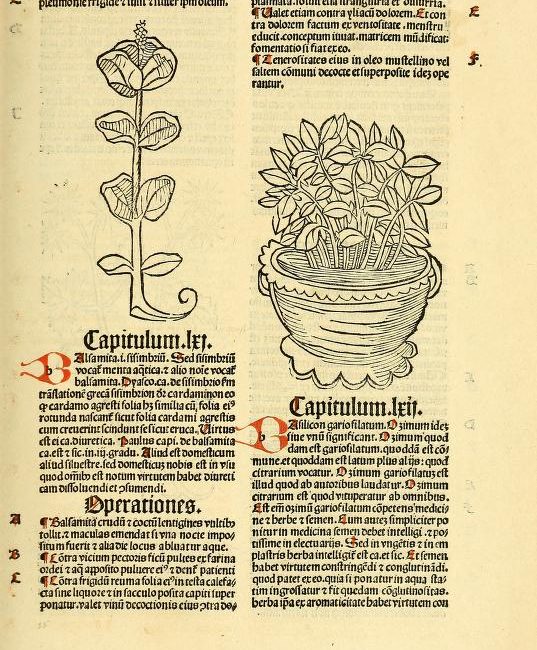
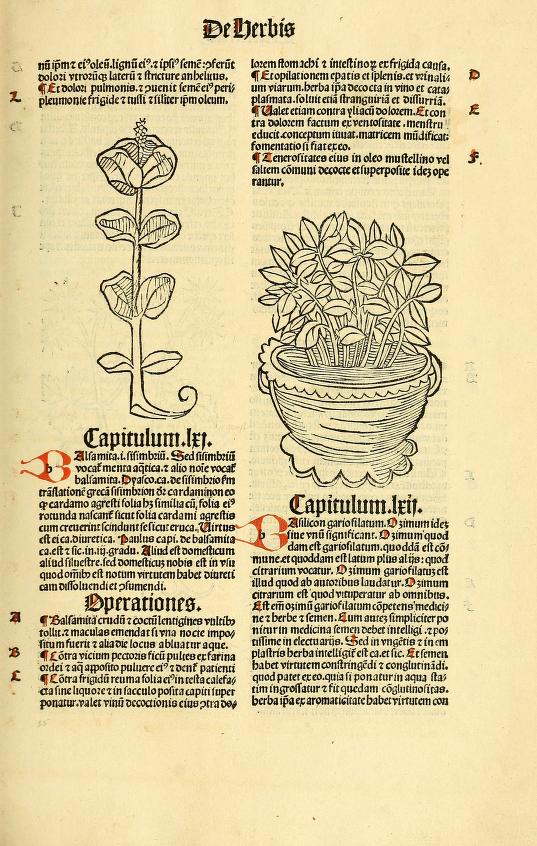
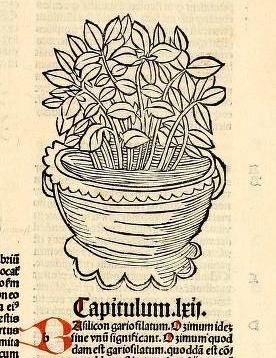
In Johann Prüss’ late 15th-century herbal, Ortus Sanitatis (Garden of Health), a bushy basil plant is portrayed growing in a decorative container. The book, a popular pharmacopoeia of various remedies drawn from ancient and medieval authors, was intended to be practical. The woodcuts are somewhat stylized and simple, meant to be easily identifiable to readers such as a doctor, apothecary, spice merchant, monk, or household member.

This was a manual for ready reference at a time when literacy was not common and earlier written descriptions alone were found to be inadequate. For instance, the all-important roots of the peony, used for infantile epileptic seizure, jaundice, stomach-aches, and kidney and bladder problems, are emphasized rather than its beautiful, fragrant blossoms.

At the time, basil was applied to a number of ailments, including convulsion, deafness, diarrhea and constipation, gout, impotency, colic, and nausea. So is it significant that basil was illustrated in a pot? Medieval and Renaissance art is full of plant symbolism. Or is this portrayal simply a charmingly unexpected domestic detail?
View Full Size Image
Ortus Sanitatis. 1497. Digitized by Smithsonian Libraries. http://www.biodiversitylibrary.org/page/40535862.
Medieval herbals ascribed healing or poisonous ‘virtues,’ the natural properties of plants. Basil is one plant of the garden full of associations, both good and bad, sometimes contradictory. And a pot of basil has a long and colorful history.

Sweet basil (Ocimum basilicum) is an herb of the mint family Lamiaceae. It is native to parts of Asia and Africa. The name may be derived from the Greek βασιλικόν φυτόν (basilikón phutón)—royal or kingly plant. While many culinary authors and cooks consider basil the “king of herbs” for its versatility and dominance in the kitchen (particularly in Italian, Thai, Vietnamese and Laotian cuisines), it long has had royal and religious associations. Ocimum sanctum(holy basil or tulasi) is sacred in the Hindu religion, though not used much in Indian dishes. In Christianity, the herb came to be associated with the Feast of the Cross, celebrating the finding by St. Helena, mother of Emperor Constantine, of the True Cross in a patch of basil.

Ancient Greeks believed basil must be sowed with words of abuse in order to thrive. In both Eastern and Western societies the herb has been associated with death. In ancient Egypt it was applied in embalming rituals. It is also an herb much connected with love and fertility rites, and has been seen as a source of erotic powers. Or, conversely, a sprig of basil would whither in the hands of the impure.

In late Medieval and Renaissance Italy, basil in a pot was a sexy thing: on a windowsill alerts a lover that the lady of the house is available to be entertained. Or, in some accounts, such as in the early 15th-century risqué tales of Sienese Gentile Sermini, its sudden removal was the signal it was safe to come on in. Apparently in some parts of present-day Southern Italy, a family notes the presence of an eligible, virginal daughter by a basil pot in the window.
View Full Size Image
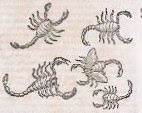
Scorpions. Woodcut from Conrad Gessner, Historia animalium. Liber 2, 1586 (BHL link here)
View Full Size Image
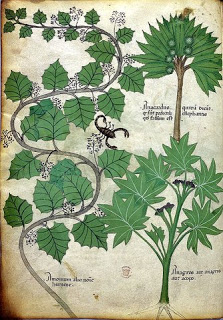
Plants and a Scorpion, in “Herbal” Manuscript folio 3v (Lombardy, Italy, around 1440). British Library Sloane 4016. This illustration indicates that a sting from a scorpion may be soothed by plants.

The Latin basiliskmeans dragon, mythical deadly reptile or serpent, sprouting legends of basil with scorpions. The arachnid with the venomous stinger was said to be bred out of mishandling the cultivated species of Ocimum. Scorpions were believed to favor hiding under a pot of basil, or that a spring of basil under a pot would turn into a scorpion. The Smithsonian’s Floyd W. Shockley, Collections Manager (and scorpion expert) in the Department of Entomology of the National Museum of Natural History, points out that the cool dark underside of the pot is a natural place for scorpions to rest, accounting for their presence and not a particular attraction to the basil.

In the pharmacopoeia on herbal medicine from the surviving writings of the ancient Greek physician and botanist Dioscorides, De Materia Medica, basil is prescribed for application to bites of the sea dragon or stings of the scorpion. Dr. Shockley notes there is some evidence that basil is effective in soothing scorpion stings and that the essential oil in the plant is anti-inflammatory and has pain-relieving enzymes. The plant would work to soothe the bites and stings of many arthropods, but ancient medicinal practitioners really focused on the scorpion relief aspect. Dioscorides observed that Africans would ingest the herb as a preventive measure against the pain of a sting. John Gerard in his famous 16th-century herbal repeated this belief but reported that, as did the 2nd-century physician Galen, basil should not be eaten.

Gerard in the Herball, or Generall Historie of Plantes of 1597, declared “The smell of Basil is good for the heart … it taketh away sorrowfulnesse which commeth of melancholy and maketh a man merry and glad.” Nicholas Culpeper in the 17th century wrote: “And away to Dr. Reason went I, who told me it was an herb of Mars, and under the scorpion, and, perhaps therefore called basilican, and it is no marvel if it carry a kind of virulent quality with it.” And, noting the differing portrayals of the plant: “This is the herb which all authors are together by the ears about and rail at one another (like lawyers).”
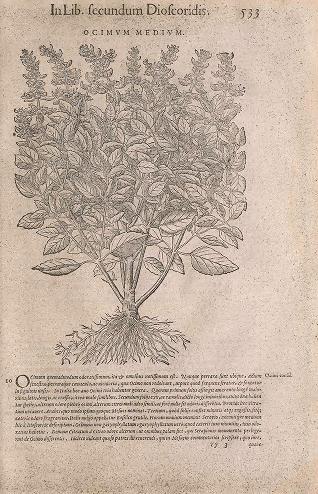
View Full Size Image
Illustration of one type of basil in the Smithsonian Libraries’ 1565 edition of Mattioli (BHL scan here)

Much of ancient plant folklore was dismissed by Pier Andrea Mattioli (1501-1577) in his commentaries on Dioscorides, Di Pedacio Dioscoride Anazarbeo Libri cinque Della historia, et materia medicinale. The work first appeared in 1544, with illustrations in the 1554 edition, and became the most influential Italian herbal of the 16th century.

A medical doctor and botanist, born in Siena, the perennially grumpy Mattioli provides the delightful contemporary observation that basil was found to be growing in every Italian household, often in a pot placed by a window or in the garden. However, the finely cut illustrations in his herbal are without any whimsy such as a container. Likewise, Leonhart Fuchs’ splendid De Historia Stirpium (1542) notes this domestic element and illustrates different types of basil, including the roots, leaves, stems, and flowers. These publications are products of the Renaissance, knowledge drawn from direct observation and not legend, although much of the texts still rely on Dioscorides.
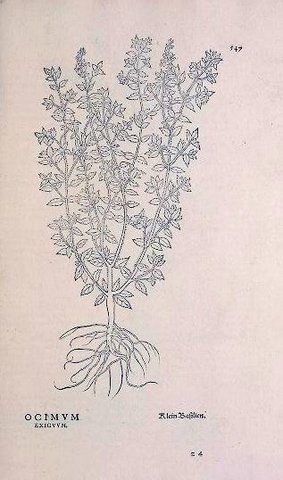
View Full Size Image
Fuchs: “Women everywhere raise Ocimun in clay pots on windowsills of their homes, also in gardens.” Smithsonian Libraries’ copy scanned by BHL (link here)
Fuchs wrote that ozimumis Greek for fragrant. Basil has highly aromatic leaves and placed in a pot would serve to sweeten the air. Royal apothecary and botanist John Parkinson in Paradisi is Sole Paradisus Terrestris(1629) wrote that basil was sometimes used in nosegays and made “sweet or washing waters.” (Boston Public Library copy). In the home, the herb acted to keep flies out. Basil is, of course, sensitive to cold temperatures and planted (in Northern Europe) in a container would allow for easy moving to a warm shelter.

There are surviving examples of actual 15th-century basil pots, known as alfabeguer (derived from the Arabic word for sweet basil). These decorative containers were imported from Valencia, supplying a demand for this luxury item throughout Europe. In the Rothschild collection at Waddesdon Manor is a beautiful one, decorated in lustre and blue, dating from 1440 to 1470.
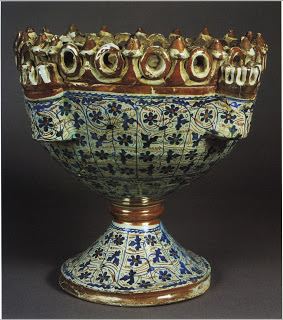
 

View Full Size Image
The Rothschild Alfabeguer (this and other illustrations of basil pots here).


View Full Size Image
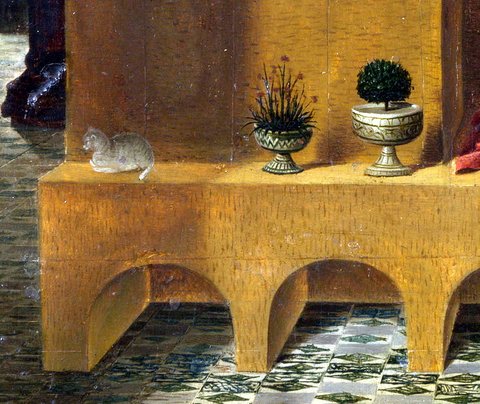
Detail of Antonello da Messina’s “St. Jerome in his Study,” of alfabeguers (and kitten) approximately 1475 (National Gallery, London)
There is an earlier recording of basil pots used as decoration or furnishing in a home, and readers of Prüss’ herbals may have picked up on the allusion. In Giovanni Boccaccio’s The Decameron (Day IV, Novella 5) of approximately 1353, is the story of Lisabetta and Lorenzo. The lady’s three brothers murdered the lowly born Lorenzo to thwart the forbidden love between the servant and their sister. They buried the corpse in a location that came to her in a dream. Lisabetta dug up the grave, decapitated the head, and, returning home:
There she shut herself up in her room with the head, and kissed it a thousand times in every part, and wept long and bitterly over it, till she had bathed it in her tears. She then wrapped it in a piece of fine cloth, and set it in a large and beautiful pot of the sort in which marjoram or basil is planted, and covered it with earth, and therein planted some roots of the goodliest basil of Salerno, and drenched them only with her tears, or water perfumed with roses or orange-blossoms. And ‘twas her wont ever to sit beside this pot, and, all her soul one yearning, to pore upon it, as that which enshrined her Lorenzo, and when long time she had so done, she would bend over it, and weep a great while, until the basil was quite bathed in her tears.”

The basil thrived with this fertilization and watering, but the distraught Lisabetta did not: the evil brothers discovered poor Lorenzo’s head in the flowerpot and stole it away. She died from further grief.
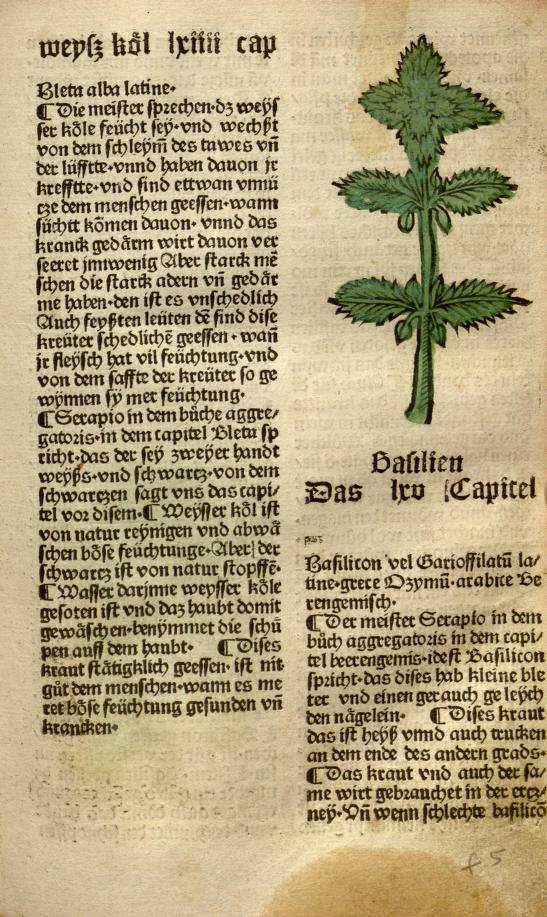
View Full Size Image
A more typical illustration of basil from an earlier period, showing the plant truncated. The Smithsonian Libraries‘ Gart der Gesundheit [Ulm?: Konrad Dinckmut?, 1487?], often attributed to Johannes von Cuba. The Missouri Botanical Garden’s copy has been scanned by BHL (link here).


A version of Peter Schöffer’s Ortus ([H]ortus) Sanitatis(1485) was published in 1491 by Jacob Meydenbach of Mainz. Some of the more than a thousand small illustrations were copied rather crudely from Der Gart der Gesundheit (also of 1485), which itself was based on the Latin Herbariusof 1484 (Missouri Botanical Garden copy in BHL). Although there is an occasional genre scene (such as laborers) and landscape setting sprinkled throughout these early printed herbals, most of the plants are simply shown cut off at the stem. The first of Prüss’ editions of Meydenbach’s Ortus Sanitatis, printed in Strasbourg in 1497, is the Smithsonian Libraries’ copy which has been scanned for the Biodiversity Heritage Library.
View Full Size Image

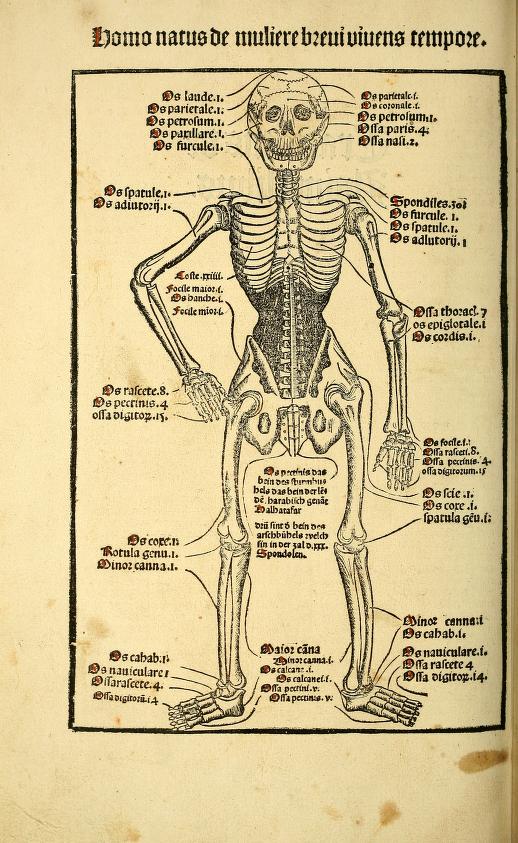
A pot of basil: may this be symbolic or practical, whether signifying divine or earthly love, used as a culinary ingredient or insect repellent, to soothe a sad soul, or just a convenient place to store a lover’s severed head. The iconography of the image in printed books, manuscripts and paintings is yet to be fully explored. The bibliography of early printed herbals—endless editions, translations, fragments, versions, and reuse and copying of woodcuts—is a complex and difficult task to sort out. But the increasing number of scanned early herbals in the Biodiversity Heritage Library allows for easy exploration of these extremely rare works. Perhaps Prüss’ Ortus Sanitatis has a unique basil pot because of an inventive author/illustrator. The book does contain a woodcut of the human skeleton, the first appearance of one in an herbal.

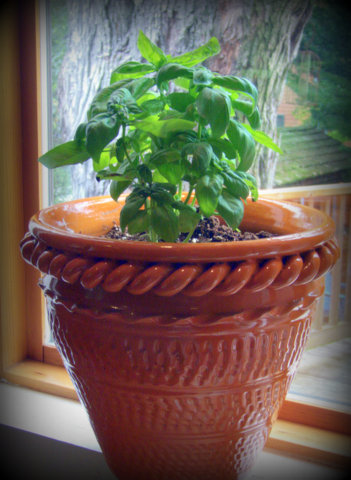
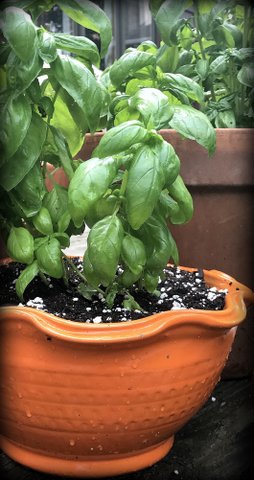
Should you happen upon any, please send me your finds of illustrations of basil in a pot. Or, a picture of the herb growing in a container on your windowsill.

View Full Size ImageView Full Size Image


View Full Size Image

Notes

View Full Size Image
What is old is new again: basil oil from the local grocery store.
The first printed herbal to have illustrations is Macer Floridus’ De Viribus Herbarum (Milan, 1482).
Di Pedacio Dioscoride Anazarbeo Libri cinque Della historia, et materia medicinale first appeared in 1544. It was soon reprinted many times in a variety of languages; there are several of these editions in the Smithsonian Libraries and many digitized versions in the Biodiversity Heritage Library (link to one here).
Blunt, Wilfrid and Sandra Raphael. The Illustrated Herbal. New York: Thames and Hudson, 1994.

Ray, Anthony. “The Rothschild ‘Alfabeguer’ and Other Fifteenth-Century Spanish Lustred ‘Basil-Pots’,” The Burlington Magazine, vol. 142, no. 1167 (June 2000), pages 371-375 (link here).

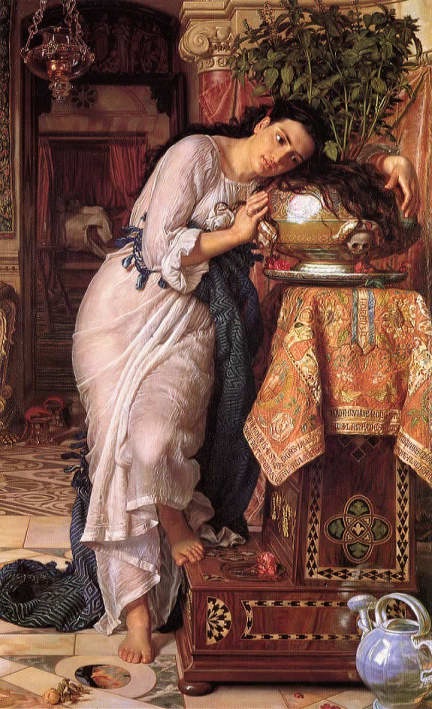
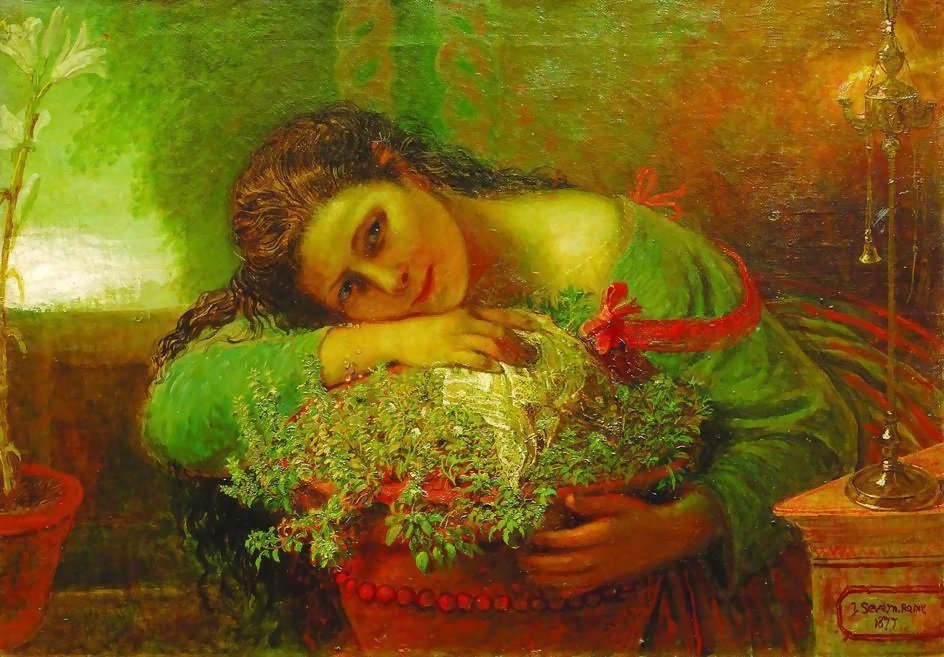
Poet John Keats picked up the narrative in “Isabella or, the Pot of Basil” (1818). In turn, British painters of the 19th century, most notably by the Pre-Raphaelite William Holman Hunt, were greatly inspired by the story.
View Full Size Image
Painting of 1867, by William Holman Hunt. Laing Art Gallery, Newcastle upon Tyne, England (image from Wikimedia Commons)


She wrapp’d it up; and for its tomb did choose
A garden-pot, wherein she laid it by,
And cover’d it with mould, and o’er it set
Sweet Basil, which her tears kept ever wet.
…
And so she ever fed it with thin tears,
Whence thick, and green, and beautiful it grew,
So that it smelt more balmy than its peers
Of Basil-tufts in Florence; for it drew
Nurture besides, and life, from human fears,
From the fast mouldering head there shut from view:
So that the jewel, safely casketed,
Came forth, and in perfumed leafits spread.
View Full Size Image
“Isabella, or the Pot of Basil,” painting by Joseph Severn (1793-1879), a close friend of Keats (image from Wikimedia Commons). Guildhall Art Gallery, London.
View Full Size Image
Ocimum basilicum ‘Genovese Verde Migliorato’. The only variety for proper pesto.


June 27, 2017by khage
Blog Reel, Campaigns, Featured Books, Garden Stories

“’Tis A Gift To Be Simple” But to Have a Splendid Garden Buy Shaker Seeds

View Full Size Image
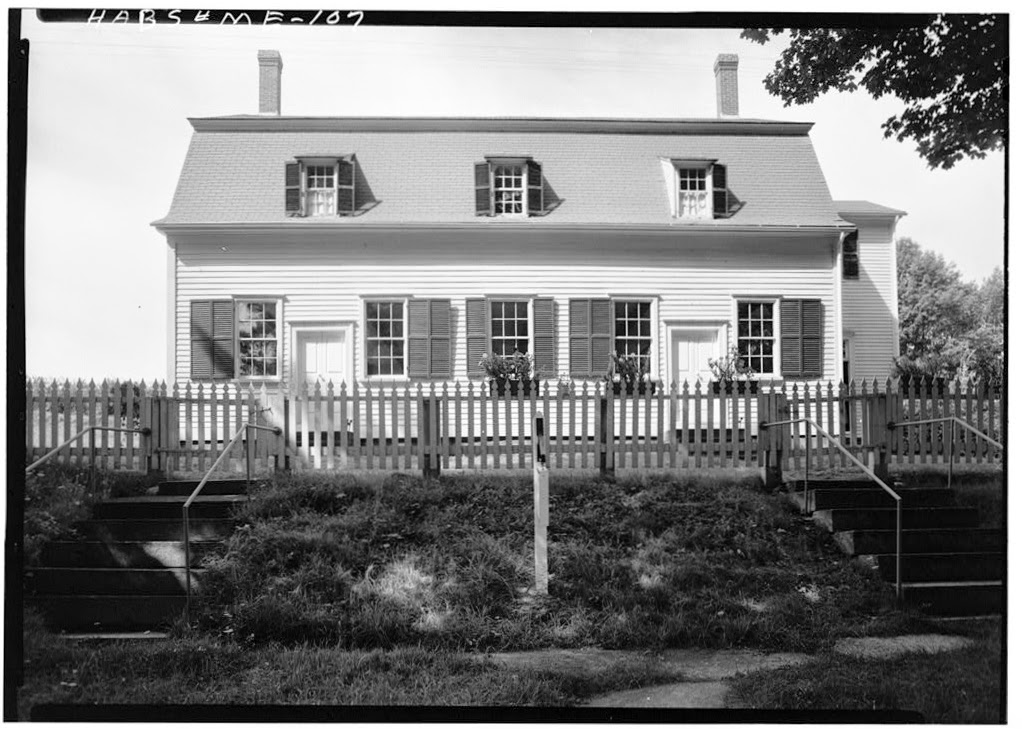
Sabbathday Lake Shaker Community Meetinghouse  (photo by Gerda Peterich for the Historic American Buildings Survey, Library of Congress Prints and Photographs Division; HAB SME,3-SAB,1—1)

The United Society of Believers in Christ’s Second Appearing, a religious sect commonly referred to as the Shakers, was founded in 18th-century England from a branch of the Quakers. Along with other newly formed devotional groups, they soon immigrated to colonial America. There they established as their economic foundation a variety of cottage industries that thrived throughout the 19th and into the early 20th centuries. Now known mostly for wonderfully simple architecture, austere but beautifully designed furniture and such functional objects as nesting oval boxes and baskets, members of the Shaker communities also once had booming garden and seed businesses. Their labor-intensive methods of working inevitably came to be overwhelmed by competition from industrial manufacturing as well as the problem of ever-shrinking membership, celibacy being one of their central tenets.

View Full Size Image
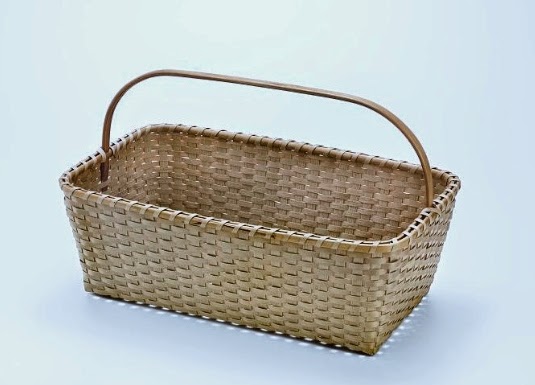
Shaker Carrier (by Sharon Dugan; Smithsonian American Art Museum, Gift of Martha G. Ware and Steven R. Cole; no. 2011.47.11)
The first fully organized Shaker community was New Lebanon in New York; by 1789, two years after its formation, the members cultivated seeds as a cash crop. This was the second earliest “company” to sell seeds in America. David Landreth & Son of Philadelphia was the first, in 1784, and that business traded back and forth with the Shakers. Another early dealer was Grant Thorburn in Philadelphia who wrote about the difficulty of obtaining seeds of good quality.
Other Shaker settlements, or “families,” soon followed in the seed-production business, including Watervvliet, New York; Hancock, Massachusetts; Enfield, Connecticut; Canterbury, New Hampshire; Alfred, Maine; and South Union, Kentucky, among several others. All were known for the excellence of their products and integrity of their business dealings. Devotion to God was expressed through their work ethic, hand labor and craftsmanship. The selling of goods was meant to raise funds only for needs the Shakers could not supply for themselves.

It is uncertain whether the Shakers were the first to put their seed products in small paper envelopes or packets, but they were the first to popularize their use. The Shaker Brothers printed millions of them on their presses, while the Sisters performed the labor of cutting, folding and pasting the papers. While believing in partnership in work and equality of the sexes, occupations tended to fall along traditional gender lines. The Brothers tilled the fields while the Sisters picked, sorted and packaged the seeds and herbs.

View Full Size Image
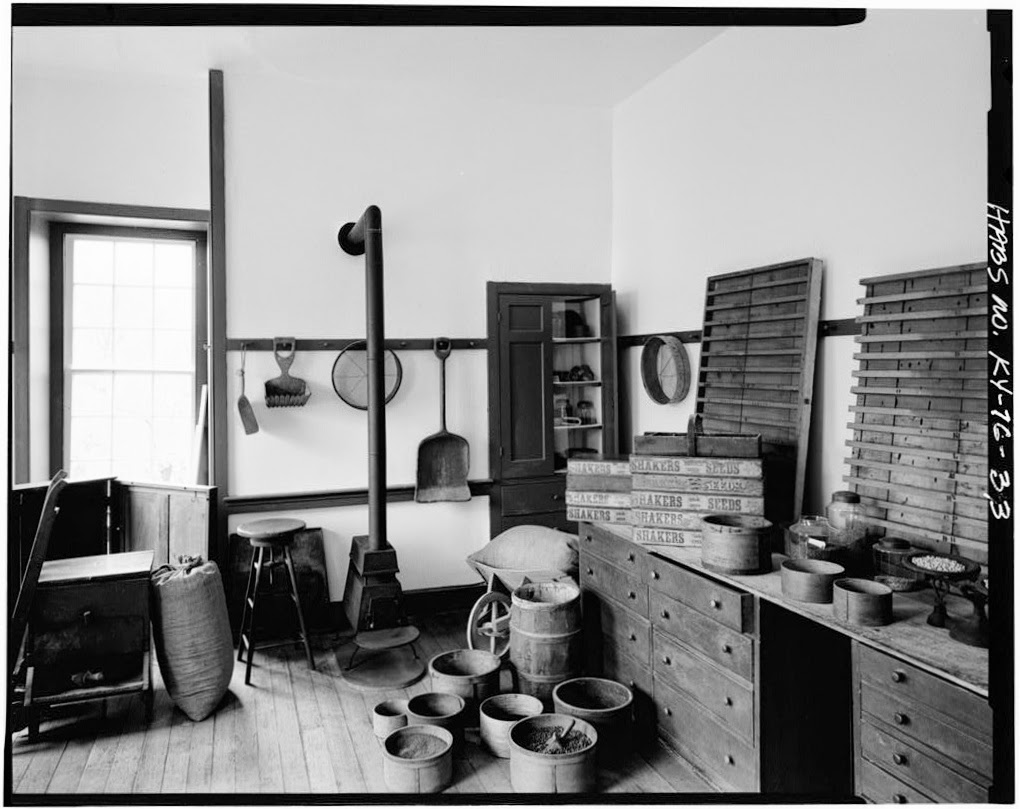
Seed Room, Shakertown, Kentucky (LC Prints & Photographs Division; HABS,84-SHAKT,2-33)

The Shakers were also early adopters of incorporating gardening manuals in their catalogs. Charles Crossman wrote ones in 1835 and 1836 for Mount Lebanon, Pittsfield and Watervilet, directing the wholesaler or the individual purchaser how best to plant the offered seeds. Instructions for storing and cooking bounties from the gardens were also sometimes given. Vegetables dominated the products but herbs and flowers as well as grass also appear in the lists. Crossman later left the Shakers and established his own company in Rochester, New York, which was just beginning to become the thriving horticultural center in the country.

View Full Size Image
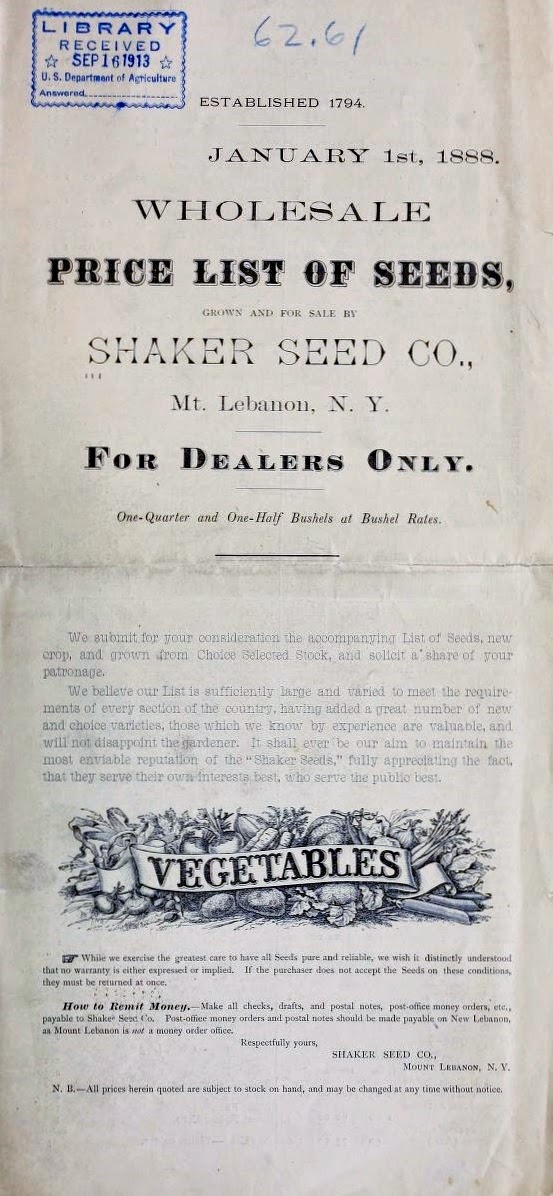
Wholesale price list of seeds by the Shaker Seed Company. New Lebanon, New York, 1888 (Henry G. Gilbert Nursery and Seed Trade Catalog Collection, National Agriculture Library; image from the Biodiversity Heritage Library)

As the Shaker seed business in the United States grew from 1840, printing firms outside of the communities were employed to keep up with demand. Correspondingly, advertisements and the design of the packets, begun first plain with simple chunky block type, were transformed to include the use of color papers and borders and eventually vivid chromolithography.

Following the Civil War, increased competition resulted in the Shakers’ using the word “genuine” in their advertising, as products from the communities were considered to be of the highest quality, their best selling point. They also used various and effective marketing techniques, including seed boxes meant to be displayed on the counters of country stores. The containers had compartments for assorted Shaker vegetable and flower seed packages, with a hinged lid to be propped open to display a broadside detailing the contents within, and a chromolithographic image of a bountiful harvest, promising the purchaser a similar reward.

View Full Size Image
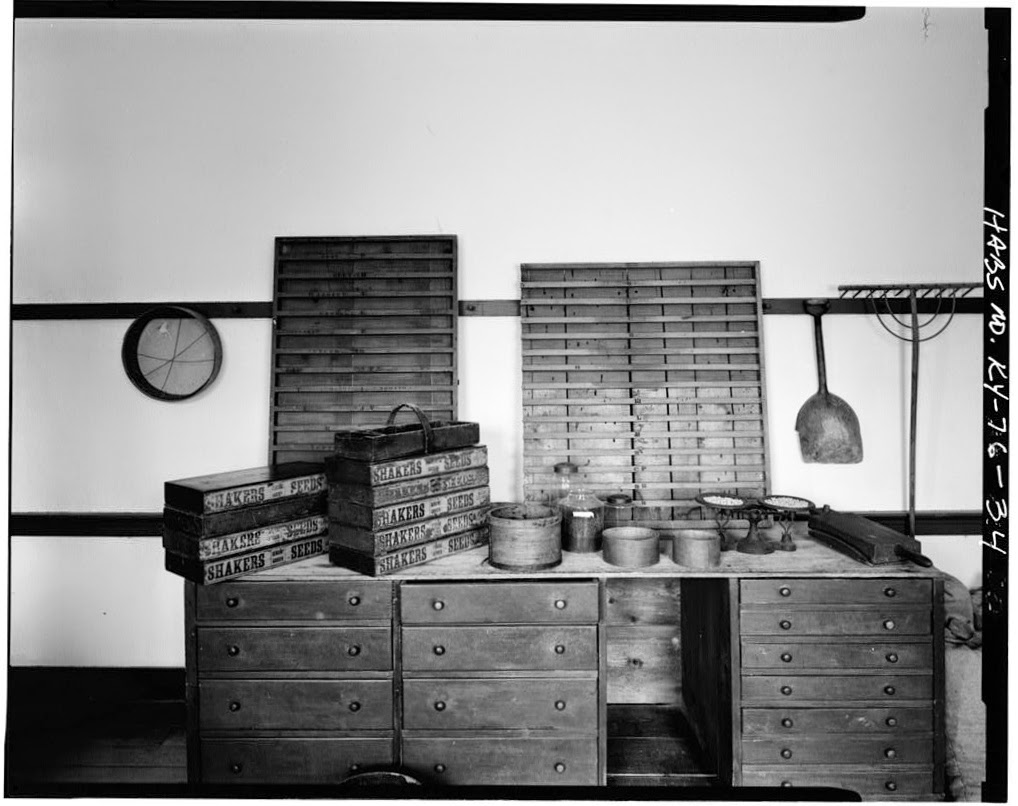
Seed Room with display containers, Shaker Centre Family Dwelling House, Shakertown, Mercer County, Kentucky (Library of Congress Prints and Photographs Division; HABS KY,84-SHAKT,2—34)

Other surviving ephemera record the once-thriving industry of seed, herbal, food, and medicinal products from the Shakers. Along with seed catalogs and the packets, mailing tags and envelopes, broadsides, receipts, invoices, billheads, and labels, give testament to their industry. Product labels include currant, grape, wild cherry, and blackberry wines. Far from being abstinent (except in the matter of sex), the Shakers made at least fourteen varieties of wine as well as distilled spirits. The religious group in their various communities was also at the forefront of selling medicinal herbs in the United States.

View Full Size Image
Shaker Digestive Cordial (A.J. White, New York, New York; National Museum of American History, no. 246707)

The changing world and market forces caused the Shaker seed industry to gradually peter out at the beginning of the 20th century. Increasing industrialization, growth of urban centers with ease of shipping and mailing to formally isolated villages, and overwhelming production from big companies, particularly in Philadelphia and Rochester, eliminated the communities’ wagon and sleigh seed routes for trading. With their firm spiritual beliefs and practices, the Shakers were not very competitive against aggressive business tactics.

View Full Size Image
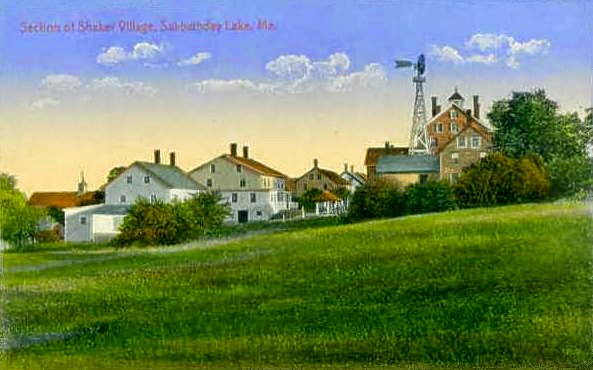
Postcard of the Shaker Village of Sabbathday Lake, Maine (ca. 1920; Wikimedia Commons)

At their peak in the mid-19th century there were about 6,000 “Shaking Quakers” so named because of their ecstatic behavior during worship services. Today, Sabbathday Lake Shaker Community, founded in 1783 in Maine, is the sole active survivor of the religion. A tree farm, an apple orchard and vegetable gardens are maintained, and hand-set printing is still practiced. The library there holds ephemera such as account records, recipes, catalogs and 1,380 labels printed by Shakers for their own products. They are living testament to the Shakers’ influence on the American seed and nursery industry and their permanent place in horticultural history—the early development of the new business, innovative techniques in marketing and education as well as the propagation and introduction of new varieties. The Sabbathday Shakers still sell herbs, and their catalog is online.

View Full Size Image
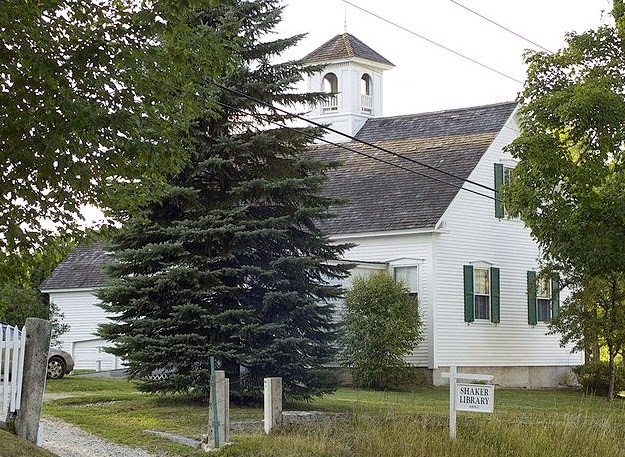
The Library of Sabbathday Village in New Gloucester, Maine (Wikimedia Commons, August 2010)
View Full Size Image
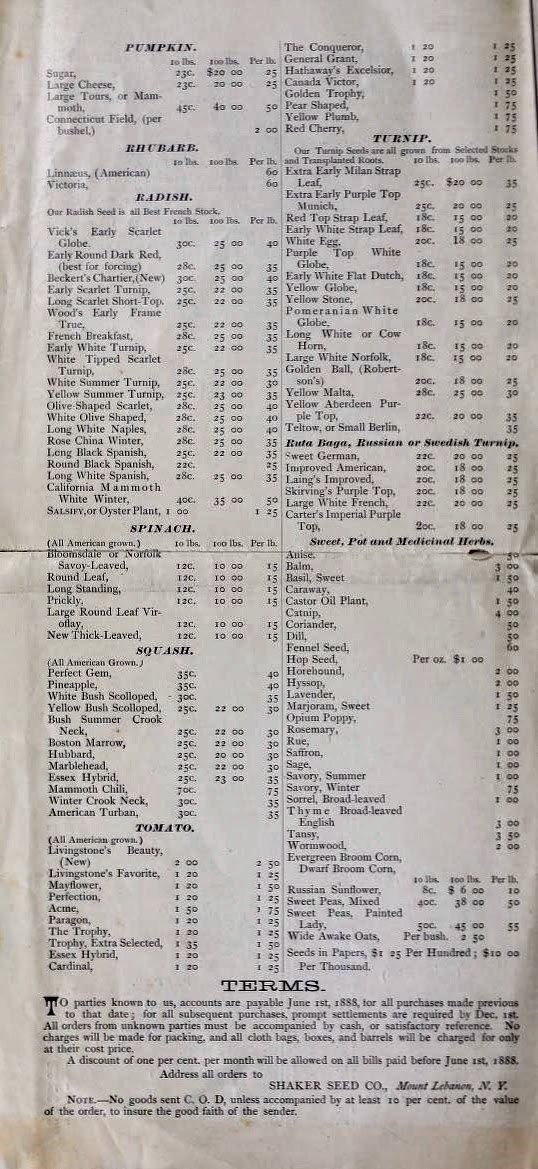
Wholesale price list of seeds by the Shaker Seed Company, Mount Lebanon, New York, 1888 (Henry G. Gilbert Nursery and Seed Trade Catalog Collection, National Agriculture Library)

More Garden Stories Fun

  • Follow our blog and #BHLinbloom on Twitter and Facebook (or go directly to BHL’s Twitter and Facebook) this week as we explore the fascinating world of gardening, from its history to plant factoids and practical gardening tips.
  • Browse over 14,000 seed and nursery catalogs in our collection.
  • Browse over 2,500 seed and nursery catalog images in our Flickr collection.
  • Explore select seed catalog art, and stunning bookmarks and postcards developed by Cornell Library, on Pinterest.
  • See historic gardening come to life on the Smithsonian Libraries’ Tumblr.
  • Purchase your very own Garden Stories T-Shirt through T-Fund. All proceeds will go to help us digitize more pages for BHL. Our goal is to sell enough shirts to digitized 5,000 pages. Can you help us get there?
  • Help us improve access to seed and nursery catalogs by transcribing some today as part of our the Institute of Museum and Library Services (IMLS)-funded Purposeful Gaming project!
  • Find great online gardening resources, tips, and help on the BHL Gardening Resources Page.
March 27, 2015by mckenzie.87
Blog Reel, Featured Books

Book of the Week: The Curious Cures

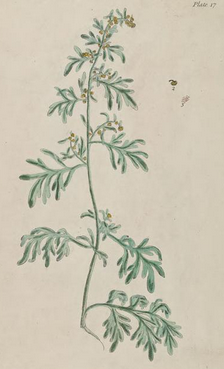
Take two of these and call in the morning. Those aren’t unusual words coming from a doctor if the “two of these” refers to some aspirin or Tylenol. It’d be a little more curious if the prescription called for two stalks of mugwort, infused with wine and a dash of salt. An interesting remedy for the common malady, but not something easily procured from the corner drug store. In the context of modern medicine this might seem an ineffective treatment, but in this week’s book of the week, “A curious herbal,” it’s the go-to recommendation for any and all disorders of the stomach, jaundice, general malaise, or swelling of the tonsils.

View Full Size Image
Blackwell’s illustration of the
Artemisia absinthium, cure for
the common stomachache.
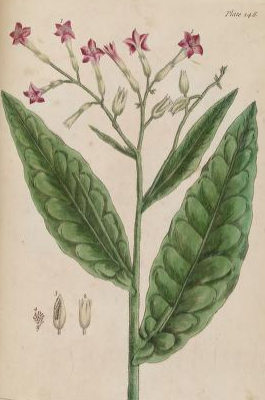
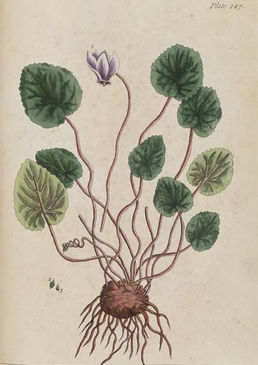
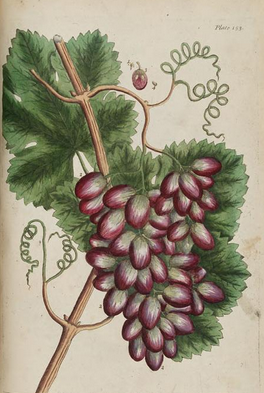
While this is not the first time “A curious herbal” has made an appearance on the BHL blog, this book offers such a variety of remedial plants that there’s an almost endless supply of medicinal instructions. Looking for a cure-all ointment or oil? Try Petum tabaccum, commonly known as tobacco. The green leaves of the plant can be used for wounds, ulcers, inflammations, tumors, and the mysterious “King’s Evil.” Even the dust “destroys Fleas, Lice, & other Vermine (sic).” Some of the plants require caution, but the Palma christi, referred to as “The greater Spurge” in the herbal, but also known as a castor oil plant, is recommended to be used with care for “watery Humors” as well as the oil extracted from the seeds “to destroy Lice in Children’s Heads.” And for a great preventative against the Plague, the Vitis vinifera, grown in Spain, Portugal, Italy, and France and flowering in April, is the approved plant of choice, also used to strengthen the stomach, help digestion and comfort the bowels. 
View Full Size Image
Petum tabaccum
View Full Size Image
Palma christi
View Full Size Image
Vitis vinifera

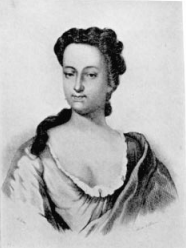
Capturing the habitats, descriptions, uses, and even the likeness of these functional plants was Elizabeth Blackwell. The legacy of Blackwell is non-existent in the history of medicine, her efforts largely dismissed as unscientific, but she was the first woman to produce an herbal, one that was innovative with an illustrated list of medicinal plants available to the medical community and the public.

View Full Size Image
Elizabeth Blackwell,
herbalist and bondsman,
from The British Library.

Blackwell’s hand-drawn illustrations and engravings were prompted by a debt and a prison sentence. Her husband and second cousin, Alexander, had a somewhat loose relationship with the law. Some shady dealings and a few questionable business decisions later, and Alexander found himself in debtors’ prison, and Blackwell found herself in a position where she needed a way to make some money quickly.

At the time, botany and the natural sciences had become a worthy pursuit of proper ladies. Blackwell had training in drawing and illustrating, had access to a printing press from one of her husband’s ne’er-do-well business pursuits, and had an idea to fill what she perceived as a void in the literature. “A curious herbal: containing five hundred cuts, of the most useful plants, which are now used in the practice of physick engraved on folio copper plans, after drawings taken from the life” was the result, issued in weekly parts and later published in two volumes.

It wasn’t the quickest means to pay off Alexander’s debts, but six years later, the book was published and Alexander was out of prison. The story didn’t end well for the couple. The two were separated after Alexander found himself on the wrong side of the law yet again, he attempted to flee, but was tried and hung for treason in 1748. Blackwell, who dedicated so many years to the herbal and immediately sold the copyright to pay off her husband’s debts, never saw him again and died ten years later.

The lack of notoriety for Blackwell herself notwithstanding, “A curious herbal” drew from the works of Sir Hans Sloane, Dr. Richard Mead, Isaac Rand and Philip Miller from the Society of Apothecaries, and Maria Sibylla Merian’s “Neues Blumen Buch,” and was the most prominent herbal of the day, still acclaimed for its detailed illustrations. Blackwell was by no means a doctor, but her herbal reference work informed the doctors–and patients–in this pre-drug store era and provides some tips for future herbalists when the Tylenol just doesn’t cut it.

Interested in more natural remedies? Check out Dr. Alain Touwaide and Emanuela Appetiti’s PLANT digital library, or rather the PLantarum Aetatis Novae Tabulae, a collection of full-text books on botany and medicinal plants printed during the 1481-1650 period. Or explore the great virtual exhibit from our BHL-Europe colleagues on all the history, legends, and, most importantly, delicious recipes surrounding other multi-use herbs and spcies.

Like the illustrations from this post? Check out this collection of medicinal plant illustrations from the BHL’s Flikr account.

References:

  • Beatty, K. (2013). “The Illustrated Herbal of Elizabeth Blackwell: A Curious Story.” Suite 101, retrieved from http://suite101.com/article/the-illustrated-herbal-of-elizabeth-blackwell-a-curious-story-a252195
  • Madge, B. (2001). “Elizabeth Blackwell–the forgotten herbalist?” Health Information and Libraries Journal, 18, p. 144-52.
September 19, 2013by LANL_RL

Help Support BHL

BHL's existence depends on the financial support of its patrons. Help us keep this free resource alive!

search

About BHL

The Biodiversity Heritage Library (BHL) is the world’s largest open access digital library for biodiversity literature and archives. BHL operates as a worldwide consortium of natural history, botanical, research, and national libraries working together to digitize the natural history literature held in their collections and make it freely available for open access as part of a global “biodiversity community.”

Join Our Mailing List

Sign up to receive the latest news, content highlights, and promotions.

Subscribe Now

Subscribe to Blog via Email

Enter your email address to subscribe to this blog and receive notifications of new posts by email.

Join 319 other subscribers

Subscribe to Blog Via RSS

Subscribe to the blog RSS feed to stay up-to-date on all the latest BHL posts.

Access RSS Feed

Inspiring Discovery through Free Access to Biodiversity Knowledge.

The Biodiversity Heritage Library makes it easier than ever for you to access the information you need to study and explore life on Earth…for free, anytime, anywhere.


64+ Million Pages of
Biodiversity Literature Online.

EXPLORE

Tools and Services
to Transform Research.

EXPLORE

300,000+
Illustrations on Flickr.

EXPLORE

ABOUT | HARMFUL CONTENT | PRIVACY | SITE MAP | TERMS OF USE