Biodiversity Heritage Library - Program news and collection highlights from BHL
  • Home
  • News
  • Featured Books
    • All Featured Books
    • Book of the Month Series
    • BHL at 20
  • User Stories
  • Campaigns
    • Fossil Stories
    • Garden Stories
    • Monsters Are Real
    • Page Frights
    • Her Natural History
    • Earth Optimism 2020
  • Tech Blog
  • Visit BHL
Home
News
Featured Books
    All Featured Books
    Book of the Month Series
    BHL at 20
User Stories
Campaigns
    Fossil Stories
    Garden Stories
    Monsters Are Real
    Page Frights
    Her Natural History
    Earth Optimism 2020
Tech Blog
Visit BHL
  • Home
  • News
  • Featured Books
    • All Featured Books
    • Book of the Month Series
    • BHL at 20
  • User Stories
  • Campaigns
    • Fossil Stories
    • Garden Stories
    • Monsters Are Real
    • Page Frights
    • Her Natural History
    • Earth Optimism 2020
  • Tech Blog
  • Visit BHL
Biodiversity Heritage Library - Program news and collection highlights from BHL
Blog Reel, Featured Books

Myrtle: The Provenance and Meaning of a Plant

Provenance can be defined as the chain of ownership of any type of object from its creation to the present day. The Smithsonian’s Material Culture Forum recently held a lively session of presentations and discussions on this topic, with speakers from across the Institution: the National Zoo; Natural History Museum scientists and researchers in anthropology and paleobiology; archivists of World War II-era material; and curators from the National Museum of American History, the National Air & Space Museum, and the National Museum of African American History and Culture. There were many other subject specialists (such as a horticulturist) who could have participated, given time and world enough, as ownership history is a crucial matter and a commonality in the work of Smithsonian staff. Issues and questions about the history of a collection, transfer of possession, and unlawful appropriation can be applied to a living object (for example, the golden lion tamarin) as well as works of art or rare books.

The provenance of a botanical specimen was recently presented to a world-wide audience, even if they did not quite realize it. One detail of the Royal wedding of Prince Harry and Meghan Markle had commentators confidently offering up the history of the sprig of myrtle used in the bride’s bouquet. This was commonly reported to be from the plant nurtured from the flower used in the marriage ceremony of Queen Victoria and Prince Albert. Every bride in Royal nuptials after Victoria carried on the ritual. If not quite true, it made for a nice, simplified story line.
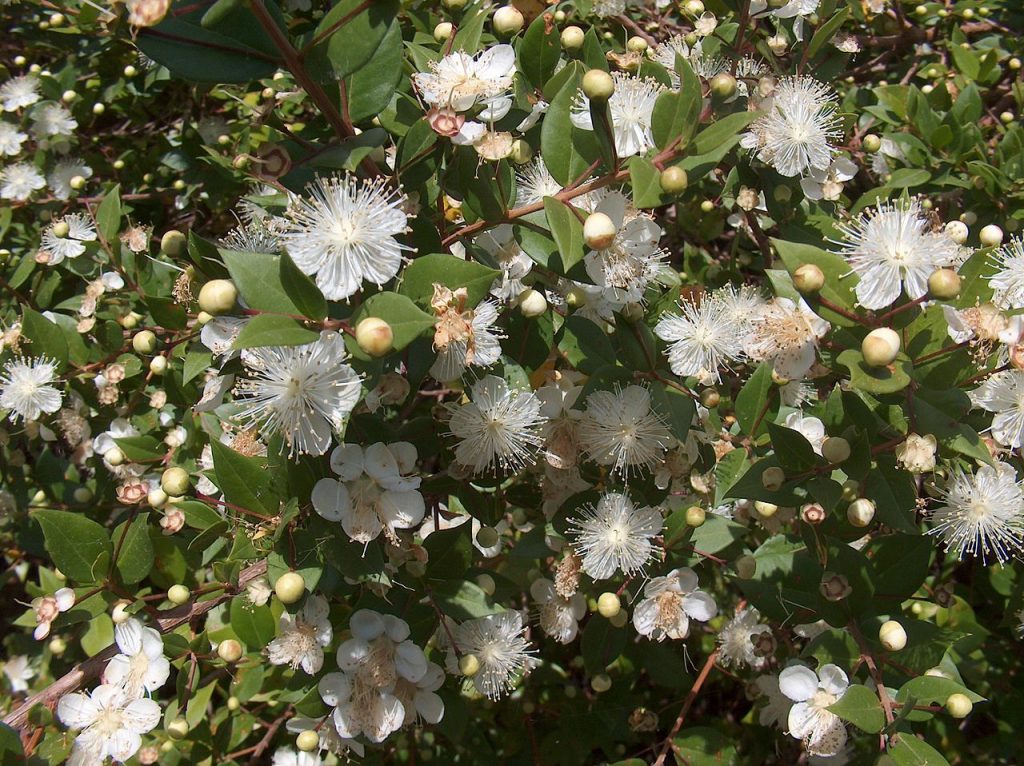
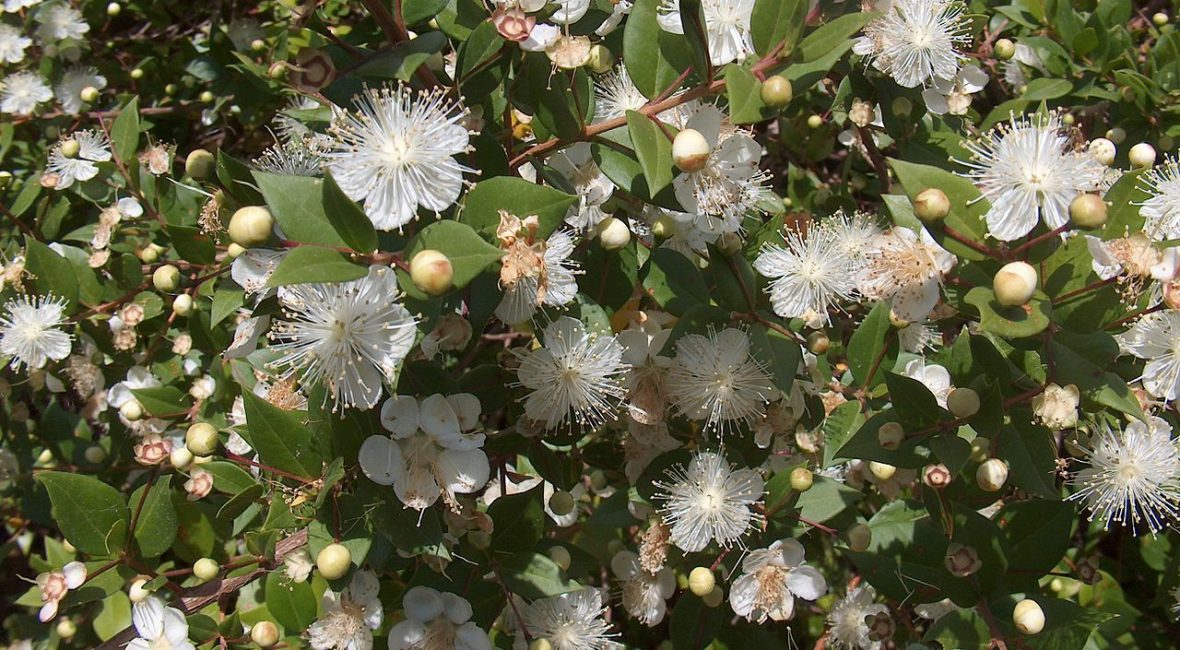
Myrtle growing in Sardinia, Villacidro (photo supplied from Wikimedia Commons)

The tidbit no doubt had some wondering just what myrtle is. In this present age, it is not a common wedding flower nor used much for culinary or medicinal purposes. Some may know myrtle as potted topiary, from its many references in poetry, or as the name of a character in literature—The Great Gatsby or Harry Potter, for instance.

Myrtus communis (true myrtle), of the family Myrtaceae, is a fragrant, evergreen shrub with small, glossy green leaves and white, star-shaped flowers with long stamens, and, after their blooming, purple-black berries. It is native to Mediterranean Europe, North Africa, the Middle East, and Turkey. In these temperate climates it is sometimes clipped as a hedge. As a container plant of topiary, it is often trimmed to look like a fuzzy bowling ball balancing on top of a long stem or a pyramid, and is brought inside in cooler weather.
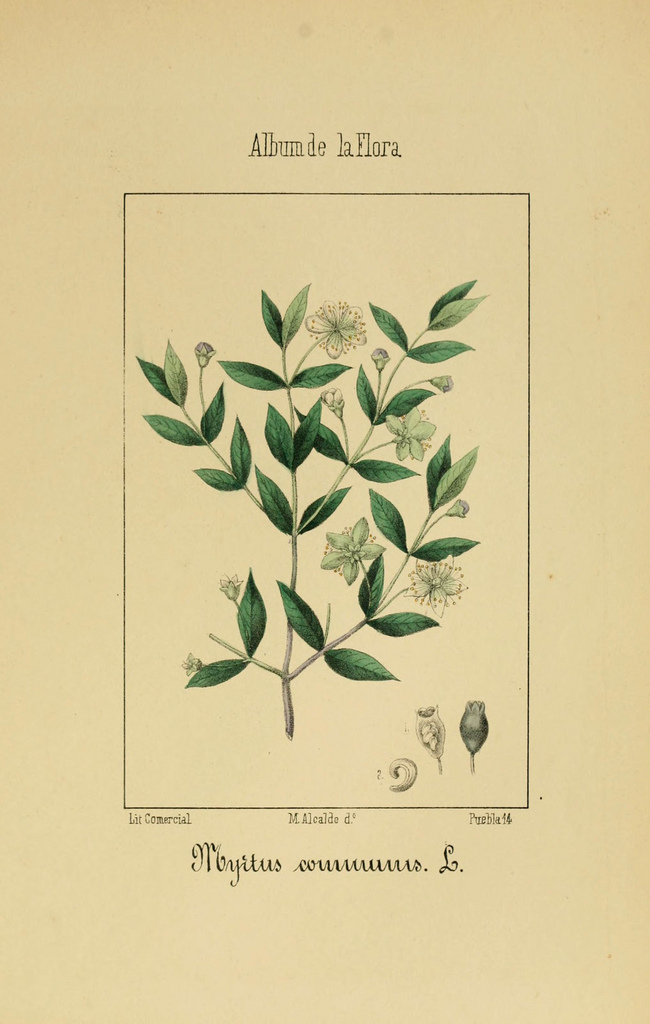
Myrtus communis (true myrtle). Album de la Flora Médico-Farmacéutica é Industrial, Indígena y Exótica (Madrid, 1862-1864), New York Botanical Garden, LuEsther T. Mertz Library copy

Queen Victoria and Prince Albert of Saxe-Coburg and Gotha were married in 1840. The only flowers adorning her during the ceremony were orange blossoms. In 1843, Princess Augusta of Cambridge (cousin to Victoria), in her wedding to Prince Frederick, Grand Duke of Mecklenburgh-Strelitz, was decorated all over with myrtle: on her dress, train, head-dress, and bouquet. The Court Circular for this ceremony reported that myrtle was “the emblematic flower of Germany.” And a nosegay of myrtle was presented to the Queen in 1845 in Gotha, Germany by her husband’s grandmother. The British Royal tradition of brides carrying myrtle was firmly established when the Queen’s eldest daughter (also named Victoria) married in 1858. The Princess Royal was decked out with so many flounces of myrtle and orange blossoms on her gown that she appeared to be a tiered wedding cake. Queen Victoria commanded that every bride of the Royal family should have myrtle planted at her Osborne House to commemorate each wedding.
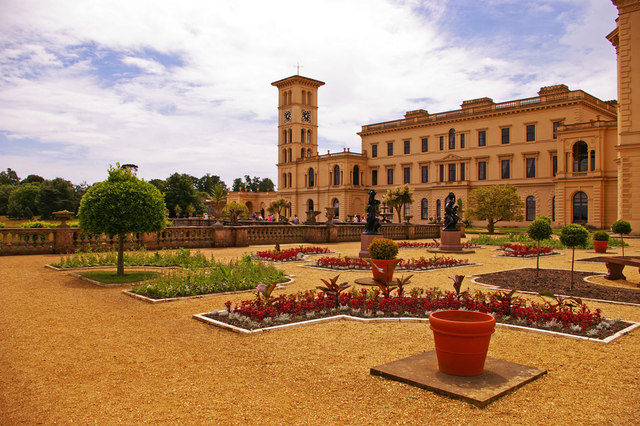
Osborne House (photo source geograph.org.uk Wikimedia Commons)

Myrtle thrived at Osborne House, Victoria and Albert’s beloved country retreat on the Isle of Wight. Long abandoned as a Royal residence (Victoria’s many offspring were not so enamored by the place) and subsequently used as a nursing home and naval college, the home and its 170-year old gardens have been recently restored by English Heritage. There is myrtle growing there today, from descendants of Victoria’s planting.

Myrtle roots easily, and there are probably others of prominent lineage growing in many of the Royal gardens, greenhouses, and orangeries. Apparently, the sprigs in the most recent Royal bouquet either came from the myrtle planted for Queen Elizabeth II in 1947 or the “original” at Osborne House. The myrtle in Camilla Parker Bowles’s wedding bouquet came from Cornwall (Charles, Prince of Wales, is the Duke of Cornwall and Camilla is now Duchess).

What was not as frequently reported about the tradition of the wedding bouquet in the lead-up to the Royal wedding in May, was the ancient history and symbolism of myrtle. Queen Victoria was well-versed in the language of flowers; the interest in floriography was at its peak in England during her reign. Blooms of various flowers were arranged in bouquets, nosegays, and tussie-mussies, a way of conveying a message, sometimes discreetly if need be. Queen Victoria’s presentation to her daughter, the Princess Royal, and, later, to her several other daughters, daughters-in-law, and granddaughters on their wedding days was not incidental. Victoria was both continuing and transforming the long traditions associated with myrtle.

There are many references to myrtle in ancient mythology and the Bible. The Greeks and Romans knew the plant as Myrtos and Myrtus and it was closely associated with the goddesses Demeter and Aphrodite. Venus is described by Ovid as emerging from the sea on her half-shell holding a sprig of myrtle. The wonderfully scented plant was considered an aphrodisiac, known to appear in wedding crowns for either the bride or the groom. In the Greco-Roman world, myrtle in laurels or crowns were sometimes presented to poets and woven into garlands of honor for athletic prizes, and was also worn to sacrifices and banquets. As opposed to laurel wreaths, myrtle signified victory from a bloodless battle. Myrtle wreaths made of gold have been excavated around the ancient world, particularly in Macedonia. Neat of appearance and amendable to clipping, myrtle was a common feature of gardens.
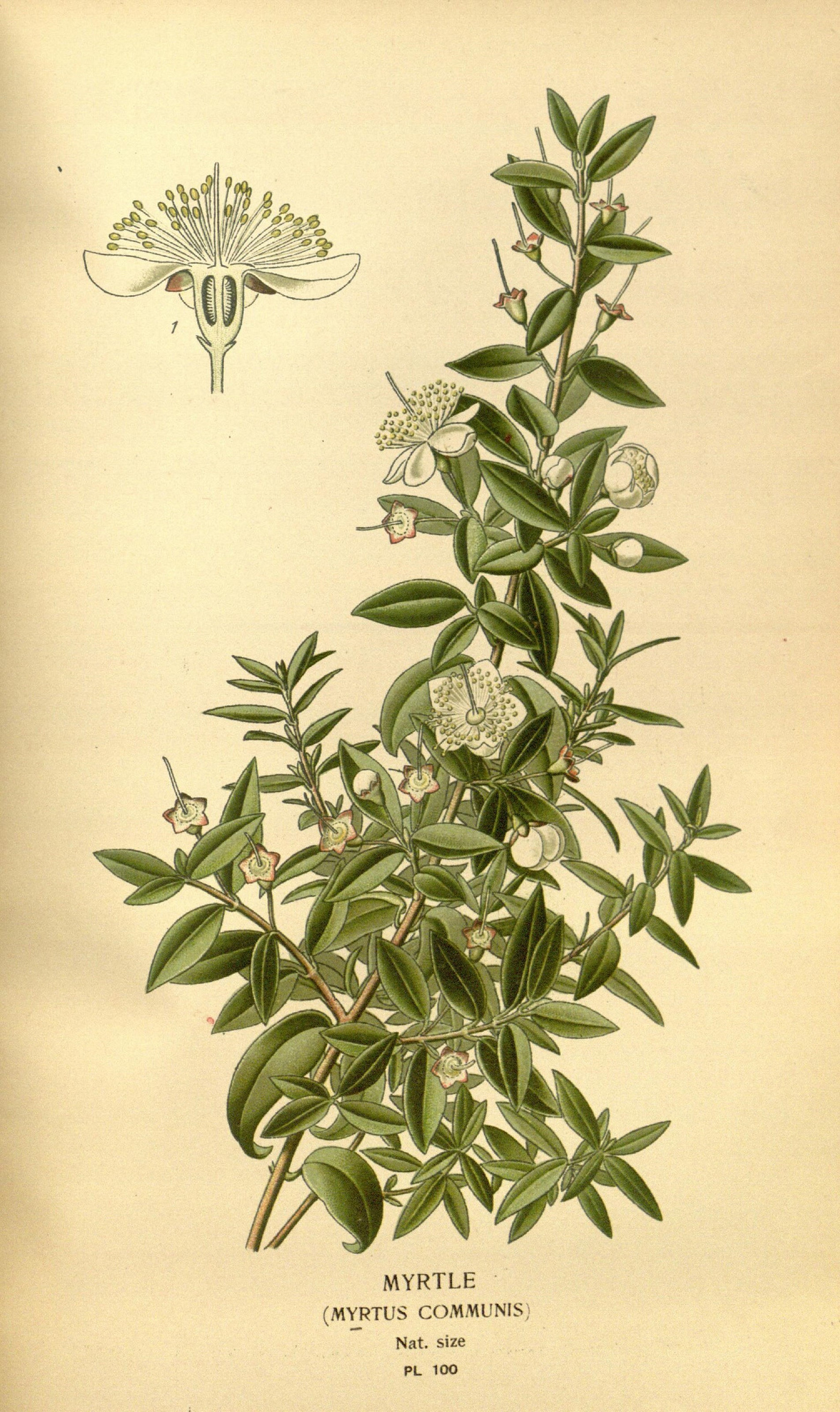
illustration of myrtle (Myrtus communis)

Myrtle (Myrtus communis). Favourite flowers of garden and greenhouse. (v. 2, 1897). Missouri Botanical Garden copy.

The ancient plant had a great ceremonial role in other civilizations. In Judaism, myrtle is known as Hadassah, as one of four sacred plants in the Feast of the Tabernacles, or, Sukkat, in 445 B.C. The Targum Sheni to Esther (2.7) states that “she was called Hadassah (Myrtle) because the righteous are compared to myrtle … As the myrtle spreads fragrance in the world, so did she spread good works.” Myrtle represents the community, thought of as a symbol of peace and of Eden and of marriage. In Christianity, losing its Greco-Roman association with female sexuality, myrtle came to be an emblematic symbol of the purity of the Virgin Mary.

As an ornament for brides, this tradition eventually made its way to Germany, an old custom that Queen Victoria adopted as her own. Publications of her era or earlier, such as Henry Philips’ Floral Emblems (1825), Charlotte de La Tour and Frederic Shoberl’s The Language of Flowers, with Illustrative Poetry (1839), Flora Symbolica, or, the Language and Sentiment of Flowers (1866), and Richard Folkard’s Plant Lore, Legends, and Lyrics (1884), well describe the significance of myrtle. The plant has many, layered meanings—youth, virginity (before marriage), fertility, innocence, immortality, fidelity—but, above all, love.

Queen Victoria did not introduce the myrtle plant to England from her visit to Germany. Tradition has Sir Walter Raleigh bringing it back from Spain in 1585, but it may well have been imported earlier. The Islamic gardens of the Iberian Peninsula featured myrtle since the Middle Ages. Unlike the Isle of Wight myrtle, the Alhambra and its Generalife Palace in Granada, Spain still have specimens that are hundreds of years old. John Gerard in his herbal of 1597 identifies six varieties grown in southern England. In the 17th and 18th centuries myrtle was a fashionable potted plant of the aristocracy, brought into the orangery when not adorning a garden. John Parkinson, in his Paradisi in Sole Paradisus Terrestris, or, A Garden of All Sorts of Pleasant Flowers wrote of “mirtle”: “Wee nourse [nourish] them with great care for the beautifull aspect, sweete sent and raritie, as delights and ornaments for a garden of pleasure, wherein nothing should be wanting that art, care and cost might produce and preserve.”
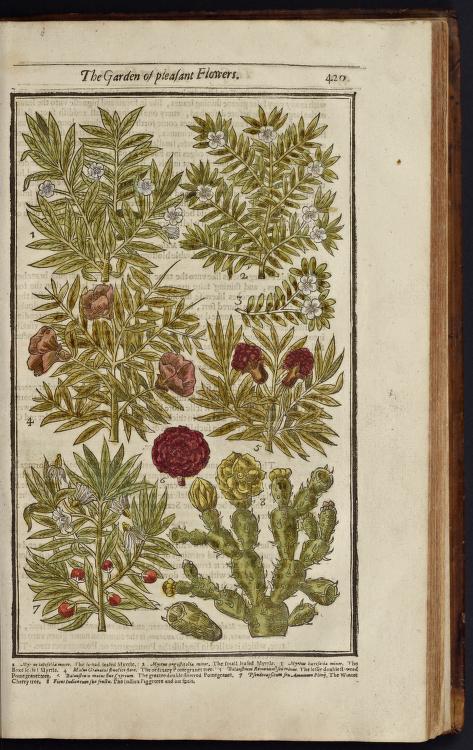
Illustration with myrtle (at top) form Parkinson’s Paradisi in Sole from the copy in the Library of the Getty Research Institute

Myrtle has thrived on a sheltered terrace of Osborne House on the Isle of Wight in the English Channel, overlooking the Solent, a seaside view that reminded Prince Albert of the Bay of Naples. Here, he was free to prove his gardening, architectural design, and landscaping abilities by supervising the building of an Italian-style palazzo and its grounds. On 17 September 1846 Victoria wrote in her journal, “… Albert supervised the transplanting of all the … myrtles … which is a tremendous job; one myrtle required 15 men to move it!” The home was their own creation and a retreat from the stiffness and oppressiveness of the court.

Victoria’s family spent July and August on the Isle of Wight when the myrtle was in bloom. The sprigs planted from successive bridal bouquets signal a continuity that many find reassuring, as attested by news reports to this day. A separate structure at Osborne House, Swiss Cottage, provided the Royal children an area where they were encouraged to learn gardening. For her granddaughter’s wedding, 18 February 1878, Victoria recorded that she “Walked … to the Swiss Cottage & planted a myrtle bush in honour of the day … grown from a sprig of myrtle in Vicky’s wedding bouquet, 20 years ago, of which I have sent a piece for Charlotte’s wedding nosegay.”

Queen Victoria was to see many more plantings of myrtle. She died at Osborne House on 22 January 1901. The provenance and significance of myrtle continues on into the 21st century, at least for British Royalty, as we saw with the bouquet that Meghan Markle carried.
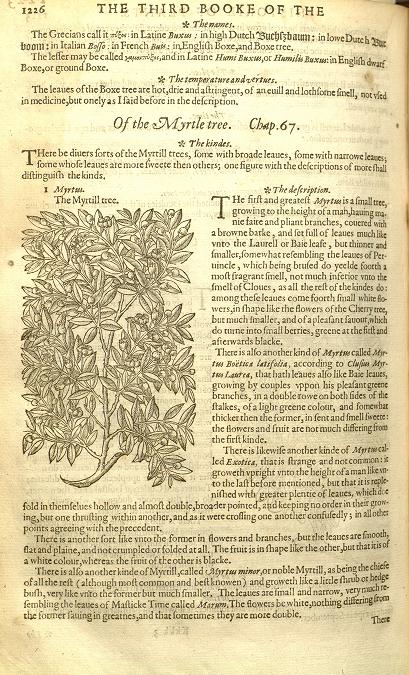
John Gerard, The Herball, or, Generall Historie of Plantes (1597), from the scanned copy in the Missouri Botanical Garden, Peter H. Raven Library


Notes
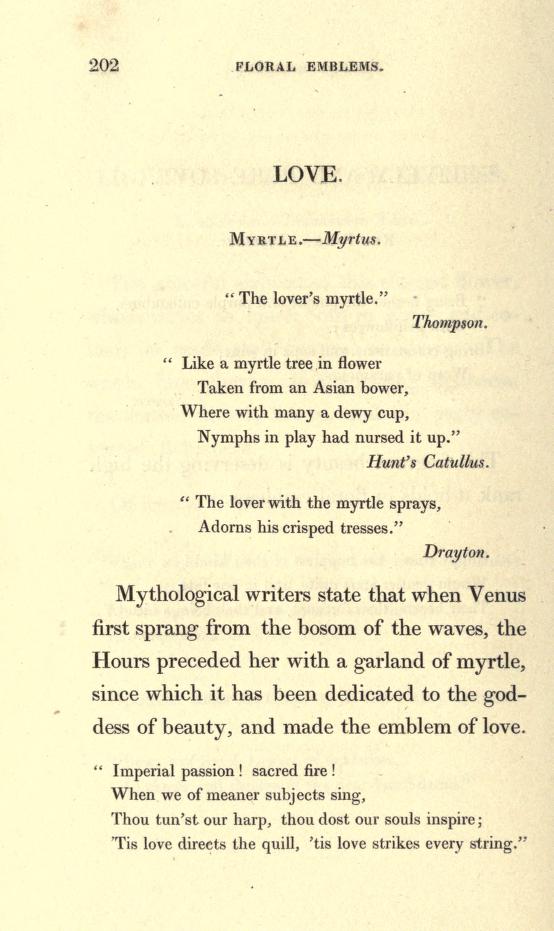
Page from Henry Philips’ Floral Emblems (1825). Page from copy of the University of California Libraries

For more on bouquets and the language of flowers (link); from Smithsonian Gardens.

Connors, Catherine. “Scents and Sensibility in Plautus’ Casina,” The Classical Quarterly, volume 47, number 1 (1997), pages 305-309.

Lachs, Samuel T. “Hadassah that is Esther,” Journal for the Study of Judaism in the Persian, Hellenistic, and Roman Period, volume 10, number 2 (1979), pages 219-220.

Nelson, E. Charles. “Victorian Royal Wedding Flowers: Orange, Myrtle, and the Apotheosis of White Heather,” Garden History, volume 37, number 2 (Winter 2009), pages 231-236. The author thoroughly examined Court Circulars in The Times for mentions of wedding flowers, dispelling many, persistent myths.
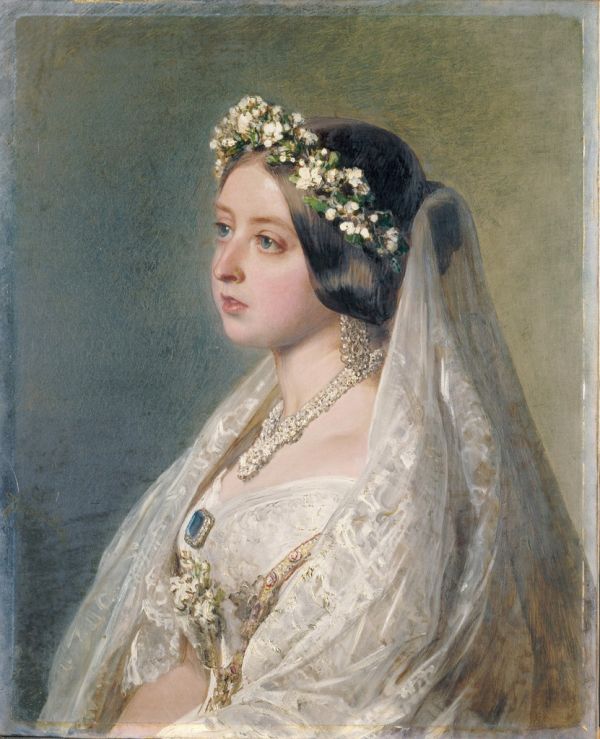
Queen Victoria, in her wedding dress, veil and what appears to be a tiara of myrtle. This charming painting by Franz Xaver Winterhalter, in the Royal Collections, was an anniversary gift to Prince Albert, seven years into their marriage.

 

June 14, 2018by mckenzie.87
Blog Reel

BHL Welcomes the Arboretum Library at the LA County Arboretum and Botanic Garden

Portrait version of the Biodiversity Heritage Library logo.
View Full Size Image

This quarter, the Biodiversity Heritage Library was pleased to welcome The Arboretum Library at the Los Angeles County Arboretum and Botanic Garden as its newest Affiliate. The BHL consortium, which has grown substantially over the past year, now consists of 17 Members and 16 Affiliates.

The Arboretum Library holds an extensive collection of books, magazines, government documents, pamphlets, and audio-visual materials covering a wide range of topics, including gardening and garden design, plant lore, medical botany, botanical art, ethnobotany, California native plant life, and Mediterranean-climate botany.

Twenty-four magazine titles published by the Los Angeles County Arboretum and Botanic Garden are already available through BHL as a result of The Arboretum Library Good Family Foundation Digitization Project, a collaboration between the Arboretum, BHL, and the Missouri Botanical Garden. The publications, dating back to the 1950s, include information about the institution’s history, Los Angeles area horticulture, and research conducted by Arboretum staff. The articles have been indexed for author, title, date, and subjects (including people and plant names), all of which are searchable.

The articles in the Arboretum publications have both a scientific and popular appeal. For example, among the many interesting topics covered is the history of coffee, which Leonid Enari explores in the June 1976 issue of Lasca Leaves.

According to the article, coffee was used as food at least by 800 AD, but the “habit of coffee drinking seems to have started in Arabia in the 15th century” (Enari 1976). The first beverages created from the berries of the coffee plant were likely alcoholic, made from the pulp of the berries. It is unknown when the practice of roasting the seeds (beans) and using them to prepare today’s familiar coffee beverage was discovered, but its consumption in Europe was popularized through coffeehouses that were often regarded, particularly in England, by the church and state as “centers of political agitation.”

View Full Size Image
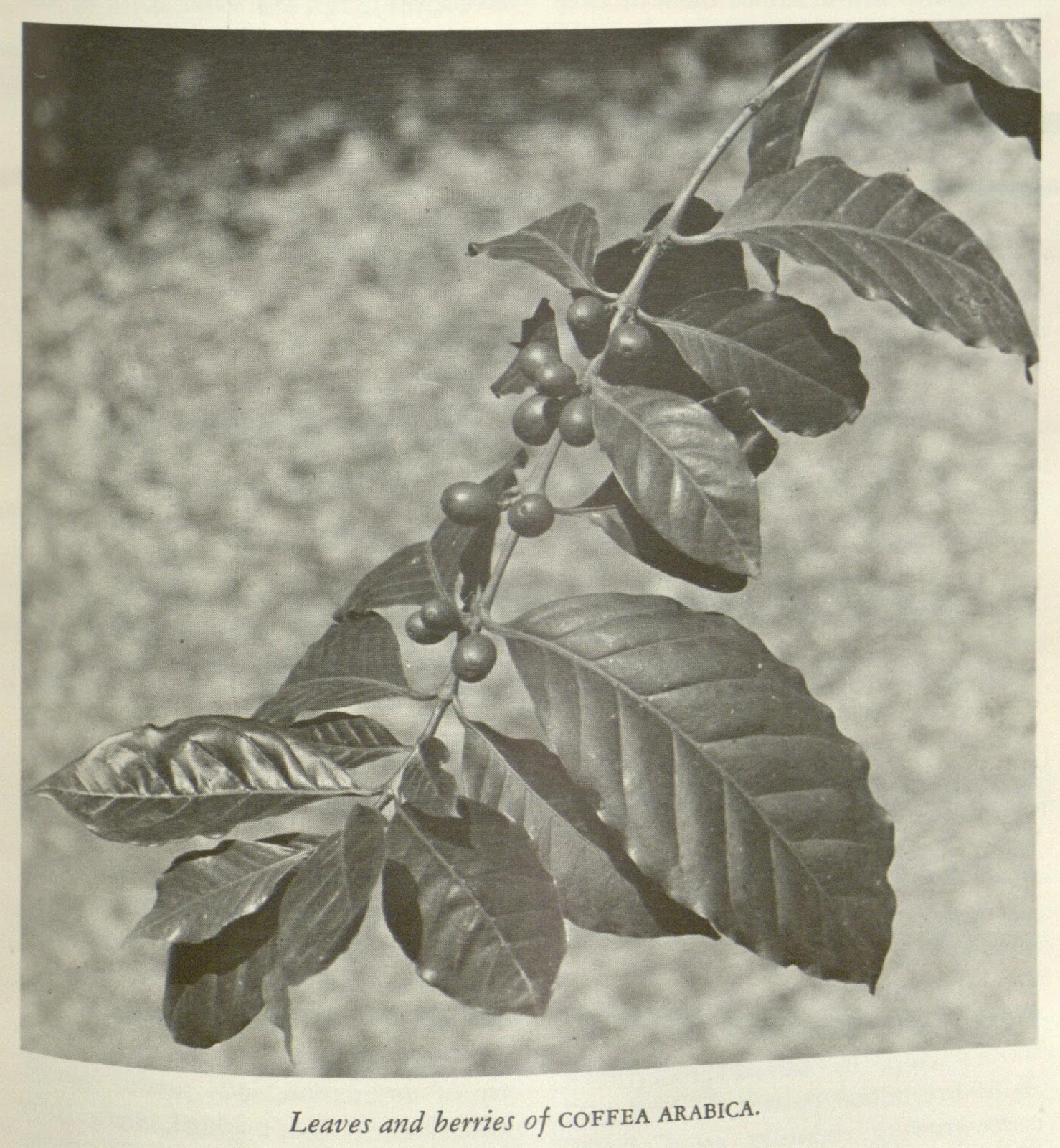
Leaves and berries of Coffea arabica. Enari, Leonid. “Coffee.” Lasca Leaves. v. 26 (1976). http://www.biodiversitylibrary.org/page/41846781. Digitized by the Missouri Botanical Garden. CC-BY-NC-SA.

The Arabian coffee tree (Coffea arabica) is used for the majority of the world’s commercial coffee production. The all-important coffee beans are the seeds of the coffee plant (found inside the plant’s fruit) which have been dried and roasted. After being roasted and ground, coffee will lose most of its aroma and flavor within 10 days. You can learn more about the history of coffee and its commercial production in the Lasca Leaves article.

The existing and future contributions from the Arboretum Library will provide valuable access to information about the history of botany and horticulture, botany in Southern California, and the Arboretum’s impact on these research areas. We look forward to working with our newest Affiliate to enhance BHL’s collections and expand our service to the global botanical, horticultural, and wider research communities.

January 11, 2017by michelle.underhill
Blog Reel, User Stories

Poetic Botany: A Digital Exhibition Celebrating the History of Botany

View Full Size Image
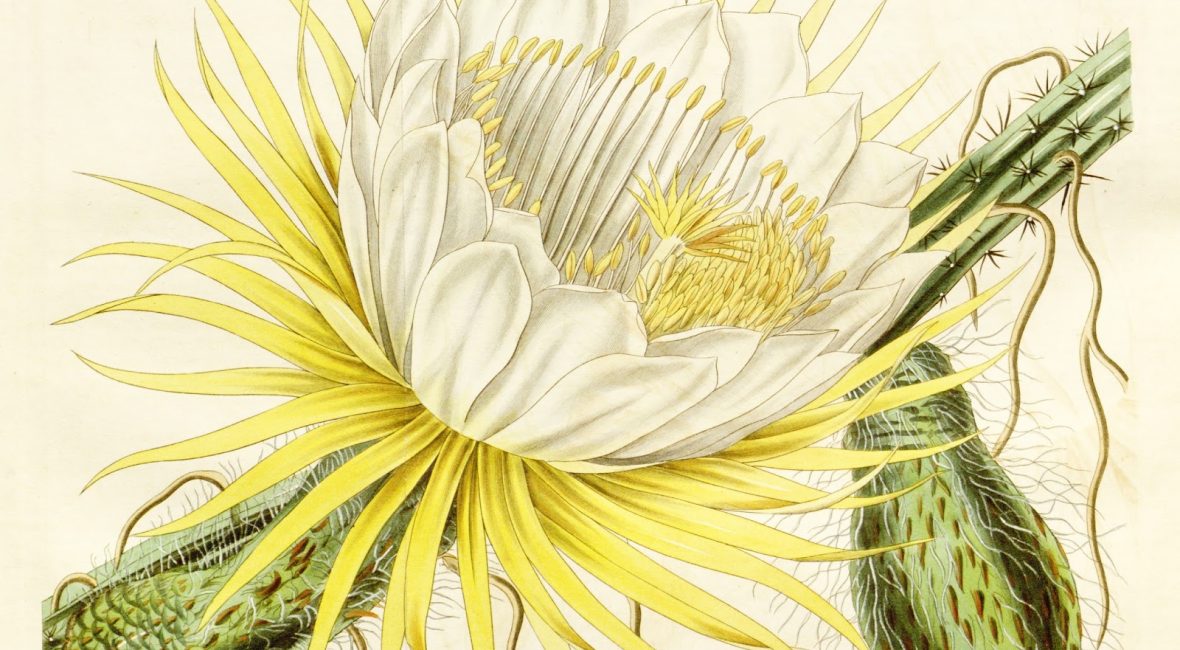
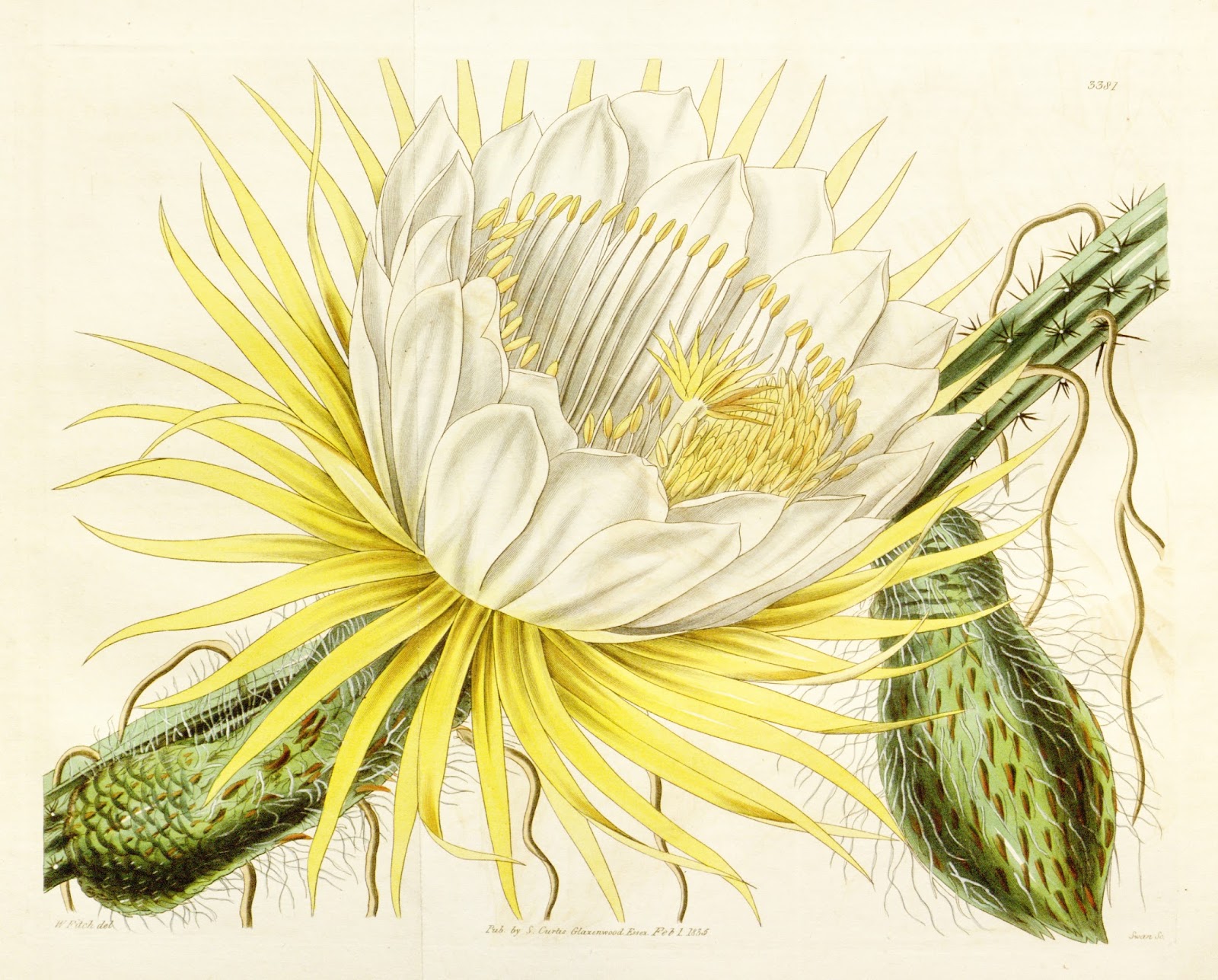
Night-blowing (Blooming) Cereus (Selenicereus grandiflorus). Curtis’s Botanical Magazine. v. 62 (1835). http://www.biodiversitylibrary.org/page/465887. Digitized by the Missouri Botanical Garden, Peter H. Raven Library.

‘Queen of the dark, whose tender glories fade
In the gay radiance of the noon-tide hours.’

‘That flower, supreme in loveliness, and pure
As the pale Cynthia’s beams, through which unveiled
It blooms, as if unwilling to endure
The gaze, by which such beauties are assailed.’

These elegant lines are quoted in Curtis’s Botanical Magazine (v. 62, 1835) as part of the description for the Night-blowing (Blooming) Cereus (Selenicereus grandiflorus) and serve as an artful conveyance of the species’ nocturnal blooming. But these lines represent more than just a whimsical representation of plant behavior. They are a reflection of the eighteenth century Poetic Botany movement that saw botany become the subject of poetry.

The Poetic Botany movement began with Erasmus Darwin, grandfather of Charles Darwin, who, in 1789, published The Loves of the Plants, a poem that in essence was a versification of Linnaean botany, where each plant in the garden is personified as a Greek god or goddess whose characteristics and interactions are meant to elucidate the Linnaean sexual system of plant classification. This highly successful poem was eventually republished along with a second poem by E. Darwin, The Economy of Vegetation, in 1791 as The Botanic Garden, A Poem in Two Parts, thus launching a movement that was proliferated by such authors as Frances Arabella Rowden, Charlotte Smith, and Robert John Thornton.

View Full Size Image
Frontispiece for the Digital Exhibition Poetic Botany: Art and Science of the Eighteenth-Century Vegetable World (2016). Credit: Ryan Feigenbaum.

Selenicereus grandiflorus is one of nine species featured in the online exhibition Poetic Botany. Using these plants as a lens through which to highlight the Poetic Botany movement, the exhibition introduces the botanists and works that constituted this period. These botanists were concerned with not just the art of their verse but also with the scientific study of their plant subjects, and thus the Poetic Botany movement reflects a beautiful union of art and science.

View Full Size Image
Ryan Feigenbaum at the Royal Botanical Gardens in Peradeniya, Sri Lanka. Credit: Madeline Chera, 2016.

The Poetic Botany exhibition was created by Ryan Feigenbaum as part of a 2015-2016 Andrew W. Mellon Fellowship at the Humanities Institute of the LuEsther T. Mertz Library of The New York Botanical Garden. NYBG, a founding BHL Member who has contributed over 3.9 million pages to the BHL collection, hosts the exhibit.

Feigenbaum, who has a BA in philosophy from DePaul University in Chicago, an MA in philosophy from Villanova University, and is currently completing a PhD in philosophy at Villanova University, researches the history and philosophy of biology. As evidenced through Poetic Botany, this research eventually led him down a botanical path.

“My dissertation, ‘The Epistemic Foundations of German Biology, 1790–1802,’ analyzes the emergence of biology as a science by tracing the genealogy of the organism concept,” explains Feigenbaum. “I came to the history of botany as an offshoot of this project; specifically, I was interested in the eighteenth-century opinion of plants, i.e., their ontological status. Whereas plants had long been regarded as devoid of intelligence, sensitivity, and locomotion, naturalists like Erasmus Darwin began to challenge these views, spurred on by the ‘discovery’ of plants like the Drosera and Mimosa pudica that challenged longstanding prejudices.”

Feigenbaum’s interest in the “life sciences” and the history of botany grew naturally out of his research on philosophy, for these two subjects have historically been intimately connected.

“The separation of philosophy and science is a relatively recent phenomenon,” affirms Feigenbaum. “Descartes, for instance, contributed to mathematics and physics beyond his cogito ergo sum, and much of Aristotle’s corpus focuses not on metaphysics or ethics but natural science. In this vein, I’ve been committed to studying not only eighteenth-century philosophy, but also its life science for the past five years or so. I say ‘life science’ because biology did not yet exist; the word ‘biology,’ in fact, was not used in its modern meaning until 1802. The how and why of biology’s emergence at this time is one focus of my dissertation.”

It was this extension into the ‘life sciences’ that eventually brought Feigenbaum to BHL.

“As my study of the history of philosophy incorporated more and more of the study of the history of science, BHL became a resource I relied on time and again,” asserts Feigenbaum. “At first I would search via Google for a particular eighteenth-century text, but I found it so often on BHL that I ended up using its website portal directly, sparing me the trouble of having to sift through Google results.”

BHL played an important role in the development of Poetic Botany, allowing Feigenbaum to discover and access relevant texts, many of which are linked from the exhibit.

“BHL provides smart access to knowledge that wouldn’t be otherwise available,” lauds Feigenbaum. “My favorite feature is the ability search by species. Since the digital exhibition is organized around species, this ability revealed new sources of which I’d been unaware. It is quite amazing that you can instantly see in which texts a species like Canna indica appeared according to date and then be taken to the exact pages of the reference. Without this resource, my workflow would have been much slower; it would’ve required me to visit multiple archives and search through texts one by one. While such an approach isn’t without its benefits, it inevitably limits what the researcher can do and extends the time required to do it.”

View Full Size Image
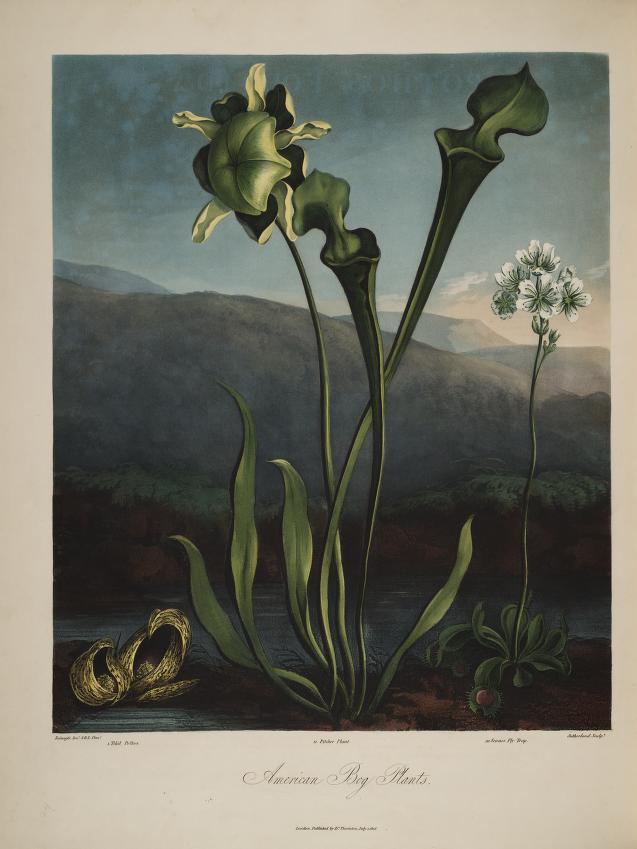
American bog plants: eastern skunk cabbage (Symplocarpus foetidus), yellow pitcherplant (Sarracenia flava), and Venus flytrap (Dionaea muscipula). Thornton, Robert John. New illustration of the sexual system of Carolus von Linnaeus. (1807) http://biodiversitylibrary.org/page/307056. Digitized by the Missouri Botanical Garden, Peter H. Raven Library.

While there are many texts featured in Poetic Botany, one of Feigenbaum’s favorites is John Thornton’s New Illustration of the Sexual System. According to Feigenbaum,

“This perennial favorite is often acclaimed for its indisputably beautiful illustrations, perhaps some of the most iconic in existence. However, the accompanying text is also marvelous, giving the reader insights into eighteenth-century botany, snippets of poetry, and whole disquisitions on culture, religion, and other topics.”

This title is also consistently a favorite among BHL’s online audiences. Thanks to the citizen science efforts of Michelle Marshall, this entire work has also been taxon tagged in Flickr, making it easy for you to identify and search for the species contained within it.

We encourage you to take some time to explore Poetic Botany and marvel at the elegant and profound union of art and science represented in the exhibit and texts. Who would have thought that poetry and science could fit together so naturally?

______________________________________

This post may contain the personal opinions of BHL users or affiliated staff and does not necessarily represent the official Biodiversity Heritage Library (BHL) position on these matters.

December 8, 2016by michelle.underhill

Help Support BHL

BHL's existence depends on the financial support of its patrons. Help us keep this free resource alive!

search

About BHL

The Biodiversity Heritage Library (BHL) is the world’s largest open access digital library for biodiversity literature and archives. BHL operates as a worldwide consortium of natural history, botanical, research, and national libraries working together to digitize the natural history literature held in their collections and make it freely available for open access as part of a global “biodiversity community.”

Join Our Mailing List

Sign up to receive the latest news, content highlights, and promotions.

Subscribe Now

Subscribe to Blog via Email

Enter your email address to subscribe to this blog and receive notifications of new posts by email.

Join 319 other subscribers

Subscribe to Blog Via RSS

Subscribe to the blog RSS feed to stay up-to-date on all the latest BHL posts.

Access RSS Feed

Inspiring Discovery through Free Access to Biodiversity Knowledge.

The Biodiversity Heritage Library makes it easier than ever for you to access the information you need to study and explore life on Earth…for free, anytime, anywhere.


64+ Million Pages of
Biodiversity Literature Online.

EXPLORE

Tools and Services
to Transform Research.

EXPLORE

300,000+
Illustrations on Flickr.

EXPLORE

ABOUT | HARMFUL CONTENT | PRIVACY | SITE MAP | TERMS OF USE