Biodiversity Heritage Library - Program news and collection highlights from BHL
  • Home
  • News
  • Featured Books
    • All Featured Books
    • Book of the Month Series
    • BHL at 20
  • User Stories
  • Campaigns
    • Fossil Stories
    • Garden Stories
    • Monsters Are Real
    • Page Frights
    • Her Natural History
    • Earth Optimism 2020
  • Tech Blog
  • Visit BHL
Home
News
Featured Books
    All Featured Books
    Book of the Month Series
    BHL at 20
User Stories
Campaigns
    Fossil Stories
    Garden Stories
    Monsters Are Real
    Page Frights
    Her Natural History
    Earth Optimism 2020
Tech Blog
Visit BHL
  • Home
  • News
  • Featured Books
    • All Featured Books
    • Book of the Month Series
    • BHL at 20
  • User Stories
  • Campaigns
    • Fossil Stories
    • Garden Stories
    • Monsters Are Real
    • Page Frights
    • Her Natural History
    • Earth Optimism 2020
  • Tech Blog
  • Visit BHL
Biodiversity Heritage Library - Program news and collection highlights from BHL
Blog Reel, Featured Books

Hummingbirds and Harlequins

Beauty can be too much for words. So it is with the charm of what many consider the loveliest of the world’s birds, the hummingbirds: Overcome by the dazzling colors of those first tiny skins, early European naturalists reached to the limits of their vocabularies to describe them. The result, nearly five centuries after the first specimens were brought back from a then truly New World, is a large set of remarkably evocative names, hillstars and woodstars, helmetcrests and plumeleteers, jacobins and incas, metaltails and thornbills, emeralds and sapphires and topazes and rubies.

View Full Size Image

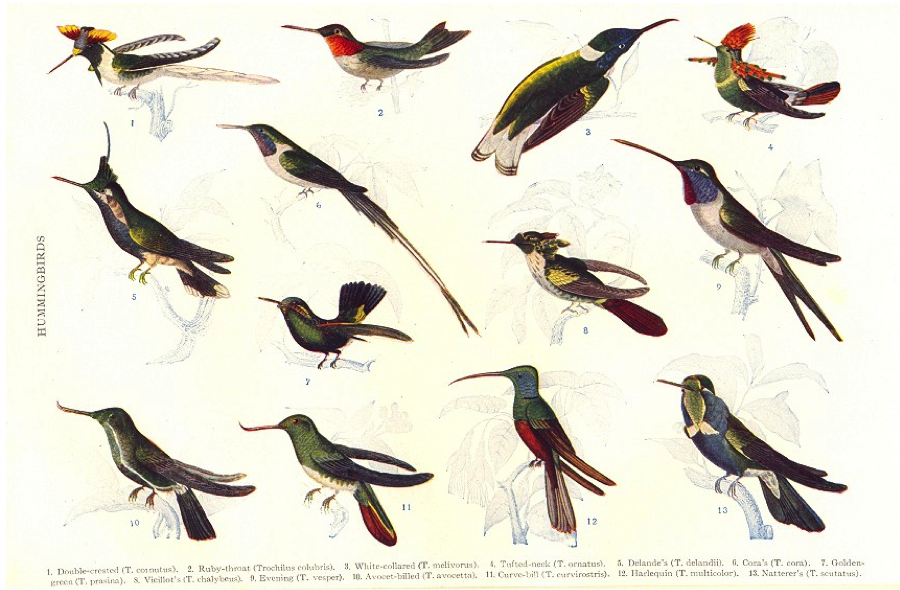
The birds, of course, are every bit as fantastic as their monikers. The 1907 edition of The Americana, the authoritative North American encyclopedia of its day, gave its readers a glimpse into the vast variety of color and adornment so typical of this large family, from the Horned Sungem to the Hyacinth Visorbearer. One of the thirteen birds shown on this appealing plate, however, is conspicuously absent from any modern list of hummingbirds: the extraordinarily colored Harlequin Hummingbird.

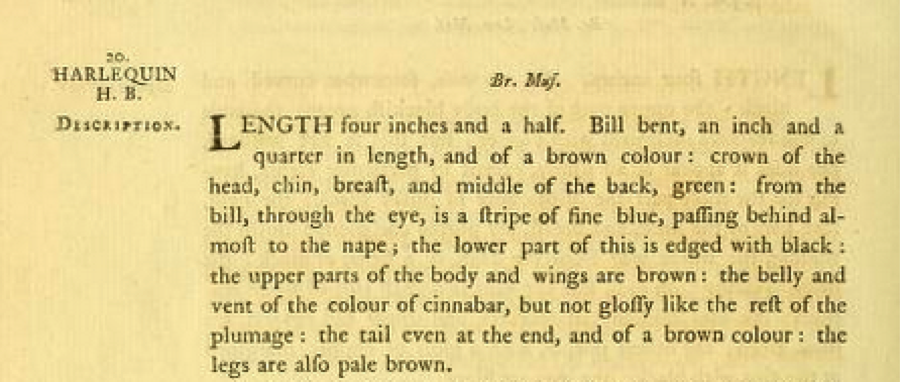
That bird was first made known to science a century and a quarter before it was depicted in The Americana. In 1782, John Latham described his new species from a specimen in the collections of the British Museum.
View Full Size Image

Unfortunately, Latham notes, that unique skin had “no history annexed to it,” and so he was unable to offer any information about the range or the habits of the species he named the Harlequin Humming-Bird.

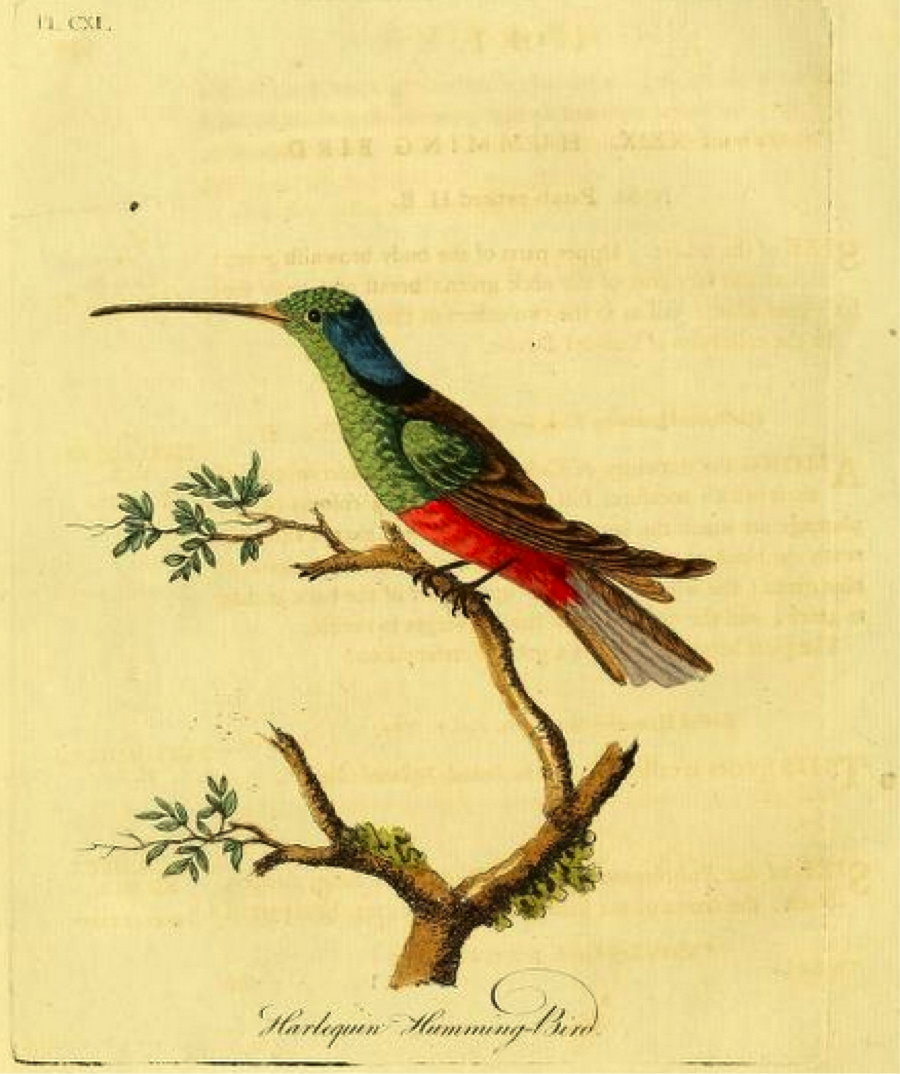
Five years later, Latham came across another source of information, a drawing by the famous watercolorist Thomas Davies, who had been in the West Indies in 1786. Davies’s rendering of the bird differs from the British Museum specimen, Latham tells us, in its greater length—five inches rather than four and a half—and in the presence of a narrow band of blue green on the back of the head, a character well shown by Latham’s plate in the Supplement to his General Synopsis of Birds.
View Full Size Image

That image and the accompanying description provided the “type” for Johann Friedrich Gmelin, who gave the species its rather bland Linnaean label in 1788, Trochilus multicolor. Latham in turn adopted that name for his 1790 Index ornithologicus, where his brief description of the bird could be read to imply that he had seen further specimens, “in some of which there is a blue-green patch below the nape.”

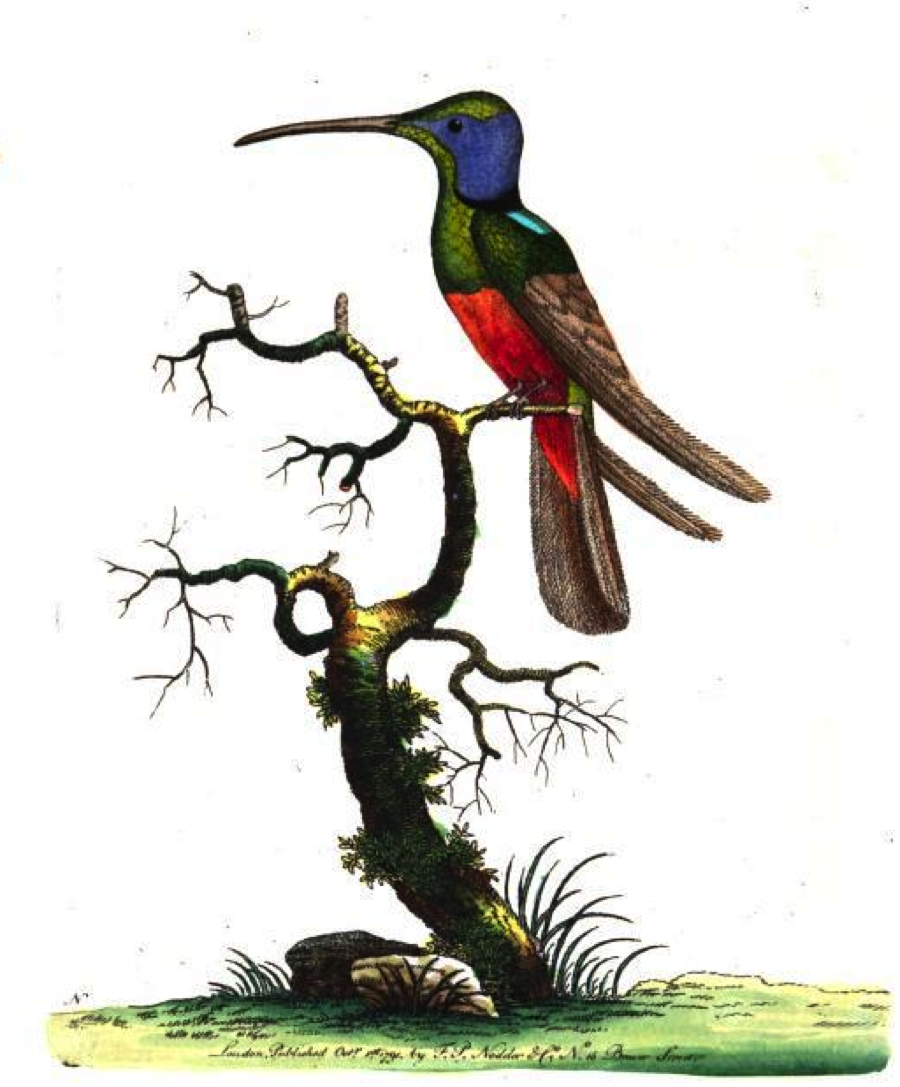
George Shaw, in his Naturalist’s Miscellany the following year, was able to narrow the range of the Harlequin, “among the rarest species of its genus,” to South America, hardly a bold conjecture in the case of a large, colorful hummingbird. Shaw’s account was accompanied by an awkwardly executed plate by Frederick Nodder, painted, Shaw claims, from the British Museum specimen; the telltale turquoise panel on the upper back, however, reveals that Nodder based his work on Davies’s—or, more likely, on Latham’s description of Davies’s sketch.
View Full Size Image

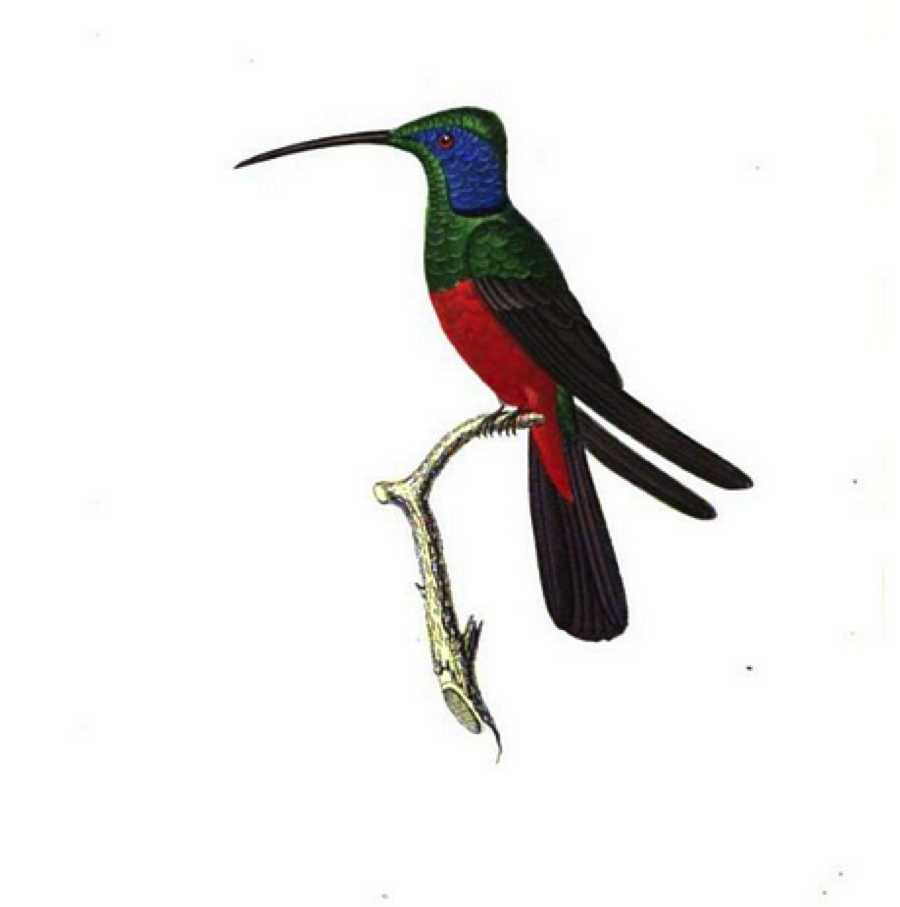
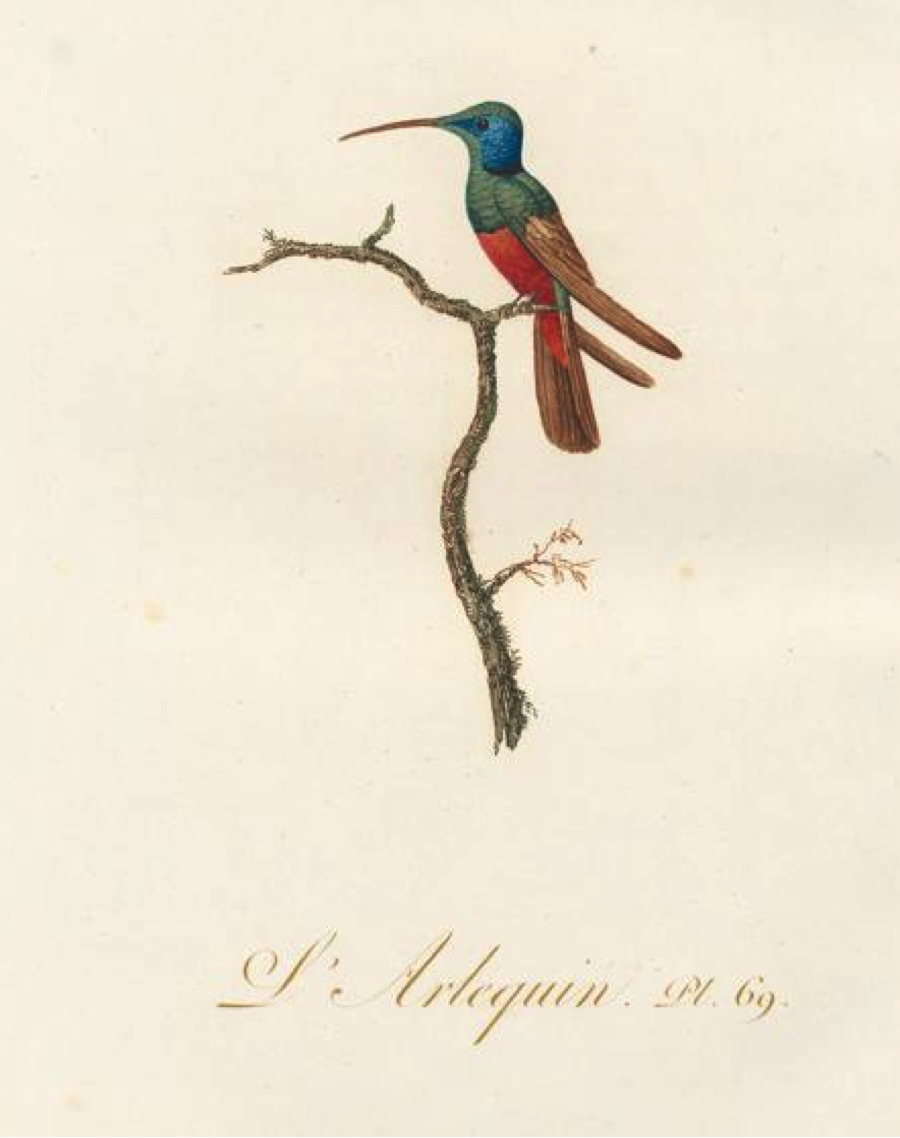
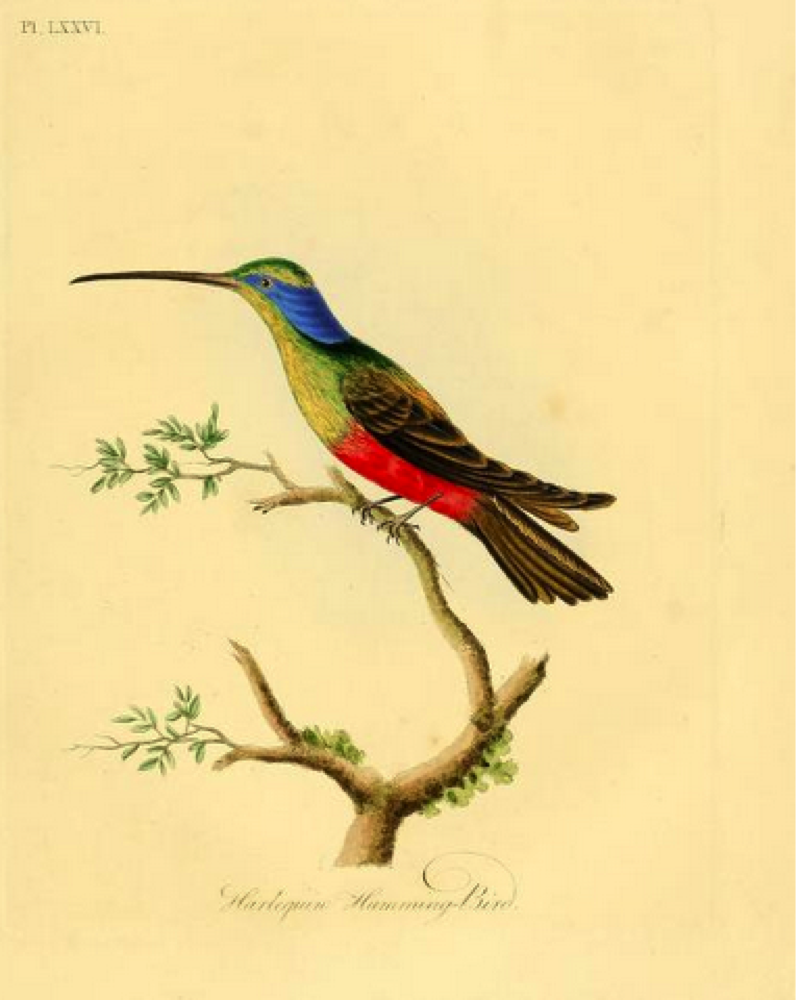
The Harlequin Hummingbird was painted again, by Sydenham Edwards, for Louis Pierre Vieillot’s 1802 continuation of the Oiseaux dorés, a lavish work begun by Vieillot and his collaborator Jean-Baptiste Audebert, who had died in December 1800. Vieillot claims that Edwards had worked directly from the skin in the British Museum; whether that was true or not, a close look suggests that Edwards was quite familiar with Nodder’s plate, too, from which it differs in omitting the nape patch Latham had noticed in the Davies drawing, a mark Vieillot says is indicative of a “variety” of the true Harlequin.
View Full Size Image

Nearly fifty years after its discovery in a museum drawer, this hummingbird was as mysterious as ever. In 1829, René Primevère Lesson wrote of the oiseau-mouche arlequin that

this bird is known only from the description and figure published by the English ornithologist Latham. That figure, drawn by Sir Edwards, was reproduced by Mr. Vieillot on Plate 69 of his Oiseaux dorés, and we have been obliged to include it in order that we omit none of the species listed on the basis of specimens preserved in collections or known from accurate portraits.
View Full Size Image

But Lesson had his doubts:

At the same time, this drawing seems to pertain rather to one of the curve-billed hummingbirds, and seems to us to be imprecise; it is only with very great reservations that the species must be admitted to the table of extant straight-billed hummingbirds. It could be, too, that it depicts nothing more than a sunbird, which we suspect even more from the fact that no hummingbird normally displays a similar distribution of solid colors in its plumage.

In 1831, Lesson had his answer. In his Trochilidées, he reported that the colibri arlequin of the British Museum had been examined by a Mr. Stokes,

who writes to us that the bird that served as the type for Latham’s description and for the figure copied by Vieillot was the product of a falsification, which one discovered on dismantling the specimen preserved in the British Museum.

It is a measure of the uncertainty that still obtained in neotropical ornithology—and, perhaps, of the antagonisms that still lingered between French and British naturalists—that William Jardine, two years after the publication of the Trochilidées, could write that

It has been hinted that the specimen in the British Museum was a specimen made up from the feathers of different birds.

Lesson’s debunking (which Jardine cites) was far more than a hint. Jardine notes, however, that Latham, who would live into the year 1837, had been aware of the rumor. In a footnote to the 1822 edition of the General History, Latham writes that

It has been suggested to me, that this is no other than a bird made up by the ingenuity of some whimsical person, who has fabricated it from the feathers of others; but which, by every attention paid to it, I cannot detect.

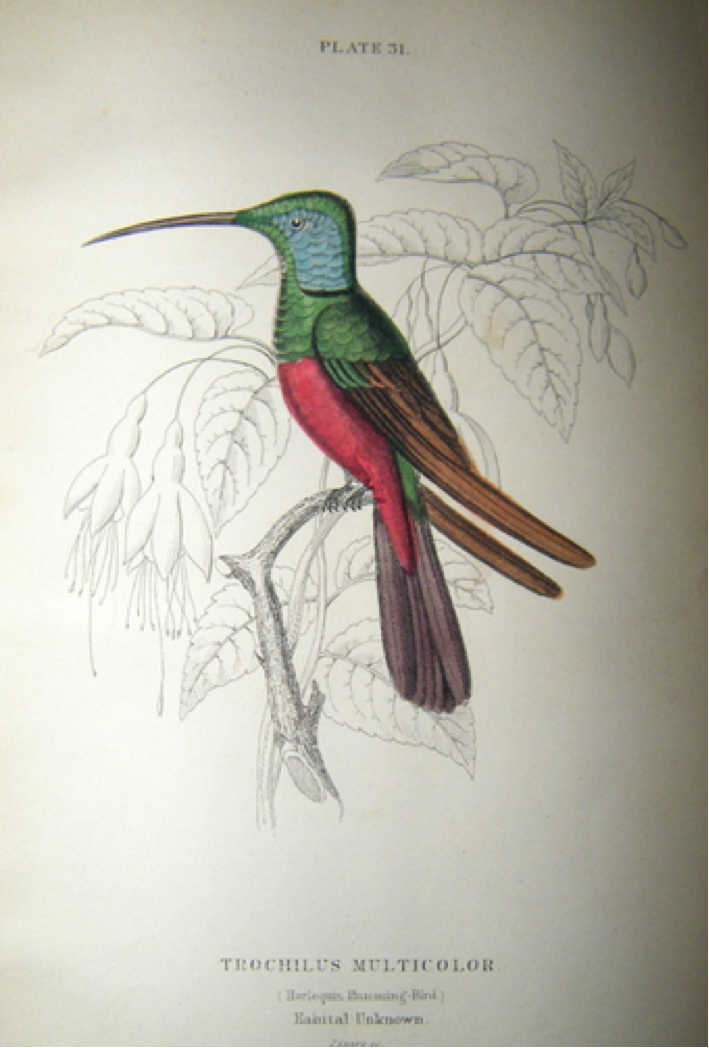
Jardine included the bird in his own work

with the view of attracting the attention of British naturalists…. If there is a specimen in the British Museum, and a drawing in the possession of General Davis, corresponding and evidently done from an individual of the same species, there will be no doubt of its existence.


View Full Size Image

“If.”

In preparing his great Monograph of the Trochilidae, John Gould was “at all times favoured … with both information and the loan of specimens” from the collections of the British Museum. Nowhere could he find a skin attesting to the existence of the Harlequin Hummingbird—Lesson’s Mr. Stokes most likely had felt no obligation to reassemble the composite hoax once it was revealed. In relying on Latham, Gould writes, Gmelin had described a new species based on

characters … taken from a plate which must have been drawn from imagination and not from any real specimen.

Indeed, of the 95 hummingbirds Latham included in the revision of his General History, Gould considered only about two-thirds “real species,” the other 30 or more, among them the Harlequin, all “so indefinitely described” as to be unassignable to any known bird.

It seems very unlikely that we will ever know who the ingenious and whimsical creator of Latham’s specimen was, or what bird was depicted in Thomas Davies’s equally mysterious drawing. What is entirely certain, though, is that this is not the only case in the history of “trochidology” where a bird turned out to be something else entirely than what its original discoverers thought or hoped.
View Full Size Image


January 6, 2014by Kathryn Stine
Blog Reel

Happy Butterfly and Hummingbird Day!

View Full Size Image
Butterflies are in the Papilionoidea superfamily.

Who hasn’t seen the majestic beauty of a butterfly bouncing through the air or hummingbirds hovering near a feeder? If you haven’t you are surely missing out. Whether you have or haven’t seen them, take the opportunity to learn more about them today on National Butterfly and Hummingbird Day. Spread awareness and observe them in nature or at a zoo.

While I can’t be certain if the holiday existed back in the 1800s, even then people knew butterflies and hummingbirds were special. This enthusiasm resulted in books with beautiful illustrations. One of the more popular ones is John Gould’s A Monograph of the Trochilidæ, or Family of Humming Birds, which you can read more about here.

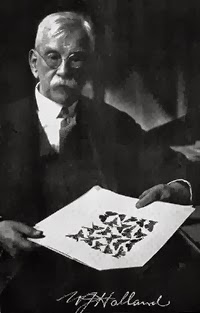
Did you know there are about 24,000 species of butterflies and representations of butterflies have been found in Egyptian frescoes at Thebes, which are 3,500 years old? Butterflies are fascinating creatures. If you want to learn more about them check out  The butterfly book; a popular guide to a knowledge of the butterflies of North America by William Jacob Holland. While he was still Chancellor of the University of Pittsburgh and Director of the Carnegie Museums of Pittsburgh, Holland’s book was published in 1898. This accomplished zoologist and paleontologist was a forward thinker that helped popularize butterflies and moths in the early 20th century.

View Full Size Image
A photograph of Holland from the Carnegie Museum of Natural History Museum.

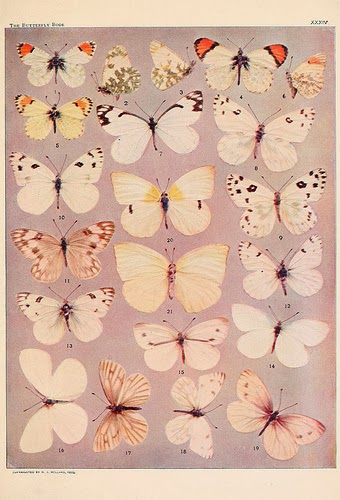
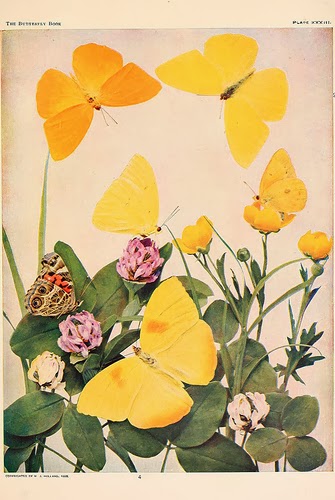
Featuring 48 plates of color photography, this book presents many of the butterfly species in the United States. Written with a youthful and amateur collector in mind, the book presents these delicate creatures in a positive light. A goal of Holland’s was to change the perception of butterflies. He quotes Henry Walter Bates’ The Naturalist on the River Amazons in the introduction which summarizes his goal, “The study of butterflies, — creatures selected as the types of airiness and frivolity, — instead of being despised, will someday be valued as one of the most important branches of biological science.”

View Full Size Image
Antarctica is the only continent on which no Lepidoptera have been found.

Many of the reproduced photographs of butterflies are from Holland’s own collection. Exceeding 250,000 specimens, he donated his private collection to the Carnegie Museum where the collection has grown and been used at unprecedented levels since access was granted to it in 1985. Holland’s collection continues to serve science, conservation, and education to this day.

Check out images from the The Butterfly Book here.

October 3, 2013by lgarvey
Blog Reel, Featured Books

Book of the Week: A monograph of the Trochilidæ

View Full Size Image

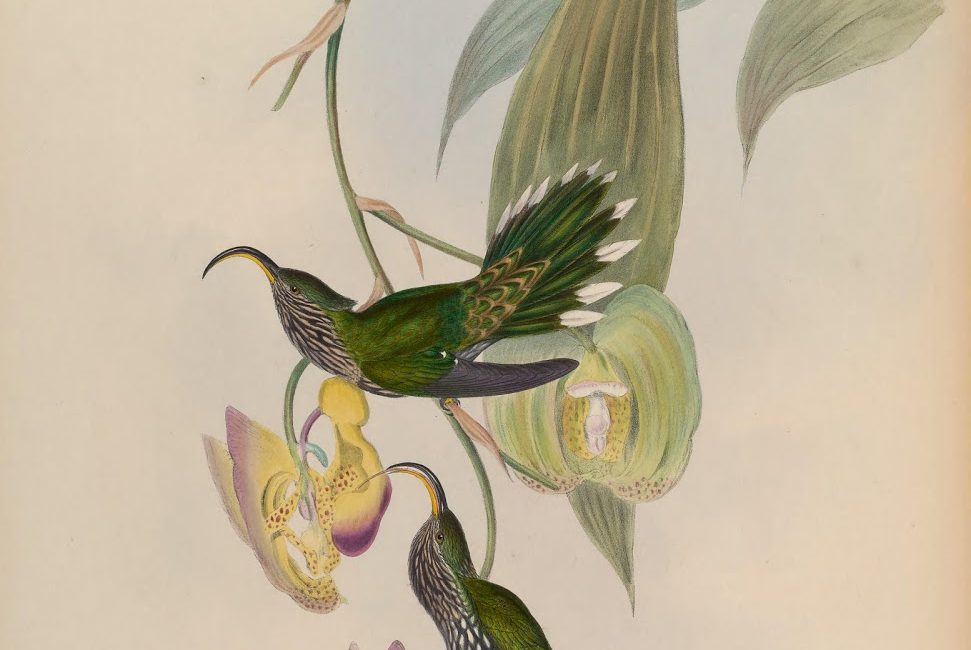
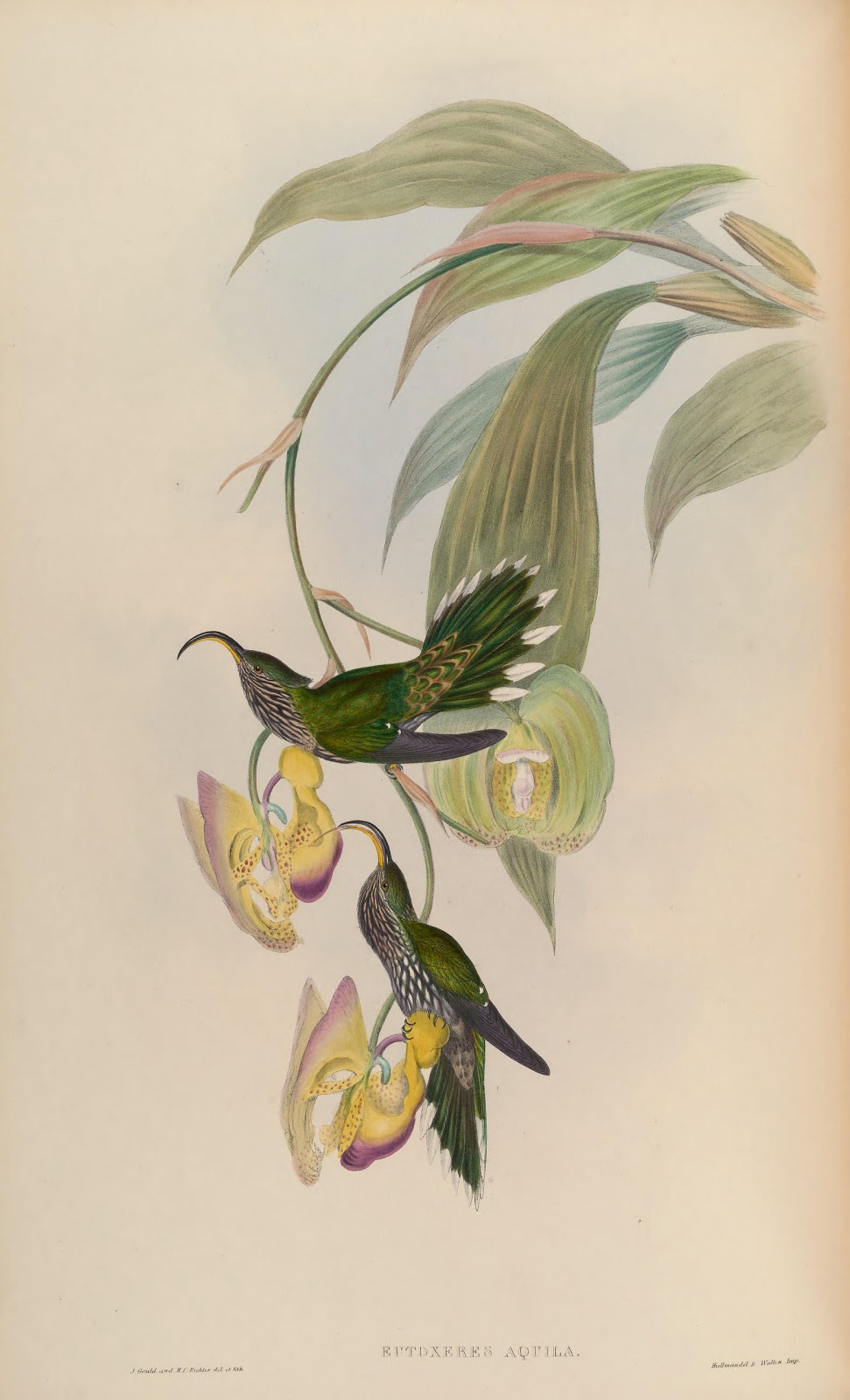
“A feast of beauty and a source of wonder” was the phrase used by Sacheverell Sitwell, Handasyde Buchanan, and James Fisher to describe the images in ornithologist and artist John Gould’s A monograph of the Trochilidæ, or family of humming-birds.* It seems there are few who would disagree with this statement, as a five volume set plus supplement sold at Christie’s Auction House in 2011 for $217,845.

Published in parts between 1849-1861, over 480 species of humming birds were described within this title. The work represents extreme attention to detail, down to the use of pure gold leaf under transparent oil colors to recreate the iridescent nature of a humming bird’s feathers.

A monograph of the Trochilidæ, or family of humming-birds is considered Gould’s masterpiece. It was originally issued in 30 parts (the final three finished by R. Bowdler Sharpe after Gould’s death). Many of the humming birds depicted are from Gould’s own collection – a collection that went on exhibit at the Zoological Gardens, Regent’s Park in 1851.

Considered the “father of bird study in Australia,” Gould assisted Charles Darwin in identifying the finches he had collected on his voyage aboard the HMS Beagle. Throughout his professional life, Gould maintained a strong interest in hummingbirds, though it was not until May, 1857 – nearly 30 years after he began his ornithological career – that Gould saw his first live hummingbird on a visit to Philadelphia.

The illustrations within this work are positively breathtaking. We’ve prepared a slideshow of them for you below. You can find the illustrations from volumes 1 in our Flickr account. Enjoy images from all five volumes without emptying your pocketbook by visiting BHL.

*Quote from Fine Bird Books, by Sacheverell Sitwell, Handasyde Buchanan, and James Fisher

June 28, 2012by ulib-libraryjobs
Blog Reel, Featured Books

Book of the Week: Happy Cinco de Mayo!

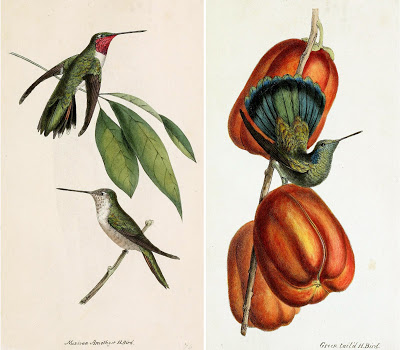
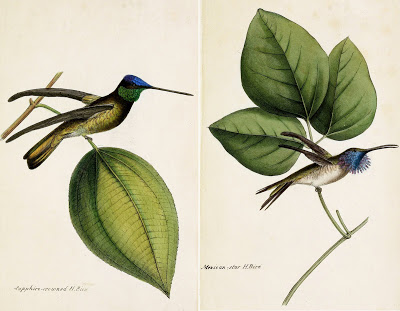
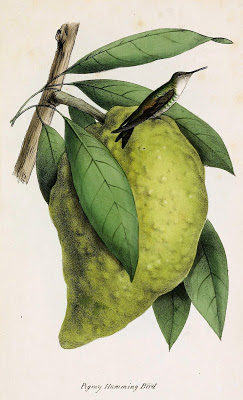
Happy Cinco de Mayo! In honor of the day, we thought we’d pick a book for our Book of the Week that highlights Mexican wildlife. While sorting through our selection of titles with Mexico as a subject, we came across A Selection of the Birds of Brazil and Mexico: The Drawings (1841), by William Swainson, which is packed full of beautiful illustrations of some of the birds of Mexico (not to mention Brazil as well). Of particular interest to us were the illustrations of the various hummingbirds of Mexico, as our species of the day post today on Twitter (@BioDivLibrary) featured hummingbirds and the recent discovery related to the way hummingbirds drink. So, for our post, we’re featuring the Mexican hummingbirds pictured in this work. Enjoy, both the book and your celebrations of Cinco de Mayo!


Mexican Amethyst Hummingbird

View Full Size Image
Green-Tailed Hummingbird
Sapphire-Crowned Hummingbird

View Full Size Image

Mexican-Star Hummingbird
Pigmy hummingbird

View Full Size Image

Our book of the week, A Selection of the Birds of Brazil and Mexico: The Drawings (1841), by William Swainson, was contributed by Harvard University, Museum of Comparative Zoology, Ernst Mayr Library.
May 5, 2011by ulib-libraryjobs

Help Support BHL

BHL's existence depends on the financial support of its patrons. Help us keep this free resource alive!

search

About BHL

The Biodiversity Heritage Library (BHL) is the world’s largest open access digital library for biodiversity literature and archives. BHL operates as a worldwide consortium of natural history, botanical, research, and national libraries working together to digitize the natural history literature held in their collections and make it freely available for open access as part of a global “biodiversity community.”

Join Our Mailing List

Sign up to receive the latest news, content highlights, and promotions.

Subscribe Now

Subscribe to Blog via Email

Enter your email address to subscribe to this blog and receive notifications of new posts by email.

Join 319 other subscribers

Subscribe to Blog Via RSS

Subscribe to the blog RSS feed to stay up-to-date on all the latest BHL posts.

Access RSS Feed

Inspiring Discovery through Free Access to Biodiversity Knowledge.

The Biodiversity Heritage Library makes it easier than ever for you to access the information you need to study and explore life on Earth…for free, anytime, anywhere.


64+ Million Pages of
Biodiversity Literature Online.

EXPLORE

Tools and Services
to Transform Research.

EXPLORE

300,000+
Illustrations on Flickr.

EXPLORE

ABOUT | HARMFUL CONTENT | PRIVACY | SITE MAP | TERMS OF USE