
Biodiversity Heritage Library - Program news and collection highlights from BHL
  • Home
  • News
  • Featured Books
    • All Featured Books
    • Book of the Month Series
    • BHL at 20
  • User Stories
  • Campaigns
    • Fossil Stories
    • Garden Stories
    • Monsters Are Real
    • Page Frights
    • Her Natural History
    • Earth Optimism 2020
  • Tech Blog
  • Visit BHL
Home
News
Featured Books
    All Featured Books
    Book of the Month Series
    BHL at 20
User Stories
Campaigns
    Fossil Stories
    Garden Stories
    Monsters Are Real
    Page Frights
    Her Natural History
    Earth Optimism 2020
Tech Blog
Visit BHL
  • Home
  • News
  • Featured Books
    • All Featured Books
    • Book of the Month Series
    • BHL at 20
  • User Stories
  • Campaigns
    • Fossil Stories
    • Garden Stories
    • Monsters Are Real
    • Page Frights
    • Her Natural History
    • Earth Optimism 2020
  • Tech Blog
  • Visit BHL
Biodiversity Heritage Library - Program news and collection highlights from BHL
BHL News, Blog Reel

On the Case: An Internship in Detective Work, Library Style

View Full Size Image
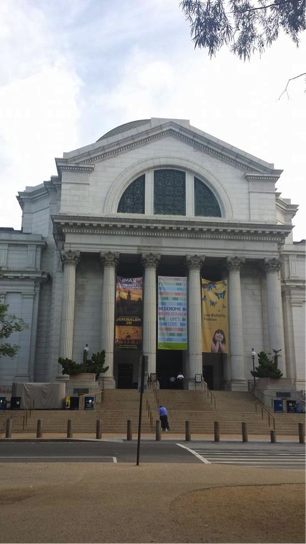
Facade, Smithsonian’s National Museum of Natural History

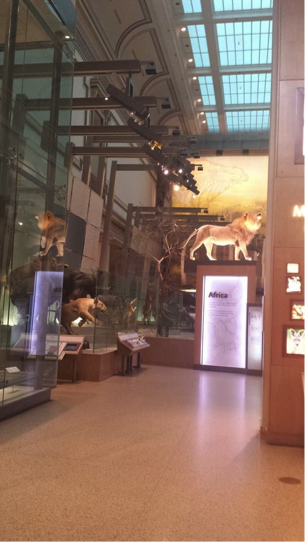
My earliest memory of the Natural History Museum is climbing the steps to see the “stuffed animal zoo.” It was a very rainy day and our plans of visiting the National Zoo were put on hold. However, my mom had an idea so that I- only about four or five at the time- could still see animals. I had no idea at the time what exactly she meant by “stuffed animal,” but I had a blast and returned frequently during our yearly trips up from Florida. The stairs seemed so much taller back then. Now they’re just a quick jaunt up to something much more than a place to escape the rain. As the years and visits went by, I found that I did not get bored by the many visits. Instead, I started looking at different aspects of the museum- beyond the educational tags and videos. I started seeing the museum as an entity and watching how much it meant to the different people visiting.
View Full Size Image
Mammal Hall, Smithsonian’s National Museum of Natural History

I completed my undergraduate degree at Florida State University, majoring in Interdisciplinary Social Sciences with a focus on Anthropology and History. I also completed a minor and certificate program in Museum Studies. I am currently working on completing my graduate degree at Catholic University of America in Library Information Science with a focus on Cultural Heritage Information Management.

Being able to work with the Smithsonian Libraries was an amazing experience. I was able to spend the last six weeks working with the Biodiversity Heritage Library as part of the Professional Development Internship Program. Those weeks flew by as I worked on a number of different projects. One of the main projects I worked on had to do with BHL’s issue tracking system, called Gemini. With digital libraries comes an even bigger audience which can lead to even more input. BHL users are able to note problems, questions, or requests that they have with items in the library which are then sent through to the issue tracking system. I was able to help unravel some of the difficult bibliographic questions which were anchored in the age old “what were the publishers thinking?” Bibliographic leg work made me feel as though my librarian skills were taking me down the path of a detective. Except instead of a dark alley I was making my way through the cyber-shelves of OCLC, wandering through different countries’ books to add to my collective knowledge about a title.
View Full Size Image
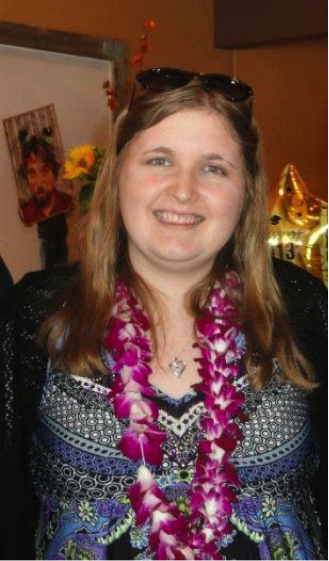
Mariah Lewis, BHL Professional Development Intern

While working on different issues in the issue tracking system I was able to make edits to the records in the BHL. After doing cataloging and metadata work in previous internships I found it very interesting to see how that data was stored and edited in a digital library setting. The collaborative effort that went into editing BHL records and answering questions in the Gemini system was incredible. With participating institutions all over the world, communication and team work was indispensable.

Working with BHL was a big change from my previous library work. It was my first time in a library setting not working with books. The transition from working with books and documents in a digitization setting to never seeing a book was not as difficult as I was expecting. I was given first-hand experience working with digital surrogates or- as some would say- totally new digital objects. Beyond this, it was really interesting to see how you can work with people all over the country and world with technology. While that seems obvious, BHL takes this to a different level and really works at having clear communication lines. The collaborative effort was probably the most inspiring part of the internship. I saw how BHL’s work can be used in other aspects of librarianship which complements my library and information science education and gives me hope and ideas for the future of librarianship.

Mariah Lewis
BHL Professional Development Intern
August 28, 2014by ntay
Blog Reel

My Life as a BHL Staffer: Jacqueline Chapman

Have you ever spotted an error in the BHL? Have you ever experienced technical difficulties with downloading digital files from our website? Have you ever looked for an article, journal, or title in our collections and been disappointed to find that it wasn’t in BHL’s collections? Have you ever wanted to thank BHL staff for a particular article, feature, or service? Have you ever had an idea for how the BHL could improve?
If you have, I hope you have taken advantage of our Feedback system and sent your corrections, suggestions, and questions on to us!  And if you have done so recently, you may have heard from me.
View Full Size Image
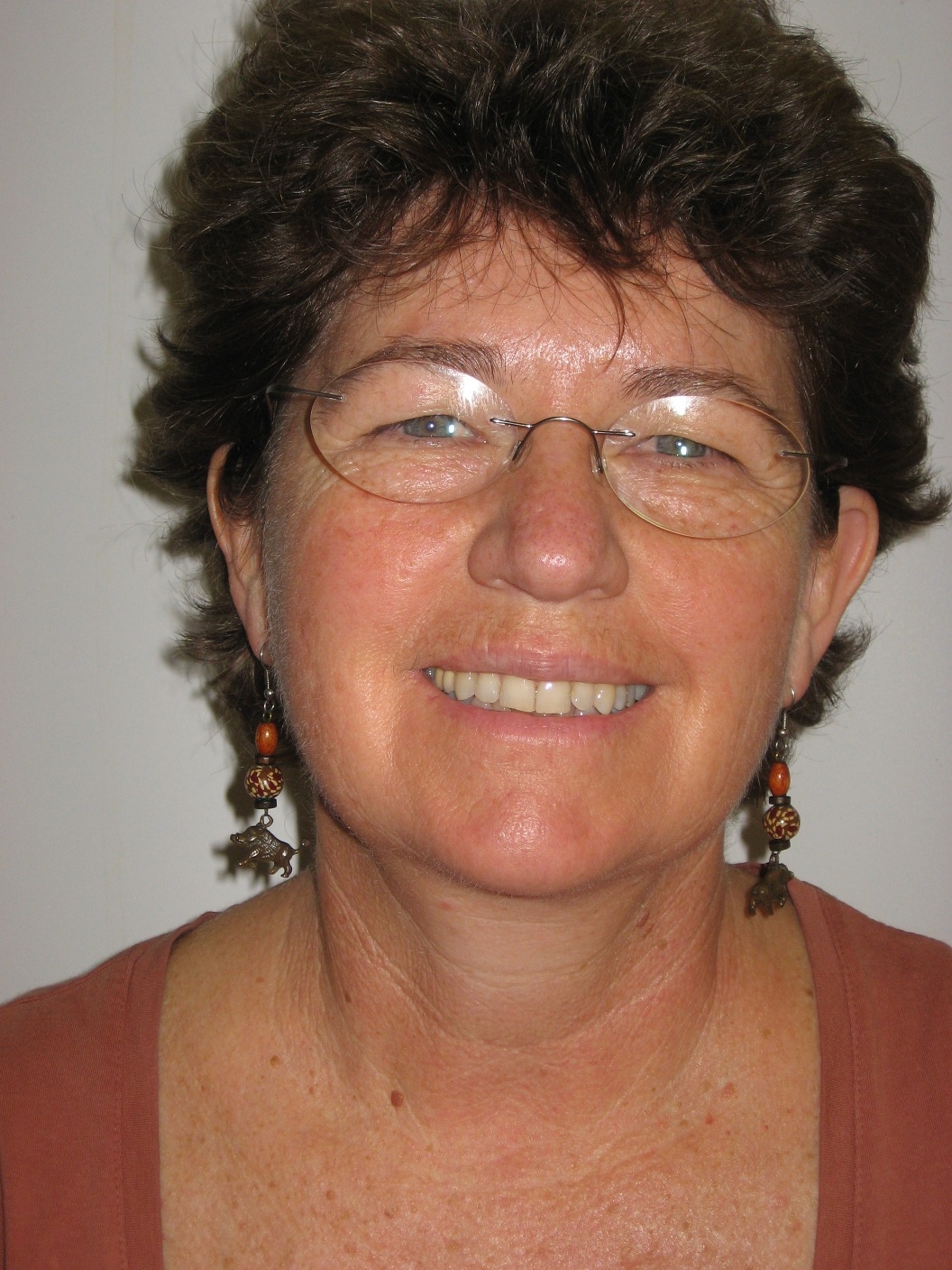
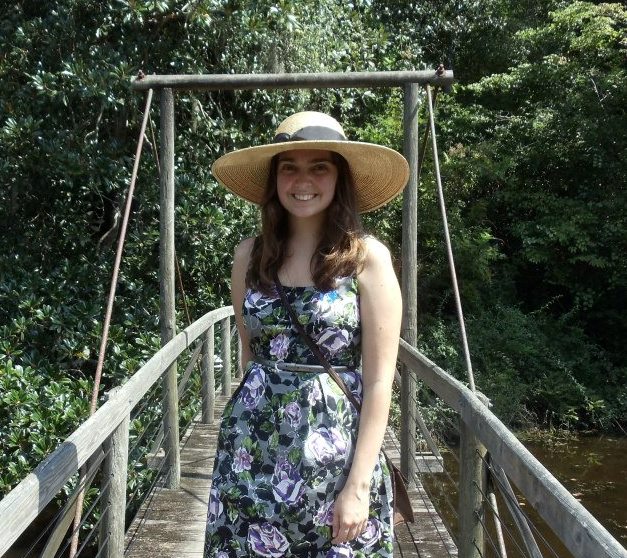
My name is Jacqueline Chapman, and I have had the pleasure of responding to hundreds of messages from BHL users over the past few months as I’ve taken on the role of BHL’s virtual reference librarian. I work on the BHL as part of my duties as a Digital Collections Librarian at the Smithsonian Institution, where I participate in digital initiatives and coordinate with various staff members to digitize the collections of Smithsonian Libraries.
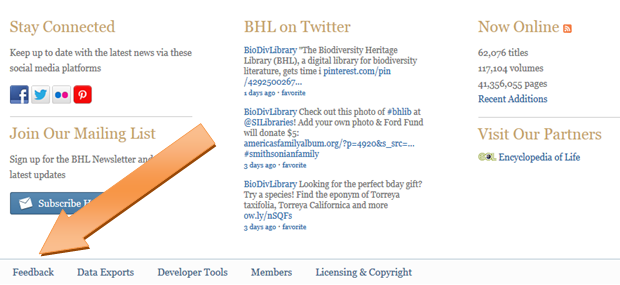
To submit feedback to the Biodiversity Heritage Library, simply scroll down to the bottom of our home page and click on Feedback.
View Full Size Image
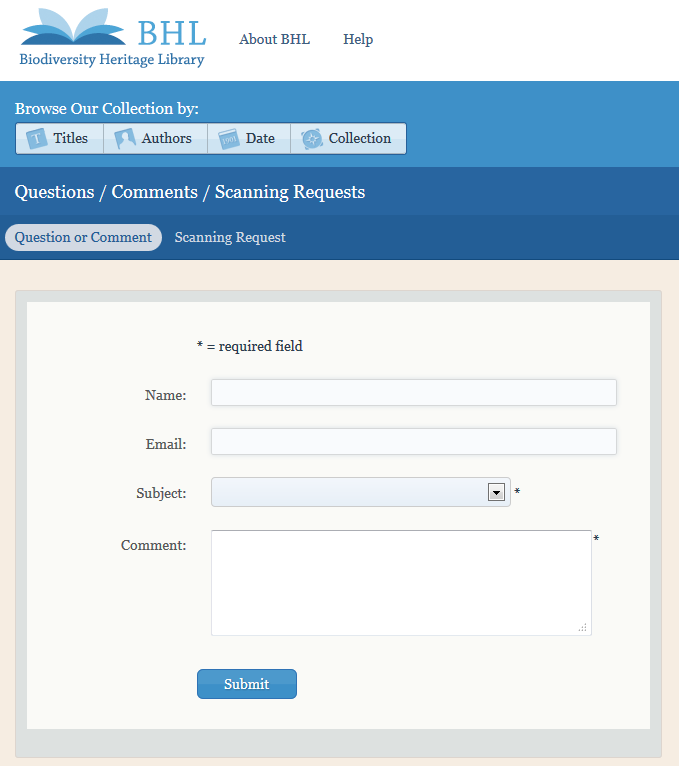
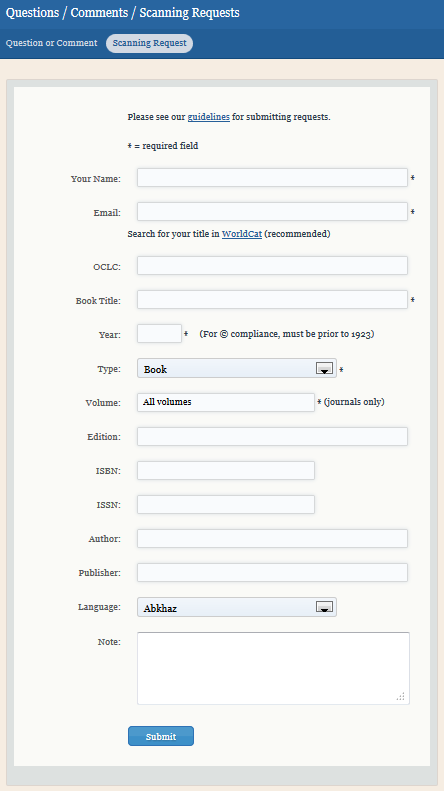
You will have the option to provide general feedback or to place a scanning request.  All submissions enter the same queue, in our back-end user feedback management system.  That’s where my work begins!
 
Questions and Comments
This section is a catch-all for user feedback that does not contain a scan request.  These may include image reuse requests, suggestions, error reporting, or technical questions.  Part of my job is to sort these submissions and determine what action is needed.
View Full Size Image
Through such user queries, I help with technical questions, investigate and fix quality issues, and answer more traditional reference questions.  I get to indulge in my enjoyment of detail-oriented intellectual tasks by merging rogue scans into their main entries, correcting metadata errors, re-sequencing volumes, merging duplicate author names, and delving into complex bibliographic mysteries. I especially enjoy sharing praise with the rest of the BHL staff!
 
Scan Requests
Members of the BHL user community are constantly helping our staff improve the quality of the BHL by requesting titles for inclusion and pointing out gaps in serials. A large portion of my duties consists of investigating these user submitted scan requests.
View Full Size Image
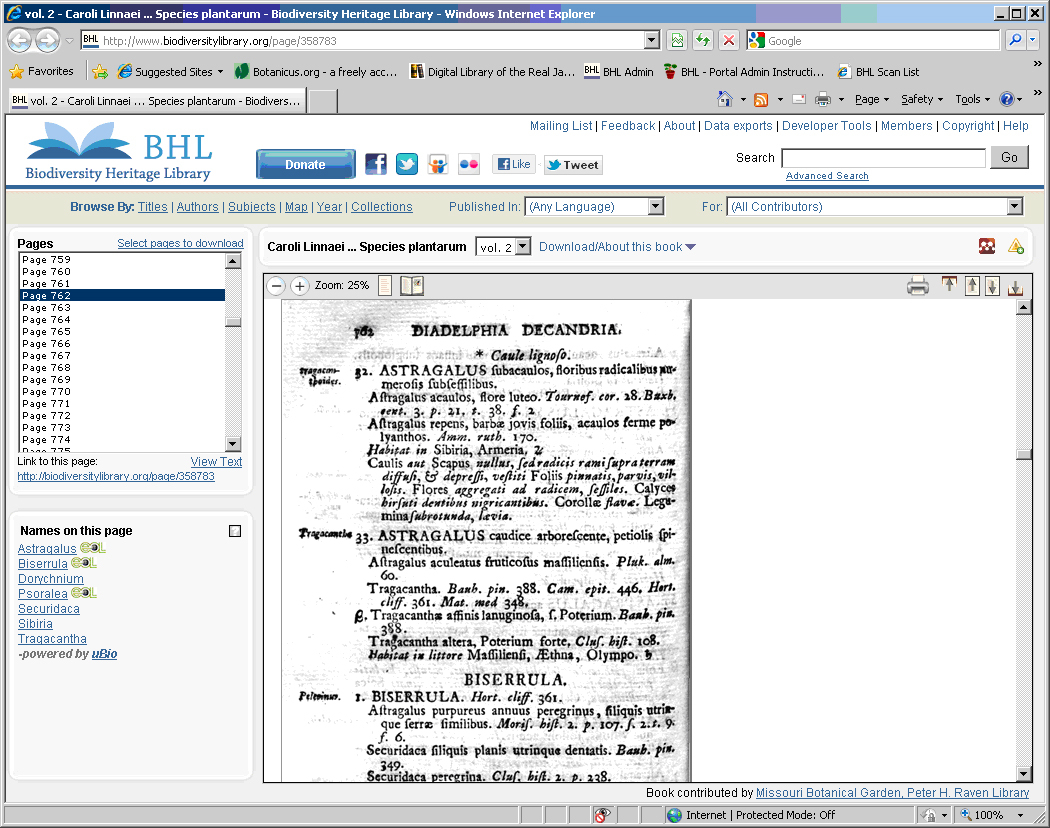
I begin by confirming that the requested item isn’t in BHL already.  Sometimes scan requests lead to the discovery of a mislabeled scan or to duplicate entries containing different volumes of the same title.  It’s great when I can satisfy a user request immediately by locating a difficult-to-find item in the BHL, and then make some changes so that it is more easily discovered by the next person.
If an item isn’t in the BHL, I check our queue to see if the item is already in progress.  We have over 1,000 issues open at any given moment, so it is not unusual for me to find that we are already hard at work on a particular scan request.
If the item is not already in progress, I will check to see if any of BHL’s member libraries holds the requested material and assign the scan accordingly.  An issue may be reassigned a number of times as institutions discover that their items are unable to be scanned, or that they lack specific volumes.  It is wonderful to see BHL collaboration in action as many partner libraries bring their collections together, digitally, in order to complete a series.
 
Submit Feedback!
I encourage you to take advantage of our feedback system. Our users make it possible for the Biodiversity Heritage Library to continually improve its offerings.  Our partners’ scanning priorities, our website’s design, the data export options that we offer, the goals we set for our project, and the social media platforms we embrace are all influenced though input from our users. We love to hear about how the BHL has aided the research of people around the world, and enjoy sharing some of the stories we hear in our BHL and Our Users feature.
Be part of the conversation!
August 21, 2013by Kathryn Stine
Blog Reel, User Stories

BHL and Our Users: Margaret Koopman

Portrait version of the Biodiversity Heritage Library logo.
View Full Size Image

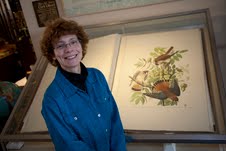
This past June, BHL-Staff visited Cape Town, South Africa for a series of meetings aimed at developing a BHL for sub-Saharan Africa. The meeting brought together 20 African participants from six countries with a variety of backgrounds including Librarians, Researchers, and Information Technologists. One such individual was Margaret Koopman, a librarian at an ornithological institute in South Africa. Margaret uses BHL regularly to help her fulfill the needs of her patrons, and she graciously agreed to be interviewed about that usage for our blog.

What is your title, institutional affiliation (or alternative place of employment), and area of interest?

I am a librarian at the Niven Library of the Percy FitzPatrick Institute of African Ornithology.  My areas of interest include ornithology, biodiversity conservation and environmental history.

How long have you been in your field of study?

I have been a qualified librarian since 1983, working almost entirely in Life Sciences libraries.  My particular field of study is environmental history in which I have an MSc.

When did you first discover BHL?

In April 2009 I linked BHL to my online catalogue.  In June 2009 I was trying to track down a copy of A Monograph of the Hirundinidae by R.B. Sharpe & C.W. Wyatt for information on population crashes of swallows in southern Africa because of extreme weather events.  I found the book in BHL and went on to write up a small piece from this publication about a population crash which took place in 1891 in Maputo, Mozambique for the Cape Bird Club Newsletter, Promerops.  The URL for BHL was included to enable readers of the article to find the BHL treasures for themselves.

What is your opinion of BHL and how has it impacted your research?

Although the Niven Library has an exceptional collection of material on African ornithology, it is not comprehensive.  BHL has been a great help in linking African ornithological research to early material published in European and British publications.  I am now able to point other researchers to what is available at BHL instead of providing pdfs myself.

How often do you use BHL?

This depends on the demand of my library users, probably on average once a week.

How do you usually use BHL (read the titles online/download whole PDFs/Select Pages to Download for a custom PDF/Download High Resolution Images/Generate Taxonomic Bibliographies/etc.)

I generally download whole PDFs, select pages to download, or identify a PDF and forward the URL to a user.

What are your favorite features/services on BHL?

I find the BHL web presence attractive and inviting.  As my use is focused I appreciate the ease with which I can establish whether a publication is available or not and the speed with which I can download material.

If you could change one thing about BHL, what would it be, or what developmental aspect would you like the BHL team to focus on next?

I know that my user community would appreciate single article access.

If you had to choose one title/item in BHL that has most impacted your research, or one item that you prefer above any other in BHL, what would it be and why?

Anything to do with African ornithology!  Providing information in this field is my mission and BHL has enabled me to do this much more easily and comprehensively.

July 24, 2012by ulib-libraryjobs
Blog Reel

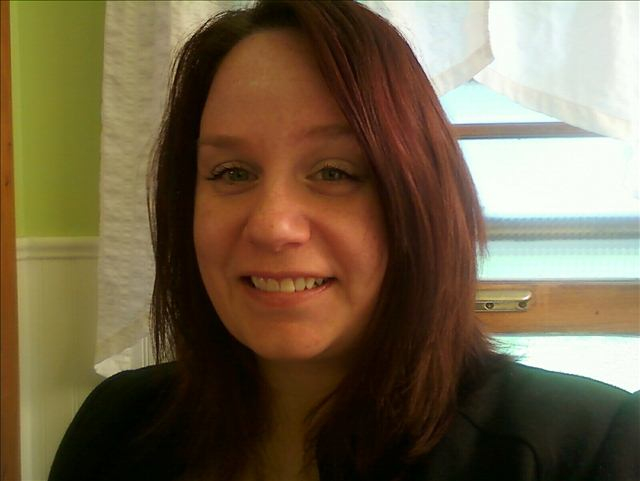
My Life as a BHL Staffer: Michelle Abeln

View Full Size Image

Hello from St. Louis. My name is Michelle Abeln, and I’m a metadata librarian at the Missouri Botanical Garden Library. I’ve been working as our BHL “liaison” for almost five years. My main focus is to make sure that our in-house scanning efforts correlate with the bigger BHL mission.

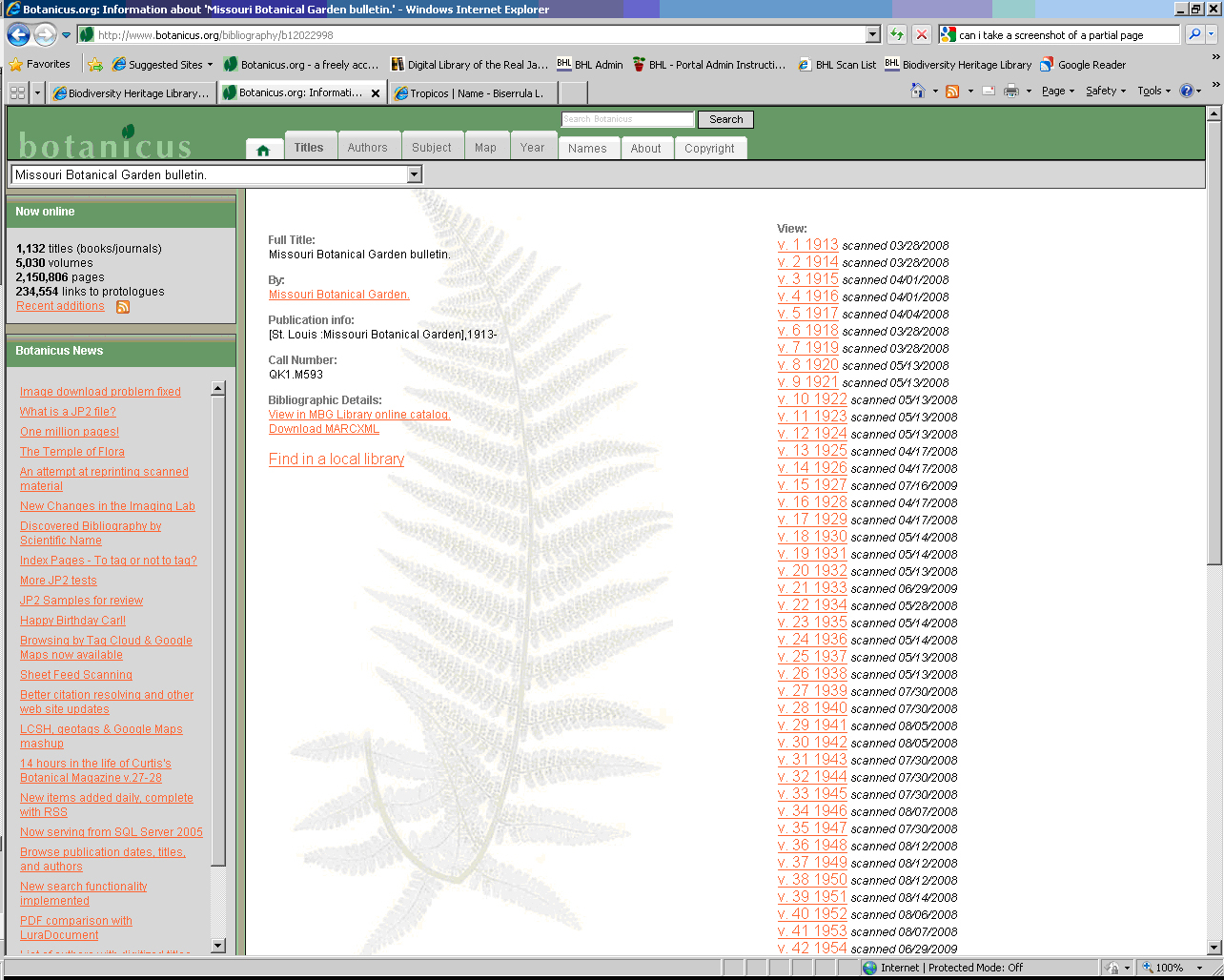
BOTANICUS
The Missouri Botanical Garden has been a leader in the digitization of scientific literature since 1995, initially focusing on illustrated volumes from the Library’s rare book collection. Working with the Garden’s Bioinformatics department, and its leader Chris Freeland, the Botanicus website was developed early on as a freely accessible web-based encyclopedia for botanical literature. While Botanicus was initially developed to house only the Garden’s holdings, the technologies and ideals behind it eventually led to the development of the BHL portal. Even though BHL is the ultimate repository for our digitized holdings, Botanicus is still very much a part of our workflow. Everything we scan goes through Botanicus first before it turns up in BHL or the Internet Archive.

View Full Size Image
Botanicus Display
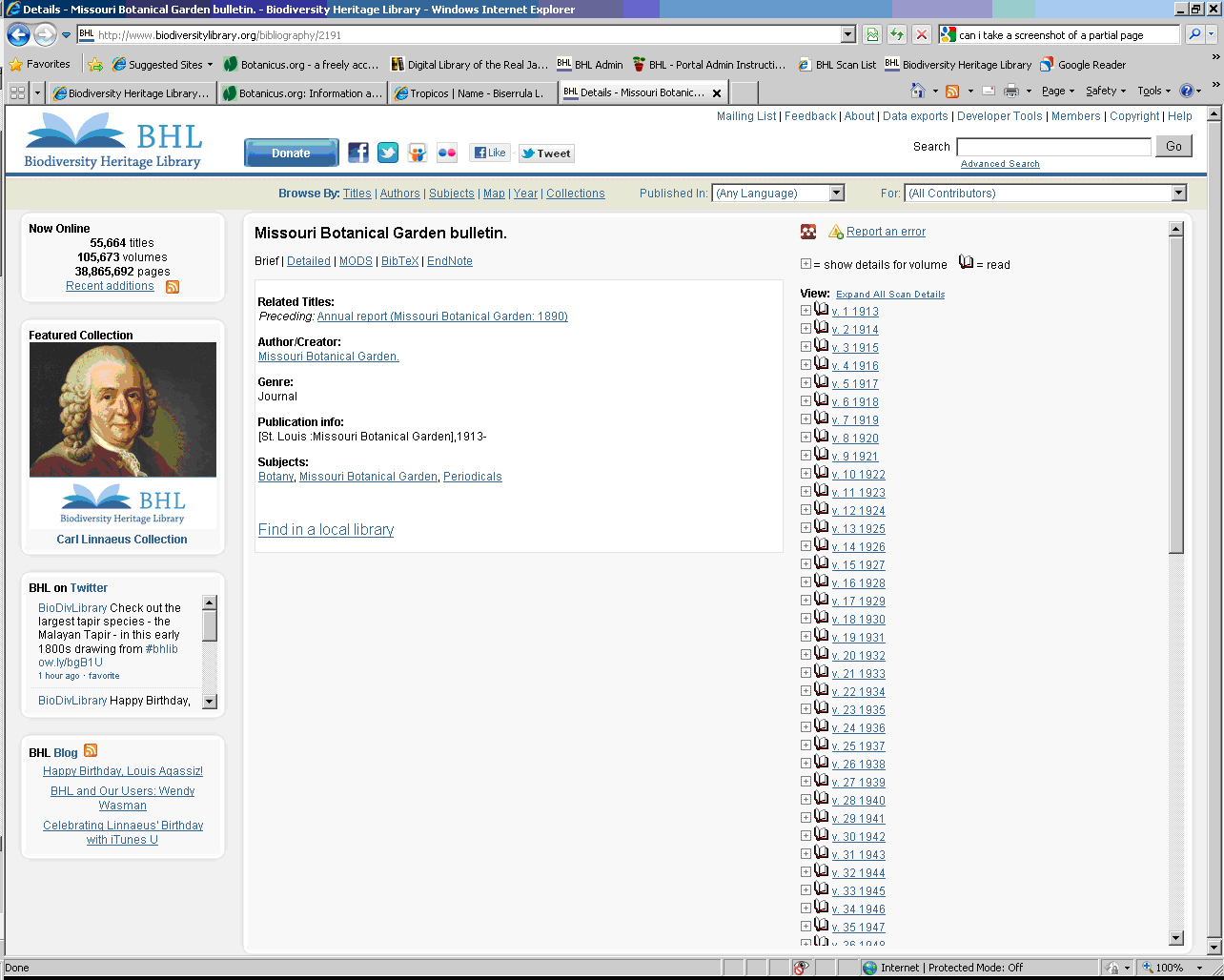
View Full Size Image
BHL Display – See the Similarities?

We’re lucky here in Missouri to have our own staff of scanners in-house, which means our workflow is quite different from other BHL institutions. We don’t need to send carts of books off site; instead we’re able to take them just down the hall. While this means that our scanning volume might be lower than other institutions, having our scanning staff on site does mean we’re able to deal with quality control issues, such as missing pages and display problems, faster. We also have things a bit easier in terms of pagination. Both Gilbert and JJ discussed the trials and tribulations (and importance!) of paginating in their blogs. At MoBot, our scanners paginate each item before it goes online. We also have the ability to scan extremely rare folios and oversized books on our “Leaf” scanner, an instant capture camera used for archival material and larger fold-outs (such as maps and plates).

Most of what we scan is monographs and journals assigned by BHL coordinators, and are received from BHL users via the online feedback form. Most are “gap-fills,” to complete serial runs, and post-copyright journal titles. We try to balance fulfilling BHL requests while still making sure that the needs of the Garden’s own research staff are met. The library shares scanning staff with the Garden’s Herbarium, so I work closely with our imaging lab coordinator, Mike Blomberg, to organize the scanners.

METADATA
One of the main focuses of my day to day work is metadata! I am forever editing, correcting, adding or subtracting data from both Garden library records and BHL records. I like to be sure that our contributions to BHL are both correct and consistent. This means that all library records are checked for corrections and edited before being parsed through (via XML conversion software) to the Botanicus database. After titles are scanned, the records are checked again once they’re online, just to make sure everything displays properly. If we’re completing a serial run started by another institution, records need to be merged so that all volumes display under one title. I also check to make sure all volumes are labeled the same (I’m a bit on the overly fastidious side when it comes to display-it’s something I know I spend way too much time on. But I do enjoy when everything lines up just so).
After scanning is complete, I return to the library catalogue and create links out to both Botanicus and BHL.

I also check the BHL RSS feed weekly for titles held by MoBot, but scanned by other institutions, so I can create links for these titles in our catalogue as well. I’ve found that these links help both research and library staff.

TROPICOS
Tropicos is a botanical database created and maintained by the Bioinformatics Department here at MoBot, which organizes over 4,000,000 plant specimens and images. Tropicos contains all of the specimen data that has been accumulated in the Gardens’ electronic databases over the past 25 years, and is now available to the public. In Tropicos, you’re able to search by both specimen name and publication name (depending on what information you have available in your citation).
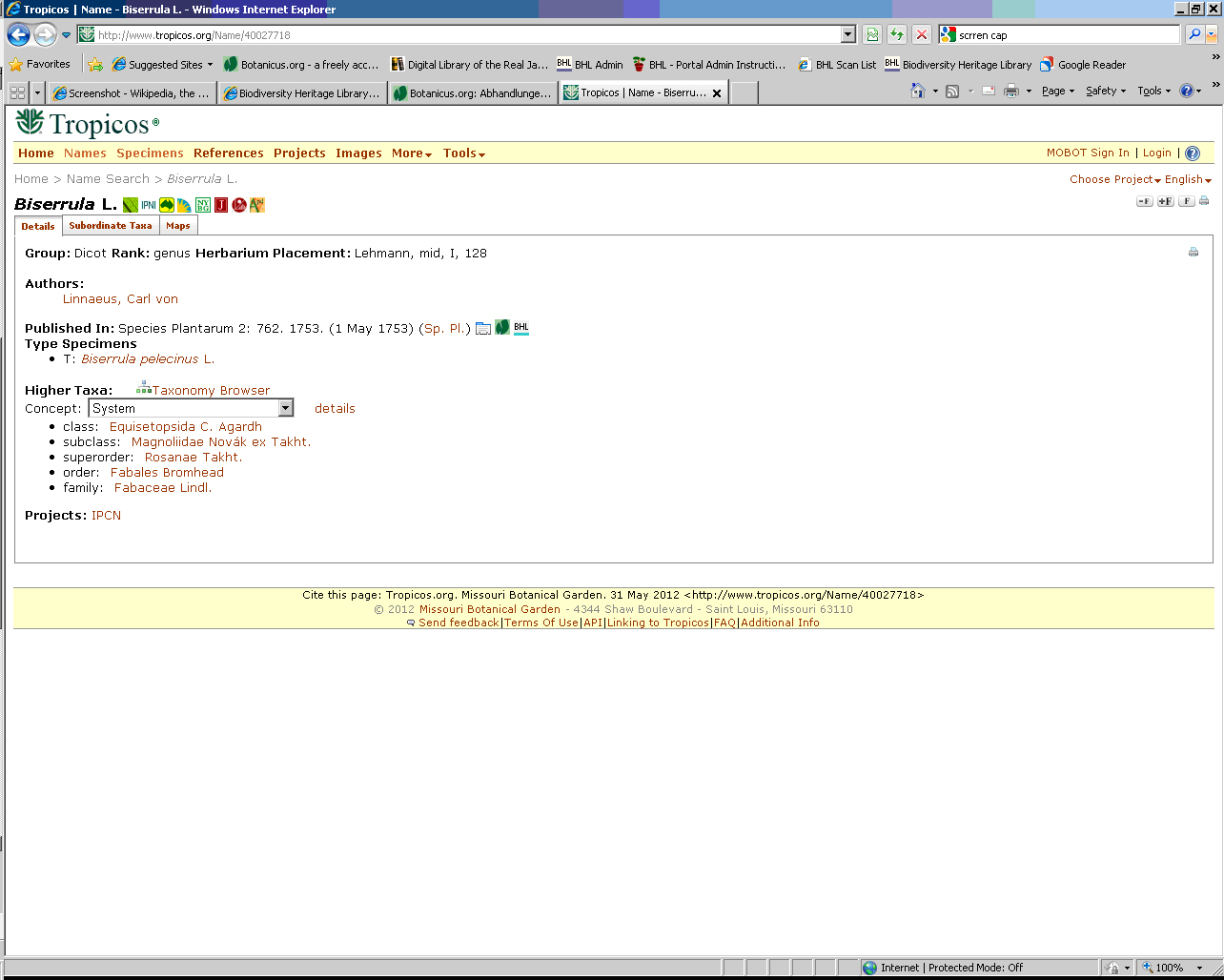
Tropicos and BHL are intimately linked: the OCR that helps identify species names in BHL “reports back” to Tropicos through an automatic data resolver, so ideally, when you look up specimens or citations in Tropicos, there should be a link out to BHL, directly to the page where the specimen is named.

View Full Size Image
Tropicos Citation Page
View Full Size Image
Citation Page in BHL, linked out from Tropicos

Unfortunately, BHL has gotten so big in recent years the automatic resolver doesn’t always work, and the links don’t always get made. I’m able to go in and add links to both Botanicus and BHL from both specific citations and publication pages. I don’t use Tropicos very often, so I rely on the Garden’s research staff to let me know when links are missing (and they do!).

I’ve been working with BHL almost since its inception, and it’s been a wonderful experience, and a lot of fun, seeing how it’s evolved and grown, not to mention meeting all the wonderful people who’ve worked on the project. I’m proud to work on such a project, knowing that we’re able to provide rare and necessary material to people who might otherwise not have a chance to study it.

June 4, 2012by michelle.underhill
Blog Reel, User Stories

BHL and Our Users: Wendy Wasman

View Full Size Image

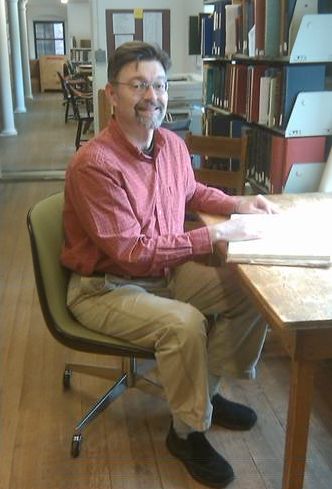
When most people think of BHL’s users, they think of scientists accessing literature for research. However, one of our largest user communities is librarians, which use BHL to fulfill requests from patrons, saving their libraries time and resources by having immediate, free, online access to our material. One such librarian is Wendy Wasman, a librarian at the Cleveland Museum of Natural History, who graciously agreed to give us a peek at the way she uses BHL to support her work activities.

What is your title and institutional affiliation?

Librarian, Cleveland Museum of Natural History

How long have you worked in a library environment?

I’ve been a professional librarian since 1988, but I have worked in libraries since I was 16! I started as a page in my public library, and then I worked in my college library (Oberlin) for 4 years. I’m on my second ‘tour of duty’ at CMNH – I was the Librarian from 1988-1994, and then moved to Philadelphia, where I was the Science Librarian at Haverford College from 1995-1999. I moved back to Cleveland in 2000, and have been back at the Museum since 2008. I tell people I’m the “renewed librarian.”

When did you first discover BHL?

I first heard about BHL back in 2008 from the listserv of the Natural History Caucus of the Special Libraries Association, and I followed its progress by reading various articles and blogs.

What is your opinion of BHL and what impact has it had on your duties as a librarian?

I can more easily meet the research needs of the Museum curators by using BHL to find articles. One of the curators was doing research on a specific salamander and needed old taxonomic literature. I was able to use BHL to find every article he needed for his research.

How often do you use BHL?

It really depends on the project. Sometimes I use it several times a week, and sometimes just once a month.

How do you usually use BHL (read the titles online/download whole PDFs/Selecting Pages to Download for a custom PDF/Downloading High Resolution Images/Generating Taxonomic Bibliographies/etc.)

I usually select pages to download for a custom PDF. I also downloaded a lot of high resolution images for a recent presentation I did on scientists and artists of the 19th century. It was a real treat being able to find and download images from the old Transactions of the Zoological Society of London, and it saved my library’s set from the wear and tear of scanning the pages I needed.

What are your favorite features/services on BHL?

Being able to select and download pages for a custom PDF is a wonderful feature.

If you could change one thing about BHL, what would it be, or what developmental aspect would you like the BHL team to focus on next?

I would love to be able to search for individual images; I know that is something that BHL is focusing on now.

Is there a specific item on BHL that is most often requested by your patrons/that you use more than any other to fulfill ILL requests?

Not really, since my use of BHL is very project-dependent right now.
____________________________________________________

Thank you, Wendy, for sharing your experiences with BHL with us! As you indicated, BHL is currently working on improving access to BHL images through work supported by our recent NEH grant. You can find out more about the grant and our project progress on our wiki. In the meantime, enjoy the thousands of BHL images freely available on the BHL Flickr!

As a final note, a recent addition to the Biodiversity Heritage Library is volumes from the Scientific Publications of the Cleveland Museum of Natural History! Be sure to check them out in BHL.


May 29, 2012by ulib-libraryjobs
Blog Reel

My Life as a BHL Staffer: Chris Carden

View Full Size Image

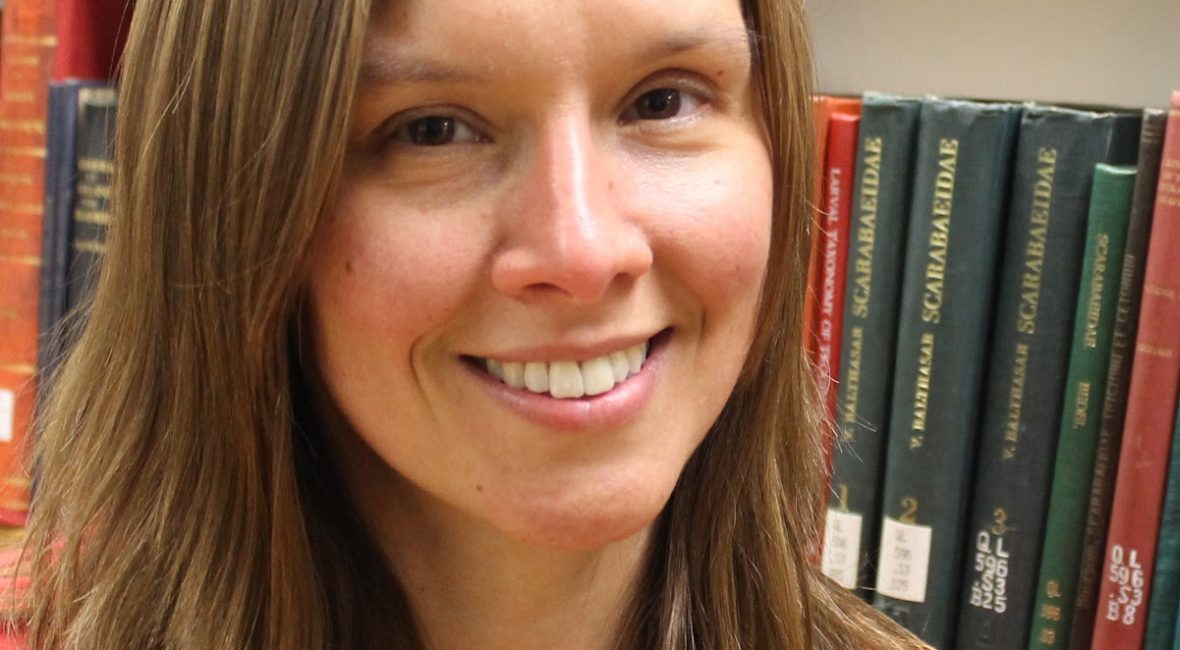
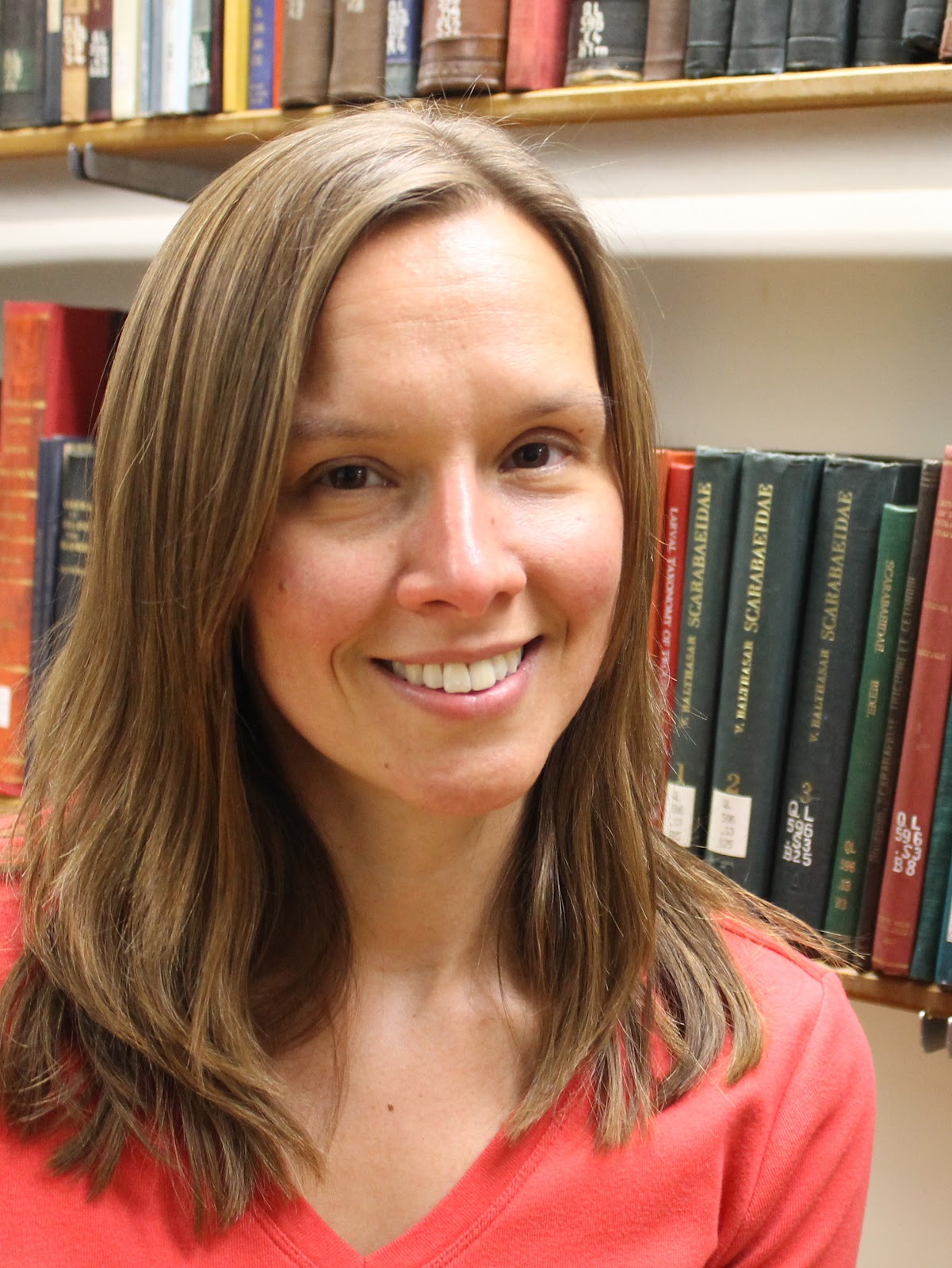
I am a Metadata Librarian for the Biodiversity Heritage Library based at the Ernst Mayr Library, Museum of Comparative Zoology, Harvard University. Under the auspices of Harvard librarians Connie Rinaldo and Joe DeVeer, I am responsible for complex cataloging of the MCZ Library’s significant natural history literature collection within Harvard’s integrated library system (known as HOLLIS) in order to provide precise bibliographic records that are imported to the BHL portal via XML pages. In order to accomplish this and to facilitate comprehensive intellectual access, I enhance minimal-level records to provide in-depth bibliographic descriptions, as well as name, series and subject authority control according to international, national and local Harvard standards.  I also resolve problems of incorrect, incomplete or conflicting bibliographic and authority data in order to facilitate navigability to content in HOLLIS and the BHL portal.

I see my job as a blend of “old” and “new” librarianship skills – I catalog in MARC, but I help facilitate knowledge accessibility for the Harvard community through HOLLIS and for the BHL community through the BHL portal, although all communities can partake of each other’s public finding aids. My goals are to improve ease of access for all biodiversity and natural history researchers through the promotion of accurate and complete digital catalog records.  The BHL taxonomy provides important search capability, but providing subject access and links to BHL records through HOLLIS provides another avenue for search means and provides facilitation for improved research use.  This access is influenced by information organization and cataloging relationships, which I endeavor to provide.

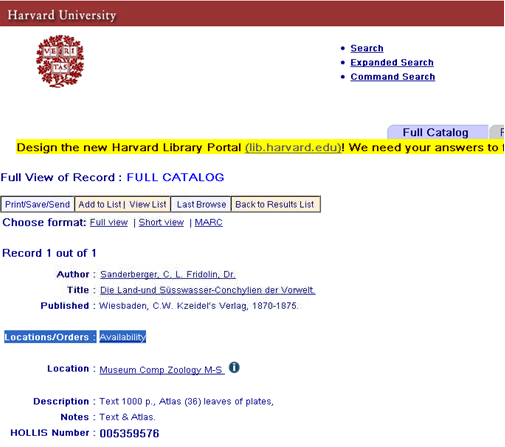
For various reasons, quite a few bibliographic records in HOLLIS have not been upgraded to local, national or international standards.  The Harvard libraries’ 19th and 20th century card catalog records were retrospectively converted into digital online catalog records during the 1990s, but considering there are over 13 million entries within HOLLIS, many of these records contained less-than-full information, what are colloquially known as core-level or “stub” records.  These records were always meant to be temporary at best – just a placeholder where a record might contain a main entry and title, and a holding location, but very little else.

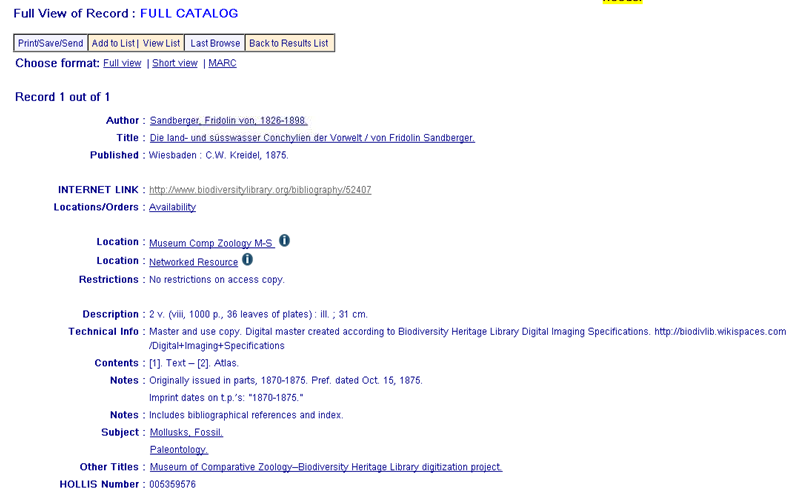
One example of this is shown here, a two-volume text and atlas set of the paleontologist Fridolin von Sandberger’s work, Die Land-und Süsswasser-Conchylien der Vorwelt, published in 1875:

View Full Size Image

This record exhibits very basic and incomplete information; there is author, title and publisher information, a physical description in terms of number of pages, a perfunctory general note, the HOLLIS record number, and the holding location here at the Ernst Mayr Library. All well and good, but obviously this record has a few problems. Besides the need to link the entry to its corresponding BHL record, there are no subject headings, there is a bibliography and index that needs to be noted, punctuation and physical descriptors need to be upgraded to contemporary cataloging rule standards (i.e., Anglo-American Cataloging Rules, 2nd ed., etc.), and most egregiously, the author’s name is misspelled!

To rectify these problems, I employed a few steps. I first checked OCLC (Online Computer Library Center) through its Connexion program to see if there were more complete records held by other reputable repositories. In this case there was a good one, so I overlaid the new record via a Z39.50 protocol over the original incomplete record in HOLLIS. I then compared the bibliographic information with the scanned BHL version of the book; if necessary, I sometimes consult the physical copy from our Library stacks. I then made necessary changes to the record to reflect the Library’s holding. I also consulted the Library of Congress Name Authorities to check the authorized heading for Dr. von Sandberger’s name. Finally, I attached a holdings record link to the corresponding BHL record, making it quick and easy for researchers to go straight to the digital copy and begin reading. The final markup in HOLLIS now looks like this:

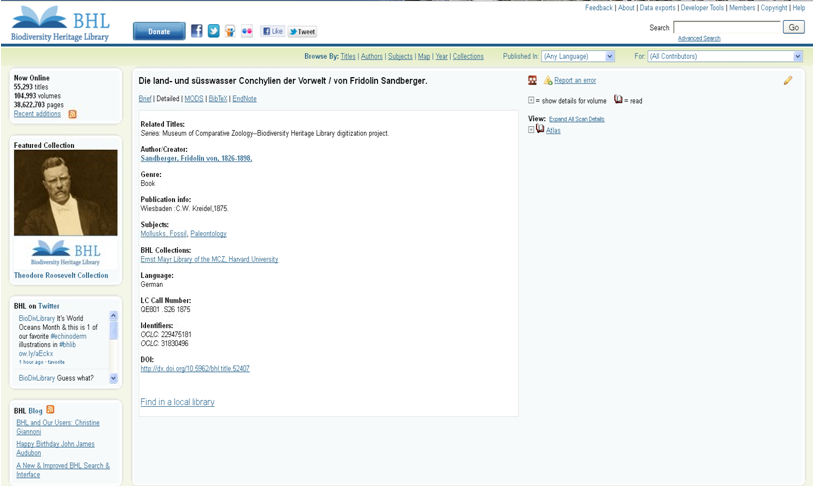
View Full Size Image

Note there is a properly-spelled author with his birth and death dates, a more complete physical description of the volumes, subject access, and an internet link to the BHL record.  In addition, the BHL record now looks like this:

View Full Size Image

One note about the subjects, of which there are only a couple and they seem very broad: in a comprehensive work such as this, the taxonomy for subject headings would be very extensive, and a massive bibliographic record would result. I don’t claim to be a biological taxonomist, and am thankful for BHL’s uBio taxonomic name server that makes searches easier within the digitized texts for specific species or genera. Therefore, with the help of Library of Congress MARC 21 authorities, I chose “Mollusks, Fossil” and “Paleontology” as subject terms that would most accurately describe the work. In other cases, for a work that covers a more specific species, geographic area or geological epoch, I would include species, geographical or chronological subject terms, if possible.

Another aspect of my job is paginating Harvard’s holdings on the public portal consistent with BHL standards. Gilbert Borrego and JJ Ford have already enlightened us on the importance of the BHL pagination through previous blog posts, so I won’t describe the process as it would be redundant. However, my intent is to help direct researchers to the materials they need in the most efficacious manner, and streamline the navigability of the online texts and illustrations held by the Ernst Mayr Library that are in the BHL portal. With the outstanding assistance of our colleagues JJ, Katie Mullen and Gwen Henry, most of Harvard’s serial holdings on BHL have been thoroughly paginated. Pagination continues on monographic titles that the Library has prioritized and our faithful users have suggested. As Gilbert noted, we’re looking for ways to accurately automate the pagination procedure, but right now it’s still a manual method. But, hopefully, even with over 38 million pages and counting, everyone will eventually get a fully-paginated BHL.

I have a varied professional background and my earlier careers included having worked as assistants in fields such as environmental law and bookselling. However, since I earned my MSLIS from Simmons College in Boston, I have been fortunate to have worked on a number of different archival and metadata projects at such diverse places as the Metropolitan Museum of Art and the Doris Duke Foundation at Duke Farms, New Jersey. I have been at Harvard since 2006 where my initial position was as a project cataloger in the Fine Arts Library.

I have been working on the BHL project since February 2010.  I truly feel privileged to be part of the BHL team, and this is one of the most satisfying and gratifying positions I have ever had in my career. I am working with a great group of intelligent, talented, hard-working and dedicated colleagues, not only at Harvard, but within all the partner institutions, and it has been very rewarding. We have also been privileged to have some great and positive feedback by our researchers, who continually help us with suggestions of titles that have yet to be scanned or suggest ways to provide better access and information online. I am very proud to be working on this project and believe that such a significant resource will continue to be sustained and be kept strong for future biodiversity researchers.

May 7, 2012by ulib-libraryjobs
Blog Reel, User Stories

BHL and Our Users: Christine Giannoni

View Full Size Image

Today, we feature another of our own: Museum Librarian Christine Giannoni at the Field Museum in Chicago, IL. Christine is an active member of the BHL consortium, managing the workflow to scan Field books for BHL, as well as participating in a variety of BHL groups and committees, including the BHL Institutional Council. She is an avid fan and proponent of the BHL project, tirelessly promoting it among her researchers and patrons. We are very thankful for her valuable contributions to the project.

What is your title, institutional affiliation, and area of interest?

I am the Museum Librarian at the Field Museum of Natural History in Chicago. I am responsible for the overall operation of the Library, focused upon ensuring access to collections, providing excellent service to our patrons & promotion of the variety of resources in our collections.

How long have you been working in a library environment?

I have worked in several different types of libraries for the last 17 years. While completing my undergraduate degree in Anthropology at the University of Illinois at Chicago, I got a job shelving books in a local public library, and I was hooked. I was also able to volunteer at The Field Museum during my undergrad years, so that helped a lot when it came to the first big challenge of working at The Field Museum – finding your way around the building!

When did you first discover BHL?

I discovered BHL around 2007 when The Field Museum Library first started digitizing FMNH publications in partnership with the scanning center at the University of Illinois at Urbana-Champaign. At the time I was Reference & Circulation Librarian, with supervisory responsibility for Interlibrary Loan. Having digital access to the Fieldiana series as well as the Museum’s early News and Annual Report series was (and remains) a fantastic resource.

What is your current level of involvement in BHL?

I devote several hours per week to various BHL activities. Our participation in regards to scanning is primarily related to user requests for filling in “missing” issues within the BHL corpus. We were also fortunate in late 2011 to receive funding for scanning from the Museum’s Africa Council. With these funds, we were able to scan literature related to African Biodiversity, several volumes of which came from our rare collection. Furthermore, I am actively working on training volunteers and interns to paginate BHL scanned materials – a very satisfying activity for them as they can immediately see the results of their work on BHL.

What is your opinion of BHL and what impact has it had on your duties as a librarian?

I feel that working on the BHL project is one of most rewarding aspects of my job. For many years, I have interacted with researchers from all over the world who come to use The Field’s specimen and object collections. When they inevitably come to the Library during their visit, I often hear things such as, “these books are nowhere in my country” or “I have needed to see this item for my research for years.” The fact that we can now make these materials freely available to researchers worldwide is incredibly satisfying.

How often do you use BHL?

Everyday. I remain a primary reference and interlibrary loan contact for internal and external users. I rarely have a day where I do not direct users to the BHL to fulfill a request.

What has been the reaction of your patrons to BHL?

Reaction to the BHL is overwhelmingly positive. As people grow more accustomed to the convenience of electronic publications, they are extremely grateful for its existence. I recall earlier in my career when individuals felt that you could digitize materials and put it into deep storage. In my experience, users view BHL content and then sometimes contact me in order to see “the real thing.” This isn’t necessarily because they distrust the content, but are interested in some other aspect of the work (the item as a physical artifact, for instance). I also have users concerned about conservation/condition of print, so they like the alternative.

What services/features do you like the most about BHL and which do you most like to point out to your patrons? Which services/features are your patrons most excited about/use most often?

For me, I like that the URL’s are easy to copy and send along…From the researcher perspective, they like being able to generate PDFs.

If you could change one thing about BHL, what would it be, or what developmental aspect would you like the BHL team to focus on next?

Full-text searching is mentioned all the time.

Is there a specific item on BHL that is most often requested by your patrons/that you use more than any other to fulfill ILL requests?

Our FM publications for sure!

May 1, 2012by ulib-libraryjobs
Page 1 of 212»

Help Support BHL

BHL's existence depends on the financial support of its patrons. Help us keep this free resource alive!

search

About BHL

The Biodiversity Heritage Library (BHL) is the world’s largest open access digital library for biodiversity literature and archives. BHL operates as a worldwide consortium of natural history, botanical, research, and national libraries working together to digitize the natural history literature held in their collections and make it freely available for open access as part of a global “biodiversity community.”

Join Our Mailing List

Sign up to receive the latest news, content highlights, and promotions.

Subscribe Now

Subscribe to Blog via Email

Enter your email address to subscribe to this blog and receive notifications of new posts by email.

Join 319 other subscribers

Subscribe to Blog Via RSS

Subscribe to the blog RSS feed to stay up-to-date on all the latest BHL posts.

Access RSS Feed

Inspiring Discovery through Free Access to Biodiversity Knowledge.

The Biodiversity Heritage Library makes it easier than ever for you to access the information you need to study and explore life on Earth…for free, anytime, anywhere.


64+ Million Pages of
Biodiversity Literature Online.

EXPLORE

Tools and Services
to Transform Research.

EXPLORE

300,000+
Illustrations on Flickr.

EXPLORE

ABOUT | HARMFUL CONTENT | PRIVACY | SITE MAP | TERMS OF USE