

Most people today are at least somewhat familiar with the order of extinct marine reptiles known as Plesiosauria, thanks to the legend of the Loch Ness monster, which is often described as resembling a plesiosaur. Indeed, some argue that Nessie may in fact be a surviving member of this order. Scientists, however, reject this suggestion, if for no other reason that the Loch Ness lake formed a mere 10,000 years ago, while the fossil record indicates that plesiosaurs went extinct over 66 million years ago. And yet, even if plesiosaurs can’t account for the Loch Ness legend, the story of their discovery is still captivating.
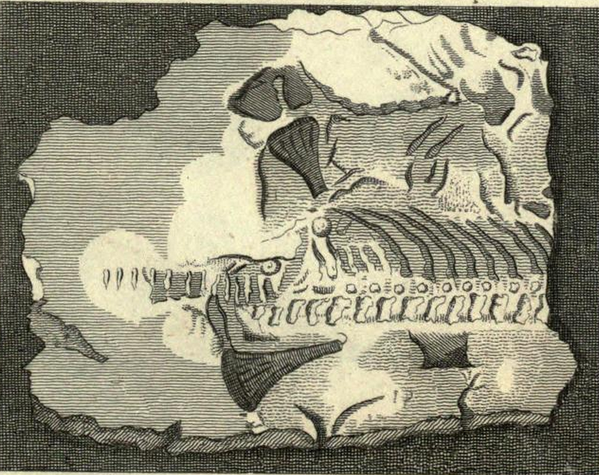
Plesiosaurs are among the first extinct fossil reptiles to be recognized as such. Plesiosaur fossils were described as early as 1605, though in the seventeenth century they were not recognized as extinct reptiles. In 1719, Anglican clergyman William Stukeley, who pioneered archaeological studies at Stonehenge and Avebury, described a partial plesiosaur skeleton that had been brought to his attention by Robert Darwin of Elston, Charles Darwin’s great-grandfather. The skeleton had been found at a quarry at Fulbeck, England. It had been used to reinforce the slope of a watering-hole until the fossils were discovered within it, after which it was displayed in the local vicarage as the remains of a sinner killed during the Biblical flood. Stukeley’s description in “An Account of the Skeleton of a Large Animal Impressed on Stone,” which describes the fossils as belonging to a sea creature such as a crocodile or porpoise, is the first published description of an articulated fossil reptile skeleton.
 |
| Stukeley’s plesiosaur. Original Publication: Philosophical Transactions of the Royal Society of London. 1719. Reprint, 1809: http://biodiversitylibrary.org/page/23269260. Digitized by University of California Libraries. |
Further descriptions of plesiosaurs through the early nineteenth century were still based on incomplete specimens. In 1821, William Conybeare and Henry Thomas De la Beche gave the genus its name, Plesiosaurus, when they described a partial skeleton from the collection of Colonel Thomas James Birch.
It was 1823 when the next great milestone in the plesiosaur story occurred. Famous “fossil-hunter” Mary Anning discovered a nearly complete skeleton at Lyme Regis in Dorset, England. The fossil was acquired by the Duke of Buckingham, who lent it to geologist William Buckland, who himself made it available to William Conybeare. Conybeare described the find, and asserted the full species name, Plesiosaurus dolichodeirus, during the same lecture at which Megalosaurus, the first dinosaur genus to be validly named, was described.
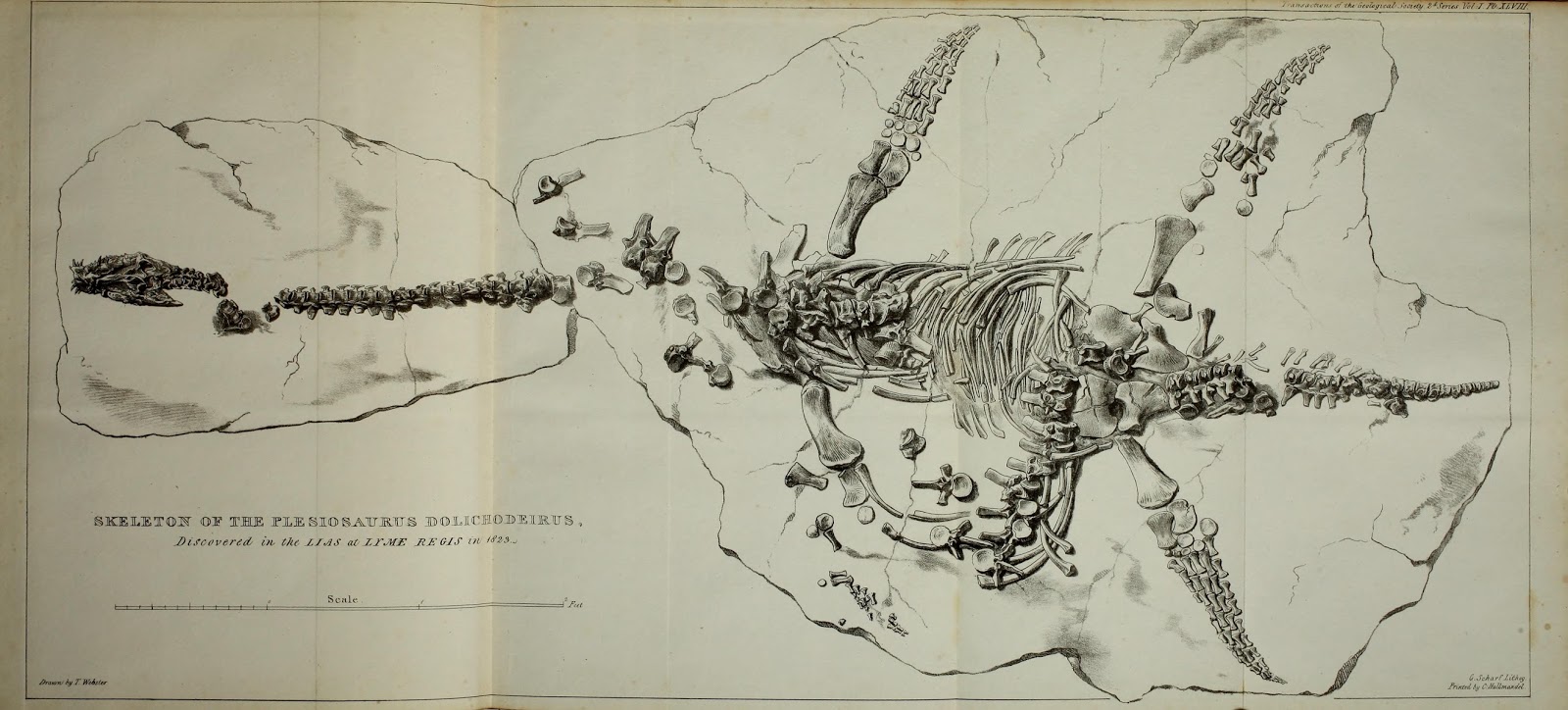 |
| Anning’s plesiosaur. Transactions of the Geological Society. ser. 2, v.1. 1824. http://biodiversitylibrary.org/page/36238986. Digitized by California Academy of Sciences. |
Sadly, despite Mary Anning’s significant contribution to the history of plesiosaur discovery, she is not named in Conybeare’s paper.
Fossil Stories
Stay tuned all week for more great fossil fun with our #FossilStories campaign, including:
- Tweets and Facebook Posts
- Blog Posts highlighting milestones and key publications in the history of fossil research
- A Flickr Collection with hundreds of historic fossil illustrations
- A Pinterest Collection featuring a selection of our favorite fossil illustrations
- A BHL Collection containing seminal publications in the history of paleontology
- A series of live webcasts at BHL partner institutions
- A citizen science challenge in collaboration with The Field Book Project, the Smithsonian Transcription Center, and Smithsonian Institution Archives
