Biodiversity Heritage Library - Program news and collection highlights from BHL
  • Home
  • News
  • Featured Books
    • All Featured Books
    • Book of the Month Series
    • BHL at 20
  • User Stories
  • Campaigns
    • Fossil Stories
    • Garden Stories
    • Monsters Are Real
    • Page Frights
    • Her Natural History
    • Earth Optimism 2020
  • Tech Blog
  • Visit BHL
Home
News
Featured Books
    All Featured Books
    Book of the Month Series
    BHL at 20
User Stories
Campaigns
    Fossil Stories
    Garden Stories
    Monsters Are Real
    Page Frights
    Her Natural History
    Earth Optimism 2020
Tech Blog
Visit BHL
  • Home
  • News
  • Featured Books
    • All Featured Books
    • Book of the Month Series
    • BHL at 20
  • User Stories
  • Campaigns
    • Fossil Stories
    • Garden Stories
    • Monsters Are Real
    • Page Frights
    • Her Natural History
    • Earth Optimism 2020
  • Tech Blog
  • Visit BHL
Biodiversity Heritage Library - Program news and collection highlights from BHL
Blog Reel, Campaigns, Featured Books, Fossil Stories

Fossils Under the Microscope: Hooke and Micrographia

By the seventeenth century, it was still widely believed that species could not become extinct, and there were still many hypotheses about the origin of fossils. One widely-held belief, extending back to Aristotle’s time, was that fossils were formed by the Earth itself, and that some “extraordinary Plastick virtue” could create stones that resembled, but were not, living organisms.

But also during the seventeenth century, some critical advances in the world of science were having an impact on fossil research.

Robert Hooke was born at Freshwater, on the Isle of Wight, in 1635. Though of humble origins, he eventually studied at Oxford and impressed many of England’s leading scientists with his ability to design experiments and build equipment. In 1662, Hooke was named Curator of Experiments of the newly formed Royal Society of London, where he demonstrated new equipment and experiments during the Society’s weekly meetings.
View Full Size Image
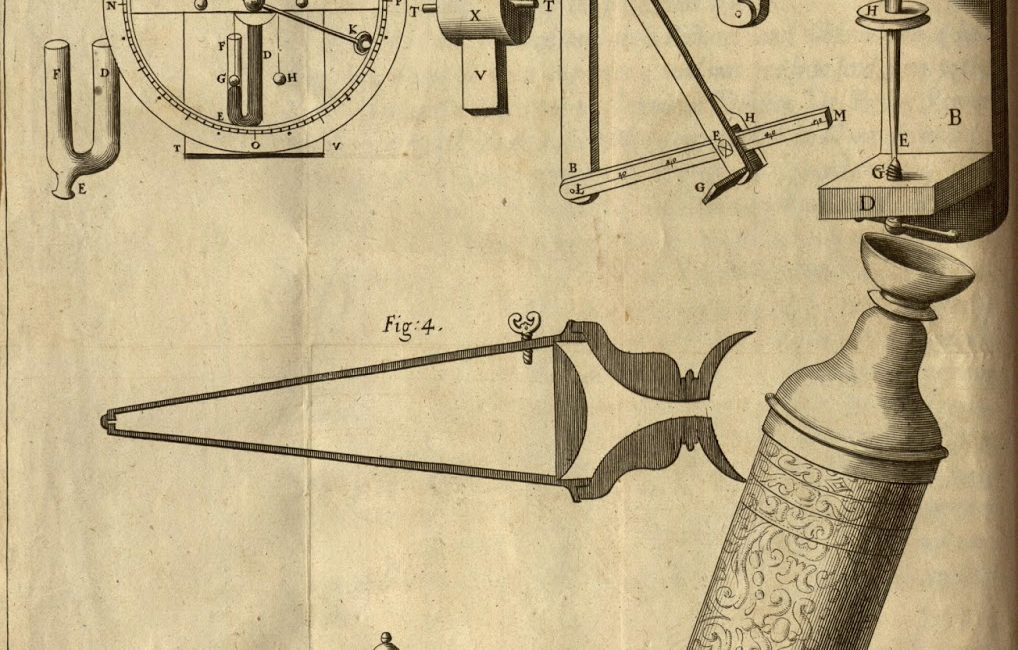
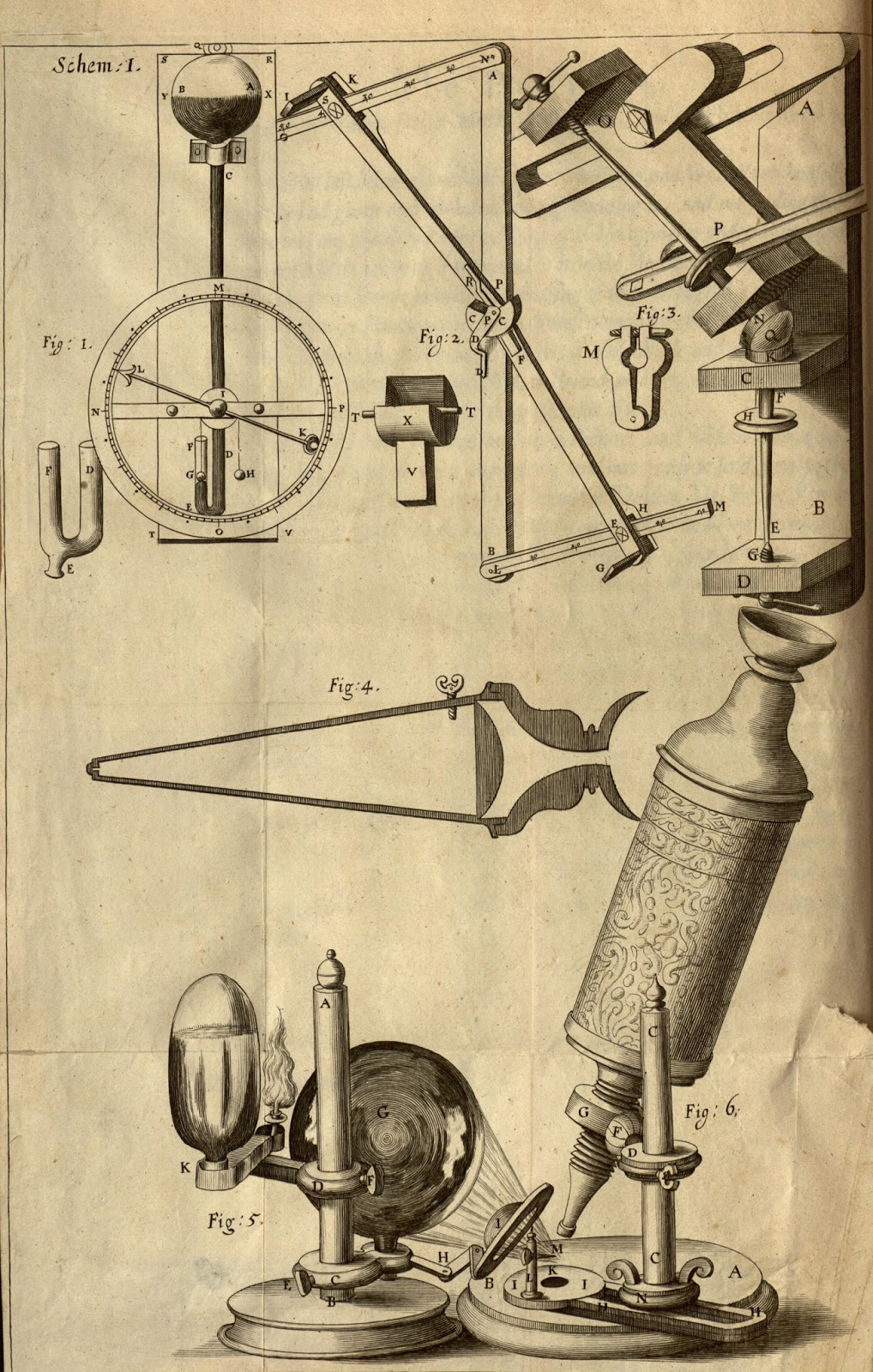
Robert Hooke’s microscope. Micrographia, 1665. http://biodiversitylibrary.org/page/786364. Digitized by: Missouri Botanical Garden.

One of his inventions was a novel compound microscope and illumination system, one of the best microscopes of the time. In 1665, Hooke published Micrographia, his masterpiece detailing his microscopic observations. It is the first book to illustrate plants and animals as seen through the microscope, and the stunning illustrations capture minute details such as the intricacies of a flea or the cells in cork tissue. In fact, Hooke coined the term “cells,” as the structures he saw in his microscope reminded him of the cells of a monastery.

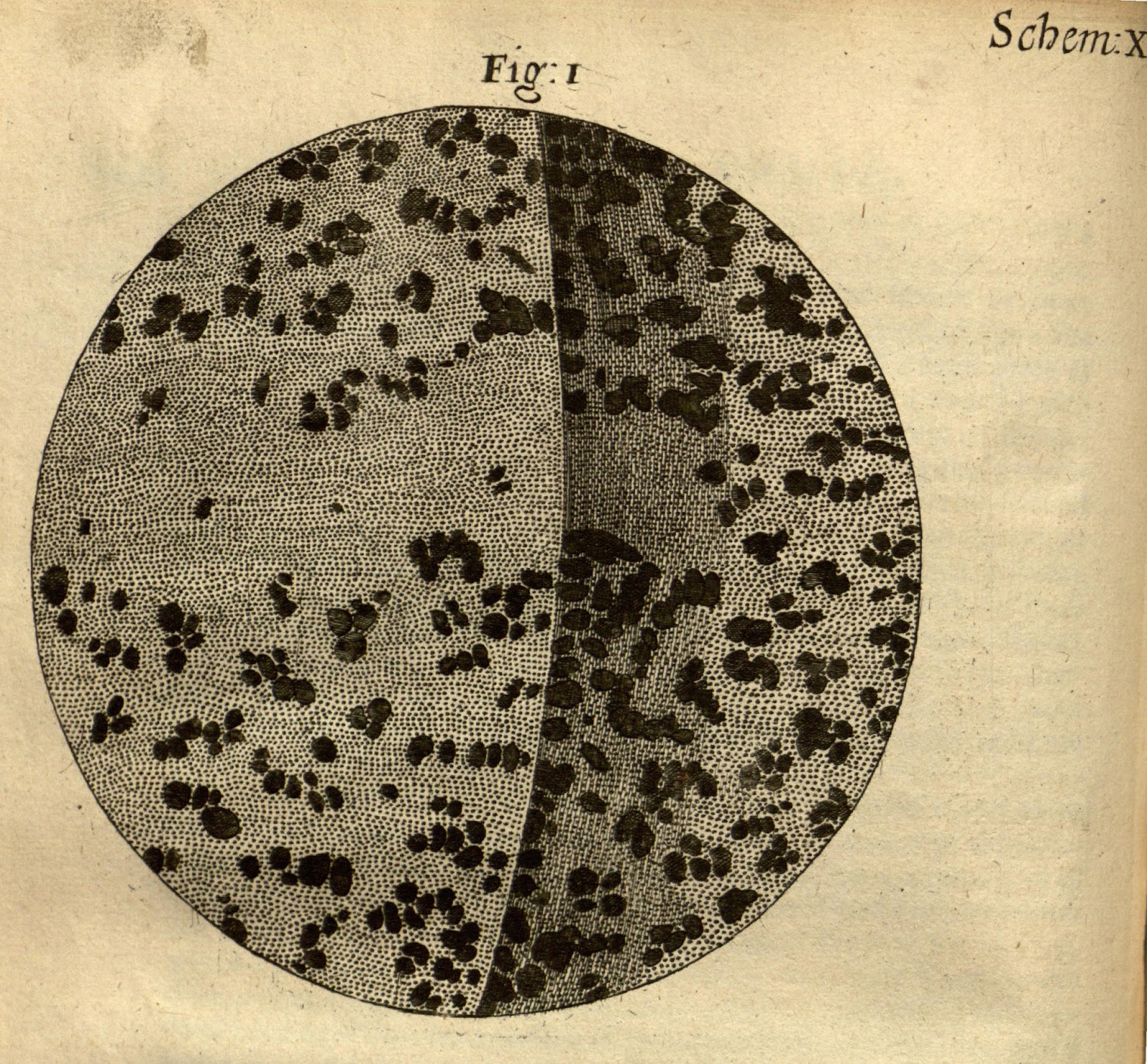
Hooke also examined fossils with his microscope, thus becoming the first recorded person to do so. Through his observations, he noticed striking similarities between petrified and living wood and fossil shells and living mollusk shells. Comparing petrified wood to a piece of rotten oak wood, Hooke realized that wood could be turned to stone when water deposited minerals throughout the wood. Similarly, his observations on shell-like fossils led him to conclude that shells could also be turned into fossils when they were “fill’d with some kind of Mud or Clay, or petrifying Water, or some other substance.”
View Full Size Image
A section of petrified wood. Micrographia, 1665. http://biodiversitylibrary.org/page/786478. Digitized by: Missouri Botanical Garden.

Throughout his life, Hooke continued to study fossils and compare them to living organisms. Recognizing that many fossils did not have living equivalents, he concluded that some represented species that no longer exist. If this was true, he deduced, it was likely that there are species alive today that did not exist in past ages.

Thus, nearly 200 years before Darwin, Hooke’s observations of fossils led him to assert that they are not only the remains of past-living organisms, but that they also document the history and changes of life on Earth.

Fossil Stories

Stay tuned all week for more great fossil fun with our #FossilStories campaign, including:
  • Tweets and Facebook Posts
  • Blog Posts highlighting milestones and key publications in the history of fossil research
  • A Flickr Collection with hundreds of historic fossil illustrations
  • A Pinterest Collection featuring a selection of our favorite fossil illustrations
  • A BHL Collection containing seminal publications in the history of paleontology
  • A series of live webcasts at BHL partner institutions
  • A citizen science challenge in collaboration with The Field Book Project, the Smithsonian Transcription Center, and Smithsonian Institution Archives
Follow #FossilStories on Twitter and Facebook to learn more.

Reference
UC Berkeley: Robert Hooke
October 13, 2015by michelle.underhill
Blog Reel, Featured Books

Book of the Week: The Birth of Microscopic Plant Anatomy

Portrait version of the Biodiversity Heritage Library logo.
View Full Size Image
There are groundbreaking biodiversity works that most of us are familiar with, including Systema Naturae and On the Origin of Species. Then there are other works that, though just as monumental for their impact on scientific knowledge, are less universally known than others. One such book is Anatomy of Plants, a seventeenth century work by Nehemiah Grew.

Many people have probably never heard of this work, and most probably have no idea what contribution it made to scientific discovery. Grew’s masterpiece, however, is significant not just because it depicts the first microscopic descriptions of pollen, but also because it is the first publication to note that a plant’s stamen is a male organ, with pollen as the seed. In fact, this work earned Grew, who was given the title “The Father of Plant Physiology,” the distinction of being one of the most celebrated scientists of the seventeenth century, and, together with Malpighi, he is considered the co-founder of plant anatomy.

Anatomy of Plants, published in 1682, was divided into four books, entitled Anatomy of Vegetables Begun, Anatomy of Roots, Anatomy of Trunks, and Anatomy of Leaves, Flowers, Fruits and Seeds. The work was largely a collection of Grew’s previous publications, many of which were presented to the Royal Society in the 1670s. Within the work, Grew describes the key differences between the morphology of stem and root, and, as previously mentioned, details the microscopic characteristics of pollen and hypothesized that stamen are the male organs of plants.

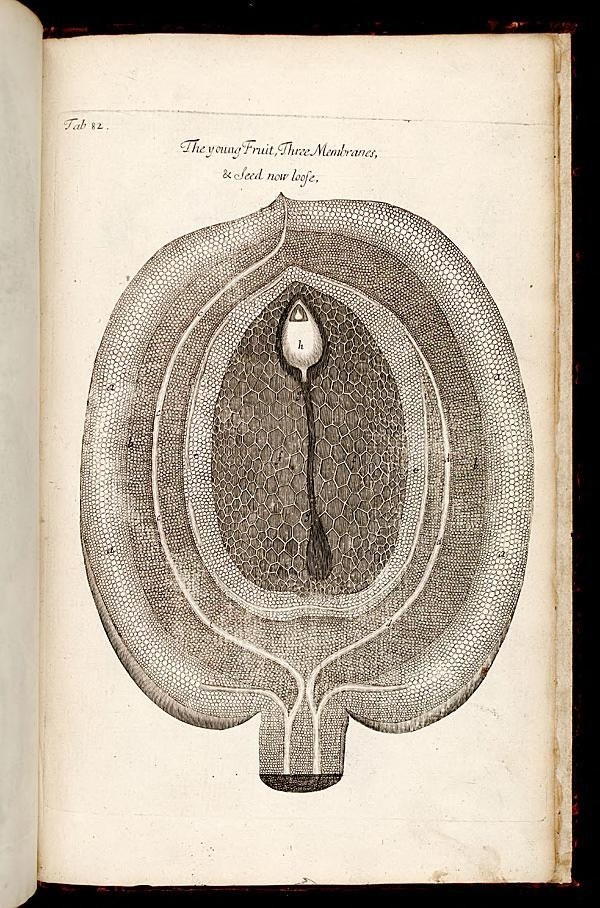
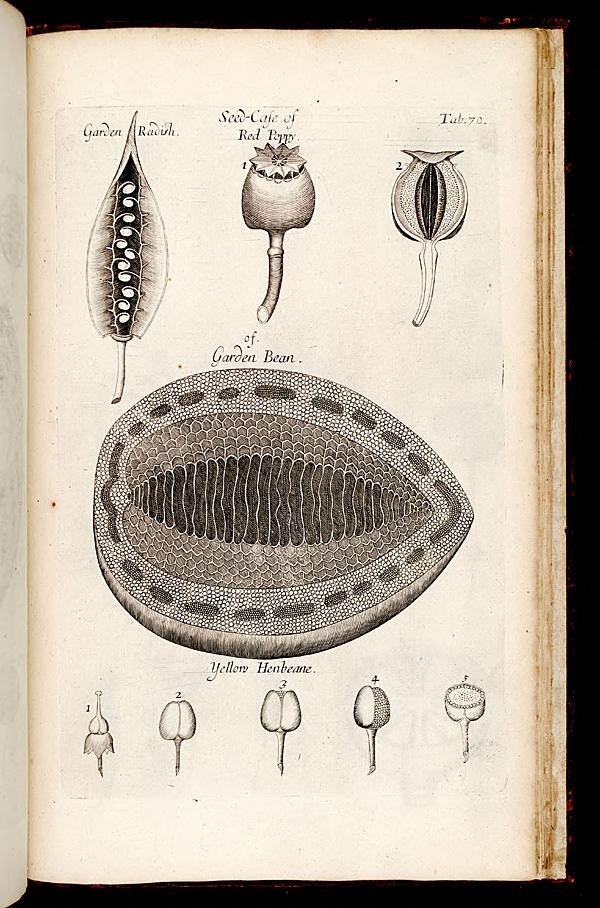
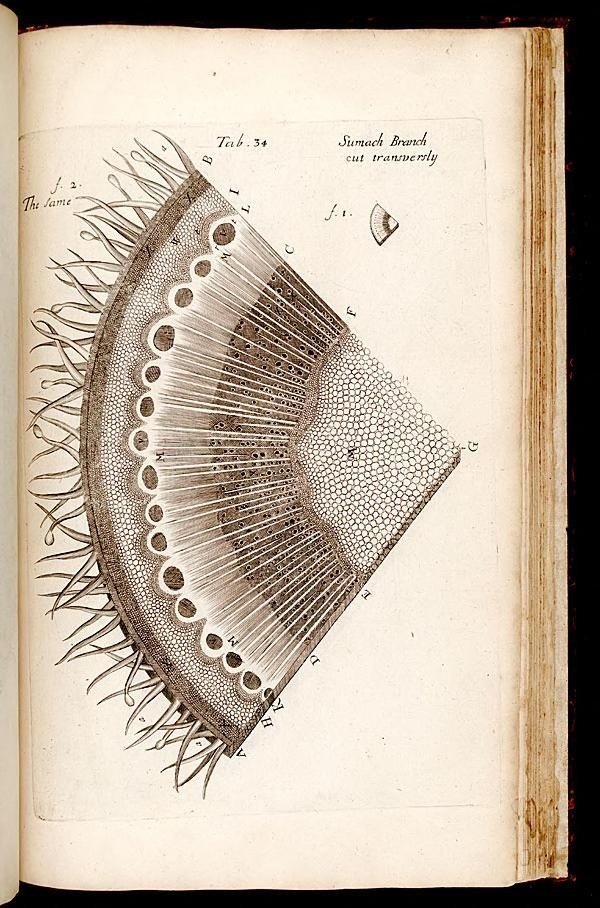
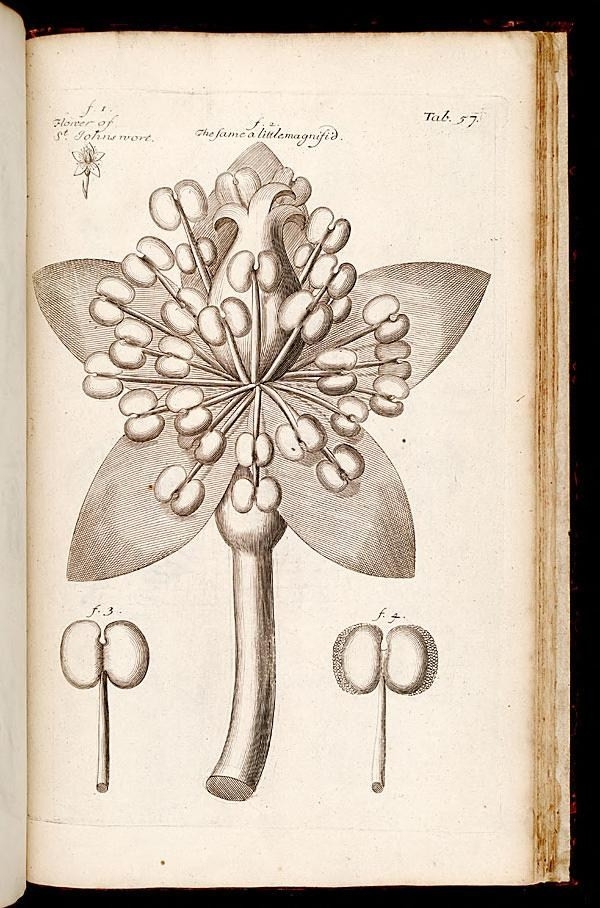
Despite the critical importance of the discoveries presented in this work, what is more likely to draw your attention to Grew’s Anatomy are the 82 exquisite engravings contained within. The illustrations depict in unprecedented detail the internal subtleties of roots, stems, tree trunks, and, not least of all, seeds. We’ve presented a few of our favorites in this post, but be sure to check out the entire collection on our Flickr account.

In 2006, a copy of Anatomy of Plants sold at auction for $7,557, nearly $5,000 over the estimate. Fortunately, you don’t have to have the budget of a used car to enjoy this work. As you’ve come to expect, it’s freely available in beautiful high resolution quality from the Biodiversity Heritage Library (in fact, it’s title #4 in BHL!). So be sure to spend some time with this title and add it to your repertoire of critical natural history works. It deserves to be among the Greats, keeping Darwin and Linnaeus company.

View Full Size Image
April 19, 2012by michelle.underhill

Help Support BHL

BHL's existence depends on the financial support of its patrons. Help us keep this free resource alive!

search

About BHL

The Biodiversity Heritage Library (BHL) is the world’s largest open access digital library for biodiversity literature and archives. BHL operates as a worldwide consortium of natural history, botanical, research, and national libraries working together to digitize the natural history literature held in their collections and make it freely available for open access as part of a global “biodiversity community.”

Join Our Mailing List

Sign up to receive the latest news, content highlights, and promotions.

Subscribe Now

Subscribe to Blog via Email

Enter your email address to subscribe to this blog and receive notifications of new posts by email.

Join 319 other subscribers

Subscribe to Blog Via RSS

Subscribe to the blog RSS feed to stay up-to-date on all the latest BHL posts.

Access RSS Feed

Inspiring Discovery through Free Access to Biodiversity Knowledge.

The Biodiversity Heritage Library makes it easier than ever for you to access the information you need to study and explore life on Earth…for free, anytime, anywhere.


64+ Million Pages of
Biodiversity Literature Online.

EXPLORE

Tools and Services
to Transform Research.

EXPLORE

300,000+
Illustrations on Flickr.

EXPLORE

ABOUT | HARMFUL CONTENT | PRIVACY | SITE MAP | TERMS OF USE