Biodiversity Heritage Library - Program news and collection highlights from BHL
  • Home
  • News
  • Featured Books
    • All Featured Books
    • Book of the Month Series
    • BHL at 20
  • User Stories
  • Campaigns
    • Fossil Stories
    • Garden Stories
    • Monsters Are Real
    • Page Frights
    • Her Natural History
    • Earth Optimism 2020
  • Tech Blog
  • Visit BHL
Home
News
Featured Books
    All Featured Books
    Book of the Month Series
    BHL at 20
User Stories
Campaigns
    Fossil Stories
    Garden Stories
    Monsters Are Real
    Page Frights
    Her Natural History
    Earth Optimism 2020
Tech Blog
Visit BHL
  • Home
  • News
  • Featured Books
    • All Featured Books
    • Book of the Month Series
    • BHL at 20
  • User Stories
  • Campaigns
    • Fossil Stories
    • Garden Stories
    • Monsters Are Real
    • Page Frights
    • Her Natural History
    • Earth Optimism 2020
  • Tech Blog
  • Visit BHL
Biodiversity Heritage Library - Program news and collection highlights from BHL
BHL News, Blog Reel

Digging into Data Challenge Winners Announced

Mining Biodiversity (MiBIO): innovative computational techniques to mine BHL texts

On January 15, 2014, ten international research funders from four countries jointly announced the winners of the third Digging into Data Challenge, a competition to develop new insights, tools and skills in innovative humanities and social science research using large-scale data analysis.

Fourteen international teams representing Canada, the Netherlands, the United Kingdom, and the United States will receive grants totaling approximately $5.1 million to investigate how computational techniques can be applied to “Big Data”.  Their work will address the evolving nature of humanities and social sciences research, which often relies on massive multisource datasets.  Each team represents collaborations among scholars, scientists, and information professionals from leading universities and libraries in Europe and North America.

The first round of the Digging into Data Challenge was held in 2009 and the second in 2011. Previous Digging into Data research projects have received international attention.  The 2013 winners were selected from among 69 applications and address a wide variety of topics.  Among the sponsoring bodies, the Institute of Museum and Library Services (IMLS) announced, on January 15, 2014, the winners of the third Digging into Data Challenge that they will fund.  IMLS’s contribution of $424,591 supports the American researchers from three of the mentioned fourteen international teams: the Missouri Botanical Garden, the University of Wisconsin-Madison, and the University of South Carolina.

As part of an international team involving partners in UK, Canada and the USA, Missouri Botanical Garden was awarded $175,000 by the IMLS to lead the USA members of the Mining Biodiversity Project team in applying innovative computational techniques to biodiversity texts and help improve the way we view, access and share the knowledge contained with in the Biodiversity Heritage Library.

The Mining Biodiversity (MiBIO) Project
Principal Investigators:

  • (United Kingdom) Sophia Ananiadou, Director of the National Centre for Text Mining and Professor in the School of Computer Science at the University of Manchester;
  • (Canada) Anatoliy Gruzd, Director of the SocialMedia Lab and Associate Professor at Dalhousie University;
  • (USA) William Ulate Rodríguez, Global Coordinator & Technical Director for US/UK of the Biodiversity Heritage Library and Senior Project Manager of the Center for Biodiversity Informatics at the Missouri Botanical Garden.

View Full Size Image

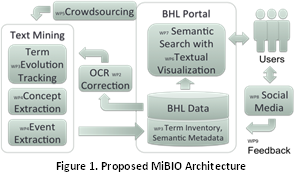
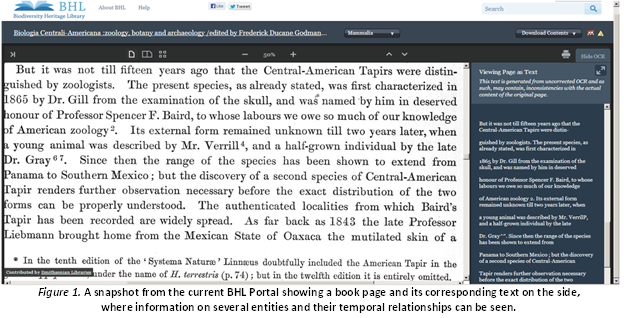
The MiBIO project is an international collaboration (UK, Canada, USA), leveraging large-scale data resources collected and curated by BHL members in US and worldwide, a digital portal developed and maintained by the BHL Technical staff at Missouri Botanical Garden and managed by the BHL Secretariat at the Smithsonian Institution Libraries, text mining resources developed by the UK partner (NaCTeM), and social media, visualization and text cleaning methodologies developed by the Canadian partner (Dalhousie).

The project’s prime objective is to promote the efficient access to and sharing of large-scale biodiversity legacy literature by the worldwide community of science libraries, museums and the interested public The project will integrate novel text mining methods, visualization, crowdsourcing and social media into the BHL to provide a semantic search system aimed to transform BHL into a next-generation social digital library resource that facilitates the study and discussion (via social media integration) of legacy science documents on biodiversity by a worldwide community.

By promoting the development of capabilities that will foster collaboration among researchers from the fields of History of Science, Environmental History, Environmental Studies, Library and Information Science and Social Media, the project hopes to make a significant impact on the above disciplines by (1) enriching a large-scale library, i.e., the BHL, via innovative application of Text Mining techniques to produce semantic metadata and a term inventory, (2) providing improved access to biodiversity-related digital artifacts via an enhanced search engine and visualization of results and (3) stimulating increased collaboration, interaction and sharing of information among BHL users via the social media environment.
View Full Size Image

The Institute of Museum and Library Services (IMLS)is the primary source of federal support for the nation’s 123,000 libraries and 17,500 museums. Our mission is to inspire libraries and museums to advance innovation, lifelong learning, and cultural and civic engagement. Our grant making, policy development, and research help libraries and museums deliver valuable services that make it possible for communities and individuals to thrive. To learn more, visit www.imls.gov and follow us on Facebook and Twitter.

In addition to the U.S. Institute of Museum and Library Services, the sponsoring funding bodies include:

  • Arts & Humanities Research Council (United Kingdom),
  • Economic & Social Research Council (United Kingdom),
  • Canada Foundation for Innovation (Canada),
  • National Endowment for the Humanities (United States),
  • Natural Sciences and Engineering Research Council (Canada),
  • National Science Foundation (United States),
  • Netherlands Organisation for Scientific Research in collaboration with The Netherlands eScience Center (NLeSC) (Netherlands),
  • Social Sciences and Humanities Research Council (Canada).

The U.K. charity Jisc will be providing professional program management in the progression of the United Kingdom projects.

The Biodiversity Heritage Library (BHL) is a consortium of natural history and botanical libraries that cooperate to digitize and make accessible the legacy literature of biodiversity held in their collections and to make that literature available for open access and responsible use as a part of a global “biodiversity commons.” The BHL consortium works with the international taxonomic community, rights holders, and other interested parties to ensure that this biodiversity heritage is made available to a global audience through open access principles. In partnership with the Internet Archive and through local digitization efforts, the BHL has digitized millions of pages of taxonomic literature, representing tens of thousands of titles and over 100,000 volumes.

The Missouri Botanical Garden’s mission is “to discover and share knowledge about plants and their environment in order to preserve and enrich life.” Today, 153 years after opening, the Missouri Botanical Garden is a National Historic Landmark and a center for science, conservation, education and horticultural display.

The Center for Biodiversity Informatics (CBI) at the Missouri Botanical Garden seeks to provide innovative technology solutions to the global community of life science scholars in order to mobilize, integrate, and repatriate data about the world’s biodiversity.

Find more information at:

MiBIO Project Website: www.nactem.ac.uk/DID-MIBIO/

Official Winners Announcement: http://www.diggingintodata.org/Home/AwardRecipientsRound32013/tabid/201/Default.aspx

IMLS Press Release: http://www.imls.gov/5.1_million_awarded_for_delving_into_big_humanities_and_social_science_data.aspx
Dalhousie University Press Release: http://www.dal.ca/news/2014/01/22/natural-history-for-the-digital-age.html
View Full Size Image

This project is made possible by a grant from the Institute for Museum and Library Services [Grant number LG-00-14-0032-14].
January 28, 2014by suzanne.chase
Blog Reel, Featured Books

Revealing and Contextualizing the treasures of the Biodiversity Heritage Library – the Art of Life and Engelmann Correspondence projects

Presentation link:  http://t.co/hQD2UnGMRX

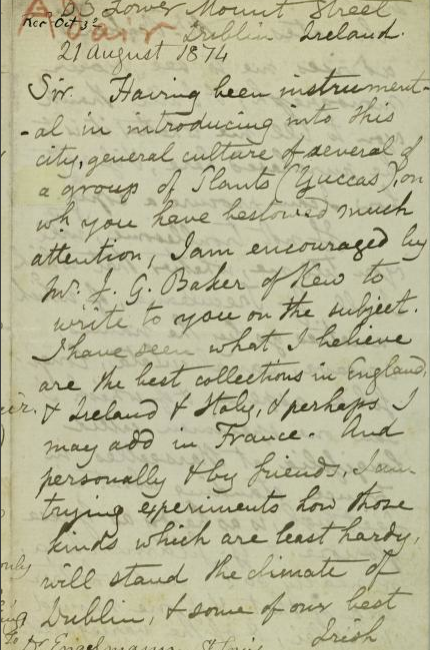
Two BHL-related projects were recently presented during the Digital History and Philosophy of Science (Digital HPS) meeting held at Indiana University, Bloomington, September 6-7.  Trish Rose-Sandler, from the Missouri Botanical Garden’s Center for Biodiversity Informatics, spoke about the Art of Life project.  Daron Dierkes, from the Missouri Botanical Garden’s Peter H. Raven Library, spoke about the George Engelmann Correspondence Project.

View Full Size Image
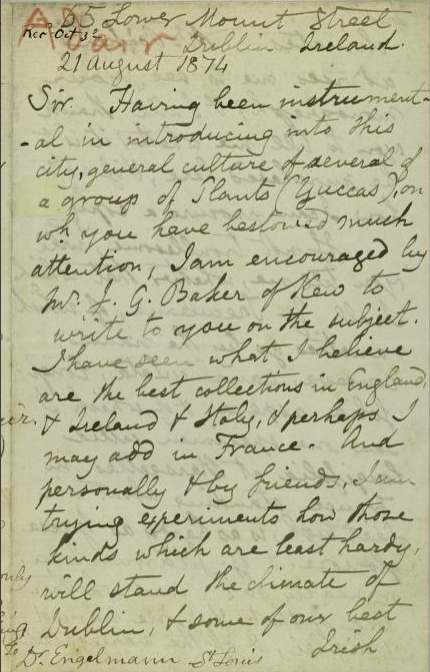
Correspondence: Adair (John) and Engelmann (George), 1874 http://biodiversitylibrary.org/item/132585#page/1/mode/1up

The Art of Life is a project to identify and describe the rich natural history illustrations hidden within the pages of BHL literature.  The George Engelmann Correspondence project is a project to digitize and make available in BHL letters sent to 19th century botanist, George Engelmann by his colleagues in the United States and Europe.  Both projects are providing new content types to the BHL portal.  They help to contextualize BHL’s published literature and expand its audiences.

Attendees at Digital HPS included researchers, technologists, and librarians who work on digital projects and build scholarly tools to help study, datamine, visualize, and improve access to content in the history and philosophy of science.  While many in the audience were aware of the BHL, they did not know about the expansion of content types beyond the published literature.  This was a great opportunity to expose BHL content to new audiences and build relationships across the humanities and science communities.

The Art of Life project is funded through a 2012 grant from the National Endowment for the Humanities.  Digitization of Engelmann’s correspondence is supported by the Institute of Museum and Library Services under the provisions of the Library Services and Technology Act as administered by the Missouri State Library, a division of the Office of the Secretary of State.

October 1, 2013by brooksm
Blog Reel

My Life as a BHL Staffer: Michelle Abeln

View Full Size Image

Hello from St. Louis. My name is Michelle Abeln, and I’m a metadata librarian at the Missouri Botanical Garden Library. I’ve been working as our BHL “liaison” for almost five years. My main focus is to make sure that our in-house scanning efforts correlate with the bigger BHL mission.

BOTANICUS
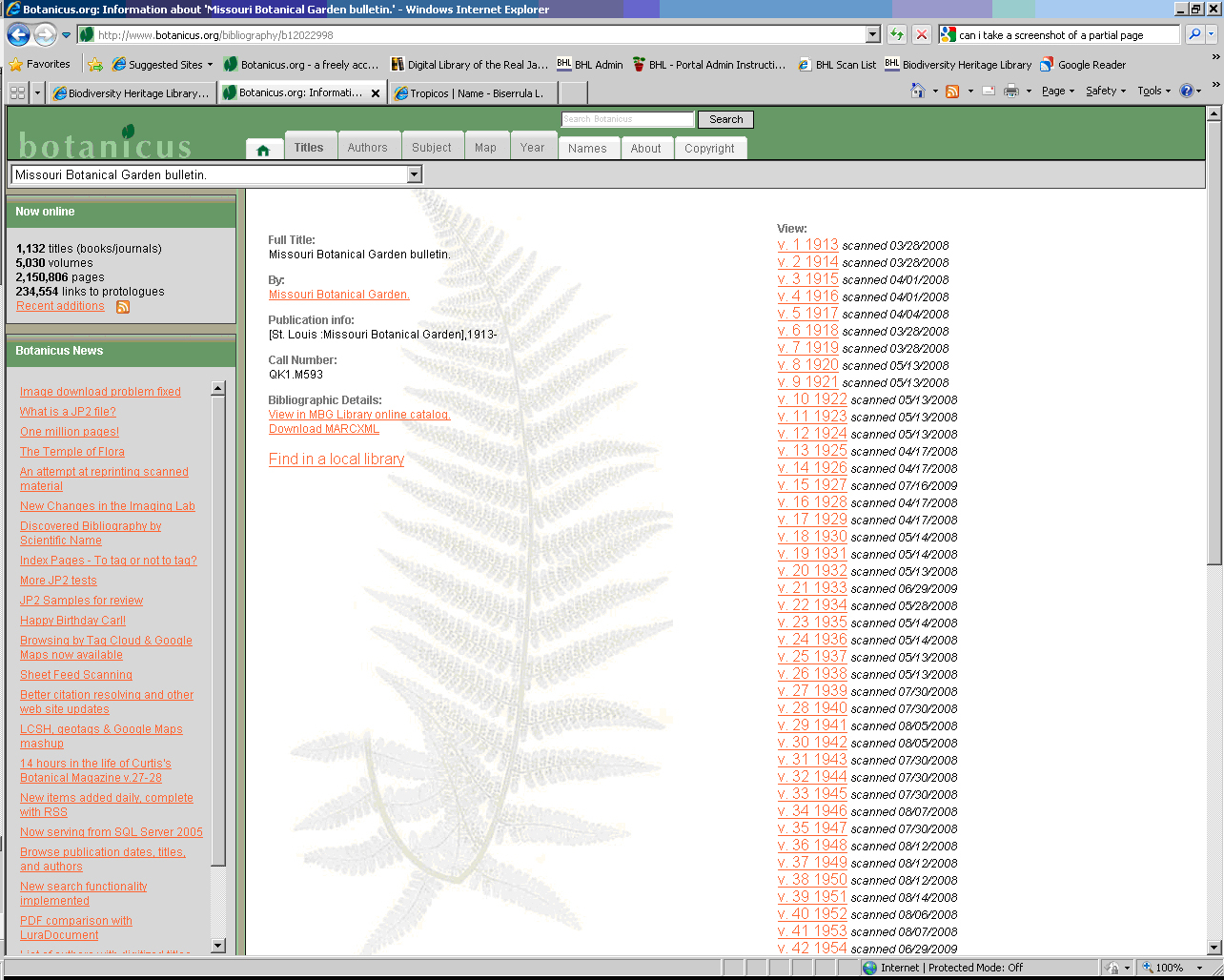
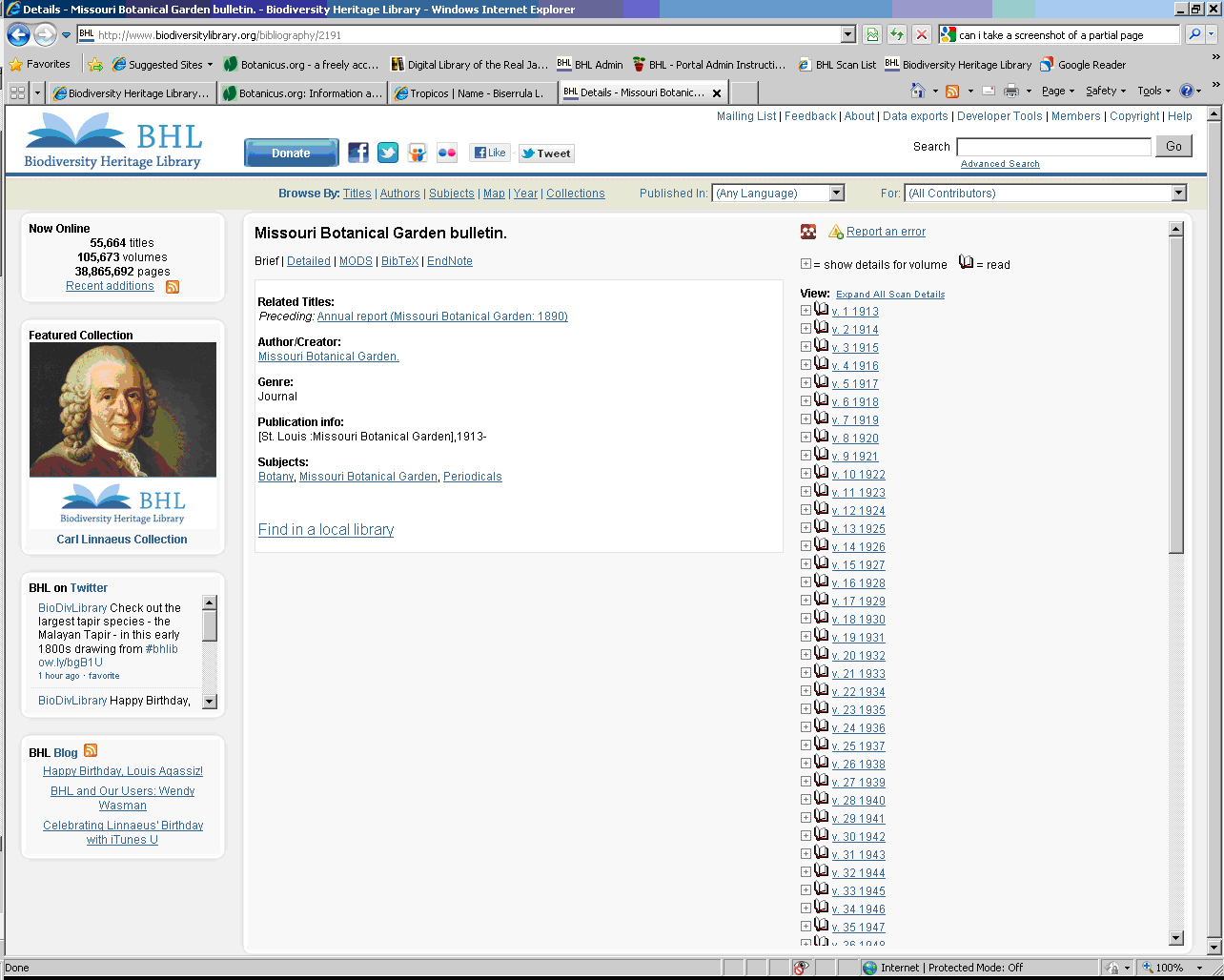
The Missouri Botanical Garden has been a leader in the digitization of scientific literature since 1995, initially focusing on illustrated volumes from the Library’s rare book collection. Working with the Garden’s Bioinformatics department, and its leader Chris Freeland, the Botanicus website was developed early on as a freely accessible web-based encyclopedia for botanical literature. While Botanicus was initially developed to house only the Garden’s holdings, the technologies and ideals behind it eventually led to the development of the BHL portal. Even though BHL is the ultimate repository for our digitized holdings, Botanicus is still very much a part of our workflow. Everything we scan goes through Botanicus first before it turns up in BHL or the Internet Archive.

View Full Size Image
Botanicus Display
View Full Size Image
BHL Display – See the Similarities?

We’re lucky here in Missouri to have our own staff of scanners in-house, which means our workflow is quite different from other BHL institutions. We don’t need to send carts of books off site; instead we’re able to take them just down the hall. While this means that our scanning volume might be lower than other institutions, having our scanning staff on site does mean we’re able to deal with quality control issues, such as missing pages and display problems, faster. We also have things a bit easier in terms of pagination. Both Gilbert and JJ discussed the trials and tribulations (and importance!) of paginating in their blogs. At MoBot, our scanners paginate each item before it goes online. We also have the ability to scan extremely rare folios and oversized books on our “Leaf” scanner, an instant capture camera used for archival material and larger fold-outs (such as maps and plates).

Most of what we scan is monographs and journals assigned by BHL coordinators, and are received from BHL users via the online feedback form. Most are “gap-fills,” to complete serial runs, and post-copyright journal titles. We try to balance fulfilling BHL requests while still making sure that the needs of the Garden’s own research staff are met. The library shares scanning staff with the Garden’s Herbarium, so I work closely with our imaging lab coordinator, Mike Blomberg, to organize the scanners.

METADATA
One of the main focuses of my day to day work is metadata! I am forever editing, correcting, adding or subtracting data from both Garden library records and BHL records. I like to be sure that our contributions to BHL are both correct and consistent. This means that all library records are checked for corrections and edited before being parsed through (via XML conversion software) to the Botanicus database. After titles are scanned, the records are checked again once they’re online, just to make sure everything displays properly. If we’re completing a serial run started by another institution, records need to be merged so that all volumes display under one title. I also check to make sure all volumes are labeled the same (I’m a bit on the overly fastidious side when it comes to display-it’s something I know I spend way too much time on. But I do enjoy when everything lines up just so).
After scanning is complete, I return to the library catalogue and create links out to both Botanicus and BHL.

I also check the BHL RSS feed weekly for titles held by MoBot, but scanned by other institutions, so I can create links for these titles in our catalogue as well. I’ve found that these links help both research and library staff.

TROPICOS
Tropicos is a botanical database created and maintained by the Bioinformatics Department here at MoBot, which organizes over 4,000,000 plant specimens and images. Tropicos contains all of the specimen data that has been accumulated in the Gardens’ electronic databases over the past 25 years, and is now available to the public. In Tropicos, you’re able to search by both specimen name and publication name (depending on what information you have available in your citation).
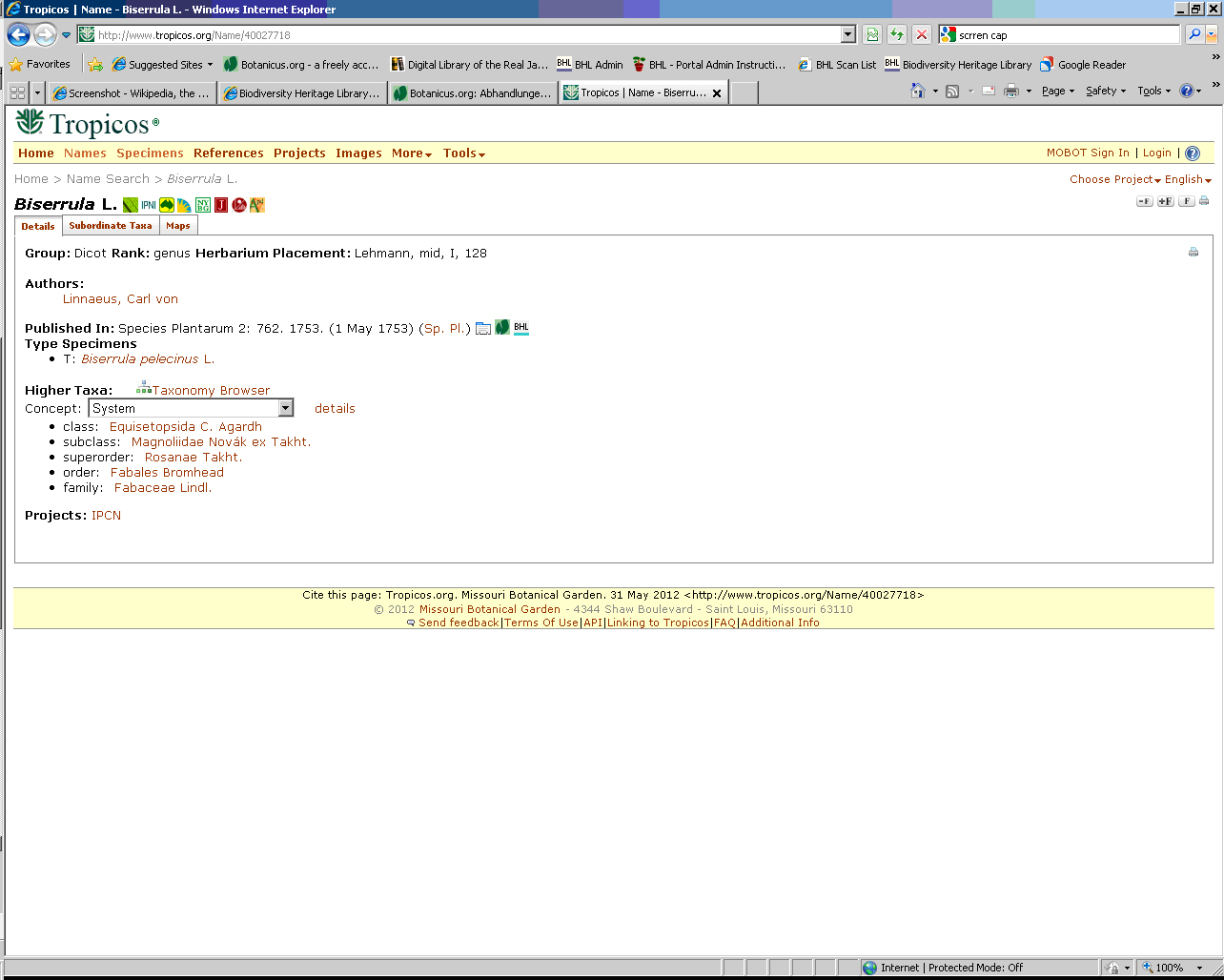
Tropicos and BHL are intimately linked: the OCR that helps identify species names in BHL “reports back” to Tropicos through an automatic data resolver, so ideally, when you look up specimens or citations in Tropicos, there should be a link out to BHL, directly to the page where the specimen is named.

View Full Size Image
Tropicos Citation Page
View Full Size Image
Citation Page in BHL, linked out from Tropicos

Unfortunately, BHL has gotten so big in recent years the automatic resolver doesn’t always work, and the links don’t always get made. I’m able to go in and add links to both Botanicus and BHL from both specific citations and publication pages. I don’t use Tropicos very often, so I rely on the Garden’s research staff to let me know when links are missing (and they do!).

I’ve been working with BHL almost since its inception, and it’s been a wonderful experience, and a lot of fun, seeing how it’s evolved and grown, not to mention meeting all the wonderful people who’ve worked on the project. I’m proud to work on such a project, knowing that we’re able to provide rare and necessary material to people who might otherwise not have a chance to study it.

June 4, 2012by michelle.underhill
Page 3 of 3«123

Help Support BHL

BHL's existence depends on the financial support of its patrons. Help us keep this free resource alive!

search

About BHL

The Biodiversity Heritage Library (BHL) is the world’s largest open access digital library for biodiversity literature and archives. BHL operates as a worldwide consortium of natural history, botanical, research, and national libraries working together to digitize the natural history literature held in their collections and make it freely available for open access as part of a global “biodiversity community.”

Join Our Mailing List

Sign up to receive the latest news, content highlights, and promotions.

Subscribe Now

Subscribe to Blog via Email

Enter your email address to subscribe to this blog and receive notifications of new posts by email.

Join 319 other subscribers

Subscribe to Blog Via RSS

Subscribe to the blog RSS feed to stay up-to-date on all the latest BHL posts.

Access RSS Feed

Inspiring Discovery through Free Access to Biodiversity Knowledge.

The Biodiversity Heritage Library makes it easier than ever for you to access the information you need to study and explore life on Earth…for free, anytime, anywhere.


64+ Million Pages of
Biodiversity Literature Online.

EXPLORE

Tools and Services
to Transform Research.

EXPLORE

300,000+
Illustrations on Flickr.

EXPLORE

ABOUT | HARMFUL CONTENT | PRIVACY | SITE MAP | TERMS OF USE