Biodiversity Heritage Library - Program news and collection highlights from BHL
  • Home
  • News
  • Featured Books
    • All Featured Books
    • Book of the Month Series
    • BHL at 20
  • User Stories
  • Campaigns
    • Fossil Stories
    • Garden Stories
    • Monsters Are Real
    • Page Frights
    • Her Natural History
    • Earth Optimism 2020
  • Tech Blog
  • Visit BHL
Home
News
Featured Books
    All Featured Books
    Book of the Month Series
    BHL at 20
User Stories
Campaigns
    Fossil Stories
    Garden Stories
    Monsters Are Real
    Page Frights
    Her Natural History
    Earth Optimism 2020
Tech Blog
Visit BHL
  • Home
  • News
  • Featured Books
    • All Featured Books
    • Book of the Month Series
    • BHL at 20
  • User Stories
  • Campaigns
    • Fossil Stories
    • Garden Stories
    • Monsters Are Real
    • Page Frights
    • Her Natural History
    • Earth Optimism 2020
  • Tech Blog
  • Visit BHL
Biodiversity Heritage Library - Program news and collection highlights from BHL
BHL News, Blog Reel

Smorball and Beanstalk Are Live!

The Purposeful Gaming project has now ended and BHL is no longer utilizing outputs from the games created as part of this project: Smorball and Beanstalk. However, both games will remain live for your continued enjoyment. Learn more.

The Biodiversity Heritage Library is excited to announce the release of two new games by Tiltfactor that will improve access to BHL collections and open a new frontier for crowdsourcing and citizen science.

Smorball and Beanstalk were designed as part of the Purposeful Gaming Project, which explores how digital games can make scanned content more accessible and searchable for cultural institutions. Based at the Missouri Botanical Garden in St. Louis, Missouri, “Purposeful Gaming” was established in 2013 through an Institute of Museum and Library Services (IMLS) grant and includes partners at Harvard University, Cornell University, and the New York Botanical Garden.

Purposeful Gaming: What It’s All About

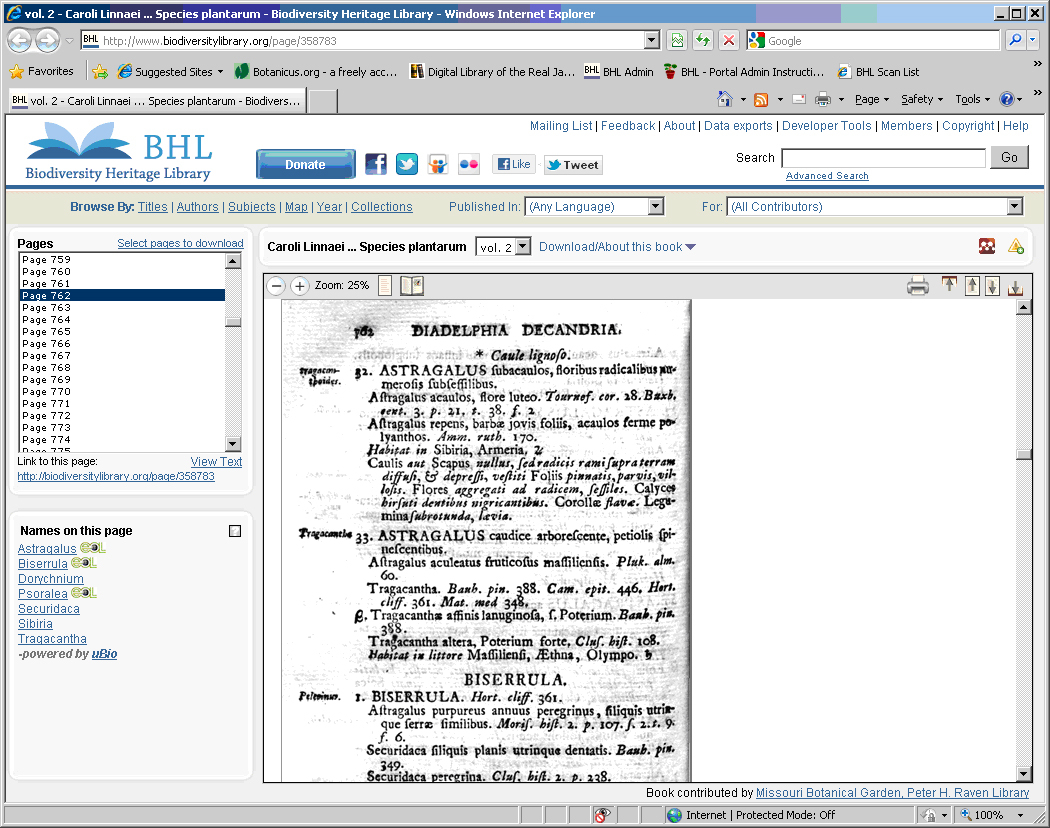
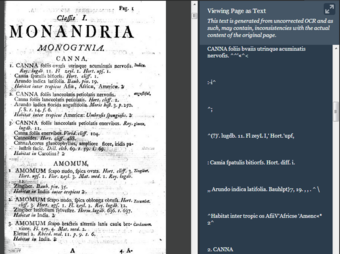
Libraries and museums across the world have scanned millions of pages of books and journals in order to increase access and enable online discoverability. When digitized, these pages are merely image files, which are unsearchable and virtually unusable. Optical character recognition software (OCR) is a method for converting page images to machine encoded text so they can be searched. Unfortunately, historic literature, like that found in the Biodiversity Heritage Library, has proven to be particularly problematic for OCR because of its tendency to have varying fonts, typesetting, and layouts that make it difficult to accurately render.

This is where the games come in.

Smorball and Beanstalk, both quick and easy browser games, present players with phrases from scanned pages in BHL. After much verification, the words players type are sent to the libraries that store the corresponding pages, allowing those pages to be searched and data mined and ultimately making historic literature more usable for institutions, scholars, educators, and the public.

Why Use Games?

View Full Size Image
Sample of bad OCR output

While transcription tasks of the sort usually crowdsourced to the public can be interesting and engaging, they are often time-consuming and exacting. Games provide a fun, interactive, piecemeal method of accomplishing those same tasks.

“Cultural heritage institutions are increasingly benefiting from human computation approaches that have been used in revolutionary ways by scientific researchers. Engaging citizens to work together as decoders of our heritage is a natural progression, as preserving these records directly benefits the public,” says Dr. Mary Flanagan, founder and director of Tiltfactor. “Integrating the task of transcription with the engagement of computer games gives an extra layer of incentive to motivate the public to contribute.”

Why This Approach Is Groundbreaking

While many institutions have harnessed the power of crowdsourcing, “Purposeful Gaming” represents a new avenue of collaboration that promises wider appeal and endless possibilities for engaging citizen scientists in new, creative ways.

“The games provide a fun and engaging way for volunteers to help us with a task that we don’t have the staff to do ourselves,” explains Trish Rose-Sandler, Principal Investigator for “Purposeful Gaming.” “BHL benefits by having improved discoverability of its books and journals on plant and animal life. More importantly, benefits from the results of the project would extend to the broader digital library community. Any institution managing large text collections can learn from novel and more cost-effective approaches to generating searchable texts.”

What’s the Difference between the Two Games? Where Can I Play them?

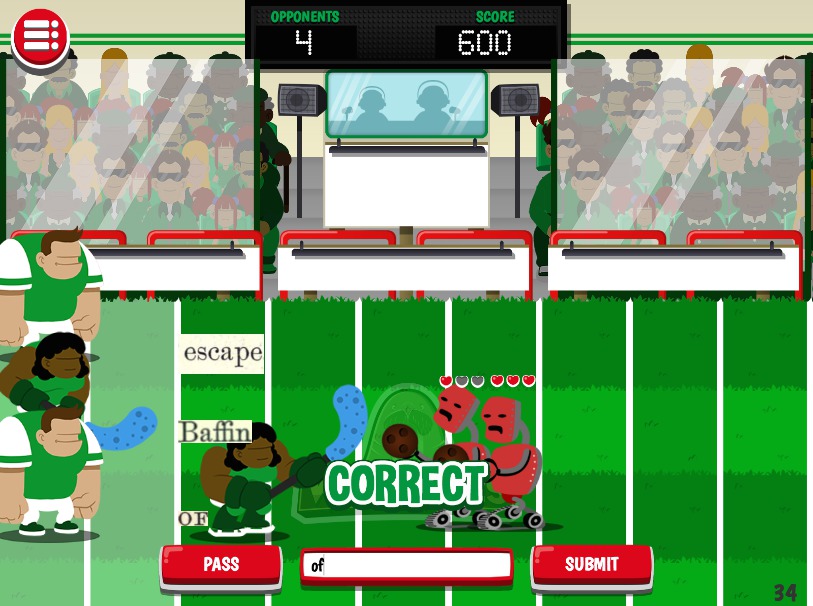
Players of the more challenging Smorball game are asked to type the words they see as quickly and accurately as possible to help coach their team, the Eugene Melonballers, to victory to win the coveted Dalahäst Trophy in the fictional sport of Smorball.  Each word typed correctly defeats an opposing smorbot and brings the Melonballers closer to the championships.
View Full Size Image

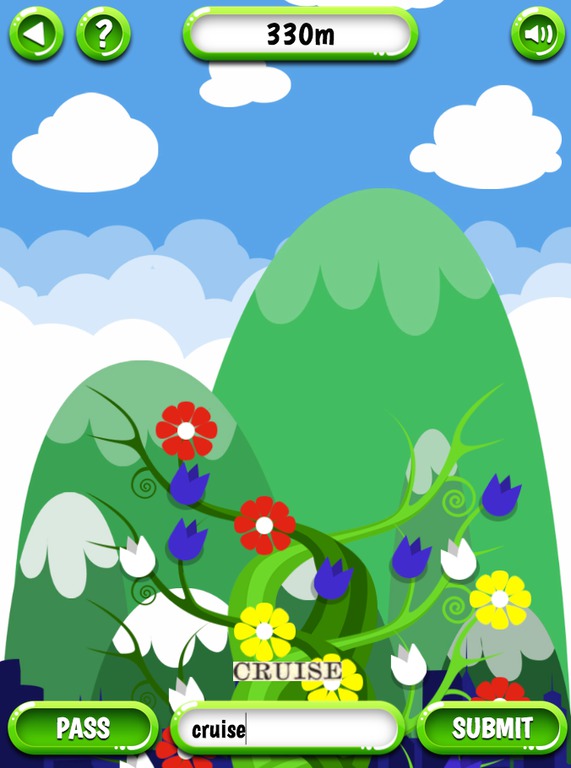
Players of the more relaxed Beanstalk game must type the words presented to them correctly in order to grow their beanstalk from a tiny tendril to a massive cloudscraper. The more words they type correctly, the faster the beanstalk grows. Players who accurately transcribe the most words will ascend to the top of the leaderboard as a result of their valuable contributions.
View Full Size Image

If you want to learn about the material that was used for the Purposeful Gaming Project, check out the writings of William Brewster and BHL’s Seed and Nursery Catalog Collection.

Now, in the name of science, go play Smorball and Beanstalk. And have fun!
June 9, 2015by eomeara
BHL News, Blog Reel

NEH-funded Art of Life project held first face to face meeting in St Louis

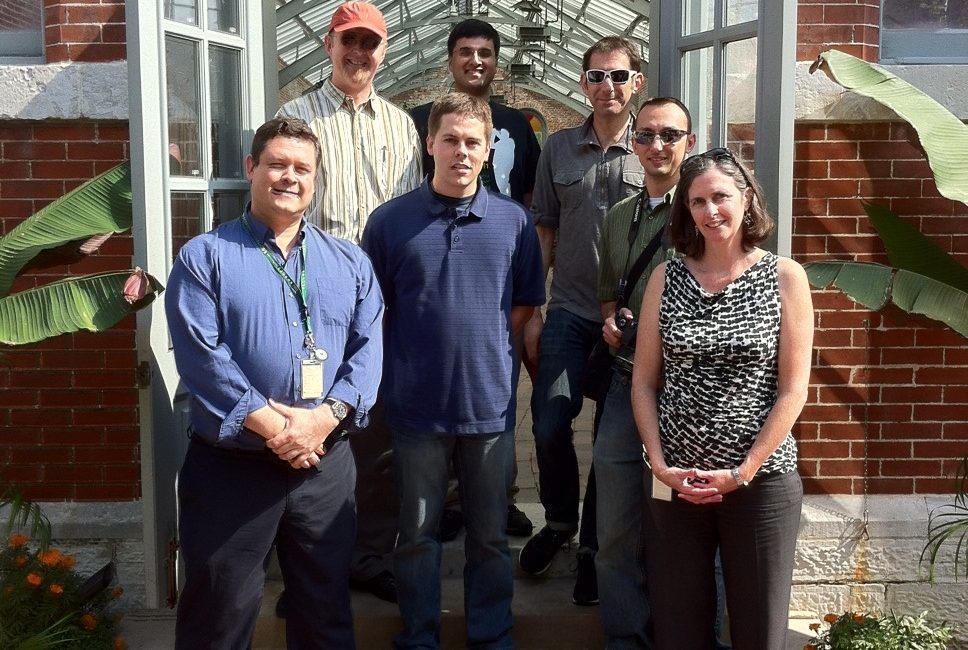
View Full Size Image
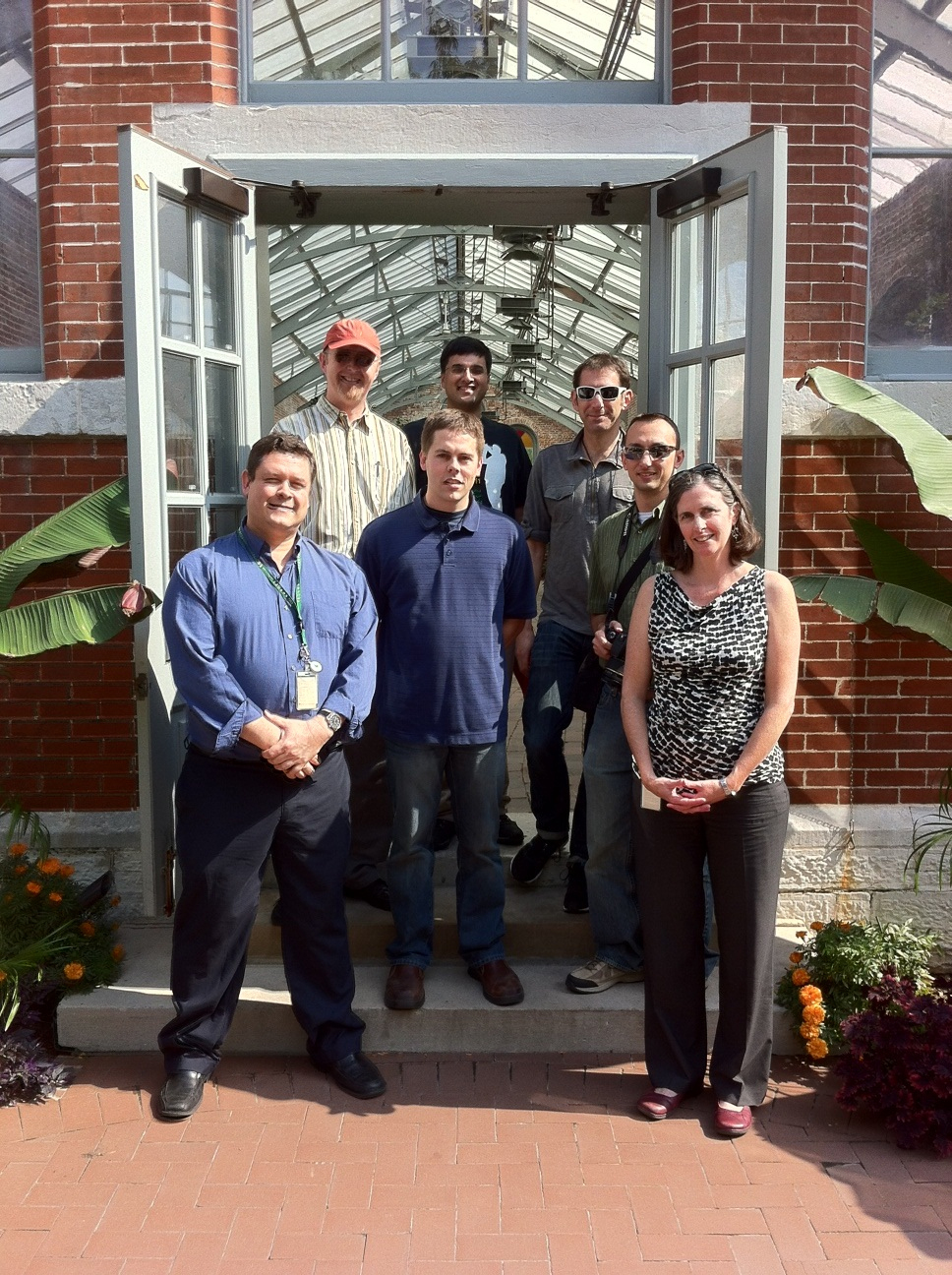
L to R front row:  William Ulate, MOBOT; Charlie Moad, IMA; Ed Bachta, IMA; Trish Rose-Sandler, MOBOT. L to R back row:  Doug Holland, MOBOT; Gaurav Vaidya, CU-Boulder; Rob Guralnick, CU-Boulder. Not pictured Mike Lichtenberg, MOBOT; Chris Freeland, WUSTL.

On October 4th & 5th 2012, team members from the Art of Life project held a meeting at the Missouri Botanical Garden in St. Louis.  While team members had been collaborating virtually since the beginning of the project in May of 2012, this was the first time all team members had met in-person.  Institutions represented were from Missouri Botanical Garden (MOBOT), Indianapolis Museum of Art (IMA), the University of Colorado Boulder (CU-Boulder); and Washington University, St Louis (WUSTL).

The goals of the meeting were to review:

1) overall workflows

2) feedback on the schema draft that was publicly posted August 2012

3) development of the algorithm used to find illustrations on BHL pages

4) next steps for the project

The team tackled thorny issues such as copyright of images, crowdsourcing image metadata, synchronicity of data, dealing with multiple illustrations on a page, and large bulk uploads to Flickr and Wikimedia Commons.

The project’s documentation and meeting notes are all available on the team’s wiki page http://biodivlib.wikispaces.com/Art+of+Life   

Questions about the project’s goals, progress, and technology can be directed to Trish Rose-Sandler [email protected]  The Art of Life project runs from May 1, 2012 through April 30, 2014 and is generously funded by the:

View Full Size Image

Any views, findings, conclusions, or recommendations expressed in this blog post do not necessarily represent those of the National Endowment for the Humanities.

October 30, 2012by ulib-libraryjobs
Blog Reel

My Life as a BHL Staffer: Michelle Abeln

View Full Size Image

Hello from St. Louis. My name is Michelle Abeln, and I’m a metadata librarian at the Missouri Botanical Garden Library. I’ve been working as our BHL “liaison” for almost five years. My main focus is to make sure that our in-house scanning efforts correlate with the bigger BHL mission.

BOTANICUS
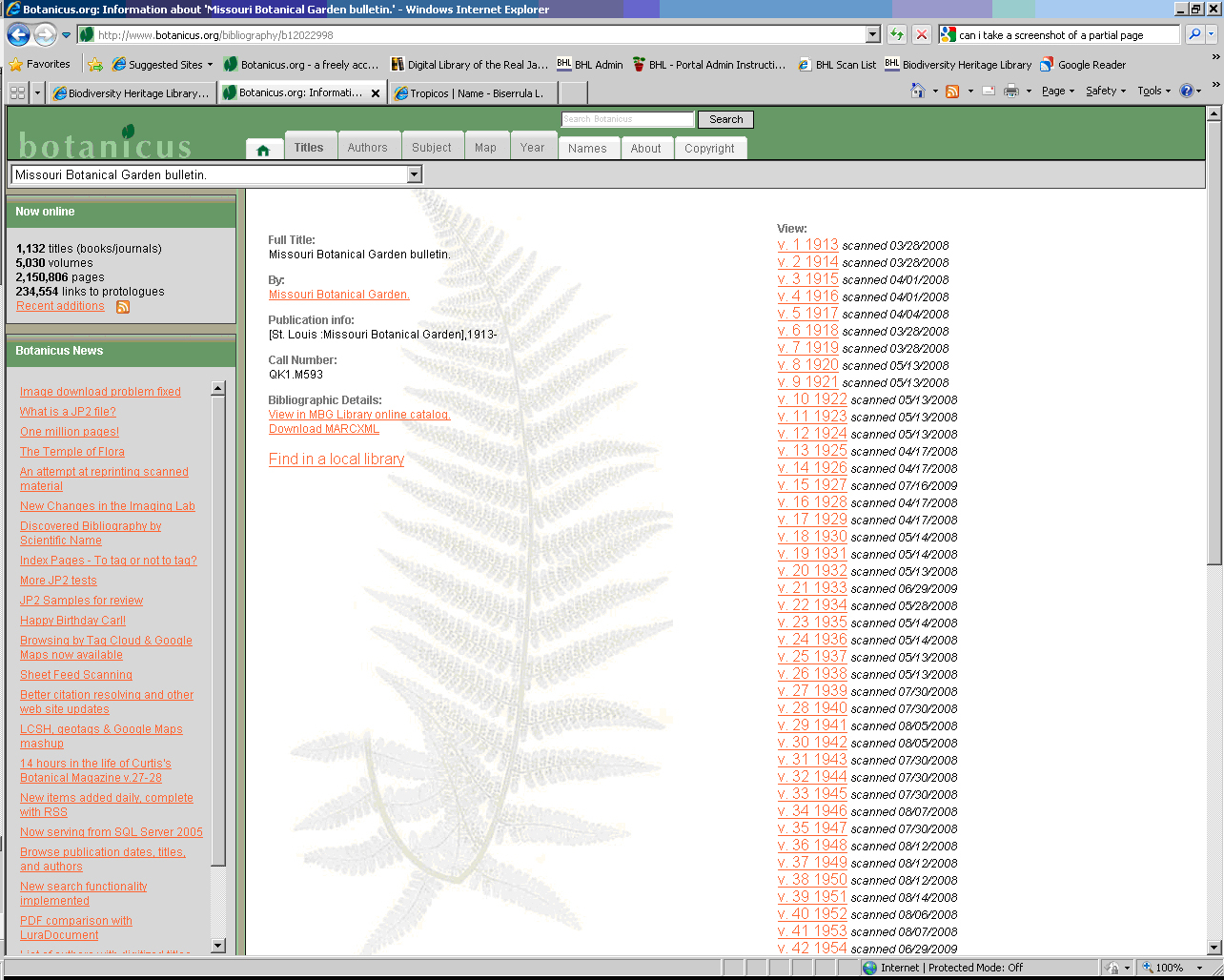
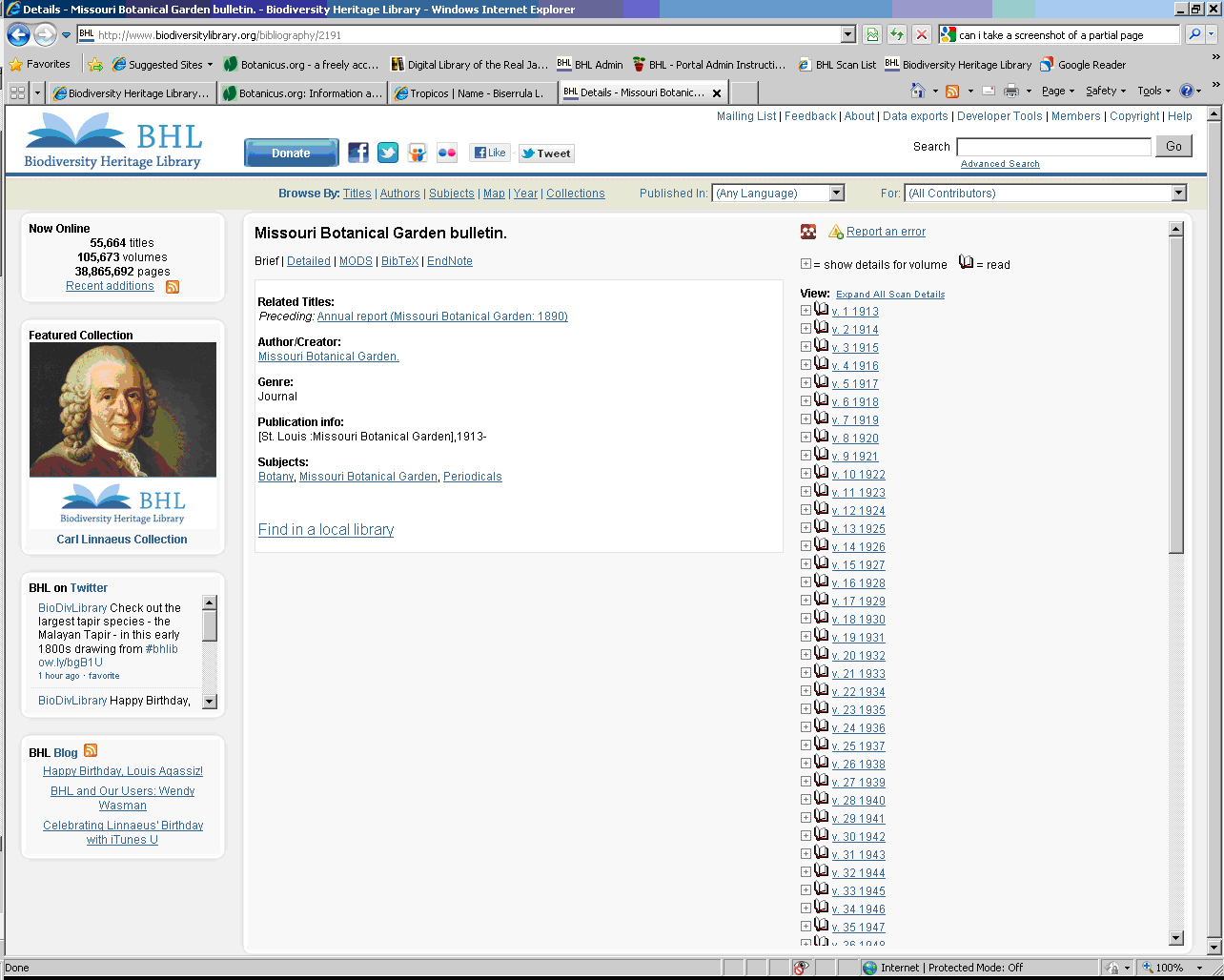
The Missouri Botanical Garden has been a leader in the digitization of scientific literature since 1995, initially focusing on illustrated volumes from the Library’s rare book collection. Working with the Garden’s Bioinformatics department, and its leader Chris Freeland, the Botanicus website was developed early on as a freely accessible web-based encyclopedia for botanical literature. While Botanicus was initially developed to house only the Garden’s holdings, the technologies and ideals behind it eventually led to the development of the BHL portal. Even though BHL is the ultimate repository for our digitized holdings, Botanicus is still very much a part of our workflow. Everything we scan goes through Botanicus first before it turns up in BHL or the Internet Archive.

View Full Size Image
Botanicus Display
View Full Size Image
BHL Display – See the Similarities?

We’re lucky here in Missouri to have our own staff of scanners in-house, which means our workflow is quite different from other BHL institutions. We don’t need to send carts of books off site; instead we’re able to take them just down the hall. While this means that our scanning volume might be lower than other institutions, having our scanning staff on site does mean we’re able to deal with quality control issues, such as missing pages and display problems, faster. We also have things a bit easier in terms of pagination. Both Gilbert and JJ discussed the trials and tribulations (and importance!) of paginating in their blogs. At MoBot, our scanners paginate each item before it goes online. We also have the ability to scan extremely rare folios and oversized books on our “Leaf” scanner, an instant capture camera used for archival material and larger fold-outs (such as maps and plates).

Most of what we scan is monographs and journals assigned by BHL coordinators, and are received from BHL users via the online feedback form. Most are “gap-fills,” to complete serial runs, and post-copyright journal titles. We try to balance fulfilling BHL requests while still making sure that the needs of the Garden’s own research staff are met. The library shares scanning staff with the Garden’s Herbarium, so I work closely with our imaging lab coordinator, Mike Blomberg, to organize the scanners.

METADATA
One of the main focuses of my day to day work is metadata! I am forever editing, correcting, adding or subtracting data from both Garden library records and BHL records. I like to be sure that our contributions to BHL are both correct and consistent. This means that all library records are checked for corrections and edited before being parsed through (via XML conversion software) to the Botanicus database. After titles are scanned, the records are checked again once they’re online, just to make sure everything displays properly. If we’re completing a serial run started by another institution, records need to be merged so that all volumes display under one title. I also check to make sure all volumes are labeled the same (I’m a bit on the overly fastidious side when it comes to display-it’s something I know I spend way too much time on. But I do enjoy when everything lines up just so).
After scanning is complete, I return to the library catalogue and create links out to both Botanicus and BHL.

I also check the BHL RSS feed weekly for titles held by MoBot, but scanned by other institutions, so I can create links for these titles in our catalogue as well. I’ve found that these links help both research and library staff.

TROPICOS
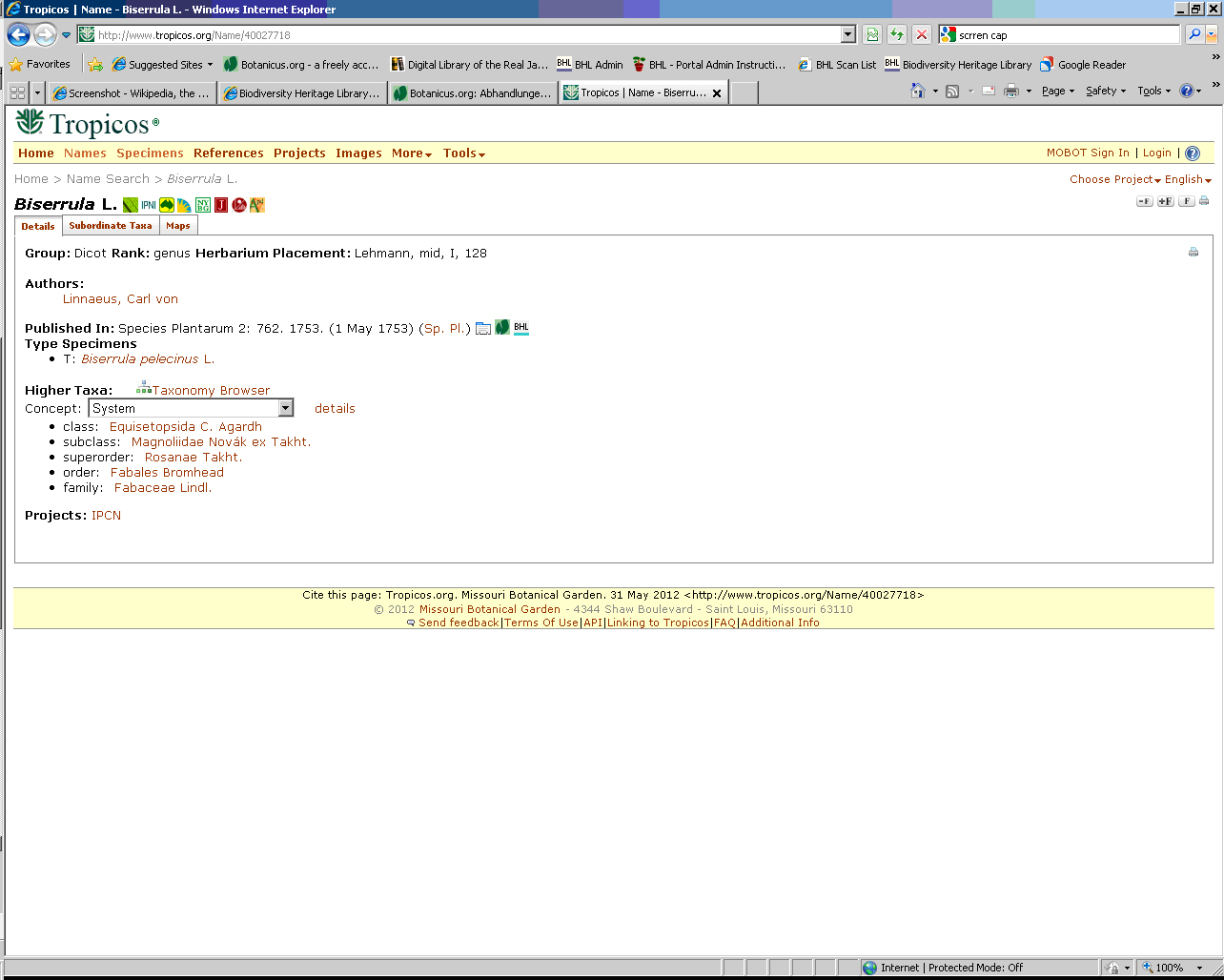
Tropicos is a botanical database created and maintained by the Bioinformatics Department here at MoBot, which organizes over 4,000,000 plant specimens and images. Tropicos contains all of the specimen data that has been accumulated in the Gardens’ electronic databases over the past 25 years, and is now available to the public. In Tropicos, you’re able to search by both specimen name and publication name (depending on what information you have available in your citation).
Tropicos and BHL are intimately linked: the OCR that helps identify species names in BHL “reports back” to Tropicos through an automatic data resolver, so ideally, when you look up specimens or citations in Tropicos, there should be a link out to BHL, directly to the page where the specimen is named.

View Full Size Image
Tropicos Citation Page
View Full Size Image
Citation Page in BHL, linked out from Tropicos

Unfortunately, BHL has gotten so big in recent years the automatic resolver doesn’t always work, and the links don’t always get made. I’m able to go in and add links to both Botanicus and BHL from both specific citations and publication pages. I don’t use Tropicos very often, so I rely on the Garden’s research staff to let me know when links are missing (and they do!).

I’ve been working with BHL almost since its inception, and it’s been a wonderful experience, and a lot of fun, seeing how it’s evolved and grown, not to mention meeting all the wonderful people who’ve worked on the project. I’m proud to work on such a project, knowing that we’re able to provide rare and necessary material to people who might otherwise not have a chance to study it.

June 4, 2012by michelle.underhill

Help Support BHL

BHL's existence depends on the financial support of its patrons. Help us keep this free resource alive!

search

About BHL

The Biodiversity Heritage Library (BHL) is the world’s largest open access digital library for biodiversity literature and archives. BHL operates as a worldwide consortium of natural history, botanical, research, and national libraries working together to digitize the natural history literature held in their collections and make it freely available for open access as part of a global “biodiversity community.”

Join Our Mailing List

Sign up to receive the latest news, content highlights, and promotions.

Subscribe Now

Subscribe to Blog via Email

Enter your email address to subscribe to this blog and receive notifications of new posts by email.

Join 319 other subscribers

Subscribe to Blog Via RSS

Subscribe to the blog RSS feed to stay up-to-date on all the latest BHL posts.

Access RSS Feed

Inspiring Discovery through Free Access to Biodiversity Knowledge.

The Biodiversity Heritage Library makes it easier than ever for you to access the information you need to study and explore life on Earth…for free, anytime, anywhere.


64+ Million Pages of
Biodiversity Literature Online.

EXPLORE

Tools and Services
to Transform Research.

EXPLORE

300,000+
Illustrations on Flickr.

EXPLORE

ABOUT | HARMFUL CONTENT | PRIVACY | SITE MAP | TERMS OF USE