Biodiversity Heritage Library - Program news and collection highlights from BHL
  • Home
  • News
  • Featured Books
    • All Featured Books
    • Book of the Month Series
    • BHL at 20
  • User Stories
  • Campaigns
    • Fossil Stories
    • Garden Stories
    • Monsters Are Real
    • Page Frights
    • Her Natural History
    • Earth Optimism 2020
  • Tech Blog
  • Visit BHL
Home
News
Featured Books
    All Featured Books
    Book of the Month Series
    BHL at 20
User Stories
Campaigns
    Fossil Stories
    Garden Stories
    Monsters Are Real
    Page Frights
    Her Natural History
    Earth Optimism 2020
Tech Blog
Visit BHL
  • Home
  • News
  • Featured Books
    • All Featured Books
    • Book of the Month Series
    • BHL at 20
  • User Stories
  • Campaigns
    • Fossil Stories
    • Garden Stories
    • Monsters Are Real
    • Page Frights
    • Her Natural History
    • Earth Optimism 2020
  • Tech Blog
  • Visit BHL
Biodiversity Heritage Library - Program news and collection highlights from BHL
Blog Reel, Featured Books

The Orchidaceous Plants of Franz Bauer and John Lindley

Two of the most important early contributors to our understanding of orchids were the artist Franz Bauer (1758-1840) and the English botanist and gardener John Lindley (1799-1865), who was to become known as the “father of modern orchidology”. The publication of the Illustrations of Orchidaceous Plants [from sketches prepared between 1792 and 1832] between 1830 and 1838 combined Bauer’s great skill and Lindley’s knowledge and industriousness to produce an invaluable artistic and scientific work. The Natural History Museum, London (NHM) has recently uploaded their copy of this volume to sit alongside the Missouri Botanical Gardens’ own volume.

108.jpg

Plate 21. “The parts of fructification of Dendrobium speciosum from a sketch by Mr. Bauer in 1793”. Bauer, Franz Andreas and Lindley, John. Illustrations of Orchidaceous plants. 1830-1838. Contributed in BHL from Natural History Museum, London.

Lindley and Bauer were likely to have met in London under the patronage of Sir Joseph Banks (1743-1820). Bauer had settled in Kew by 1790 as their first artist in residence and was profiting from the technological developments in Kew’s heating of its glasshouses. The change from hot dry air and flue systems to heating by hot water circulating through cast-iron pipes enabled a better control of humidity, a prerequisite for the successful growing of tropical orchids. The following influx in orchidaceous species provided Bauer with a plethora of material to dissect and examine under a microscope and his skill in depicting scientifically accurate and aesthetically pleasing work flourished.

Lindley, on the other hand, was an assistant to Robert Brown (1773-1858) in Banks’s library and herbarium until Banks’s death in 1820. Although his life-long fascination was with orchids, he initially studied roses leading him to publish the volume A botanical history of roses, which he illustrated himself. In 1822, he was appointed by the Royal Horticultural Society as assistant secretary where he supervised their plant collections, and in 1829 he was appointed Professor of Botany at the University College, London, developing a reputation as a leading figure in orchidology and an excellent teacher. His recognition of several major groups of orchids according to the type of pollen and its arrangement on the column is still the basis of orchid classification today.

It was during this period that Lindley set about publishing Bauer’s many drawings of orchids studied under a microscope, of which Bauer had started these drawing in 1792 and continued beyond the first publication of the volume in 1832. Lindley provided the text on the organisation of Orchidaceae in his prefatory remarks, detailing many of the characteristics of orchids he had observed over his lifetime and referencing the various writings available to him at the time.

He states in his preface that “it has been found indispensable to represent Mr Bauer’s drawings by means of lithography instead of engraving on copper” and as such the final published volume contains thirty-five lithographed folio plates. Lindley was conscious of the changes he was making to Bauer’s drawings and goes on to state that he hopes “…that the defects of some of the plates as works of art will not be prejudicial to them as illustrations of science”. The plates are either un-coloured or hand-coloured with the individual components on each plate numbered with an index of what is depicted following each plate. Lindley lithographed several of Bauer’s drawings with the remaining being lithographed by Maxim Gauci (1774-1854).

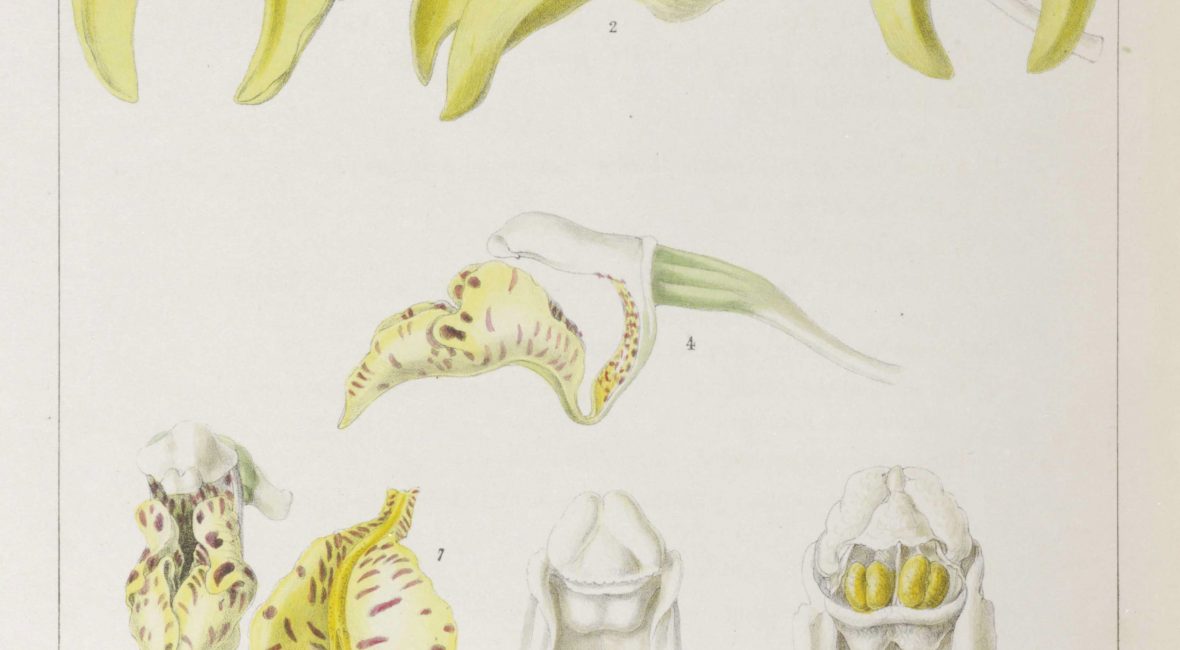
The plates are based on Bauer’s drawings and illustrate various characteristics of the orchid plants, from floral structure to seeds and pollen. The plate below shows the single anther of a Bletia flower at a magnification of 100 times and a few pollen grains at a magnification of 400 times. Bauer ultimately sketched thousands of pollen grain at various magnifications, but in this example, he was able to soak the pollinia in water and thus discover the elastic tissue that connects the pollen grains together.

56.jpg

Plate 8. “A view of the pollen-masses of Bletia verecunda dissolved in water; from a sketch by Mr. Bauer in 1801”. Bauer, Franz Andreas and Lindley, John. Illustrations of Orchidaceous plants. 1830-1838. Contributed in BHL from Natural History Museum, London.

The volume recently uploaded to BHL via the Natural History Museum contains a manuscript dedication by Mr Meyer, Bauer’s friend and executor, to Franz Bauer, attached to the front flyleaf. This letter reads:

“In memory of Francis Bauer Esq.re, FRS & FLS, & c. Botanical Painter to His Majesty George 3rd. And Resident Draughtsman for fifty years to the Royal Botanic Garden at Kew, where he devoted himself to the advancement of natural science under the magnificent patronage of Sir Joseph Banks, Bart. the President of the Royal Society. In the delineation of plants he united the accuracy of the profound naturalist with the skill of the accomplished artist to a degree which has been only equaled by his brother Ferdinand and in microscopical drawing he was altogether unrivaled. In this branch of his most useful labours, the world will ever contemplate with admiration his elaborate illustrations of animal and vegetable structures, especially those which are preserved in the British Museum, and in the University of Göttingen. He was born 4th of October 1758 at Feldsperg in Austria, and came to England from Vienna with the Baron Joseph Jacquin in 1788. He settled at Kew in 1790, where he continued to live in the enjoyment of an exalted reputation, and in the affection and respect of all to whom his generous character, his unassuming manner, and his deep religious feelings were known until 11 December 1840 when he died at the age of 82. While the works of Francis Bauer are his imperishable monument friendship inscribes this record on his honored tomb. [From Mr Bauer’s friend and executor Mr Meyer, 38 Sackville Street, Piccadilly, February 26 1846, at Stanhope Cottage. Wm. Clift (Mr Meyer, Mrs Haverfield’s, Kew Green. March 3, 1846)”

Further reading:

Stewart, Joyce and Stearn, William T. (1993) The orchid paints of Franz Bauer, The Herbert Press

Cooper, Paul M. (2015) The Bauer brothers, Natural History Museum, London

December 19, 2018by Joel Richard
Blog Reel, Featured Books

Orchidelirium: The Orchid Craze Takes Printed Form

View Full Size Image
Puydt, Émile de. Les orchidées, histoire iconographique, organographie, classification, géographie, collections, commerce, emploi, culture, avec une revue descriptive des espèces cultivées en Europe. 1880. Digitized by Harvard University Botany Libraries. http://biodiversitylibrary.org/page/43644141.

Walk into most any nursery or florist and you will see beautiful orchids of many colors and sizes, with “easy care” instructions attached right to the pot enabling even the brownest thumb success. Want to shake the winter doldrums? Attend an orchid show or meeting – there are over 500 local groups affiliated with the American Orchid Society alone. Orchids are as diverse as they are beautiful, with over 27,000 accepted species living in nearly every corner of the globe.

View Full Size Image
Puydt, Émile de. Les orchidées, histoire iconographique, organographie, classification, géographie, collections, commerce, emploi, culture, avec une revue descriptive des espèces cultivées en Europe. 1880. Digitized by Harvard University Botany Libraries. http://biodiversitylibrary.org/page/43644221.

We are not alone in our fascination with orchids. In the nineteenth century, Europe was gripped by what has been named “Orchidelirium.”  The collection of orchids from around the world was booming as the industrial revolution continued to change the economy and reach of Europe. Amateur and professional botanists were frantically developing methods to cultivate these exotic plants under glass.

Capitalizing on the orchid trend, a Belgian botanist named Émile de Puydt published a treatise on orchids in French in 1880, entitled Les orchidées, histoire iconographique, organographie, classification, géographie, collections, commerce, emploi, culture, avec une revue descriptive des espèces cultivées en Europe [Orchids, iconographic history, organography, classification, geography, collections, trade, employment, culture, with a descriptive review of the species cultivated in Europe (tr.)].

View Full Size Image
Puydt, Émile de. Les orchidées, histoire iconographique, organographie, classification, géographie, collections, commerce, emploi, culture, avec une revue descriptive des espèces cultivées en Europe. 1880. Digitized by Harvard University Botany Libraries. http://www.biodiversitylibrary.org/page/43643931.

Les orchidées was published on the tails of another French orchid book directed towards amateurs, entitled L’Orchidophile: traité théorique et pratique sur la culture des Orchidées [The Orchid, theoretical and practical treatise on growing orchids (tr.)] by François du Buysson. Both works contained detailed information regarding orchid culture. However, L’Orchidophile is a hefty book of over 500 pages, with dense text, equipment line drawings, and tables but not a single drawing of these magnificent plants. It appealed to the serious orchid cultivator, but lacked a “wow” factor to make it appeal to a more general French-speaking audience.

De Puydt’s book changed that. The more scholarly sections of Les orchidées are less than half the length of those in L’Orchidophile, yet they are filled with 237 black and white drawings of orchids, exotic locales, and greenhouses bursting with plants. The final section of Les orchidées contains fifty full-page chromolithographs (by M. Leroy and M. Guibert, of whom little is known) of cultured orchids accompanied by elegant descriptions of each species. De Puydt put his writing talents to great use, describing the orchid species as “beautiful (belle),” “magnificent (magnifique),” “pretty (jolie),” and “very splendid (plus slendide).” The book received awards from the Société d’Acclimatation de Paris and the Société centrale d’Horticulture de Paris.

View Full Size Image
Puydt, Émile de. Les orchidées, histoire iconographique, organographie, classification, géographie, collections, commerce, emploi, culture, avec une revue descriptive des espèces cultivées en Europe. 1880. Digitized by Harvard University Botany Libraries. http://biodiversitylibrary.org/page/43644233.

Following de Puydt’s book, another Belgian botanist specializing in orchids, Jean Jules Linden, began publication of Lindenia: iconograhie des orchidées in 1885. With lavish illustrations and short 1-2 page hints to growers, the work was quickly translated into English and published to reach an even more general audience of orchid-lovers. Linden highlighted orchids available through his business L’Horticulture Internationale as well as commonly cultivated species and new discoveries.

A modern review of Les orchidées, published in 1973, notes that the descriptions of the orchids in this work lack sufficient scientific and cultural details to be a good resource for modern growers. The review author also criticized the limitations of the drawings and considers the value of the book to be primarily for book collectors. While Les orchidées may not be as detailed as L’Orchidophile or as colorful as Lindenia, it is a well written and beautiful historical overview during the time of “Orchidelirium.”

View Full Size Image
Puydt, Émile de. Les orchidées, histoire iconographique, organographie, classification, géographie, collections, commerce, emploi, culture, avec une revue descriptive des espèces cultivées en Europe. 1880. Digitized by Harvard University Botany Libraries. http://biodiversitylibrary.org/page/43644277.

Paul Émile de Puydt (1810-1891) was born and died in Mons, a small city in western Belgium where his father served for four years as governor of Hainaut province. De Puydt founded the horticulture society of Mons and published many articles in scientific journals and newspapers on horticulture.

De Puydt did not confine his interests to botany. He was a writer, novelist, playwright, and political theorist. He coined the term “panarchy” or competitive government, where people choose the government in which they want to be a citizen. Different forms of government compete for citizens in an open market and more than one form of government can exist in the same locale. In modern times, the term panarchy also refers to a conceptual framework to understand stability and change of complex systems.

View Full Size Image
Puydt, Émile de. Les orchidées, histoire iconographique, organographie, classification, géographie, collections, commerce, emploi, culture, avec une revue descriptive des espèces cultivées en Europe. 1880. Digitized by Harvard University Botany Libraries. http://biodiversitylibrary.org/page/43644309.

Resources

  • De Puydt, Émile. Les orchidées, histoire iconographique, organographie, classification, géographie, collections, commerce, emploi, culture, avec une revue descriptive des espèces cultivées en Europe. http://dx.doi.org/10.5962/bhl.title.77404
  • du Buysson, François. L’Orchidophile: traité théorique et pratique sur la culture des Orchidées. http://dx.doi.org/10.5962/bhl.title.15493
  • Linden, Jean Jules. Lindenia: iconograhie des orchidées. http://dx.doi.org/10.5962/bhl.title.64391

Bibliography

  • American Orchid Society. http://www.aos.org/about-us/affiliated-societies.aspx. Accessed 1/11/2017.
  • Comte de Kerchove de Denterghem (1891). “P.E. de Puydt.” Revue d’lhorticultre belge et etrangere. Vol. 17, 147-151.
  •  De Puydt, Paul Emile. Wikipedia. https://en.wikipedia.org/wiki/Paul_%C3%89mile_de_Puydt. Accessed 1/11/2017.
  • Duveen, Denis I. (1973). “Les Orchidees: Histoire Iconographique by E. de Puydt.” Bulletin of the American Orchid Society. Vol. 42, No. 7, pgs. 627-629.
  • Linden, Lucien (1881). “Paul Émile de Puydt.” L’Illustration horticole. v. 28, pg. 105-107.
  • Orchidaceae. Encyclopedia of Life. http://www.eol.org/pages/8156/overview. Accessed 1/11/2017.
  • Sustainable Scale Project. http://www.sustainablescale.org/ConceptualFramework/UnderstandingScale/MeasuringScale/Panarchy.aspx. Accessed 1/11/2017.
  • Zhou, Li (2015). “Orchidelirium, an Obsession with Orchids, Has Lasted for Centuries.” Smithsonian Magazine. http://www.smithsonianmag.com/smithsonian-institution/orchidelirium-obsession-orchids-lasted-centuries-180954060/#kro3ZxCy1rSpeL5J.99. Accessed 1/13/2017.
January 26, 2017by ulib-libraryjobs
Blog Reel, Featured Books

Wildflowers of Ecuador: Watercolors and eBooks

View Full Size Image
Missouri Botanical Garden, Peter H. Raven Library’s first eBook: Wildflowers and Landscapes of Ecuador: The Way We Knew It.

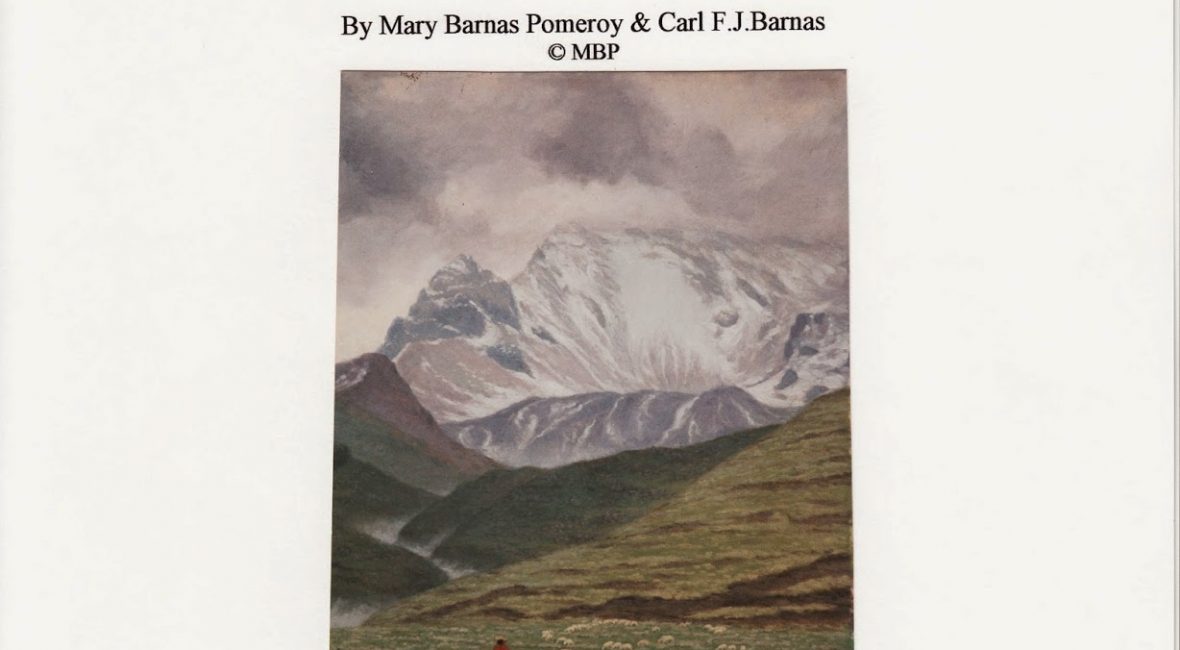
Every now and then an unusual and exciting opportunity arises to digitize a very unique item. Such an opportunity arrived in the email box of Doug Holland, the director of the Peter H. Raven Library at the Missouri Botanical Garden, one afternoon in January 2014. Anne Hess, daughter of artist Mary Barnas Pomeroy and grand-daughter of artist/teacher Carl Barnas, had decided to donate a collection of artwork and her mother’s unfinished manuscript to the library. It was with great honor that the Raven Library accepted this collection. Not only are the paintings themselves beautiful, but the backdrop to history that this collection provides is also fascinating.

View Full Size Image
Orchidaceae. Pomeroy, Mary Barnas. Wildflowers and Landscapes of Ecuador: The Way We Knew It (2015). http://biodiversitylibrary.org/page/46381682.

Escaping the rise of Nazism in 1930s Laubach, Germany, the Barnas family travelled to Quito, Ecuador, after a one-year stay in Czechoslovakia. It is in Ecuador that most of the artwork was created. Ms. Pomeroy created detailed watercolors of many botanical specimens, but she also labeled their location and sought to identify each specimen.

Ms. Pomeroy’s interest in botanical illustrations piqued at the suggestion of her father. In 1938, she began the first of what would become more than 200 illustrations, when she decided to start compiling all the information six years later for a book that would contain her numerous illustrations. She decided to focus on illustrating smaller plants and fungi with the thought that the larger specimens might have already been described as “the more attractive ones might have been easier noticed and better known to science.” The 41 different botanical families were examined under a magnifying glass to be able to replicate all visible details.

View Full Size Image
Ericaceae. Pomeroy, Mary Barnas. Wildflowers and Landscapes of Ecuador: The Way We Knew It (2015). http://biodiversitylibrary.org/page/46381572.

As her portfolio kept increasing, she thought it prudent to try to identify and label each of the specimens she had already painted. Although never formally trained as a botanist herself, she enlisted the assistance of many other botanists, such as Dr. Alfredo Paredes of the Universidad Central del Ecuador and Dr. Francis Pennel of the Academy of Natural Sciences of Philadelphia, to help identify or confirm the identity of various specimens to label each one as accurately as possible. Ms. Pomeroy was also employed at various times as a botanical illustrator; for instance, she worked for the University of California – Berkeley’s Herbert L. Mason who was laboring on A Flora of the Marshes of California.

After a more than 50-year hiatus, Ms. Pomeroy returned to her book of botanical illustrations of plants and fungi from Ecuador. Unfortunately, she passed away before being able to complete her book.

During her life, Ms. Pomeroy enthralled Dr. Peter H. Raven, former president of the Missouri Botanical Garden, with her early Ecuadorian illustrations. This led to a showing of the artwork both at the Missouri Botanical Garden in St. Louis and in various other cities.

View Full Size Image
Caritas rojas / Alonsoa meridionalis. Pomeroy, Mary Barnas. Wildflowers and Landscapes of Ecuador: The Way We Knew It (2015). http://biodiversitylibrary.org/page/46381921.

This is where Ms. Pomeroy’s daughter, Anne Hess, stepped into the foreground and offered her mother’s collection to the Raven Library. Upon learning that most of the artwork was meant to tie-in with an unpublished manuscript, suggestions arose that the unpublished manuscript should evolve into the library’s first e-book publication entitled Wildflowers and Landscapes of Ecuador: The Way We Knew It.

Ms. Pomeroy had already sorted all the images into major categories, which facilitated easy pairing of the images with their respective chapters and descriptions.

View Full Size Image
Viguiera sodiroi. Pomeroy, Mary Barnas. Wildflowers and Landscapes of Ecuador: The Way We Knew It (2015). http://biodiversitylibrary.org/page/46381524.

In addition, Ms. Pomeroy had written a short fictional story titled “An Indian boy meets Mount Pichincha’s flowers,” which is included toward the end of the book. The reader is taken on an expedition through the eyes of a young boy, Hilario, as he collects botanical specimens with a botanist named Professor Flores.

View Mr. Barnas’ landscapes and Ms. Pomeroy’s enchanting botanical illustrations, as well as relive her experiences when you peruse this wonderful work on the Biodiversity Heritage Library’s website.

View Full Size Image
Senna hirsuta. Pomeroy, Mary Barnas. Wildflowers and Landscapes of Ecuador: The Way We Knew It (2015). http://biodiversitylibrary.org/page/46381304.


View Full Size Image
Epidendrum secundum. Pomeroy, Mary Barnas. Wildflowers and Landscapes of Ecuador: The Way We Knew It (2015). http://biodiversitylibrary.org/page/46381402.


View Full Size Image
Campanea sp. Pomeroy, Mary Barnas. Wildflowers and Landscapes of Ecuador: The Way We Knew It (2015). http://biodiversitylibrary.org/page/46381463.


View Full Size Image
Cavendishia gilgiana. Pomeroy, Mary Barnas. Wildflowers and Landscapes of Ecuador: The Way We Knew It (2015). http://biodiversitylibrary.org/page/46381804.


View Full Size Image
Cephalis tomentosa. Pomeroy, Mary Barnas. Wildflowers and Landscapes of Ecuador: The Way We Knew It (2015). http://biodiversitylibrary.org/page/46381241.


January 22, 2015by ulib-libraryjobs
Blog Reel, Featured Books

Book of the Week: Welcome to the Orchid Family, Bulbophyllum nocturnum!

Portrait version of the Biodiversity Heritage Library logo.

View Full Size Image

While there are many species of plants that flower at night, and among those are many orchids, scientists researching in New Britain just discovered the only orchid species that flowers exclusively at night. Meet Bulbophyllum nocturnum, discovered by Ed de Vogel during a field trip to the lowland rainforest of the island, which is located near Papua New Guinea.
 
Dr. de Vogel, after taking a specimen of the plant home to the Netherlands with him, discovered that it only flowers a few hours after dusk and closes a few hours after sunrise. While this is a remarkable discovery, the purpose for the flower’s nocturnal preference remains a mystery. According to Andre Schuiteman, a co-author of the paper detailing the find, which was published in the Botanical Journal of the Linnean Society, “related species are pollinated by tiny flies that think they are visiting fungi,” with the smell and physical appearance of the flower appearing like fungus in the eyes of the insect. The insects visit the flower searching for a place to lay their eggs and unwittingly pollinate it. There is a strong possibility that a night-foraging fly species may thus be the pollinator of B. nocturnum and the reason for its unique behavior.
 
The authors of the paper stipulate that it will take much more research before some of the questions surrounding this species are answered. These are questions best answered in the field. However, as the BBC article (from which this information comes) articulates, examining the flower in the wild may be difficult in the future. The orchid was discovered in a previously-inaccessible portion of the island, which, thanks to recent roads constructed for the purposes of logging, has only lately been opened up for scientific discovery. While the logging thus made the find itself possible, it also threatens the long-term survival of the species. Schuiteman affirmed that it is necessary for the local government to protect the habitat of the species from the potential damages caused by logging.
 
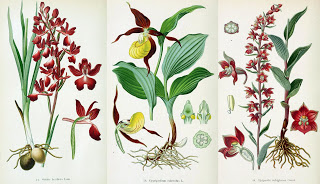
To celebrate the discovery of our new orchid friend, for this week’s book of the week we’re featuring a book full of stunning orchid illustrations. Abbildungen der in Deutschland und den Angrenzenden Gebieten Vorkommenden Grundformen der Orchideenarten (1904), by Friedrich Kränzlin, features 60 gorgeous plates by Walter Müller. While of course Bulbophyllum nocturnum is too new to science to be included in this work, we’re happy to know that future publications will highlight this species just as beautifully as this book does for the species included within its pages.
 
For our post, we’re featuring some of our favorite illustrations from the work. You can enjoy all of the images from this title on our Flickr site, which now has over 21,000 natural history images. Hopefully one day we’ll be able to pull in an illustration of Bulbophyllum nocturnum as well!
 
View Full Size Image
Left: Anacamptis laxiflora (Loose-Flowered Orchid; Green-winged Meadow Orchid)
Middle: Cypripedium calceolus (Lady’s Slipper Orchid)
Right: Epipactis atrorubens (Dark Red Helleborine; Royal Helleborine)
 
View Full Size Image
Left: Orchis italica
Middle: Epipogium aphyllum (Ghost Orchid)
Right: Limodorum abortivum (Violet Limodore)

Abbildungen der in Deutschland und den Angrenzenden Gebieten Vorkommenden Grundformen der Orchideenarten (1904), by Friedrich Kränzlin and Walter Müller, was contributed by the New York Botanical Garden, LuEsther T. Mertz Library.
 
Image Credit (Top): J. Vermeulen, http://www.bbc.co.uk/news/science-environment-15818662
December 8, 2011by michelle.underhill

Help Support BHL

BHL's existence depends on the financial support of its patrons. Help us keep this free resource alive!

search

About BHL

The Biodiversity Heritage Library (BHL) is the world’s largest open access digital library for biodiversity literature and archives. BHL operates as a worldwide consortium of natural history, botanical, research, and national libraries working together to digitize the natural history literature held in their collections and make it freely available for open access as part of a global “biodiversity community.”

Join Our Mailing List

Sign up to receive the latest news, content highlights, and promotions.

Subscribe Now

Subscribe to Blog via Email

Enter your email address to subscribe to this blog and receive notifications of new posts by email.

Join 319 other subscribers

Subscribe to Blog Via RSS

Subscribe to the blog RSS feed to stay up-to-date on all the latest BHL posts.

Access RSS Feed

Inspiring Discovery through Free Access to Biodiversity Knowledge.

The Biodiversity Heritage Library makes it easier than ever for you to access the information you need to study and explore life on Earth…for free, anytime, anywhere.


64+ Million Pages of
Biodiversity Literature Online.

EXPLORE

Tools and Services
to Transform Research.

EXPLORE

300,000+
Illustrations on Flickr.

EXPLORE

ABOUT | HARMFUL CONTENT | PRIVACY | SITE MAP | TERMS OF USE