Biodiversity Heritage Library - Program news and collection highlights from BHL
  • Home
  • News
  • Featured Books
    • All Featured Books
    • Book of the Month Series
    • BHL at 20
  • User Stories
  • Campaigns
    • Fossil Stories
    • Garden Stories
    • Monsters Are Real
    • Page Frights
    • Her Natural History
    • Earth Optimism 2020
  • Tech Blog
  • Visit BHL
Home
News
Featured Books
    All Featured Books
    Book of the Month Series
    BHL at 20
User Stories
Campaigns
    Fossil Stories
    Garden Stories
    Monsters Are Real
    Page Frights
    Her Natural History
    Earth Optimism 2020
Tech Blog
Visit BHL
  • Home
  • News
  • Featured Books
    • All Featured Books
    • Book of the Month Series
    • BHL at 20
  • User Stories
  • Campaigns
    • Fossil Stories
    • Garden Stories
    • Monsters Are Real
    • Page Frights
    • Her Natural History
    • Earth Optimism 2020
  • Tech Blog
  • Visit BHL
Biodiversity Heritage Library - Program news and collection highlights from BHL
BHL News, Blog Reel

Announcing the New Biodiversity Heritage Library!

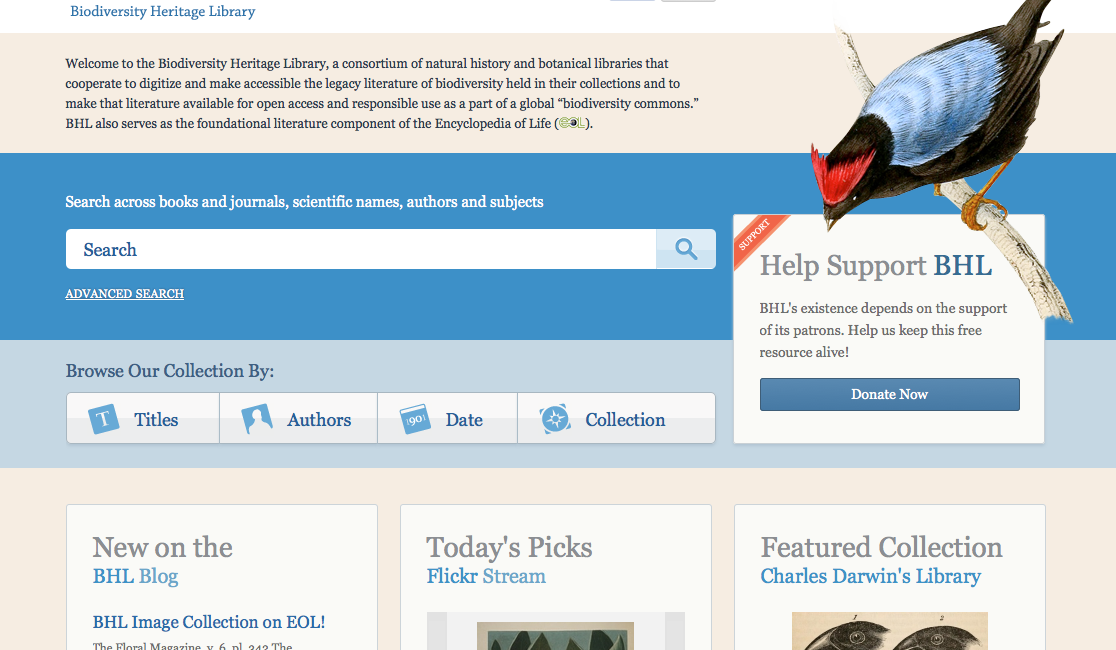
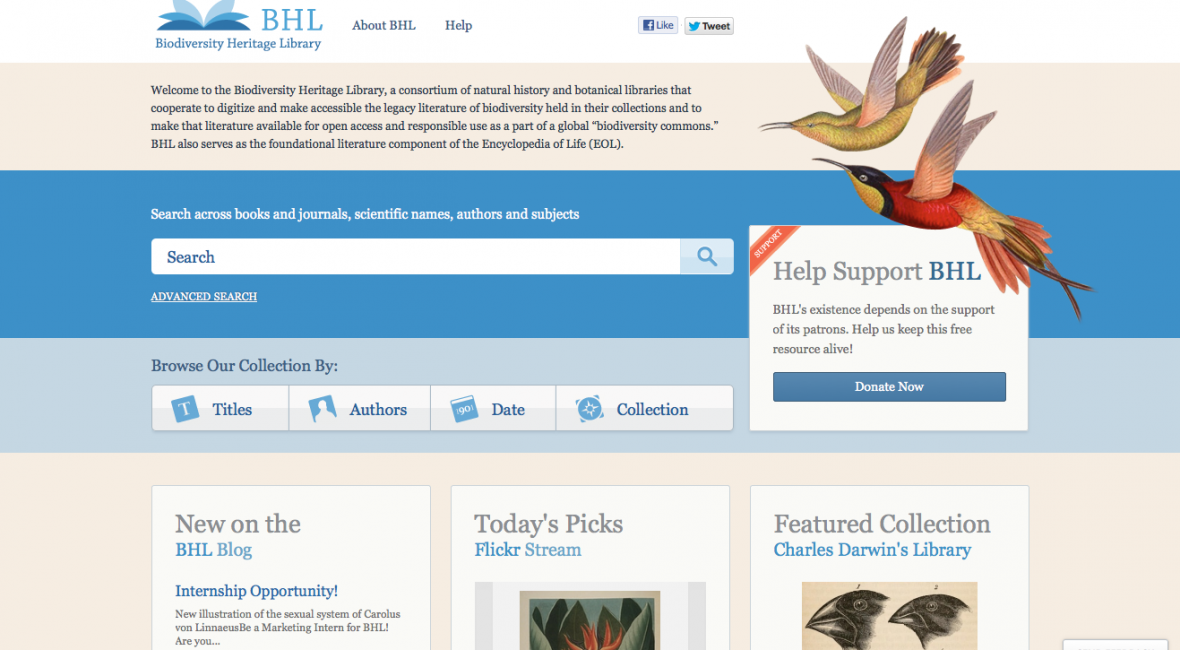
View Full Size Image
The Homepage of the New BHL! Click image to enlarge.

Today the Biodiversity Heritage Library released a new user interface, including an updated website design, improved book navigation, and article-level access to collections. The new interface was informed by usability studies and is based on the design and functionality of the BHL-Australia portal.

Current Improvements Include:

  • Updated Design: The website’s design has been upgraded to reflect the celebrated aesthetics of the BHL-Australia portal. 
  • Article and Chapter Access: The ability to search BHL by article or chapter titles has been implemented. To date, over 81,000 articles and chapters have been indexed and are searchable within BHL. Additional articles and chapters will become available as the collections continue to be indexed.
  • Open Data Enhancements: BHL’s APIs, OpenURL interface, and Data Exports have been modified to include available article and chapter information.
  • Book Viewer Updates: The BHL book viewer has been updated, allowing users to view multiple columns of pages on screen at once and more easily navigate to a specific page within a book. Users can also view OCR text alongside page images, and, where the books have been indexed, users can navigate directly to the articles or chapters within using a new Table of Contents feature.
  • PDF Creation Improvements: The custom PDF creation process has been improved, allowing users to select pages for their PDF while in the book-viewer mode and more easily review the PDF before creation. Learn more about the new creation process in our Guide!


View Full Size Image
New and Improved BHL Book Viewer, with option to view multiple columns of pages at once and view OCR text alongside page images. Select books also have a Table of Contents feature which displays the articles/chapters identified within the text, with the ability for users to click on each to navigate directly to the corresponding part. Click image to enlarge.
View Full Size Image
New custom-PDF creation process, with ability to select pages for your PDF while viewing them and review your PDF before generation. Click image to enlarge.

Upcoming Improvements Include:

  • Improved Taxon Name Finding Algorithms: BHL will soon implement a new algorithm capable of identifying previously undiscovered taxon names throughout the BHL corpus. Test applications of this algorithm have already resulted in an increase of nearly 50 million names instances in BHL, translating to over 20 million unique names identified. These newly-identified names are currently available in BHL.

These developments follows BHL’s December, 2012, milestone achievement of providing access to over 40 million pages and over 110,000 volumes of freely-available biodiversity literature.

Explore the changes to BHL in-depth in our Guide to the New BHL.

We’d like to send a special thanks to everyone who made the new BHL possible. To start, thanks to the BHL-Australia team for their contributions to the process. First, to those who designed and developed the original BHL-Australia portal on which our new website is based, we thank Simon O’Shea (Designer) and Michael Mason (Developer). Secondly, to the BHL-Australia staff that worked with the US staff to merge the two UIs, we thank Simon Sherrin and Ajay Ranipeta (Developers) and Simone Downey (Designer – design based on original design by Simon O’Shea). And finally, a special thanks to Ely Wallis, BHL-Australia Director and Chair of the Global BHL Executive Committee, who selflessly supported the dedication of her staff’s time to this process.

Secondly, thanks to all of the members of the BHL TAG (Technical Advisory Group), including William Ulate (BHL Technical Director, Missouri Botanical Garden), Joe deVeer (Harvard-MCZ), John Mignault (The New York Botanical Garden), Joel Richard (Smithsonian Libraries), Jenna Nolt (United States Geological Survey), Francis Webb (Cornell University), Keri Thompson (Smithsonian Libraries), and Chris Freeland (Washington University). Furthermore, thanks to the Missouri Botanical Garden for hosting the BHL Technical Team, whose hard work made this vision a reality!

Thirdly, we would like to thank everyone who helped alpha and beta test the new site to ensure that our users’ experience would be the best that it could possibly be. Specifically, thanks to Rod Page, Pat LaFollette, and Francisco Welter-Schultes, BHL superstar users, for the valuable user-perspective input they provided.

Finally, we’d like to give a standing ovation to BHL’s Lead Developer, Mike Lichtenberg (Missouri Botanical Garden), who has dedicated countless hours over the past year to creating, with the support of all mentioned above, the new Biodiversity Heritage Library!

Big News Across the Pond: Launching BHL-Europe

Coinciding with the launch of our new portal, the BHL-Europe portal is also officially launching today. Providing access to material scanned from 92 content providers in Europe and the United States (including a subset of the BHL-US/UK corpus), the BHL-Europe collection currently comprises over 6,000 items, constituting over 1 million pages, of open access biodiversity literature, with more content being added daily. BHL-Europe’s content is also available through the Europeana portal. And, while you’re exploring BHL-Europe, be sure to check out Biodiversity Library Exhibitions (BLE), online exhibitions from BHL-Europe featuring books, images, stories and factoids about such topics as expeditions, spices, and poisonous nature.

Congratulations to all of our colleagues at BHL-Europe on the exciting launch of your new portal! Click here to learn more about the BHL-Europe launch.

We hope you’ll be as excited about all of these changes as we are! Visit the new and improved Biodiversity Heritage Library today! Explore the improvements in the “Guide to the New BHL.” Also, be sure to check out the new BHL-Europe portal and their online exhibitions! Tell us what you think of our improvements by sending us feedback, writing to [email protected], or leaving a comment on this post.

March 18, 2013by michelle.underhill
BHL News, Blog Reel

Coming Soon! A New and Improved Biodiversity Heritage Library

View Full Size Image
Sneak Peek! The soon-to-be-released BHL homepage!

The BHL team has been hard at work for the past year developing a new user interface (which will become live on March 18, 2013!) based on usability studies and the design and functionality of the BHL-Australia portal. BHL-Australia staff* partnered with BHL-US/UK staff to merge the user-praised aesthetics and book viewer of the Au portal with the functionality of the US/UK portal.

Besides a whole new look and feel, users will be able to navigate more easily within books, with the ability to view multiple columns of pages on screen at once, scroll quickly to a specific page within the book, and view the book’s OCR text alongside page images.

View Full Size Image
The new book viewer, which will include options to view multiple columns of pages on the screen at once and view OCR text alongside page images!
March 4, 2013by michelle.underhill
BHL News, Blog Reel

BHL, Internet Archive, and the eBook

View Full Size Image
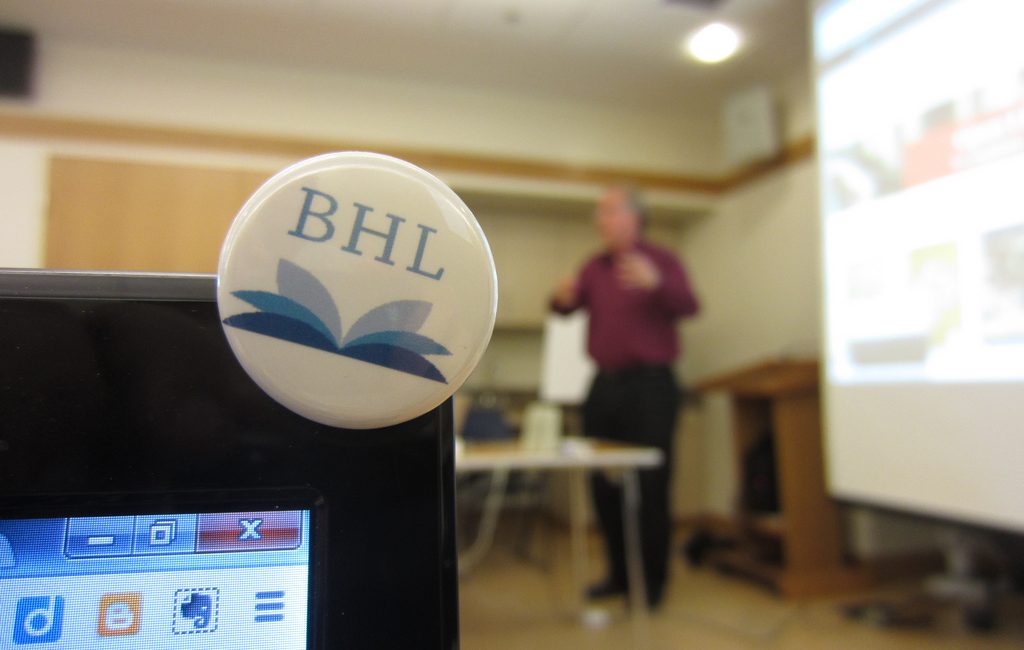
BHL at the IA Leaders Forum, with Brewster Kahle presenting in background.

On October 24-25, BHL Program Director Martin Kalfatovic and BHL Program Manager Grace Costantino attended the Internet Archive Leaders Forum in San Francisco, CA. The meeting, attended by 23 representatives from projects partnering with Internet Archive, provided attendees with a chance to showcase their projects, discuss their collaborations with IA, and nurture ideas associated with eBooks.

Since BHL’s inception, we have partnered with Internet Archive for digitization services. Whether by sending large shipments of books to local IA mass scanning centers, or by operating a single scanning machine provided by IA within their own institution, most BHL members have contributed material to BHL via IA collaborations. While we ingest, store, and serve book metadata via our own hardware, the page images on BHL are served directly from Internet Archive. As such, even books scanned outside of IA are ultimately ingested into the Archive (via a software developed by Joel Richard at the Smithsonian Libraries) so they can be served via the BHL portal.

The Internet Archive was founded in 1996 by Brewster Kahle as a non-profit digital library that provides free, unrestricted access to digitized materials, including not only books but also music and images and, through the Way Back Machine, an archive of the Internet itself. The Archive recently began work in television, archiving all news produced over the past three years on twenty news channels. On the last day of the IA Leaders Forum, the Archive announced that they now house over 10 petabytes of digitized material.


View Full Size Image
Robert Miller with his terracotta surrogate.

Though the meetings took place at the San Francisco Public Library Richmond Branch just a few blocks from the IA headquarters, Robert Miller, IA’s Global Director of Books and the meeting’s emcee, gave attendees a tour of the main IA building – a repurposed former Christian Science facility. Though transformed to meet the needs of a digital archive, the building still maintains the charms of the 100-year-old church, including marble drinking fountains, stained glass, and a massive auditorium whose pews are replete with statues crafted in the likeness of IA employees that have been with the project at least three years – a practice modeled after the famous “Terracotta Army” of China’s first emperor, Qin Shi Huang.

The theme of this year’s meeting was “eBook Lending Library: the 2nd Million eBooks.” In early 2011, IA launched an In-Library Lending Program through their OpenLibrary project. The project now provides access to over 1,000,000 free eBooks, 250,000 of which are contemporary (post-1923), with another 200,000 contemporary titles available in DAISY format for the print disabled. These eBooks are freely available to all participating libraries and OpenLibrary users and can be downloaded directly to your computer or eReader, such as a Kindle. For more information about the OpenLibrary project, visit this website. IA is working diligently to provide another 1,000,000 eBook titles in OpenLibrary, and has already obtained funding for 500,000 of those titles.

This meeting was an opportunity for IA’s stakeholders (those of us who partner with IA for digitization services) to help shape the future of the OpenLibrary lending program. 11 states, representing 110 million people, are currently members of the program (meaning residents in those states can freely “check out” the contemporary eBooks in OpenLibrary), and IA hopes to extend that access to another 50 million people by Q1 of 2013. IA also has an MOU in place with COSLA (Chief Operating State Librarians Association) to implement the eBook lending program in all 50 states and the District of Columbia. For many libraries, particularly smaller state libraries, OpenLibrary may constitute the only eLending program available to patrons.

IA hopes particularly to build the contemporary collection in OpenLibrary, and discussions at the meeting were focused on brainstorming ways to encourage participation among the organizations represented around the table. Of particular concern for many present were the legal implications of participation, as well as ensuring adequate access to popular titles within the collection, which essentially constitutes ensuring that multiple copies of each eBook are available.

View Full Size Image
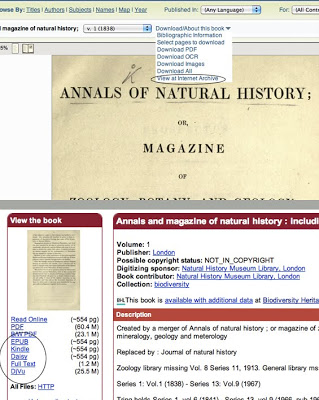
Fig. 1: “View at IA” provides access to other eBook formats

Each participant also had a chance to talk about eBooks in the context of their own project, and elaborate on their requirements for such a program. Grace Costantino provided an overview of the BHL project, highlighting that users can freely download PDFs, custom PDFs, OCR, and high resolution images from BHL. The “View at Internet Archive” option in BHL also allows users to download additional eBook formats generated by IA and based on uncorrected OCR. BHL has also expanded eBook possibilities with their recent collections in iTunes U. However, what makes BHL particularly invaluable for users are the additional services we provide on top of the digitized texts, chiefly our name finding technology, which locates species names throughout the entire corpus. As Costantino articulated, if eBooks are going to work for the science community, they must be openly available, users must be able to “mine” them for the data required, and name finding services and linked data options must be supported.

We are entering an exciting time in this digital era. Open access projects like Internet Archive and BHL are providing unprecedented access to materials formerly confined to physical availability in select libraries. Such projects remove the barriers to research and repatriate knowledge to all parts of the world. As we explore ways to make this content even more usable and accessible, it’s exciting to know that projects like IA are listening to the needs of their stakeholders and striving to build programs that fulfill those requirements. While BHL’s primary eBook efforts will continue to revolve around improving PDF download functionality (with various other eBook options available through the IA link in BHL – see fig. 1 above), and expanding collaborations with iTunes, we’re invested in exploring eBook options with IA and OpenLibrary, and are anxious to see where these initiatives take us!


November 1, 2012by ulib-libraryjobs
BHL News, Blog Reel

BHL and eReaders

So, you’ve got an iPad or another eBook reader, and you’re thinking, “BHL was just made for this!” It can be a little tricky to determine how best to use BHL on your reader or iPad, so we thought we’d take a few minutes to publish some tips that might help. So…

First off, you always have the option to simply download the PDF from BHL and view your content that way. If you’re using an iPad or iPod Touch, you’ll need an application that will let you read these PDFs, such as GoodReader. If you go to the BHL website and choose the option to download the PDF on your iPad, your iPad should then give you the option to open the PDF with any one of the eBook reader applications you have installed.

Unfortunately, there is a drawback to viewing BHL downloaded content as PDFs on your eReader device. Depending on the size of the PDF, it may take some time for the pages to render. Thus, you might have to be somewhat patient when viewing your PDF.

View Full Size Image

If you do not want to mess with the loading time involved in PDF viewing, you can download an eBook version of the item first and then use one of your eReader applications, such as iBooks, to view it. To download one of these eReader-friendly files, find the item you want to download in BHL, click on the “Download/About this Book” drop down menu on the page turner screen, and choose the option “View at Internet Archive.”

Once you are on the Internet Archive site, on the left-hand side of the screen, beneath the thumbnail view of the item, you will see a variety of download options, including ePub and a download for Kindle. Simply choose the eBook friendly file type you want to download. If you downloaded it while on your iPad, your iPad will then give you the option to choose which eReader application you want to use to view the file. If you download it on your computer, you will simply need to transfer the file to whichever eReading device you are using. If you are using an iPad and you download on your computer, simply add the eBook to your iTunes account and sync your iPad with your iTunes.

There is one thing to keep in mind with any eBook-type files you may download. These files are dependent on the quality of the OCR text associated with the item. Thus, due to the limitations of the technology, you may find that there are some strange characters or misspellings throughout your eBook. As OCR technology continues to improve, these kinds of issues will become much less apparent. However, for now, we are at the mercy of the technology.

Hopefully this information will prove helpful to any of our users braving the new frontier of eReaders. Please feel free to send us any questions or comments you might have, or tell us how you are using eReaders to access BHL content by commenting on this post. Happy eReading!

February 1, 2011by michelle.underhill

Help Support BHL

BHL's existence depends on the financial support of its patrons. Help us keep this free resource alive!

search

About BHL

The Biodiversity Heritage Library (BHL) is the world’s largest open access digital library for biodiversity literature and archives. BHL operates as a worldwide consortium of natural history, botanical, research, and national libraries working together to digitize the natural history literature held in their collections and make it freely available for open access as part of a global “biodiversity community.”

Join Our Mailing List

Sign up to receive the latest news, content highlights, and promotions.

Subscribe Now

Subscribe to Blog via Email

Enter your email address to subscribe to this blog and receive notifications of new posts by email.

Join 319 other subscribers

Subscribe to Blog Via RSS

Subscribe to the blog RSS feed to stay up-to-date on all the latest BHL posts.

Access RSS Feed

Inspiring Discovery through Free Access to Biodiversity Knowledge.

The Biodiversity Heritage Library makes it easier than ever for you to access the information you need to study and explore life on Earth…for free, anytime, anywhere.


64+ Million Pages of
Biodiversity Literature Online.

EXPLORE

Tools and Services
to Transform Research.

EXPLORE

300,000+
Illustrations on Flickr.

EXPLORE

ABOUT | HARMFUL CONTENT | PRIVACY | SITE MAP | TERMS OF USE