Biodiversity Heritage Library - Program news and collection highlights from BHL
  • Home
  • News
  • Featured Books
    • All Featured Books
    • Book of the Month Series
    • BHL at 20
  • User Stories
  • Campaigns
    • Fossil Stories
    • Garden Stories
    • Monsters Are Real
    • Page Frights
    • Her Natural History
    • Earth Optimism 2020
  • Tech Blog
  • Visit BHL
Home
News
Featured Books
    All Featured Books
    Book of the Month Series
    BHL at 20
User Stories
Campaigns
    Fossil Stories
    Garden Stories
    Monsters Are Real
    Page Frights
    Her Natural History
    Earth Optimism 2020
Tech Blog
Visit BHL
  • Home
  • News
  • Featured Books
    • All Featured Books
    • Book of the Month Series
    • BHL at 20
  • User Stories
  • Campaigns
    • Fossil Stories
    • Garden Stories
    • Monsters Are Real
    • Page Frights
    • Her Natural History
    • Earth Optimism 2020
  • Tech Blog
  • Visit BHL
Biodiversity Heritage Library - Program news and collection highlights from BHL
Blog Reel, Featured Books

Eerie Anatomy: Vesalius’ De humani corporis fabrica

This post originally published on the Smithsonian Libraries blog Unbound. See it here.

Halloween is quickly approaching and with it comes the traditional decorations of bats, pumpkins, ghosts and of course, skeletons. Back in the 1500’s, one man changed the way the medical world saw the skeletal and muscular systems of the human body. That man, Andreas Vesalius, illustrated anatomical features in his De humani corporis fabrica (On the structure of the human body) in a way never before seen. Although the pages below may seem pretty gruesome, they come from one of the most influential anatomy books of all time.

View Full Size Image
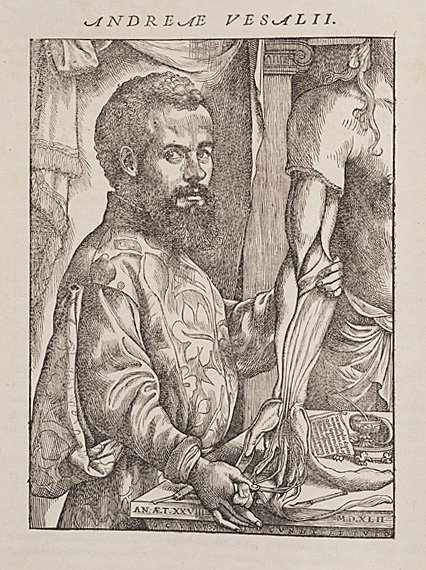
Portrait of Vesalius from De humani corporis fabrica, 1543. http://biodiversitylibrary.org/page/48714916.

Born in Brussels in 1514, Andreas Vesalius came from a family of doctors and apothecaries. When he became a physician himself and began teaching medical school in the 1530’s, most of the standard texts were based on animal dissections and the observations of an ancient Roman doctor named Galen. Vesalius took the unconventional step of performing dissections live in front of his medical students and using human bodies, in some cases those of convicted criminals.
View Full Size Image
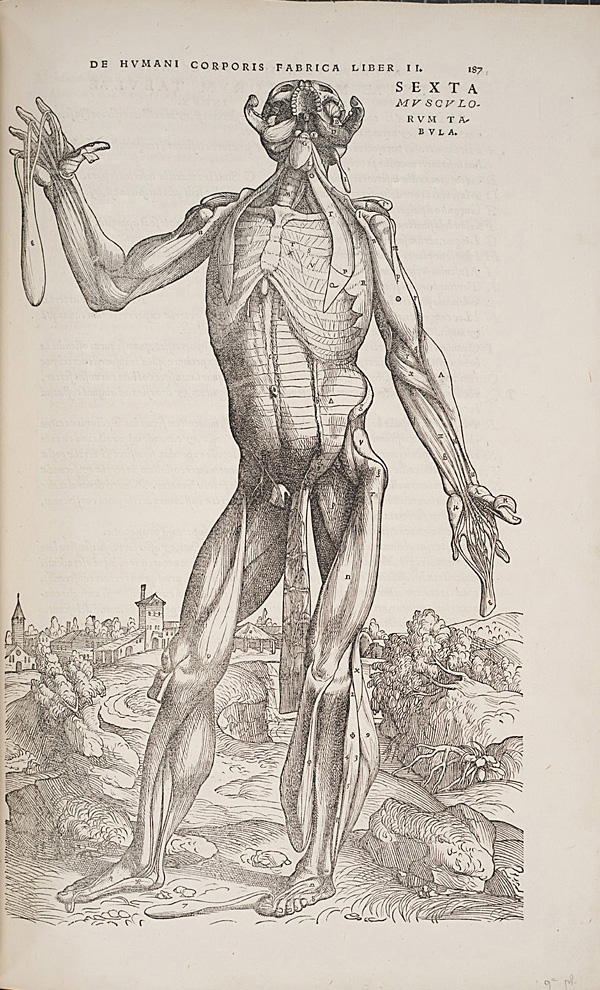
Standing figure from De humani corporis fabrica, 1543. http://biodiversitylibrary.org/page/48715058.

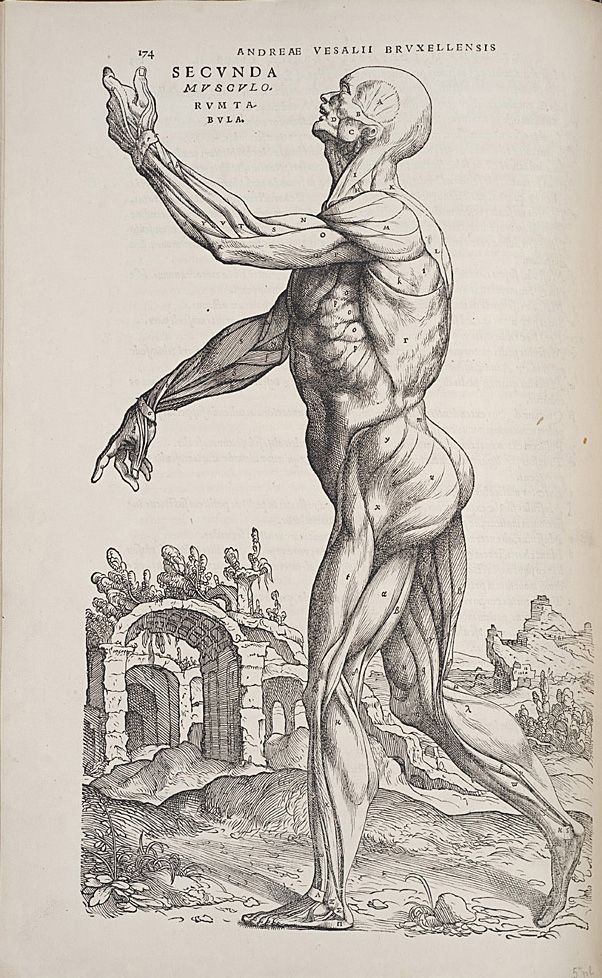
In 1543, 29 year old Vesalius published De humani corporis fabrica with elaborate wood-cut illustrations of human dissections. But these bodies weren’t just lying still, as if on a mortuary slab. They were depicted in classical contrapposto. In many instances, layers of tissue artfully fall away to reveal the muscles and ligaments which lie beneath. Despite the artistic quality, the book is considered one of the first anatomical works, accurately representing and describing various systems in the body.

Vesalius gave detailed notes to the printer, helping to assure that the descriptive text matched the appropriate figure and that the artistic style of the plates was preserved. The printer, Johannes Oporinus, felt that these notes were so important that he included them in the publication itself (see “Printer’s Note to the Reader” here: http://vesalius.northwestern.edu/books/FA.b.html). In the text of the book, Vesalius not only describes the systems of the body, but also his recommendations for obtaining skeletons, putting them together and dissecting cadavers.
View Full Size Image
Standing figure from De humani corporis fabrica, 1543. http://biodiversitylibrary.org/page/48715045.

The so-called “Muscle Men” of the book are depicted on a background that is thought to be Padua, where Vesalius taught medicine. If pieced together, the plates’ backgrounds form a full landscape. Vesalius dedicated the book to Holy Roman Emperor Charles V and later went to work as the Emperor’s personal physician.

You can learn more about Vesalius and the history of anatomy books during a live tour in the Smithsonian’s Dibner Library of the History of Science and Technology via Periscope on Thursday, October 29th at 1pm (EST). Head of Special Collections, Lilla Vekerdy, will highlight a few of the rare books, including Vesalius’, that helped transform the way that medical professions studied the human body.
View Full Size Image

If you’d like to explore more of De humani corporis fabric on your own, check out the recently-added copy from the Getty Research Institute (via the Internet Archive) in BHL.

We hope you’ll join us on Oct. 29 for the Eerie Anatomy Periscope. Make no bones about it, it will be a ghoulishly good time!
October 28, 2015by ulib-libraryjobs
BHL News, Blog Reel, Campaigns, Fossil Stories

Webcast! Exploring the Smithsonian’s FossiLab

The Smithsonian National Museum of Natural History’s FossiLab is a busy place, responsible for preparing newly-collected fossils for Smithsonian’s scientists and maintaining the fossils in the Smithsonian’s collection. Visitors to the museum can actually watch staff and volunteers at work in the FossiLab, which is located within the Last American Dinosaurs Exhibition.

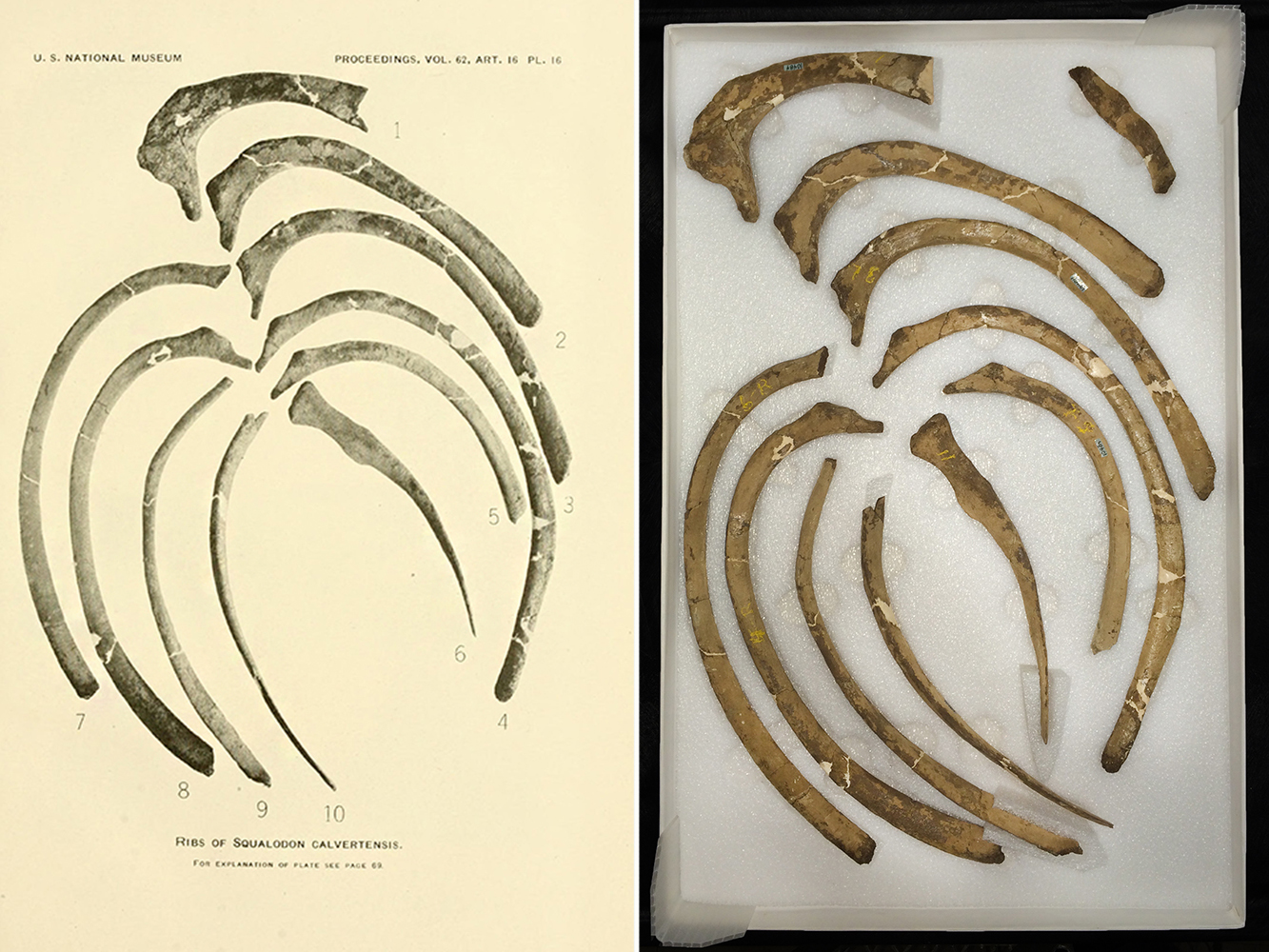
One of the projects in the FossiLab is the conservation and rehousing of specimens from the Museum’s fossil marine mammal collection. The specimens range from individual teeth to skulls, jaws and more-or-less complete skeletons comprised of both intact and fragmentary bones. Some of the most important specimens were described by Smithsonian scientists in articles now available online through the Biodiversity Heritage Library. The BHL collection gives FossiLab staff easy access to early photographs and drawings of these fossils, aiding their conservation work greatly. How is that? Fossils tend to break over time (gravity, vibration, and even the most careful handling may cause old repairs to fail or new fractures to form). Most such breaks are easy to repair, but in a large collection of fragmentary bones it’s not always easy to distinguish breaks that occurred during storage from those that predate a fossil’s discovery. When staff compare the bones to the original illustrations, the distinction becomes clear. Not only can they see if fragments have gone missing, but they also learn the approximate shapes of any missing pieces. If you’ve ever put a jigsaw puzzle together, you know how much easier it is to find a missing piece if you know what it looks like!

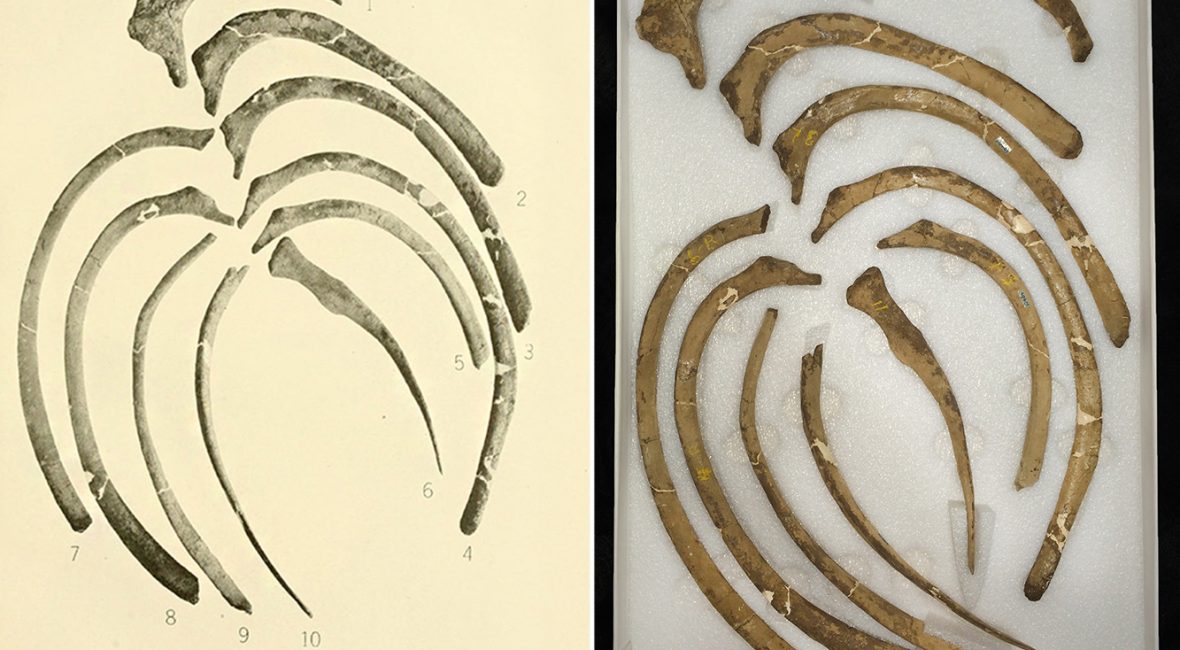
The photos below show an example of the FossiLab’s work. This past summer, the fossil of an extinct shark-toothed dolphin, Squalodon calvertensis (USNM 10484), was brought to FossiLab for rehousing. It had been described in 1923 by Remington Kellogg in the Proceedings of the United States National Museum. When staff compared the ribs with the photo in the publication (left), they realized that some had broken during their 92 years in storage. A careful search among all the bones in the storage drawer turned up the missing pieces. FossiLab staff reattached them using an archival adhesive before rehousing the entire specimen and returning it to storage. The repaired and rehoused ribs are shown in the photo on the right.

View Full Size Image
Ribs from Squalodon calvertensis. Left: Photo from “Description of two squalodonts recently discovered in the Calvert Cliffs, Maryland; and notes on the shark-toothed cetaceans.” Kellogg, Remington. Proceedings of the United States National Museum. 62(2462). pg. 1-69. http://biodiversitylibrary.org/page/16118643. Right: Same ribs, recently rehoused at the Smithsonian’s FossiLab.

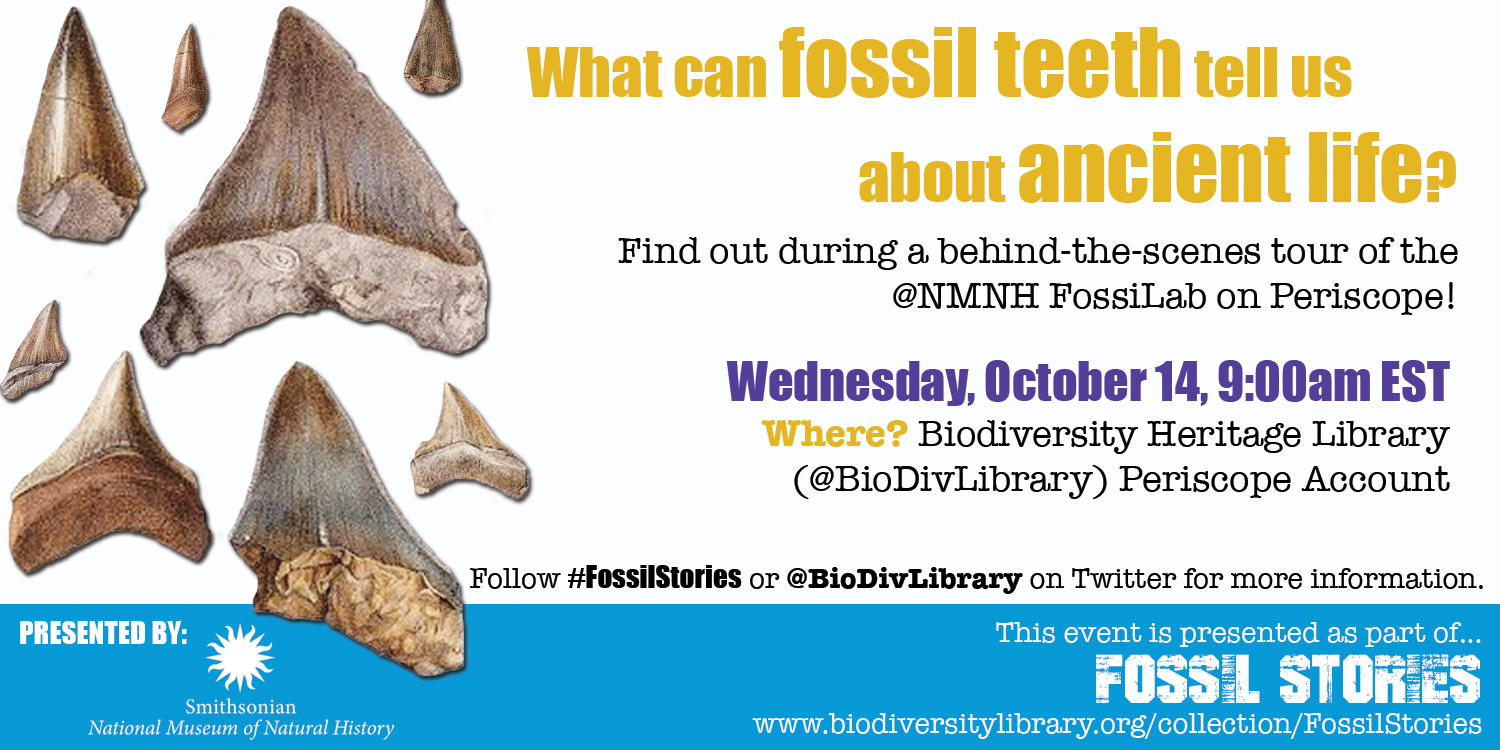
The FossiLab is also very interested in fossil teeth. Why? According to FossiLab volunteer Advait Jukar, a PhD student at George Mason University, these teeth can help us determine, for example, the number and types of dinosaur species in a region.

Curious to know more about the fascinating things that fossil teeth can tell us about ancient life and to further explore the work going on at the Smithsonian’s FossiLab? You’re in luck!

View Full Size Image

Tune in today, October 14, at 9am EST for a live tour of the FossiLab with Advait Jukar! The event will take place on the BHL Periscope account. To participate, simply follow BHL (@BioDivLibrary) on Periscope (you’ll then receive a notification via Periscope once the event is live) or follow @NMNH or @BioDivLibrary on Twitter. We’ll tweet out the link to the Periscope event on those accounts once it’s live.

If you missed the live event, you’re in luck. You can see the recording on YouTube!

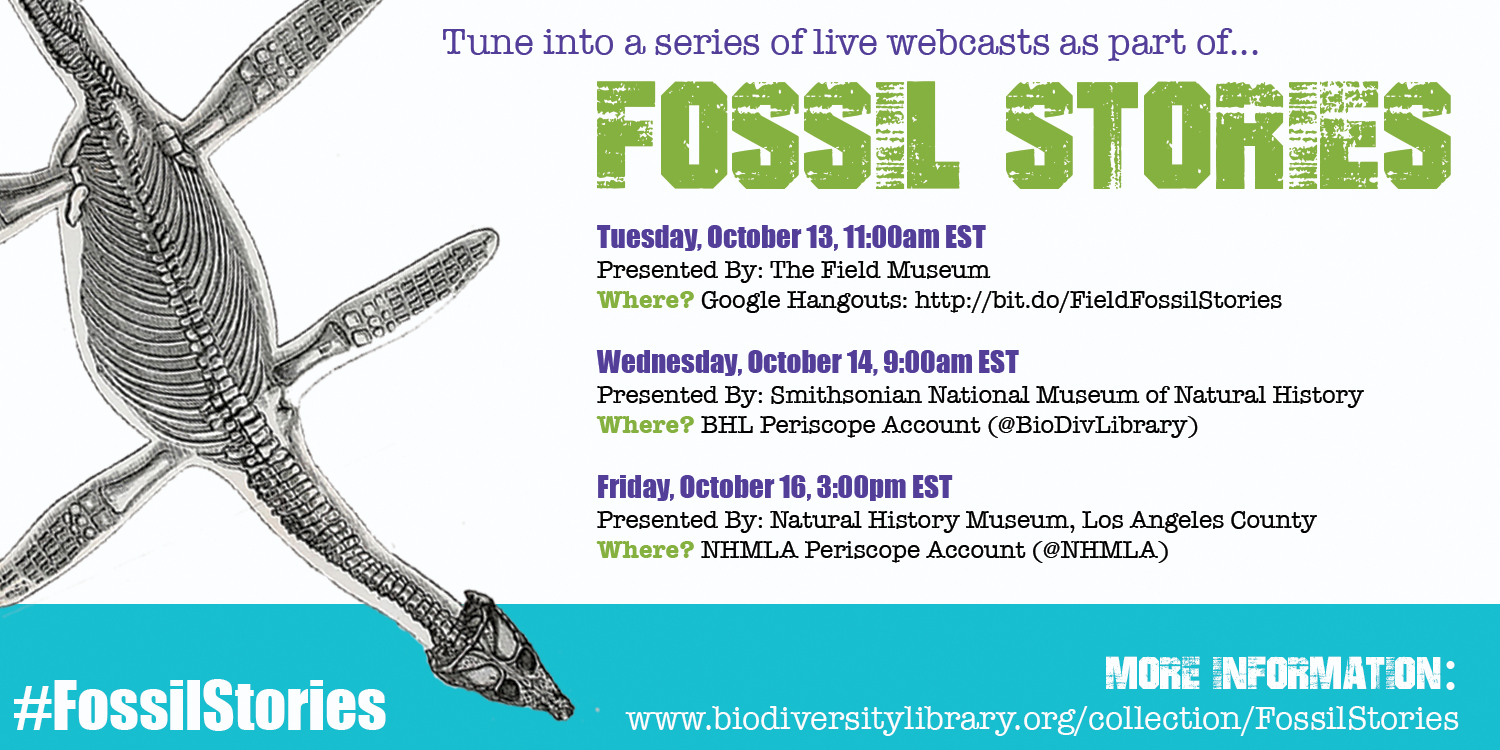
We hope to see you today on Periscope, and remember to follow our blog and #FossilStories on Twitter and Facebook all week for more great fossil fun and live webcasts. Check out the full webcast schedule below:

View Full Size Image
October 14, 2015by michelle.underhill

Help Support BHL

BHL's existence depends on the financial support of its patrons. Help us keep this free resource alive!

search

About BHL

The Biodiversity Heritage Library (BHL) is the world’s largest open access digital library for biodiversity literature and archives. BHL operates as a worldwide consortium of natural history, botanical, research, and national libraries working together to digitize the natural history literature held in their collections and make it freely available for open access as part of a global “biodiversity community.”

Join Our Mailing List

Sign up to receive the latest news, content highlights, and promotions.

Subscribe Now

Subscribe to Blog via Email

Enter your email address to subscribe to this blog and receive notifications of new posts by email.

Join 319 other subscribers

Subscribe to Blog Via RSS

Subscribe to the blog RSS feed to stay up-to-date on all the latest BHL posts.

Access RSS Feed

Inspiring Discovery through Free Access to Biodiversity Knowledge.

The Biodiversity Heritage Library makes it easier than ever for you to access the information you need to study and explore life on Earth…for free, anytime, anywhere.


64+ Million Pages of
Biodiversity Literature Online.

EXPLORE

Tools and Services
to Transform Research.

EXPLORE

300,000+
Illustrations on Flickr.

EXPLORE

ABOUT | HARMFUL CONTENT | PRIVACY | SITE MAP | TERMS OF USE