Biodiversity Heritage Library - Program news and collection highlights from BHL
  • Home
  • News
  • Featured Books
    • All Featured Books
    • Book of the Month Series
    • BHL at 20
  • User Stories
  • Campaigns
    • Fossil Stories
    • Garden Stories
    • Monsters Are Real
    • Page Frights
    • Her Natural History
    • Earth Optimism 2020
  • Tech Blog
  • Visit BHL
Home
News
Featured Books
    All Featured Books
    Book of the Month Series
    BHL at 20
User Stories
Campaigns
    Fossil Stories
    Garden Stories
    Monsters Are Real
    Page Frights
    Her Natural History
    Earth Optimism 2020
Tech Blog
Visit BHL
  • Home
  • News
  • Featured Books
    • All Featured Books
    • Book of the Month Series
    • BHL at 20
  • User Stories
  • Campaigns
    • Fossil Stories
    • Garden Stories
    • Monsters Are Real
    • Page Frights
    • Her Natural History
    • Earth Optimism 2020
  • Tech Blog
  • Visit BHL
Biodiversity Heritage Library - Program news and collection highlights from BHL
Blog Reel, Featured Books

A Crusade to Save the Golden Lion Tamarin

Post by Grace Costantino with significant contributions from Field Book Project blog post, “Field Notes from a Battle Against Extinction,” by Sonoe Nakasone.
View Full Size Image
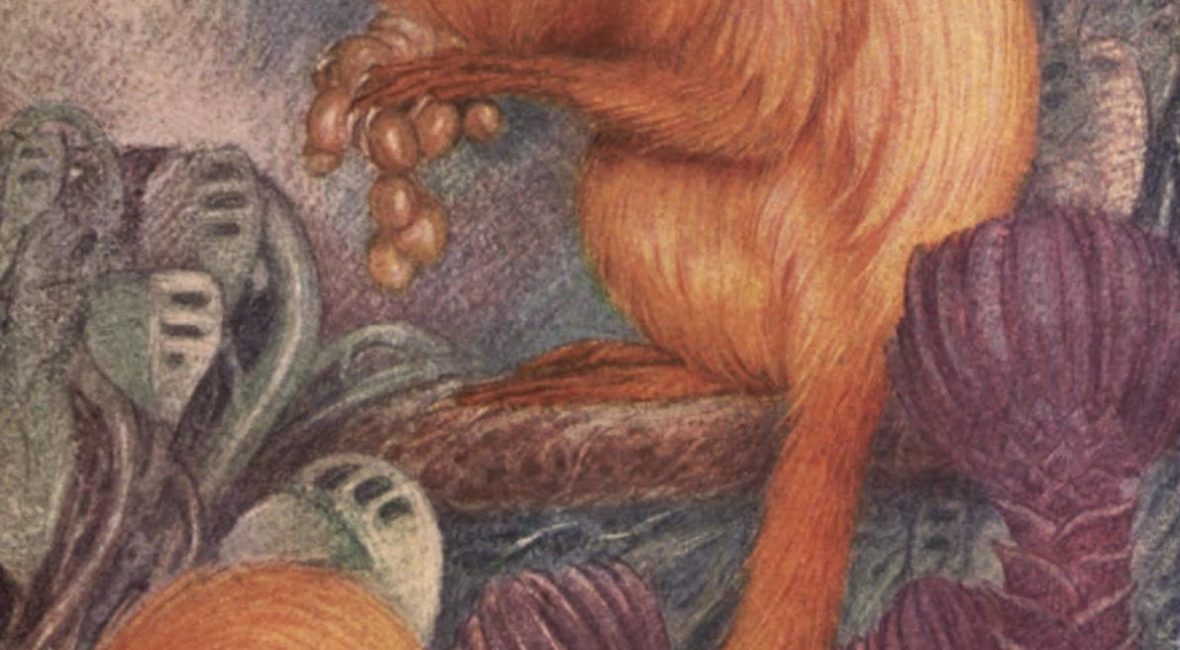
The Golden Lion Tamarin. Illustrated by Louis Sargent. From: Finn, Frank.
The Wild Beasts of the World. (v. 1, 1909). http://biodiversitylibrary.org/page/19058592 

A small, endangered primate, the Golden Lion Tamarin (GLT) (also known as the Golden or Lion Marmoset) gets its name from the trademark, vivid orange “mane” surrounding its face. Don’t let the “lion” part fool you, however. The tamarin averages only 10.3 inches in length and 1.37 lbs.

In the marvelous book The Wild Beasts of the World (v.1, 1909), Frank Finn, an English ornithologist, writes that the GLT is not much larger than the English squirrel, with “paws” quite unlike “ordinary” monkeys. The accompanying illustration, by Louis Sargent, is a breathtaking representation of this adorable New World Monkey.

Interestingly, Finn records that “the present species is one of the most widely-ranging of the Marmosets, being found from the Isthmus of Panama to South-eastern Brazil and New Granada.” Much has changed since the early 1900s. Today, GLTs have extremely limited distribution, confined solely to Brazil, and occupying only 2-5% of their original habitat. In the 1970s, as few as 200 GLTs remained on Earth. Thanks to conservation efforts, led largely by Dr. Devra Kleiman, who passed away in 2010, their wild population is now closer to 3,200.

The Field Book Project* has cataloged a number of Kleiman’s fieldbooks, many focusing on her research with the GLT. Sonoe Nakasone, who cataloged the books and published a blog post about them, noted that Kleiman’s notes were quite different from those of many other researchers she had cataloged in the past, as:

Kleiman didn’t really “collect specimens”. Rather, her notes document animal behavior, activities, diet, as well as external factors affecting the livelihood of tamarins. Kleiman and her team did collect blood, skin, and fur samples, and they did capture tamarins to breed in captivity before reintroducing them into the wild, yet the fundamental purpose and method of research was distinct from traditional natural history field work.

View Full Size Image
Devra Kleiman and colleague conducting playback study. From the Field Book Project.

Kleiman’s fieldbooks also document a number of her research techniques. She employed three common protocols:

Scans, focals, and playbacks. Scans and focals are systematic observations. Scans focus on all member of a group of animals; focals focus on an individual animal. Both adhere to specific lengths of time and seek specific information about behavior and activities. Playbacks involved projecting recordings of various animal vocalizations in the field. During these experiments, animal responses, if any, were documented and differences between male and female responses noted.

Nakasone also highlights some of the challenges Kleiman faced during her conservation initiatives:

On October 25, 1991, Kleiman remembers a particularly difficult visit to a corporation: “the veep [VP] we meet is very obnoxious—suggesting that people are burned out [with] ecology (mentions a t-shirt entitled “I don’t give a s— about the GLT)”. On March 16, 1990, Kleiman notes the effects of economic instability in Brazil on the project: “they are freezing all interest-bearing overnight accounts […]. Cecilia [Kleiman’s colleague] had $6000 WWF grant in an overnight account. It increased by $1000 interest, but now she can’t touch it.”

Yet despite these and other obstacles like deforestation, poaching, and political instability, Kleiman coordinated the Golden Lion Tamarin Conservation Program for almost 30 years and “was successful at shedding light on the issue of golden lion tamarins and helping to increase the GLT population by 800%.” As Nakaone notes:

Kleiman’s field books are a refreshing and exhilarating alternative to many of her predecessor’s field books because she was a pioneer in the burgeoning field of conservation biology. Her notes reflect not only the advancement of human knowledge, but also the application of that knowledge to ensure the livelihood of species struggling for survival.

View Full Size Image
“Participants in the Front Royal Conference on Mammalian Behavior, 16-19 August 1980.”
Kleiman 2nd row, 2nd from right.

Learn more about Kleiman’s contributions to conservation and biodiversity sciences from the Smithsonian Archives. Explore the GLT in The Wild Beasts of the World, and learn more about the species in EOL. Read Sonoe Nakasone’s full blog post and explore Kleiman’s fieldbooks, cataloged by the Field Book Project.

* The Field Book Project is an initiative to increase accessibility to field book content that documents natural history. Through ongoing partnerships within and beyond the Smithsonian, the project is making field books easier to find and available in a digital format for current research, as well as inspiring new ways of utilizing these rich information sources. 

September 18, 2014by michelle.underhill
Blog Reel

Book of the Week: The Memory of a Museum Dissolved but Not Forgotten

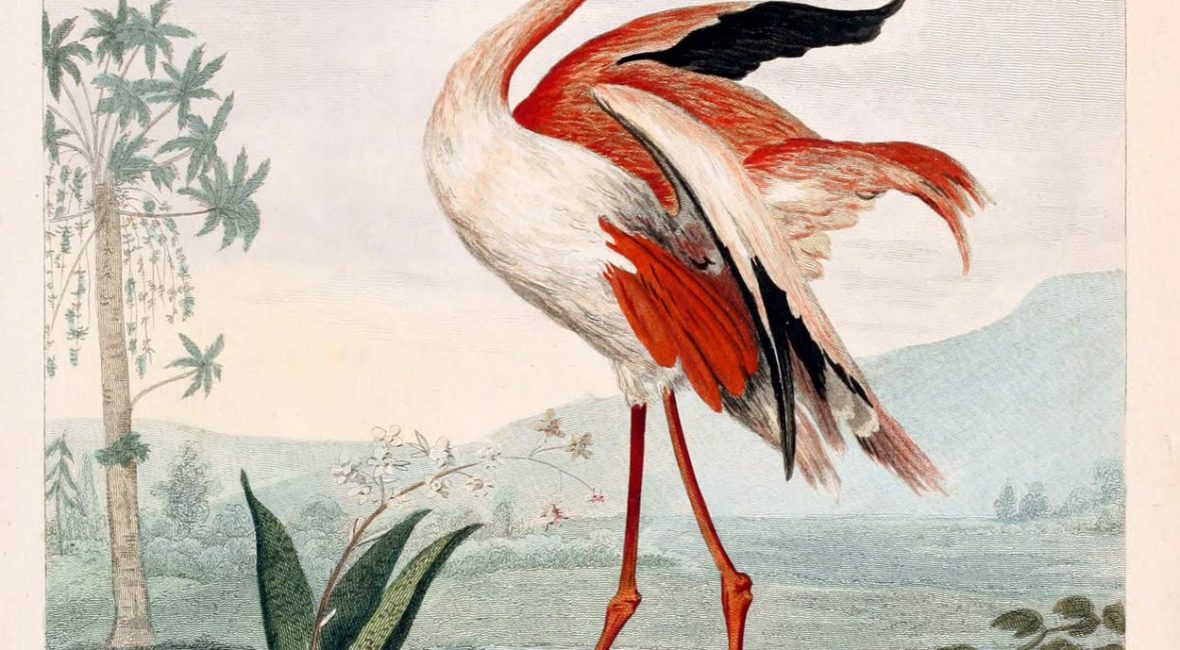
View Full Size Image of this FlamingoWhen Musei Leveriani Explicatio, Anblica et Latina (1792-96), by George Shaw, went up for auction at Christie’s Auction House in April of 2008 it was described as “one of the most comprehensive natural history collections of the eighteenth century.” It sold for $3,926 USD. The work documents the specimens found in Sir Ashton Lever’s museum (the Museum Leverianum), which was originally housed in his home at Alkrington Hall. The book contains 72 hand-colored engraved plates after, among others, Charles Reuben Ryley, Sarah Stone, and Philip Reinagle. With such a claim as “most comprehensive natural history collection,” we had to check it out, and the quality of the illustrations blew us away. So: Voila! Here you have our book of the week!

As stated, Sir Ashton’s museum, which comprised approximately 28,000 items, was originally housed in his home. However, hoping to make the museum self-financing, Lever moved the collection to Leicester House in London in 1774, opening it to the public in 1775 with an admission fee of half a guinea. The museum was popular but not as financially successful as Lever had hoped. In 1784, he was forced to sell the collection, which had been valued at £53,000. He did so by public lottery. 8,000 tickets, priced at 1 guinea each, were sold. James Parkinson won the collection with a ticket purchased by his late wife. Parkinson successfully ran the museum until May of 1806, when, despite the continued popularity of the museum, he was also forced to sell the collection by piece at an auction lasting 65 days.

View Full Size Image of this Baboon

While the two volumes of this work on BHL contain dozens of gorgeous illustrations (all of which you can browse at your leisure on Flickr!), we’ve selected just a few of our favorites to feature here. Sir Ashton and Mr. Parkinson would have been proud that, though the museum itself did not endure, a record of the enchanting and impressive specimens contained within it has lasted these 200+ years. And now, thanks to BHL and the modern digital era, you don’t have to spend $4,000 at auction to enjoy the marvels that one composed the Museum Leverianum! All you need is a computer and Internet connection!

View Full Size Image of these Birds

View Full Size Image of this ChameleonView Full Size Image of these Monkeys
Musei Leveriani Explicatio, Anblica et Latina (1792-96), by George Shaw, was contributed by the Smithsonian Institution Libraries. See the images from this book on Flickr!

September 15, 2011by michelle.underhill
Blog Reel

Conservation 101: Near Threatened

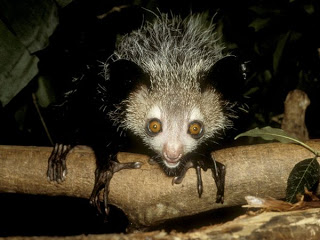
View Full Size ImageThe Aye-Aye. Also known as Daubentonia madagascar-iensis. This creature is peculiar, even by the lemur’s standards of peculiarity. It has a distinctively slender and very long middle finger used to seek out grubs and other possible food sources from tree trunks, like a woodpecker. They have dark brown or black fur that can have white flecks at the tip. The Aye-aye’s tail is much longer than its body in a way that frustrates our expectations for proportion and, well, let’s just say the eyes are intense. Further, the aye-aye’s mammary glands are located near the groin and persistent ova production allows reproduction for the entire life span of a female aye-aye. These strange and nocturnal primates are found almost exclusively in Madagascar and live in the canopies of rain forests.

Their status as near-threatened has two main sources. First, it’s the result of local superstition. View Full Size Image Aye-ayes are viewed as harbingers of evil and death and they are often killed on sight. One cannot help but suspect if these creatures were perhaps a little softer around the edges, a little less freaky, they might have avoided their local status as a boogie man. And though they are currently protected by law, well meaning villagers often kill them in an effort to mitigate the bad luck. And, secondly, deforestation and the loss of their original habitat also contributes to the decline of the species. Aye-ayes are forced to move closer to villages as they lose their treetop habitats and as we’ve seen, the villages are mostly bad luck for aye-ayes!

Although there is much we still don’t know about the Aye-aye (used to be classified as a rodent, for example), check out the Primate Fact-sheet from the University of Wisconsin for information regarding morphology, behavior and other detailed descriptions.

May 24, 2010by jwinberry

Help Support BHL

BHL's existence depends on the financial support of its patrons. Help us keep this free resource alive!

search

About BHL

The Biodiversity Heritage Library (BHL) is the world’s largest open access digital library for biodiversity literature and archives. BHL operates as a worldwide consortium of natural history, botanical, research, and national libraries working together to digitize the natural history literature held in their collections and make it freely available for open access as part of a global “biodiversity community.”

Follow BHL

  • Bluesky logo
  • Instagram logo
  • Facebook logo
  • Flickr logo
  • Twitter logo

Join Our Mailing List

Sign up to receive the latest news, content highlights, and promotions.

Subscribe Now

Subscribe to Blog via Email

Enter your email address to subscribe to this blog and receive notifications of new posts by email.

Join 319 other subscribers

Subscribe to Blog Via RSS

Subscribe to the blog RSS feed to stay up-to-date on all the latest BHL posts.

Access RSS Feed


64+ Million Pages of
Biodiversity Literature Online.

EXPLORE

Tools and Services
to Transform Research.

EXPLORE

300,000+
Illustrations on Flickr.

EXPLORE

ABOUT | HARMFUL CONTENT | PRIVACY | SITE MAP | TERMS OF USE