Biodiversity Heritage Library - Program news and collection highlights from BHL
  • Home
  • News
  • Featured Books
    • All Featured Books
    • Book of the Month Series
    • BHL at 20
  • User Stories
  • Campaigns
    • Fossil Stories
    • Garden Stories
    • Monsters Are Real
    • Page Frights
    • Her Natural History
    • Earth Optimism 2020
  • Tech Blog
  • Visit BHL
Home
News
Featured Books
    All Featured Books
    Book of the Month Series
    BHL at 20
User Stories
Campaigns
    Fossil Stories
    Garden Stories
    Monsters Are Real
    Page Frights
    Her Natural History
    Earth Optimism 2020
Tech Blog
Visit BHL
  • Home
  • News
  • Featured Books
    • All Featured Books
    • Book of the Month Series
    • BHL at 20
  • User Stories
  • Campaigns
    • Fossil Stories
    • Garden Stories
    • Monsters Are Real
    • Page Frights
    • Her Natural History
    • Earth Optimism 2020
  • Tech Blog
  • Visit BHL
Biodiversity Heritage Library - Program news and collection highlights from BHL
Blog Reel, User Stories

Teaching Rare Book Cataloguing During a Pandemic

As I am writing this, Melbourne is at the end of its second wave of COVID-19 and I have been separated from the library collections that I work with at Museums Victoria for six months, 25 days, 21 hours, and around 12 minutes… but who’s counting?!

The pandemic has created a lot of challenges, not least working out how to be a librarian of an overwhelmingly print-based collection from a distance, but this time working from home has also afforded me opportunities to present a handful of webinars, the most recent being a guest lecture on rare book cataloguing for library and information management students.

I can say without a doubt that this would have been a near impossible task without the Biodiversity Heritage Library.

Having a number of items from the Museums Victoria Library digitised and openly available on the BHL website enabled me to access collection items virtually for students and create engaging online content showing real-life examples of features such as collation, signatures, catchwords, and provenance. These are some of the things we look for when cataloguing rare books from the hand-press era, which for Western printing spans roughly from 1440, around the time when the Gutenberg press was invented, to the early 19th century, by which time the machine age was well established and steam-powered machines dominated printing.

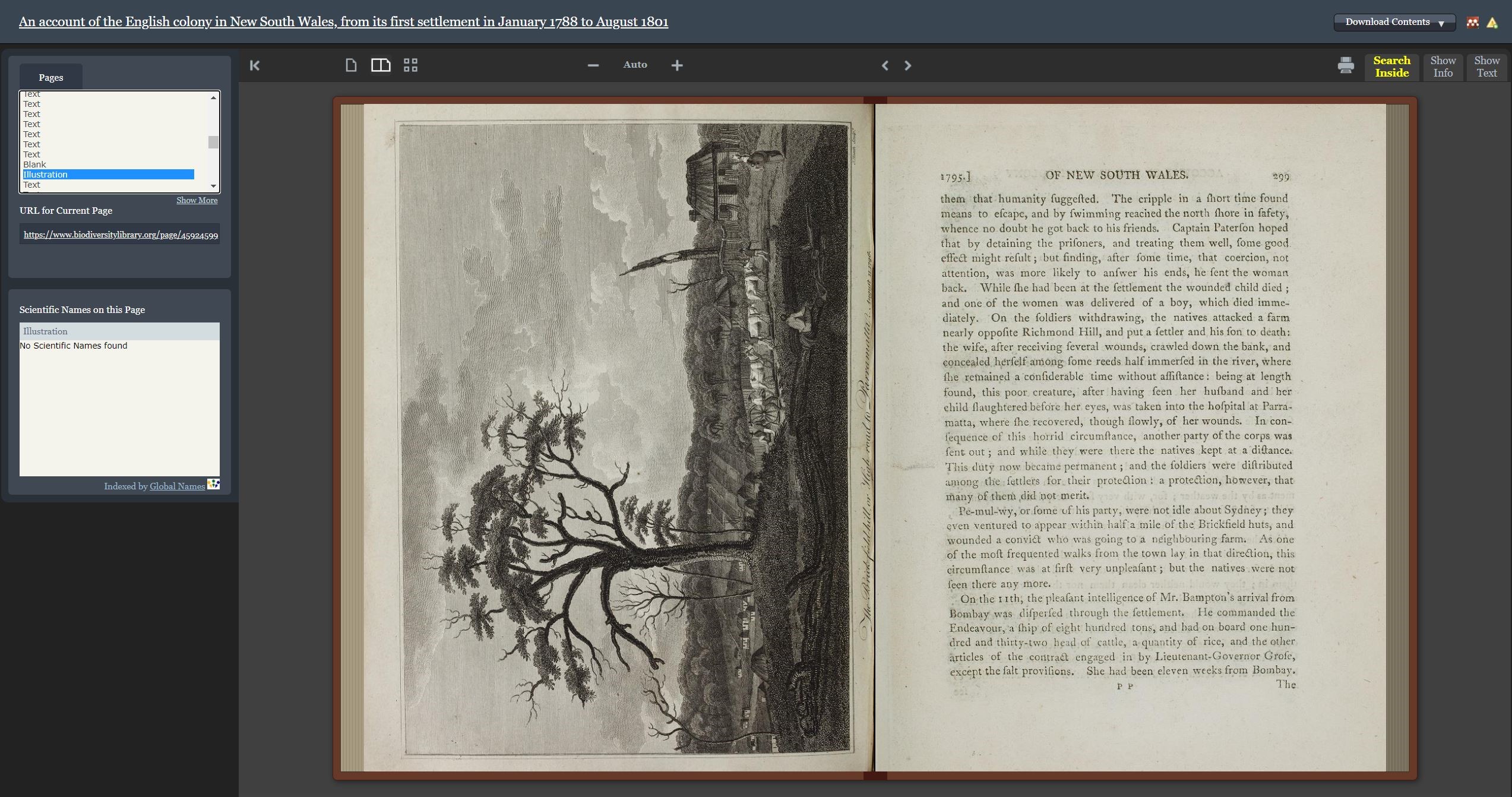
Screenshot of the book viewer in BHL with pages from An account of the English colony in New South Wales.

The two-page view on BHL allowed me to flick through books virtually in the same manner as a physical object in order to indicate some of the things we might look for when cataloguing rare books. Plate and text page 299. Collins, David. An account of the English colony in New South Wales, from its first settlement in January 1788 to August 1801. 1804. Contributed in BHL from Museums Victoria.

A central part of a bibliographical description is to record the format and the physical structure of the book. In determining a book’s collations—or in other words, how it was put together or assembled—we can look for evidence on books, including the impressions that the paper mould have left on the paper and devices used by printers to keep track of page order such as signatures and catchwords.

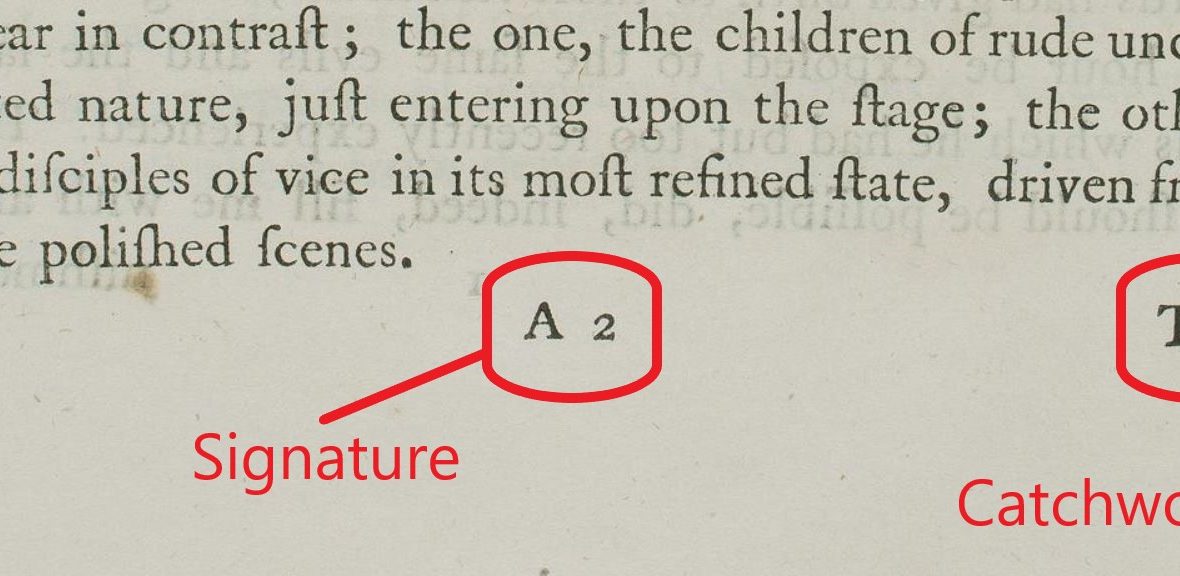
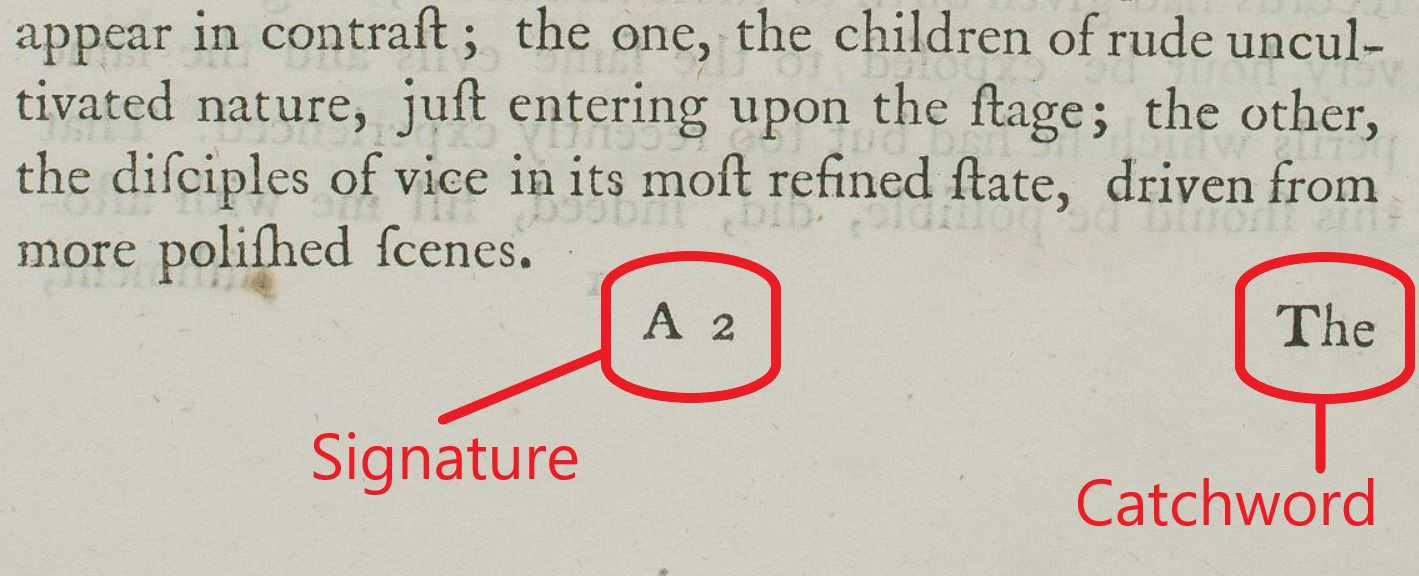
A catchword will show the first word on the following page and a signature will indicate how many pages are in each gathering of the book. Both generally appear near the bottom of a page and both are also useful for rare book cataloguers to check that the item they are cataloguing is not missing any pages.

Highlight of signatures and catchwords on a printed page of a rare book.

Close-up of a page indicating the location of the signature and catchword. Preface. Collins, David. An account of the English colony in New South Wales, from its first settlement in January 1788 to August 1801. 1804. Contributed in BHL from Museums Victoria.

During the lecture, I used BHL to flick through David Collins’ published journal, An account of the English colony in New South Wales … (1804), where I could clearly demonstrate to the students what I am referring to when I say “collations”, “signatures” and “catchwords”, and what aspects of the book that I might record in a catalogue record.

Another thing that I touched on was provenance markings and how to record any marks of ownership, custody or location on an item. In the case of books, this can mean autographs or notes written in books, as well as bookplates and stamps—people scribble, affix or slip all sorts of things in or on books! Generally, when cataloguing, I’d aim to note anything in our copy that might deviate from the “perfect” copy, so in other words, anything that’s happened to the book after publication.

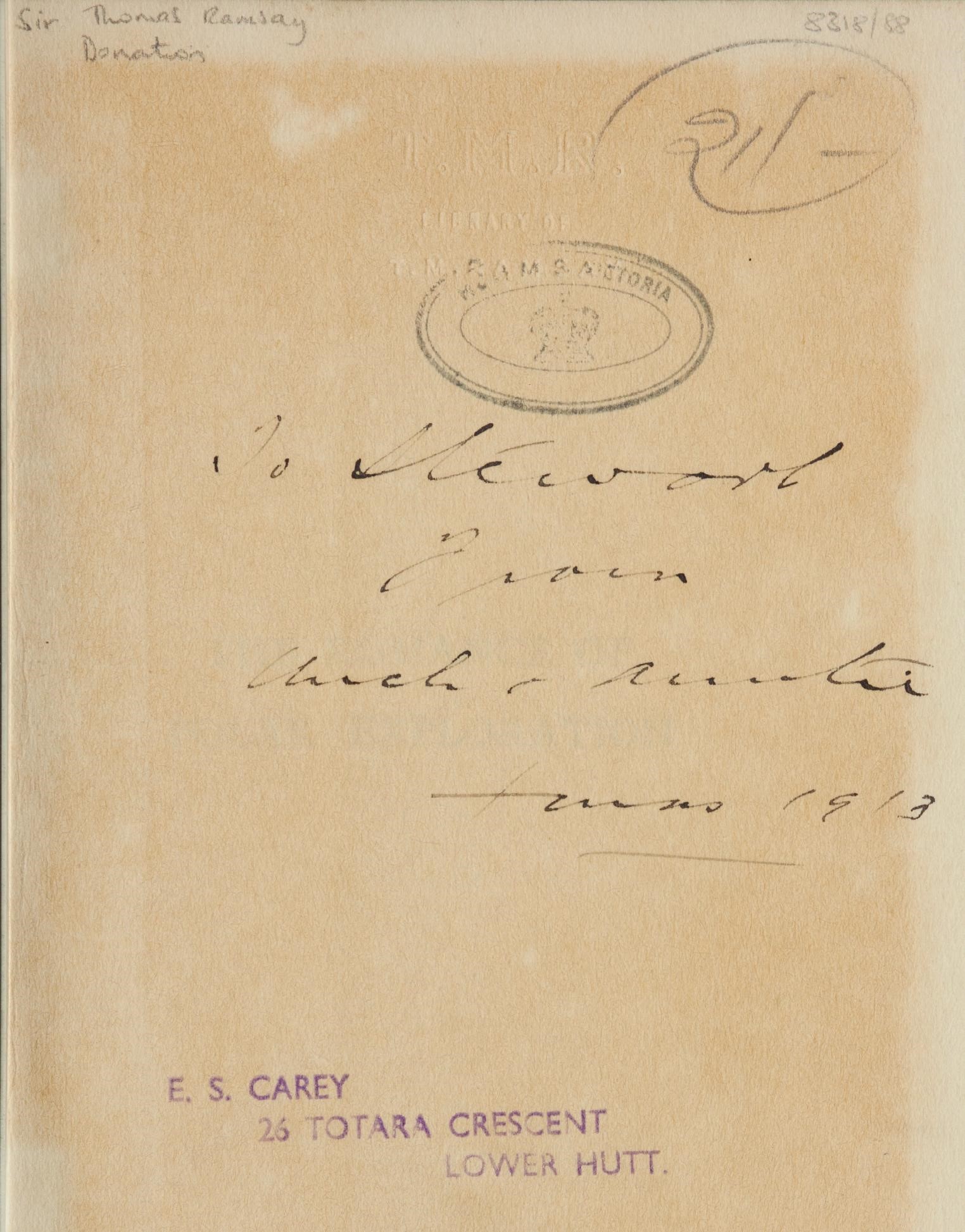
Provenance information highlighted on the front flyleaf of a rare book.

The front flyleaf of the Museums Victoria Library copy features several marks of provenance, including an acquisition number, a blind or embossed stamp near the top of the page, and an inscription. Front flyleaf. Scott, G. Firth. The romance of polar exploration. 1909. Contributed in BHL from Museums Victoria.

Once again, BHL delivered the goods on provenance markings. I was able to browse some of the 600+ volumes that Museums Victoria has contributed to find many different kinds of provenance markings, including several marks of provenance in our copy of The romance of polar exploration by G. Firth Scott (1909) as well as bookplates, annotations and even a cheeky manicule! If you are interested to know more about provenance markings in our collections, take a look at this BHL blog post from 2019 by Hayley Webster.

So yes, the pandemic has been challenging, but not always in a bad way. It has certainly forced me to be adaptable and creative around my approach to my job, and I’ve also learned to love and appreciate the digital surrogates of the books in the Museums Victoria Library as much as I do the real thing.

January 14, 2021by Joel Richard
Blog Reel, Featured Books

A Basic Guide to Rare Book Research

In my job as the manager of the Library at Museums Victoria (Australia), I am frequently required to conduct rare book research for programs, displays, online projects, or to establish the provenance of a book. I remember being a little daunted by this task at first, not knowing quite what to cover or what the relevant references were in this field. I have put together this quick guide as a reference for newcomers, using digitised books in BHL to demonstrate how to “read” a book for rare book research. I’ve also included some useful links and further reading if you’d like to delve deeper.

Having conducted numerous talks and tours on rare books in my career, I am now familiar with the questions people ask and prepare by trying to cover as much as possible of the following:

  • Bibliographical information: publication date and the dates of any parts if applicable, edition statement, number of volumes, parts and plates
  • Production details: method of printing and illustrating, method of colouring
  • Print run (edition)
  • Remaining (extant) copies
  • Biographical information of authors/illustrators/contributors
  • Provenance
  • Significance

Here are my top tips for finding that information.

1. Look at the book!

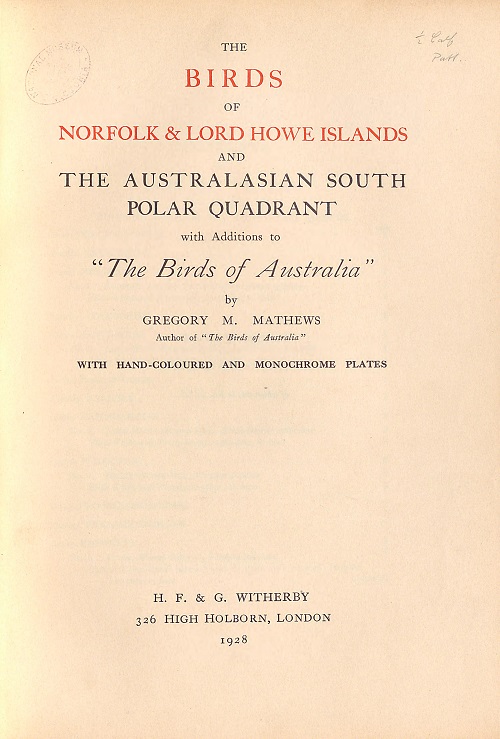
Much information can be gleaned from the item itself. The title page is normally the go-to for bibliographical details and may also provide information about illustrations. For instance, title pages frequently advertise methods of printing and colouring plates.
1. t.p. Mathews small.jpg

Image: This title page informs us that the book contains hand-coloured and monochrome plates. Source: Mathews, Gregory. The birds of Norfolk & Lord Howe Islands and the Australasian South Polar quadrant. 1928. Contributed in BHL from Museums Victoria.

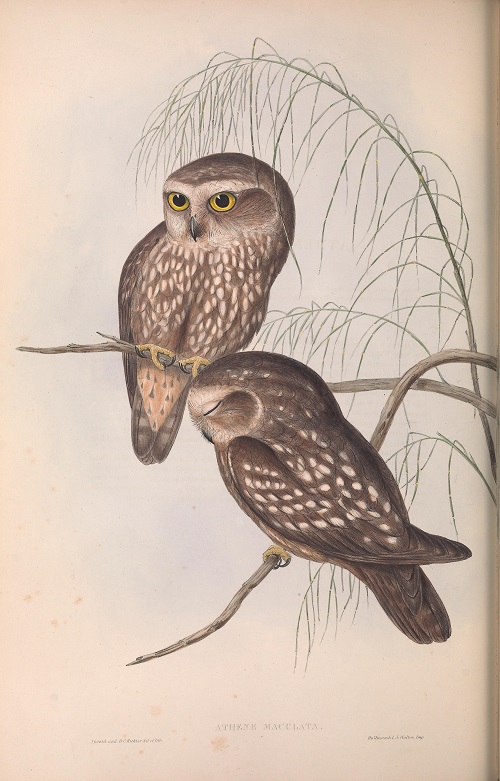
The illustrations themselves often bear further information, such as the names of contributors or the method of printing.
2. Plate Gould small.jpg

Plate 33. Gould, John. Birds of Australia. Volume 1 (1848). Contributed in BHL from Smithsonian Libraries.

You may need to do some detective work to decipher abbreviations. In the example above “J. Gould & H. C. Richter” appears on the left with the abbreviation del et lith and “Hullmandel & Walton” appears on the right with the abbreviation Imp. There are a number of references that you can consult to illuminate these terms (see further reading). Princeton University Library’s post on Printmaker’s abbreviations provides the following information:

  • del = drawn by
  • lith = lithographed by
  • imp = printed by

Therefore, this illustration indicates that it was transferred to (drawn on) the lithographic stone by J. Gould and H. C. Richter and printed by the firm Hullmandel & Walton.

The preface and introduction may also contain acknowledgements of contributors and details on production methods.

3. Preface Gould crop.jpg

Preface. Gould, John. Birds of Australia. Volume 1 (1848). Contributed in BHL from Smithsonian Libraries.

For instance, John Gould’s preface to Birds of Australia provides greater detail than the acknowledgements on individual plates. He laments the loss of his wife Elizabeth part-way through the production of the work, and we learn that she drew the preliminary sketches that Richter used to develop the final prints. Gould also mentions that the illustrations were hand-coloured by a Mr. Bayfield.

Rare books may also contain traces of their previous owners, or provenance. Provenance information is commonly found in the first few pages of a book, such as the inside front cover, flyleaves or title page. Hints as to previous owners can include inscriptions, bookplates or library stamps (more on stamps in my library here).
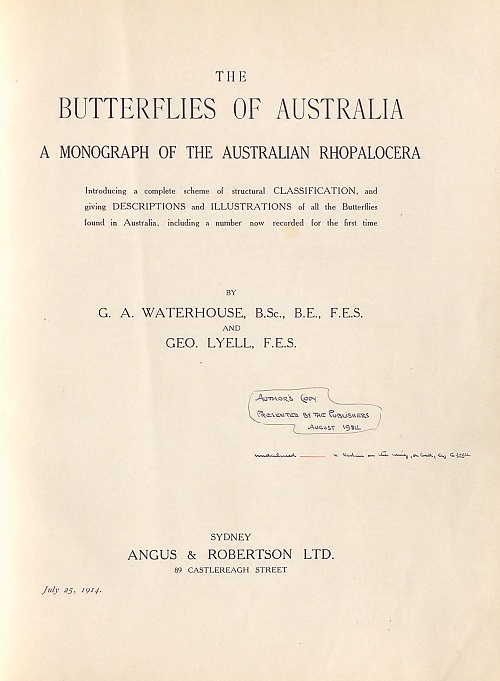
4. Inscription Lyell small.jpg

Image: This inscription on the title page indicates that this book belonged to author George Lyell. Source: Waterhouse, G. A & Lyell, G.. Butterflies of Australia. 1914. Contributed in BHL from Museums Victoria.
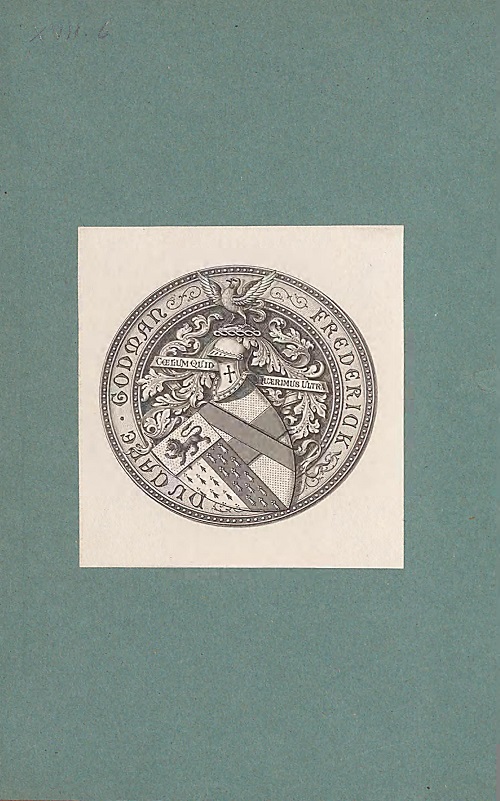
5. Bookplate Ducane Godman small.jpg

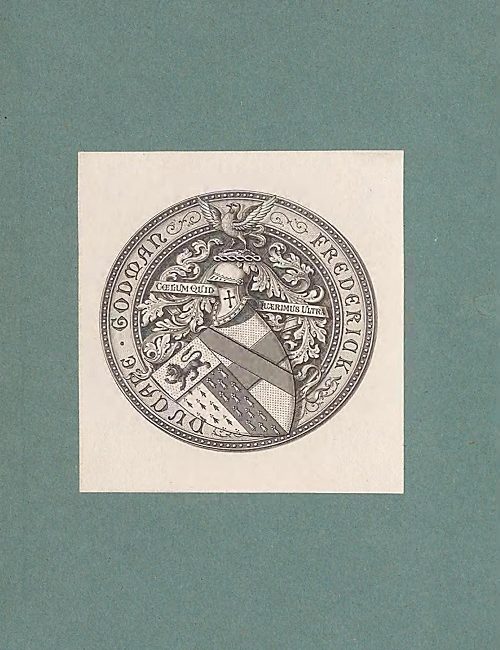
Image: Bookplate of naturalist Frederick Ducane Godman, co-author of Biologia Centrali-Americana with Osbert Salvin. Source: Salvin, Osbert. [Collected articles from The Ibis on the ornithology of Central America]. 1859-1864. Contributed in BHL from Museums Victoria.
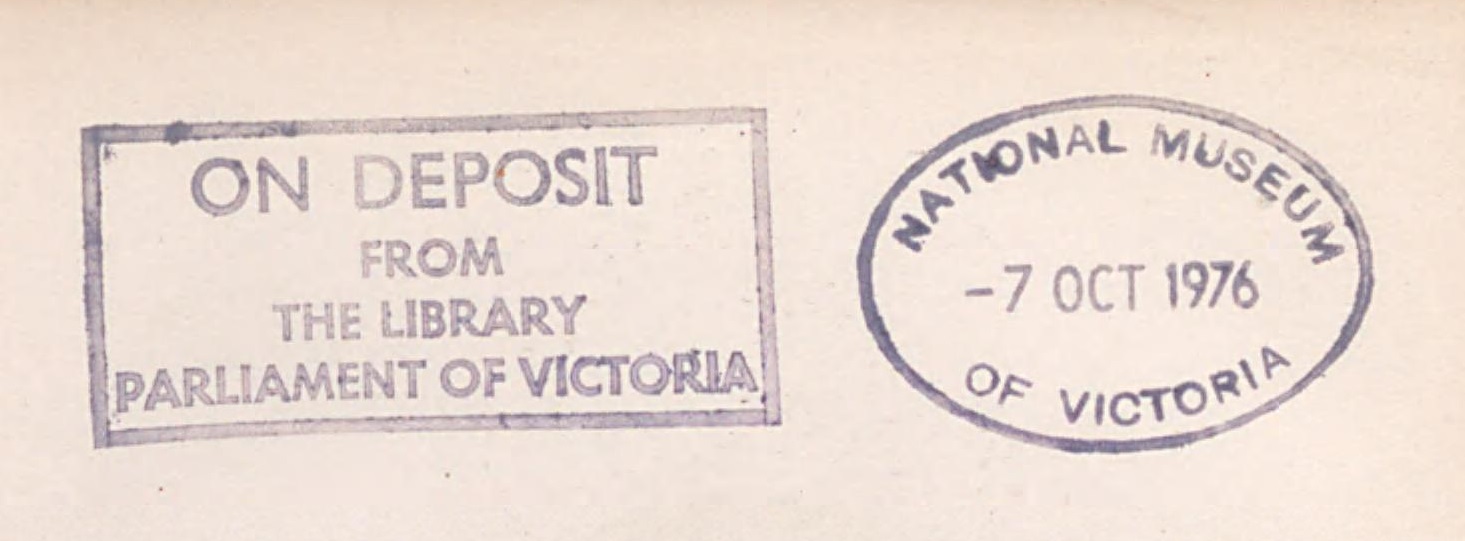
6. Library stamps Antarctica crop.jpg

Image: These library stamps demonstrate the transfer of this item between institutions. The Museums Victoria Library has received two significant donations of material from the Parliamentary Library of Victoria in its history. Source: Elisha Kent Kane. Arctic explorations : the second Grinnell Expedition in search of Sir John Franklin, 1853, ’54, ’55. Volume 1. 1856. Contributed in BHL from Museums Victoria.

Institutional or library markings may direct you to relevant archival materials.
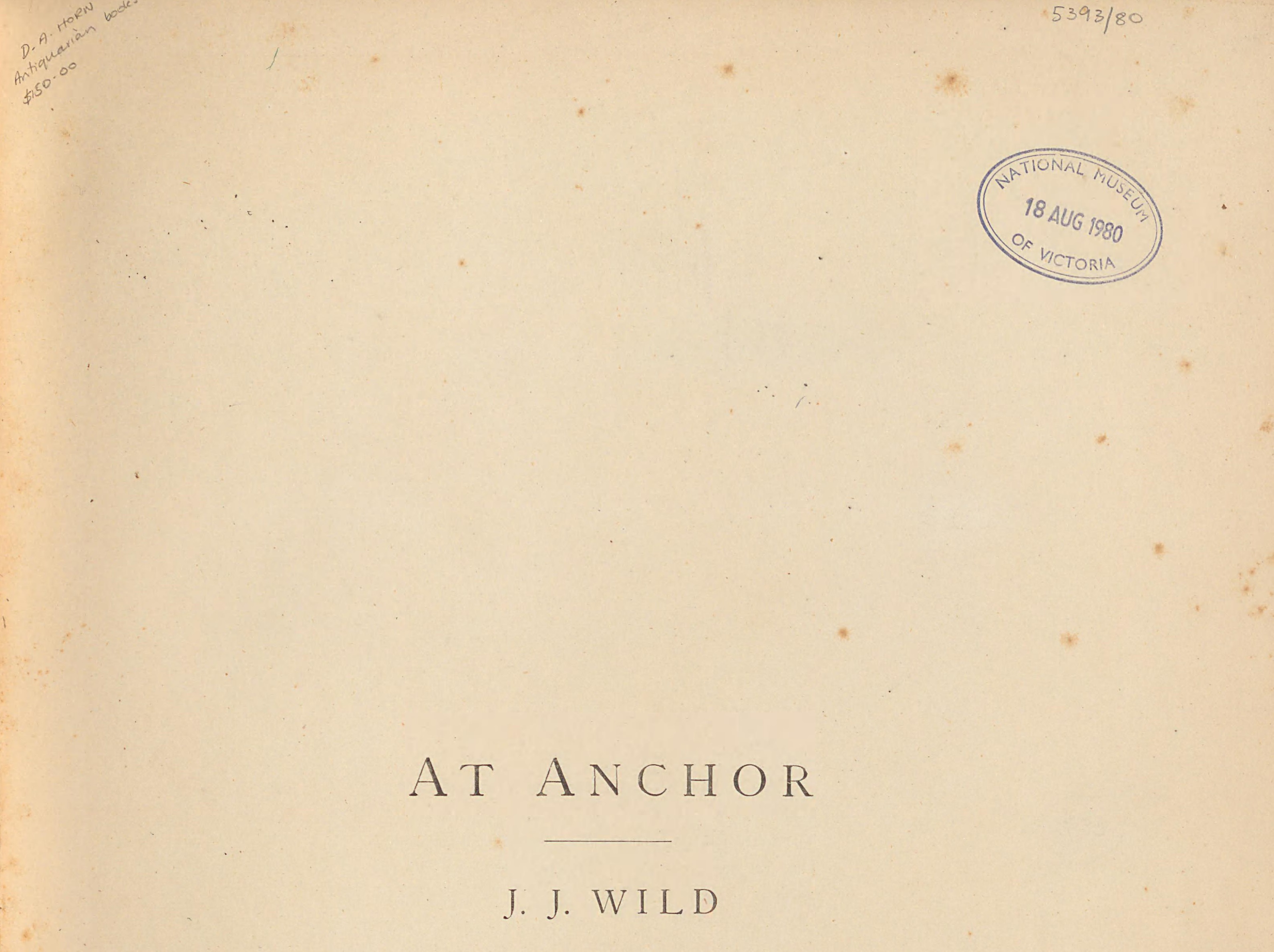
7. Archival References JJ Wild crop.jpg

Image: Pencil notes in the top right-hand corner of this page indicate that this book was for sale by D. A. Horn Antiquarian Books for $50. The top left-hand numbers are an acquisition number that would allow us to trace the purchase in our archives. Source: Wild, John James. At anchor : a narrative of experiences afloat and ashore during the voyage of H.M.S. Challenger, from 1872 to 1876. 1878. Contributed in BHL from Museums Victoria.

Be particularly attentive to any dates as these should help narrow the date range for further archival research.

2. Consult catalogue records

If you are working with a library book, the catalogue record will be an indispensable resource for bibliographic details, and may contain additional contributor, production or provenance information. Comparing your local catalogue record to other library records will allow you to compare basic details of your copy with others to verify the completeness of your item. Trove and Worldcat are useful for locating library catalogue records and identifying how many copies remain in public collections in Australia or worldwide. It is often difficult to establish the number of extant copies with any certainty unless a census has been conducted (such as this one of the Aurora Australis.)

Auction catalogue records are useful as they normally provide a physical description, brief biography of the author, list any known contributors, and highlight points of significance. The price estimate can be helpful too! Some auction houses make their catalogue records freely available online, so you will be able to find them through an internet search. Otherwise, try consulting your public or institutional library to see if they can help you locate relevant resources.

3. Locate digitised versions

Sometimes it can be useful to consult a digitised version of the book, such as may be found in online repositories like the Biodiversity Heritage Library. This level of detailed research may be needed if you suspect the copy is incomplete, or to compare variations in hand-colouring or binding.
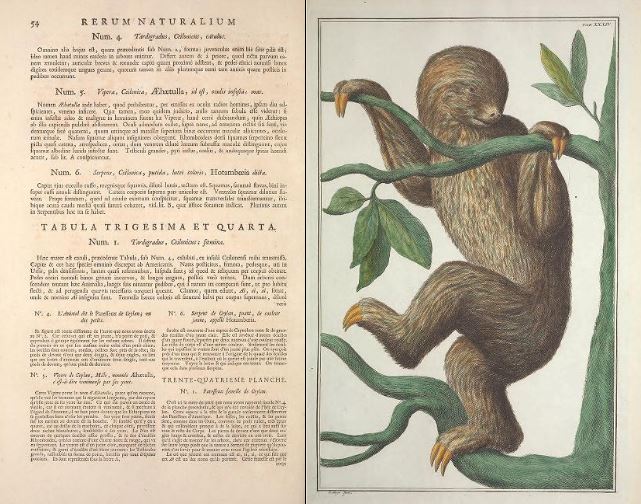
9. Seba Smithsonian.JPG

Image: By comparing our copy of Albertus Seba’s Thesaurus with a Smithsonian copy, I was able to establish that our copy is bound differently; two volumes of plates and two volumes of text, rather than the usual four volumes with plates interleaved throughout. Source: Seba, Albertus. Locupletissimi rerum naturalium thesauri accurata descriptio. Volume 1. 1734-1765. Contributed in BHL from Smithsonian Libraries.

4. Consult secondary references

Verify the information you have compiled by consulting relevant secondary sources. Rare books are described using specific terminology that you may not be familiar with, so it can be helpful to utilise a glossary such as this one from the International League of Antiquarian Booksellers.

Become familiar with standard references in your subject area and region. For instance, in Australia biographical information is readily accessible through the Australian Dictionary of Biography. The Bibliography of Australia by John Alexander Ferguson provides a list of Australian publications, and similar titles document publications in other regions.

Subject-specific bibliographies may also be of use. For instance, in my library I have consulted Antarctica, 1772-1922 : freestanding publications through 1999, Natural science books in English, 1600-1900 and Bibliography of Australian entomology, 1775-1930 : with bibliographical notes on authors and collectors when undertaking rare book research. These types of references can help outline significance and sometimes provide additional information on contributors, editions, or production methods.

If the book or author you are researching is well-known, there will be an array of books, journal articles and websites that provide biographical and contributor information, methods of production, and significance. For instance, recent secondary material on John Gould tends to emphasise the important role of his wife Elizabeth in more detail than is readily apparent from acknowledgements on the works themselves. Secondary sources also suggest that while John Gould certainly had input into the illustrations that adorn his publications, he would not have been the one to transfer the drawing to the lithographic stone.

However, if the book or author is more obscure, this can present a greater challenge. This is a good opportunity to utilise the reference services offered by your local or institutional library!

5. Remember the wider context

In my role as a librarian, I undertake rare book research on items in our collection as required, and therefore my research tends to be object-oriented. While this guide aims to assist this type of research, it is important to be aware of the broader social and historical context that a book was produced in and to consider how this might affect your interpretation (a much bigger topic than I can cover here!).

This guide outlines a basic approach to rare book research and is based on my professional experience. It is most applicable to rare printed materials such as you will find in BHL. If a more detailed approach appeals, the study of bibliography offers techniques for analysing and describing rare books at a more technical level.

Further Reading

Antiquarian Booksellers’ Association of America, ABAA Glossary. Retrieved from https://www.abaa.org/glossary

Carter, John (1980) ABC for book collectors, 6th ed., London & New York, Granada.

Gascoigne, Bamber (2004) How to identify prints : a complete guide to manual and mechanical processes from woodcut to inkjet, London, Thames & Hudson.

International League of Antiquarian Booksellers, ILAB Glossary. Retrieved from https://ilab.org/glossary

Melby, Julie (2009) Printmaker’s abbreviations, Princeton University Library Blog, Retrieved from https://www.princeton.edu/~graphicarts/2009/02/printmakers_abbreviations.html

Pearson, David (2019) Provenance research in book history : a handbook, 2nd ed. London & New Castle, Delaware, Bodleian Library & Oak Knoll.

Russell, Roslyn and Winkworth, Kylie (2009) Significance 2.0 : a guide to assessing the significance of collections, Rundle Mall, South Australia, Collections Council of Australia, https://www.arts.gov.au/what-we-do/museums-libraries-and-galleries/significance-20

Webster, Hayley (2019) Provenance and Library Stamps at Museums Victoria and on BHL, BHL blog, Retrieved from https://blog.biodiversitylibrary.org/2019/10/provenance-and-library-stamps.html#more-23080

November 26, 2019by michelle.underhill
Blog Reel, Featured Books, User Stories

Provenance and Library Stamps at Museums Victoria and on BHL

On the BHL blog, we often focus on the extensive biodiversity information made available through BHL and the innovative ways scientists are using the vast quantities of historical biodiversity data in BHL to conduct contemporary research. BHL is also useful for a range of non-scientific research, however, and is used by researchers in the arts and humanities as well as the sciences. Artists draw on the illustrations for inspiration, while humanities scholars use the digitised collections for historical research.

For librarians and book historians, BHL contains a wealth of provenance information, as well as the material to conduct comparative research. As a librarian in charge of a rare book collection specialising in natural history, I often use BHL to check if our copy of an item is complete, bound in the usual manner, or coloured in the same way as other copies.

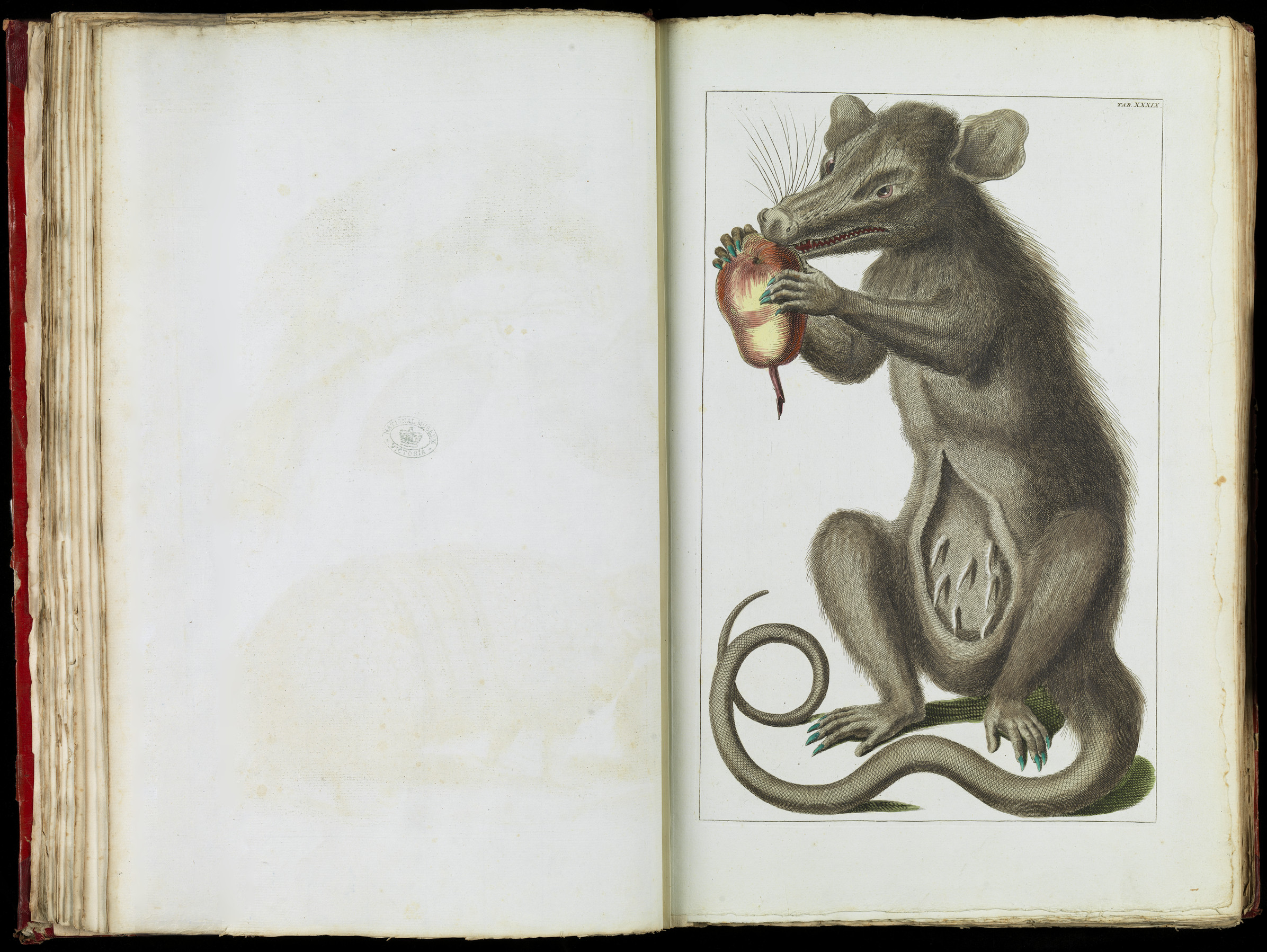
A good example of this is Museums Victoria’s copy of Albertus Seba’s Locupletissimi rerum naturalium thesauri accurata descriptio (commonly referred to in English as his Thesaurus). Museums Victoria holds the only copies of Seba’s Thesaurus in Australian libraries; however, using the Biodiversity Heritage Library I have been able to compare our copy with copies around the world in libraries that I would be unlikely to visit. I have been able to identify that our copy is bound differently to the norm, with plates and text in separate volumes — presumably at the request of a previous owner. I was also able to deduce that the unusual teal nails on the opossum are intentional — we had thought it a quirk of hand-colouring! However, all coloured copies on BHL show the opossum sporting a teal mani pedi (fig. 1).

000080372c-39.jpg

Fig. 1. Tab XXXIX. Seba, Albertus. Locupletissimi rerum naturalium thesauri accurata descriptio. Plates to Volumes 1 & 2. 1734-1765. Digitized in BHL by Museums Victoria.

Lately, I have used our digitised items in conjunction with our Rare Book Collection to look at provenance and acquisition information in our collection. This was inspired by a fantastic course in “Provenance in Books” as part of London Rare Book School last year. Our instructor, David Pearson, took us through various aspects of provenance information in books, including bookplates, bindings, inscriptions, and annotations. Working in an institutional library, one of the things I was most interested in was different forms of library acquisition and provenance information. David told us of a project at the British Library to develop a research guide detailing the different stamps used across the institution’s history to assist in identifying when items had been acquired. I set out to develop something similar for our institution, and here is a sample of the work I have done so far, focusing primarily on one of our predecessor institutions, the National Museum of Victoria.

The National Museum of Victoria was established in the 1850s, and the library collection has been developed since its foundation. Accessioning practices have changed over the 160-plus year history of the library. The most consistent practice appears to have been to mark or apply stamps to the title page, or first few flyleaves, of a book. The stamps that appear on these pages are therefore usually the most reliable for dating an acquisition or to assist in narrowing a date range for archival research.

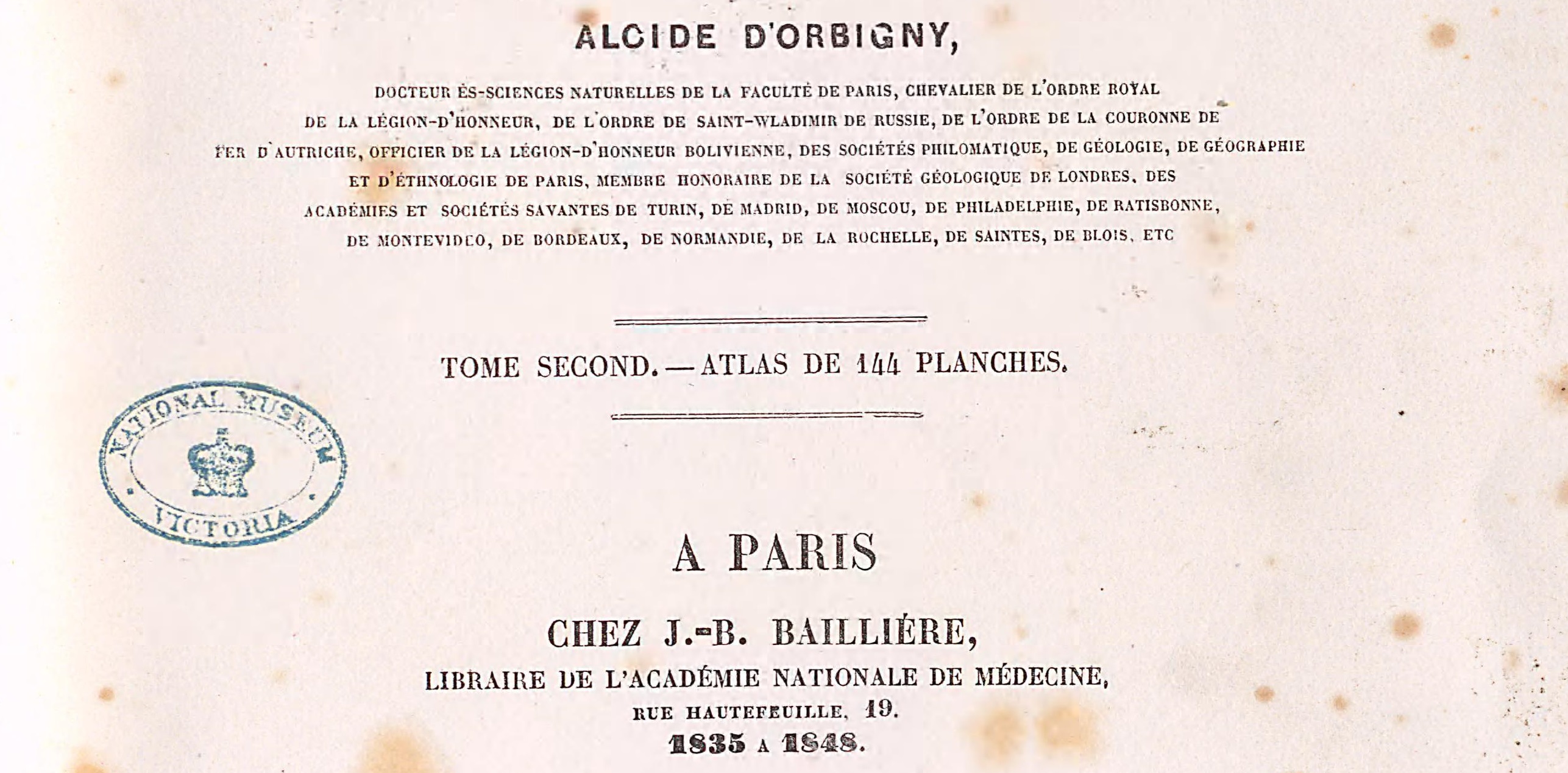
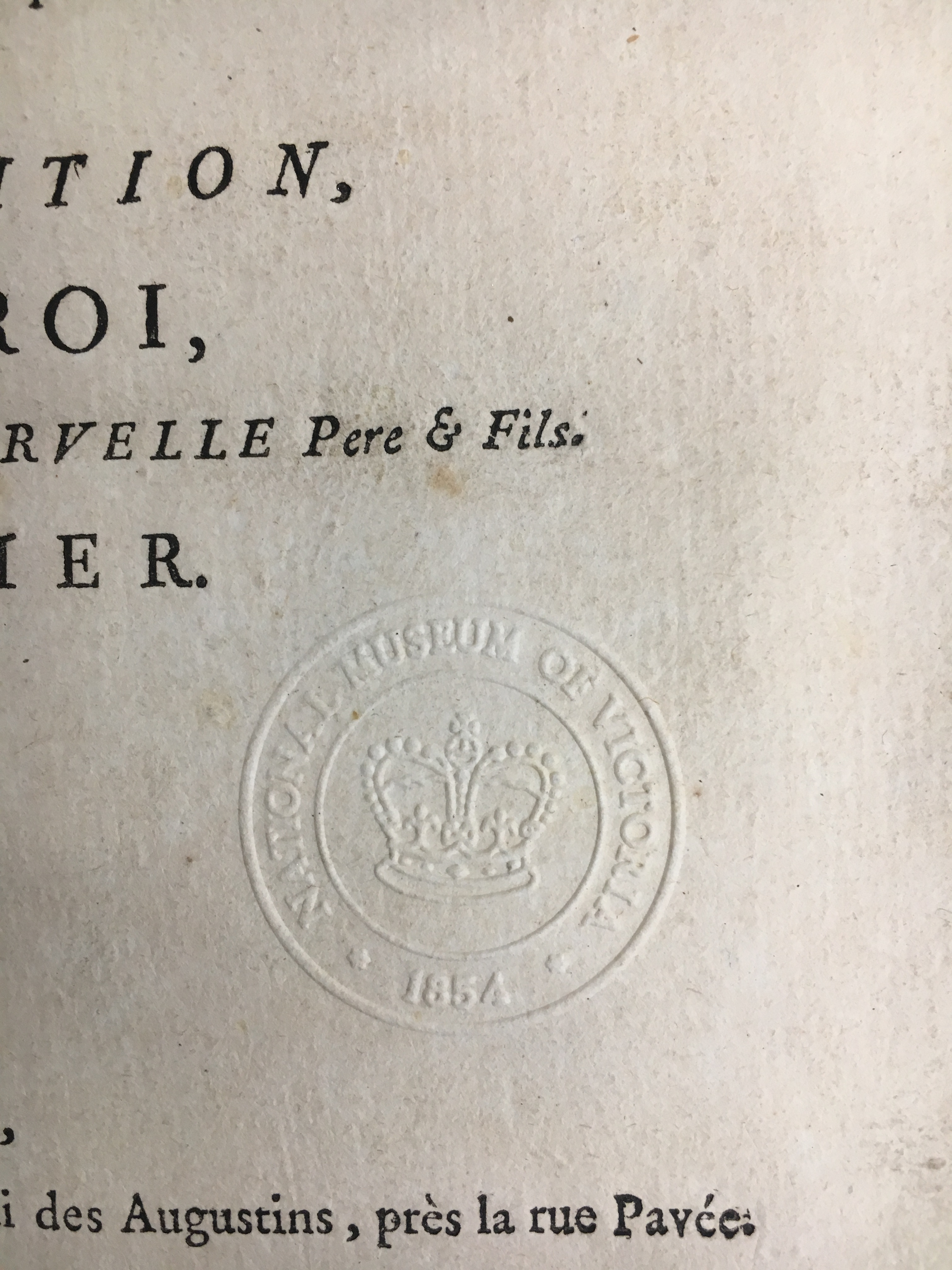
The information available in each library book varies. A book may include all or none of the following: accession number, date of acquisition, library stamp, inscription or bookplate of a previous owner. Books purchased between 1854 and the end of the nineteenth century are the least likely to carry acquisition information; many only bear a stamp, as shown below (fig. 2).

D'orbigny tp stamp.jpg

Fig. 2. Title page of Museums Victoria’s copy of Histoire naturelle : generale et particuliere des cephalopodes acetabuliferes vivants et fossils by Ferussac and d’Orbigny (Volume 2. 1835-1848) with National Museum Victoria stamp.

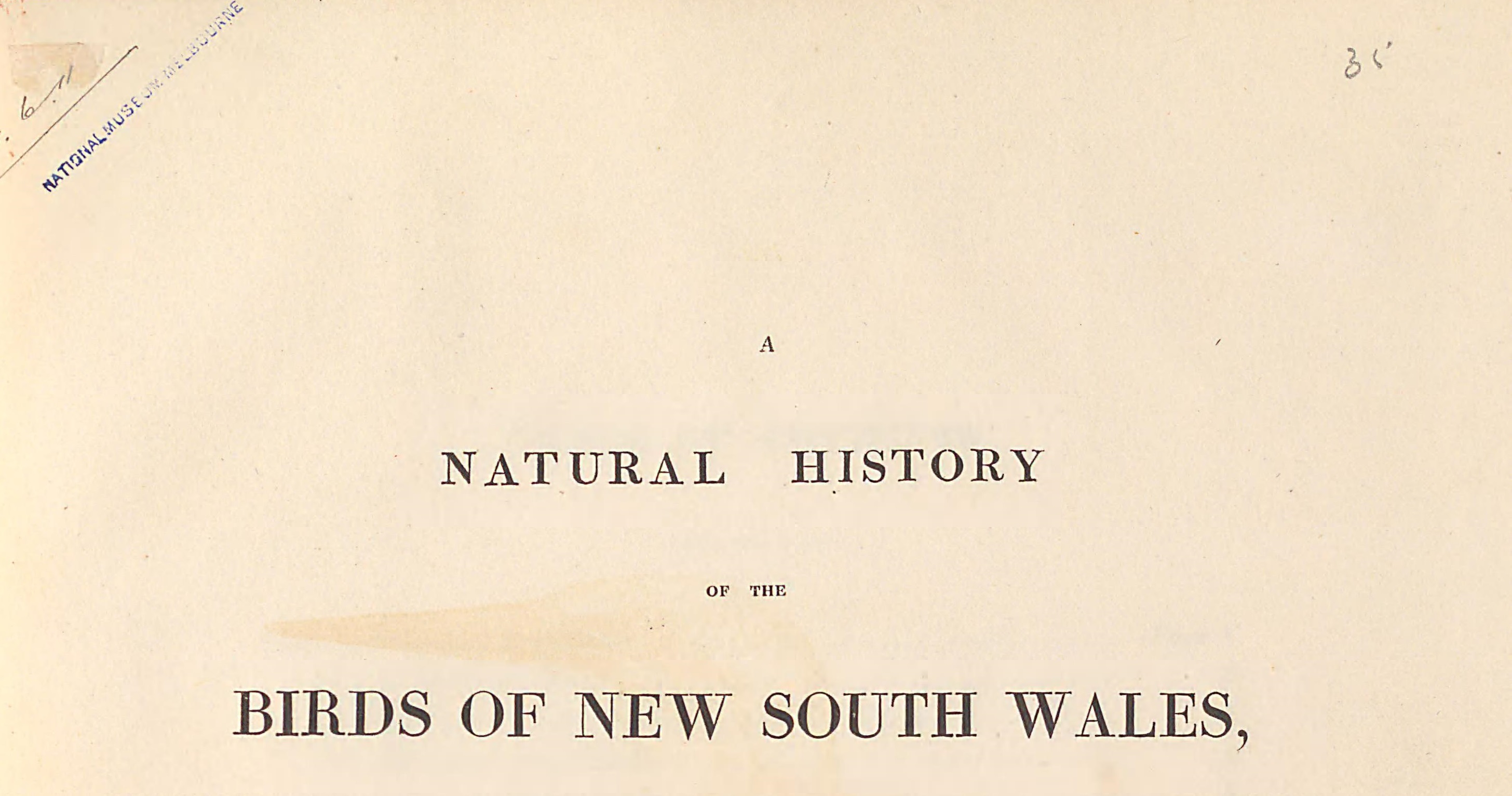
The practice from around 1900 seems to have been to write the accession date on the top left corner of the title page or the abbreviations ‘Entd.’ Or ‘E’ (fig. 3).

lewin tp stamp.jpg

Fig. 3. Title page of Museums Victoria’s copy of A natural history of the birds of New South Wales (3rd ed. 1822) by John Lewin. Unfortunately, Museums Victoria doesn’t hold a first edition of this work, however we have digitised the 3rd (1822) and 4th editions (1838) for everyone to enjoy!

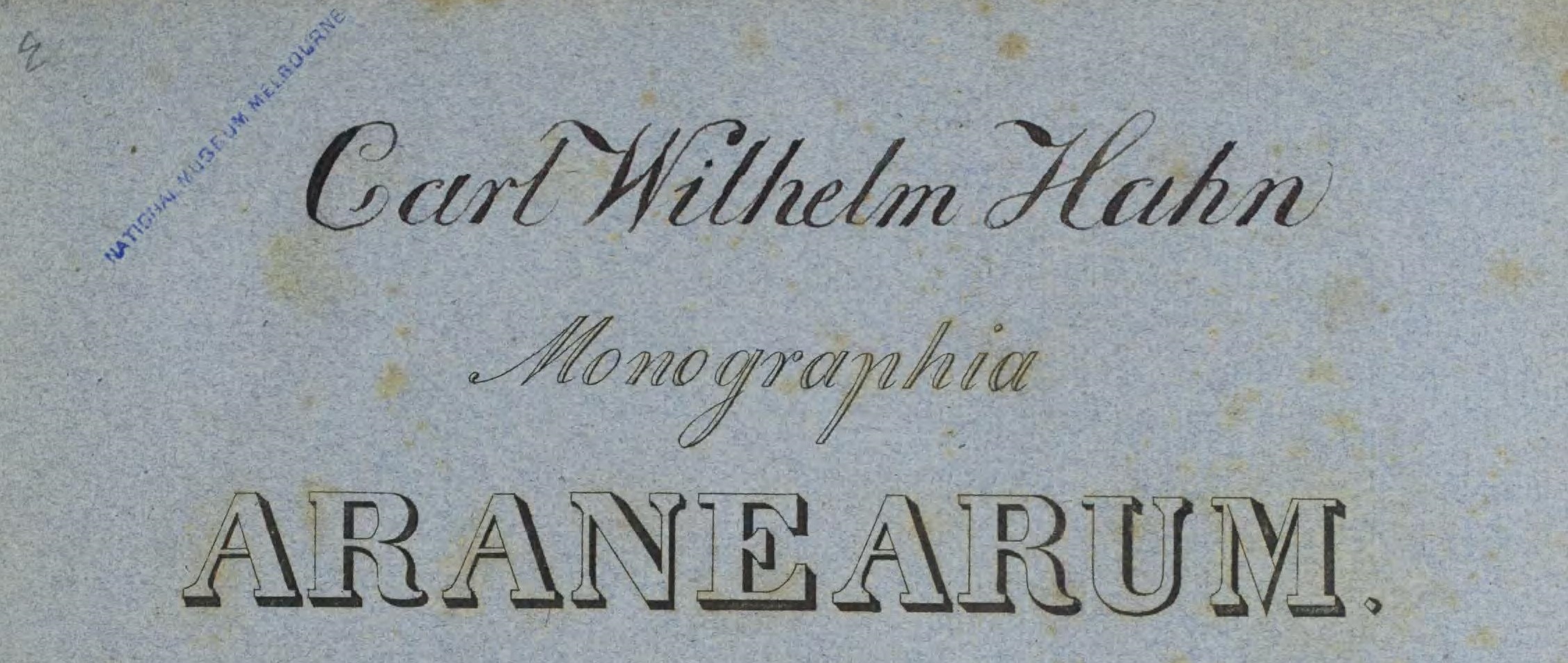
The National Museum Melbourne stamp appears to have been used from around 1900 to 1930 (fig. 4).

Hahn tp stamp.jpg

Fig. 4. Title page of Museums Victoria’s copy of Monographia Aranearum (or Monographie der Spinnen in German) (1820-1836) by Carl Wilhelm Hahn with National Museum Melbourne stamp. This title is very rare, with only 13 complete copies recorded in Peter Sacher’s census in 1988.[1]

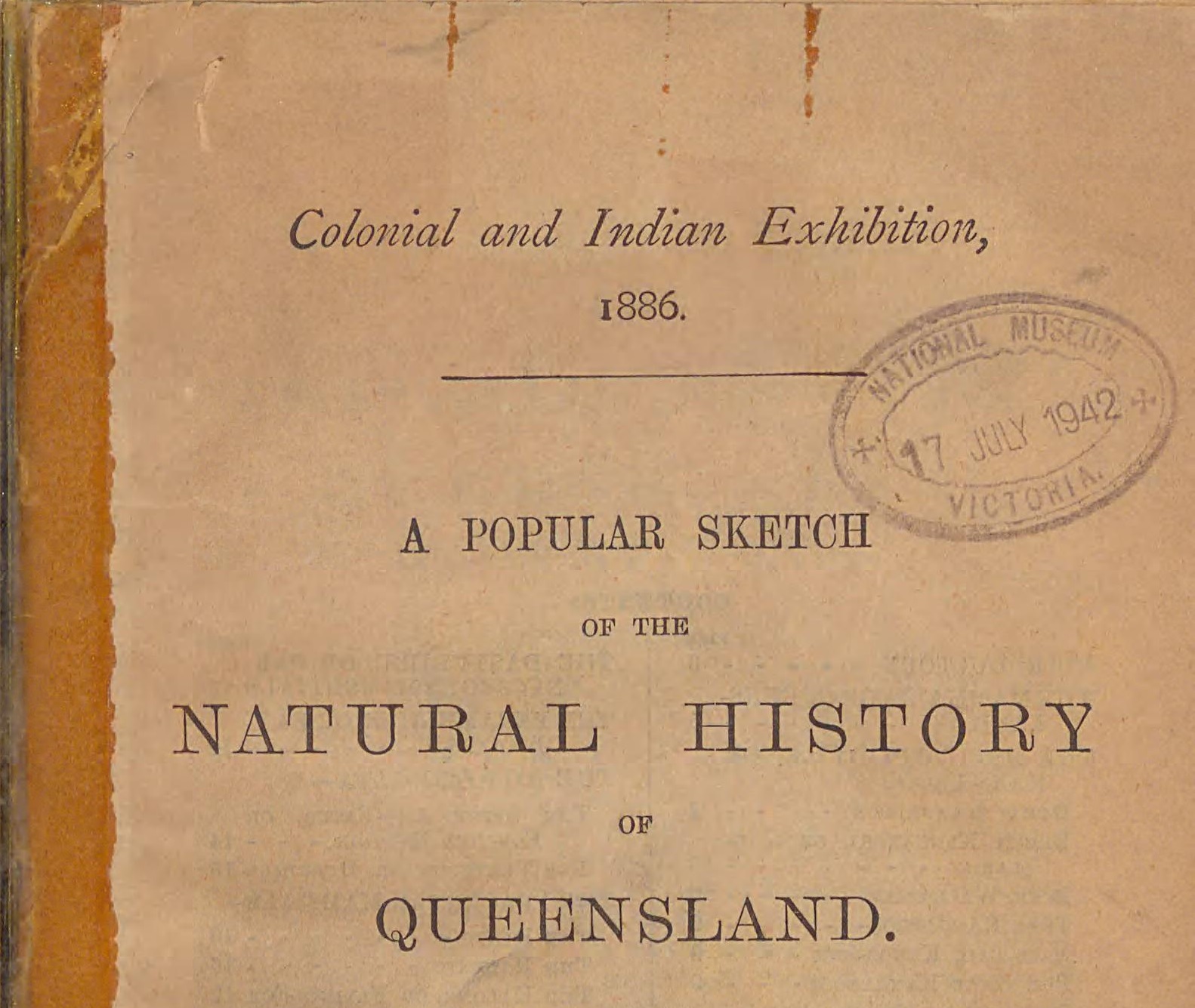
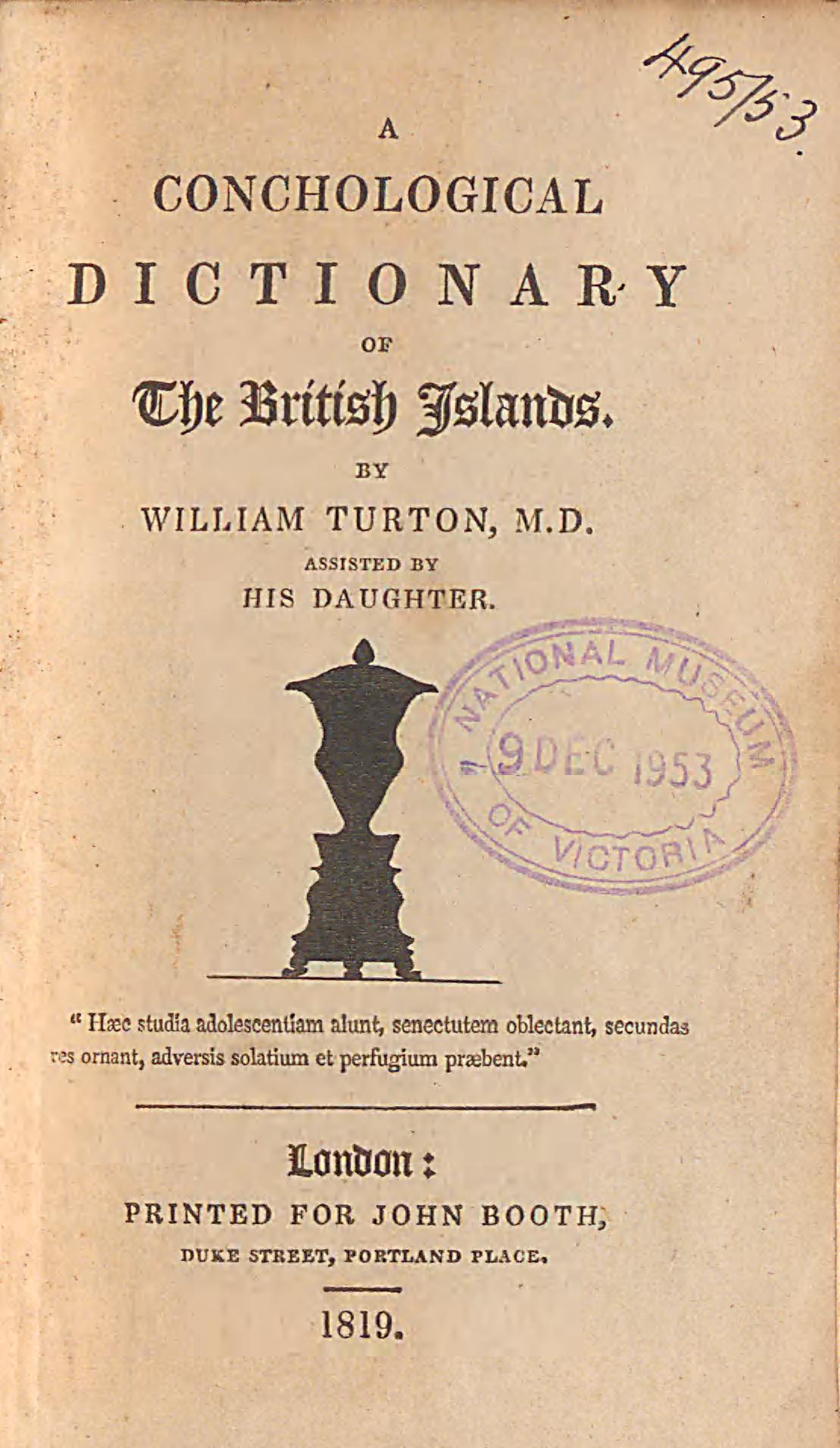
From the 1930s to late 1970s, dated stamps such as the examples below were in use, making purchases in this period very easy to date (figs. 5 & 6).

Fletcher tp stamp.jpg

Fig. 5. Museums Victoria’s copy of A popular sketch of the natural history of Queensland (1886) by Price Fletcher with dated stamp. With a specific date available, this acquisition would be easy to trace in our archives.

Turton tp.jpg

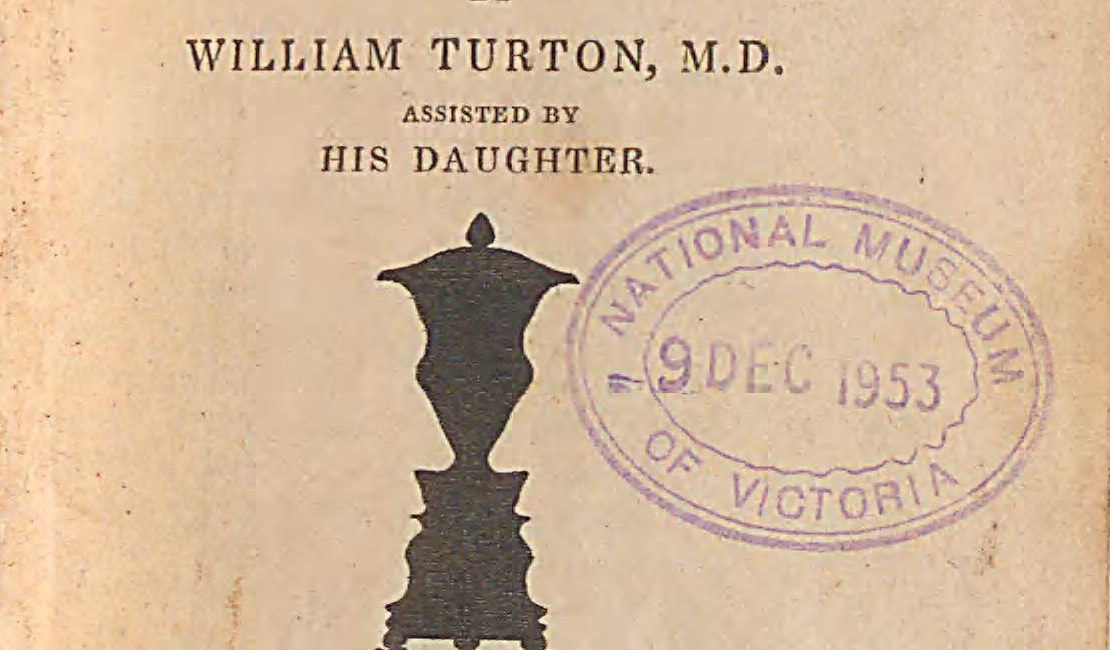
Fig. 6. Title page of Museums Victoria’s copy of William Turton’s A conchological dictionary of the British Islands (1819) with dated stamp. The acquisition number in the top right-hand corner makes this title even easier than the last example to trace in our archives. Keep looking through this item and you will spy some lovely additional illustrations added in the margins by a former owner.

While dated stamps continued to be used after the 1970s, a blind stamp was used for items that were being directly entered into the Rare Book Collection between the late 1970s and early 2000s (fig. 7).

Example of a blind stamp from Museums Victoria

Fig. 7. This blind stamp would have been considered less intrusive, while still clearly indicating ownership.

This is representative of a shift in library practice towards the designation and separate management of rare book collections. By the late 1970s, the Museums Victoria Library was housing its rare books separately from the general collection.

recent stamp crop.jpg

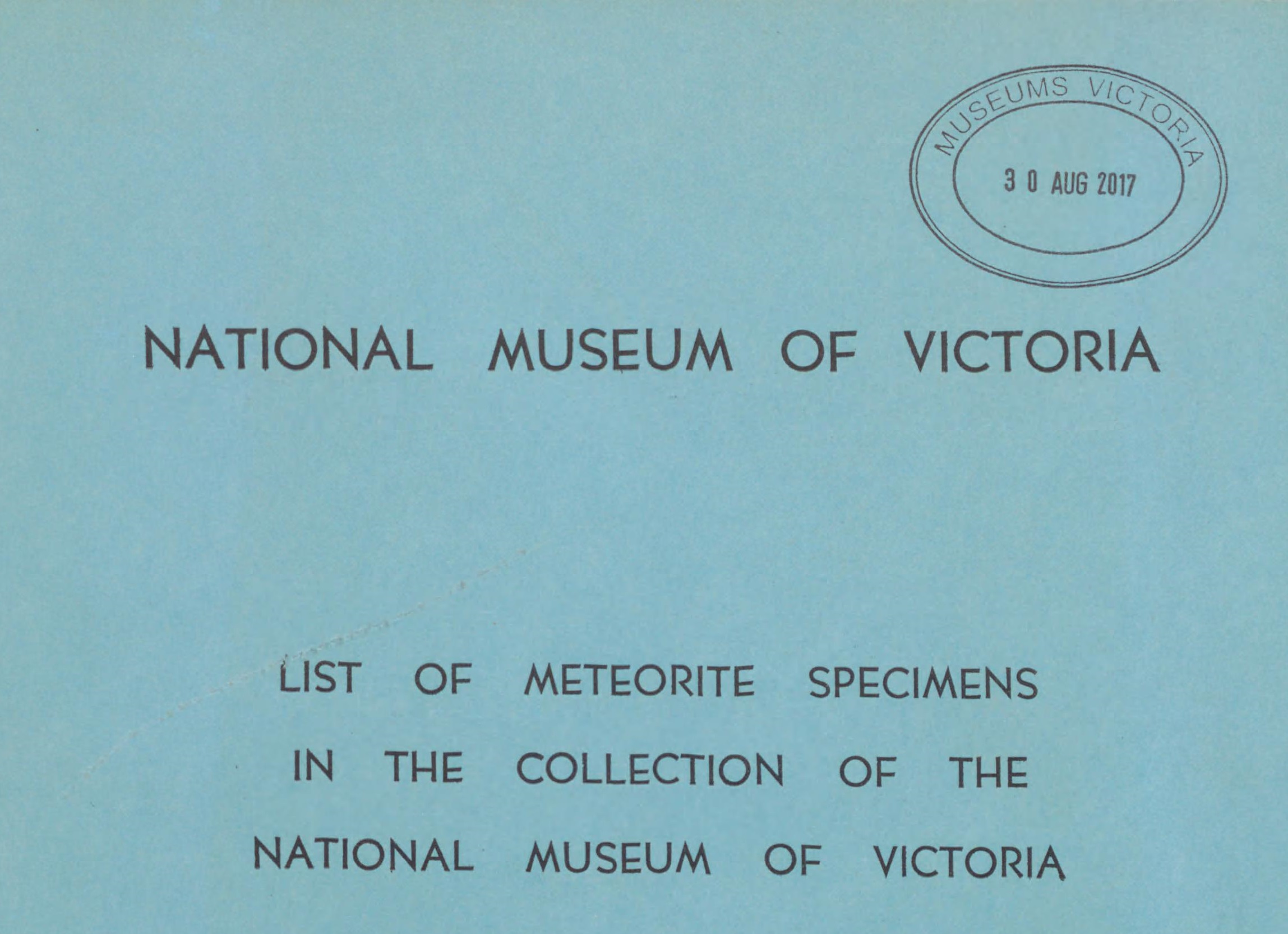
Fig. 8. A recent example of a dated stamp from 2017. National Museum of Victoria. List of meteorite specimens in the collection of the National Museum of Victoria, September 1972. 1972. Digitized in BHL by Museums Victoria.

Archival research is usually needed to confirm the date of acquisition. Items frequently bear multiple stamps, which may have been applied after accessioning. It appears that stamps were applied to the verso of plates retrospectively, while items may also have been routinely stamped if they were rebound.

While the stamps can be a bit confusing at times, having a general understating of them can help refine a date range for archival research. It also allows me to give a quick answer to a question often asked by tour groups — how long has this item been in your collection?

References

[1] Sacher, Peter 1988 ‘Commentary’ in Hahn, Carl Wilhelm, Monographie der spinnen (1820-1836), Leipzig, Zentralantiquariat der DDR.

Further Reading

Guide to researching provenance of books now in the British Library

Northcote Library – Stamps & Stickers

Daley, Jason. Bonn Library Recovers More Than 600 Books Looted After World War II, Smithsonian Magazine. April 15, 2019.

McGrane, Sally. What became of the Jewish books? New Yorker. February 28, 2014.

October 3, 2019by Joel Richard

Help Support BHL

BHL's existence depends on the financial support of its patrons. Help us keep this free resource alive!

search

About BHL

The Biodiversity Heritage Library (BHL) is the world’s largest open access digital library for biodiversity literature and archives. BHL operates as a worldwide consortium of natural history, botanical, research, and national libraries working together to digitize the natural history literature held in their collections and make it freely available for open access as part of a global “biodiversity community.”

Join Our Mailing List

Sign up to receive the latest news, content highlights, and promotions.

Subscribe Now

Subscribe to Blog via Email

Enter your email address to subscribe to this blog and receive notifications of new posts by email.

Join 319 other subscribers

Subscribe to Blog Via RSS

Subscribe to the blog RSS feed to stay up-to-date on all the latest BHL posts.

Access RSS Feed

Inspiring Discovery through Free Access to Biodiversity Knowledge.

The Biodiversity Heritage Library makes it easier than ever for you to access the information you need to study and explore life on Earth…for free, anytime, anywhere.


64+ Million Pages of
Biodiversity Literature Online.

EXPLORE

Tools and Services
to Transform Research.

EXPLORE

300,000+
Illustrations on Flickr.

EXPLORE

ABOUT | HARMFUL CONTENT | PRIVACY | SITE MAP | TERMS OF USE