Biodiversity Heritage Library - Program news and collection highlights from BHL
  • Home
  • News
  • Featured Books
    • All Featured Books
    • Book of the Month Series
    • BHL at 20
  • User Stories
  • Campaigns
    • Fossil Stories
    • Garden Stories
    • Monsters Are Real
    • Page Frights
    • Her Natural History
    • Earth Optimism 2020
  • Tech Blog
  • Visit BHL
Home
News
Featured Books
    All Featured Books
    Book of the Month Series
    BHL at 20
User Stories
Campaigns
    Fossil Stories
    Garden Stories
    Monsters Are Real
    Page Frights
    Her Natural History
    Earth Optimism 2020
Tech Blog
Visit BHL
  • Home
  • News
  • Featured Books
    • All Featured Books
    • Book of the Month Series
    • BHL at 20
  • User Stories
  • Campaigns
    • Fossil Stories
    • Garden Stories
    • Monsters Are Real
    • Page Frights
    • Her Natural History
    • Earth Optimism 2020
  • Tech Blog
  • Visit BHL
Biodiversity Heritage Library - Program news and collection highlights from BHL
Blog Reel, Campaigns, Featured Books, Monsters Are Real

The Beautiful Monster: Mermaids

In 1492, Christopher Columbus sailed out from Spain with a mission to find a western trade route to Asia. Instead, he found a whole “New World”…and something altogether more mysterious.

On January 9, 1493, near the Dominican Republic, Columbus spotted three “mermaids.” How did he describe them? “They are not as beautiful as they are painted, since in some ways they have a face like a man” (History.com).

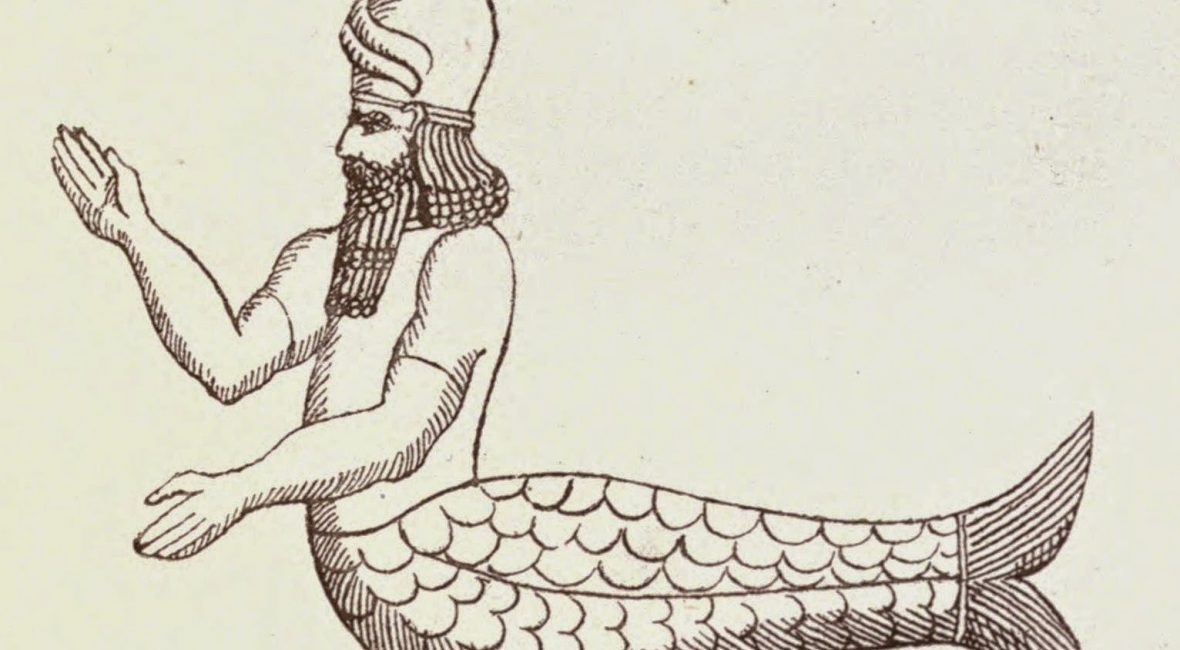
The myth of a marine human extends as far back as 5,000 BCE, when the Babylonians worshipped a fish-tailed god named Oannes. John Ashton, author of Curious Creatures in Zoology, proposes that this is the first depiction of a merman. Also in classical antiquity, the goddess Atargatis, chief goddess of northern Syria, was depicted as a fish-bodied human, thus constituting the first known representation of a mermaid.

View Full Size Image
Ancient god Oannes, perhaps first representation of a merman. Ashton, John. Curious Creatures in Zoology. 1890. http://biodiversitylibrary.org/page/23574964.

By the Common Era, mermen and mermaids had made their way into the accepted zoological canon. Pliny the Elder, who lived in the first century CE and had quite a lot to contribute to the discussion of mythical beasts, asserted that mermaids were real. According to Philemon Hollands’s 1601 translation (1634 edition in BHL), Pliny stated,

“And as for the Mermaids called Nereides, it is no fabulous tale that goeth of them: for looke how painters draw them, so they are indeed: only their body is rough and scaled all over, even in those parts where they resemble a woman.”


View Full Size Image
Tritons, or Nereids, the merpeople of the Greeks and Romans. Ashton, John. Curious Creatures in Zoology. 1890. http://biodiversitylibrary.org/page/23574966.

In the centuries that followed, many people claimed to actually see mermaids. In 1608, during an expedition to discover the Northwest Passage, Henry Hudson claimed that several crewmembers spotted a mermaid. From the naval upwards, she was like a woman, with long, black hair, but she had a tail like a porpoise.

View Full Size Image
Mermaid of the type inhabiting the Dutch East Indies. Valentijn’s mermaid, after Fallours. Lee, Henry. Sea Fables Explained. 1883. http://biodiversitylibrary.org/page/10985600.

By the eighteenth century, many believed that mermaids inhabited the seas surrounding the Dutch East Indies. The official painter of the Dutch East India Company, Samuel Fallours, included a tantalizing mermaid within his 1718 drawing depicting the assortment of exotic biodiversity found around the islands. Francois Valentijn included a copy of Fallours’ mermaid in his publication on the East Indies, entitled Natural History of Amboina (1727). He claims that this “monster resembling a siren” was captured on the coast of Borneo.

Mermaid as Monster

Valentijn’s “monster” title alludes to the fact that merpeople were not always represented in a sensual light. Sometimes, they were just plain monsters. Within the 13th century Norwegian manuscript Konungs skuggsjá (linked: English translation by Laurence Larson), we read of the merman:

“The monster is tall and of great size and rises straight out of the water…It has shoulders like a man but no hands…No one has ever observed it closely enough to determine whether its body has scales like a fish or skin like a man. Whenever the monster has shown itself, men have always been sure that a storm would follow.”


View Full Size Image
Sea Satyr, or Sea Demon. Gessner, Conrad. Historia Animalium. 2nd Ed. 1604. http://biodiversitylibrary.org/page/42166652.

And of course, we can’t omit Conrad Gessner from our discussion. His 16th century book Historia Animalium depicts the Sea Satyr, also calling it a sea demon. According to John Ashton, Gessner “tries to pass it off as a veritable merman.” Gessner also claims that, on November 3, 1523, a man-fish, about the size of a five year old boy, was seen at Rome.

View Full Size Image
Man-fish, about the size of a boy, seen at Rome. Gessner, Conrad. Historia Animalium. 2nd Ed. 1604. http://biodiversitylibrary.org/page/42166072.

Two other curious, merman-esque monsters include the Monk and Bishop Fish. Gessner, and later others including Guillaume Rondelet, Ulisse Aldrovandi, and Gaspar Schott, portray these beasts, claiming that a Monk-fish was caught off Norway, in a troubled sea, and that the Bishop-fish was seen off the coast of Poland in 1531. Despite such observational reports, these monsters were likely a commentary on the religious tension of the day, resulting in an association between cleric figures and monsters.

View Full Size Image
Monk and Bishop Fish, as republished by Schott. Not all historians accepted the full veracity of these beasts. Guillaume Rondelet, who included a picture of the bishop fish in his 1554-55 book, stated, “I think that certain details beyond the truth of the matter have been added by the painter to make the thing seem more marvelous.” (Ellis, pg. 85). Schott, Gaspar. Physica Curiosa. 1662. http://biodiversitylibrary.org/page/41531037.


Mermaids Through Misidentification

If an exploration of historic monsters has taught us anything, it’s that most were not fabricated out of pure myth. Usually, they proceed from an attempt to categorize an unknown animal sighting.

Bernard Heuvelmans, considered the father of cryptozoology, studied the process by which unknown animals become monsters and monsters are identified as known animals. Of this transformation, he wrote, “The mythifying process can sometimes be carried to the point of altering its object beyond recognition” (Heuvelmans, 1990).

Case in point: The Manatee.

View Full Size Image
Manatees. Biologia Centrali-Americana. Mammalia. 1879-82. http://biodiversitylibrary.org/page/570882. Read a manatee dissection in this 1941 fieldbook by Edward Chapin from The Field Book Project.

As Heuvelmans explained,

“Since the manatee has pectoral mammae…and a body that tapers to a fishlike tail, it has always been identified, on both side of the Atlantic, with the fascinating mermaid, despite its (to our eyes) ugly face…” (Heuvelmans, 1990)

The three mermaids that Columbus spotted in 1493 (or sirens as he called them), were undoubtedly manatees. He, and many explorers after him, determined that these aquatic mammals were mermaids in flesh and blood. Sightings of dugongs, a member of the manatee’s order, have also been associated with mermaids throughout history. Indeed, the order containing manatees and dugongs to this day is called “Sirenia.”

View Full Size Image
Dugong and Manatee. Craig, Hugh. Johnson’s Household Book of Nature. 1880. http://biodiversitylibrary.org/page/39742211.

Manatees aren’t the only animals that have played the part of a mermaid. In the thirteenth century, a fisherman in Lake Constance, outside Bregenz, Austria, found a mermaid (Shadows in the Sea, 1963). He heard a voice call to him from the sea, saying, “Take my daughter and hang her in the Arch of Martinster. She is begat of a land woman and is of no use here.” He followed the voice’s command and hung the mermaid in the archway, after which it died in a contorted shape. The true identity of the creature? A shark, possibly a Porbeagle. The original mummified shark was replaced with a stone replica so that it could always stand guard over the city.

View Full Size Image
Bregenz Mermaid, actually a mummified shark. McCormick, Harold. Shadows in the Sea. 1963. http://biodiversitylibrary.org/page/10741173.

Of course, mistaking a manatee or a shark for a mermaid with breasts and flowing locks, which so many sailors vehemently claimed to have seen, seems impossible. It’s clear that some good old exaggeration (and blatant lies) contributed to the mermaid myth.

Mermaids Through Fabrication

The lies associated with the mermaid’s history are more tangible than exaggerating manatees as beautiful women. “Unlike most other monsters, which, almost by definition are very large” explains Richard Ellis in his book Monsters of the Sea, “’mermaids’ are small enough to tempt people to manufacture them.” (pg. 80). And that’s exactly what they did.

Mermaid Fabrication falls into two general categories: “Monkey” Mermaids and Jenny Hanivers.

View Full Size Image
“Monkey” Mermaid. Lee, Henry. Sea Fables Explained. 1883. http://biodiversitylibrary.org/page/10985610.

“Monkey” Mermaids made their way into western mermaid lore in the nineteenth century. Apparently manufactured in Japan, these twisted mermaid interpretations were created by combining a small monkey’s head and torso with a dehydrated fish. In the 1840s, P.T. Barnum made a fortune by exhibiting what he claimed, and successfully convinced many people, were the remains of a mermaid. Today it is famously known as the Feejee Mermaid.

View Full Size Image
Barnum’s Feejee Mermaid. Lee, Henry. Sea Fables Explained. 1883. http://biodiversitylibrary.org/page/10985611.

Over time the Jenny Haniver also came to be associated with mermaids. The first known illustration of a Jenny Haniver appears in Gessner’s Historia Animalium in the mid-1500s.

View Full Size Image
A ray, mutilated to look mermaid-esque. This image is the first known depiction of a Jenny Haniver-style specimen. Gessner, Conrad. Historia Animalium. 2nd Ed. 1604. http://biodiversitylibrary.org/page/42166434.

What exactly are these disturbing specimens? They are mutilated elasmobranchs – either a ray, skate, or guitarfish. The fins are cut so that they resemble wings, a string is tied around the “neck” area to give it a human appearance, and the tail is twisted into a suitable mermaid-esque form. The charade is then allowed to dry in the sun and varnished for preservation.

View Full Size Image
“basilicus ex raia,” another Jenny Haniver-style farce. These specimens were also sometimes associated with dragons. Aldrovandi, Ulisse. Serpentum, et draconum historiæ libri duo. 1640. http://biodiversitylibrary.org/page/41765368.

In the mid-1600s, Ulisse Aldrovandi published what he called a basilisk but which was created in the same fashion as Gessner’s Jenny Haniver. He includes a caption with his illustrations reading “basilicus ex raia,” indicating his awareness of the illegitimacy of the monster. Both Gessner and Aldrovandi classify these strange beasts as rays, but provide no further information.

View Full Size Image
Over time, rays mutilated to resemble human-fish hybrids came to be associated with mermaids under the term Jenny Hanivers. Ulisse Aldrovandi, who published this image in 1640, described it as “basilicus ex raia,” indicating an awareness of the illegitimacy of the creature. See more fantastic historic monsters come to life on the Smithsonian Libraries’ Tumblr. GIF created by Richard Naples (Smithsonian Libraries), based on Aldrovandi, Ulisse. Serpentum, et draconum historiæ libri duo. 1640. http://biodiversitylibrary.org/page/41765369.

Of course, by Gessner and Aldrovandi’s time, the term Jenny Haniver was not yet in use. The name does not appear in published form until 1928, when Gilbert Whitley wrote about these monsters in an Australian Museum Magazine article. The origin of the name is unknown, though it has been suggested that it is a derivative of ‘Anvers,’ the French name for Antwerp and a possible place of origin for the deception.

The Case for the Mermaid

So, does the mermaid exist? Obviously not in the form of a half man or woman, half fish, but, to quote Dr. Ellis in Monsters of the Sea, “The sirens are still with us, however, in the form of the manatees and dugongs. They may not have the sex appeal of their namesake, and they certainly are not as beautiful as the mermaid, but they differ from their historic and literary ancestors in one irrefutable respect: they exist.” (pg. 98).

  • Follow our blog and #bhlMonstersRreal on Twitter and Facebook all week to learn more about monsters and the animals that inspired them.
  • Browse historic illustrations of mermaids and the animals that inspired them in Flickr.
  • Browse the books that portray these historic monsters in BHL.
  • Carve a merman in your Halloween Pumpkin this year! Share your carvings with us on Facebook and Twitter!
  • See some of our favorite monsters come to life on the Smithsonian Libraries’ Tumblr!


Reference:

  • Ellis, Richard. Monsters of the Sea. New York: Alfred A. Knopp, Inc., 1994. Print.
  • Heuvelmans, Bernard. The Metamorphosis of Unknown Animals into Fabulous Beasts and of Fabulous Beasts into Known Animals. Cryptozoology 9 (1990) 1-12.
October 31, 2014by ulib-libraryjobs
Blog Reel, Featured Books

Book of the Week: Voyages to South America

Portrait version of the Biodiversity Heritage Library logo.

This week for our book of the week, we feature a title that Charles Darwin himself called “one of the great monuments of science in the 19th century.” The book? Voyage dans l’Amérique Méridionale(1835-47), by Alcide Dessalines d’Orbigny. The work chronicles d’Orbigny’s travels to South America for the Paris Museum from 1826-1833. As a result of this voyage, d’Orbigny returned to Paris with more than 10,000 natural history specimens.

Alcide d’Orbigny was a French naturalist born in 1802 that studied a variety of fields including zoology, paleontology, geology, archaeology, and anthropology. He was born to a ship’s physician and naturalist, which made his choice of occupation a natural one. When his family moved to La Rochelle in 1820, d’Orbigny’s interest in natural history was nourished as he began to study the marine fauna in that area. Shortly thereafter he moved to Paris, where he closely studied the work of Georges Cuvier.

d’Orbigny’s mission to South America included visits to Brazil, Argentina, Paraguay, Chile, Bolivia, and Peru. d’Orbigny described some of the 10,000 specimens he collected in our book of the week, Voyage dans l’Amérique Méridionale, which was published in 90 fascicles. As mentioned, Darwin highly praised the work, and d’Orbigny even named select species after him. For instance, the common name of Rhea pennata is Darwin’s Rhea.

After 1840, d’Orbigny focused his attention on fossils, publishing two important titles on the subject between 1840 and 1850. In 1853, he became a professor of paleontology at the Muséum National d’Histoire Naturelle in Paris. The position of Chair of Paleontology was created especially for him, and his geological timescales and strata are still used today as chronostratigraphic reference.

For our post, we’re featuring some of the species that d’Orbigny described as a result of his voyage to South America, particularly those contained in v.9 of the title. You can see all of the images from this volume on our Flickr site, and be sure to check out a few of the other volumes from the title that we have in BHL.

View Full Size ImageGeoffroy’s Cat Leopardus geoffroyi: A wild cat found in Southern and Central South America that is about the size of a domestic house cat. While fairly abundant, issues over land-use changes in its habitat, as well as intense international fur trade in the 1960s-80s, results in this species being listed as “Near Threatened” by the IUCN.

View Full Size ImageXantho planus: A crab species of the family Xanthidae, the largest crab family in terms of species richness, with 572 species and 133 genera. Species of Xanthidae are commonly called mud crabs, pebble crabs or rubble crabs. They are poisonous, containing a toxin, similar to that produced by puffer fish, for which there is no antidote and which is not destroyed by cooking.

View Full Size ImagePorcupine River Stingray Potamotrygon hystrix: This species is found within marshy, freshwater zones of the Paraná-Paraguay River basin. When it remains perfectly immobile, partially covered by sand, and exercising homochromy (a process of protective coloration that allows the animal to blend into its environment), this species is practically undetectable to the eye. Its tail contains 1 or more spines, which are covered in a toxic mucus that inflicts painful wounds.


View Full Size ImageBlue-banded Toucanet Aulacorhynchus coeruleicinctis – Top Figure: This species of Toucanet lives in Bolivia and Peru. Members of the Toucan family, Toucanets are near-passerine or high land-birds, meaning that they are arboreal birds believed to be related to true passerines. Passerines, which are of the order Passeriformes, include more than half of all bird species, with over 5,000 identified species. This is approximately twice as many species as that contained in the largest mammal order, Rodentia, and, with over 110 families, it has the second most families of any order of vertebrates, after Perciformes (bony fish).

November 3, 2011by michelle.underhill

Help Support BHL

BHL's existence depends on the financial support of its patrons. Help us keep this free resource alive!

search

About BHL

The Biodiversity Heritage Library (BHL) is the world’s largest open access digital library for biodiversity literature and archives. BHL operates as a worldwide consortium of natural history, botanical, research, and national libraries working together to digitize the natural history literature held in their collections and make it freely available for open access as part of a global “biodiversity community.”

Join Our Mailing List

Sign up to receive the latest news, content highlights, and promotions.

Subscribe Now

Subscribe to Blog via Email

Enter your email address to subscribe to this blog and receive notifications of new posts by email.

Join 319 other subscribers

Subscribe to Blog Via RSS

Subscribe to the blog RSS feed to stay up-to-date on all the latest BHL posts.

Access RSS Feed

Inspiring Discovery through Free Access to Biodiversity Knowledge.

The Biodiversity Heritage Library makes it easier than ever for you to access the information you need to study and explore life on Earth…for free, anytime, anywhere.


64+ Million Pages of
Biodiversity Literature Online.

EXPLORE

Tools and Services
to Transform Research.

EXPLORE

300,000+
Illustrations on Flickr.

EXPLORE

ABOUT | HARMFUL CONTENT | PRIVACY | SITE MAP | TERMS OF USE