Biodiversity Heritage Library - Program news and collection highlights from BHL
  • Home
  • News
  • Featured Books
    • All Featured Books
    • Book of the Month Series
    • BHL at 20
  • User Stories
  • Campaigns
    • Fossil Stories
    • Garden Stories
    • Monsters Are Real
    • Page Frights
    • Her Natural History
    • Earth Optimism 2020
  • Tech Blog
  • Visit BHL
Home
News
Featured Books
    All Featured Books
    Book of the Month Series
    BHL at 20
User Stories
Campaigns
    Fossil Stories
    Garden Stories
    Monsters Are Real
    Page Frights
    Her Natural History
    Earth Optimism 2020
Tech Blog
Visit BHL
  • Home
  • News
  • Featured Books
    • All Featured Books
    • Book of the Month Series
    • BHL at 20
  • User Stories
  • Campaigns
    • Fossil Stories
    • Garden Stories
    • Monsters Are Real
    • Page Frights
    • Her Natural History
    • Earth Optimism 2020
  • Tech Blog
  • Visit BHL
Biodiversity Heritage Library - Program news and collection highlights from BHL
BHL News, Blog Reel

More than 250,000 Free Nature Images Now Available in the BHL Flickr

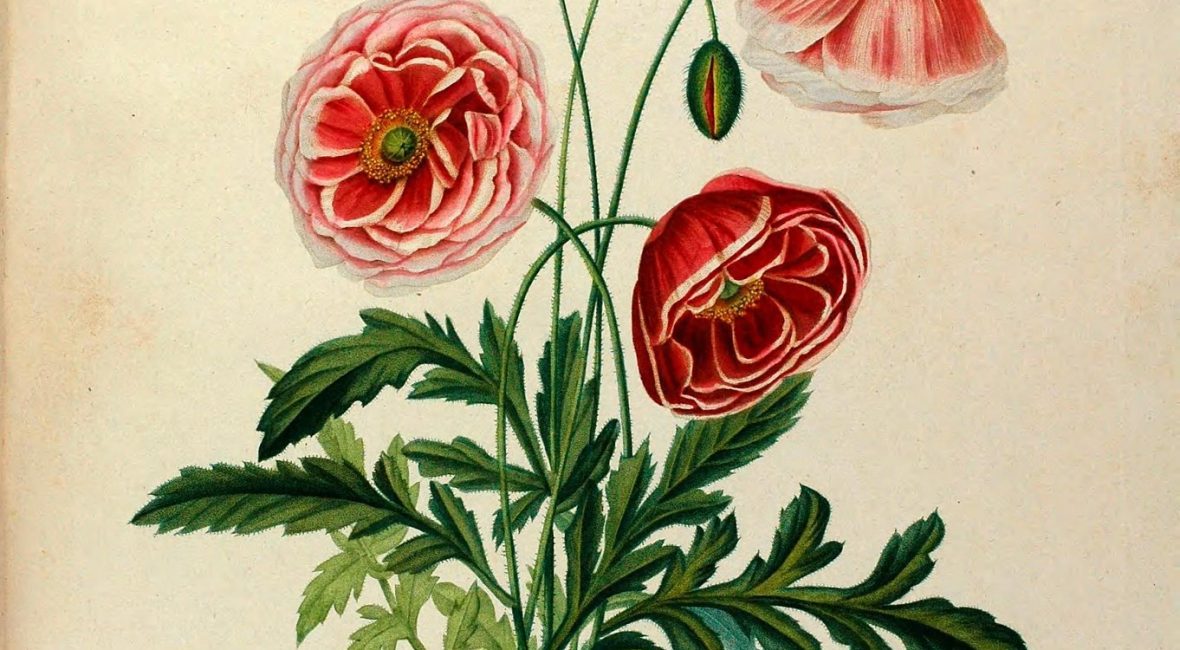
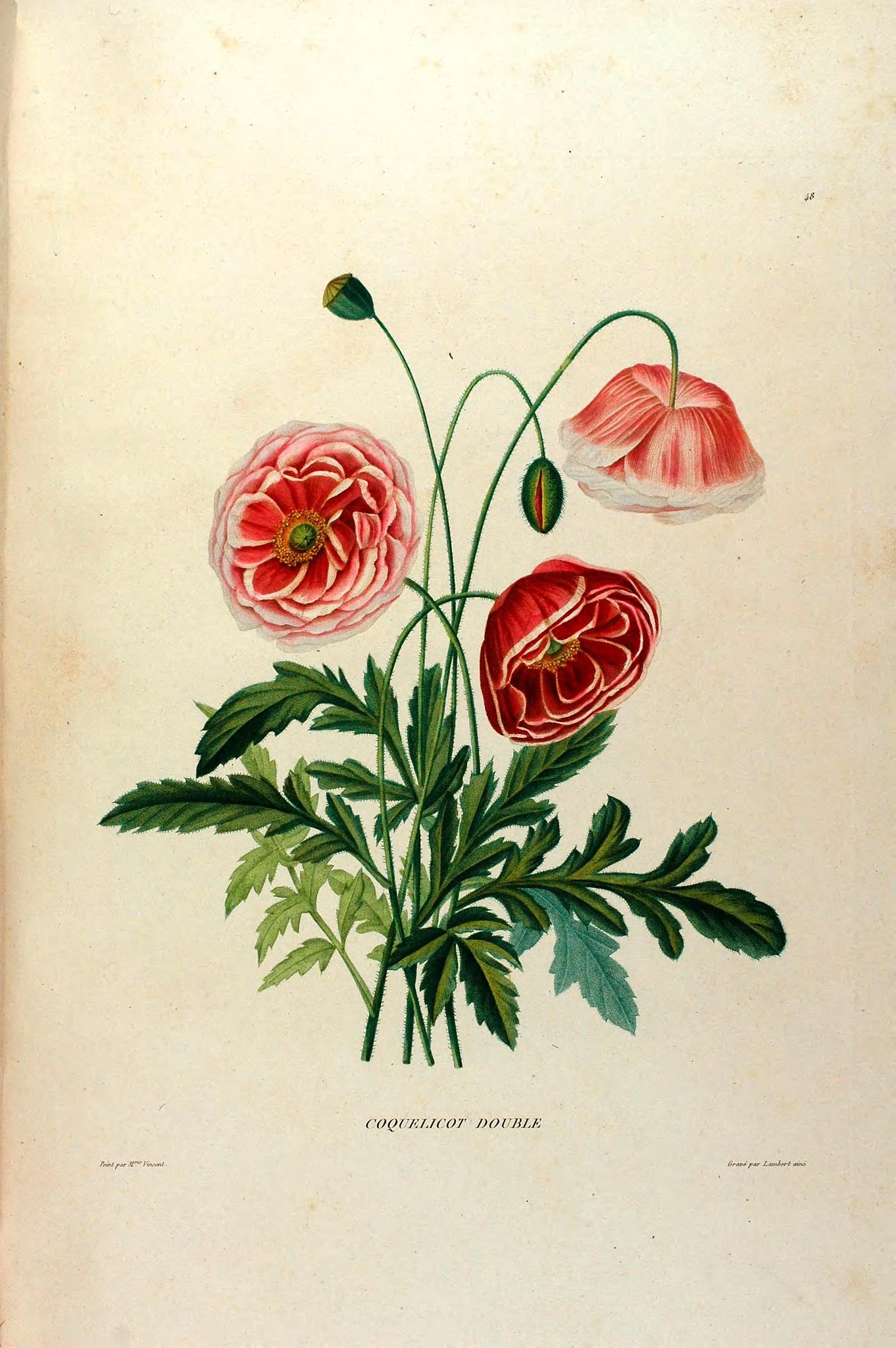
illustration of red flowers with green stems and leaves.

The most-viewed image in the BHL Flickr as of February 2021. Vincent, Henriette Antoinette. Études de fleurs et de fruits. c1820. Art by Vincent. Contributed in BHL from Chicago Botanic Garden, Lenhardt Library. Link in Flickr. Link in BHL.

Over a quarter of a million nature images are now freely available through the BHL Flickr!

Since 2011, we’ve been making many of the illustrations from BHL’s collection available via Flickr. While it has long been a community favorite amongst our audiences, in 2020 our Flickr’s popularity increased significantly when it received considerable media attention in outlets including Colossal, Laughing Squid, Český rozhlas, ZME Science, Cultura Inquieta, Hyperallergic, Graffica, Smithsonian Magazine, Open Culture, la Repubblica, Genbeta, My Modern Met (en Español), eCulture Greece, Daily Geek Show, Вокруг Света, Atlas Obscura, Shifter, Lifehacker, Indiehoy, Microsiervos, and Vice. As a result of this publicity in February 2020, we saw a 518% increase in daily views on Flickr images (2.5 million daily views compared to an average of 400,000) and an over 100% increase in visits and unique visitors to BHL. This popularity continued throughout the year, culminating in over 343 million views on images in 2020 alone—a 123% increase over 2019, bringing our all-time views to over 902 million!

Last year also offered a unique opportunity to substantially build our Flickr collection. With many of our partners working virtually in 2020 due to the COVID-19 pandemic, we focused on projects to improve our digital collections remotely. This work included uploading images to Flickr. In 2020, over 40 BHL partner staff and volunteers contributed to the upload of over 90,000 new images to Flickr—a nearly 200% increase in images uploaded compared to 2019.

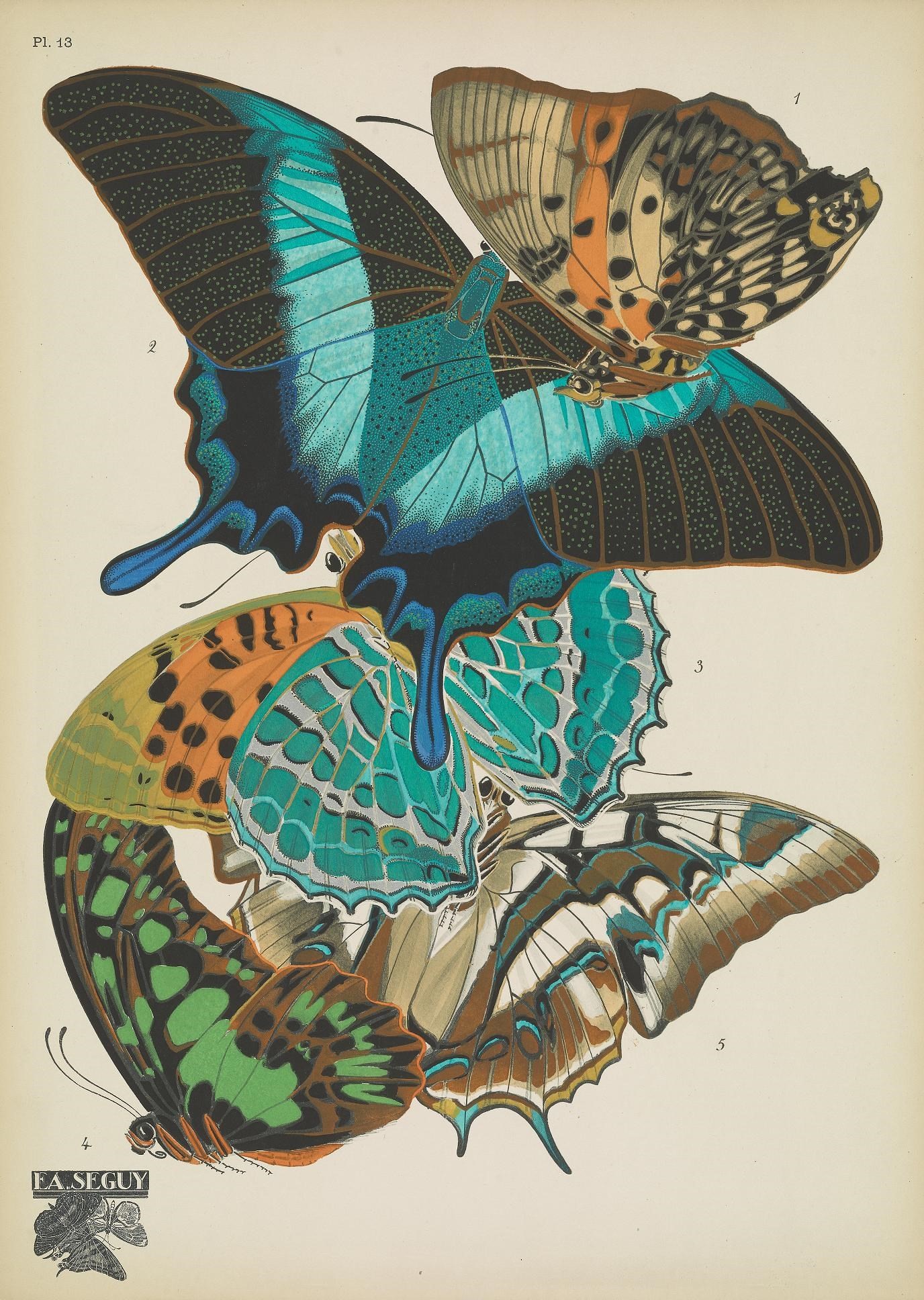
illustration of multiple butterflies positioned on top of one another.

The second most-viewed image in the BHL Flickr as of February 2021. Séguy, Emile-Allain. Papillons. 1925. Art by Séguy. Contributed in BHL from Smithsonian Libraries and Archives. Link in Flickr. Link in BHL.

Thanks to this impressive work, our Flickr collection now includes over 250,000 free images dating from the 16th-20th centuries and representing a range of biodiversity subjects, from plants and animals to fungi, microscopic organisms, and even artifacts like tools made from shells. All images in the BHL Flickr are free to browse, download, and reuse. You can learn more about reusing images from Flickr on the BHL About site.

This post features some of the most popular (by views) images in the BHL Flickr.

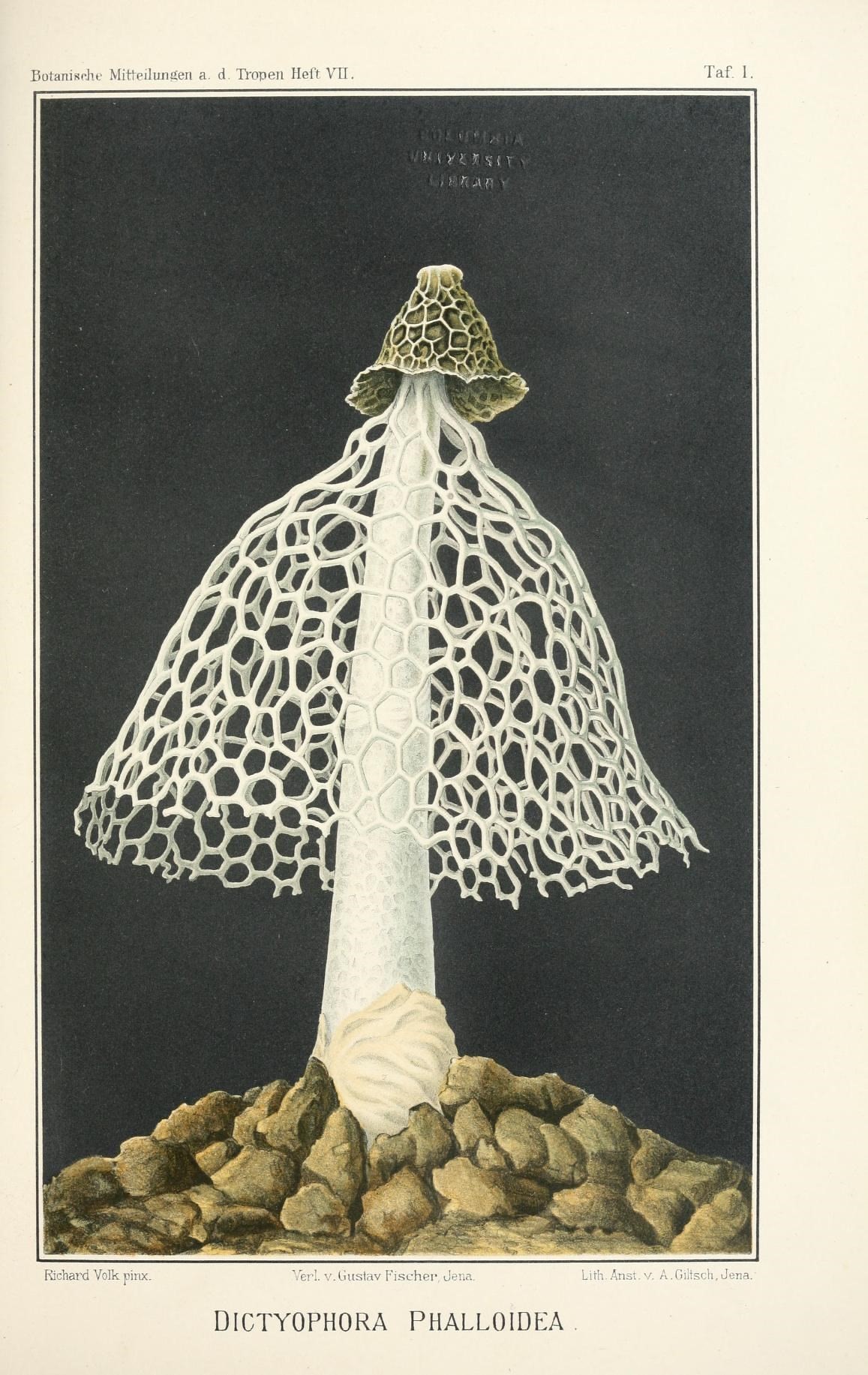
illustration of fungi with an indusium.

The third most-viewed image in the BHL Flickr as of February 2021. Möller, Alfred. Brasilische Pilzblumen. 1895. Art by Richard Volk. Contributed in BHL from The LuEsther T Mertz Library, the New York Botanical Garden. Link in Flickr. Link in BHL.

Images in Flickr are curated by album and collection. Each album corresponds to a particular volume in BHL and contains all of the full page images from that volume. Images and albums are further curated into collections on particular subjects, from botanical art to marine species, gardening, endangered species, and more. We also have collections associated with BHL’s various social media campaigns, including Her Natural History (featuring a collection of illustrations by women artists, each tagged with the name of the artist), Monsters Are Real (featuring images of mythical creatures like hydra, sea serpents, and kraken), Color Our Collections (featuring black and white illustrations perfect for printing and coloring), and Fossil Stories (featuring a wealth of historic paleontological art).

Flickr helps improve image discoverability for BHL, not only by making it easier to browse images from BHL’s collection of over 59 million pages, but also by providing an opportunity for the public to help enhance the metadata for these images through crowdsourcing, making it easier to search the images by species, artist, geographic location, and more! Visit our About site to learn more about how to search images in the BHL Flickr.

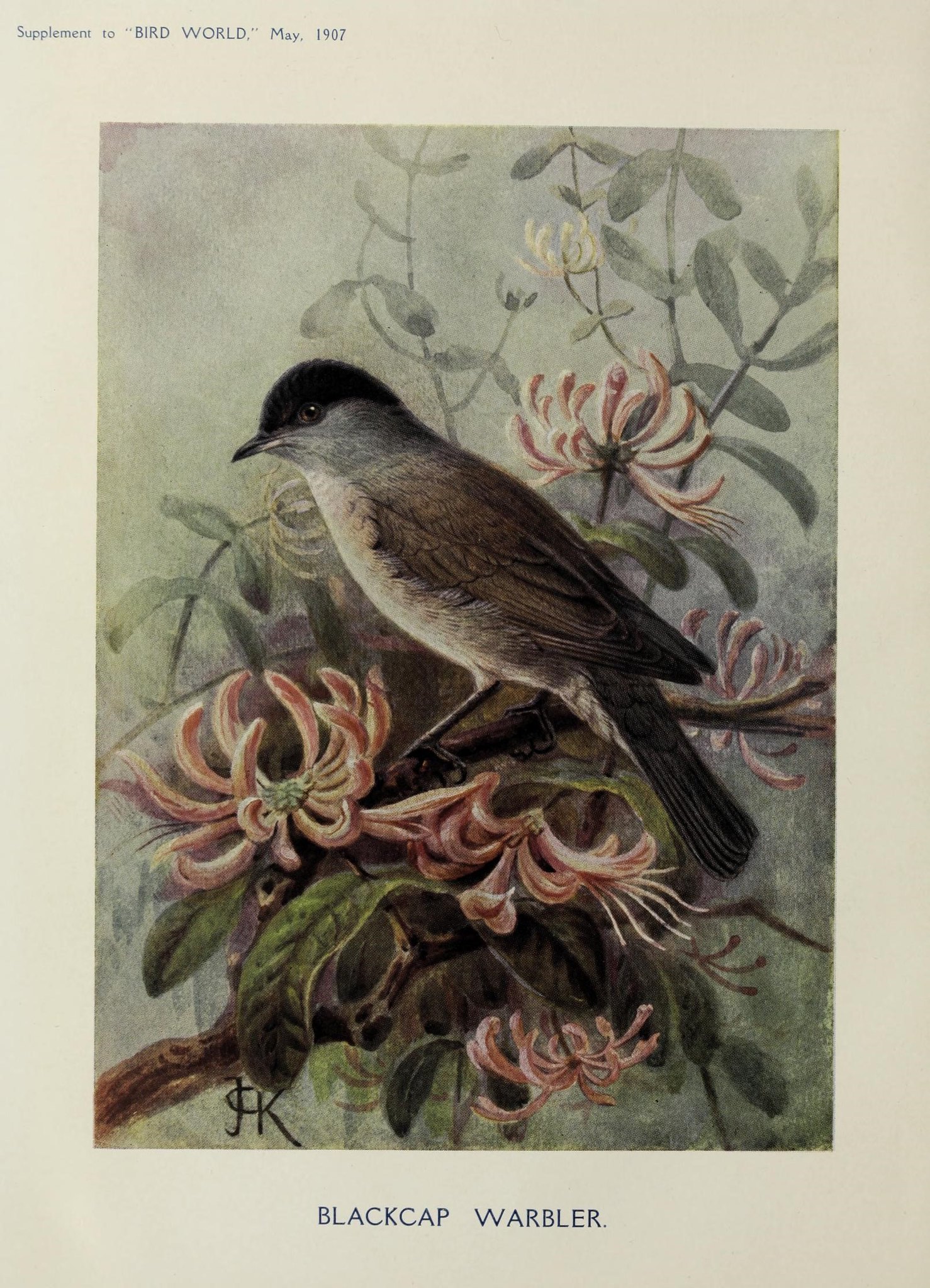
illustration of a bird sitting amongst pink flowers.

The fourth most-viewed image in the BHL Flickr as of February 2021. Bird World Magazine, v.1 (1906-1907). Art by John Gerrard Keulemans. Contributed in BHL from the University Library at the University of Illinois at Urbana-Champaign. Link in Flickr. Link in BHL.

Through our Flickr Tagging Crowdsourcing Project, we invite anyone to help add tags to Flickr images that describe the species depicted, identify the artist of the image, or indicate the geographic location in which the depicted species lives. To date, over 46,000 images, or about 18% of our Flickr collection, has been tagged by the public. This is an incredible accomplishment, but don’t worry—there’s still plenty of images in need of tags. And the best part? This is an educational activity that you can do from home!

We are so grateful to all of our volunteers who have helped tag our images. Thanks to you, these images are more accessible and discoverable for others to support their research and educational activities.

We welcome anyone to join us in tagging images in our Flickr. Learn how to get started with these detailed tagging instructions.

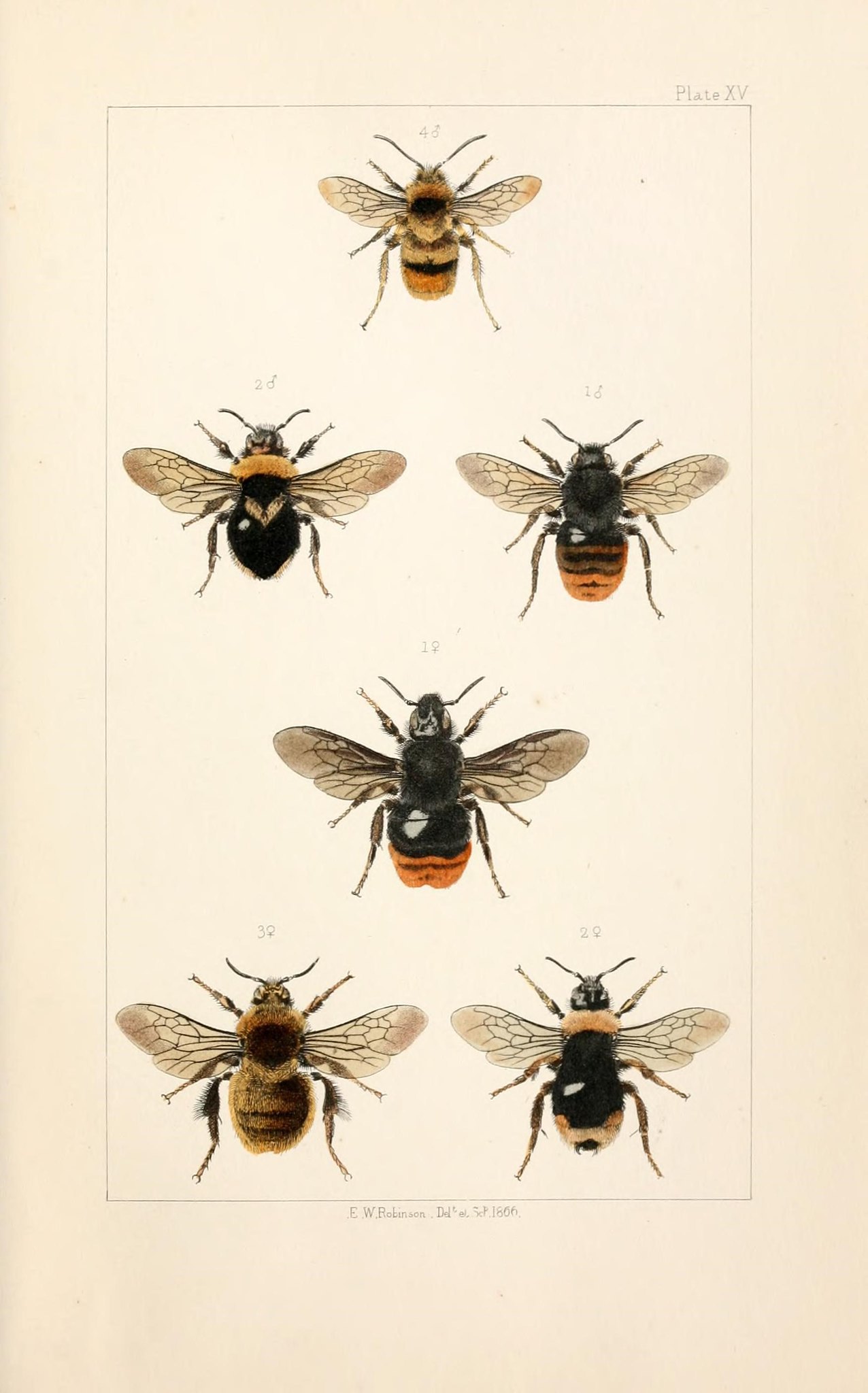
Illustration of bees.

The fifth most-viewed image in the BHL Flickr as of February 2021. Shuckard, William Edward. British Bees. 1866. Art by Edward William Robinson. Contributed in BHL from MBLWHOI Library. Link in Flickr. Link in BHL.

We invite you to explore our image collections on Flickr today. Thank you to all of our incredible partners who have helped build this amazing resource, and to all of our volunteers who have helped improve it through image tagging. We encourage you to download and reuse the images for your own educational, artistic, personal, and professional uses, and to help us improve the collections by participating in our tagging project.

Enjoy immersing yourself in the beauty of nature through art!

February 18, 2021by michelle.underhill
Blog Reel, User Stories

Bringing Natural History Art to Life: Installation Artist Uses BHL to Create Fantastic Worlds Through Immersive Artworks

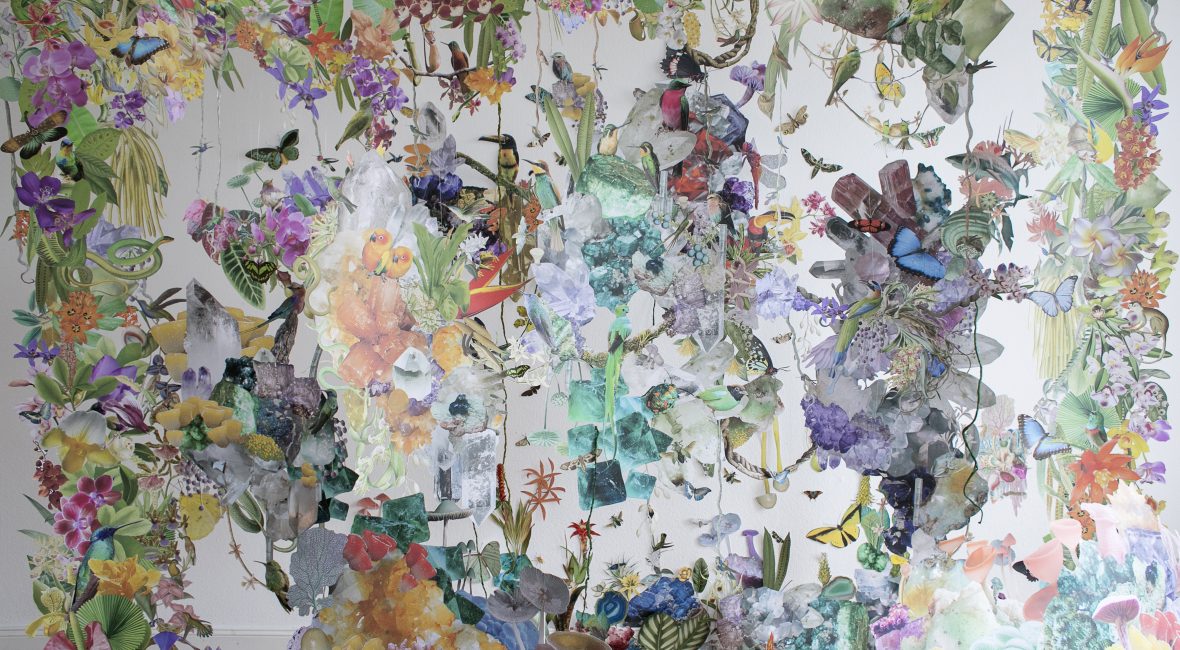
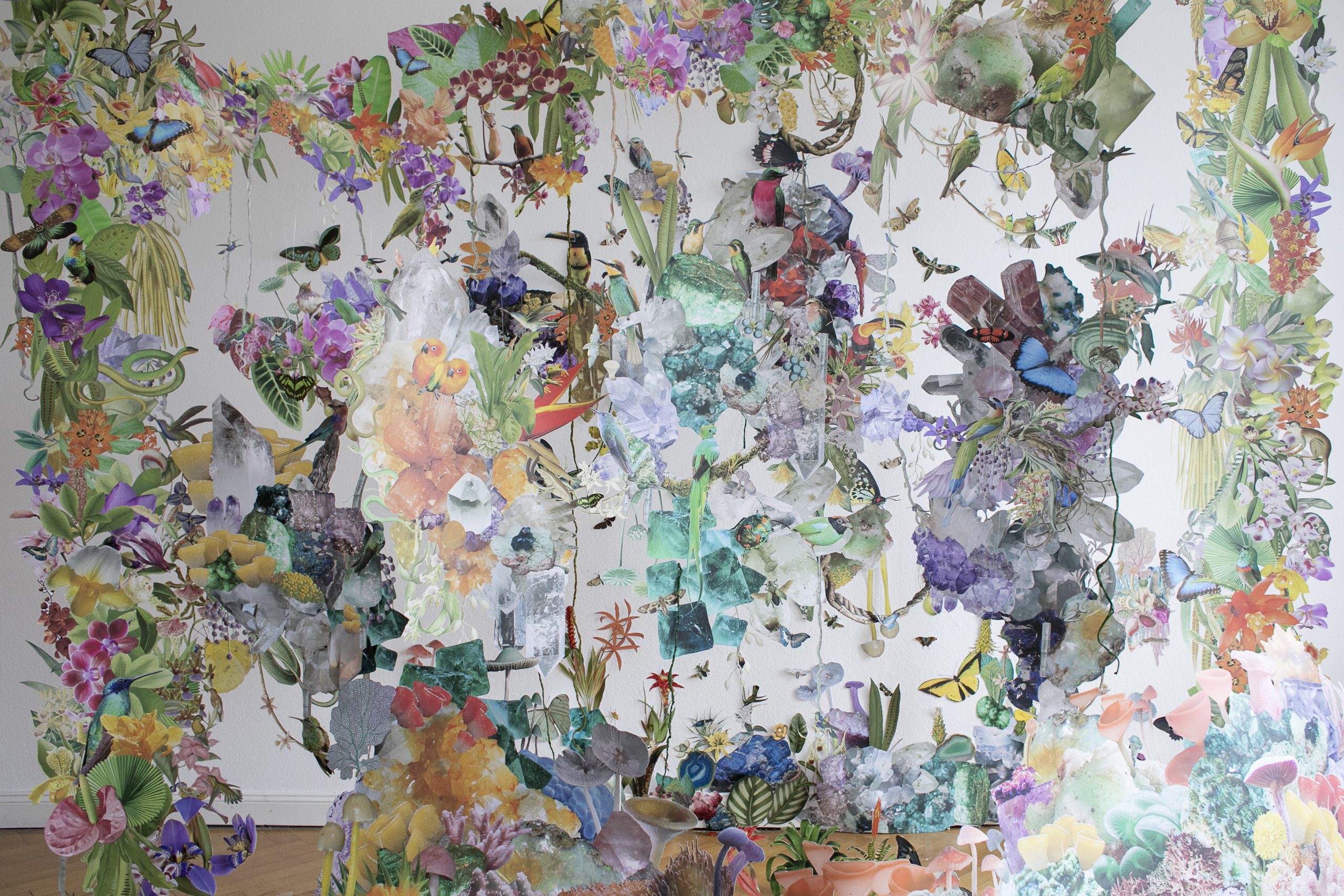
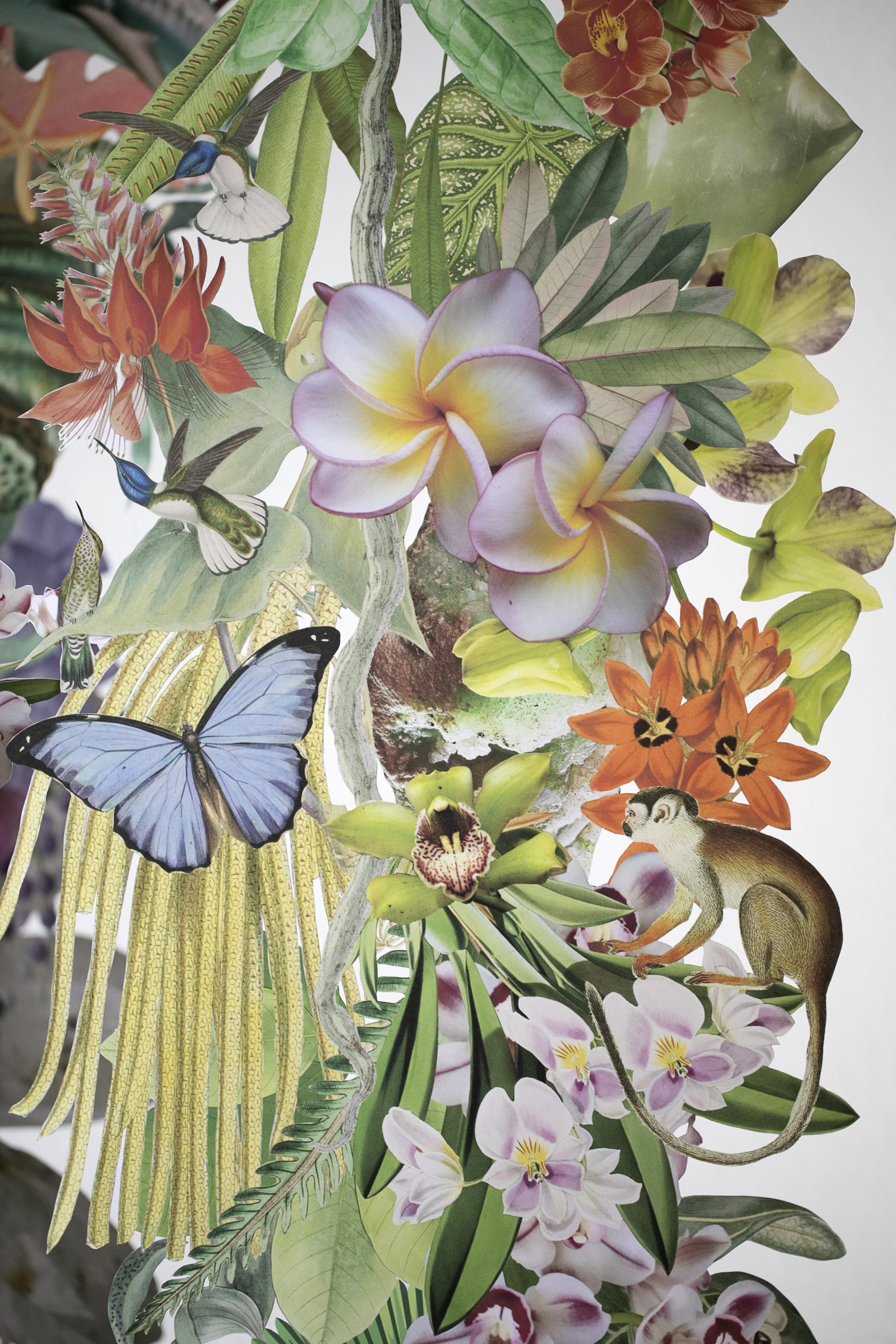
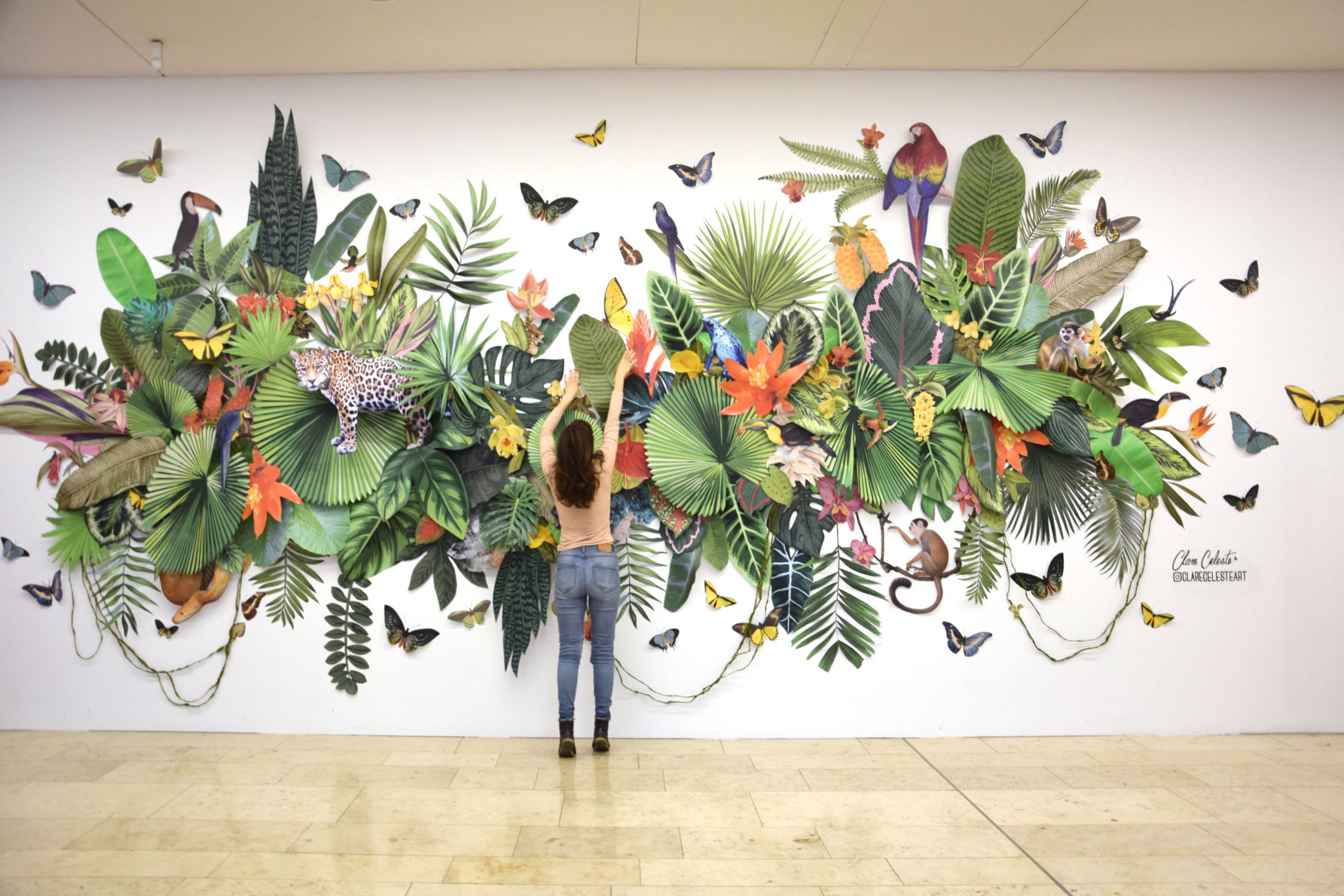
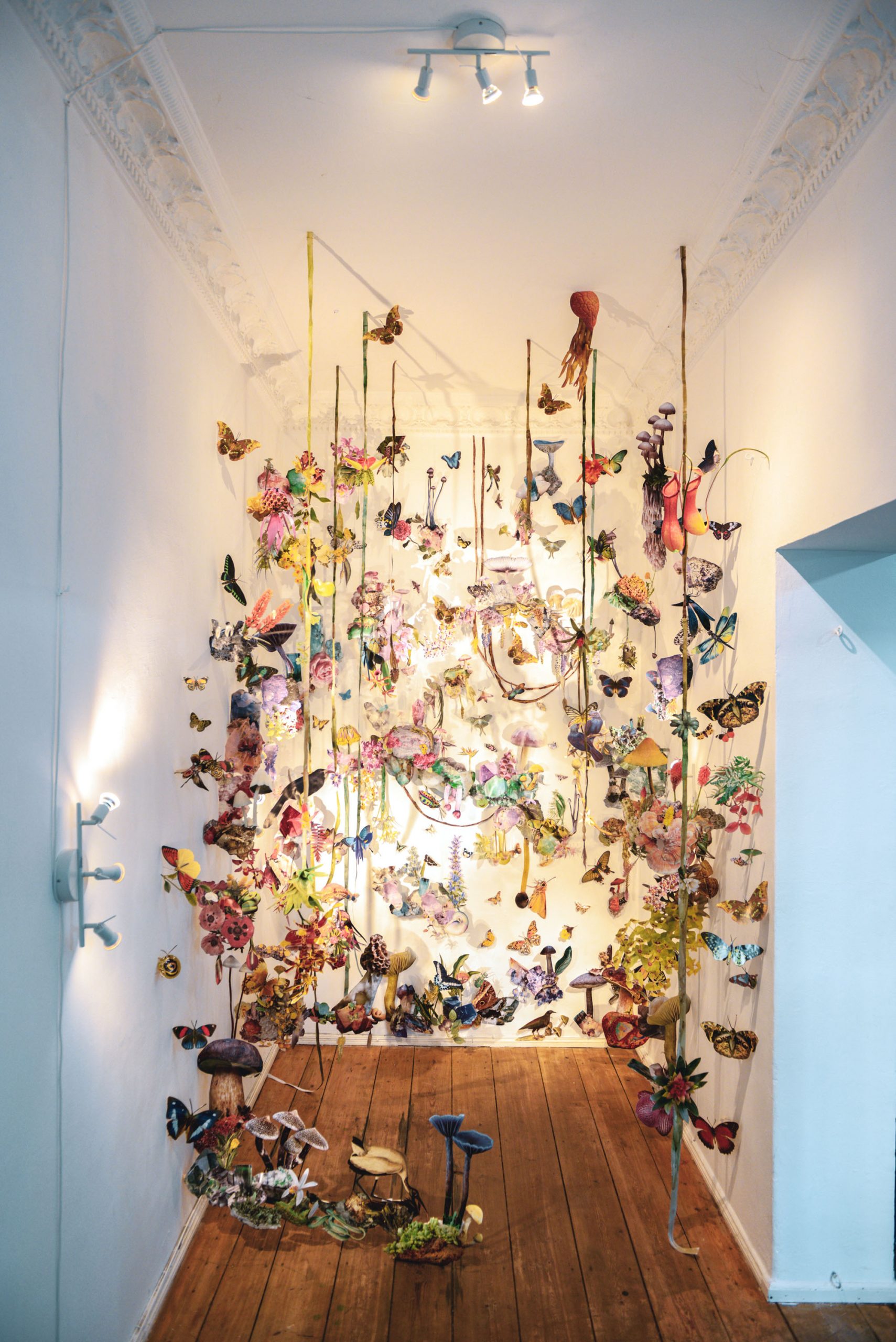
Collage installation art with various biodiversity figures.

Biodiversity (2020), a collaged art installation by Clare Börsch. The installation uses illustrations and photographs sourced mainly from open access collections like the Biodiversity Heritage Library (BHL). Photo courtesy of Clare Börsch. Photo by Patricia Schichl.

Imagine stepping into a world teeming with dazzling biodiversity. Everywhere you turn, colorful birds perch amidst exotic blooms, glimmering butterflies and energetic hummingbirds flit from flower to flower, shimmering serpents wind their way through a jungle of foliage, and an array of mushrooms add color and dimension to the forest floor.

This world, seemingly alive with biodiversity, is composed not of flesh and blood, but of ink and paper. It is a world brought to life from the imagination of Berlin-based American artist Clare Börsch using illustrations and photographs sourced mainly from open access collections like the Biodiversity Heritage Library (BHL) and painstakingly cut and arranged into a marvelous, three-dimensional ecosystem. Within this Biodiversity installation of collaged nature art, a wondrous world awaits.

collages illustrations of various bird heads and feet

Close-up from the collaged art installation Biodiversity (2020) by Clare Börsch. Photo courtesy of Clare Börsch. Photo by: Patricia Schichl.

Beneath this enchanting beauty, however, lies a graver message—a warning—for this installation is also a commentary on the biodiversity and climate crises facing our planet today.

“Humanity has wiped out 68% of all our planet’s biodiversity in just the last 50 years,” says Börsch within her video for the Biodiversity installation. “My latest artwork and video shares a message of love, urgency and hope. Love for our planet, our future selves, our children and future generations. Urgency, because climate change is upon us and the predictions of what to come are dire. And Hope, because there is still a narrow window of time to act and there is still so much we can save.”

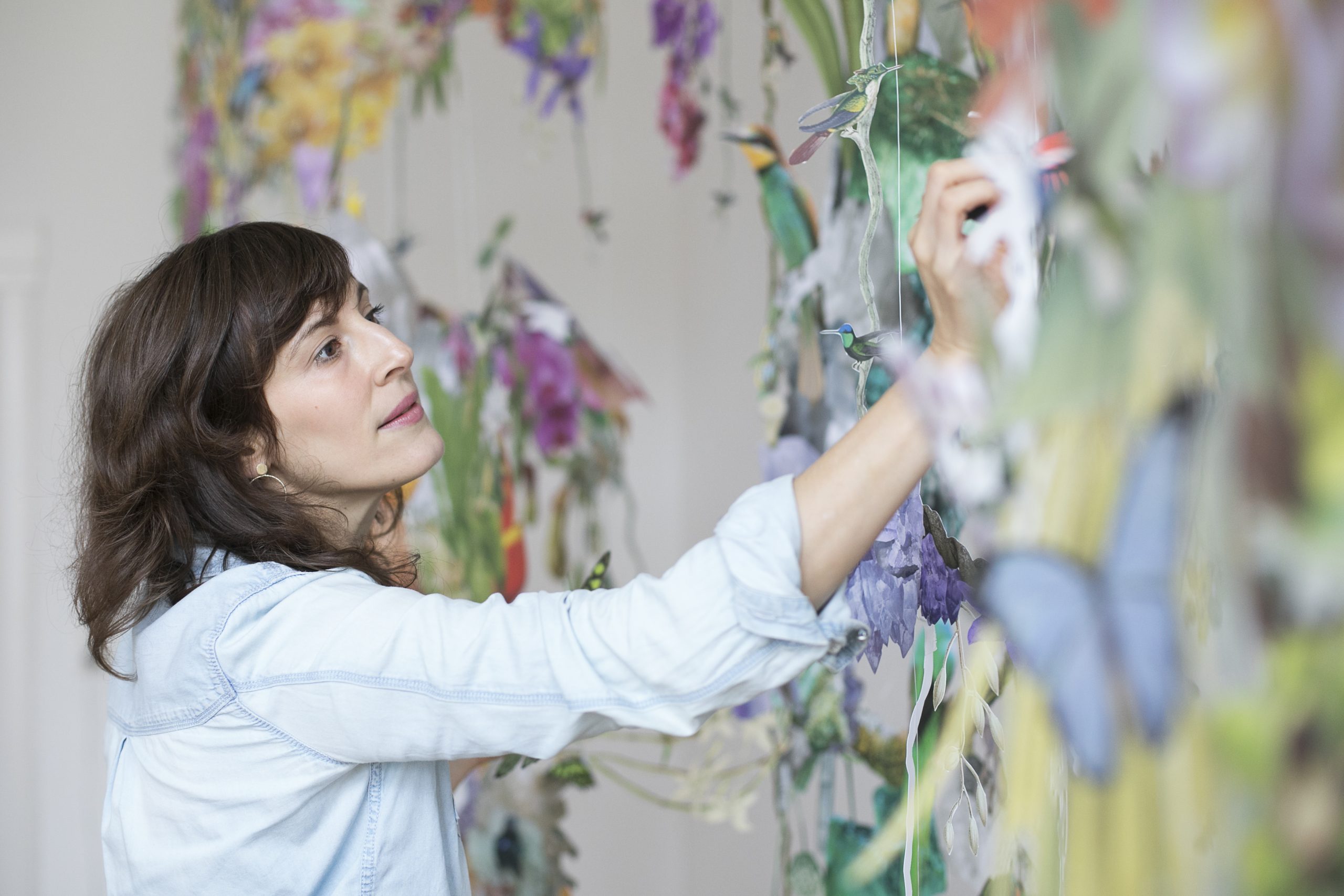
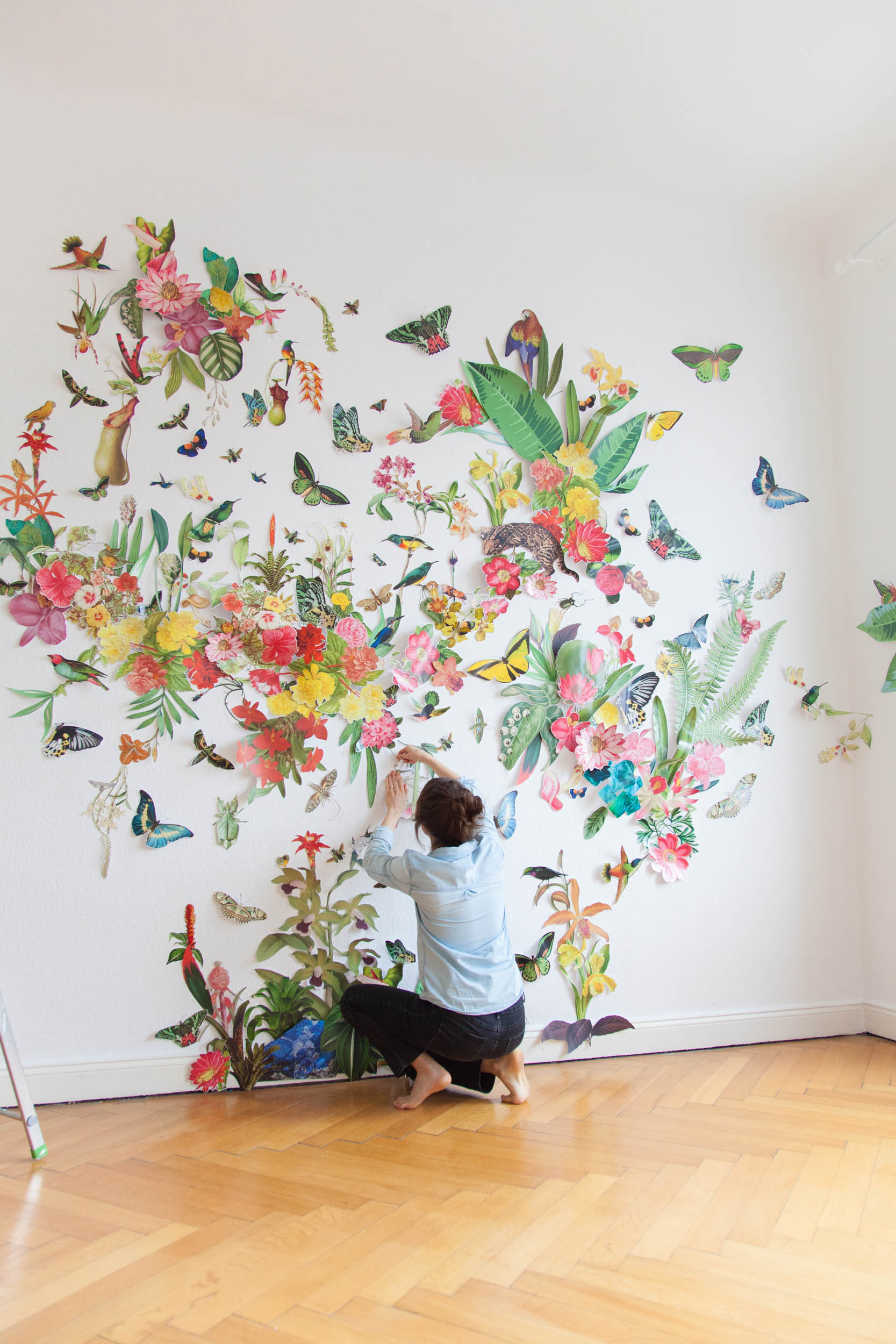
collage installation art featuring various biodiversity figures

Artist Clare Börsch building her collaged art installation, Biodiversity (2020). Photo courtesy of Clare Börsch. Photo by: Patricia Schichl.

With a background in public policy, Börsch has been a full-time artist for the past three years. Having lived in Brazil, the United States, Italy, Honduras, Argentina and Germany, her personal experiences with nature are global and diverse. Installation collage art allows Börsch to bring together flora and fauna from around the world to create an environment that reflects this global perspective and immerses the viewer within this incredible diversity through the use of historic naturalist imagery. This same imagery can also be emblematic of the threats facing this biodiversity.

“As I use naturalist imagery from 1900 and earlier, many species in my artwork have already vanished or are vanishing,” shares Börsch in her artist statement. “This adds a layer of ecological urgency to my work.”

collage installation art featuring various biodiversity figures

Collaged art installation in process. Installation by Clare Börsch incorporating imagery from BHL. Photo courtesy of Clare Börsch. Photo by: Artist.

Much of the naturalist imagery Börsch uses for her installations is sourced from BHL. The BHL Flickr, which contains over 240,000 images extracted from publications and archival materials in the Library, allows her to easily browse and download high resolution materials for her own artworks.

“Discovering BHL has transformed the scale and complexity of my installations,” asserts Börsch. “The archive is an incredible resource and allows me to really execute and realize the ideas I have.”

collage installation art featuring various biodiversity figures

Intimate Immensity installation by Clare Börsch incorporating imagery from BHL. Photo courtesy of Clare Börsch. Photo by: Trevor Good.

Over the past year, as many of our partners have transitioned to a telework environment due to the COVID-19 pandemic, we’ve focused on projects to improve our collections remotely—including building our image library on Flickr. Since March, we’ve uploaded over 75,000 new images to the BHL Flickr, all freely available for download and reuse. The growing collection offers an ever-expanding source of inspiration for everyone, including artists like Börsch, to explore.

Börsch takes full advantage of this wealth of imagery, using the BHL Flickr daily. She is especially appreciative of the curated collections, which facilitate discovery around particular topics. In the future, she’d love to see the images enhanced with more geographic information, allowing her to search for species by specific ecosystems, and information on each depicted species’ status, such as whether it is extinct or endangered.

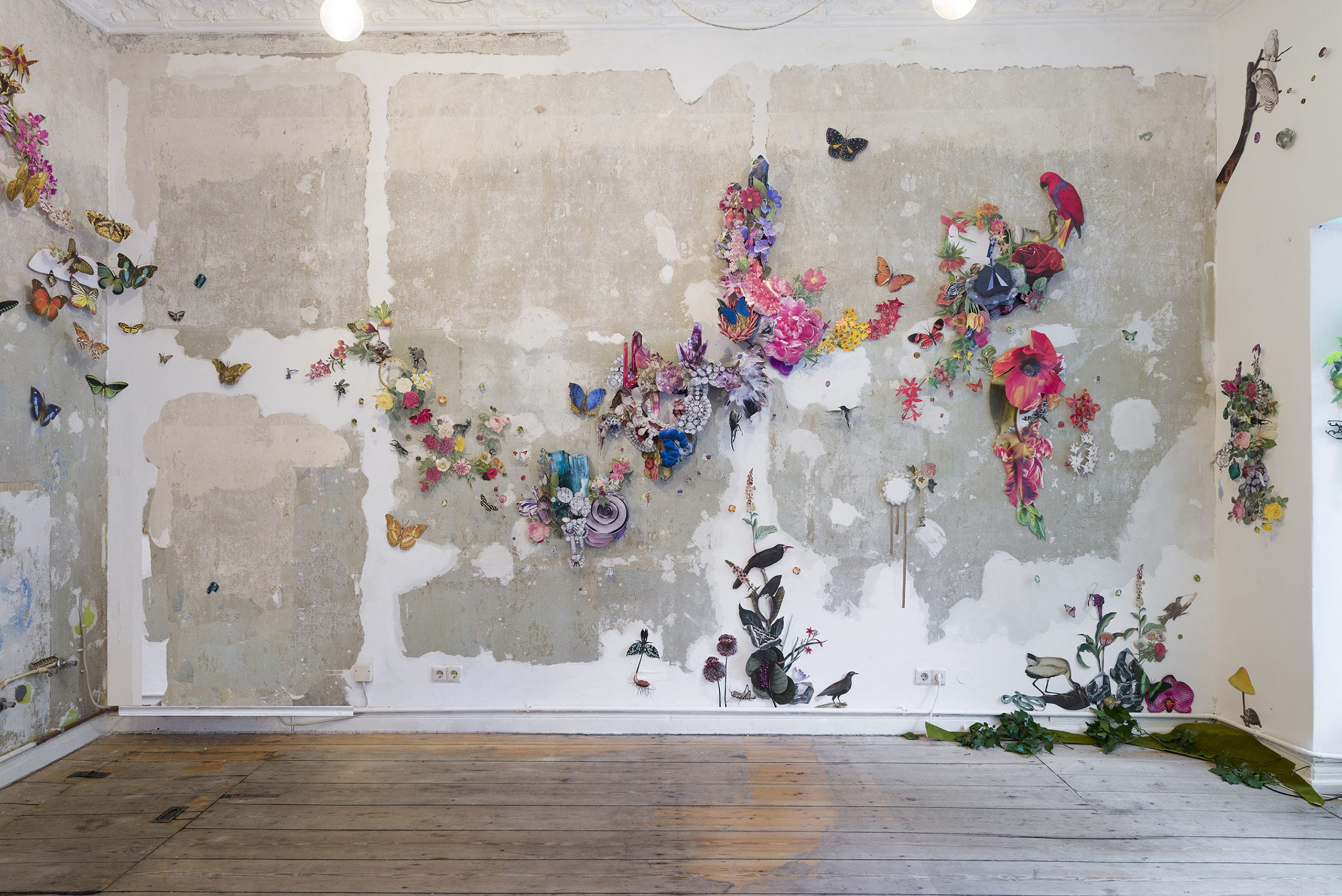
Imagery from BHL has appeared in many of Börsch’s works, including her previous installation, The Mushroom Hunters, which created an immersive world inspired by Neil Gaiman’s poem of the same name.

collage installation art featuring various biodiversity figures

The Mushroom Hunters, a collaged art installation by Clare Börsch that includes imagery from BHL. Photo courtesy of Clare Börsch. Photo by: Kolja Raschke.

“I create immersive installations so that others can join me in being moved by the beauty of our planet,” asserts Börsch in the artist video for Biodiversity. “2020 has been hard, but I think the grief we feel is a symptom of our love, of an ecological awakening. Our grief reminds us that we are connected in our humanity, that one group’s suffering impacts us all, and that we are connected to our shared and finite home, our planet.”

BHL’s open access collections not only empower the work of scientists striving to study and conserve biodiversity, but they also allow everyone to explore the wonders of nature—to help develop a connection to our planet that galvanizes us to action. Artists like Börsch breathe new life into the work of naturalist artists from centuries past and allow us to experience the beauty they captured in new ways. This art—old and new—is a powerful reminder of what we have…and what we stand to lose.

collage installation art featuring various biodiversity figures

Collaged art installation in process. Installation by Clare Börsch incorporating imagery from BHL. Photo courtesy of Clare Börsch. Photo by: Christiane Meyer.

“In twenty years from now, I do not want my art to be a memorial for everything we could have saved,” asserts Börsch. “I rather want it to inspire change and action today.”

In keeping with this aspiration, within the artist video for Biodiversity, Börsch suggests actions that can have a positive impact on the environment, such as choosing greener transportation options and eating locally. Supporting organizations whose work empowers science and conservation, like the Biodiversity Heritage Library, is another way that you can make a difference today.

Our planet’s biodiversity is experiencing unprecedented declines, with at least one million species currently threatened with extinction [1], but there is still time to act. Together, we can build a better future for our planet and every species that calls it home, ensuring that Earth’s ecosystems remain as wondrous and diverse as those born from Börsch’s imagination.

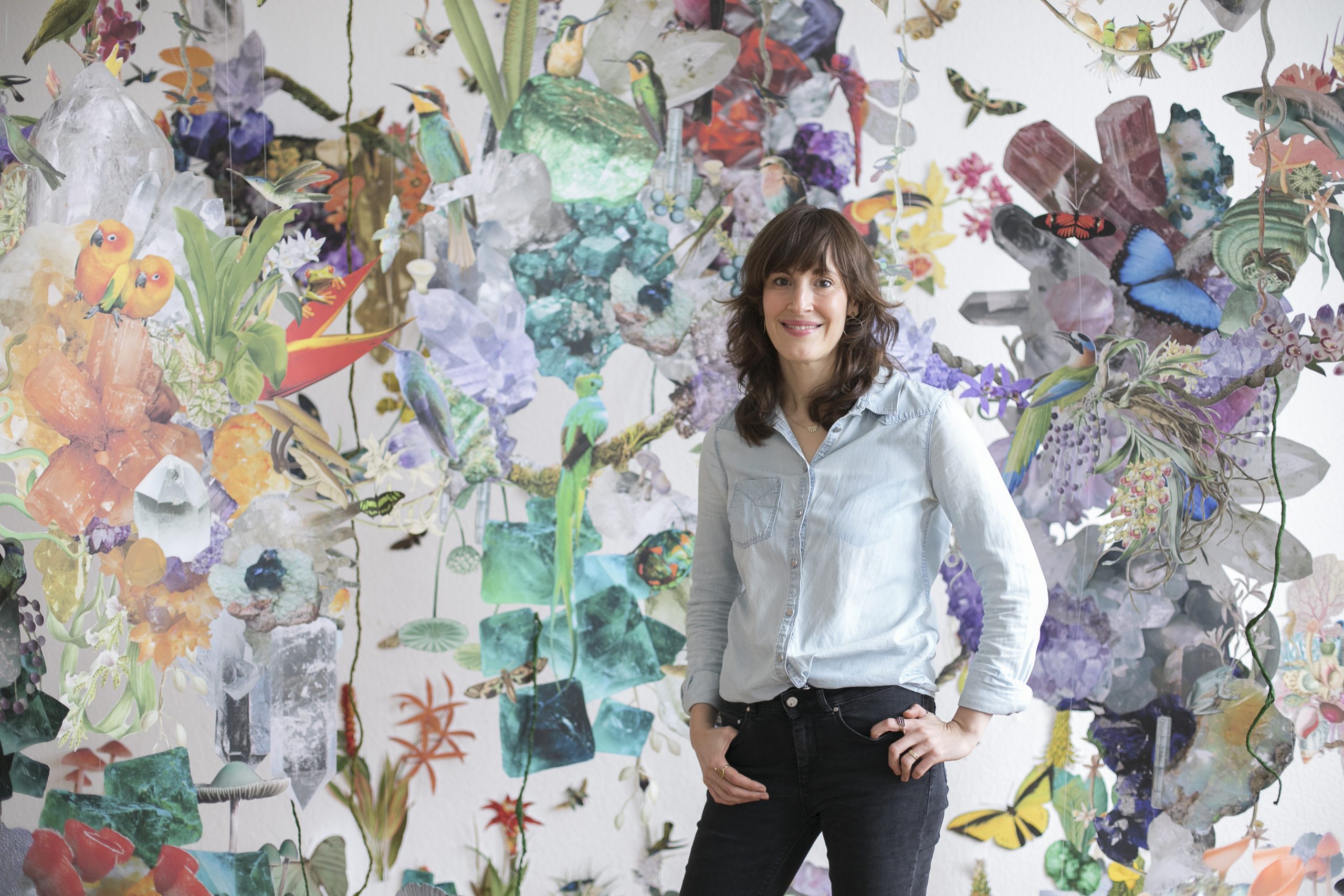
collage installation art featuring various biodiversity figures

Clare Börsch with her collaged art installation, Biodiversity (2020). Photo courtesy of Clare Börsch. Photo by: Patricia Schichl.

References

[1] Intergovernmental Science-Policy Platform on Biodiversity and Ecosystem Services. (2019). Nature’s Dangerous Decline ‘Unprecedented’; Species Extinction Rates ‘Accelerating’. Available at https://www.ipbes.net/news/Media-Release-Global-Assessment.

December 15, 2020by michelle.underhill
Blog Reel, Featured Books

“I took care to get the true character of the animal” – The Zoological Sketches by Joseph Wolf

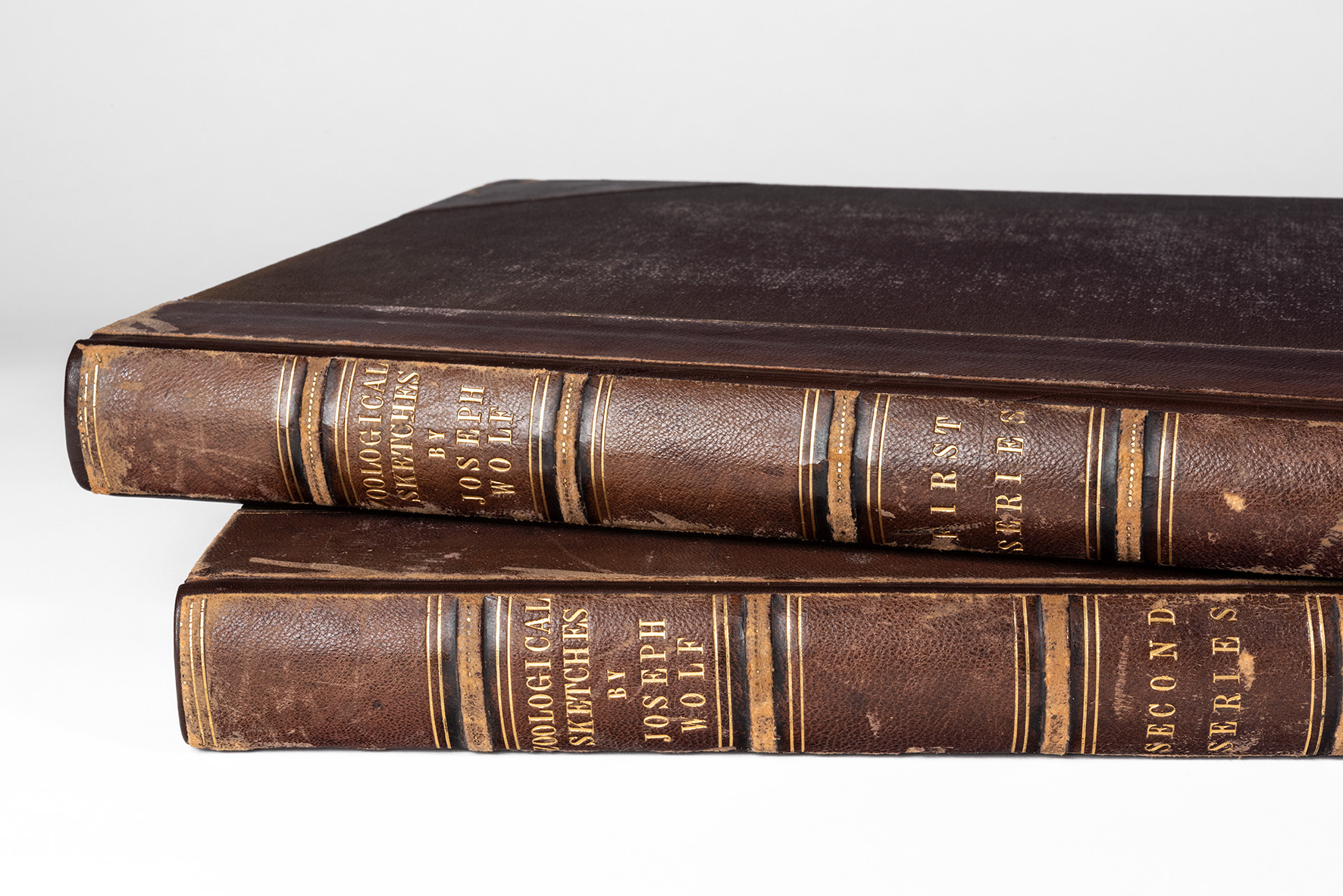
The Zoological Sketches are two volumes of 100 plates published between 1857 and 1867. They show particularly rare animals from Regent’s Park in London, which Joseph Wolf captured in watercolours and on the basis of which Joseph Smit made lithographs. The edited notes were written by David William Mitchell, Secretary of the Zoological Society. After his death his successor, Philip Lutley Sclater, took over the work and completed the volumes.

The Library of the Museum für Naturkunde in Berlin holds a copy of this title in its collection. There is a digital copy of the work in BHL, contributed by the Ernst Mayr Library of the Museum of Comparative Zoology at Harvard University.

photo of brown book spines

Copy of the Zoological Sketches by Joseph Wolf in the Holdings of the Museum für Naturkunde Berlin, Photo: Carola Radtke | MfN.

Regent’s Park, now London Zoo, was founded in 1828 for the purpose of scientific observation of wild animals from all parts of the British Empire. “In the year 1852 the Council of the Zoological Society […] resolved to commence the formation of a series of original water-colour drawings […]. For this purpose the Council were fortunate enough to secure the services of Mr. Joseph Wolf, who may be fairly said to stand alone in intimate knowledge of the habits and forms of Mammals and of Birds. …“(Preface).

Joseph Wolf was born on 22 January 1820 in Mörz (Germany). He was trained as a lithographer in Münster, but also mastered the work with pencil, water and oil paints, and coal. He worked in different places in Europe before coming to London in 1840 to work at the British Museum as an animal illustrator. By that time, he had already made a name for himself with his illustrations, especially of birds.  Sir Edwin Landseer described him as “… without exception, the best all-round animal painter that ever lived. …” (Palmer 1895, p. 283). The Zoological Society appointed Wolf as its resident artist in 1861.

Wolf, who until then only sketched animals in the wild, always dealt with the self-assertion of the individual and incorporated this into his works. The housing of the animals in the zoo in which they did not show their natural behaviour was therefore a challenge for him.

Animals that came to Regent’s Park in the 19th century often had a long, exhausting journey behind them. Wolf wrote “… for sometimes, when they arrived, they were in a miserable state, and hardly I knew what to make of them. I used to do two or three of these drawings in a day, if the material were good. All these were vignettes only; but I took care to get the true character of the animal” (Palmer 195, p. 110).

In addition to the embellished depictions of the individuals, most of the 100 plates show the zoo animals in an ideal, natural environment. A few, however, provide insights into zoo life and depict the animals in their enclosures or provide a view of the visitors. Although the animals are described anonymously by Mitchell and Sclater, the records of the Zoological Society allow us to deduce which individuals of Regent Park’s Wolf drew.

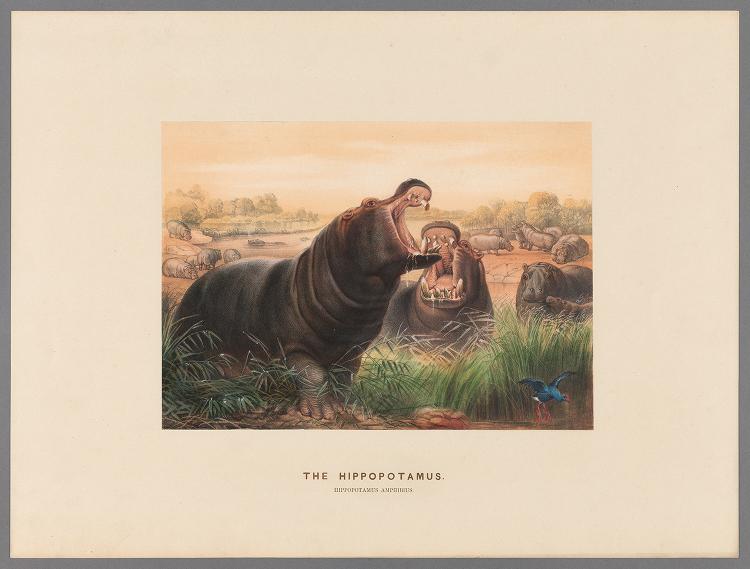
Illustration of hippopotami

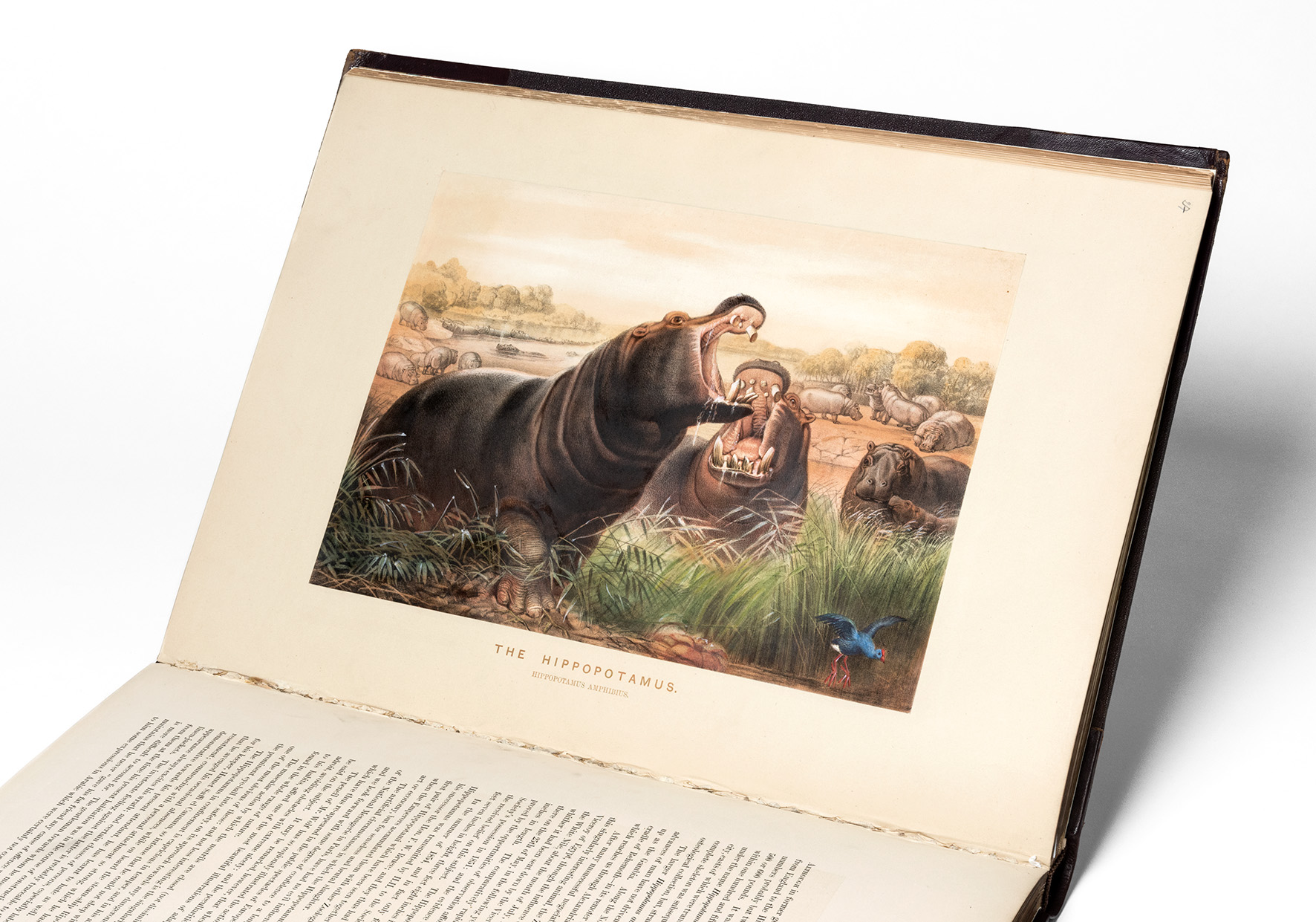
Illustration of the hippopotamus in the Zoological Sketches (Volume 1, Plate XXVII) by Joseph Wolf, here shown in the copy that is in the holdings of the Museum für Naturkunde Berlin. Photo: Carola Radtke | MfN.

The hippopotamus bull Obaysh came to Regent’s Park as a calf on 25 May 1850 and quickly became a crowd puller. In 1854, he got a companion, Adhela. On plate XXVII (Part I) are two adult hippos, as well as a herd in the background, a mother with a calf and a western swamphen in a natural habitat. Since Joseph Wolf himself never visited Africa, he relied on third party sources for the design of the environment. For all the hippopotami depicted, especially the two individuals in the foreground, Obaysh and Adhela were probably models. Their names are not mentioned in the text and the representation of the right side of the body makes it impossible to identify Obaysh by a characteristic scar on his left side. As Obaysh and Adhela were the only hippos in the zoo, Wolf used different sketches of them for the herd to show different behaviours of the species.

zoologicalsketc2wolf_0055.jpg

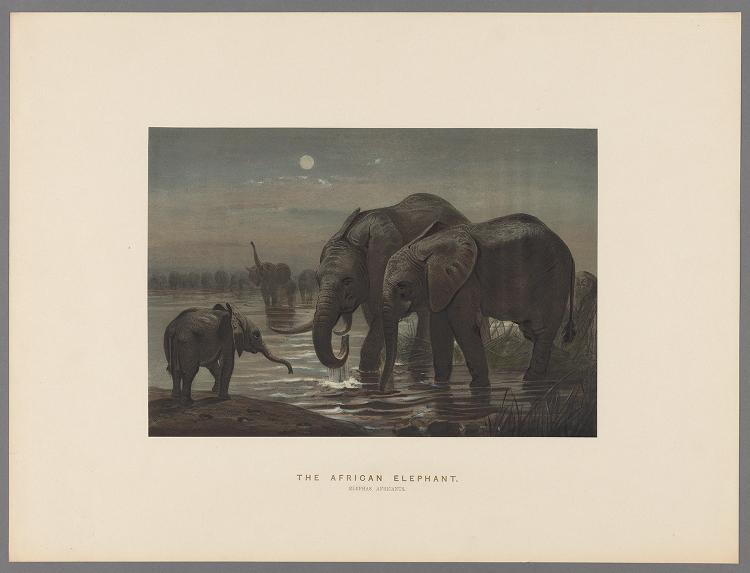
Plate XXIV, Part 2. The Zoological Sketches. Art by Joseph Wolf. Lithographed by Joseph Smit. Contributed in BHL from the Ernst Mayr Library of the Museum of Comparative Zoology at Harvard University.

The situation is similar with plate XXIV, Part 2, where a herd of elephants shows up in a supposedly natural environment. Probably Jumbo, who came to Regent’s Park on 26 June 1865, and Alice were depicted. This plate makes it clear that Wolf’s depiction of zoo animals does not show their natural behaviour. The picture of the bull elephant together with the cow and a calf rather reflects the ideal of a Victorian family, as bull elephants are rouges. Furthermore, in African elephants, both females and males have tusks but the cow elephant shown here does not seem to have any. This can be explained by the fact that Alice was only 2 years old when Wolf made his sketches, and her tusks were apparently not yet fully developed.

illustration of a bear in a book alongside text

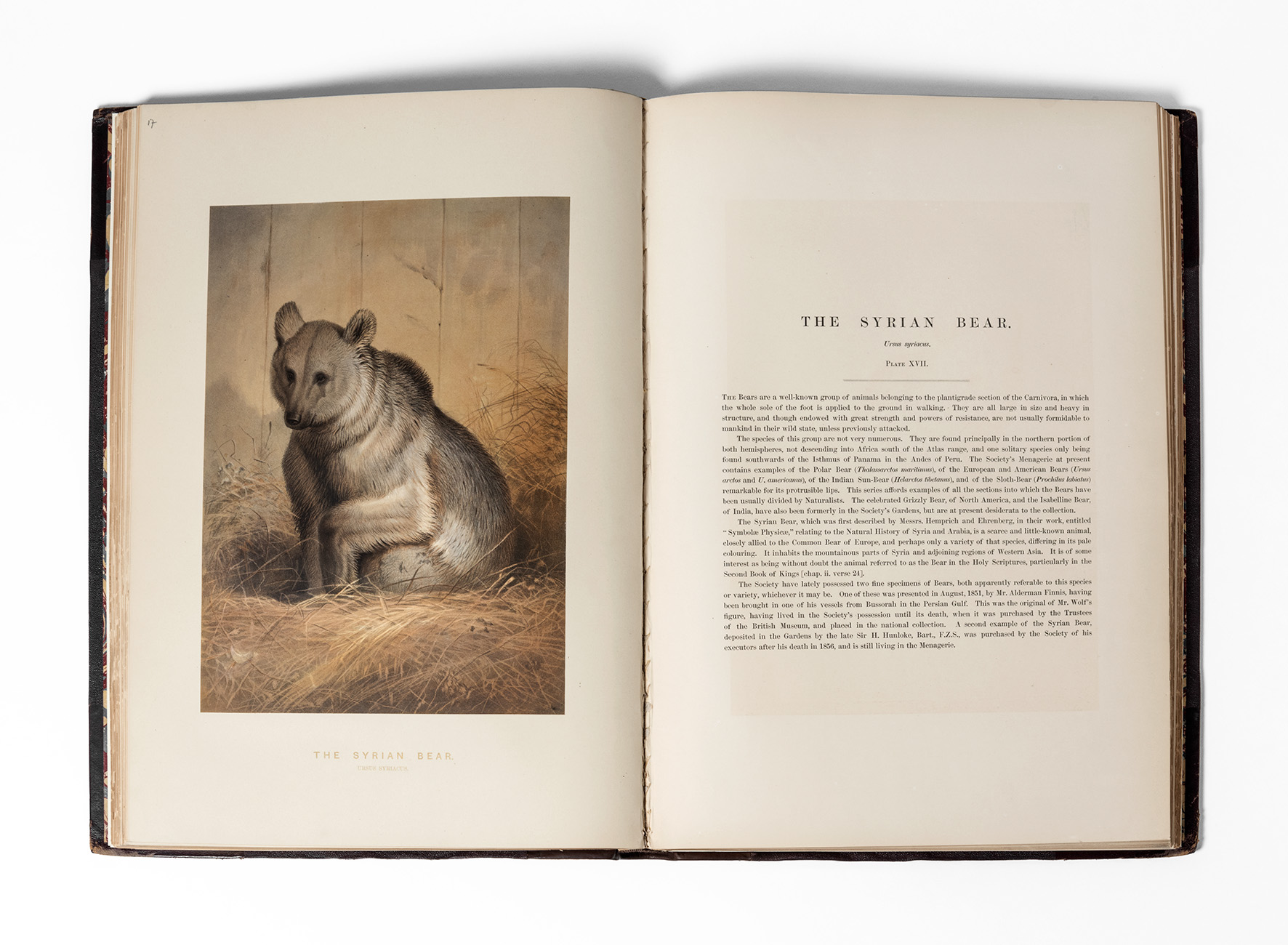
Illustration and edited notes of the Syrian Bear in the Zoological Sketches (Volume 1, Plate XVII) by Joseph Wolf, here shown in the copy that is in the holdings of the Museum für Naturkunde Berlin. Photo: Carola Radtke | MfN.

Plate XVII, Part 1 is one of the few that shows an animal in its zoo enclosure. The almost portrait-like drawing shows a Syrian Bear on straw in front of a board wall. It is not possible to take a closer look at the surroundings, e.g. to determine whether he lives together with other animals of the same species or to measure the dimensions of the enclosure.  By depicting the bear in its actual accommodation, Wolf focuses on the animal’s personality; the bear no longer remains anonymous. The accompanying text also mentions that the bear was a gift from the Persian Gulf and arrived in London in August 1851.

The discussed plates show a selection of the illustrations of the Zoological Sketches and set highlights on individual features that are characteristic for this work. Despite their idealization and partial embellishment, they remain true to their scientific purpose and are an outstanding example of 19th century European animal painting.

You can also explore all of the artworks from this title in the BHL Flickr: Volume One | Volume Two

Sources

Palmer, A. H. 1895. The life of Joseph Wolf,: animal painter. London: Longmans, Green.
Susset, Nicole Ricarda, and Nicole Ricarda Susset. 2013. Lebendigkeit im Bild: Joseph Wolf und die Tiermalerei im 19. Jahrhundert.
Schulze-Hagen, Karl, and Joseph Wolf. 2000. Joseph Wolf (1820-1899), Tiermaler. Marburg an der Lahn: Basilisken-Presse.

January 22, 2020by Joel Richard
Blog Reel, Featured Books

Our Experience Digitising a Rare Book for the Biodiversity Heritage Library

illustration of blue and green birds

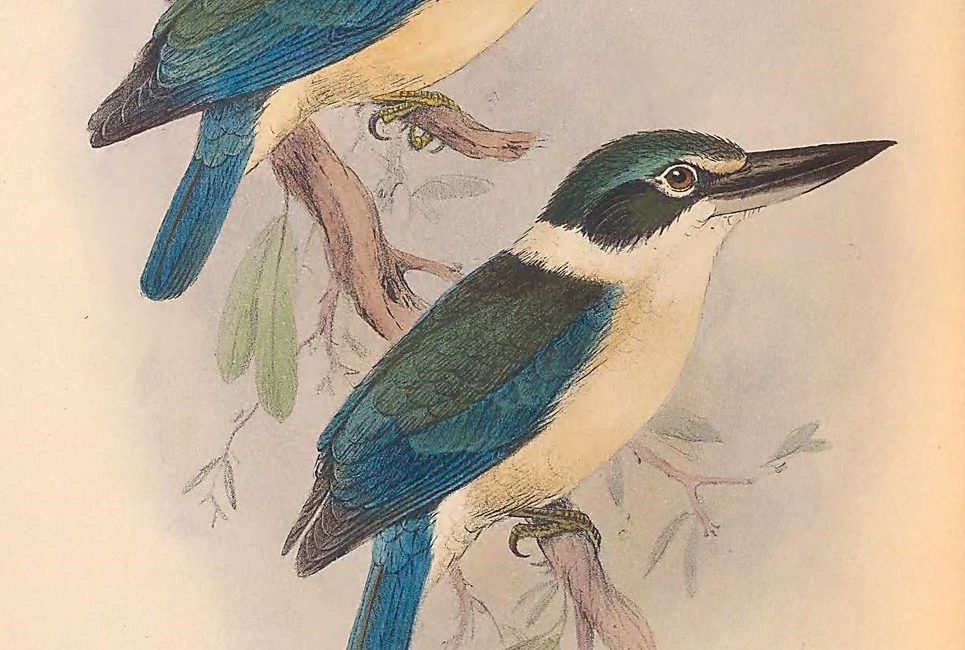
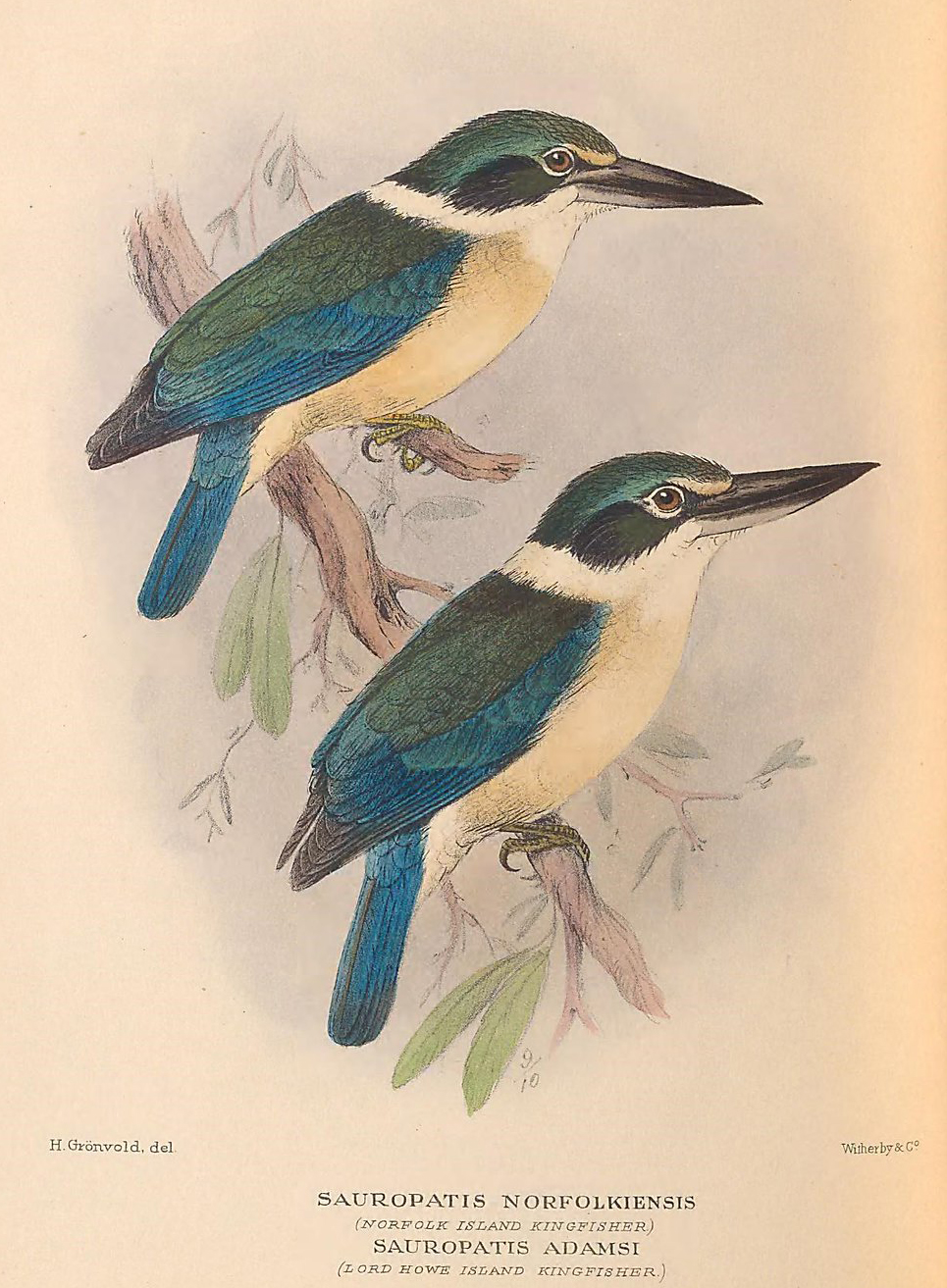
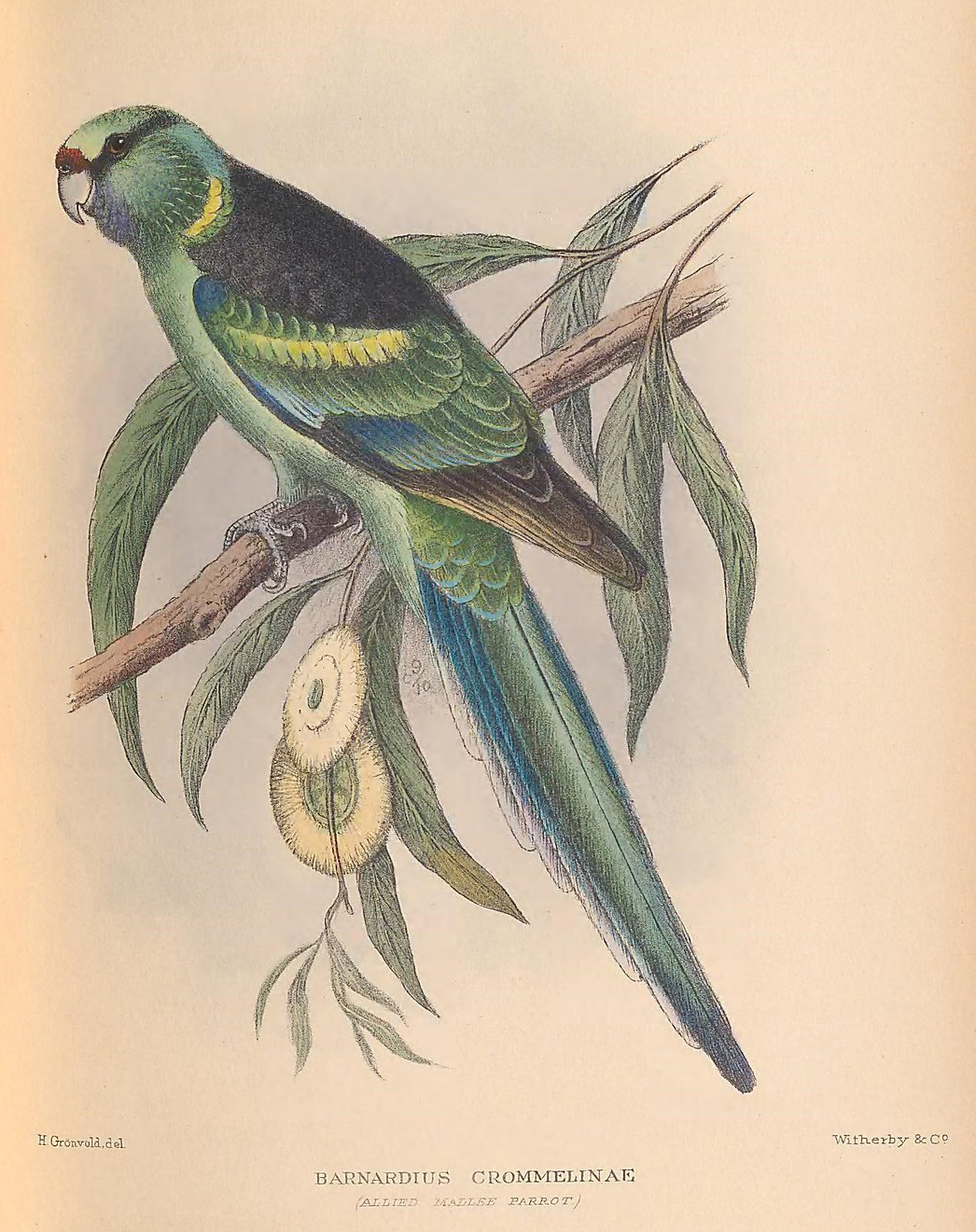
Plate 18. Mathews, Gregory M. (Gregory Macalister). The birds of Norfolk & Lord Howe Islands and the Australasian South Polar quadrant. 1928. Art by Henrik Grönvold. Contributed in BHL from Museums Victoria.

Recently, we spent three weeks on student placement at Museums Victoria Library and were fortunate enough to be involved with the digitisation of the beautiful title The birds of Norfolk & Lord Howe Islands and the Australasian South Polar quadrant by Gregory M. Mathews. It was an eye-opening experience, making us aware of the patience and attention to detail that is a necessity for book digitisation.

In order to get suitably high resolution scans, a Zeutschel OS 16000 scanner is primarily used for Biodiversity Heritage Library (BHL) digitisations at Museums Victoria. The Australian branch of the project, BHL Australia, digitises the collections of 25 organisations across the country. It is hosted by Museums Victoria and funded by the Atlas of Living Australia.

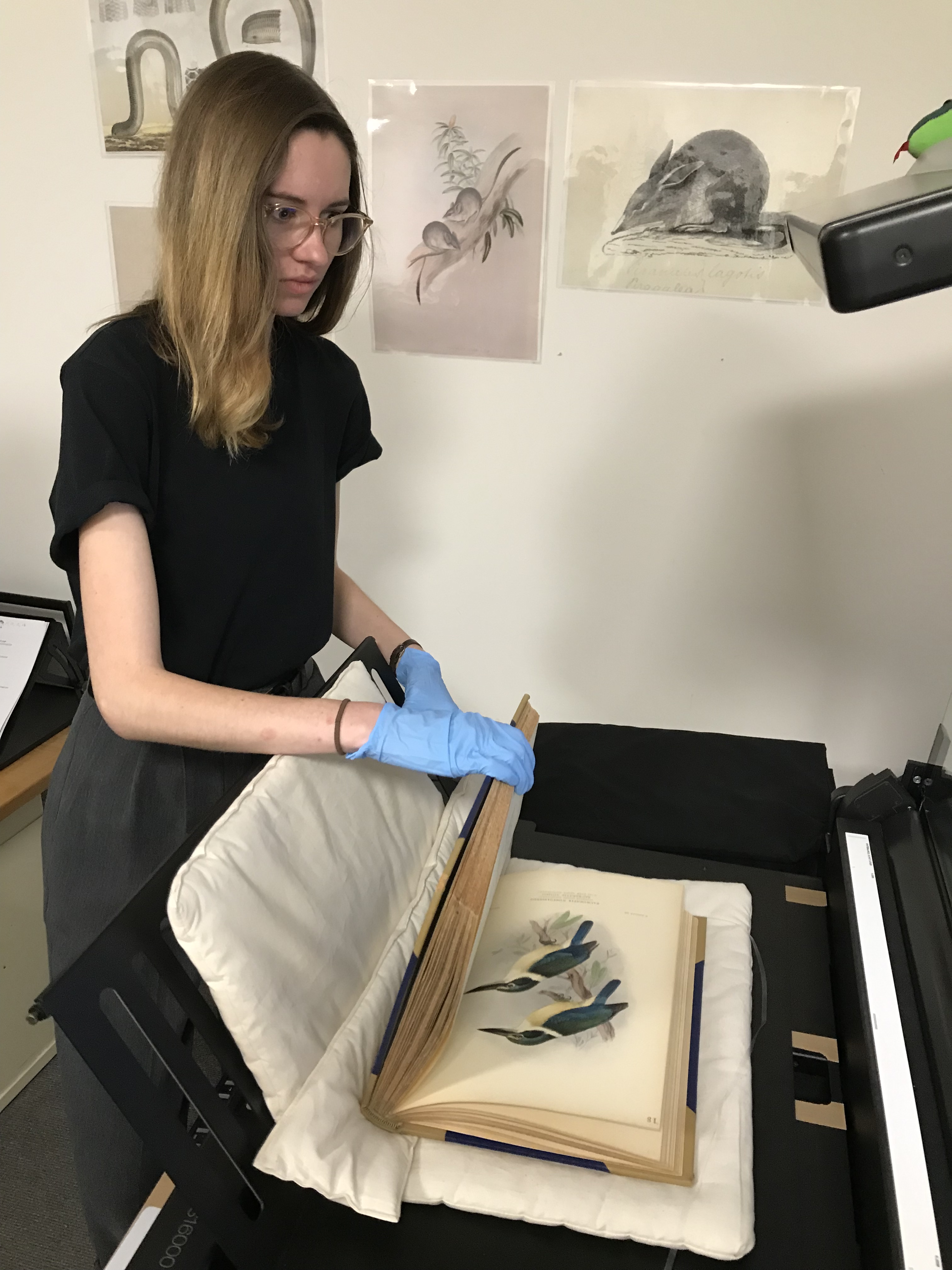
As this title was rare, it was essential to handle it gently, and to protect the spine from excessive pressure. To ensure minimal impact, we wore gloves when in contact with the book, and scanned one page at a time. We scanned all right-hand pages first, before turning the book around and repeating the process for the left-hand pages. The glass pane normally used to pin pages down on ordinary books can’t be used on rare books, so getting pages to lie flat was a challenge in itself! This digitisation project has given us a chance to see a lot of this beautiful title, with its multitude of breathtaking illustrations.

Marina Hunt scanning The birds of Norfolk & Lord Howe Island for the Biodiversity Heritage Library.

Both of us are currently working towards the Master of Information Management qualification at RMIT University. Being involved with the BHL project has been invaluable to our understanding of the challenges and importance of digitisation. As digital technology continues to develop and evolve, digitisation provides exceptional opportunities for further access and research. As such, digitisation is likely to play a significant role in our careers in information management into the future, and we are highly grateful to have had the opportunity to be involved in such a project.

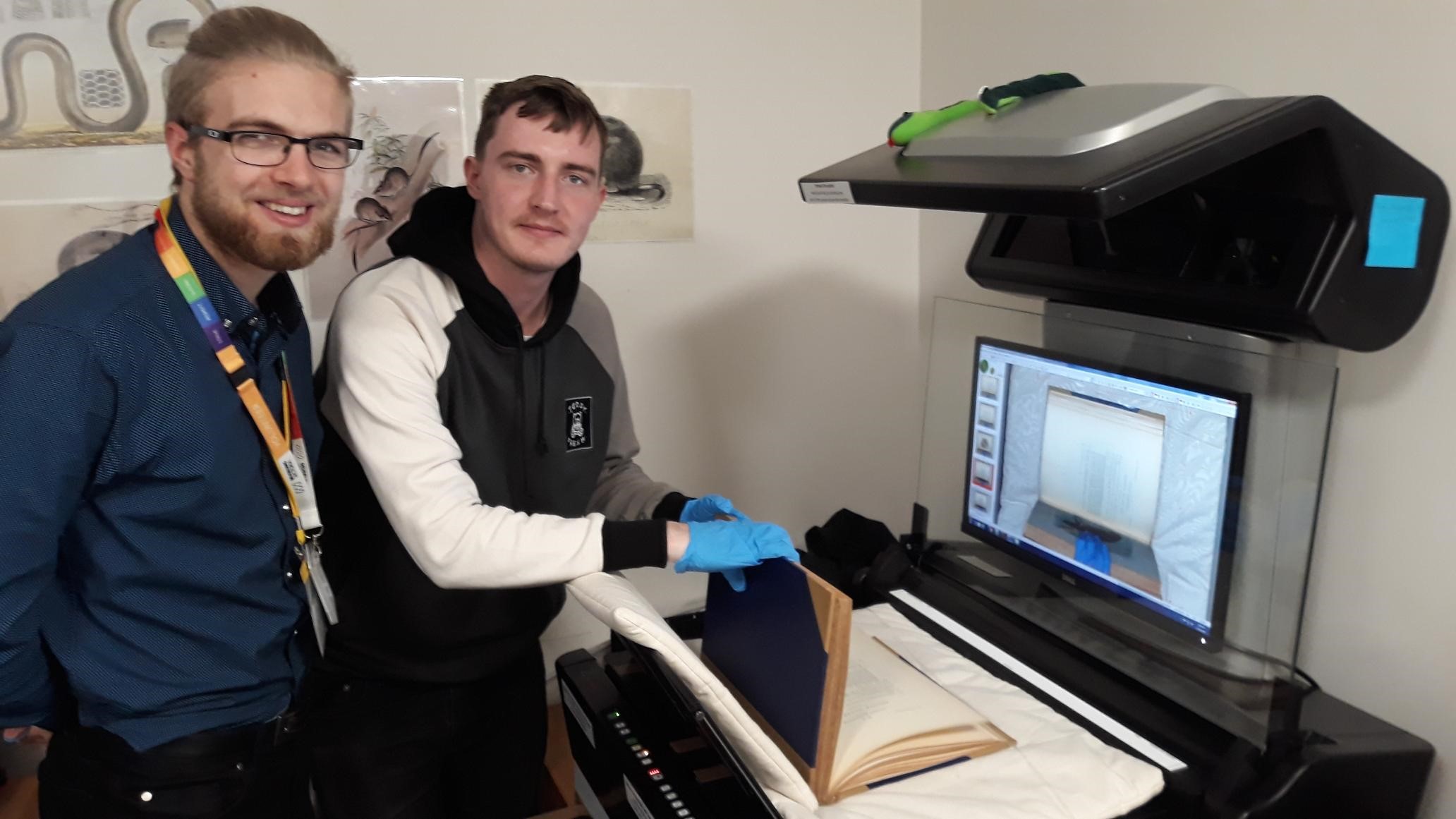
Brendan with Chris Healey, Technical Support Officer BHL.jpg

Brendan Bachman with BHL-AU’s Technical Support Officer Chris Healey.

The birds of Norfolk & Lord Howe Islands and the Australasian South Polar quadrant is a remarkable guide to the birds of some of Australia’s more outlying territories, specifically Norfolk and Lord Howe Islands and areas of the Antarctic. Published in 1928, the title contains detailed description and distribution information for a number of species, as well as beautiful illustrations of each bird. Many of the species covered in the book were extinct when the book was published, while others became extinct in the decades afterwards. This adds to the unique nature of this title. Only 225 copies of this work were produced, and around 57 are currently held in library collections worldwide.

illustration of green bird

Plate 43. Mathews, Gregory M. (Gregory Macalister). The birds of Norfolk & Lord Howe Islands and the Australasian South Polar quadrant. 1928. Art by Henrik Grönvold. Contributed in BHL from Museums Victoria.

The book was written by noted ornithologist Gregory Macalister Mathews. Born in 1876, Mathews grew up in Australia before moving to England, where his interest in birds became an obsession. Over his life Mathews contributed to a significant number of ornithological works, but none drew more attention than his Birds of Australia (which is also available on the BHL website, the final volumes of which were digitised by the BHL Australia project at Museums Victoria). During the creation of Birds of Australia, he regularly worked 16 hour days, and through the course of this work he acquired 30,000 skins and around 5,000 books.

Despite dedicating much of his life to their study, Mathews “was not really interested in the living bird”, and was “essentially a bibliophile” (Kloot, 1986). Mathews stressed that The birds of Norfolk & Lord Howe Islands was not a supplement to his far more famous Birds of Australia, but he did believe that the birds discussed should be considered part of any list of Australian birds. Certainly, it follows the same format, has the same publisher and should be considered a related work.

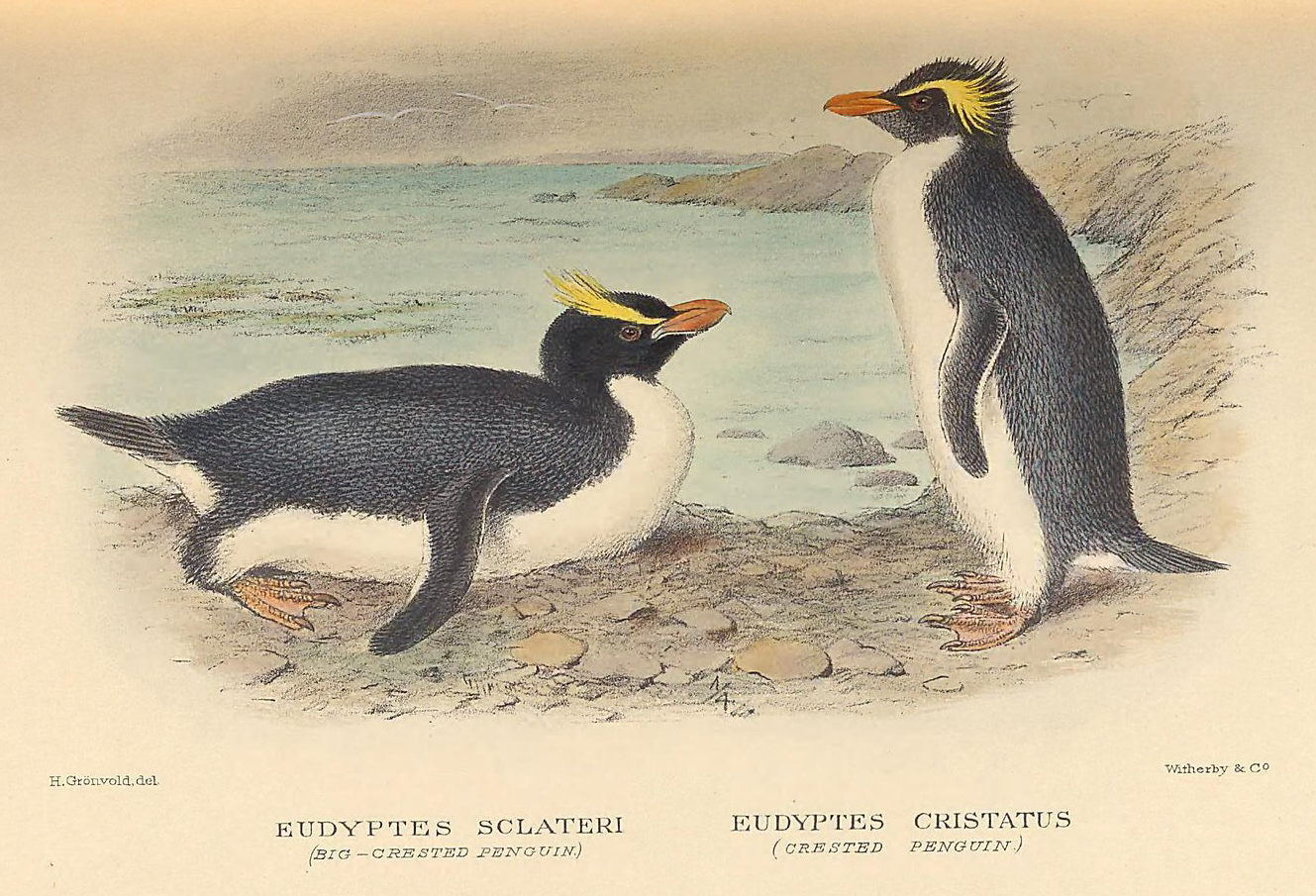
illustration of penguins

Plate 32. Mathews, Gregory M. (Gregory Macalister). The birds of Norfolk & Lord Howe Islands and the Australasian South Polar quadrant. 1928. Art by Henrik Grönvold. Contributed in BHL from Museums Victoria.

The birds of Norfolk & Lord Howe Islands includes 45 hand-coloured lithographs and monochrome plates, with this work being one of the last publications worldwide to include hand-coloured plates (Pasquier & Farrand 1991). These were the work of two illustrators — Henrik Grönvold and Frederick William Frohawk.

Grönvold was a well-known Danish naturalist and lithographer who predominately illustrated birds and their eggs. Born in 1858, he worked on a wide range of ornithological works, including Birds of Africa and The British Warblers, and he created a remarkable 600 plates for Mathew’s Birds of Australia.

Frederick William Frohawk was born in 1861 and had an interest in illustration and natural history from an early age, catching a rare pale clouded yellow butterfly at the age of seven. Despite losing virtually all sight in one eye during his school years, he went on to become a noted illustrator of butterflies and birds. Among his notable works is The complete book of British butterflies, which he both wrote and illustrated.

References

Kloot, T 1986, ‘Mathews, Gregory Macalister (1876–1949)’, Australian Dictionary of Biography, http://adb.anu.edu.au/biography/mathews-gregory-macalister-7517

Pasquier, R. F., & Farrand, J., Jr 1991, Masterpieces of Bird Art: 700 Years of Ornithological Illustration. Abbeville Press. pp. 180–181.

October 10, 2019by Joel Richard
Blog Reel, Campaigns, Her Natural History

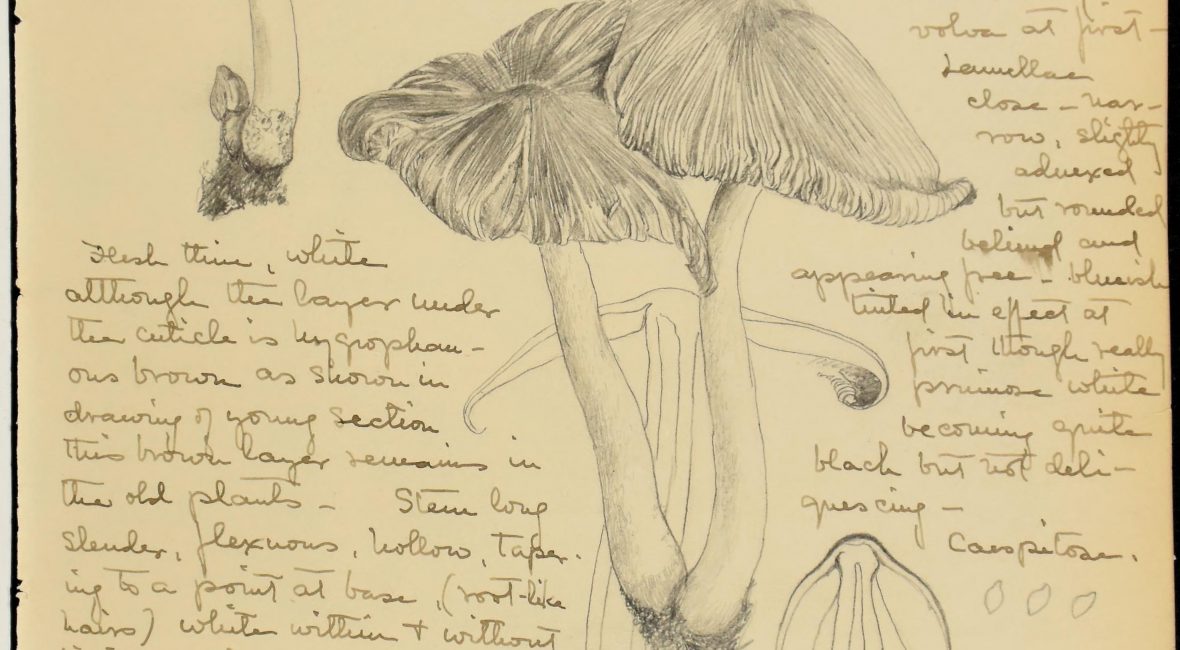
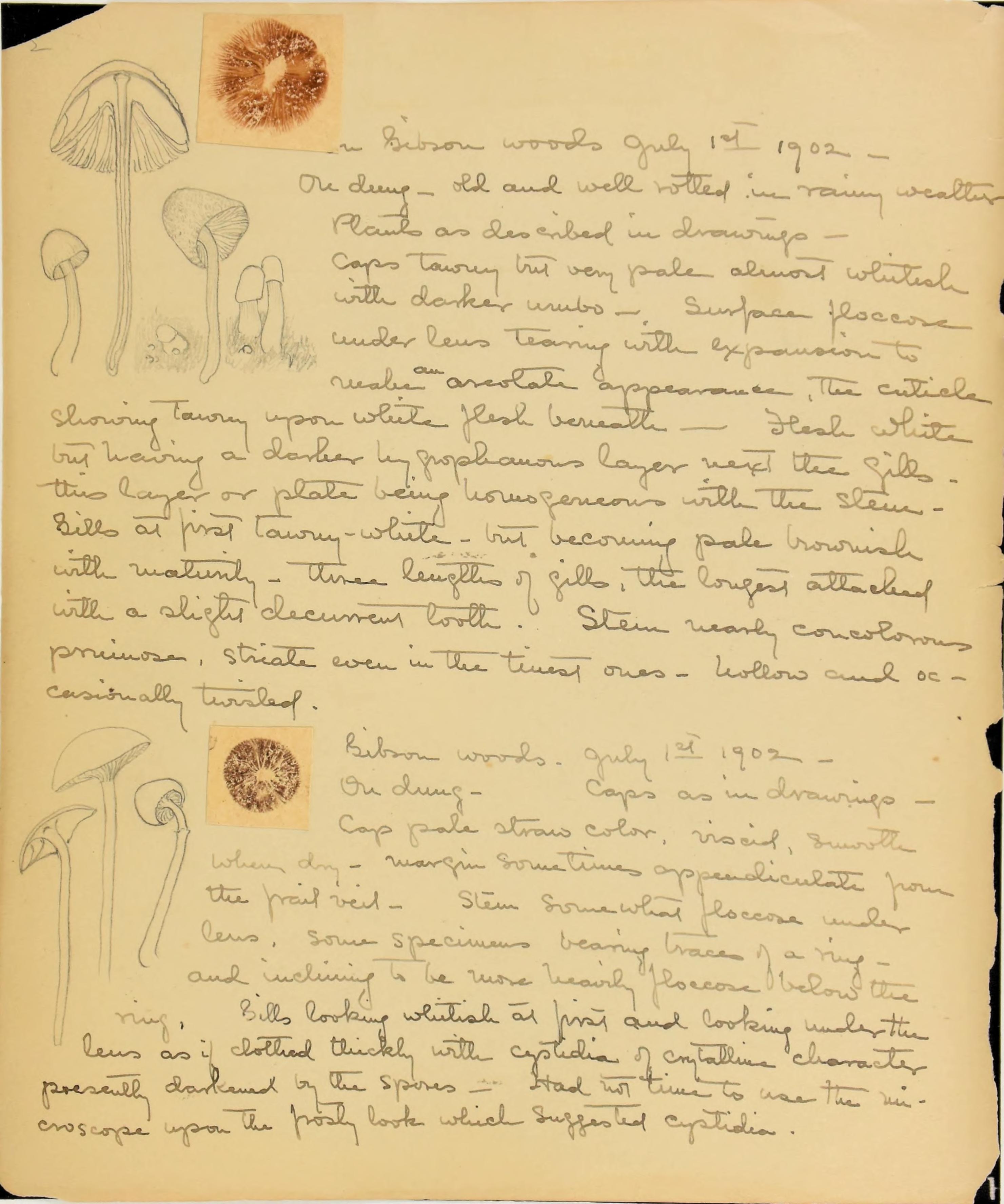
Henrietta Page sketchbook of fungi drawings

Page, Henrietta. [Sketchbook of drawings of fungi], volume II. Contributed in BHL Harvard University Herbarium, Botany Libraries.

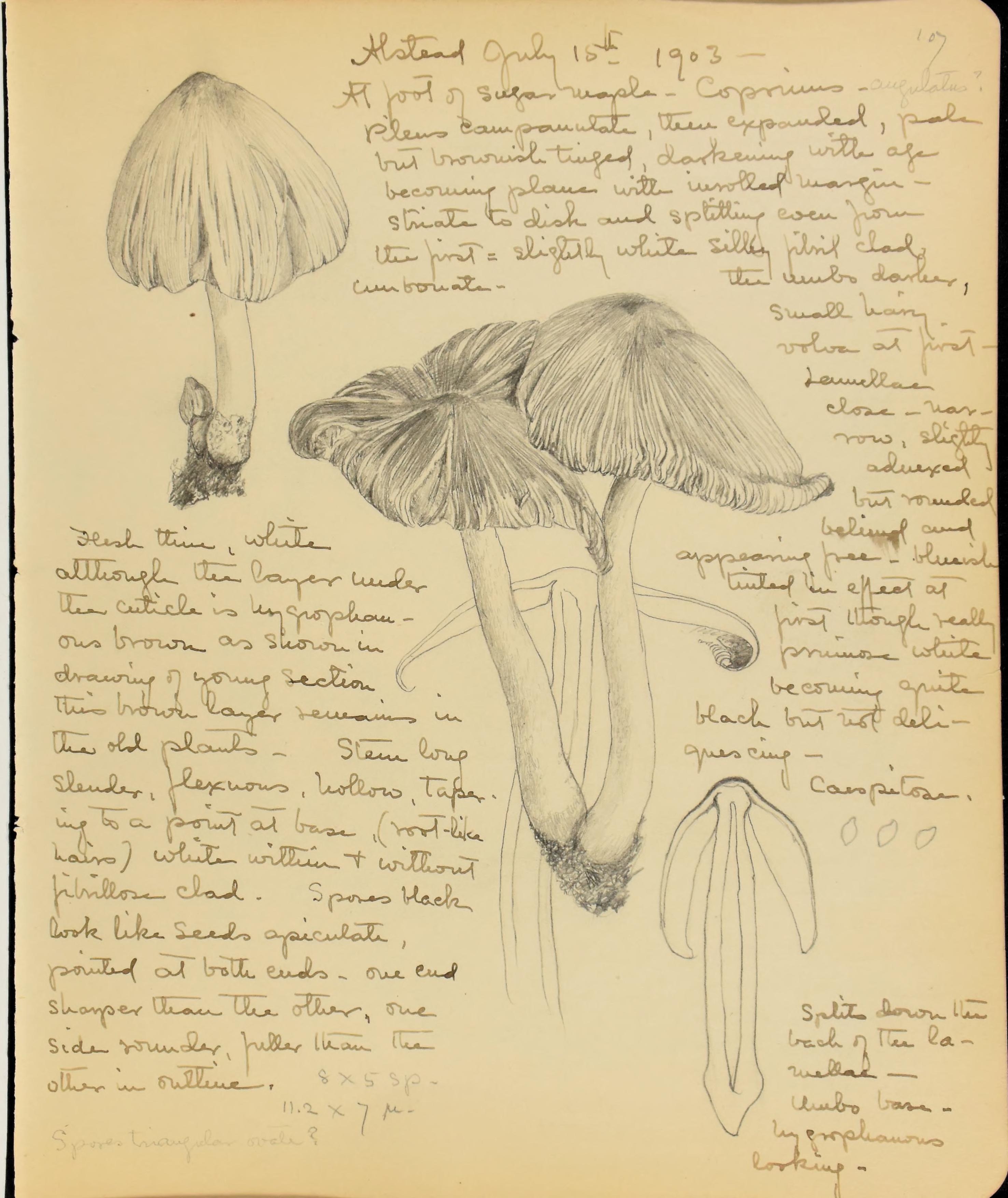
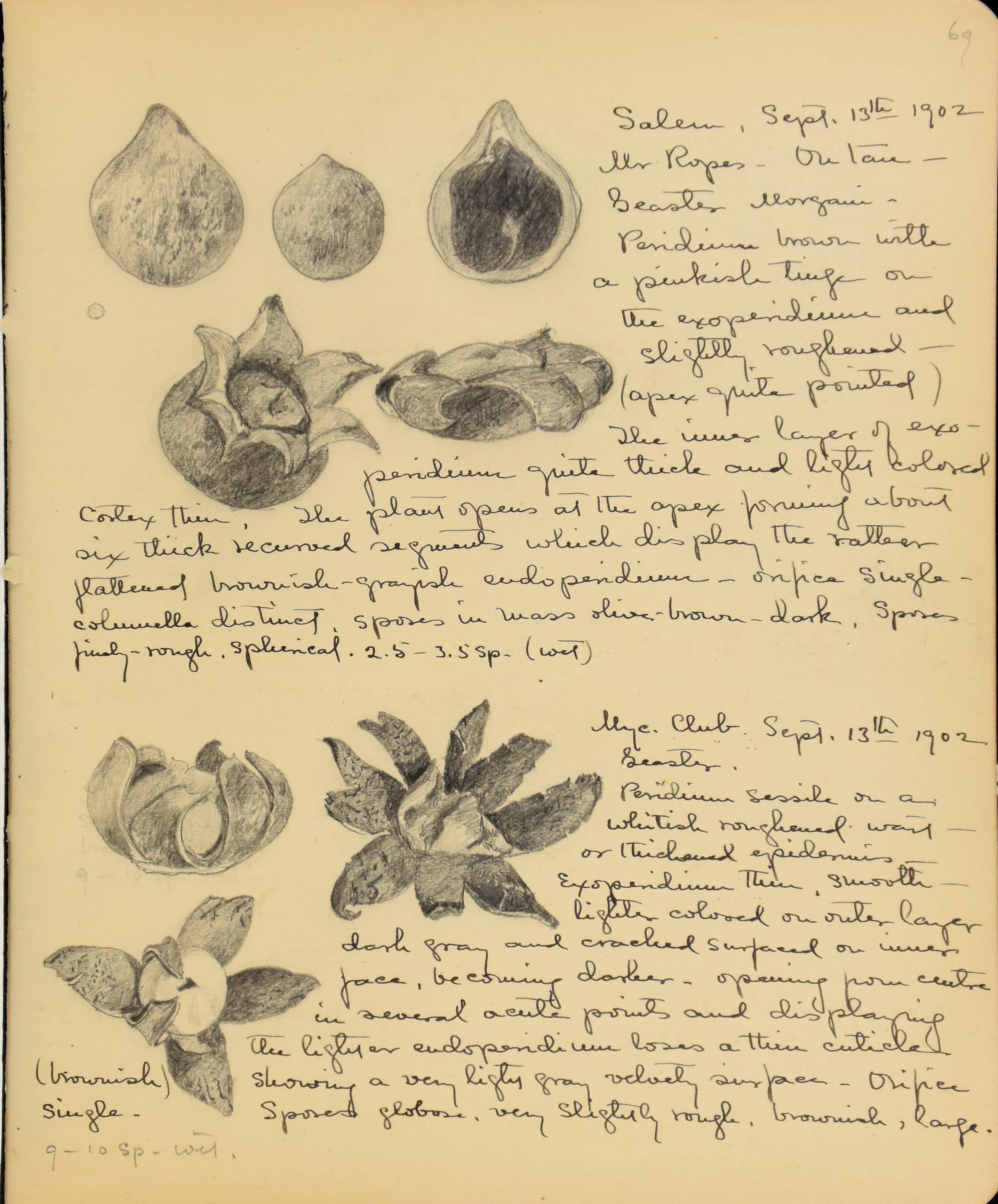
The Harvard Botany Libraries recently acquired and digitized Henrietta Page’s [Sketchbook of drawings of fungi], volume II. The sketchbook was a gift from the Boston Mycological Club (BMC) where Page was a member and served on the executive committee for a time. She was also a member of the Boston Society of Natural History. The sketchbook mostly describes fungi collected during July and August when Page attended three-week long natural history classes held in Alstead, New Hampshire under the Alstead School of Natural History from 1899-1903. The mycology section was taught by Hollis Webster, secretary and co-founder of the BMC and Harvard graduate (class of 1884); phanerogamic botany by Merritt Lyndon Fernald; ornithology by Ralph Hoffmann; and physiography and biology by William Lusk Webster Field. The school ran from 1899-1904.

The sketchbook was originally unattributed, but Jason Karakehian (BMC archivist) discovered that the sketchbook connects to specimens that are now housed in the fungarium at New York Botanical Garden (NYBG). The specimens were originally part of the Alstead School of Natural history fungarium, which was integrated into the BMC fungarium after the Alstead School’s closing. Jason was able to attribute the sketchbook to Ms. Page by searching the NYBG’s online database of specimens for fungal collections made in Alstead in the years 1900-1903, which yielded a few collections whose labels referred to Henrietta Page by name and referenced specific pages in her sketchbook “Vol. II.”

Page, Henrietta. [Sketchbook of drawings of fungi], volume II. Contributed in BHL Harvard University Herbarium, Botany Libraries.

There are a number of glass plate negatives, prints, and lantern slides of fungi in the BMC archive which were made by Hollis Webster in the 1902 and 1903 sessions of the School. These have been cleaned, organized, placed in archival negative envelopes, and listed in a spreadsheet. The specimens photographed do not appear to match those drawn by Ms. Page, but there is some overlap in taxa.

The sketchbook is a popular new acquisition and has already been used for several classes interested in field notes, women in science, and scientific illustrations.

Page, Henrietta. [Sketchbook of drawings of fungi], volume II. Contributed in BHL Harvard University Herbarium, Botany Libraries.

March 27, 2019by Joel Richard
Blog Reel, Campaigns, Featured Books, Her Natural History

Isabella in Hawaii: The Adventures of an Amateur Botanist in the 1860s

This post was originally published on the Chicago Botanic Garden, Lenhardt Library website in November 2014. It is authored by (now retired) Edward J. Valauskas, Curator of Rare Books.

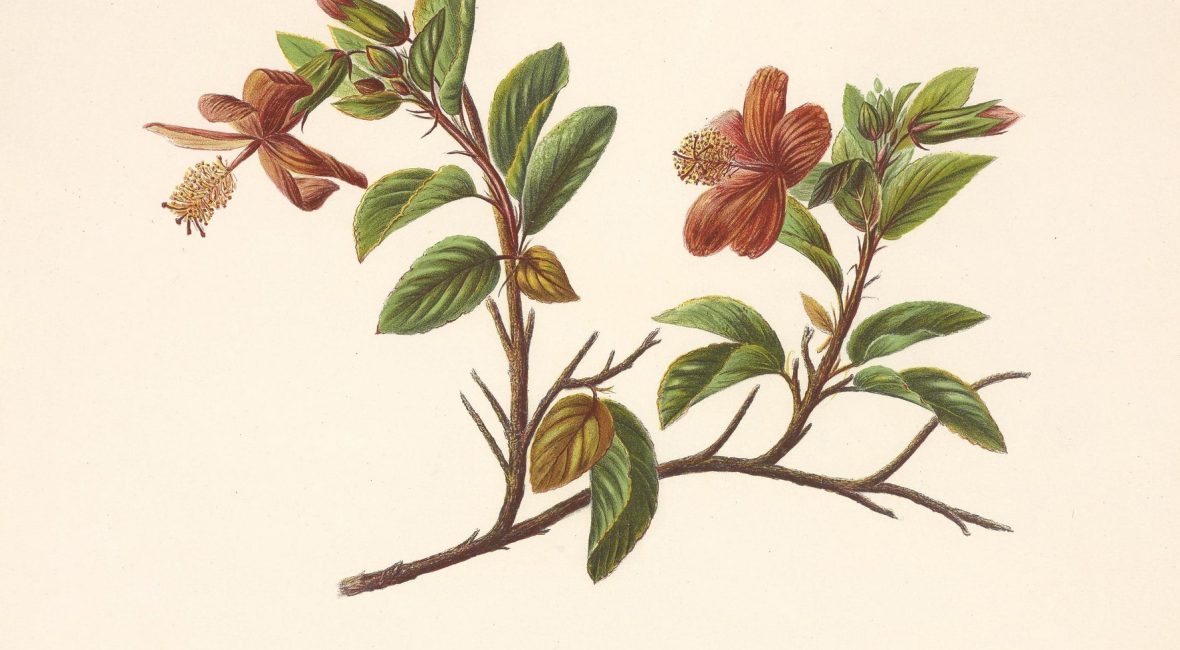
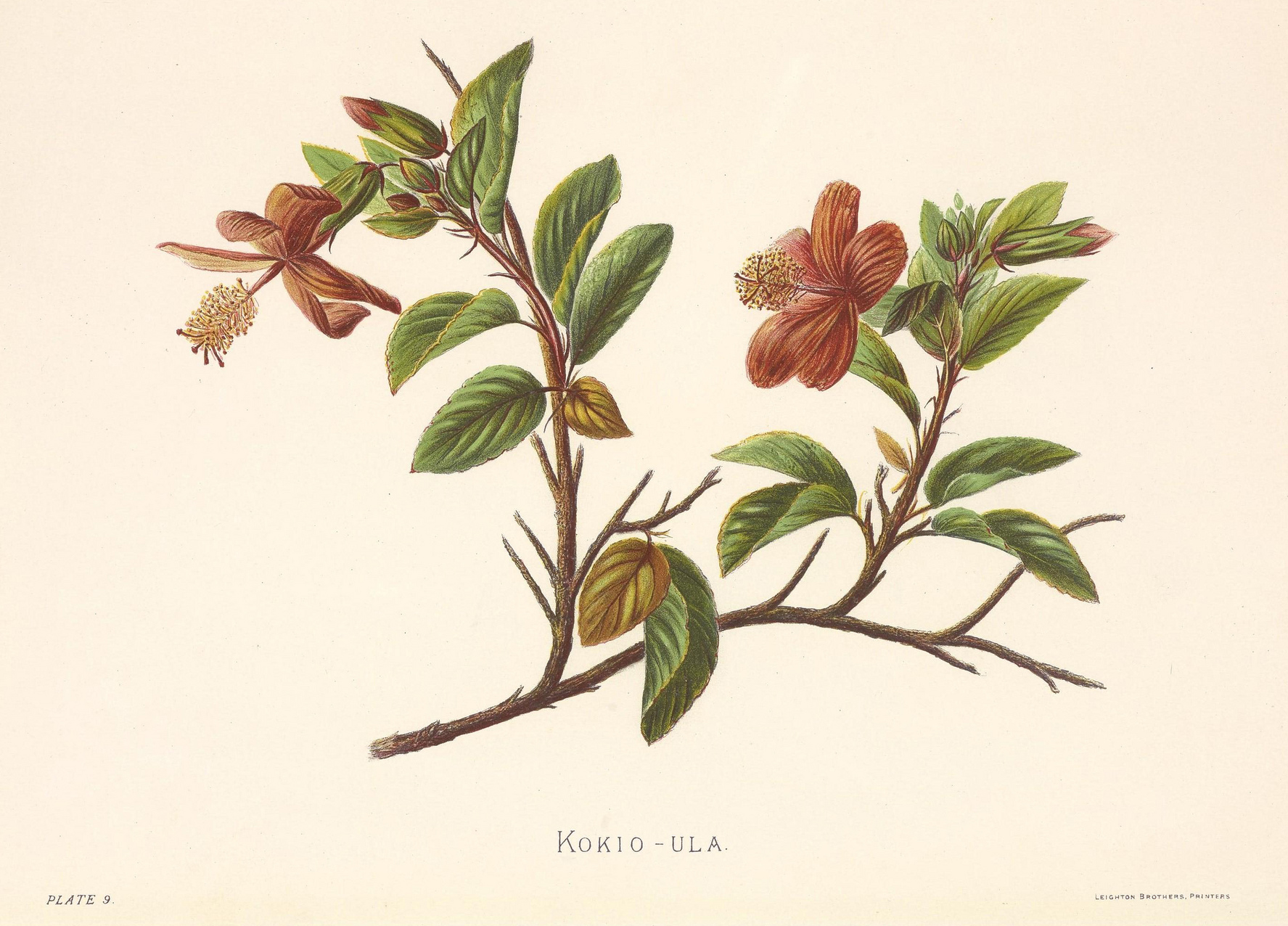
Kokiʻo ʻula. Art by Isabella McHutcheson Sinclair. Indigenous Flowers of the Hawaiian Islands. 1885. Contributed in BHL from the U.S. Department of Agriculture, National Agricultural Library.

How does a young woman create the most important record of Hawaiian flowers in the nineteenth century? Who helps her identify plants and find a London publisher? Why does she leave New Zealand for Niihau, the Forbidden Island? Thanks to a magnificent book in the Rare Book Collection of the Chicago Botanic Garden Library (and a little research), we can answer these questions.

With 44 delightful chromolithographed plates, Indigenous Flowers of the Hawaiian Islands is no ordinary book. Its illustrations introduced the world to an exotic, endemic, and vanishing flora. Indigenous Flowers provides a marker to measure the impact of humans on the fragile ecosystem of two Hawaiian islands, yet another signal of the Anthropocene epoch. Isabella McHutcheson Sinclair (1840–90) was probably the most unexpected ambassador for plant conservation. Her breadth of botanical experiences in the Pacific, in both New Zealand and the Sandwich Islands (better known today as Hawaii), gave her a particular vision to recognize the effects of humans on local flora and fauna.

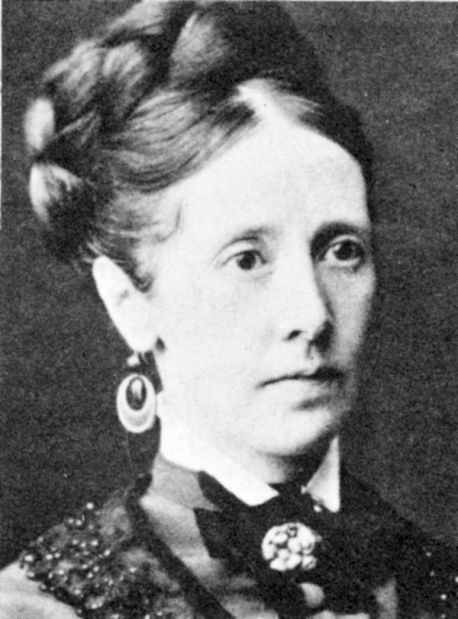
Isabella McHutcheson Sinclair (1840–90)

Isabella McHutcheson Sinclair (1840–90)

Isabella was born in Scotland, and migrated across the globe with her family to Canterbury, New Zealand, in 1861. A little more than 16,000 people of European descent resided in Canterbury at the time, making it the second most populous city in the country. Her father, William McHutcheson (1810–1905), moved to this faraway locale thanks to the energetic efforts of his sister Elizabeth McHutcheson Sinclair (1800–92). Better known as Eliza, she managed family prospects successfully, in part because her husband and son perished at sea in 1846.

After several decades in New Zealand, Elizabeth decided to try her luck elsewhere, moving to British Columbia in Canada in 1863. Eliza and her family found that the natives of British Columbia were quite different from Maori, and the mountainous, wooded terrain was much more difficult to clear and prepare for settlement and agriculture. Eliza decided to abandon Canada for California, but a friend recommended the Sandwich Islands instead.

In September 1863, Elizabeth Sinclair, et al. arrived in Honolulu via a circuitous route on the ship Bessie, starting in Vancouver and stopping in Los Angeles. Moving with speed, Eliza bought the island called Niihau for $10,000 from Kamehameha V (1830–72), the fifth monarch of Hawaii. Niihau, measuring about 70 square miles (or less than a third of Chicago’s 228 square miles), became the base for the expanding Sinclair family, including Isabella who married her cousin Francis.

Isabella and Francis worked with the Sinclair clan on Niihau, but decided to settle on the southern shore of the adjacent island of Kauai in Makaweli. Kauai is a little more than 17 miles southwest of Niihau, so Francis (known also as Frank) could easily move between family duties on the islands. Isabella, fortunately for botanical and artistic posterity, had the time and inclination to explore the vegetation of Kauai and Niihau.

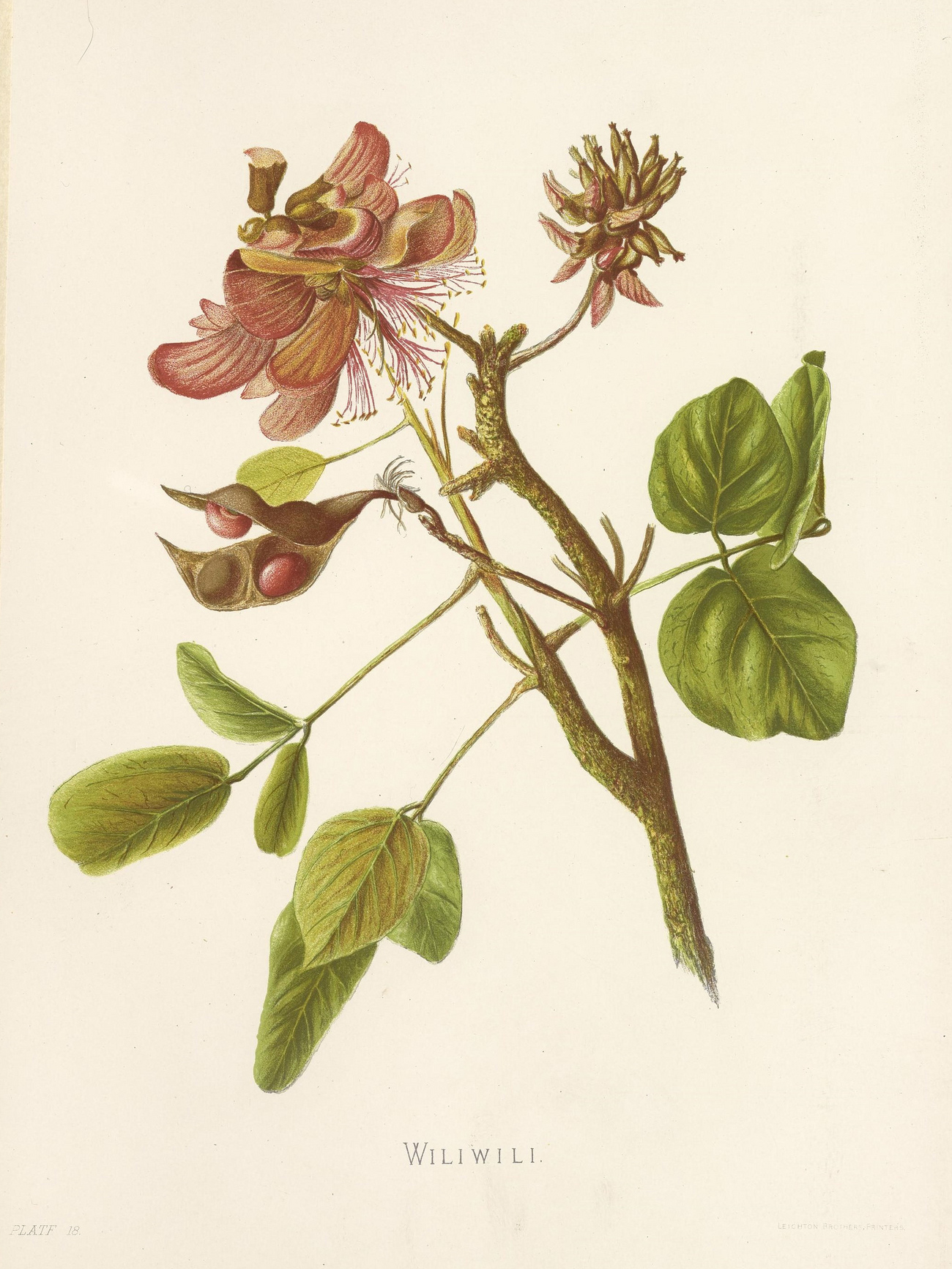
Wiliwili. Art by Isabella McHutcheson Sinclair. Indigenous Flowers of the Hawaiian Islands. 1885. Contributed in BHL from the U.S. Department of Agriculture, National Agricultural Library.

The Sinclair family was respected by natives on both islands, since Eliza, the matriarch, was recognized as a “chiefess.” Isabella, via the locals, was able to secure a great deal of information about her botanical discoveries, including vernacular names and medicinal properties. She explored extensively on Kauai, including Waimea Canyon, some 10 miles long and nearly 3,000 feet deep. Isabella used her specimens to create delicate and detailed watercolors for each plant. She organized her botanical information with notes on habitat and flowering times.

Isabella noticed that many of her Hawaiian flowers had similarities to those she found in New Zealand. She decided to take a bold step and contact the world’s expert on the Pacific flora, Sir Joseph Dalton Hooker (1817–1911). Hooker, director of Kew, was the author of the first descriptions of New Zealand’s flora in Flora novae-zelandiae (1853–55). Hooker collected specimens as a member of the British expedition to the Southern Ocean aboard the HMS Erebus between 1839–43. He quickly recognized the diversity of floras of different localities in the Pacific, but also saw similarities. His phytogeographical speculations were the first to trace botanical links to southern Africa, Asia, and South America.

In Flora novae-zelandiae, Hooker guessed that geology had some role to play in the botanical similarities of widely dispersed plants:

“Beyond the bare fact of the difficulty of accounting by any other means for the presence of the same species in two of the islands, there appeared nothing in the botany of the Antarctic regions to support or even to favour the assumption of a double creation, and I hence dismissed it as a mere speculation which, till it gained some support on philosophical principles, could only be regarded as shelving a difficulty; whilst the unstable doctrine that would account for the creation of each species on each island by progressive development on the spot, was contradicted by every fact.

It was with these conclusions before me, that I was led to speculate on the possibility of the plants of the Southern Ocean being the remains of a flora that had once spread over a larger and more continuous tract of land than now exists in that ocean; and that the peculiar Antarctic genera and species may be the vestiges of a flora characterized by the predominance of plants which are now scattered throughout the southern islands.”

Hooker found that the flora of New Zealand was largely endemic, by his calculations two-thirds “peculiar” (his description) to the islands, while one-third related to Australia or South America. A more recent calculation, in the first volume of Harry Howard Allan’s masterful Flora of New Zealand, finds that 80 percent of the plants are endemic.

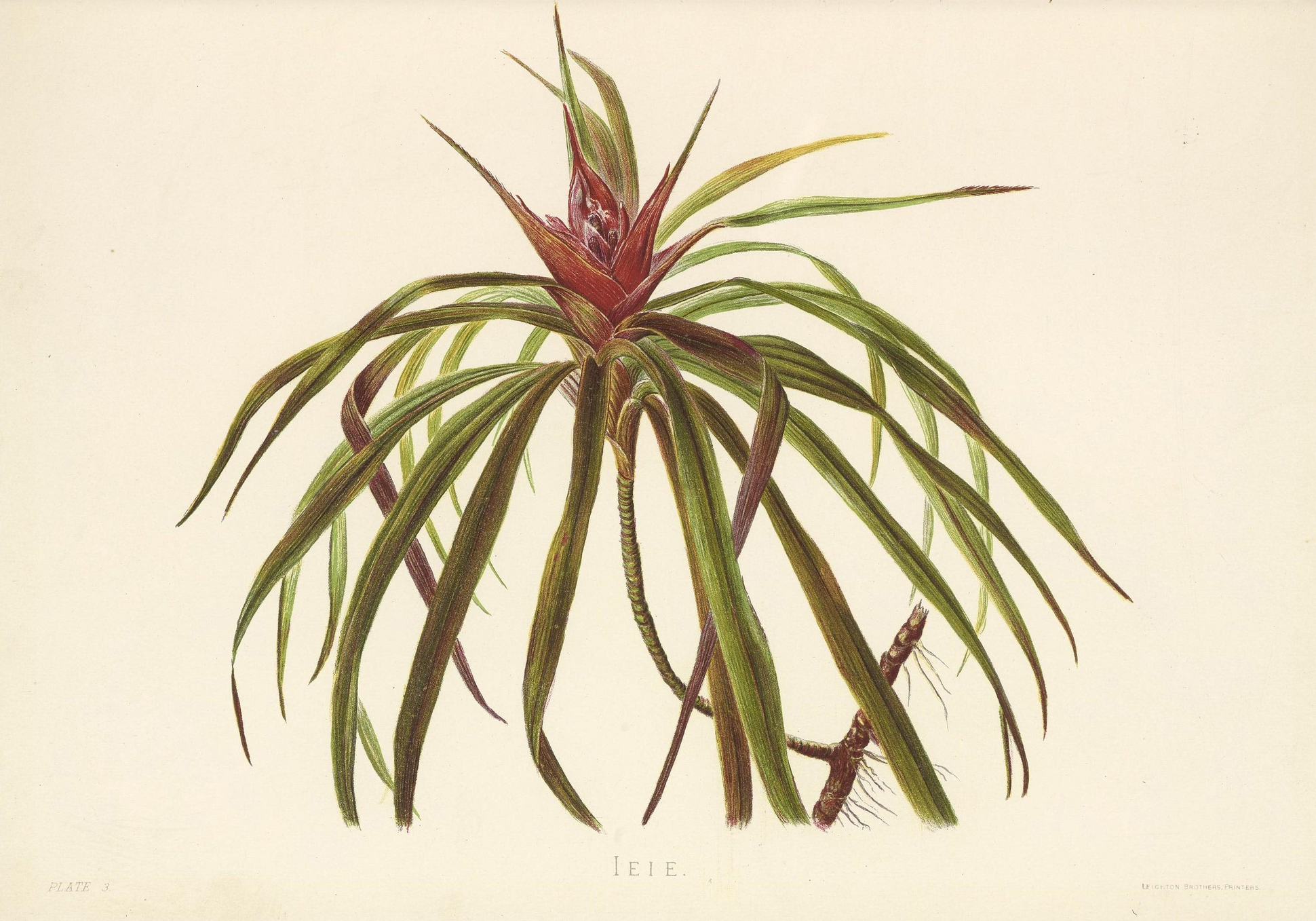
ʻIeʻie. Art by Isabella McHutcheson Sinclair. Indigenous Flowers of the Hawaiian Islands. 1885. Contributed in BHL from the U.S. Department of Agriculture, National Agricultural Library.

Hooker needed more data to confirm his notions of a primeval landmass, which today we know as Gondwana. His duties at Kew certainly prevented him from carrying out more field-work, so he was dependent on his colleagues and talented amateurs, like Isabella in Hawaii. Hooker knew the risks of depending on citizen scientists. In Flora novae–zelandiae, he issued a cautionary reminder:

“The very many aspirants to a knowledge of science whom I have had the pleasure of knowing in the Colonies, though well educated in the ordinary acceptation of the term, have never been trained to habits of observation, or of reasoning upon what they read in the book of nature, nor have they been grounded in the elements of natural science; they are hence prone to rely for information on these speculative subjects (which they seek with avidity) upon a class of works that are, with very few exceptions, by authors who have no practical acquaintance with the sciences they write about, or with the facts they so often distort.”

Imagine Hooker’s surprise when he first heard from Isabella! She sought his taxonomic advice on the scientific names of her discoveries in the northern outposts of the Sandwich Islands. Isabella provided exquisite details on the occurrence of each plant, plus a bonus of amazing watercolors. She was no ordinary observer of flowers, thanks to her New Zealand experiences and connections to both the Maori and Polynesians.

Hooker encouraged Isabella to publish her watercolors and observations in a book on flowers of Hawaii. She must have been both flattered and embarrassed to have one of the greatest botanists on the planet recognize the value of her efforts. Finally in 1884, Isabella and her husband made the long voyage to London to put her findings into print as Indigenous Flowers of the Hawaiian Islands.

Published by Sampson, Low, Marston, Searle, and Rivington in London, Indigenous Flowers was also an experiment. It was one of the earliest books to use “perfect binding” which is anything but perfect. Probably in an effort to reduce costs for the volume, letterpress and chromolithographic plates in Indigenous Flowers were glued rather than sewn to the binding. Given the small press run, this perfect binding has led to copies losing pages and plates over time, probably encouraging some extant copies to move to the guillotine for print merchants. Four years after the appearance of the London edition in 1885, Houghton in Boston published an American version (which is even scarcer than the rare London edition). Hooker pressed Isabella to write as an introduction to her work some impressions of the flora of the islands. With extraordinary prescience, Isabella recognized the fragility of the habitats on her beloved islands:

“The Hawaiian flora seems … to grow in an easy careless way, which, though pleasingly artistic, and well adapted to what may be termed the natural state of the islands, will not long survive the invasion of foreign plants, and changed conditions. Forest fires, animals, and agriculture, have so changed the islands, within the last fifty or sixty years, that one can now travel for miles, in some districts, without finding a single indigenous plant; the ground being wholly taken possession of by weeds, shrubs, and grasses, imported from various countries.”

According to the National Tropical Botanical Garden, the Hawaiian Islands are home to more than 1,300 endemic plant species, of which 100 are extinct and 273 are threatened or endangered. Isabella Sinclair recognized this problem 130 years ago in Indigenous Flowers of the Hawaiian Islands. Her book provides a standard for measuring the flora of those islands as well as providing an artistic expression of the beauty of these special plants.

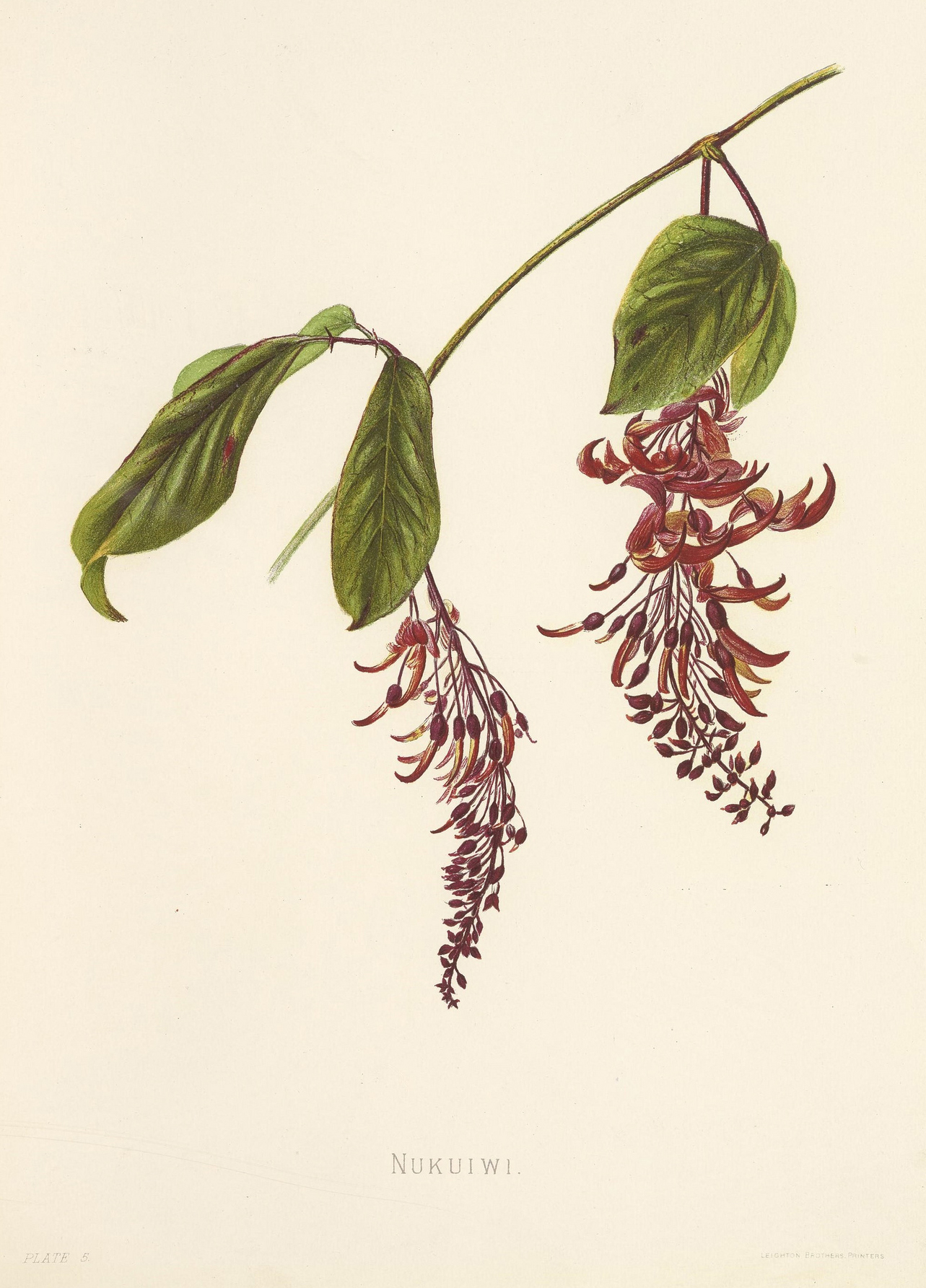
Nukuiwi. Art by Isabella McHutcheson Sinclair. Indigenous Flowers of the Hawaiian Islands. 1885. Contributed in BHL from the U.S. Department of Agriculture, National Agricultural Library.

Harold St. John (1892–1991), professor of botany at the University of Hawaii, analyzed the content of Indigenous Flowers. His resulting paper, published in 1954 in the journal Pacific Science, found that Isabella described in Indigenous Flowers 37 indigenous species. Of these, 23 were native to Kauai but not Niihau, while 15 were found on both islands.

Mark Twain visited Hawaii for several months in 1866 as a reporter for the newspaper The Sacramento Union. He was quite impressed by the beauty of Hawaii and the lives of the natives. Decades later, he wrote:

“For me its balmy airs are always blowing, its summer seas flashing in the sun; the pulsing of its surf is in my ear; I can see its garlanded crags, its leaping cascades, its plumy palms drowsing by the shore, its remote summits floating like islands above the cloud-rack; I can feel the spirit of its woody solitudes, I hear the plashing of the brooks; in my nostrils still lives the breath of flowers that perished twenty years ago.”

Thanks to Isabella McHutcheson Sinclair’s Indigenous Flowers of the Hawaiian Islands, we can experience that magical world, battling for survival.

March 11, 2019by michelle.underhill
Blog Reel, User Stories

What’s This Bird? Classify Old Natural History Drawings with R

illustration of birds

This post was originally published on the rOpenSci blog on 28 August 2018 and is republished with permission of the author, Dr. Maëlle Salmon, and rOpenSci.

Armed with rOpenSci’s packages binding powerful C++ libraries and open taxonomy data, how much information can we automatically extract from images? Maybe not much, but, experimenting with gorgeous drawings from a natural history collection, we can least explore image manipulation, optical character recognition (OCR), language detection, and taxonomic name resolution with rOpenSci’s packages.

Free natural history images and appropriate R tooling!

A long time ago I had bookmarked the Flickr account of the Biodiversity Heritage Library (BHL). So many beautiful images of biodiversity, moreover free to use! In particular, I downloaded all pictures from one of the Birds of Australia albums (contributed in BHL by Museums Victoria).

I wanted to try to extract the bird names from images using packages of Jeroen Ooms’, rOpenSci’s post-doc hacker & C(++)-bindings wizard. For that I worked with magick for image manipulation, tesseract for optical character recognition (OCR), cld2/cld3 for language detection… Quite the armory! We’ll also sprinkle some taxonomy magic by Scott Chamberlain, one of rOpenSci’s co-founders, to resolve the names extracted.

OCR bird naming workflow, piece by piece

In this section, we explain the different elements of our R workflow: preparing images, extracting text, resolving taxonomic names.

Image preparation

I saved the pictures locally in a “birds” folder. Yes, I click-buttoned instead of using the Flickr API for which e.g. Jim Hester wrote a minimal R wrapper… I don’t do everything with R scripts (yet).

library("magrittr") 
filenames <- fs::dir_ls("birds")

Each image shows a bird and its name. Images are either landscape- or portrait-oriented, but for the sake of simplicity, I’ll act as if they were all portrait-oriented. A possible easy and lazy fix here would be to duplicate images rotated (magick::image_rotate) in all possible directions and then to apply the workflow to all 4 versions of each image, hoping to get good data from one of the rotated versions.

magick::image_read(filenames[1])
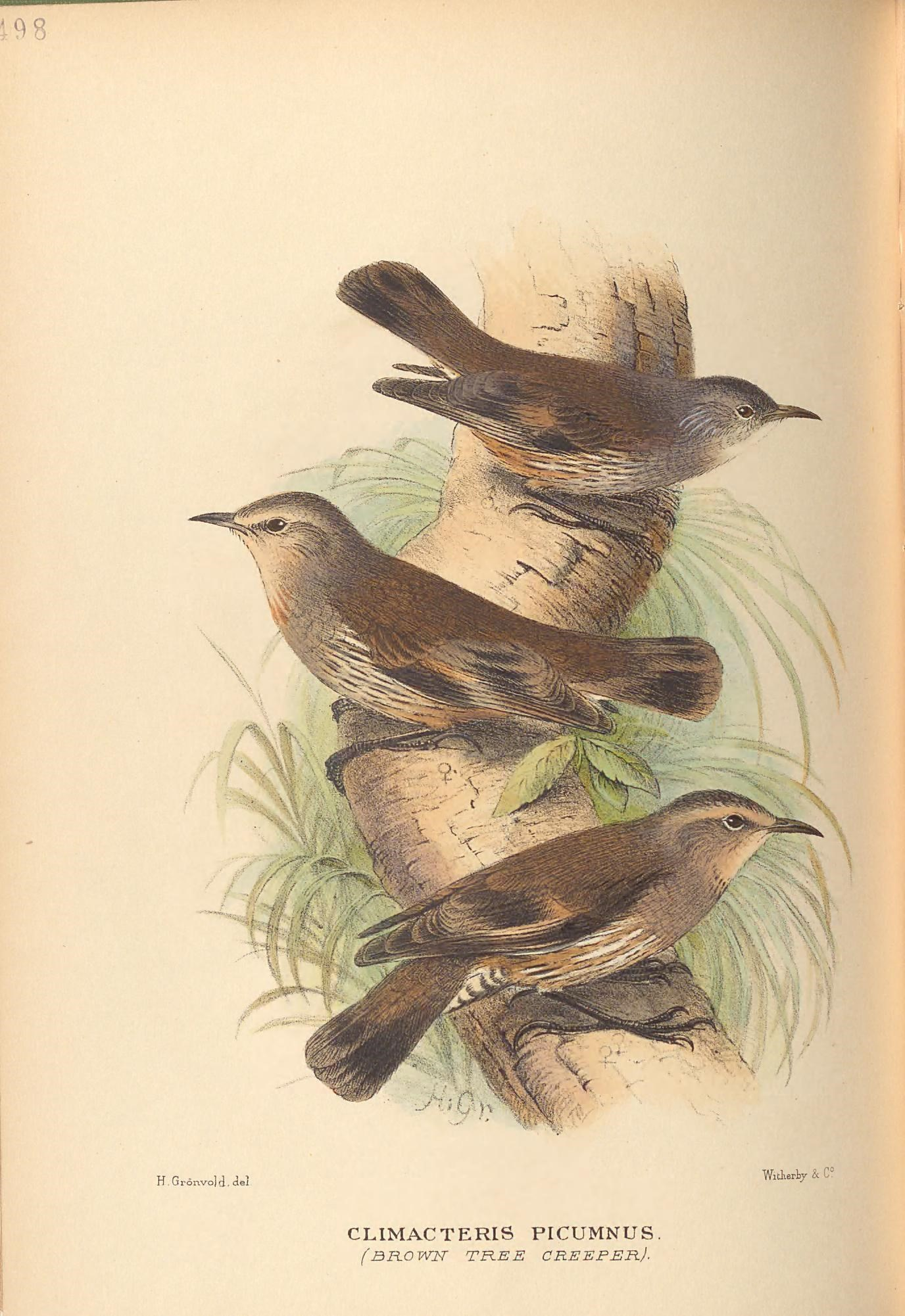
illustration of birds

Mathews, Gregory M. The Birds of Australia. v. 11 (1923-24). Art by Henrik Grönvold. Contributed in BHL from Museums Victoria.

From that image, I wanted to extract the name indicated below the bird. To maximize the efficiency of OCR, I shall first prepare the image, since the accuracy of OCR depends on the quality of the input image which can be influenced a bit. This part could be tweaked even more, and in real life examples it’ll be worth spending time trying different magick functions and parameter values. Since I have in mind the case of a bunch of images to be batch-processed, nothing is done by hand.

crop_bird <- function(filename){
  image <- magick::image_read(filename)

  height <- magick::image_info(image)$height

  # crop the top of the image
  image <- magick::image_crop(image, 
                     paste0("+0+",round(0.75*height))) %>%
    # convert the image to black and white
    magick::image_convert(type = "grayscale") %>%
    # increase brightness
    magick::image_modulate(brightness = 120) %>%
    magick::image_enhance() %>%
    magick::image_median() %>%
    magick::image_contrast() 

  # we'll need the filename later
  attr(image, "filename") <- filename

  return(image)
}

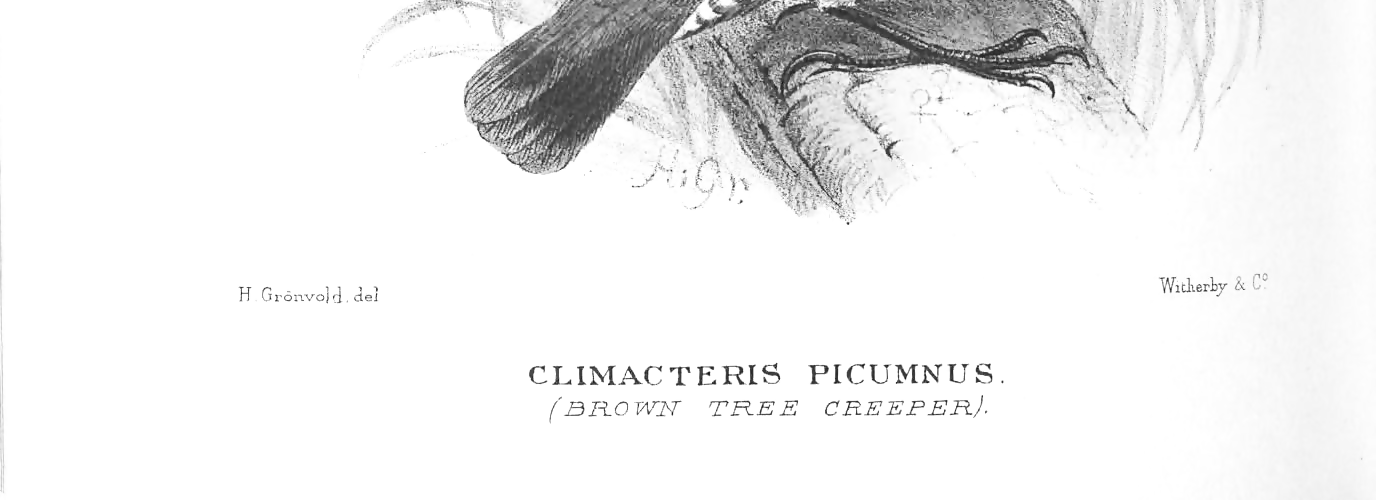
crop_bird(filenames[1])
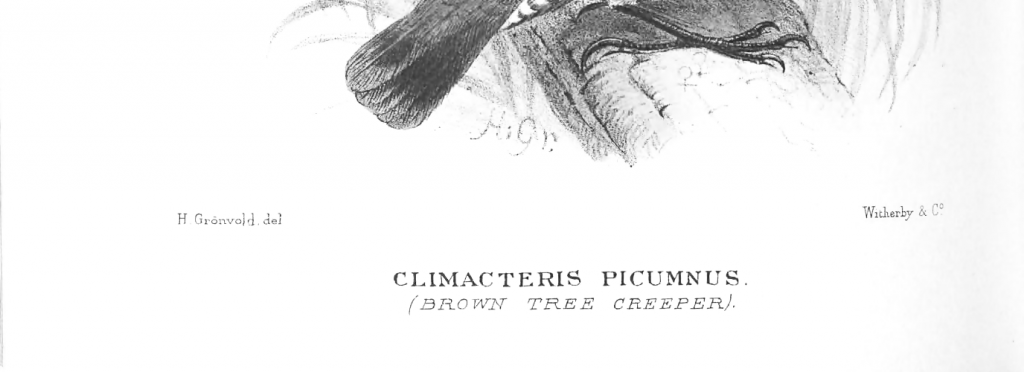
scientific name of birds on a drawing

It does look cleaner now!

Text extraction

Now is the actual OCR step! The tesseract package provides bindings to the Tesseract OCR engine, free software currently sponsored by Google. It is a powerful engine, with a ton of parameters. Here again, tweaking a lot is warranted. Particularly useful reads are hocr vignette and this Wiki page of Tesseract about improving the quality of the output. The hocr package might be of interest for post-processing of OCR results.

Below, the only option changed from default is the page segmentation mode choosing 1 for “Automatic page segmentation with Orientation and script detection (OSD)”. When using Latin instead of English training data the results were not as good.

One can use either tesseract::ocr for a file path, url, or raw vector to image, or magick::image_ocr for a magick object which is quite handy in our pipeline.

The function below also filters results of the OCR using language detection. By only keeping text recognized as either Latin or English by one of the two language detection packages cld2 and cld3 that are interfaces to Google compact language detectors 2 and 3, one gets a first quality filter. If not doing that, the output would contain more unusable text.

get_names <- function(image){
  filename <- attr(image, "filename")
  ocr_options <- list(tessedit_pageseg_mode = 1)

  text <- magick::image_ocr(image, options = ocr_options)
  text <- stringr::str_split(text, "\n", simplify = TRUE)
  text <- stringr::str_remove_all(text, "[0-9]")
  text <- stringr::str_remove_all(text, "[:punct:]")
  text <- trimws(text)
  text <- stringr::str_remove_all(text, "~")
  text <- text[text != ""]
  text <- tolower(text)

  # remove one letter words
  # https://stackoverflow.com/questions/31203843/r-find-and-remove-all-one-to-two-letter-words
  text <- stringr::str_remove_all(text, " *\\b[[:alpha:]]{1,2}\\b *")
  text <- text[text != ""]

  # keep only the words that are recognized as either Latin
  # or English by cld2 or cld3
  if(length(text) > 0){
    results <- tibble::tibble(text = text,
                 cld2 = cld2::detect_language(text),
                 cld3 = cld3::detect_language(text),
                 filename = filename)

  results[results $cld2 %in% c("la", "en") |
          results$cld3 %in% c("la", "en"),]
  }else{
    return(NULL)
  }


}

(results1 <- filenames[1] %>%
  magick::image_read() %>%
  get_names())
## NULL

Nothing! Now if we replace magick::image_read with the previously defined crop_bird function that crops and cleans the image…

(results2 <- filenames[1] %>%
  crop_bird() %>%
  get_names())
## # A tibble: 2 x 4
##   text                 cld2  cld3  filename                          
##   <chr>                <chr> <chr> <chr>                             
## 1 climacteris picumnus <NA>  la    birds/n115_w1150_42399797481_o.jpg
## 2 brown tree creeper   en    <NA>  birds/n115_w1150_42399797481_o.jpg

We get a result! So we see that the image transformation was quite useful.

Now, these names look fine, but how to be sure they’re actually taxonomic names?

Taxonomic name resolution

The taxize package by Scott Chamberlain, is a taxonomic toolbelt for R, providing access to many fantastic data sources and tools for taxonomy. One of them, the Global Name Resolver, provides, well, resolution of taxonomic names, sadly not common names. taxize::gnr_resolve has many options, of which only one is used below: best_match_only = TRUE means it’ll only return the best match from the different data sources.

latin <- results2$text[results2$cld2 == "la"|
                         results2$cld3 == "la"]
taxize::gnr_resolve(latin,
  best_match_only = TRUE)
## # A tibble: 1 x 5
##   user_supplied_name submitted_name  matched_name   data_source_tit~ score
## * <chr>              <chr>           <chr>          <chr>            <dbl>
## 1 climacteris picum~ Climacteris pi~ Climacteris p~ NCBI             0.988

English names could be cleaned up a bit using the spelling package, also an rOpenSci package, since spelling::spell_check_text would output possible typos.

OCR bird naming workflow in action!

First the two steps image processing and OCR are applied to all images.

bird_names <- purrr::map(filenames, crop_bird) %>%
  purrr::map_df(get_names)

Out of 51 images only 17 are present in the final table with possible names which is a bit disheartening, but one could surely do better in the image processing and OCR tweaking steps! Maybe one could frame the parameter search as a machine learning problem. Please also keep in mind that such natural history images are quite hard to parse.

The name resolution information can be added to this table.

safe_resolve <- function(text){

  results <- taxize::gnr_resolve(text,
                                 best_match_only = TRUE)

  if(nrow(results) == 0){
    list(NULL)
  }else{
    list(results)
  }
}

bird_names <- dplyr::group_by(bird_names, text) %>%
  dplyr::mutate(gnr = ifelse(cld2 == "la" | cld3 == "la",
                             safe_resolve(text),
                             list(NULL)))

We do not get much resolution, but we knew the names weren’t very good to start with. A better (untested here!) idea here might be to get a full list of names of Australian birds, potentially leveraging the taxizedb package by Scott Chamberlain, and to then fuzzy-match them with the names we have.

unique(bird_names$gnr)
## [[1]]
## # A tibble: 1 x 5
##   user_supplied_name submitted_name  matched_name   data_source_tit~ score
## * <chr>              <chr>           <chr>          <chr>            <dbl>
## 1 climacteris picum~ Climacteris pi~ Climacteris p~ NCBI             0.988
## 
## [[2]]
## [1] NA
## 
## [[3]]
## NULL
## 
## [[4]]
## # A tibble: 1 x 5
##   user_supplied_na~ submitted_name  matched_name  data_source_title  score
## * <chr>             <chr>           <chr>         <chr>              <dbl>
## 1 austrodicaeum ii~ Austrodicaeum ~ Austrodicaeu~ The Interim Regis~  0.75
## 
## [[5]]
## # A tibble: 1 x 5
##   user_supplied_name submitted_name  matched_name   data_source_tit~ score
## * <chr>              <chr>           <chr>          <chr>            <dbl>
## 1 melithreptus laet~ Melithreptus l~ Melithreptus ~ CU*STAR          0.988
## 
## [[6]]
## # A tibble: 1 x 5
##   user_supplied_na~ submitted_name matched_name  data_source_title   score
## * <chr>             <chr>          <chr>         <chr>               <dbl>
## 1 rad isdlvorniode  Rad isdlvorni~ Rad Baker & ~ The Interim Regist~  0.75

Conclusion

rOpenSci packages supporting this (and your) workflow

In this post, we made use of R packages quite useful to wrangle information from diverse formats:

  • magick for image manipulation,
  • tesseract for optical character recognition (OCR),
  • cld2/cld3 for language detection.

We also used a function from taxize allowing us to use the Global Name Resolver. Discover more packages from our suite here.

Applicability of this OCR bird naming workflow

Actually, the BHL itself provides OCR output for its collection, see this example. I wasn’t able to find information about the software powering this OCR. What I was able to find out is that the BHL uses purposeful gaming in its OCR workflow. The raw OCR results aren’t much better than what we got in this post which is comforting.

More data from the Biodiversity Heritage Library

If you’re interested in other types of data from the BHL, in addition to the images, have a look at the rbhl package, part of rOpenSci’s suite, that interacts with the BHL API. One can e.g. search all books by the same author as the one we used images from.

author <- rbhl::bhl_authorsearch("Gregory M Mathews")
books <- rbhl::bhl_getauthortitles(creatorid = author$CreatorID)
head(books$FullTitle)
## [1] "A manual of the birds of Australia,"                                                                                                                                                                                                                                          
## [2] "A list of the birds of the Phillipian sub-region : which do not occur in Australia. "                                                                                                                                                                                         
## [3] "A manual of the birds of Australia /"                                                                                                                                                                                                                                         
## [4] "A list of the birds of Australia : containing the names and synonyms connected with each genus, species, and subspecies of birds found in Australia, at present known to the author /"                                                                                        
## [5] "Austral avian record; a scientific journal devoted primarily to the study of the Australian avifauna."                                                                                                                                                                        
## [6] "Arcana, or, The museum of natural history : containing the most recent discovered objects : embellished with coloured plates, and corresponding descriptions : with extracts relating to animals, and remarks of celebrated travellers; combining a general survey of nature."

Or we could get all books whose title contains the words “birds” and “australia”.

australia_birds <- rbhl::bhl_booksearch(title = "birds Australia")
head(australia_birds$FullTitle)
## [1] "Handbook to the birds of Australia. : [Supplementary material in Charles Darwin's copy]."
## [2] "An introduction to The birds of Australia /"                                             
## [3] "The useful birds of southern Australia : with notes on other birds /"                    
## [4] "The Birds of Australia"                                                                  
## [5] "The birds of Australia,"                                                                 
## [6] "The birds of Australia,"

And to get the OCR results of the pages of the book we used, we could write:

library("magrittr")

# ocr=TRUE to extract OCR for all pages
rbhl::bhl_getitempages("250938", ocr = TRUE) %>%
  # for each page transform the type into a string
  dplyr::group_by(PageUrl) %>%
  dplyr::mutate(page_type = toString(PageTypes[[1]])) %>%
  # keep only the illustration pages
  # that are like the ones we used 
  dplyr::filter(page_type == "Illustration") %>%
  # from the data.frame extract the OCR
  dplyr::pull(OcrText) %>%
  head()
## [1] "491 \nFAL CUNCULUS LEUCOGASTER. \n( WHITE -BELLIED £ If BIKE - TIT) \nFALCUNCULUS FRONTATUS. \nSHRIKE - TIT). \n"                                                                                                                   
## [2] "492 \nA** \nOREOICA GUTTURALIS. \n(CRESTED BELL-BIRD). \n"                                                                                                                                                                          
## [3] "APHELOCEPHALA LEUCOPSIS \n( WHITE FACE ). \n"                                                                                                                                                                                       
## [4] "* \nAPHELOCEPHALA PE CTORALIS. \n(CHE <3 TNUT -BREASTED WHITEFA CEj. \nAPHELOCEPHALA NIGRICINCTA. \n(BE A CK-BAH.DED WHITE FA CEj. \n"                                                                                              
## [5] "H . Gronvold. del. \nWitherLy & C° \nSPHENOSTOMA CRIS TATUM \n(WEDGE BIEL). \n"                                                                                                                                                     
## [6] "49 6 \nH \n(jronvolcl. del. \nN E O SIT TA LE CJ C O CE PHAI.A. \n( WHITE ¦ HE AID EE THE EH UN HE FL). \nNEOSHTA ALBATA \n(F IE E> T Ft E EE UNNEFlj. \nNEOSITTA CHRYSOPTERA \nf OFi. A. NGE - wing-e d tree runner). \nWitWLjA \n"

So there’s quite a lot to explore!

More birding soon!

Follow this series on the rOpenSci blog to explore this topic further! In the meantime, happy birding!

October 4, 2018by michelle.underhill
Page 1 of 3123»

Help Support BHL

BHL's existence depends on the financial support of its patrons. Help us keep this free resource alive!
search

About BHL

The Biodiversity Heritage Library (BHL) is the world’s largest open access digital library for biodiversity literature and archives. BHL operates as a worldwide consortium of natural history, botanical, research, and national libraries working together to digitize the natural history literature held in their collections and make it freely available for open access as part of a global “biodiversity community.”

Join Our Mailing List

Sign up to receive the latest news, content highlights, and promotions.

Subscribe Now

Subscribe to Blog via Email

Enter your email address to subscribe to this blog and receive notifications of new posts by email.

Join 319 other subscribers

Subscribe to Blog Via RSS

Subscribe to the blog RSS feed to stay up-to-date on all the latest BHL posts.

Access RSS Feed

Inspiring Discovery through Free Access to Biodiversity Knowledge.

The Biodiversity Heritage Library makes it easier than ever for you to access the information you need to study and explore life on Earth…for free, anytime, anywhere.


64+ Million Pages of
Biodiversity Literature Online.

EXPLORE

Tools and Services
to Transform Research.

EXPLORE

300,000+
Illustrations on Flickr.

EXPLORE

ABOUT | HARMFUL CONTENT | PRIVACY | SITE MAP | TERMS OF USE