Biodiversity Heritage Library - Program news and collection highlights from BHL
  • Home
  • News
  • Featured Books
    • All Featured Books
    • Book of the Month Series
    • BHL at 20
  • User Stories
  • Campaigns
    • Fossil Stories
    • Garden Stories
    • Monsters Are Real
    • Page Frights
    • Her Natural History
    • Earth Optimism 2020
  • Tech Blog
  • Visit BHL
Home
News
Featured Books
    All Featured Books
    Book of the Month Series
    BHL at 20
User Stories
Campaigns
    Fossil Stories
    Garden Stories
    Monsters Are Real
    Page Frights
    Her Natural History
    Earth Optimism 2020
Tech Blog
Visit BHL
  • Home
  • News
  • Featured Books
    • All Featured Books
    • Book of the Month Series
    • BHL at 20
  • User Stories
  • Campaigns
    • Fossil Stories
    • Garden Stories
    • Monsters Are Real
    • Page Frights
    • Her Natural History
    • Earth Optimism 2020
  • Tech Blog
  • Visit BHL
Biodiversity Heritage Library - Program news and collection highlights from BHL
BHL News, Blog Reel

Smithsonian Scientists Name New Fossil Fly Species For the Biodiversity Heritage Library and Smithsonian Libraries

Photographs of fossil fly species

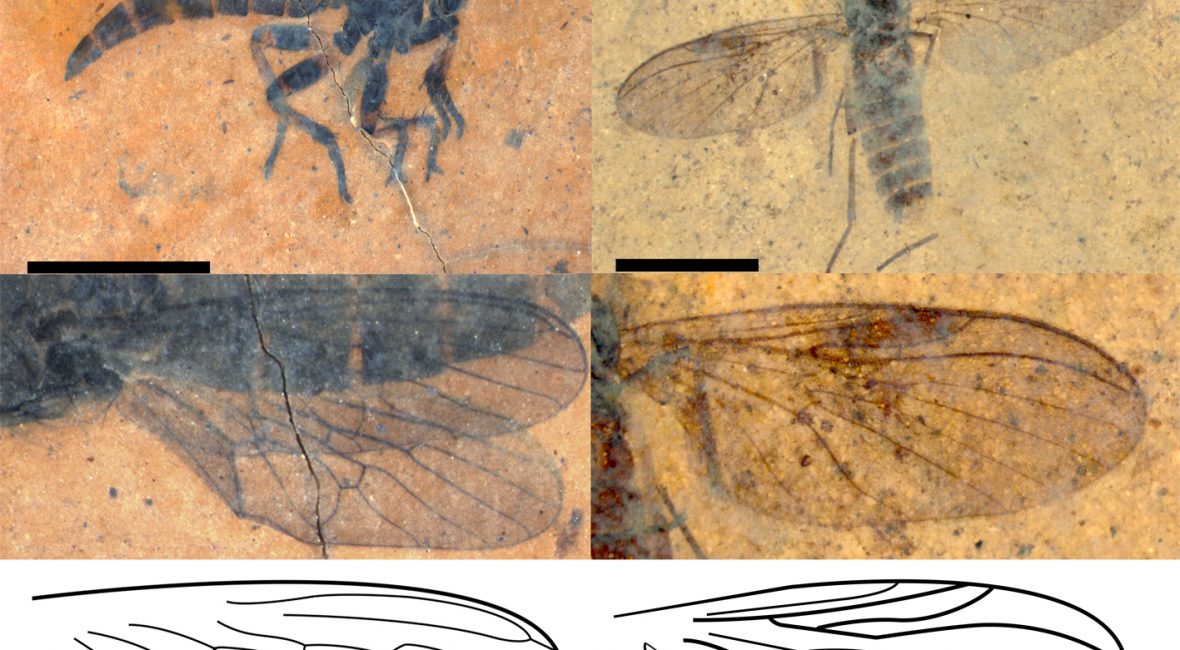
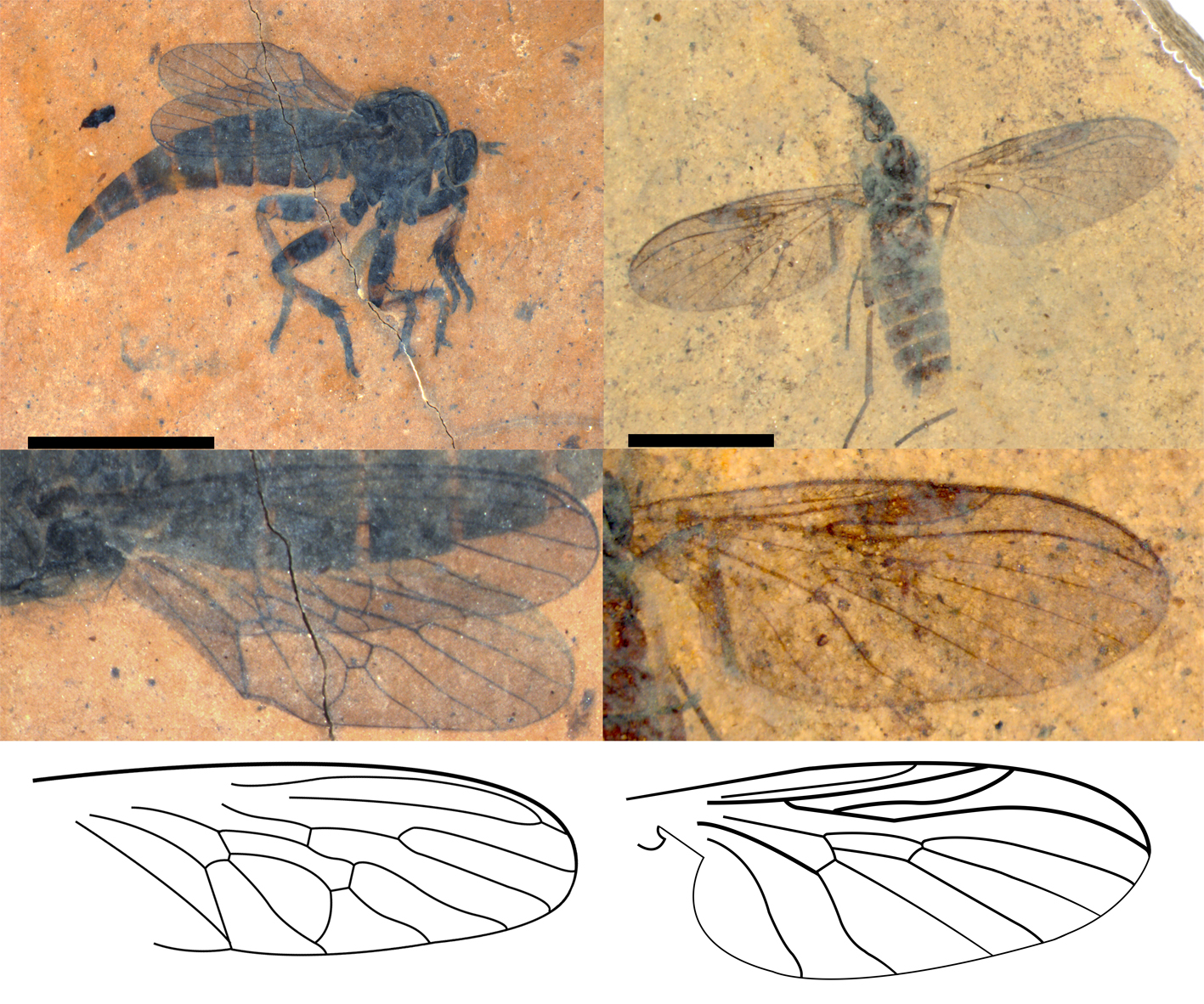
(LEFT) Kishenehnoasilus bhl gen. sp. nov. Dikow 2019 (Diptera: Asilidae) & (RIGHT) Sylvicola silibrarius sp. nov. Greenwalt 2019 (Diptera: Anisopodidae). These two extinct species of flies were collected from the Kishenehn Formation in Northwestern Montana as part of the National Museum of Natural History’s research in paleobiology and the evolution of insect diversity. The fossils were exposed by erosion of oil shale, derived from sediments of a 46-million-year-old lake, by the Middle Fork of the Flathead River along the southwestern boundary of Glacier National Park. The robber fly (Kishenehnoasilus bhl; USNM 624491) was collected at the Dakin site in 2014; the wood gnat (Sylvicola silibrarius; USNM 626077) was collected from the Deep Ford site in 2015. The scale bars = 5 mm. The specimens are named in honor of the staff of the Biodiversity Heritage Library and the library staff of the National Museum of Natural History, respectively. Photo by: Dale Greenwalt.

Two new fossil fly species have been named in honor of the Smithsonian Libraries and the Biodiversity Heritage Library. Sylvicola silibrarius Greenwalt, 2019 and Kishenehnoasilus bhl Dikow, 2019 have been described from specimens collected from the 46-million-year-old Kishenehn Formation of northwestern Montana. The species were published last week in the open access journal Palaeontologia Electronica.

The species are two of 15 new species identified in a new study led by scientists at the Smithsonian’s National Museum of Natural History and colleagues on the diversity of fossil flies (order Diptera) in the Coal Creek Member of the Kishenehn Formation, a 34-56 million year old fossil site. The study also records 15 new families, dramatically expanding scientists’ knowledge of fly diversity during the Eocene in North America. With this publication, a total of 21 different families of flies have now been described from the region. The study provides researchers with a snapshot of flies during their evolution and helps establish the Kishenehn Formation as one of the most important fossil sites in North America for understanding the evolution of one of the most successful groups of life on Earth.

Sylvicola silibrarius Greenwalt, 2019 is a wood gnat in the widely-distributed Anisopodidae family containing nearly 200 species and boasting a rich fossil record. The specific epithet is a combination of the abbreviation SI (for the Smithsonian Institution) and the Latin term librarius (pertaining to books). Dale Greenwalt, lead study author and a resident research associate at the National Museum of Natural History, named the species in appreciation for the essential services that the Smithsonian Libraries perform.

“My research here at the National Museum of Natural History would be impossible without the Libraries,” said Greenwalt. “In my ten years here at the museum, I have never had an interaction with our world class library staff that was not positive, friendly and helpful.”

Kishenehnoasilus bhl Dikow, 2019, a robber fly in the family Asilidae, represents the type species for this new genus. The specific epithet is an abbreviation referring to the Biodiversity Heritage Library (BHL). Torsten Dikow, study co-author and curator of Diptera at the National Museum of Natural History, drew a comparison between the fly and the Library when naming the species.

“Taxonomic research involves not only the study of specimens, but also the review of often old literature,” said Dikow. “Having digital access to publications enhanced with tools such as scientific name recognition makes my research so much more efficient. The Biodiversity Heritage Library provides a lens into the literature published a long time ago. The same is true for this new species of robber fly, as it helps us to understand and document the past of biodiversity.”

The type specimens for both Sylvicola silibrarius and Kishenehnoasilus bhl have been deposited within the paleobiology collections of the Smithsonian’s National Museum of Natural History, where they will be available to researchers to help inform future studies on dipteran evolution and diversification.

“For centuries, libraries have been essential centers of knowledge with collections serving as windows into the universe of human scholarship, history and creativity,” said Martin R. Kalfatovic, associate director of the Smithsonian Libraries and program director for the Biodiversity Heritage Library. “As libraries have evolved to embrace the digital world — from online access for collections to data mining those same collections for new discoveries — they have empowered new research efficiencies and connections and facilitated the democratization of knowledge through open access principles like those embraced by the Smithsonian and Biodiversity Heritage Library. That these researchers have honored our libraries through these species is a testament to the essential services that libraries provide today. We are privileged to be recognized in such a meaningful way for our impact on the global research community.”

Citation: Greenwalt, D.E., and Bickel, D.J., Kerr, P.H., Curler, G.R., Brown, B.V., de Jong, H., Scott J. Fitzgerald, S.J., Dikow, T., Tkoč, M. and Kehlmaier, C. 2019. Diptera of the Kishenehn Formation. I. Documentation of diversity at the family level. Palaeontologia Electronica. 22(2):1-57. https://doi.org/10.26879/891.
August 26, 2019by michelle.underhill
BHL News, Blog Reel

GBIF Launches New Web Portal!

View Full Size Image
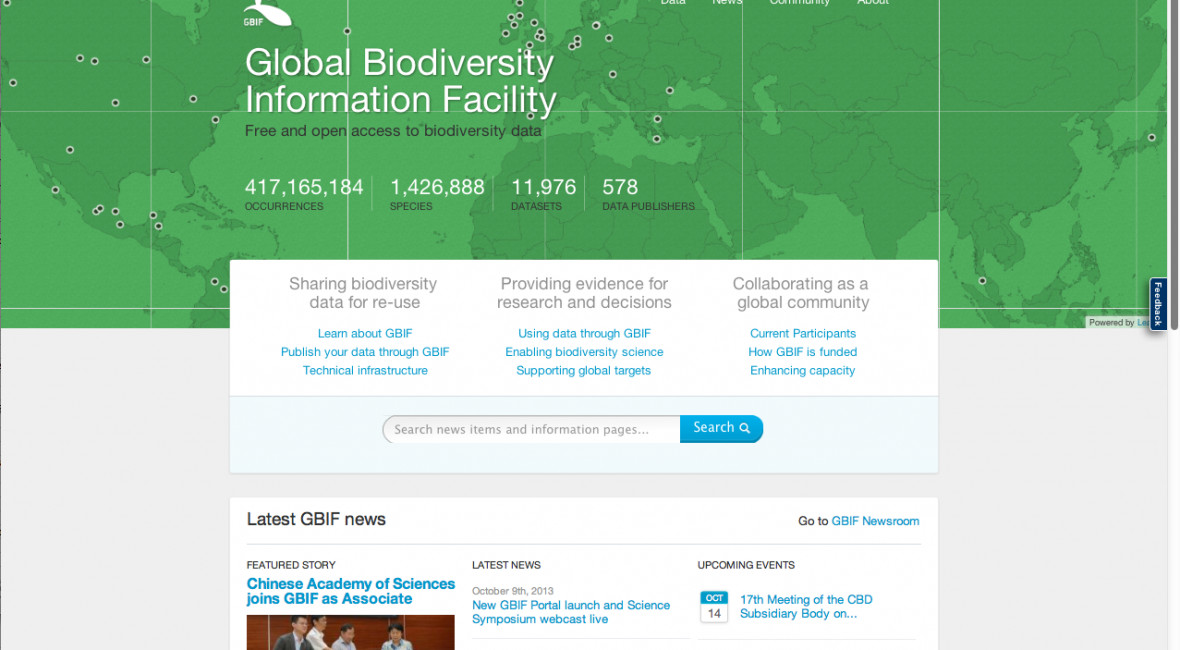
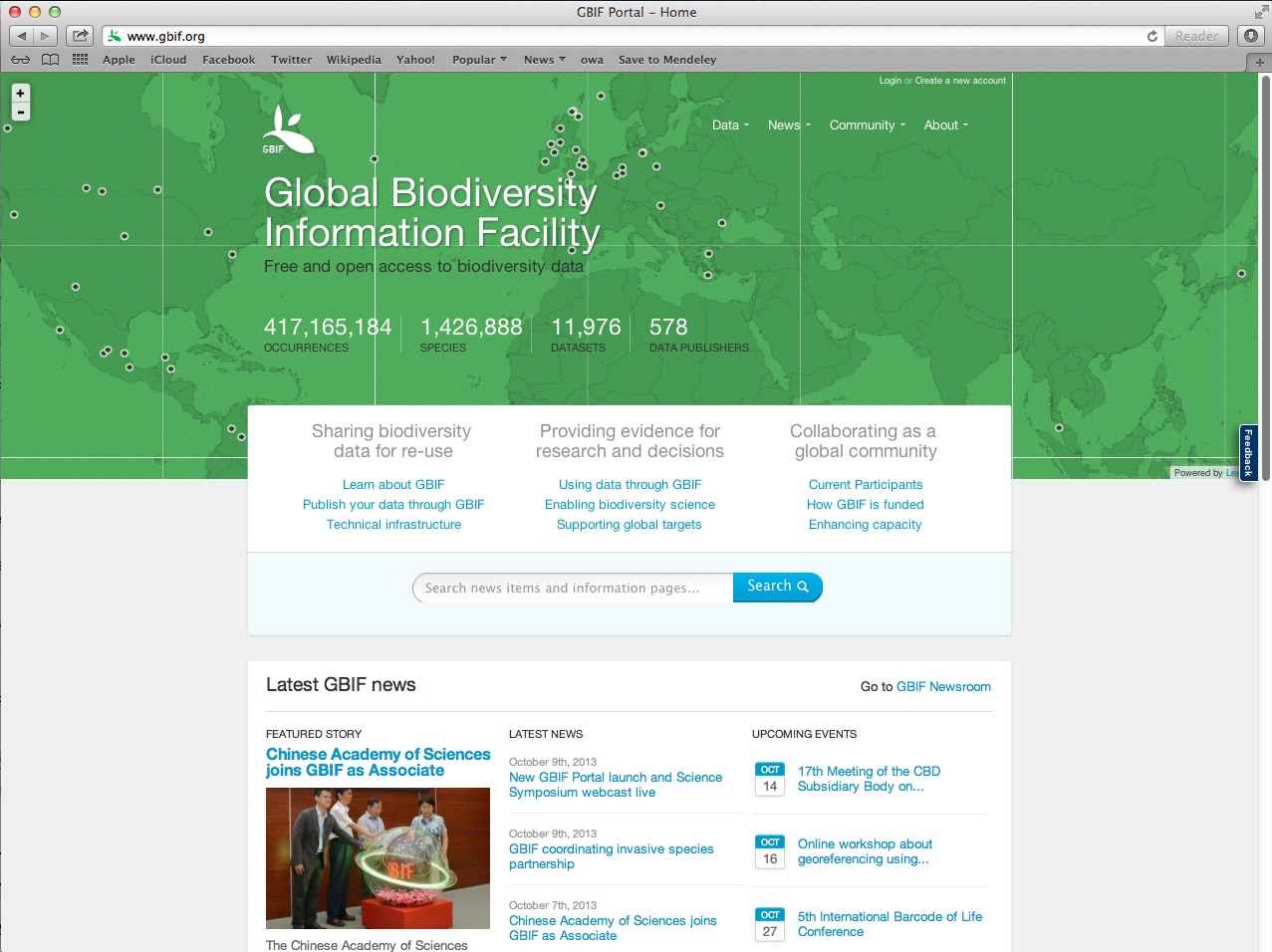
GBIF’s new web portal: http://www.gbif.org

We’re very excited to share that yesterday, October 9, the Global Biodiversity Information Facility (GBIF) launched their new web portal as part of the 20th meeting of the GBIF Governing Board.  The new portal provides greatly enhanced access to the world’s largest database of documented evidence for the distribution of species across the planet.

The scientific meeting was held in Berlin and webcast for the press and public. Tim Hirsch, Senior Program Officer for Engagement, and Tim Robertson, Information Systems Architect, introduced and demonstrated some of the new features now available.  For example, the home page now includes prominent links to information that help “tell the entire GBIF story,” including how GBIF, its content-contributing partners, and users are:

  1. Sharing Biodiversity for Reuse;
  2. Providing Evidence for Research and Decisions; and
  3. Collaborating as a Global Community.

You can learn more about all of the new functionality by visiting the new GBIF web portal or watching the webcasts of the launch.

The meeting also included presentations on how GBIF’s partners in Colombia and Japan are providing free and open access to information about biodiversity in their own countries.  In the afternoon, the annual GBIF Science Symposium highlighted how researchers throughout the world are using the data mobilized through GBIF’s network of data publishers.  The Symposium kicked off with a presentation on climate change and patterns of biodiversity by Miguel Bastos Araújo, winner of the 2013 Ebbe Nielsen Prize.  More information is available in the Symposium brochure and webcast of the event.

October 10, 2013by sayeedmd
BHL News, Blog Reel

BHL Image Collection on EOL!

View Full Size Image
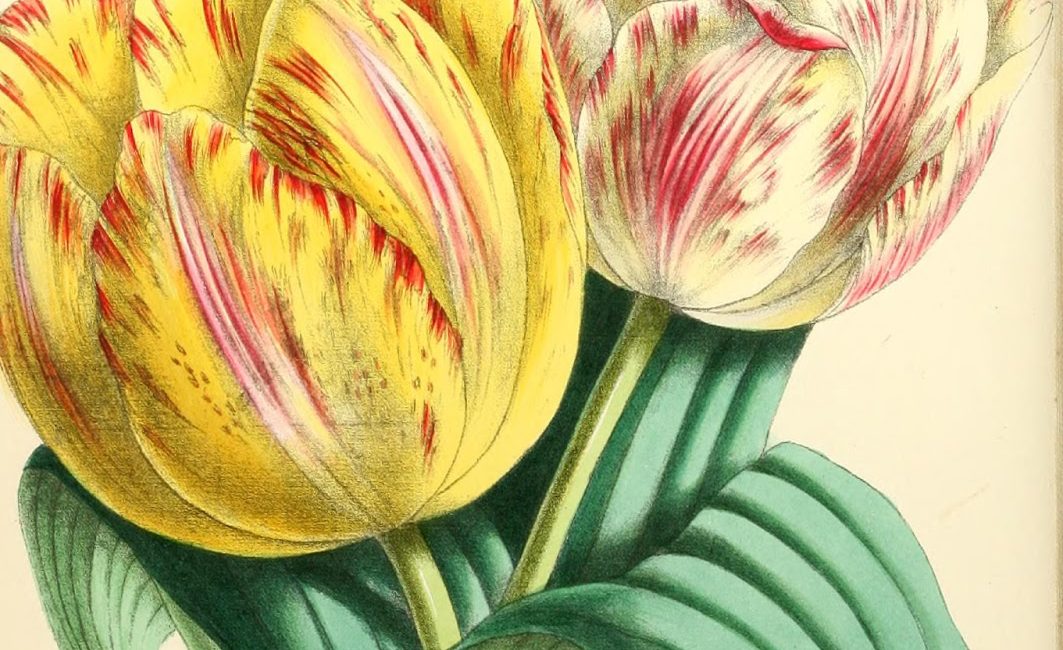
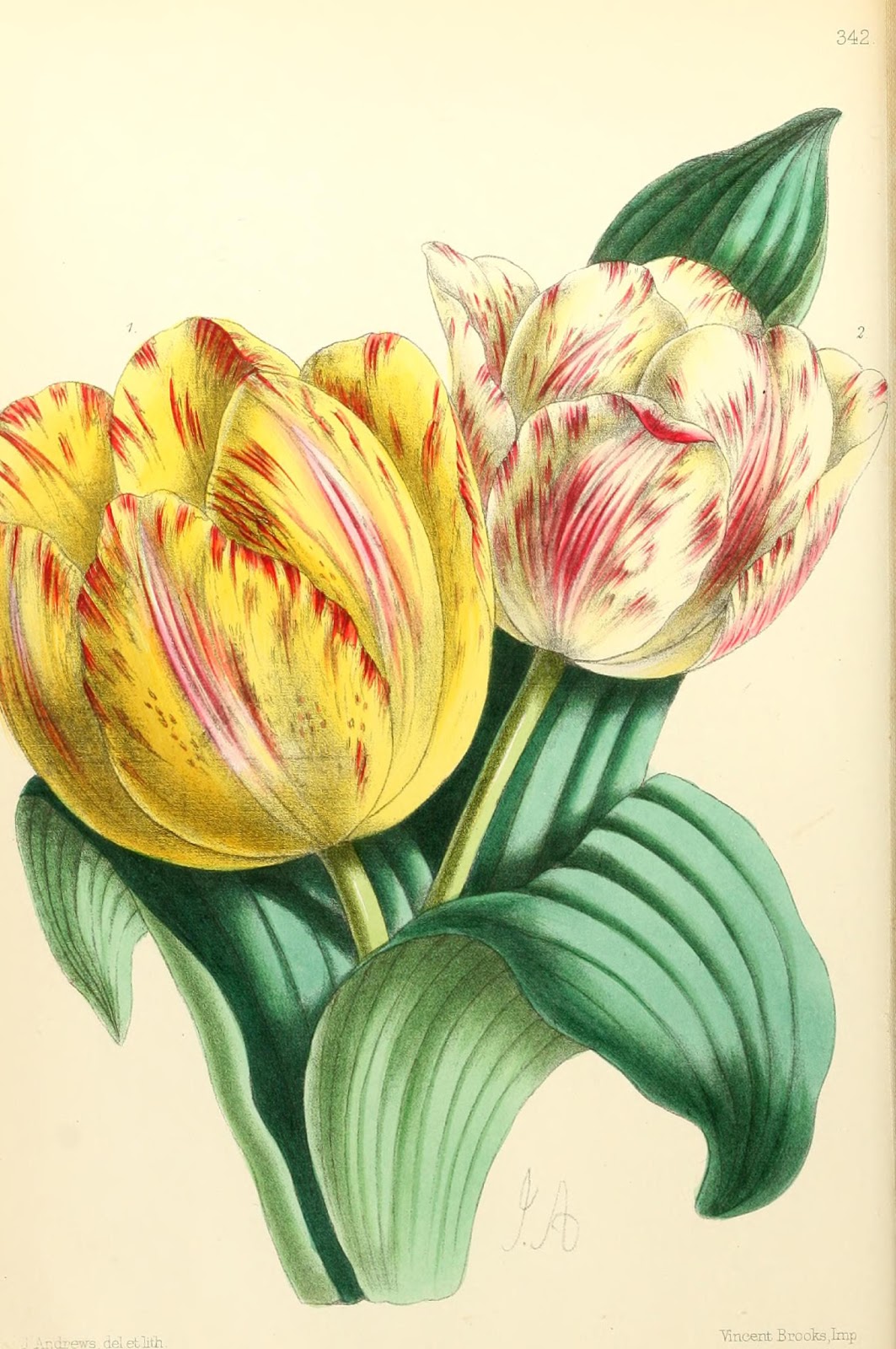
The Floral Magazine, v. 6, pl. 342.

The Biodiversity Heritage Library now has its own collection of images in the Encyclopedia of Life! This collection is comprised of images that have been tagged with species name machine tags, relating the species depicted in each image. The collection currently comprises over 11,000 images representing over 10,000 taxa, and will continue to grow as additional illustrations are tagged in the BHL Flickr.

The BHL Flickr

By now, you’re no doubt aware of the Biodiversity Heritage Library Flickr, which provides free access to over 104,000 illustrations gleaned from the BHL collections. These images span over five hundred years and range in topic from fish to reptiles, mammals to birds, insects to mollusks, and everything in between!

Building the Collection: Tagging Images

To make it easier for you to search our Flickr collection and for us to share images with external websites like EOL, we’re adding species name machine tags to our images, and we’ve been encouraging you to help us do this.

A tag is basically a searchable keyword that you can add to an image to describe it, and a machine tag is a tag with special formatting to allow it to be read by computers. Thus, a species name machine tag is a tag that describes the species depicted in an image in a format that can be understood by computers.

When you add species name machine tags to our images, you as a user can not only search the BHL Flickr and retrieve any images tagged with a desired name, but these images can also automatically be uploaded to EOL and associated with the corresponding species page.

View Full Size Image
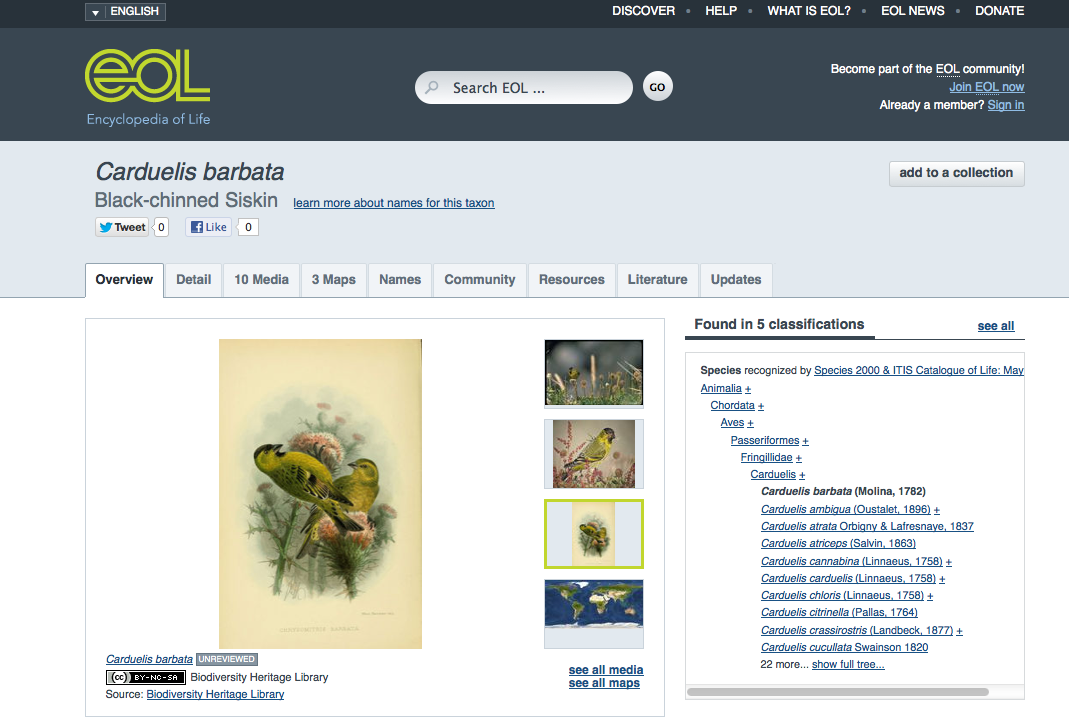
Example of an image from the BHL Flickr automatically associated with the EOL species page for Carduelis barbata, the Black-chinned Siskin, because a species name machine tag was added to the image in Flickr.

The format for species name machine tags is “taxonomy:binomial=Genus species,” where “Genus” and “species” are replaced with the particulars of the organism you’re describing. You can replace “binomial” with another taxonomic tag, such as “genus” or “family”, if you can only identify the organism at that level. Learn more about the Flickr tagging process and machine tag formats in our previous blog post.

The images in the new EOL Collection are images from the BHL Flickr that have a species name machine tag associated with them. Each time new images are tagged in the BHL Flickr, they will automatically be added to our collection in EOL, as well as associated with appropriate species pages.

You Can Help us Grow this Collection!

With over 104,000 images in our Flickr collection to date, and that number growing daily, it’s impossible for BHL staff to tag all of our images by ourselves. That’s why we need your help! You can help us by adding species name machine tags to our images in Flickr. All you have to have is a free Flickr account to add tags to BHL images.

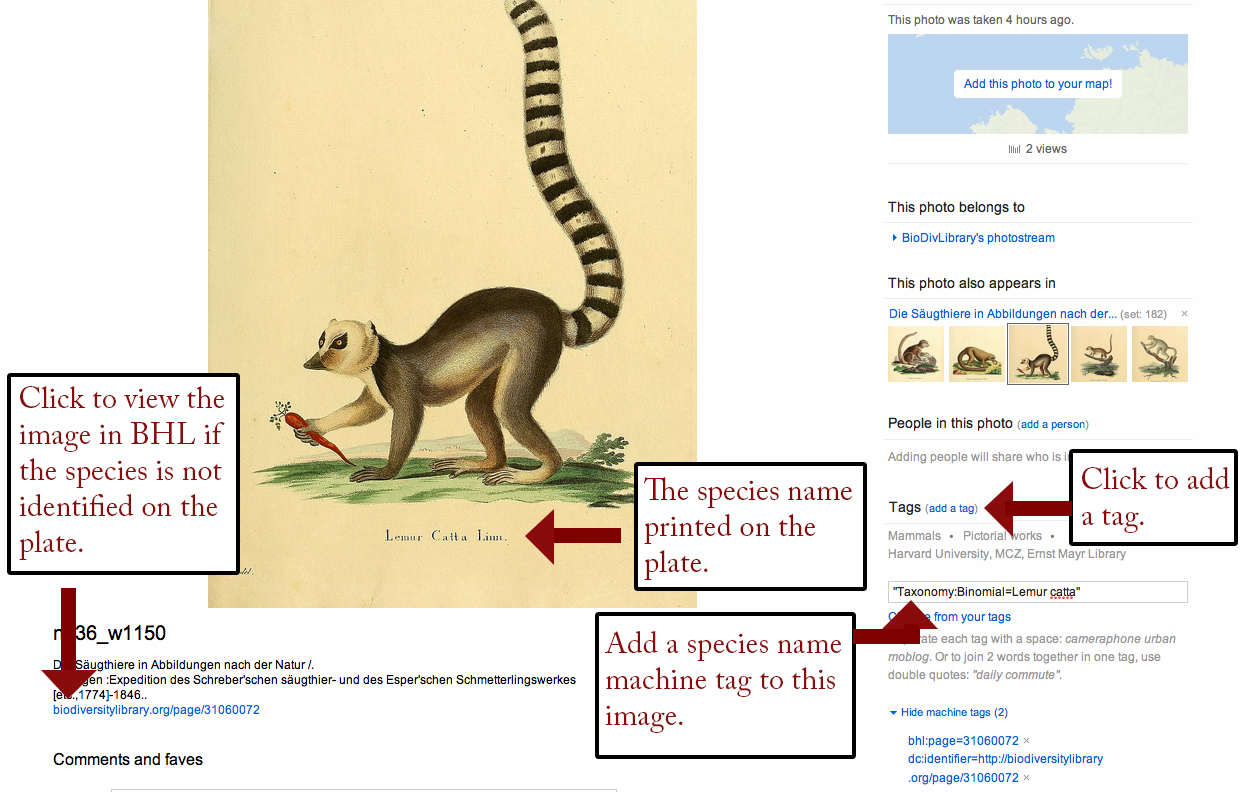
Once you’re signed in to Flickr, browse our collection of images and when you see some with species you can identify, simply click “add a tag” and add the species name in the machine tag format (“Taxonomy:Binomial=Genus species”). Be sure to include the quotation marks around your machine tag.

Many images actually have the species name printed on the plate itself. In these cases, you can simply transcribe that name as a tag for the image. If the species is not identified on the plate, navigate to the book in BHL to find the associated description pages outlining the species depicted. We encourage you to tag the image with the species name provided by the book itself, but if that name is no longer valid, and you know the current, accepted name, feel free to add that name as an additional tag to the image.

View Full Size Image
Adding a species name machine tag to an image in the BHL Flickr. Click this image to enlarge for better viewing.

If there are multiple species depicted on an image, add a separate tag for each species depicted (or as many as you can identify). Learn more about tagging BHL images, and get additional tips, in our Guide.

Every time you add a species name machine tag to an image in our Flickr, you’re growing the BHL EOL Collection, as your tagged images will automatically be added to that collection.

We hope we’ve inspired you to help us identify life on earth, as portrayed through some of the most incredible scientific illustrations ever created! Keep exploring, and keep tagging!

Visit the BHL Image Collection on EOL today!

March 11, 2013by Grace Costantino

Help Support BHL

BHL's existence depends on the financial support of its patrons. Help us keep this free resource alive!

search

About BHL

The Biodiversity Heritage Library (BHL) is the world’s largest open access digital library for biodiversity literature and archives. BHL operates as a worldwide consortium of natural history, botanical, research, and national libraries working together to digitize the natural history literature held in their collections and make it freely available for open access as part of a global “biodiversity community.”

Join Our Mailing List

Sign up to receive the latest news, content highlights, and promotions.

Subscribe Now

Subscribe to Blog via Email

Enter your email address to subscribe to this blog and receive notifications of new posts by email.

Join 319 other subscribers

Subscribe to Blog Via RSS

Subscribe to the blog RSS feed to stay up-to-date on all the latest BHL posts.

Access RSS Feed

Inspiring Discovery through Free Access to Biodiversity Knowledge.

The Biodiversity Heritage Library makes it easier than ever for you to access the information you need to study and explore life on Earth…for free, anytime, anywhere.


64+ Million Pages of
Biodiversity Literature Online.

EXPLORE

Tools and Services
to Transform Research.

EXPLORE

300,000+
Illustrations on Flickr.

EXPLORE

ABOUT | HARMFUL CONTENT | PRIVACY | SITE MAP | TERMS OF USE