
Biodiversity Heritage Library - Program news and collection highlights from BHL
  • Home
  • News
  • Featured Books
    • All Featured Books
    • Book of the Month Series
    • BHL at 20
  • User Stories
  • Campaigns
    • Fossil Stories
    • Garden Stories
    • Monsters Are Real
    • Page Frights
    • Her Natural History
    • Earth Optimism 2020
  • Tech Blog
  • Visit BHL
Home
News
Featured Books
    All Featured Books
    Book of the Month Series
    BHL at 20
User Stories
Campaigns
    Fossil Stories
    Garden Stories
    Monsters Are Real
    Page Frights
    Her Natural History
    Earth Optimism 2020
Tech Blog
Visit BHL
  • Home
  • News
  • Featured Books
    • All Featured Books
    • Book of the Month Series
    • BHL at 20
  • User Stories
  • Campaigns
    • Fossil Stories
    • Garden Stories
    • Monsters Are Real
    • Page Frights
    • Her Natural History
    • Earth Optimism 2020
  • Tech Blog
  • Visit BHL
Biodiversity Heritage Library - Program news and collection highlights from BHL
Blog Reel, User Stories

Botanical Research in the Asian Tropics


View Full Size Image
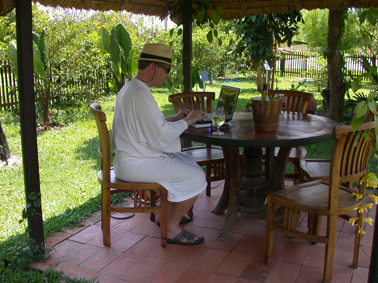
“If you intend to work at 40°C you need a bathrobe, a glass of cold, crispy dry, white wine and WiFi to access BHL.” Dr. Eric Danell, Director, Dokmai Garden, Chiang Mai, Thailand.

Nestled within the Hang Dong district, Chiang Mai, Thailand, is a 10 acre botanical garden called Dokmai Garden. Run by the Thai family Seehamongkol, it boasts over 1,000 plant species, including orchids, laurels, banana plants, birds-of-paradise plants, and gingers. The Seehamongkol family, and the garden’s biologist and Director, Dr. Eric Danell, have the lucky fortune of not only working in this garden, but also of calling it home.

While living amidst such a paradise is undeniably enchanting, for Dr. Danell, being a botanist in the Asian tropics also has its challenges. Access to taxonomic literature is scarce, and the closest library may still be many days away. Even if a researcher is able to gain access to local library collections, the breadth of these collections are often limited, lacking titles critical to enabling further research. For researchers in these situations, digital, open access projects like the Biodiversity Heritage Library are indispensable.

Dr. Danell began his botanical adventure in Sweden at an early age. “Born a botanist,” Eric spent the weekends of his youth at the Museum of Natural History in Stockholm, pursuing a lifelong love of plants that resulted in a PhD in Plant Physiology from Uppsala University in 1994. Following the degree, Danell taught at the Swedish University of Agricultural Sciences as an Associate Professor in Forest Microbiology.

Eric’s passion, however, is gardens. “Essentially, I am a gardener,” said Dr. Danell when asked about his chief area of interest. It comes as no surprise, then, that he left his teaching position for the opportunity to garden in the Asian Tropics at Dokmai Garden. Caring for over a thousand plant species (not to mention countless other varieties of birds, insects, reptiles and fungi that also call the ecosystem home), and conducting further botanical research, requires access to natural history literature collections, including many rare titles. As discussed, this access is often glaringly absent in developing countries.

Fortunately for Dr. Danell, a few years ago, he stumbled upon BHL via the Kew Gardens/Missouri Botanical Garden joint project,  The Plant List. It was love at first click. “[BHL] is a crucial tool since I am located in the Asian tropics. Although I have a private rare books collection in Sweden, I do not dare bring it here due to termites and moulds. Rare books can hardly be found at local university libraries,” articulated Danell.

Since discovering BHL, Eric uses it several times a week, typically verifying plant species descriptions online but occasionally also downloading PDFs. “We have frequent electricity cuts which would otherwise disconnect me from ongoing work,” explained Danell. “A laptop with battery keeps you focused in spite of tropical rainstorms!”

The true magic of BHL for Danell, however, is the truly global access it provides. “The fact that I can sit in a remote corner of the world and access rare books is awesome! BHL is my favorite.”

Being located in a developing country also provides opportunities for Dr. Danell to suggest improvements specific to users with varying Internet connectivity strengths. He suggests that the development of an interface specifically designed for old computers with poor Internet access would be particularly beneficial. This was a major discussion point at the recent BHL-Africa meetings, as much of Africa also has limited Internet connectivity. The development of a “BHL in a Box” application, which would allow some version of BHL to be installed on a local computer to limit the need for continuous internet availability, or the development of a text-based interface, were some options proposed. BHL and its African colleagues hope to pursue funding in the future to make this ambition a reality.

For many of our users, there is one special title in BHL that makes their knees weak and their hearts beat a little faster. For Dr. Danell, that book is Linnaeus Species Plantarum (1753, volumes 1-2). “This is the origin of plant research and so many important plants, also in the tropics, are described here. [Linnaeus’] spelling, his comments and his references are crucial to botanical research,” emphasized Danell.

Thanks to BHL, Eric can access his favorite eighteenth century botanical masterpiece while sitting in a fairy tale garden in the Asian tropics, dressed comfortably in his favorite bathrobe, sipping a glass of crisp white wine. All scientific research should be this perfect!

June 25, 2013by michelle.underhill
BHL News, Blog Reel

Celebrating Linnaeus’ Birthday with iTunes U

View Full Size Image

He has been dubbed “The Father of Modern Taxonomy,” “The Father of Modern Ecology,” Princeps botanicorum (Prince of Botanists), “The Pliny of the North,” and “The Second Adam.” He is credited with creating the classification schema known as binomial nomenclature, and today, he turns 305 years old. Of course, we’re talking about Carl Linnaeus, and we’re celebrating his birthday with the release of our latest iTunes U collection dedicated to him.

Carl Linnaeus was born May 23rd, 1707, in Småland, Sweden. As evidenced by his later publications, his first and primary passion was botany. At an early age, he took an interest in plants, eventually coming under the tutelage of Johan Rothman, the state doctor of Småland. Linnaeus first learned to classify plants under Rothman’s direction, using the system developed by Joseph Pitton de Tournefort, which, though based on artificial similarities between organisms, nevertheless was the first system to make a clear distinction between genus and species.

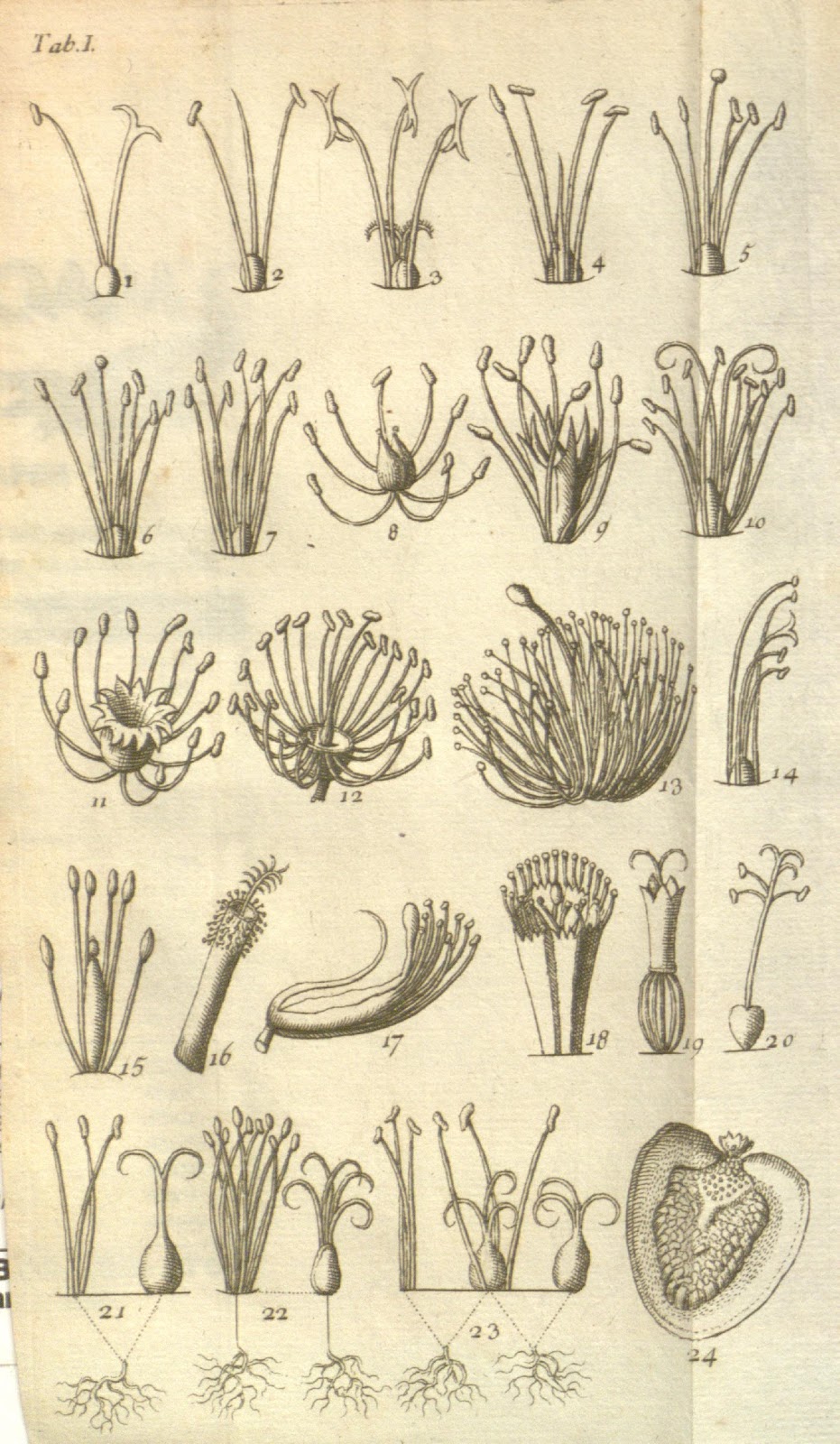
In 1728, Linnaeus enrolled at Uppsala University, where he made quick progress in the field of botany and, by only his second year, was himself giving lectures. During these years, Linnaeus began to question Tournefort’s classification system, and thus decided to develop his own. Linnaeus’ system arranged plants according to the number of stamens and pistils each possessed. This new system formed the basis of his work in the critical publication Genera Plantarum (first edition published 1737). A young German botanical draughtsman named Georg Dionys Ehret crafted a visual representation of this system, which Linnaeus included in Genera Plantarum (though without acknowledgement to Ehret). The image represents the earliest illustration of Linnaeus’ classification system for plants.

View Full Size Image
Ehret’s illustration of Linnaeus’ classification system

Linnaeus continued to revise Genera Plantarum, publishing a total of five editions (fifth edition published 1754). During the years between the publication of the first and fifth editions of this work, Linnaeus also published Species Plantarum (first edition published 1753), which arranged all plants known to him into orders, classes, and genera according to the Genera sexual system. Species Plantarum provided formal, multiple word descriptions in Latin of each species, as well as an additional epithet for easy reference. The combination of the genus and epithet quickly became a popular method by which to refer to a plant species. Species Plantarum is considered the inception of botanical nomenclature, and the use of a consistent naming structure based on the methods presented in Species and Genera was a vital step in the maturation of Linnaeus’ binomial schema.

In 1735, even before the publication of the first edition of Genera Plantarum, Linnaeus published the first edition of Systema Naturae. This first edition outlined Linnaeus’ ideas for the hierarchical arrangement of the natural world, dividing it into the animal, plant, and mineral kingdoms. His classification of the plant kingdom followed the sexual system he presented in Genera. However, it was not until the tenth edition of Systema Naturae that the binomial classification system we so readily associate with Linnaeus came into its own. While Species Plantarum had already established a binomial naming system for plants, the tenth edition of Systema Naturae (published in 1758) organized, for the first time, the animal kingdom according to this system – Kingdom, Class, Order, Genera, and Species. Thus, it represents the beginning of zoological nomenclature and, together with the first edition of Species Plantarum, is considered the starting point of binomial nomenclature.

Today, we highlight Linnaeus’ contributions to science with the release of our newest iTunes U Collection: The Carl Linnaeus Collection. The collection features 13 of Linnaeus’ publications (including the first edition of Species Plantarum, the tenth edition of Systema Naturae, and the fifth edition of Genera Plantarum), as well as two additional items about Carl Linnaeus and his sexual classification system (Carolvs Linnaevs by Edward Lee Greene and New illustration of the sexual system of Carolus von Linnaeus by Robert John Thonrton). You can download all of these titles directly onto your iPad, iPhone, or iPod Touch for free through iTunes. And, of course, you can download them directly to your computer through the BHL interface.

So Happy Birthday, Carl Linnaeus! Our present to you: Your very own iTunes U collection!

May 23, 2012by ulib-libraryjobs

Help Support BHL

BHL's existence depends on the financial support of its patrons. Help us keep this free resource alive!

search

About BHL

The Biodiversity Heritage Library (BHL) is the world’s largest open access digital library for biodiversity literature and archives. BHL operates as a worldwide consortium of natural history, botanical, research, and national libraries working together to digitize the natural history literature held in their collections and make it freely available for open access as part of a global “biodiversity community.”

Join Our Mailing List

Sign up to receive the latest news, content highlights, and promotions.

Subscribe Now

Subscribe to Blog via Email

Enter your email address to subscribe to this blog and receive notifications of new posts by email.

Join 319 other subscribers

Subscribe to Blog Via RSS

Subscribe to the blog RSS feed to stay up-to-date on all the latest BHL posts.

Access RSS Feed

Inspiring Discovery through Free Access to Biodiversity Knowledge.

The Biodiversity Heritage Library makes it easier than ever for you to access the information you need to study and explore life on Earth…for free, anytime, anywhere.


ABOUT | HARMFUL CONTENT | PRIVACY | SITE MAP | TERMS OF USE