Biodiversity Heritage Library - Program news and collection highlights from BHL
  • Home
  • News
  • Featured Books
    • All Featured Books
    • Book of the Month Series
    • BHL at 20
  • User Stories
  • Campaigns
    • Fossil Stories
    • Garden Stories
    • Monsters Are Real
    • Page Frights
    • Her Natural History
    • Earth Optimism 2020
  • Tech Blog
  • Visit BHL
Home
News
Featured Books
    All Featured Books
    Book of the Month Series
    BHL at 20
User Stories
Campaigns
    Fossil Stories
    Garden Stories
    Monsters Are Real
    Page Frights
    Her Natural History
    Earth Optimism 2020
Tech Blog
Visit BHL
  • Home
  • News
  • Featured Books
    • All Featured Books
    • Book of the Month Series
    • BHL at 20
  • User Stories
  • Campaigns
    • Fossil Stories
    • Garden Stories
    • Monsters Are Real
    • Page Frights
    • Her Natural History
    • Earth Optimism 2020
  • Tech Blog
  • Visit BHL
Biodiversity Heritage Library - Program news and collection highlights from BHL
Blog Reel, User Stories

Catesby in the Classroom: Students Explore the Intersection of Art and Science

Portrait version of the Biodiversity Heritage Library logo.

In the early eighteenth century, English naturalist Mark Catesby set foot in a New World. After spending the better part of ten years, spread across two separate trips, exploring and documenting North America’s rich biodiversity, he would eventually publish his research and original artworks as the first fully illustrated book on the flora and fauna of North America.

View Full Size Image
Catesby, Mark. The Natural History of Carolina, Florida, and the Bahama Islands. v. 1, ed. 1. pl. 19. Digitized by Smithsonian Libraries. http://www.biodiversitylibrary.org/page/40753174.

Published over eighteen years between 1729-1747, The Natural History of Carolina, Florida, and the Bahama Islands contains 220 plates based mostly upon Catesby’s own watercolors, which he worked up based on sketches he made in the field.

The success of Catesby’s work was based largely on his emphasis on personal observation and use of art to convey a visual record of his research.

Over 250 years later, students in South Carolina are following Catesby’s example.

As part of a collaboration with the Catesby Commemorative Trust, Dr. Tracey Hunter-Doniger used illustrations from The Natural History of Carolina, Florida, and the Bahama Islands as the foundation for lesson plans designed to help students learn more about the importance of observation and the relationship between art and science.

“Before photography, scientists used drawings to record what they saw. Scientists also had to be artists. These lessons are an opportunity for students to see how art and science are connected while also understanding the importance of Catesby’s work and his role in natural history,” emphasizes Tracey.
View Full Size Image
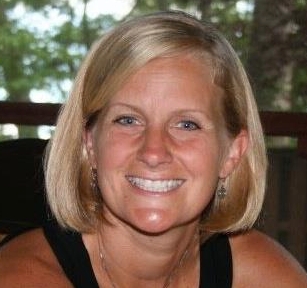
Dr. Tracey Hunter-Doniger. Image Credit: College of Charleston website http://teachered.cofc.edu/faculty-staff-listing/hunter-doniger-tracey.php.

A fifteen year K-8 visual art education veteran, Tracey has spent the last five years at the College of Charleston as an Assistant Professor of Creativity and Creative Arts in Education. In the fall of 2016, Tracey teamed up with her friend Erin Russell, the art teacher at Memminger Elementary School in Charleston, SC, to implement a trial run of her lesson plans in the 1st, 3rd, and 5th grade art classes at Memminger.

All three classes were challenged to use their powers of observation to record what they saw, just as Catesby had done centuries before. Students were given copies of Catesby’s illustrations, which Tracey downloaded and printed from the Biodiversity Heritage Library. The first edition copy of Catesby’s masterpiece in BHL, digitized from the Joseph F. Cullman Rare Book Library at Smithsonian Libraries, is one of the few known perfect copies of this edition in existence.

“Having access to this resource through BHL is a treasure,” praises Tracey. “Being able to show the students the prints of the original artworks and use them to explain that these represent what Catesby saw and what he wanted to convey speaks volumes to the students.”

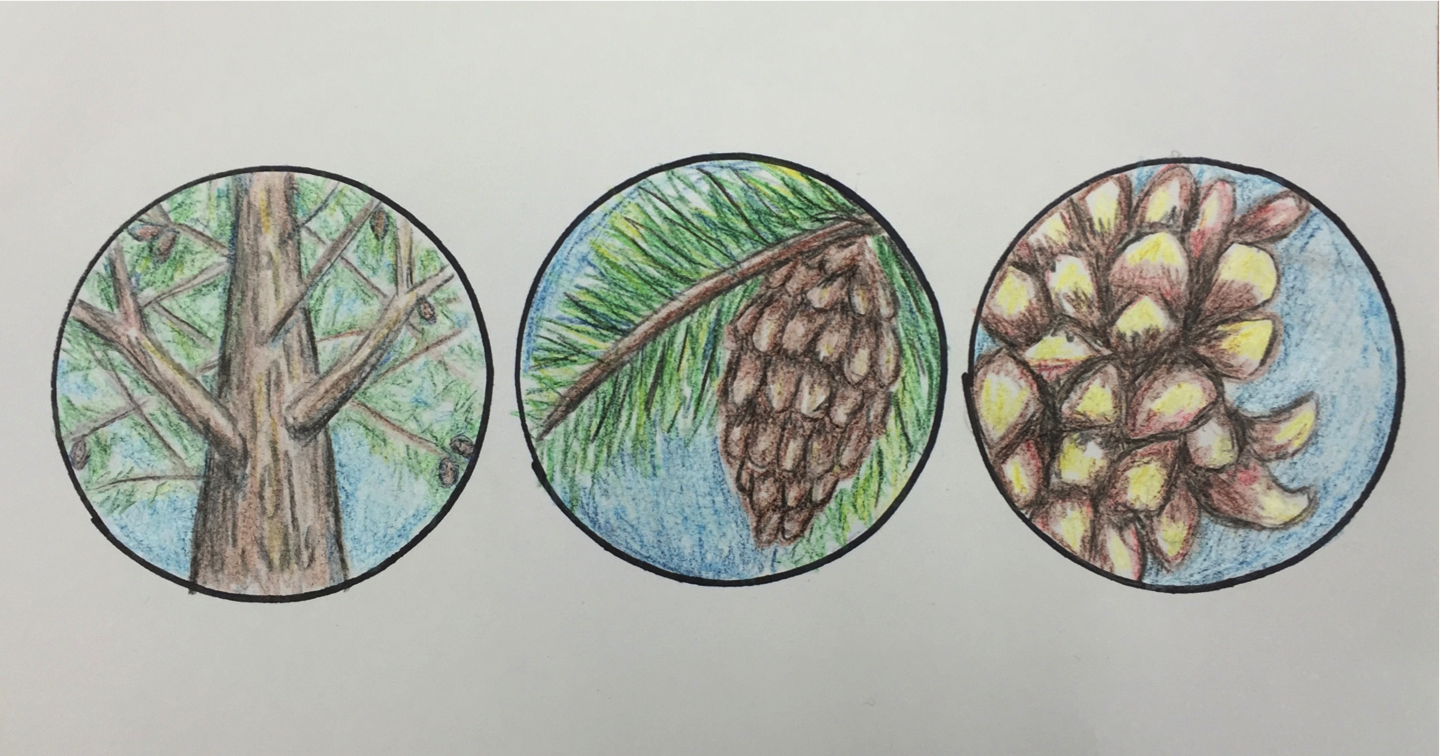
The first grade students were instructed to use the illustrations as a reference to draw their own copy of the specimens. The third and fifth graders were asked to flex their observational skills even further by not only copying the illustration as they saw it, but also homing in on a specific section of the image and creating a more detailed depiction of that area, as though they were looking at it through the lens of a microscope.
View Full Size Image
Example of the 3rd and 5th grade Catesby lesson, whereby students “zoom” in on details in the specimen being observed. Example by Dr. Tracey Hunter-Doniger.

While the trial runs of each class were limited to one, 45-minute session, Tracey believes that the lessons helped the students understand how art can be a scientific tool. For future iterations, she hopes to run the classes as three-week lessons where students start by observing and copying Catesby’s art in the classroom and then extend their learning to the outdoors by taking nature walks and drawing in the field, as Catesby did. She would also love the students to have the opportunity to explore Catesby’s publication in full through the BHL website.

“Access is key,” stresses Tracey. “In an ideal scenario, we would go into the website, we would do research, and then we would practice the skills we learn by going into the field. We would ‘do’ as Catesby did. We would ‘be’ Catesby in the field.”

The lessons that Tracey created are just two of several that are being developed as part of a collaboration with the Catesby Commemorative Trust and the College of Charleston. For example, a science lesson, written by William Veal, Cyndi Hall, and Rodney Moore, uses Catesby’s art to help students assess how adaptations contribute to a species’ ability to survive in a given environment. Lesson activities include drawing a bird inspired by a Catesby illustration, noting characteristics (such as beak shape), and performing experiments to see how various adaptations might help that species survive.

The lessons plans resulting from this collaboration are being made available to teachers in South Carolina through the LearningWhy site created by South Carolina ETV. The plans are also available to teachers across the country through PBS LearningMedia.
View Full Size Image
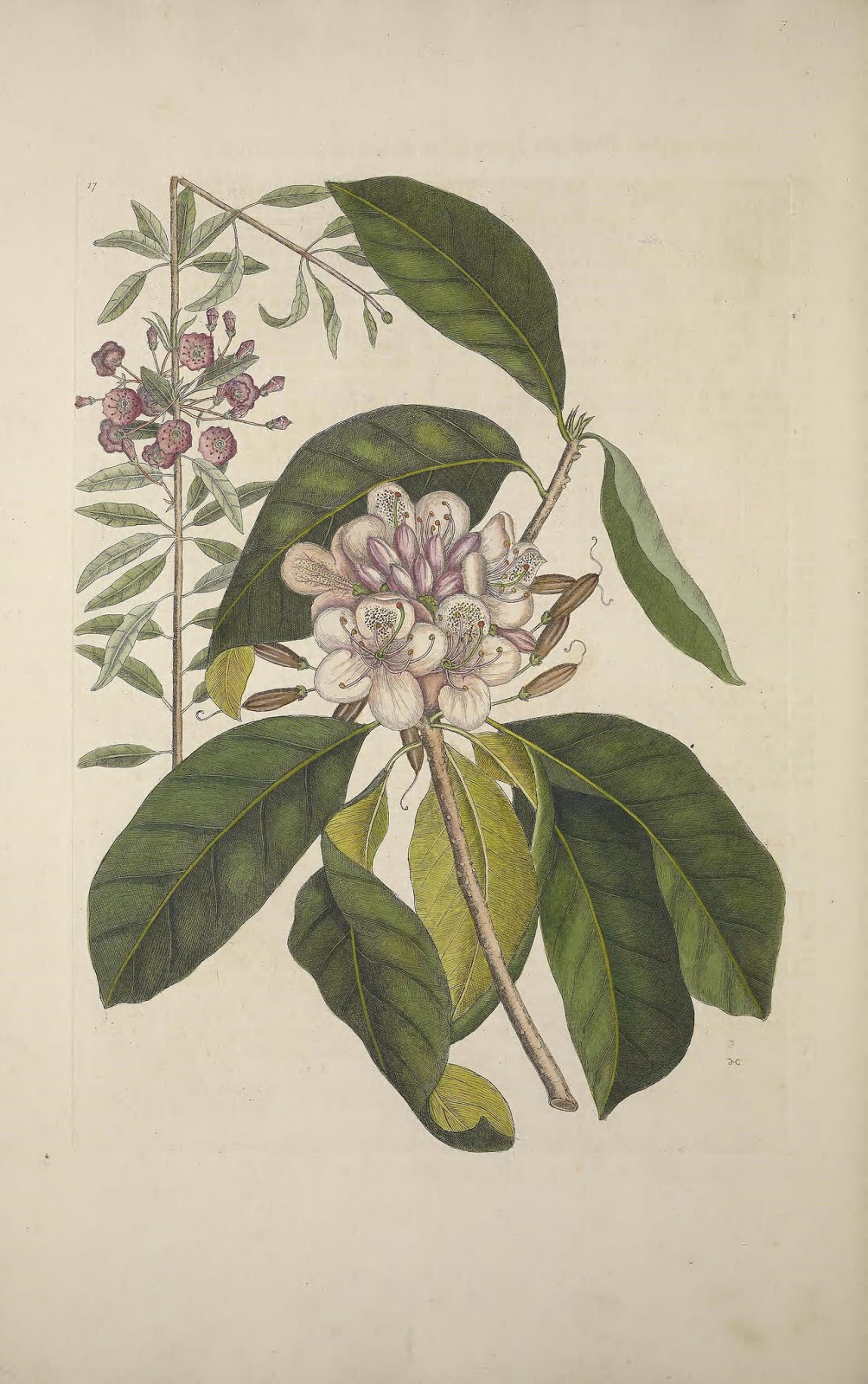
Catesby, Mark. The Natural History of Carolina, Florida, and the Bahama Islands. v. 2, ed. 1, pl. 17. Digitized by Smithsonian Libraries. http://www.biodiversitylibrary.org/page/40680449.

From Tracey’s perspective, the use of Catesby’s material in these lesson plans is a powerful way to integrate primary source material that is not only historically significant but also highly relevant to the area where she and her students live.

“Living in an area that’s so rich in history, it’s very impactful to be able to show the students how Catesby’s story fits into that history,” says Tracey. “The art is the visual side of that narrative. It helps explain who Catesby was, what he did, and why he was important. If you’re telling the Catesby story, the art is a critical part of that story.”

Thanks to the Biodiversity Heritage Library and Smithsonian Libraries, students in South Carolina and others around the world can freely and easily access Catesby’s work and countless other natural history treasures, no matter where their classroom journeys take them.

______________________________________

This post may contain the personal opinions of BHL users or affiliated staff and does not necessarily represent the official Biodiversity Heritage Library (BHL) position on these matters.
January 12, 2017by michelle.underhill
Blog Reel, User Stories

Undergraduates and the BHL

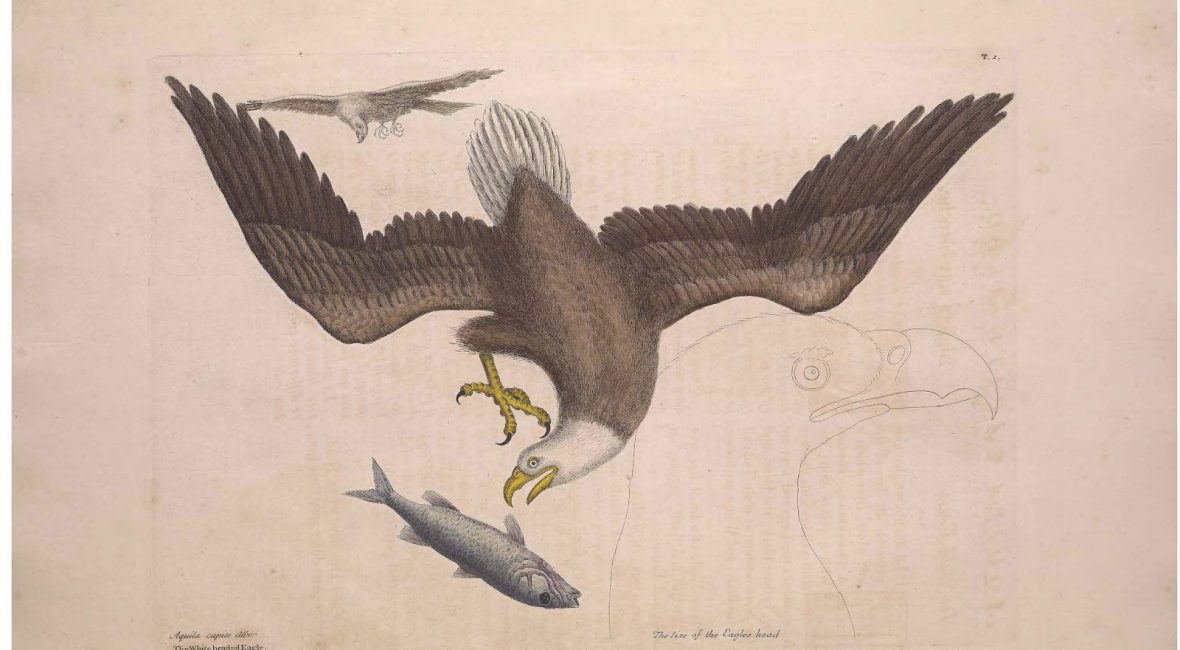
“Is the bald eagle really bald?”

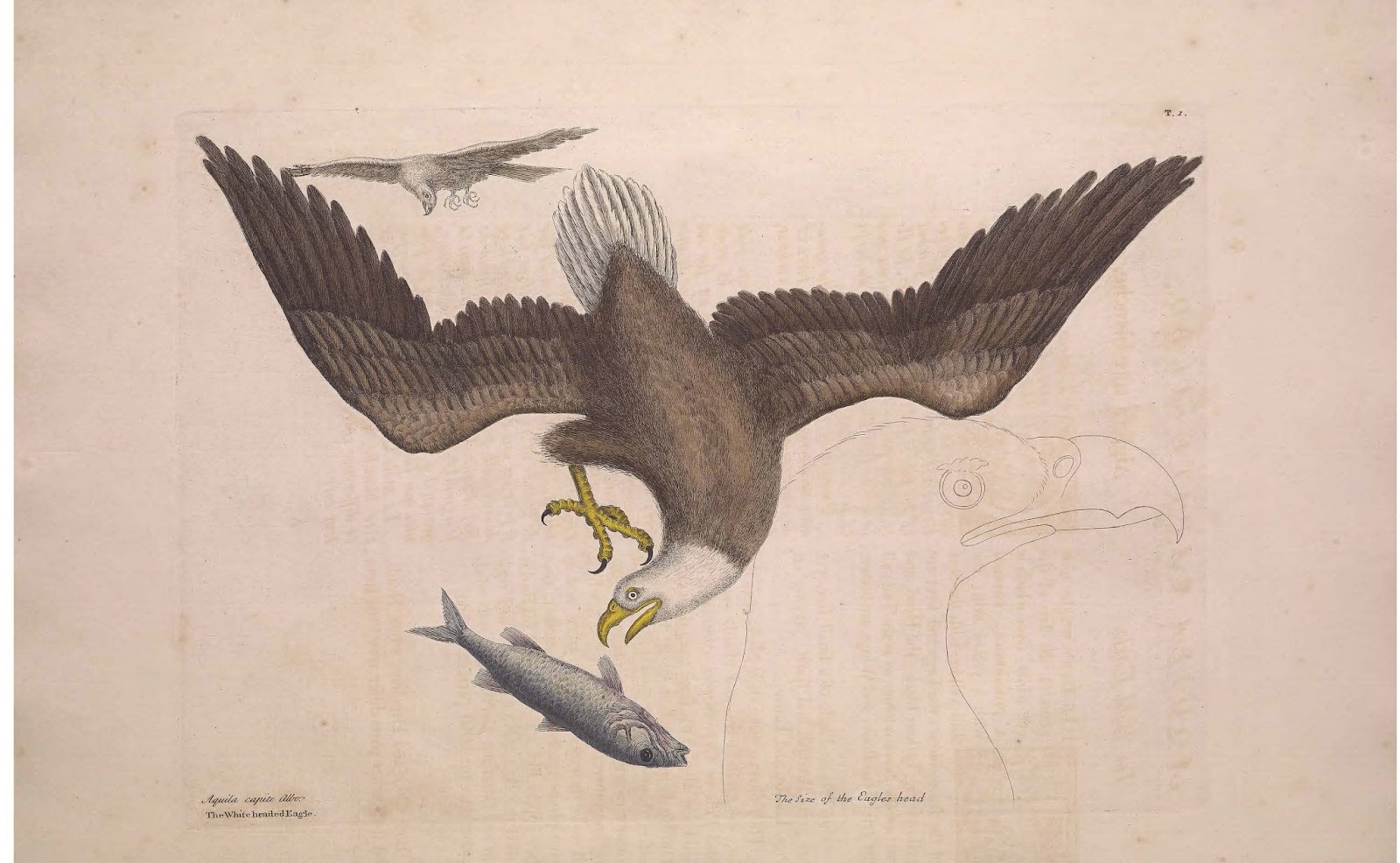
This was the question that a recent history of science undergraduate class at Harvard University had to answer with the help of BHL. Specifically, students were required to locate Mark Catesby’s 1731 plate of the bald eagle in BHL and use the accompanying text to determine the accuracy of the bird’s moniker.

View Full Size Image
The White-Headed Eagle. Catesby, Mark. The Natural History of Carolina, Florida and the Bahama Islands. vol. 1, 1731. pl. 1. http://biodiversitylibrary.org/page/40753120. Digitized by Smithsonian Libraries.

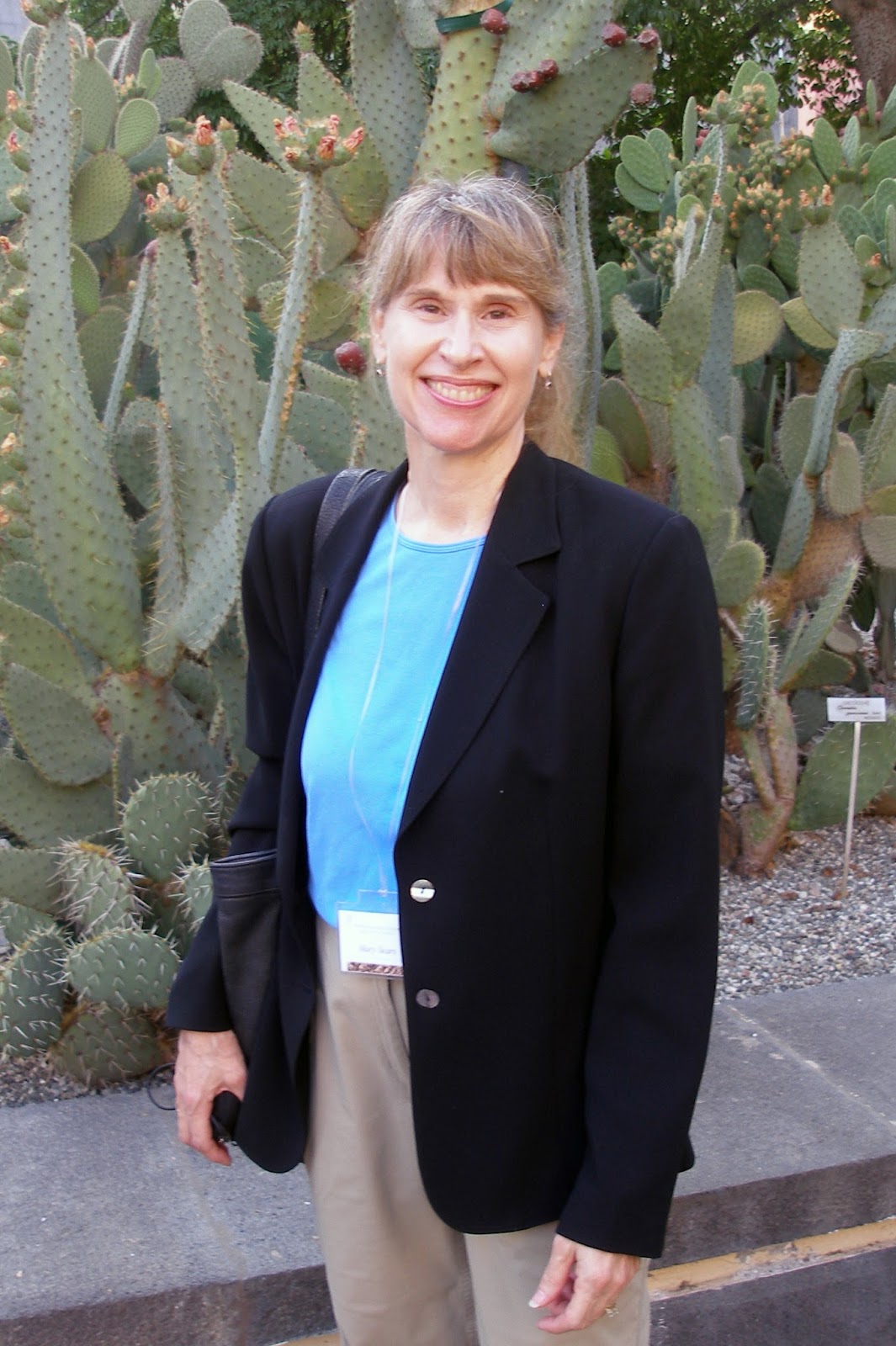
Mary Sears, Head of Public Services at the Ernst Mayr Library of the Museum of Comparative Zoology at Harvard University, instructed the class on how to use BHL to satisfy the assignment. Instructing students on the use of BHL is something Mary has done for some time now.

View Full Size Image
Mary Sears.

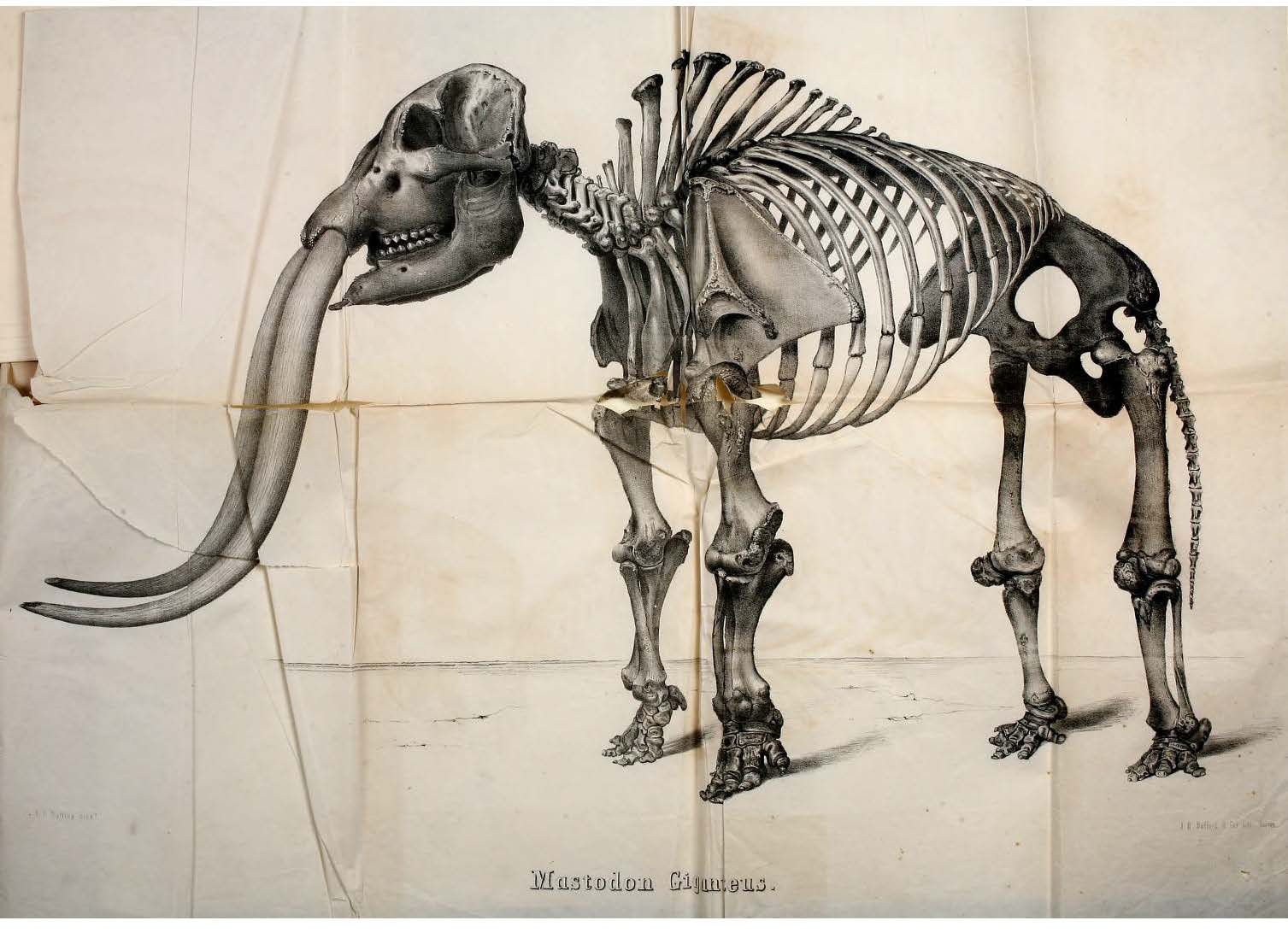
“We present the BHL to groups of students, when their class visits the library, and also use BHL as a reference tool when students are working on individual projects,” explains Mary. “Typically, a class visit involves an exhibit of historical volumes in Special Collections, and a tour and orientation on electronic resources. Faculty and students receive a bibliography of their Special Collections exhibit, with links to those works that are in BHL. The quality, immediacy and scope of the BHL make it an important tool when working with individual students, who are usually working on short-term projects. I regularly direct students to BHL who need taxonomic and anatomical works (and walk them through how to use it). Especially for students who are not science majors, the BHL is a dependable central source of scholarly articles and books in zoology and natural history. Our print journals and older monographs do not circulate, so the BHL’s high quality scans fill the students’ needs for accessible sources. Warren’s monograph on Mastodon giganteus (image below) is a great example. I have the volume downloaded at the reference desk and send it to a student at least once a year. They can see the original in Special Collections during library hours but use the BHL version from anywhere, 24/7.”

View Full Size Image
Skeleton of Mastodon giganteus. Warren, John C. The Mastodon Giganteus of North America. 1852. pl. XXVII. http://biodiversitylibrary.org/page/40681510. Digitized by Smithsonian Libraries.

Mary has been at the MCZ Ernst Mayr Library for twenty-five years. Her specialty is reference and research, but she also collaborates on circulation and other areas where the library intersects with the public. She is most active in the subject areas of marine biology, bryozoology, and scientific biography.

As the Ernst Mayr Library is a founding Member of the Biodiversity Heritage Library, Mary has been aware of BHL’s existence since its launch in 2006. It has had an increasingly significant impact on her work over the past ten years.

“I have a very high opinion of BHL,” affirms Mary. “It has impacted my work by making natural history journals and books easier to find and use. I am very fortunate to be in a library that contributes to the BHL: we have a solid collection of 19th century journals and many pre-1850 titles. As the repository has grown, I have experienced the shift from wondering whether a classic text will be in BHL to assuming that it will be. Now that so many important titles are there, I almost always use BHL scans instead of consulting a print volume in our Special Collections. Before BHL, I regularly went to Special Collections to confirm citations, make copies, etc. Being able to do those ordinary tasks remotely saves a lot of wear and tear on the collection. For works we do not own, I can have immediate access through the BHL to volumes that would have taken weeks and delicate negotiations (or microfilm!) [to obtain access to] twenty years ago.”

Mary’s favorite feature of BHL is the quality of the scans. As she describes, BHL’s scan quality, “especially the plates, more especially the foldout plates, is vastly better than other online repositories.” She also appreciates that downloading content from BHL “keeps getting better and easier.” Thinking about future improvements, Mary hopes to see the runs of journal titles in BHL be extended to include more recent volumes. “It is difficult to negotiate copyrights, but it is a big win to have a whole run of a journal in the BHL,” explains Mary.

Mary’s favorite title in BHL demonstrates the value of having full journal runs in BHL.

“The Bulletin of the Museum of Comparative Zoology (1863-current) is the primary publication of my institution and covers a vast array of zoological topics over a 150 year time span,” says Mary. “I get a lot of questions about the works published by the MCZ and authors/historical figures associated with the Museum. Having the Bulletin available through BHL makes works easier to find, download and send, as well as taking pressure off of our print volumes.”

View Full Size Image
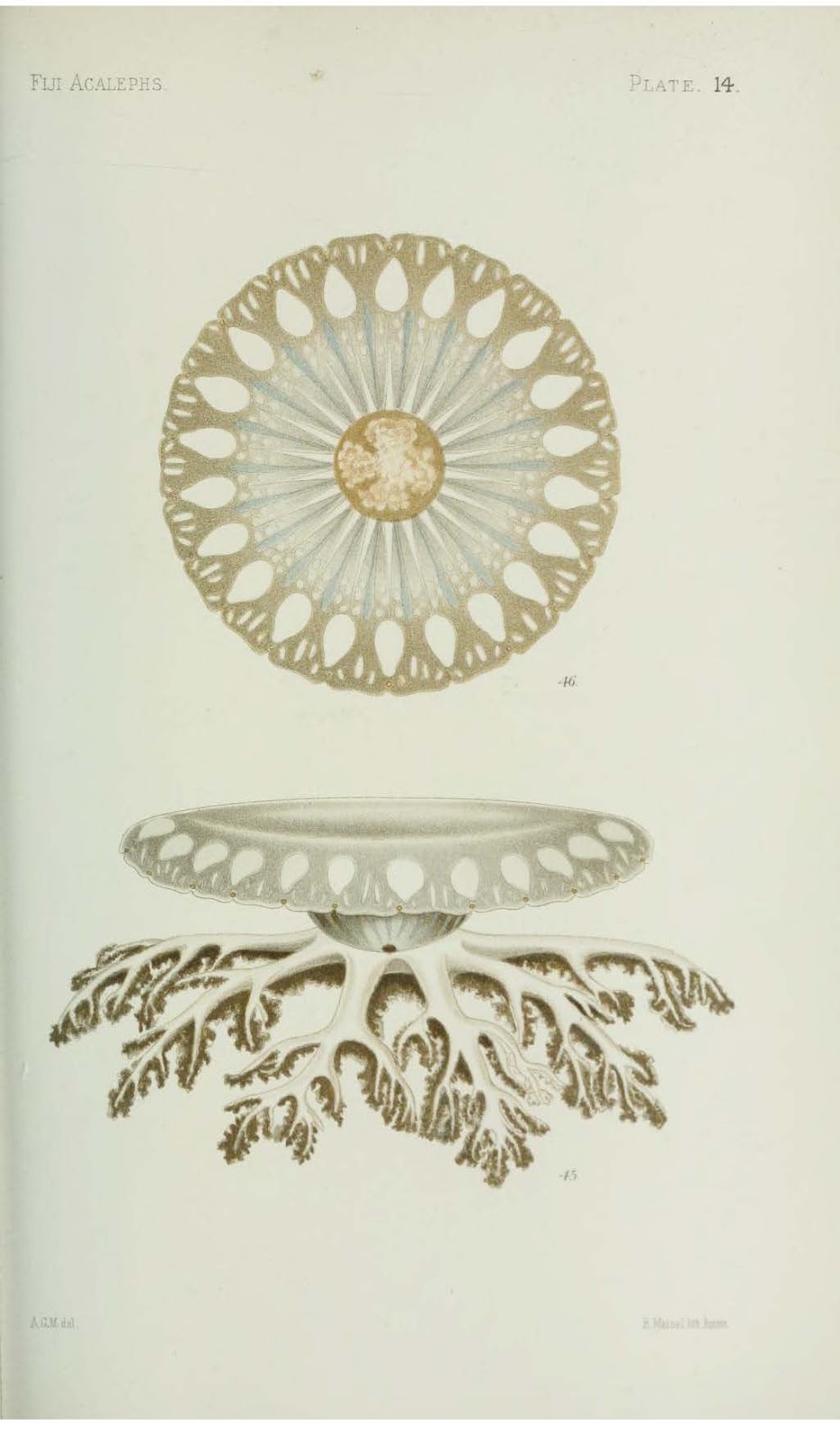
New species Cassiopeia ndrosia. Agassiz, A. and A.G. Mayer. Acalephs from the Fiji Islands. Bulletin of the Museum of Comparative Zoology, vol. 32 (9), 1899. pl. 14. http://biodiversitylibrary.org/page/30426482. Digitized by the Gerstein – University of Toronto.

BHL has an active permissions program, which is working to secure licenses for more and more in-copyright titles. Recent work by the Institute of Museum and Library Services-funded Expanding Access to Biodiversity Literature project has resulted in a significant boost to the number of permissions agreements that BHL has secured over the past few months. See our recent blog post to explore the most recent in-copyright titles for which we’ve secured permission and to learn more about EABL.

So, is the bald eagle really bald? Nope, as you should be able to tell from Catesby’s illustration. According to the National Park Service, “The term ‘bald’ comes from the word ‘piebald,’ meaning markings that are two colors, usually black and white.” As Catesby writes, “This bird is called the Bald Eagle, both in Virginia and Carolina, though his head is as much feather’d as the other parts of his body.”

BHL to the rescue for students, librarians, scientists, and readers everywhere!

_____________________

This post may contain the personal opinions of BHL users or affiliated staff and does not necessarily represent the official Biodiversity Heritage Library (BHL) position on these matters.
May 12, 2016by michelle.underhill
Blog Reel, User Stories

Supporting Biodiversity Research in the High School Classroom

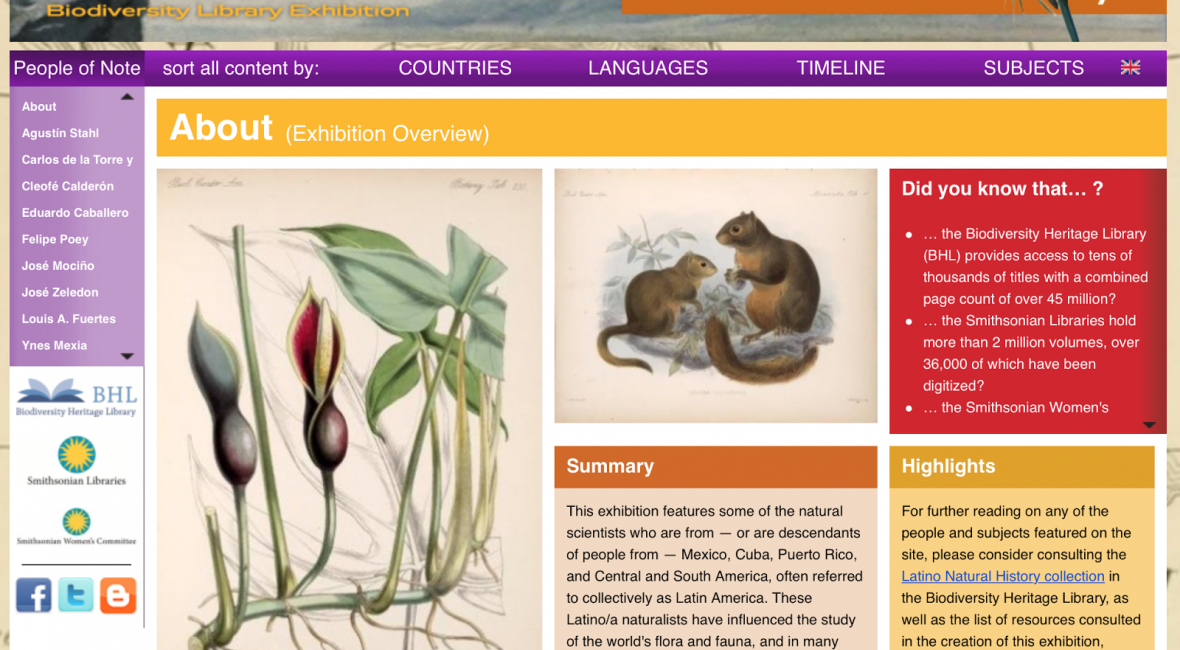
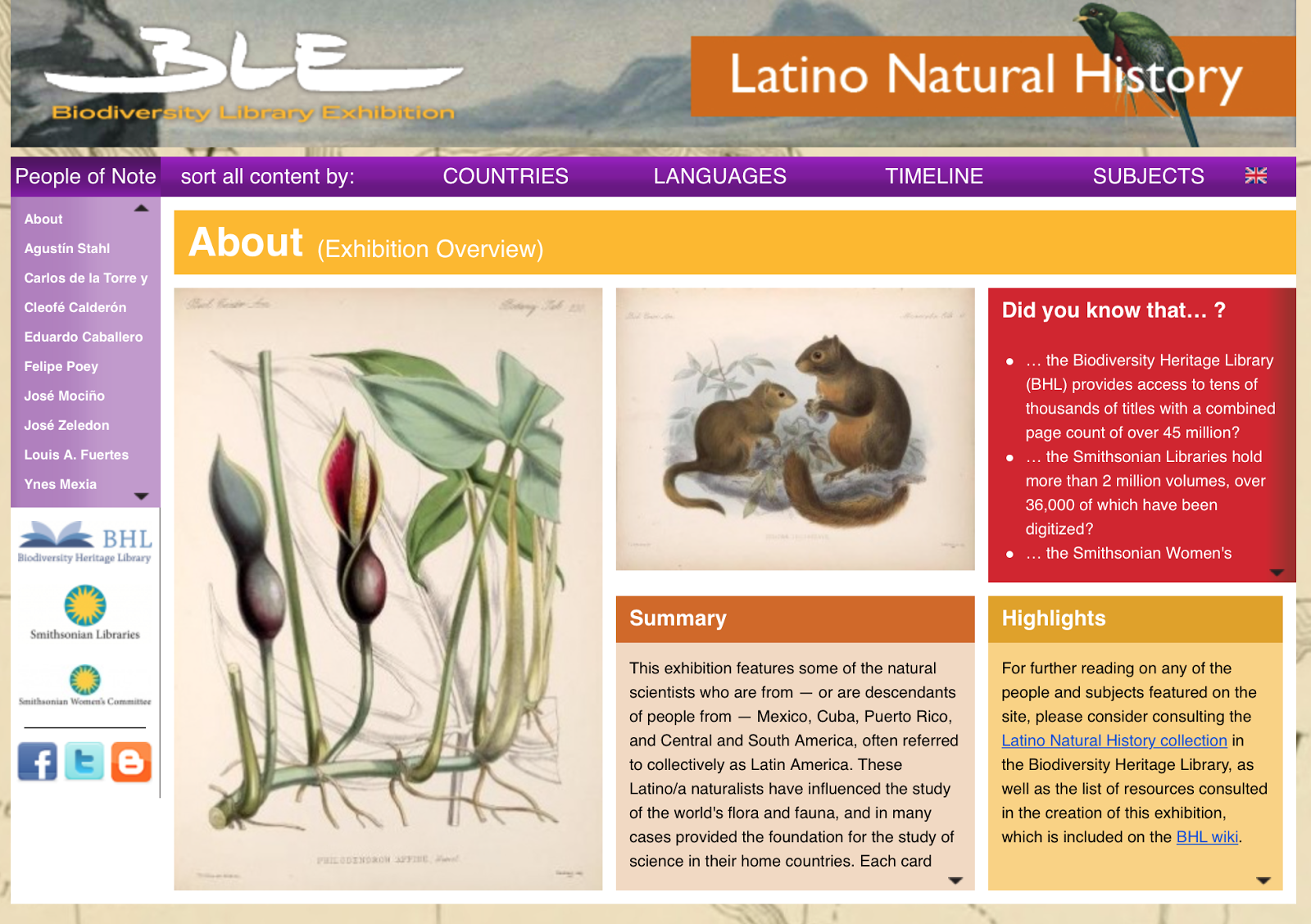
When we talk about BHL’s impact on global science, we often focus on how our collections support the work of scientists, researchers, and post-docs. Our collections are also an invaluable tool for students as well, and not just college students either. Middle and high school students can use our primary source material to conduct research for classroom assignments. Additionally, students of all ages can benefit from the wealth of plant and animal illustrations that we make available in Flickr as well as our online exhibitions highlighting topics like Latino Natural History and Early Women in Science.

View Full Size Image
Online exhibit for Latino Natural History.

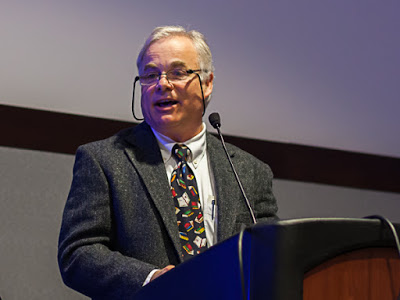
Michael R. Blake, Associate Director and Head of Instructional Services at Phillips Academy Andover, provides support to high school students researching the natural world. He graciously provided us with the following testimonial on his experience with BHL, including its use as a resource for class assignments and research.

View Full Size Image
Michael Blake telling stories to the Ticknor Society.


“I have been a science/medical librarian for more than 30 years. I retired from Harvard University two years ago and am now working with high school students focusing on the natural sciences. My avocation is exploring the out-of-doors and fishing the rivers, lakes, ponds, and streams within a reasonable driving distance. To fuel the librarian in me, I am also an avid collector of first edition fly fishing books printed in North America.

I first discover BHL during its early days of existence. I had worked with two of the parent organizations, Harvard University and the Smithsonian, and knew some of the people involved in bringing this amazing resource to the public.

I frequently use the BHL to learn about regions of the world I am unfamiliar. In helping students with writing assignments and their own research, the BHL’s resources provide answers not easily found using other databases. Recently, after reading “John Muir and the Ice that Started a Fire,” I searched the BHL for any correspondence that John Muir might have written. I discovered a few items that then lead me to explore George Engelmann and Paulus Roetter.

I usually am looking for specific items in the BHL when I use it. As an Instructional Librarian, I try to teach students how to find their needed information and enjoy some new aspect of natural history. I also go to the “Recent Additions” link to find the latest and greatest additions to the BHL; even though the latest addition might be a breviary from the 15th century. My favorite features and services provided by the BHL are the beautifully digitized images that add so much to any work. Seeing how a plant was illustrated in the 1800’s and then gathering all of the research on the item keeps me coming back.

If I could change one thing about BHL, it would be the financial support of the organization. I would love to see an endowment that ensured the existence of the organization for the future.”

Thanks so much for sharing your testimonial with us, Michael! Ensuring BHL’s financial future is, not surprisingly, a top priority for us as well. You can help ensure that BHL continues to support research about the natural world at all levels, from scientist to elementary school student, with a tax-deductible donation.

Do you have experience with or examples of using BHL in classroom settings? Tell us about it by leaving a comment on this blog or emailing us at [email protected].

April 5, 2016by ulib-libraryjobs

Help Support BHL

BHL's existence depends on the financial support of its patrons. Help us keep this free resource alive!

search

About BHL

The Biodiversity Heritage Library (BHL) is the world’s largest open access digital library for biodiversity literature and archives. BHL operates as a worldwide consortium of natural history, botanical, research, and national libraries working together to digitize the natural history literature held in their collections and make it freely available for open access as part of a global “biodiversity community.”

Join Our Mailing List

Sign up to receive the latest news, content highlights, and promotions.

Subscribe Now

Subscribe to Blog via Email

Enter your email address to subscribe to this blog and receive notifications of new posts by email.

Join 319 other subscribers

Subscribe to Blog Via RSS

Subscribe to the blog RSS feed to stay up-to-date on all the latest BHL posts.

Access RSS Feed

Inspiring Discovery through Free Access to Biodiversity Knowledge.

The Biodiversity Heritage Library makes it easier than ever for you to access the information you need to study and explore life on Earth…for free, anytime, anywhere.


64+ Million Pages of
Biodiversity Literature Online.

EXPLORE

Tools and Services
to Transform Research.

EXPLORE

300,000+
Illustrations on Flickr.

EXPLORE

ABOUT | HARMFUL CONTENT | PRIVACY | SITE MAP | TERMS OF USE