

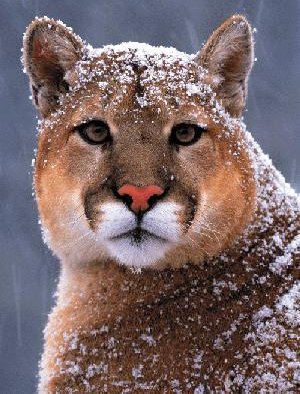
 The sad fate of the Eastern Cougar has now been officially declared by the U.S. Government – it is extinct. The status of this animal has long been a subject of controversy, with many, including the U.S. Government, declaring that the animal has been extinct since the 1930s. The disappearance of the Eastern Cougar is directly related to the arrival of settlers to the New World. This fact is clearly documented in this week’s book of the week, Extinct and Vanishing Mammals of the Western Hemisphere, with the Marine species of all the Oceans (1942), by Glover M. Allen:
“…It is clear that the eastern panther, though fairly common for so large a beast of prey, was exterminated from the more settled parts along the Atlantic coast in the colonial days, while in the wilder and more mountainous regions, as in Vermont and New Hampshire, the Adirondacks, and the Alleghenies, it persisted in some numbers till about the middle of the last century, after which the last surviving scattered individuals were gradually shot or trapped until they were exterminated, or practically so, by the last years of the nineteenth century.”
Indeed, early settlers were even offered rewards for the bodies of these unfortunate creatures:
“The catamount, or panther, as these big cats were usually called in New England, was not especially common even in early days but was nevertheless evidently troublesome to the first white settlers on our shores, for bounties were offered and many were killed though with little record…As early as 1694 Connecticut offered a bounty of 20 shillings apiece for catamounts and as late as 1769 paid for four or five. Massachusetts first offered a reward of 40 shillings for killing these animals in 1742. In 1753 this was increased to ₤4. Probably by the time of the Revolution Panthers were fairly well gone from the three southern States of New England.”
Despite the declaration of extinction, some still claim to spot members of this species in the wild. The U.S. Fish and Wildlife Service asserts that these sightings are actually “wanderers from western breedings ranges or escaped captives.” It is interesting to note that a debate exists regarding whether the Eastern Cougar, and all other divisions of the cougar, are truly subspecies of the North American Cougar, or whether all North American species are a single subspecies. It was not until 1929 that the Eastern Cougar was declared a separate subspecies, and not until 1946 that Young and Goldman described all 15 subspecies. Despite calls to label all cougars in North America as a single subspecies, the U.S. Fish and Wildlife Service still maintains their distinction, declaring in 2011 that “While more recent genetic information introduces significant ambiguities, a full taxonomic analysis is necessary to conclude that a revision to the Young and Goldman (1946) taxonomy is warranted.”
As we consider the unfortunate fate of the Eastern Cougar, let this be a reminder that we have a responsibility to take action to preserve the biodiversity of our planet so that existing species will still be around for future generations. We hope that the literature made available through BHL will continue to unlock the knowledge contained in these important historical documents, thus continuing to enhance research into biodiversity conservation on our planet.
For more information on the U.S. Fish and Wildlife’s announcement regarding the Eastern Cougar, visit the press release page: http://www.fws.gov/northeast/ecougar/newsreleasefinal.html.
