Biodiversity Heritage Library - Program news and collection highlights from BHL
  • Home
  • News
  • Featured Books
    • All Featured Books
    • Book of the Month Series
    • BHL at 20
  • User Stories
  • Campaigns
    • Fossil Stories
    • Garden Stories
    • Monsters Are Real
    • Page Frights
    • Her Natural History
    • Earth Optimism 2020
  • Tech Blog
  • Visit BHL
Home
News
Featured Books
    All Featured Books
    Book of the Month Series
    BHL at 20
User Stories
Campaigns
    Fossil Stories
    Garden Stories
    Monsters Are Real
    Page Frights
    Her Natural History
    Earth Optimism 2020
Tech Blog
Visit BHL
  • Home
  • News
  • Featured Books
    • All Featured Books
    • Book of the Month Series
    • BHL at 20
  • User Stories
  • Campaigns
    • Fossil Stories
    • Garden Stories
    • Monsters Are Real
    • Page Frights
    • Her Natural History
    • Earth Optimism 2020
  • Tech Blog
  • Visit BHL
Biodiversity Heritage Library - Program news and collection highlights from BHL
BHL News, Blog Reel

Seeds for the Future: Closing Thoughts from BHL’s Wikimedian-in-Residence

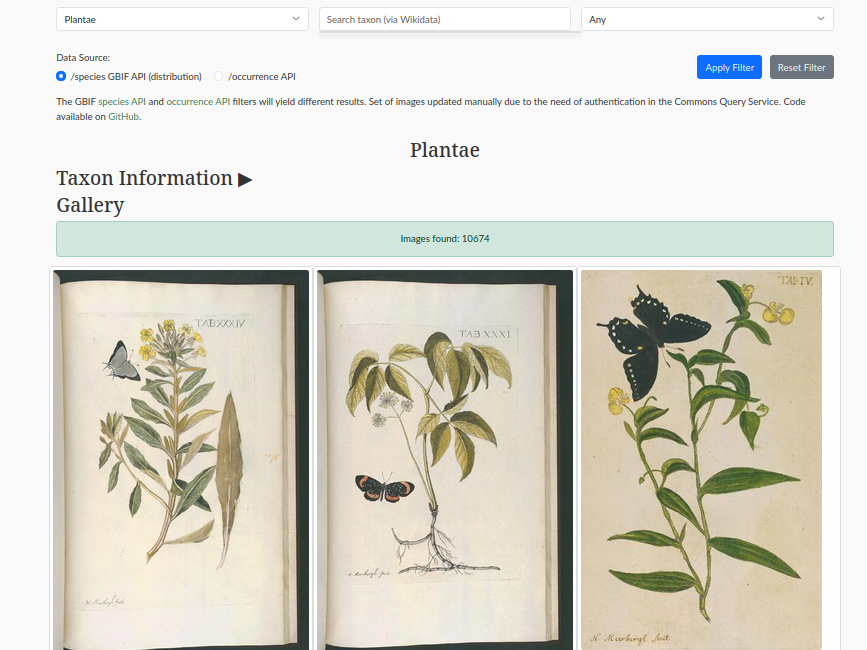
Sample search in BHL Image Explorer app showing three images in taxon Plantae, including scientific names, wikpedia links, wikimedia uses, and links to other databases

In November 2024, I embarked on a dream job as the Wikimedian-in-Residence at the Biodiversity Heritage Library (BHL), aiming to enrich Wikimedia’s platforms with BHL’s incredible biodiversity collections. This crucial role was shaped by community-driven recommendations outlined along with the dedicated efforts of the BHL-Wiki Working Group, including key figures such as JJ Dearborn, Jake Orlowitz, Giovanna Fontenelle, and Siobhan Leachman, who continuously support the integration of BHL content with the Wikimedia ecosystem.

Connecting the Dots

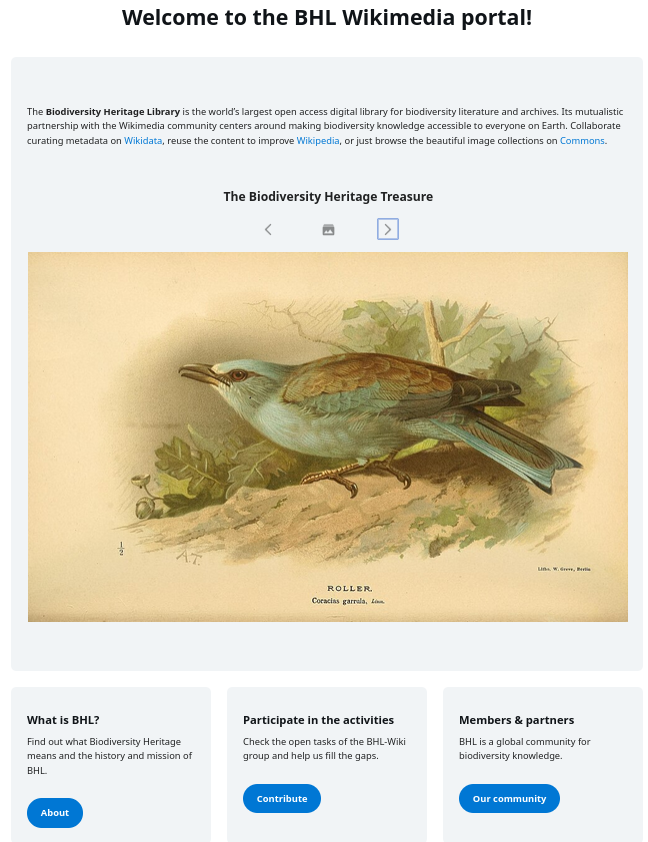
One of our first achievements was creating a comprehensive Meta-Wiki portal clearly showcasing the partnership across Wikimedia’s diverse projects and adding rich documentation on the different ways both communities are connected. Throughout the residency, we transparently documented our ongoing activities through detailed status updates, offering insights into our step-by-step progress.

Homescreen of the BHL wikimedia portal with an image of a blue and brown bird perching on a log

The BHL-Wiki Meta-Wiki portal

Tools and Impact

We developed several exciting tools, including BHL Arena, a fun interactive game highlighting BHL’s visual treasures and collecting insights about community preferences.

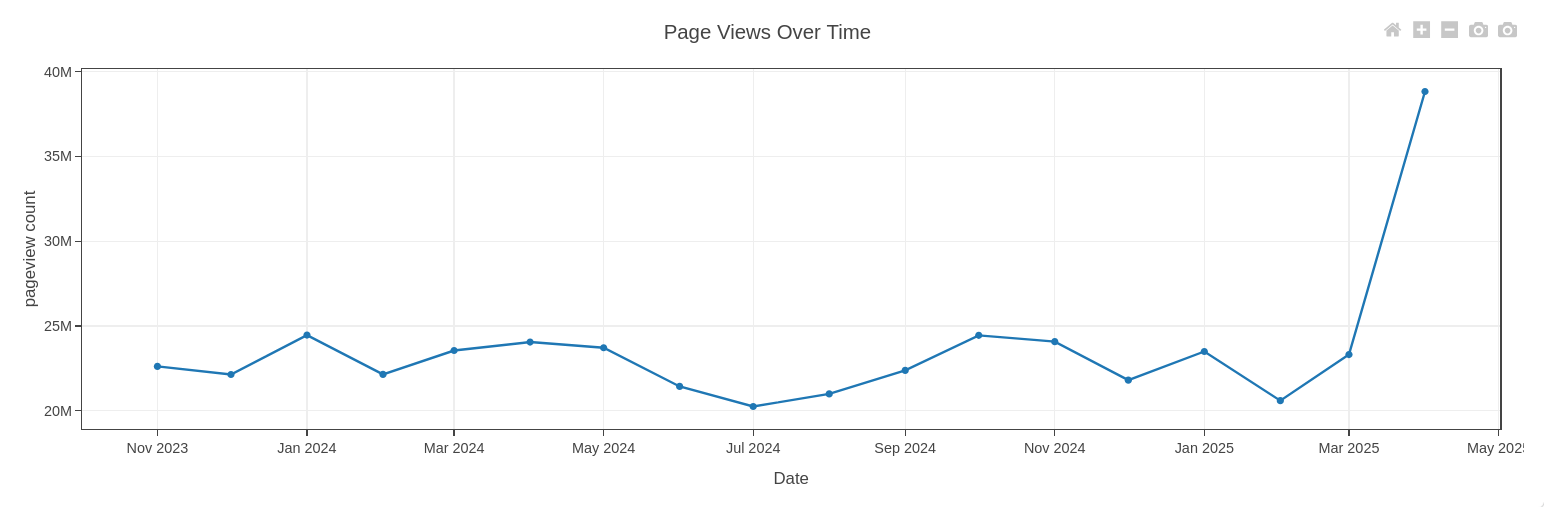
To capture and understand the broader impact, we built a dedicated dashboard leveraging Wikimedia’s Commons Impact Metrics API. Remarkably, BHL images attract around 20 million monthly views—vastly surpassing BHL’s own website traffic, which averages an already impressive 1.5 million accesses per month.

Graph demonstrating page views over time, starting in November 2023 through April 2025

Monthly views for BHL content on Wiki (with spike in April motivated by traffic to “dire wolf”)

Structuring Data for Maximum Reach

A key achievement was enhancing metadata through Structured Data on Commons (SDC). Collaboratively, we designed a comprehensive, structured metadata model, supported by detailed workflows using tools like Open Refine to efficiently add rich structured data to thousands of BHL images.

We successfully developed scripts integrating metadata from Flickr, the BHL API, GBIF, as well as Wikimedia Commons community-curated categories. With the scripts, the initial goal was to add structured data to 5000 files by the end of March. The combination of the automated approaches with the tireless work of the BHL-Wiki participants, namely User:Ambrosia10, led us to the current coverage of structured data additions for over 18,000 files!

A Tool for the Future: BHL Image Explorer

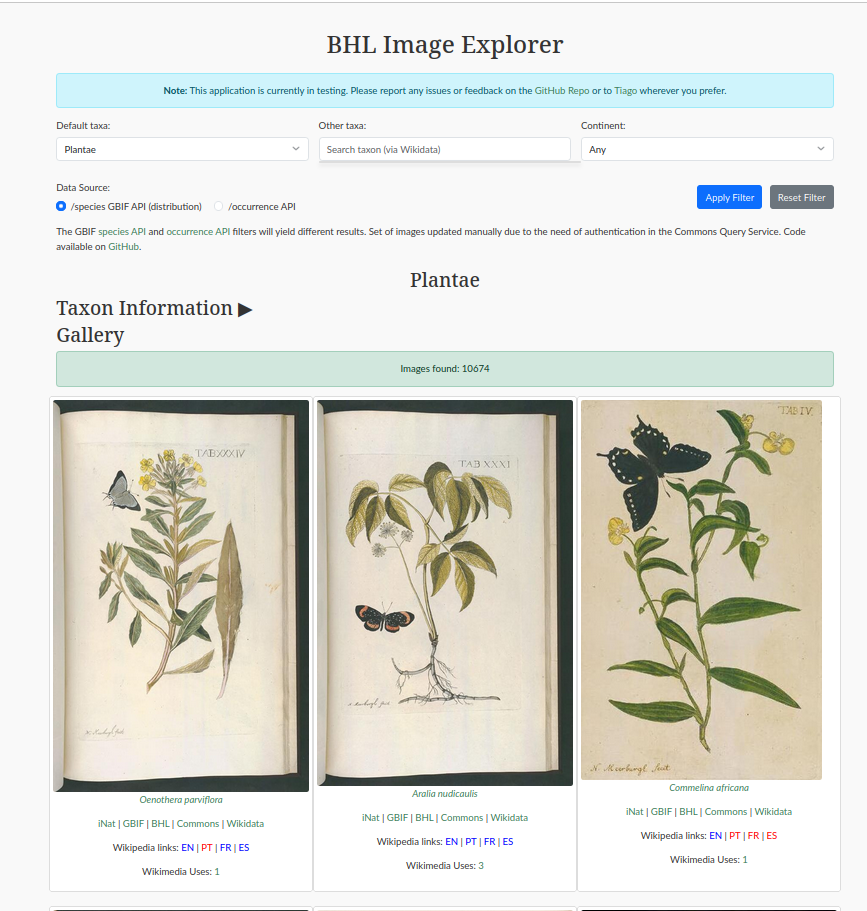
One particularly impactful creation was the BHL Image Explorer, an intuitive tool enabling easy discovery and reuse of BHL images on Wikipedia. Developed iteratively with user feedback, it offers robust taxon- and location-based searches drawing from the GBIF API, interactive navigation, and detailed Wikimedia reuse statistics. It is a demonstration of how the structured data can be leveraged to improve navigability of image collections as well as aiding Wikimedia volunteers in extending the reach of illustrations.

Sample search in BHL Image Explorer app showing three images in taxon Plantae, including scientific names, wikpedia links, wikimedia uses, and links to other databases

Search for plants in the BHL Image Explorer

Looking Ahead

Through these six months, I have grown a passion for the BHL Image collection, and I really want to see them everywhere (e.g. every time I open a new tab). In an age of cheap, AI-generated illustrations, there is something grand in seeing these human-made pieces of scientific art, tales of the biodiversity-loving nature of humankind across the centuries.

Although my formal residency has concluded and new futures for BHL are in preparation, I am confident that the outcomes of this work will continue to flourish. Some of the key contributions poised for lasting impact on the data/metadata for BHL Images include:

  1. A robust, adaptable, structured metadata model ready for future use;
  2. Efficient scripts for large-scale structured data integration from diverse APIs;
  3. Automated workflows transforming Wikimedia Commons categories into structured data; and
  4. The accessible and powerful BHL Image Explorer tool, enhancing global access to biodiversity imagery.

These advancements significantly amplify the visibility and accessibility of biodiversity heritage content, inspiring ongoing volunteer engagement and enriching global biodiversity knowledge.

I warmly invite everyone to explore the BHL Image Explorer and actively participate in ongoing efforts listed on BHL’s Meta-Wiki page. Together, we can continue bridging biodiversity’s rich past with Wikimedia’s vibrant, open-access future!

July 29, 2025by [email protected]
BHL News, Blog Reel

Advancing BHL’s Data for a Sustainable Future: Meet Tiago, Our New Wikimedian-in-Residence

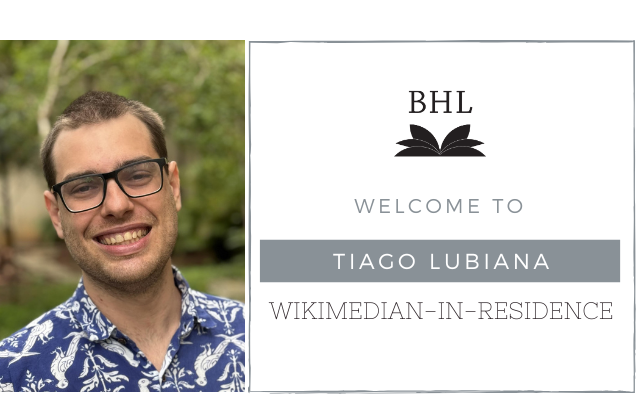
BHL - Welcome to Tiago Lubiana, Wikimedian-in-residence
A person with short brown hair, black glasses, and a blue and white shirt smiles at the camera

Tiago Lubiana, BHL Wikimedian-in-Residence. Photo credit: Maria Eugenia Tita / Personal Archive / CC0 Dedication

We are thrilled to announce the appointment of Tiago Lubiana as the new Wikimedian-in-Residence (WiR) at the Biodiversity Heritage Library (BHL)! This crucial role, shaped by community-driven recommendations from the Unifying Biodiversity Knowledge to Support Life on a Sustainable Planet white paper, is aimed at advancing BHL’s goal of making biodiversity data more accessible, actionable, and impactful for a sustainable future.

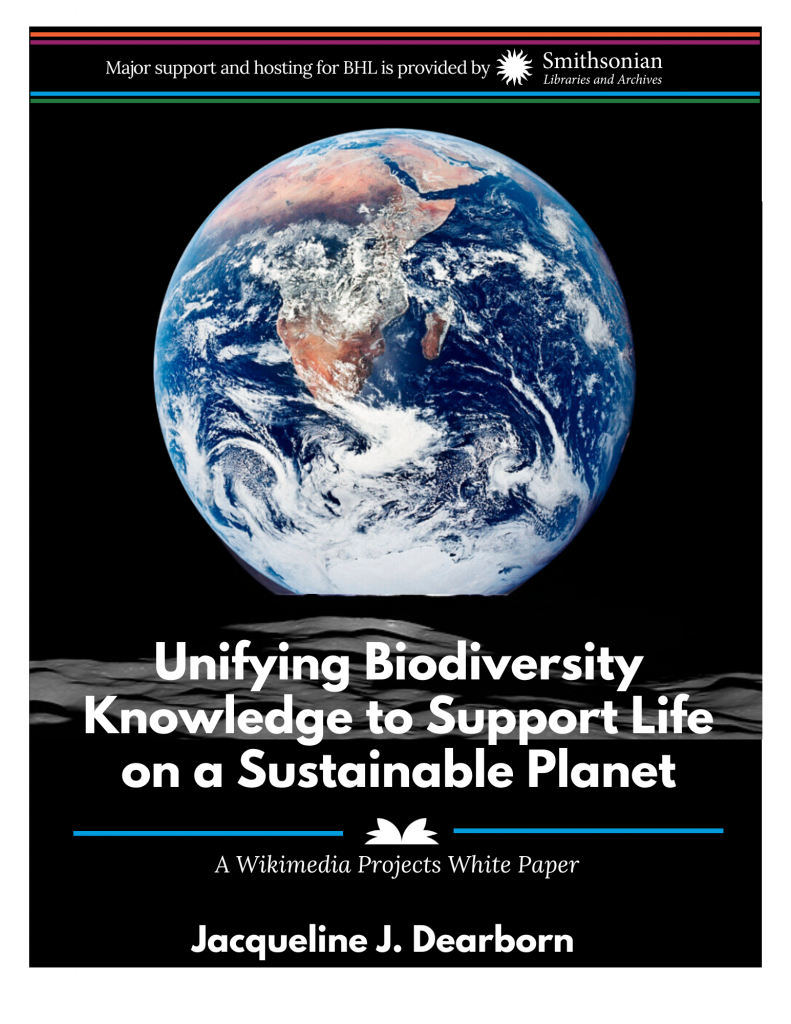
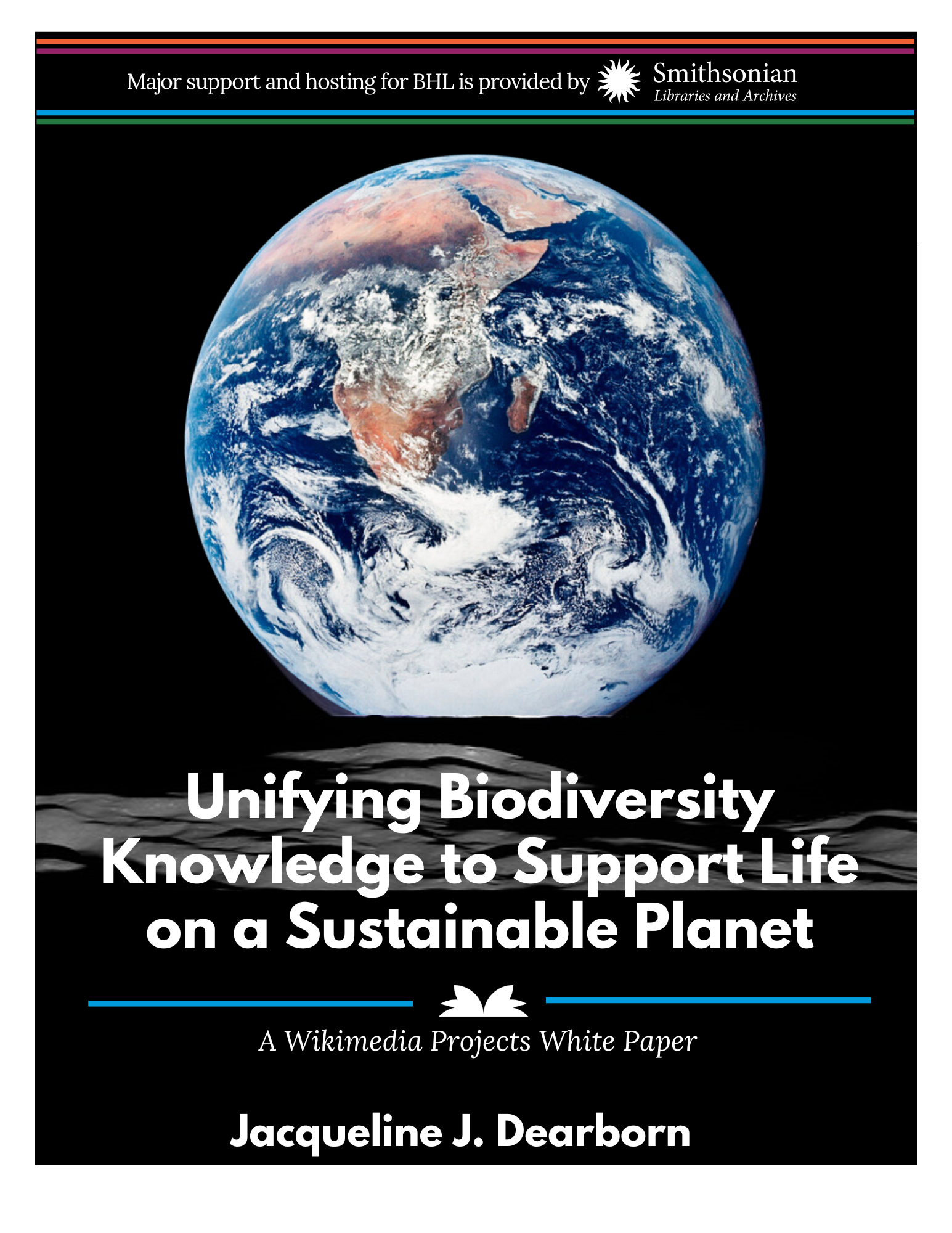
Cover of white paper with image of earth from space

Dearborn, J. (2023). Unifying Biodiversity Knowledge to Support Life on a Sustainable Planet. Biodiversity Heritage Library. https://doi.org/10.21428/bcf8962c.699434fb

As BHL’s new Wikimedian-in-Residence, Tiago will expand BHL’s data presence within Wikimedia platforms, convert legacy data to structured data on Structured Data on Commons for BHL’s vast image collection, and provide training to the broader biodiversity wiki community. His expertise in open science, data modeling, and the semantic web will help connect BHL’s data to the growing biodiversity knowledge graph, fostering collaboration and ensuring our information is accessible, interoperable, and integrated into the emerging semantic web ecosystem.

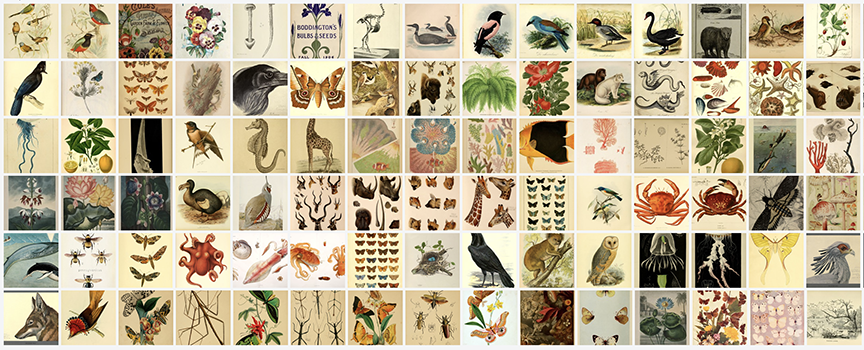
BHL Flickr Image Collection

Tiago will be enhancing BHL’s Image Collection via the Structured Data on Commons Project. Photo credit: BHL / Screenshot/ CC0 Dedication

About Tiago

Tiago is a bioinformatician and independent Wikimedian based in São Paulo, Brazil, with a strong focus on open science, open knowledge, and life sciences. He holds a PhD in Bioinformatics from the University of São Paulo, where his research explored Wikidata as an open biocuration platform for disseminating knowledge about human cells. Tiago is also an active member of the International Society for Biocuration, the Wiki Movimento Brasil User Group, and has contributed significantly to various WikiProjects on Wikidata, including WikiProject COVID-19 and WikiProject Biodiversity.

A passionate advocate for biodiversity and open knowledge, Tiago is also the developer behind the inat2wiki tool, which bridges data between iNaturalist and Wikimedia Commons. Outside of his work in bioinformatics and open data, Tiago’s early passion for biology was sparked by his experience attending the International Biology Olympiad in Singapore in 2012, where he won a bronze medal.

Tiago holds a Bachelor’s Degree in Biomedical Sciences (University of São Paulo, 2014–2017), a Master’s Degree in Bioinformatics (University of São Paulo, 2018–2020), and a PhD in Bioinformatics (University of São Paulo, 2020–2024). For more information, visit his website.

The BHL-Wiki Working Group: A Global Collaborative Effort

In addition to Tiago’s role, we are also excited to officially announce the BHL-Wiki Working Group newly formed in 2024, which will help guide and support BHL’s wiki initiative. The group is made up of 30 members from 20 GLAM organizations worldwide, working to strengthen the biodiversity data infrastructure through greater interoperability and accessibility in the Wikimedia ecosystem and beyond. With diverse expertise spanning biodiversity research, open data, user engagement and technology, the group is committed to integrating semantic web technologies and adhering to open data principles, including FAIR (Findable, Accessible, Interoperable, Reusable) and CARE (Collective Benefit, Authority to Control, Responsibility, and Ethics).

Leadership of the BHL-Wiki Working Group includes:

  • Siobhan Leachman (User:Ambrosia10), BHL-Wiki Chair, a Wikimedian laureate and long-time advocate for the Biodiversity Heritage Library and Wikimedia projects.
  • Jake Orlowitz, BHL-Wiki Vice Chair, Wikiblueprint, Independent Wikimedian and Wikimedia Consultant
  • Giovanna Fontanelle, WMF Institutional Representative, Program Officer, Culture and Heritage, Wikimedia Foundation
  • JJ Dearborn, Smithsonian Institutional Representative, BHL Data Manager / Secretariat

Together, the BHL-Wiki Working Group is working towards the following key objectives:

  1. Maximizing Accessibility & Interoperability through Semantic Web Integration
    Ensuring biodiversity data is discoverable, accessible, and interoperable across global research networks by leveraging semantic web technologies and open data standards, supporting global biodiversity research and climate action.
  2. Advancing Data Modeling for Global Challenges
    Developing data models that enable better insights into climate change and biodiversity loss, while harmonizing with international initiatives to address pressing sustainability challenges.
  3. Strengthening User Engagement & Global Partnerships
    Enhancing community engagement, integrating traditional ecological knowledge (TEK), and fostering collaborations with marginalized voices to ensure BHL’s data is scientifically rich and culturally inclusive.

The working group is excited to have a new Wikimedian-in-Residence on board and see Tiago’s appointment as a critical need to push forward on the group’s collective goals. Chair of BHL-Wiki, Siobhan Leachman commented that:

“Having a Wikimedian-in-Residence at BHL is extremely important as this will help both the Wiki community to continue to actively and appropriately interweave content sourced from BHL into the Wikiverse and will also encourage and support members of the BHL community to contribute to the Wiki movement. In doing so the Wikimedian-in-Residence will be assisting BHL with its aim of helping to document and understand the world’s biodiversity.”

Presentation - What can a Wikipedian in Residence Do for You?

Presentation by Jake Orlowitz – “What can a Wikipedian in Residence Do for You?” Credit: Wikiblueprint.

If you are a BHL partner and you are interested in hosting your own Wikimedian-in-Residence, please check out the presentation from Wikiblueprint explaining the myriad benefits that hosting a Wikimedian at your home institution can bring.

Building a Global Ecosystem for Biodiversity Knowledge

The work led by the BHL-Wiki Working Group will lay the foundation for a more connected, sustainable biodiversity knowledge ecosystem. The BHL-Wiki initiative will amplify the impact of biodiversity data, support urgent climate action, and foster a more sustainable and inclusive future.

We are excited for the journey ahead and look forward to the innovations and collaborations that will emerge from this partnership!

November 20, 2024by mdimeo
BHL News, Blog Reel

Advancing Data Excellence: A New Era for the BHL Cataloging and Metadata Committee

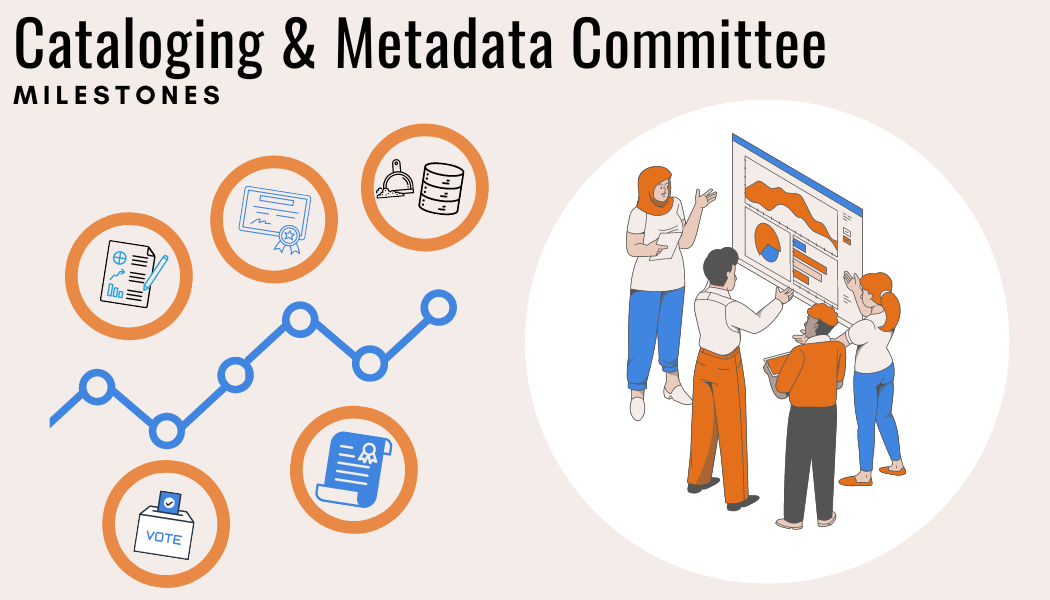
Cataloging & Metadata Committee Milestones with graphic visuals of a team pointing to charts

2023 proved to be a transformative year of growth, increased collaboration, and heightened dedication to advancing biodiversity knowledge for the BHL Cataloging and Metadata Committee. Last year, the Committee achieved significant milestones in committee governance, professional development opportunities, data quality updates, and the ratification of consortia-wide data policies, accompanied by comprehensive documentation.

Cataloging & Metadata Committee Milestones with graphic visuals of a team pointing to charts

On the governance front, the former “Cataloging working group” completed a Committee Charter to elevate the group’s status to an official BHL Committee. Approval of the Committee at the 2023 BHL Annual Meeting by the Executive Committee and BHL Partners, as well as the formal codification in the BHL Bylaws, solidifies Cataloging and Metadata as a permanent standing BHL Committee.

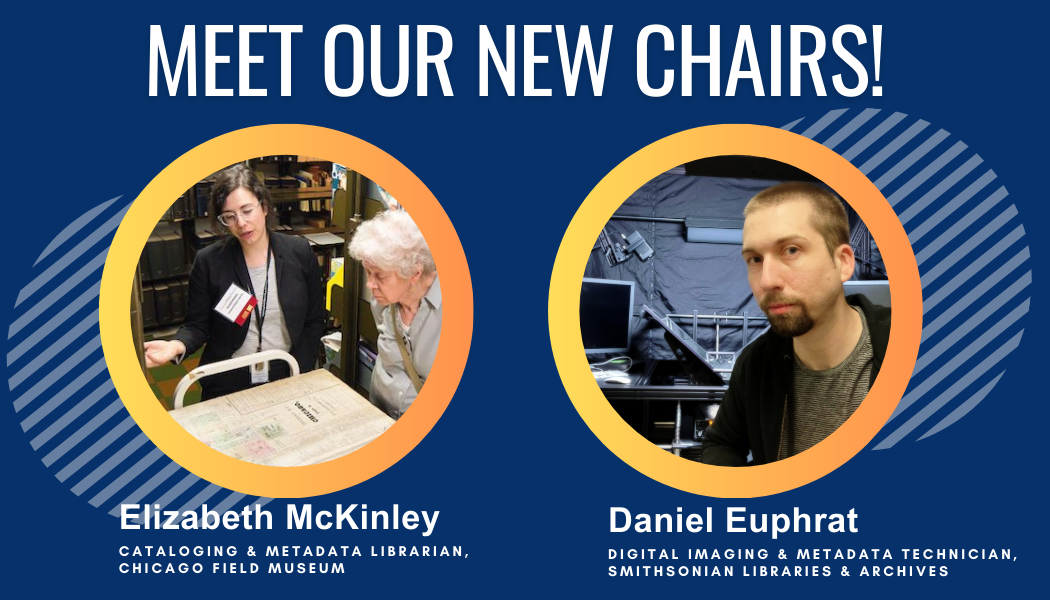
Pictures of new committee co chairs Elizabeth McKinley (leading a tour of patrons) and Daniel Euphrat (sitting in front of digitization equipment)

In 2023, the Committee held its inaugural Chair Election which signified a notable transition for the former working group. We are excited to welcome Daniel Euphrat of the Smithsonian Libraries and Archives and Elizabeth McKinley of the Chicago Field Museum as the co-chairs for 2024. Additionally, we extend our gratitude and appreciation to former chairs Suzanne Pilsk of the Smithsonian Libraries and Archives and Diana Duncan of the Chicago Field Museum, who will continue to provide valuable mentorship during this transitional period. A warm welcome and congratulations to Daniel Euphrat and Elizabeth McKinley on becoming the inaugural co-chairs in 2024.

The Committee membership grew with the addition of advisors, retired staff as observers, and new members:

  • Siobhan Leachman, Committee Advisor and Independent Wikimedian
  • Elizabeth McKinley, Committee Co-Chair and Cataloging & Metadata Librarian at the Chicago Field Museum
  • Briana Giasullo, Committee Member and Cataloging and Digital Resources Librarian at the Academy of Natural Sciences of Drexel University
  • Sandra Lee Parker Provenzano, Committee Member and Head Cataloger at Dumbarton Oaks, Harvard University

As a newly formalized Committee, this coming year will see some fresh perspectives and ideas to drive progress on BHL Strategic Goals and the Committee’s formal charge.

Empowering BHL Staff with Wiki Education’s Wikidata Certificate Course

A tangible benefit of Committee membership includes access to broader professional development opportunities through BHL. Early in 2023, committee members celebrated the completion and final project wrap-up of a six-week professional certificate course sponsored by BHL and the Smithsonian Libraries and Archives (SLA). This specialized course was facilitated by Wiki Education, a non-profit that focuses exclusively on supporting students, faculty, and subject area specialists with their Wikimedia work. The program provided BHL and SLA staff with a unique opportunity to hone advanced skills in SPARQL queries, visualizations, and data modeling.

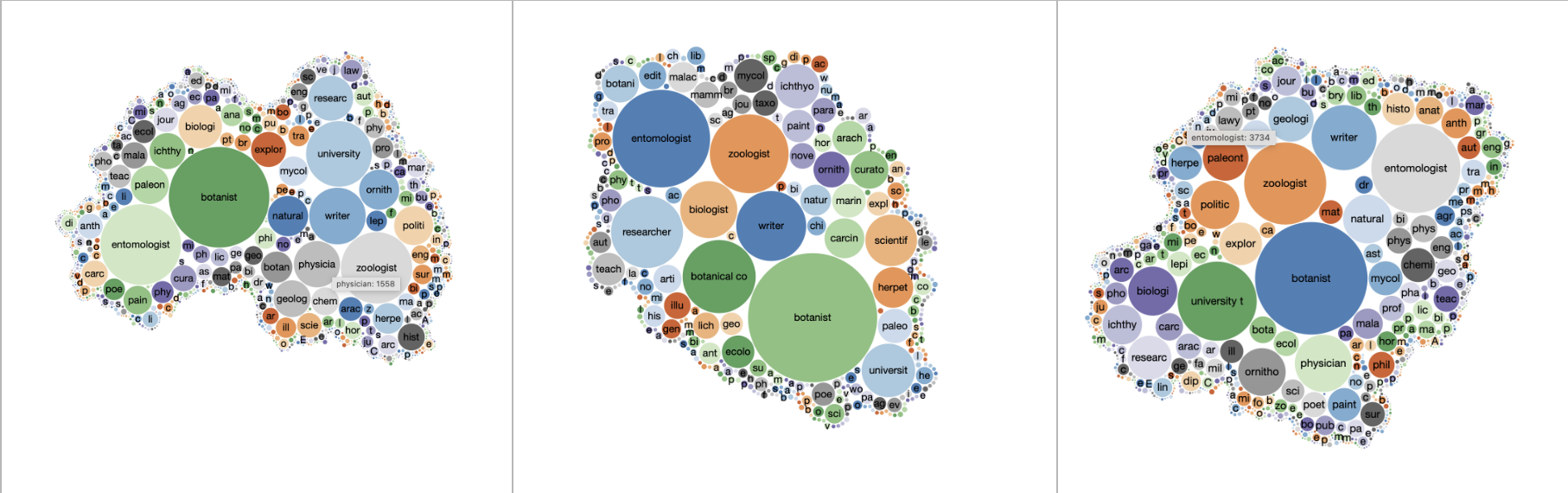
Three SPARQL visualizations with varying colors and sizes of circles clustered together

Left to right: SPARQL visualizations of BHL Authors by Occupation; BHL Female Authors by Occupation; BHL Male Authors by Occupation. The course provided participants with the opportunity to experiment with linked data and visualizations produced by the Wikidata Query Service.

The custom curriculum, led by the knowledgeable Will Kent aka “Wikidata Will” and SLA co-facilitators JJ Dearborn, Richard Naples, Suzanne Pilsk, and Jackie Shieh engaged a cohort of 25 participants in a tailored, immersive experience exploring topics like SPARQL queries, visualizations, federation, data modeling, bulk data loading, and editing tools.

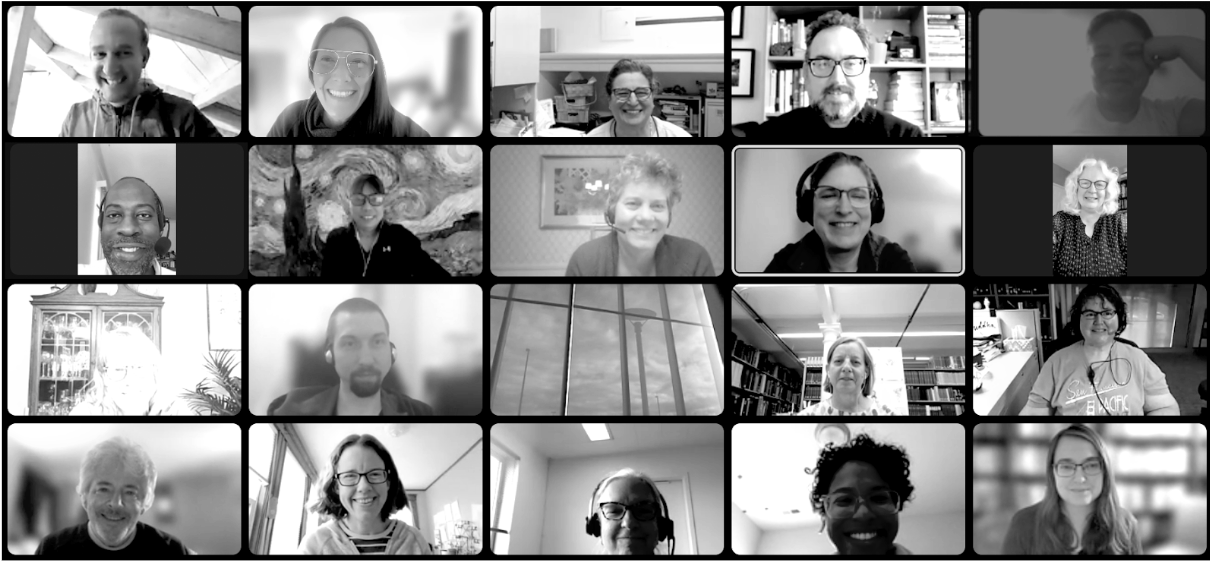
Grid of 20 black and white video screens of committee members on a video conference call

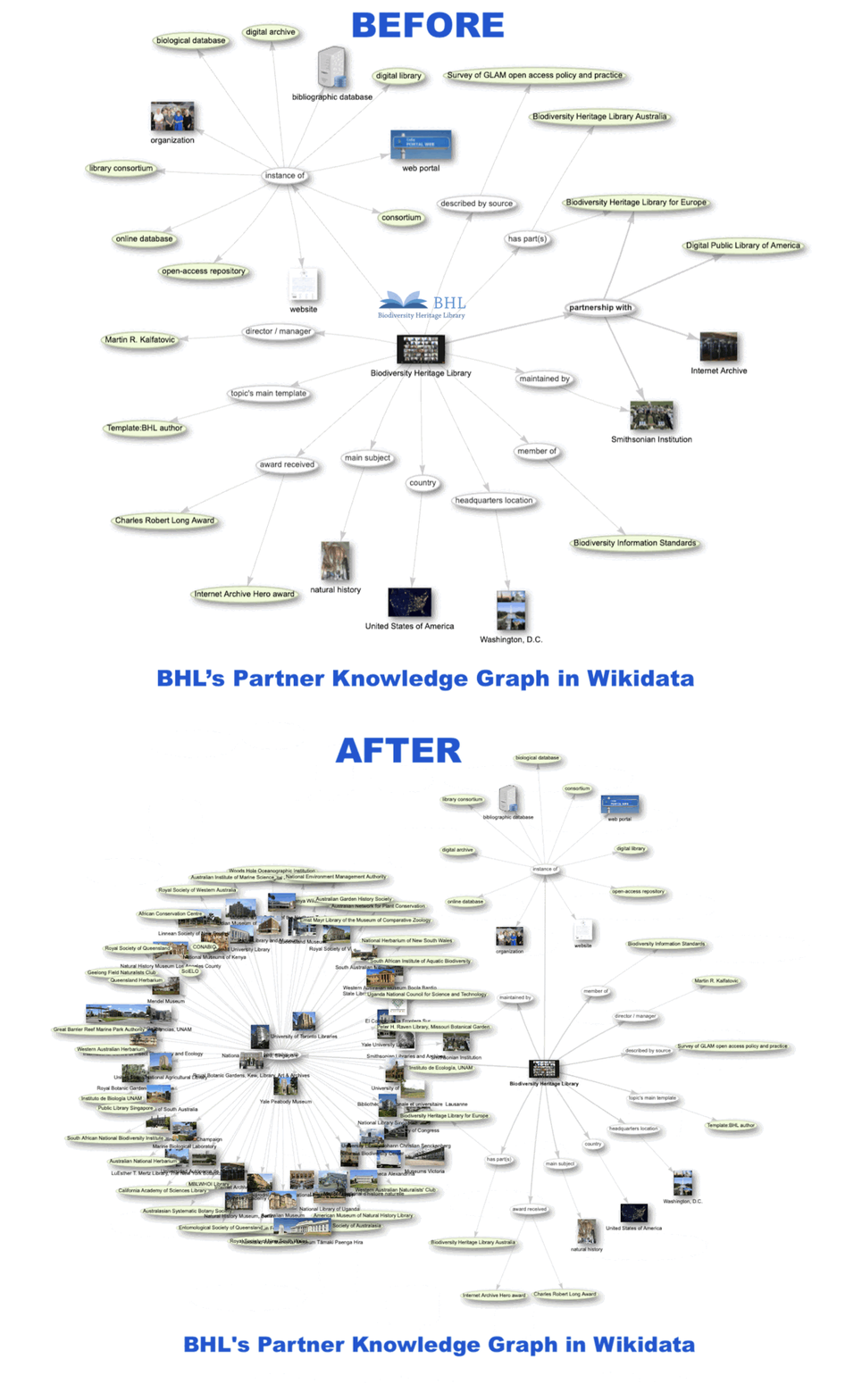
Participants added BHL partner nodes as items and linked them up with BHL using the Wikidata in partnership property:

GIF of before and after visualization of BHL knowledge graph with entities clustered and connected by arrows

The BEFORE is what BHL’s Partner Knowledge Graph looked like and AFTER the course, one can see how BHL’s network has grown in Wikidata!

Enriching our Committee’s technical expertise has not only opened new avenues for exploration within the Wikimedia project ecosystem but has also laid the foundation for the newly formed BHL-WIKI working group, set to launch this year under the distinguished leadership of Wikimedia Laureate and long-time BHL advocate, Siobhan Leachman. Under Siobhan’s guidance, BHL is embarking on a dedicated effort to convert its legacy data into 5-star linked open data, facilitating expanded global access to biodiversity knowledge for all.

For a more in-depth understanding of BHL’s symbiotic relationship with the Wikimedia ecosystem, we encourage readers to explore related post “BHL is Round Tripping Persistent Identifiers with the Wikidata Query Service,” and the white paper titled “Unifying Biodiversity Knowledge to Support Life on a Sustainable Planet.”

Comprehensive BHL Metadata Requirements for our Global Consortium

Conformant metadata in BHL is the linchpin that allows BHL to manage diverse global sources of metadata across 588+ contributors. A guiding document is paramount to fostering metadata harmonization from a globally disparate network and empowers BHL technical staff in maintaining data consistency and ensuring interoperability across the consortium. The new BHL metadata requirements facilitates effective searching, browsing, discovery, and identification for BHL’s end-users, enabling broader access and engagement with biodiversity knowledge on a global scale.

The journey to finalize BHL’s Metadata Requirements was a lengthy endeavor and bringing together once-disparate guidelines into a unified framework is the culmination of many years of work. After a Metadata Requirements Summit in 2023 and multiple rounds of Committee peer review, the first version of comprehensive BHL Metadata Requirements has been published and incorporated into BHL’s Collection Development Policy.

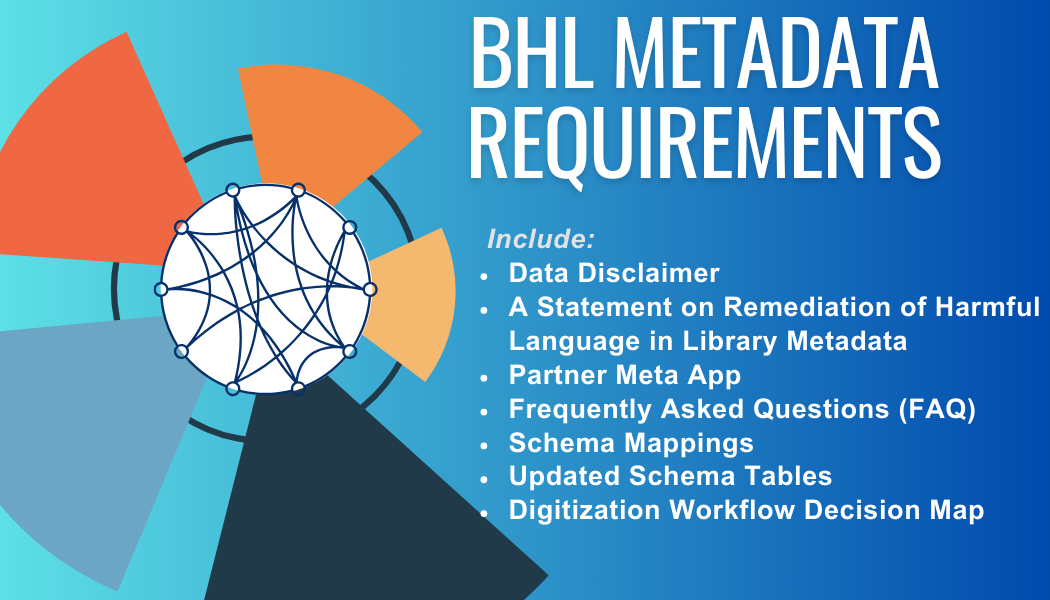
BHL Metadata requirements include data disclaimer, a statement on remediation of harmful language in library metadata, partner meta app, FAQ, schema mappings, updated schema tables, digitization workflow decision map

Additionally, embedded within these requirements is the BHL Cataloging and Metadata Committee’s formal Statement on Remediation of Harmful Language in Library Metadata, which serves as a commitment to address harmful language in library metadata, recognizing the impact of legacy language and knowledge organization systems can have on perpetuating biases. BHL actively champions inclusivity, encouraging contributors to realign vocabulary terms to ensure diverse user access. Rejecting censorship, BHL acknowledges and commends the ongoing efforts by contributing institutions in remediating outdated metadata terms. This commitment not only aligns with our dedication to diversity but also reinforces our mission to provide a comprehensive and inclusive perspective on biodiversity knowledge for a global audience.

Across the BHL Consortium, we consistently unite to uphold excellence in metadata management and recognize the individual needs of our digitization partners, encompassing factors such as staff, technical expertise, funding, and local facilities. Having comprehensive Metadata Requirements reflects the tenacious and collaborative spirit across the BHL Consortium to come together in unity and further our collective mission to provide free, worldwide access to knowledge about life on Earth.


BHL Cataloging and Metadata Committee Charge

The BHL Cataloging and Metadata Committee possesses advanced expertise in metadata standards, remediation, mapping, and cross-walking workflows. The committee is responsible for overall BHL metadata advising, curation, and validation with the overarching goal of sharing the highest quality bibliographic data outputs broadly with the bioinformatics community and the world. The task of harmonizing hundreds of years of metadata from diverse sources is a continuous, iterative activity. The Cataloging and Metadata Committee directly supports the following strategic goals:

  • Ensures reliability and accuracy of the collections by curating the BHL collection 
  • Defines the BHL collection as a data resource as well as a digital library to support big data approaches
  • Extends and deepens metadata parsing and validation 

In closing, the Committee eagerly anticipates a year ahead filled with continued efforts to enhance BHL’s metadata quality and further integrate diverse information into the growing network of biodiversity knowledge. Please don’t hesitate to reach out to the group with your feedback. Your input will be invaluable as we strive to advance our mission and better serve our community. Thank you for your ongoing support and engagement.

February 29, 2024by mdimeo
BHL News, Blog Reel, Tech Updates

Interlinking BHL Data in the Wikimedia Project Ecosystem

Cover of white paper with image of earth from space

The planet is at a critical juncture, where urgent action is required to combat climate change, biodiversity loss, and secure a sustainable future for our planet. With the release of the recent BHL Wikimedia white paper entitled Unifying Biodiversity Knowledge to Support Life on a Sustainable Planet, the Biodiversity Heritage Library Secretariat hopes that an expanded data vision for the BHL community presents new opportunities to take bold steps forward into Wikimedia projects and the emergent semantic web.

Cover of white paper with image of earth from space

Dearborn, J. (2023). Unifying Biodiversity Knowledge to Support Life on a Sustainable Planet. Biodiversity Heritage Library. https://doi.org/10.21428/bcf8962c.699434fb

The white paper sheds light on BHL’s crucial role as a member of the biodiversity informatics community and reveals a series of key use cases and big data challenges that, if addressed, could be opportunities to enhance global biodiversity data infrastructure.

Addressing BHL’s Big Data Challenges

Three significant challenges remain for BHL to solve in the era of big data:

  1. correcting and transcribing OCR text;
  2. improving search precision and retrieval within the BHL interface; and
  3. expanding interlinkages and deposits of data from BHL into global knowledge bases, e.g. depositing species occurrence data in Global Biodiversity Information Facility (GBIF).

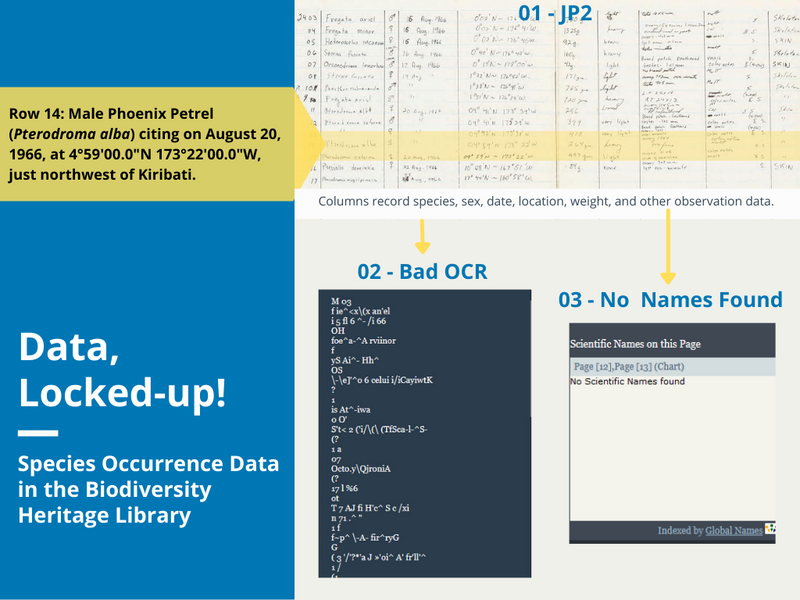
Example of handwritten observation data with poor quality OCR and no scientific names found on the page

By working to address these challenges, BHL aims to ensure data accuracy, enhance user experience, and forge stronger connections within the global biodiversity data infrastructure.

If liberated, the data in BHL’s collection will:

  1. improve scientific understanding of ecological change, deeper into time;
  2. assist decision-makers in shaping global environmental policy informed by the historical record; and
  3. bridge knowledge gaps and facilitate information exchange regarding our planet’s history.

Unlocking BHL’s Power with Wikimedia Projects

Within the white paper, Wikimedia’s core projects, particularly Wikidata, take center stage. BHL is already engaged in projects to load title, author and article metadata into Wikidata. By integrating more of BHL’s biodiversity and climate-related data into the collaborative and unified ecosystem of Wikidata, BHL can unlock new opportunities for data-driven insights.

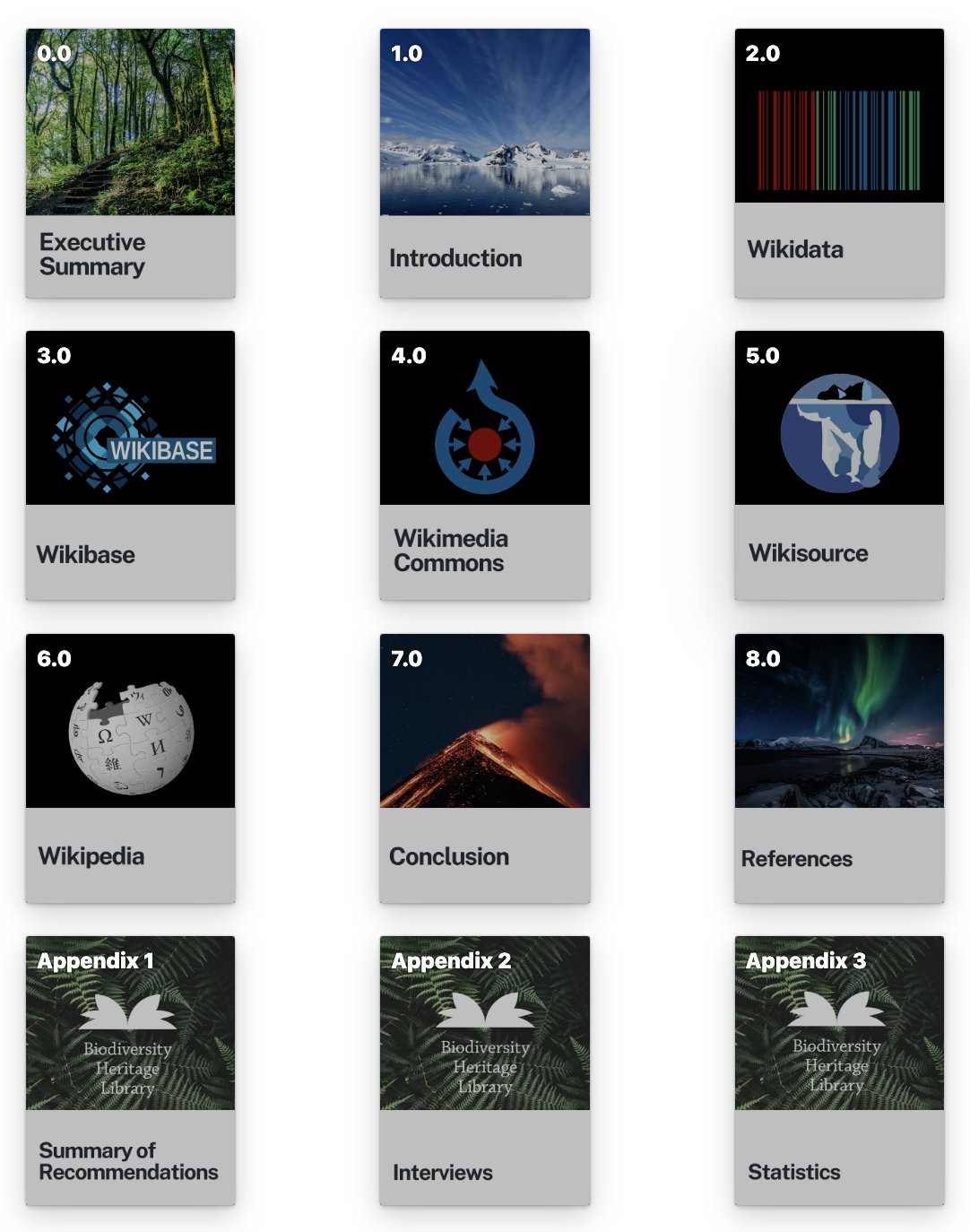
Thumbnails of each chapter and appendix in the white paper

Call to Action: Vote for the Most Impactful Use Cases!

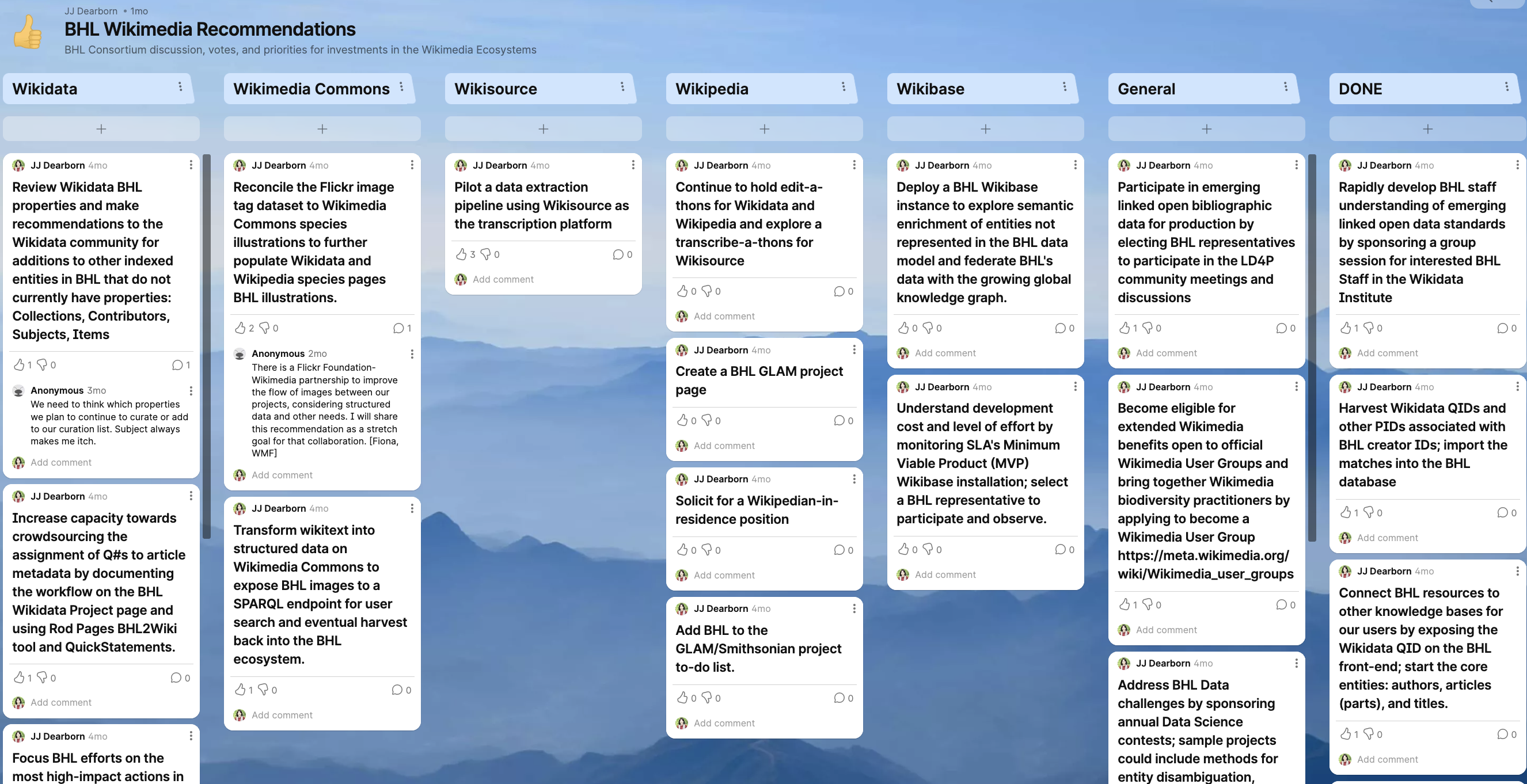
BHL partners, Wikimedians, and key BHL collaborators are encouraged to actively participate in shaping the future of BHL by voting and commenting on which use cases the community believes will have the most significant impact. Your input and insights are invaluable in guiding the direction of BHL’s Wikimedia projects. Visit the voting platform to share your thoughts, provide feedback, and cast your vote to take action on 25 recommended use cases. Let’s work together to identify the areas of maximum impact for BHL that will help transform BHL’s data into interlinked knowledge in the semantic web.

Screenshot of 25 BHL wikimedia recommendations on voting platform

VOTE NOW!

Through a range of potential applications for BHL data in the Wikimedia ecosystem and the pursuit of solutions for BHL’s big data challenges, BHL is making the case for deeper integration of its collection into biodiversity knowledge networks. The release of the white paper demonstrates unique opportunities for BHL to improve biodiversity research infrastructure, increase understanding of our planet’s biodiversity and impact climate policy.

August 25, 2023by mdimeo
BHL News, Blog Reel, Tech Updates

BHL is Round Tripping Persistent Identifiers with the Wikidata Query Service

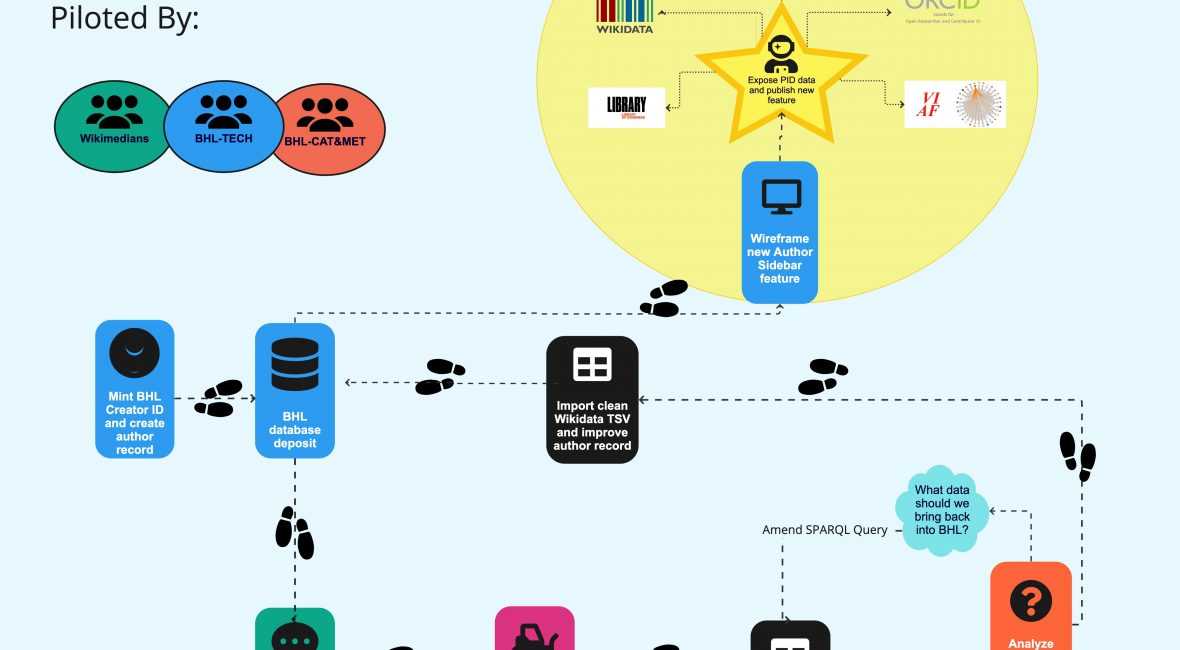
Diagram of the 8 steps detailed below of the BHL wikidata round trip.

In the Spring of 2022, the BHL Cataloging and Metadata Committee investigated the possibility of harvesting persistent identifiers (PIDs) from Wikidata as part of the group’s longstanding project to disambiguate and deduplicate author records in the BHL database. The motivation behind this one-time experimental data harvest was to see if BHL could:

  1. Enhance BHL author records with additional PID data points;
  2. Improve the committee’s ability to disambiguate author names in the BHL database; and
  3. Respond to an outstanding user request from two of Wikimedia’s super star editors, Siobhan Leachman and Andy Mabbett, to expose BHL’s author data on BHL and include hyperlinks to other authoritative knowledge bases on the web.
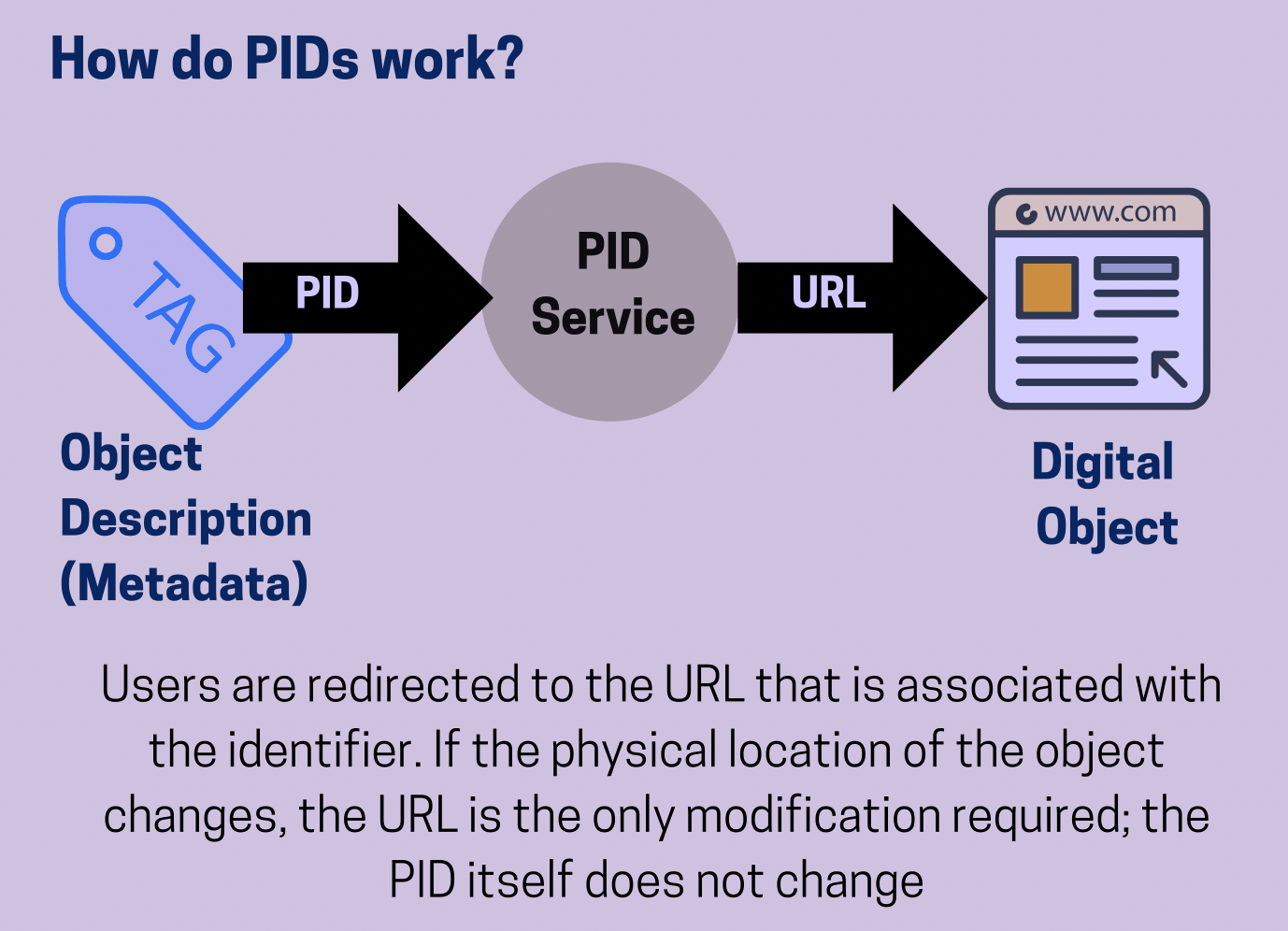
How do PIDs work? Users are directed to the URL that is associated with the identifier. If the physical location of the object changes, the URL is the only modification required; the PID itself does not change.

Persistent identifiers can become resolvable links that connect two knowledge bases (like BHL and Wikidata) together.

In particular, Wikimedians wanted to see the Wikidata Q identifier exposed, providing a link to the corresponding creator item record in Wikidata.

There are multiple motivations for undertaking this work. By adding the BHL Creator ID to the corresponding Wikidata item, Wikidata editors help link BHL to the richer biographical data about that person held in Wikidata. The Wikidata item for a person may contain links to their Wikipedia page or to images of the person held in the image repository Wikimedia Commons. Wikidata items also act as identifier hubs and contain links to other databases and identifiers.
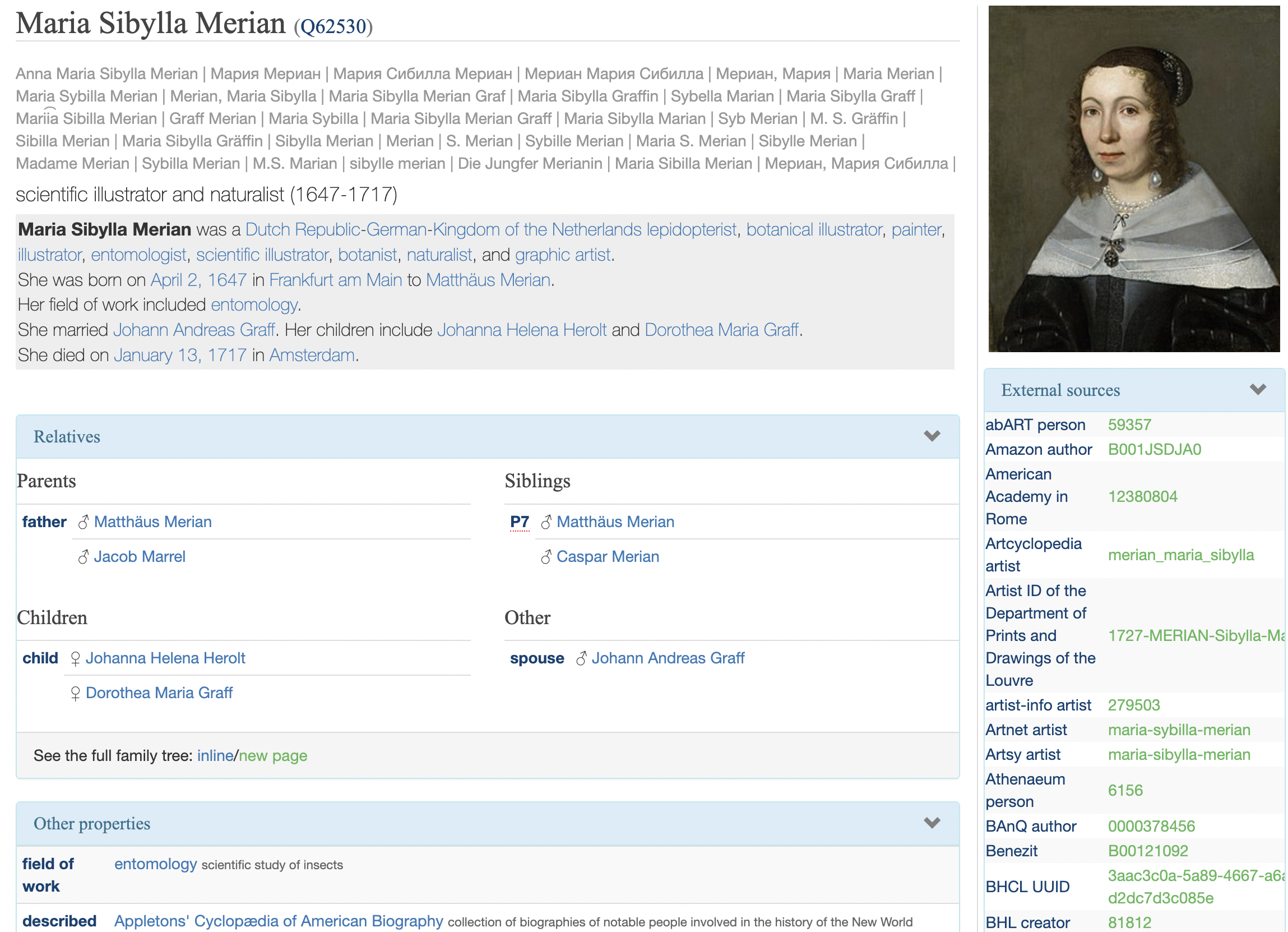
Maria Sibylla Merian's wikidata entry, including name variants, biographical information, external sources, an image, and more

Maria Sibylla Merian in Wikidata, rendered with the Reasonator Tool; note the External sources section and BHL’s Creator ID entry.

By adding the BHL Creator ID to this list of identifiers, the Wikidata editor is linking the content held in BHL to the content held in multiple other datasets and repositories.

These extra author data points provide Wikimedians and BHL catalogers with crucial clues that aid in name disambiguation. In particular, hyperlinks to other knowledge bases are incredibly valuable because they lead to new knowledge pathways that help confirm a person’s identity in a complex game of “Who’s Who?”

Workflow Overview

The diagram below illustrates the experimental data pipeline from BHL to Wikidata and back.
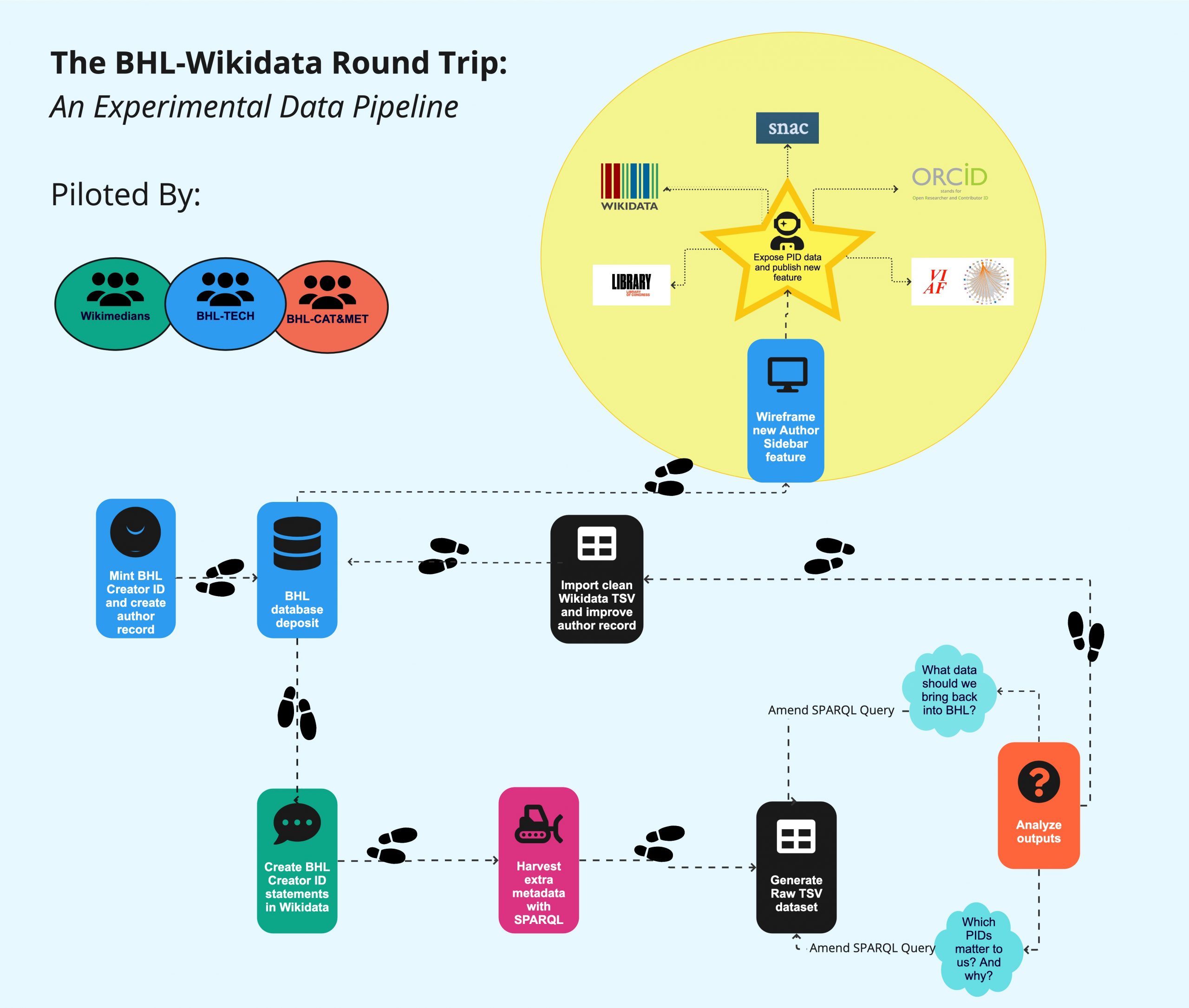
Diagram of the 8 steps detailed below of the BHL wikidata round trip.

The BHL to Wikidata Round Trip Overview

The BHL to Wikidata Round Trip Steps

  1. BHL Creator ID and record are created when digital content is harvested into BHL and/or articles are defined in BHL.
  2. Wikimedians record BHL Creator IDs as a statement in corresponding Wikidata items via various community workflows. (See: Mix’n’match deep dive below and/or read about QuickStatements for two ways volunteers are populating Wikidata with BHL’s Creator IDs).
  3. BHL subsequently harvests additional metadata from Wikidata for any author item where a BHL Creator ID statement has been added.
  4. Data outputs are analyzed for quality and breadth.
  5. SPARQL queries and data outputs are iteratively refined to match BHL’s requirements until a quality dataset can be generated for import.
  6. Clean data is imported into the BHL database.
  7. The new author record sidebar displays data on BHL.
  8. PIDs are converted into resolvable URIs, opening up new research pathways for BHL’s users.

Quick note: In Wikidata BHL author records are represented by the Wikidata BHL Creator ID; the presence of this Wikidata property in a Wikidata item provides a powerful connection point that can be used later by BHL to ingest more information about any named entity. A popular author matching tool in Wikidata is Mix’n’match.

Getting BHL Authors in Wikidata with Mix’n’match

Mix’n’match is a Wikidata tool that empowers editors to match Wikidata items to entries in other databases. One of the datasets in Mix’n’match is the BHL Creator ID dataset.
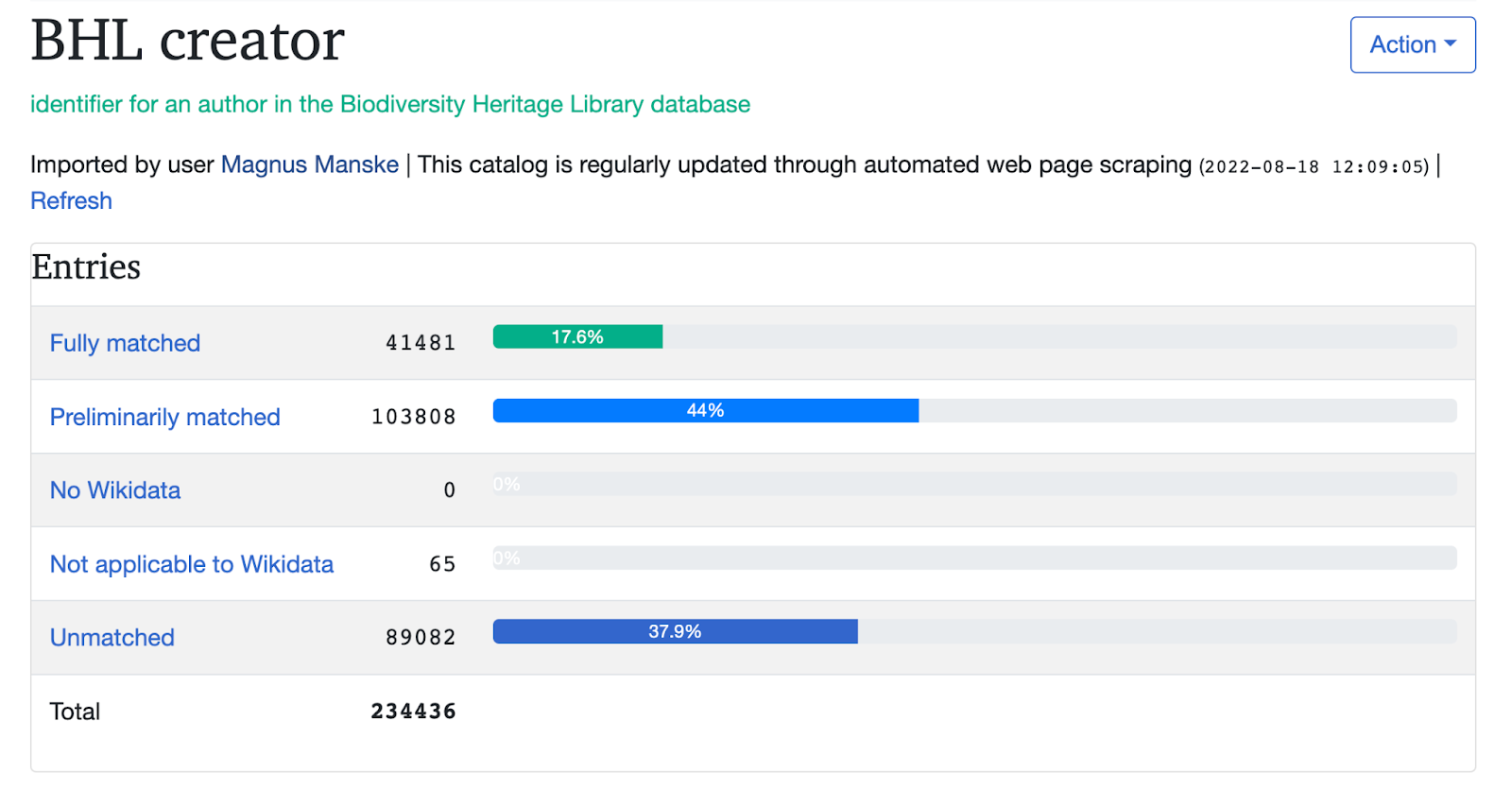
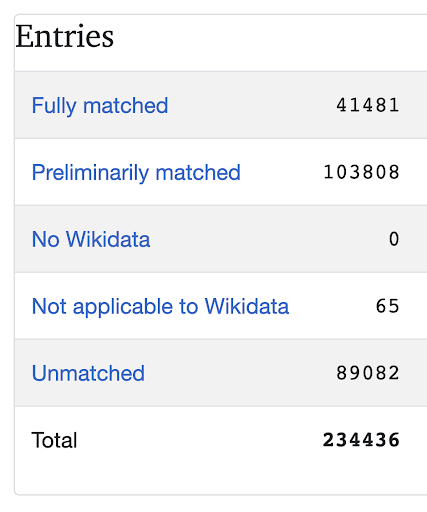
Summary from the mix'n'match tool for the BHL creator ID dataset

A summary of the completeness of matching the BHL Creator ID dataset to Wikidata as of January 2023

When the BHL Creator ID dataset is uploaded into Mix’n’match, an algorithm undertakes fuzzy name matching. The tool then suggests a preliminary match to a Wikidata item. Wikidata editors working on the dataset have the choice of whether to confirm the suggested match or to remove it.
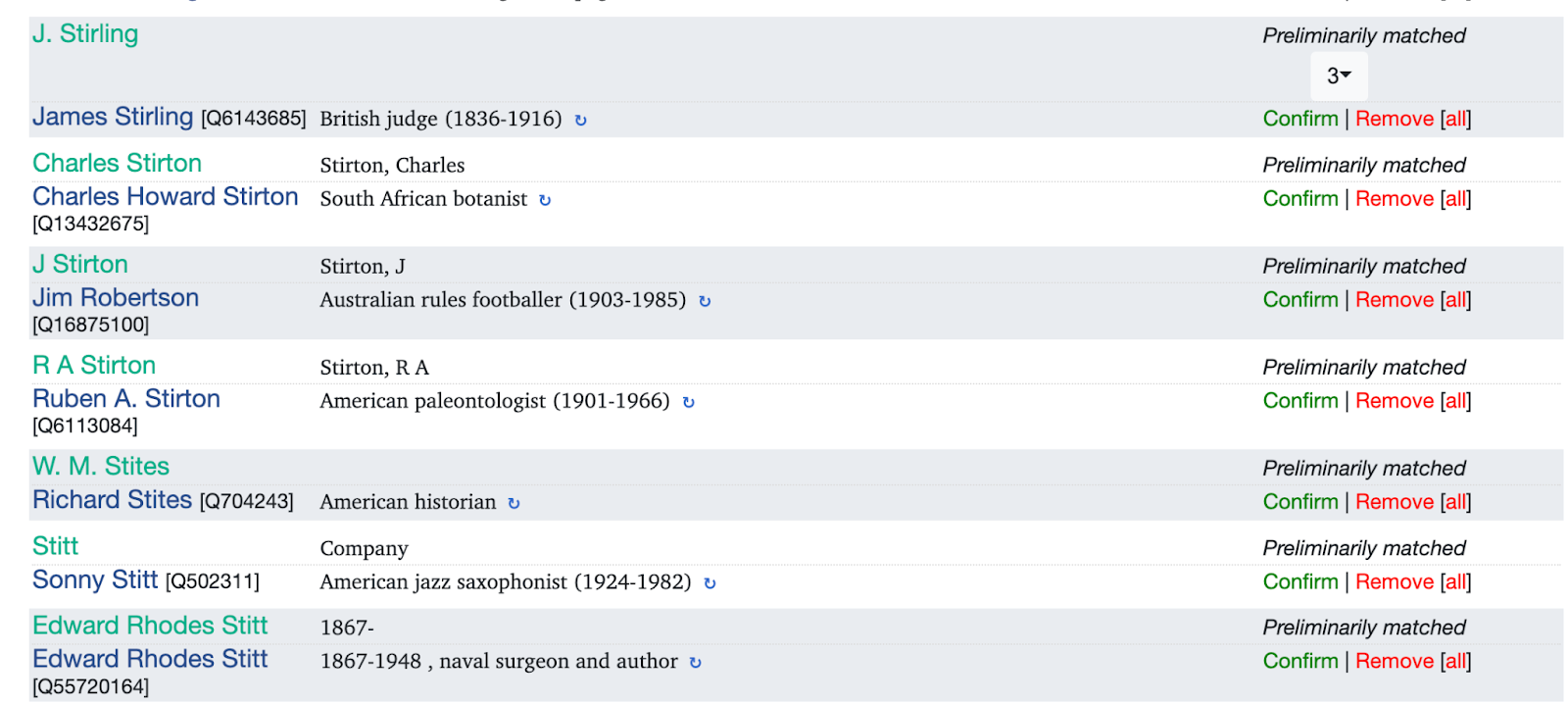
Sample matches suggested by the mix'n'mtch tool

Examples of possible matches suggested by the Mix’n’match algorithm with the BHL creator in green and the Wikidata item in blue.

If the Wikidata editor confirms the match, the BHL Creator ID is automatically added to the Wikidata item for the creator. If the editor rejects the match, the editor can add a correct Wikidata item ID, create a new Wikdiata item if the creator is not yet in Wikidata or, in some cases, decide that the BHL Creator ID isn’t applicable to Wikidata. If the editor simply rejects the match without further action, the BHL Creator ID will be added to the unmatched portion of the dataset.
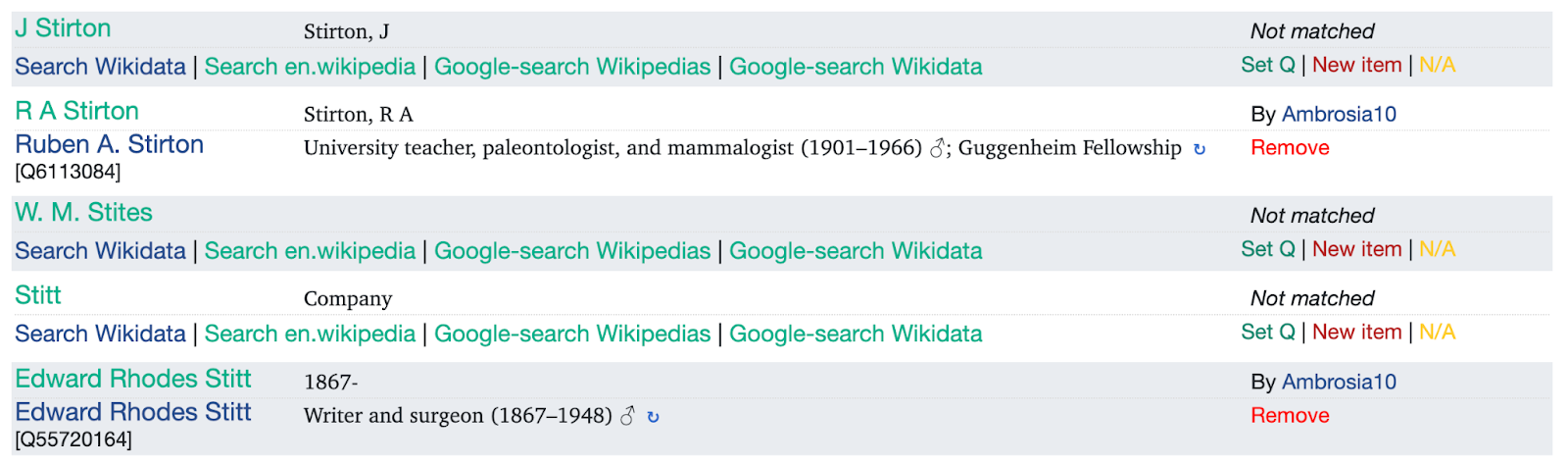
Examples of confirmed and unconfirmed matches in the Mix'n'match tool

Results after the Wikidata editor Ambrosia10 has confirmed or removed the Mix’n’match algorithm suggestions.

The act of linking the BHL Creator ID to the Wikidata item also helps to disambiguate the creator. It removes much of the uncertainty about who the creator is. Names are not unique but by linking identifiers to biographical data, editors can ensure that similarly named people or people whose names have changed over time are all associated with the correct Wikidata item. This addresses the age-old problem of how to assign correct attribution to the right person.

This work also assists BHL. By ensuring BHL Creator ID’s are matched to the Wikidata item, the Wikidata editor can assist BHL in weeding out the duplicate entries for creators in BHL’s database. After matching has taken place, BHL is also able to ingest any of the other identifiers listed on the creator’s Wikidata item, thus enriching the metadata held in BHL’s database.

Currently there are over 230,000 entries in the BHL Creator ID dataset. Of these, just over 41,000 have been matched to Wikidata items. There is a long way to go before this dataset is complete. In the spirit of “many hands make light work,” BHL encourages Wikidata editors to work alongside BHL staff who were recently trained and certified in Wikidata Advanced Concepts by Wiki Education. Our collaborative work will help increase the number of Creator IDs in Wikidata.

Summary from the mix'n'match tool for the BHL creator ID dataset

BHL Creator ID dataset completeness statistics as of January 2023.

Once BHL Creator ID statements were recorded on Wikidata items, either through manual edits or workflows like Mix’n’match or QuickStatements, then BHL created custom SPARQL queries using the Wikidata Query Service to output data of interest.
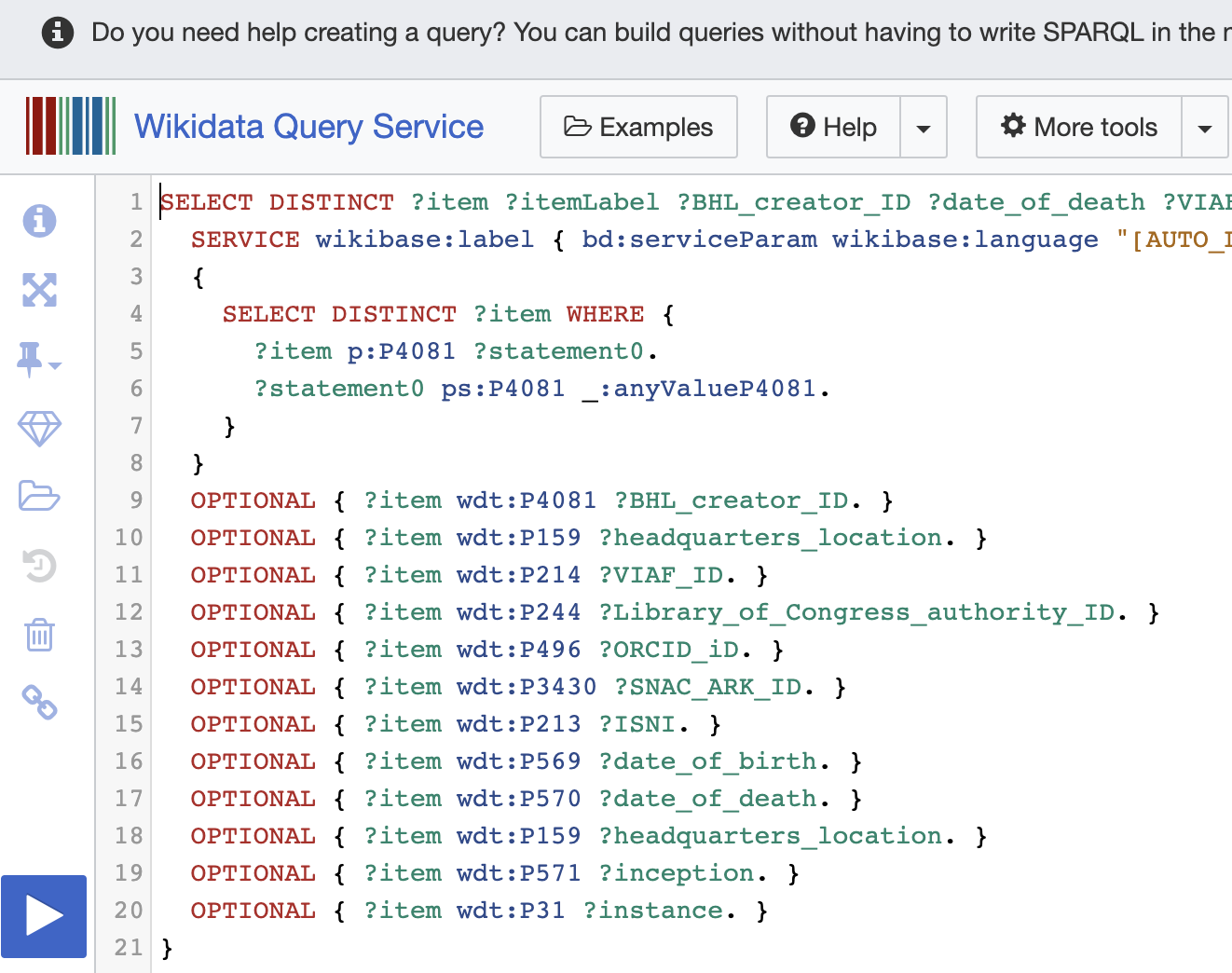
Example of a SPARQL query using the wikidata query service

The SPARQL query language is used to query and return data from semantic databases like Wikidata.

Once the data was brought back, the BHL Cataloging and Metadata Committee discussed and reviewed the records with the aim of bringing key data points back into the BHL database.
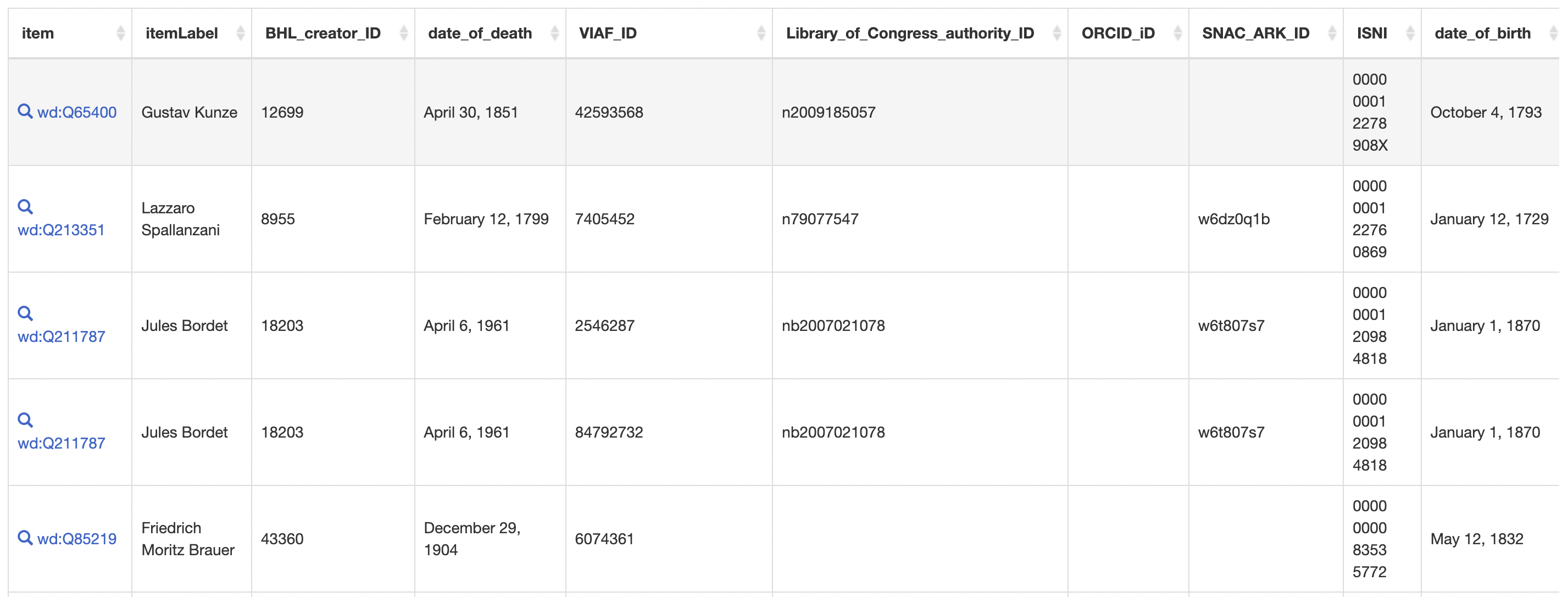
Sample data returned from the SPARQL query, including item ID, itemLabel, BHL_creator_ID, date_of_death, VIAF_ID, Library_of_congress_authority_ID, ORCID_ID, ISNI, date_of_birth

Snippet of raw data brought back by the BHL Cataloging and Metadata Committee’s SPARQL query.

In total, the BHL Cataloging and Metadata Committee was able to “round trip” 88,507 persistent identifiers (PIDs) associated with BHL Creator records from the following authoritative knowledge bases:

  • Virtual International Authority File (VIAF)
  • Wikidata
  • Social Networks and Archival Context (SNAC)
  • ResearchGate
  • ORCID
  • Library of Congress Authorities

There are still more PIDs out there to gather but practicality calls for moderation – moderation of the quantity that the Wikidata Query Service can bring back and the amount feasible to curate in BHL. After many discussions, the above list was chosen by narrowing down the PIDs that seem most appropriate in the BHL context. A comprehensive policy on Uniform Resource Identifiers (URIs) in the BHL ecosystem is now being drafted by BHL committees.

Additionally, in post-work analysis, the Committee did find that the data modeling of corporate names in Wikidata differs from the library world, and pulling in identifiers for corporate names was not worth the effort (at least at this time).

Below is an example of Académie des sciences (France), which receives multiple item records in library databases like VIAF for each name change. However, in Wikidata these name changes are collapsed and will appear on one item record; this divergence means that one-to-one matches are not possible without a lot of manual clean-up from BHL Staff.
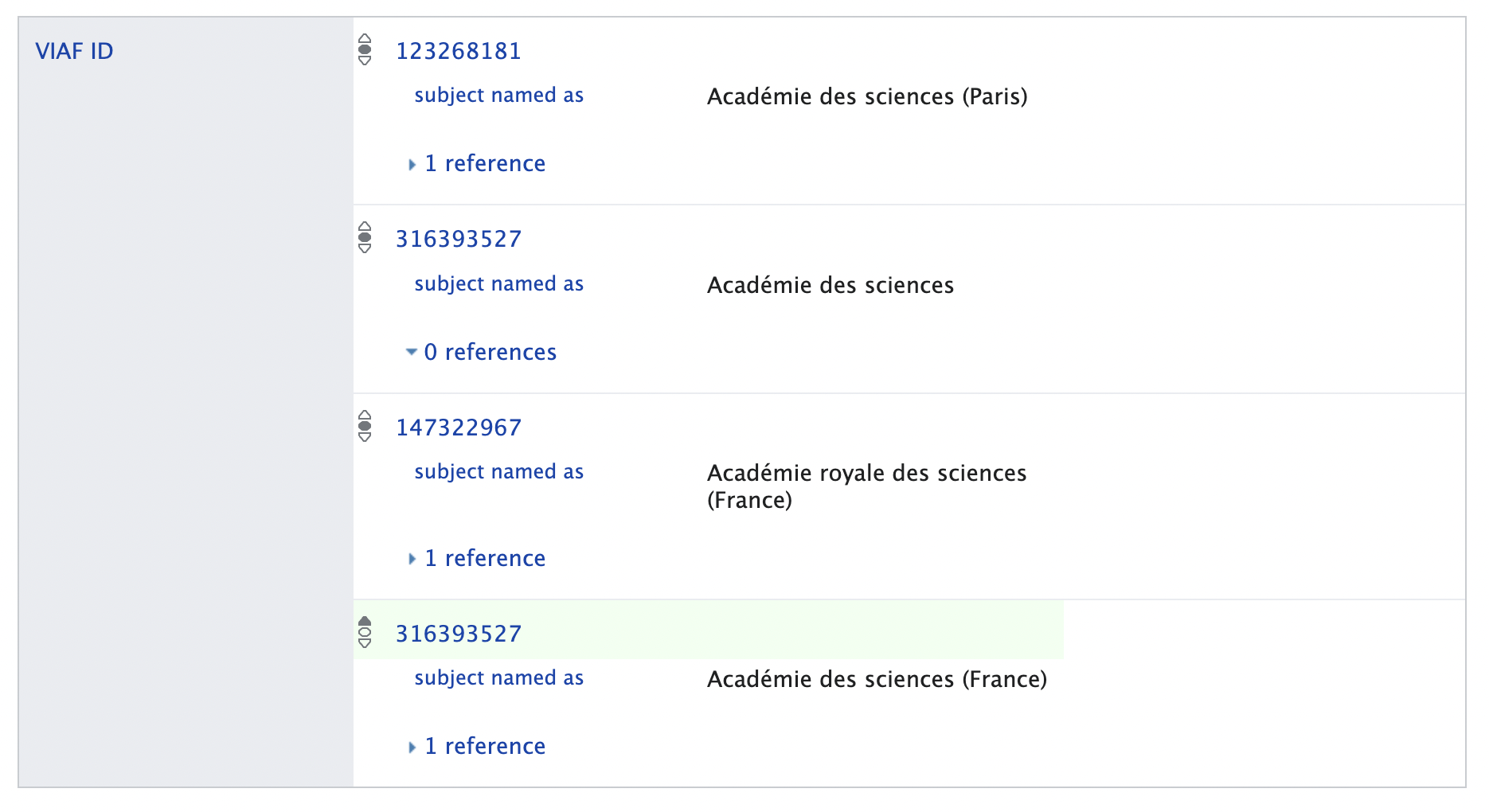
Example of the Wikidata entry for VIAF ID for Académie des sciences

Divergent data models: Wikidata corporate names collapse name changes.

It’s important to note that data modeling in Wikidata is in its nascent stages and librarians should have a vested interest in shaping the best practices of the community so all of humanity can model the world’s knowledge together. As we have seen with this one-time experiment, there is little to lose, and so much to gain!

The Result: A New Author Record Sidebar for BHL

Thanks to the feedback from the Wikimedia community, BHL’s Lead Developer created an Author Record sidebar. Click on any BHL author name on the BHL website and the author details will appear on the right-hand side. Below is an example of Australian paleontologist and ornithologist, Patricia Vickers-Rich in BHL. 
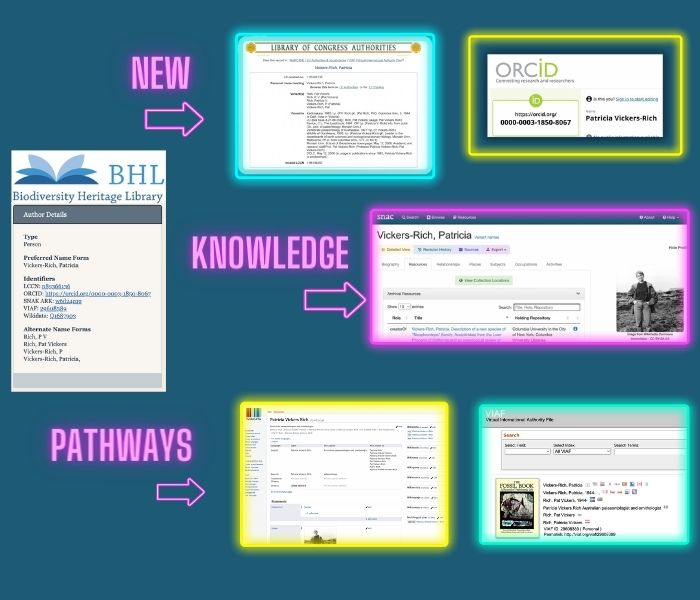
Graphic example of an author record with detailed sidebar and the pages to which it links out, such as ORCID, Library of Congress Authorities, Wikidata, SNAC

A New Wikimedian Driven Feature: The BHL Author Record Sidebar!

The goal of this new feature was to expose existing and recently harvested identifiers as resolvable links that could open up critical knowledge pathways for BHL’s users on their information journeys. Other key data points are provided such as preferred name forms, entity type, and alternative name forms that give additional context for disambiguation research.
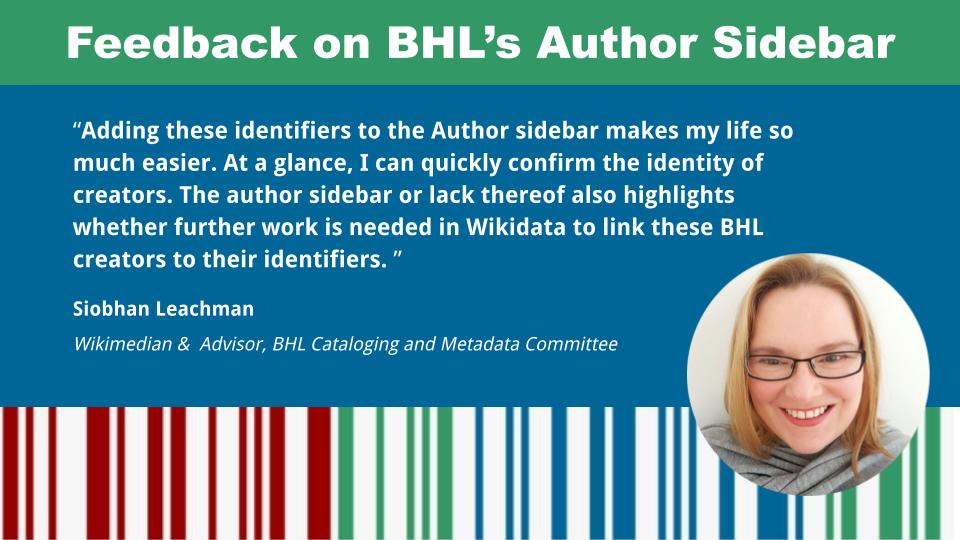
A quote from Siobhan Leachman on BHL's new author sidebar: Adding these identifiers to the author sidebar makes my life so much easier. At a glance, I can quickly confirm the identify of creators. The author sidebar or lack thereof also highlights whether further work is needed in wikidata to link these BHL creators to their identifiers."

Next Steps for BHL Committees?

Please let us know in the comments what you think of this experiment. Should BHL pursue similar persistent identifier harvests for other entity types? Or perhaps, a recurring harvest for BHL Authors?

Additional BHL entities:

  • Titles
  • Scientific Names
  • Subjects
  • Media (illustrations, scientific plates, photos)

Let us know! Your feedback is crucial to BHL’s evolution as a biodiversity knowledge base.

If you are new to Wikidata, Mix’n’match is a great place to start. There are many tutorials and resources available on the web including this great YouTube introduction on how to use the tool.

Additionally, a workflow for BHL articles has been piloted and is currently underway thanks to BHL’s Persistent Identifier Working Group. For more details on how to roundtrip BHL Article Q identifiers, please refer to the group’s documentation at: Wikidata:WikiProject_BHL/Projects

BHL committees and working groups are actively scoping many projects. Sign-up here to get involved!

Related Posts

For more information on the assignment of DOIs, a very important type of persistent identifier specific to scholarly publications, check out Nicole Kearney’s blog post What Is BHL’s New Persistent Identifier Working Group DOI’ng?

For a list of all of the new features and data quality improvements BHL made in 2022, check out the post BHL Technical Development: Year in Review

February 15, 2023by mdimeo
BHL News, Blog Reel, Campaigns, Her Natural History

#HerNaturalHistory: Open Data, BHL, and Wiki Projects

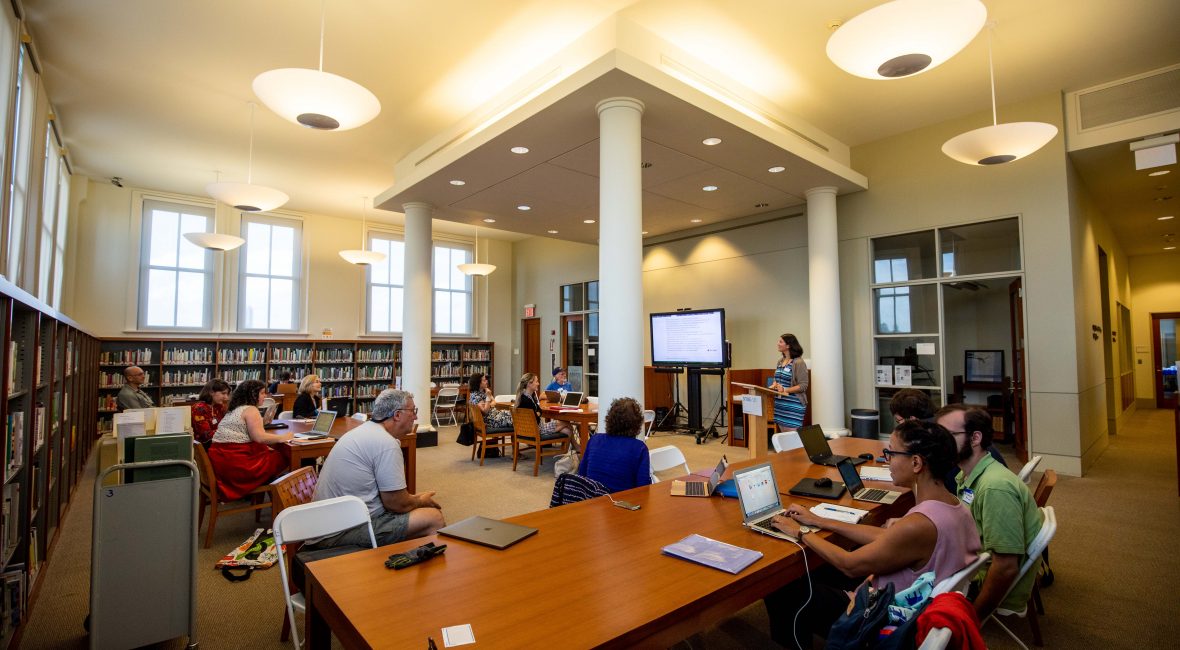
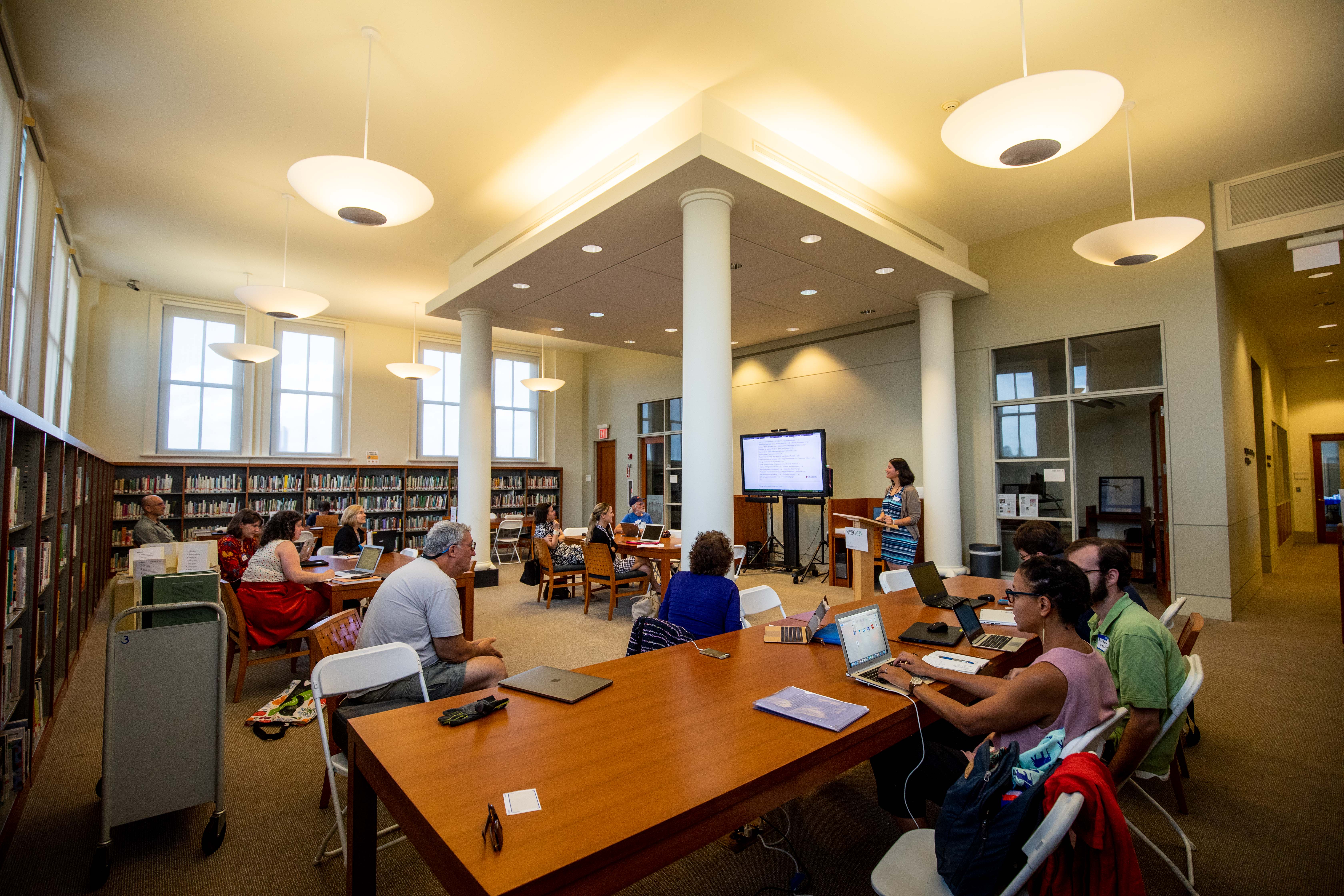
Attendees edit Wiki content at the LuEsther T. Mertz Library of the New York Botanical Garden. Photo by Marlon Co.

Wiki projects, including Wikipedia, Wikimedia Commons, and Wikidata, contain the information that powers the web. Wikipedia is the fifth most-visited website in the world. To edit a Wiki project is to contribute content that could potentially be viewed by thousands or even millions of people over time, both on Wiki sites and on sites like Google and Facebook, which harvest data, including media, from Wiki sites.

Like Wiki editors, BHL contributors are passionate about having their content accessible to and used by the most people possible. The information that we provide through BHL is intended for global audiences. We hope that the special things and unique data in our collections have a life beyond our walls and our institutions.

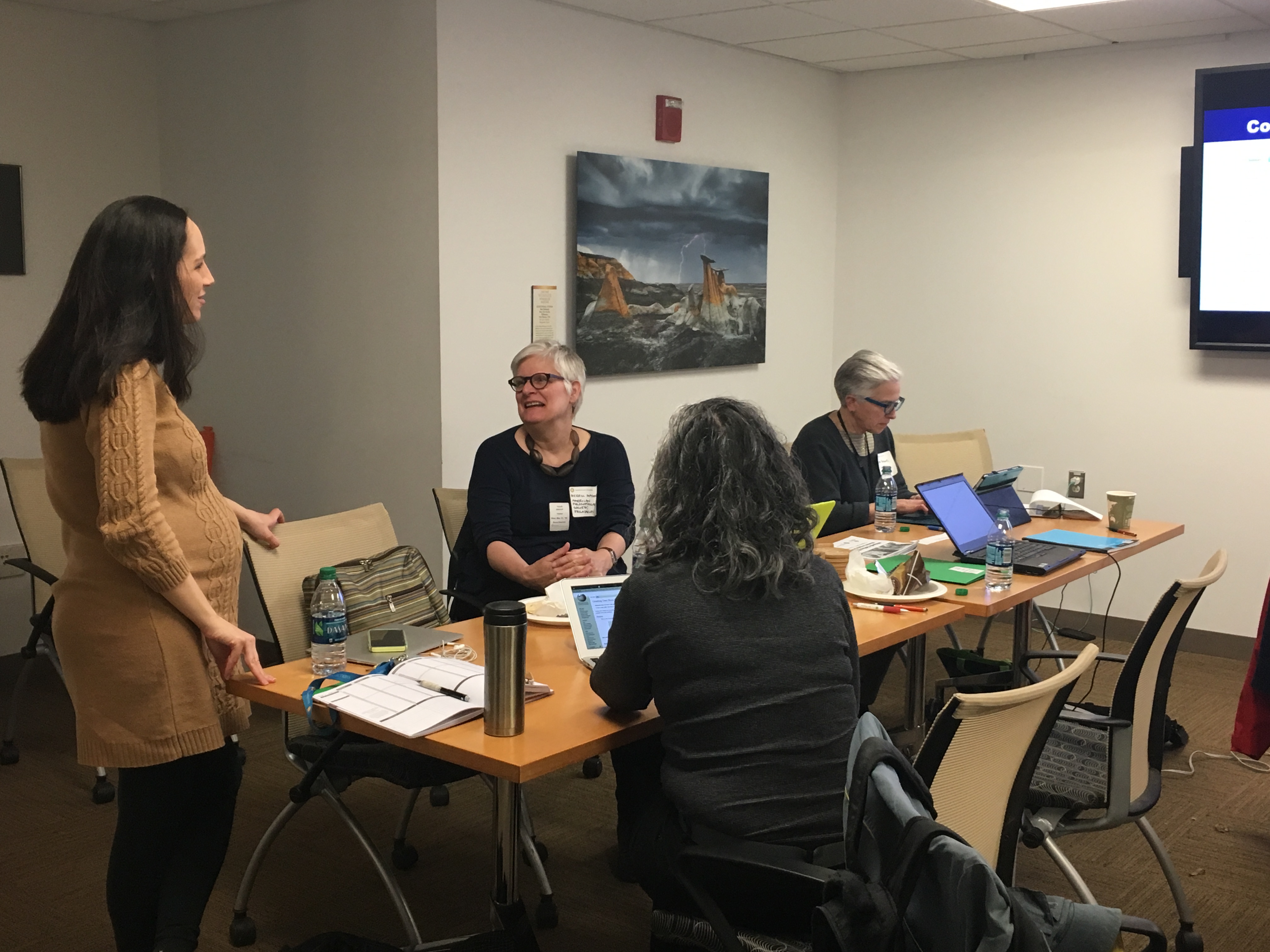
This similarity in missions and goals is what makes projects involving both BHL and Wiki* a great fit. To this end, for the #HerNaturalHistory campaign, the LuEsther T. Mertz Library of the New York Botanical Garden and the Smithsonian Libraries held three crowd-sourcing citizen science/citizen humanities events in March of 2019. These events were intended to bring new editors to Wiki projects, have editors add information about female scientists to Wikipedia, and have editors add information to BHL collections on Flickr and in Wikimedia Commons utilizing the Wikidata knowledge base/database/catalog.

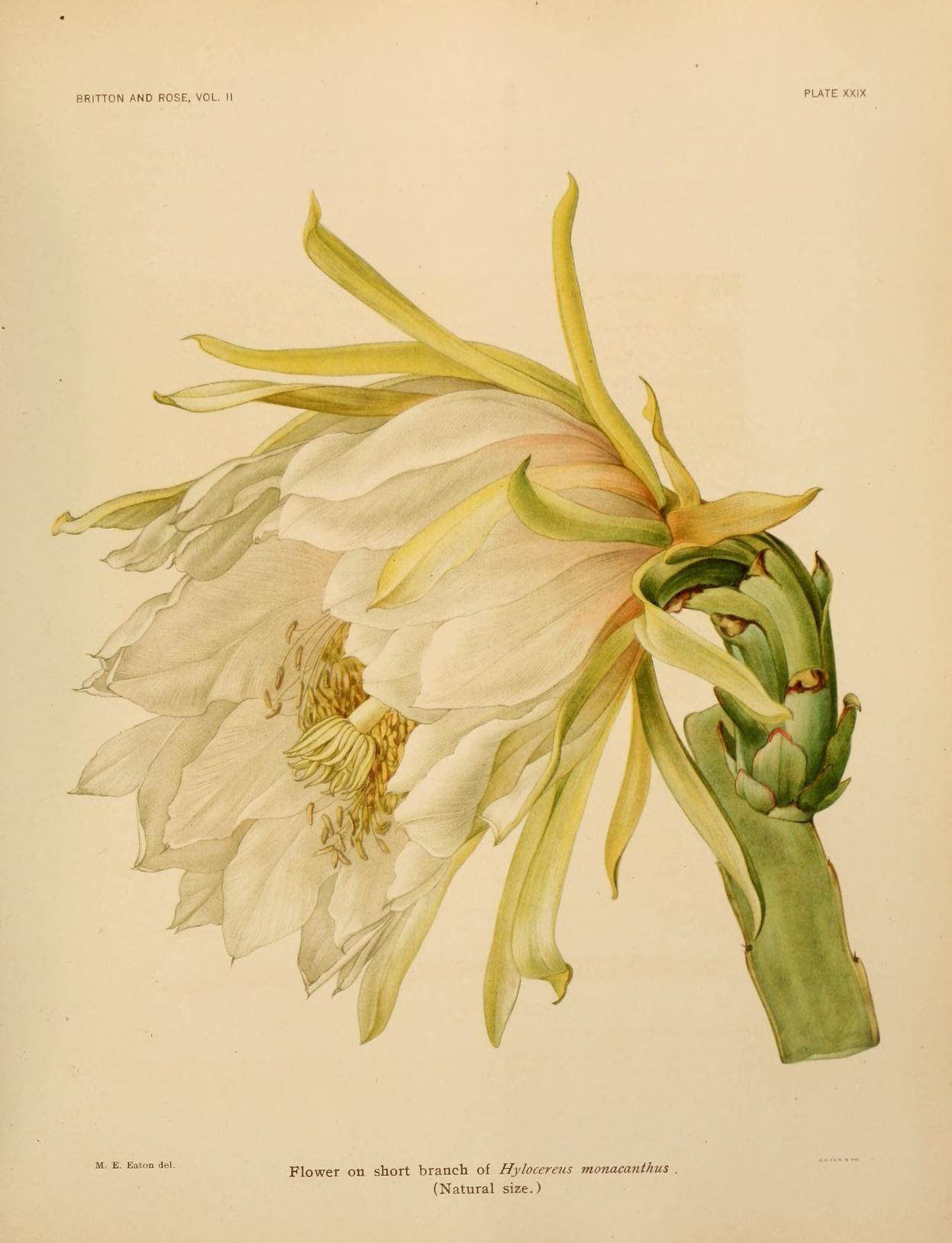
Illustration of Hylocereus monacanthus by Mary Eaton, The Cactaceae, . Contributed in BHL from The New York Botanical Garden.

At the New York Botanical Garden on 12 and 13 March, attendees had the opportunity to add data to images in Flickr, add data and categories for images in Wikimedia Commons, and add data to items in Wikidata. (The task list can be found here.) Over the span of two days, attendees edited 22 files on Flickr, adding 84 taxonomy:binomial and 34 taxonomy:common machine tags. 206 edits were made to Wikimedia Commons files, categories, and other content, adding 16,748 bytes of data and five new images to the repository. On Wikidata, four new items were created and 24 items were edited 114 times, for a total of 30,700 bytes added.

The event was offered in collaboration with Wikimedia NYC, the regional Wikimedia chapter serving the New York metropolitan area. WM NYC promotes free access to the world’s knowledge and supports Wiki projects in the greater New York City region; the attendance of WM NYC members provided the other attendees with a great deal of expertise on the finer points of Wiki projects and editing.

During the Smithsonian Libraries Workshop on 13 March, in-person participants at the Natural History Museum Library and virtual participants from around the world focused on editing the Wikipedia pages of female contributors to natural history using resources from BHL. Attendees focused their edits on women included in the Workshop’s Suggested Article Work List, comprised of over 100 women represented in the BHL collection. The Work List was compiled based on research and suggestions predominantly from BHL citizen scientists Michelle Marshall and Siobhan Leachman, as well as colleagues from the New York Botanical Garden, Smithsonian Institution Archives, and the BHL Cataloging Group.

Attendees editing at the Smithsonian Libraries Wikipedia Editing Workshop, hosted in the Natural History Museum Library and sponsored by Wikimedia DC. Photo by Grace Costantino.

The Smithsonian Libraries Workshop was sponsored by Wikimedia DC, with representative Ariel Cetrone facilitating the meeting. Two other representatives from Wikimedia DC, Jim Hayes and Andrew Lih, were also in attendance to provide support to participants. To facilitate virtual attendance, the Workshop was live-streamed via YouTube Live. A copy of the presentation used during the Workshop is also available online.

In total, over 70 people attended the Smithsonian Libraries Workshop, representing 20 in-person and over 50 virtual attendees. All told, as a result of the Workshop, 50 articles were edited, 5 new articles were created, and 14 images were uploaded to Wikimedia Commons, representing a total of 140 edits. Additionally, 36 new “editors” (first-time Wikipedia editors) participated in the Workshop.

The Suggested Work List will remain active indefinitely, and we welcome anyone to continue editing the Wikipedia pages for these women.

Although metrics are important, and offer a glimpse into one aspect of these events, the more impactful takeaways from these collaborations were the discussions that attendees had on topics ranging from open content, to information architecture, data storage, content curation, and more. In a sense, these crowd-sourcing edit-a-thons were a salon of sorts, where curious people who are passionate about open information were able to discuss strategies for how to make data more accessible and useful to the public, and work together to find and implement these solutions.

March 19, 2019by michelle.underhill
BHL News, Blog Reel

BHL and WikiCite 2018

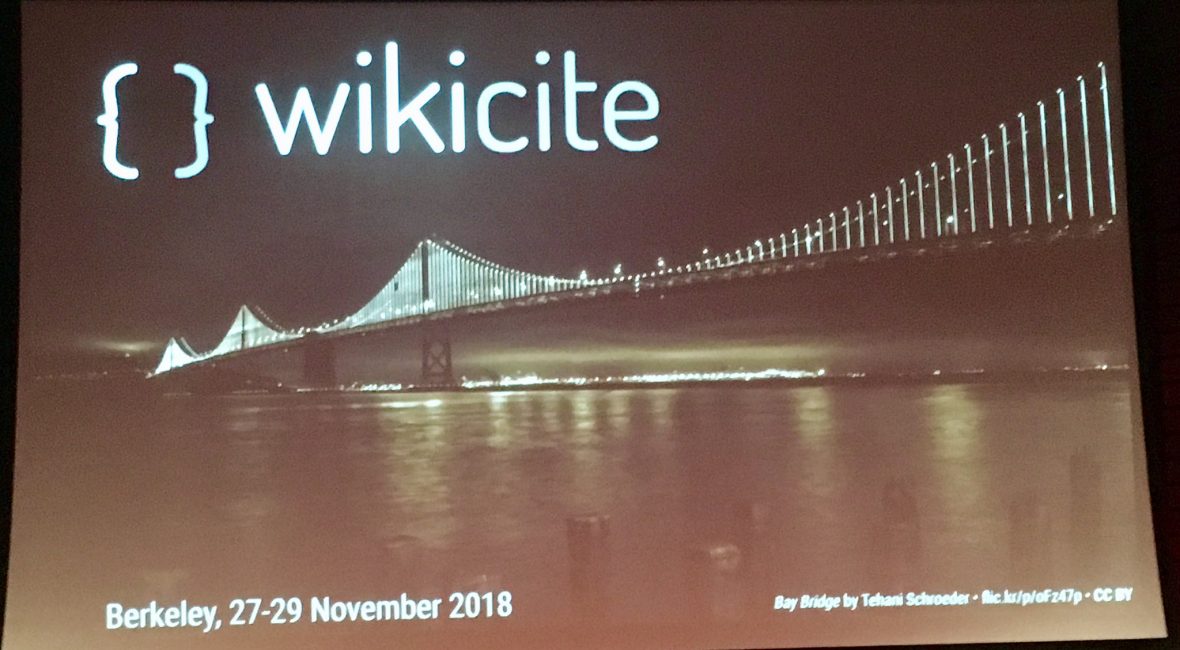
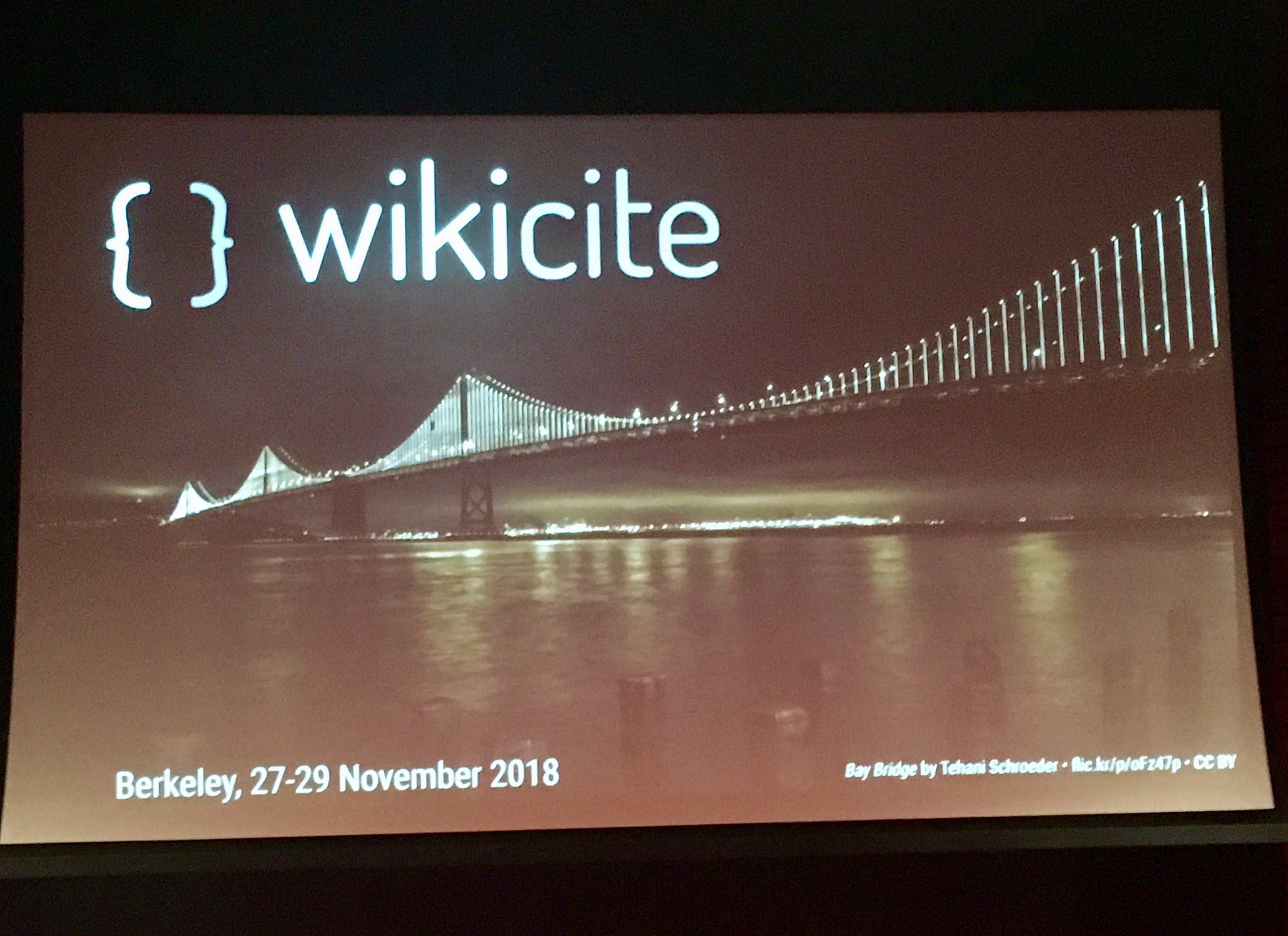
WikiCite conference in Berkeley, ca, 27-29 November 2018.

WikiCite conference in Berkeley, ca, 27-29 November 2018. Photo Credit: Diane Shaw. Graphic by Dario Taraborelli (CC-BY 4.0) with photo by Tehani Schroeder.

In November 2018, Diane Shaw, Katie Mika and Siobhan Leachman attended WikiCite 2018 in Berkeley, CA. WikiCite is a Wikimedia initiative that aims to develop a database of open citations and linked bibliographic data. Since sources are the foundation of Wikipedia’s claim to authority, WikiCite is working to build a repository of bibliographic data that is open, structured, and separable. WikiCite also draws from the academic community in which citation data (most often from peer-reviewed articles) is crucial for creating and linking knowledge. At the outset, WikiCite aimed to build this repository specifically for use in Wikipedia and other Wikimedia Foundation projects. Since the first meeting in 2016, this idea has grown into building a universal repository of sources to serve the sum of all human knowledge, leveraging Wikidata as its infrastructure.

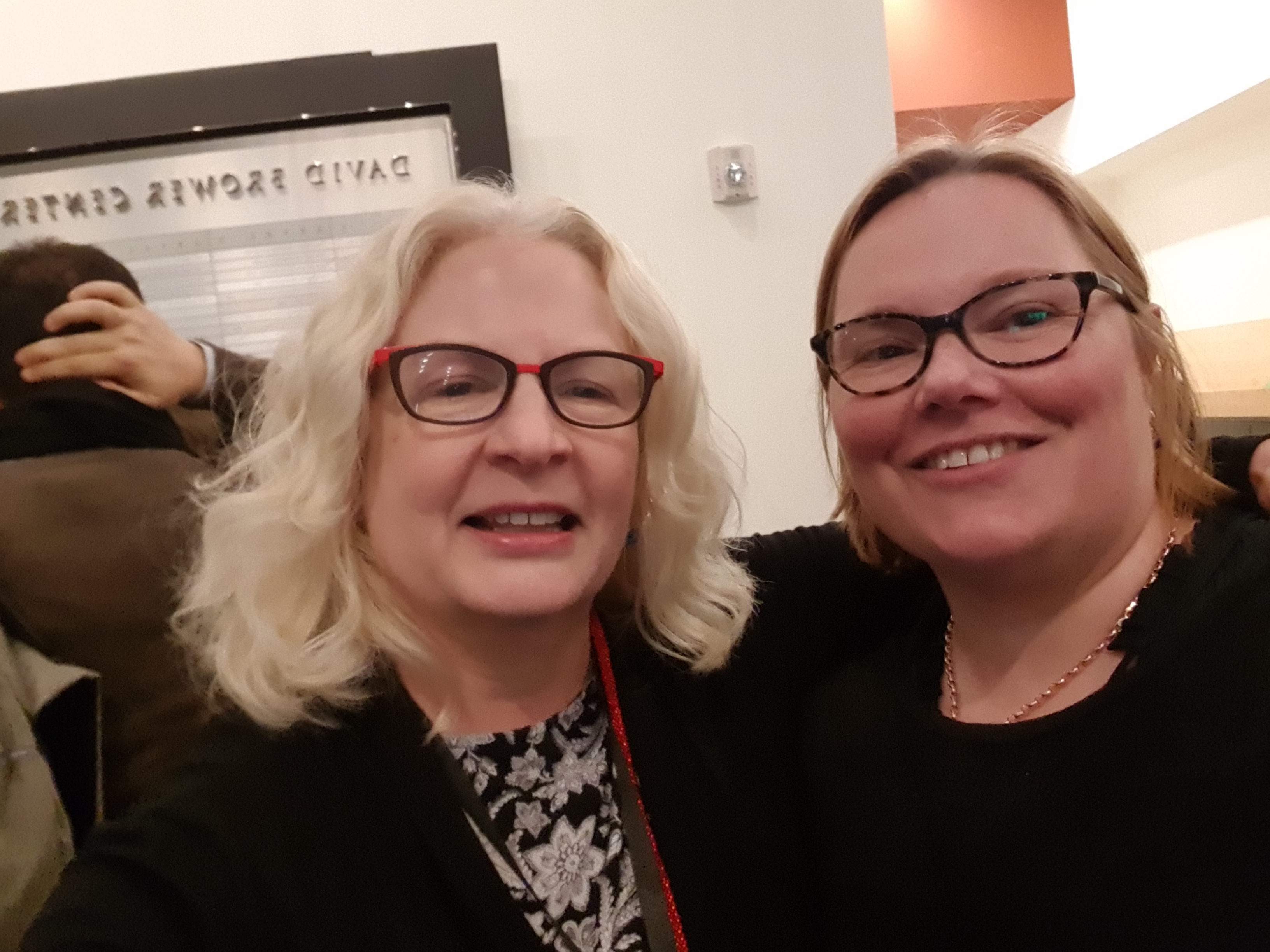
Diane Shaw (left) and Siobhan Leachman (right) at WikiCite 2018.

Diane Shaw (left) and Siobhan Leachman (right) at WikiCite 2018. Photo Credit: Siobhan Leachman.

Now in its third iteration, the conference included extended and short presentations, numerous lightning talks, strategy tracks, tutorials, data modelling, and a hack day (renamed a Do-athon Day to be more inclusive of those who aren’t computer science experts). The purpose of the conference, open primarily by invitation to a group of approximately 100 attendees from across the United States and abroad, was to work towards a “vision of creating an open repository of bibliographical data to support the citation and fact-checking needs of Wikimedia projects, and possibly, to serve as an open infrastructure for research, education, and information quality across the web.” Librarians were well-represented among the attendees, as were linked open data advocates, software engineers, data scientists, and active members of the Wikimedian community.

Unlike some of the other very popular Wikimedia Foundation products (Wikipedia in 303 languages; Wikimedia Commons hosting image, audio, and video files; Wikisource for full text transcriptions; and Wikidata for storing structured data, among others), WikiCite has no real online presence itself, but has grown as a community of practice dedicated to the support of a bibliographical metadata commons enabling reliable, verified linked open data connections both among Wikimedia projects and externally with many other online catalogs, databases and reference sources for a variety of libraries, galleries, archives, museums, scientific institutes, and other similar organizations, including OCLC, the Internet Archive and the Biodiversity Heritage Library. We are not exaggerating when we say it was awe-inspiring to be part of this dedicated group harnessing technical knowledge, bibliographical expertise, and lots of creativity and imagination in an effort to bring about a future of linked open data serving all kinds of scholarly information needs.

What WikiCite hopes to make possible goes beyond a simple structure for providing and sharing linked open data: attendees at the conference were also experimenting with new and improved ways to discuss, analyze, curate, vet and annotate sources online.
Dario Taraborelli, Director of Research at the Wikimedia Foundation, gave a terrific overview of WikiCite in his opening talk: Here Be Dragons: Uncharted regions of the bibliographic commons. Other talks and projects that would be of particular interest to libraries include presentations about projects at the National Library of Sweden and the National Library of Wales using structured linked open data for name and subject authority files and to help document the history of national book trade; Linked Data for Production (LD4P), a collaborative pilot project using BIBFRAME for creating structured linked data with connections to Wikidata, the Virtual International Authority File (VIAF) and WorldCat; initiatives to use Wikidata, VIVO and Scholia to generate scholarly profiles; and ways to incorporate Wikidata training into library education, including classes on Library Carpentry.

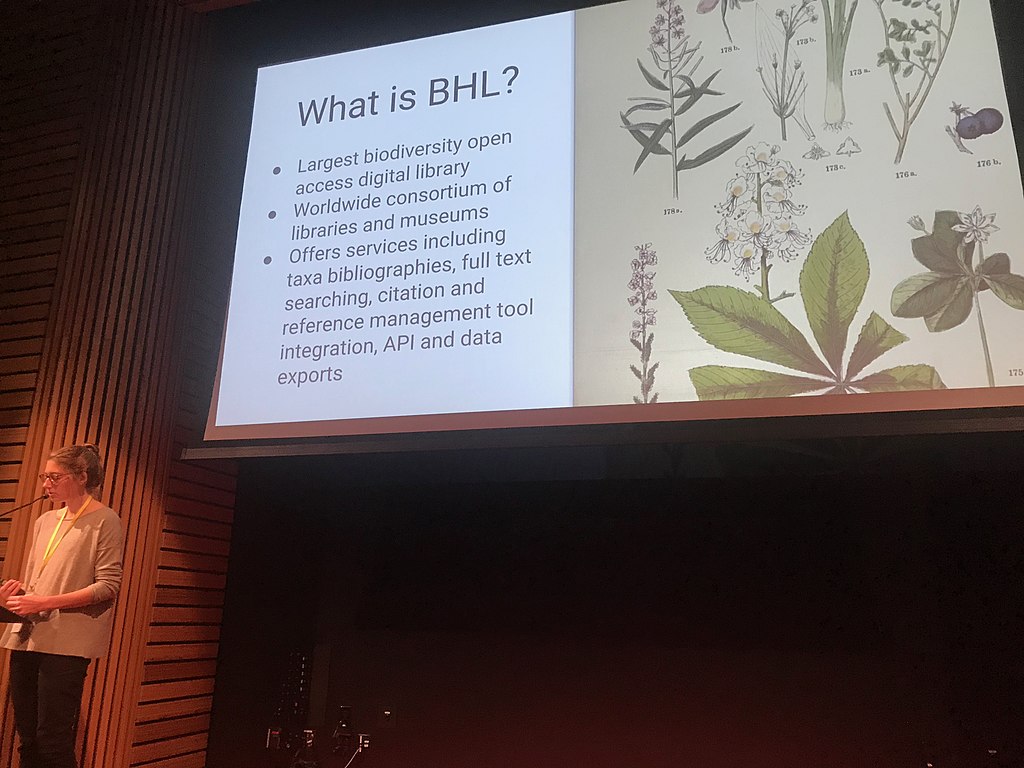
Katie Mika presenting as part of WikiCite and the Biodiversity Heritage Library at WikiCite 2018.

Katie Mika presenting as part of WikiCite and the Biodiversity Heritage Library at WikiCite 2018. Photo Credit: Diane Shaw.

Katie, a former BHL National Digital Stewardship Resident from Harvard’s Museum of Comparative Zoology, and Siobhan, a citizen scientist and linked open data champion from New Zealand who has been a devoted transcriber of natural history materials in the Smithsonian Transcription Center, gave a talk on WikiCite and the Biodiversity Heritage Library. They described some of the unique challenges for heritage literature and metadata, and demonstrated how open access citations, images, and details gleaned from BHL and other open natural history digital repositories are applied to Wikimedia Foundation projects to support essential documentation of scientists, literature, and rare and endemic species.

Unlike modern scientific literature, much historic literature does not have original digital identifiers (DOI’s) attached. These identifiers enable a particular publication to be identified and provide a persistent link to its location on the Internet.  Without these identifiers it is difficult to ingest historical bibliographic data into Wikidata in bulk. If historic bibliographic data is not able to be ingested or reused, scientists are unable to make use of this important resource. Siobhan expressed her frustration that much of the citation metadata of historic biodiversity literature is not currently found in Wikidata and urged the attendees to help resolve this problem.

Siobhan Leachman presenting as part of WikiCite and the Biodiversity Heritage Library at WikiCite 2018.

Siobhan Leachman presenting as part of WikiCite and the Biodiversity Heritage Library at WikiCite 2018. Photo Credit: Diane Shaw.

Siobhan’s key takeaway from the conference was the various discussions on how to solve the difficulties of getting bibliographic information on historic biodiversity literature into Wikidata. Also of interest were the discussions on how book data is modelled in Wikidata (see https://www.wikidata.org/wiki/Wikidata:WikiProject_Books) and discovering a practical new tool to help disambiguate authors within wikidata: Author Disambiguator. Katie enjoyed the opportunity during the summit day’s events to discuss the potential for a bibliographic commons to support citations and information provenance across the web and in support of Open Science practices. On the Do-a-thon Day, Diane spent time discussing approaches for modelling the properties of holotypes on Wikidata with Siobhan, biophysicist and open scientist Daniel Mietchen, and Terry Catapano of Plazi and UC Berkeley’s Bancroft Library.

The opportunity presented by WikiCite for libraries and public knowledge creation cannot be overstated. As of November 2018, there are over 21 million publication items in Wikidata, which accounts for 40% of the entire database. More than 160 million Wikidata statements use the property “cites” (P2860) to connect items. Wikidata is open to contribute to, edit, reuse, and extend. Not only can we leverage Wikidata for metadata enrichment and linked data connections, but we can build bibliographic applications on top of this open database, track the provenance of citations, and study patterns of information reuse. Wikicite advocates for an open destination to more easily discuss, analyze, curate, annotate, and vet bibliographic resources used in Wikipedia and across the web. As connectors to information, libraries have staff who can offer a tremendous amount of expertise for modeling difficult kinds of data (like books), while ensuring equitable access to information.

The easiest way to get involved is to edit! Explore Wikidata using reasonator and SQID (“squid”). Head over to Youtube to watch talks and tutorials on Wikidata and SPARQL. Match some Wikidata items with their external identifiers using Mix ‘n Match. And join the wikicite-discuss mailing list to join conversations about adding bibliographic data to Wikidata and WikiCite program updates.

January 31, 2019by michelle.underhill

Help Support BHL

BHL's existence depends on the financial support of its patrons. Help us keep this free resource alive!

search

About BHL

The Biodiversity Heritage Library (BHL) is the world’s largest open access digital library for biodiversity literature and archives. BHL operates as a worldwide consortium of natural history, botanical, research, and national libraries working together to digitize the natural history literature held in their collections and make it freely available for open access as part of a global “biodiversity community.”

Join Our Mailing List

Sign up to receive the latest news, content highlights, and promotions.

Subscribe Now

Subscribe to Blog via Email

Enter your email address to subscribe to this blog and receive notifications of new posts by email.

Join 319 other subscribers

Subscribe to Blog Via RSS

Subscribe to the blog RSS feed to stay up-to-date on all the latest BHL posts.

Access RSS Feed

Inspiring Discovery through Free Access to Biodiversity Knowledge.

The Biodiversity Heritage Library makes it easier than ever for you to access the information you need to study and explore life on Earth…for free, anytime, anywhere.


64+ Million Pages of
Biodiversity Literature Online.

EXPLORE

Tools and Services
to Transform Research.

EXPLORE

300,000+
Illustrations on Flickr.

EXPLORE

ABOUT | HARMFUL CONTENT | PRIVACY | SITE MAP | TERMS OF USE