Biodiversity Heritage Library - Program news and collection highlights from BHL
  • Home
  • News
  • Featured Books
    • All Featured Books
    • Book of the Month Series
    • BHL at 20
  • User Stories
  • Campaigns
    • Fossil Stories
    • Garden Stories
    • Monsters Are Real
    • Page Frights
    • Her Natural History
    • Earth Optimism 2020
  • Tech Blog
  • Visit BHL
Home
News
Featured Books
    All Featured Books
    Book of the Month Series
    BHL at 20
User Stories
Campaigns
    Fossil Stories
    Garden Stories
    Monsters Are Real
    Page Frights
    Her Natural History
    Earth Optimism 2020
Tech Blog
Visit BHL
  • Home
  • News
  • Featured Books
    • All Featured Books
    • Book of the Month Series
    • BHL at 20
  • User Stories
  • Campaigns
    • Fossil Stories
    • Garden Stories
    • Monsters Are Real
    • Page Frights
    • Her Natural History
    • Earth Optimism 2020
  • Tech Blog
  • Visit BHL
Biodiversity Heritage Library - Program news and collection highlights from BHL
BHL News, Blog Reel

Seeds for the Future: Closing Thoughts from BHL’s Wikimedian-in-Residence

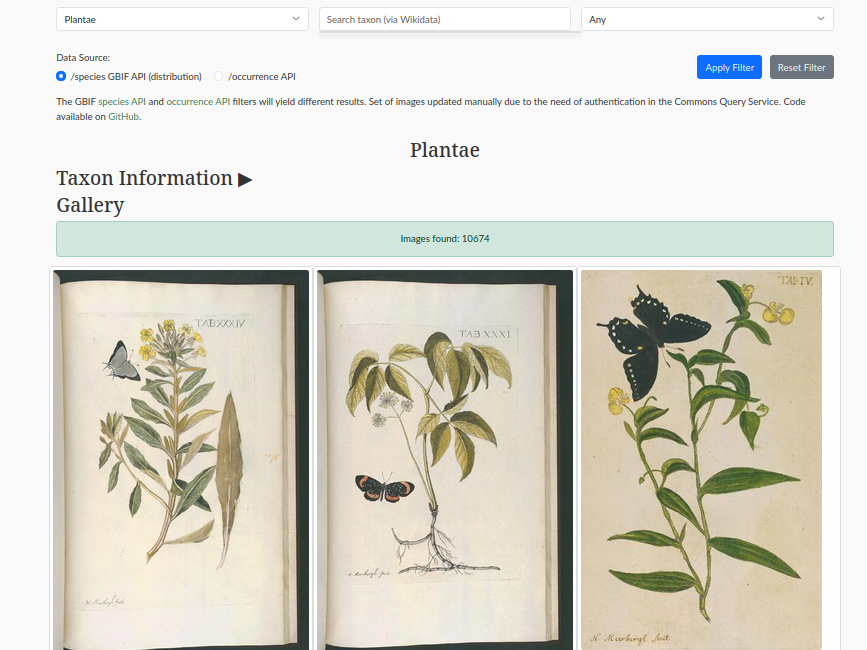
Sample search in BHL Image Explorer app showing three images in taxon Plantae, including scientific names, wikpedia links, wikimedia uses, and links to other databases

In November 2024, I embarked on a dream job as the Wikimedian-in-Residence at the Biodiversity Heritage Library (BHL), aiming to enrich Wikimedia’s platforms with BHL’s incredible biodiversity collections. This crucial role was shaped by community-driven recommendations outlined along with the dedicated efforts of the BHL-Wiki Working Group, including key figures such as JJ Dearborn, Jake Orlowitz, Giovanna Fontenelle, and Siobhan Leachman, who continuously support the integration of BHL content with the Wikimedia ecosystem.

Connecting the Dots

One of our first achievements was creating a comprehensive Meta-Wiki portal clearly showcasing the partnership across Wikimedia’s diverse projects and adding rich documentation on the different ways both communities are connected. Throughout the residency, we transparently documented our ongoing activities through detailed status updates, offering insights into our step-by-step progress.
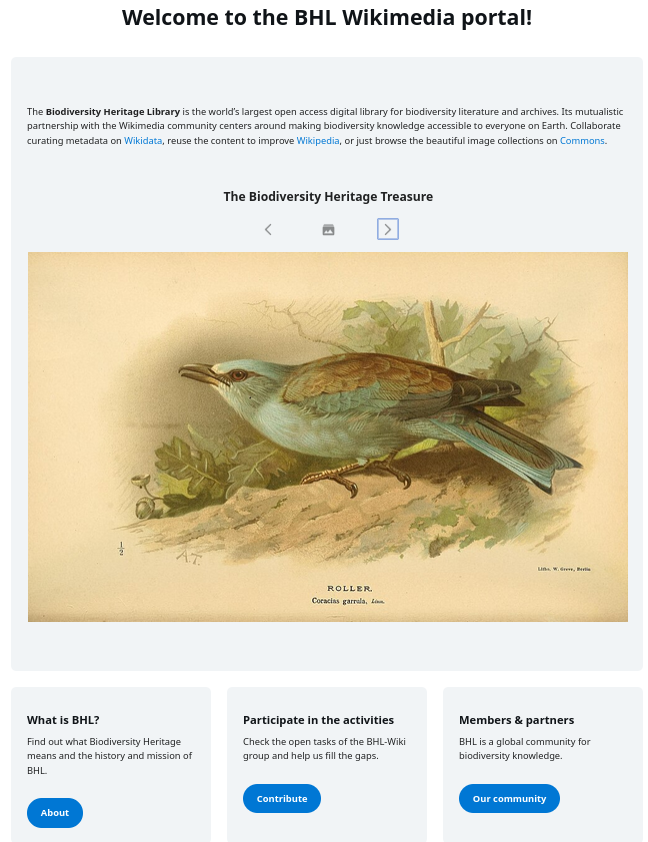
Homescreen of the BHL wikimedia portal with an image of a blue and brown bird perching on a log

The BHL-Wiki Meta-Wiki portal

Tools and Impact

We developed several exciting tools, including BHL Arena, a fun interactive game highlighting BHL’s visual treasures and collecting insights about community preferences.

To capture and understand the broader impact, we built a dedicated dashboard leveraging Wikimedia’s Commons Impact Metrics API. Remarkably, BHL images attract around 20 million monthly views—vastly surpassing BHL’s own website traffic, which averages an already impressive 1.5 million accesses per month.
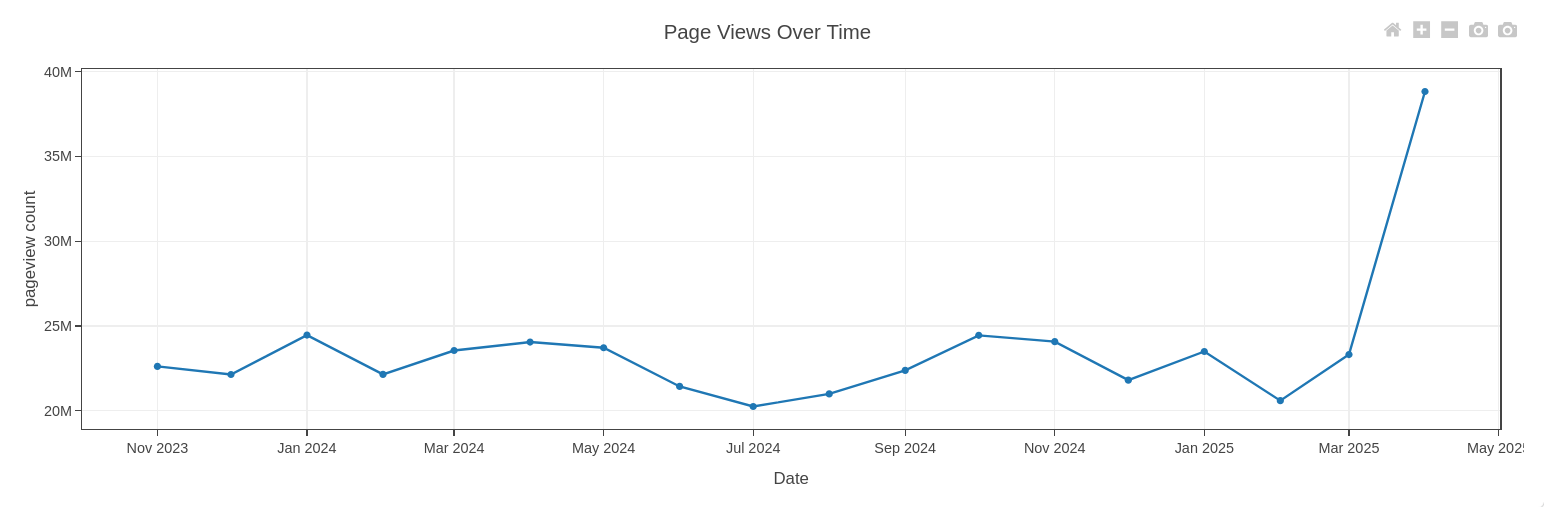
Graph demonstrating page views over time, starting in November 2023 through April 2025

Monthly views for BHL content on Wiki (with spike in April motivated by traffic to “dire wolf”)

Structuring Data for Maximum Reach

A key achievement was enhancing metadata through Structured Data on Commons (SDC). Collaboratively, we designed a comprehensive, structured metadata model, supported by detailed workflows using tools like Open Refine to efficiently add rich structured data to thousands of BHL images.

We successfully developed scripts integrating metadata from Flickr, the BHL API, GBIF, as well as Wikimedia Commons community-curated categories. With the scripts, the initial goal was to add structured data to 5000 files by the end of March. The combination of the automated approaches with the tireless work of the BHL-Wiki participants, namely User:Ambrosia10, led us to the current coverage of structured data additions for over 18,000 files!

A Tool for the Future: BHL Image Explorer

One particularly impactful creation was the BHL Image Explorer, an intuitive tool enabling easy discovery and reuse of BHL images on Wikipedia. Developed iteratively with user feedback, it offers robust taxon- and location-based searches drawing from the GBIF API, interactive navigation, and detailed Wikimedia reuse statistics. It is a demonstration of how the structured data can be leveraged to improve navigability of image collections as well as aiding Wikimedia volunteers in extending the reach of illustrations.
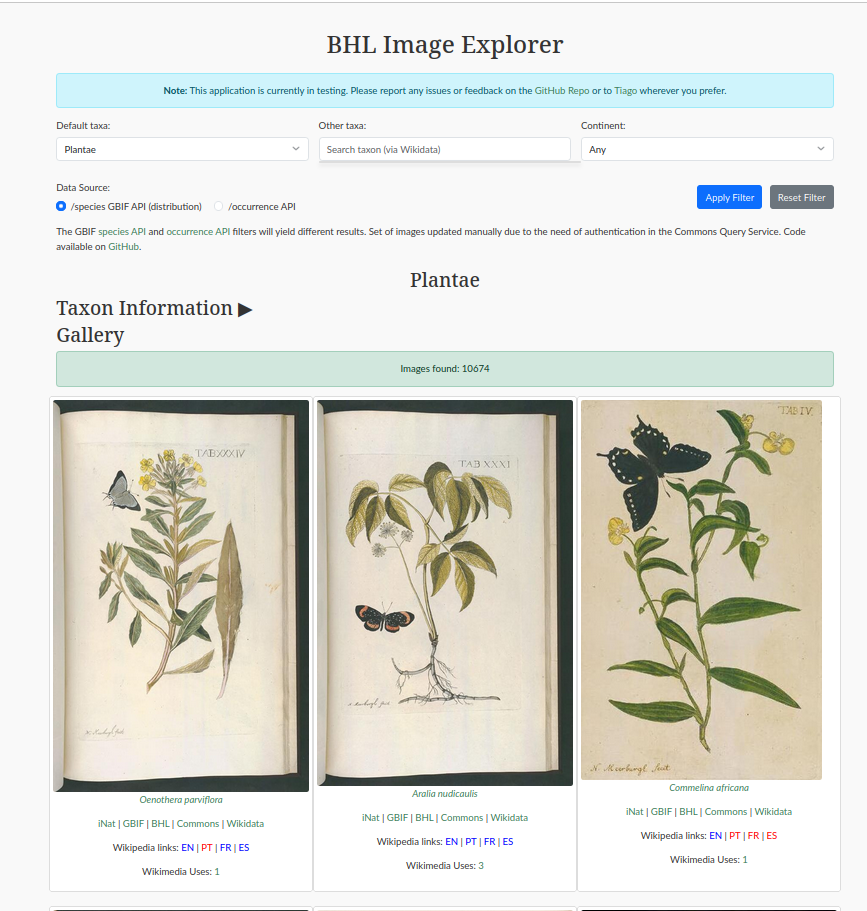
Sample search in BHL Image Explorer app showing three images in taxon Plantae, including scientific names, wikpedia links, wikimedia uses, and links to other databases

Search for plants in the BHL Image Explorer

Looking Ahead

Through these six months, I have grown a passion for the BHL Image collection, and I really want to see them everywhere (e.g. every time I open a new tab). In an age of cheap, AI-generated illustrations, there is something grand in seeing these human-made pieces of scientific art, tales of the biodiversity-loving nature of humankind across the centuries.

Although my formal residency has concluded and new futures for BHL are in preparation, I am confident that the outcomes of this work will continue to flourish. Some of the key contributions poised for lasting impact on the data/metadata for BHL Images include:

  1. A robust, adaptable, structured metadata model ready for future use;
  2. Efficient scripts for large-scale structured data integration from diverse APIs;
  3. Automated workflows transforming Wikimedia Commons categories into structured data; and
  4. The accessible and powerful BHL Image Explorer tool, enhancing global access to biodiversity imagery.

These advancements significantly amplify the visibility and accessibility of biodiversity heritage content, inspiring ongoing volunteer engagement and enriching global biodiversity knowledge.

I warmly invite everyone to explore the BHL Image Explorer and actively participate in ongoing efforts listed on BHL’s Meta-Wiki page. Together, we can continue bridging biodiversity’s rich past with Wikimedia’s vibrant, open-access future!
July 29, 2025by [email protected]
BHL News, Blog Reel, Tech Updates

Interlinking BHL Data in the Wikimedia Project Ecosystem

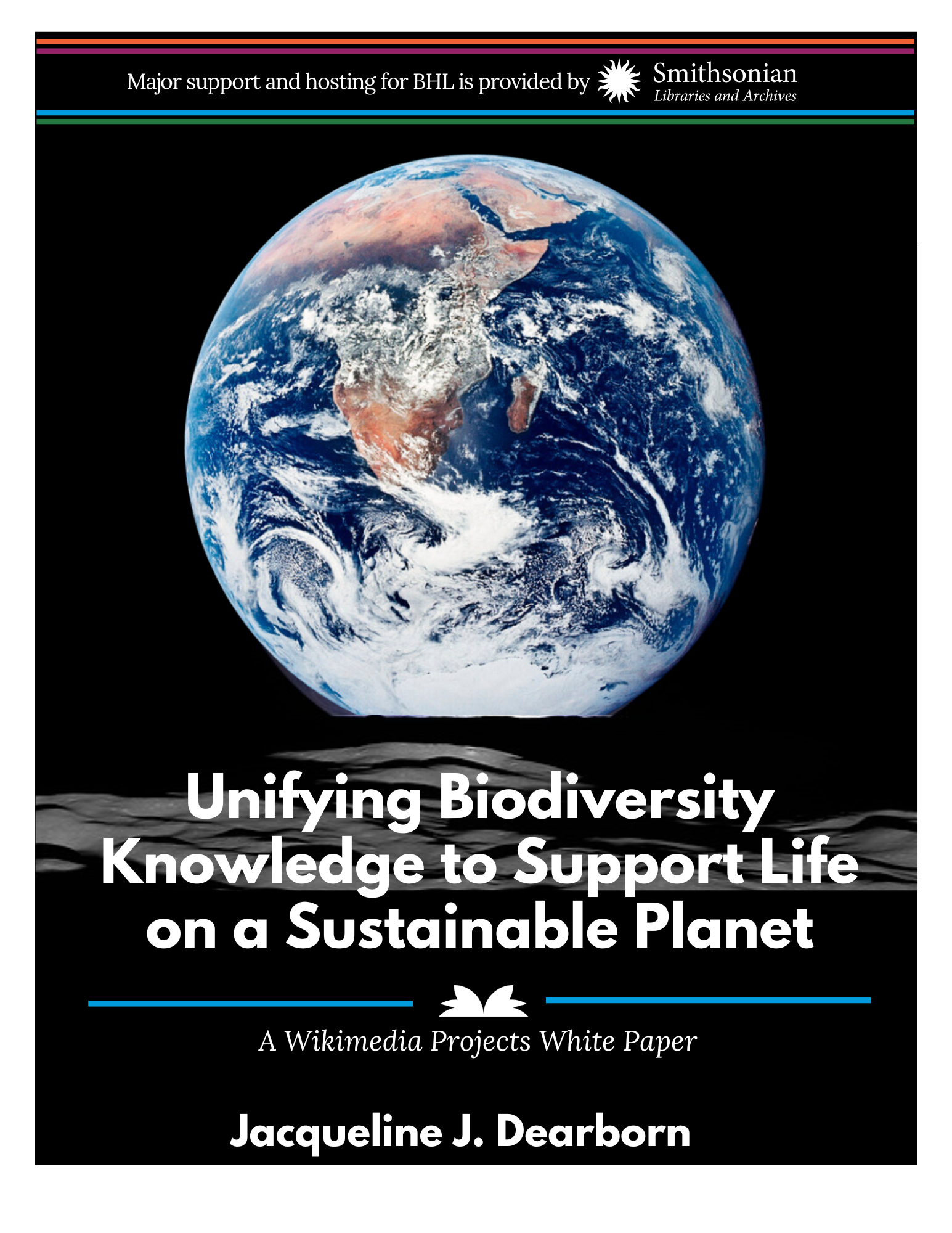
Cover of white paper with image of earth from space

The planet is at a critical juncture, where urgent action is required to combat climate change, biodiversity loss, and secure a sustainable future for our planet. With the release of the recent BHL Wikimedia white paper entitled Unifying Biodiversity Knowledge to Support Life on a Sustainable Planet, the Biodiversity Heritage Library Secretariat hopes that an expanded data vision for the BHL community presents new opportunities to take bold steps forward into Wikimedia projects and the emergent semantic web.

Cover of white paper with image of earth from space

Dearborn, J. (2023). Unifying Biodiversity Knowledge to Support Life on a Sustainable Planet. Biodiversity Heritage Library. https://doi.org/10.21428/bcf8962c.699434fb

The white paper sheds light on BHL’s crucial role as a member of the biodiversity informatics community and reveals a series of key use cases and big data challenges that, if addressed, could be opportunities to enhance global biodiversity data infrastructure.

Addressing BHL’s Big Data Challenges

Three significant challenges remain for BHL to solve in the era of big data:

  1. correcting and transcribing OCR text;
  2. improving search precision and retrieval within the BHL interface; and
  3. expanding interlinkages and deposits of data from BHL into global knowledge bases, e.g. depositing species occurrence data in Global Biodiversity Information Facility (GBIF).

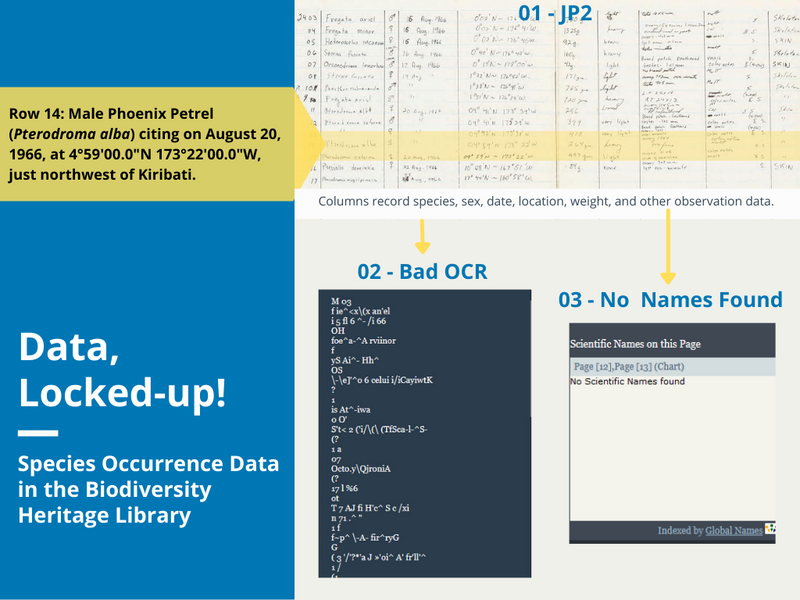
Example of handwritten observation data with poor quality OCR and no scientific names found on the page

By working to address these challenges, BHL aims to ensure data accuracy, enhance user experience, and forge stronger connections within the global biodiversity data infrastructure.

If liberated, the data in BHL’s collection will:

  1. improve scientific understanding of ecological change, deeper into time;
  2. assist decision-makers in shaping global environmental policy informed by the historical record; and
  3. bridge knowledge gaps and facilitate information exchange regarding our planet’s history.

Unlocking BHL’s Power with Wikimedia Projects

Within the white paper, Wikimedia’s core projects, particularly Wikidata, take center stage. BHL is already engaged in projects to load title, author and article metadata into Wikidata. By integrating more of BHL’s biodiversity and climate-related data into the collaborative and unified ecosystem of Wikidata, BHL can unlock new opportunities for data-driven insights.

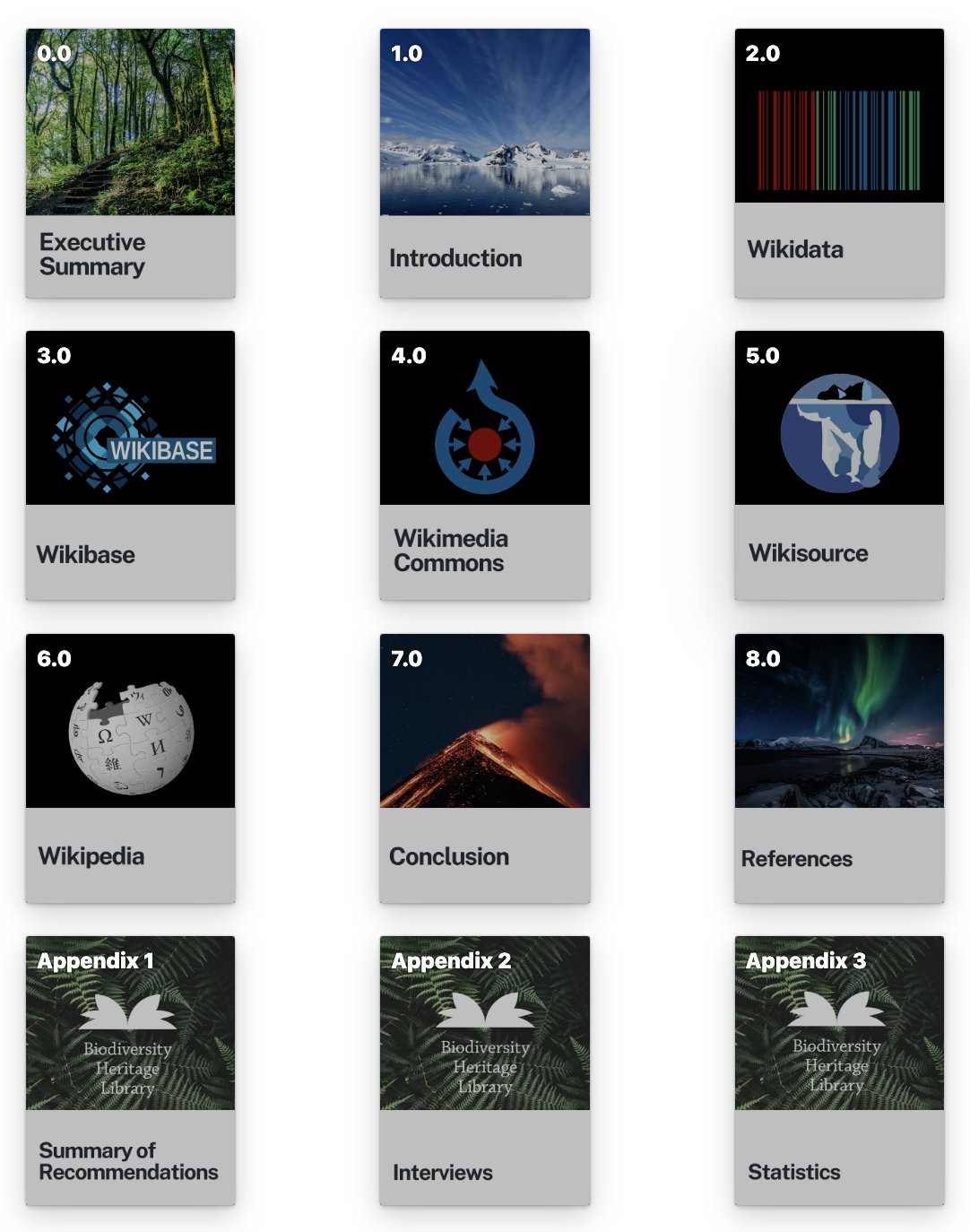
Thumbnails of each chapter and appendix in the white paper

Call to Action: Vote for the Most Impactful Use Cases!

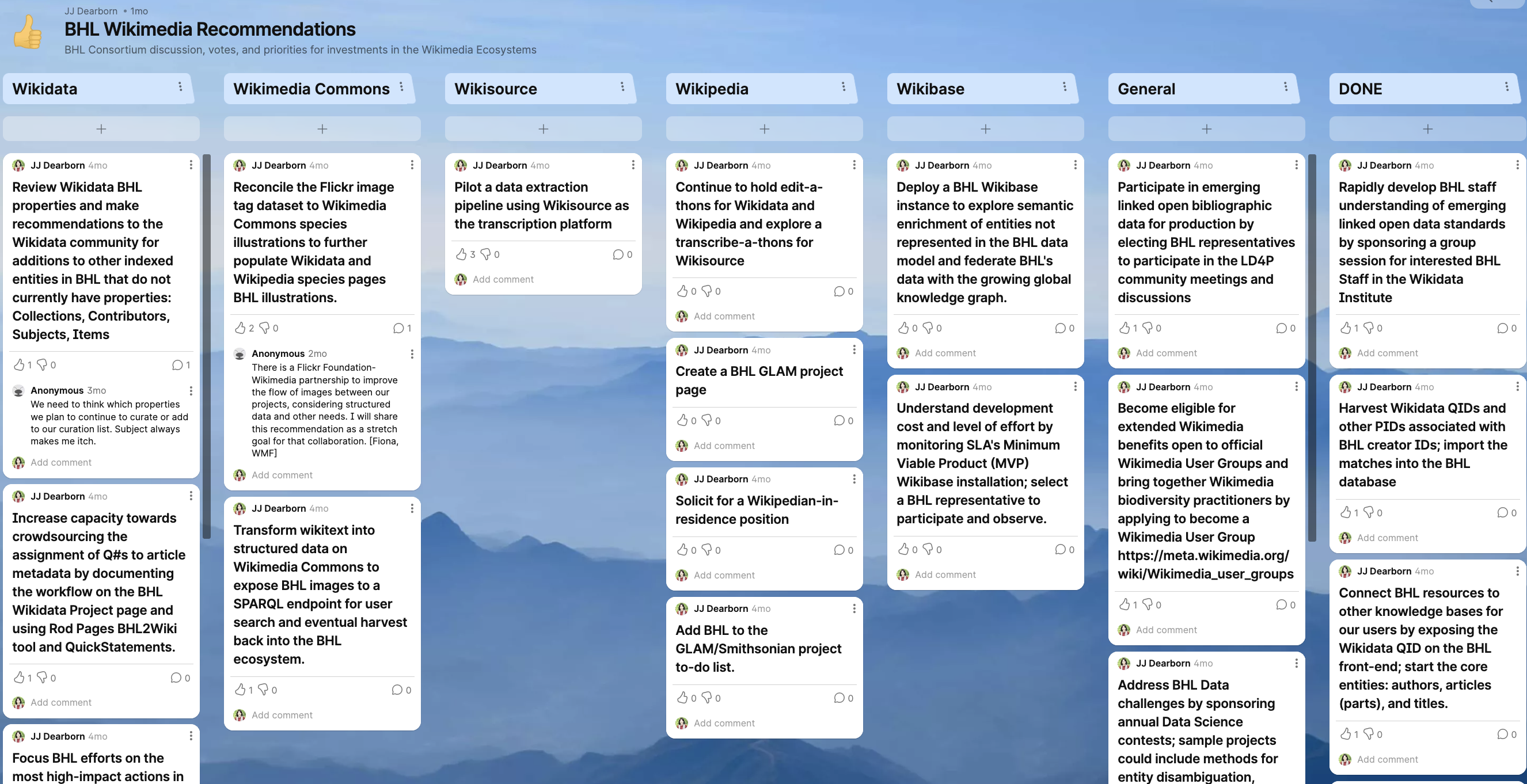
BHL partners, Wikimedians, and key BHL collaborators are encouraged to actively participate in shaping the future of BHL by voting and commenting on which use cases the community believes will have the most significant impact. Your input and insights are invaluable in guiding the direction of BHL’s Wikimedia projects. Visit the voting platform to share your thoughts, provide feedback, and cast your vote to take action on 25 recommended use cases. Let’s work together to identify the areas of maximum impact for BHL that will help transform BHL’s data into interlinked knowledge in the semantic web.

Screenshot of 25 BHL wikimedia recommendations on voting platform

VOTE NOW!

Through a range of potential applications for BHL data in the Wikimedia ecosystem and the pursuit of solutions for BHL’s big data challenges, BHL is making the case for deeper integration of its collection into biodiversity knowledge networks. The release of the white paper demonstrates unique opportunities for BHL to improve biodiversity research infrastructure, increase understanding of our planet’s biodiversity and impact climate policy.

August 25, 2023by mdimeo
BHL News, Blog Reel, Campaigns, Her Natural History

#HerNaturalHistory: Open Data, BHL, and Wiki Projects

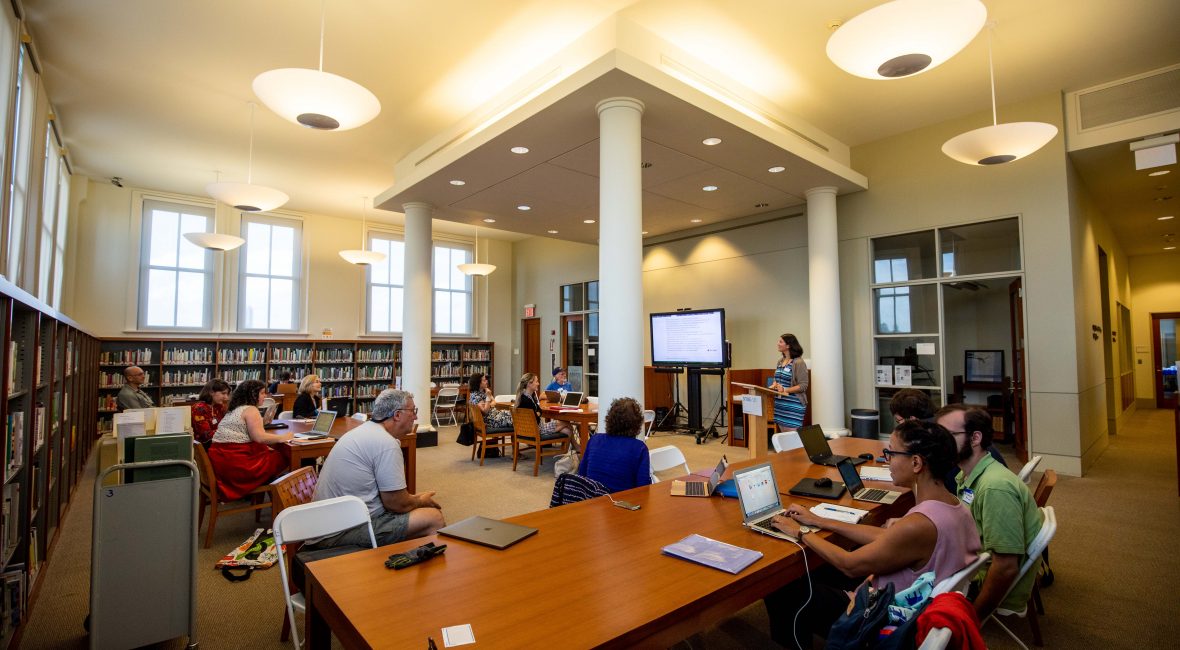
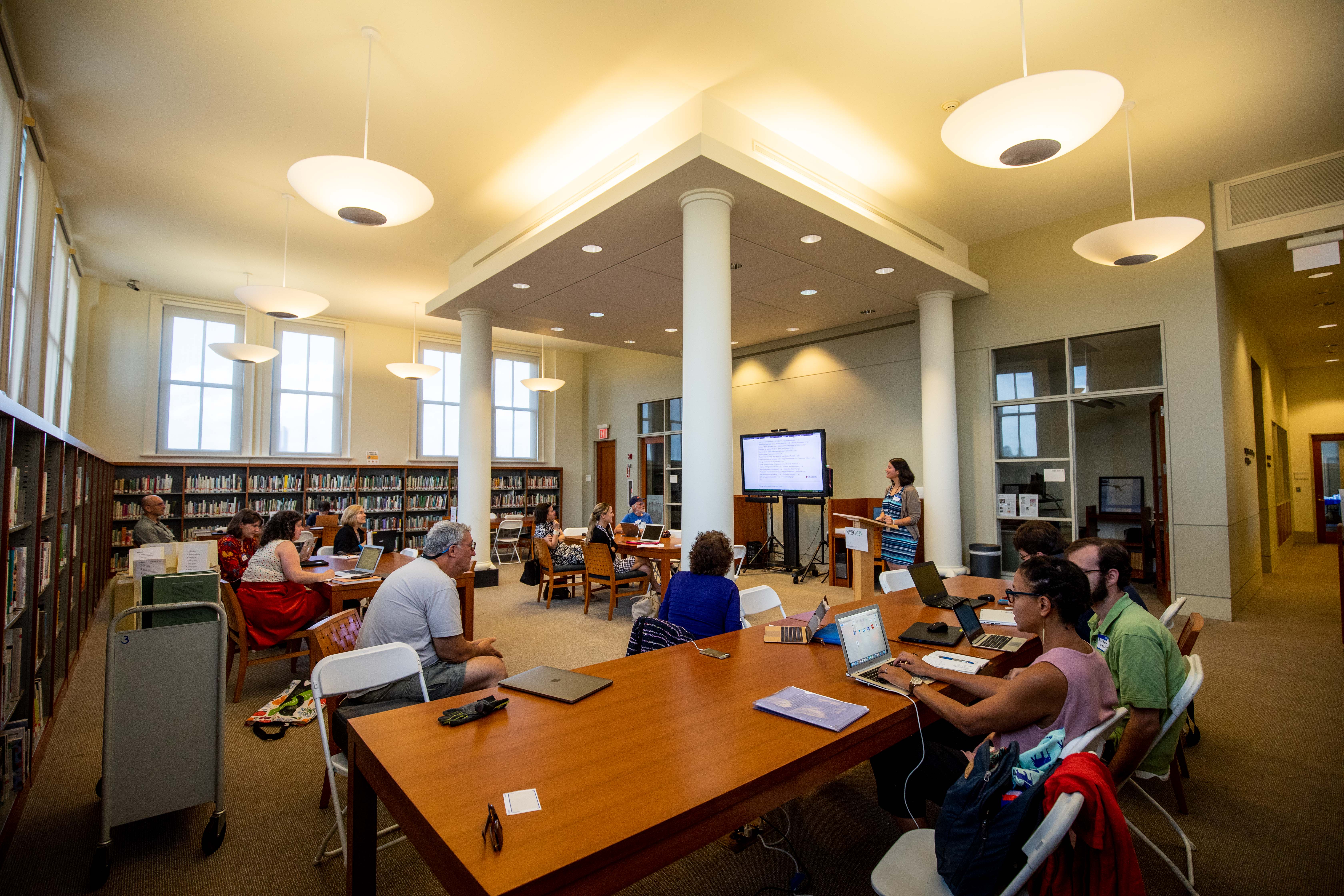
Attendees edit Wiki content at the LuEsther T. Mertz Library of the New York Botanical Garden. Photo by Marlon Co.

Wiki projects, including Wikipedia, Wikimedia Commons, and Wikidata, contain the information that powers the web. Wikipedia is the fifth most-visited website in the world. To edit a Wiki project is to contribute content that could potentially be viewed by thousands or even millions of people over time, both on Wiki sites and on sites like Google and Facebook, which harvest data, including media, from Wiki sites.

Like Wiki editors, BHL contributors are passionate about having their content accessible to and used by the most people possible. The information that we provide through BHL is intended for global audiences. We hope that the special things and unique data in our collections have a life beyond our walls and our institutions.

This similarity in missions and goals is what makes projects involving both BHL and Wiki* a great fit. To this end, for the #HerNaturalHistory campaign, the LuEsther T. Mertz Library of the New York Botanical Garden and the Smithsonian Libraries held three crowd-sourcing citizen science/citizen humanities events in March of 2019. These events were intended to bring new editors to Wiki projects, have editors add information about female scientists to Wikipedia, and have editors add information to BHL collections on Flickr and in Wikimedia Commons utilizing the Wikidata knowledge base/database/catalog.

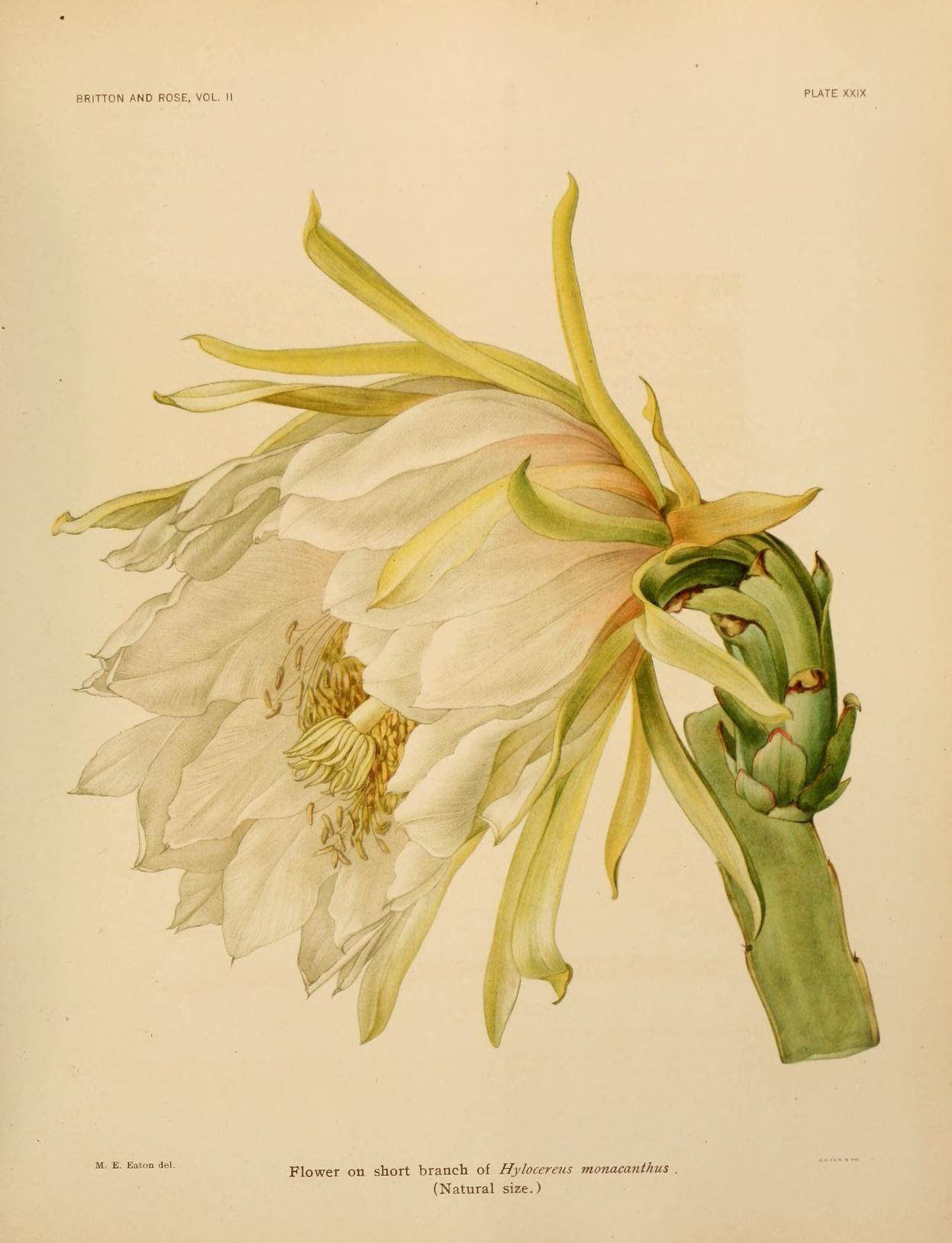
Illustration of Hylocereus monacanthus by Mary Eaton, The Cactaceae, . Contributed in BHL from The New York Botanical Garden.

At the New York Botanical Garden on 12 and 13 March, attendees had the opportunity to add data to images in Flickr, add data and categories for images in Wikimedia Commons, and add data to items in Wikidata. (The task list can be found here.) Over the span of two days, attendees edited 22 files on Flickr, adding 84 taxonomy:binomial and 34 taxonomy:common machine tags. 206 edits were made to Wikimedia Commons files, categories, and other content, adding 16,748 bytes of data and five new images to the repository. On Wikidata, four new items were created and 24 items were edited 114 times, for a total of 30,700 bytes added.

The event was offered in collaboration with Wikimedia NYC, the regional Wikimedia chapter serving the New York metropolitan area. WM NYC promotes free access to the world’s knowledge and supports Wiki projects in the greater New York City region; the attendance of WM NYC members provided the other attendees with a great deal of expertise on the finer points of Wiki projects and editing.

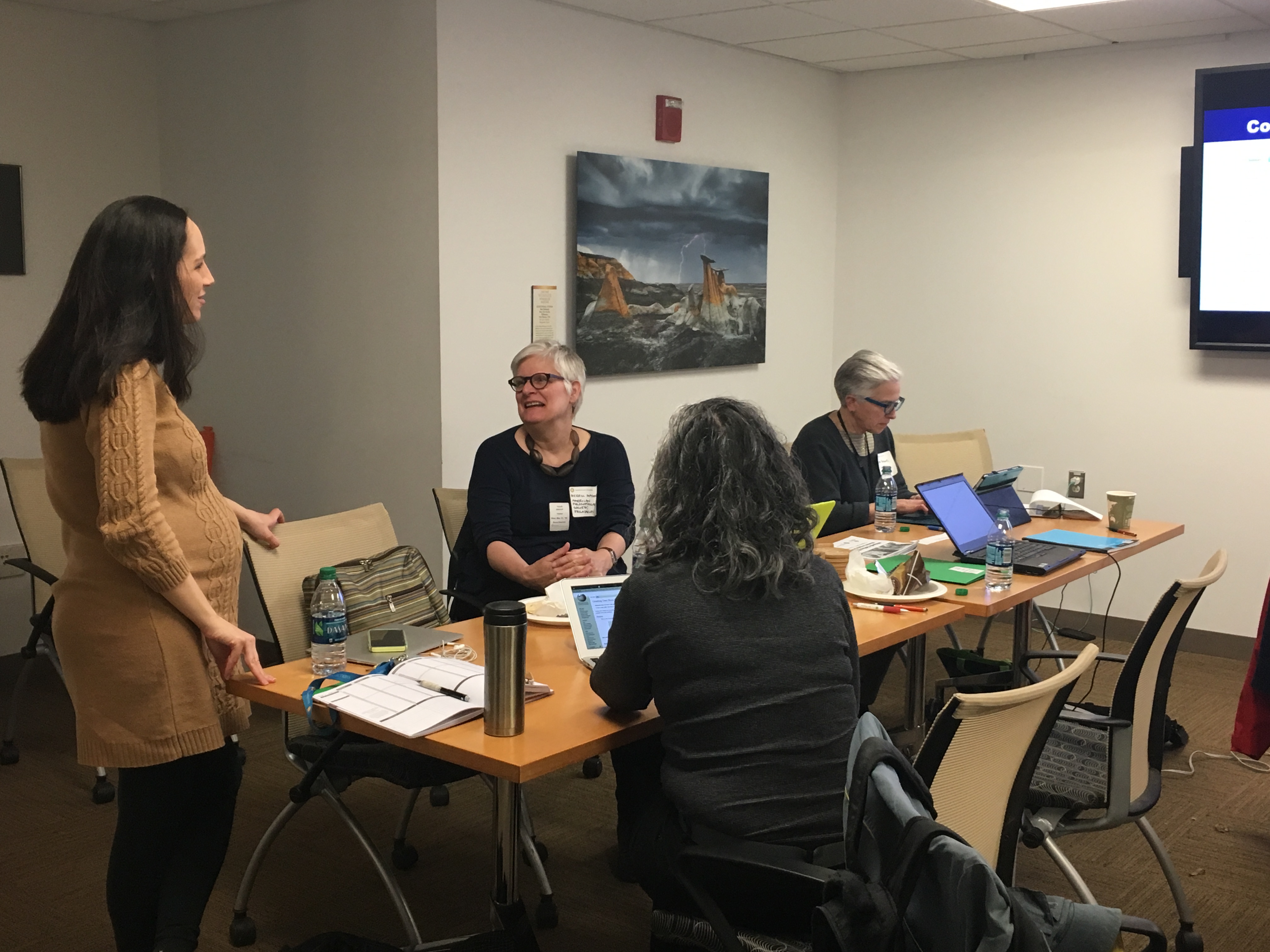
During the Smithsonian Libraries Workshop on 13 March, in-person participants at the Natural History Museum Library and virtual participants from around the world focused on editing the Wikipedia pages of female contributors to natural history using resources from BHL. Attendees focused their edits on women included in the Workshop’s Suggested Article Work List, comprised of over 100 women represented in the BHL collection. The Work List was compiled based on research and suggestions predominantly from BHL citizen scientists Michelle Marshall and Siobhan Leachman, as well as colleagues from the New York Botanical Garden, Smithsonian Institution Archives, and the BHL Cataloging Group.

Attendees editing at the Smithsonian Libraries Wikipedia Editing Workshop, hosted in the Natural History Museum Library and sponsored by Wikimedia DC. Photo by Grace Costantino.

The Smithsonian Libraries Workshop was sponsored by Wikimedia DC, with representative Ariel Cetrone facilitating the meeting. Two other representatives from Wikimedia DC, Jim Hayes and Andrew Lih, were also in attendance to provide support to participants. To facilitate virtual attendance, the Workshop was live-streamed via YouTube Live. A copy of the presentation used during the Workshop is also available online.

In total, over 70 people attended the Smithsonian Libraries Workshop, representing 20 in-person and over 50 virtual attendees. All told, as a result of the Workshop, 50 articles were edited, 5 new articles were created, and 14 images were uploaded to Wikimedia Commons, representing a total of 140 edits. Additionally, 36 new “editors” (first-time Wikipedia editors) participated in the Workshop.

The Suggested Work List will remain active indefinitely, and we welcome anyone to continue editing the Wikipedia pages for these women.

Although metrics are important, and offer a glimpse into one aspect of these events, the more impactful takeaways from these collaborations were the discussions that attendees had on topics ranging from open content, to information architecture, data storage, content curation, and more. In a sense, these crowd-sourcing edit-a-thons were a salon of sorts, where curious people who are passionate about open information were able to discuss strategies for how to make data more accessible and useful to the public, and work together to find and implement these solutions.

March 19, 2019by michelle.underhill
BHL News, Blog Reel

Be Like a BHL Librarian and Edit Wikipedia for #1Lib1Ref

You too can be like a librarian … a Biodiversity Heritage Library librarian! The Biodiversity Heritage Library wants people to use its resources, and Wikipedia is encouraging librarian-minded folk to add citations to articles via their #1Lib1Ref campaign (15 January – 3 February 2017). Talk about a perfect match. You can help by adding citations from BHL to Wikipedia.

Don’t worry if you haven’t edited Wikipedia before. What follows is an easy “How to” guide to adding a citation from works held in BHL to a Wikipedia article.

Create a Wikipedia Account

Your first step is to create a Wikipedia account. Although you can edit Wikipedia without an account, if you create one, you can use Wikipedia’s fabulously easy “Visual Editor” tool. This comes with a feature which allows for ease of citation of references. Click here to see how to create an account and how to enable the Visual Editor tool.

Find an Article

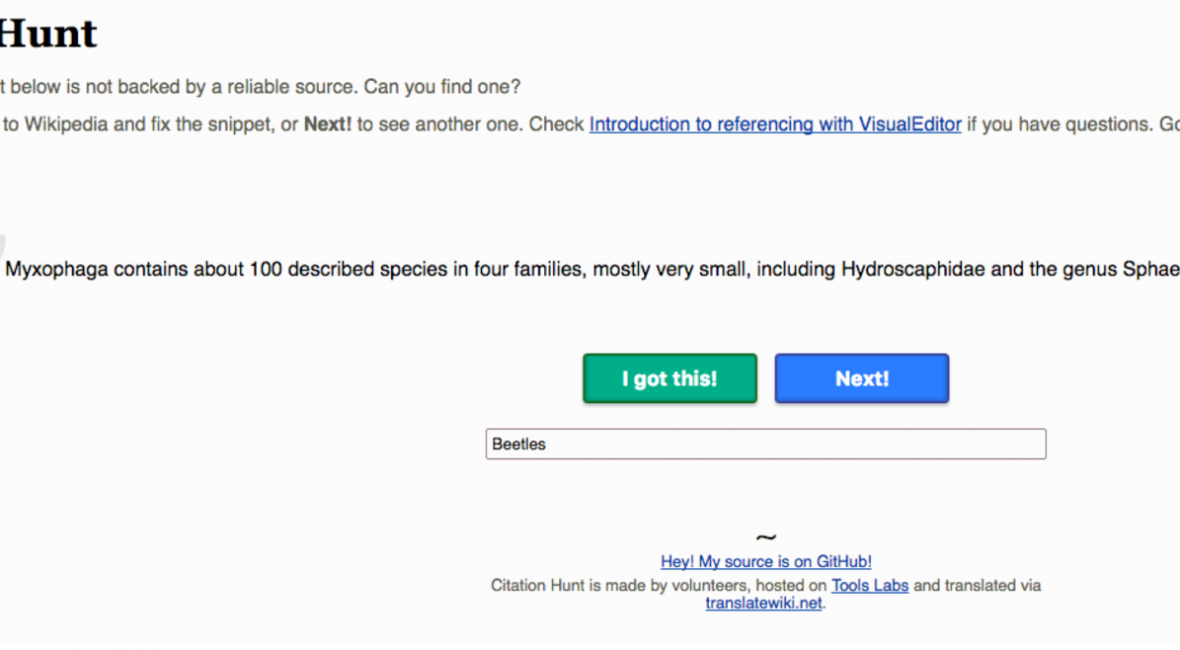
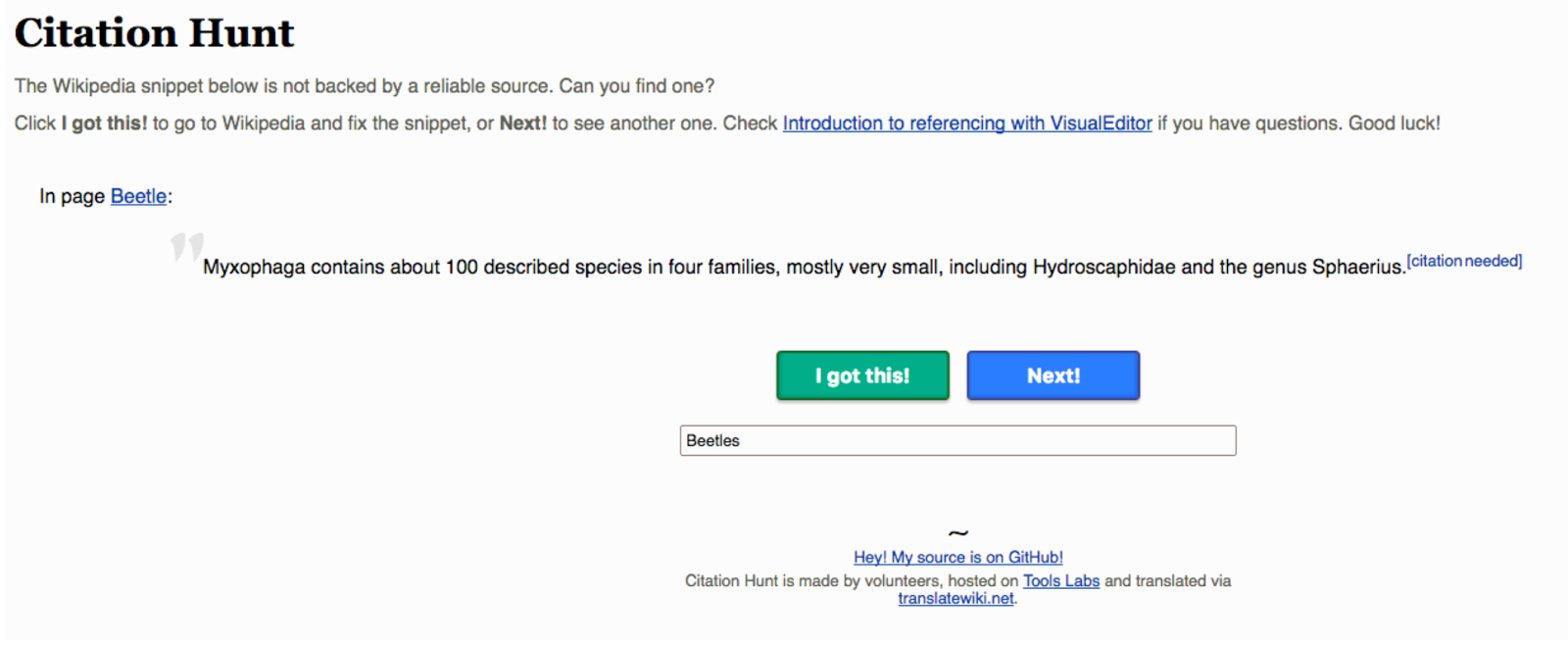
Your second step is to find an article that needs to be improved with added citations. One way is to use the Wikimedia Citation Hunt tool. When using this tool, I narrow my search to articles which need the Biodiversity Heritage Library resources. I do this by filling in the “What makes you tick” box with a search term. In the example below, I’ve added “Beetles” to find beetle articles that need citations, but there are many other terms you could use. For example, try “mosses”, “Fish of Canada”, “lizards” or any subject you are interested in.

View Full Size Image

In the above case, to find the needed citation I would put “Myxophaga” (a suborder of Coleoptera or beetles) in the search box on the BHL website and see if I could find any article, journal or book in BHL supporting the statement in the Wikipedia article to which I want to add a citation.

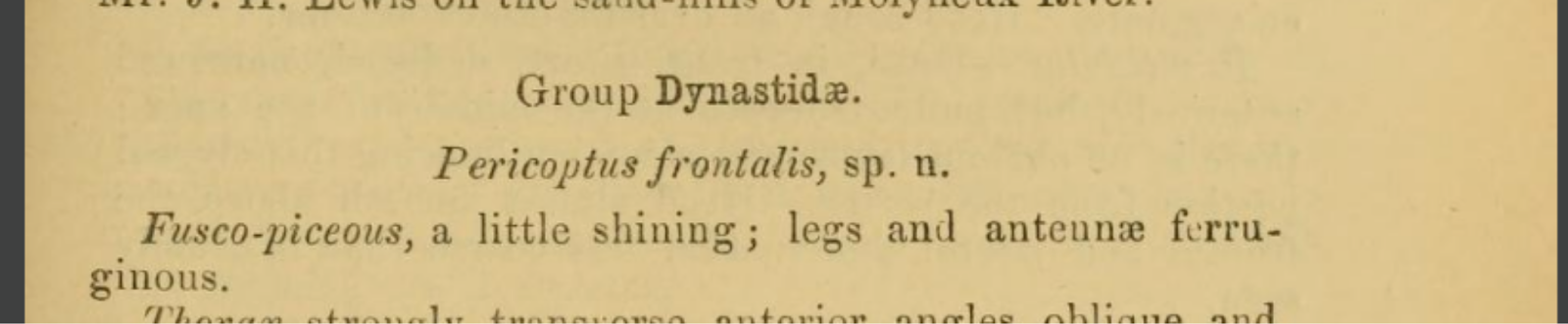
You can also work from the other end and find an article in BHL that you can then cite in Wikipedia. So for example I found this article which first describes the Pericoptus frontalis beetle. This is an article that can and should be cited in the Pericoptus frontalis beetle Wikipedia page.

View Full Size Image

Citing Reference in Wikipedia

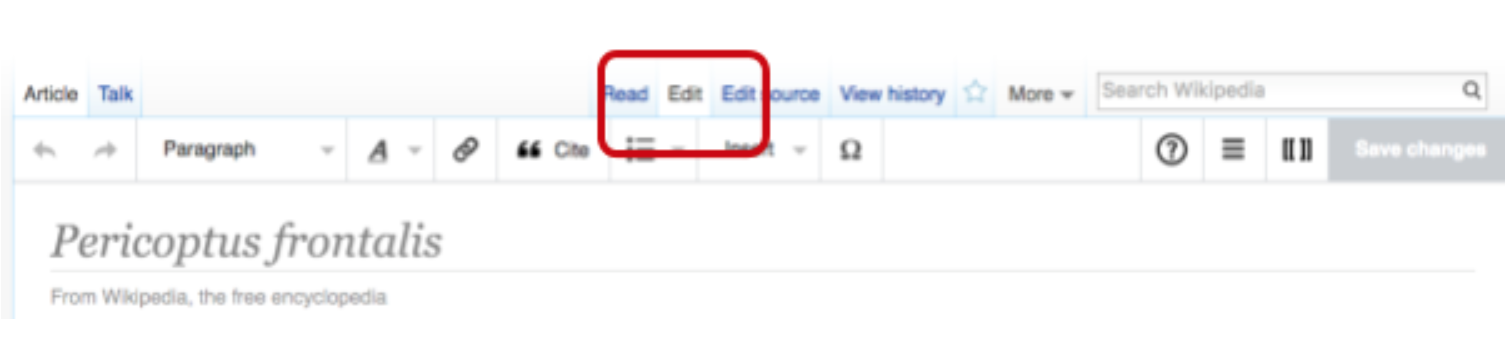
So you’ve logged in to Wikipedia, enabled the Visual Editor tool, and found the article in BHL you want to cite. Now go to the page you want to edit and click on the “Edit” tab so that the Visual Editor edit bar appears.

View Full Size Image

Place your cursor in the Wikipedia article where you wish to add the citation and then press “cite” on the edit bar.

View Full Size Image

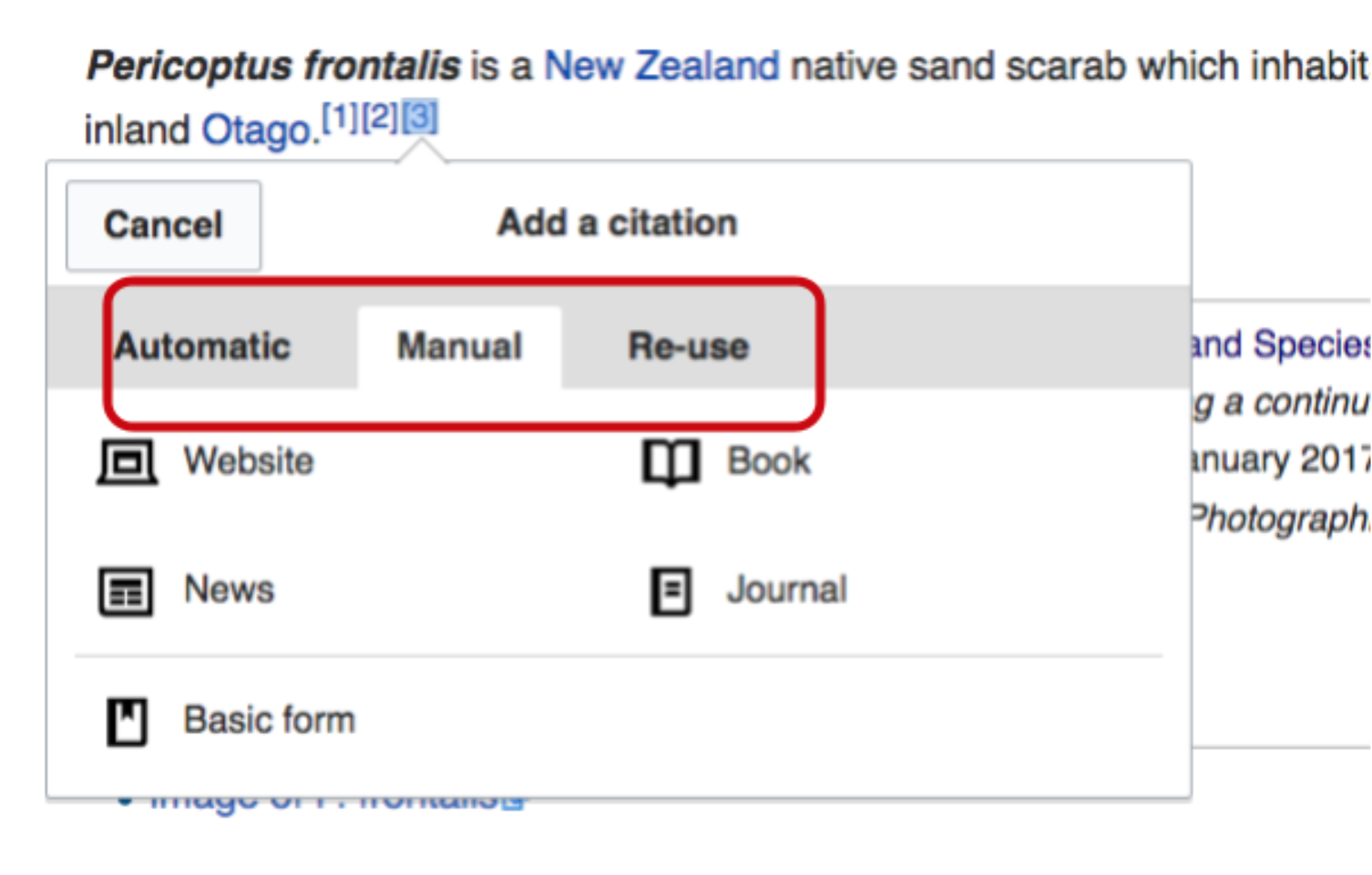
The “add a citation” box should then appear.

View Full Size Image

You then have a choice of either using the “Automatic”, “Manual” or “Reuse” citation method. If you have the URL, DOI or PMID of the article, you can use the “Automatic” citation tool to generate a citation. Alternatively, use the “Manual” citation, which will give you different options to choose from depending on where you obtained your citation. The image above shows you the manual citation options.

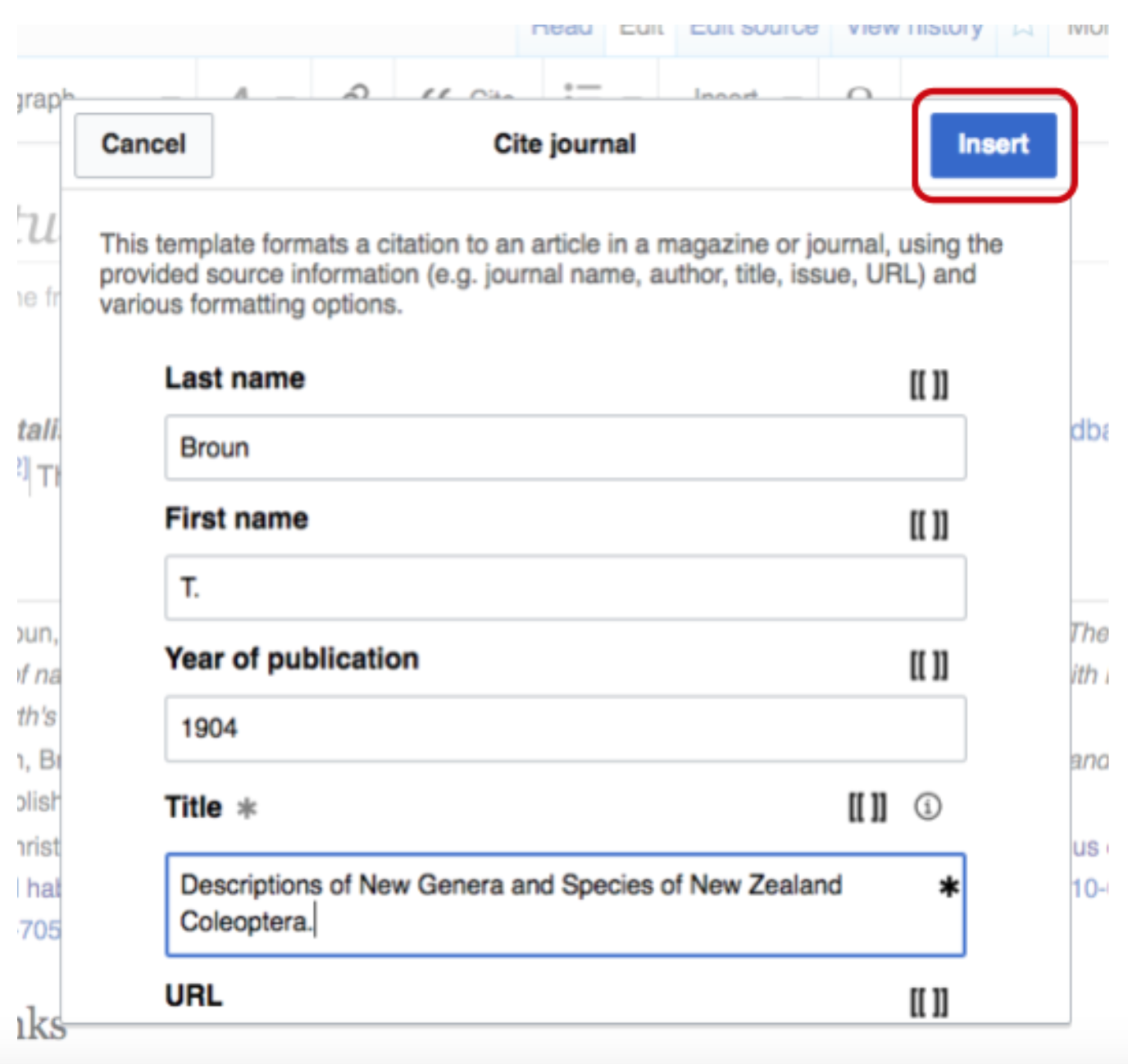
In this case, I’m citing an article in a journal rather than a book or a newspaper article, so I would choose the “Journal” option. Clicking on “Journal” brings up a template. Fill in all the information you can in the appropriate boxes and then press “Insert” on the top right of the box. Make sure you provide the stable URL link in BHL (learn more).

View Full Size Image

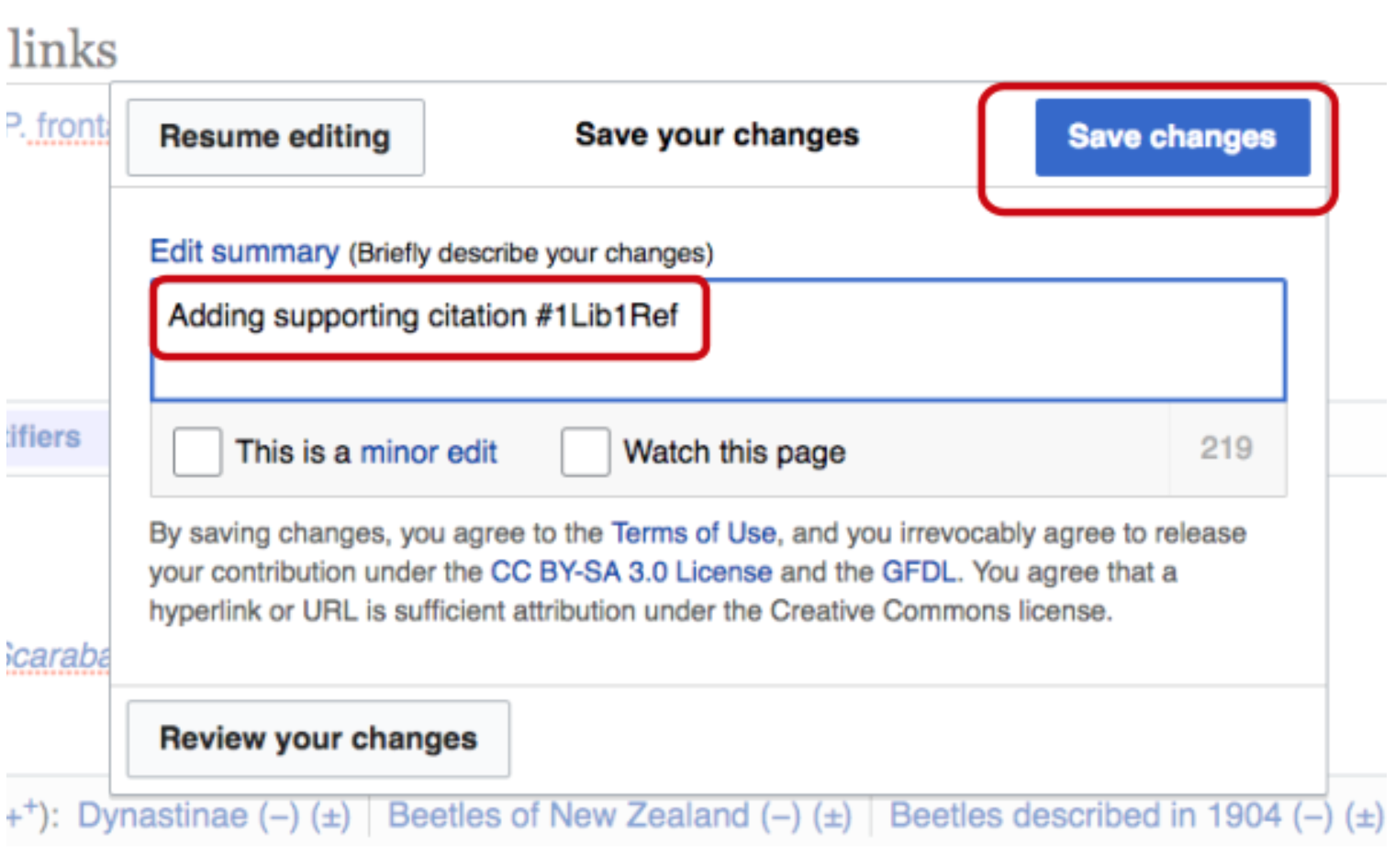
Pressing “insert” brings up a “Save your changes” box asking you to briefly describe the changes you’ve made to the article. Make sure you add the hashtag #1Lib1Ref to your edit summary as this will add your edit to the campaign total.

View Full Size Image

You then press the “Save changes” button and with that you have added a citation to Wikipedia!

For further Information on the Wikipedia #1Lib1Ref campaign, click here.

Follow #ILib1Ref on social media, 15 January – 3 February 2017 to learn more about the campaign and see how adding citations to Wikipedia can improve the resource for everyone!

If you have questions or get stuck, see this page to learn more about the various outlets you can use to find help and information. You can also tweet BHL at @BioDivLibrary or Siobhan at @SiobhanLeachman.

January 17, 2017by ulib-libraryjobs
BHL News, Blog Reel

Wikimania 2012!

Two missions collide: Free, Open, and Global! Wikipedia we love you.

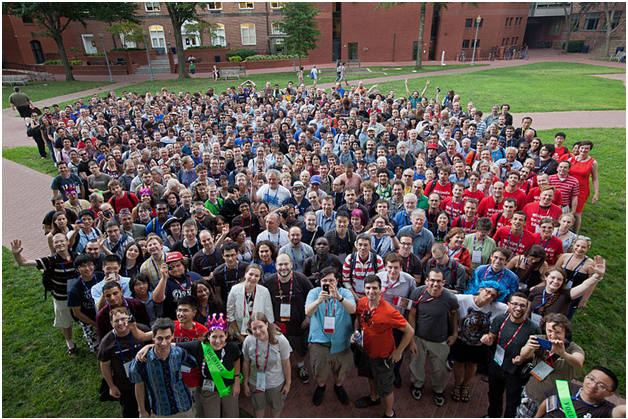
Since 2009, we have been looking at Wikipedia as a way to drive new user traffic to the Biodiversity Heritage Library while improving the content and accuracy of Wikipedia’s articles. This symbiotic relationship has had a few bumps along the way but, our recent attendance at the  8th Annual Wikimania Conference held in Washington, DC, reaffirmed our commitment to increase our Wikipedia efforts which include adding our Flickr images to the Wikimedia commons file repository as well as inserting species citations, and external links to auto-generated BHL taxon name bibliographies. During this week-long conference, we were inspired by the sense of mission, ingenuity and passion that our fellow Wikipedians demonstrated.

 
View Full Size Image
Photographed by Adam Novak

Early on, we ran into some obstacles with our Wikipedia edits. It seems we lacked the user “clout” necessary to add BHL links en masse. As newcomers who had not been “validated” by the Wikipedia community, we found that many of our citations were subsequently deleted which proved a tad bit frustrating since we had no idea why this was happening! At this year’s conference, we learned that Wikipedia is subject to rampant vandalism and many links from unverified or new users will be deleted. You must earn authority over time in Wikipedia. Top users are awarded virtual honors dubbed “barnstars.” Yes, anyone may edit but, in Wikipedia only the unbiased vetted truth sticks.

View Full Size Image
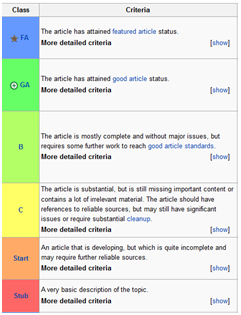
Wikipedia’s Article Quality Rubric

Contrary to popular derision, Wikipedia’s standards for trusted citations, fact checking and article quality are intensely rigorous. They have developed rubrics for quality, tutorials for writing articles, and lists of articles that need user help. Wikipedia is built upon the hard-work of a global network of altruistically motivated (as opposed to financially), passionate and tech savvy people who have developed a highly complex information ecosystem. Frankly, we were in awe at the spirit Wikipedians had for Open Knowledge not to mention the amount of free work they seemed willing to do. Beyond traditional editing efforts, Team BHL has also been exploring potential tech developments for two out of the ten official Wikimedia foundation projects; those being, Wikisource and Wikimedia Commons.

Wikisource
Wikisource is a project that gives users the opportunity to augment open content texts with corrections, hyperlinks and notes. This really piqued our interest because free-text searching in the BHL has been one of the most requested improvements for functionality by our users and remains on our tech development to-do list. The main obstacle that we face is that optical character recognition software (OCR) is marginally accurate at best and the errors present in uncorrected OCR texts remain one of the insurmountable hindrances to free-text searching of the BHL corpus.

After sitting-in on the Wikisource presentation given by Andrea Zanni, a Wikisource sysop, advocate, and volunteer, we were extremely impressed by this project and its potential future application for BHL text files. Finally: a platform that opens up the possibility of crowd-sourcing BHL user-generated corrections for OCR text! Moreover, the multi-layered djvu file format that Wikisource accepts allows users to add their own links into the text’s OCR, further augmenting the usefulness of the original resource.

Lastly, perhaps the most exciting application of Wikisource is its potential use with manuscripts. For instance, handwritten scientific field notes or Linnaeus’ personal letters are not accompanied by a text file; these invaluable scholarly resources could be transcribed by Wikisource users and thus exposed to user search and discovery.

View Full Size Image
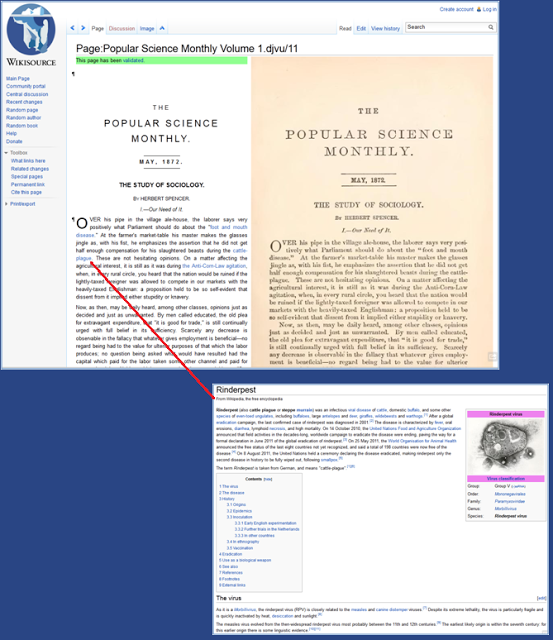
Users can correct OCR using Wikisource’s dual-pane interface. Also, they have linked the term “cattle-plague” to the Wikipedia article “Rinderpest.” Linked data or Wikisourcery?!

Currently, there are still few options for extracting the corrections and re-integrating them into the BHL. Nevertheless, the Wikisource developers were among the most enthusiastic and driven folks at the conference; we will be watching them closely for future improvements to Wikisource that might help make the “Full-text Search Dream” a reality. As users, how likely would it be for you to help make corrections to BHL texts using the Wikisource interface?  (Screenshot above)

Wikimedia Commons

Another project already in the works as part of our recent NEH grant is to batch upload our 37,595 Flickr images into the Wikimedia Commons. The Commons provides Wikipedians with a central repository that stores photographs, diagrams, maps, videos, animations, music, sounds, spoken texts, and other free media, all of which can be re-purposed and reused for Wikipedia articles and projects. For our purposes here at BHL, we just see this as another avenue to expose the fabulous illustrations that we already have in our Flickr account and have them used  for article creation and species description in the future. We are particularly interested in providing images to species that have been identified in Wikipedia that are lacking illustrations.

Stay tuned for more information in the future about the progress of our Wikimedia Commons work.

Current State of Team BHL’s Efforts

As of yesterday, there were 3,181 BHL links in Wikipedia. We can only hope that this number continues to grow as word about BHL spreads. Our continued efforts are only a small piece of the pie. We count on our users to help us vet Wikipedia’s biodiversity articles, all of which benefit from citations pulled from the BHL. Please help us spread knowledge about life on Earth to new user communities by becoming a Wikimanian yourself. We may hold an “edit-a-thon” in the future for interested users — if the idea takes hold.

In the meantime, feel free to sail solo by adding BHL links and citations to Wikipedia. For helpful tips on how to do this, our Technical Director, Chris Freeland put together a presentation that offers a quick primer on Wikipedia editing for BHL.

We depend on user feedback to drive our technical development efforts, so please let us know what you think about our involvement with Wikipedia and the two aforementioned projects.

July 30, 2012by BeccaQ_92

Help Support BHL

BHL's existence depends on the financial support of its patrons. Help us keep this free resource alive!

search

About BHL

The Biodiversity Heritage Library (BHL) is the world’s largest open access digital library for biodiversity literature and archives. BHL operates as a worldwide consortium of natural history, botanical, research, and national libraries working together to digitize the natural history literature held in their collections and make it freely available for open access as part of a global “biodiversity community.”

Join Our Mailing List

Sign up to receive the latest news, content highlights, and promotions.

Subscribe Now

Subscribe to Blog via Email

Enter your email address to subscribe to this blog and receive notifications of new posts by email.

Join 319 other subscribers

Subscribe to Blog Via RSS

Subscribe to the blog RSS feed to stay up-to-date on all the latest BHL posts.

Access RSS Feed

Inspiring Discovery through Free Access to Biodiversity Knowledge.

The Biodiversity Heritage Library makes it easier than ever for you to access the information you need to study and explore life on Earth…for free, anytime, anywhere.


64+ Million Pages of
Biodiversity Literature Online.

EXPLORE

Tools and Services
to Transform Research.

EXPLORE

300,000+
Illustrations on Flickr.

EXPLORE

ABOUT | HARMFUL CONTENT | PRIVACY | SITE MAP | TERMS OF USE