Biodiversity Heritage Library - Program news and collection highlights from BHL
  • Home
  • News
  • Featured Books
    • All Featured Books
    • Book of the Month Series
    • BHL at 20
  • User Stories
  • Campaigns
    • Fossil Stories
    • Garden Stories
    • Monsters Are Real
    • Page Frights
    • Her Natural History
    • Earth Optimism 2020
  • Tech Blog
  • Visit BHL
Home
News
Featured Books
    All Featured Books
    Book of the Month Series
    BHL at 20
User Stories
Campaigns
    Fossil Stories
    Garden Stories
    Monsters Are Real
    Page Frights
    Her Natural History
    Earth Optimism 2020
Tech Blog
Visit BHL
  • Home
  • News
  • Featured Books
    • All Featured Books
    • Book of the Month Series
    • BHL at 20
  • User Stories
  • Campaigns
    • Fossil Stories
    • Garden Stories
    • Monsters Are Real
    • Page Frights
    • Her Natural History
    • Earth Optimism 2020
  • Tech Blog
  • Visit BHL
Biodiversity Heritage Library - Program news and collection highlights from BHL
BHL News, Blog Reel

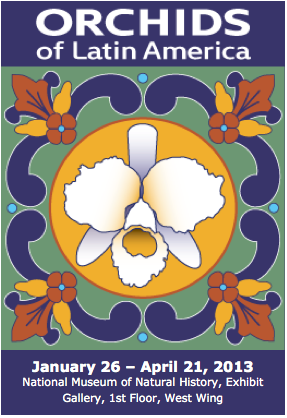
Happening NOW! Latin American Orchid Exhibition

View Full Size Image
Click here for Full Event Details

Did you know that orchids are the national flower of Belize, Brazil, Colombia, Costa Rica, Guatemala, Honduras, and Venezuela? Or that an estimated 25,000 species live in almost every type of environment and continent except Antarctica? The Orchidiceae is one of the most iconic, beloved, and studied flower families in the world, particularly in Latin America where many species of orchid are found in large numbers and are entwined in local folklore, religious ceremonies, and cultural traditions.

To celebrate this fact, the Smithsonian National Museum of Natural History (NMNH), in collaboration with Smithsonian Gardens and U.S. Botanic Garden, is currently hosting a three-month-long Orchids of Latin America Exhibition that explores the connections between orchid botany, horticulture, and Latin American culture. The exhibition will be open and free to the public until April 21st at the NMNH’s Exhibit Gallery, 1st Floor, West Wing. If you happen to be in DC during this time, this event should not be missed.  It will be an oasis of color and warmth, providing visitors with a much needed respite from the bleak winter weather. Families should make special note to mark their calendars for Saturday, February 23, 2012 and attend !Fiesta de las Or-KID-eas! which will give kids the opportunity to make an orchid garland or pot their own orchid plant, learn to care for it, and even bring it home.


BHL Book of the Week Celebrates Orchids!

To coincide with Orchids of Latin America Exhibition that just opened over the weekend, the Biodiversity Heritage Library wanted to highlight one of the most comprehensive resources on Orchids in its corpus as this week’s book of the week. Orchidologists and orchid enthusiasts alike, will appreciate the breadth of this sixteen volume work as well as the enchanting illustrations that it contains:


Dictionnaire Iconographique des Orchidées by Alfred Cogniaux

Although the BHL has a voluminous selection of some absolutely fabulous orchid books, folios, and journals, the Dictionnaire Iconographique des Orchidées is truly a stand-out resource. Originally, the work was issued in no particular order but, the intent of the author was that subscribers would eventually rearrange the plates and their descriptions by genera and bind the work after all of the parts had been issued. Unfortunately, the work was never completed. However, the copy in the BHL digitized by partner library Missouri Botanical Garden, has indeed been arranged by genera as the Belgian Botanist and author Alfred Cogniaux would have wanted. This arrangement makes the tome very user-friendly and allows readers to easily compare and contrast the many different varieties of orchids. Today, around 25,000 orchid species have been documented and over 70,000 hybrids have been cultivated by horticulturists!  Orchids truly are one of the most beautiful and diverse flower families in the world.

Peruse the BHL’s Orchids of Latin America Flickr Collection

As mentioned earlier, the national flower of many Latin American countries is some variety of orchid. In addition to highlighting our favorite orchid tome, we wanted to bring your attention to a special collection of orchid illustrations that Gilbert Borrego our Flickr guru curated to coincide with the ongoing exhibition happening at the National Museum of Natural History. The “Orchids of Latin America Flickr Collection” brings together some of the most beautiful Latin American orchid illustrations in the BHL — including many of the national flower specimens. As always, these illustrated plates are open, free, and available for download by users everywhere to enjoy!

Columbia’s National Flower – Cattleya trianae, The Christmas Orchid

View Full Size Image

This variety of orchid has been Colombia’s national flower since 1834 and was named after the Colombian naturalist José Jerénimo Triana.

 
Guatemala’s National Flower – Lycaste skinneri,  Monja Blanca (White Nun)
View Full Size Image

The Lycaste skinneri is a hermaphrodite plant capable of producing millions of seeds within a fruit in capsule form. In 1934 the President of Guatemala issued a decree naming the Monja Blanca the official national flower. It was chosen for its exceptional rarity and beauty.

Honduras’ National Flower – Rhyncholaelia digbyana, Digby’s Beaked Laelia

View Full Size Image,

Formerly named Brassavola digbyana, Honduras’ National Flower has been used more in hybridizing than almost any other orchid. It has been known to grow in extreme conditions and can withstand long periods of dryness. Some sightings of this specimen have been seen growing on cacti!

Venezuela’s National Flower – Cattleya mossiae, Mrs. Moss’s Cattleya

View Full Size Image

This kind of orchid is also commonly known as Flor de Mayo (May Flower). It was given the status as Venezuela’s National Flower on 23 May 1951. Venezuela lays claims to eight Cattleya species so becoming its national flower was quite a feat. This flower is most beloved by the Venezuelan people.

All of these orchids and MANY more are available in the BHL Orchid Flickr Collection. Don’t forget to check them out!

We hope you enjoyed this post. Interested in guest-blogging for BHL? We’d love that! Natural history, biodiversity and conservation topics are especially welcomed. Email us your ideas at [email protected].


Orchid Links

BHL Orchid Flickr Collection

BHL Orchid Resource Bibliography

SI Gardens: Orchid Exhibition  

Opulent Orchids: Smithsonian Associates Tour 

Facebook Event Details: !Fiesta de las Or-KID-eas!

EOL: The Smithsonian Orchid Collection Watchlist

Highlights of Orchid History,  by R. Rigby

January 31, 2013by BeccaQ_92
BHL News, Blog Reel

Natural Histories: Exploring Rare Books and Scientific Illustration

View Full Size Image
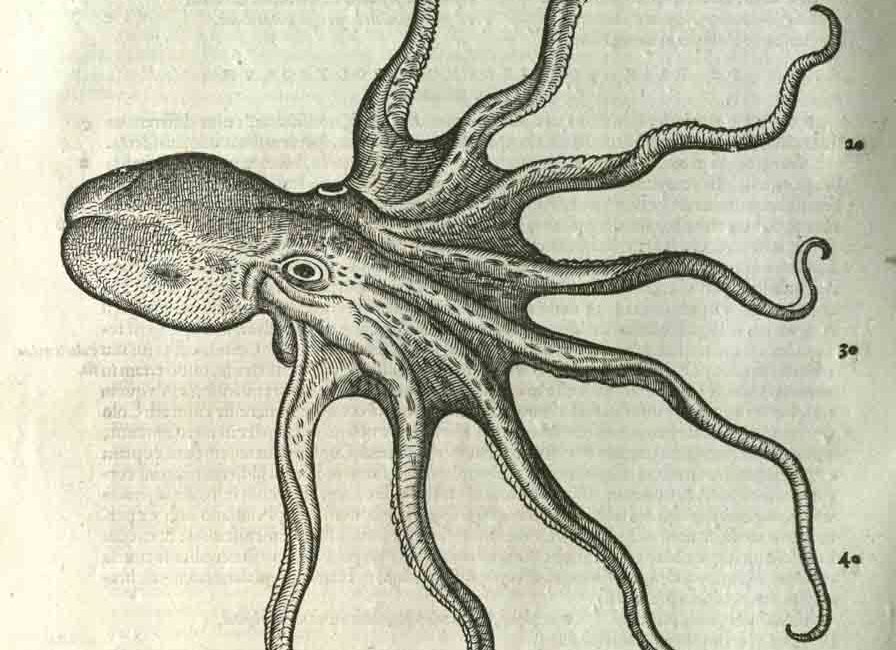
Gessner’s Octopus

Have you ever wanted to browse the stacks of a rare book library? To explore the pages of Gessner’s sixteenth century masterpiece Historiae Animalium and ask an expert why a walrus is illustrated with wing-like appendages? Or study Alexander Wilson’s passenger pigeon illustration and learn from a rare book authority the scientific implications of the depictions of now-extinct species?

Of course, you can examine the digital surrogates of many incredible rare books on BHL, but where can you go to get expert knowledge of the importance of these titles, or even understand what these authors of long-ago wrote in the first place if you can’t read Latin?

The American Museum of Natural History can help you get answers to some of your burning rare book questions. A new book, Natural Histories: Extraordinary Rare Book Selections from the American Museum of Natural History, provides insight into a selection of spectacularly illustrated volumes from the AMNH’s rare book library. The work, edited by Tom Baione, the Harold Boeschenstein Director of Library Services at AMNH and BHL Institutional Council member, features 40 essays from museum curators, scientists, librarians, and other experts discussing each rare book’s unique qualities and scientific contributions. Furthermore, Natural Histories includes 40 “suitable-for-framing” prints selected from the illustrations found within the rare tomes discussed.

View Full Size Image
Cover of Natural Histories. Image: “Great Horned Owl” from Alexander Wilson’s American Ornithology.

The books highlighted in Natural Histories span from the 16th century to the early 20thcentury and include such critical works as Gessner’s Historiae Animalium, Robert Hooke’s Micrographia, Alexander Wilson’s American Ornithology, Ernst Haeckel’s Kunstformen der Natur, and John James Audubon’s The viviparous quadrupeds of North America. According to Baione,

Natural Histories came about because we wanted to let people know about our rich rare book collection, which contains more than 14,000 volumes and is used by researchers from around the world and includes many unique and hard-to-find volumes.

View Full Size Image
Microscopic view of snow and frozen water. Micrographia.

Natural Historiesfocuses in particular on the importance of the scientific illustrations found within each rare book discussed. As Baione articulates,

In the days before photography and printing, original art was the only way to capture the likeness of organisms, people, and places, and therefore was the only way to share this information with others. Printed reproductions of natural history art enabled many who’d never seen an elephant, for instance, to try to begin to understand what an elephant looked like and how its unusual features might function…I hope this collection of essays and plates will give readers a better understanding of the science behind these works and an appreciation of the art illuminating their pages.
The best part is, you can own your own copy of Natural Histories today. Dazzle your friends with the knowledge you’ll glean from the book’s essays and spruce up your décor by framing the 40 extraordinary prints included within it! Once you get your copy, read it with the Internet at your fingertips, so that you can not only learn about these books, but also explore many of them page-by-digital-page in BHL.  It’s the next-best thing to viewing the works in person.
Learn more about Natural Histories in an interview with the book’s editor, Tom Baione, below. And, if you find yourself at the American Museum of Natural History this summer, be sure to check out the Natural Histories exhibit, which will open in June.
January 29, 2013by Grace Costantino
Blog Reel, Featured Books

Wallace, Darwin, and Evolution: The Real Story

Book of the Week: The Malay Archipelago, by Alfred Russel Wallace

View Full Size Image
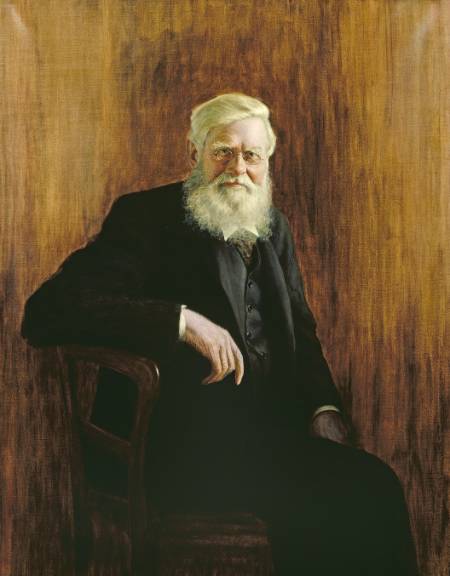
Portrait of Wallace at NHM. Restored to celebrate Wallace100.

In 1858, Journal and Proceedings of the Linnean Society: Zoology published a paper proposing what would later be recognized as a revolutionary scientific concept: the theory of Evolution by means of Natural Selection. If we were to ask you who penned this publication, chances are your response would be Charles Darwin.

You would, however, only be half right.

While it is true that this 1858 publication represented 20 years of Darwin’s contemplation and conclusions on the process of natural selection (which culminated in the monumental work On the Origin of Species published just one year later in 1859), the Linnean Society piece was actually co-authored by Alfred Russel Wallace, who independently conceived of the theory of natural selection.

While Wallace, an avid explorer, collector, and natural historian, had long been seeking the cause of speciation during his 14 years of exploration in South America, Malaysia and Indonesia, it was in the midst of a fever in 1858, during his expedition to the Malay Archipelago, that inspiration struck: in the form of the theory of natural selection. Wallace expanded on this idea in a detailed article which he subsequently sent to Charles Darwin for review, unaware that Darwin himself had come to the same conclusion, though had yet to publish his theory.

At the suggestion of Darwin’s friends Charles Lyell and Joseph Hooker, Wallace’s article, together with unpublished writing by Darwin on the subject of natural selection and evolution, were presented to the Linnean Society in 1858 and subsequently published in the Society’s journal as “On the Tendency of Species to Form Varieties; and On the Perpetuation of Varieties and Species by Natural Means of Selection.”

2013 marks the 100th anniversary of Wallace’s death (in November, 1913). The Natural History Museum, London, has organized Wallace100, with a year’s worth of events and writings on the life and legacy of this great man.  This week, we explore the significant contribution Wallace made to natural history, with particular attention to Wallace’s account of his Malay expedition – the adventure that triggered a fever that fanned the flames of genius.

Great Things from Small Beginnings

View Full Size Image
Illustration from A narrative of travels on the Amazon and Rio Negro, Wallace’s account of his expedition to South America.

Alfred Russel Wallace was born in 1823 in Usk, England, the seventh of nine children. While in his twenties, Wallace took a job as a schoolteacher in Leicester, during which time he met and befriended Henry Bates, a promising young entomologist. The two were invigorated by Darwin’s account of his voyage on the Beagle, and in 1848 set out on an expedition of their own to South America. The duo hoped to determine the mechanism driving the transmutation of species, the precursor to the theory of Natural Selection.

Over the four years of this exploration, Wallace gathered thousands of specimens, largely insects. The untimely death of his younger brother, however, who had traveled to South America to join the expedition, prompted Wallace, together with his entire collection of specimens and notebooks, to return to England. It was a fateful voyage. The ship caught fire and sank, along with most of Wallace’s collections and notebooks.

Undaunted, Wallace used the insurance money he collected from his specimens to organize a new expedition to the Malay Archipelago (today Malaysia and Indonesia). Wallace departed from England in 1854 to embark on his eight year journey through the exotic East Indies.

The Malay Archipelago and the Fever that Changed Science

View Full Size Image
Birds of Paradise from Malay Archipelago

Over the course of the Malay Expedition, Wallace gathered 125,660 specimens, more than a thousand of which were new to science. Six years after returning from the expedition, Wallace began writing an account of his adventure, which was published in 1869 in the two-volume masterpiece, The Malay Archipelago. The work, which provided readers (scientists and laymen alike) a rare window into the exotic depths of the “wild East,” became one of the most popular books on scientific exploration in the 1800s. Wallace dedicated the work, which has never been out of print, to Charles Darwin, “not only as a token of personal esteem and friendship but also to express…deep admiration for his genius and his works.”

The work was particularly note-worthy for its descriptions of birds of paradise, orang-utans, and native peoples. During the course of the expedition, Wallace obtained the distinction of being the first European to study apes in the wild. He shot and skinned several for the British Museum, and even raised an orphan orang-utan in his field camp. Apparently, his interaction with the orang-utans was particularly troubling to the natives, who viewed them as the “men of the woods.” Alarmed by Wallace’s collection of the apes, they feared that they, too, would be shot and skinned.

Despite this tension, Wallace made a point of understanding local customs and respecting the native people’s beliefs. Before the expedition, Wallace learned Malay and other tribal languages, expressing an interest in the “manners, customs, and modes of thought of people so far removed from European races and European civilization.” His work constituted pioneering efforts in ethnology and linguistics.

View Full Size Image
Long-armed Chafer Beetle from The Malay Archipelago. View the images from The Malay Archipelago in the BHL Flickr.

The expedition was a critical period for Wallace’s conceptualization of natural selection. Taking his first step towards the realization of this theory, Wallace published “On the Law which has Regulated the Introduction of New Species” in 1855, in which he hypothesized about when and where species originate. In what would later become known as the Sarawak Law, he observed that “every species has come into existence coincident both in space and time with a pre-existing, closely-allied species,” which “clearly pointed to some kind of evolution.” The “how” was still a mystery.

In the midst of a fever in 1858, the mystery was solved. While contemplating Malthus’ “Essay on Population,” which described how factors such as disease, accidents, and war keep human population in check, Wallace conceived of the idea of survival of the fittest, leading him to the conclusion that “in every generation the inferior would inevitably be killed off and the superior would remain.” Bingo. Natural Selection. It was this epiphany that Wallace communicated to Darwin via letter. This letter, together with some of Darwin’s unpublished works on the subject, was presented to the Linnean Society in 1858.

The Truth Behind Evolution

View Full Size Image
“Ejecting an Intruder” from The Malay Archipelago

Darwin and Wallace’s co-attributed theory of evolution by means of Natural Selection published in 1858, and a year later, prompted by Wallace’s letter, Darwin published On the Origin of Species. Throughout his lifetime, Wallace expressed only extreme gratitude at being given recognition for the theory along with Darwin. When Wallace sent his letter to Darwin in 1858, he did so without expectation of publication, and indeed, Darwin approved of the publication without consent from Wallace, as the delay in sending and receiving postage from the Malay Archipelago was considerable. When informed of the publication, Wallace wrote that he “happily and graciously approved.” According to Wallace biographer Richard Milner, Wallace “maintained that even if his only contribution was getting Darwin to write his book, he would be content.”

During the time of Darwin, Wallace was widely-acknowledged as the co-discoverer of the evolutionary theory. Today, most do not even know Wallace’s name, let alone associate him with Evolution. Why is this? According to George Beccaloni, public favor in the early twentieth century holds the key. In the late 1800s and early 1900s, natural selection as a theory became unpopular as other theories like neo-Lamarckism, orthogenesis, and the mutation theory took root. The generation of scientists that understood natural selection and recognized Wallace and Darwin died out. In the 1930s and 40s, natural selection again gained favor as a new generation of scientists rediscovered On the Origin of Species. Embracing natural selection through that avenue, the name of Wallace faded from scientific recognition.

Remembering Wallace

View Full Size Image
Darwin-Wallace Medal

Today, we recognize the contribution Wallace made to science, evolution, and natural selection. Wallace was awarded a multitude of medals, including the Darwin-Wallace and Linnean Gold Medals of the Linnean Society of London, the Copley, Darwin and Royal Medals of the Royal Society, and the Order of Merit. As we remember the 100th anniversary of Wallace’s death this year, let us remember that the great advances in science are often the work of many more men and women that are given general acclaim for the accomplishment.

Here’s to you, Alfred Russel Wallace. We have not forgotten you.

Links of Interest

  • See Darwin’s annotated copy of our Book of the Week, The Malay Archipelago, contributed by the Natural History Museum, London.
  • See Alfred Russel Wallace’s publications in BHL.
  • Wallace100: Explore 100 years of Alfred Russel Wallace on the Natural History Museum website.
  • View the images from this week’s book of the week, The Malay Archipelago, in Flickr.
  • Learn more about Alfred Russel Wallace in Richard Milner’s biography.
  • Debunk Wallace Myths and Misconceptions.

We hope you enjoyed this post. Interested in guest-blogging for BHL? We’d love that! Natural history, biodiversity and conservation topics are especially welcomed. Email us your ideas at [email protected].

January 24, 2013by michelle.underhill
BHL News, Blog Reel

BHL at ALA Midwinter 2013!

Every year, approximately 10,000 librarians gather together in one place to network, learn about emerging library trends and technological developments, and share their knowledge and expertise with colleagues. They call it ALA Midwinter (ALA = American Library Association), and this year it’s in Seattle, Washington, January 25-29, 2013.

View Full Size Image
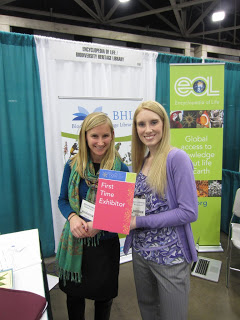
BHL & EOL staff at ALA Midwinter 2012

Last year, we took advantage of this opportunity to showcase BHL to over 6,000 attendees and nearly 4,000 exhibitors at ALA Midwinter 2012 in Dallas, TX. Along with our friends at the Encyclopedia of Life (EOL), BHL staff co-hosted a booth during the four days of exhibits. We not only engaged in meaningful conversations, answered a multitude of questions about the projects, and highlighted our beautiful Flickr images, but we also gave away great goodies, including brochures, pens, notepads, Post-It notes, bags, cups, and, of course, candy.

The enthusiasm displayed by booth visitors prompted us to repeat the experience at this year’s midwinter meeting. This time, we’re bringing along our friends from the Smithsonian’s Field Book Project.

The Field Book Project aims to “create one online location for scholars and others to visit when searching for field books and other field research materials.” To do this, the project is building the Field Book Registry, which will serve as a single access point for field book content both at the Smithsonian and throughout the country. Currently, the project is focused on identifying, locating, and cataloging the field books at the Smithsonian. Recently, the Field Book Project released 6,679 detailed catalog records describing field books from over 542 Smithsonian collections. The project has also received funds to conserve and digitize a portion of these field books.

View Full Size Image
The BHL and Field Book Project booth, #307, at ALA Midwinter 2013

5:30pm, Friday, January 25, 2013, marks the opening reception of the ALA Midwinter Exhibits, which remain open until 3pm, Monday, January 28, 2013 (see full exhibits schedule here). You can find BHL and the Field Book Project at booth 307 (see booth location on exhibit floor plan, above). BHL Collections Coordinator Bianca Crowley and BHL Program Manager Grace Costantino, along with Project Manager for the Field Book Project, Carolyn Sheffield, will be on site for the duration of the conference. We’ll be live demoing our website, showcasing our fabulous Flickr site, and handing out some great swag, including stickers, buttons, pens, brochures, business cards, and more. Plus, we’ll be holdings raffles for even more snazzy things, including matted prints of BHL images and greeting cards featuring some of our favorite illustrations in the collection. And lest we forget, there will be candy!

Guest appearances from other BHL staff, including the Program’s Director, Martin Kalfatovic, and Executive Chair, Nancy Gwinn, are also expected, so be sure to check back regularly for your chance to meet our celebrities in person!

We hope to see you at ALA Midwinter 2013, starting next week. We’re eager to spread the word about the important work we do to help improve the efficiency of scientific research around the globe and ensure that the published record of biodiversity knowledge is freely available to everyone, everywhere.

  • What? BHL and Field Book Project booth at ALA Midwinter 2013, Seattle, WA, Jan. 25-29, 2013 (For more information on the booth, click here and search under “B” for Biodiversity Heritage Library/Field Book Project)
  • Where? Exhibit Hall = 4th Floor Halls, Booth #307
  • When? Booth will be open from 5:30pm, Friday, Jan. 25 – 3:00pm, Monday, Jan. 28 (see exhibit site for more details on hours)
  • Why? Learn all about BHL and the Smithsonian’s Field Book Project with your chance to ask questions of staff, engage in lively conversations, and view live demos of the sites and affiliated content. Plus, we’ll be handing out great free stuff! Don’t miss it!
January 18, 2013by Grace Costantino
Blog Reel, Featured Books

Albertus Seba’s Cabinet of Wonder and Awe

View Full Size Image
Dutch Apothecary Albertus Seba and his famous natural history collection

Contrary to what one might think, a curiosity cabinet is not a piece of furniture, rather it is an entire room(s) dedicated to the collection of objects that are meant to bring shock, awe, inspiration, and stimulating conversation to its viewers. During the 16th-19th centuries, the curiosity cabinet became a popular way for aristocrats and aspiring bourgeoisie to show off personal wealth and erudition. These “rooms of wonder” are considered the precursors to the modern museum. However, unlike a museum collection that is organized around a specific theme e.g. archaeology, art, natural history, and sculpture, a cabinet of curiosities celebrates its own bedlam, juxtaposing disparate objects in a jumbled mass to prompt serendipitous discoveries, new connections, and eureka! moments about the manifest world.

By the 18th century, order began to coalesce out of chaos and curiosity cabinets became a bit more focused. Such was the case with a famed apothecary from Amsterdam, Albertus Seba, and his cabinet of natural history curiosities. Today, we will examine what exactly was in Seba’s celebrated collection and see if we can still find hints of the fabulous, wondrous, exotic, and down-right strange. And how are we able to peer into this almost 300 year old room of wonder that is no longer in existence? Seba was thoughtful enough to record his collected specimens in this week’s Book of the Week: Locupletissimi rerum naturalium thesauri accurata descriptio, et iconibus artificiosissimis expressio, per universam physices historiam : opus, cui, in hoc rerum genere, nullum par exstitit.

Accurate Description of the Richest Natural Treasures

Did you know that a copy of Seba’s Thesauri was sold in 2000 at a Christie’s auction for $442,500 US dollars? The pricey memento of a time past, published between 1734 and 1765, can now be enjoyed for by you on the BHL for free. It is composed of four volumes and 446 plates: 175 of which are double-page spreads. Seba commissioned 13 artists to draw every single specimen that he owned. Plate tinting was done at the buyer’s expense therefore most of the existing copies of Seba’s Thesauri are only found in black and white. For bibliophiles interested in scientific illustration, the BHL happily provides three copies of Seba’s work in both black and white and in color> Compare a butterfly from the three copies in the BHL:

View Full Size Image
Museums Victoria
View Full Size Image
Smithsonian
View Full Size Image
MOBOT

Which is the prettiest? Which one provides you with the most information about the butterfly?

While the color copies are naturally prettier, it is widely known by the research community that black and white illustrations are better scientific resources because of their ability to convey details, texture and dimension in a way that color cannot. We’re just so glad to have access to all three. Let us all thank the Museums Victoria, the Smithsonian Libraries and the Missouri Botanical Garden for contributing their copies of this magnificent work.

At the time, the boundary between art and science had not yet been drawn. Hence, Seba’s snakes slither fancifully across the page and his crustaceans and shells are arranged in pleasing patterns for the sole purpose of delighting the reader:

View Full Size Image
Seba’s Shocking Shells

Seba’s passion for collecting

18th century Amsterdam was the center or European international maritime trade largely due in-part to the Dutch East India Trading Company. There couldn’t have been a better home-base for a man such as Albertus Seba, an apothecary with a penchant for collecting exotic specimens of animals, plants, and minerals to use in his medicinal concoctions. According to accounts, Seba eagerly greeted sailors at the city’s port, especially those who arrived ill and in need of medicine, because it meant he would get first dibs on the newly imported stock. In exchange for his services, medicine, or a bargain price, the apothecary was able to purchase the choicest specimens for his ever-growing natural history collection. Quickly, the collection’s reputation grew and began to be widely used by scholars all over Europe. In 1717, the entire collection was bought by a long-time patron, Czar Peter the Great for 15,000 guilders. Our book of the week actually represents Seba’s second endeavor to amass an even grander collection than the first– and grander it was – with 72 drawers of shells, 32 drawers of 1,000 European insects, and 400 jars of animal specimens preserved in alcohol, many of them containing Seba’s favorite specimen: snakes.

View Full Size Image
Sensational Slithering Snakes

More of Seba’s plates available for free download on Flickr.

5 reasons to explain all the hoarding

Seba like all serious collectors amassed specimens for both practical and more abstract reasons:

View Full Size Image
Peter the Great (by Paul Delaroche)

1. Showing-off: Wealthy friends and respected colleagues came from all over Europe to use Seba’s collection and marvel at his magnificent treasures. The collection was a prestige magnet. As related earlier, Peter the Great was impressed.

2. Investment: Like modern collectors, owning rare and exotic items was viewed as a sound investment: “this mermaid hand will surely go up in value.”

3. Scientific Inquiry:  Apothecaries were some of the most avid collectors in Europe at this time, often experimenting with different natural compounds and searching for new cures and medicines. The work of the apothecary is regarded as the foundation of the modern sciences of pharmacology and chemistry.

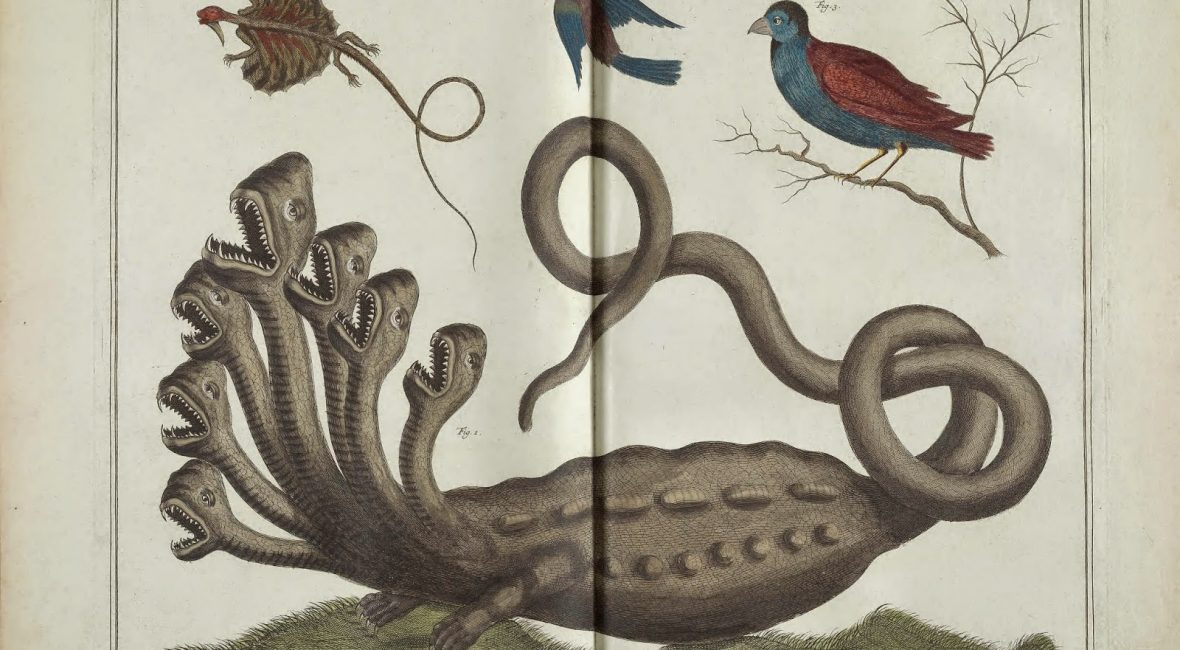
4. Validation of Sensory Experience: Unlike us, Seba didn’t have the convenience of using Google Image Search to validate phenomena occurring in the natural world. To validate the existence of a new organism one needed to see, touch, hold, and experience it — in person. This might explain why it was so difficult at that time to distinguish between the veracity of a seven-headed hydra and a narwhal tusk. Both seem equally fantastic yet, we all know that the hydra is just a myth. Collecting was a way to prove to others that you weren’t crazy or just plain making stuff-up.

View Full Size Image

Seba admits to being doubtful at first of the hydra’s existence, but  later became convinced that the specimen was true to nature based on first-hand accounts.

5. Provide a Microcosm of the Macrocosm: In Historian Michael Wintroub’s excellent paper, Taking Stock at the End of the World, he explains that the curiosity cabinet “contain(s) specimens of every category of things and help(s) to render visible the totality of the universe, which otherwise would remain hidden from human eyes,” he goes on to say that “The wonder cabinet was a response to the apparent disorder of the world; through it the collector sought not only to win prestige, but to piece the variegated and multifarious mosaic of existence into a coherent—microcosmic—whole” (405-407) Talk about a pretty philosophical and deep reason to collect!

Clearly the reasons behind collecting are multifaceted and complex but, bring obvious advantages and joy for the inquisitive.

The fate of the curiosity cabinet

Today, while curiosity cabinets still exist, much of the meaning and purpose behind them is lost. Our view of the natural world is much more complete than ever before and many scholars claim that the Internet is the ultimate ‘Cabinet of Curiosities.’ Old rooms full of weird stuff seem less relevant than ever. However, one might also argue that to digital natives, the analog experience becomes a curiosity in itself which might explain the popularity of aesthetic movements like Steampunk that celebrate anachronistic technology in a futuristic setting —  analog has become the new sexy. Whatever your view, it is important to recognize that the Curiosity Cabinet serves an important role in the history of information, science, and intellectual inquiry. It is the antecedent to the modern museum and digital curation platforms like Tumblr and Pinterest that essentially allow an individual to collect and curate objects based on personal interests. However, the nice thing about these virtual tools is that now we don’t have to stalk sailors with scurvy to add new objects to our collections.

View Full Size Image
Check out the Biodiverisity Heritage Library’s Pinterest Board

Want to enjoy Seba in the comfort of your own home? Now you can. Taschen Books published a reprint of the Thesauri in 2006. You can own Seba’s Thesauri reproduction for a mere 40 dollars. For taxonomists, the very best thing about the 2006 edition is the fact that they have assigned the Linnaean binomials to all of Seba’s specimens. I can assure you that I will be adding the book to my very own cabinet of curiosities — guaranteed to prompt wonder, awe and stimulating conversation whenever things get boring.

View Full Size Image
Ferrante Imperato’s Curisotiy Cabinet depicted in Dell’Historia Naturale(1599),

Read more about this first pictorial representation of a renaissance humanist’s cabinet of curiosities in BHL Blogger and Program Manager, Grace Constantino’s piece: The Good, the Bad, and Pest Control.

We hope you enjoyed this post. Interested in guest-blogging for BHL? We’d love that! Natural history, biodiversity and conservation topics are especially welcomed. Email us your ideas at [email protected].

For the Curious

  • BibliOdyssey: Wondertooneel der Nature (2008)
  • The Guardian UK: A Wonder Room (2011)
  • ‘MOMA’s 2008 exhibition ‘Wunderkammer‘ ‘
  • Sullivan, Andrew When storage was a stage.(2012)
  • Wintroub, Michael. Taking Stock at the End of the World: Rites of Distinction and Practices of Collecting in Early Modern Europe.”
January 17, 2013by [email protected]
BHL News, Blog Reel

BHL staff attend the 6th Annual Global Plant Initiative meeting

Portrait version of the Biodiversity Heritage Library logo.

A number of BHL staff attended the 6th Annual Global Plant Initiative (GPI) meeting (January 7-11, 2013) in Panama City, Panama. Hosted by the Smithsonian’s Tropical Research Institute, the meeting brought together close to 200 participants in the GPI from a truly global contingent of participants.

The GPI is:

an international project focused on digitization of previously unpublished botanical material. This material is made widely accessible for scholarly research purposes through the JSTOR Plant Science online resource.

View Full Size Image

A key component of the GPI is JSTOR Plant Science. This meeting covered a number of topics including the future and sustainability of the GPI, presentations on the World Flora project (by Peter Wyse Jackson, President; and Chuck Miller, Vice-President for Information Technology from the Missouri Botanical Garden), and plant science presentations by Sandy Knapp (Natural History Museum, London), Brent Mishler (University and Jepson Herbaria, UC Berkeley), Luc Willemse (Naturalis Biodiversity Centre, The Netherlands), and Helga Ochoterena (Botany Department, Institute of Biology, Universidad Nacional Autónoma de México).

All of the BHL botanical partner parent institutions were represented (New York Botanical Garden; Royal Botanic Gardens, Kew; the Missouri Botanical Garden, and Harvard Herbarium and Arnold Arboretum.

View Full Size Image

BHL members attending the meeting were: Susan Fraser (New York Botanical Garden and BHL Executive Committee Secretary), Kevin Nolan (New York Botanical Garden), Judy Warnement (Harvard University Herbaria and Botany Libraries), and Chuck Miller (Missouri Botanical Garden). Also at the meeting was BHL Europe member, Heimo Rainer (Museum of Natural History, Vienna).

Look for a re-launch of the GPI/JSTOR Plant Science in April 2013 under the moniker, Global Plants.

More links:

  • JSTOR Plant Science
  • More about the GPI
View Full Size Image
Julie McIntosh Shapiro (HU Herbaria, left) and

Judy Warnement (HU Botany Libraries, right)


January 16, 2013by
Blog Reel, User Stories

BHL Use Case: Facilitating the Study of Mollusca in southern Africa

Portrait version of the Biodiversity Heritage Library logo.

Imagine that you live in a developing country and you’re studying a rare species of Mollusca. You need to verify the identity of a species you uncovered while performing some field work, but to do so you need to view a publication from the 1700s. Unfortunately, you do not have access to a library that holds the volume you need. What is a scientist to do?

Cue the Biodiversity Heritage Library! BHL is helping to improve the efficiency of scientific research around the world, particularly in developing countries, by providing free, global access to natural history literature, much of which can be found in only a few select libraries in the developing world.

Scientists everywhere feel the value of BHL, especially those in developing countries, like BHL user Dr. Dai Herbert, who graciously agreed to take some time out of his busy schedule to tell us how BHL has impacted his research on the Mollusca of southern Africa.

BHL and Our Users: Dr. Dai Herbert

View Full Size Image

What is your title, institutional affiliation, and area of interest? Chief Curator: Mollusca, KwaZulu-Natal Museum, Pietermaritzburg and Honorary Professor, University of KwaZulu-Natal, Pietermaritzburg.

My field of interest is molluscan diversity and biogeography in southern Africa, with an emphasis on taxonomy and systematics. In work of this nature it is essential that one is fastidious and painstaking about accuracy. Consequently one often needs to go back to original sources to check information and these can sometimes be old and rare literature resources.

How long have you been in your field of study? Heavens, it’s a long time now – over 30 years.

When did you first discover BHL? I can’t remember exactly when I first came across BHL, but I have been making progressively more and more use of it over the last five years.

What is your opinion of BHL and how has it impacted your research? BHL is a tremendous and extremely valuable resource. As I mentioned previously, I frequently need to refer to the older literature, but before the advent of the internet and the BHL, this was usually a very frustrating task because much of the relevant material was not available in South Africa. This represented a considerable stumbling block and hindrance. The BHL has greatly alleviated this problem. Far more often than not, I am able to find what I need on the BHL. This resource has done an enormous amount to enhance the capacity of developing countries to undertake taxonomic research on their biota. I am extremely grateful to those who set up and manage this resource. Keep up the good work!

How often do you use BHL? This is variable and depends upon how much time I have for research (i.e. how much nonsense the bureaucrats and administrators thrust my way), but hardly a week goes by when I don’t use it. When fully engaged in a project, I might use it almost daily.

How do you usually use BHL (read the titles online/download whole PDFs/Select Pages to Download for a custom PDF/etc.)? Normally I search for the reference or journal by title, download the pdf and print the section that I need to refer to. I guess I’m still a little old fashioned in that I like to have a hard copy of original descriptions and I then scribble my own notes on these and store them for reference.

What are your favorite features/services on BHL? The advanced search facility and the pdf download option.

If you could change one thing about BHL, what would it be, or what developmental aspect would you like the BHL team to focus on next? BHL works well – the big issue is to get as much of the older literature scanned as possible.

If you had to choose one title/item in BHL that has most impacted your research, or one item that you prefer above any other in BHL, what would it be and why? This is impossible for me to say. I use many titles of considerable importance to my research.

Learn more about Dr. Herbert on the KwaZulu-Natal Museum website.

Interested in sharing how the BHL has helped facilitate your research? We would love to hear from you! Send us an email to [email protected]. With continuous input from our users, we can ensure that our development priorities continue to transform BHL into a tool that best meets the needs of our user community!

January 15, 2013by michelle.underhill
Page 1 of 212»

Help Support BHL

BHL's existence depends on the financial support of its patrons. Help us keep this free resource alive!

search

About BHL

The Biodiversity Heritage Library (BHL) is the world’s largest open access digital library for biodiversity literature and archives. BHL operates as a worldwide consortium of natural history, botanical, research, and national libraries working together to digitize the natural history literature held in their collections and make it freely available for open access as part of a global “biodiversity community.”

Join Our Mailing List

Sign up to receive the latest news, content highlights, and promotions.

Subscribe Now

Subscribe to Blog via Email

Enter your email address to subscribe to this blog and receive notifications of new posts by email.

Join 319 other subscribers

Subscribe to Blog Via RSS

Subscribe to the blog RSS feed to stay up-to-date on all the latest BHL posts.

Access RSS Feed

Inspiring Discovery through Free Access to Biodiversity Knowledge.

The Biodiversity Heritage Library makes it easier than ever for you to access the information you need to study and explore life on Earth…for free, anytime, anywhere.


64+ Million Pages of
Biodiversity Literature Online.

EXPLORE

Tools and Services
to Transform Research.

EXPLORE

300,000+
Illustrations on Flickr.

EXPLORE

ABOUT | HARMFUL CONTENT | PRIVACY | SITE MAP | TERMS OF USE