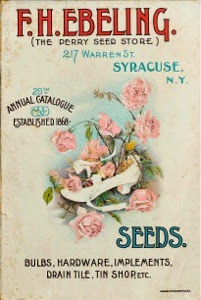
Since the mid-19th century, seed and nursery catalogs have reflected the agricultural and horticultural landscape of the United States. These catalogs—which began as guides to medicinal herbs, and are still printed today—often contain lists of plant varieties and gardening advice. While seed catalogs are used primarily by commercial growers and home gardeners, they also represent an invaluable resource to historians, artists, and researchers of all kinds.
So, what exactly do seed and nursery catalogs tell us?
History
Seed catalogs offer a fascinating glimpse into the cultural, economic, and political history of the era in which they were published. For instance, when the outbreak of World War I halted agricultural exports from Europe to the US, American citizens planted their own “
war gardens” to ease the strain on the food supply; seed catalogs of the time leveraged the economic climate to aid the war effort and increase their own sales. In 1918, Allen’s Book of Berries—a seed catalog specializing in strawberries—prefaced its
annual publication with this admonition:
“Of one thing we are sure. We must not slacken our efforts to produce just as much as we can, for reasons of patriotism as well as of profit. Fruit is not a luxury; it is a necessity. As such, we should make that supply plentiful.”
Technology
In addition to offering varieties of seeds for sale, seed and nursery catalogs often included advertisements for the latest tools and gadgets. This technology reflected the materials available at the time as well as the gradual trend toward large-scale commercial growing and away from single-household plots. The
hand-held implements of the mid-19
th century catalogs gave way to the combine-like machinery of the 20
th century.
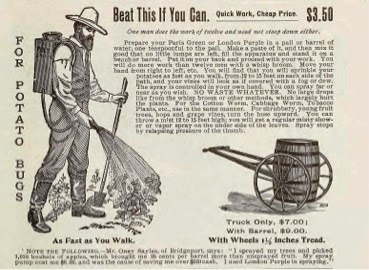 |
| A new type of sprayer to combat potato bugs, featured in F.H. Ebeling’s 1899 Catalogue |
|
Seed catalogs themselves started to change, incorporating black-and-white photography alongside traditional, brightly-colored illustrations. The widespread availability of color film in the 1940s changed the look of catalogs yet again.
Food
As the genetic landscape of our food continues to change, many people look to historical seed catalogs to understand what previous generations were eating, and what it means for GMOs and current agricultural practices. Seed catalogs are a treasure trove of information about heirloom vegetable varieties and organic gardening. As technology continues to evolve however, they face an uncertain future: does the Internet make printed seed catalogs obsolete?
The Future
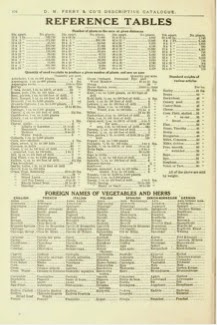 |
| An example of material that computers have a hard time transcribing |
Whether the Internet means the end of printed catalogs or not, it provides some new and exciting IMLS-funded Purposeful Gaming Project. Because they are printed in unconventional formats, with many tables and abbreviations, seed catalogs make poor candidates for Optical Character Recognition (OCR) technology. This means that in order to make them searchable in BHL, individuals must transcribe their contents by hand.
opportunities to use them as part of the
The Missouri Botanical Garden, the New York Botanical Garden, and Cornell University are providing their seed catalogs to game developer
Tiltfactor, which is working on a video game to help users compare and correct these difficult transcriptions. Once corrections are made, they will be incorporated into the BHL collection.
Stay tuned for how you can help transcribe seed and nursery catalogs, and look for Tiltfactor’s new game after the holidays! If you’re eager to start transcribing now, check out the diaries and journals of ornithologist William Brewster. And don’t forget to browse a century’s worth of horticultural history in the BHL’s Seed and Nursery Catalogs collection.