Biodiversity Heritage Library - Program news and collection highlights from BHL
  • Home
  • News
  • Featured Books
    • All Featured Books
    • Book of the Month Series
    • BHL at 20
  • User Stories
  • Campaigns
    • Fossil Stories
    • Garden Stories
    • Monsters Are Real
    • Page Frights
    • Her Natural History
    • Earth Optimism 2020
  • Tech Blog
  • Visit BHL
Home
News
Featured Books
    All Featured Books
    Book of the Month Series
    BHL at 20
User Stories
Campaigns
    Fossil Stories
    Garden Stories
    Monsters Are Real
    Page Frights
    Her Natural History
    Earth Optimism 2020
Tech Blog
Visit BHL
  • Home
  • News
  • Featured Books
    • All Featured Books
    • Book of the Month Series
    • BHL at 20
  • User Stories
  • Campaigns
    • Fossil Stories
    • Garden Stories
    • Monsters Are Real
    • Page Frights
    • Her Natural History
    • Earth Optimism 2020
  • Tech Blog
  • Visit BHL
Biodiversity Heritage Library - Program news and collection highlights from BHL
Blog Reel

Reflecting back on my incredible summer at Smithsonian Libraries

View Full Size Image

As the weather in Central New York is getting colder, and the winter is inevitably approaching, I can’t help but recall the humid summer of Washington, DC. Over the summer of 2016, I interned at Smithsonian Libraries. As a summer intern, I worked at the Department of Digital Programs and Initiatives on the “Cataloging across collections” project. The project was focused on metadata and cataloging. During my internship I worked on digital curation of the records in Biodiversity Heritage Library as well as cataloging field notes for the Field Book Project. Both aspects of my internship were coordinated by mentors assigned by the Smithsonian Libraries – Bianca Crowley, Digital Collections Manager of Biodiversity Heritage Library, and Lesley Parilla, Cataloging Coordinator of the Field Book Project. During my internship I met with Smithsonian Institution staff members, toured different departments, attended the staff picnic, and, most importantly, improved my understanding of the technical services in libraries.

Although working on metadata projects was quite challenging, it helped me to gain confidence as an information professional. As a librarian, I’ve always known that the information organization is important, but I didn’t realize how much properly maintained bibliographic descriptions can improve the user experience. Especially, when the audience can only interact with online assets. Biodiversity Heritage Library is a unique digital collection of the resources in Natural Sciences. My work focused on editing metadata for existing records, which included author merging, editing of volume information, title merging, and linking of the serial records. I received training in 2 internal systems, the Gemini Issue Tracker and BHL Administrative Dashboard to work on these tasks.

On the first week of my internship, I needed to link several volumes together. “Den Norske Nordhavs-expedition, 1876-1878” gives an account of the Norwegian North-Atlantic expedition in the 19th century, commanded by Carl Fredrik Wille, Captain of the Royal Navy. Since I have interest in Scandinavian languages, I enjoyed interacting with this resource. This and many other assignments throughout my internship taught me the importance of metadata standards. Seeing both librarian and user perspectives on the information-retrieval systems became an eye-opening experience for me.


View Full Size Image

“Den Norske Nordhavs-expedition, 1876-1878”, bd. 5, pt. 17 [Alcyonida], tab. I

View Full Size Image
“Den Norske Nordhavs-expedition, 1876-1878”, bd. 5, pt. 17 [Alcyonida], tab.

Further into my internship, I was trained to upload the scanned images into the Internet Archive, the platform that hosts the BHL assets. I used another internal system, Macaw, for this purpose. As I was uploading the new images, I assigned page-level metadata. One of the publications I was working with was Bonn Zoological Bulletin. I had so much fun working on the metadata-level description of William Mann’s scrapbook from his trip to South East Asia for the Field Book Project. One of my favorite serials was Canadian Forest Industries, a magazine that was renamed at least 6 times before its current title. While I was adding volume information and page level metadata, I encountered amazing illustrations and advertisement campaigns from Florists’ Review, that is a wonderful compilation of the marketing tools of the past.


View Full Size Image
Canadian Forest Industries, formerly known as Canadian Lumberman, Jan 1903.


View Full Size Image
Drawing from the Florists’ Review April 1913 v.31 no.797 (801) p.17


View Full Size Image
Front page of from the Florists’ Review December 1922, Christmas edition v. 51 no.1306

In addition to learning many essential skills for technical services in libraries, during my internship I worked with Camtasia software. Screen-casting was used to develop tutorials for BHL Staff about working in the BHL “Admin Dash.” I recorded one video that focused on merging author records together. During the internship I also presented at a Brown Bag presentation in front of Smithsonian Libraries staff, my mentors, and other interns.

I would like to express gratitude to my mentors – Bianca Crowley, Digital Collections Manager at Biodiversity Heritage Library, and Lesley Parilla, Cataloging Coordinator of the Field Book Project, and the entire Department of Digital Programs and Initiatives for their guidance and support. I would also like to thank LIS Program Director at Syracuse University – Jill Hurst-Wahl, and my Academic Advisor – Barbara Stripling, for their invaluable insights on the US library system. My boundless gratitude goes to Cultural Vistas and the Edmund S. Muskie Internship Program that made it possible for me to intern in Washington, D.C. during the summer of 2016. Being a part of the Smithsonian Institution was an unforgettable life experience, which I will proudly carry with me throughout my library career!

December 28, 2016by [email protected]
BHL News, Blog Reel

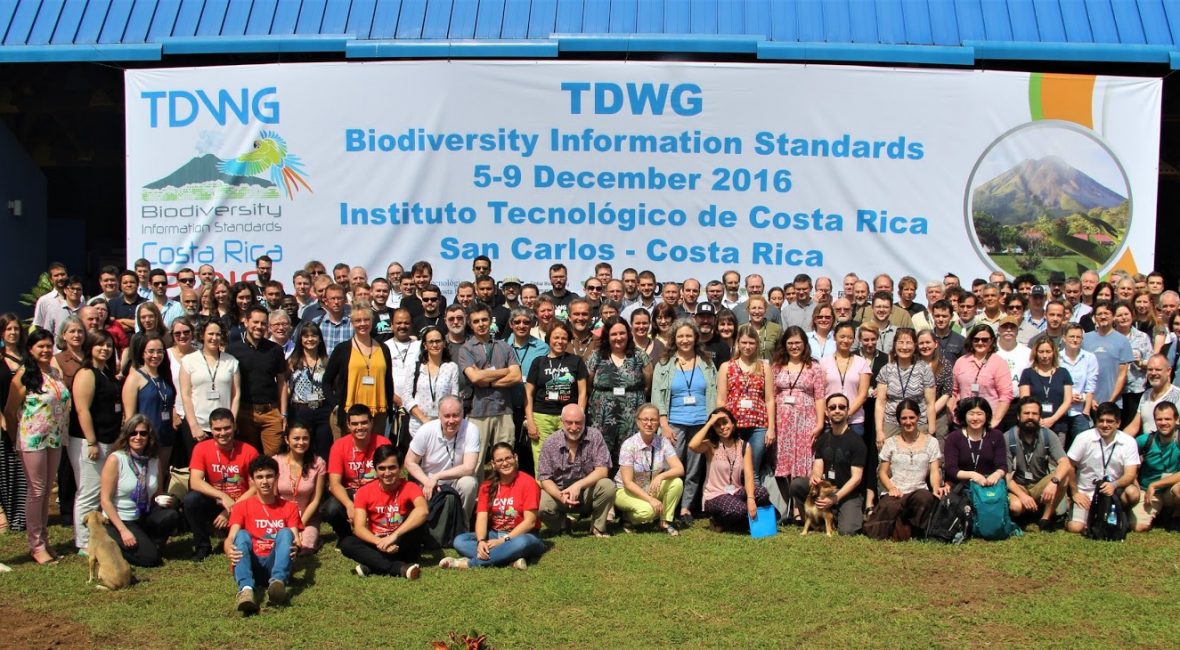
TDWG 2016 meeting, La Fortuna & Alajuela Province, San Carlos, Costa Rica

View Full Size Image
Official Photo by Denisse Vargas

The 2016 TDWG Biodiversity Information Standards meeting was held at the Centro de Transferencia Tecnológica y Educación Continua (CTEC) in San Carlos, Costa Rica. Hotels and other activities were in La Fortuna, about a 45 minute bus ride from CTEC.

BHL was represented at the TDWG 2016 conference with a symposium, “BHL: 10 Years of Innovation and Growth”. The panel consisted of:

View Full Size Image
Constance Rinaldo
  • BHL – 10 Years and More! (Martin R. Kalfatovic)
  • BHL: Grants and Growth (Constance Rinaldo)
  • BHL-SciELO Network (Henrique Rodrigues)
  • Towards extracting occurrence data from biodiversity literature (Dmitry Schigel)
  • Questions: BHL – 10 years of innovation & growth (Discussion led by Constance Rinaldo)

The session was attended by about 70 people. The conclusion of the session was a discussion with the audience about desires for the future direction of BHL and features or services that could be implemented as BHL explores refactoring the BHL platform. Among the topics mentioned by the audience were: integration of visual resources in BHL and expanding in-copyright material.

View Full Size Image
Dimitris Koureas, Cynthia Parr, Erick Mata

The TDWG organizers, led by the program committee – Dr. Erick Mata Montero (Professor, School of Computing, Costa Rica Institute of Technology); Gail Kampmeier (Prairie Research Institute, Illinois Natural History Survey, University of Illinois, USA); Francisco (“Paco”) Pando (Real Jardín Botánico-CSIC, Spain); Maria Mora Instituto (Nacional de Biodiversidad, Costa Rica); Joel Sachs (Agriculture and Agri-Food, Canada); Manuel Vargas (Instituto Nacional de Biodiversidad, Costa Rica); Stan Blum (ex-officio TDWG Coordinator); and William Ulate (ex-officio TDWG Treasurer, Missouri Botanical Garden) – delivered an excellent program.

The keynote, by Dr. Rodrigo Gámez Lobo (founder and former Director General and President of the National Biodiversity Institute) explored the future of Costa Rican biodiversity as exemplified in his work On Biodiversity, People and Utopias (1999). His talk addressed the theme of this work, in which he states, “Our real goal is to make the society come to the understanding that, because of being something that directly affects quality of life, materially, intellectually and spiritually, we must preserve at all costs the rich biodiversity of the country”.

Former BHL Technical Director William Ulate led a symposium on Semantics for Biodiversity Science: Challenges & Solutions. Ulate and co-author Riza Batista-Navarro spoke on “Real use cases for Semantic Information from the Mining Biodiversity project.”

Another important symposium was Semantics for Biodiversity Science: Text Mining & Semantic Role Tagging. Key papers included:

  • Enhancing semantic search through the automatic construction of a Biodiversity Terminological Inventory (Nhung T.H. Nguyen, Georgios Kontonatsios, Axel J. Soto, Riza Batista-Navarro, Sophia Ananiadou)
  • Geographic entities extraction from biological textual sources (Moisés Alberto Acuña-Chaves)

Another symposium of note was Semantics for Biodiversity Science: Taxon Names & Traits. Key papers included:

  • What’s in a name? Sense and reference in digital biodiversity information (Joakim Philipson)
  • Creating computable definitions for clades using the Web Ontology Language (OWL) (Gaurav Vaidya, Hilmar Lapp, Nico Cellinese)
Globally Unique Identifiers for Names (organized by Chuck Miller and Richard Pyle) included papers of interest to BHL:
  • Reviewing data integration and mobilisation using name reconciliation and identifier services (Nicky Nicolson, Robert Turner, Abigail Barker)
  •  Implementing Name Identifiers for the World Flora Online (Chuck Miller)
  • Identifiers for Biodiversity Informatics: The Global Names Approach (Dmitry Y. Mozzherin, Richard Pyle)
  • The Catalogue of Life Editor’s View on Globally Unique Identifiers for Names (Yuri Roskov)
  • Names and identifiers in the CyVerse cyberinfrastucture (Ramona L. Walls)
  • Utilizing Unique Identifiers for Taxonomic Concepts (Jeff Gerbracht)

View Full Size ImageTwo papers of interest in the contributed papers session were  a historical review of TDWG and a paper  describing a new publishing practice that relies on extraction of highly relevant details (species descriptions, for example) from longer publications.

  • TDWG Then and Now (Arturo H. Ariño, Anabel Pérez de Zabalza)
  • Nanopublications for biodiversity: concept, formats and implementation (Lyubomir Penev, Éamonn Ó Tuama, Viktor Senderov, Pavel Stoev, Teodor Georgiev)


View Full Size Image
Volcán Arenal

A highlight of the meeting was the TDWG 2016 Bioblitz at the nearby Texas A&M; Soltis Center. The bioblitz helped to create a biodiversity snapshot of TDWG 2016. Participants were encouraged to take the opportunity to observe and to post their pictures of local biodiversity. The event took place in a torrential rainstorm, but the event still provided some observations and camaraderie.

There were other opportunities to see some of Costa Rica’s amazing biodiversity, among those sighted were:

View Full Size Image
Two-toed Sloth
(Choloepus hoffmanni)

Mammals

  • Three-toed Sloth (Bradypus variegatus)
  • Two-toed Sloth (Choloepus hoffmanni)
  • White-nosed Coati (Nasua narica)
  • Mantled Howler Monkey (Alouatta palliata)
  • Spider Monkey (Ateles geoffroyi)
  • White-throated Capuchin (Cebus capucinus)
  • Long-nosed bat (Rhynchonycteris naso)
View Full Size Image
Yellow-throated Toucan
(Ramphastos ambiguus)

Birds

  • Wood Stork (Mycteria americana)
  • Little Blue Heron (Egretta caerulea)
  • Cattle Egret (Bubulcus ibis)
  • Snowy Egret (Egretta thula)
  • Northern Jacana (Jacana spinosa)
  • Turkey Vulture (Cathartes aura)
  • Groove-billed Ani (Crotophaga sulcirostris)
  • Yellow-throated Toucan (Ramphastos ambiguus)
  • Green Kingfisher (Chloroceryle americana)
  • Anhinga (Anhinga anhinga)
  • White Ibis (Eudocimus albus)
  • Boat-billed Heron (Cochlearius cochlearius)
View Full Size Image
American Crocodile
(Crocodylus acutus)

Reptiles

  • Spectacled Caiman (Caiman crocodilus)
  • American Crocodile (Crocodylus acutus)
  • Emerald Basilisk (Basiliscus plumifrons)
  • Black River Turtle (Rhinoclemmys funerea)
  • Common Snapping Turtle (Chelydra serpentina)
  • Green Iguana (Iguana iguana)


December 26, 2016by joelrichard
Blog Reel, Featured Books

Michał Piotr Boym’s Flora sinensis, fructus floresque humillime [Flora of China, fruits and flowers].

View Full Size Image
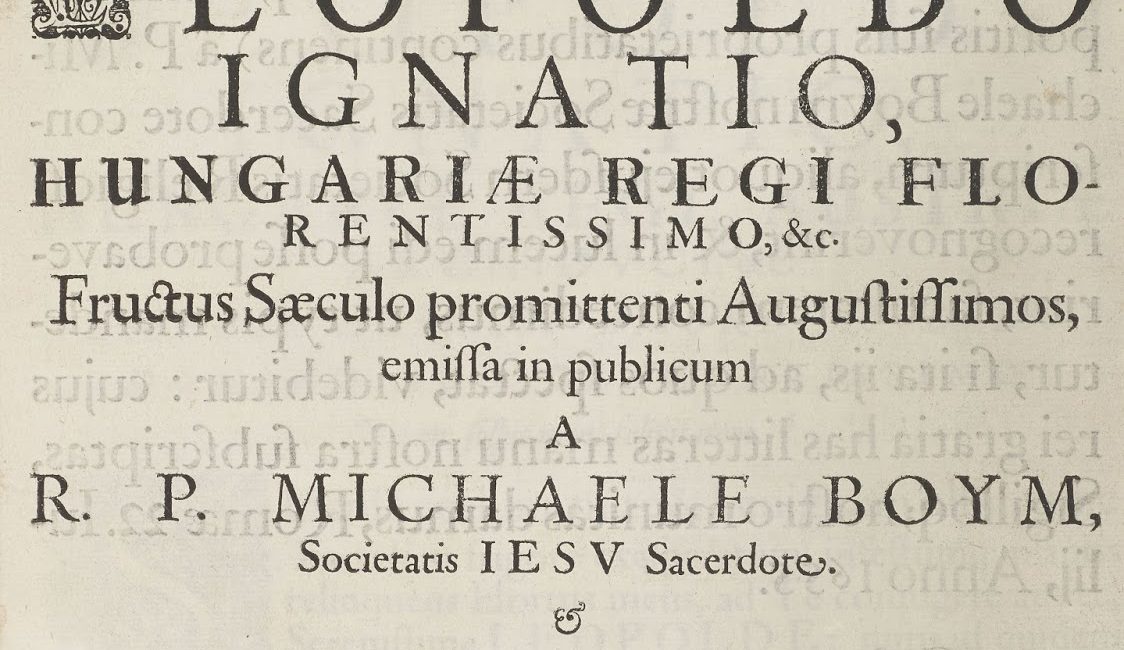
Fig. 1. Title Page. Boym, Michał Piotr. Flora sinensis. 1656. Digitized by Royal Botanic Gardens Kew, Library, Art & Archives. http://www.biodiversitylibrary.org/page/52239363.

Flora sinensis is one of the first natural history books on China by a European. Authored by Michał Piotr Boym, it was published in 1656 by Matthæi Rictii in Vienna. Boym dedicated it to Leopold I (1640-1705), Holy Roman Emperor, King of Hungary and Croatia, King of Bohemia and King of Serbia, and included a poem incorporating chronograms alluding to his coronation date, 1655.

View Full Size Image
Fig. 2 Ananas (pineapple). Boym, Michał Piotr. Flora sinensis. 1656. Digitized by Royal Botanic Gardens Kew, Library, Art & Archives. http://www.biodiversitylibrary.org/page/52239334.

Augustin Pyramus, a Swiss Botanist, identified Boym as the first person to use ‘flora’ to define the plants of a particular region, habitat or geological period. Despite the title, it contains some animals, as well as a selection of choice plants, some of which are non-Chinese natives introduced from the Americas in the previous century, including guava (Psidium), papaya (Carica) and pineapple (Ananas) (fig. 2). Others, including cinnamon (Cinnamomum) (fig. 9), ginger (Zingiber) (fig. 3) and pepper (Piper), were important commodities of the spice trade.

View Full Size Image
Fig. 3. Zingiber (ginger). Boym, Michał Piotr. Flora sinensis. 1656. Digitized by Royal Botanic Gardens Kew, Library, Art & Archives. http://www.biodiversitylibrary.org/page/52239318.

Flora sinensis contains 48 pages of text and 23 black and white woodcut illustrations, 17 of plants, five of animals and one of a Nestorian Stele. Boym describes each species, its physical characteristics, common names, geographical distribution and medicinal virtues. The plates have titles in Chinese, transliterated into Latin, and in the Kew Gardens copy most of the Latin plant names have also been added to genus level.

Whilst the book was originally published uncoloured, some rare hand-coloured copies exist, notably at the Natural History Museum in London, Université de Namur, and SLUB Dresden.

View Full Size Image
Fig. 4. Flora sinensis 1696, French edition title page. Digitized by Boston Public Library. http://www.biodiversitylibrary.org/page/25193368.

In 1664, Melchisédech Thévenot published a 15 page French translation, Flora Sinensis, ou traité des fleurs, des fruits, des plantes et des animaux particuliers à la Chine In: Relations de divers voyages curieux : qui n’ont point esté publiées, est qu’on a traduit or tiré des originaux des voyageurs françois, espagnols, allemands, portugais, anglois, hollandois, persans, arabes & autres orientaux, the 1696 edition of which is available on BHL.

View Full Size Image
Fig. 5. Chinese leopard missing from the 1664 French edition. Boym, Michał Piotr. Flora sinensis. 1656. Digitized by Royal Botanic Gardens Kew, Library, Art & Archives. http://www.biodiversitylibrary.org/page/52239371.

Unfortunately the illustrations in this edition appear to be composites derived from the originals and some, notably the Chinese leopard (fig. 5), are not included. Flora sinensis was also the source for much of the natural history content of Athanasius Kircher’s China illustrata (1667).

View Full Size Image
Fig. 6. Composite plate of Cinnamomum, Musa (bananas) and an un-named plant. Flora sinensis, 1696 French edition. Digitized by Boston Public Library. http://www.biodiversitylibrary.org/page/25193501.

Michał Piotr Boym was born the son of a wealthy merchant in Lwów, Poland in 1612. He joined the Jesuits in 1629 and was ordained in 1641. He sailed from Lisbon in 1643, reaching Macao, via Madeira, the Cape Verde Islands, Mozambique, the Bay of Bengal, Siam, and Goa, in 1647.

View Full Size Image
Fig. 7. Avis regia, Rhabarbarum (possibly rhubarb) and Gallina sylvestris. Flora sinensis, 1696 French edition. Digitized by Boston Public Library. http://www.biodiversitylibrary.org/page/25193697.

It was probably in Mozambique that he observed the hippopotamus, illustrated in Flora Sinensis (fig. 8), and wrote an account of the natural history of Mozambique, one of the oldest works on Africa in Polish (Cafraria: a P.M. Boym Polono Missa Mozambique 1644 Januario 11).

View Full Size Image
Fig. 8. Hippopotamus from the original 1656 edition. Boym, Michał Piotr. Flora sinensis. 1656. Digitized by Royal Botanic Gardens Kew, Library, Art & Archives. http://biodiversitylibrary.org/page/52239327.

Boym taught and studied Chinese in Macao and started to write on medicine, natural history and Chinese society after he moved to Hainan. It was there that he founded a mission, but had to flee to Tonkin when the Manchus invaded the island. He was then sent on a diplomatic mission to the court of the last Ming dynasty ruler, the Emperor Yongli, in Guangxi.

In 1650, Boym left Zhaoqing carrying letters from the court to Pope Innocent X, requesting support against the Manchus. He arrived in Venice in 1652, where he began work on various publications, including Flora sinensis and Fondo Borgia Cinese 531. (The latter unpublished collection of 18 maps is still in the Vatican Library, and includes the first European map to include Korea as a peninsula, not an island. It also features Chinese topography and Chinese and transliterated place names). He finally reached Rome in 1653, but it was not until 1655 that he was granted an audience with Pope Alexander VII.

In 1656, Boym set out again from Lisbon to China, but only four of the eight priests accompanying him survived as far as Goa and the news from the Chinese court was ominous. He persevered, arriving in Siam in 1658, but died on 22 June 1659 somewhere in the province of Guangxi before reaching the emperor’s court. He has no known grave.

View Full Size Image
Fig. 9. Cinnamomum (cinnamon) on left. Boym, Michał Piotr. Flora sinensis. 1656. Digitized by Royal Botanic Gardens Kew, Library, Art & Archives. http://www.biodiversitylibrary.org/page/52239309.

One of the plants described by Boym is a favourite Christmas spice. The rich spicy flavour of cinnamon (fig. 9) is a Christmas ingredient in recipes such as cakes, puddings, mince pies, Zimtsterne (Christmas stars), lebkuchen, mulled wine and glühwein. It was also used in medicine and as an ingredient of oils and perfumes.

Early trade in cinnamon to the Roman and Greek empires was controlled by Arab traders, who kept the source secret. It was thought, by both Herodotus and Theophrastus (4th and 5th century BC) to have come from Arabia, and locating the source was an ambition of 15th and 16th century European explorers.

In the 13th and 14th centuries, Venetian traders controlled the cinnamon trade in Europe until the Portuguese broke their monopoly when they arrived in Sri Lanka (then Ceylon) in the early 1500s, when cinnamon was one of the most highly prized and valuable spices in Europe. The Dutch expelled the Portuguese from the island in the mid 17th century, monopolising the trade and maintaining cinnamon’s rarity by refusing to allow commercial farming until the 1770s. The East India Company obtained control in 1796, when the Dutch were ousted, and retained it until 1833, when the cinnamon trade was opened to all.

Cinnamon is the prepared bark of Cinnamomum verum (synonym C. zeylanicum Bl., Laurus cinnamomum) in the family Lauraceae. It is indigenous to Sri Lanka and south India and widely cultivated in Sri Lanka (approximately 80% of total output), Indonesia, Java, Seychelles, Madagascar, South West Indies, Brazil, Martinique, and Jamaica.

Other items written by Boym include:

  • The first Chinese-Latin and Chinese-French dictionaries (1667).
  • Clavis medica ad Chinarum doctrinam de pulsibus. Nuremberg: Wolfgang Moritz Endter, 1686.
  • Specimen Medicinæ Sinicæ sive Opuscula Medica ad Mentem Sinensium Continens. A. Cleyer, ed. Francofvrti: Sumptibus Joannis Petri Zubrodt, 1682.

Bibliography:

  • Lehner, M. & Lehner, G. (2016) M.Boym: Flora Sinesis [online]. Bibliotheca Sinica 2.0. [Accessed 12 December 2016].
  • Davidson, A. (2006). The Oxford companion to food. 2nd ed. Oxford: Oxford University Press, p.186-187.
  • Hart, A. (2015). Michał Piotr Boym: Flora Sinensis In: J. Magee, ed., Rare treasures from the Library of the Natural History Museum. 1st ed. London: NHM, p. 38-45.
  • Jeong, S. (2016). The Silk Road Encyclopedia. Irvine, California: Seoul Selection. [Accessed 12 December 2016].
  • Rema, J. &. (2008). Cinnamon and cassia. In: V. P. Parthasarathy ed., Spice crops, Volume 2, tree spices. New Delhi: Today & Tomorrow’s, p. 29-75.
  • Van Wyk, B. E. (2013). Culinary herbs and spices of the world. Kew: Royal Botanic Gardens, Kew, p. 104.
December 22, 2016by ulib-libraryjobs
BHL News, Blog Reel

Internet Archive Library Leaders Forum 2016

View Full Size Image

At the end of October I attended the Internet Archive Library Leaders Forum 2016. This was the 3rd time I’ve attended this meeting since 2009 and was by far the best one yet! The Forum coincided with IA’s 20th anniversary so there was a big push from IA to showcase their latest and greatest to celebrate their platinum year.

Some of the coolest new features highlighted:

  • The ability to perform a full text search across all books and journal volumes in IA such as this full text search for “darwin.”
  • New keyword search functionality for their Wayback Machine – just look at all these web pages about “biodiversity.”
  • Additionally, Wikimedia Foundation is now using the Wayback Machine to fix over 1 million broken links in English Wikipedia! Plus Mozilla is experimenting with the Wayback Machine to develop a pilot that will eliminate the dreaded 404 pages that pop up when Internet links break. How useful!
  • See more of their newest cool innovations
View Full Size Image
New GifCities searchable gif database
View Full Size Image
New Webverse 3D web visualization tool

The most successful aspect of the Forum was meeting with Internet Archive colleagues and partners face to face, many of which share similar digitization workflow and collection management challenges to BHL. In particular, colleagues from the Getty Research Institute, Georgetown University Law Library and HathiTrust are pursuing projects that could help inform BHL collection development for the future.

View Full Size Image
IA Founder Brewster Kahle delivers presentation

Interestingly, as the meeting attendees imagined the future of libraries over the next 10-20 years, I was pleased to hear that some of the challenges shared by both HathiTrust and IA are issues BHL has already considered and continues to explore as its collection and consortium grows:

  • In what ways can we expand the scope of our content? Should we?
  • What are the best strategies to ensure comprehensiveness of your collection?
  • How can we encourage greater curation of our collection?
  • What emphasis should be placed on the development of tools for de-duplication?

The BEST thing accomplished during the Forum was getting access to IA’s Slack tool and encouraging the formation of BHL’s very own channel. Now when questions and problems arise we have a direct line to some of IA’s key digitization management staff. As Digital Collections Manager for BHL this has already proven to be an extremely useful means to troubleshoot digitization and metadata issues.

Internet Archive staff are a positive group of motivated, creative individuals and it was a pleasure attending this productive meeting. Kudos to Wendy Hanamura for organizing a positive experience!

View Full Size Image
Me and an IA Petabox storage system
-Bianca Crowley, Digital Collections Manager
View Full Size Image
Internet Archive’s official truck
December 21, 2016by [email protected]
BHL News, Blog Reel

Expanding Access Project: The Year in Review

Just past the halfway point of its 2-year IMLS grant period, the Expanding Access to Biodiversity Literature (EABL) project has made significant contributions to BHL’s collections and is well on its way to achieving its stated goals: securing permission for 50 in-copyright titles; adding 100 new contributors; adding 300,000 metadata records; and positioning BHL as an on-ramp for content delivered to the Digital Public Library of America (DPLA).

View Full Size Image
The institutions participating in EABL

Background

EABL was conceived to address some of the persistent challenges facing digital repositories in the U.S. scientific community. How do small organizations get involved when they don’t have much content to contribute? How can the necessary metadata be harvested or created to point to their content? And how can the discoverability of that content be improved?

By reaching out to small natural history organizations outside the BHL consortium, EABL has created a pathway for inclusion in BHL, and, ultimately, the U.S. national digital infrastructure (DPLA). The first step is getting content into BHL.

Process

View Full Size Image
Diagram illustrating the relationship between IA and BHL

When an institution has already digitized its content, EABL Metadata Specialist Mariah Lewis, at the New York Botanical Garden (NYBG), uploads it to Internet Archive (IA). Because BHL strives to create cover-to-cover digital reproductions of the printed item, this sometimes requires stitching together article PDFs prior to upload. It also requires a MARCXML record, which Mariah pulls from an existing catalog record or, in rare cases, creates from scratch. Once in IA, the content is ingested into the BHL EABL collection, where Mariah curates it to ensure that it displays correct enumeration and metadata. Recently, the EABL team worked with BHL to add a “Rights Holder” field, which distinguishes the organization that owns the copyright for a publication from the “Contributor,” or the organizations that provided the physical copy.

For organizations with material that hasn’t yet been digitized, EABL provides funds for shipping and scanning the material at an IA scanning center. In special cases where the material is too fragile or valuable to ship to IA, EABL is working with third-party scanners or training personnel to do their own in-house scanning. Alternatively, EABL secures permission for a title from the rights holder and then a BHL member library pulls a copy from the shelf and scans it.

Material that is uploaded to BHL will eventually appear in DPLA as well. DPLA is currently mapping its fields to BHL to facilitate this content transfer and will have records ready for review early in the new year. When this process is complete, BHL will be an active “content hub,” aggregating content from smaller providers and feeding it to DPLA.

View Full Size Image

For organizations that plan to contribute material to BHL over time, especially those that are interested in becoming BHL Affiliates, Mariah provides training on all aspects of the BHL digitization workflow. She does this in person or virtually, depending on the organization’s needs, and has also created video tutorials of the metadata creation and upload process.

Results

So far, EABL has secured permission for 106 in-copyright titles and added 59 new contributors to BHL. The EABL collection holds 3,428 volumes from 289 titles, containing 377,924 pages. Important titles (some of which have not yet been scanned) include:

  • Zoologica: Scientific Contributions of the New York Zoological Society
  • Roosevelt Wild Life Bulletin and Roosevelt Wild Life Annals
  • Entomologica Americana
  • Wilson Journal of Ornithology
  • Journal of Arachnology
  • North American Birds
  • Kirtlandia
  • Journal of the New York Entomological Society
  • Journal of Raptor Research
  • Memoirs of the Southern California Academy of Sciences
  • Arnoldia
  • The Green Scene
  • Transactions of the Worcester County Horticultural Society
An important part of curating these titles, and one that greatly enhances their discoverability, is article and chapter definition. EABL team members Susan Lynch at NYBG and Trish Rose-Sandler at Missouri Botanical Garden (MOBOT) are working to index journals added to BHL through EABL. This involves collecting available citations from the publisher or from databases like Web of Science so that article titles and authors’ names can be isolated. To date, EABL has indexed 58,801 articles and chapters in BHL. The value of this becomes apparent when browsing long-running publications like Zoologica or Kirtlandia, which are now 100% indexed. (For more information about how to view articles, see last month’s blog post about Kirtlandia).
View Full Size Image
In-copyright titles added by BHL

For more information about EABL, please visit the wiki, where you will find an up-to-date list of digitized titles, a list of presentations given about the project, related blog posts, and the EABL Twitter feed.

Get Involved

EABL will receive new content through the fall of 2017. If you know of a publication or institution that you would like to see represented in BHL and DPLA, please contact EABL Community Manager Patrick Randall at [email protected] or Principal Investigator Susan Fraser at [email protected]. If you would like funding for digitization, please fill out the EABL interest survey.

December 15, 2016by eomeara
Blog Reel, User Stories

Poetic Botany: A Digital Exhibition Celebrating the History of Botany

View Full Size Image
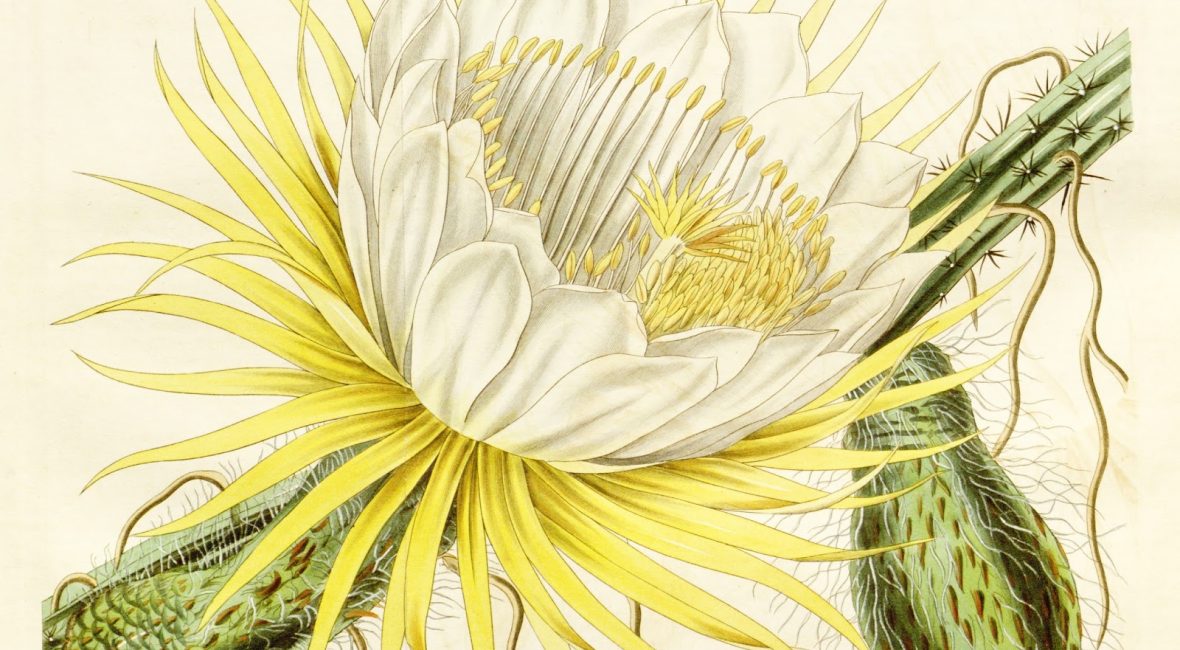
Night-blowing (Blooming) Cereus (Selenicereus grandiflorus). Curtis’s Botanical Magazine. v. 62 (1835). http://www.biodiversitylibrary.org/page/465887. Digitized by the Missouri Botanical Garden, Peter H. Raven Library.

‘Queen of the dark, whose tender glories fade
In the gay radiance of the noon-tide hours.’

‘That flower, supreme in loveliness, and pure
As the pale Cynthia’s beams, through which unveiled
It blooms, as if unwilling to endure
The gaze, by which such beauties are assailed.’

These elegant lines are quoted in Curtis’s Botanical Magazine (v. 62, 1835) as part of the description for the Night-blowing (Blooming) Cereus (Selenicereus grandiflorus) and serve as an artful conveyance of the species’ nocturnal blooming. But these lines represent more than just a whimsical representation of plant behavior. They are a reflection of the eighteenth century Poetic Botany movement that saw botany become the subject of poetry.

The Poetic Botany movement began with Erasmus Darwin, grandfather of Charles Darwin, who, in 1789, published The Loves of the Plants, a poem that in essence was a versification of Linnaean botany, where each plant in the garden is personified as a Greek god or goddess whose characteristics and interactions are meant to elucidate the Linnaean sexual system of plant classification. This highly successful poem was eventually republished along with a second poem by E. Darwin, The Economy of Vegetation, in 1791 as The Botanic Garden, A Poem in Two Parts, thus launching a movement that was proliferated by such authors as Frances Arabella Rowden, Charlotte Smith, and Robert John Thornton.

View Full Size Image
Frontispiece for the Digital Exhibition Poetic Botany: Art and Science of the Eighteenth-Century Vegetable World (2016). Credit: Ryan Feigenbaum.

Selenicereus grandiflorus is one of nine species featured in the online exhibition Poetic Botany. Using these plants as a lens through which to highlight the Poetic Botany movement, the exhibition introduces the botanists and works that constituted this period. These botanists were concerned with not just the art of their verse but also with the scientific study of their plant subjects, and thus the Poetic Botany movement reflects a beautiful union of art and science.

View Full Size Image
Ryan Feigenbaum at the Royal Botanical Gardens in Peradeniya, Sri Lanka. Credit: Madeline Chera, 2016.

The Poetic Botany exhibition was created by Ryan Feigenbaum as part of a 2015-2016 Andrew W. Mellon Fellowship at the Humanities Institute of the LuEsther T. Mertz Library of The New York Botanical Garden. NYBG, a founding BHL Member who has contributed over 3.9 million pages to the BHL collection, hosts the exhibit.

Feigenbaum, who has a BA in philosophy from DePaul University in Chicago, an MA in philosophy from Villanova University, and is currently completing a PhD in philosophy at Villanova University, researches the history and philosophy of biology. As evidenced through Poetic Botany, this research eventually led him down a botanical path.

“My dissertation, ‘The Epistemic Foundations of German Biology, 1790–1802,’ analyzes the emergence of biology as a science by tracing the genealogy of the organism concept,” explains Feigenbaum. “I came to the history of botany as an offshoot of this project; specifically, I was interested in the eighteenth-century opinion of plants, i.e., their ontological status. Whereas plants had long been regarded as devoid of intelligence, sensitivity, and locomotion, naturalists like Erasmus Darwin began to challenge these views, spurred on by the ‘discovery’ of plants like the Drosera and Mimosa pudica that challenged longstanding prejudices.”

Feigenbaum’s interest in the “life sciences” and the history of botany grew naturally out of his research on philosophy, for these two subjects have historically been intimately connected.

“The separation of philosophy and science is a relatively recent phenomenon,” affirms Feigenbaum. “Descartes, for instance, contributed to mathematics and physics beyond his cogito ergo sum, and much of Aristotle’s corpus focuses not on metaphysics or ethics but natural science. In this vein, I’ve been committed to studying not only eighteenth-century philosophy, but also its life science for the past five years or so. I say ‘life science’ because biology did not yet exist; the word ‘biology,’ in fact, was not used in its modern meaning until 1802. The how and why of biology’s emergence at this time is one focus of my dissertation.”

It was this extension into the ‘life sciences’ that eventually brought Feigenbaum to BHL.

“As my study of the history of philosophy incorporated more and more of the study of the history of science, BHL became a resource I relied on time and again,” asserts Feigenbaum. “At first I would search via Google for a particular eighteenth-century text, but I found it so often on BHL that I ended up using its website portal directly, sparing me the trouble of having to sift through Google results.”

BHL played an important role in the development of Poetic Botany, allowing Feigenbaum to discover and access relevant texts, many of which are linked from the exhibit.

“BHL provides smart access to knowledge that wouldn’t be otherwise available,” lauds Feigenbaum. “My favorite feature is the ability search by species. Since the digital exhibition is organized around species, this ability revealed new sources of which I’d been unaware. It is quite amazing that you can instantly see in which texts a species like Canna indica appeared according to date and then be taken to the exact pages of the reference. Without this resource, my workflow would have been much slower; it would’ve required me to visit multiple archives and search through texts one by one. While such an approach isn’t without its benefits, it inevitably limits what the researcher can do and extends the time required to do it.”

View Full Size Image
American bog plants: eastern skunk cabbage (Symplocarpus foetidus), yellow pitcherplant (Sarracenia flava), and Venus flytrap (Dionaea muscipula). Thornton, Robert John. New illustration of the sexual system of Carolus von Linnaeus. (1807) http://biodiversitylibrary.org/page/307056. Digitized by the Missouri Botanical Garden, Peter H. Raven Library.

While there are many texts featured in Poetic Botany, one of Feigenbaum’s favorites is John Thornton’s New Illustration of the Sexual System. According to Feigenbaum,

“This perennial favorite is often acclaimed for its indisputably beautiful illustrations, perhaps some of the most iconic in existence. However, the accompanying text is also marvelous, giving the reader insights into eighteenth-century botany, snippets of poetry, and whole disquisitions on culture, religion, and other topics.”

This title is also consistently a favorite among BHL’s online audiences. Thanks to the citizen science efforts of Michelle Marshall, this entire work has also been taxon tagged in Flickr, making it easy for you to identify and search for the species contained within it.

We encourage you to take some time to explore Poetic Botany and marvel at the elegant and profound union of art and science represented in the exhibit and texts. Who would have thought that poetry and science could fit together so naturally?

______________________________________

This post may contain the personal opinions of BHL users or affiliated staff and does not necessarily represent the official Biodiversity Heritage Library (BHL) position on these matters.

December 8, 2016by michelle.underhill
BHL News, Blog Reel

BHL participates in meetings at the Muséum national d’Histoire naturelle (Paris)

View Full Size Image
From left:
Bruno David, Martin R. Kalfatovic,
Laurence Bénichou, Nancy E. Gwinn, Gildas Illien.
Photo by Jean-Christophe Domenech

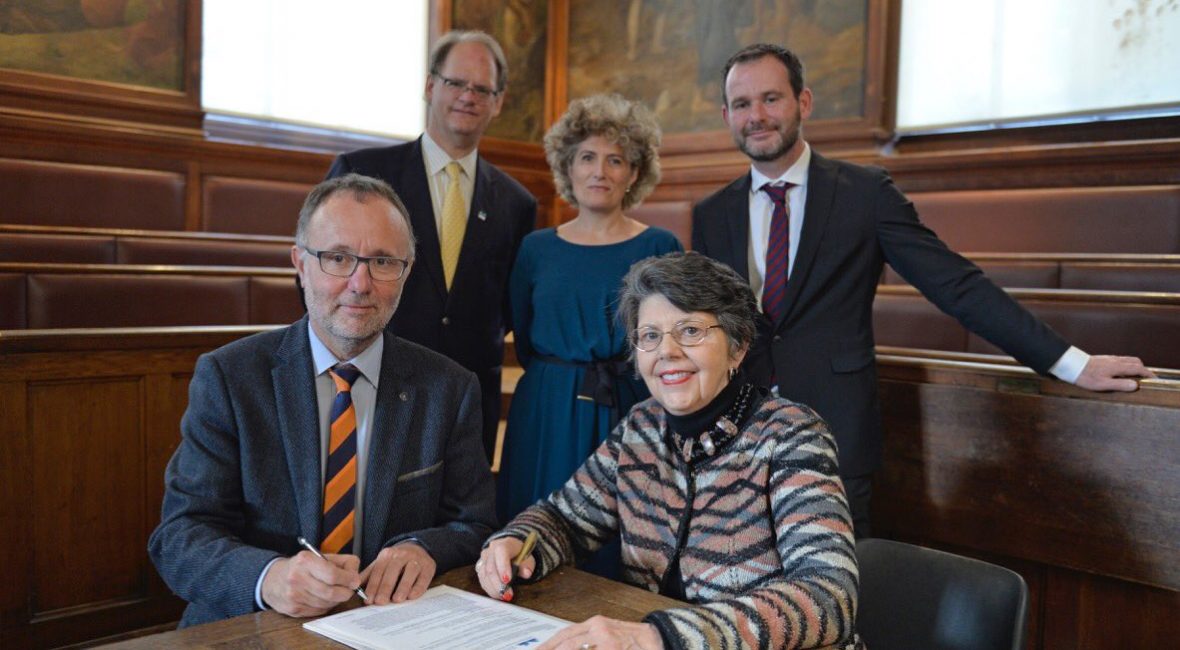
I was honored to participate in the signing ceremony on 2 December 2016 where Muséum national d’Histoire naturelle officially joined the Biodiversity Heritage Library. Accompanying Dr. Nancy E. Gwinn (Smithsonian Libraries Director and Chair of the BHL Members’ Council), the ceremony was held in the amphitheater of the Galeries d’Anatomie comparée et de Paléontologie. Attending on behalf of the MNHN were Dr. Bruno David (Director), Gildas Illien (head of the MNHN library), and Laurence Bénichou (Head, Publications Scientifiques).

View Full Size Image

Immediately before the meeting, I gave a presentation (“Increasing Access, Promoting Progress: Empowering Global Research through the BHL“) on BHL to representatives from a number of large natural history museums from around the world (including BHL partners American Museum of Natural History, The Field Museum of Natural History, Muséum national d’Histoire naturelle, Natural History Museum (London), National Museum of Natural History (Smithsonian Libraries), Natural History Museum Los Angeles County, and Naturalis Biodiversity Center).

View Full Size ImageEarlier, on 30 November, I was treated to a tour of the MNHN library by M. Illien and had the opportunity to meet with key staff (Alice LeMaire, Anaïs Rameaux, Chloé Besombes, and Vincent Detienne) who will be participating in BHL. The following day, I met with Laurence Bénichou and the staff of the Publications Scientifiques. Topics included BHL metadata models and best practices to be reviewed for ingest of MNHN publications into BHL.

View Full Size Image

A tour of the Grand Hall of Evolution and the special exhibition, Espèces d’ours! was also arranged. The Grande Galerie de l’Évolution is an amazing four level exhibition that documents life on our planet. The installation is an outstanding re-envisioning of an older space for the 21st century. Of personal interest was the La salle des espèces menacées et disparues and a nice display of artifacts related to Raphus cucullatus.

On 2 December, before the signing ceremony, the Museum arranged for a tour of the Jardin des Plantes for me and Nancy E. Gwinn. Our host, Fabien Dupuis, Desk Officer from the office of International and European Affairs, provided an excellent tour of the gardens and greenhouses that are under the auspices of the Museum.

View Full Size Image View Full Size Image
Herbarium (left) and Galeries d’Anatomie comparée et de Paléontologie (right)
View Full Size Image
Gwinn (left) and Illien (right)

My special thanks to the staff of the Museum for arranging our visit. Gildas Illien was a superb host who juggled multiple high-profile events during this brief visit. It was a pleasure to meet him in person after many emails and phone calls. All of us at BHL and the Smithsonian look forward to working with him in the years to come. And at last, I was able to meet with Laurence Bénichou in France after seeing her in many other places around the world. Seeing her office, located in the 18th century home of noted naturalist  Georges-Louis Leclerc, Comte de Buffon, made one appreciate the over 200 year history of scientific publishing at the Museum.

And yes, good food was had by all …

View Full Size Image
Raphus cucullatus
December 7, 2016by
Page 1 of 212»

Help Support BHL

BHL's existence depends on the financial support of its patrons. Help us keep this free resource alive!

search

About BHL

The Biodiversity Heritage Library (BHL) is the world’s largest open access digital library for biodiversity literature and archives. BHL operates as a worldwide consortium of natural history, botanical, research, and national libraries working together to digitize the natural history literature held in their collections and make it freely available for open access as part of a global “biodiversity community.”

Join Our Mailing List

Sign up to receive the latest news, content highlights, and promotions.

Subscribe Now

Subscribe to Blog via Email

Enter your email address to subscribe to this blog and receive notifications of new posts by email.

Join 319 other subscribers

Subscribe to Blog Via RSS

Subscribe to the blog RSS feed to stay up-to-date on all the latest BHL posts.

Access RSS Feed

Inspiring Discovery through Free Access to Biodiversity Knowledge.

The Biodiversity Heritage Library makes it easier than ever for you to access the information you need to study and explore life on Earth…for free, anytime, anywhere.


64+ Million Pages of
Biodiversity Literature Online.

EXPLORE

Tools and Services
to Transform Research.

EXPLORE

300,000+
Illustrations on Flickr.

EXPLORE

ABOUT | HARMFUL CONTENT | PRIVACY | SITE MAP | TERMS OF USE