

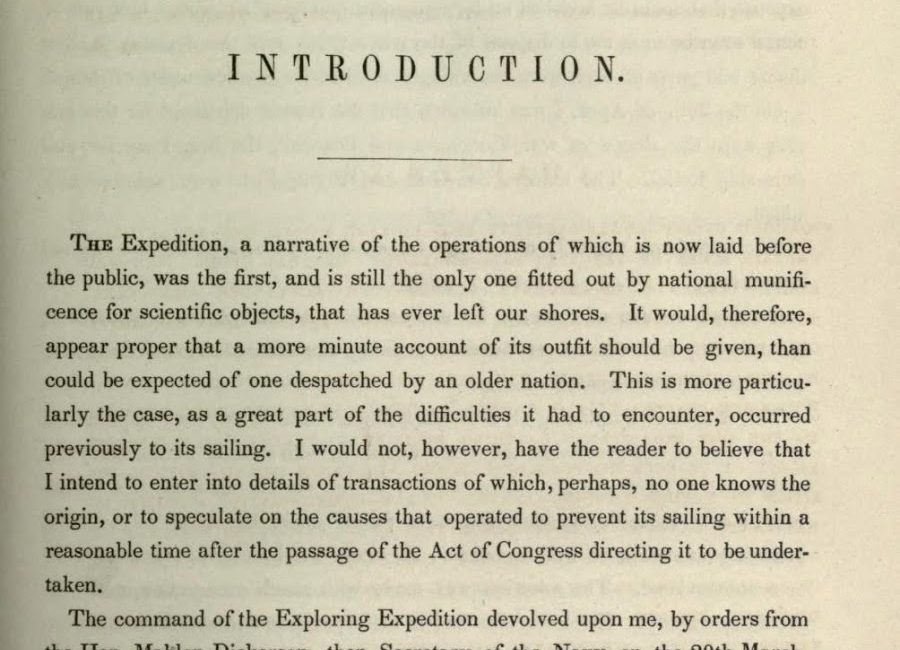
The United States South Seas Exploring Expedition of 1838-1842 was authorized by Congress in 1836 to observe the Pacific Ocean and South Seas. The four-year voyage — also referred to as the Wilkes Expedition or Ex. Ex. for shorthand — covered an expansive geographic region, including the Pacific Northwest, Fiji Islands, and South America. The expedition was under the command of Lieutenant Charles Wilkes of the Unites States Navy, and the resulting collection is thought to be one of the largest early natural history collections, weighing in at an estimated 40 tons. The collection was transferred to the Smithsonian Institution in 1857 and established what would eventually become the National Museum of Natural History. A narrative of the expedition was published in 1844, with a multi-volume publication on the results of the expedition published later.
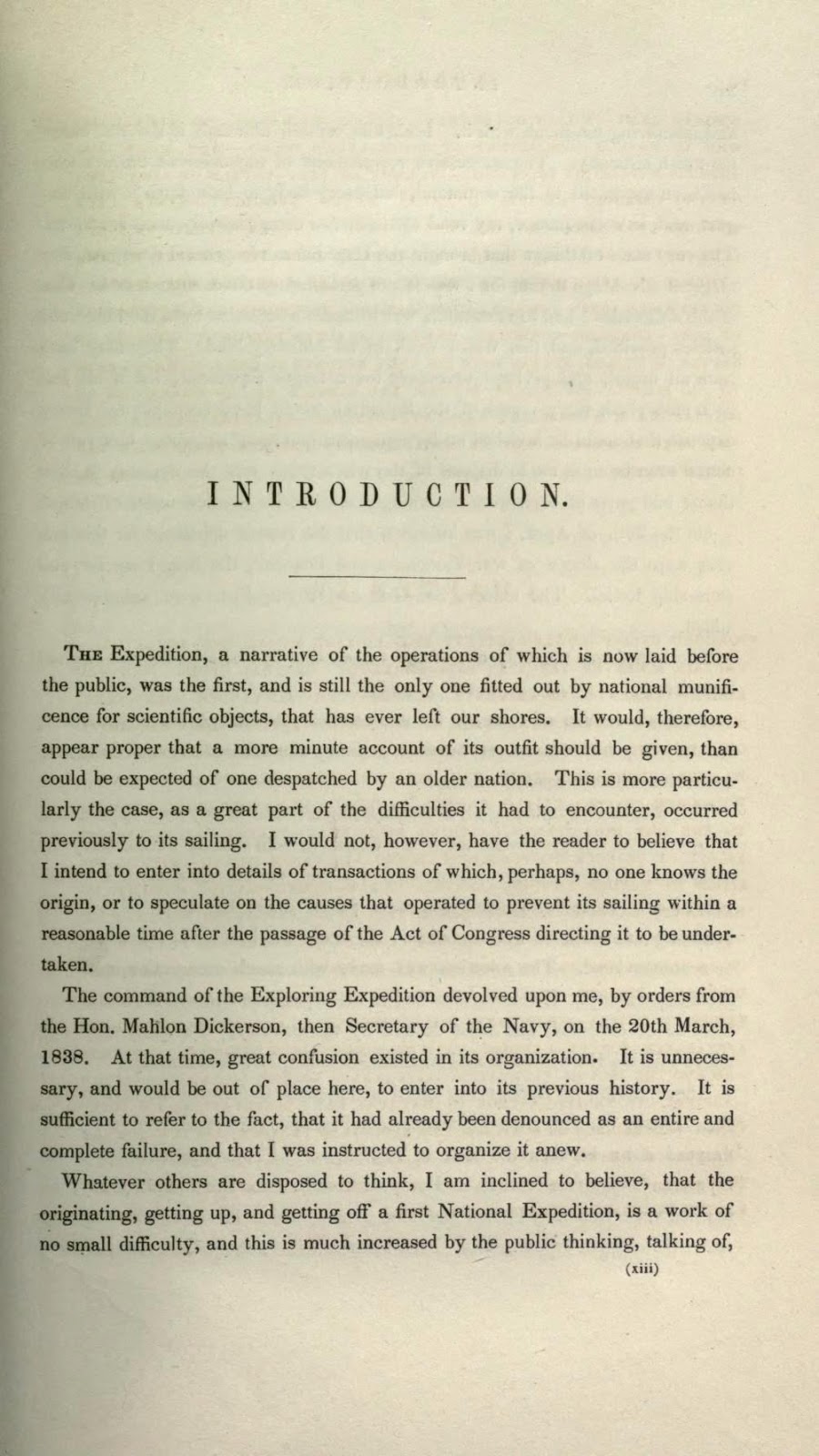 |
| Wilkes, Charles. United States Exploring Expedition. During the year 1838, 1839, 1840, 1841, 1842. Vol. 1 (1845). http://biodiversitylibrary.org/page/21175563. |
As we have mentioned before, it was an interest in identifying the original source material for the Ex. Ex. which really became a major incentive to establish what would become the Smithsonian Field Book Project. Over the course of the project, team members cataloged the Ex. Ex. field books in Smithsonian Institution Archives’ collection. Now as the Smithsonian Field Book Project team participates in the BHL Field Notes Project, this collection of original expedition notes is being digitized and published in BHL, giving researchers a way to view related content in one place.
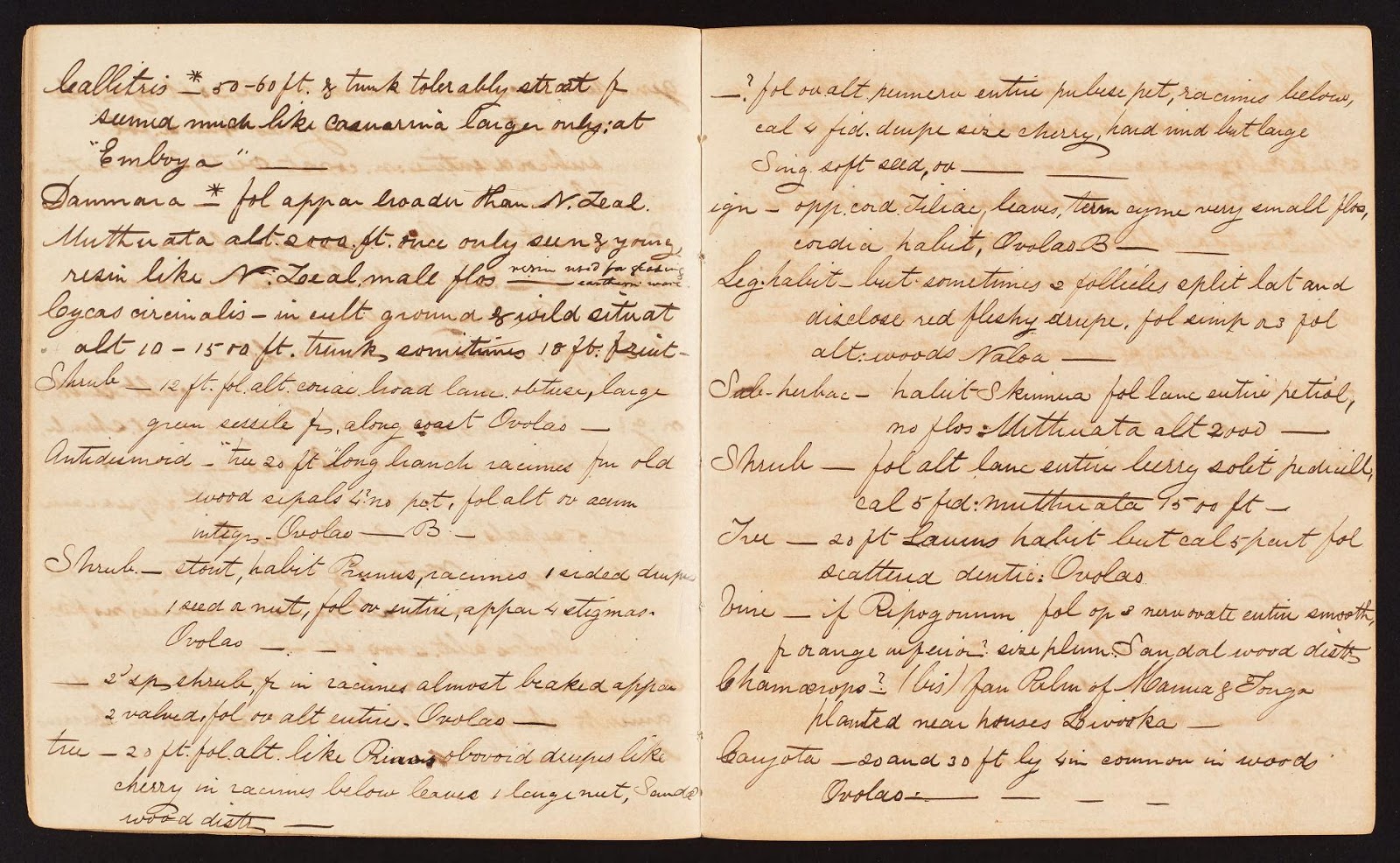 |
| Brackenridge, William D. Original notebooks of the botanist, volumes 13 – 14, Fiji Islands group. (1838-1842) http://biodiversitylibrary.org/page/53612590. |
One of the sets of material SIA has digitized as part of the BHL Field Notes Project are the notebooks of William D. Brackenridge. Brackenridge was a gardener and nurseryman from Scotland who moved to the United States in 1837. Brackenridge became part of the Ex. Ex. as a result of Asa Gray resigning as Botanist of the expedition to take an academic position at the newly established University of Michigan. With Gray’s departure, William Rich was promoted from Assistant Botanist to Botanist, and Brackenridge was brought on to fill the assistantship role.
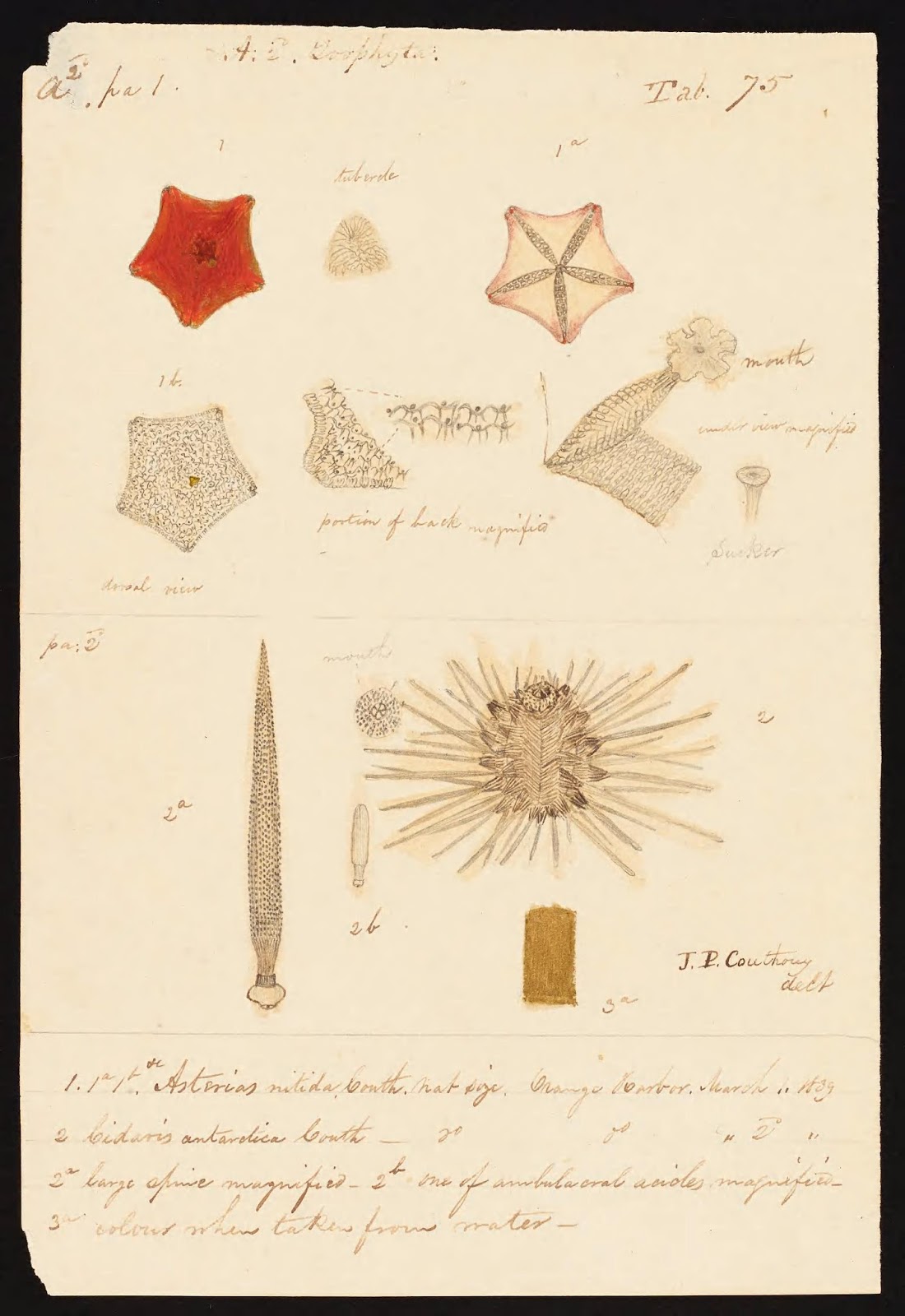 |
| Drayton, Joseph. Botany: Echinoderms, drawings by Joseph Drayton. (1838-1839) http://biodiversitylibrary.org/page/53640152. |
Also part of the expedition team were two illustrators, Joseph Drayton and Alfred T. Agate. As part of the BHL Field Notes Project, we have digitized a set of sea star and other marine drawings by Drayton. The drawings include a signature and date, and often additional notes on the location where the specimen was found. As far as we can tell, these illustrations were not used for reference in the multi-volume Expedition publication, making this set of drawings a particularly good example of how field notes can inform research in conjunction with traditionally published material.
Smithsonian Institution Archives still has several field books from the Ex. Ex. to digitize for the BHL Field Notes Project, so be sure to check back over the next few months to see our whole set.
The BHL Field Notes Project is funded by the Council on Library and Information Resources (CLIR).
Walsh, Dr. Jane. “From the Ends of the Earth: The United States Exploring Expedition Collections”.” The United States Exploring Expedition, 1838-1842, a Smithsonian Libraries Digital Collection.
