Biodiversity Heritage Library - Program news and collection highlights from BHL
  • Home
  • News
  • Featured Books
    • All Featured Books
    • Book of the Month Series
    • BHL at 20
  • User Stories
  • Campaigns
    • Fossil Stories
    • Garden Stories
    • Monsters Are Real
    • Page Frights
    • Her Natural History
    • Earth Optimism 2020
  • Tech Blog
  • Visit BHL
Home
News
Featured Books
    All Featured Books
    Book of the Month Series
    BHL at 20
User Stories
Campaigns
    Fossil Stories
    Garden Stories
    Monsters Are Real
    Page Frights
    Her Natural History
    Earth Optimism 2020
Tech Blog
Visit BHL
  • Home
  • News
  • Featured Books
    • All Featured Books
    • Book of the Month Series
    • BHL at 20
  • User Stories
  • Campaigns
    • Fossil Stories
    • Garden Stories
    • Monsters Are Real
    • Page Frights
    • Her Natural History
    • Earth Optimism 2020
  • Tech Blog
  • Visit BHL
Biodiversity Heritage Library - Program news and collection highlights from BHL
Blog Reel, Featured Books

When Writing in a 15th Century Rare Book is a Good Thing: Exploring the Incredible Marginalia in the Smithsonian’s Naturalis Historia

old book with writing in margins

This post is derived from an article published on the Smithsonian Libraries’ blog. View the original post. 
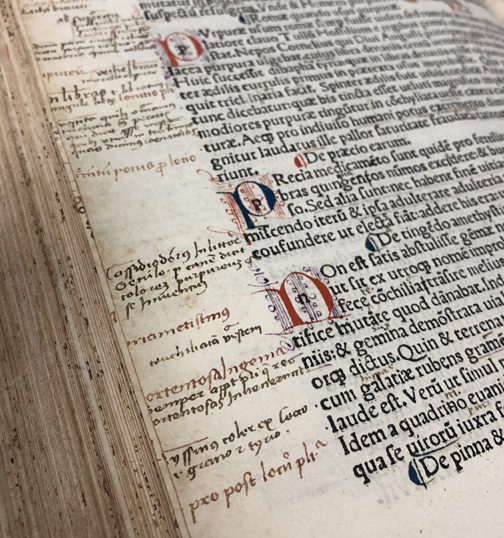
Pliny, the Elder. Naturalis Historia. 1491. Digitized by Smithsonian Libraries. http://s.si.edu/2Ep11Lf.

“Do your reading!” and “Don’t write in your books!” are two oft-echoed directions from schoolteachers. A 1491 edition of Pliny the Elder’s Naturalis Historia, housed in the Smithsonian Libraries’ Joseph F. Cullman 3rd Library of Natural History and recently digitized for the Biodiversity Heritage Library, challenges both of those commands: not only did Pliny write it in such a way that doesn’t necessitate reading it cover to cover, but readers in centuries past have added notes, reactions, and even corrections to every page of the book!

These reader-made notes and symbols are known as marginalia, and in this copy of the Historia, many of them were made in order to make navigating the text as efficient as possible. But the density and the variety of marginalia indicates that at least eight different annotators have added their thoughts to the Cullman’s copy over the course of several centuries, from about 1500-1700.

Unfortunately, due to the loss of evidence resulting from the Historia’s rebinding, the annotators’ identities and relationship to the book remain vague. But understanding—and, in some cases, not understanding—what these annotators were hoping to accomplish in their note-taking offers us some clues to who they were and how they used the book. This, in conjunction with understanding how Pliny intended the Historia to be used, illuminates a period when people didn’t just read books—they interacted with them.
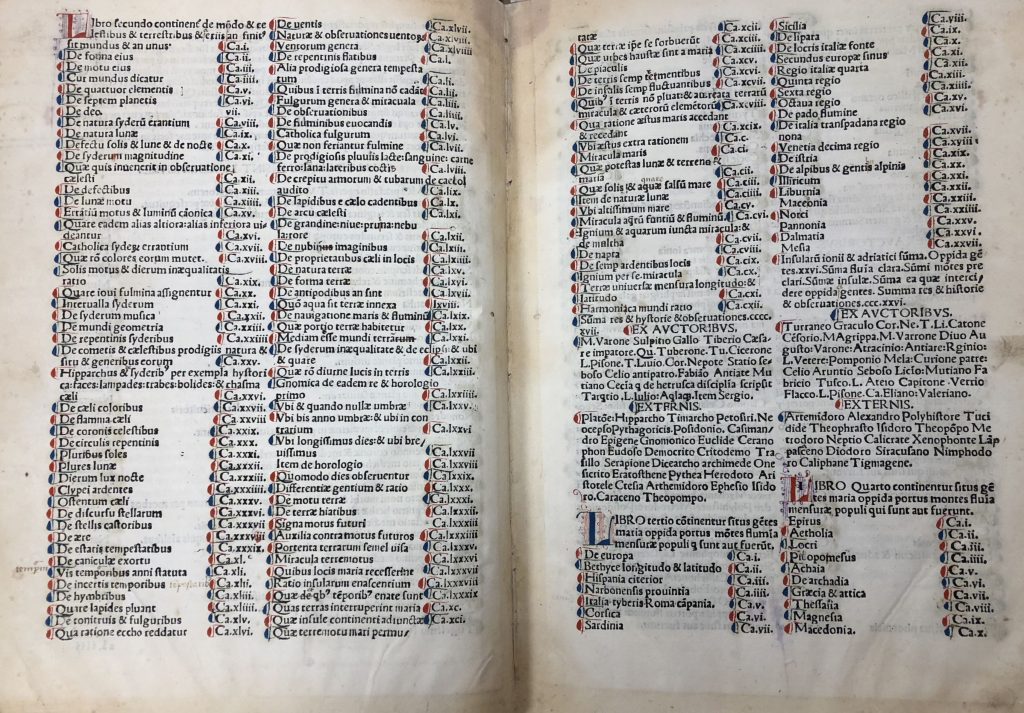
The Summarium. Pliny, the Elder. Naturalis Historia. 1491. Digitized by Smithsonian Libraries. http://s.si.edu/2BXFmw4.

In most ways other than its name, the Historia is the first attempt at creating an encyclopedia in the western world—it aspires to be a comprehensive summary of knowledge about a particular subject (the natural world), organized into easily-navigable headings which are laid out in the summarium (a sort of proto-index) at the beginning of the work. In his dedication to the future Roman emperor Titus, Pliny states that he included the summarium “so you [Titus] don’t have to go to the trouble of reading [all thirty-seven books]. And so you will have provided everyone else with the means not to read it through either, instead everyone will look for the particular thing they want and know where to find it.”[1]

But even with all this thinking ahead, the Historia couldn’t please everyone.
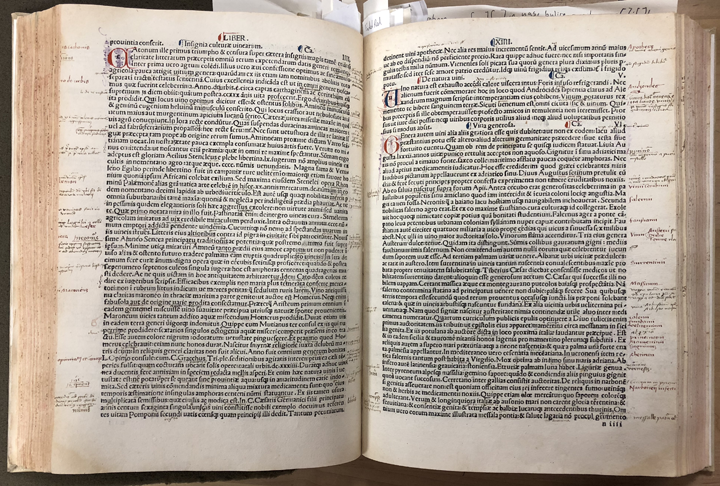
In centuries past, attitudes toward books were quite different, both on the part of the author and the reader. Rather than a disruption of authorial intent, many of these reader additions were seen as part of a collaboration over time, resulting in “the production of the best text.”[2]
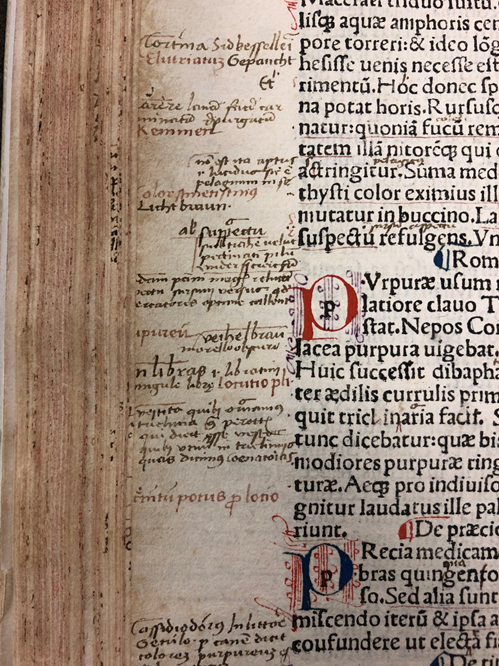
Marginalia madness: in some places, the notes in the margins are incredibly dense.

Each annotator in the Smithsonian’s copy of the Historia seems to have had their own agenda for their note-making, which shows up in the form and content of their marginalia; this, along with their handwriting and the different inks they used, leads me to surmise that there were eight or more of them. Despite the differences in their marginal styles that make them identifiable as discrete individuals, they employ similar methods of note-making and drawing attention to relevant passages. For example, the annotators used underlining and brackets to highlight passages they saw to be important, or that they wished to discuss further in a longer marginal note. Manicules (Latin for “little hands”) and other symbols of a variety of styles pop up throughout the Historia, and are used in almost the same way that readers use sticky flags in their books today.
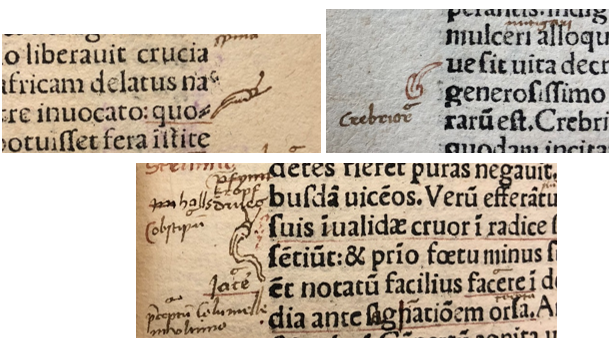
Little hands: manicules pointing out important passages.

The nature and content of the marginal notes, indexes, and glosses are what really establish the different annotators as individuals. Although their identities remain unclear at best, they reveal themselves in what they chose to make note of and how they do it; this information has been used to give them nicknames that, while not terribly creative, serve to trace their actions through the text.
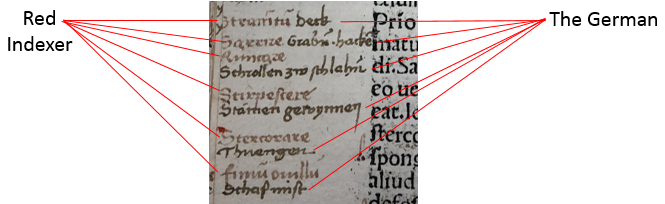
For example, the Red Indexer acts exactly as their nickname implies: they have thoroughly indexed the book, pulling out more granular subject headings that are not mentioned in the chapter titles. Following in the Red Indexer’s footsteps is the German, who glosses many—but not all—of the index words as their German equivalent. Understanding that the German glossed the Red Indexer, rather than vice versa, situates the German after the Red Indexer on a time line.

Two other annotators, Faded Red and Sloppy Hand, act as beginning and end points of this timeline: Faded Red’s notes are situated at the extreme edges of the page and have, in some cases, been trimmed away when the book was rebound, while the style of the Sloppy Hand indicates that the annotator was probably working in the early 18th century.
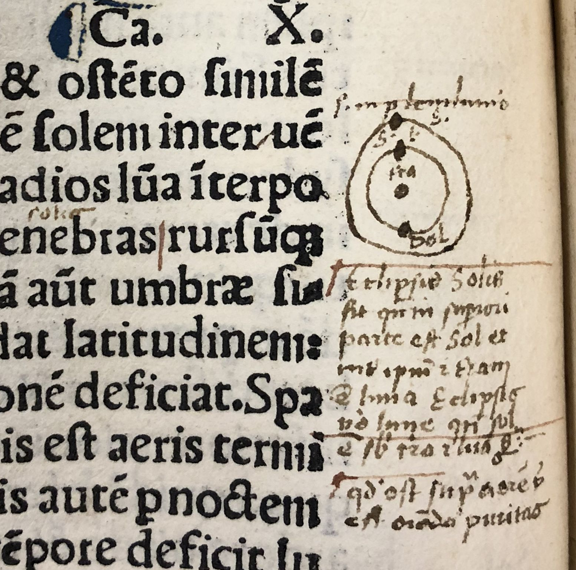
Bracket at work.

Four other annotators occupy the rest of the timeline, but two in particular stand out: Bracket and the Editor. Bracket is responsible for the longest marginal notes, which run the gamut from cross-referencing other works that Pliny has cited, to adding detail about subjects mentioned, and even to drawing diagrams of concepts that Pliny describes. This annotator tends to enclose one side of these notes in a bracket that points back towards the passage being referenced—hence the name. The Editor’s name is self-explanatory too: they have peppered every page of the text with spelling corrections, some of which are so small that they are barely visible.
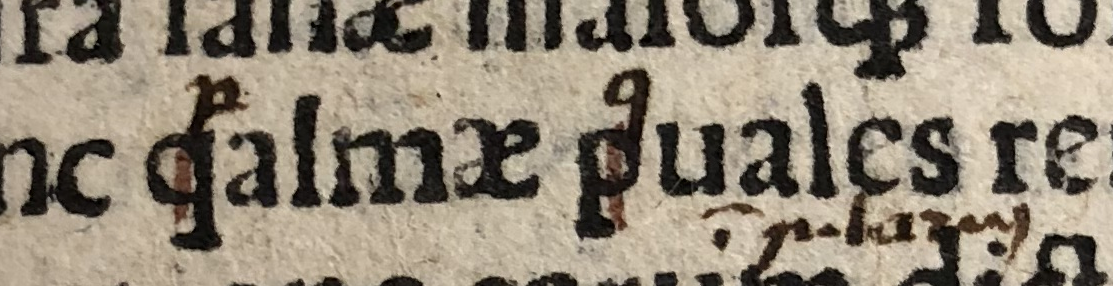
The Editor reminds you to mind your P’s and Q’s.

But what is interesting about these two annotators is not what we understand about them, but what we do not. Bracket is responsible for the most befuddling note in the text: a grim line from Horace’s Epistles, which when translated reads “the unhoped for hour will be a welcome surprise.”
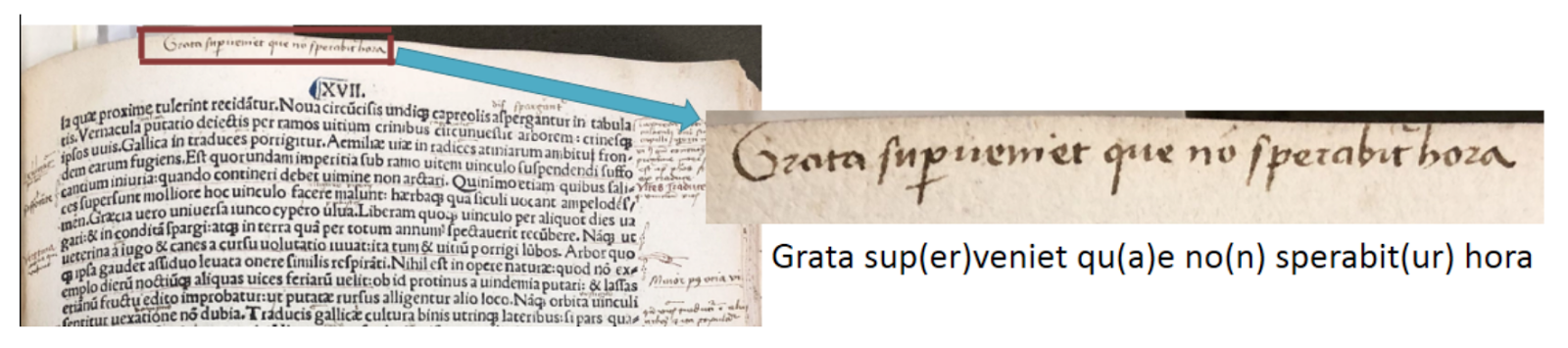
This is in reference to the inevitability and acceptance of death, which is a heavy topic to refer to in the margin of a chapter about caring for grapes and the diseases of trees. Pliny does not even reference Horace in this chapter, which rules out Bracket’s usual practice of cross-referencing sources. Although its purpose remains mysterious, the fact that Bracket included it gives us a glimpse of other works that they may have been reading at the time, which in turn bolsters our understanding of what texts were available to and being used by literate people.

The Editor’s goal, which at first seems relatively clear, is in fact nearly as ambiguous as Bracket’s reference to Horace: what is the point of being so thorough in making corrections to the text, aside from pedantry? The Cullman’s copy of the Historia was clearly not a working copy, which would have been used for editing purposes in the printing process—the fact that the text is embellished with colorful, hand-finished initials indicates that it was in fact a top-of-the-line book, and not something to be corrected and discarded on the print shop floor.
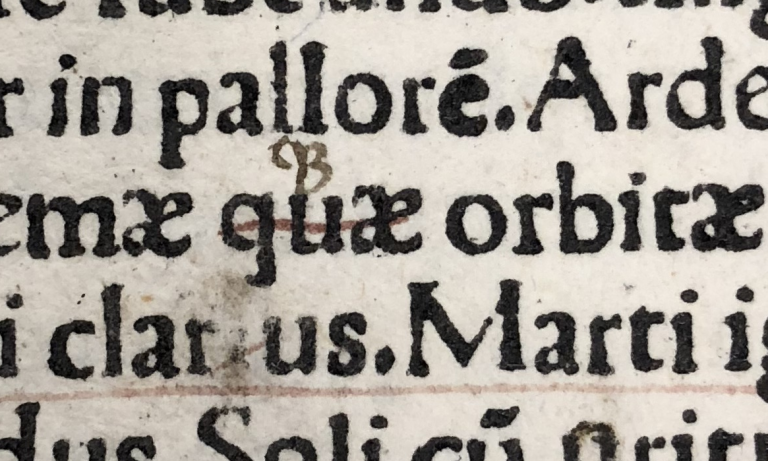
One correction, though, points to preparation rather than pedantry: a simple suggestion of using an abbreviation rather than the full Latin word quae. It is possible that the Editor was using the Cullman’s Historia to prepare a new edition of the work sometime in the 16th or 17th centuries, and the multitudinous corrections represent their efforts to iron out any mistakes made in this 1491 edition. The suggestion of an abbreviation amongst numerous spelling corrections points to a person who is concerned not only with accurate spelling, but with brevity. Comparing the corrections in this copy to later editions may reinforce this theory, although since the Historia has only rarely been out of print since the 15th century, there will be a lot of material to work through.

Unfortunately, we may never be certain of why the Cullman’s Historia was annotated by so many different people. As it has been rebound at least twice, it has lost a great deal of provenance information, such as bookplates, shelfmarks, or ownership inscriptions. This is one of the reasons why historians treasure marginalia: not only does it reflect the knowledge and interests of the readers making it, it adds precious detail to this book’s individual history. And while we might not know the annotators’ names, their marks, notes, and corrections reveal so much more about them as people than a simple ownership inscription would. Continued research will enable this book, and its annotators, to tell even more of its story.

To facilitate ongoing research and provide greater access to this unique work, the Smithsonian Libraries has digitized the Cullman’s copy of the Historia and made it freely available in the Biodiversity Heritage Library. While digitization allows readers everywhere to study the work’s fascinating marginalia, these annotations also presented quite a digitization challenge.

Smithsonian Libraries’ Digital Imaging Technician Daniel Euphrat had to take special care to avoid losing portions of notations that sometimes trailed into the tightly-bound gutters or extreme edges of a page. Since some marginalia had previously been physically trimmed away, likely during rebinding, staff were careful to avoid any further “trimming” through cropping of pages.
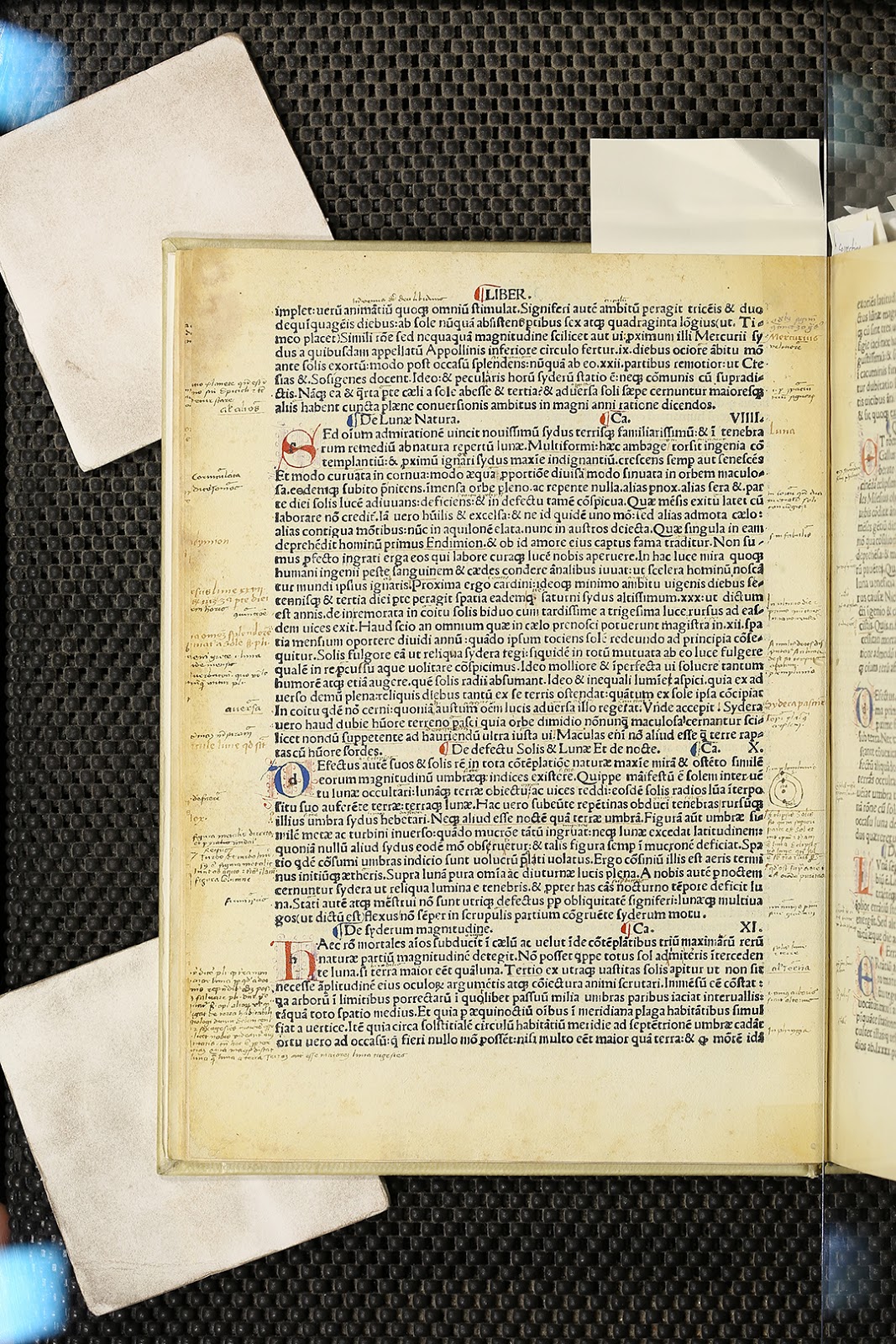
Example of an uncropped image for a page from Naturalis Historia. Notice the marginalia running into the gutter, necessitating careful manual cropping in the post-digitization process to minimize text loss.

During digitization, the book had to be carefully positioned and monitored on a page-by-page basis to make sure that as much text as possible was being captured. Additionally, during the post-digitization process (called “republishing”), the crop-box for each image had to be manually adjusted so that none of the captured text would be accidentally cropped out. Cropping near the gutter was especially difficult because there was very little space between text on the relevant page that needed to be kept in and text from the opposing page that needed to be cropped out for the sake of readability. To fully appreciate the amount of manual processing involved in the post-digitization of this work, take a look at the uncropped image files available on Internet Archive by downloading the “Singe page original jp2 tar” file.
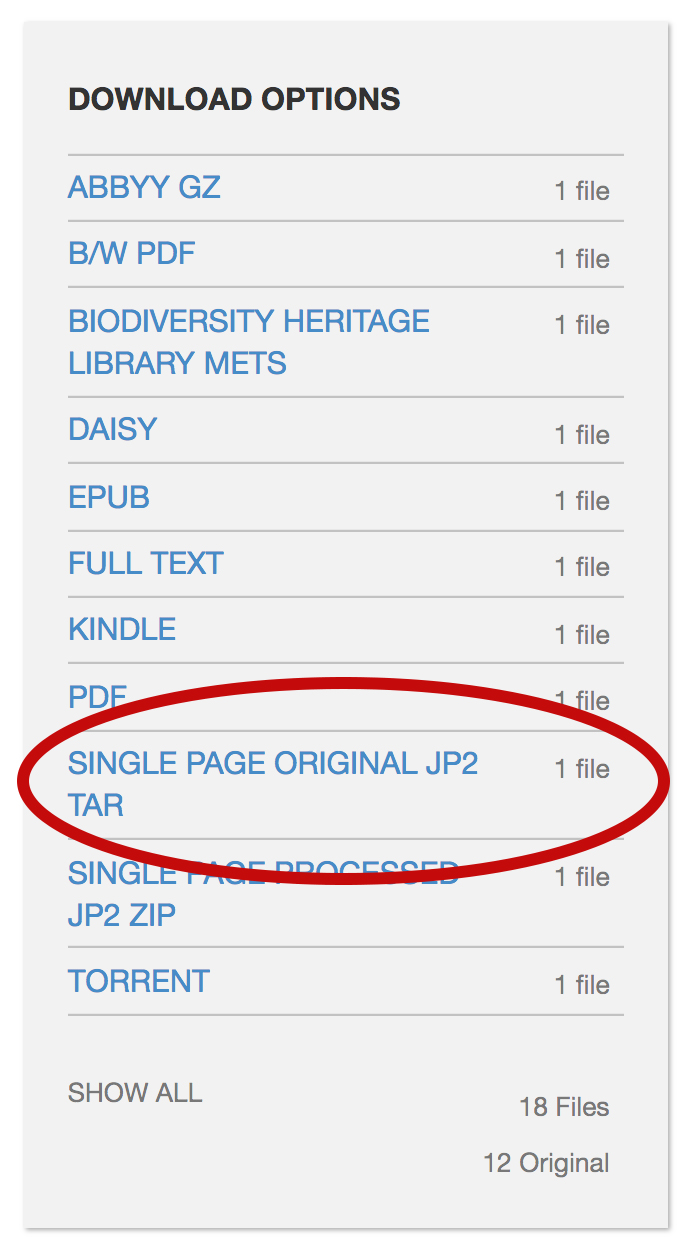
Get a glimpse of the manual processing involved in the post-digitization of Naturalis Historia by downloading the uncropped “single page original JP2 tar” files from Internet Archive.

While manual post-processing work is employed during the digitization of any book, the proliferation of marginalia in this volume added an extra layer of complexity to the digitization of Naturalis Historia. Thanks to the patience and tireless dedication of the staff at Smithsonian Libraries, anyone can now freely access and marvel at the incredible history represented in this natural history treasure.


References

[1] Naturalis Historia, Book 1.
[2] Whitaker, Elaine E. “A Collaboration of Readers: Categorization of the Annotations in Copies of Caxton’s Royal Book 234.” Text Volume 7. (1994): 233-242. P. 234.

February 22, 2018by ulib-libraryjobs
Blog Reel, Featured Books

BHL Gains Works on the Diverse Plant Genus ‘Hoya’

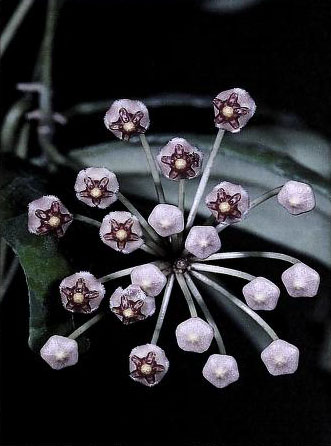
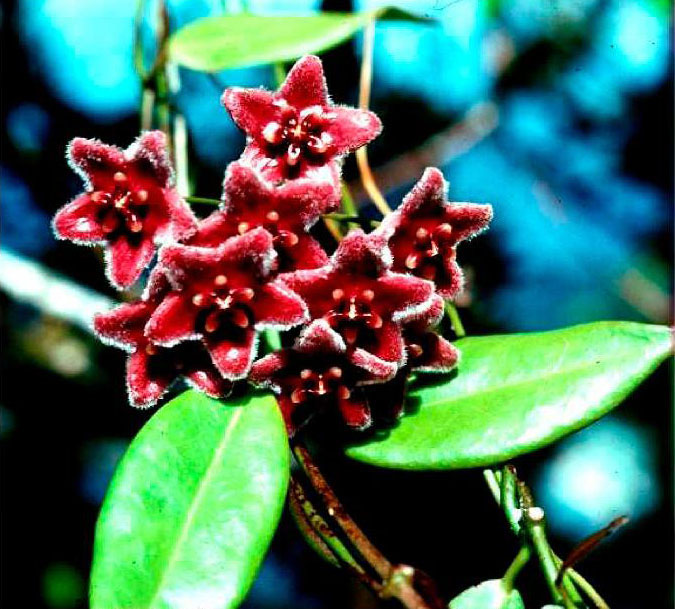
Hoya fetuana on cover of Hoya New, v.6: issue 4, 2017. Photo by Robert Dale Kloppenburg. http://s.si.edu/2BuX7ll.

Robert Dale Kloppenburg is definitely a dedicated botanist. As of January 2018 – when he celebrated his 97th birthday – he has named 234 plant species, mainly in the flowering genus Hoya, which has been his focus for close to forty years since his retirement.

Kloppenburg and the International Hoya Association, of which he is president, have made some generous contributions to the Biodiversity Heritage Library, with funding of the Expanding Access to Biodiversity Literature project. Currently available on BHL are:

  • Fraterna : Official Bulletin for International Hoya Association (1991-2006): Contributed by International Hoya Association and digitized by Harvard University Botany Libraries and The New York Botanical Garden, LuEsther T. Mertz Library.
  • Hoya New (2013-2017): Published and contributed by Robert Dale Kloppenburg.

Fraterna provides a wealth of information on Hoya species and hybrids, for botanists and horticulturalists, as well as the association’s news updates.

Hoya New presents new species descriptions with photos and identification keys.

Also currently available on BHL are Kloppenburg’s titles:

  • Ganges Hoya (2008)
  • Malaysian Hoya Species : A Monograph (2004)
  • Samoan Hoya Species : Preliminary Presentation (2014)
Hoya andalensis on cover of Fraterna v.18: no. 1, 2005. Photo by Kim F. Yap. Contributed by International Hoya Association and digitized by The New York Botanical Garden. http://s.si.edu/2EoGlH0.

The International Hoya Association originated in 1988 as a USA west coast interest group which published a newsletter, first bi-monthly and then quarterly. By the end of their second year, international interest had allowed the group to expand to a non-profit with global membership. An affiliated group, ‘Svenska Hoya Sõllskapet’ based in Borlõnge, Sweden, also publishes a quarterly magazine about hoyas.

What are these plants? The association’s website describes the diverse genus:

“The genus Hoya is found in South East Asia through Australia. They are adaptable plants found everywhere from true rain forests through the slopes of the Himalayas, from semi-arid niches in Australia to damp forests. They range from vines, the most common form, to shrub-like growth. Most are epiphytic [growing on other plants]. Hoyas are in the family commonly known as milkweeds.”

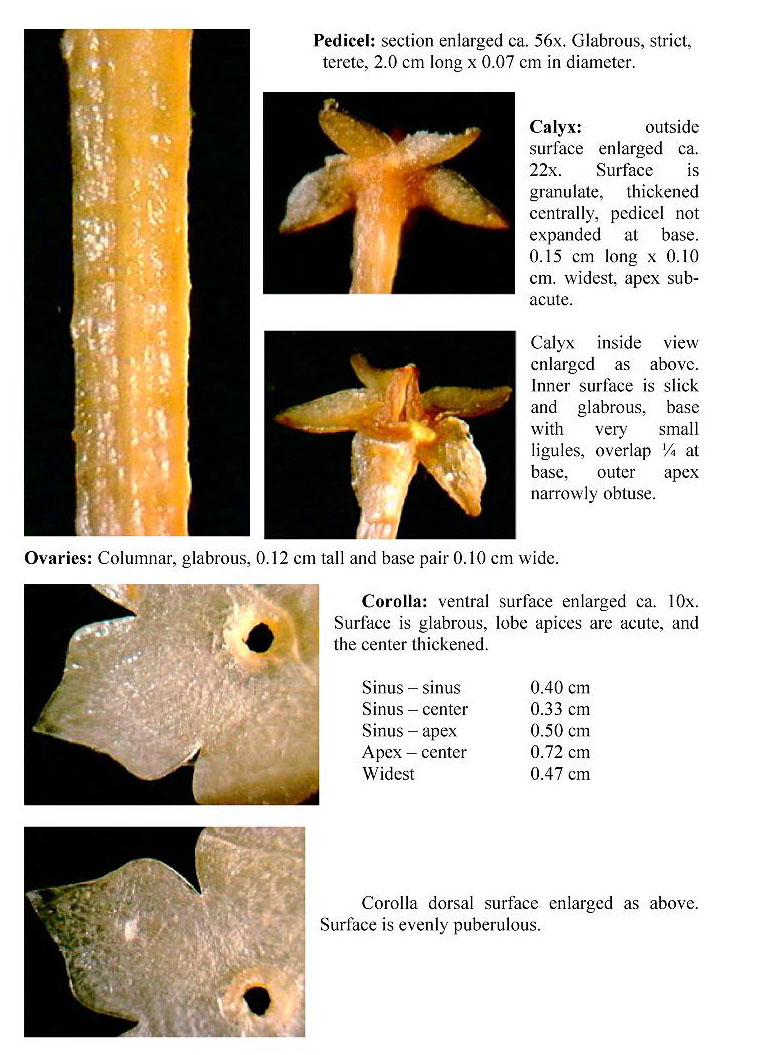
Parts of Hoya bebsguevarre described in Hoya New, v.1: no.4, 2013. http://s.si.edu/2EotCQx.

“What interests me most about hoyas is the vast diversity, the genetic differences and their possible evolutionary significance,” Kloppenburg shared in an interview in Fraterna. “I am of the opinion that we have collected and identified less than 1% of the wild hoya species.”

As an opening message for Hoya New, Kloppenburg explains how the work of horticultural professionals and hobbyists can contribute to the conservation of biodiversity:

“When a species is collected from the wild, I feel it is wise to identify it, propagate it, and name it. In this way it will eventually get into the commercial channels, be distributed to all those interested in the genus and thus be preserved. If in the future the species is lost through natural causes or forest destruction it will still be here on earth in your collection.”

Kloppenburg began studying the genus Hoya in the Philippines in 1981. He had graduated from the University of California, Berkeley, shortly after WWII and worked as a plant breeder research agronomist. Since his retirement in 1986, he has continued to study hoyas, traveling extensively in the South Pacific. His data has been donated to UC Berkeley. In 2016, he reached out to Smithsonian Libraries to offer publications, and agreed to contribute the material to Biodiversity Heritage Library. His assistant, Karen Case, assisted with the permissions process.

“It has been a most exciting journey to be hosted with such a prestigious organization as the Biodiversity Heritage Library, for which I will be eternally grateful,” Kloppenburg says. “I hope my work will help others to become interested in hoyas, and that they will carry on the discovery of new species in the future.”

Meanwhile, he’s still studying plants in the genera Hoya, Dischidia and Eriostemma. “I no longer travel, so I depend on others, mainly in the Philippines, to send me material,” he says.

Many thanks to the International Hoya Association and to Robert ‘Dale’ Kloppenburg for their commitment to sharing biodiversity research, and to Karen Case for helping to facilitate the process.

Sources:

  • International Hoya Association website: http://www.international-hoya.org/aboutus.asp
  • Robert Dale Kloppenburg’s website: http://hoyardk.wixsite.com/kloppenburg
February 15, 2018by ulib-libraryjobs
BHL News, Blog Reel

BHL Internship Opportunity: Digital Content Internship

The Biodiversity Heritage Library is looking for a Digital Content Intern for Summer 2018.

Hosted through the Smithsonian Libraries, this is an unpaid, virtual internship. Interns will work remotely and should should have their own computer and internet access, as well as video conferencing capability.

Applications are open until 23 March 2018 or until filled.

Internship Description:

The BHL Digital Content Intern will work closely with the Digital Collections Manager to contribute digitized books and metadata to the BHL collection. Interns will learn various digitization workflow tools to track collection management and curation activities, enhance metadata, and process digital files for inclusion. Routine activities will include identifying key gaps in BHL’s collection, preparing digital books and catalog records for upload, adding descriptive item and page level metadata, ensuring copyright compliance and documenting workflow tasks.

Ideal candidates will possess great attention to detail and a demonstrated ability to communicate proactively and work independently. Preference given to students with metadata or cataloging experience. Students enthusiastic to learn about collection management and curation in digital libraries are strongly encouraged to apply.

How to Apply:

All applications must go through the Smithsonian Online Appointment System: https://solaa.si.edu. Select Smithsonian Institution Libraries as the unit, Smithsonian Institution Libraries Internship Program as the program and then the “Biodiversity Heritage Library Digital Content (VIRTUAL)” project.

Questions or comments? Send us feedback or write to [email protected].

February 13, 2018by michelle.underhill
Blog Reel, Featured Books

Dr. Arthur Cronquist and his Botanical Field Notes

The LuEsther T. Mertz Library at the New York Botanical Garden is one of many partners on the Biodiversity Heritage Library Field Notes Project which was generously funded by the Council of Library and Information Resources (CLIR). As its contribution to the project, NYBG selected 91 field notebooks for digitization. Nine different collectors are represented in the selected volumes. The bulk of the selected volumes — a total of 61 — document the botanical collecting of Dr. Arthur Cronquist (1919-1992), a pre-eminent twentieth-century American botanist who spent most of his career at NYBG. The Cronquist field notes date from 1941 to 1990 and while most document work done in the continental United States, other countries are also represented including the former Soviet Union, a region of great interest to Cronquist.

Dr. Arthur Cronquist 

Arthur Cronquist in his office at NYBG, 1980s.

Cronquist’s professional accomplishments were numerous and varied. He was recognized internationally as an expert in the Asteraceae (also known as Compositae), the largest plant family in terms of number of described species. His other professional achievements include floristic studies, development of a taxonomic classification system and authorship of several widely used botany textbooks. Floristics refers to study of the types, numbers, distributions and relationships of plant species within a given, delimited area. Theodore Barkley wrote about Cronquist:

“Over the years, he was variously connected to nearly every major floristic project in temperate North America (and even one in the Galapagos), whether as author, coauthor, contributor, or consultant.” [1]

The list of projects worked on by Cronquist includes Compositae in The New Britton & Brown Illustrated Flora (Gleason, 1952); Compositae in Flora of Idaho (Davis, 1952), Vascular Plants of the Pacific Northwest (Hitchcock et al., 1955-1969), Manual of the Vascular Plants of the Northeastern United States and Adjacent Canada (Gleason & Cronquist, 1963 [ed. 2, 1991]) and the fifth volume of the multi-volume Intermountain Flora (1994) to name just a few.

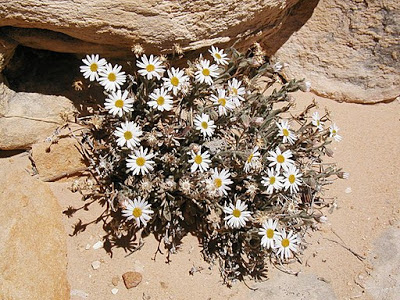
Erigeron maguirei, named by Cronquist in honor of Dr. Bassett Maguire, an early mentor. Endemic to Utah, Maguire’s Fleabane is a species of conservation concern and is a member of the Asteraceae, one of Cronquist’s major research foci.

While eulogizing Cronquist at a memorial service held at NYBG in 1992, Dr. Peter Raven compared the botanical achievements of Cronquist to those of Linnæus. [2]  Other scientists have called him the twentieth-century Asa Gray, considered by many to be the most important American botanist of the nineteenth century. Arthur Cronquist died on March 22, 1992, while studying specimens in the herbarium of Brigham Young University in Provo, Utah.

The Field Notes 

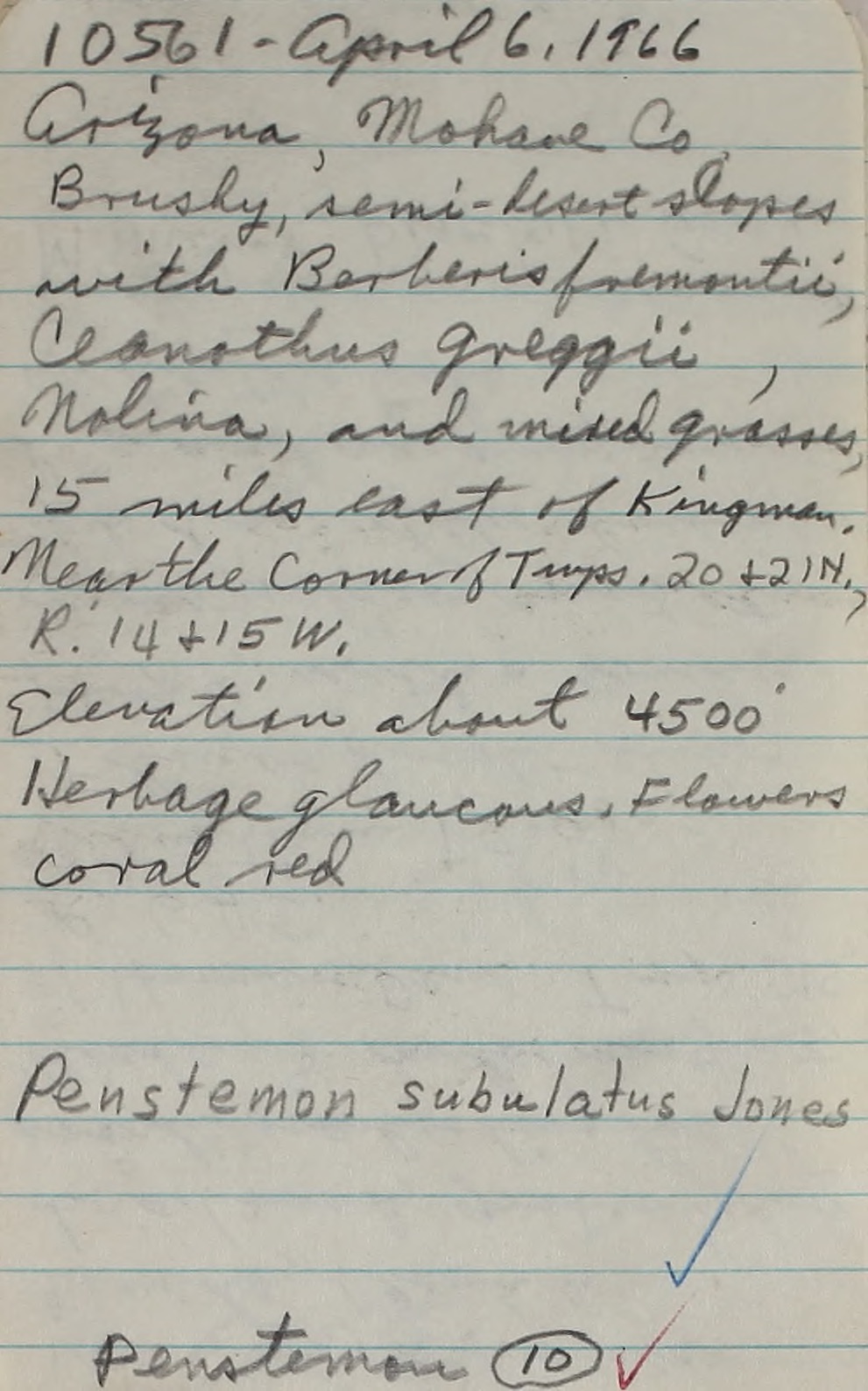
Penstemon subulatus Jones, Cronquist 10561,
from Nevada, Arizona, California, 1966, [numbers 10554-10649]. http://s.si.edu/2nQpjqo.

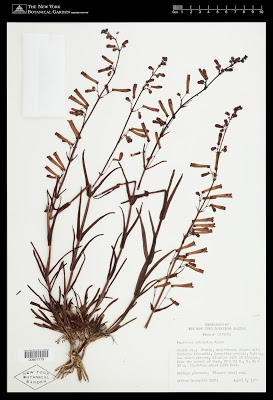
Cronquist’s botanical field notebooks are typical of other botanical field notebooks and show how botanists document their field work and collect specimens. The image above shows one page in a field notebook created by Cronquist in 1966. At the top of the page, the number “10561” is visible. Botanists assign sequential numbers to the specimens that they collect throughout their careers. This number, when appended to the collector’s name, e.g. Cronquist 10561, forms an identifier that is retained when the specimen is subsequently deposited in a herbarium. The descriptive information recorded in the field notebook, e.g. the date, location and elevation, is copied from the field notes to a specimen label. The dried, pressed specimen and the specimen label are then mounted on a large sheet of paper. The image below shows a herbarium sheet for the specimen described on this page in Cronquist’s field notes and comes from the William and Lynda Steere Herbarium at New York Botanical Garden.

Penstemon subulatus Jones, Herbarium Specimen

The entire collection of field notes from all institutions participating in the BHL Field Notes Project is available in the BHL here. The Cronquist field notes contributed by NYBG are located here.

References:
[1] Barkley, Theodore M. (1996). On the Contribution of Arthur Cronquist to Botanical Science at The New York Botanical Garden. Brittonia, 48(3), 372-375. Retrieved from http://www.jstor.org/stable/2807800

[2] Lamont, Eric E. (1994). Arthur Cronquist (1919-1992). Bulletin of the Torrey Botanical Club, 58, 126-129. Retrieved from https://www.biodiversitylibrary.org/part/254875

Further Reading:
University of Florida Herbarium. Preparation of Plant Specimens for Deposit as Herbarium Vouchers. Retrieved from https://www.floridamuseum.ufl.edu/herbarium/voucher.htm 

The BHL Field Notes Project is funded by the Council on Library and Information Resources (CLIR).

February 8, 2018by lmyrick
Blog Reel, User Stories

Teaching with Historic Biodiversity Publications

Can science increase agricultural productivity and support food security?

The founders of the Royal Agricultural Society of England believed so. In 1838, a group of individuals with varied agricultural interests united to establish the Society with the purpose to promote the scientific advancement of English agriculture. Just two years later, in 1840, Queen Victoria granted the Society its Royal Charter, and the Society has played a significant role in agricultural progress in England ever since.

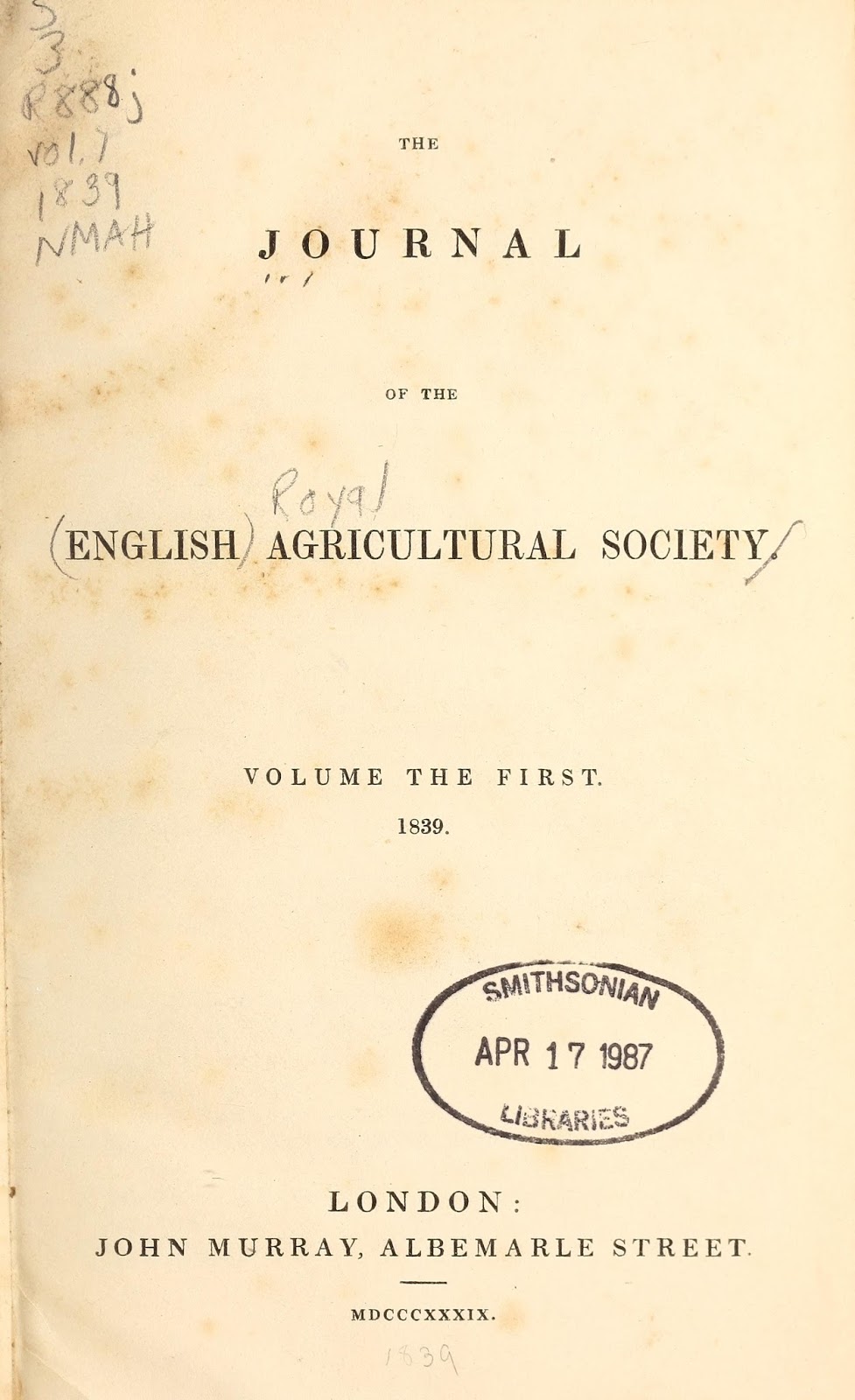
Title page for Volume One of the Journal of the Royal Agricultural Society of England. 1839. Digitized by Smithsonian Libraries. http://s.si.edu/2nqmWdu.

The Journal of the Royal Agricultural Society of England was used to communicate the Society’s activities and disseminate information useful to those in agricultural fields. Since the publication of the first volume in 1839, the Journal has shared practical advice on soil cultivation; advances in agricultural implements, structures, and pest control; discoveries of new crop varieties; land management guidance; improvements in veterinary care related to livestock; and the results of agricultural experiments.

The Journal is useful not only for research in agricultural science, but also other fields like environmental history. For Dr. Karen Sayer, Professor of Social and Cultural History at Leeds Trinity University, it is an invaluable resource.

“The Journal of the Royal Agricultural Society of England is a crucial source in my field, and I have easy access to it thanks to the Biodiversity Heritage Library.”

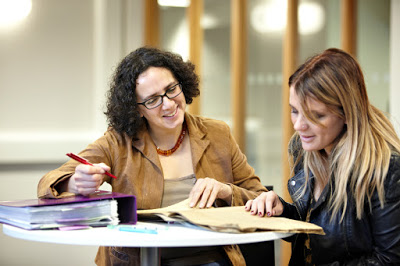
Dr. Karen Sayer (left) with a student. Image Rights: Leeds Trinity University.

Sayer’s research focuses on conceptualizations of rural communities, landscapes, and environments; human and animal relations in agriculture; and agricultural labor, landscapes, and structures in a social and cultural context. Thanks to BHL, which she discovered whilst searching for primary sources nearly ten years ago, Sayer has easy access to the references she needs to support her research.

“BHL is an incredible resource,” affirms Sayer. “It provides access to material that is otherwise hard to get and enables me to undertake detailed searches of these sources. I use it frequently, often weekly, especially when I’m teaching as it is also a great resource for my students.”

Sayer’s favorite feature within the library is the ability to generate custom PDFs of specific pages, which allows her to download just those articles relevant to her research. This feature is also useful within the classroom, allowing her to share articles with her students for reading and commenting.

Having digital access to publications such as the Journal of the Royal Agricultural Society of England also allows Sayer and her students to easily explore elements of agricultural and rural society and the dissemination of information at different cultural levels.

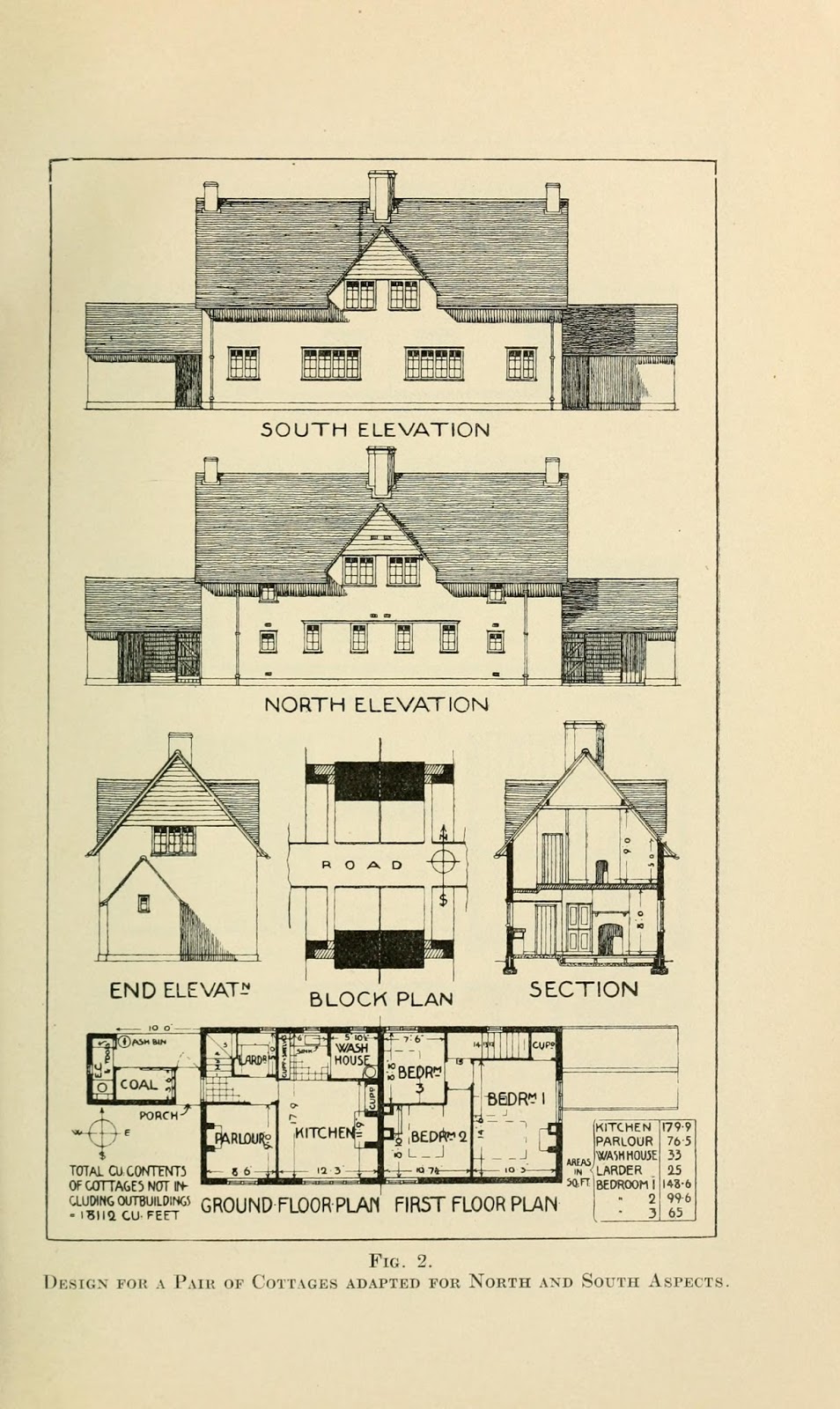
Plans for cottages within the article “The Housing of the Agricultural Labourer.” Journal of the Royal Agricultural Society of England. v. 75 (1914). Digitized by The New York Botanical Garden. http://s.si.edu/2BF3VsT.

“I like being able to pull up a whole text online for teaching, as I can project it on a Smart Board in the classroom and as a group we can scroll through it to explore ideas, juxtapositions, etc.” explains Sayer. “My students can see that articles about French or German agriculture were being published alongside detailed explorations of wheat yields at agricultural research stations and reports on machinery exhibits at a county level. They can see how knowledge circulated at the time and the ways in which issues and ideas were debated.”

To further facilitate her research, Sayer would love to be able to search the full text of the collection and specific holdings to more easily identify articles related to specific topics and get a sense of the development of an idea or debate over time.

We are thrilled to confirm that full text search is currently under development. Through increased research efficiency, full text search will enhance BHL’s ability to inspire discovery through free access to biodiversity knowledge. Stay tuned for more information on this new service.

As Dr. Sayer’s experience demonstrates, historic natural history publications provide a wealth of information beyond scientific data. These works also document important cultural information, providing insight into the emergence of ideas and the spread of knowledge through society and time. We are thrilled to know that BHL’s collections support research across a wide array of disciplines.

Source

Royal Agricultural Society of England. 2018. “History.” Accessed January 30, 2018. http://www.rase.org.uk/history/.

February 1, 2018by michelle.underhill

Help Support BHL

BHL's existence depends on the financial support of its patrons. Help us keep this free resource alive!

search

About BHL

The Biodiversity Heritage Library (BHL) is the world’s largest open access digital library for biodiversity literature and archives. BHL operates as a worldwide consortium of natural history, botanical, research, and national libraries working together to digitize the natural history literature held in their collections and make it freely available for open access as part of a global “biodiversity community.”

Join Our Mailing List

Sign up to receive the latest news, content highlights, and promotions.

Subscribe Now

Subscribe to Blog via Email

Enter your email address to subscribe to this blog and receive notifications of new posts by email.

Join 319 other subscribers

Subscribe to Blog Via RSS

Subscribe to the blog RSS feed to stay up-to-date on all the latest BHL posts.

Access RSS Feed

Inspiring Discovery through Free Access to Biodiversity Knowledge.

The Biodiversity Heritage Library makes it easier than ever for you to access the information you need to study and explore life on Earth…for free, anytime, anywhere.


64+ Million Pages of
Biodiversity Literature Online.

EXPLORE

Tools and Services
to Transform Research.

EXPLORE

300,000+
Illustrations on Flickr.

EXPLORE

ABOUT | HARMFUL CONTENT | PRIVACY | SITE MAP | TERMS OF USE