
Biodiversity Heritage Library - Program news and collection highlights from BHL
  • Home
  • News
  • Featured Books
    • All Featured Books
    • Book of the Month Series
    • BHL at 20
  • User Stories
  • Campaigns
    • Fossil Stories
    • Garden Stories
    • Monsters Are Real
    • Page Frights
    • Her Natural History
    • Earth Optimism 2020
  • Tech Blog
  • Visit BHL
Home
News
Featured Books
    All Featured Books
    Book of the Month Series
    BHL at 20
User Stories
Campaigns
    Fossil Stories
    Garden Stories
    Monsters Are Real
    Page Frights
    Her Natural History
    Earth Optimism 2020
Tech Blog
Visit BHL
  • Home
  • News
  • Featured Books
    • All Featured Books
    • Book of the Month Series
    • BHL at 20
  • User Stories
  • Campaigns
    • Fossil Stories
    • Garden Stories
    • Monsters Are Real
    • Page Frights
    • Her Natural History
    • Earth Optimism 2020
  • Tech Blog
  • Visit BHL
Biodiversity Heritage Library - Program news and collection highlights from BHL
BHL News, Blog Reel, User Stories

Worlds of Wonder: Tracing Microscopy Illustrations on Zooniverse

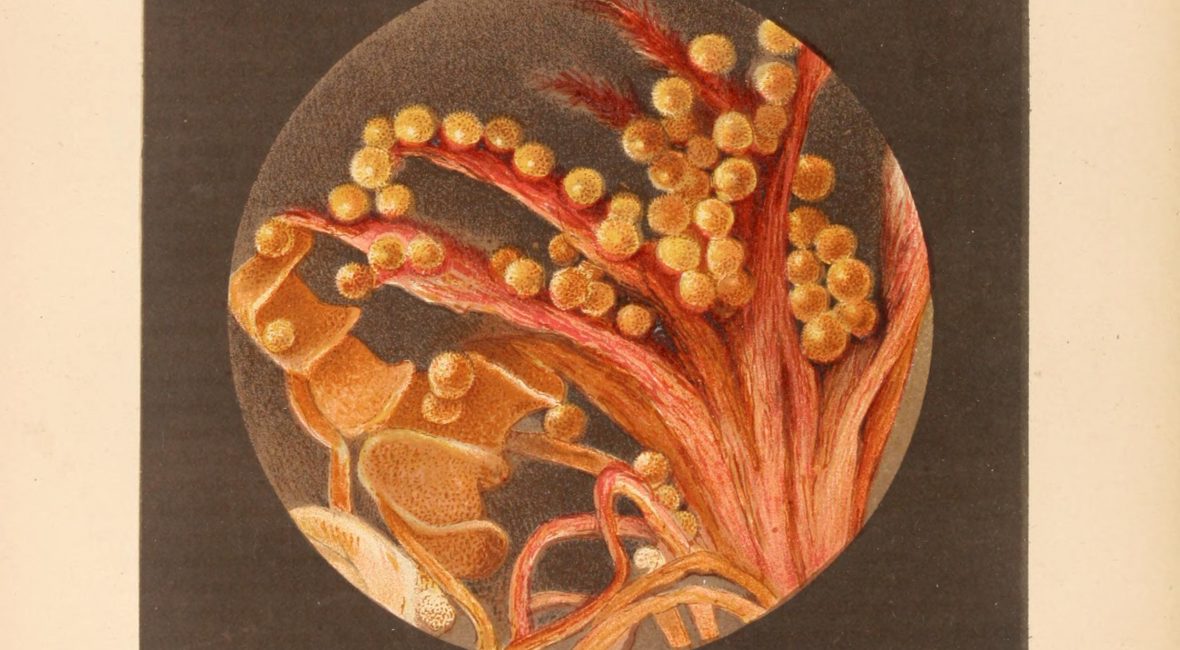
dropsofwaterthei00catl_0_0026.jpg

Catlow, Agnes. Drops of Water; their Marvellous and Beautiful Inhabitants Displayed by the Microscope. 1851. Contributed in BHL by University of Toronto – Thomas Fisher Rare Book Library.

In the mid-nineteenth century, microscopy became immensely popular with European and American naturalists. As microscopes became more affordable, microscopy societies were established, and numerous microscopy journals were launched and widely distributed. Many microscopy publications were richly illustrated, trying to recreate the “world of wonder and beauty” seen through the microscope (Gosse, 1860, p. v). In his widely read Evenings at the Microscope (1859), the English naturalist Philip Henry Gosse showed his readers “the path to the myriad wonders of creation” displayed by the microscope (p. 3). Moreover, microscopy journals, inviting their readers to contribute inquiries and observations, often made it possible for geographically dispersed microscopists to work together.

monthlymicroscop11869roya_0197.jpg

Hudson, Charles Thomas. “On Triarthra longiseta” in The Monthly Microscopical Journal. Vol. 1. 1869. Contributed in BHL by Smithsonian Libraries.

Since international copyright laws were only enforced after the signing of the Berne Convention in 1886 and the passing of the American Chace Act in 1891, mid-nineteenth-century publications frequently reused material published elsewhere. Illustrations and texts would be copied and reprinted, thus targeting several readerships at different places at the same time. Edward Pennock, editor of the Philadelphian Microscopical Bulletin and Science News, claimed that he could “write much better articles with the scissors than with the pen” (Pennock, 1890, p. 7). Pennock not only copied but also recombined articles to better accommodate the interests of his readers.

Citizen Scientists Invited to Explore the History of Microscopy

To this day, so many nineteenth-century publications on microscopy remain that they can hardly be analyzed by just a handful of historians. Therefore, the MUSTS research group at Maastricht University launched Worlds of Wonder, an online crowdsourcing project, on the Zooniverse citizen science platform. Worlds of Wonder is part of a PhD project funded by the Netherlands Organisation for Scientific Research, and it was inspired by Science Gossip, another crowdsourcing initiative asking citizen scientists to classify illustrations. The MUSTS researchers behind Worlds of Wonder, Lea Beiermann, Cyrus Mody and Raf De Bont, ask citizen scientists to help them classify nineteenth-century microscopy illustrations, assign keywords to the illustrations to make them searchable, and identify the people who made them.
hardwickesscienc20cook_0092.jpg

E. T. D. “Graphic Microscopy” in Hardwicke’s Science Gossip. Vol. 20. 1884. Contributed in BHL by MBLWHOI Library.

Worlds of Wonder aims to better understand the formation of a community of European and American microscopists by investigating the publications that connected them. How did microscopists and illustrators collaborate to produce illustrations? Who could contribute illustrations to microscopy publications? Where did microscopy illustrations travel and how did they change along the way? It seems that the circulation and reproduction of illustrations was a crucial factor in connecting nineteenth-century microscopists, who formed a strikingly diverse scientific community including physicians, biologists, engineers, natural historians, school teachers and zoologists with a shared interest in microscopy. Adapting and recombining published texts and illustrations may have made it easier for editors to tailor their publications to different groups of microscopists. In order to trace reproductions of microscopy illustrations, Worlds of Wonder draws on a wealth of digitized microscopy publications hosted by the BHL.

Although copyright laws were not strictly enforced in the mid-nineteenth century, issues of ownership and the authenticity of reproduced materials were strongly debated. Considering that today many online platforms continue to recombine and distribute texts and illustrations published elsewhere, Worlds of Wonder may also help us get a better idea of the effects of using these platforms in science communication.

You can join the crowdsourcing project on Zooniverse or learn more about the history of microscopy on the Worlds of Wonder blog.

References

Gosse, Philip Henry. 1860. Evenings at the Microscope; or Researches Among the Minuter Organs and Forms of Animal Life. New York: D. Appleton.

Pennock, Edward. 1890. Minutiae. The Microscopical Bulletin and Science Ne, 7(1), 7.

April 25, 2019by Joel Richard
BHL News, Blog Reel, Tech Updates

BHL LEADS Project at the 2019 iConference

Gretchen Stahlman (left), LEADS Fellow and doctoral candidate at University of Arizona, and Carolyn Sheffield (right), former BHL Program Manager now based at the Albin O. Kuhn Library of UMBC, presenting their poster at the 2019 iConference.

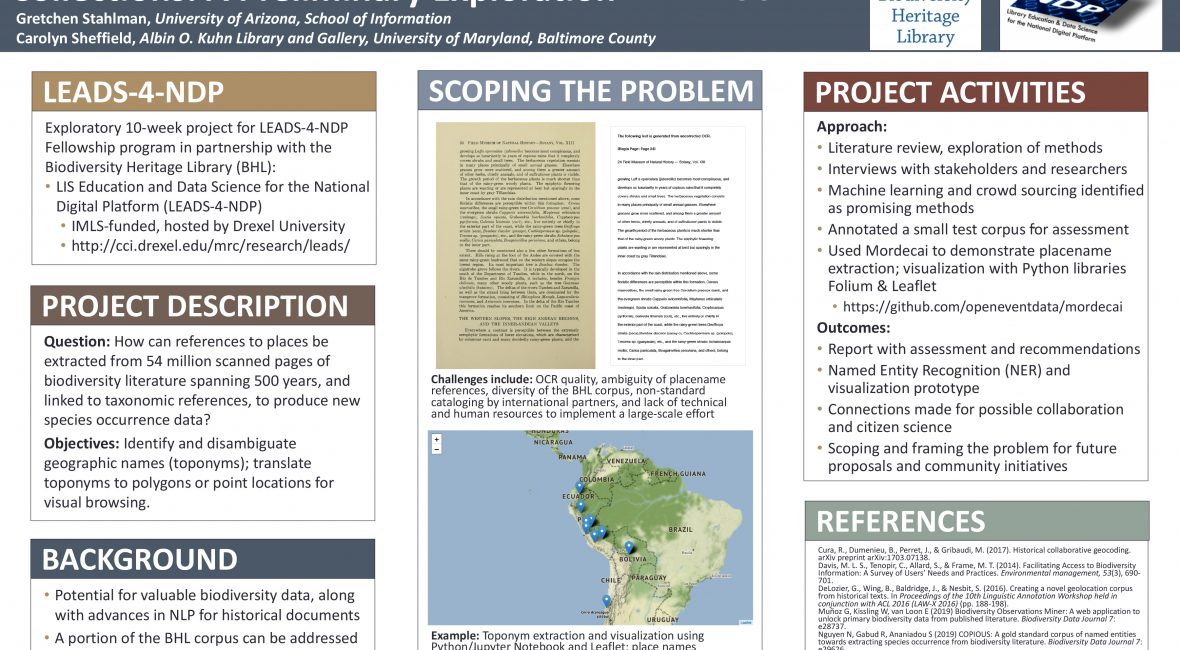
BHL was pleased to have the results of their participation in the 2018 LIS Education and Data Science for the National Digital Platform (LEADS-4-NDP) shared via a poster at the 2019 iConference held at the University of Maryland, College Park (UMD) from 31 March – 3 April, 2019. The LEADS program, funded by the Institution of Museum and Library Services (IMLS) and led by Drexel’s Metadata Research Center, supported ten Fellows in 2018 to develop data science skills by contributing to fast-paced, 10-week projects at several different host sites throughout the US. This conference provided an opportunity to present BHL’s LEADS project alongside those from two other 2018 LEADS Fellows as well some Fellows who were recently selected for the 2019 program.

Jointly hosted by UMD, Syracuse University, and University of Maryland, Baltimore County (UMBC), the conference theme was Inform, Include, Inspire. Keynotes included ‘Libraries in the Digital Age: Now What?’ presented by Librarian of Congress Carla Hayden and ‘Opening Our Libraries: Millions of Books Online Through Controlled Digital Lending’ delivered by Brewster Kahle, Founder and Digital Librarian of the Internet Archive. The conference itself was well-attended with strong international representation.

The poster session was held on the afternoon of April 2 and included about 90 posters. The BHL poster was authored by Gretchen Stahlman, LEADS Fellow and doctoral candidate at University of Arizona, and Carolyn Sheffield, former BHL Program Manager now based at the Albin O. Kuhn Library of UMBC. The poster, entitled ‘Geoparsing Biodiversity Heritage Library Collections: A Preliminary Exploration’ provided an overview of an investigation into different approaches for identifying and disambiguating geographic names, and then translating toponyms to polygons or point locations on a map.

The poster abstract, along with others from the conference, is available on the University of Illinois IDEALS website.

‘Geoparsing Biodiversity Heritage Library Collections: A Preliminary Exploration’ poster by Gretchen Stahlman and Carolyn Sheffield, presented at the 2019 iConference.

April 18, 2019by brooksm
Blog Reel, User Stories

How the BHL Makes Little Brown Beetle Species Discovery Easier

There are more described species of beetles (order Coleoptera) than any other group of organisms on the planet. With over 350,000 described extant and extinct species and subspecies, beetles represent about 40% of all described arthropods and about 25% of all described species [1,2].

Europs frontalis (Grouvelle, 1896), a monotomid beetle from Chile described by Antoine Henri Grouvelle in the Annales de la Société entomologique de France. Photo by TC McElrath.

One of the myriad families of beetles is Monotomidae, with over 250 described species [3]. Commonly called minute clubbed beetles, the family includes such species as Europs frontalis (found only in south temperate forests of Argentina and Chile) and Pycnotomina cavicolle (found exclusively in forested regions of eastern North America).

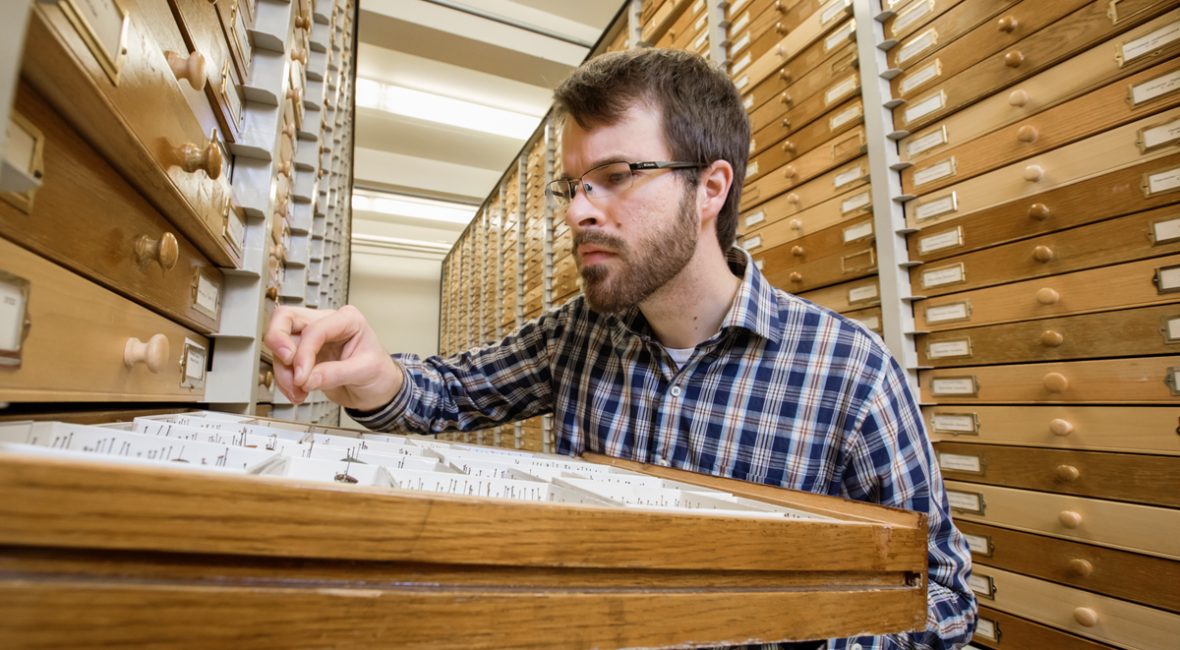
Dr. Thomas McElrath, Insect Collections Manager at the Illinois Natural History Survey, has been studying the systematics of Coleoptera for nine years. He is currently working on compiling a worldwide checklist of the Monotomidae. The Biodiversity Heritage Library is a crucial resource for his research on this project.

“The BHL is an integral research tool for beetle systematists like me. I absolutely love it. It has saved me time, money, and resources,” lauds McElrath. “Most of the older, obscure literature I need to reference to study the taxonomy of beetles is now available from the BHL. Soon, I hope to have a worldwide checklist available for the Monotomidae, thanks, in part, to the resources available on the BHL.”

Dr. Thomas McElrath in the Illinois Natural History Survey Coleoptera Collection. Photo by L. Brian Stauffer.

McElrath first discovered BHL around 2011, and it soon became an essential research tool, particularly during his PhD, when it was not uncommon for him to use the Library multiple times a day in search of older publications and species descriptions.

“Without BHL, my PhD would have taken much longer, and I wouldn’t have been able to do as much as I did within the time period available to me,” explains McElrath. “It saved me hundreds of hours of library research, interlibrary loan requests, and scanning.”

Today, McElrath still uses BHL daily to weekly, typically downloading whole or custom PDFs to support his research on the Monotomidae. The Library allows him to access relevant materials in a variety of languages quickly and easily.

“Without BHL, finding all the the species descriptions in American, German, French, and Italian taxonomic journals would have been much harder,” affirms McElrath. “My advisor always told me I had it ‘too easy’ with BHL, and that in his day they would have to beg for reprints from colleagues all around the world, which sometimes took months to arrive. Now, I just log onto BHL and download a high quality scan for free. It’s really amazing.”

McElrath also views BHL as a great way for institutions to share collections-related information. To that end, the Illinois Natural History Survey (INHS), in collaboration with BHL Member the University of Illinois at Urbana-Champaign (UIUC), has started uploading accession logs related to collections in the INHS to BHL.

Page from Specimen Collection Logs of Charles Robertson. Contributed in BHL from University Library, University of Illinois Urbana Champaign.

For example, the Specimen Collection Logs of Charles Robertson document insect specimens collected by Robertson, providing information such as specimen number, scientific names, sex of specimen, date of collection, locality, insect order, host plant scientific name, and notes. The logs, now available on BHL, are held in the Archives of UIUC, while the corresponding specimens are held by INHS.

“My museum and institutional library have used BHL to host scans of our accession logs so that researchers can access them from around the world, alongside our already digitized specimens,” explains McElrath. “I would love to see more institutions and individuals put their field notes and accession logs on the BHL for others to access.”

Thanks to recent initiatives such as the BHL Field Notes Project and the Smithsonian Field Book Project, over 6,000 field notes, correspondence, and related archival materials have been made available in BHL, with more being added regularly. These materials serve as unique primary source documents and provide valuable context for and data around specimens, collecting events, and the activities, observations, and personal notes of individual researchers. Thanks to their availability on BHL, researchers across the globe can easily access this valuable information.

The Biologia Centrali-Americana was published around the turn of the century and describes several unique monotomids, including Thione championi, figured at top right of this page. Contributed in BHL from Smithsonian Libraries.

Beyond supporting research activities, McElrath also appreciates the wealth of illustrations available from BHL. Since 2011, BHL has been uploading the scientific illustrations found within the collection to Flickr, making it easier for anyone to explore and download these images, which are valuable both as scientific documents and works of art.

“My wife and I also download high resolution plates of cool biodiversity (insects, plants, etc.) from the BHL Flickr page and use them to make prints for decorating our house,” shares McElrath.

Nudibranchs by Ernst Haeckel, one of the images McElrath and his wife have printed for their “natural history wall” at home. Kunstformen der Natur. 1905. Contributed in BHL from Smithsonian Libraries.

Whether it be supporting research on clubbed beetles or as a source of beautiful home decor, the Biodiversity Heritage Library is making it easier for everyone to explore, study, and appreciate the natural world.

For McElrath, BHL has been a game-changer. In short: “Its existence is extraordinary.”

References

[1] Catalogue of Life. 2019. “Coleoptera.” Accessed 26 March 2019. http://www.catalogueoflife.org/col/browse/classification/kingdom/Animalia/phylum/Arthropoda/class/Insecta/order/Coleoptera/fossil/1/match/1.

[2] Stork, Nigel E, James McBroom, Claire Gely, and Andrew J. Hamilton. 2015. “New Approaches Narrow Global Species Estimates for Beetles, Insects, and Terrestrial Arthropods.” PNAS 112 (24) 7519-7523. Accessed 26 March 2019. https://www.pnas.org/content/112/24/7519.

[3] McElrath, Thomas, Olivia Boyd and Joseph V. McHugh. 2016. “Overview.” MonotomidGen. Accessed 26 March 2019. http://www.monotomidae.com/index.html.

April 11, 2019by michelle.underhill
BHL News, Blog Reel, Tech Updates

Changes Coming to the BHL Data Exports Files on 10 April 2019

On 10 April 2019, we will implement additions and changes to the export files available from the Biodiversity Heritage Library.

The updates involve the following:

  1. A new set of exports will be created alongside the existing exports. The new set will contain only data for material that is hosted by BHL. No externally-hosted content will be included in these files. Because these files are added in addition to the existing export files, no existing users should be affected.
  2. The BHL author Identifiers will be added to the creator.txt and partcreator.txt tab-delimited files. The format of these files will change to accommodate the additional data; the author identifier will now be the second “column” in each file. Because of this, anyone regularly harvesting from these files may be affected.

Additional detailed information about these updates will be reflected on the Data Exports: Developer and Data Tools webpage, effective 10 April 2019.

If you have questions, please feel free to submit feedback via this form.

April 3, 2019by michelle.underhill

Help Support BHL

BHL's existence depends on the financial support of its patrons. Help us keep this free resource alive!

search

About BHL

The Biodiversity Heritage Library (BHL) is the world’s largest open access digital library for biodiversity literature and archives. BHL operates as a worldwide consortium of natural history, botanical, research, and national libraries working together to digitize the natural history literature held in their collections and make it freely available for open access as part of a global “biodiversity community.”

Join Our Mailing List

Sign up to receive the latest news, content highlights, and promotions.

Subscribe Now

Subscribe to Blog via Email

Enter your email address to subscribe to this blog and receive notifications of new posts by email.

Join 319 other subscribers

Subscribe to Blog Via RSS

Subscribe to the blog RSS feed to stay up-to-date on all the latest BHL posts.

Access RSS Feed

Inspiring Discovery through Free Access to Biodiversity Knowledge.

The Biodiversity Heritage Library makes it easier than ever for you to access the information you need to study and explore life on Earth…for free, anytime, anywhere.


64+ Million Pages of
Biodiversity Literature Online.

EXPLORE

Tools and Services
to Transform Research.

EXPLORE

300,000+
Illustrations on Flickr.

EXPLORE

ABOUT | HARMFUL CONTENT | PRIVACY | SITE MAP | TERMS OF USE