Biodiversity Heritage Library - Program news and collection highlights from BHL
  • Home
  • News
  • Featured Books
    • All Featured Books
    • Book of the Month Series
    • BHL at 20
  • User Stories
  • Campaigns
    • Fossil Stories
    • Garden Stories
    • Monsters Are Real
    • Page Frights
    • Her Natural History
    • Earth Optimism 2020
  • Tech Blog
  • Visit BHL
Home
News
Featured Books
    All Featured Books
    Book of the Month Series
    BHL at 20
User Stories
Campaigns
    Fossil Stories
    Garden Stories
    Monsters Are Real
    Page Frights
    Her Natural History
    Earth Optimism 2020
Tech Blog
Visit BHL
  • Home
  • News
  • Featured Books
    • All Featured Books
    • Book of the Month Series
    • BHL at 20
  • User Stories
  • Campaigns
    • Fossil Stories
    • Garden Stories
    • Monsters Are Real
    • Page Frights
    • Her Natural History
    • Earth Optimism 2020
  • Tech Blog
  • Visit BHL
Biodiversity Heritage Library - Program news and collection highlights from BHL
BHL News, Blog Reel, Tech Updates

Additions to Text Exports Coming Soon

The BHL website was recently updated for new fields to download content. The TSV Data Exports are being updated on 1 September 2019 to mirror this change.

History

Recently, we added new URLs to the site to facilitate getting the text, Images or PDFs of the items at BHL. When viewing an item (for example, Darwin’s Origin of Species), the Download Contents > Download Book option presents four choices for downloading the contents of an item. Three of these have new, normalized URLs to download the content of an item.

  • PDF: https://www.biodiversitylibrary.org/itempdf/124544
  • All: (unchanged)
  • JPEG 2000: https://www.biodiversitylibrary.org/itemimages/124544
  • Text: https://www.biodiversitylibrary.org/itemtext/124544

We added these links because we discovered that there were some inconsistencies in connecting our content to the Internet Archive. Additionally with the new ability of BHL Partners to upload transcribed text, we needed a method of downloading the updated text rather than the original OCR.

What has changed?

In summary, these three new URLs have been added to the tab-delimited Item (volumes) TSV download files. The presence of these fields will impact any downstream processes that rely on the order of the fields. Please review your code if you rely on the field order instead of the field names of the TSV file.

In the past, the fields were:

ItemID, TitleID, ThumbnailPageID, BarCode, MARCItemID, CallNumber, VolumeInfo, ItemURL, LocalID, Year, InstitutionName, ZQuery, CreationDate

On 1 September 2019, the fields will change to the following:

ItemID, TitleID, ThumbnailPageID, BarCode, MARCItemID, CallNumber, VolumeInfo, ItemURL, ItemTextURL, ItemPDFURL, ItemImagesURL, LocalID, Year, InstitutionName, ZQuery, CreationDate

These fields mirror those of the new links mentioned above and will save you from needing to create the URLs to download content.

Please update your code or processes if necessary!

August 27, 2019by Sheila Rabun
BHL News, Blog Reel

Smithsonian Scientists Name New Fossil Fly Species For the Biodiversity Heritage Library and Smithsonian Libraries

Photographs of fossil fly species

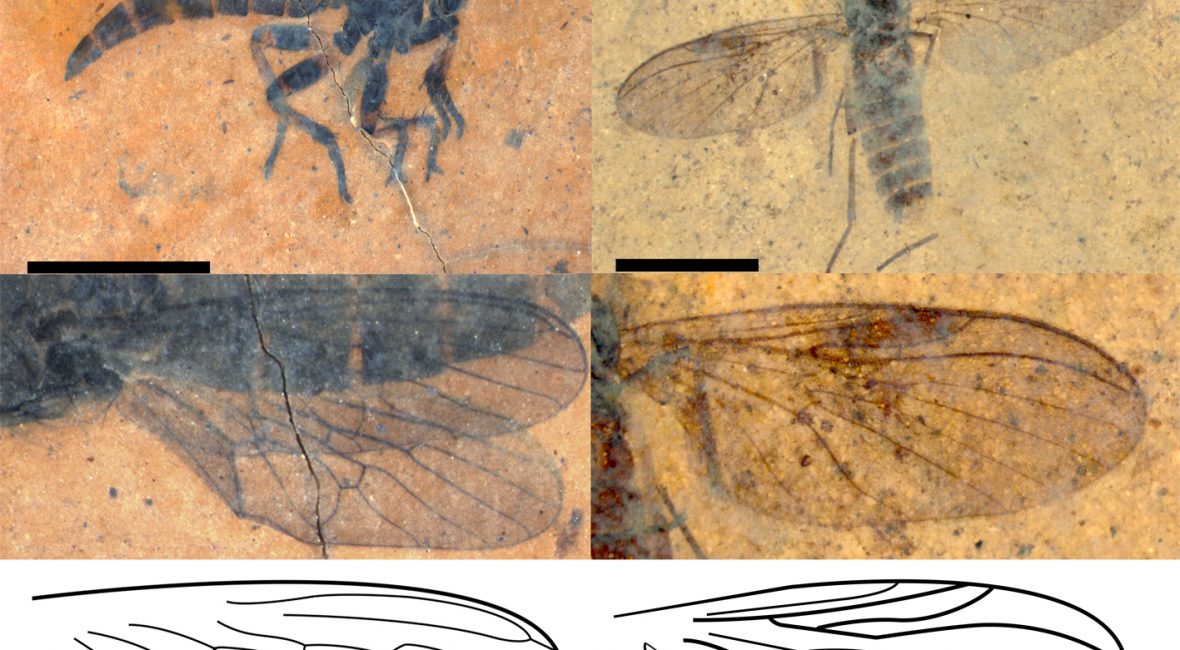
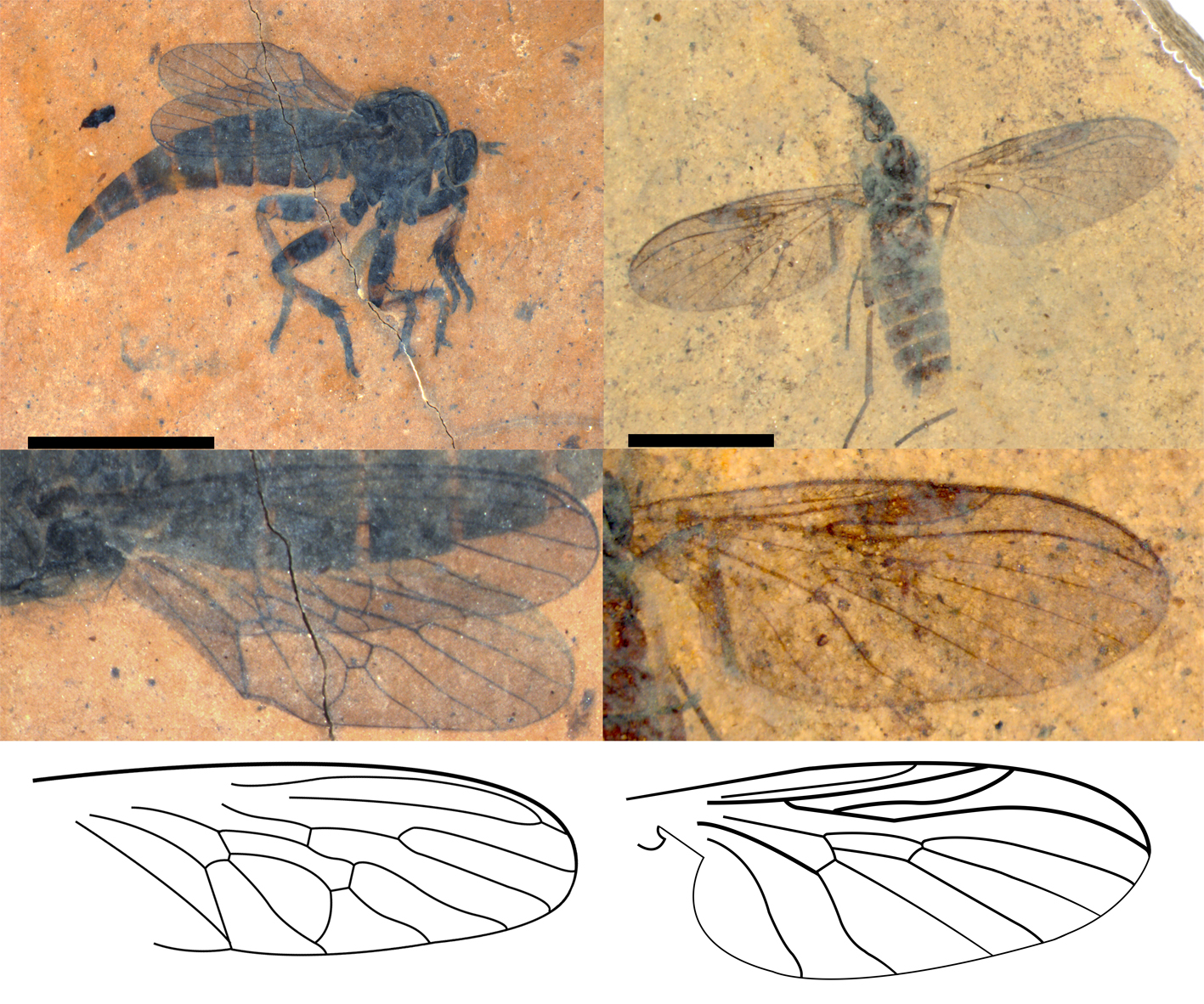
(LEFT) Kishenehnoasilus bhl gen. sp. nov. Dikow 2019 (Diptera: Asilidae) & (RIGHT) Sylvicola silibrarius sp. nov. Greenwalt 2019 (Diptera: Anisopodidae). These two extinct species of flies were collected from the Kishenehn Formation in Northwestern Montana as part of the National Museum of Natural History’s research in paleobiology and the evolution of insect diversity. The fossils were exposed by erosion of oil shale, derived from sediments of a 46-million-year-old lake, by the Middle Fork of the Flathead River along the southwestern boundary of Glacier National Park. The robber fly (Kishenehnoasilus bhl; USNM 624491) was collected at the Dakin site in 2014; the wood gnat (Sylvicola silibrarius; USNM 626077) was collected from the Deep Ford site in 2015. The scale bars = 5 mm. The specimens are named in honor of the staff of the Biodiversity Heritage Library and the library staff of the National Museum of Natural History, respectively. Photo by: Dale Greenwalt.

Two new fossil fly species have been named in honor of the Smithsonian Libraries and the Biodiversity Heritage Library. Sylvicola silibrarius Greenwalt, 2019 and Kishenehnoasilus bhl Dikow, 2019 have been described from specimens collected from the 46-million-year-old Kishenehn Formation of northwestern Montana. The species were published last week in the open access journal Palaeontologia Electronica.

The species are two of 15 new species identified in a new study led by scientists at the Smithsonian’s National Museum of Natural History and colleagues on the diversity of fossil flies (order Diptera) in the Coal Creek Member of the Kishenehn Formation, a 34-56 million year old fossil site. The study also records 15 new families, dramatically expanding scientists’ knowledge of fly diversity during the Eocene in North America. With this publication, a total of 21 different families of flies have now been described from the region. The study provides researchers with a snapshot of flies during their evolution and helps establish the Kishenehn Formation as one of the most important fossil sites in North America for understanding the evolution of one of the most successful groups of life on Earth.

Sylvicola silibrarius Greenwalt, 2019 is a wood gnat in the widely-distributed Anisopodidae family containing nearly 200 species and boasting a rich fossil record. The specific epithet is a combination of the abbreviation SI (for the Smithsonian Institution) and the Latin term librarius (pertaining to books). Dale Greenwalt, lead study author and a resident research associate at the National Museum of Natural History, named the species in appreciation for the essential services that the Smithsonian Libraries perform.

“My research here at the National Museum of Natural History would be impossible without the Libraries,” said Greenwalt. “In my ten years here at the museum, I have never had an interaction with our world class library staff that was not positive, friendly and helpful.”

Kishenehnoasilus bhl Dikow, 2019, a robber fly in the family Asilidae, represents the type species for this new genus. The specific epithet is an abbreviation referring to the Biodiversity Heritage Library (BHL). Torsten Dikow, study co-author and curator of Diptera at the National Museum of Natural History, drew a comparison between the fly and the Library when naming the species.

“Taxonomic research involves not only the study of specimens, but also the review of often old literature,” said Dikow. “Having digital access to publications enhanced with tools such as scientific name recognition makes my research so much more efficient. The Biodiversity Heritage Library provides a lens into the literature published a long time ago. The same is true for this new species of robber fly, as it helps us to understand and document the past of biodiversity.”

The type specimens for both Sylvicola silibrarius and Kishenehnoasilus bhl have been deposited within the paleobiology collections of the Smithsonian’s National Museum of Natural History, where they will be available to researchers to help inform future studies on dipteran evolution and diversification.

“For centuries, libraries have been essential centers of knowledge with collections serving as windows into the universe of human scholarship, history and creativity,” said Martin R. Kalfatovic, associate director of the Smithsonian Libraries and program director for the Biodiversity Heritage Library. “As libraries have evolved to embrace the digital world — from online access for collections to data mining those same collections for new discoveries — they have empowered new research efficiencies and connections and facilitated the democratization of knowledge through open access principles like those embraced by the Smithsonian and Biodiversity Heritage Library. That these researchers have honored our libraries through these species is a testament to the essential services that libraries provide today. We are privileged to be recognized in such a meaningful way for our impact on the global research community.”

Citation: Greenwalt, D.E., and Bickel, D.J., Kerr, P.H., Curler, G.R., Brown, B.V., de Jong, H., Scott J. Fitzgerald, S.J., Dikow, T., Tkoč, M. and Kehlmaier, C. 2019. Diptera of the Kishenehn Formation. I. Documentation of diversity at the family level. Palaeontologia Electronica. 22(2):1-57. https://doi.org/10.26879/891.

August 26, 2019by michelle.underhill
Blog Reel, Featured Books

Researching the American Horseshoe Crab: Connecting 19th and 21st Century Research with the MBLWHOI Library

Foldout illustration of a horseshoe crab
Photo of volumes of the Biological Bulletin on a book shelf.

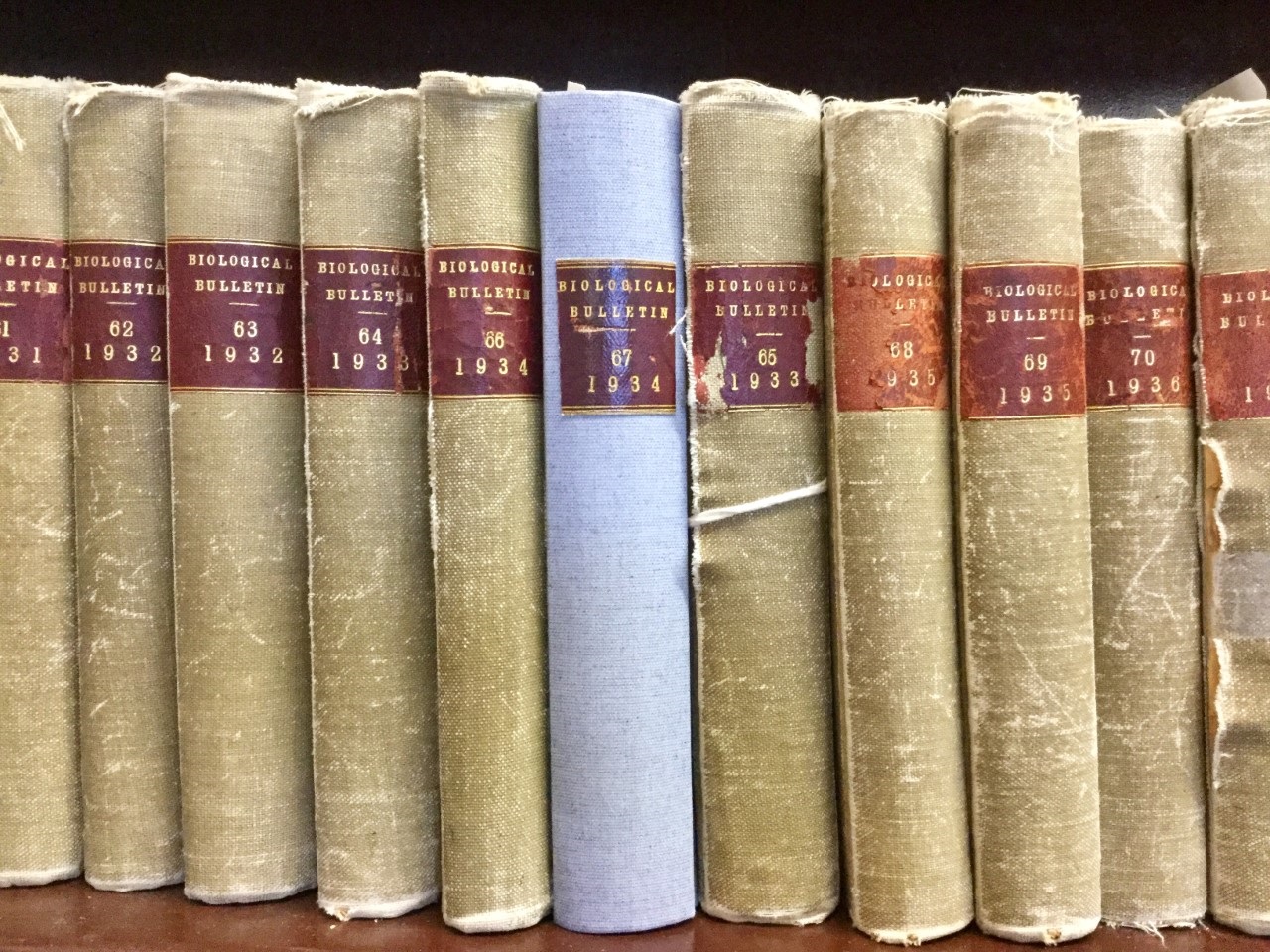
Volumes of the Biological Bulletin, on the shelf of the MBLWHOI Library. Photo by: Matthew Person.

The venerable science journal the Biological Bulletin has been published in association with the Marine Biological Laboratory of Woods Hole, Massachusetts for over 120 years. Presently, the publisher is the University of Chicago Press, with the editorial office in Woods Hole managed by longtime Editor, Carol Schachinger.

The Marine Biological Laboratory (MBL) was founded in 1888 through the diligent efforts of working scientists and Boston community leaders deeply invested in the marine and associated biological sciences as a tools to conduct research and develop diverse educational opportunities for the study of marine model organisms, through experimental work ultimately leading to an improved understanding of the human condition.

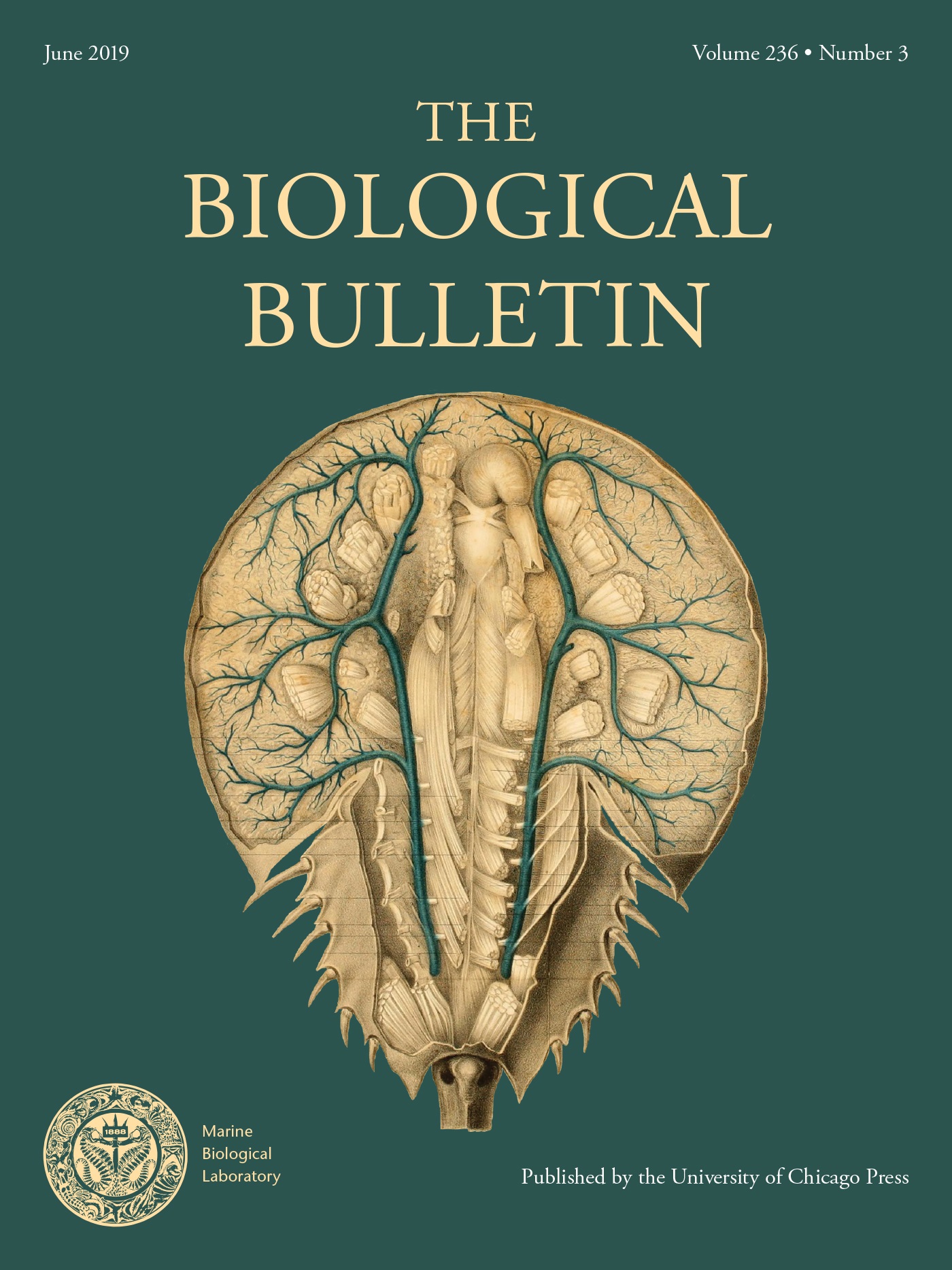
Cover of the Biological Bulletin with a horseshoe crab on it.

Cover. Biological Bulletin (Volume 236, Number 3, June 2019). Image reprinted by permission of the Biological Bulletin.

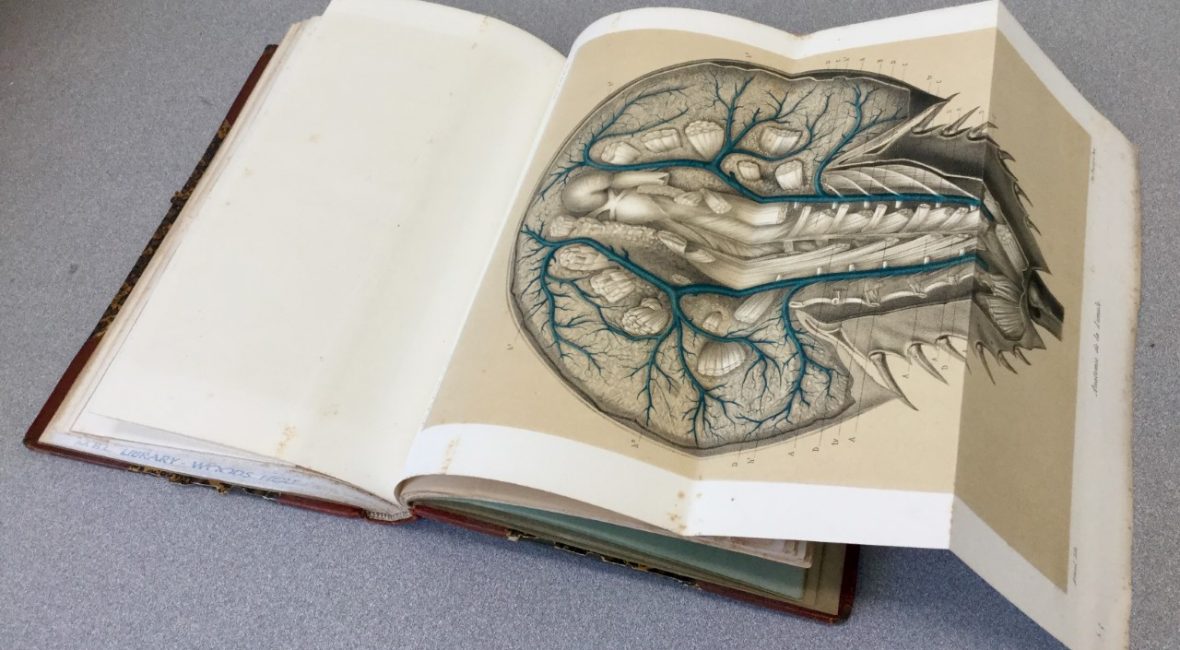
The June 2019 issue of the Biological Bulletin (Volume 236, Number 3) has an informative and beautiful cover illustration of the venous return half of the circulatory system of the horseshoe crab (Limulus polyphemus), chosen to illustrate an article in the issue: Effects of the Biomedical Bleeding Process on the Behavior of the American Horseshoe Crab, Limulus polyphemus, in Its Natural Habitat. The cover of this issue of the Biological Bulletin was designed from a freely downloaded Biodiversity Heritage Library file, coincidentally from a monograph about the horseshoe crab: Recherches sur l’anatomie des Limules — an 1873 work by Alphonse Milne-Edwards, the French medical doctor, mammologist, ornithologist, and carcinologist (one who studies crustaceans) who was director of the French Museum National d’Histoire Naturelle from 1891-1900.

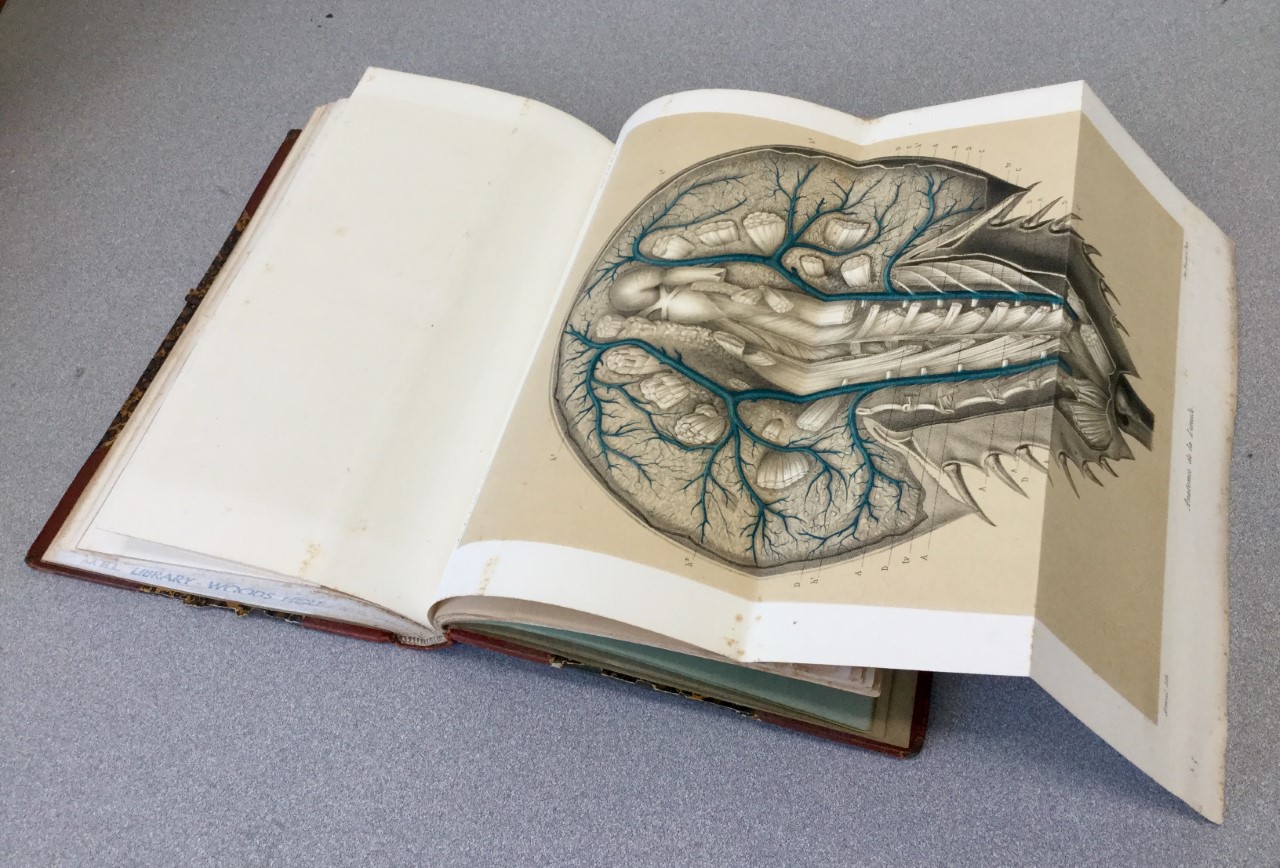
Foldout illustration of a horseshoe crab

Plate of the horseshoe crab (Limulus polyphemus) from “Recherches sur l’anatomie des Limules”, 5th Series, Tome 17, (1873) of the journal, Annales des Sciences Naturelles. Used for the cover of Biological Bulletin (Volume 236, Number 3, June 2019). Contributed in BHL from the MBLWHOI Library.

In the MBLWHOI Library this volume, interestingly, is shelved both in the climate controlled secure Rare Books Room and separately in the freely accessible journal stacks as an article in the 5th Series, Tome 17, (1873) of the journal, Annales des Sciences Naturelles. For important monographic works, multiple shelving locations in the pre-electronic age was common. Much of this content is also available in BHL in the multi-volume work partly edited by Alphonse Milne-Edwards: Mission scientifique au Mexique et dans l’Amérique Centrale : ouvrage publié par ordre de S.M. l’Empereur et par les soins du Ministre de l’instruction publique (1873). The introductory pages of this work speak of the ancient horseshoe crab, living over broadly distributed coastal swaths of the earth, yet the scientific community at that time was stumped as to how this creature was related to other similar species.

Black and white photo of a man with a mustache.

Photo (1883) of Alphonse Milne-Edwards, the author of “Recherches sur l’anatomie des Limules”, from which came the illustration of the horseshoe crab used on the cover of the Biological Bulletin, (Volume 236, Number 3, June 2019). By Th. Truchelut & Valkman, photographers. Upload, stitch and restoration by User:Jebulon – Bibliothèque nationale de France, Public Domain, Wikimedia Commons.

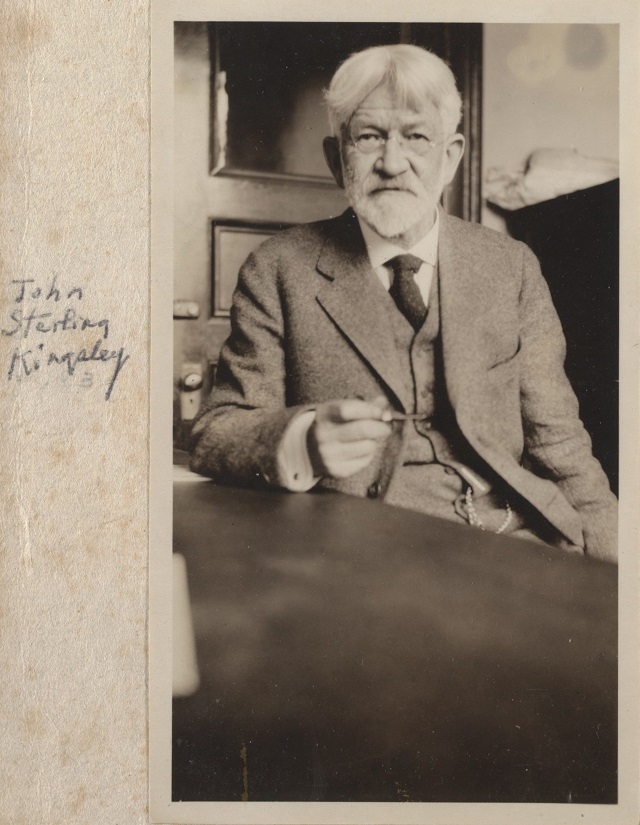
We noticed another aspect of the MBLWHOI Library Rare Books Collection copy of this monograph scanned into BHL. The title page is inscribed by the probable original owner of the volume: “Kingsley”. Looking at the History of the Marine Biological Laboratory’s online database of scientists, we see that biology professor John Sterling Kingsley (1854-1929) — who had appointments during his career at the universities of Indiana, Nebraska, Illinois, and Tufts University, and was editor of books such as The Riverside Natural History series (1885) — spent summers from the late 1880’s to the mid 1910’s doing research at the Marine Biological Laboratory in Woods Hole.

People often wonder how academic research libraries grow and become institutions unto themselves. This example illustrates one method of library growth. With Kinglsey’s name inscribed on page one of Recherches sur l’anatomie des Limules, the book was most probably given to the then-MBL Library by Kingsley or his heirs — one of thousands of volumes over 130+ years which became a part of the Library’s collection in that manner.

Black and white photo of a man in a suit.

Photo of John Sterling Kingsley, the original owner of the MBLWHOI Library copy of “Recherches sur l’anatomie des Limules”, available in BHL. Source: MBL archives. CC-BY-NC-SA.

We spoke with Biological Bulletin Managing Editor Carol Schachinger about the process of selecting a cover for a journal issue. She told us that out of the body of articles comprising a new issue published every two months, an appropriate cover image to be considered for publication often naturally rises to the top. In the case of V.236, n.3 of the Biological Bulletin, however, this did not initially happen, and even after contacting article authors for possible cover issue suggestions, Schachinger was still without a cover image as the issue headed towards completion.

Schachinger’s alternate plan was to begin making simple online image searches related to issue articles. As the horseshoe crab has been one of the most important studied marine organisms at the Marine Biological Laboratory, it was natural to look for images of this organism, and shortly, the plates from Milne-Edwards’ monograph appeared in simple Google website searches as distinct possibilities for a cover image.

At first, she did not realize the image she ultimately chose was from the holdings of the MBLWHOI Library, nor did she realize the image was from the Biodiversity Heritage Library. Carol was also not aware of the flickr feed of BHL images, which was another access point for this image (and many thousands of images extracted directly from the electronic pages of BHL content). However, when she selected plate 14 of the horseshoe crab circulatory system as the probable cover illustration for the June 2019 issue of the Biological Bulletin, she contacted the librarians at the MBLWHOI Library to ask about proper attribution and the workflow for downloading the out-of-copyright image. They directed her to the FAQ pages of BHL, where all of this information sits.

Thus the v.236, n.3 issue of the Biological Bulletin finally had cover art.

The MBLWHOI Library

In 1888, the sea-side Marine Biological Laboratory heeded the charge of its first Director, Charles Otis Whitman (1842-1910), with reference to the building of a working library to serve its scientists. Woods Hole on Cape Cod was just too far from the Boston research institutions for MBL to rely upon libraries there to provide library services to a small Cape Cod research institution (which would eventually grow into a biological research facility of global renown). Dr. Whitman said: “A library is a necessity in such a laboratory…We must have at a minimum to begin with, all the important journals now printed in the four principal languages.” Jump forward 120 years hence, the MBLWHOI Library (the joint library of the Marine Biological Laboratory and the Woods Hole Oceanographic Institution (WHOI, founded in 1930) was a founding partner of the Biodiversity Heritage Library, providing key technical and library staff support to BHL at its founding in 2006, and continuing to this day.

August 22, 2019by michelle.underhill
BHL News, Blog Reel

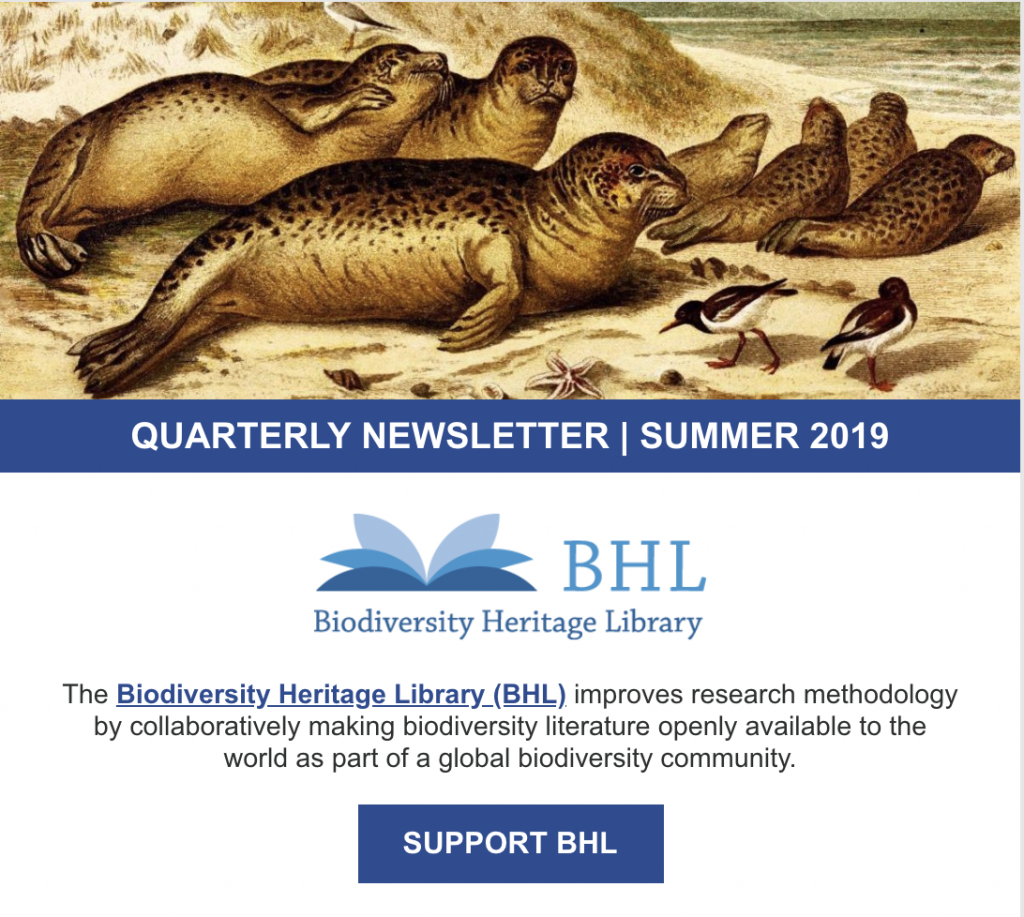
2019 Summer BHL Newsletter Now Available!

screenshot of the summer 2019 newsletter

screenshot of the summer 2019 newsletter

Enjoying your summer? We are, because we’ve been busy these past few months and have a lot to share! From crowdsourced transcriptions in BHL to new article download functionality and a new paleobiology collection curated by Smithsonian Libraries, check out all of the latest program news in the 2019 Summer Newsletter.

Be sure to subscribe to our mailing list to keep up to date with all the latest BHL news.

August 20, 2019by michelle.underhill
BHL News, Blog Reel, Tech Updates

BHL Journal Articles Are Now Discoverable via Unpaywall

Earlier this week, Rod Page and I received an email from Richard Orr, the Lead Developer at Unpaywall, telling us that he had created a work-around that would finally enable the Unpaywall extension to discover content in BHL. And I (Nicole) literally spent the rest of the day jumping for joy. 

Let us explain: 

Firstly, what’s a DOI?

DOIs (Digital Object Identifiers) are used throughout the scholarly research community to uniquely identify academic articles. They help readers locate the definitive version of a published article, and they make linking together the academic literature much easier – look at any recent paper and you’ll see that most of the references cited have DOIs.

DOIs do two things: 1) they uniquely identify an article, and 2) they point to the online location of the definitive version of that article (typically hosted by the article’s publisher). 

Many articles are not free to read: a significant proportion of both recently-published and historic articles are locked behind paywalls. However, with the rise of open access, it’s increasingly the case that there may be a free version of an article available somewhere online. BHL, for example, has scanned and made available tens of thousands of articles that also exist on commercial publishers’ websites. DOIs always direct users to the definitive version of an article. But if the definitive version is behind a paywall (as they so often are), how do we tell users that BHL has a free version available? Enter Unpaywall.

What’s Unpaywall?

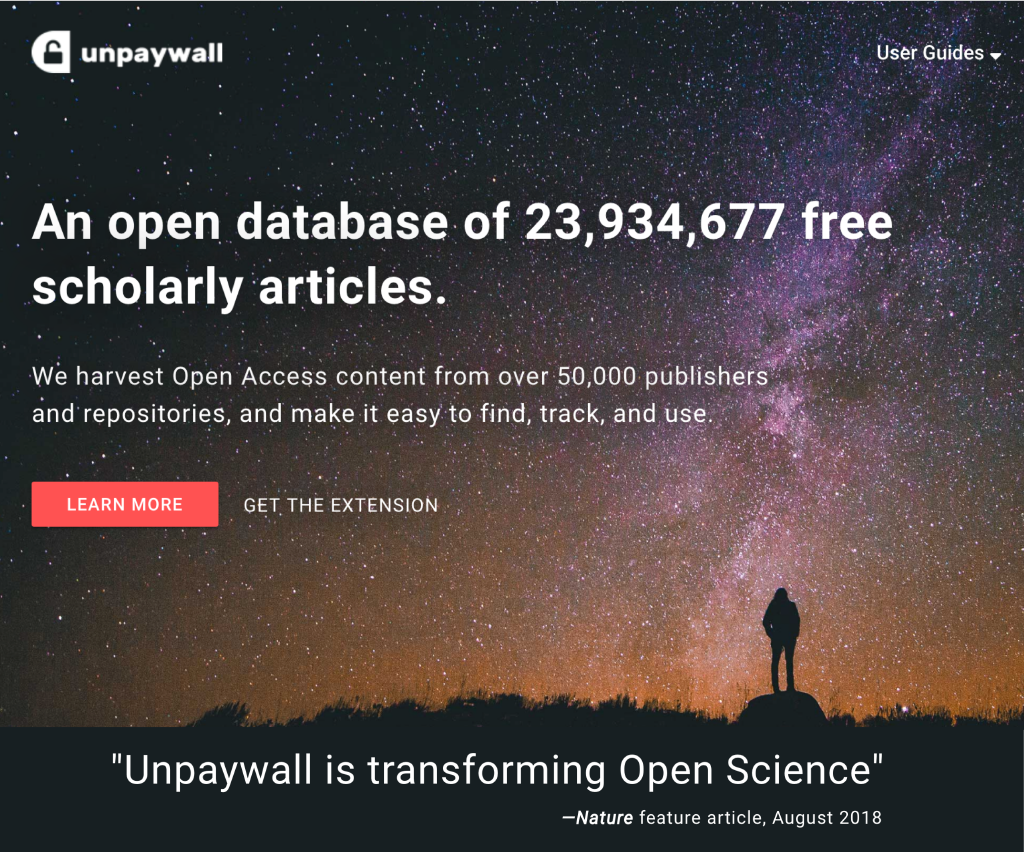
Unpaywall finds (legally) open access versions of paywalled literature. Since its launch in 2016, Unpaywall has become an indispensable tool for scientists  (see “How Unpaywall is transforming open science”). Unpaywall’s free browser extension (downloadable via their website) displays a discrete padlock symbol on the side of your browser whenever you are on a paywalled paper. If Unpaywall is able to locate a freely-accessible copy of the article elsewhere, the padlock symbol appears green and clicking on it will take you directly to the open access version. To discover whether an article is free, Unpaywall scans a database of millions of articles compiled from over 50,000 sources. Until this week, BHL wasn’t one of them. 

Screenshot of Unpaywall homepage

Why couldn’t Unpaywall link to BHL?

BHL contains hundreds of thousands of journal articles. More than a quarter of a million of these articles have been indexed (the vast majority by Rod Page via Biostor), which means that they now have article-level landing pages containing their article-level metadata. Tens of thousands of these article landing pages now have DOIs. This should have made them discoverable, but Unpaywall still couldn’t find them. 

In June, we contacted Unpaywall to find out why. It turns out that the reason BHL content has never been picked up by Unpaywall is because of the way BHL uploads and presents its journal content. Most providers of online journals present each article neatly packaged as an individual PDF. BHL, however, is first and foremost a virtual library. We upload complete volumes of journals made up of individual page images. Our article landing pages don’t link to PDFs; they link to the page in the volume upon which the article starts. Unpaywall looks for a PDF link to confirm that the document is actually available. Thus, the 57 million pages of open access content on BHL was excluded from Unpaywall’s database.  

After we explained to Unpaywall how significant BHL’s content was, Richard Orr, Unpaywall’s Lead Developer, very kindly agreed to create a work-around, specifically for BHL, that would enable Unpaywall to link to BHL article landing pages. The result of this work-around is that (as of this week) 43,000 journal articles on the BHL website are now discoverable via Unpaywall. 

To demonstrate how useful this is, here are two examples:

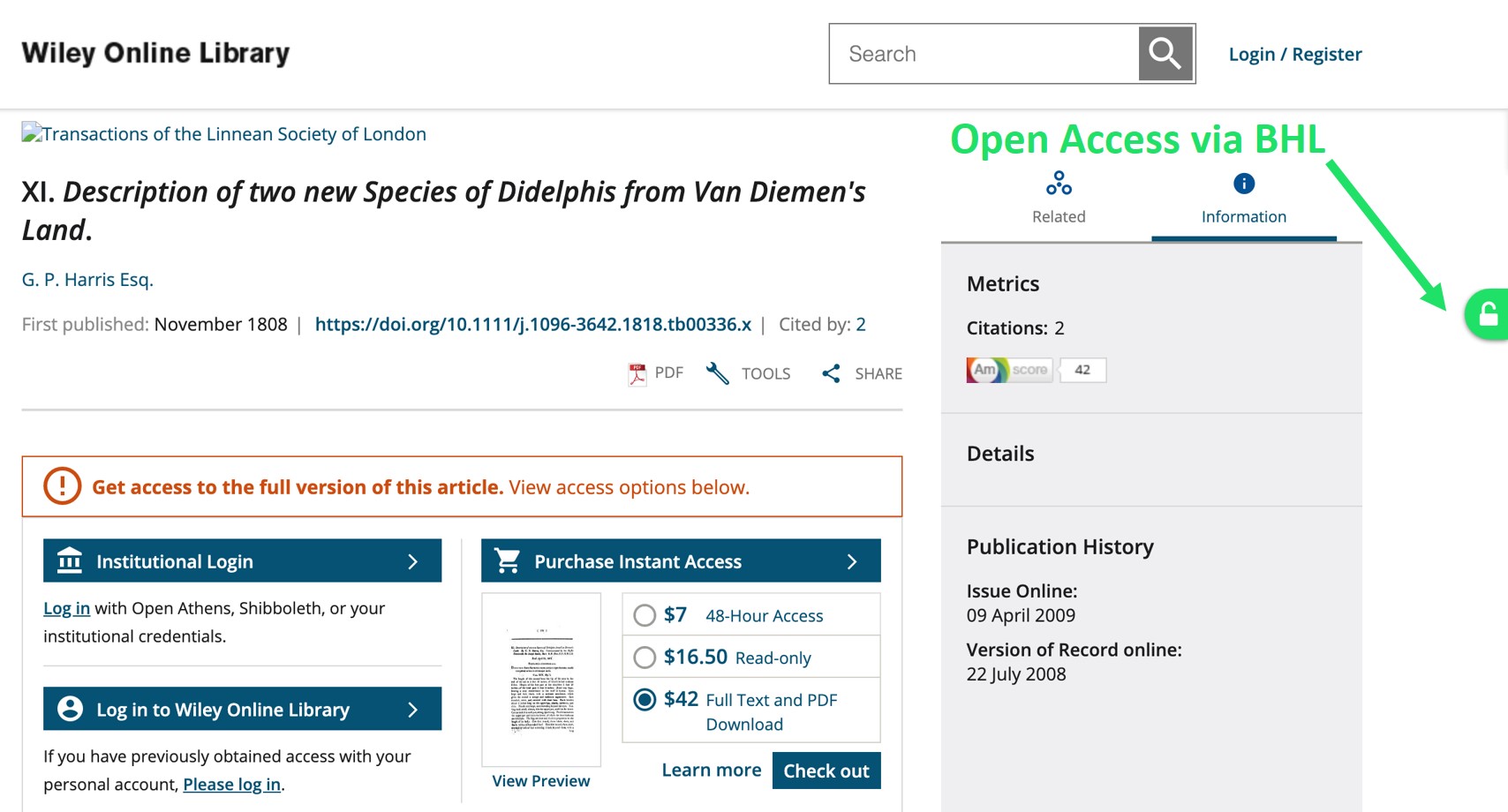
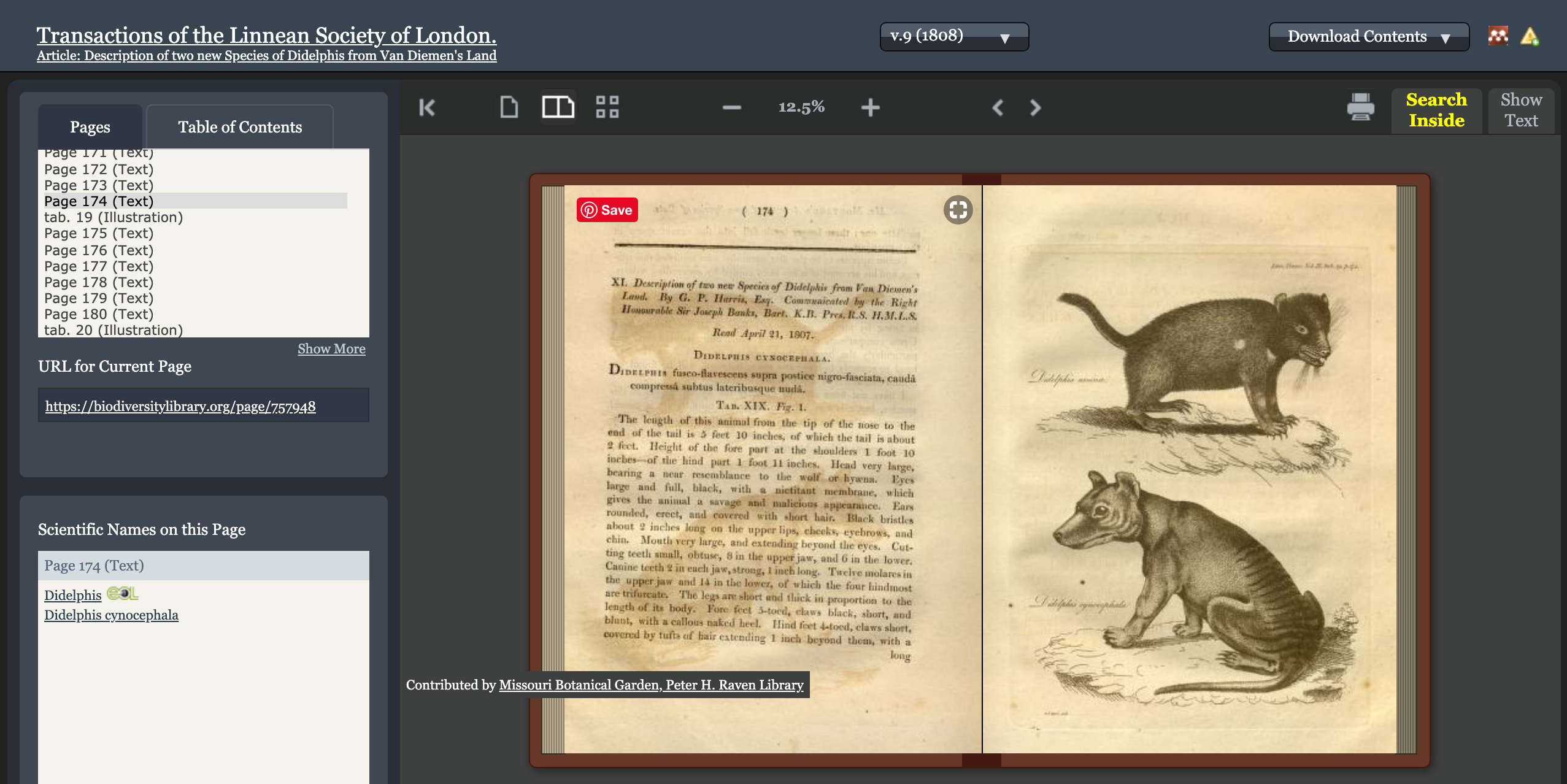
The first description of the iconic (sadly now-extinct) Thylacine (or Tasmanian Tiger) was published in the Transactions of the Linnean Society of London in 1808. This article is well and truly out of copyright and yet the definitive version of this article is behind a paywall on the Wiley Online website: https://doi.org/10.1111/j.1096-3642.1818.tb00336.x. Downloading the PDF of this out-of-copyright article from the Wiley website will cost you $42 USD.

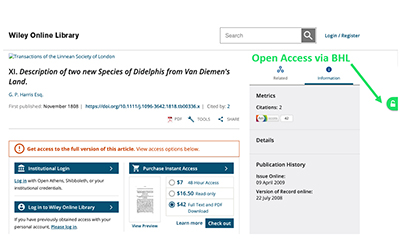
Screenshot of an article landing page on Wiley Online

The definitive DOI version of this article is behind a paywall on the Wiley Online website, but it is freely available on the BHL website. With the Unpaywall extension, you can now easily navigate to the free version on BHL.

Now that BHL’s content is discoverable via Unpaywall, anyone directed to the Wiley version via the article’s DOI can discover the free version on BHL (via the Unpaywall extension).

Screenshot of an article in BHL

Article freely available via the Biodiversity Heritage Library.

It’s important to note that making BHL discoverable via Unpaywall doesn’t just enhance access to legacy literature such as the Thylacine paper; it also applies to much more recent research. For example, “The generic relationships of the new endemic Australian ant spider genus Notasteron (Araneae, Zodariidae)” was published in The Journal of Arachnology in 2005. This article has the DOI (https://doi.org/10.1636/04-56.1) and is behind a paywall on BioOne. With Unpaywall’s extension in your browser you can now discover the free version hosted by BHL.

How to make even more BHL content discoverable via Unpaywall

43,000 may seem like a large number, but it’s actually only a tiny fraction of the articles freely available on BHL. For the Unpaywall extension to be able to locate all the journal content on BHL, we need to unlock the rest of the journal articles on BHL by 1) adding more article-level metadata, and 2) ensuring that, for every article on BHL that has an existing DOI, we include that DOI in the article-level metadata. That’s our next task…

We would like to thank Unpaywall for providing access to an ever-increasing number of open access scholarly articles (23,943,966 at 14/8/19) and to particularly thank their Lead Developer, Richard Orr, for making it possible for BHL (a square peg) to fit into their open database (a round hole).  

August 16, 2019by Joel Richard
Blog Reel, User Stories

Between Nature and Society: Empowering Research on the History of Science

Photo of a man standing in front of a book case.
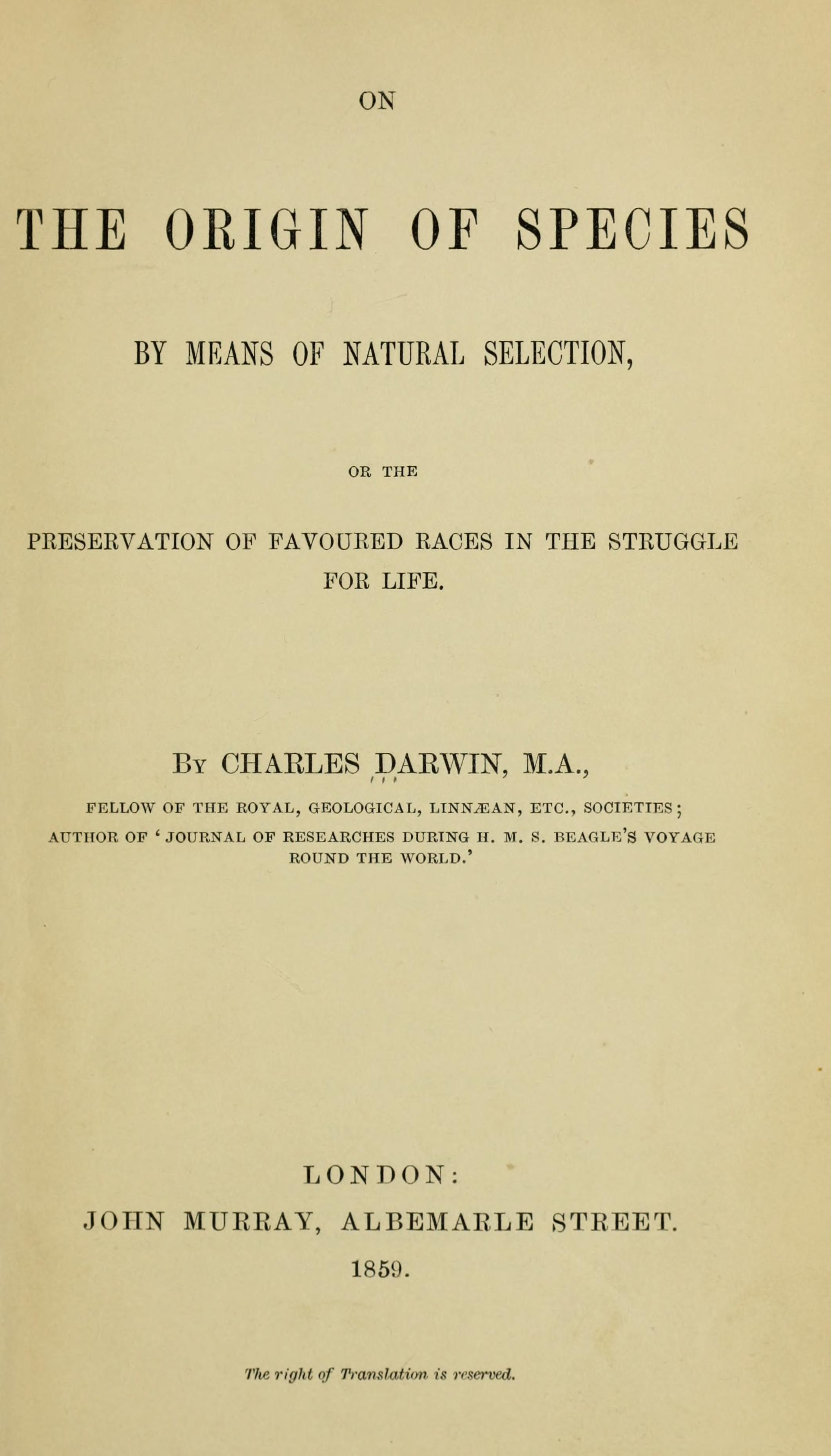
Title page of On the Origin of Species

Title page. On the Origin of Species by Charles Darwin. Contributed in BHL from Harvard University Botany Libraries.

Charles Darwin is a household name. One of the most famous naturalists to ever live, he is known around the world for his publication On the Origin of Species and contributions to evolutionary theory.

The work of contemporary scientists informed the development of Darwin’s evolutionary concepts. By applying, and sometimes countering, the theories of others, he constructed one of our most important scientific foundations. He documented this intellectual progression in the margins of the books in his library. This historically significant collection is available online in the Biodiversity Heritage Library.

Charles Darwin’s Library is a digital edition and virtual reconstruction of the surviving books owned by Charles Darwin. Produced as a collaboration between BHL, Cambridge University Library, the Library & Archives of the Natural History Museum in London, and the Darwin Manuscripts Project, the collection draws on original copies and surrogates from other libraries and includes over 500 of the 1,480 books in Darwin’s library. Notably, these books are complemented with fully-indexed transcriptions of Darwin’s annotations.

Charles Darwin’s Library is particularly meaningful to Dr. B. Ricardo Brown, Professor of Social Science and Cultural Studies at the Pratt Institute. Brown has devoted years of research to Darwin and the impact of his evolutionary theories on debates around monogenetic vs. polygenetic human origins. Brown’s 2010 book, Until Darwin: Science, Human Variety and the Origin of Race, explores the complex web of factors that influenced these debates from the 17th-19th centuries and the impact of the publication of On the Origin of Species on this scientific discourse.

Brown spent nearly 10 years researching this book. Today, BHL’s open access collections offer researchers considerable time-savings.

“I am sure that if I had the kind of access to texts that BHL now provides researchers, I could have reduced the research time for Until Darwin in half,” muses Brown.

Photo of a man standing in front of a book case.

Dr. B. Ricardo Brown, Professor of Social Science and Cultural Studies at the Pratt Institute. Photo Courtesy of B. Ricardo Brown.

With academic backgrounds in environmental studies, sociology, and critical theory, Brown’s research explores the history of science, investigating the relationship between society and nature and the “genealogies of systems of knowledge” through which we make sense of these relationships. His current project looks at sociology and ecology as “sciences of life” whose formation was made possible by the dissolution — marked by Darwin’s Origin — of political economy and natural history.

“Without BHL, such a project would be much more limited, if not impossible,” affirms Brown. “The Library’s impact has been immense.”

Brown refers to BHL at least several times a week. A great benefit of the Library is that it has facilitated unexpected discoveries that expand the scope of relevant literature for his research projects.

“BHL makes it possible to browse through the library and (virtually) pick-up an unfamiliar work or author and discover something that is relevant or just interesting — which you might not have come across without BHL,” explains Brown. “There is much to be said for the pleasures of simply exploring the archive.”

Beyond serving as a vast archive of texts, artifacts, and scientific ideologies, BHL also facilitates Brown’s interest in ecology and environmental studies by allowing him to compare his own field observations to those of past naturalists.

“I found that it is quite useful to do some field observations and hikes when immersed in the study of Darwin and the Natural History of his time,” says Brown. “One gets a better insight into Darwin’s methodology, which depended on his own observations and those of trusted naturalists and correspondents.”

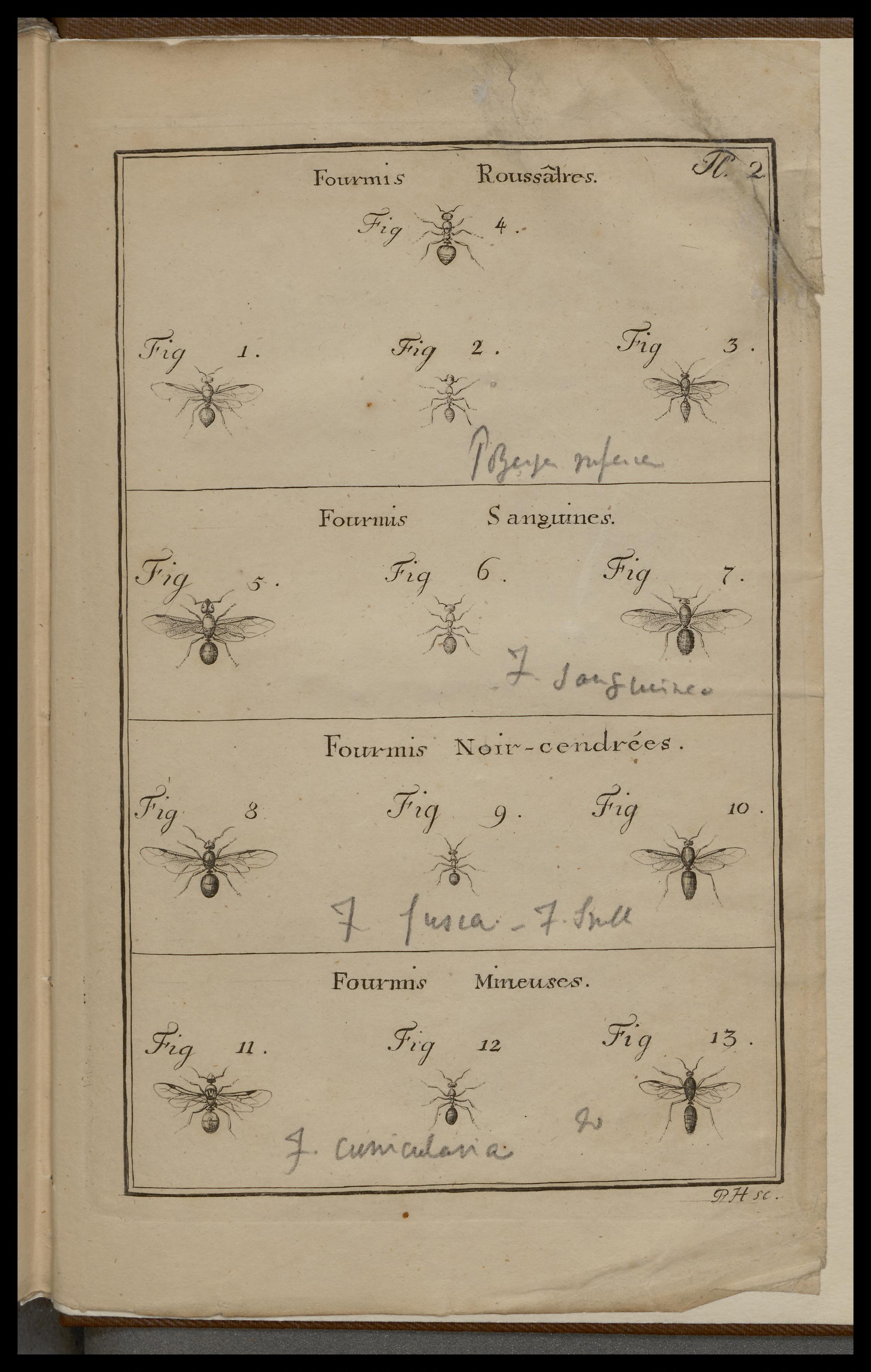
Take, for example, Darwin’s observations on slave-making ants.

“Darwin constantly tacks back and forth between his own observations and those of the recognized authority on the slave-making ‘instinct’ in ants, Pierre Huber,” explains Brown. “This series of observations led Darwin to conclude that the ‘instinct for slavery’, in ants as well as human societies, was in no way ‘miraculous’ or evidence of a fixed or natural hierarchy.”

Illustration of ants

Plate 2. Recherches sur les moeurs des fourmis indigènes by Pierre Huber. Part of the Charles Darwin’s Library collection. Contributed in BHL from Cambridge University Library.

Brown also finds BHL to be a useful educational resource for his courses.

“BHL provides a means for students in my courses to access and download PDFs of texts that only a few years ago would have been known to them only through secondhand descriptions, summaries….or long lectures,” affirms Brown. “ As Pratt is primarily a school of art, design, and architecture, students appreciate the aesthetic skills of early naturalists that they experience through BHL’s high resolution images. Works such as Cuvier’s Tableau élémentaire de l’histoire naturelle des animaux or Haeckel’s Kunstformen der Natur provide a wonderful avenue for understanding the social relations of art, aesthetics, and science.“

With much of his research focused on the investigation of science and society’s influence on each other, he’d love to see BHL incorporate functionality allowing readers to explore the social and cultural contexts of the texts in the Library.

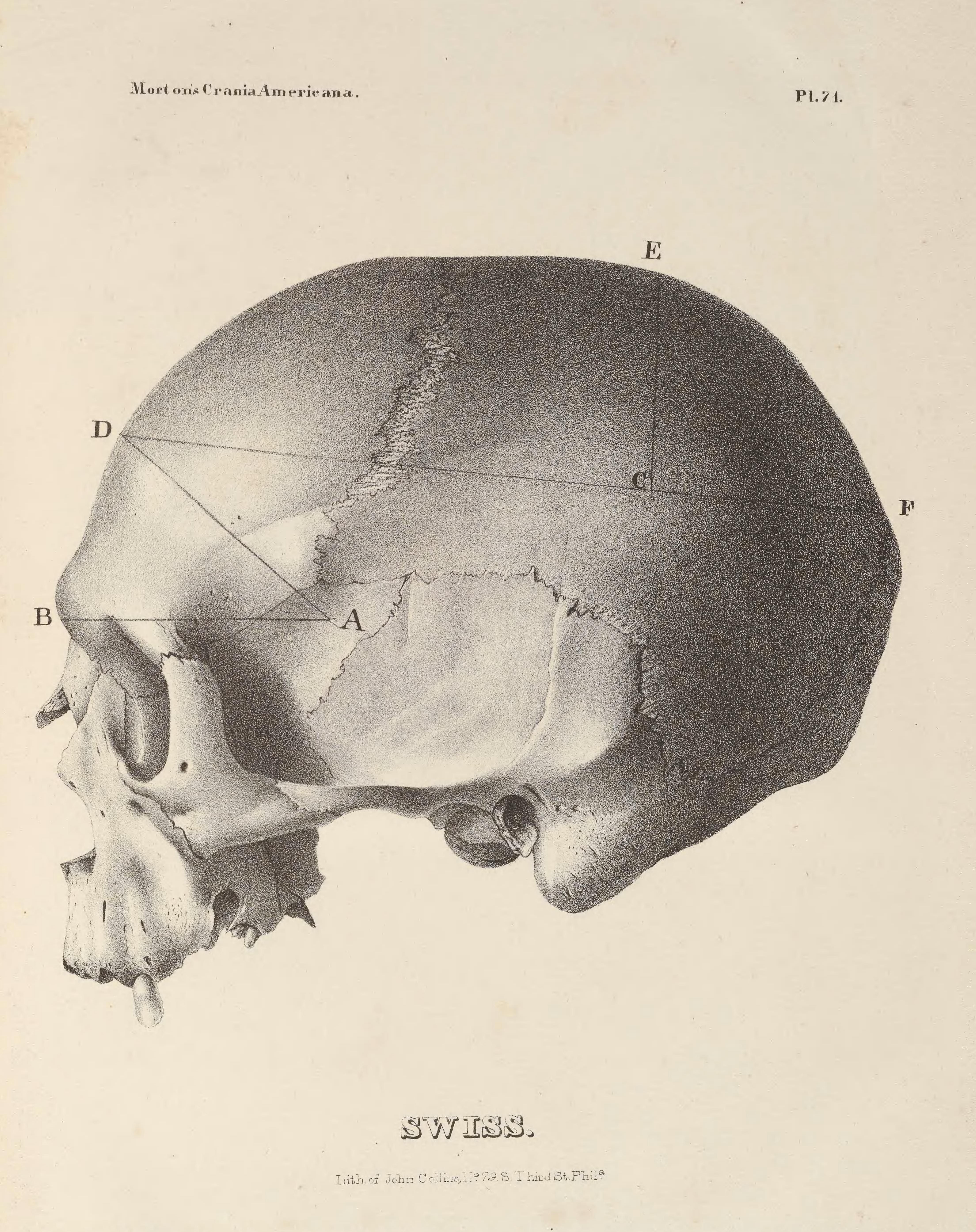
“By its inclusion in the collection, each text potentially takes on a certain legitimacy,” considers Brown. “This means that texts such as Morton’s Crania Americana or Pouchet’s The Plurality of the Human Race might, despite or perhaps even because of their age, be misread as somehow giving voice to views that remain contested. And because much of the history of science is the history of errors, this issue takes on a particular importance when authoritarian movements are constantly seeking to co-opt a wide variety of knowledges — for example, Classical and Medieval Studies, Darwinism, Ecology and Environmental Studies — to the service of supremacy.”

Illustration of a skull

Pl. 71. Crania americana by Samuel George Morton. Contributed in BHL from Smithsonian Libraries.

As we explore opportunities to link our content with other resources, collections, and databases in future iterations of BHL, including through linked data applications, strategies to provide this context will hopefully become increasingly feasible.

While many aspects of BHL’s collections and services have been important to Brown’s research, his favorite feature of the Library is that it is free and open to the public.

“BHL makes the history of science available to everyone,” praises Brown. “It would seem to have significant potential to enrich citizen science projects, as well as public discourse on climate change, extinction, the authority of science, the domination of Nature, and much more.”

We’re proud to know that, by making our collections globally accessible to anyone with an Internet connection, BHL is helping to advance a wide range of research and inspire discovery of the natural world.

August 15, 2019by michelle.underhill
Blog Reel, Featured Books

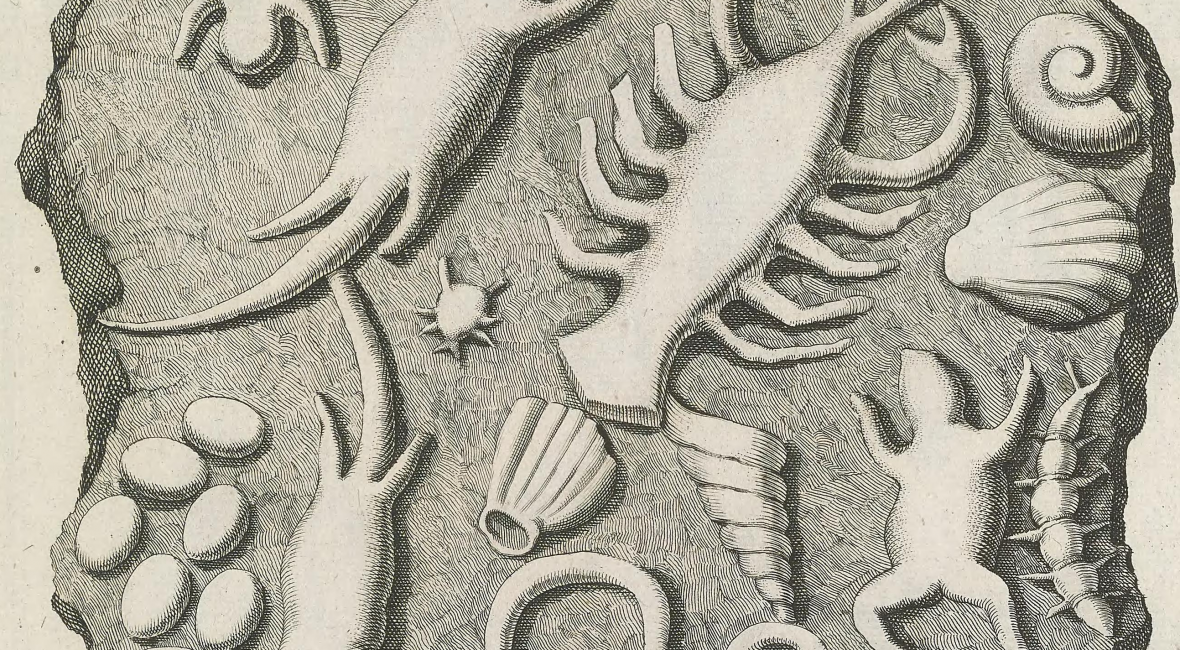
A Heavy Hoax: The “Lying Stones” of Johann Beringer

Illustration of fake fossils

This blog post is part of a series from Smithsonian Libraries highlighting Unearthed, a new collection of paleobiology literature in the Biodiversity Heritage Library curated by Smithsonian Libraries in celebration of the opening of the National Museum of Natural History’s David H. Koch Hall of Fossils – Deep Time exhibit. Follow the series throughout 2019 as Smithsonian scientists and librarians discuss the collection, identify their favorite books within it, and explain the importance of paleobiology literature in research today.

This post was written by Alexandra K. Alvis, reference librarian in the Joseph F. Cullman 3rd Library of Natural History. The Cullman Library holds the Smithsonian’s collection of rare books in anthropology and the natural sciences. Its world-class collection contains approximately 20,000 volumes published before 1840, all of which are available for consultation in our reading room. The Cullman has contributed over 4,700 volumes to BHL, with more being added every week.
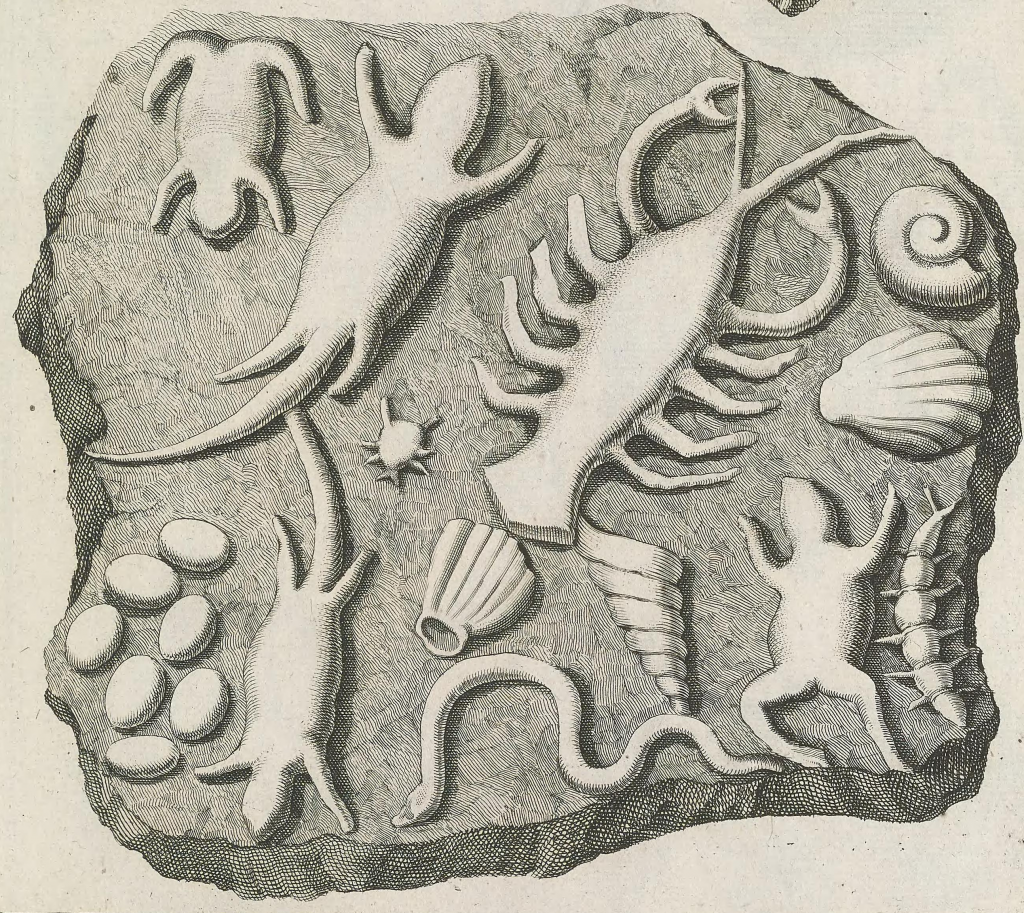
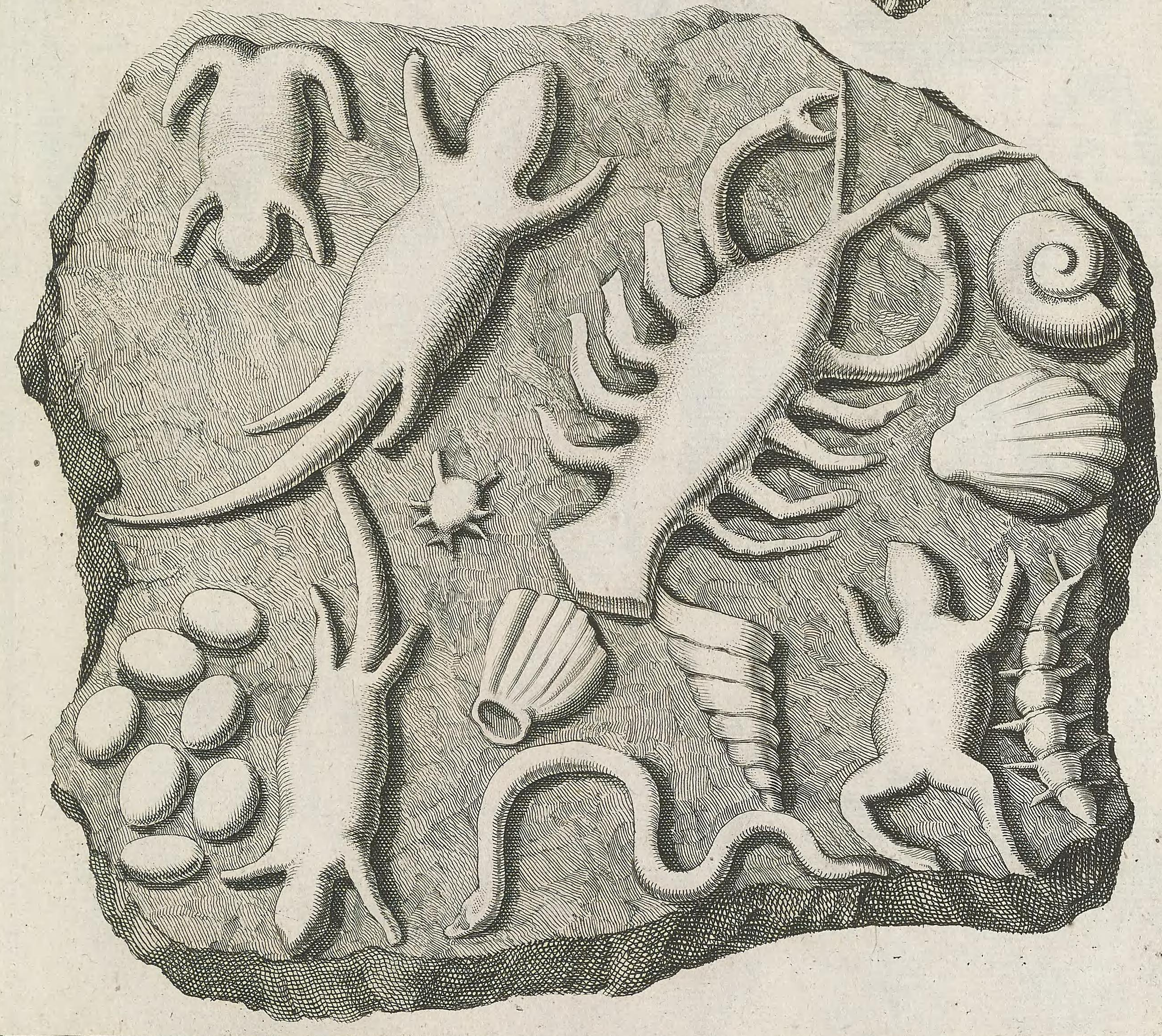
Illustration of fake fossils

Tab. I from Beringer’s Lithographia (1740). Contributed in BHL from Smithsonian Libraries.

Fake fossils are a difficult issue for modern paleontologists: there is a booming black market in forgeries, and well-intentioned researchers of the past have even managed to accidentally fool the curators of today with detailed reconstructions! The black market manufacturers have money on their minds and past researchers were simply doing their jobs to the best of their abilities, but one historical case of forged fossils stands out as particularly sinister. The victim was a certain Dr. Johann Bartholomew Adam Beringer (1667-1738), a professor at the University of Wurzburg. The perpetrators: Beringer’s very own colleagues, J. Ignatz Roderick and Georg von Eckhart.[1] This sordid tale resulted in unfortunate endings for all three of the parties involved, but also produced a curious monograph entitled Lithographia Wirceburgensis which can be found digitized in our Unearthed! digital collection.

This tale of stony deception began when the twenty-seven year old Beringer was named professor at the University of Wurzburg in 1694, only a year after achieving his doctorate in medicine there.[2] In 1695, he was summarily appointed keeper of the botanical gardens of the University. In this period, medicine was heavily anchored by botanical knowledge; the main components of most cures and salves were plant-based concoctions. Beringer was particularly enthralled by the natural history side of his career, and passionately expanded his personal cabinet of curiosities to display his collection of interesting objects from the natural world. He also began to pepper his lectures with references to “petrifactions,” a catch-all term for what modern science now understands as fossilized remains of plants and animals.
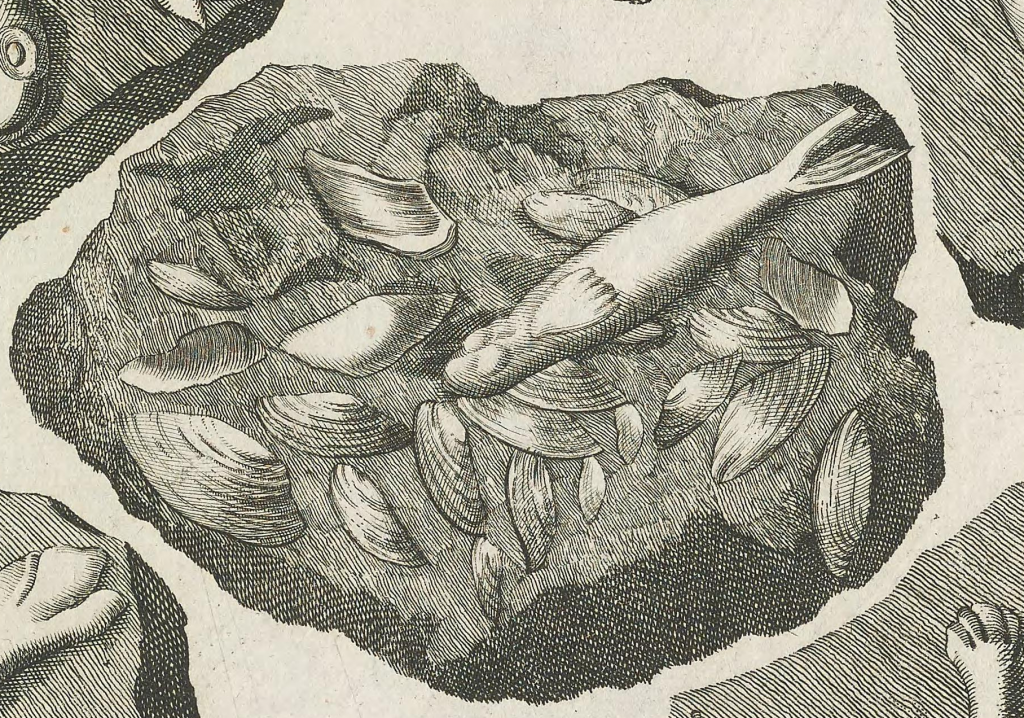
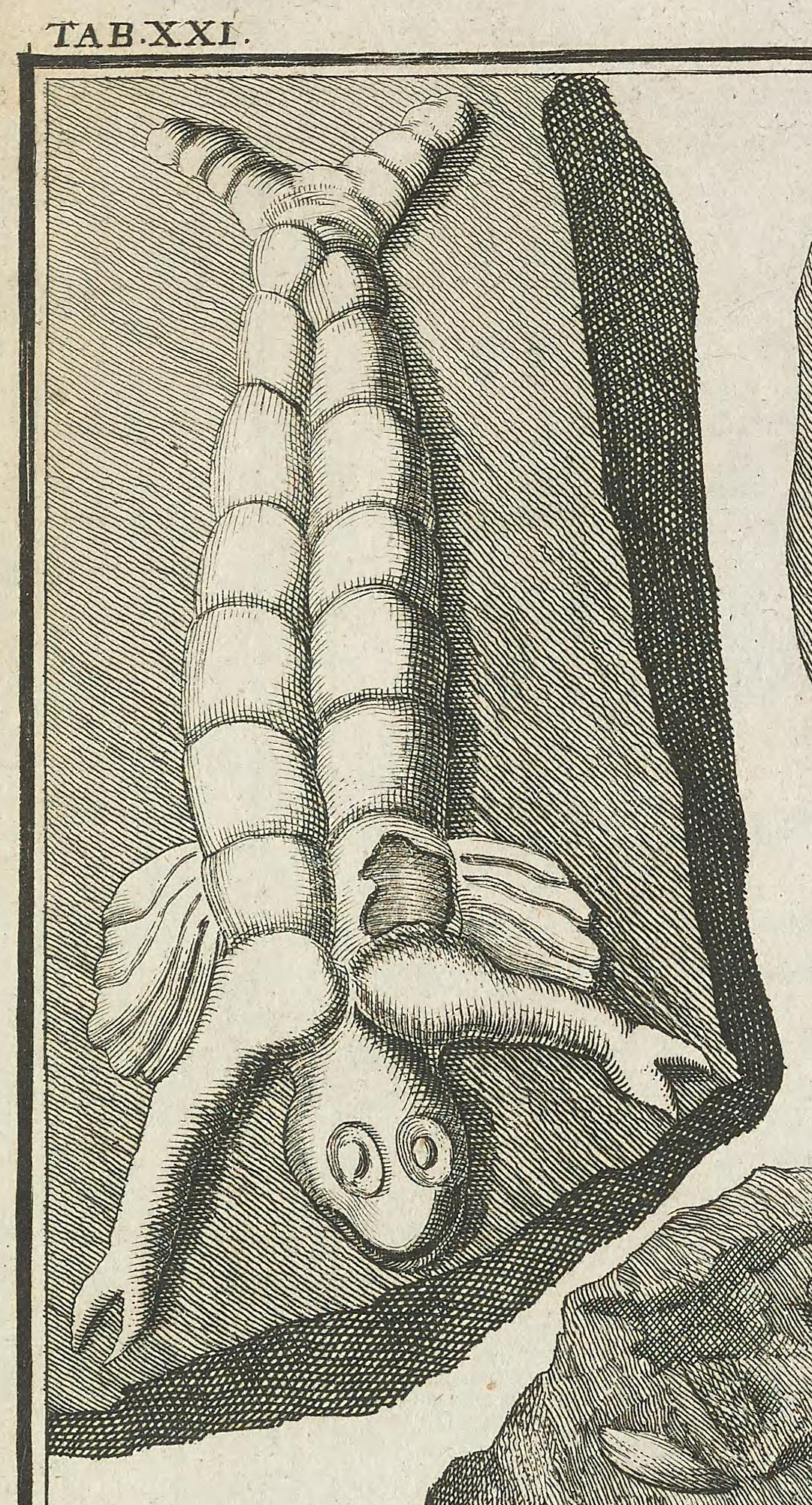
Illustration of a fake fossil

Detail, Tab XXI, Beringer’s Lithographia (1740). Contributed in BHL from Smithsonian Libraries.

Beringer’s rise through the academic ranks did not go unnoticed. J. Ignatz Roderick, a University of Wurzburg professor of geography, algebra, and analysis, and Georg von Eckhart, the University librarian, resented what they saw as Beringer’s arrogance[3] and plotted to deflate his ego. Aware of Beringer’s fascination with the fossils in the shell lime deposits of Mount Eibelstadt[4] and his collecting practices, Roderick and Eckhart formulated a plan to carve and plant fake fossils on the mountain. In 1725, they placed their first specimens and enlisted the assistance of Beringer’s “diggers”— three boys that Beringer had hired to search the mountain for “figured stones” for his cabinet— although only one of the boys knew the full extent of the deception.[5]

And so, their trap was laid: when the boys returned from the mountain with the first three fakes, Beringer was thrilled. News of the fantastic stones spread, and the boys began receiving requests for their stone-hunting abilities from local pharmacists, rich gentlemen, and even some of Beringer’s fellow medical doctors.[6] Beringer himself visited the mountain on several occasions, and remarked on the fact that the hillside which he had “frequented and examined in the past but had never scrutinized very closely, revealed a treasure.”[7] As the false stones continued to turn up, Beringer began to display them to friends and colleagues, not all of whom were as certain of their veracity as he was. He writes that “to dispel these misgivings from their minds, I led some companions on the pleasant jaunt to the site… where they dug out these portentous symbols of natural things with their own hands.”[8]
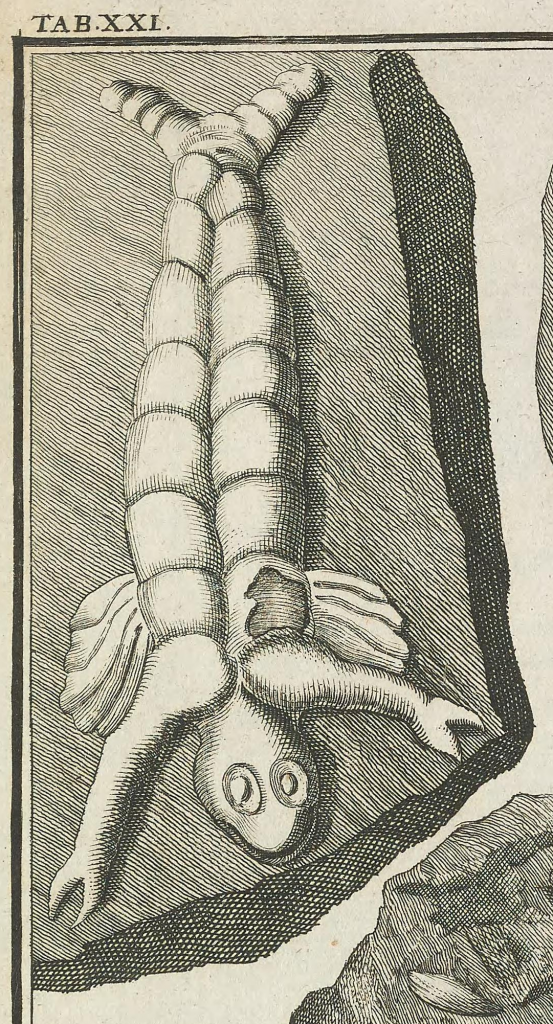
Illustration of a fake fossil.

Detail, Tab XXI, Beringer’s Lithographia (1740). Contributed in BHL from Smithsonian Libraries.

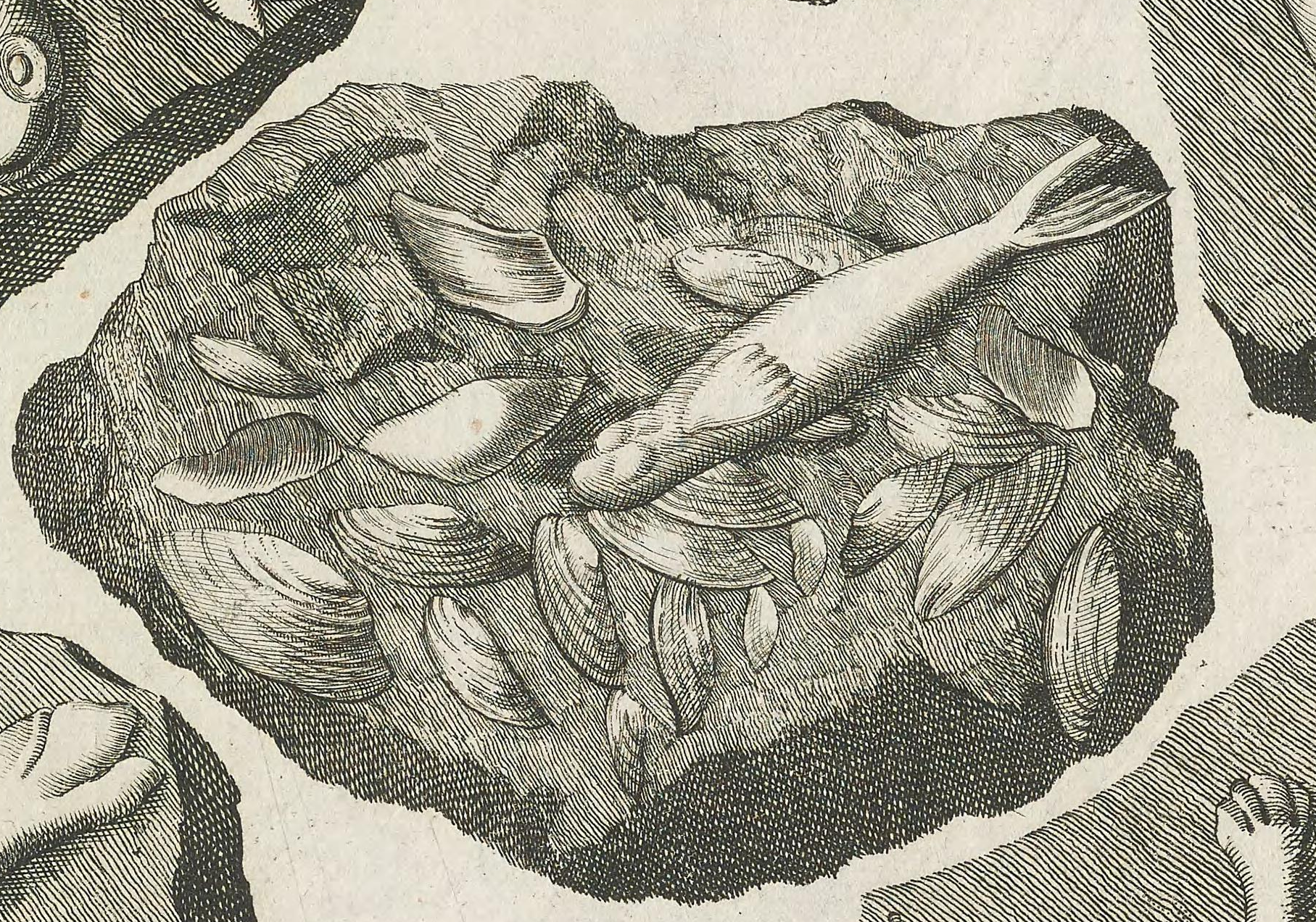
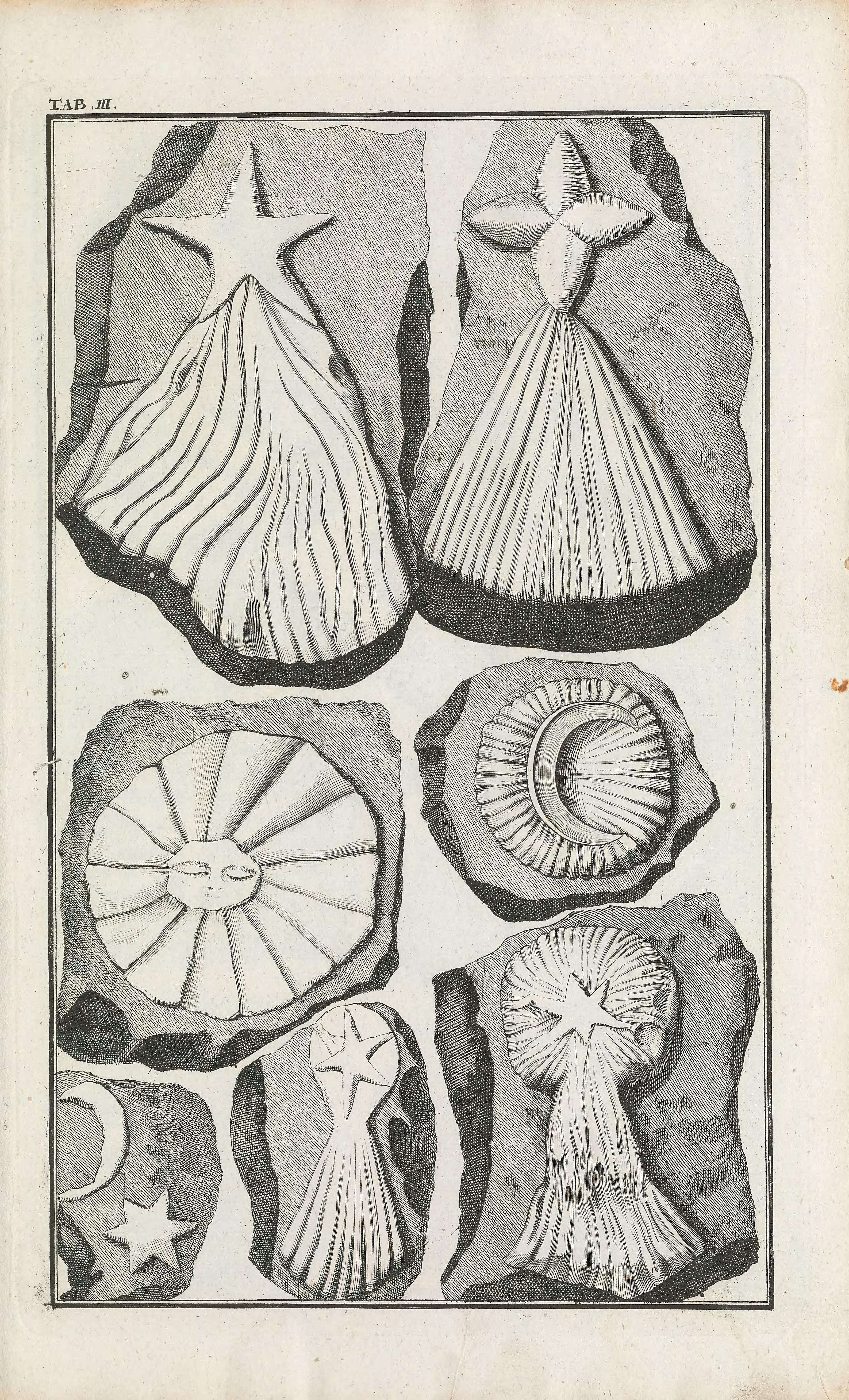
Many of the fossils found on the mountain were genuine, which certainly contributed to Beringer’s unwillingness to consider the possibility of deception in the more whimsical examples. Although his cabinet no longer survives, Beringer’s records show that it contained numerous specimens of these real fossils until Roderick and Eckhart began to surreptitiously contribute to his collection. He developed complex theories to explain the more fantastical items: the stones with writing, even with their occasional spelling and orthographical mistakes, were the work of God, to ensure that “when forgetful men grow silent, these mute stones might speak.”[9] The images of celestial activity such as shooting stars and radiant suns could be explained in reference to the Archimedian method of using a parabolic mirror to “collect [sunlight] in a bowl” in order to focus it to set fire to an enemy fleet.[10]
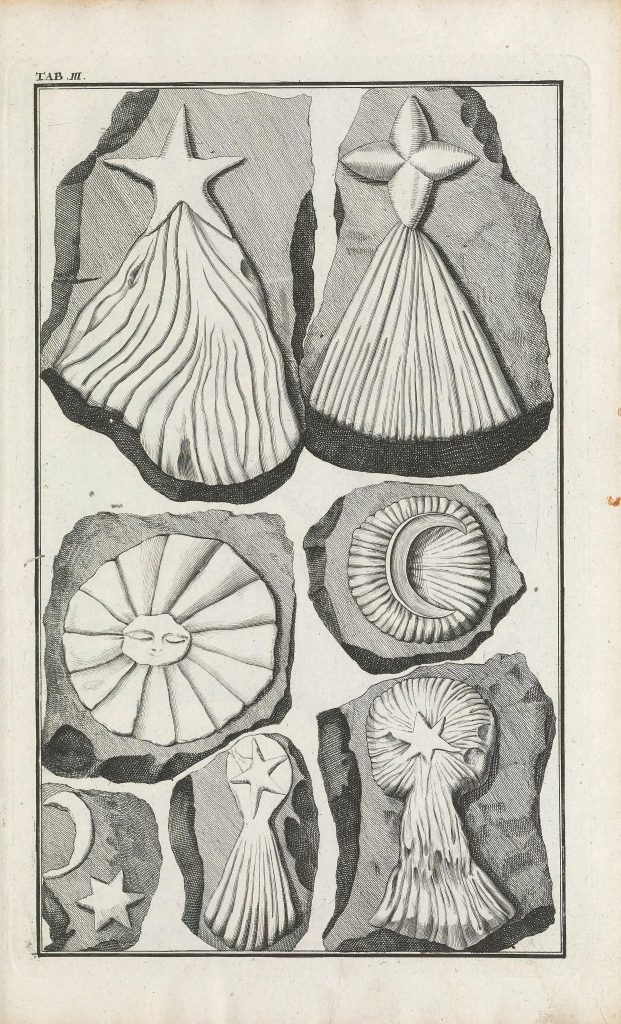
Illustration of fake fossils.

Tab. III from Beringer’s Lithographia (1740). Contributed in BHL from Smithsonian Libraries.

Beringer compiled these theories and justifications, along with engraved plates of the figured stones, into a dissertation to be titled Lithographia Wirceburgensis. As word reached Roderick and Eckhart that Beringer intended to publish on their hoax, it seems they felt a pang of guilt; they started a rumor that the stones had been false all along, and even sold some of them to him directly, later informing him of how they were made.[11] But Beringer put no stock their words, instead criticizing the rumor and confession as an attempt to discredit him in chapter 12 of the Lithographia.[12]

History does not record what catalyst finally changed Beringer’s mind about the origin of the stones; the story passed down through generations of scientists claims that, in translating one of the Hebrew inscriptions, he discovered his own name after the publication of the Lithographia. Disgraced, Beringer immediately sought to recall and buy back the printed sheets distributed to booksellers.[13] Historical lore describes how this process bankrupted him, although there is no evidence that this was ultimately the case. He subsequently brought a court case against Roderick, Eckhart, and the three diggers in 1726; the term “lying stones” (Lügensteine in German) was used in the case to describe the fraudulent fossils. In the course of the lawsuit, the boys were found not guilty, but the duplicity of Roderick and Eckhart was fully exposed.[14] Beringer spent his remaining thirteen years of life on staff at the University, where he published two further books.[15] But criticisms of his Lithographia have dogged his reputation as a scientist since, to the point that even his entry in the Dictionary of Scientific Biography is principally concerned with his mistake. Roderick and Eckhart suffered more immediate effects: Roderick was banished from Wurzburg, and Eckhart was denied further access to archives of the Duchy.[16] This dealt a crushing blow to his scholarship, much of which was left unfinished at his death.[17]

Frontispiece illustration for a rare book

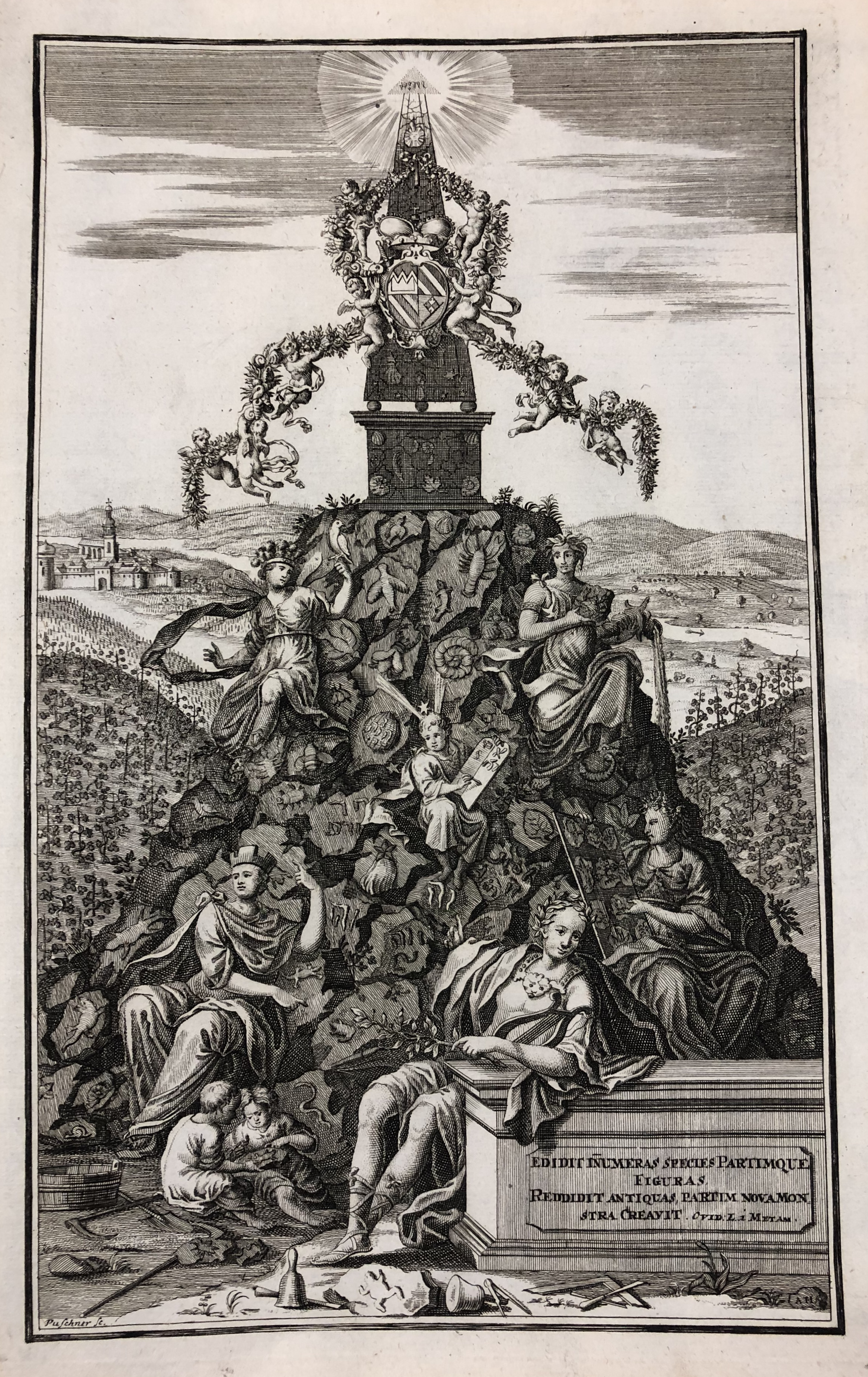
Frontispiece illustration, Beringer’s Lithographia (1740). Contributed in BHL from Smithsonian Libraries.

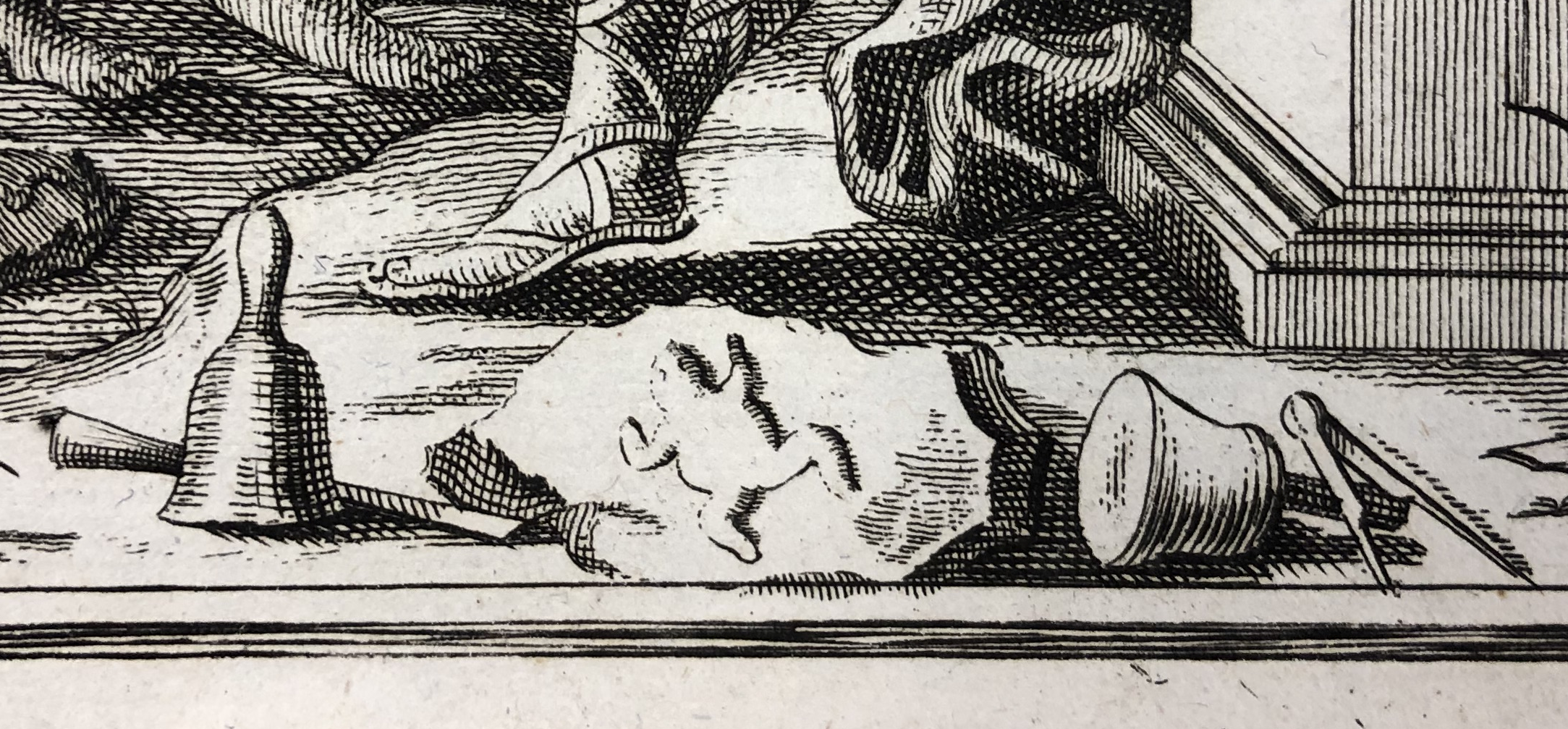
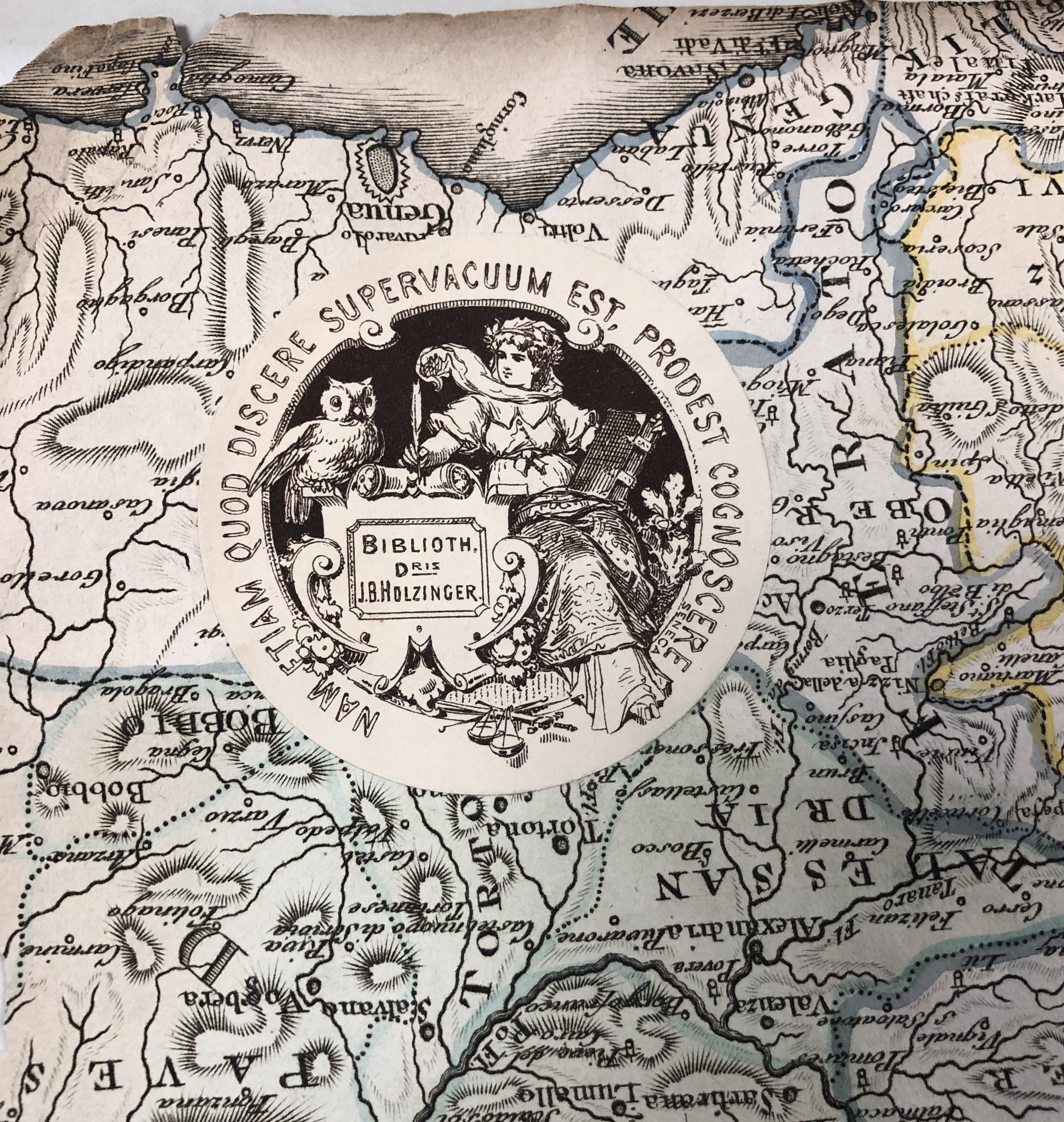
The end of Beringer’s story is just the beginning for the Smithsonian Libraries’ copy of the Lithographia. It is housed in our Joseph F. Cullman 3rd Library of Natural History, and is somewhat of a bibliographic curiosity. While the title page of our copy claims it is the second edition, it is actually the second issue, incorporating the recalled sheets from the first printing. It is speculated that one of Beringer’s sons is responsible for this re-issue, perhaps to recoup some of the costs from their father’s failed effort.[18] Curiously, it lacks any sort of permanent binding, although material evidence of former binding structures suggests it had one in the past. Instead, it is loosely glued together with a scrap of a German map of Sardinia and Piedmont dated 1793. It further features its frontispiece bound in with the plates. The frontispiece is a work of art in itself, depicting the Roman poet Ovid in repose, gesturing to a mountain composed of Beringer’s figured stones as cherubs and other symbolic figures look on. In the foreground sits one of the stones surrounded by carving tools, meant by Beringer to be a nod to the divine hands that crafted them, but more ironically representative of Roderick and Eckhart’s deceit.

Detail of a fake fossil and excavation tools in a frontispiece illustration from a rare book.

Detail, Frontispiece illustration, Beringer’s Lithographia (1740). Contributed in BHL from Smithsonian Libraries.

Before coming to the Cullman, this copy of the Lithographia belonged to Austrian lawyer and botanist[19] Josef Bonaventura Holzinger (1835-1912). Holzinger was an avid antiquarian book collector with a distinctive bookplate, and the Cullman also holds another item from his collection, Euricius Cordus’ 1534 Botanologicon. But the Lithographia has a closer Smithsonian connection: it was most recently owned by Dr. Norman F. Sohl, a scientist with the United States Geological Survey. Dr. Sohl was an invertebrate paleontologist particularly interested in mollusks, and collected numerous fossil specimens that are still housed in the National Museum of Natural History. The Smithsonian Institution Archives also holds two boxes of Dr. Sohl’s papers.[20] Despite the fact that the items described in the Lithographia are known to be fakes, it is clear that the work is valuable to collectors in the field.
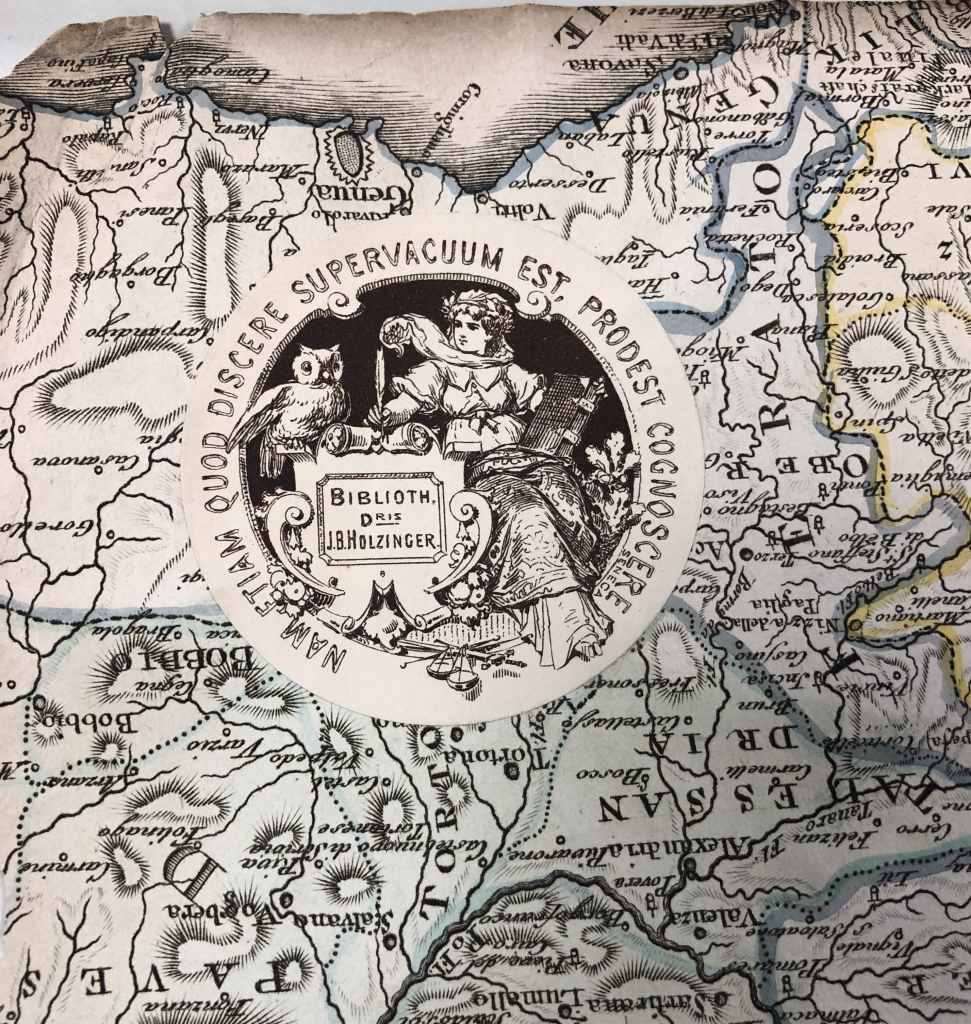
Holzinger’s bookplate

Holzinger’s bookplate from the Cullman copy of Beringer’s Lithographia (1740). Contributed in BHL from Smithsonian Libraries.

While Beringer and the Lithographia are now best remembered for the deception associated with them, his work is actually an important benchmark in the history of paleontology. As Melvin E. Jahn and Daniel J. Woolf describe in their 1963 work The Lying Stones of Dr. Johann Bartholomew Adam Beringer, the period in which the Lithographia was published was a time of seismic changes in how fossils and their origins were understood.[21] The very fact that Beringer presented numerous theories for the formation of his stones is indicative of how the science of the time was in flux. The Lithographia then is more than a reputation-shattering hoax, and is instead a window into paleontological thought of the 18th century. Its second issue is a precious survivor of a time before science was certain about fossils, and shows a crossroads between the theory that fossils were distributed in Great Flood of the Old Testament and the theory that the world is old enough to have changed dramatically over the ages.

References

[1] Melvin E. Jahn and Daniel J. Woolf, The Lying Stones of Dr. Johann Bartholomew Adam Beringer, Berkeley and Los Angeles: University of California Press, 1963. 3.

[2] Charles Coulston Gillispie, Dictionary of Scientific Biography, vol. 2, New York: Charles Scribner’s Sons, 1970. 15.

[3] Jahn and Woolf, 137.

[4] Gillispie, 15.

[5] Melvin E. Jahn, “Dr. Beringer and the Wurzburg ‘Lugensteine’,” Journal of the Society for the Bibliography of Natural History, vol. 4 (Jan. 1963). 143. https://www.euppublishing.com/doi/pdfplus/10.3366/jsbnh.1963.4.2.138

[6] Jahn and Woolf, 133.

[7] Johann Bartholomäus Adam Beringer, Lithographia Wirceburgensis : ducentis lapidum figuratorum, Frankfurt: Tobiam Goebhardt, 1767. 4.

[8] Beringer, 6.

[9] Beringer, 70.

[10] Beringer, 44.

[11] Jahn and Woolf, 129.

[12] Beringer, 80.

[13] Gillispie, 15.

[14] For a full record of the court proceedings, see Jahn and Woolf, 130-139.

[15] Jahn and Woolf, 139-140.

[16] Jahn, 144.

[17] Jahn and Woolf, 128.

[18] Gillispie, 16.

[19] As described in the University of Glasgow Library’s catalog record for a book once part of his collection, a c. 1483 edition of the Secreta Mulierum et Virorum of Psuedo-Albertus Magnus: https://www.gla.ac.uk/myglasgow/incunabula/a-zofauthorsa-j/albertusmagnuspseudo-secretamulierumetvirorumcumcommentostrassburgca1483/

[20] Accession 88-113. Find their record here: https://siarchives.si.edu/collections/siris_arc_229400

[21] 5.

August 8, 2019by Joel Richard

Help Support BHL

BHL's existence depends on the financial support of its patrons. Help us keep this free resource alive!

search

About BHL

The Biodiversity Heritage Library (BHL) is the world’s largest open access digital library for biodiversity literature and archives. BHL operates as a worldwide consortium of natural history, botanical, research, and national libraries working together to digitize the natural history literature held in their collections and make it freely available for open access as part of a global “biodiversity community.”

Join Our Mailing List

Sign up to receive the latest news, content highlights, and promotions.

Subscribe Now

Subscribe to Blog via Email

Enter your email address to subscribe to this blog and receive notifications of new posts by email.

Join 319 other subscribers

Subscribe to Blog Via RSS

Subscribe to the blog RSS feed to stay up-to-date on all the latest BHL posts.

Access RSS Feed

Inspiring Discovery through Free Access to Biodiversity Knowledge.

The Biodiversity Heritage Library makes it easier than ever for you to access the information you need to study and explore life on Earth…for free, anytime, anywhere.


64+ Million Pages of
Biodiversity Literature Online.

EXPLORE

Tools and Services
to Transform Research.

EXPLORE

300,000+
Illustrations on Flickr.

EXPLORE

ABOUT | HARMFUL CONTENT | PRIVACY | SITE MAP | TERMS OF USE