
Biodiversity Heritage Library - Program news and collection highlights from BHL
  • Home
  • News
  • Featured Books
    • All Featured Books
    • Book of the Month Series
    • BHL at 20
  • User Stories
  • Campaigns
    • Fossil Stories
    • Garden Stories
    • Monsters Are Real
    • Page Frights
    • Her Natural History
    • Earth Optimism 2020
  • Tech Blog
  • Visit BHL
Home
News
Featured Books
    All Featured Books
    Book of the Month Series
    BHL at 20
User Stories
Campaigns
    Fossil Stories
    Garden Stories
    Monsters Are Real
    Page Frights
    Her Natural History
    Earth Optimism 2020
Tech Blog
Visit BHL
  • Home
  • News
  • Featured Books
    • All Featured Books
    • Book of the Month Series
    • BHL at 20
  • User Stories
  • Campaigns
    • Fossil Stories
    • Garden Stories
    • Monsters Are Real
    • Page Frights
    • Her Natural History
    • Earth Optimism 2020
  • Tech Blog
  • Visit BHL
Biodiversity Heritage Library - Program news and collection highlights from BHL
BHL News, Blog Reel

BHL Australia Turns 10!

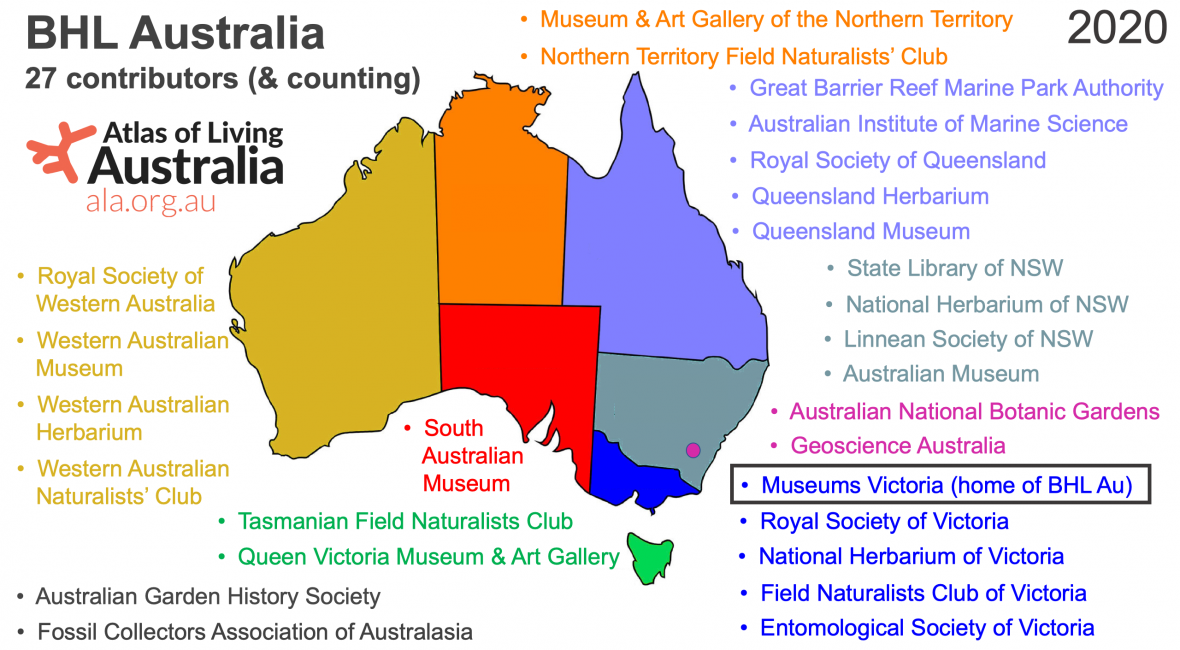
map of australia with BHL Australia contributors highlighted

Ten years ago in June 2010, the Atlas of Living Australia and Museums Victoria signed an agreement with the Biodiversity Heritage Library – and BHL Australia was born.

Signing of BHL agreement.jpg

Dr. Mark Lonsdale (left), the then Chief of the Commonwealth Scientific and Industrial Research Organisation’s (CSIRO’s) Entomology Division, and Martin Kalfatovic (right), BHL Program Director, signing the Relationship Agreement between the Atlas of Living Australia, Museums Victoria and BHL. Image sourced from Martin Kalfatovic.

BHL Australia’s mission is to make Australia’s biodiversity literature freely accessible and discoverable. Ten years ago, we started with a single contributing organisation, Museums Victoria, and a team of five incredibly dedicated volunteers.

Over the past 10 years, BHL Australia has grown considerably. Our operation is still hosted by Museums Victoria (at the Melbourne Museum), but we now digitise literature (and ingest born-digital material) on behalf of 27 organisations across the country.

map of australia with BHL Australia contributors highlighted

We are now a truly national project, representing Australia’s state and territory museums, herbaria, royal societies and field naturalists clubs, as well as government agencies and natural history publishers. Together these organisations have contributed more than 350,000 pages from over 2,400 volumes.
Ely with scanner.jpg

Dr. Elycia Wallis, Project Lead for BHL Australia at the Atlas of Living Australia, with our Zeutschel 16000 Book Scanner, purchased in 2017. Photo Credit: Nicole Kearney.

These volumes include treasures such as George Shaw’s The Naturalist’s Miscellany (1789-1813), Helena Forde and Harriet Scott’s Australian lepidoptera and their transformations, drawn from the life (1890-1898) and John Gould’s A synopsis of the birds of Australia, and the adjacent Islands (1837).

BHL Australia has also uploaded an extensive list of journals onto BHL (they may not be as pretty, but they’re just as important). To peruse all 2,400+ volumes, see our full BHL Australia Collection.

Shaw's Platypus resized.jpg

The Naturalist’s Miscellany includes the first published scientific description and illustration of the Duck-billed Platypus (Ornithorhynchus anatinus). Shaw, George. The Naturalist’s Miscellany. Volume 10. 1799. Contributed to  BHL by Museums Victoria. DOI: https://doi.org/10.5962/p.304567. 

Our volunteer team has also grown since 2010; BHL Australia now has 15 amazing volunteers who do the majority of our scanning, cropping, image processing and metadata addition work, as well as three science communication volunteers. (You may have seen their hugely successful takeover of the BHL Instagram account during #BirdWeek last year.)

Tiziana cropped.PNG

BHL Australia volunteer, Tiziana Tizian, cropping page images in preparation for upload onto BHL. Photo Credit: Nicole Kearney.

Of course, like so many other digitisation operations around the globe, BHL Australia is now in lockdown (and has been since mid-March). But out of adversity comes opportunity. While in lockdown, we’ve switched our focus from physical to born-digital material. We’ve welcomed new contributors and have uploaded journal volumes published as recently as 2020. We’ve also started a major project (in collaboration with BHL superuser Rod Page) to upload article metadata for every Australian journal on BHL (we’re pretty obsessed with discoverability).

Records of WAM.png

The Records of the Western Australian Museum is now complete on BHL from 1910 to 2019 as a result of our efforts (during our COVID-19 lockdown) to upload born-digital material from Australia’s journals.

And, like so many others, we’ve also had to postpone our celebrations. We had planned to invite all our Australian contributors and volunteers to a big BHL birthday bash. That’s on hold for now, but in the meantime, here are our BHL staff — Cerise, Chris, Veronica and myself — waving our thanks to all those who support BHL Australia. To our volunteers, our contributors, the Atlas of Living Australia and our BHL community around the world — thank you for a wonderful 10 years!

BHL staff waving for volunteers

The BHL Australia team: Manager Nicole Kearney (top right); Digitisation Coordinators Veronica Scholes (top left) and Cerise Howard (bottom right); and Technician Chris Healey (bottom left).

June 30, 2020by Joel Richard
Blog Reel, Campaigns, Earth Optimism 2020

George Washington Carver: Strengthening Society with Conservation Through Agriculture

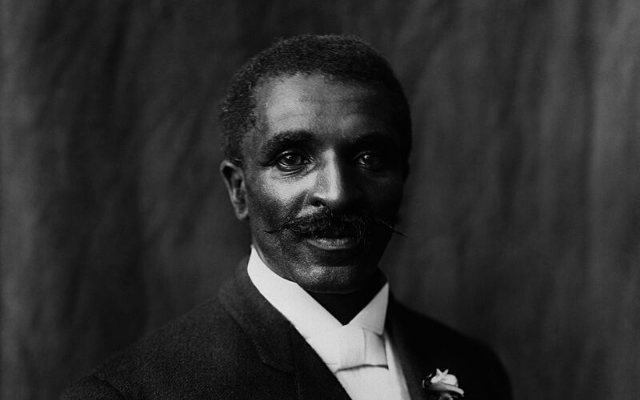
Black and white photograph of a man with short hair and a mustache in a suit

April 2020 marks the 50th anniversary of Earth Day. Organizations around the world have commemorated the occasion by participating in the global Earth Optimism movement — an initiative spearheaded by the Smithsonian to “turn the conservation conversation from doom and gloom to optimism and opportunity”.

Throughout 2020, the Biodiversity Heritage Library (BHL) and our partners are joining the movement by sharing conservation success stories from and made possible by the BHL collection. Follow our blog for conservation stories — past and present — and visit our website for more information and to explore our Earth Optimism book collection.

———————

Photo of George Washington Carver by Frances Benjamin Johnston

Photo of George Washington Carver by Frances Benjamin Johnston, Wikimedia Commons, Public Domain.

“‘When I touch that flower,’ he said softly, ‘I am not merely touching that flower. I am touching infinity. That little flower existed long before there were human beings on this earth. It will continue to exist for thousands, yes, millions of years to come.”‘

— George Washington Carver, as quoted in The man who talks with the flowers; the intimate life story of Dr. George Washington Carver (Clark, 1939)

Taraxacum officinale -Dandelion, after Strasburger, Schenck, Schimper, Biodiversity Heritage Library.

Carver, George Washington. Nature’s Garden for Victory and Peace. 1942. Contributed in BHL by U.S. Department of Agriculture, National Agricultural Library.

Widely known as the “Peanut Man”, George Washington Carver is a famous historical figure in the world of agriculture. His work with peanuts is the first thing many learn about him in grade school, and indeed he popularized an underused versatile legume. He also worked extensively with sweet potatoes, soybeans, tomatoes, and much more. However, he sought to do more than highlight particular foodstuffs. He was interested in creating social change through agriculture, and thoughtfully caring for the soil that would bring about this change. Carver sought to encourage sustainable farming practices, move nature education outside the classroom, and improve the livelihoods and economic security of poor Black farmers in the South. Somewhere in the enticing history of peanut farming we lose the knowledge of his passion for conservation; Carver was instrumental in highlighting the need for agriculture to be intertwined with ecology.

“Unkindness to anything means an injustice done to that thing. If I am unkind to you I do you an injustice, or wrong you in some way. On the other hand, if I try to assist you in every way that I can to make a better citizen and in every way to do my very best for you, I am kind to you.

The above principles apply with equal force to the soil. The farmer whose soil produces less every year, is unkind to it in some way; that is, he is not doing by it what he should; he is robbing it of some substance it must have, and he becomes, therefore, a soil robber rather than a progressive farmer.” (Carver, 1914)

Carver began his studies as the first African American student at the Iowa Agriculture College (now Iowa State University) in 1891. Louis Pammel, Carver’s advisor, was instrumental in shaping Carver’s views on ecology. Pammel felt that ecology was incredibly important to the field of agriculture, particularly the need to achieve agricultural equilibrium between crops and natural species (Hersey, 2011). Carver followed his mentor’s teachings closely and went on to complete his master’s degree in Iowa.  In 1896, Booker T. Washington offered him the role of head of the agriculture department at the Tuskegee Institute. The following year, the state of Alabama established an Agricultural Experiment Station at Tuskegee, the first of its kind at a Black institution.

“When my train left the golden wheat fields and the tall green corn of Iowa for the acres of cotton, nothing but cotton, my heart sank a little…The scraggly cotton grew close up to the cabin doors; a few lonesome collards, the only sign of vegetables; stunted cattle, boney mules; fields and hill sides cracked and scarred with gullies and deep ruts…Not much evidence of scientific farming anywhere. Everything looked hungry: the land, the cotton, the cattle, and the people.” (Carver, 1941)

Though Carver focused his instruction on the relationships between plants, he also looked specifically at how people interact with nature. While at Iowa, he was a member of the Welch Eclectic Society, which focused on strengthening skills in literature, science, and public speaking; in this group he often wrote poetry and performed music (Gart, 2014). He was an advocate of the nature study movement, which tied personal, spiritual, artistic, and observational experience with the natural world. Correlating perspectives of nature with personal responsibility solidifies the importance of conservation. Nature study was often employed at the time to provide primary school children opportunities to work with gardens. Carver also took his adult students out into the natural world to experience what they were learning aesthetically. While at Tuskegee, he served on the board of Nature-Study Review, and also penned Progressive Nature Studies. In it, Carver highlights why he felt so strongly about this kind of study:

“The thoughtful educator realizes that a very large part of the child’s education must be gotten outside of the four walls designated as class room. He also understands that the most effective and lasting education is the one that makes the pupil handle, discuss and familiarize himself with the real things about him, of which the majority are surprisingly ignorant… If properly taught the practical Nature study method cannot fail to both entertain and instruct. It is the only true method that leads up to a clear understanding of the fundamental principles which surround every branch of business in which we may engage. It also stimulates thought, investigation, and encourages originality.” (Carver, 1897)

Title Page: Nature Study and Gardening for Rural Schools by George Washington Carver, Biodiversity Heritage Library, Public Domain

Carver, George Washington. Nature Study and Gardening for Rural Schools. 1910. Contributed in BHL by U.S. Department of Agriculture, National Agricultural Library.

Carver was invested in scientific education and sharing the joy of ecology with people outside of academia as well. He spent a great deal of his time providing short courses for those unable to attend the Institute; both farmers and educators benefited from these opportunities. He spoke widely at state fairs and other public venues, emphasizing that understanding the whole of the natural world, of which crops are a component, is essential to being least harmful to that world.

In some notes on his coursework, Carver defined agriculture as “…the cultivation or the manipulation of the soil in such a way as to bring about the greatest possible yield of products useful to man with the least injury to the soil and at the least expense” (Hersey, 2011). This message was evident in his work, especially as it tied to economic independence for farmers. His very first experimental station bulletin highlighted the use of the acorn as an inexpensive and nutritious food source for livestock; not only were acorns widely available to poor farmers, but also the usage provided the added economic justification for maintaining forests (Carver, 1898). Carver focused on crops that were edible, marketable, and contributed to healthy soil, such as: cowpeas, sweet potatoes, and, of course, peanuts. To this end, he published bulletins highlighting recipes for using readily available ingredients on a family farm.

Recipes of meat alternatives using peanuts by George Washington Carver, Biodiversity Heritage Library, Public Domain.

Carver, George Washington. How to Grow the Peanut, and 105 Ways of Preparing it for Human Consumption. 1916. Contributed in BHL by U.S. Department of Agriculture, National Agricultural Library.

Carver spent a great deal of time studying alternatives for the purposes of improving soil quality and frugality. He was a champion for crop rotation and natural fertilization. “His was in many ways a voice alone, the voice of one calling not in the wilderness—like his more famous contemporaries—but in denuded and depleted fields white with bolls of cotton” (Hersey, p 220). Carver was concerned with reducing erosion of the topsoil, and he highlighted the importance of forest preservation in providing rich nutrients to that topsoil. He persuaded Tuskegee Institute to collect leaves from the trees within its land holdings for use in his work. He advocated more extensive plowing to aerate and mix the soil. He tested and promoted the use of natural fertilizers, arguing for their scientific merits as well as their accessibility to farmers with fewer means to purchase commercial products. He focused on crops that would bring the least damage to the soil while also providing yields to farmers over longer periods of time (Burchard & George Washington Carver National Monument (Mo.), 2005).

Carver did not publish prolifically as is expected in scientific fields, nor did he keep extensive laboratory records. There is some controversy over his scientific achievements as these metrics often require. Additionally, his push for sustainable farming and providing economic independence for Black farmers was unrealized. His ideas flew in the face of the politics and practices of the South where sharecropping was rampant (Kaufman 2019). The poorest farmers were in thrall to their landlords and were only given latitude to diversify crops when cotton prices were low. When it was allowed, most new crops needed attention in the spring and summer, when cotton was demanding. While the early 1900s saw a dramatic increase in Black homeowners in the South, soon after the United States faced the Great Depression and World War I, decreasing those numbers yet again (Hersey, 2011). Though Carver and the Tuskegee Institute attempted to push for better practices by working with white landlords, this understandably caused concern for many of the Black farmers who had been subject to many disreputable landlords over time. Additionally, his colleagues often considered his suggestions and concern over the natural world to be “feminine” and thus outside of the scientific pursuits of the day.

Though many may not initially think of Carver while considering conservation efforts over time, his goal was to marry preservation of the natural world with more accessible and successful farming practices. His ideas were almost prescient considering the more widespread cries that came much later to prevent deforestation for both environmental and agricultural benefits, the focus on organic farming, and the concern of the effect of pollutants from agriculture on the natural world. His influence on conservation may sometimes get lost in the excitement over peanuts, but the BHL contains windows into the complexity of his research and his historical impact on agriculture and conservation.

Check out sources included in this post in the curated BHL Earth Optimism collection.

To see all BHL content by Dr. Carver, see his author profile in BHL.

Works Cited

Burchard, P. D., & George Washington Carver National Monument (Mo.). (2005). George Washington Carver, for his time and ours : special history study : natural history related to George Washington Carver National Monument, Diamond, Missouri. Omaha, Nebraska: National Park Service. Retrieved from: https://www.nps.gov/gwca/learn/management/upload/GWC-For-His-Time-Ours-Spec-History-Study.pdf

Carver, G. W. (1897). Progressive nature studies. Tuskegee, Alabama: Tuskegee Institute Print.

Carver, G. W. (1898). Feeding acorns. Tuskegee, Alabama: Normal School Steam Press.

Carver, G. W. (1910). Nature study and gardening for rural schools. Tuskegee Institute, Alabama: Experiment Station, Tuskegee Normal and Industrial Institute,.

Carver, G. W. (1914). Being Kind to the Soil. The Negro Farmer, p. 1.

Carver, G. W. (1916). How to grow the peanut, and 105 ways of preparing it for human consumption. Tuskegee, Alabama: Tuskegee Institute.

Carver, G. W. (1942). Nature’s garden for victory and peace (Revised and reprinted. ed. Vol. no.43). [Tuskegee]: Tuskegee Institute.

Carver, G. W., “Script for Dr. George W. Carver Broadcast: U. S. Office of Education,” 19 October 1941,

TIA, 46,989 & 62, 151.

Clark, G. (1939). The man who talks with the flowers; the intimate life story of Dr. George Washington Carver. Saint Paul, Minn.: Macalester Park Publishing Co.

Gart, J. (2014). He shall direct thy paths: The early life of George W. Carver, historic resource study George Washington Carver National Monument, Diamond, Missouri. Omaha, Nebraska: National Park Service. Retrieved from:

Hersey, M. D. (2011). My work is that of conservation : an environmental biography of George Washington Carver. Athens: University of Georgia Press.

Kaufman, R. (2019). In Search of George Washington Carver’s True Legacy. Smithsonian Magazine. Retrieved from https://www.smithsonianmag.com/history/search-george-washington-carvers-true-legacy-180971538/.

June 25, 2020by Joel Richard
BHL News, Blog Reel

2020 BHL Annual Meeting — Global and Virtual

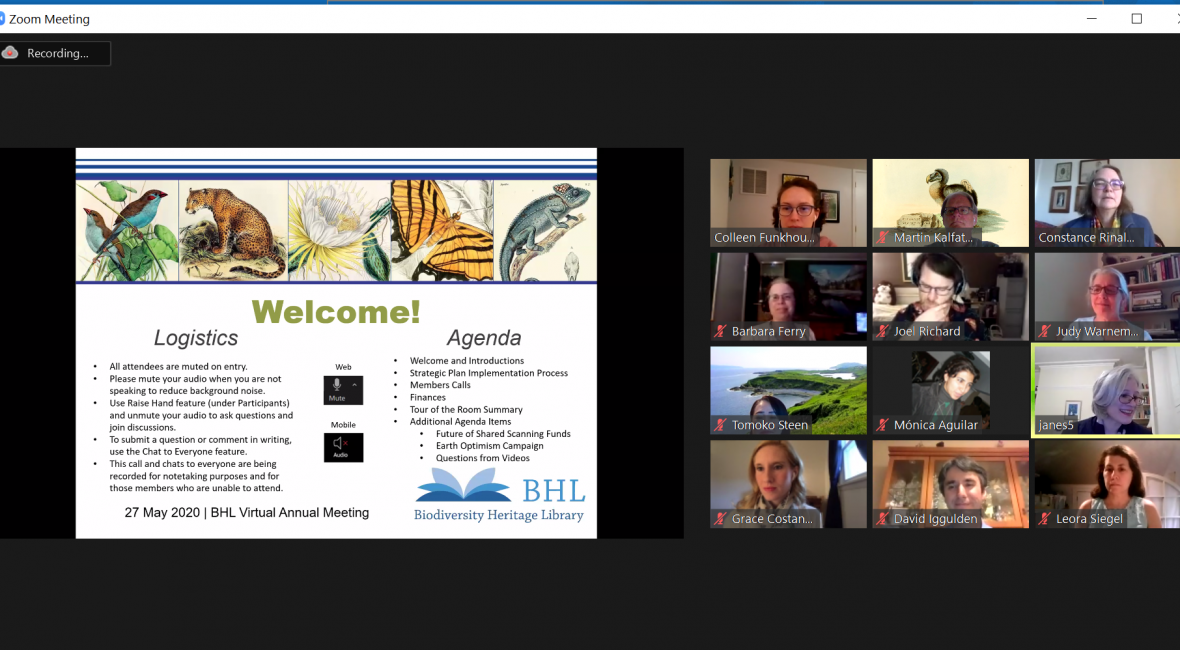
video conference screen showing a collage of people's faces and a welcome slide

The 2020 BHL Annual Meeting went virtual this year. In addition to pre-recorded presentations from the Executive Committee and Secretariat, three video calls with partners were hosted in mid- to late-May. A total of 38 participants joined at least one of the three calls, with 22 joining the third and final call on 27 May 2020.

Like many organizations around the world, the Biodiversity Heritage Library was compelled to move the 2020 BHL Annual Meeting to a virtual environment. In consultation with our prospective 2020 hosts, the Muséum national d’histoire naturelle in Paris, the BHL Executive Committee made the difficult, yet necessary, decision on 11 March 2020 to move to a virtual meeting rescheduled from April to May.

The 2020 BHL Virtual Annual Meeting was conducted over the course of May 2020. The Executive Committee and Secretariat staff provided pre-recorded video presentations which were made available to the BHL partner community in early May. Three video calls were hosted at various time zones in mid- to late-May to allow for the widest participation and the least inconvenience for partners. These three calls brought together 38 participants from 24 institutions and organizations, representing eight countries, and provided an opportunity for interaction and discussion even while separated by (in some cases great) distances. Some participants even came to more than one call!

As BHL Members’ Council Chair Constance Rinaldo noted in her inspiring opening remarks:

“This is BHL’s natural ecosystem, these are our strengths, BHL is virtual, BHL is global, our partners collaborate and are interconnected. BHL is resilient. It makes critical information available thanks to all our partners’ efforts to digitize for open access … Social distancing, collaborating virtually, opening up science. Again, BHL has it covered. In this time, we have the opportunity to leverage BHL’s strengths. The virtualness and interconnectivity we already have allows us to demonstrate our resilience.”

Business Meeting Reports

To accommodate a virtual meeting with a globally dispersed audience, the Executive Committee and Secretariat’s business meeting reports were provided via a series of pre-recorded presentations that participants could watch on their own schedules prior to the business meeting calls.

The series opened with a presentation by Constance Rinaldo (Chair, BHL Members’ Council and Librarian of the Ernst Mayr Library, Harvard University) on the state of the BHL as we enter 2020 (2020: The State of the Biodiversity Heritage Library). Martin R. Kalfatovic (BHL Program Director and Associate Director, Digital Programs and Initiatives Division at Smithsonian Libraries) followed with a report covering BHL’s 2019 program activities, a financial update, and anticipated projects in 2020 (2019 Biodiversity Heritage Library – The Year of the Old Normal).

BHL Secretariat staff Bianca Crowley (BHL Collections Manager) and Grace Costantino (BHL Outreach and Communication Manager) provided respectively a BHL Collection Management Update (Collections Management Overview – Stewarding a River of Content) and a BHL Outreach update (Biodiversity Heritage Library Outreach – Highlights from 2019).

Joining the Annual Meeting for the first time, Joel Richard (BHL Technical Coordinator and Head of Web Services & IT at Smithsonian Libraries) provided an overview of the BHL Tech Team’s work and presented the goals of the 2020 BHL Technical Priorities as determined by the BHL Executive Committee in December 2019 (2020 Technical Priorities).

The series also included a message from incoming BHL Program Manager Colleen Funkhouser, who started her position on 30 March 2020, and some final thoughts from the BHL Executive Committee.

Business Meeting Calls

During the three video calls, participants discussed a variety of business topics, including the strategic plan and implementation process, planning for future Member calls, and feedback from partners on BHL’s strengths and opportunities for improvement. Partners were also encouraged to submit additional agenda items in response to the pre-recorded presentations or other topics for discussion, which the Executive Committee and Secretariat addressed during each call.

Video conferencing screen showing a grid of people's faces in video screens and a welcome slide

Twenty participants joined the second BHL Virtual Annual Meeting call on 26 May 2020.

Strategic Plan and Plan Implementation

Last year, BHL undertook an ambitious, collaborative process to draft its next five-year strategic plan. Development work on the plan successfully involved Members and Affiliates in this process, which was launched in earnest at the 2019 Annual Meeting. After receiving initial feedback from partners at the meeting, working groups were formed to draft each individual goal and related objectives, which were combined and further refined under the Executive Committee’s leadership to create the 2020-2025 BHL Strategic Plan, which was approved by Member vote in April 2020.

The 2020 business meeting calls provided an opportunity to launch the implementation process for the recently-approved strategic plan. On the three video calls, Jane Smith (Vice-Chair, BHL Members’ Council and Head of Library and Archives at the Natural History Museum, London) led the participants through the outline for implementing the new strategic plan. There will be ongoing engagement as the implementation takes shape.

An on-screen poll in a video conference in front of a video feed of a woman's face

Jane Smith (Vice-Chair, BHL Members’ Council and Head of Library and Archives at the Natural History Museum, London) led the participants through the outline for implementing the 2020-2025 strategic plan during the three Virtual Annual Meeting calls. A poll was used to gauge interest in participating in working groups for the various plan goals.

Member Call Planning

David Iggulden (Secretary, BHL Members’ Council and Head of Data & Digital in the Library, Art & Archives at the Royal Botanic Gardens, Kew) led a discussion on changing the frequency, format, and constituency of the current quarterly BHL Member calls. Meeting participants’ input will be evaluated by the Executive Committee and action taken in July to implement changes.

An on-screen poll for a video conferencing call with a grid of people's faces on video screens behind

David Iggulden (Secretary, BHL Members’ Council and Head of Data & Digital in the Library, Art & Archives at the Royal Botanic Gardens, Kew) led a discussion on implementing changes to the BHL Member calls. Polls were used to gather input from participants on each call.

Tour of the Room, Tour of the World

To engage our partners in the vision and future of BHL, a new component of the annual meeting was planned. Partners were given two questions: “Why is BHL important to your institution?” and “What is one thing you would change about BHL to make your participation in the program more relevant?” Written responses were requested ahead of the meeting, with the original plan to conduct a “tour of the room” during the meeting and have partners present their thoughts.

In our virtual environment, this became a “tour of the world” as participants engaged with Constance Rinaldo’s summary of the remarks. This valuable exercise will provide important feedback and guidance as BHL moves forward.

Screenshot from a video conference call showing a slide with "why BHL is important"

Constance Rinaldo (Chair, BHL Members’ Council and Librarian of the Ernst Mayr Library, Harvard University) led the group on a “tour of the room”/ “tour of the world”, sharing partners’ responses to two questions: “Why is BHL important to your institution?” and “What is one thing you would change about BHL to make your participation in the program more relevant?”.

2021 BHL Annual Meeting

While we were not able to travel to Paris this year, the BHL Executive Committee and Secretariat would like to note with much appreciation the excellent planning put in by Gildas Illien (Director of Libraries and Deputy Director of Collections at the Muséum national d’Histoire naturelle, Paris) and his staff, particularly Clément Oury and Chloé Besombes, prior to our move to a virtual environment for 2020. We are also pleased to announce that the Muséum national d’Histoire naturelle has kindly offered to host the 2021 BHL Annual Meeting in Paris. More details on that will come later in the year.

Final Thoughts from the BHL Executive Committee

The BHL Executive Committee closed the meeting with some final thoughts. Jane Smith noted that: “BHL at this time more than ever is a key resource for our staff and visitors who support their scholarship, their teaching, and also citizen science as well as general public interest in the natural world.” David Iggulden reminded us that: “BHL has very much shown how we can provide invaluable remote access to our collections at this time and continue to support research even when physical access is not possible … and now really is the time to remind all your colleagues about BHL and all that they can find there so please help us in spreading the word.”

Video conference all screenshot with three people's faces on screen

The BHL Executive Committee (Top Left: David Iggulden (Secretary); Top Right: Jane Smith (Vice-Chair); Bottom: Constance Rinaldo (Chair)) shared some final thoughts at the conclusion of the pre-recorded BHL Business Meeting reports.

Business Meeting Reports: Links to the PPTs

  • Constance Rinaldo (Chair, BHL Members’ Council and Librarian of the Ernst Mayr Library, Harvard University): 2020: The State of the Biodiversity Heritage Library
  • Martin R. Kalfatovic (BHL Program Director and Associate Director, Digital Programs and Initiatives Division at Smithsonian Libraries):2019 Biodiversity Heritage Library – The Year of the Old Normal
  • Joel Richard (BHL Technical Coordinator and Head of Web Services & IT at Smithsonian Libraries): 2020 Technical Priorities
  • Bianca Crowley (BHL Collections Manager): Collections Management Overview – Stewarding a River of Content
  • Grace Costantino (BHL Outreach and Communication Manager): Biodiversity Heritage Library Outreach – Highlights from 2019
June 16, 2020by

Help Support BHL

BHL's existence depends on the financial support of its patrons. Help us keep this free resource alive!

search

About BHL

The Biodiversity Heritage Library (BHL) is the world’s largest open access digital library for biodiversity literature and archives. BHL operates as a worldwide consortium of natural history, botanical, research, and national libraries working together to digitize the natural history literature held in their collections and make it freely available for open access as part of a global “biodiversity community.”

Join Our Mailing List

Sign up to receive the latest news, content highlights, and promotions.

Subscribe Now

Subscribe to Blog via Email

Enter your email address to subscribe to this blog and receive notifications of new posts by email.

Join 319 other subscribers

Subscribe to Blog Via RSS

Subscribe to the blog RSS feed to stay up-to-date on all the latest BHL posts.

Access RSS Feed

Inspiring Discovery through Free Access to Biodiversity Knowledge.

The Biodiversity Heritage Library makes it easier than ever for you to access the information you need to study and explore life on Earth…for free, anytime, anywhere.


64+ Million Pages of
Biodiversity Literature Online.

EXPLORE

Tools and Services
to Transform Research.

EXPLORE

300,000+
Illustrations on Flickr.

EXPLORE

ABOUT | HARMFUL CONTENT | PRIVACY | SITE MAP | TERMS OF USE