
Biodiversity Heritage Library - Program news and collection highlights from BHL
  • Home
  • News
  • Featured Books
    • All Featured Books
    • Book of the Month Series
    • BHL at 20
  • User Stories
  • Campaigns
    • Fossil Stories
    • Garden Stories
    • Monsters Are Real
    • Page Frights
    • Her Natural History
    • Earth Optimism 2020
  • Tech Blog
  • Visit BHL
Home
News
Featured Books
    All Featured Books
    Book of the Month Series
    BHL at 20
User Stories
Campaigns
    Fossil Stories
    Garden Stories
    Monsters Are Real
    Page Frights
    Her Natural History
    Earth Optimism 2020
Tech Blog
Visit BHL
  • Home
  • News
  • Featured Books
    • All Featured Books
    • Book of the Month Series
    • BHL at 20
  • User Stories
  • Campaigns
    • Fossil Stories
    • Garden Stories
    • Monsters Are Real
    • Page Frights
    • Her Natural History
    • Earth Optimism 2020
  • Tech Blog
  • Visit BHL
Biodiversity Heritage Library - Program news and collection highlights from BHL
Blog Reel, Featured Books

From Poetry to Pulp Fiction: Carnivorous Plants in Popular Culture

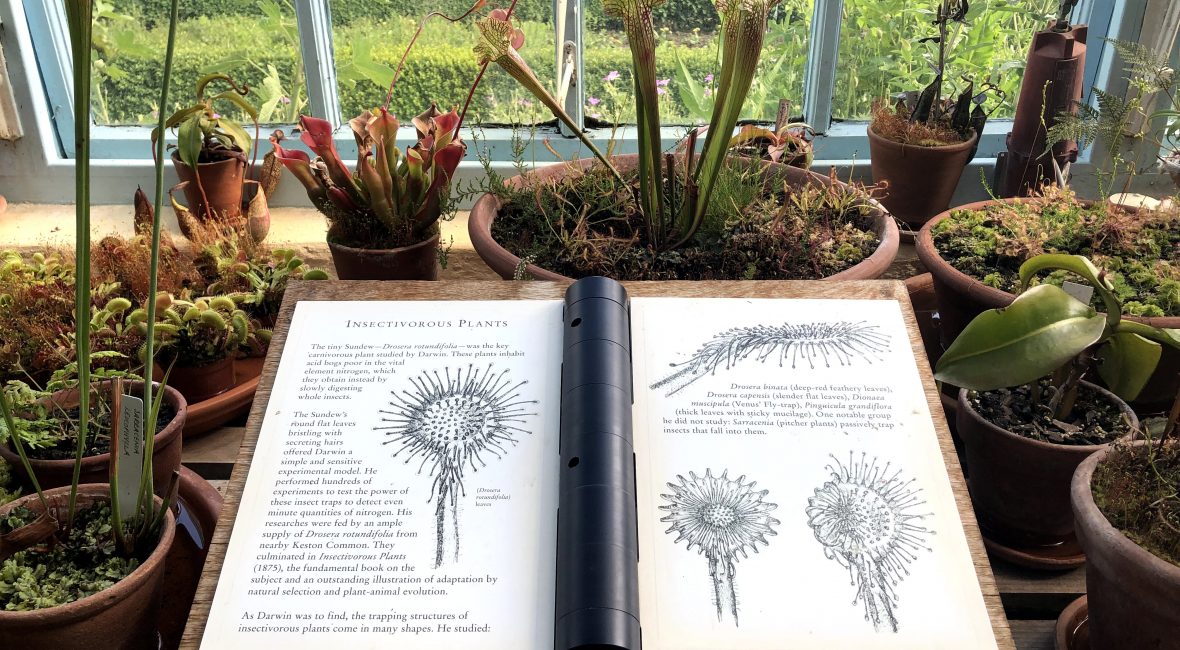
Black and white book open on a table, depicting insectivorous plant sketches and text, surrounded by potted carnivorous plants

Carnivorous plants, beguiling vegetables capable of attracting, trapping, and digesting animal prey, have fascinated generations of botanists on nearly every continent. However, there is perhaps no better way to trace their rise to cultural prominence than through the eyes of the Darwin family. The botanical legacy of Charles Darwin, his grandfather Erasmus, and son Francis, conveys the dramatic shift in how carnivorous plants were perceived by general botanical audiences from the late eighteenth century and into the twentieth. From poetic musings about their carnivorous habits to pulp fiction accounts of man-eating vegetal monsters, the BHL carnivorous plant collection offers a glimpse into the powerful spell these plants have cast over readers and observers through the centuries.

Venus flytrap with some red spike-lined traps open and others closed on insect prey. Cluster of white blossoms.

The Venus flytrap, (Dionaea muscipula). Curtis, William. Curtis’s Botanical Magazine. Vol. 19. Plate No. 785. 1804. Engraving by Sydenham Edwards. Contributed in BHL from the Missouri Botanical Garden, Peter H. Raven Library.

Charles Darwin was enamoured with carnivorous plants. As early as 1859, soon after encountering the sundew Drosera rotundifolia on an English heath, the author of On the Origin of Species wrote, “I care more about Drosera than the origin of all the species in the world” (Darwin Correspondence Project). By September 1860 he was working with Dionaea muscipula as well, and would later dub the Venus flytrap “one of the most wonderful” plants in the world (Darwin 1875, 286). Darwin’s rigorous experimentation with these enigmatic vegetal carnivores culminated in 1875 with the publication of Insectivorous Plants. This treatise laid the framework for the study of plant carnivory as it exists today and cemented the notion of carnivorous plants in the scientific and public imagination.
Drosera rotundifolia on display in Charles Darwin’s greenhouse. Downe, UK. June 22, 2019. Photo credit: John Schaefer.

Black and white book open on a table, depicting insectivorous plant sketches and text, surrounded by potted carnivorous plants

Selected images from Insectivorous Plants on display in Darwin’s greenhouse. Downe, UK. June 22, 2019. Photo credit: John Schaefer.

Yet Charles Darwin was neither the first nor the only one in his family to delight at the Venus flytrap and its murderous cohort. Indeed, his fascination with these plants developed over three generations of philosophical thought and scientific experimentation that included his grandfather and son. The family’s work with carnivorous plants reveals much about the enduring botanical legacy of Erasmus, Charles, and Francis Darwin.

Poetic Botany

The second part of Erasmus Darwin’s poem The Botanic Garden (1789) sought to display the Linnaean sexual system through poetic analogies of plant sexuality and human affairs, accompanied by Erasmus’ own botanical notes and observations. He carefully weaved together mythological and the physiological discussions through poetic prose and technical footnotes, appealing to a broad audience of general readers and botanical experts alike. His stanza on Drosera beautifully illustrates the tone of the work as a whole:

Queen of the marsh, imperial Drosera treads
Rush-fringed banks, and moss-embroider’d beds;
Redundant folds of glossy silk surround
Her slender waist, and trail upon the ground;
Five sister-nymphs collect with graceful ease,
Or spread the floating purple to the breeze;
And five fair youths with duteous love comply
With each soft mandate of her moving eye.
As with sweet grace her snowy neck she bows,
A zone of diamonds trembles round her brows,
Bright shines the silver halo, as she turns;
And, as she steps, the living lustre burns. (Darwin 1791, 24-25)

Erasmus considered the “viscous material” of the Drosera merely a mechanism to prevent “small insects from infesting the leaves,” “[a]s the ear-wax in animals seems to be in part designed to prevent fleas and other insects from getting into their ears” (Darwin 1789, 24). Darwin further relayed in his extensive notes to the reader that “[i]n the Dionaea Muscipula there is a still more wonderful contrivance to prevent the depredations of insects: […] so irritable, that when an insect creeps upon them, they fold up, and crush or pierce it to death” (Darwin 1789, 15). He had witnessed this “irritable” behavior of Dionaea firsthand in August 1788 at Ashburn Hall, Derbyshire, subsequently receiving a colored illustration of the flytrap from Maria Elizabetha Jacson.

Black and white sketch of a Venus flytrap, including open and closed leaves and a cluster of flowers

The Venus flytrap (Dionaea muscipula). Darwin, Erasmus. The Botanic Garden. A Poem in Two Parts. Pt. I Containing the Economy of Vegetation. Pt. 2. the Loves of the Plants. With Philosophical Notes. The third edition. 1791. Engraving by F.P. Nodder. Contributed in BHL from the Wellcome Library (archive.org).

Erasmus Darwin’s conviction that these mechanisms—“curious contrivance[s]” to “prevent various insects from plundering the honey, or devouring the seed”—were a defense against insects is perplexing, placing so much emphasis on the damage a tiny fly could inflict on these plants (Darwin 1789, 15). Was he perhaps allowing poetic metaphors to guide his understanding of biological phenomena? While painting a vivid picture of “The fell SILENE and her sisters fair,” who “[s]kill’d in destruction, spread the viscous snare,” he seemed to present his anthropomorphized botanical actors as righteous wardens rather than scheming hunters (Darwin 1789, 15).

Carnivorous plants continued to assert themselves in poetry and philosophical thought at the turn of the century. Some authors expressed incredulity and wonder at carnivory as such, as did the Irish poet Thomas Moore in Epistles, Odes, and Other Poems (1806): “The Lord deliver us, Think of a vegetable being ‘carnivorous!’” (Moore, 156). Moore’s verse parallels William Bartram’s lively 1791 description, included in his Travels Through North and South Carolina: “But admirable are the properties of the extraordinary Dionaea muscipula! […] carnivorous vegetable!” (Bartram 1791, xiii).

A pitcher plant with pitcher "lid" open and a closed blossom in the foreground. A Venus flytrap with open "traps" and a cluster of white blossoms.

The Venus flytrap (Dionaea muscipula) and yellow pitcher plant (Sarracenia flava). Plate LXI. Thornton, Robert John. New Illustration of the Sexual System of Carolus von Linnaeus: And the Temple of Flora, or Garden of Nature. 1807. Contributed in BHL from the Missouri Botanical Garden, Peter H. Raven Library.

Darwin’s ‘Most Wonderful’ Plants

It was not until 1860, when another Darwin, Charles, began pondering the lethal activities of sundews to make sense of the Venus flytrap and other suspected vegetal carnivores. Over the course of the next decade, he sporadically worked with the Droseraceae. Among those who facilitated his study of these plants were the American naturalist Mary Treat and Sir Joseph Dalton Hooker, Darwin’s close friend and director of Kew Gardens, who supplied him with living specimens. Armed with this network of correspondents and the global resources of Kew, Darwin was able to carry out the investigations of carnivory from his backyard greenhouse in Downe.

Two black and white sketches of open and closed tentacles of the sundew plant, surrounded by descriptive text of the species

The trapping mechanism of the sundew Drosera rotundifolia. Page 10. Darwin, Charles. Insectivorous Plants. 1875. Contributed in BHL from the Royal College of Physicians in Edinburgh by the Wellcome Library (archive.org).

In the early 1870s Darwin’s passion for these plants reached a fever pitch. While focusing mainly on Drosera, he simultaneously studied carnivory in Dionaea, Utricularia, Pinguicula, and Aldrovanda. Meanwhile, Hooker occupied himself with the pitcher plants Nepenthes, Sarracenia, and Cephalotus at Kew. Inspired by a visit to Darwin’s home, Dr. John Burdon-Sanderson, one of the most prominent physiologists of the nineteenth century, was also compelled to investigate the mysterious behavior of Dionaea.

Burdon-Sanderson’s experiments showed that Dionaea’s leaves closed only when unsuspecting prey disturbed the electric current running through the plant, just as animal muscles contract in response to stimulus. Darwin further elucidated the nature of this ingenious trapping mechanism. He realized that the plant had “learned” to determine the prey that was worth capturing. Of the three trigger hairs on each lobe of the leaf, two had to be touched within 20 seconds of each other to trigger the trap. Continuous stimulation would cause the trap to seal shut and begin digesting its prey, while smaller insects could simply slip out and the trap would reset. Part of Darwin’s enduring impact on biology was his work that examined such evolutionary adaptations through various botanical lenses, with carnivorous plants serving as a prime example.

Father and Son

Darwin’s son, Francis, carried on his father’s legacy in a variety of ways, including his own research of plant carnivory. Francis’s passion for carnivorous plants first stemmed from aiding his father in his work on Insectivorous Plants, in which he is credited with illustrating the tiny underwater traps of Aldrovanda and Utricularia. Drosera, however, was the resounding favorite of both father and son. Nearly two-thirds of Insectivorous Plants was dedicated to the sundew. Being privy to his father’s experiments, Francis sought to develop the book’s findings after the first edition was published.

Detractors of Charles Darwin’s carnivorous theory frequently pointed out that so-called carnivorous plants flourished in European hothouses year-round without any insect prey to feed on. Experiments that Darwin carried out while writing Insectivorous Plants sought to address this quandary but failed, as all the plants — fed or not — had died. Francis returned to the subject of his father’s beloved Drosera rotundifolia in June 1877, finding out that the sundews that had been ‘fed’ nearly doubled in seed production and size (Darwin 1878). Since these early experiments, many carnivorous genera have been proven to demonstrate increased size and biomass when the plants had access to insect prey. After his father’s death, Francis went on to publish a revised second edition of Insectivorous Plants in 1888, incorporating new discoveries by himself and others to enhance the scientific understanding of plant carnivory.

Botanical Bestiaries

Parallel to this shift in scientific illustration, an explosion of periodical literature featuring plant carnivory catapulted the Venus flytrap and its fellow vegetal carnivores into the public imagination. Fictional accounts of man-eating plants regularly featured in Anglo-American periodical literature at the end of the nineteenth century, perpetuating pseudo-scientific stories from fictional explorers encountering such horrors as the “Man-Eating Tree” of Madagascar or the “Vampire Vine” of Namibia (Prior 1939, 10-19).

A tree with tentacles for branches entangles a grown man while two men with spears watch in shock

The man-eating tree. Page 476. Buel, James W. Sea and land : an illustrated history of the wonderful and curious things of nature existing before and since the deluge. 1887. Contributed in BHL from University of Connecticut Libraries (archive.org).


A woman is fed to a giant carnivorous plant while men and women with spears and shields look on.

Sacrificed to a man-eating plant. Prior, Sophia. Carnivorous Plants and “the Man Eating Tree.” 1939. Contributed in BHL from the University Library, University of Illinois Urbana Champaign. CC BY-NC-SA 3.0. Rights Holder: Field Museum of Natural History.

Sir Arthur Conan Doyle, the author of Sherlock Holmes, helped jumpstart this craze in 1880 with “The American’s Tale.” First published anonymously in the Christmas special of the London Society magazine, this short story centered around a man killed by a massive Venus flytrap in the Arizona wilderness. The legendary science fiction writer H.G. Wells also wrote of a botanist’s blood-sucking orchid in 1905, laying the foundations for alien man-eating plants featured in musical, film, and television adaptations of Little Shop of Horrors and Day of the Triffids, popular in the twentieth century (Price 2013).

In Conclusion

As countless stunning cultivars are grown commercially to fuel the demanding global plant trade, wild populations of carnivorous plants have become increasingly threatened by habitat destruction, poaching, pollution, and anthropogenic climate change. Nearly half of all carnivorous plants fall under International Union for Conservation of Nature (IUCN) risk categories, ranging from near threatened to critically endangered. Frequently appearing in special exhibitions and displays at botanic gardens around the world, these plants continue to draw the fascination of millions of visitors each year. As legions of individuals have struggled to find a place for them within various social and scientific contexts, carnivorous plants have become firmly established as organisms of towering cultural significance.

Misty view of sundew plants with pink sticky hairs on green leaves. One Venus flytrap leaf hidden among the sundew leaves.

A Venus flytrap (Dionaea muscipula) lurking among a sea of sundews (Drosera capensis). Royal Botanic Garden, Sydney. February 8, 2020. Photo credit: John Schaefer.

The Plant Humanities Initiative at Dumbarton Oaks takes an interdisciplinary approach to understanding the roles of plants in human affairs. This blog series, and the BHL carnivorous plant collection, were created in collaboration with the Plant Humanities Lab – an open access platform developed by Dumbarton Oaks and JSTOR. Find more information on the cultural history of the Venus flytrap and many other plants here.

References and Additional Suggested Reading

Bartram, William, and T. Cander. Travels through North and South Carolina, Georgia, East and West Florida, the Cherokee Country, the Extensive Territories of the Muscogulges or Creek Confederacy, and the Country of the Chactaws : Containing an Account of the Soil and Natural Productions of Those Regions : Together with Observations on the Manners of the Indians : Embellished with Copper-Plates. Philadelphia : Printed by James and Johnson, 1791. https://doi.org/10.5962/bhl.title.109283

Darwin, Charles. Insectivorous Plants. London : J. Murray, 1875. https://doi.org/10.5962/bhl.title.99933

Darwin, Charles, and Francis Darwin. Insectivorous Plants. London : J. Murray, 1888. https://doi.org/10.5962/bhl.title.74

Darwin Correspondence Project, “Letter no. 2996,” accessed on 2 August 2021, https://www.darwinproject.ac.uk/letter/DCP-LETT-2996.xml

Darwin, Erasmus. The Botanic Garden. A Poem in Two Parts. Pt. I Containing the Economy of Vegetation. Pt. 2. the Loves of the Plants. With Philosophical Notes. The third edition. London : Printed for J. Johnson, 1791. https://doi.org/10.5962/bhl.title.143120

Darwin, Francis. Experiments on the Nutrition of Drosera rotundifolia. Botanical Journal of the Linnean Society, 17(98), 17–31, 1878.

Ellis, John, Lockyer Davis, Carl von Linné, and James Roberts. Directions for Bringing over Seeds and Plants, from the East-Indies and Other Distant Countries, in a State of Vegetation : Together with a Catalogue of Such Foreign Plants as Are Worthy of Being Encouraged in Our American Colonies, for the Purposes of Medicine, Agriculture, and Commerce. To Which Is Added, the Figure and Botanical Description of a New Sensitive Plant, Called Dionaea Muscipula: Or, Venus’s Fly-Trap. London : Printed and sold by L. Davis, printer to the Royal Society, opposite Gray’s-Inn, Holborn, 1770. https://doi.org/10.5962/bhl.title.108658

Hooker, Joseph Dalton. Report of the British Association for the Advancement of Science. Vol. 44. London, 1875.https://www.biodiversitylibrary.org/item/94451

Juniper, B. E. The Carnivorous Plants. London ; San Diego: Academic Press, 1989.

Moore, Thomas. Epistles, Odes, and Other Poems. James Carpenter, 1806.

Price, Cheryl Blake. “VEGETABLE MONSTERS: MAN-EATING TREES IN FIN-DE-SIÈCLE FICTION.” Victorian Literature and Culture 41, no. 2 (June 2013): 311–27. https://doi.org/10.1017/S1060150312000411

Prior, Sophia. Carnivorous Plants and “the Man Eating Tree.” Chicago: Field Museum of Natural History, 1939. https://www.biodiversitylibrary.org/item/25206

Recommended Sites

Darwin Correspondence Project

IUCN (International Union for Conservation of Nature) Red List of Threatened Species

International Carnivorous Plants Society (ICPS)

Plant Humanities Initiative

Wikipedia. “Carnivorous Plant.”

October 28, 2021by [email protected]
BHL News, Blog Reel

Acknowledging Harm, Rethinking Collections

BHL Acknowledgment of Harmful Content

The Biodiversity Heritage Library has released an Acknowledgment of Harmful Content to recognize deep prejudices within some of the pages of its collection. As a digital library of natural science publications and archival materials, BHL is a free and open access online resource that primarily reflects the print collections of its contributors. Some of the content in BHL is harmful because it reflects ableist, classist, colonialist, eurocentrist, racist, sexist, xenophobic, and other biased views, especially in descriptions of peoples, lands, and species. The long and, at times, painful history of the scientific record has privileged hegemonic perspectives with the right to print while stifling the voices of the powerless.

Acknowledgment of Harmful Content

The Biodiversity Heritage Library acknowledges the existence of harmful content in many biodiversity science publications and original materials included in its collection. We are reckoning with the, at times, painful heritage of our collection and seeking to address its impact on science and culture today. As a curated digital collection aggregating content from hundreds of providers into a single platform, BHL is a reflection of the historical collection development decisions of those providers as well as the publishing practices and historical colonial processes that have shaped the scholarly record of biodiversity science. Scientific understanding evolves over time, through critical analysis of new information and scrutiny of its mistakes. We recognize that as a free and open access digital library, we simultaneously increase and promote access to materials, some of which espouse deep prejudices that are counterproductive to the advancement of scientific knowledge and overshadow the contributions of marginalized peoples across the globe. At best these views are outdated; at worst, the legacy of natural sciences is unjust and inhumane. The harmful content in BHL’s collection goes against the values of the Biodiversity Heritage Library. It is provided for access as part of the historical record.

BHL joins recent global outcries against racial and environmental injustice. We are assessing our role as a digital library and the responsibility we have to question our neutrality and address harm without reducing access. We are deeply concerned about the continuing crisis of global species loss and the inequitable divisions within our own species. Reflecting on ourselves, we see an organization grappling with inclusion and the acute consequences that these harmful views have on the world and its people today.

Heritage institutions such as the AfricaMuseum, Digital Public Library of America, Royal Botanic Gardens Kew, Trove, and others are also addressing these issues. In general the museum and cultural heritage community is reckoning with our organizations’ past and present, as well as the ways in which our collections, publications, public exhibitions and strategic goals impact society.

Over the course of 2020, BHL rethought the implementation of our strategic plan with the goal to challenge ourselves towards more equitable collection management, technical development, outreach, partnership development, and mission enabling practices. With regard to our collection management objectives going forward, we will be:

  • publishing a collaborative research bibliography to inform new collection management strategies that focus on global challenges including biodiversity loss, systematic racism, and the effects of a worldwide pandemic on scholarly research,
  • identifying and filling gaps in the collection to achieve more complete and inclusive representation of the available knowledge of and perspectives on biodiversity, e.g. including indigenous knowledge,
  • and conducting a comprehensive review and revision of our collection development policy.

If “knowing the past is critical to reforming the present” as Dr. David Silverman suggests [1] then publicly acknowledging the biases in our collection is a first step towards making our collection more inclusive. As a global consortium with a variety of social, cultural, epistemological, and political factors at play, we are unified in our commitment to advancing equity in the global biodiversity community while also maintaining access to the historical record.

Sincere thanks to the Biodiversity Heritage Library Collections Committee for participating in many challenging discussions and writing BHL’s Acknowledgment. In addition, we would like to thank BHL’s Executive Committee, Secretariat, as well as BHL Staff and Partners for their careful consideration and feedback. The Acknowledgment would not have been possible without the thoughtful input of our reviewers including: Lidia Ponce de la Vega, Smithsonian Libraries and Archives Diversity Equity Accessibility and Inclusion (DEAI) Committee, as well as colleagues within our professional networks especially Cornell University Library, MBLWHOI Library and the Woods Hole Diversity Advisory Committee, Muséum national d’Histoire naturelle, and Royal Botanic Gardens Kew.

[1] Silverman, D. (2019, November 18). [This Land Is Their Land] | C-SPAN.org. https://www.c-span.org/video/?466094-1/this-land-land

October 13, 2021by SheilaC7108

Help Support BHL

BHL's existence depends on the financial support of its patrons. Help us keep this free resource alive!

search

About BHL

The Biodiversity Heritage Library (BHL) is the world’s largest open access digital library for biodiversity literature and archives. BHL operates as a worldwide consortium of natural history, botanical, research, and national libraries working together to digitize the natural history literature held in their collections and make it freely available for open access as part of a global “biodiversity community.”

Join Our Mailing List

Sign up to receive the latest news, content highlights, and promotions.

Subscribe Now

Subscribe to Blog via Email

Enter your email address to subscribe to this blog and receive notifications of new posts by email.

Join 319 other subscribers

Subscribe to Blog Via RSS

Subscribe to the blog RSS feed to stay up-to-date on all the latest BHL posts.

Access RSS Feed

Inspiring Discovery through Free Access to Biodiversity Knowledge.

The Biodiversity Heritage Library makes it easier than ever for you to access the information you need to study and explore life on Earth…for free, anytime, anywhere.


64+ Million Pages of
Biodiversity Literature Online.

EXPLORE

Tools and Services
to Transform Research.

EXPLORE

300,000+
Illustrations on Flickr.

EXPLORE

ABOUT | HARMFUL CONTENT | PRIVACY | SITE MAP | TERMS OF USE