Biodiversity Heritage Library - Program news and collection highlights from BHL
  • Home
  • News
  • Featured Books
    • All Featured Books
    • Book of the Month Series
    • BHL at 20
  • User Stories
  • Campaigns
    • Fossil Stories
    • Garden Stories
    • Monsters Are Real
    • Page Frights
    • Her Natural History
    • Earth Optimism 2020
  • Tech Blog
  • Visit BHL
Home
News
Featured Books
    All Featured Books
    Book of the Month Series
    BHL at 20
User Stories
Campaigns
    Fossil Stories
    Garden Stories
    Monsters Are Real
    Page Frights
    Her Natural History
    Earth Optimism 2020
Tech Blog
Visit BHL
  • Home
  • News
  • Featured Books
    • All Featured Books
    • Book of the Month Series
    • BHL at 20
  • User Stories
  • Campaigns
    • Fossil Stories
    • Garden Stories
    • Monsters Are Real
    • Page Frights
    • Her Natural History
    • Earth Optimism 2020
  • Tech Blog
  • Visit BHL
Biodiversity Heritage Library - Program news and collection highlights from BHL
Blog Reel, Featured Books

Rejected to Accepted: E.A.W. Zimmermann’s Geographische Geschichte des Menschen, und der allgemein verbreiteten vierfüßigen Thiere

An historic map on yellowed paper

This post is part of BHL at 20: Treasures from the Biodiversity Heritage Library, a series contributed by members of the BHL community, highlighting remarkable works from across the collection in celebration of its 20th anniversary.

The Field Museum’s Marie Louise Rosenthal Library is fortunate to have a small fund dedicated to the purchase of rare books. As a result, Library staff are often on the lookout for titles that fall within our natural history collecting scope while also meeting the criteria of being both historically valuable and scientifically significant.

In March, I came across an interesting zoological title for sale: Geographische Geschichte des Menschen, und der allgemein verbreiteten vierfüßigen Thiere, nebst einer hieher gehörigen Zoologischen Weltcharte, a three-volume work on biogeography published between 1778 and 1783 by Eberhard August Wilhelm von Zimmermann, a German geographer, zoologist, and mathematician. The work also includes a fold-out map, Tabula Mundi Geographico Zoologica sistens Quadrupedes hucusque notos sedibus suis adscriptos edidit, which has been described as the first world map of zoological geography, illustrating late-eighteenth-century understandings of the global distribution of mammals.

Before purchasing a title for the rare book collection, I evaluate whether it fits the Library’s collecting scope, whether it is scientifically valuable, which institutions hold copies, and whether a digital version is already available in BHL. As I looked into Geographische Geschichte des Menschen und der allgemein verbreiteten vierfüßigen Thiere, I learned that Zimmermann had published an earlier edition in Latin in 1777 under a different title: Specimen zoologiae geographicae, quadrupedum domicilia et migrationes sistens, which is available in BHL.

A subsequent search led me to another BHL resource: Opinions and Declarations Rendered by the International Commission on Zoological Nomenclature (1954). In Opinion 257, the Commission rejected Specimen zoologiae geographicae, quadrupedum domicilia et migrationes sistens for “nomenclatorial purposes.” In short, the 1777 edition did not satisfy the requirements of Article 25 of the Règles internationales de la nomenclature zoologique, the predecessor of today’s International Code of Zoological Nomenclature. The work was consequently placed on the “Official Index of Rejected and Invalid Works in Zoological Nomenclature.”

The yellowed cover of an historic scientific publication with a black border and a library stamp.

The International Commission on Zoological Nomenclature’s 1954 opinion rejecting E.A.W. Zimmermann’s Specimen zoologiae geographicae, quadrupedum domicilia et migrationes sistens (1777) and accepting his later work Geographische Geschichte des Menschen, und der allgemein verbreiteten vierfüßigen Thiere, nebst einer hieher gehörigen Zoologischen Weltcharte (1778–1783).

Even more interestingly, further reading revealed that this opinion had a connection to the Field Museum. The Commission’s ruling stemmed in part from correspondence between Francis Hemming, Secretary of the Commission, and Wilfred H. Osgood of the Field Museum, who advocated for the recognition of Geographische Geschichte. Hemming also consulted Philip Hershkovitz, then Curator of Mammals at the Field Museum, who supported Osgood’s position. (This correspondence is summarized in the published statement of the case.)

Fortunately, the Commission confirmed that binomial nomenclature was applied in Zimmermann’s later publication, and therefore declared Geographische Geschichte des Menschen, und der allgemein verbreiteten vierfüßigen Thiere, nebst einer hieher gehörigen Zoologischen Weltcharte to be included on the “Official List of Works Approved as Available for Zoological Nomenclature.”

It is clear that Zimmermann greatly revised and improved his work in the German edition. Notably, Geographische Geschichte debuted several binomial names that are still attributed to Zimmermann, including Cervus muntjak, Lutra minima (known today as Chironectes minimus), and Canis zerda (known today as Vulpes zerda).

Two pages from historic scientific descriptions in Latin script

In his 1777 edition, Zimmermann failed to consistently apply binomial nomenclature, instead using a combination of generic or descriptive names. For example, in Specimen zoologiae geographicae, Zimmermann refers to a species of dormouse as Glis seu Rattus somnolentus (Left). However, in volume 2 (1780) of Geographische Geschichte, Zimmermann uses the binomial Myoxus glis (right). Today, the species is known as Glis glis.

In addition to the improved nomenclature, Geographische Geschichte also features an updated version of the Tabula mundi geographico zoologica, which incorporates new geographical information derived largely from recent travelers’ reports, including those from Captain James Cook and his crew. For example, the 1783 map reflects Cook’s “discovery” of the Sandwich Islands (Hawaii) and provides a more complete rendering of the western coast of North America. The Seychelles is also named east of mainland Africa, where the French established their colonial settlement just thirteen years prior.

On the fold-out map, names of quadrupeds are plotted directly onto their geographic ranges. Zimmermann’s use of nomenclature varies here. In some instances, he uses the genus alone; in others, the species epithet or full binomen; and, occasionally, a common name. Castor (beaver), for example, appears across northern North America, as does Bison; Tigris (tiger) can be found in Asia; and Kanguro (kangaroo) appears in New Holland (Australia), where the animal was first recorded for European science by Daniel Solander, a botanist aboard Cook’s ship, the HMS Endeavour.
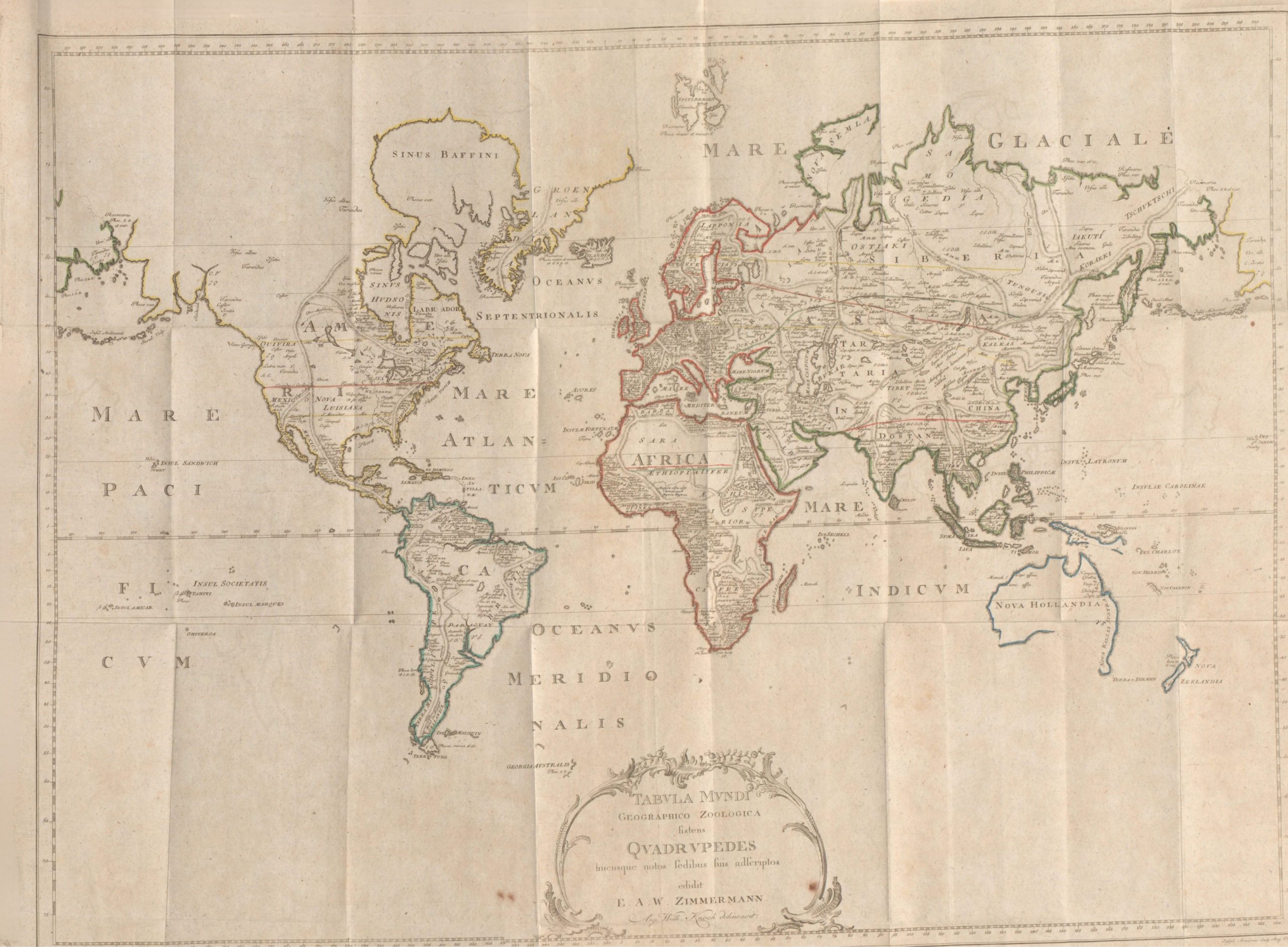
An historic map on yellowed paper

Tabula mundi geographico zoologica sistens quadrupedes(1783) from Zimmermann, Eberhard August Wilhelm von. 1778. Geographische Geschichte des Menschen, und der allgemein verbreiteten vierfüssigen Thiere : nebst einer hieher gehörigen zoologischen Weltcharte. Leipzig: In der Weygandschen Buchhandlung. https://www.biodiversitylibrary.org/bibliography/221536.

Finding the work to be historically important to mammalian biogeography, not widely held nor digitized in BHL, and connected to the Field Museum through its role in securing the work’s recognition for zoological nomenclature, I considered this acquisition an obvious choice.

I’m happy to report that Geographische Geschichte des Menschen, und der allgemein verbreiteten vierfüßigen Thiere, nebst einer hieher gehörigen Zoologischen Weltcharte is now available in BHL. Having access to both this three-volume edition and the rejected 1777 title, alongside the International Commission on Zoological Nomenclature’s ruling, provides a compelling case study in the development of zoological nomenclature, the changing standards by which scientific works are evaluated, and the ways in which new evidence can reshape our understanding of the natural world. As the 1954 ICZN opinion suggests, a work published in the 18th century can continue to have a life in the scientific record and be actively reassessed centuries later.

Further reading

In addition to the sources linked above, I also referred to the following:

Allen, J. A. (1902). Zimmermann’s ‘Zoologiae Geographicae’ and ‘Geographische Geschichte’ considered in relation to their zoological nomenclature. Bulletin of the American Museum of Natural History, 16, 13–22. https://digitallibrary.amnh.org/items/22a3b549-b2a3-4e28-b2aa-7758c85641fe

American Society of Mammalogists. (n.d.). Glis glis (Linnaeus, 1766): European fat dormouse. Mammal Diversity Database. https://www.mammaldiversity.org/taxon/1001506

Delaney, J. (2012). First X, then Y, now Z: Landmark thematic maps. Princeton University Library. https://static-prod.lib.princeton.edu/visual_materials/maps/websites/thematic-maps/contents.html

Lotzof, K. (n.d.). Endeavour 250: Natural history through colonial encounter. Natural History Museum. https://www.nhm.ac.uk/discover/hms-endeavour-250.html

From the Biodiversity Heritage Library

For 20 years, BHL has helped bring works like Zimmermann’s out of rare book collections and into the hands of researchers and readers around the world. With your support, we can continue to preserve, connect, and provide open access to the scientific record – including works whose significance is still being rediscovered centuries later.

Orange button with a heart icon

August 18, 2026by nkearney
BHL News, Blog Reel

BHL Welcomes Two New Members to Its Executive Committee

Announcement text flanked by images of two women.

The Biodiversity Heritage Library is pleased to welcome Amanda Boczar and Leora Siegel to two newly created positions on the Executive Committee of the BHL Members’ Council.

Amanda Boczar has been appointed as BHL’s inaugural Strategic Development Officer, while Leora Siegel joins the Executive Committee as its first Member-at-Large. Both appointments strengthen the Committee’s capacity as BHL enters a new era as an independent, community-governed global consortium.

Expanding BHL’s governance capacity

In June 2026, BHL Members approved the creation of the two new positions to provide additional capacity in areas of growing importance to the consortium, including financial sustainability, fundraising, strategic development, and broader representation across the BHL community.

These appointments come at a pivotal time for BHL. Following its transition to a new distributed operational model and administrative home with the Council on Library and Information Resources (CLIR), the consortium is developing its next strategic plan and building the partnerships, resources, and governance structures needed to support its future.

Because amendments to the BHL Bylaws can only be formally adopted at an Annual Meeting, the two positions are provisional and will be presented for ratification at the 2027 BHL Annual Meeting.

Amanda Boczar, Strategic Development Officer

As Strategic Development Officer, Amanda will provide additional financial oversight and help lead fundraising and development activities on behalf of the Executive Committee. She will work closely with the BHL Secretariat and relevant committees to identify, assess, and respond to grant and funding opportunities.

The position will increase BHL’s capacity to pursue new sources of support and coordinate development priorities as the consortium works towards long-term operational sustainability.

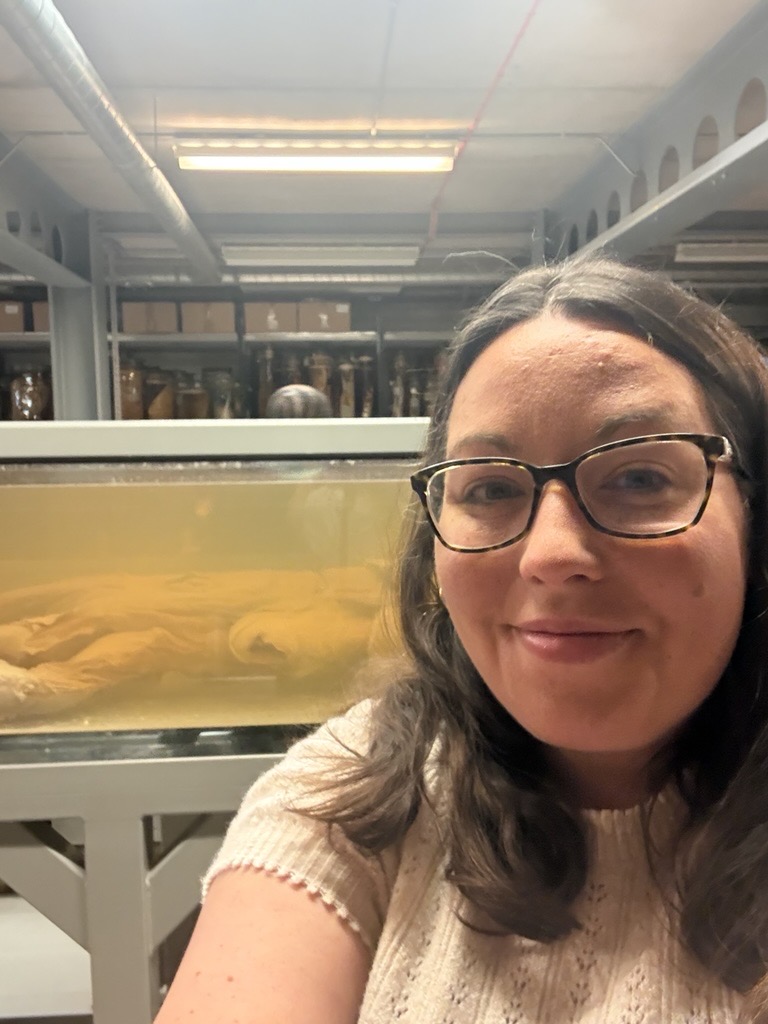
A woman posing in front of a tank filled with mirky liquid and a creature from the deep.

Amanda Boczar at the Natural History Museum, London, with the Giant Squid, during the 2026 BHL Annual Meeting. Selfie by Amanda Boczar.

Amanda is Associate Director of Digital Initiatives at the University of South Florida Libraries, one of BHL’s newest Member institutions. She is already playing an active role in the consortium, co-leading the Collection Development and Discovery strategic planning writing group alongside Emily Benton, Prairie Research Institute Librarian at the University of Illinois Urbana-Champaign.

I have been working with digital collections related to Florida’s environment and natural history since 2020 and have always looked to BHL as a model for global outreach and community. After USF joined BHL as both a member and a strategic partner for its technical infrastructure in January 2026, I knew I wanted to really dive in and make the most of the opportunity. It has been such a privilege to engage with the other members and affiliates, and I am very honored to have been selected for this new role to help sustain the organization for many more years to come.

– Amanda Boczar, Associate Director of Digital Initiatives, University of South Florida Libraries

Leora Siegel, Member-at-Large

The Member-at-Large provides additional support across the Executive Committee’s activities, assists with special projects, and fills gaps where needed.

As the only Executive Committee position open to staff from both BHL Member and Affiliate institutions, this new role creates an important pathway for wider participation in BHL governance. It also provides an opportunity to gain experience on the Executive Committee and potentially move into another elected position in the future.

A smiling woman in a black top standing in a library

Leora Siegel in the Chicago Botanic Garden’s Lenhardt Library. Photo by Donna Herendeen.

Leora is Senior Director of the Lenhardt Library at the Chicago Botanic Garden, a long-standing BHL Affiliate. She brings extensive experience in library leadership, collaborative digital initiatives, and the stewardship of botanical and biodiversity information. In 2024, Leora co-hosted the BHL Annual Meeting in Chicago, welcoming the BHL community to the Chicago Botanic Garden and contributing extensively to the meeting’s program. Leora is also contributing to BHL’s strategic planning as a member of the Operational Sustainability writing group.

Through collaborations with BHL colleagues over the past 10 years as an Affiliate member, and witnessing BHL’s amazing growth and development, I’m honored to serve on the Executive Committee and contribute as BHL becomes fully independent.

– Leora Siegel, Senior Director, Lenhardt Library, Chicago Botanic Garden

Strengthening BHL for its next chapter

Amanda and Leora officially joined the BHL Executive Committee in July. Their appointments expand the range of skills, experience, and perspectives represented on the Executive Committee at this important stage in BHL’s development.

We are delighted to welcome Amanda and Leora to the Executive Committee. Leora will be well known to many in the BHL community and, coming from an Affiliate institution, brings both extensive experience and new perspectives to the Committee. Amanda joins us with a wealth of ideas and previous successes in a role that is vital to BHL’s long-term sustainability. With the expansion of the Executive Committee complete, and the addition of two such capable colleagues, we are now well placed to secure a bright and stable future for BHL.

– Richard Wragg, Vice Chair, BHL Executive Committee and Head of Library and Archives at the Natural History Museum, London

Please join us in welcoming Amanda and Leora to the BHL Executive Committee. We look forward to working with them as BHL builds a strong, sustainable, and collaborative future for open biodiversity knowledge.

August 14, 2026by nkearney
Blog Reel, Featured Books

Pioneers of Illinois Natural History: Stephen A. Forbes and Charles Robertson

This post is part of BHL at 20: Treasures from the Biodiversity Heritage Library, a series contributed by members of the BHL community, highlighting remarkable works from across the collection in celebration of its 20th anniversary.

Introduction

Stephen A. Forbes and Charles Robertson were pioneering scientists whose groundbreaking research continues to influence our understanding of the natural world. Forbes advanced the fields of biology and ecology, while Robertson explored bees and their relationships with flowers and other insects. Their careful observations and influential publications laid important foundations for modern biological and entomological research. Their enduring insights remain valuable to researchers, students, educators, and nature fans alike, connecting historical discoveries with contemporary scientific knowledge of biodiversity and ecological interactions. The University of Illinois Urbana-Champaign Library’s contributions of rare archival materials and publications by Forbes and Robertson are valuable additions to the Biodiversity Heritage Library (BHL), improving access to these records for scientists and historians alike.

Stephen A. Forbes

Stephen Alfred Forbes was born on 29 May 1844. He was a professor of zoology and entomology and a leader in the natural sciences at the University of Illinois Urbana-Champaign. His studies included insects, crustaceans, fishes, and birds – and their relationships to the environment. In 1886, he received the first-class medal of the Société d’Acclimation de France for scientific publications. He was appointed director of the Natural History Survey Division in 1917 and led the organization until his death on 13 March 1930 in Urbana, Illinois.

A black and white portrait photograph of a man with a heavy moustache wearing a suit jacket and a bowtie.

Portrait of Stephen A Forbes from the foreword to “Forbes Biological Station: the past and the promise,” in Illinois Natural History Survey special publication 10 (1989).

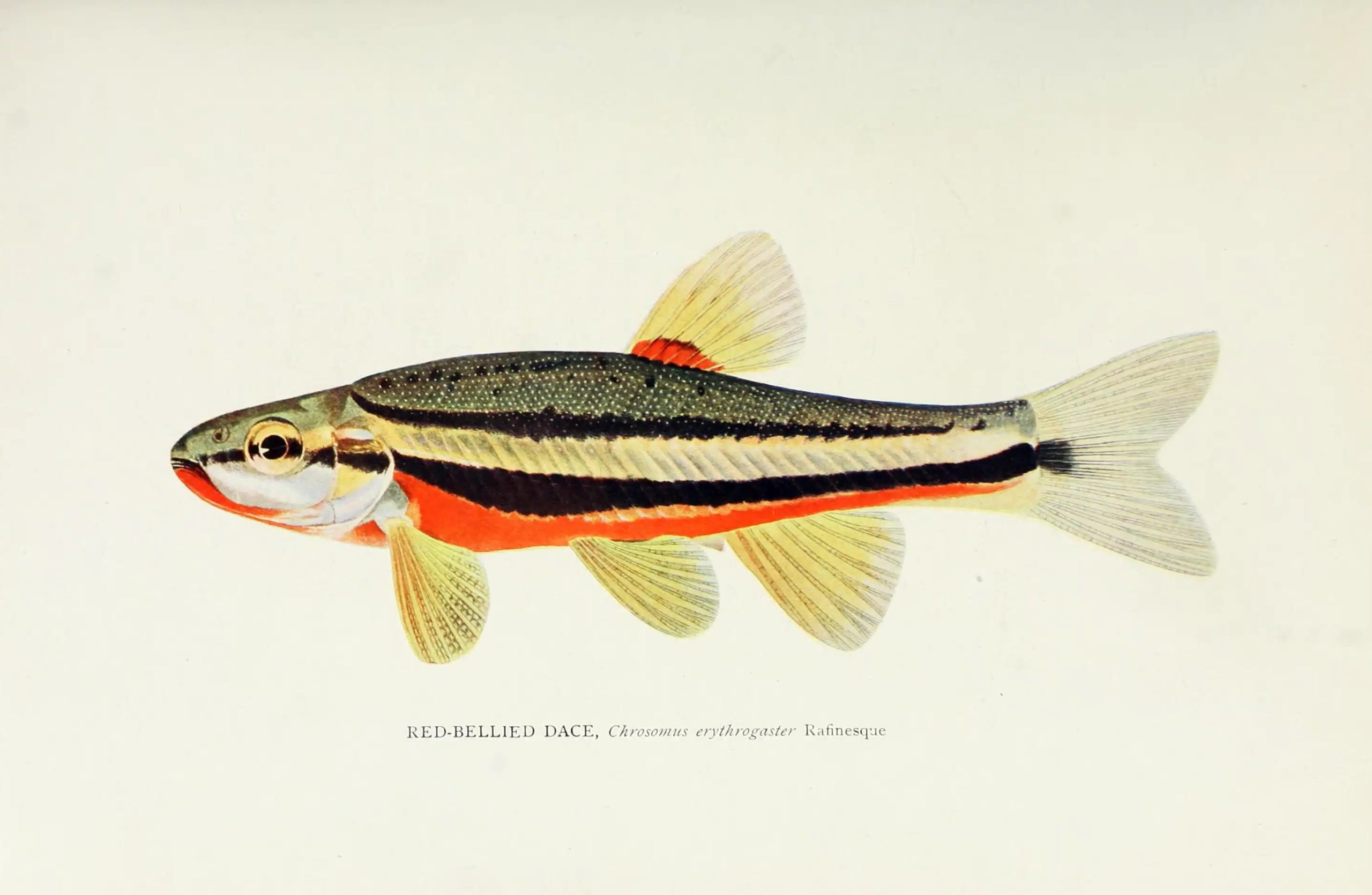
Among Forbes’ most influential works is The Fishes of Illinois, which documents over 150 fish species represented by more than 200,000 specimens collected from 102 Illinois counties. These fish are depicted in richly detailed color paintings by illustrators Lydia M. (Hart) Green and Charlotte M. Pinkerton. You can read more about the lives and work of these women in our previous blog post, written by Susan Braxton. The publication also includes detailed distribution maps, making it a valuable reference for aquatic biodiversity and fisheries research.

An historic illustration of an orange, yellow and brown striped fish.

Illustration of Chrosomus featured in The Fishes of Illinois (1908).

In 1894, he established the Forbes Biological Station and, in 1896, directed the construction of a 48-foot floating biological laboratory at the site on the Illinois River in Havana, Illinois. The Station was specifically created to support continuous scientific investigation. It is no wonder that the Illinois Natural History Survey (INHS) celebrated the 150th anniversary of Forbes’ birth on 26 May 1994.

A black and white photograph of a cabin boat anchored on a river. There are bare trees in the background.

Image of a cabin boat from “Forbes Biological Station: the past and the promise”, in Illinois Natural History Survey Special Publication 10, p. 17 (1989).

Today, Forbes Station is used to advance science and policy in the Illinois River Valley and beyond. It houses the Frank C. Bellrose Waterfowl Research Center, whose research focuses on wetlands, waterfowl, and marsh birds. Today, the Illinois Natural History Survey operates six other field stations: Great Rivers Field Station, Illinois River Biological Station, Kaskaskia Biological Station, Lake Michigan Biological Station, Ridge Lake Biological Station, and Sam Parr Biological Station – all serving researchers from the University of Illinois Urbana-Champaign and across the state. BHL has an extensive collection of these and related publications, chronicling Forbes’ contributions to the understanding of ecology and the foundation of aquatic ecosystem science.

Forbes’ Memorial captures the impact he had on his contemporaries, the University of Illinois, and the state. The University Senate put forth a resolution acknowledging Forbes’ significant contributions:

The Senate knew him as Professor of Zoology and Entomology and Dean of the College of Science; it admired his sagacity and patience as chairman of its Committee on Educational Policy; its members loved him for his simplicity, sincerity and broad human interests. The University and the State are immeasurably indebted to him as one of their most useful and eminent laborers for the common good.

Charles Robertson

Charles Robertson was born on 12 June 1858 in Carlinville, Illinois. He began his academic education at Blackburn College in his hometown and continued his studies in botany and zoology at Harvard University. He returned to Blackburn College as a professor of biology and Greek. His research centered on investigating interactions of insects and flowering plants. Over more than 20 years, Robertson recorded visits by 1,429 pollinating insects (including flies, beetles, butterflies, and bees) to 456 plant species. He was collecting insects in Florida just a few months before his death on 1 June 1935 in Carlinville. His book, Flowers and Insects, published in 1928, presents an intensive study of flower-visiting insects from the city of Carlinville and remains one of the most comprehensive studies conducted in a single locality. Each insect he recorded was associated with the plant on which it was collected.

A black and white portrait of a moustached man in a suit and tie.

Portrait of Charles Robertson from History of Macoupin County, Illinois: Biographical and Pictorial, vol. 2 (1911), edited by Charles A. Walker. Image enhanced using Adobe Photoshop by T. C. McElrath. Source: Wikipedia

His personal life mirrored his work: he was born and died in the same small town, kept few but lasting friendships, and brought the same steady, unhurried patience to his acquaintances that he brought to a lifetime of observing flowers and their visitors.

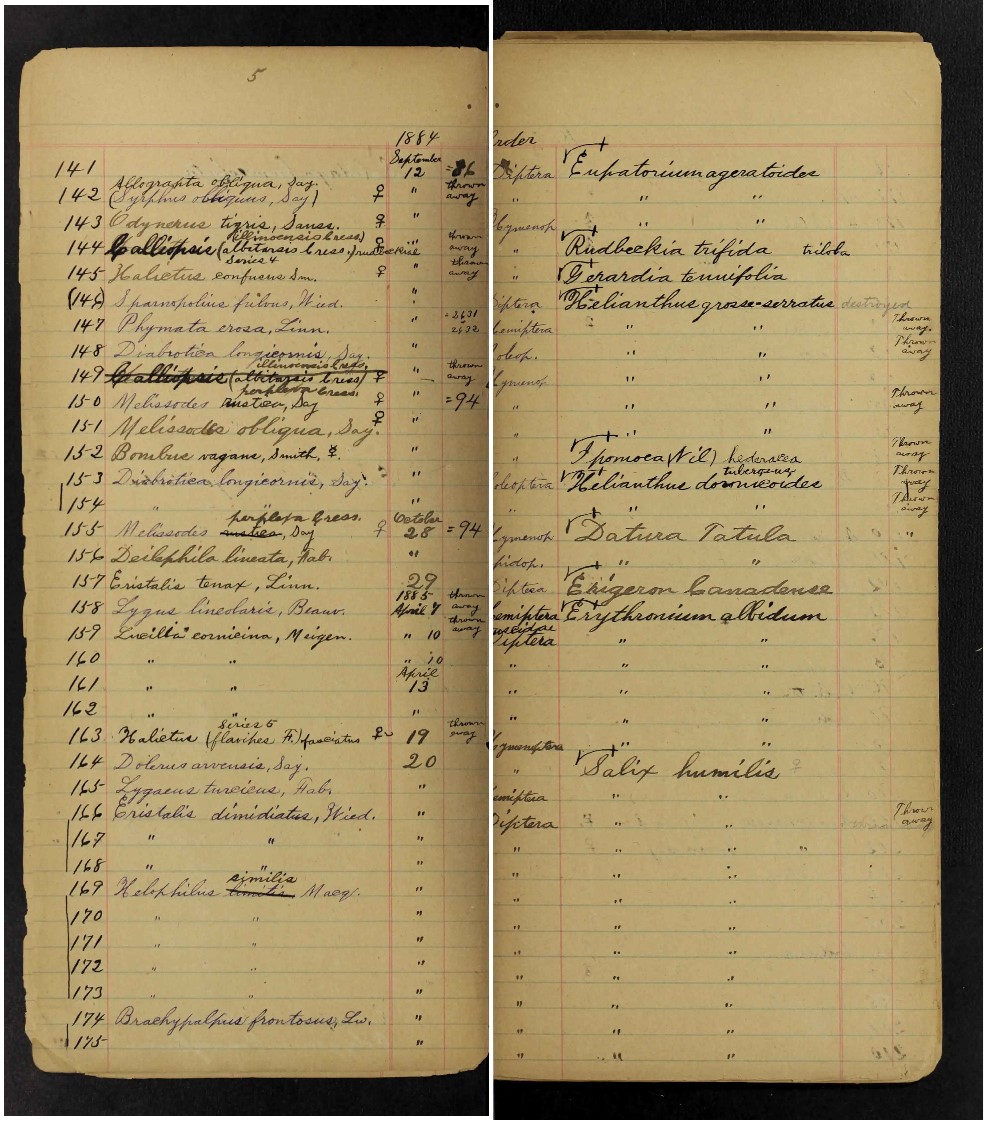
Charles Robertson’s specimen collection logs document insect specimens and include information such as the specimen number, scientific name, sex, date and locality of collection, insect order, and scientific name of the host plant. His collections and correspondence have proved invaluable to researchers. His work was essential to an investigation of species decline in Carlinville, published in Ecology & Society and conducted by John Marlin, a research affiliate with the Illinois Sustainable Technology Center and INHS. A quantitative analysis published in July 2026 in the Data Science Journal highlights the wealth of knowledge contained in his correspondence and collection logs. The logs and most of Robertson’s papers from 1877 to 1935, including correspondence, reprints, five ledgers, and a data book on bee research, are preserved in the University Archives at the University of Illinois Urbana-Champaign. The seminal work Flowers and Insects, as well as his specimen collection logs, is readily available through BHL.

Two side-by-side pages of handwritten logs of scientific observations on lined yellow paper.

Side-by-side images of page 5 of the handwritten Specimen Collection Logs of Charles Robertson, vol. 1, 1884-1886. Images assembled by Kelli Trei.

Conclusion

These collections preserve the irreplaceable life’s work of two Illinois scientists. Forbes’ work remains important today. His holistic view of ecology, examining the relationships between organisms, the environment, and natural-resource industries, has helped shape our current understanding of applied ecology. Robertson’s correspondence and specimen logs represent an irreplaceable record of an ecosystem that can no longer be observed firsthand.

Archival documents such as these reveal the values, culture, and identity that shaped the Illinois Natural History Survey and science in Illinois. Being able to trace the legacy of scientific research and lives of those behind these discoveries provides richer context and understanding for future scientific research. BHL provides a unique juxtaposition between the human experience of doing science, revealed through archival documents, and the official scientific record preserved in books and journal articles. Together, these materials provide a fuller and more inclusive account of the history of science here in Illinois.


From the Biodiversity Heritage Library

For 20 years, BHL has helped preserve and share the scientific record, from landmark publications to the archival materials that illuminate the people, places, and observations behind them. With your support, we can keep treasures like these freely accessible, connecting past research with the scientists, historians, and communities who continue to learn from it today.

Orange button with a heart icon

August 11, 2026by nkearney
Blog Reel

Together, We Saved BHL. Now We Need to Sustain It.

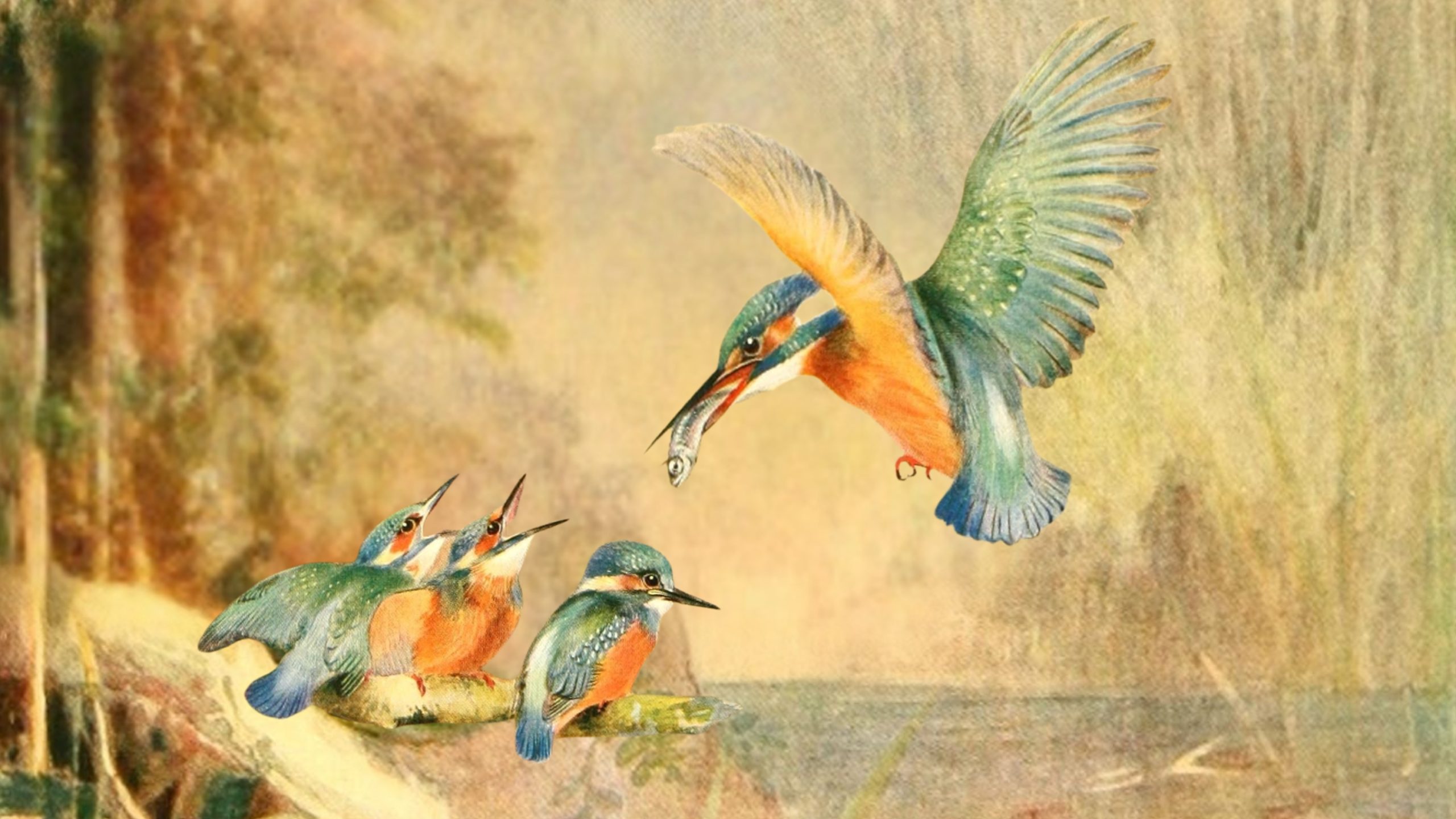
An adult kingfisher holding a fish flying above three chicks

Last year, our community gave BHL wings.

In 2025, the Biodiversity Heritage Library faced a real threat to its existence: the sudden loss of the institutional support on which it had depended, with no guarantee that it could continue. After nearly two decades of support from the Smithsonian Institution, BHL needed to establish a new independent and globally governed future. Staff, services, technical systems, partnerships, governance and funding all had to be secured so that the world’s largest open-access digital library for biodiversity literature and archives could remain free and available to everyone.

Thank you for helping secure BHL’s future

Since BHL launched public fundraising for the transition on 17 October 2025, supporters from 46 countries have contributed more than USD $113,000 to help support BHL’s independent future.

USD $51,000 of that support was given during our #GiveBHLWings campaign, held during the final seven weeks before BHL’s transition to independence on 1 January 2026.

We are profoundly grateful.

Because our community rallied around BHL, staff were retained, services continued, and more than 64 million pages of biodiversity literature and archives remain freely accessible online.

At the end of June 2026, BHL’s formal transition period concluded. The final major piece of the transition was completed in July: moving BHL’s servers and core technical infrastructure from the Smithsonian Institution to the Field Museum in Chicago. BHL now operates through a distributed, partner-supported model, with a new administrative and technical foundation for the future.

Together, we saved BHL. Now we need to sustain it.

🤍 Become a BHL Sustainer


Why monthly support matters

Like these baby kingfishers, BHL needs dependable ongoing support to sustain staff and services, modernize our technical infrastructure, improve access and discoverability, grow and connect collections, and keep biodiversity knowledge open to everyone.

An adult kingfisher holding a fish above three hungry chicks on a log

Kingfisher and young, from Pycraft, W. P., and Roland Green. Birds in Flight. London: Gay & Hancock Limited, 1922. https://doi.org/10.5962/bhl.title.14815. Contributed to BHL by Smithsonian Libraries and Archives.

Monthly gifts are especially valuable because they provide predictable income that keeps BHL running month after month. A monthly gift does not need to be large to make a difference. Regular gifts of every size combine to create a stronger and more stable foundation for BHL.

Become a BHL Sustainer

This month, we are inviting our community to become BHL Sustainers by making a monthly gift.

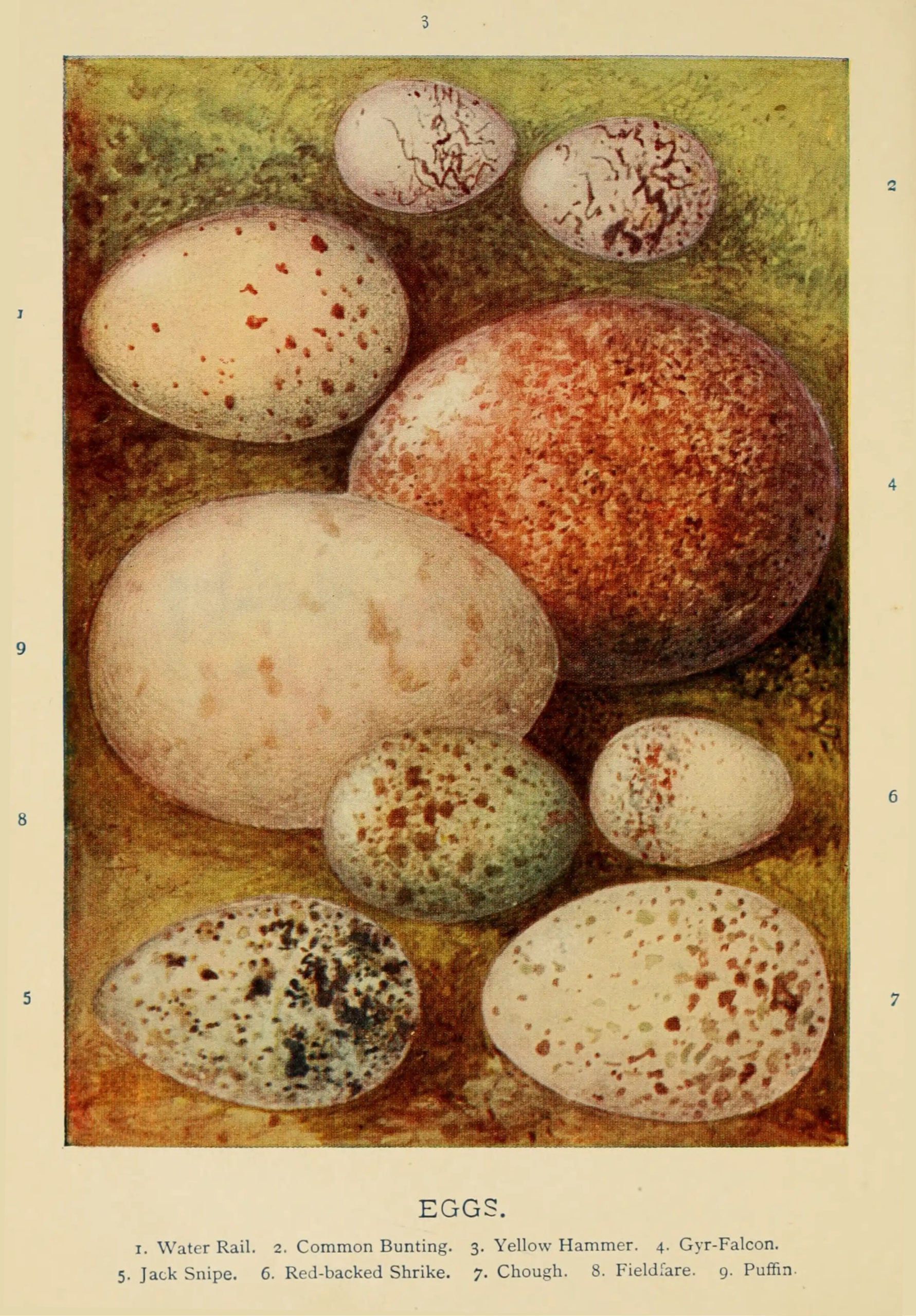
An historic illustration of bird eggs of different sizes and colors

Eggs, from Kearton, Richard. Birds’ Nests, Eggs and Egg-Collecting. London: Cassell, 1896. https://doi.org/10.5962/bhl.title.56067. Contributed to BHL by Smithsonian Libraries and Archives.

Like the eggs illustrated in this historic plate from BHL’s own collections, monthly gifts come in many sizes, and every size matters.

  • USD $5/month – Yellow Hammer-sized: small, but part of something that adds up fast.
  • USD $10/month – Puffin-sized: steady, dependable support, month after month.
  • USD $20/month – Chough-sized: a stronger, ongoing contribution.
  • USD $50/month – Falcon-sized: substantial, sustaining support for the long haul.

These examples are shown in USD, but donations can be made in more than 135 currencies and in whatever amount works for you.

🤍 Become a BHL Sustainer


Every gift helps. Every month matters.

For 20 years, BHL has opened biodiversity literature to the world. It exists because of a global community committed to open access, shared infrastructure, and the belief that biodiversity knowledge should be available to everyone.

Last year, that community gave BHL wings. Now we’re asking you to help us keep flying.

If BHL matters to your work, your collections, your teaching, your research, your art, your writing, or your love of the natural world, please consider becoming a monthly donor today.

You can also support BHL through major gifts, wire transfers, bequests, or other legacy gifts: Ways to Give.

Donations are processed through BHL’s fiscal sponsor, the Council on Library and Information Resources (CLIR). Tax deductibility depends on your country of residence and individual circumstances.

August 5, 2026by nkearney

Help Support BHL

BHL's existence depends on the financial support of its patrons. Help us keep this free resource alive!

search

About BHL

The Biodiversity Heritage Library (BHL) is the world’s largest open access digital library for biodiversity literature and archives. BHL operates as a worldwide consortium of natural history, botanical, research, and national libraries working together to digitize the natural history literature held in their collections and make it freely available for open access as part of a global “biodiversity community.”

Join Our Mailing List

Sign up to receive the latest news, content highlights, and promotions.

Subscribe Now

Subscribe to Blog via Email

Enter your email address to subscribe to this blog and receive notifications of new posts by email.

Join 319 other subscribers

Subscribe to Blog Via RSS

Subscribe to the blog RSS feed to stay up-to-date on all the latest BHL posts.

Access RSS Feed

Inspiring Discovery through Free Access to Biodiversity Knowledge.

The Biodiversity Heritage Library makes it easier than ever for you to access the information you need to study and explore life on Earth…for free, anytime, anywhere.


64+ Million Pages of
Biodiversity Literature Online.

EXPLORE

Tools and Services
to Transform Research.

EXPLORE

300,000+
Illustrations on Flickr.

EXPLORE

ABOUT | HARMFUL CONTENT | PRIVACY | SITE MAP | TERMS OF USE